lock MERCEDES-BENZ SPRINTER 2011 MY11 Operator’s Manual
[x] Cancel search | Manufacturer: MERCEDES-BENZ, Model Year: 2011, Model line: SPRINTER, Model: MERCEDES-BENZ SPRINTER 2011Pages: 292, PDF Size: 6.75 MB
Page 116 of 292
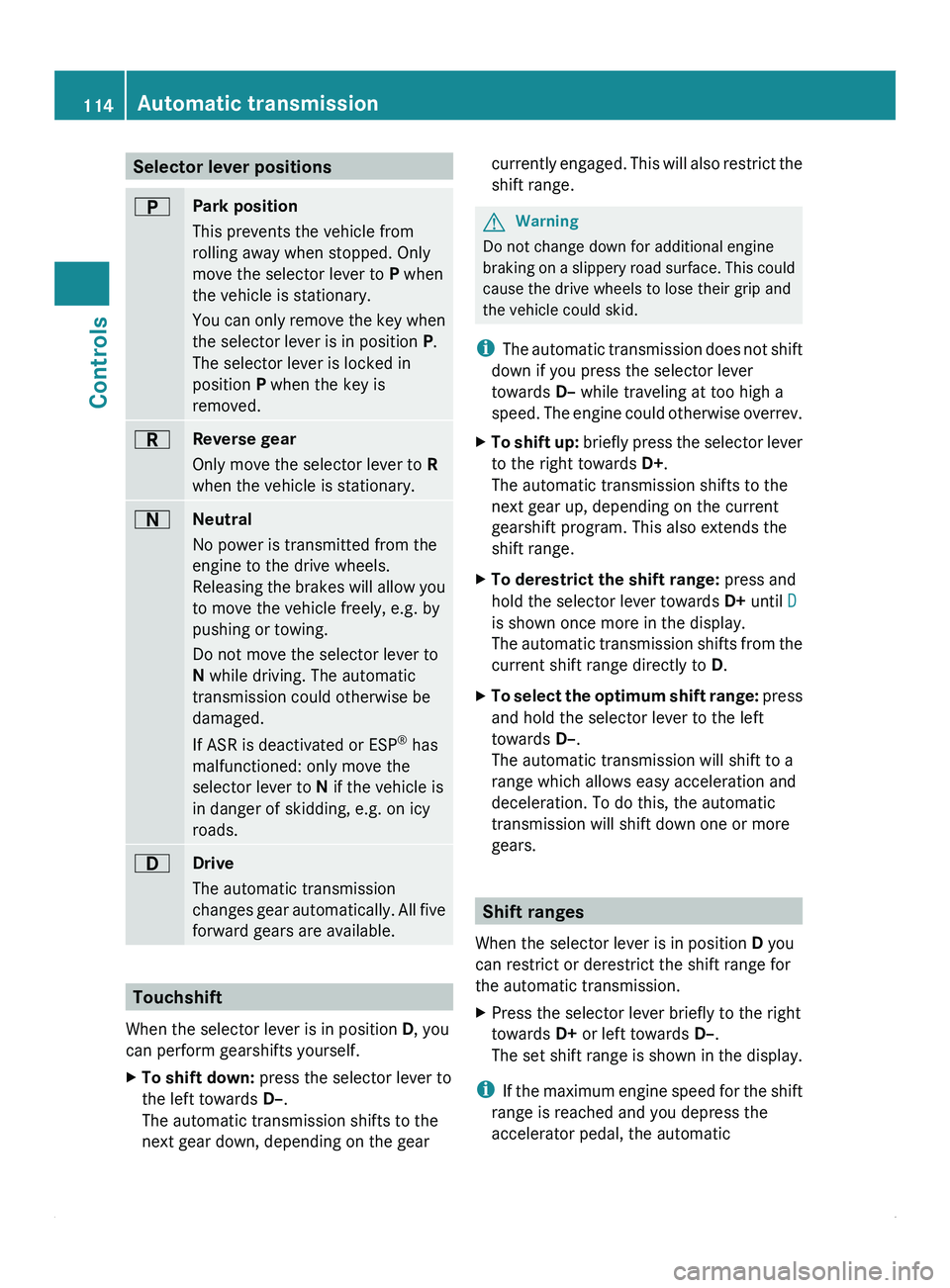
Selector lever positions
0045
Park position
This prevents the vehicle from
rolling away when stopped. Only
move the selector lever to
P when
the vehicle is stationary.
You can only
remove the key when
the selector lever is in position P.
The selector lever is locked in
position P when the key is
removed. 0046
Reverse gear
Only move the selector lever to R
when the vehicle is stationary. 0044
Neutral
No power is transmitted from the
engine to the drive wheels.
Releasing the
brakes
will allow you
to move the vehicle freely, e.g. by
pushing or towing.
Do not move the selector lever to
N while driving. The automatic
transmission could otherwise be
damaged.
If ASR is deactivated or ESP ®
has
malfunctioned: only move the
selector lever to N if the vehicle is
in danger of skidding, e.g. on icy
roads. 003A
Drive
The automatic transmission
changes gear
automatically.
All five
forward gears are available. Touchshift
When the selector lever is in position D
, you
can perform gearshifts yourself.
X To shift down: press the selector lever to
the left towards D–.
The automatic transmission shifts to the
next gear down, depending on the gear currently engaged. This will also restrict the
shift range. G
Warning
Do not change down for additional engine
braking on a
slippery road surface. This could
cause the drive wheels to lose their grip and
the vehicle could skid.
i The automatic transmission does not shift
down if you press the selector lever
towards D– while traveling at too high a
speed. The engine could otherwise overrev.
X To shift up:
briefly press
the selector lever
to the right towards D+.
The automatic transmission shifts to the
next gear up, depending on the current
gearshift program. This also extends the
shift range.
X To derestrict the shift range: press and
hold the selector lever towards D+ until D
is shown once more in the display.
The automatic transmission
shifts from the
current shift range directly to D.
X To select the optimum shift range: press
and hold the selector lever to the left
towards D–
.
The automatic transmission will shift to a
range which allows easy acceleration and
deceleration. To do this, the automatic
transmission will shift down one or more
gears. Shift ranges
When the selector lever is in position D
you
can restrict or derestrict the shift range for
the automatic transmission.
X Press the selector lever briefly to the right
towards D+ or left towards D–.
The set shift
range is shown in the display.
i If the maximum
engine speed for the shift
range is reached and you depress the
accelerator pedal, the automatic 114
Automatic transmission
Controls
Page 122 of 292
immediate surroundings when parking and
maneuvering. You could otherwise endanger
yourself and others.
G
Warning
Make sure that no persons or animals are in
the maneuvering range. Otherwise, they
could be injured.
PARKTRONIC is an electronic parking aid.
PARKTRONIC indicates visually and audibly
the distance between your vehicle and an
object.
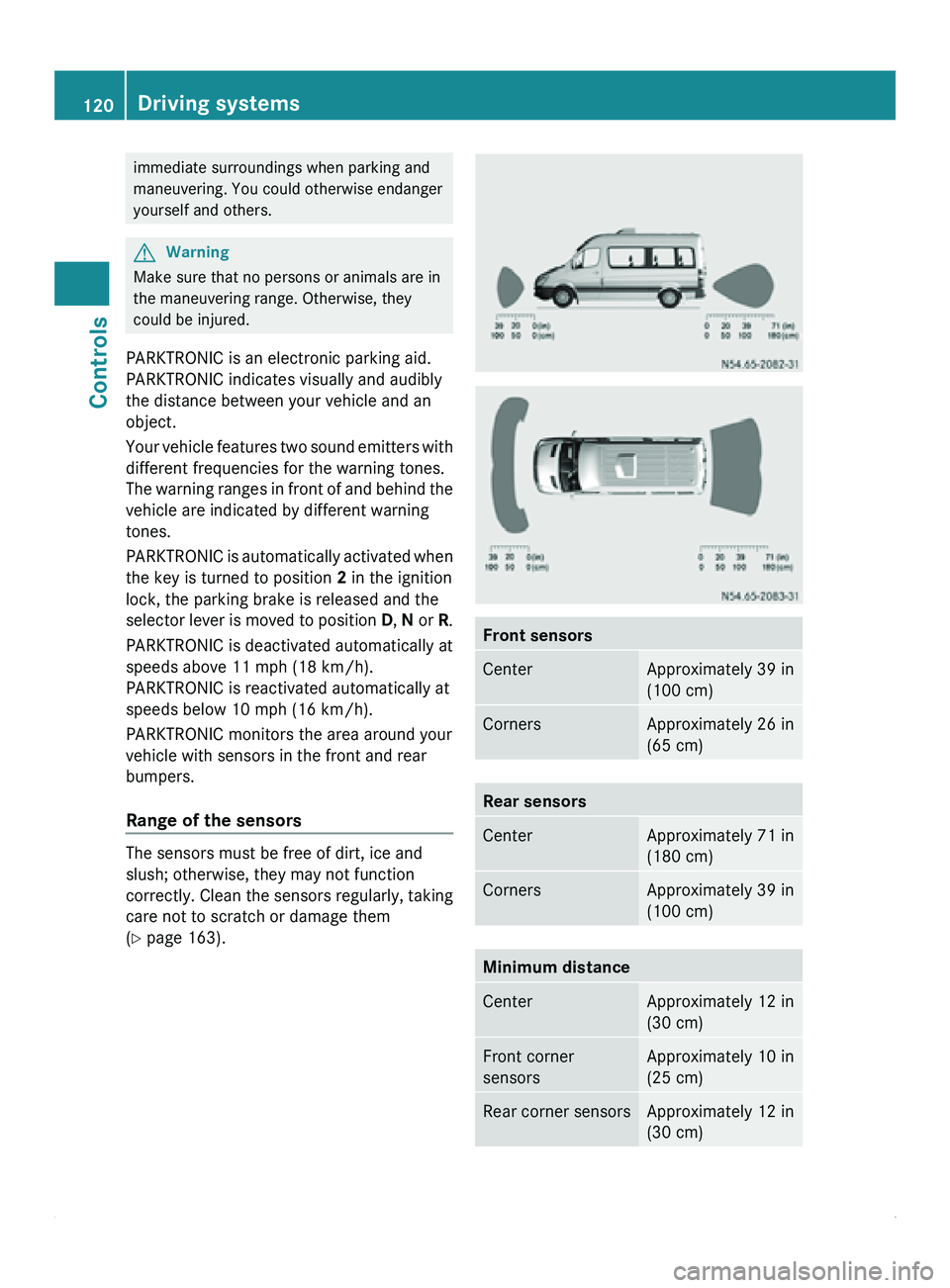
Your vehicle features
two sound emitters with
different frequencies for the warning tones.
The warning ranges in front of and behind the
vehicle are indicated by different warning
tones.
PARKTRONIC is automatically activated when
the key is turned to position 2 in the ignition
lock, the parking brake is released and the
selector lever is moved to position D, N or R.
PARKTRONIC is deactivated automatically at
speeds above 11 mph (18 km/h).
PARKTRONIC is reactivated automatically at
speeds below 10 mph (16 km/h).
PARKTRONIC monitors the area around your
vehicle with sensors in the front and rear
bumpers.
Range of the sensors The sensors must be free of dirt, ice and
slush; otherwise, they may not function
correctly. Clean
the
sensors regularly, taking
care not to scratch or damage them
(Y page 163). Front sensors
Center Approximately 39 in
(100 cm)
Corners Approximately 26 in
(65 cm)
Rear sensors
Center Approximately 71 in
(180 cm)
Corners Approximately 39 in
(100 cm)
Minimum distance
Center Approximately 12 in
(30 cm)
Front corner
sensors Approximately 10 in
(25 cm)
Rear corner sensors Approximately 12 in
(30 cm)120
Driving systems
Controls
Page 131 of 292
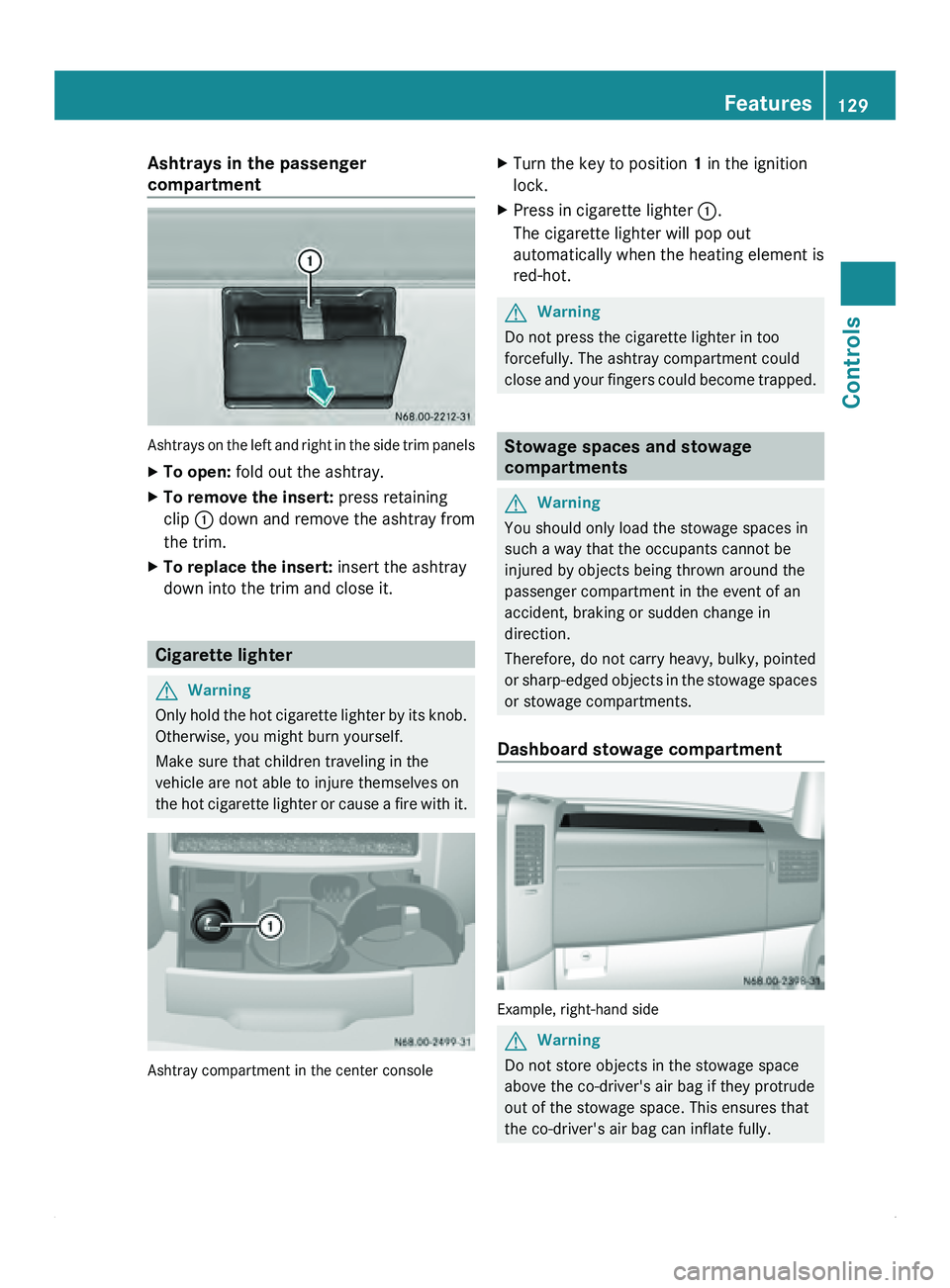
Ashtrays in the passenger
compartment
Ashtrays on the left and right in the side trim panels
X
To open: fold out the ashtray.
X To remove the insert: press retaining
clip 0046 down and
remove the ashtray from
the trim.
X To replace the insert: insert the ashtray
down into the trim and close it. Cigarette lighter
G
Warning
Only hold the hot cigarette lighter by its knob.
Otherwise, you might burn yourself.
Make sure that children traveling in the
vehicle are not able to injure themselves on
the hot cigarette
lighter or cause a fire with it.Ashtray compartment in the center console X
Turn the key to position 1 in the ignition
lock.
X Press in cigarette lighter 0046.
The cigarette lighter will pop out
automatically when the heating element is
red-hot. G
Warning
Do not press the cigarette lighter in too
forcefully. The ashtray compartment could
close and your
fingers could become trapped. Stowage spaces and stowage
compartments
G
Warning
You should only load the stowage spaces in
such a way that the occupants cannot be
injured by objects being thrown around the
passenger compartment in the event of an
accident, braking or sudden change in
direction.
Therefore, do not carry heavy, bulky, pointed
or sharp-edged objects
in the stowage spaces
or stowage compartments.
Dashboard stowage compartment Example, right-hand side
G
Warning
Do not store objects in the stowage space
above the co-driver's air bag if they protrude
out of the stowage space. This ensures that
the co-driver's air bag can inflate fully. Features
129
Controls Z
Page 133 of 292
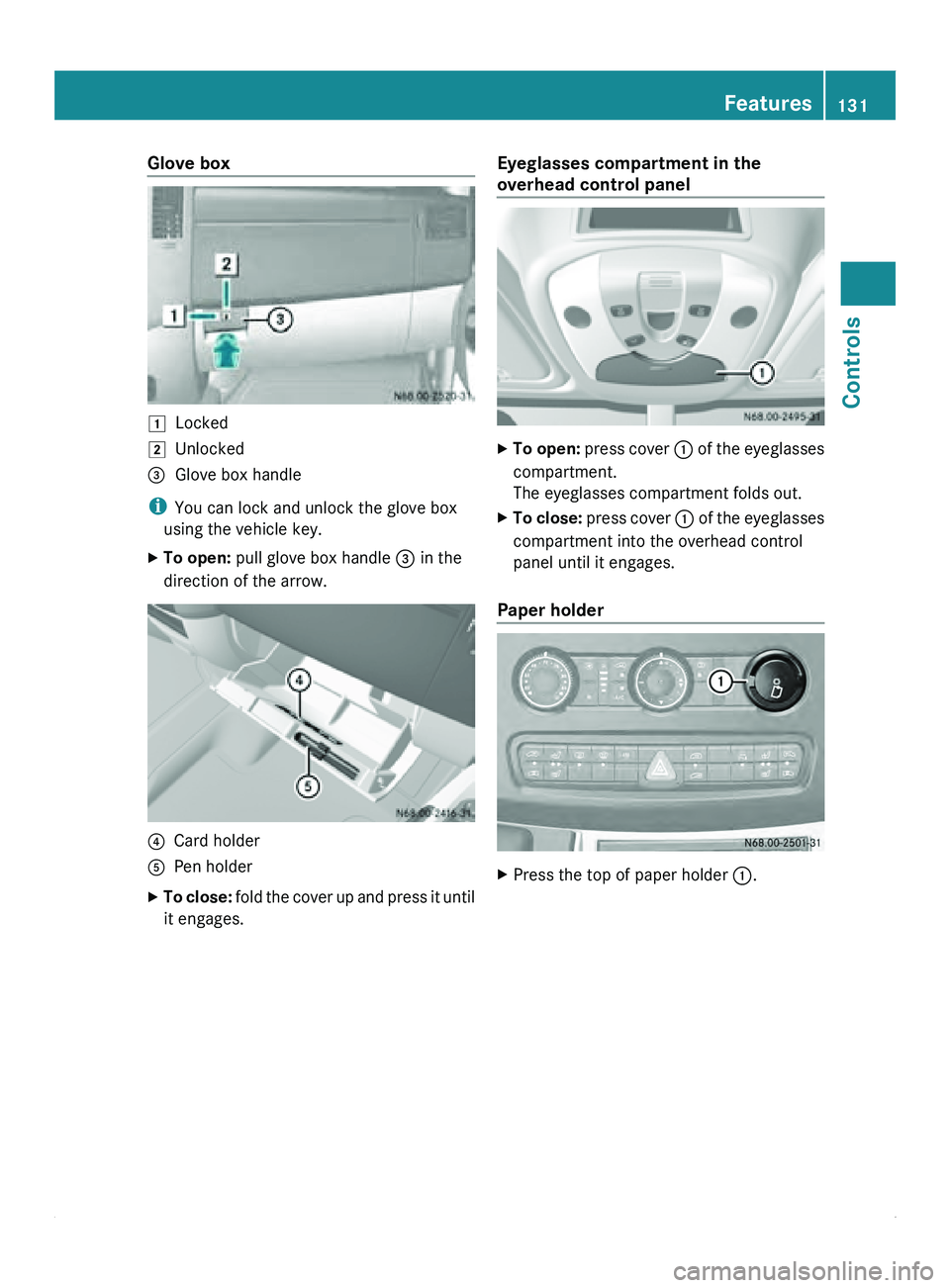
Glove box
004A
Locked
004B Unlocked
008A Glove box handle
i You can lock and unlock the glove box
using the vehicle key.
X To open: pull glove box handle 008A in the
direction of the arrow. 0088
Card holder
0086 Pen holder
X To close: fold the cover up and press it until
it engages. Eyeglasses compartment in the
overhead control panel X
To open: press cover 0046 of the eyeglasses
compartment.
The eyeglasses compartment folds out.
X To close: press cover 0046
of the eyeglasses
compartment into the overhead control
panel until it engages.
Paper holder X
Press the top of paper holder 0046. Features
131
Controls Z
Page 135 of 292
X
Place the beverage container in cup
holder 0086.
X Push clamping arm 0087 against the
container.
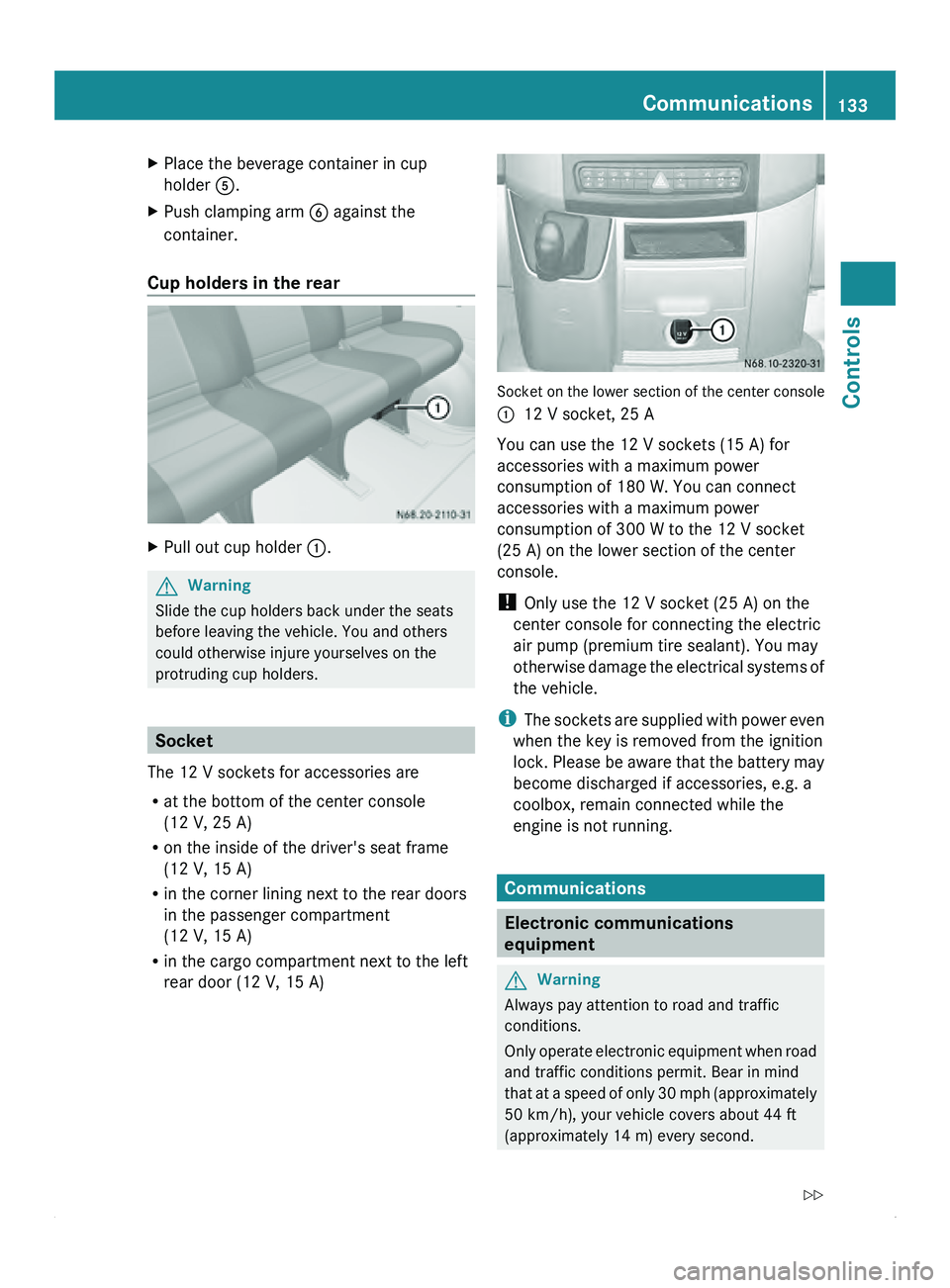
Cup holders in the rear X
Pull out cup holder 0046.G
Warning
Slide the cup holders back under the seats
before leaving the vehicle. You and others
could otherwise injure yourselves on the
protruding cup holders. Socket
The 12 V sockets for accessories are
R at the bottom of the center console
(12 V, 25 A)
R on the inside of the driver's seat frame
(12 V, 15 A)
R in the corner lining next to the rear doors
in the passenger compartment
(12 V, 15 A)
R in the cargo compartment next to the left
rear door (12 V, 15 A) Socket on the lower section of the center console
0046
12 V socket, 25 A
You can use the 12 V sockets (15 A) for
accessories with a maximum power
consumption of 180 W. You can connect
accessories with a maximum power
consumption of 300 W to the 12 V socket
(25 A) on the lower section of the center
console.
! Only use the 12 V socket (25 A) on the
center console for connecting the electric
air pump (premium tire sealant). You may
otherwise
damage the electrical systems of
the vehicle.
i The sockets are supplied with power even
when the key is removed from the ignition
lock. Please be aware that the battery may
become discharged if accessories, e.g. a
coolbox, remain connected while the
engine is not running. Communications
Electronic communications
equipment
G
Warning
Always pay attention to road and traffic
conditions.
Only operate electronic
equipment when road
and traffic conditions permit. Bear in mind
that at a speed of only 30 mph (approximately
50 km/h), your vehicle covers about 44 ft
(approximately 14 m) every second. Communications
133
Controls
Z
Page 137 of 292
status and the position of the key in the
ignition lock. The mobile phone display
indicates the charging status. Communications
135Controls Z
Page 144 of 292
reduced in volume each time reverse gear
is engaged.
Refueling
G
Warning
Fuel is highly flammable. Fire, naked flames
and smoking as well as the use of auxiliary
heaters (sparks) are therefore prohibited
when handling fuel.
Switch off the
engine and the auxiliary heating
before refueling. G
Warning
Avoid any contact with fuels.
You can damage your health if your skin
comes into direct contact with fuel or if you
inhale fuel vapors.
0040Environmental note
If fuels are handled improperly, they pose a
danger to persons and the environment. Do
not allow fuels
to run into the sewage system,
the surface waters, the ground water or into
the ground.
! Filter the fuel
before transferring it to the
vehicle if you are refueling the vehicle from
barrels or containers.
This will prevent malfunctions in the fuel
system due to contaminated fuel. G
Warning
Do not use gasoline to refuel vehicles with a
diesel engine. Never
mix diesel with gasoline.
This causes damage to the fuel system and
engine and could result in the vehicle catching
fire.
! Do not use gasoline to refuel vehicles with
a diesel engine. Even small amounts of
gasoline will cause damage to the fuel
system and engine. Damage resulting from
adding gasoline is not covered by the New
Vehicle Limited Warranty. !
If the wrong fuel has been added by
mistake, do not switch on the ignition. If
you do, the fuel could enter the fuel lines.
The tank and the fuel lines must then be
drained. Inform a qualified specialist
workshop and have the tank and the fuel
lines drained completely.
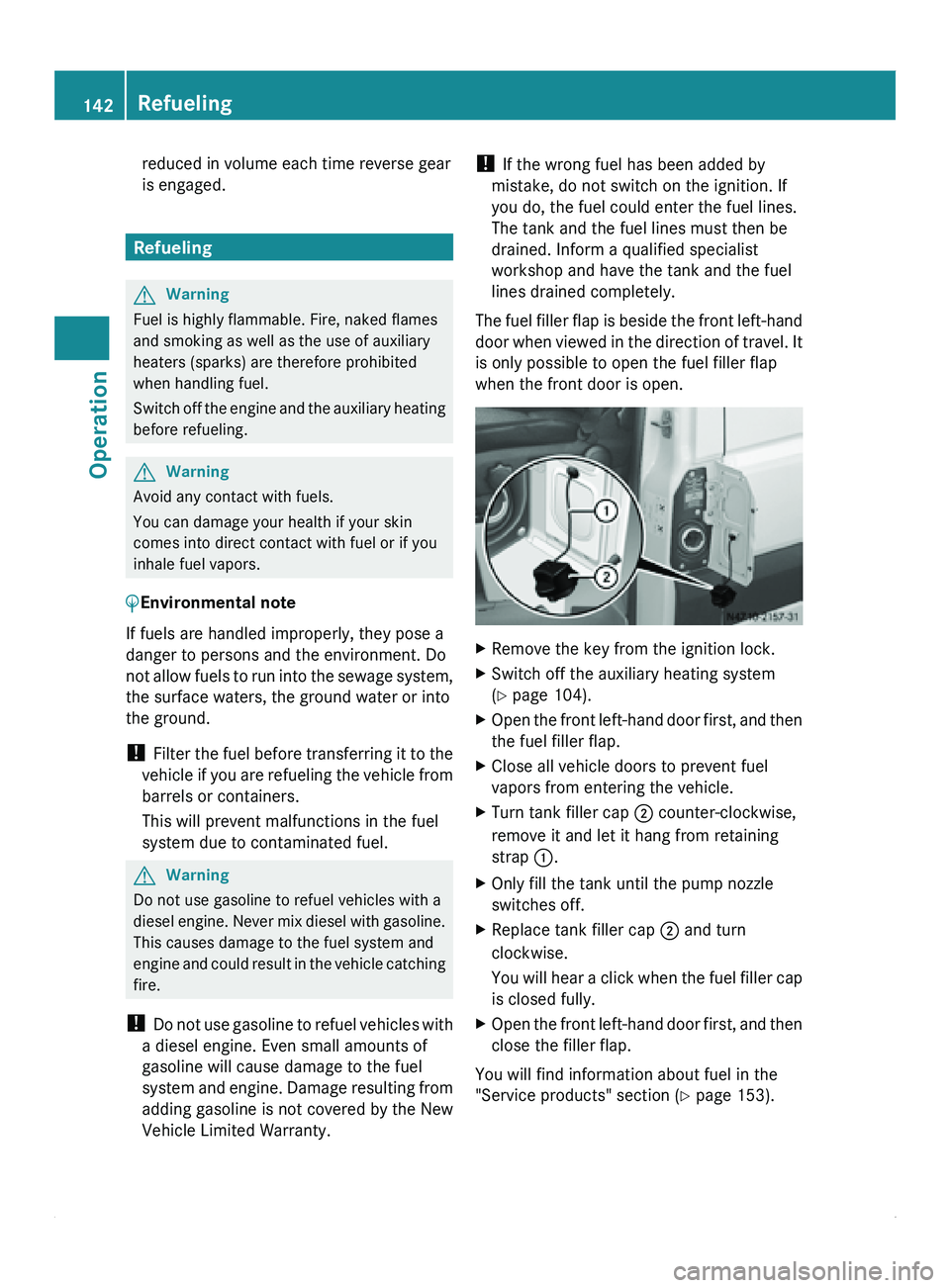
The fuel filler
flap is beside the front left-hand
door when viewed in the direction of travel. It
is only possible to open the fuel filler flap
when the front door is open. X
Remove the key from the ignition lock.
X Switch off the auxiliary heating system
(Y page 104).
X Open the front left-hand door first, and then
the fuel filler flap.
X Close all vehicle doors to prevent fuel
vapors from entering the vehicle.
X Turn tank filler cap 0047 counter-clockwise,
remove it and let it hang from retaining
strap 0046.
X Only fill the tank until the pump nozzle
switches off.
X Replace tank filler cap 0047 and turn
clockwise.
You will
hear
a click when the fuel filler cap
is closed fully.
X Open the front left-hand door first, and then
close the filler flap.
You will find information about fuel in the
"Service products" section (Y page 153). 142
Refueling
Operation
Page 145 of 292
Diesel Exhaust Fluid (DEF)
The exhaust gas aftertreatment requires a
reducing agent, Diesel
Exhaust Fluid (DEF), in
order to function correctly. G
Warning
If you open the DEF reservoir cap at high
temperatures, ammonia vapors could be
released.
Ammonia vapors have
a pungent odor and are
particularly irritating for your skin, respiratory
organs and eyes. This may result in burning
eyes, nose and throat, as well as coughing and
watering eyes.
Do not inhale ammonia vapors. G
Warning
Avoid contact with DEF.
DEF is hazardous
to health. Do not allow DEF
to come into contact with your skin. Rinse
affected areas with plenty of clean water and
consult a doctor if necessary.
0040Environmental note
Dispose of DEF in an environmentally
responsible manner.
! Only use DEF in accordance with
ISO 22241 .
The exhaust gas aftertreatment
system may otherwise be damaged.
Observe the MB Specifications for Service
Products, Sheet No. 352.0.
Damage caused by the use of other
reducing agents will result in the loss of
your New Vehicle Limited Warranty
entitlements.
! If DEF comes into contact with a painted
or aluminum surface, wash the surface off
immediately with plenty of water.
! DEF is not a diesel additive and must not
be mixed with fuel in the tank. Even small
amounts of DEF can cause engine damage.
Damage resulting from adding DEF is not
covered by the New Vehicle Limited
Warranty. i
If the DEF level drops below the reserve
level, the second warning message
(Y page 116) appears and at this point, at
the latest, you
must add at least 2.0 US gal
(7.6 l) of DEF.
You will find further information on DEF in the
"Service products" section (Y page 155).
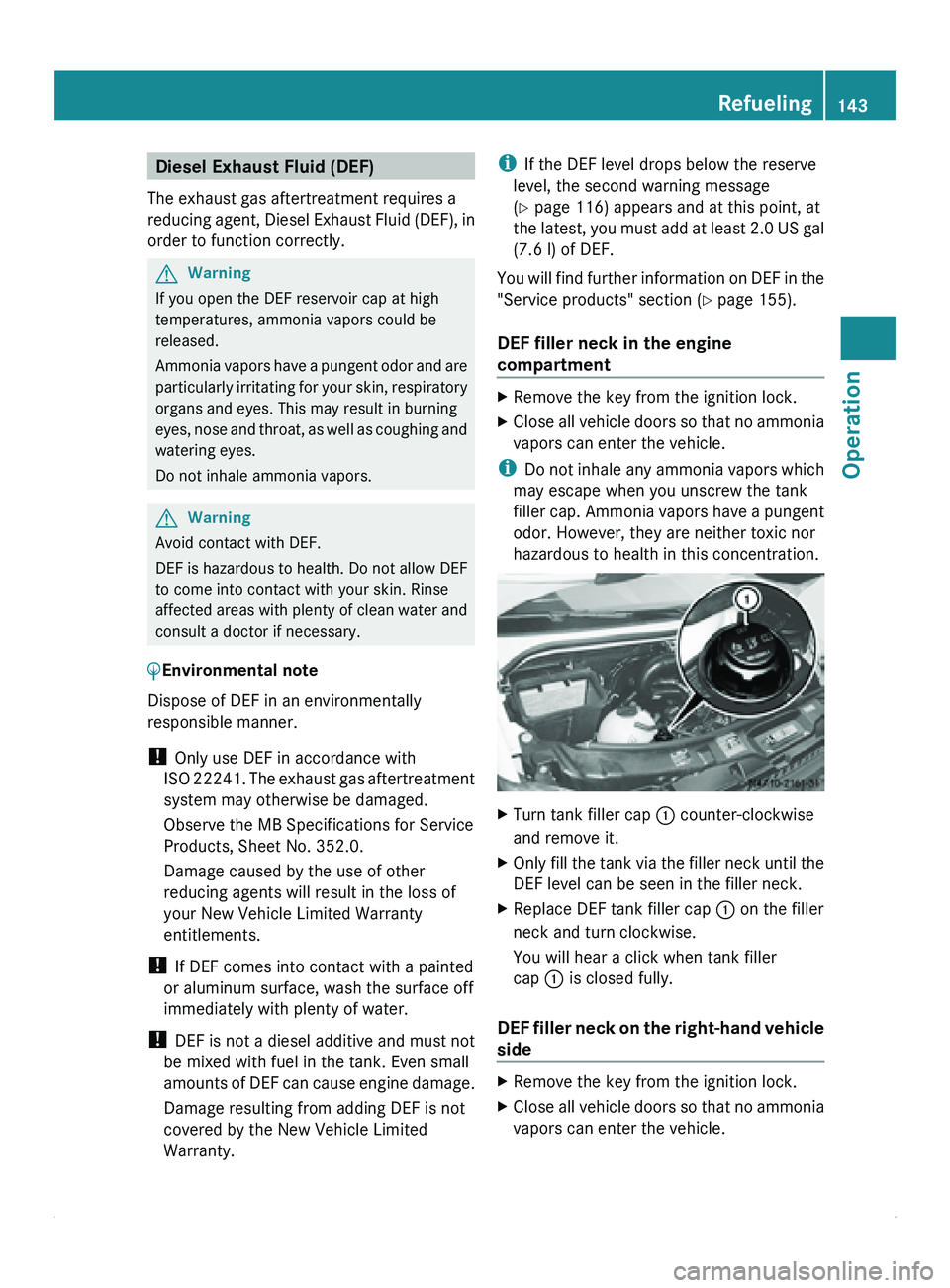
DEF filler neck in the engine
compartment X
Remove the key from the ignition lock.
X Close all
vehicle doors so that no ammonia
vapors can enter the vehicle.
i Do not inhale
any ammonia vapors which
may escape when you unscrew the tank
filler cap. Ammonia vapors have a pungent
odor. However, they are neither toxic nor
hazardous to health in this concentration. X
Turn tank filler cap 0046
counter-clockwise
and remove it.
X Only fill the tank via the filler neck until the
DEF level can be seen in the filler neck.
X Replace DEF tank filler cap 0046 on the filler
neck and turn clockwise.
You will hear a click when tank filler
cap 0046 is closed fully.
DEF filler neck on the right-hand vehicle
side X
Remove the key from the ignition lock.
X Close all vehicle doors so that no ammonia
vapors can enter the vehicle. Refueling
143
Operation Z
Page 146 of 292
i
Do not inhale
any ammonia vapors which
may escape when you unscrew the tank
filler cap. Ammonia vapors have a pungent
odor. However, they are neither toxic nor
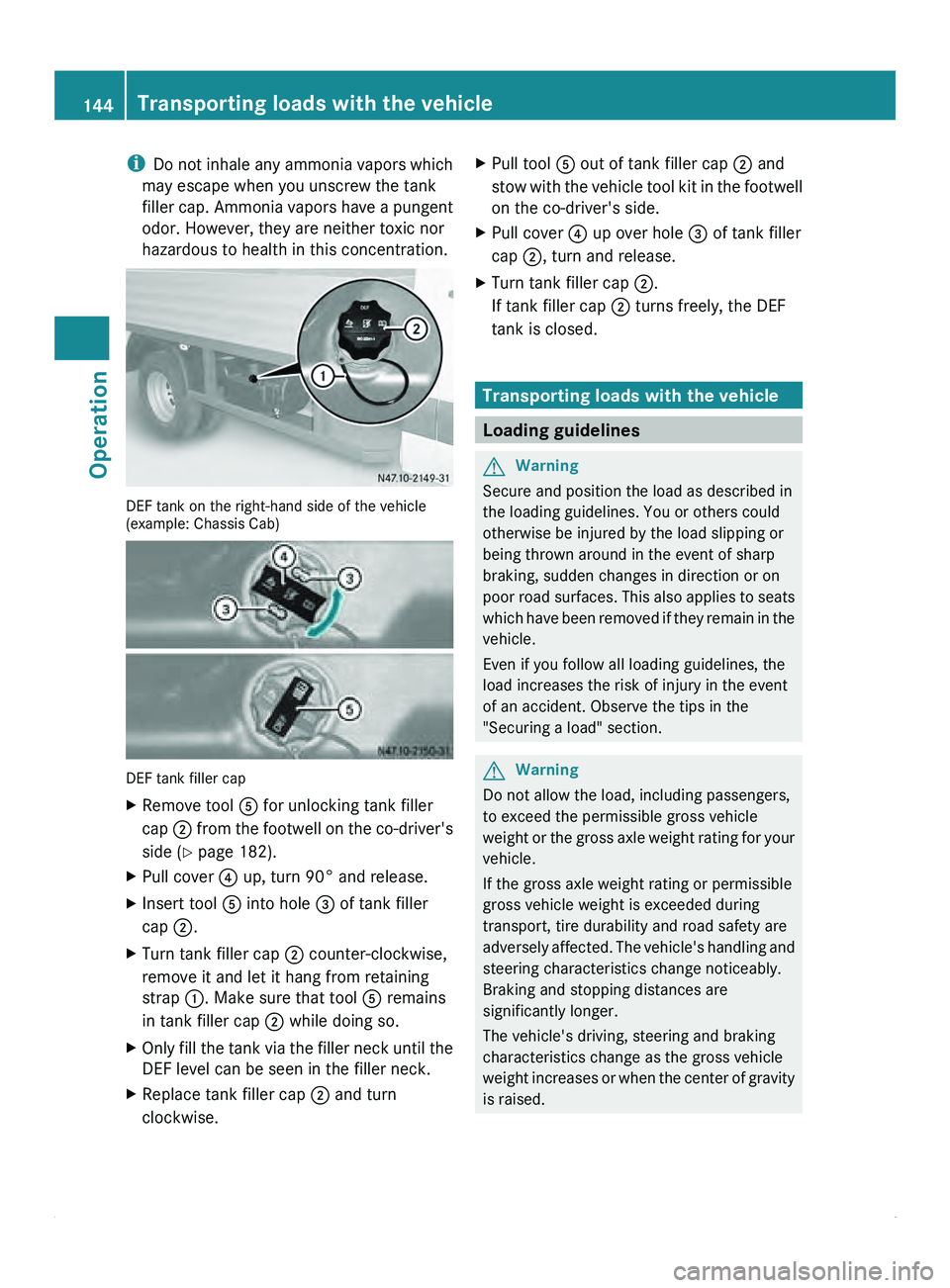
hazardous to health in this concentration. DEF tank on the right-hand side of the vehicle
(example: Chassis Cab)
DEF tank filler cap
X
Remove tool 0086 for unlocking tank filler
cap 0047 from the
footwell on the co-driver's
side ( Y page 182).
X Pull cover 0088 up, turn 90° and release.
X Insert tool 0086 into hole 008A of tank filler
cap 0047.
X Turn tank filler cap 0047 counter-clockwise,
remove it and let it hang from retaining
strap 0046. Make sure that tool 0086 remains
in tank filler cap 0047 while doing so.
X Only fill the tank via the filler neck until the
DEF level can be seen in the filler neck.
X Replace tank filler cap 0047 and turn
clockwise. X
Pull tool 0086 out of tank filler cap 0047 and
stow with
the
vehicle tool kit in the footwell
on the co-driver's side.
X Pull cover 0088 up over hole 008A of tank filler
cap 0047, turn and release.
X Turn tank filler cap 0047.
If tank filler cap 0047 turns freely, the DEF
tank is closed. Transporting loads with the vehicle
Loading guidelines
G
Warning
Secure and position the load as described in
the loading guidelines. You or others could
otherwise be injured by the load slipping or
being thrown around in the event of sharp
braking, sudden changes in direction or on
poor road surfaces.
This also applies to seats
which have been removed if they remain in the
vehicle.
Even if you follow all loading guidelines, the
load increases the risk of injury in the event
of an accident. Observe the tips in the
"Securing a load" section. G
Warning
Do not allow the load, including passengers,
to exceed the permissible gross vehicle
weight or the
gross axle weight rating for your
vehicle.
If the gross axle weight rating or permissible
gross vehicle weight is exceeded during
transport, tire durability and road safety are
adversely affected. The vehicle's handling and
steering characteristics change noticeably.
Braking and stopping distances are
significantly longer.
The vehicle's driving, steering and braking
characteristics change as the gross vehicle
weight increases or when the center of gravity
is raised. 144
Transporting loads with the vehicle
Operation
Page 149 of 292
journey, and correct an incorrectly or
inadequately secured load if necessary.
i
You can obtain information about
securing the load correctly from the
manufacturer of the load securing aids or
tie down for securing the load.
X Fill spaces between the load and the cargo
compartment walls or wheel arches (form-
locking). Use rigid
load securing aids, such
as wedges, wooden fixings or padding.
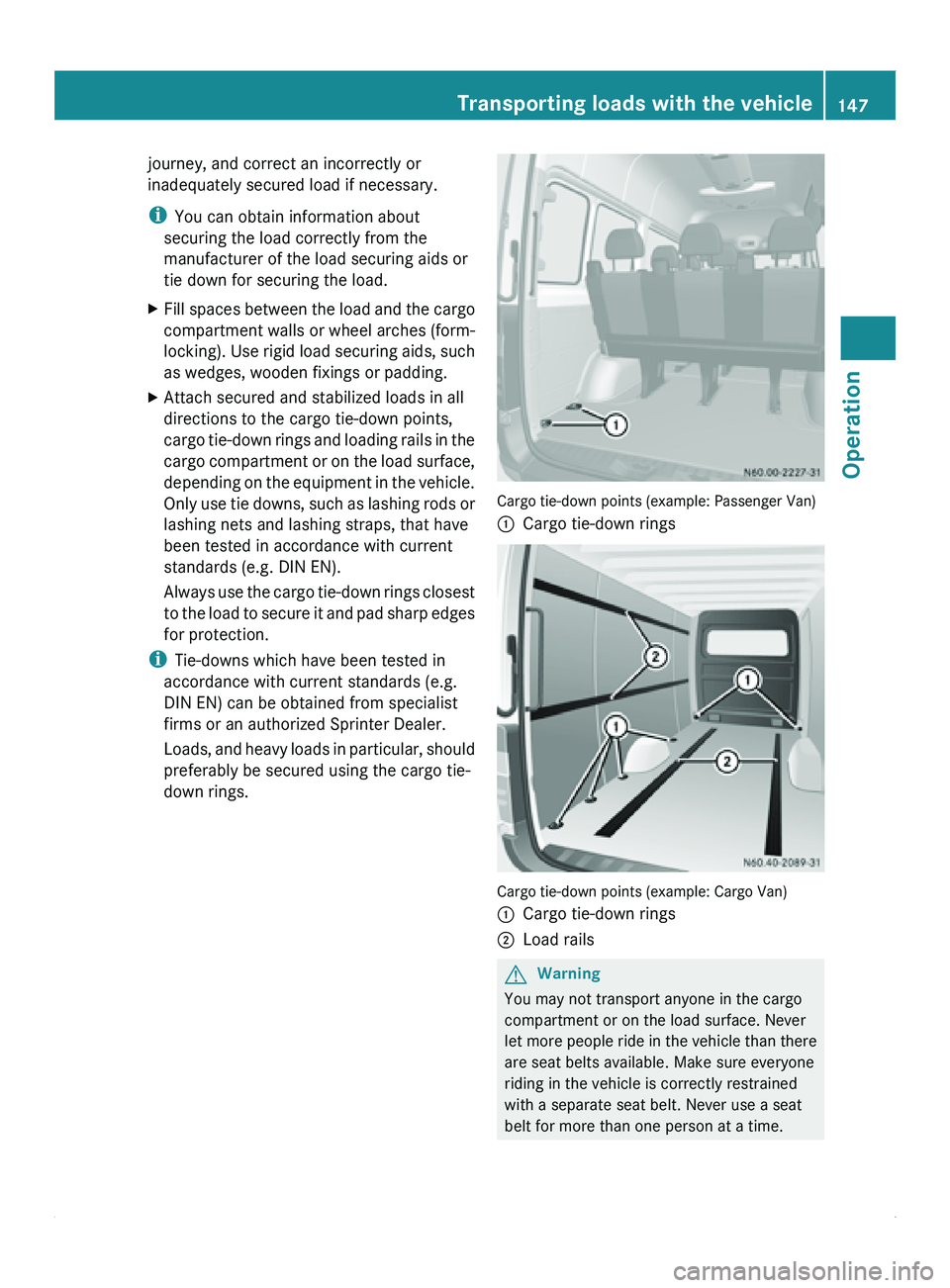
X Attach secured and stabilized loads in all
directions to the cargo tie-down points,
cargo tie-down rings
and loading rails in the
cargo compartment or on the load surface,
depending on the equipment in the vehicle.
Only use tie downs, such as lashing rods or
lashing nets and lashing straps, that have
been tested in accordance with current
standards (e.g. DIN EN).
Always use the cargo tie-down rings closest
to the load to secure it and pad sharp edges
for protection.
i Tie-downs which have been tested in
accordance with current standards (e.g.
DIN EN) can be obtained from specialist
firms or an authorized Sprinter Dealer.
Loads, and
heavy loads in particular, should
preferably be secured using the cargo tie-
down rings. Cargo tie-down points (example: Passenger Van)
0046
Cargo tie-down rings Cargo tie-down points (example: Cargo Van)
0046
Cargo tie-down rings
0047 Load rails G
Warning
You may not transport anyone in the cargo
compartment or on the load surface. Never
let more people
ride in the vehicle than there
are seat belts available. Make sure everyone
riding in the vehicle is correctly restrained
with a separate seat belt. Never use a seat
belt for more than one person at a time. Transporting loads with the vehicle
147
Operation Z