wheel MERCEDES-BENZ SPRINTER 2011 MY11 Operator’s Manual
[x] Cancel search | Manufacturer: MERCEDES-BENZ, Model Year: 2011, Model line: SPRINTER, Model: MERCEDES-BENZ SPRINTER 2011Pages: 292, PDF Size: 6.75 MB
Page 112 of 292
Starting the engine
X
Turn the key to position 2 in the ignition
lock.
The 0028 preglow indicator lamp in the
instrument cluster lights up.
X When the 0028 preglow indicator lamp
goes out, turn the key to position 3 in the
ignition lock and release it as soon as the
engine is running.
i You can start
the engine without preglow
when the engine is warm.
i Depending on the equipment installed,
the vehicle either automatically locks
centrally after switching on the ignition or
after pulling away. The locking knobs in the
doors drop down.
You can open the doors from the inside at
any time.
Automatic door locking can be deactivated
(Y page 55). Driving off
G
Warning
Do not downshift for additional engine
braking on a
slippery road surface. This could
cause the drive wheels to lose their grip and
the vehicle could skid. You could lose control
of the vehicle and cause an accident.
i After pulling away or switching on the
ignition, the vehicle automatically locks
centrally. The locking knobs in the doors
drop down.
You can open the doors from the inside at
any time.
Automatic door locking can be deactivated
(Y page 55). X
Depress the brake pedal and keep it
depressed.
The selector lever lock is released.
X Release the parking brake ( Y page 112).
The 0066 indicator lamp in the instrument
cluster goes out.
X Move the selector lever to position D or R.
i On vehicles with a reverse warning
feature, a warning signal sounds when
reverse gear is
engaged to alert other road
users.
! Only shift into reverse gear when the
vehicle is stationary. You could otherwise
damage the transmission.
X Release the brake pedal.
X Carefully depress the accelerator pedal. General driving tips
Steering G
Warning
Do not switch off the engine while the vehicle
is in motion.
There is no
power assistance for the steering
or the service brake when the engine is not
running.
Steering and braking require significantly
more effort and you could lose control of the
vehicle and cause an accident as a result.
! Do not hold the steering wheel at full
steering angle for a long time, e.g. when
turning or maneuvering.
The hydraulic pump could be damaged if
the hydraulic fluid temperature increases.
Overrun cut-off If you take your foot off the accelerator pedal,
the diesel fuel supply is cut off in overrun
mode when the
engine speed is out of the idle
speed control range. 110
Driving and parking
Controls
Page 113 of 292
Driving in wet conditions
G
Warning
There is a danger of hydroplaning occurring,
even if you are driving slowly and your tires
have sufficient tread
depth, depending on the
depth of water on the road.
For this reason, avoid tire ruts and brake
carefully.
Driving on flooded roads If you have to drive on stretches of road on
which water has collected, the water level
must not rise above the bottom edge of the
bumper. The maximum speed at which you
may drive is walking speed.
!
Note that vehicles in front or oncoming
vehicles create waves. This could mean
that the maximum permitted water depth
is exceeded.
You must observe these notes. Otherwise,
damage may
occur
to the engine, electrics
or transmission.
Driving in winter Drive particularly carefully on slippery roads
in winter.
Avoid
sudden acceleration, steering
and braking maneuvers. G
Warning
Do not downshift for additional engine
braking on a
slippery road surface. This could
cause the drive wheels to lose their grip and
the vehicle could skid. You could lose control
of the vehicle and cause an accident.
If the vehicle threatens to skid or cannot be
stopped when moving at low speed, shift to
the neutral position N. Try to maintain control
of the vehicle using corrective steering
! Vehicles with automatic transmission
may roll only briefly in the neutral position
N. Prolonged rolling of the wheels, e.g.
when being towed, will result in
transmission damage. Road salt may adversely affect braking
performance.
Consequently, you
may need to
depress the brake pedal more forcefully in
order to achieve normal braking force. Apply
the brakes regularly when driving for longer
periods on gritted or salted roads. This will
restore the brakes to their normal level of
performance.
When stopping the vehicle after traveling on
roads that have been salted, make sure that
the brakes are fully functional before
proceeding further.
i Fit snow chains to the outside rear wheels
(driven axle) in good time for driving on
snow, slush or ice. Comply with the
manufacturer's fitting instructions.
You will find information about winter tires
and about driving with snow chains in the
"Operation" section .
Tire grip Whereas the vehicle can be fully controlled at
a certain speed on a dry road surface, you
must reduce your speed on a wet or icy
surface to maintain the same degree of
safety.
Pay particular attention to the road
conditions at temperatures around freezing
point. When ice forms on the road surface
(e.g. due to fog), applying the brakes can
cause a
thin
layer of water to form rapidly on
the ice and tire grip will be greatly reduced.
Drive with particular care in such weather
conditions. Stopping the vehicle and switching
off the engine
G
Warning
Always switch off the engine and apply the
parking brake before leaving the vehicle.
Otherwise, the vehicle could roll away if it is
not secured. Driving and parking
111
Controls
Z
Page 114 of 292
On gradients steeper than 15%:
R
secure an unladen
vehicle at the front axle,
e.g. using a wheel chock or similar object.
R additionally, secure a laden vehicle at the
rear axle, e.g. using a wheel chock or similar
object. G
Warning
Make sure that the exhaust system does not
under any circumstances come into contact
with easily ignitable
material such as dry grass
or gasoline. Do not park the vehicle on dry
grassland or harvested grain fields.
Otherwise, the flammable material may ignite
and set the vehicle on fire. G
Warning
Only remove the key from the ignition lock
when the vehicle is stationary, since you
cannot steer the vehicle with the key
removed.
Never leave children unsupervised in the
vehicle. They could
release the parking brake.
This could lead to a serious or fatal accident.
! When the vehicle is parked, always
remove the key to prevent the battery from
becoming discharged.
On vehicles with a battery isolating switch,
switch off the power supply if the vehicle is
to be out of use for a longer period of time. G
Warning
You must use the parking lamps to enable
your vehicle to
be recognized on public roads
when it is dark. You can also use reflective
night parking signs in built-up areas.
Observe legal requirements.
X Stop the vehicle.
X Shift the automatic transmission to
position P.
X Apply the parking brake.
i On steep slopes, turn the front wheels
towards the curb. !
If the coolant temperature is very high,
e.g. after driving on mountain roads, leave
the engine running at idle speed for about
two minutes before turning it off.
This allows the coolant temperature to
return to normal.
X To switch off the engine: turn the key to
position 0 in the ignition lock and remove
it.
The immobilizer is activated.
X Switch on the parking lamps if necessary.
X On uphill or downhill gradients, secure the
vehicle additionally against rolling away at
the axle with
the heaviest load, e.g. by using
a wheel chock or similar object.
Use the wheel chock (Y page 183) for this
purpose. Brakes
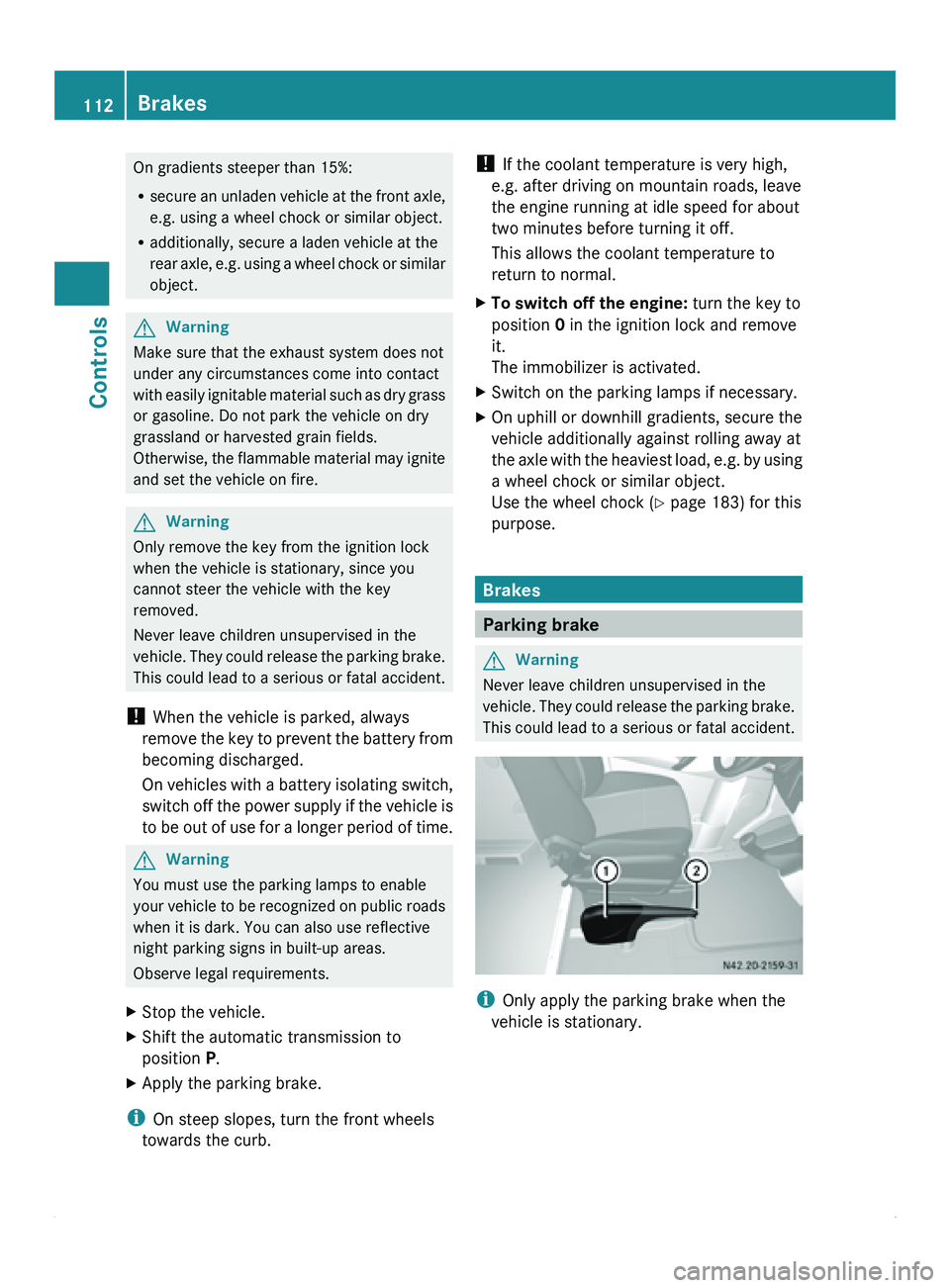
Parking brake
G
Warning
Never leave children unsupervised in the
vehicle. They could
release the parking brake.
This could lead to a serious or fatal accident. i
Only apply the parking brake when the
vehicle is stationary. 112
Brakes
Controls
Page 115 of 292
Applying the parking brake
X
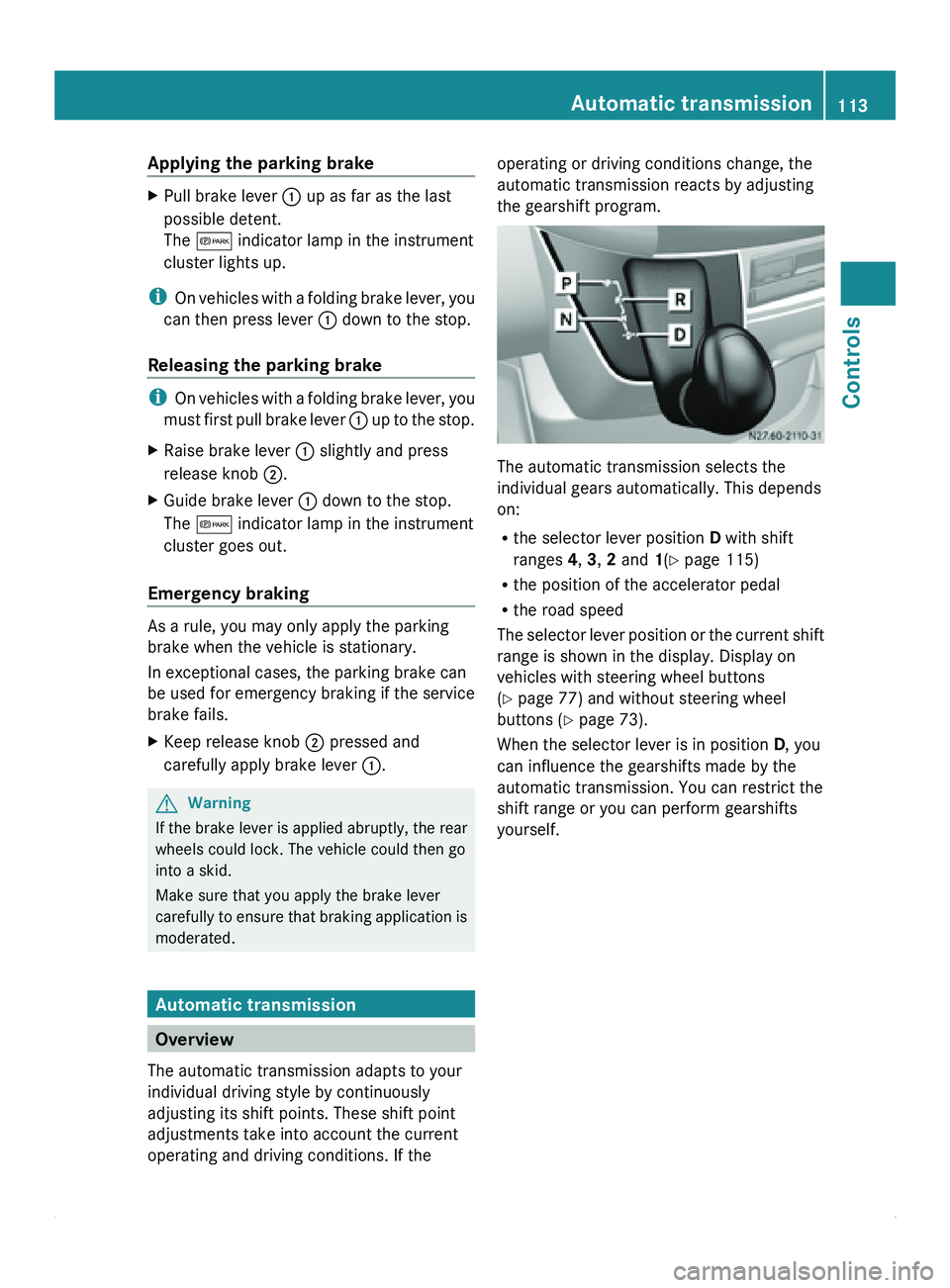
Pull brake lever 0046 up as far as the last
possible detent.
The 0066 indicator lamp in the instrument
cluster lights up.
i On vehicles with
a folding brake lever, you
can then press lever 0046 down to the stop.
Releasing the parking brake i
On vehicles with
a folding brake lever, you
must first pull brake lever 0046 up to the stop.
X Raise brake lever 0046 slightly and press
release knob 0047.
X Guide brake lever 0046 down to the stop.
The 0066 indicator lamp in the instrument
cluster goes out.
Emergency braking As a rule, you may only apply the parking
brake when the vehicle is stationary.
In exceptional cases, the parking brake can
be used for emergency braking if the service
brake fails.
X
Keep release knob 0047 pressed and
carefully apply brake lever 0046.G
Warning
If the brake lever is applied abruptly, the rear
wheels could lock. The vehicle could then go
into a skid.
Make sure that you apply the brake lever
carefully to ensure
that braking application is
moderated. Automatic transmission
Overview
The automatic transmission adapts to your
individual driving style by continuously
adjusting its shift points. These shift point
adjustments take into account the current
operating and driving conditions. If the operating or driving conditions change, the
automatic transmission reacts by adjusting
the gearshift program.
The automatic transmission selects the
individual gears automatically. This depends
on:
R
the selector lever position D with shift
ranges 4, 3, 2 and 1(Y page 115)
R the position of the accelerator pedal
R the road speed
The selector lever
position or the current shift
range is shown in the display. Display on
vehicles with steering wheel buttons
(Y page 77) and without steering wheel
buttons ( Y page 73).
When the selector lever is in position D, you
can influence the gearshifts made by the
automatic transmission. You can restrict the
shift range or you can perform gearshifts
yourself. Automatic transmission
113
Controls Z
Page 116 of 292
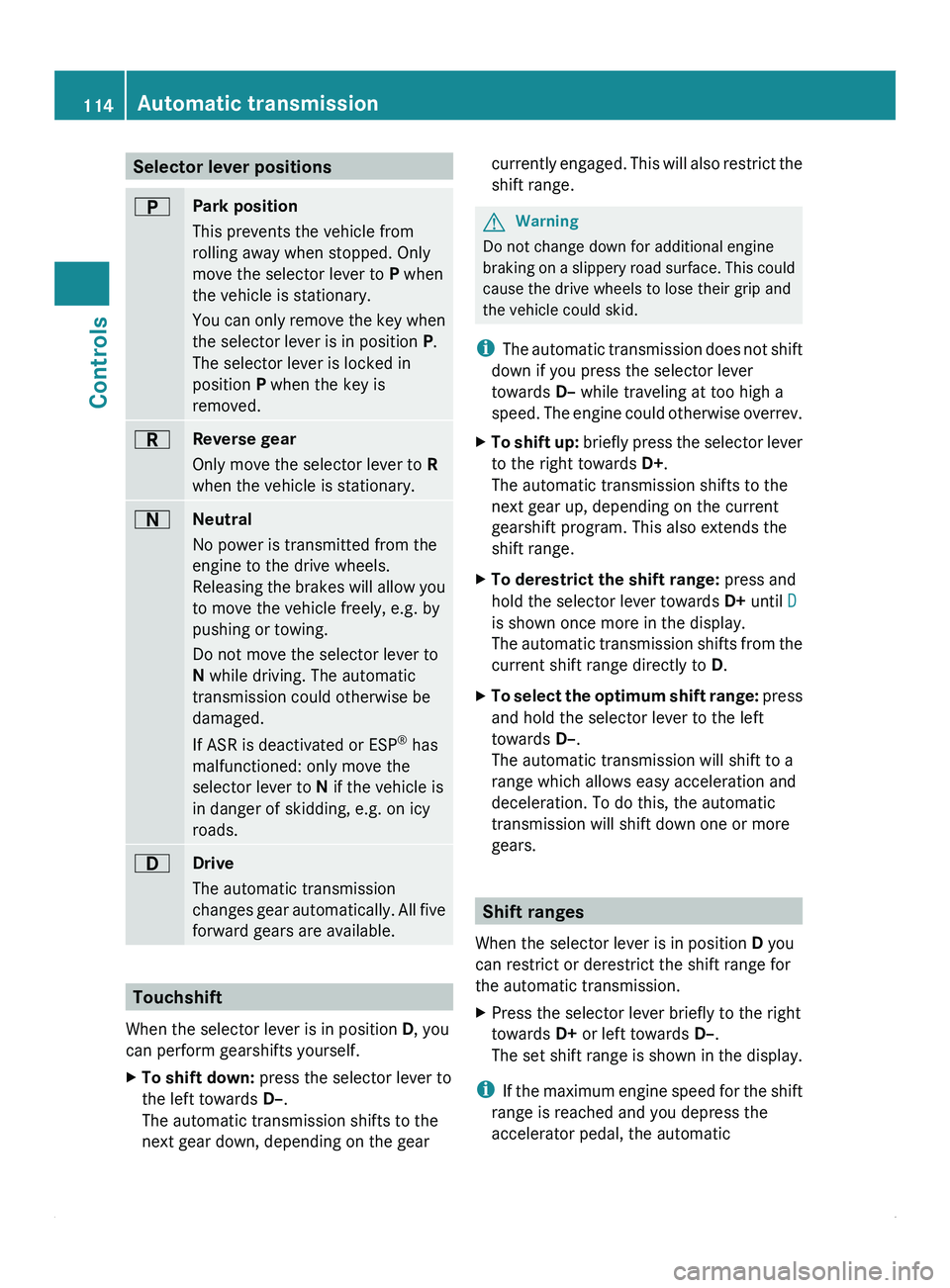
Selector lever positions
0045
Park position
This prevents the vehicle from
rolling away when stopped. Only
move the selector lever to
P when
the vehicle is stationary.
You can only
remove the key when
the selector lever is in position P.
The selector lever is locked in
position P when the key is
removed. 0046
Reverse gear
Only move the selector lever to R
when the vehicle is stationary. 0044
Neutral
No power is transmitted from the
engine to the drive wheels.
Releasing the
brakes
will allow you
to move the vehicle freely, e.g. by
pushing or towing.
Do not move the selector lever to
N while driving. The automatic
transmission could otherwise be
damaged.
If ASR is deactivated or ESP ®
has
malfunctioned: only move the
selector lever to N if the vehicle is
in danger of skidding, e.g. on icy
roads. 003A
Drive
The automatic transmission
changes gear
automatically.
All five
forward gears are available. Touchshift
When the selector lever is in position D
, you
can perform gearshifts yourself.
X To shift down: press the selector lever to
the left towards D–.
The automatic transmission shifts to the
next gear down, depending on the gear currently engaged. This will also restrict the
shift range. G
Warning
Do not change down for additional engine
braking on a
slippery road surface. This could
cause the drive wheels to lose their grip and
the vehicle could skid.
i The automatic transmission does not shift
down if you press the selector lever
towards D– while traveling at too high a
speed. The engine could otherwise overrev.
X To shift up:
briefly press
the selector lever
to the right towards D+.
The automatic transmission shifts to the
next gear up, depending on the current
gearshift program. This also extends the
shift range.
X To derestrict the shift range: press and
hold the selector lever towards D+ until D
is shown once more in the display.
The automatic transmission
shifts from the
current shift range directly to D.
X To select the optimum shift range: press
and hold the selector lever to the left
towards D–
.
The automatic transmission will shift to a
range which allows easy acceleration and
deceleration. To do this, the automatic
transmission will shift down one or more
gears. Shift ranges
When the selector lever is in position D
you
can restrict or derestrict the shift range for
the automatic transmission.
X Press the selector lever briefly to the right
towards D+ or left towards D–.
The set shift
range is shown in the display.
i If the maximum
engine speed for the shift
range is reached and you depress the
accelerator pedal, the automatic 114
Automatic transmission
Controls
Page 118 of 292
vehicle. Otherwise, the vehicle could roll
away.
Driving the vehicle
Exhaust gas aftertreatment
The exhaust gas aftertreatment requires a
reducing agent, Diesel
Exhaust Fluid (DEF), in
order to function correctly. Filling up the DEF
tank is usually part of the service scope. DEF
consumption depends on operational and
driving conditions; the supply does not have
to suffice until the next scheduled service. For
this reason, refill the DEF tank regularly
during vehicle operation, or, at the latest,
after the first warning message has been
received from the on-board computer.
To conform with emission regulations, you
must operate the vehicle with DEF and refill
the supply regularly. If you try to operate the
vehicle without DEF, with diluted DEF, or with
a different reduction agent, the engine
management detects this and issues a
warning message, after which the engine
cannot be restarted.
If the DEF supply drops below
1.5 US gal (5.5 l), you receive the first warning
message and you hear a warning tone. After
the first message appears, the remaining DEF
supply suffices for approximately 1000 miles
(1600 km) in normal driving conditions.
Then, the reserve range of 0.8 US gal (3.0 l)
is reached. Once the reserve range has been
reached, you receive the next warning
message and you hear a series of warning
tones. After the first message appears, the
DEF reserve suffices for approximately
1200 miles (1900 km). You can, however,
only start the engine another 16 times.
You should now, at the latest, fill up with at
least 2.0 US gal (7.6 l) of DEF (Y page 143)
or have the DEF tank filled at a qualified
specialist workshop. When the number of remaining engine starts
is 0, the engine management prevents the
engine from being started.
If the
00BB
check engine indicator lamp lights
up, the exhaust gas aftertreatment is faulty or
an emission-relevant malfunction has
occurred (Y page 195). You can then drive a
maximum of 50 miles (80 km) before the
engine management limits the number of
remaining engine starts.
If the exhaust gas aftertreatment is faulty,
have it checked and repaired at a qualified
specialist workshop. We recommend that you
use an authorized Sprinter Dealer for this
purpose.
You will find further information on DEF in the
"Service products" section (Y page 155).
Level indicator You will find further information about DEF
consumption in the "Driving tips" section
(Y
page 140).
Vehicles without steering wheel buttons
If the DEF supply is less than
1.5 US gal (5.5 l), the 00E4 indicator lamp in
the instrument cluster lights up and the
009BdEF Chk message appears in the
display.
If the DEF supply drops below the reserve
level of 0.8 US gal (3.0 l), the 00E4 indicator
lamp in the instrument cluster lights up and
the 009BStArtS RE
xx
message is shown in
the display. xx refers to the number of
remaining engine starts (from 16 to 0).
Vehicles with steering wheel buttons
If the DEF supply is less than
1.5 US gal (5.5 l), the Check Diesel
Exhaust Fluid See Operator's Manual
message appears in the display.
If the DEF supply drops below the reserve
level of 0.8 US gal (3.0 l), the 00E4xx
starts remaining message appears in the
display. xx refers to the number of remaining
engine starts (from 16 to 0).116
Driving the vehicle
Controls
Page 119 of 292
ADR (working speed governor)
When activated, the working speed governor
(ADR) automatically increases the engine
speed to a preset or adjustable speed
(Y page 117).
i After a cold start, the idling speed of the
engine is increased automatically. If the
preset working speed is lower than the
increased idling speed, the working speed
is only reached once the engine has
completed the warm-up phase.
It is only possible to activate ADR with the
vehicle stationary and the parking brake
applied.
The selector lever must be in position P.
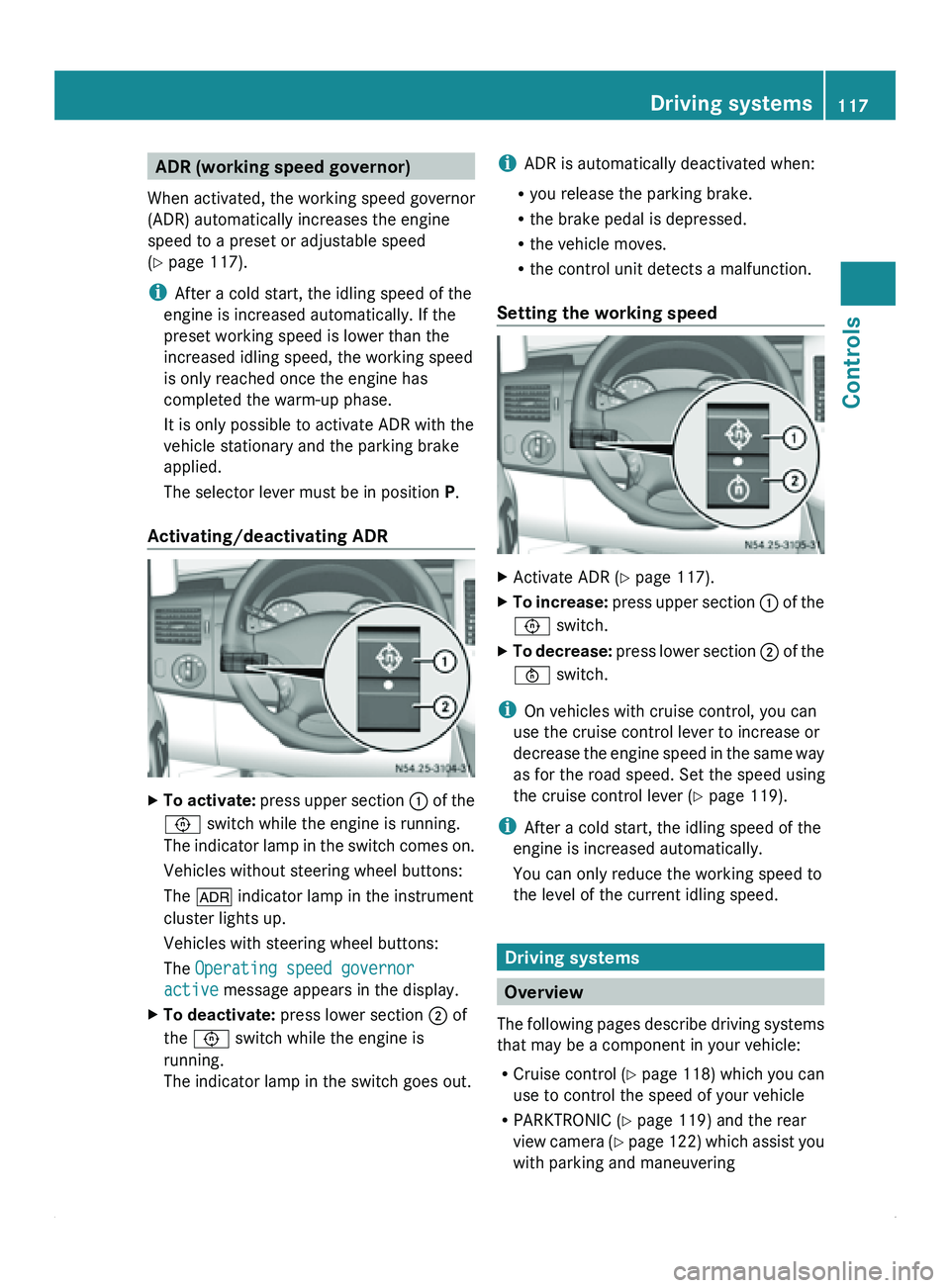
Activating/deactivating ADR X
To activate: press upper
section 0046 of the
0093 switch while the engine is running.
The indicator lamp in the switch comes on.
Vehicles without steering wheel buttons:
The 004E indicator lamp in the instrument
cluster lights up.
Vehicles with steering wheel buttons:
The Operating speed governor
active message appears in the display.
X To deactivate: press lower section 0047 of
the 0093 switch while the engine is
running.
The indicator lamp in the switch goes out. i
ADR is automatically deactivated when:
R you release the parking brake.
R the brake pedal is depressed.
R the vehicle moves.
R the control unit detects a malfunction.
Setting the working speed X
Activate ADR (
Y page 117).
X To increase: press upper
section 0046 of the
0093 switch.
X To decrease: press lower
section 0047 of the
0094 switch.
i On vehicles with cruise control, you can
use the cruise control lever to increase or
decrease the engine
speed in the same way
as for the road speed. Set the speed using
the cruise control lever (Y page 119).
i After a cold start, the idling speed of the
engine is increased automatically.
You can only reduce the working speed to
the level of the current idling speed. Driving systems
Overview
The
following pages
describe driving systems
that may be a component in your vehicle:
R Cruise control ( Y page 118) which you can
use to control the speed of your vehicle
R PARKTRONIC ( Y page 119) and the rear
view camera (Y page 122) which assist you
with parking and maneuvering Driving systems
117
Controls Z
Page 120 of 292
Cruise control
General notes Cruise control maintains the speed of the
vehicle for you.
Use cruise control if road and traffic
conditions make it appropriate to maintain a
steady speed
for
a prolonged period. You can
set any speed from 20 mph upwards in
increments of 1 mph.
i If you have set km/h as the unit for the
digital speedometer , you can set any speed
from 30 km/h upwards in increments of
1 km/h. G
Warning
Cruise control is unable to take account of
road and traffic conditions.
Always pay attention
to the traffic conditions,
even when cruise control is activated.
Cruise control is only an aid designed to assist
driving. You are always responsible for the
vehicle's speed and for braking in good time.
If there is a change of drivers, make sure that
you inform the new driver about the set cruise
speed. Otherwise, sudden acceleration or
braking could endanger you or others. G
Warning
Do not use cruise control:
R in road and traffic conditions which do not
allow you to
maintain a constant speed (e.g.
heavy traffic or winding roads). You could
otherwise cause an accident.
R on slippery roads. Braking or accelerating
could cause the drive wheels to lose
traction and the vehicle could then skid.
R when there is poor visibility, e.g. due to fog,
heavy rain or snow
i Cruise control may not be able to
maintain the stored speed on uphill or
downhill gradients. The stored speed is
resumed if the gradient evens out and the
vehicle's speed does not fall below 20 mph
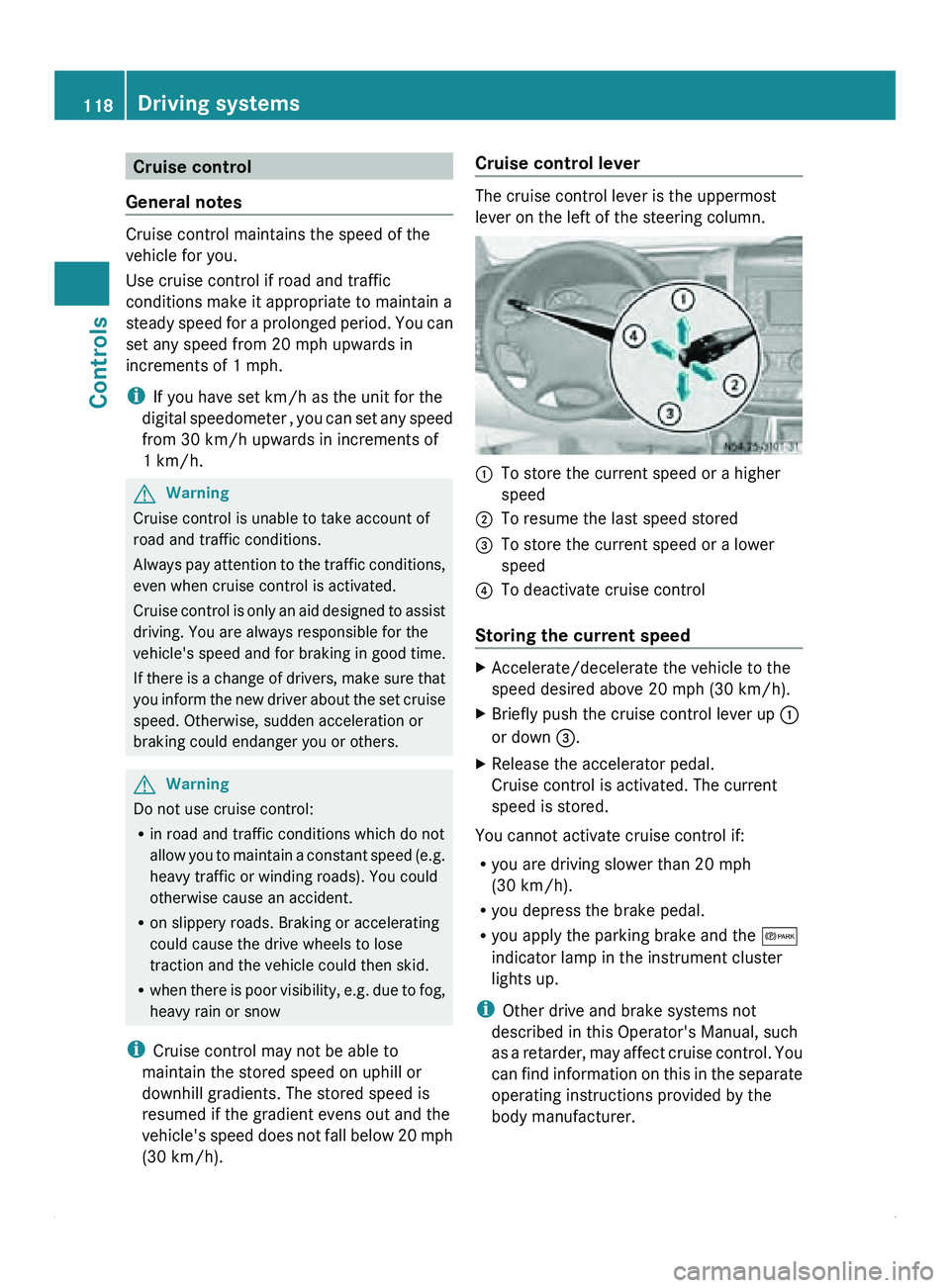
(30 km/h). Cruise control lever The cruise control lever is the uppermost
lever on the left of the steering column.
0046
To store the current speed or a higher
speed
0047 To resume the last speed stored
008A To store the current speed or a lower
speed
0088 To deactivate cruise control
Storing the current speed X
Accelerate/decelerate the vehicle to the
speed desired above 20 mph
(30 km/h).
X Briefly push the cruise control lever up 0046
or down 008A
.
X Release the accelerator pedal.
Cruise control is activated. The current
speed is stored.
You cannot activate cruise control if:
R you are driving slower than 20 mph
(30 km/h).
R you depress the brake pedal.
R you apply the parking brake and the 0066
indicator lamp in the instrument cluster
lights up.
i Other drive and brake systems not
described in this Operator's Manual, such
as a
retarder,
may affect cruise control. You
can find information on this in the separate
operating instructions provided by the
body manufacturer. 118
Driving systems
Controls
Page 140 of 292
Vehicle equipment
i Diese Betriebsanleitung beschreibt alle
Modelle, Serien- und
Sonderausstattungen
Ihres Fahrzeugs, die zum Zeitpunkt des
Redaktionsschlusses dieser
Betriebsanleitung erhältlich waren.
Länderspezifische Abweichungen sind
möglich. Beachten Sie, dass Ihr Fahrzeug
nicht mit allen beschriebenen Funktionen
ausgestattet sein könnte. Dies betrifft auch
sicherheitsrelevante Systeme und
Funktionen. Driving tips
Breaking-in
It is of decisive importance for the operating
life, reliability and
economy of the vehicle that
the engine is not subjected to its full rated
load during the breaking-in period.
Up to 1000 miles (1500 km)
R Run the vehicle in carefully. Drive at varying
road and engine speeds.
R Avoid heavy loads (driving at full throttle)
and high engine speeds. Do not exceed ¾
of the maximum speed for each gear.
R Do not change down a gear manually in
order to brake.
R Avoid depressing the accelerator pedal
beyond the pressure point (kickdown) and
only engage gear 4, 3, 2 or 1 while driving
slowly.
After 1000 miles (1500 km)
R Gradually bring the vehicle up to full road
and engine speeds.
i These instructions must also be observed
if you have the engine, the transmission, or
the rear axle differential of your vehicle
replaced. Driving abroad
An extensive network of authorized Sprinter
Dealers is also
at your disposal when you are
traveling abroad. The respective workshop
directories are available from any authorized
Sprinter Dealer.
In some countries, only fuels with a lower
octane rating or a higher sulfur content are
available.
You will find information about fuel in the
"Service products" section (Y page 153).
If you are traveling in countries where
vehicles are driven on the opposite side of the
road to that in which the vehicle is registered,
you must have the headlamps:
R partially masked (halogen headlamps)
R switched over (Bi-Xenon headlamps) G
Warning
Masking the headlamps incorrectly can
impair your visibility when driving with the
headlamps switched on. You could also
impede other road users. Oncoming traffic
may be dazzled.
Always have the headlamps masked/
switched over at a qualified specialist
workshop which has
the necessary specialist
knowledge and tools to carry out the work
required.
For this we recommend an authorized
Sprinter Dealer. All work relevant to safety or
on safety-related systems must be carried out
at a qualified specialist workshop. Driving off-road
When driving the vehicle, particularly on
rough terrain, ensure that the driven wheels
always have sufficient traction.
Avoid letting the drive wheels spin. Spinning
drive wheels can damage the differential.
! Always observe the ground clearance of
the vehicle and avoid obstacles, e.g. deep
ruts. 138
Driving tips
Operation
Page 141 of 292
Obstacles could damage the vehicle, for
example:
R
the axles
R the propeller shafts
and the transmission
R the tanks and supply reservoirs
For this reason, you should always drive
slowly when driving off-road. If you have to
drive over obstacles, have the co-driver
direct you. G
Warning
If you drive too fast off-road, you may not
recognize obstacles in good time or you may
underestimate the roughness of the ground.
When driving off-road, always drive slowly to
avoid damaging the vehicle.
The vehicle may slip to the side, tip and roll
over. Always drive along the line of fall when
you are on
a slope. Never drive across a slope.
Never turn the vehicle around on a slope. If
the vehicle cannot manage an uphill slope,
drive back down the slope in reverse gear.
You could lose control of the vehicle if you
shift the transmission to neutral or disengage
the clutch on an incline and then try to brake
the vehicle using only the service brake.
Never let the vehicle roll.
Overloading the vehicle will increase the risk
of the vehicle tipping over. Never exceed the
maximum permissible axle loads under any
circumstances. Keep the vehicle's center of
gravity as low as possible when the vehicle is
laden.
If the vehicle is frequently or mainly operated
in muddy or marshy terrain, substances that
impair braking efficiency, such as sand or oil
mixed with water, could get into the brake
system. This may lead to excessive wear and
a reduction in braking efficiency. In an
emergency, there is a risk that full braking
power may no longer be available.
After driving off-road, always carry out a short
brake test. If you detect a reduced braking
effect or hear grinding noises, have the brake
system checked at a qualified specialist workshop, for example at an authorized
Sprinter Dealer.
G
Warning
When driving off-road, your body is subject to
forces from all directions, due to the uneven
surface. There is a danger that you could be
thrown out of
your seat and be injured. Always
wear a seat belt, even when driving off-road.
Rules for driving off-road G
Warning
If you drive over obstacles or in ruts, the
steering wheel may jerk out of your grip and
you could injure the thumbs on both hands.
Always hold the steering wheel cross firmly
with both hands.
When driving over obstacles,
you must expect steering forces to increase
briefly and suddenly.
R Before driving off-road, stop the vehicle and
shift to a low gear.
R Only drive off-road with the engine running
and a gear engaged.
R Drive slowly and smoothly. Walking pace is
necessary in many situations.
R Make sure that the wheels always remain
in contact with the ground.
R Drive with extreme care over unknown
terrain where you can only see for a short
distance. As a precaution, get out of the
vehicle to take a look at the route to be
taken first.
R Check the water depth before fording.
R Watch out for obstacles (e.g. rocks, holes,
tree stumps and ruts).
R Avoid edges where the surface could
crumble or break away. Driving tips
139
Operation Z