jump start MERCEDES-BENZ SPRINTER 2013 MY13 Operator’s Manual
[x] Cancel search | Manufacturer: MERCEDES-BENZ, Model Year: 2013, Model line: SPRINTER, Model: MERCEDES-BENZ SPRINTER 2013Pages: 334, PDF Size: 3.88 MB
Page 265 of 334
Useful information
............................264
Where will I find...? ...........................264
Flat tire .............................................. 266
Jump-starting .................................... 267
Tow-starting and towing away ........268
Electrical fuses ................................. 271 263Breakdown assistance
Page 269 of 334
Jump-starting
Important safety notes
G
WARNING
During charging and jump-starting, explosive
gases can escape from the battery. There is a
risk of an explosion.
Particularly avoid fire, open flames, creating
sparks and smoking. Ensure there is sufficient
ventilation while charging and jump-starting.
Do not lean over a battery. G
WARNING
Battery acid is caustic. There is a risk of injury.
Avoid contact with the skin, eyes or clothing.
Do not inhale any battery gases. Do not lean
over the battery. Keep children away from
batteries. Wash battery acid immediately with
water and seek medical attention. G
WARNING
Non-combusted fuel can collect in the
exhaust system and ignite. There is a risk of
fire. Avoid repeated and lengthy starting
attempts.
Do not use a rapid charging device to start
the vehicle. If your vehicle's battery is
discharged, the engine can be jump-started
from another vehicle or from a donor battery
using jumper cables. For this purpose, the
vehicle has a jump-starting connection point
in the engine compartment.
The additional battery in the engine
compartmenti s not suitable for jump-starting
operations. If your vehicle requires jump-
starting, or if you use it to jump-start another
vehicle, use the jump-starting connection
point in the engine compartment.
When jump-starting, observe the following
points:
R The battery is not accessible in all vehicles.
If the other vehicle's battery is not accessible, jump-start the vehicle using a
donor battery or a jump-starting device.
R Do not start the engine if the battery is
frozen. Let the battery thaw first.
R Jump-starting may only be performed from
batteries with a nominal voltage of 12 V.
R Only use jumper cables that have a
sufficient cross-section and insulated
terminal clamps.
R If the battery is fully discharged, attach the
battery of another vehicle for a few minutes
before attempting to start. This charges the
empty battery a little.
R Make sure that the two vehicles do not
touch.
Make sure that:
R the jumper cables are not damaged.
R bare parts of the terminal clamps do not
come into contact with other metal parts
while the jumper cables are connected to
the battery.
R the jumper cables cannot come into
contact with parts such as the V-belt pulley
or the fan. These parts move when the
engine is started and while it is running.
i Jumper cables and further information
regarding jump starting can be obtained at
any qualified specialist workshop. Before connecting the jumper cables
On vehicles with a battery main switch, check
whether the battery main switch is switched
on (Y page 132).
X Apply the parking brake.
X Move the selector lever of the automatic
transmission to position P.
X Switch off all electrical consumers, e.g.
audio equipment, blower.
X Turn the key to position 0in the ignition
lock and remove it (Y page 133).
X Open the hood (Y page 240). Jump-starting
267Breakdown assistance Z
Page 271 of 334
Installing/removing the towing eye
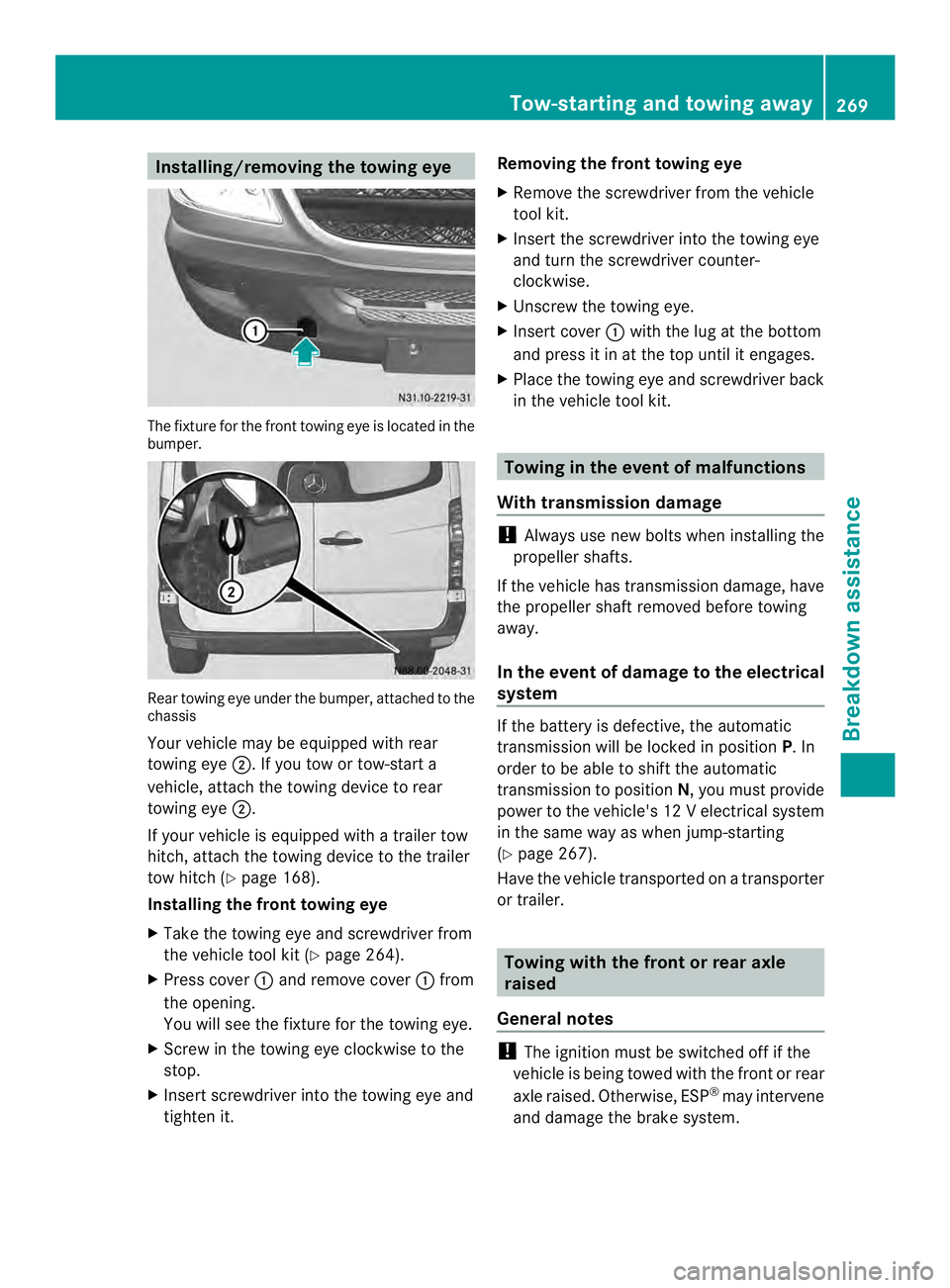
The fixture for the fron
ttowing eye is located in the
bumper. Rear towing eye under the bumper, attached to the
chassis
Your vehicle may be equipped with rear
towing eye 0006. If you tow or tow-start a
vehicle, attach the towing device to rear
towing eye 0006.
If your vehicle is equipped with a trailer tow
hitch, attach the towing device to the trailer
tow hitch (Y page 168).
Installing the front towing eye
X Take the towing eye and screwdriver from
the vehicle tool kit (Y page 264).
X Press cover 0005and remove cover 0005from
the opening.
You will see the fixture for the towing eye.
X Screw in the towing eye clockwise to the
stop.
X Insert screwdriver into the towing eye and
tighten it. Removing the front towing eye
X
Remove the screwdriver from the vehicle
tool kit.
X Insert the screwdriver into the towing eye
and turn the screwdriver counter-
clockwise.
X Unscrew the towing eye.
X Insert cover 0005with the lug at the bottom
and press it in at the top until it engages.
X Place the towing eye and screwdriver back
in the vehicle tool kit. Towing in the event of malfunctions
With transmission damage !
Always use new bolts when installing the
propeller shafts.
If the vehicle has transmission damage, have
the propeller shaft removed before towing
away.
In the event of damage to the electrical
system If the battery is defective, the automatic
transmission will be locked in position
P. In
order to be able to shift the automatic
transmission to position N, you must provide
power to the vehicle's 12 Velectrical system
in the same way as when jump-starting
(Y page 267).
Have the vehicle transported on a transporter
or trailer. Towing with the front or rear axle
raised
General notes !
The ignition must be switched off if the
vehicle is being towed with the front or rear
axle raised. Otherwise, ESP ®
may intervene
and damage the brake system. Tow-starting and towing away
269Breakdown assistance Z
Page 273 of 334
If the drive wheels get trapped on loose or
muddy ground, recover the vehicle with the
utmost care. This is especially the case if the
vehicle is laden.
Never attempt to recover a vehicle with a
traile rattached.
Pull ou tthe vehicle backwards, if possible,
using the tracks it made when it became
stuck. Transporting the vehicle
! Only lash the vehicle down by the wheels
or wheel rims, not by parts of the vehicle
such as axle or steering components.
Otherwise, the vehicle could be damaged.
The towing eye or trailer tow hitch can be
used to pull the vehicle onto a trailer or
transporter if you wish to transport it.
X Turn the key to position 2in the ignition
lock.
X Move the selector lever of the automatic
transmission to position N.
If the vehicle is loaded:
X Apply the parking brake.
X Move the selector lever of the automatic
transmission to position P.
X Turn the key to position 0in the ignition
lock and remove it.
X Lash down the vehicle. Tow-starting (emergency engine
starting)
Vehicles with automatic transmission !
Vehicles with automatic transmission
must not be tow-started. You could
otherwise damage the automatic
transmission.
Information on "Jump-starting" can be found
at the beginning of the "Breakdown
assistance" section (Y page 267). Electrical fuses
G
WARNING
Only use fuses that have been approved for
your vehicle and which have the correct fuse
rating for the systems concerned. Do not
repair or bypass defective fuses. Acircuit
overload could otherwise cause afire. Have
the cause determined and rectified at a
qualified specialist workshop.
! Only use fuses that have been approved
for Sprinter vehicles and that have the
required fuse rating for the systems
concerned. Components or systems could
otherwise be damaged.
The fuses in your vehicle switch off defective
power circuits. If a fuse blows, all the
components on the circuit and their functions
will cease to operate.
Blown fuses must be replaced with fuses of
the same rating, which you can recognize by
the color and fuse rating.
Observe the information about fuse rating in
the fuse allocation chart.
You can obtain advice fro maqualified
specialist workshop.
The fuse allocation chart and other
information on the fuses can be found in the
"Fuse allocation chart" supplement. Electrical fuses
271Breakdown assistance Z