open hood MERCEDES-BENZ SPRINTER 2013 MY13 Operator’s Manual
[x] Cancel search | Manufacturer: MERCEDES-BENZ, Model Year: 2013, Model line: SPRINTER, Model: MERCEDES-BENZ SPRINTER 2013Pages: 334, PDF Size: 3.88 MB
Page 221 of 334
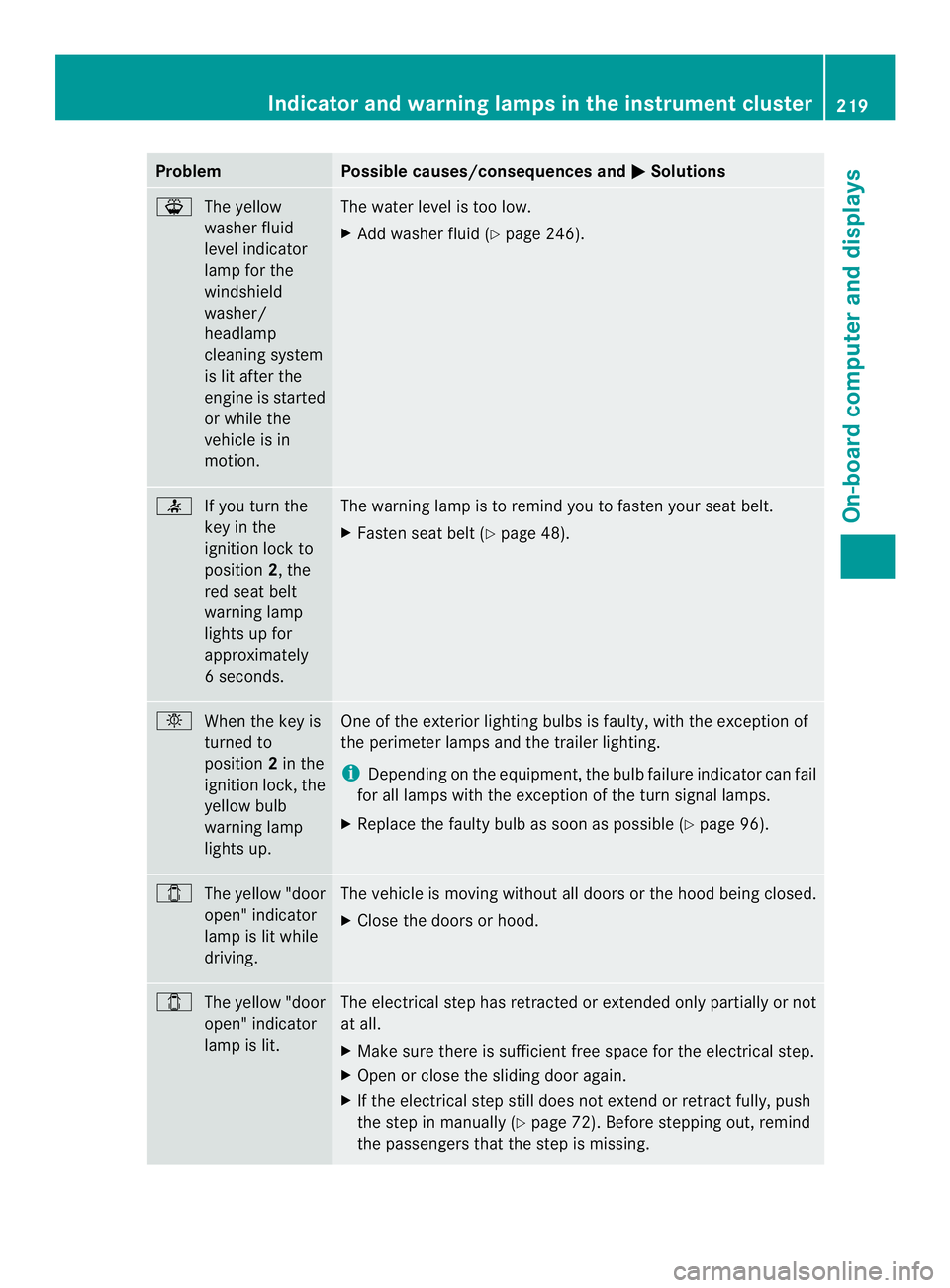
Problem Possible causes/consequences and
0004 Solutions
000F
The yellow
washer fluid
level indicator
lamp for the
windshield
washer/
headlamp
cleaning system
is lit after the
engine is started
or while the
vehicle is in
motion. The water level is too low.
X
Add washer fluid (Y page 246). 0014
If you turn the
key in the
ignition lock to
position 2, the
red seat belt
warning lamp
lights up for
approximately
6s econds. The warning lamp is to remind you to fasten your seat belt.
X
Fasten seat belt (Y page 48). 0002
When the key is
turned to
position 2in the
ignition lock, the
yellow bulb
warning lamp
lights up. One of the exterior lighting bulbs is faulty, with the exception of
the perimeter lamps and the trailer lighting.
i
Depending on the equipment, the bulb failure indicator can fail
for all lamps with the exception of the turn signal lamps.
X Replace the faulty bulb as soon as possible (Y page 96).0004
The yellow "door
open" indicator
lamp is lit while
driving. The vehicle is moving without all doors or the hood being closed.
X
Close the doors or hood. 0004
The yellow "door
open" indicator
lamp is lit. The electrical step has retracted or extended only partially or not
at all.
X Make sure there is sufficien tfree space for the electrical step.
X Open or close the sliding door again.
X If the electrical step still does not extend or retract fully, push
the step in manually (Y page 72). Before stepping out, remind
the passengers that the step is missing. Indicator and warnin
glamps in the instrument cluster
219On-board computer and displays Z
Page 242 of 334
Useful information
This Operator's Manual describes all models
as well as standard and optional equipment
of your vehicle that were available at the time
of going to print. Country-specific variations
are possible. Note that your vehicle may not
be equipped with all of the described
functions. This also applies to systems and
functions relevant to safety.
Read the information on qualified specialist
workshops (Y page 26). Engine compartment
Hood
Opening the hood G
WARNING
If the hood is unlatched, it may open up when
the vehicle is in motion and block your view.
There is a risk of an accident.
Never unlatch the hood while driving. G
WARNING
Opening the hood when the engine is
overheated or when there is a fire in the
engine compartmen tcould expose you to hot
gases or other service products. There is a
risk of injury.
Let an overheated engine cool down before
opening the hood. If there is a fire in the
engine compartment, keep the hood closed
and contact the fire department. G
WARNING
Certain components in the engine
compartment, such as the engine, radiator
and parts of the exhaust system, can become
very hot. Working in the engine compartment
poses a risk of injury.
Where possible, let the engine cool down and
touch only the components described in the
following. G
WARNING
The engine compartment contains moving
components. Certain components, such as
the radiator fan, may continue to run or start
again suddenly when the ignition is off. There
is a risk of injury.
If you need to do any work inside the engine
compartment,
R switch off the ignition
R never reach into the area where there is a
risk of danger from moving components,
such as the fan rotation area
R keep clothing away from moving parts G
WARNING
The fuel injection system operates with a high
voltage. If you touch the live components, you
could receive an electric shock. There is a risk
of injury.
Never touch components of the fuel injection
system when the ignition is switched on.
The live components of the fuel injection
system are, for example, the injectors.
! Make sure that the windshield wipers are
not folded away from the windshield. You
could otherwise damage the windshield
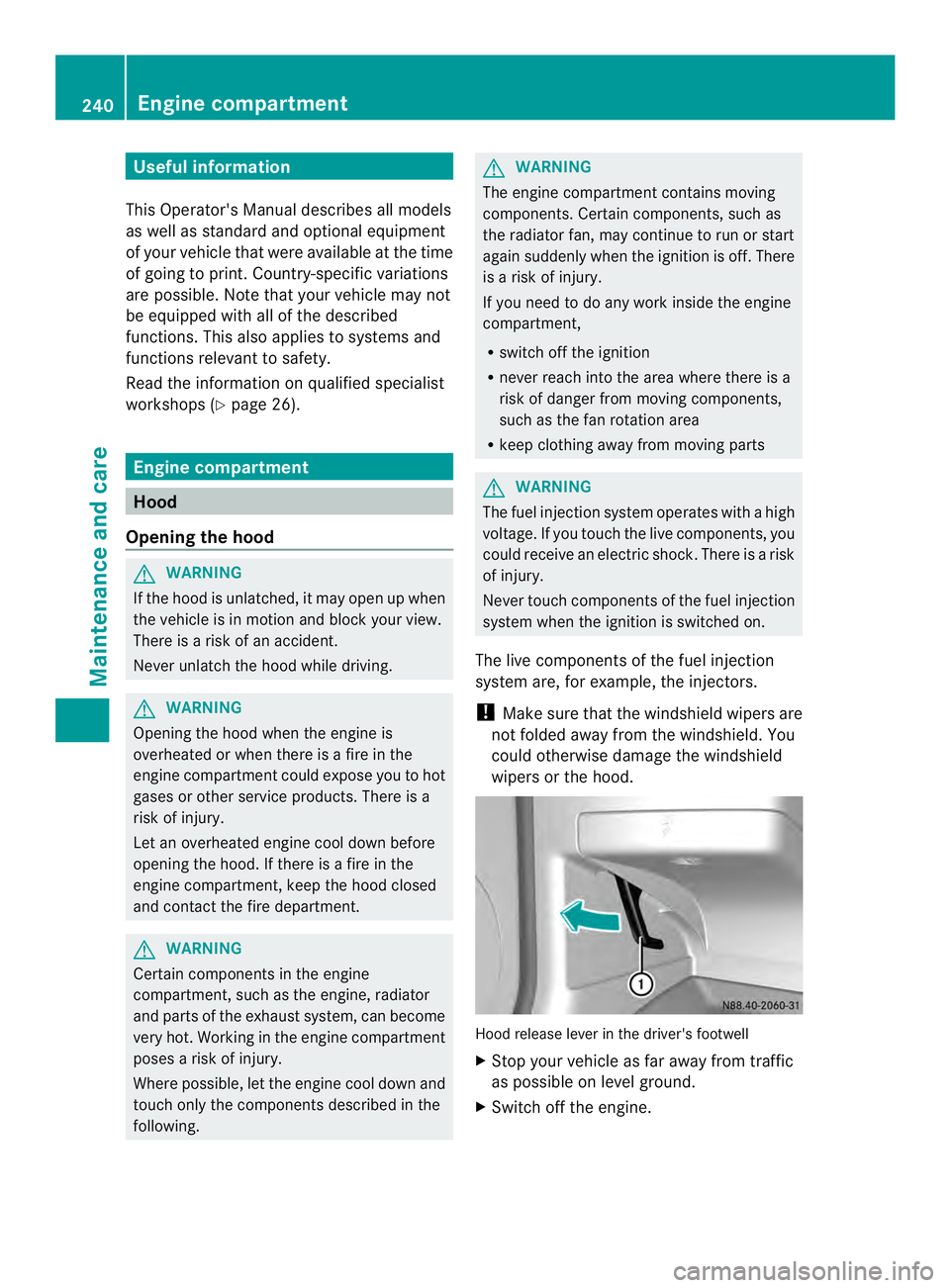
wipers or the hood. Hood release lever in the driver's footwell
X
Stop your vehicle as far away from traffic
as possible on level ground.
X Switch off the engine. 240
Engine compartmentMaintenance and care
Page 243 of 334
X
Secure the vehicle to prevent it from rolling
away.
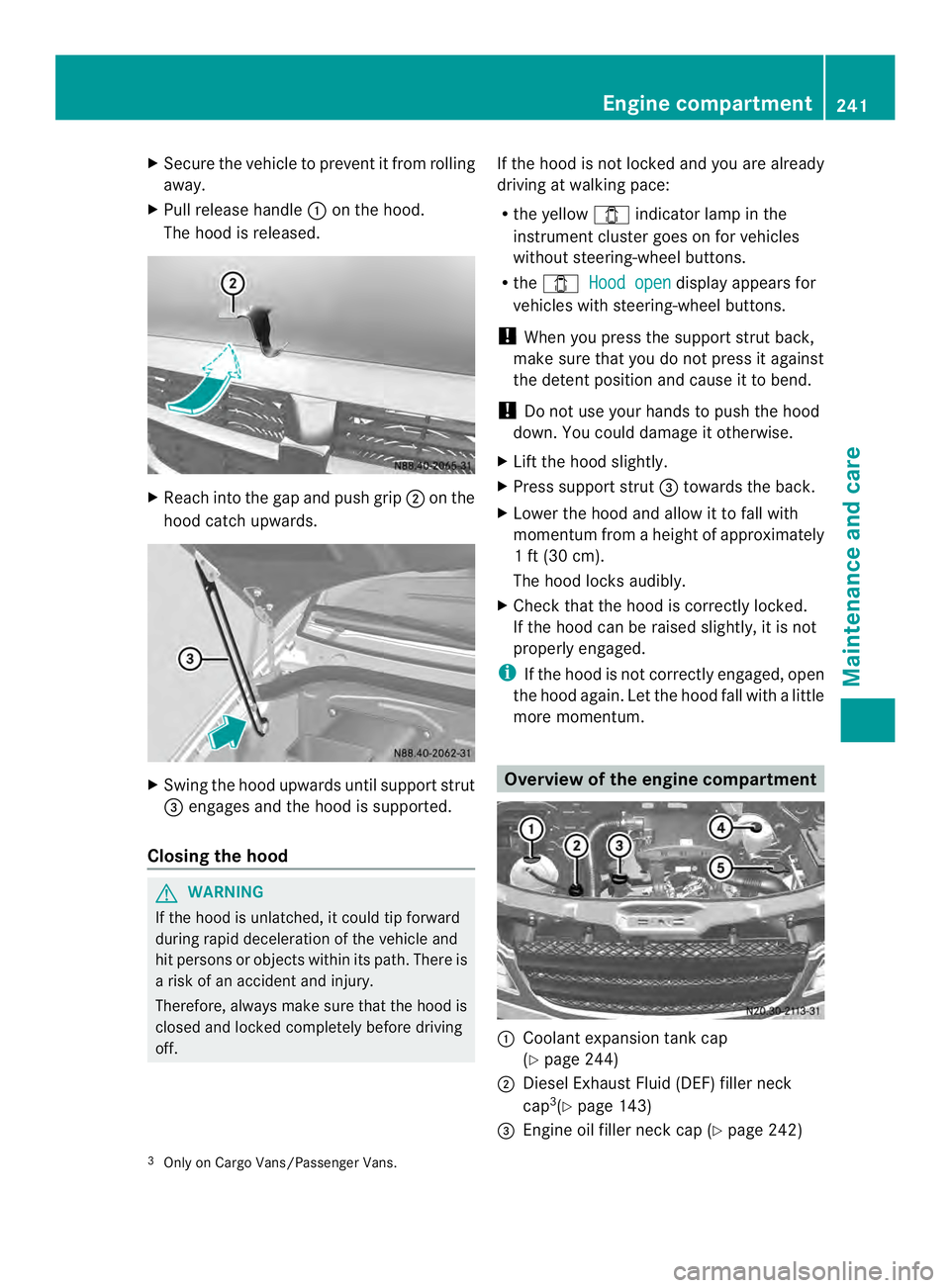
X Pull release handle 0005on the hood.
The hood is released. X
Reach into the gap and push grip 0006on the
hood catch upwards. X
Swing the hood upwards unti lsuppor tstrut
0026 engages and the hood is supported.
Closing the hood G
WARNING
If the hood is unlatched, it could tip forward
during rapid deceleratio nofthe vehicle and
hit persons or objects within its path. There is
a risk of an accident and injury.
Therefore, always make sure that the hood is
closed and locked completely before driving
off. If the hood is not locked and you are already
driving at walking pace:
R
the yellow 0004indicator lamp in the
instrumentc luster goes on for vehicles
without steering-wheel buttons.
R the 0004 Hood open display appears for
vehicles with steering-wheel buttons.
! When you press the support strut back,
make sure that you do not press it against
the detent position and cause it to bend.
! Do not use your hands to push the hood
down. You could damage it otherwise.
X Lift the hood slightly.
X Press support strut 0026towards the back.
X Lower the hood and allow it to fall with
momentum fro maheight of approximately
1 ft (30 cm).
The hood locks audibly.
X Check that the hood is correctly locked.
If the hood can be raised slightly, it is not
properly engaged.
i If the hood is not correctly engaged, open
the hood again. Let the hood fall with a little
more momentum. Overview of the engine compartment
0005
Coolant expansion tank cap
(Ypage 244)
0006 Diesel Exhaust Fluid (DEF) filler neck
cap 3
(Y page 143)
0026 Engine oil filler neck cap (Y page 242)
3 Only on Cargo Vans/Passenger Vans. Engine compartment
241Maintenance and care Z
Page 245 of 334
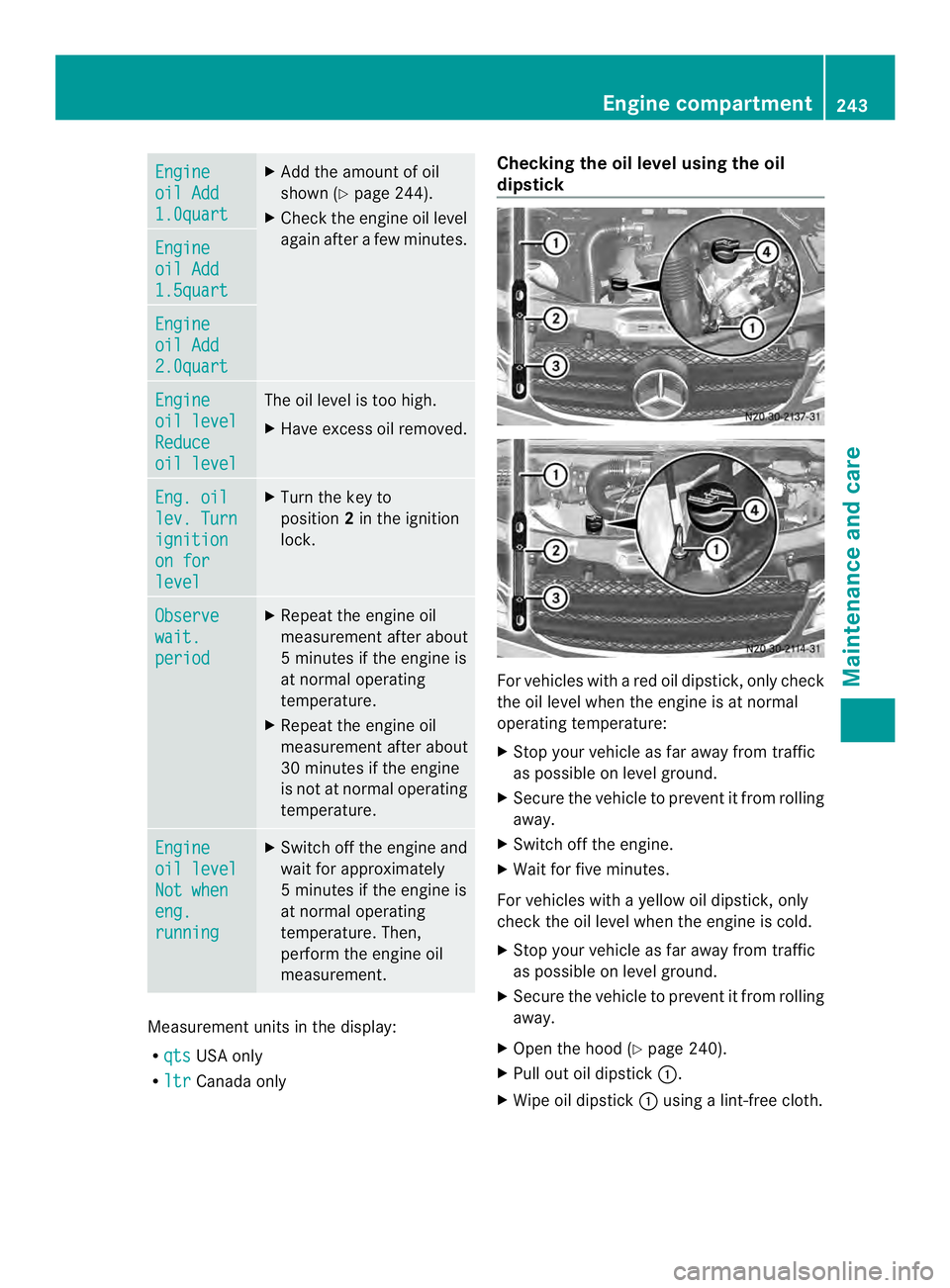
Engine
oil Add
1.0quart X
Add the amount of oil
shown (Y page 244).
X Check the engine oil level
againa fter a few minutes. Engine
oil Add
1.5quart
Engine
oil Add
2.0quart
Engine
oil level
Reduce
oil level The oil level is too high.
X
Have excess oil removed. Eng. oil
lev. Turn
ignition
on for
level X
Turn the key to
position 2in the ignition
lock. Observe
wait.
period X
Repeat the engine oil
measurement after about
5 minutes if the engine is
at normal operating
temperature.
X Repeat the engine oil
measurement after about
30 minutes if the engine
is not at normal operating
temperature. Engine
oil level
Not when
eng.
running X
Switch off the engine and
wait for approximately
5 minutes if the engine is
at normal operating
temperature. Then,
perform the engine oil
measurement. Measurement units in the display:
R
qts USA only
R ltr Canada only Checking the oil level using the oil
dipstick
For vehicles with a red oil dipstick, only check
the oil level whe
nthe engine is at normal
operating temperature:
X Stop your vehicle as far away from traffic
as possible on level ground.
X Secure the vehicle to prevent it from rolling
away.
X Switch off the engine.
X Wait for five minutes.
For vehicles with a yellow oil dipstick, only
check the oil level when the engine is cold.
X Stop your vehicle as far away from traffic
as possible on level ground.
X Secure the vehicle to prevent it from rolling
away.
X Open the hood (Y page 240).
X Pull out oil dipstick 0005.
X Wipe oil dipstick 0005using a lint-free cloth. Engine compartment
243Maintenance and care Z
Page 246 of 334
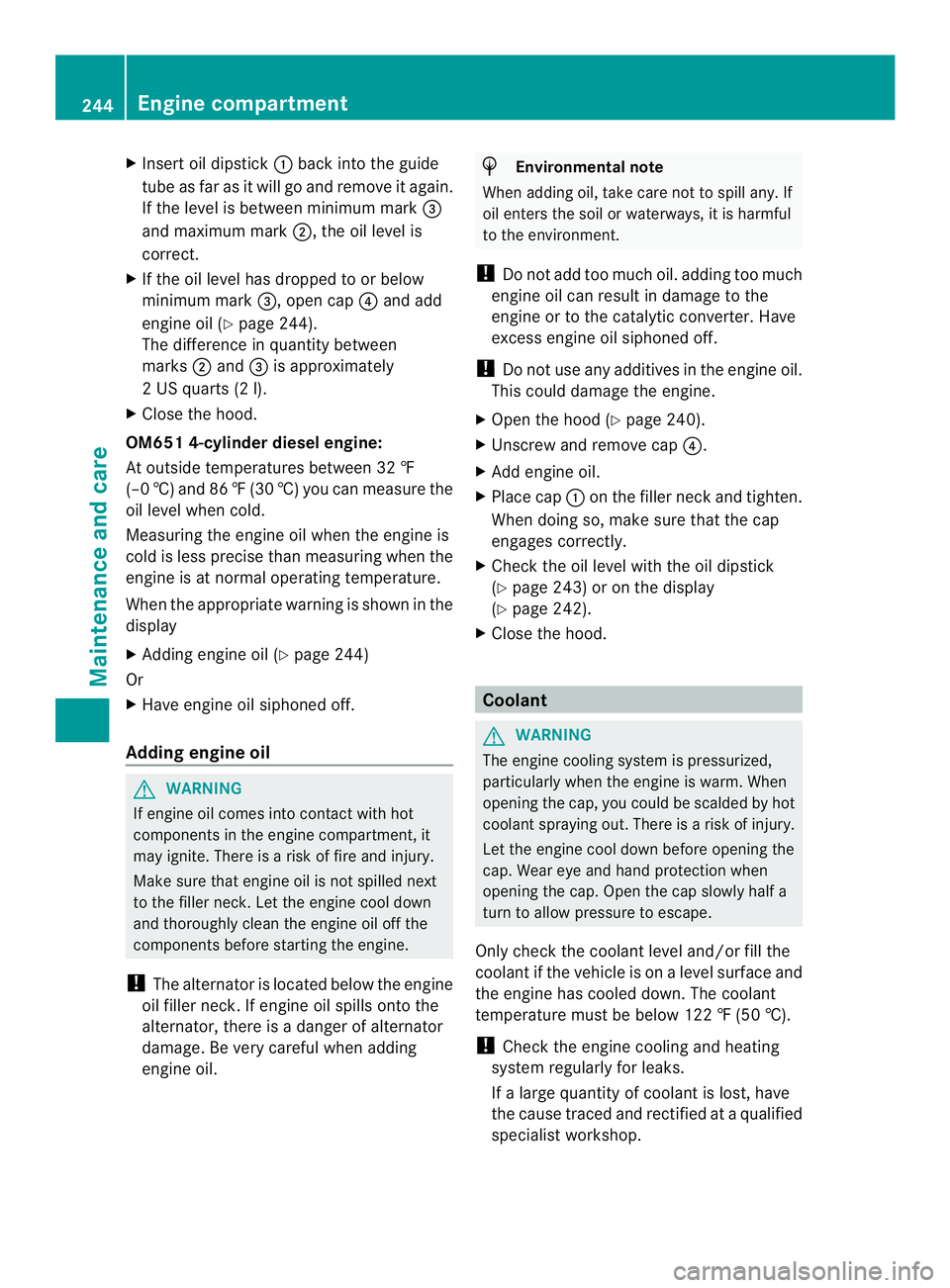
X
Insert oil dipstick 0005back into the guide
tube as far as it will go and remove it again.
If the level is between minimum mark 0026
and maximum mark 0006, the oil level is
correct.
X If the oil level has droppe dto or below
minimum mark 0026, open cap0025and add
engine oil (Y page 244).
The difference in quantity between
marks 0006and 0026is approximately
2 US quarts (2 l).
X Close the hood.
OM651 4-cylinder diesel engine:
At outside temperatures between 32 ‡
(–0 †) and 86 ‡(30 †) you can measure the
oil level whe ncold.
Measuring the engine oil when the engine is
cold is less precise than measuring when the
engine is at normal operating temperature.
When the appropriate warning is shown in the
display
X Adding engine oil (Y page 244)
Or
X Have engine oil siphoned off.
Adding engine oil G
WARNING
If engine oil comes into contact with hot
components in the engine compartment, it
may ignite. There is a risk of fire and injury.
Make sure that engine oil is not spilled next
to the filler neck. Let the engine cool down
and thoroughly clean the engine oil off the
components before starting the engine.
! The alternator is located below the engine
oil filler neck.Ife ngine oil spills onto the
alternator, there is a dange rofalternator
damage. Be very careful when adding
engine oil. H
Environmental note
When adding oil, take care not to spill any. If
oil enters the soil or waterways, it is harmful
to the environment.
! Do not add too much oil. adding too much
engine oil can result in damage to the
engine or to the catalytic converter. Have
excess engine oil siphoned off.
! Do not use any additives in the engine oil.
This could damage the engine.
X Open the hood (Y page 240).
X Unscrew and remove cap 0025.
X Add engine oil.
X Place cap 0005on the filler nec kand tighten.
Whe ndoing so, make sure that the cap
engages correctly.
X Check the oil level with the oil dipstick
(Y page 243) or on the display
(Y page 242).
X Close the hood. Coolant
G
WARNING
The engine cooling system is pressurized,
particularly when the engine is warm. When
opening the cap, you could be scalded by hot
coolant spraying out. There is a risk of injury.
Let the engine cool down before opening the
cap. Wear eye and hand protection when
opening the cap. Open the cap slowly half a
turn to allow pressure to escape.
Only check the coolant level and/or fill the
coolant if the vehicle is on a level surface and
the engine has cooled down. The coolant
temperature must be below 122 ‡ (50 †).
! Check the engine cooling and heating
system regularly for leaks.
If a large quantity of coolant is lost, have
the cause traced and rectified at a qualified
specialist workshop. 244
Engine compartmentMaintenance and care
Page 247 of 334
G
WARNING
Coolant contains glycol and is therefore toxic.
Do not swallow the coolant. See a doctor
immediately if you swallow coolant.
Make sure that coolant does not come into
contact with skin, eyesorc lothing. In case of
contac twith eyes, rinse immediately with
plenty of clean water .Clean affected areas of
skin and clothing with soap and water
immediately. Change any affected clothing
immediately. G
WARNING
If antifreeze comes into contact with hot
components in the engine compartment, it
may ignite. There is a risk of fire and injury.
Let the engine cool down before you add
antifreeze. Make sure that antifreeze is not
spilled nex tto the filler neck.T horoughly
clean the antifreeze from components before
starting the engine.
! Take care not to spill any coolant on
painted surfaces. You could otherwise
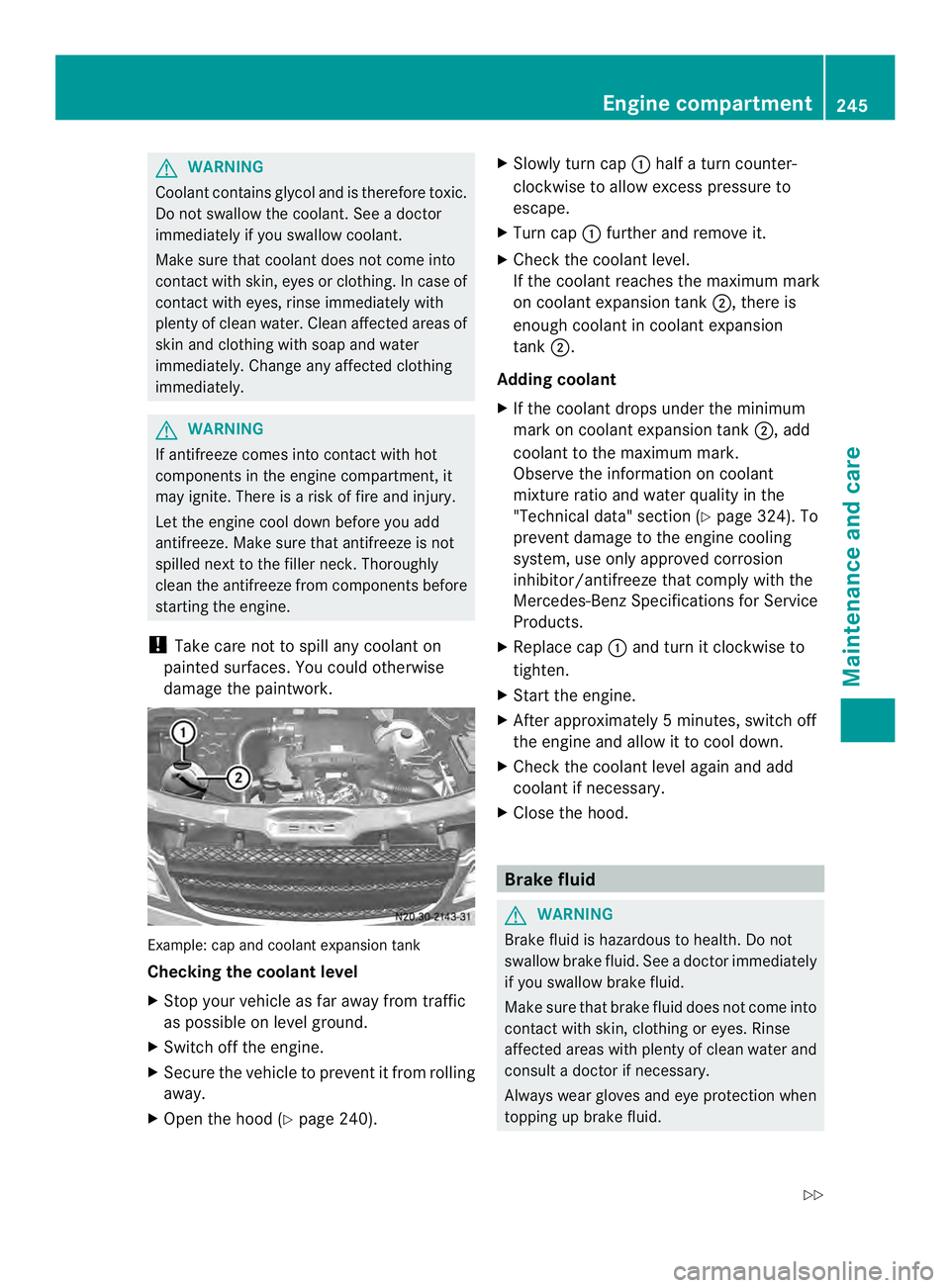
damage the paintwork. Example: cap and coolant expansion tank
Checking the coolant level
X
Stop your vehicle as far away from traffic
as possible on level ground.
X Switch off the engine.
X Secure the vehicle to prevent it from rolling
away.
X Open the hood (Y page 240). X
Slowly turn cap 0005half a turn counter-
clockwise to allow excess pressure to
escape.
X Turn cap 0005further and remove it.
X Check the coolant level.
If the coolant reaches the maximum mark
on coolant expansion tank 0006, there is
enough coolant in coolant expansion
tank 0006.
Adding coolant
X If the coolant drops under the minimum
mark on coolant expansion tank 0006, add
coolant to the maximum mark.
Observe the information on coolant
mixture ratio and water quality in the
"Technical data" section (Y page 324). To
prevent damage to the engine cooling
system, use only approved corrosion
inhibitor/antifreeze that comply with the
Mercedes-Benz Specifications for Service
Products.
X Replace cap 0005and turn it clockwise to
tighten.
X Start the engine.
X After approximately 5minutes, switch off
the engine and allow it to cool down.
X Check the coolan tlevel again and add
coolant if necessary.
X Close the hood. Brake fluid
G
WARNING
Brake fluid is hazardous to health. Do not
swallow brake fluid. See adoctor immediately
if you swallow brake fluid.
Make sure that brake fluid does not come into
contact with skin, clothing or eyes. Rinse
affected areas with plenty of clean water and
consult a doctor if necessary.
Always wear gloves and eye protection when
topping up brake fluid. Engine compartment
245Maintenance and care
Z
Page 248 of 334
Store brake fluid only in the original closed
container and keep it out of the reach of
children. Comply with safety regulations
when handling brake fluid.
! Brake fluid corrodes paint, plastic and
rubber .Ifpaint, plastic or rubbe rhas come
into contact with brake fluid, rinse with
wate rimmediately. G
WARNING
The brake fluid constantly absorbs moisture
from the air. This lowers the boiling point of
the brake fluid. If the boiling point of the brake
fluid is too low, vapo rpockets may form in the
brake system when the brakes are applied
hard. This would impair braking efficiency.
There is a risk of an accident.
You should have the brake fluid renewed at
the specified intervals.
! If the brake fluid level in the brake fluid
reservoir has fallen to the MIN mark or
below, check the brake system
immediately for leaks. Also check the
thickness of the brake linings. Visit a
qualified specialist workshop immediately.
Do not add brake fluid. This does not
correct the malfunction.
Have the brake fluid renewed every two
years.
Observe the information on brake fluid in the
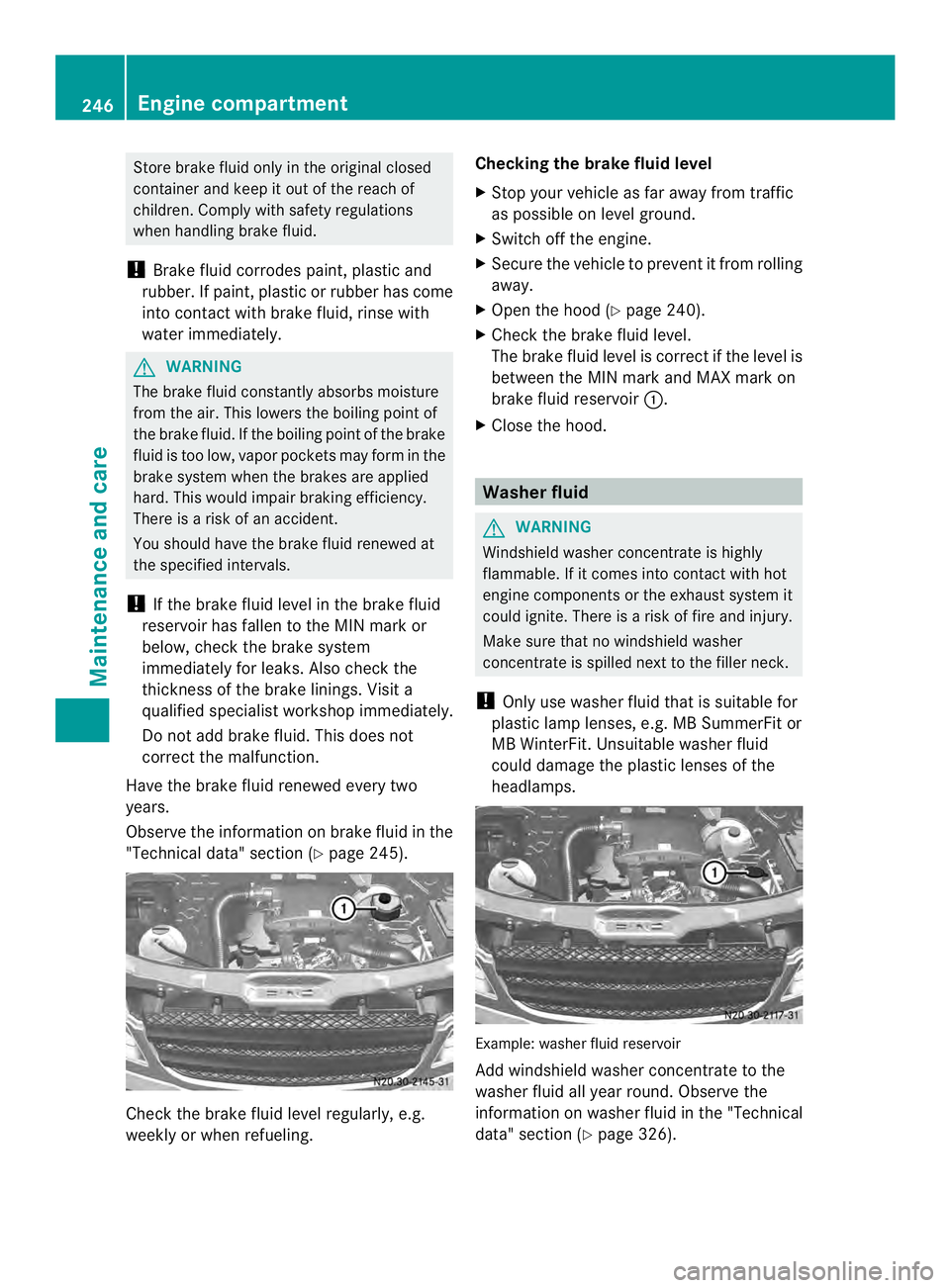
"Technical data" section ( Ypage 245). Check the brake fluid level regularly, e.g.
weekly or when refueling. Checking the brake fluid level
X
Stop your vehicle as far away from traffic
as possible on level ground.
X Switch off the engine.
X Secure the vehicle to prevent it from rolling
away.
X Open the hood (Y page 240).
X Check the brake fluid level.
The brake fluid level is correc tifthe level is
between the MIN mark and MAX mark on
brake fluid reservoir 0005.
X Close the hood. Washer fluid
G
WARNING
Windshield washer concentrate is highly
flammable. If it comes into contact with hot
engine components or the exhaust system it
could ignite. There is a risk of fire and injury.
Make sure that no windshield washer
concentrate is spilled next to the filler neck.
! Only use washer fluid that is suitable for
plastic lamp lenses, e.g. MB SummerFit or
MB WinterFit. Unsuitable washer fluid
could damage the plastic lenses of the
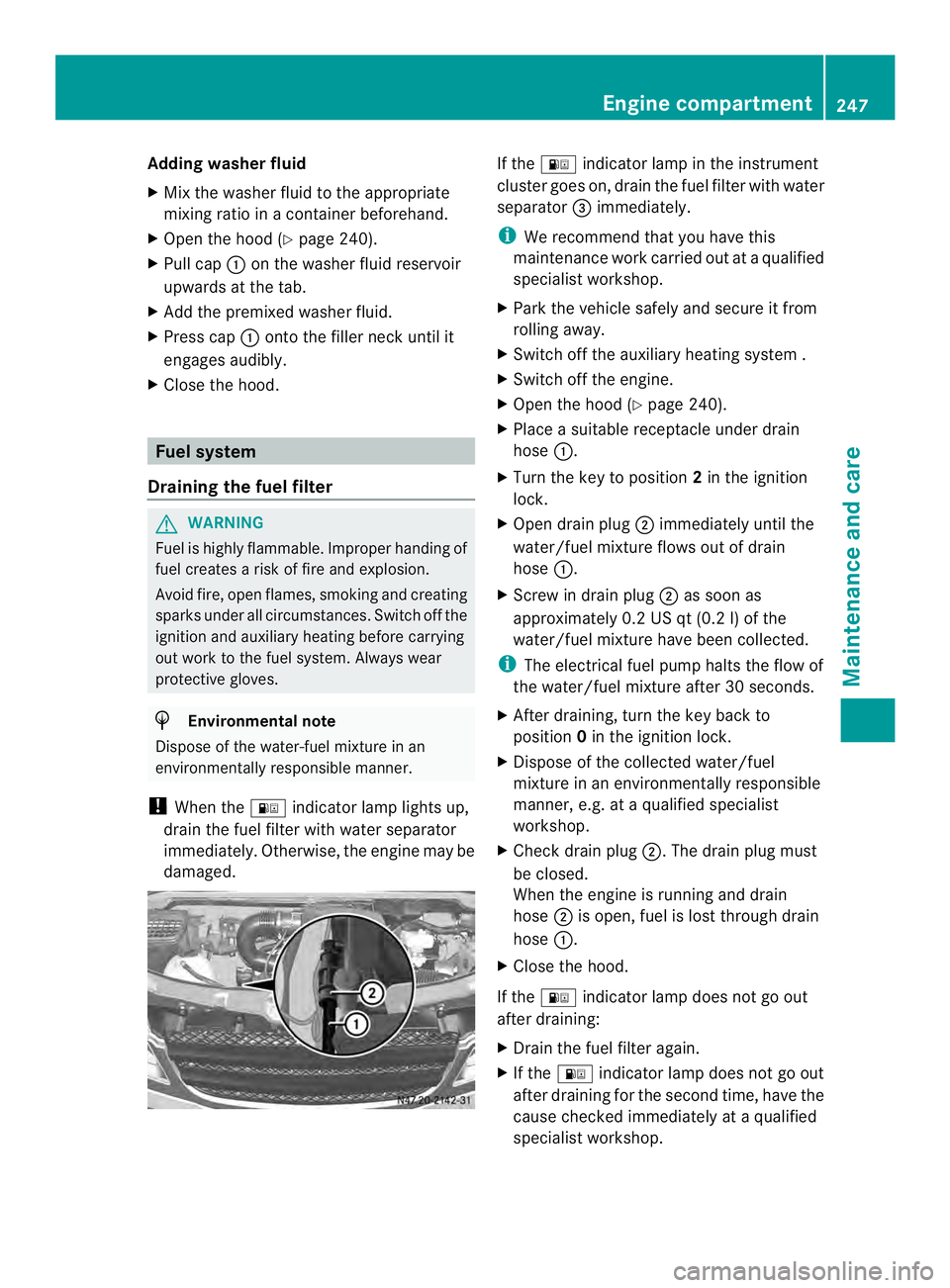
headlamps. Example: washer fluid reservoir
Add windshield washer concentrate to the
washer fluid all year round. Observe the
information on washer fluid in the "Technical
data" section (Y
page 326).246
Engine compartmentMaintenance and care
Page 249 of 334
Adding washer fluid
X
Mix the washe rfluid to the appropriate
mixing ratio in a container beforehand.
X Open the hood (Y page 240).
X Pull cap 0005on the washer fluid reservoir
upwards at the tab.
X Add the premixed washer fluid.
X Press cap 0005onto the filler neck until it
engages audibly.
X Close the hood. Fuel system
Draining the fuel filter G
WARNING
Fuel is highly flammable. Improper handing of
fuel creates a risk of fire and explosion.
Avoid fire, open flames ,smoking and creating
sparks under all circumstances. Switch off the
ignitio nand auxiliary heating before carrying
ou tw ork to the fuel system. Always wear
protective gloves. H
Environmental note
Dispose of the water-fuel mixture in an
environmentally responsible manner.
! When the 000Eindicator lamp lights up,
drain the fuel filter with water separator
immediately. Otherwise, the engine may be
damaged. If the
000E indicator lamp in the instrument
cluster goes on, drain the fuel filter with water
separator 0026immediately.
i We recommend that you have this
maintenance work carried out at a qualified
specialist workshop.
X Park the vehicle safely and secure it from
rolling away.
X Switch off the auxiliary heating system .
X Switch off the engine.
X Open the hood (Y page 240).
X Place a suitable receptacle under drain
hose 0005.
X Turn the key to position 2in the ignition
lock.
X Open drain plug 0006immediately until the
water/fuel mixture flows out of drain
hose 0005.
X Screw in drain plug 0006as soon as
approximately 0.2 US qt (0.2 l) of the
water/fuel mixture have been collected.
i The electrical fuel pump halts the flow of
the water/fuel mixture after 30 seconds.
X After draining, turn the key back to
position 0in the ignition lock.
X Dispose of the collected water/fuel
mixture in an environmentally responsible
manner, e.g. at a qualified specialist
workshop.
X Check drain plug 0006.The drain plug must
be closed.
When the engine is running and drain
hose 0006is open, fuel is lost through drain
hose 0005.
X Close the hood.
If the 000E indicator lamp does not go out
after draining:
X Drain the fuel filter again.
X If the 000E indicator lamp does not go out
after draining for the second time, have the
cause checked immediately at a qualified
specialist workshop. Engine compartment
247Maintenance and care Z
Page 256 of 334
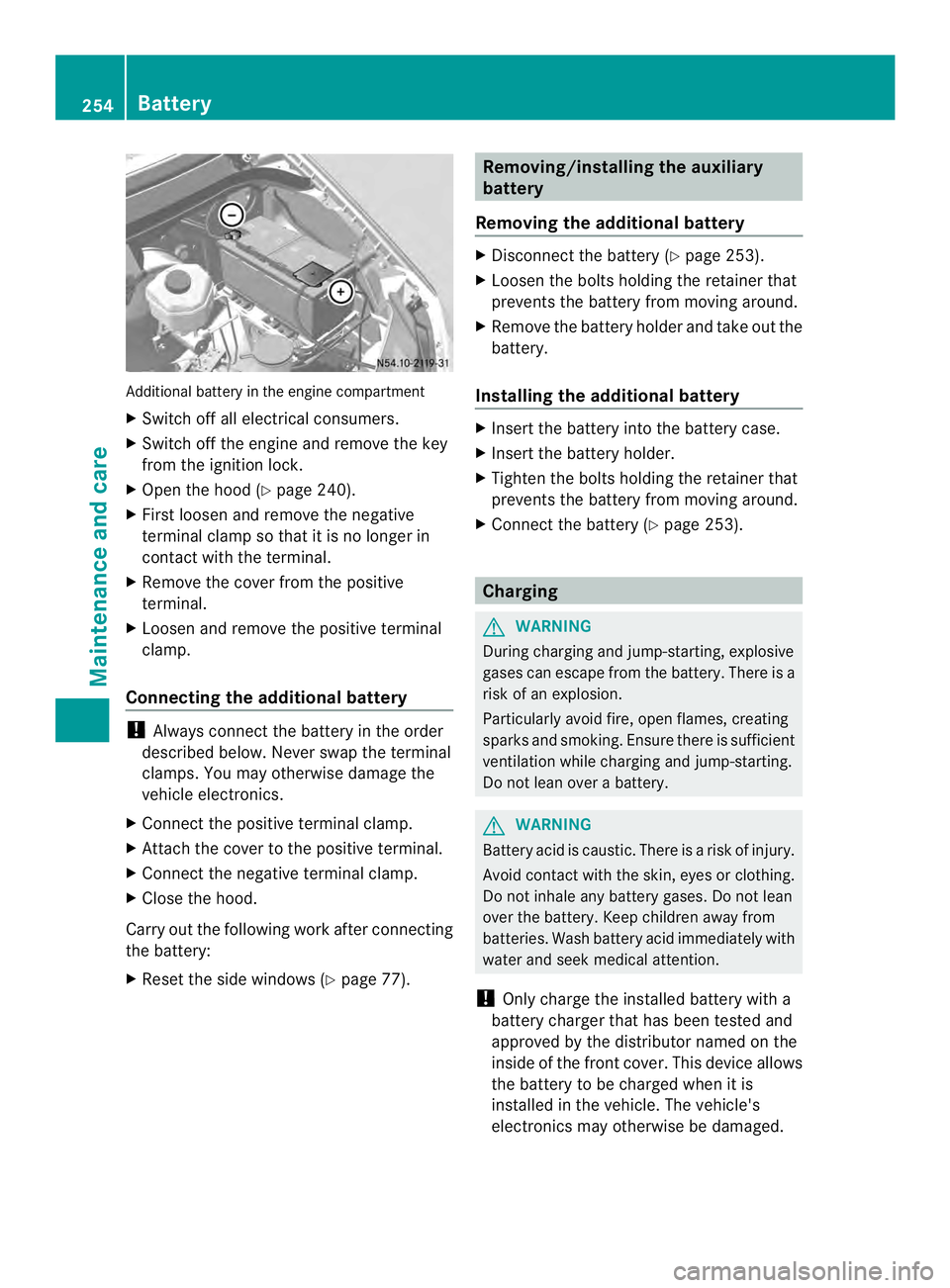
Additional battery in the engine compartment
X
Switch off all electrical consumers.
X Switch off the engine and remove the key
from the ignition lock.
X Ope nthe hood (Y page 240).
X First loosen and remove the negative
terminal clamp so that it is no longer in
contact with the terminal.
X Remove the cover from the positive
terminal.
X Loosen and remove the positive terminal
clamp.
Connecting the additional battery !
Always connect the battery in the order
described below. Never swap the terminal
clamps. You may otherwise damage the
vehicle electronics.
X Connect the positive terminal clamp.
X Attach the cover to the positive terminal.
X Connect the negative terminal clamp.
X Close the hood.
Carry out the following work after connecting
the battery:
X Reset the side windows (Y page 77). Removing/installing the auxiliary
battery
Removing the additional battery X
Disconnect the battery (Y page 253).
X Loosen the bolts holding the retainer that
prevents the battery from moving around.
X Remove the battery holder and take out the
battery.
Installing the additional battery X
Insert the battery into the battery case.
X Insert the battery holder.
X Tighten the bolts holding the retainer that
prevents the battery from moving around.
X Connect the battery (Y page 253). Charging
G
WARNING
During charging and jump-starting, explosive
gases can escape from the battery. There is a
risk of an explosion.
Particularly avoid fire, open flames, creating
sparks and smoking. Ensure there is sufficient
ventilation while charging and jump-starting.
Do not lean over a battery. G
WARNING
Battery acid is caustic. There is a risk of injury.
Avoid contact with the skin, eyes or clothing.
Do not inhale any battery gases. Do not lean
over the battery. Keep children away from
batteries. Wash battery acid immediately with
water and seek medical attention.
! Only charge the installed battery with a
battery charger that has been tested and
approved by the distributor named on the
inside of the front cover. This device allows
the battery to be charged when it is
installed in the vehicle. The vehicle's
electronics may otherwise be damaged. 254
BatteryMaintenance and care
Page 269 of 334
Jump-starting
Important safety notes
G
WARNING
During charging and jump-starting, explosive
gases can escape from the battery. There is a
risk of an explosion.
Particularly avoid fire, open flames, creating
sparks and smoking. Ensure there is sufficient
ventilation while charging and jump-starting.
Do not lean over a battery. G
WARNING
Battery acid is caustic. There is a risk of injury.
Avoid contact with the skin, eyes or clothing.
Do not inhale any battery gases. Do not lean
over the battery. Keep children away from
batteries. Wash battery acid immediately with
water and seek medical attention. G
WARNING
Non-combusted fuel can collect in the
exhaust system and ignite. There is a risk of
fire. Avoid repeated and lengthy starting
attempts.
Do not use a rapid charging device to start
the vehicle. If your vehicle's battery is
discharged, the engine can be jump-started
from another vehicle or from a donor battery
using jumper cables. For this purpose, the
vehicle has a jump-starting connection point
in the engine compartment.
The additional battery in the engine
compartmenti s not suitable for jump-starting
operations. If your vehicle requires jump-
starting, or if you use it to jump-start another
vehicle, use the jump-starting connection
point in the engine compartment.
When jump-starting, observe the following
points:
R The battery is not accessible in all vehicles.
If the other vehicle's battery is not accessible, jump-start the vehicle using a
donor battery or a jump-starting device.
R Do not start the engine if the battery is
frozen. Let the battery thaw first.
R Jump-starting may only be performed from
batteries with a nominal voltage of 12 V.
R Only use jumper cables that have a
sufficient cross-section and insulated
terminal clamps.
R If the battery is fully discharged, attach the
battery of another vehicle for a few minutes
before attempting to start. This charges the
empty battery a little.
R Make sure that the two vehicles do not
touch.
Make sure that:
R the jumper cables are not damaged.
R bare parts of the terminal clamps do not
come into contact with other metal parts
while the jumper cables are connected to
the battery.
R the jumper cables cannot come into
contact with parts such as the V-belt pulley
or the fan. These parts move when the
engine is started and while it is running.
i Jumper cables and further information
regarding jump starting can be obtained at
any qualified specialist workshop. Before connecting the jumper cables
On vehicles with a battery main switch, check
whether the battery main switch is switched
on (Y page 132).
X Apply the parking brake.
X Move the selector lever of the automatic
transmission to position P.
X Switch off all electrical consumers, e.g.
audio equipment, blower.
X Turn the key to position 0in the ignition
lock and remove it (Y page 133).
X Open the hood (Y page 240). Jump-starting
267Breakdown assistance Z