park assist MERCEDES-BENZ SPRINTER 2013 MY13 Operator’s Manual
[x] Cancel search | Manufacturer: MERCEDES-BENZ, Model Year: 2013, Model line: SPRINTER, Model: MERCEDES-BENZ SPRINTER 2013Pages: 334, PDF Size: 3.88 MB
Page 273 of 334
If the drive wheels get trapped on loose or
muddy ground, recover the vehicle with the
utmost care. This is especially the case if the
vehicle is laden.
Never attempt to recover a vehicle with a
traile rattached.
Pull ou tthe vehicle backwards, if possible,
using the tracks it made when it became
stuck. Transporting the vehicle
! Only lash the vehicle down by the wheels
or wheel rims, not by parts of the vehicle
such as axle or steering components.
Otherwise, the vehicle could be damaged.
The towing eye or trailer tow hitch can be
used to pull the vehicle onto a trailer or
transporter if you wish to transport it.
X Turn the key to position 2in the ignition
lock.
X Move the selector lever of the automatic
transmission to position N.
If the vehicle is loaded:
X Apply the parking brake.
X Move the selector lever of the automatic
transmission to position P.
X Turn the key to position 0in the ignition
lock and remove it.
X Lash down the vehicle. Tow-starting (emergency engine
starting)
Vehicles with automatic transmission !
Vehicles with automatic transmission
must not be tow-started. You could
otherwise damage the automatic
transmission.
Information on "Jump-starting" can be found
at the beginning of the "Breakdown
assistance" section (Y page 267). Electrical fuses
G
WARNING
Only use fuses that have been approved for
your vehicle and which have the correct fuse
rating for the systems concerned. Do not
repair or bypass defective fuses. Acircuit
overload could otherwise cause afire. Have
the cause determined and rectified at a
qualified specialist workshop.
! Only use fuses that have been approved
for Sprinter vehicles and that have the
required fuse rating for the systems
concerned. Components or systems could
otherwise be damaged.
The fuses in your vehicle switch off defective
power circuits. If a fuse blows, all the
components on the circuit and their functions
will cease to operate.
Blown fuses must be replaced with fuses of
the same rating, which you can recognize by
the color and fuse rating.
Observe the information about fuse rating in
the fuse allocation chart.
You can obtain advice fro maqualified
specialist workshop.
The fuse allocation chart and other
information on the fuses can be found in the
"Fuse allocation chart" supplement. Electrical fuses
271Breakdown assistance Z
Page 305 of 334
Diagra
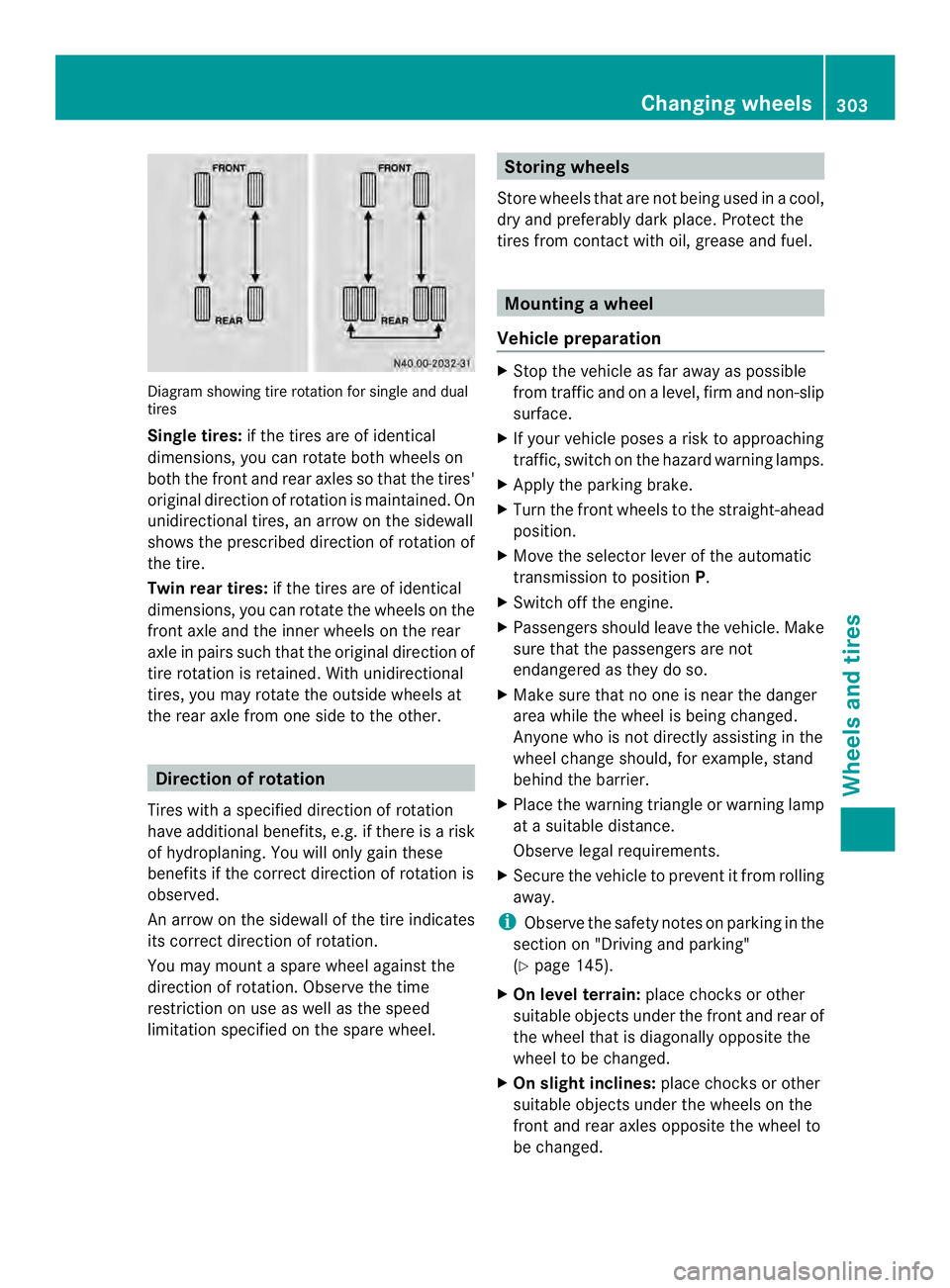
mshowing tire rotation for single and dual
tires
Single tires: if the tires are of identical
dimensions, you can rotate both wheels on
both the front and rear axles so that the tires'
original direction of rotation is maintained. On
unidirectional tires, an arrow on the sidewall
shows the prescribed direction of rotation of
the tire.
Twin rear tires: if the tires are of identical
dimensions, you can rotate the wheels on the
front axle and the inner wheels on the rear
axle in pairs such that the original direction of
tire rotation is retained. With unidirectional
tires, you may rotate the outside wheels at
the rear axle from one side to the other. Direction of rotation
Tires with a specified direction of rotation
have additional benefits, e.g. if there is a risk
of hydroplaning. You will only gain these
benefits if the correct direction of rotation is
observed.
An arrow on the sidewall of the tire indicates
its correct direction of rotation.
You may mount a spare wheel against the
direction of rotation. Observe the time
restriction on use as well as the speed
limitation specified on the spare wheel. Storing wheels
Store wheels that are not being used in a cool,
dry and preferably dark place. Protect the
tires from contact with oil, grease and fuel. Mounting
awheel
Vehicle preparation X
Stop the vehicle as far away as possible
from traffic and on a level, firm and non-slip
surface.
X If you rvehicle poses a risk to approaching
traffic, switch on the hazard warning lamps.
X Apply the parking brake.
X Turn the fron twheels to the straight-ahead
position.
X Move the selector lever of the automatic
transmission to position P.
X Switch off the engine.
X Passengers should leave the vehicle. Make
sure that the passengers are not
endangered as they do so.
X Make sure that no one is near the danger
area while the wheel is being changed.
Anyone who is not directly assisting in the
wheel change should, for example, stand
behind the barrier.
X Place the warning triangle or warning lamp
at a suitable distance.
Observe legal requirements.
X Secure the vehicle to prevent it from rolling
away.
i Observe the safety notes on parking in the
section on "Driving and parking"
(Y page 145).
X On level terrain: place chocks or other
suitable objects under the front and rear of
the wheel that is diagonally opposite the
wheel to be changed.
X On slight inclines: place chocks or other
suitable objects under the wheels on the
front and rear axles opposite the wheel to
be changed. Changing wheels
303Wheels and tires Z
Page 319 of 334
Service products include the following:
R Fuels, e.g. diesel
R Additives for the exhaus tgas
aftertreatment, e.g .Diesel Exhaust Fluid
(DEF)
R Lubricants, e.g. engine oil, transmission oil
R Coolant
R Brake fluid
R Washer fluid
R Climate control system refrigerants
Approved service products comply with the
highes tquality standards and are listed in the
MB Specifications for Service Products. Only
use service products approved for the
vehicle. This is an important condition for the
warranty.
You will recognize the approved service
products by the inscription on the container:
MB Approval (e.g. MB Approval 228.5)
Other identifications and recommendations
refer to quality level or a specification
according to an MB Sheet Number (e.g. MB
228.5). They are therefore not necessarily
approved.
Further information can be obtained at any
qualified specialist workshop.
Additives for approved service products are
neither required no rpermitted. Approved fuel
additives are the exception .Additives can
cause engine damage and must therefore not
be added to the service products.
The use of additives is always the
responsibility of the vehicle operator .The use
of additives may result in the restriction or
loss of your Limited Warranty entitlements. Fuel
Important safety notes G
WARNING
Fuel is highly flammable. Improper handing of
fuel creates a risk of fire and explosion. Avoid fire, open flames, smoking and creating
sparks under all circumstances. Switch off the
engine and, if applicable, the auxiliary heating
before refueling.
G
WARNING
Fuel is poisonous and hazardous to health.
There is a risk of injury.
You must make sure that fuel does not come
into contact with your skin, eyes or clothing
and that it is not swallowed. Do not inhale fuel
vapors. Keep fuel away from children.
If you or others come into contact with fuel,
observe the following:
R Wash away fuel from skin immediately
using soap and water.
R If fuel comes into contact with your eyes,
immediately rinse them thoroughly with
clean water. Seek medical assistance
without delay.
R If fuel is swallowed, seek medical
assistance without delay.Don ot induce
vomiting.
R Immediately change out of clothing which
has come into contact with fuel.
Tank contents Total capacity
Approximately
26.4 US gal (100 l) of which reserve
fuel
Approximately
5.3 US gal(20 l) Diesel
Fuel grade
G
WARNING
If you mix diesel fuel with gasoline, the flash
point is lower than that of pure diesel fuel.
When the engine is running, exhaust system
components could overheat without being
noticed. There is a risk of fire.
Never refuel with gasoline. Never mix gasoline
with diesel fuel. Service products and capacities
317Technical data Z