stop start MERCEDES-BENZ SPRINTER 2013 MY13 Operator’s Manual
[x] Cancel search | Manufacturer: MERCEDES-BENZ, Model Year: 2013, Model line: SPRINTER, Model: MERCEDES-BENZ SPRINTER 2013Pages: 334, PDF Size: 3.88 MB
Page 216 of 334
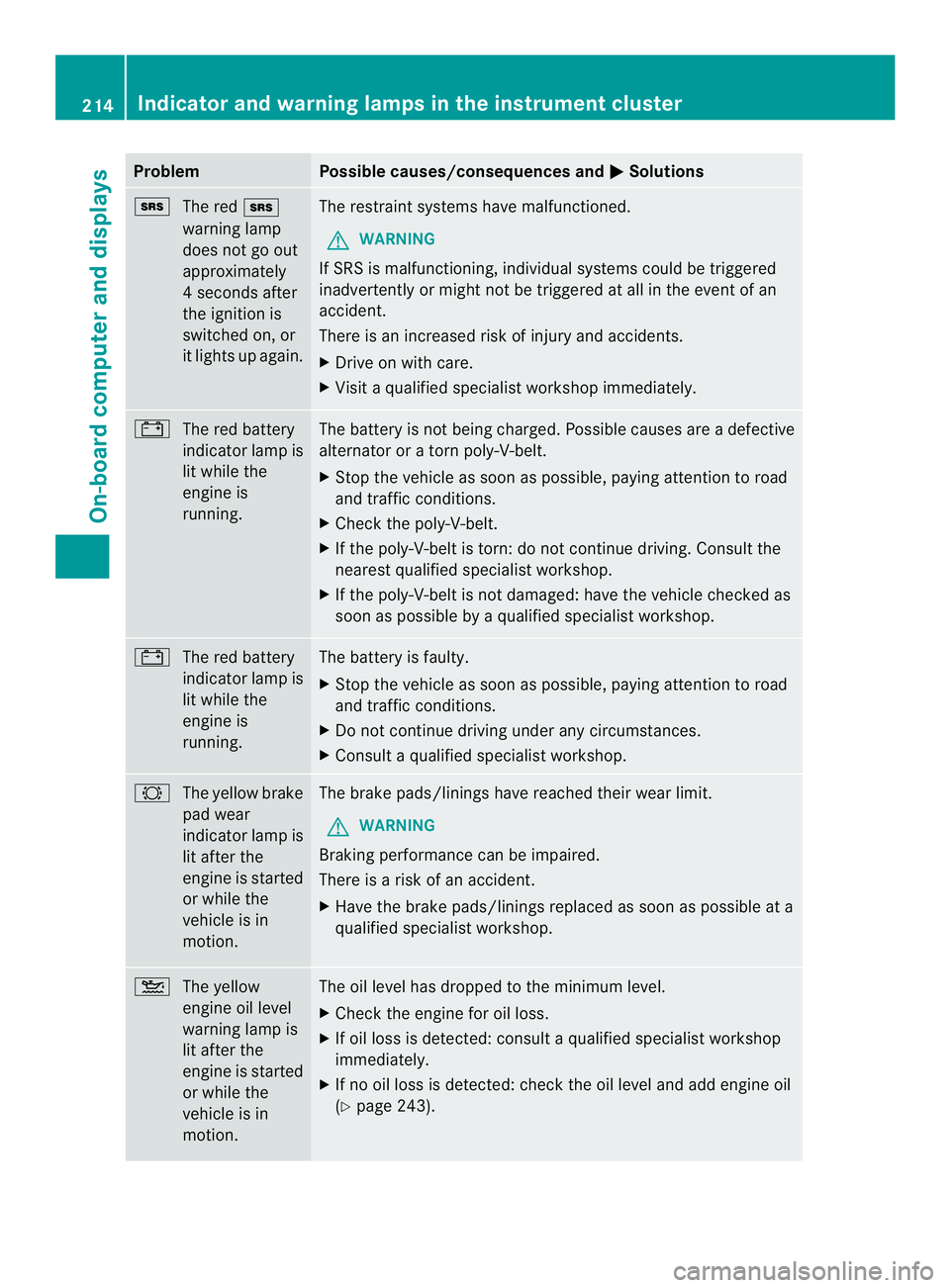
Problem Possible causes/consequences and
0004 Solutions
0008
The red 0008
warning lamp
does not go out
approximately
4s econds after
the ignition is
switched on, or
it lights up again. The restraint systems have malfunctioned.
G WARNING
If SRS is malfunctioning, individual systems could be triggered
inadvertently or might not be triggered at all in the event of an
accident.
There is an increased risk of injury and accidents.
X Drive on with care.
X Visit a qualified specialist workshop immediately. 0010
The red battery
indicator lamp is
lit while the
engine is
running. The battery is not being charged. Possible causes are a defective
alternator or a torn poly-V-belt.
X
Stop the vehicle as soon as possible, paying attention to road
and traffic conditions.
X Check the poly-V-belt.
X If the poly-V-belt is torn: do not continue driving. Consult the
nearest qualified specialist workshop.
X If the poly-V-belt is not damaged: have the vehicle checked as
soon as possible by a qualified specialist workshop. 0010
The red battery
indicator lamp is
lit while the
engine is
running. The battery is faulty.
X
Stop the vehicle as soon as possible, paying attention to road
and traffic conditions.
X Do not continue driving under any circumstances.
X Consult a qualified specialist workshop. 0005
The yellow brake
pad wear
indicator lamp is
lit after the
engine is started
or while the
vehicle is in
motion. The brake pads/linings have reached their wear limit.
G WARNING
Braking performance can be impaired.
There is a risk of an accident.
X Have the brake pads/linings replaced as soon as possible at a
qualified specialist workshop. 001D
The yellow
engine oil level
warning lamp is
lit after the
engine is started
or while the
vehicle is in
motion. The oil level has dropped to the minimum level.
X
Check the engine for oil loss.
X If oil loss is detected: consult a qualified specialist workshop
immediately.
X If no oil loss is detected: chec kthe oil level and add engine oil
(Y page 243). 214
Indicator and warning lamps in the instrument clusterOn-board computer and displays
Page 217 of 334
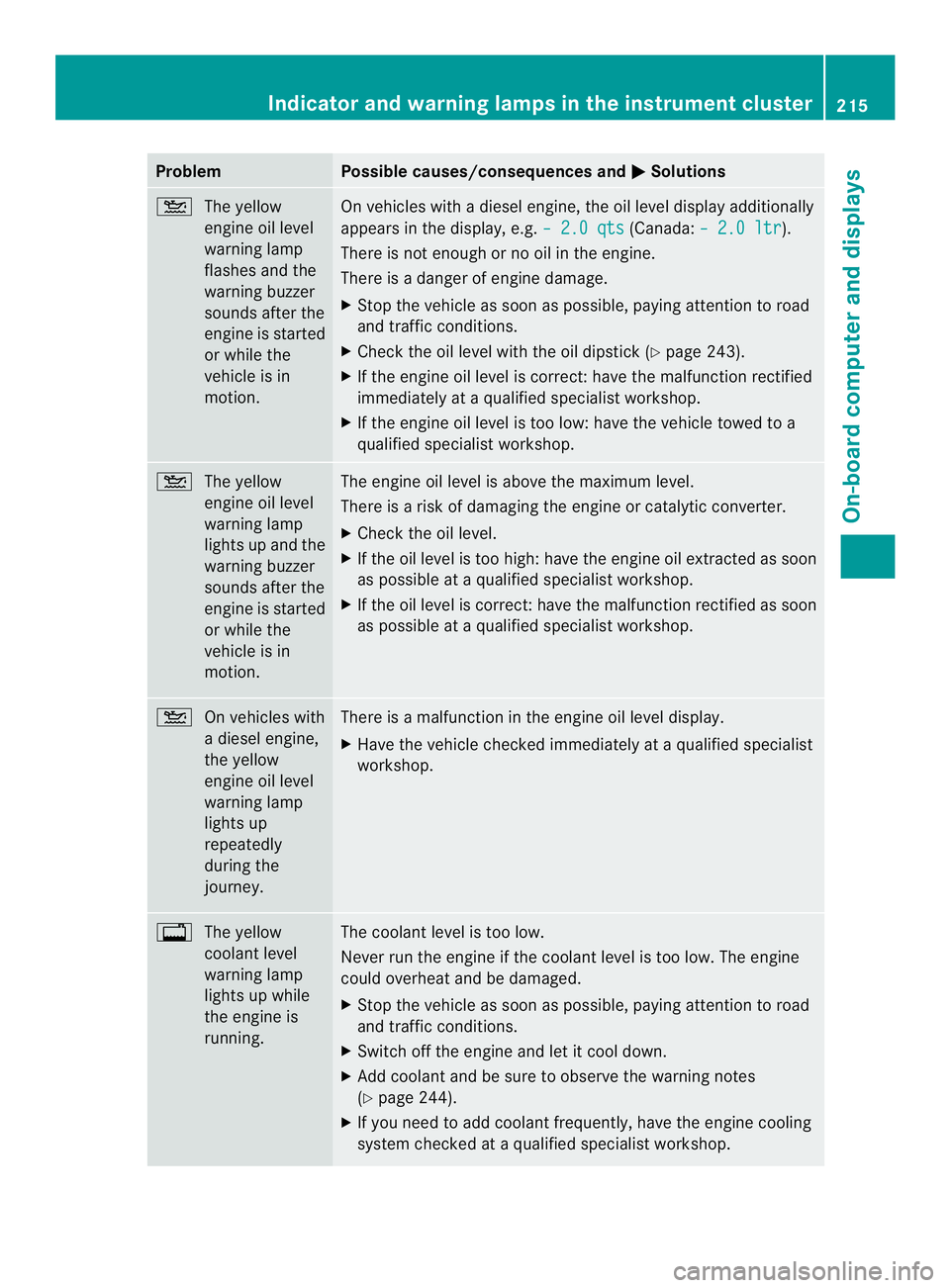
Problem Possible causes/consequences and
0004 Solutions
001D
The yellow
engine oil level
warning lamp
flashes and the
warning buzzer
sounds after the
engine is started
or while the
vehicle is in
motion. On vehicles with a diesel engine, the oil level display additionally
appears in the display, e.g.
– 2.0 qts (Canada:
– 2.0 ltr ).
There is not enough or no oil in the engine.
There is a danger of engine damage.
X Stop the vehicle as soon as possible, paying attention to road
and traffic conditions.
X Check the oil level with the oil dipstick (Y page 243).
X If the engine oil level is correct: have the malfunction rectified
immediately at a qualified specialist workshop.
X If the engine oil level is too low: have the vehicle towed to a
qualified specialist workshop. 001D
The yellow
engine oil level
warning lamp
lights up and the
warning buzzer
sounds after the
engine is started
or while the
vehicle is in
motion. The engine oil level is above the maximum level.
There is a risk of damaging the engine or catalytic converter.
X Check the oil level.
X If the oil level is too high: have the engine oil extracted as soon
as possible at a qualified specialist workshop.
X If the oil level is correct: have the malfunction rectified as soon
as possible at a qualified specialist workshop. 001D
On vehicles with
a diesel engine,
the yellow
engine oil level
warning lamp
lights up
repeatedly
during the
journey. There is a malfunction in the engine oil level display.
X
Have the vehicle checked immediately at a qualified specialist
workshop. 001A
The yellow
coolant level
warning lamp
lights up while
the engine is
running. The coolant level is too low.
Never run the engine if the coolant level is too low. The engine
could overheat and be damaged.
X
Stop the vehicle as soon as possible, paying attention to road
and traffic conditions.
X Switch off the engine and let it cool down.
X Add coolant and be sure to observe the warning notes
(Y page 244).
X If you need to add coolant frequently, have the engine cooling
system checked at a qualified specialist workshop. Indicator and warning lamps in the instrument cluster
215On-board computer and displays Z
Page 218 of 334
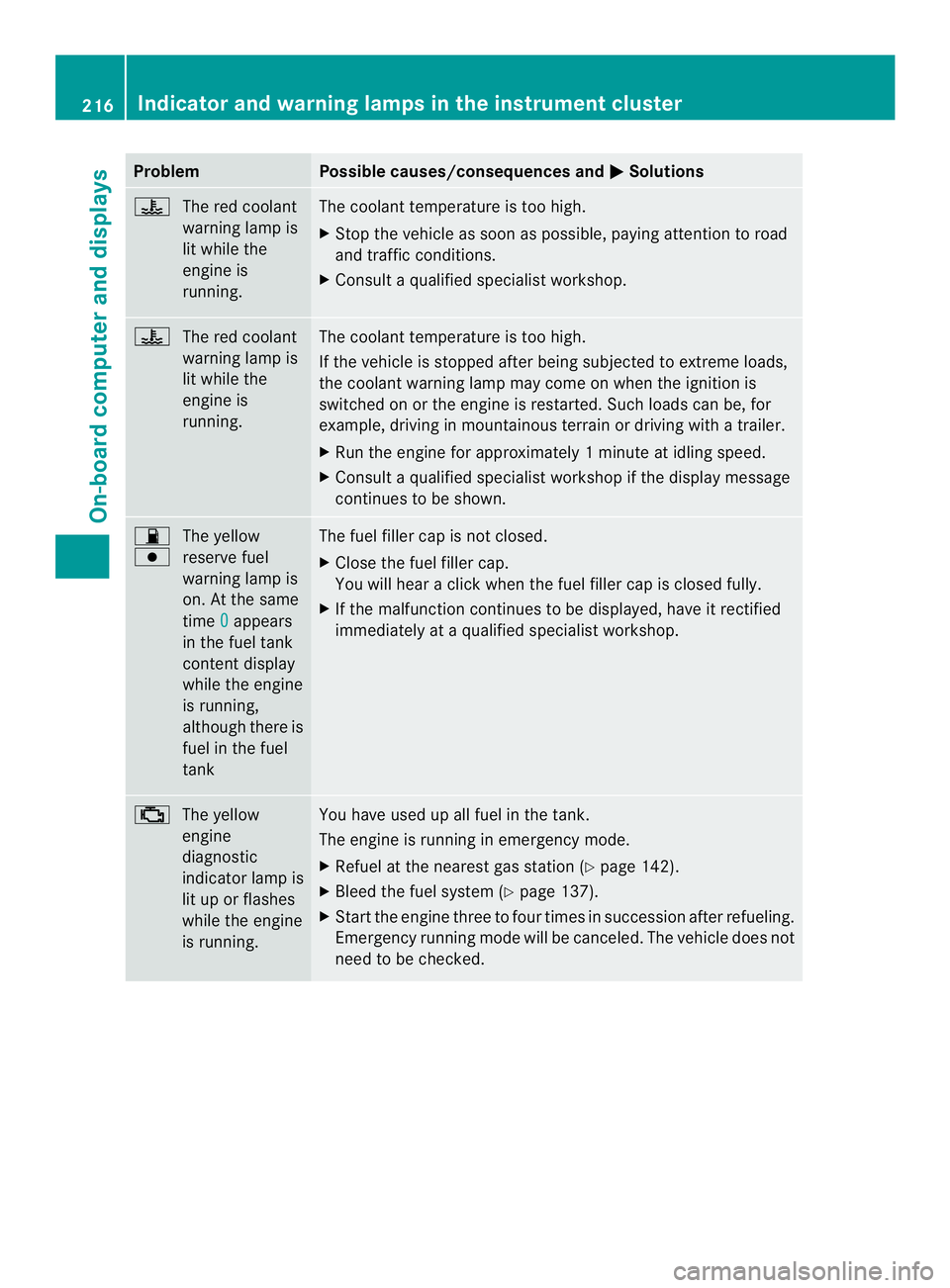
Problem Possible causes/consequences and
0004 Solutions
0014
The red coolant
warning lamp is
lit while the
engine is
running. The coolant temperature is too high.
X
Stop the vehicle as soon as possible, paying attention to road
and traffic conditions.
X Consult a qualified specialist workshop. 0014
The red coolant
warning lamp is
lit while the
engine is
running. The coolant temperature is too high.
If the vehicle is stopped after being subjected to extreme loads,
the coolant warning lamp may come on when the ignition is
switched on or the engine is restarted. Such loads can be, for
example, driving in mountainous terrain or driving with a trailer.
X
Run the engine for approximately 1minute at idling speed.
X Consult a qualified specialist workshop if the display message
continues to be shown. 0016
0006
The yellow
reserve fuel
warning lamp is
on. At the same
time
0 appears
in the fuel tank
conten tdisplay
while the engine
is running,
although there is
fuel in the fuel
tank The fuel filler cap is not closed.
X
Close the fuel filler cap.
You will hear a clic kwhen the fuel filler cap is closed fully.
X If the malfunction continues to be displayed, have it rectified
immediately at a qualified specialist workshop. 0018
The yellow
engine
diagnostic
indicator lamp is
lit up or flashes
while the engine
is running. You have used up all fuel in the tank.
The engine is running in emergency mode.
X
Refuel at the nearest gas station (Y page 142).
X Bleed the fuel system (Y page 137).
X Start the engine three to four times in succession after refueling.
Emergency running mode will be canceled. The vehicle does not
need to be checked. 216
Indicator and warning lamps in the instrument clusterOn-board computer and displays
Page 242 of 334
Useful information
This Operator's Manual describes all models
as well as standard and optional equipment
of your vehicle that were available at the time
of going to print. Country-specific variations
are possible. Note that your vehicle may not
be equipped with all of the described
functions. This also applies to systems and
functions relevant to safety.
Read the information on qualified specialist
workshops (Y page 26). Engine compartment
Hood
Opening the hood G
WARNING
If the hood is unlatched, it may open up when
the vehicle is in motion and block your view.
There is a risk of an accident.
Never unlatch the hood while driving. G
WARNING
Opening the hood when the engine is
overheated or when there is a fire in the
engine compartmen tcould expose you to hot
gases or other service products. There is a
risk of injury.
Let an overheated engine cool down before
opening the hood. If there is a fire in the
engine compartment, keep the hood closed
and contact the fire department. G
WARNING
Certain components in the engine
compartment, such as the engine, radiator
and parts of the exhaust system, can become
very hot. Working in the engine compartment
poses a risk of injury.
Where possible, let the engine cool down and
touch only the components described in the
following. G
WARNING
The engine compartment contains moving
components. Certain components, such as
the radiator fan, may continue to run or start
again suddenly when the ignition is off. There
is a risk of injury.
If you need to do any work inside the engine
compartment,
R switch off the ignition
R never reach into the area where there is a
risk of danger from moving components,
such as the fan rotation area
R keep clothing away from moving parts G
WARNING
The fuel injection system operates with a high
voltage. If you touch the live components, you
could receive an electric shock. There is a risk
of injury.
Never touch components of the fuel injection
system when the ignition is switched on.
The live components of the fuel injection
system are, for example, the injectors.
! Make sure that the windshield wipers are
not folded away from the windshield. You
could otherwise damage the windshield
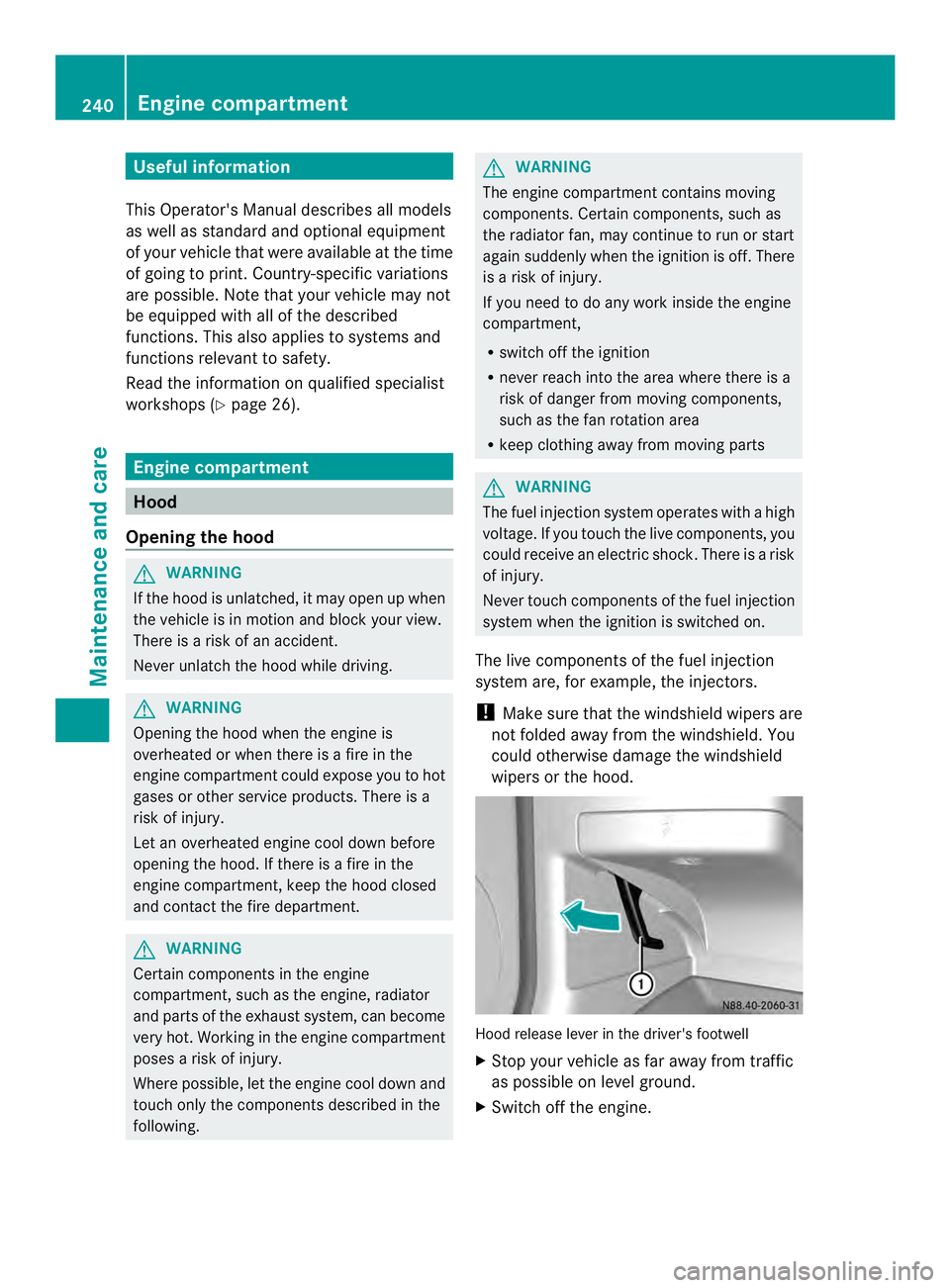
wipers or the hood. Hood release lever in the driver's footwell
X
Stop your vehicle as far away from traffic
as possible on level ground.
X Switch off the engine. 240
Engine compartmentMaintenance and care
Page 247 of 334
G
WARNING
Coolant contains glycol and is therefore toxic.
Do not swallow the coolant. See a doctor
immediately if you swallow coolant.
Make sure that coolant does not come into
contact with skin, eyesorc lothing. In case of
contac twith eyes, rinse immediately with
plenty of clean water .Clean affected areas of
skin and clothing with soap and water
immediately. Change any affected clothing
immediately. G
WARNING
If antifreeze comes into contact with hot
components in the engine compartment, it
may ignite. There is a risk of fire and injury.
Let the engine cool down before you add
antifreeze. Make sure that antifreeze is not
spilled nex tto the filler neck.T horoughly
clean the antifreeze from components before
starting the engine.
! Take care not to spill any coolant on
painted surfaces. You could otherwise
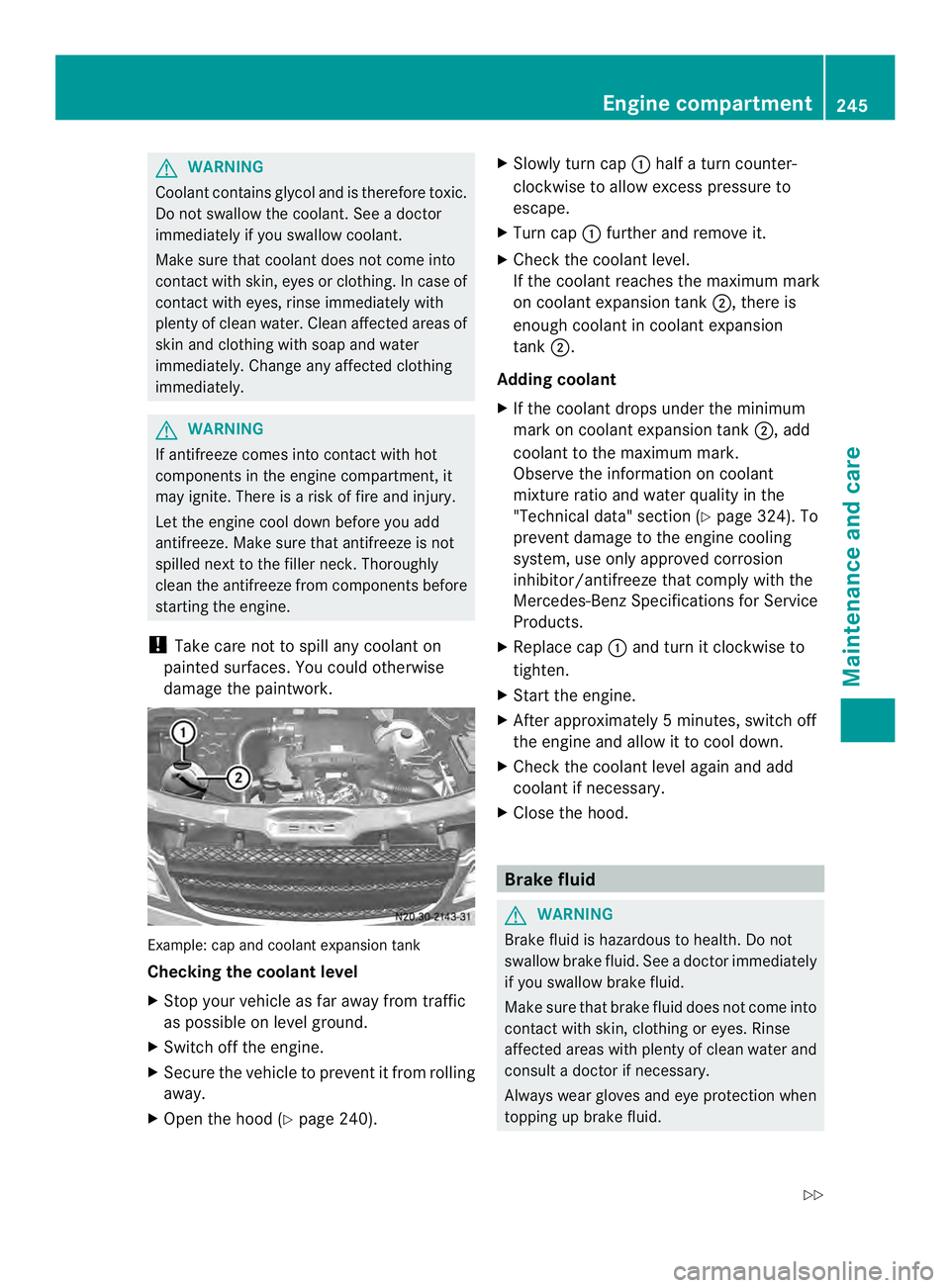
damage the paintwork. Example: cap and coolant expansion tank
Checking the coolant level
X
Stop your vehicle as far away from traffic
as possible on level ground.
X Switch off the engine.
X Secure the vehicle to prevent it from rolling
away.
X Open the hood (Y page 240). X
Slowly turn cap 0005half a turn counter-
clockwise to allow excess pressure to
escape.
X Turn cap 0005further and remove it.
X Check the coolant level.
If the coolant reaches the maximum mark
on coolant expansion tank 0006, there is
enough coolant in coolant expansion
tank 0006.
Adding coolant
X If the coolant drops under the minimum
mark on coolant expansion tank 0006, add
coolant to the maximum mark.
Observe the information on coolant
mixture ratio and water quality in the
"Technical data" section (Y page 324). To
prevent damage to the engine cooling
system, use only approved corrosion
inhibitor/antifreeze that comply with the
Mercedes-Benz Specifications for Service
Products.
X Replace cap 0005and turn it clockwise to
tighten.
X Start the engine.
X After approximately 5minutes, switch off
the engine and allow it to cool down.
X Check the coolan tlevel again and add
coolant if necessary.
X Close the hood. Brake fluid
G
WARNING
Brake fluid is hazardous to health. Do not
swallow brake fluid. See adoctor immediately
if you swallow brake fluid.
Make sure that brake fluid does not come into
contact with skin, clothing or eyes. Rinse
affected areas with plenty of clean water and
consult a doctor if necessary.
Always wear gloves and eye protection when
topping up brake fluid. Engine compartment
245Maintenance and care
Z
Page 271 of 334
Installing/removing the towing eye
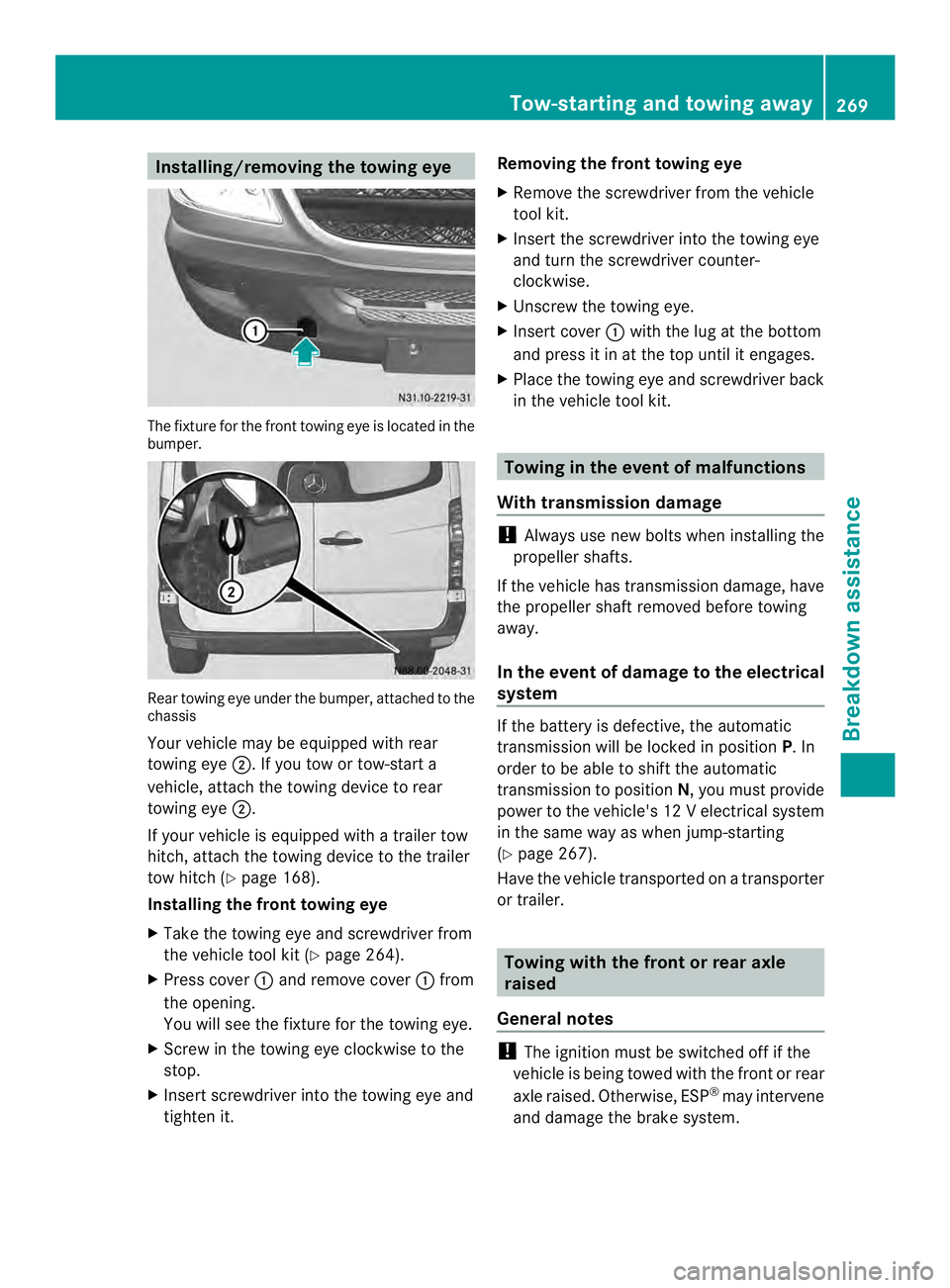
The fixture for the fron
ttowing eye is located in the
bumper. Rear towing eye under the bumper, attached to the
chassis
Your vehicle may be equipped with rear
towing eye 0006. If you tow or tow-start a
vehicle, attach the towing device to rear
towing eye 0006.
If your vehicle is equipped with a trailer tow
hitch, attach the towing device to the trailer
tow hitch (Y page 168).
Installing the front towing eye
X Take the towing eye and screwdriver from
the vehicle tool kit (Y page 264).
X Press cover 0005and remove cover 0005from
the opening.
You will see the fixture for the towing eye.
X Screw in the towing eye clockwise to the
stop.
X Insert screwdriver into the towing eye and
tighten it. Removing the front towing eye
X
Remove the screwdriver from the vehicle
tool kit.
X Insert the screwdriver into the towing eye
and turn the screwdriver counter-
clockwise.
X Unscrew the towing eye.
X Insert cover 0005with the lug at the bottom
and press it in at the top until it engages.
X Place the towing eye and screwdriver back
in the vehicle tool kit. Towing in the event of malfunctions
With transmission damage !
Always use new bolts when installing the
propeller shafts.
If the vehicle has transmission damage, have
the propeller shaft removed before towing
away.
In the event of damage to the electrical
system If the battery is defective, the automatic
transmission will be locked in position
P. In
order to be able to shift the automatic
transmission to position N, you must provide
power to the vehicle's 12 Velectrical system
in the same way as when jump-starting
(Y page 267).
Have the vehicle transported on a transporter
or trailer. Towing with the front or rear axle
raised
General notes !
The ignition must be switched off if the
vehicle is being towed with the front or rear
axle raised. Otherwise, ESP ®
may intervene
and damage the brake system. Tow-starting and towing away
269Breakdown assistance Z
Page 283 of 334
X
Read the tire pressure and compare it with
the recommended value on the loading
information table or th etire pressure table
(Y page 278).
X If the tire pressure is too low, increase it to
the recommended value.
X If the tire pressure is too high, release air
by pressing down the metal pin in the valve.
Use the tip of a pen, for example. Then,
chec kthe tire pressure again using the tire
pressure gauge.
X Screw the valve cap onto the valve.
X Repeatt he steps for the other tires. Tire pressure monitor
Important safety notes G
WARNING
Each tire, including the spare (if provided),
should be checked at least once a month
when cold and inflated to the pressure
recommended by the vehicle manufacturer
on the Tire and Loading Information placard
on the driver's door B-pillar or the tire
pressure label on the inside of the fuel filler
flap. If your vehicle has tires of a different size
than the size indicated on the Tire and Loading
Information placard or the tire pressure label,
you should determine the proper tire pressure
for those tires.
As an added safety feature, your vehicle has
been equipped with a tire pressure monitoring
system (TPMS) that illuminates a low tire
pressure telltale when one or more of your
tires are significantly underinflated.
Accordingly, when the low tire pressure
telltale illuminates, you should stop and check
your tires as soon as possible, and inflate
them to the proper pressure. Driving on a
significantly underinflated tire causes the tire
to overheat and can lead to tire failure.
Underinflation also reduces fuel efficiency
and tire tread life, and may affect the vehicle's
handling and stopping ability. Please note that the TPMS is not a substitute
for proper tire maintenance, and it is the
driver's responsibility to maintain correct tire
pressure, even if underinflation has not
reached the level to trigger illumination of the
TPMS low tire pressure telltale.
USA only:
Your vehicle has also been equipped with a
TPMS malfunction indicator to indicate if the
system is not operating properly. The TPMS
malfunction indicator is combined with the
low tire pressure telltale. When the system
detects a malfunction, the warning lamp will
flash for approximately a minute and then
remain continuously illuminated. This
sequence will be repeated every time the
vehicle is started as long as the malfunction
exists.
When the malfunction indicator is illuminated,
the system may not be able to detect or signal
low tire pressure as intended. TPMS
malfunctions may occur for a variety of
reasons, including the installation of
incompatible replacement or alternate tires
or wheels on the vehicle that prevent the
TPMS from functioning properly. Always
check the TPMS malfunction telltale after
replacing one or more tires or wheels on your
vehicle to ensure that the replacement or
alternate tires and wheels allow the TPMS to
continue to function properly.
Vehicles with a tire pressure monitor are
equipped with sensors in the wheels that
monitor the tire pressure of all four tires. The
tire pressure monitor monitors the pressure
in all four tires; you set this pressure when
you activate the tire pressure monitor. The
tire pressure monitor warns you when the
pressure drops in one or more of the tires. The
tire pressure monitor only functions if the
corresponding sensors are installed to all
wheels.
You should always adjust the tire pressure
according to the vehicle load. Restart the tire
pressure monitor if you change the tire
pressure. Tire pressure
281Wheels and tires Z
Page 299 of 334
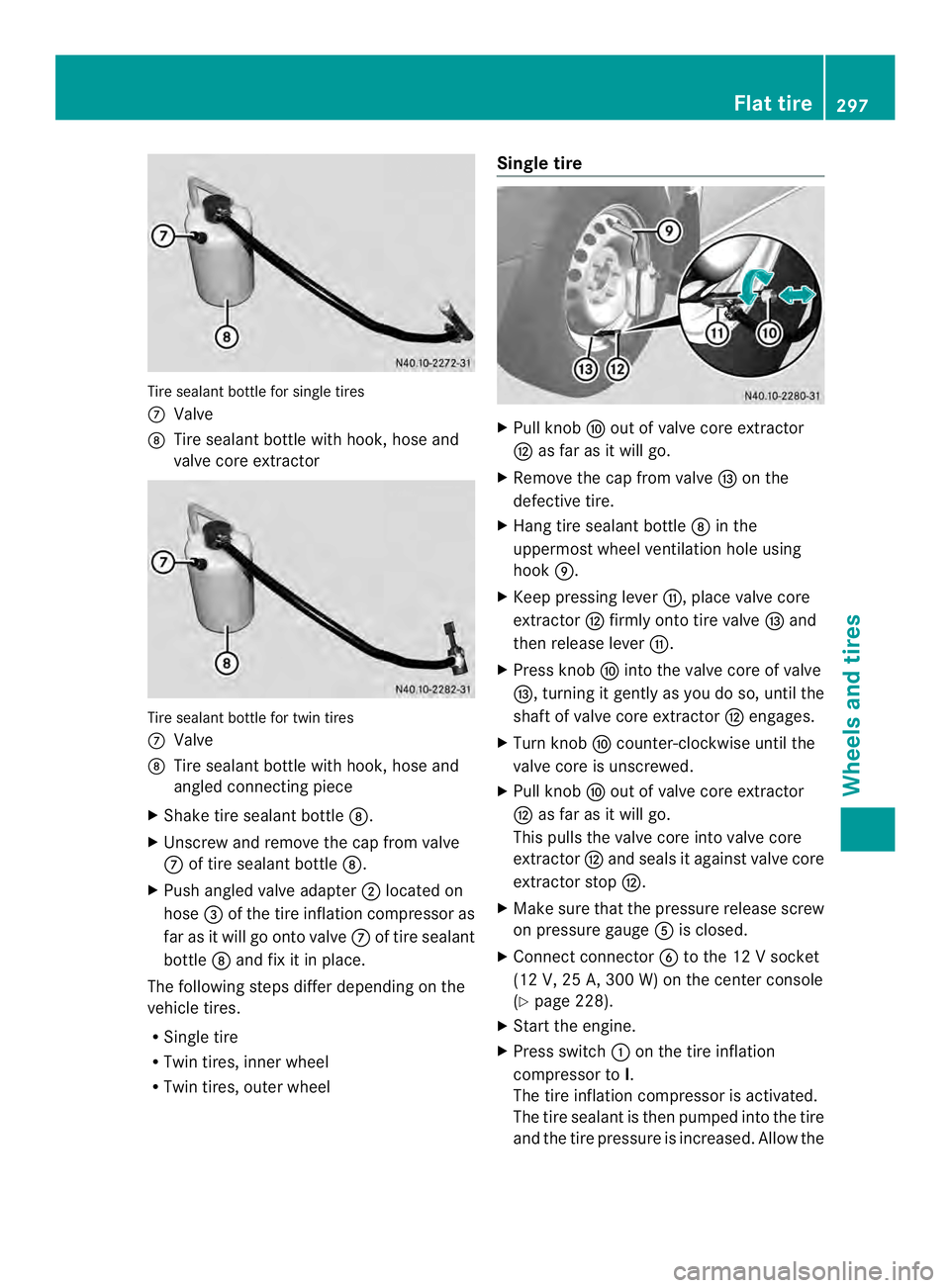
Tire sealant bottle for single tires
0018
Valve
0019 Tire sealant bottle with hook, hose and
valve core extractor Tire sealant bottle for twin tires
0018
Valve
0019 Tire sealant bottle with hook, hose and
angled connecting piece
X Shake tire sealant bottle 0019.
X Unscrew and remove the cap from valve
0018 of tire sealant bottle 0019.
X Push angled valve adapter 0006located on
hose 0026of the tire inflation compressor as
far as it will go ontov alve0018of tire sealant
bottle 0019and fix it in place.
The following steps differ depending on the
vehicle tires.
R Single tire
R Twin tires, inner wheel
R Twin tires, outer wheel Single tire
X
Pull knob 001Bout of valve core extractor
001D as far as it will go.
X Remove the cap from valve 001Eon the
defective tire.
X Hang tire sealan tbottle 0019in the
uppermost wheel ventilation hole using
hook 001A.
X Keep pressing lever 001C, place valve core
extractor 001Dfirmly onto tire valve 001Eand
then release lever 001C.
X Press knob 001Binto the valve core of valve
001E, turning it gently as you do so, until the
shaft of valve core extractor 001Dengages.
X Turn knob 001Bcounter-clockwise until the
valve core is unscrewed.
X Pull knob 001Bout of valve core extractor
001D as far as it will go.
This pulls the valve core into valve core
extractor 001Dand seals it against valve core
extractor stop 001D.
X Make sure that the pressure release screw
on pressure gauge 0023is closed.
X Connect connector 0024to the 12 V socket
(12 V, 25 A, 300 W) on the center console
(Y page 228).
X Start the engine.
X Press switch 0005on the tire inflation
compressor to I.
The tire inflation compressor is activated.
The tire sealant is then pumped into the tire
and the tire pressure is increased. Allow the Flat tire
297Wheels and tires Z
Page 301 of 334
X
Turn knob 001Dcounter-clockwise until the
valve core is unscrewed.
X Pull knob 001Dout of valve core extractor
001B as far as it will go.
This pulls the valve core into valve core
extractor 001Band seals it against valve core
extractor stop 001B.
X Hang tire sealant bottle 0019in the
uppermost wheel ventilation hole 001C.
X Push angled valve adapter 001Elocated on
the hose of tire sealant filler bottle 0019as
far as it will go on to valve core extractor
001B and fix it in place.
X Make sure that the pressure release screw
on pressure gauge 0023is closed.
X Connect connector 0024to the 12 V socket
(12 V, 25 A, 300 W) on the center console
(Y page 228).
X Start the engine.
X Press switch 0005on the tire inflation
compressor to move to position I.
The tire inflation compressor is activated.
The tire sealant is then pumped into the tire
and the tire pressure is increased. Allow the
tire inflation compressor to run for at least
10 minutes until tire sealant bottle 0019is
completely empty and the tire pressure is
at least 300 kPa (3.0 bar/43.5 psi).
If possible, inflate the tire to the
recommended tire pressure. You will find a
table of recommended tire pressure on the
Tire and Loading Information placard 9
or
the tire pressure plate on the B-pillar on the
driver's side of the vehicle ( Ypage 278).
X Then press 0on tire inflation compressor
switch 0005.
The tire inflation compressor is
deactivated.
X Quickly slide knob 001Dto the stop in valve
core extractor 001B.
X Turn knob 001Dclockwise until the valve core
is firmly screwed into tire valve 001F.i
Do not pull valve core extractor 001Bfrom
tire valve 001Fwhile the valve core is
unscrewed from tire valve 001F. The tire
sealant could otherwise run out and get on
your skin or clothes.
X Pull knob 001Dout of valve core extractor
001B as far as it will go.
X Unscrew valve core extractor 001Bcounter-
clockwise from tire valve 001F.
X Screw valve extension 001Aonto tire valve
001F and tighten it.
X Screw the valve cap onto valve extension
001A.
X Observe the following notes and
instructions:
R
Tire pressure of 300 kPa (3.0 bar/
43.5 psi) not reached (Y page 301).
R Tire pressure of 300 kPa (3.0 bar/
43.5p si) reached (Y page 301).
9 Only for vehicles with a gross vehicle weight of less than 10,000 lbs(4,536 kg). Flat tire
299Wheels and tires Z