tire type MERCEDES-BENZ SPRINTER 2013 MY13 Operator’s Manual
[x] Cancel search | Manufacturer: MERCEDES-BENZ, Model Year: 2013, Model line: SPRINTER, Model: MERCEDES-BENZ SPRINTER 2013Pages: 334, PDF Size: 3.88 MB
Page 282 of 334
the braking properties and the driving
characteristics .There is a risk of an accident.
Avoid tire pressures that are too low in all the
tires, including the spare wheel.
Underinflated tires can:
R fail from being overheated
R adversely affect handling
R wear excessively and/or unevenly
R have an adverse effect on fuel consumption
Overinflated tires G
WARNING
Tires with excessively high pressure can burst
because they are damaged more easily by
road debris, potholes etc. In addition, they
also suffer from irregular wear, which can
severely impair the braking properties and the
driving characteristics. There is a risk of an
accident.
Avoid tire pressures that are too high in all the
tires, including the spare wheel.
Overinflated tires can:
R increase the braking distance
R adversely affect handling
R wear excessively and/or unevenly
R adversely affect ride comfort
R be more susceptible to damage
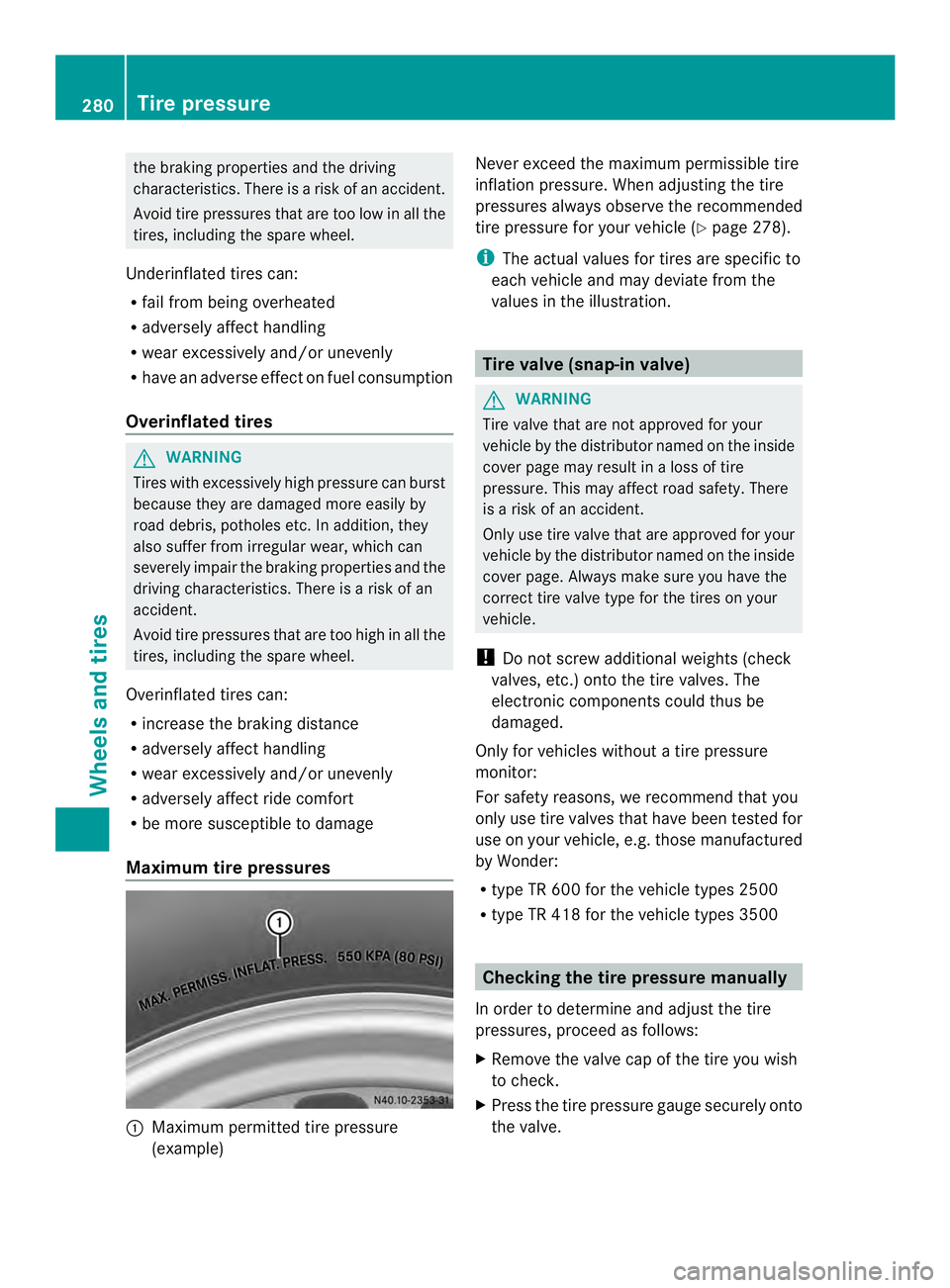
Maximum tire pressures 0005
Maximum permitted tire pressure
(example) Never exceed the maximum permissible tire
inflation pressure. When adjusting the tire
pressures always observe the recommended
tire pressure for your vehicle (Y
page 278).
i The actual values for tires are specific to
each vehicle and may deviate from the
values in the illustration. Tire valve (snap-in valve)
G
WARNING
Tire valve that are not approved for your
vehicle by the distributor named on the inside
cover page may result in a loss of tire
pressure. This may affect road safety. There
is a risk of an accident.
Only use tire valve that are approved for your
vehicle by the distributor named on the inside
cover page. Always make sure you have the
correct tire valve type for the tires on your
vehicle.
! Do not screw additional weights (check
valves, etc.) onto the tire valves. The
electronic components could thus be
damaged.
Only for vehicles without atire pressure
monitor:
For safety reasons, we recommend that you
only use tire valves that have been tested for
use on your vehicle, e.g. those manufactured
by Wonder:
R type TR 600 for the vehicle types 2500
R type TR 418 for the vehicle types 3500 Checking the tire pressure manually
In order to determine and adjust the tire
pressures, proceed as follows:
X Remove the valve cap of the tire you wish
to check.
X Press the tire pressure gauge securely onto
the valve. 280
Tire pressureWheels and tires
Page 292 of 334
0026
Maximum tire pressure (Y page 280)
0025 Manufacturer
0023 Tire material (Y page 292)
0024 Tire size designation, load-bearing
capacity and speed index (Y page 290)
0018 Tire name
The markings described above are on the tire
in addition to the tire name (sales
designation) and the manufacturer's name.
i Tire data is vehicle-specific and may
deviate from the data in the example.
Tire size designation, load bearing index
and speed index G
WARNING
Exceeding the stated tire load-bearing
capacity and the approved maximum speed
could lead to tire damage or the tire bursting.
There is a risk of accident.
Therefore, only use tire types and sizes
approved for your vehicle model. Observe the
tire load rating and speed rating required for
your vehicle. 0005
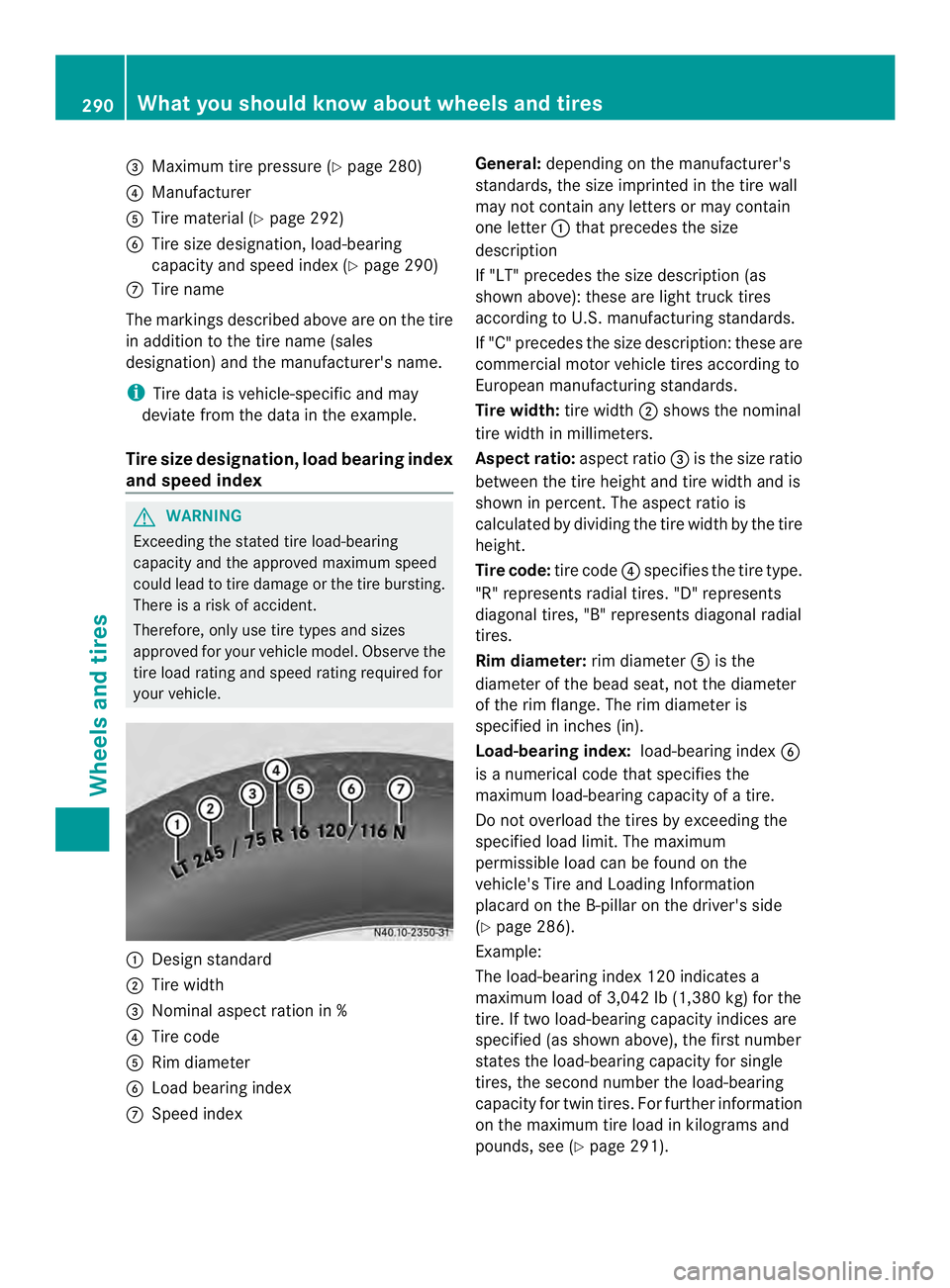
Design standard
0006 Tire width
0026 Nominal aspect ration in %
0025 Tire code
0023 Rim diameter
0024 Load bearing index
0018 Speed index General:
depending on the manufacturer's
standards, the size imprinted in the tire wall
may not contain any letters or may contain
one letter 0005that precedes the size
description
If "LT" precedes the size description (as
shown above): these are light truck tires
according to U.S. manufacturing standards.
If "C" precedes the size description: these are
commercial motor vehicle tires according to
European manufacturing standards.
Tire width: tire width0006shows the nominal
tire width in millimeters.
Aspect ratio: aspect ratio0026is the size ratio
between the tire height and tire width and is
shown in percent.T he aspect ratio is
calculated by dividing the tire width by the tire
height.
Tire code: tire code0025specifies the tire type.
"R" represents radial tires. "D" represents
diagonal tires, "B" represents diagonal radial
tires.
Rim diameter: rim diameter0023is the
diameter of the bead seat, not the diameter
of the rim flange. The rim diameter is
specified in inches (in).
Load-bearing index: load-bearing index0024
is a numerical code that specifies the
maximum load-bearing capacity of a tire.
Do not overload the tires by exceeding the
specified load limit. The maximum
permissible load can be found on the
vehicle's Tire and Loading Information
placard on the B-pillar on the driver's side
(Y page 286).
Example:
The load-bearing index 120 indicates a
maximum load of 3,042 lb (1,380 kg) for the
tire. If two load-bearing capacity indices are
specified (as shown above), the first number
states the load-bearing capacity for single
tires, the second number the load-bearing
capacity for twin tires. For further information
on the maximum tire load in kilograms and
pounds, see (Y page 291).290
What you should know about wheels and tiresWheels and tires
Page 294 of 334
permissible load can be found on the
vehicle's Tire and Loading Information
placard on the B-pillar on the driver's side
(Y
page 286).
i The actual values for tires are specific to
each vehicle and may deviate from the
values in the illustration.
DOT, Tire Identification Number (TIN) U.S
.tire regulations stipulate that every tire
manufacturer or retreader must imprint aTIN
in or on the sidewall of each tire produced. The TIN is a unique identification number. The
TIN enables the tire manufacturers or
retreaders to inform purchasers of recalls and
other safety-relevant matters. It makes it
possible for the purchaser to easily identify
the affected tires.
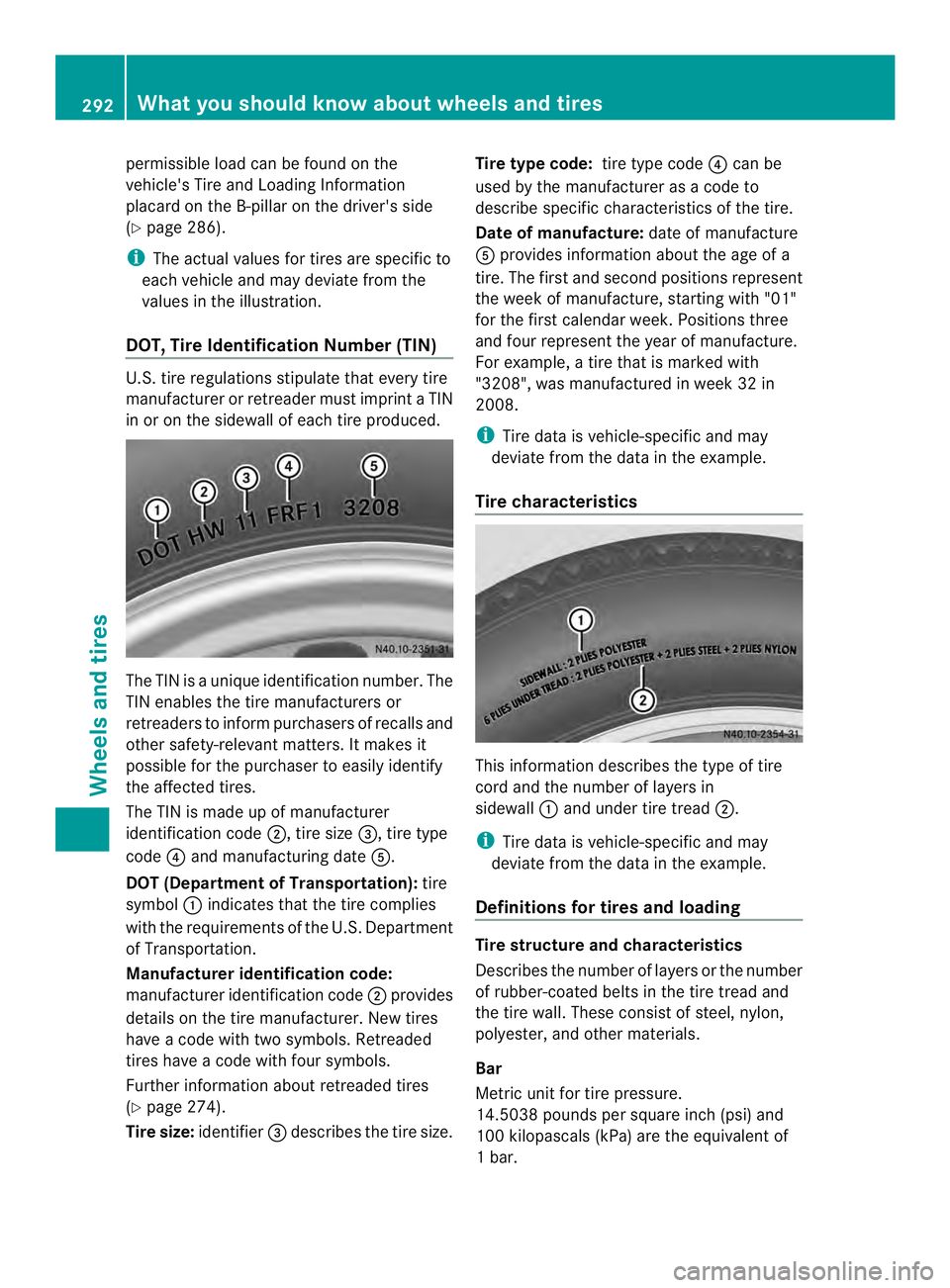
The TIN is made up of manufacturer
identification code 0006, tire size0026, tire type
code 0025and manufacturing date 0023.
DOT (Department of Transportation): tire
symbol 0005indicates that the tire complies
with the requirements of the U.S. Department
of Transportation.
Manufacturer identification code:
manufacturer identification code 0006provides
details on the tire manufacturer. New tires
have a code with two symbols. Retreaded
tires have a code with four symbols.
Further information aboutr etreaded tires
(Y page 274).
Tire size: identifier0026describes the tire size. Tire type code:
tire type code0025can be
used by the manufacturer as a code to
describe specific characteristics of the tire.
Date of manufacture: date of manufacture
0023 provides information about the age of a
tire. The first and second positions represent
the week of manufacture, starting with "01"
for the first calendar week. Positions three
and four represent the year of manufacture.
For example, a tire that is marked with
"3208", was manufactured in week 32 in
2008.
i Tire data is vehicle-specific and may
deviate from the data in the example.
Tire characteristics This information describes the type of tire
cord and the number of layers in
sidewall
0005and under tire tread 0006.
i Tire data is vehicle-specific and may
deviate from the data in the example.
Definitions for tires and loading Tire structure and characteristics
Describes the number of layers or the number
of rubber-coated belts in the tire tread and
the tire wall. These consist of steel, nylon,
polyester, and other materials.
Bar
Metric unit for tire pressure.
14.5038p
ounds per square inch (psi) and
100 kilopascals (kPa) are the equivalent of
1 bar. 292
What you should know about wheels and tiresWheels and tires
Page 307 of 334
!
Only use the jack pump lever middle rod
and the rod with the largest diameter as a
lug wrench extension. Only slide the middle
rod as far as it will go onto the lug wrench.
The rods may otherwise bend and be
distorted to such an extent that they can
no longer be used as a pump lever for the
jack.
! Do not place the jack on the leaf spring or
the differential case. Hydraulic jack
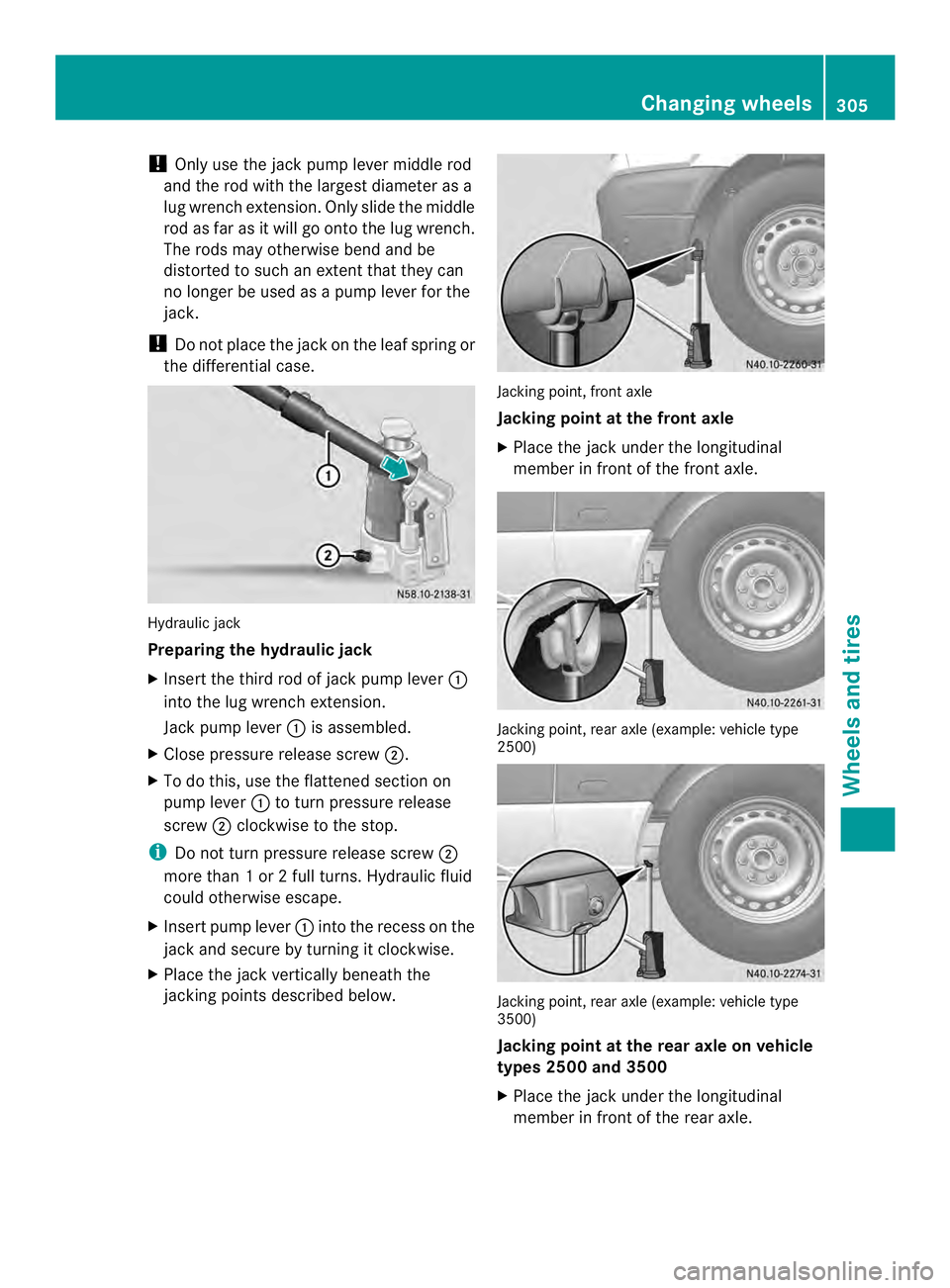
Preparing the hydraulic jack
X
Insert the third rod of jack pump lever 0005
into the lug wrench extension.
Jack pump lever 0005is assembled.
X Close pressure release screw 0006.
X To do this, use the flattened section on
pump lever 0005to turn pressure release
screw 0006clockwise to the stop.
i Do not turn pressure release screw 0006
more than 1 or 2 full turns. Hydraulic fluid
could otherwise escape.
X Insert pump lever 0005into the recess on the
jack and secure by turning it clockwise.
X Place the jack vertically beneath the
jacking points described below. Jacking point, front axle
Jacking point at the front axle
X
Place the jack under the longitudinal
member in front of the front axle. Jacking point, rear axle (example: vehicle type
2500)
Jacking point, rear axle (example: vehicle type
3500)
Jacking point at the rear axle on vehicle
types 2500 and 3500
X
Place the jack under the longitudinal
member in front of the rear axle. Changing wheels
305Wheels and tires Z
Page 310 of 334
X
Wheel with hub cap: position the opening
for the tire valve in the hub cap over the tire
valve.
X Push the edge of the hub cap with both
hands against the wheel until it clicks into
place. Make sure the hub cap retaining
catches engage on the steel wheel.
X Wheel with central hub cap: position the
retaining lugs of the central hub cap over
the wheel bolts.
X Hit the middle of the hub cap to engage it
on the wheel.
X Secure the faulty wheel in the spare wheel
bracket (Y page 309).
X Check the tire pressure of the newly
mounted wheel and adjust it if necessary.
Observe the recommended tire pressure
(Y page 278).
X Retighten the wheel bolts or wheel nuts to
the specified tightening torque after the
vehicle has been driven for 30 miles
(50 km).
When using a wheel/spare wheel with a new
or newly painted wheel rim, have the wheel
bolts/nuts retightened again after
approximately 600 to 3,000 miles (1,000 to
5,000 km). Observe the specified tightening
torque.
i Vehicles with the tire pressure monitor
system: all mounted wheels must be
equipped with functioning sensors. Wheel and tire combination
General notes
! Retreaded tires are neither tested nor
recommended for Sprinter vehicles, since
previous damage cannot always be
detected on retreaded tires. We can
therefore not guarantee driving safety. Do
not mount used tires if you have no
information about their previous usage. The recommended tire pressures can be
found:
R
on the Tire and Loading Information
placard 11
on the B-pillar on the driver's side
R on the tire pressure table on the B-pillar on
the driver's side
The recommended tire pressure can also be
found in the "Tire pressure table" section in
these Operating Instructions (Y page 285).
The wheel/tire combination for your vehicle
can be found on the tire pressure table.
Further information on wheel/tire
combination can be obtained at any qualified
specialist workshop.
Check tire pressures regularly and only when
the tires are cold. Observe the notes on the
recommended tire pressures (Y page 278).
Follow the maintenance recommendations in
the tire manufacturer's warranty book in your
vehicle documents.
Notes on the vehicle equipment –always
install the vehicle:
R with tires of the same size across an axle
(left/right)
R with the same type of tires on all wheels at
a given time (summer tires, winter tires) Spare wheel
Important safety notes
G
WARNING
Wheel and tire dimensions as well as the type
of tire can vary between the spare wheel and
the wheel to be replaced. When the spare
wheel is installed, driving characteristics may
be severely affected. There is a risk of an
accident.
In order to reduce risks:
R you should therefore adapt your driving
style and drive carefully.
R never install more than one spare wheel
that differs fro mthe wheel to be replaced.
11 Only for vehicles with a gross weight of less than 10,000 lbs(4,536 kg). 308
Spare wheelWheels and tires
Page 311 of 334
R
only use a spare wheel that differs from the
wheel to be replaced for a short time.
R do not deactivate ESP ®
.
R have a spare wheel that differs from the
wheel that has been changed replaced at
the nearest qualified specialist workshop.
You must observe the correc twheel and
tire dimensions as well as the wheel type.
When using a spare wheel of a different size,
do not exceed the maximum speed of
80 km/h. General notes
! Check the spare wheel regularly to see
that it is secure and has the prescribed tire
pressure.
The procedure for mounting the spare wheel
is described in "Mounting awheel"
(Y page 303).
The following should be checked regularly,
particularly prior to long journeys:
R the tire pressure of the spare wheel, which
should then be corrected if necessary
(Y page 278).
R the fastenings of the spare wheel bracket.
The spare wheel is located in a spare wheel
bracket under the rear of the vehicle.
Replace the tires after 6years at the latest,
regardless of wear. This also applies to the
spare wheel.
i If you have mounted a spare wheel, the
tire pressure monitor (Y page 281) will not
function for this wheel. The spare wheel is
not equipped with a sensor for monitoring
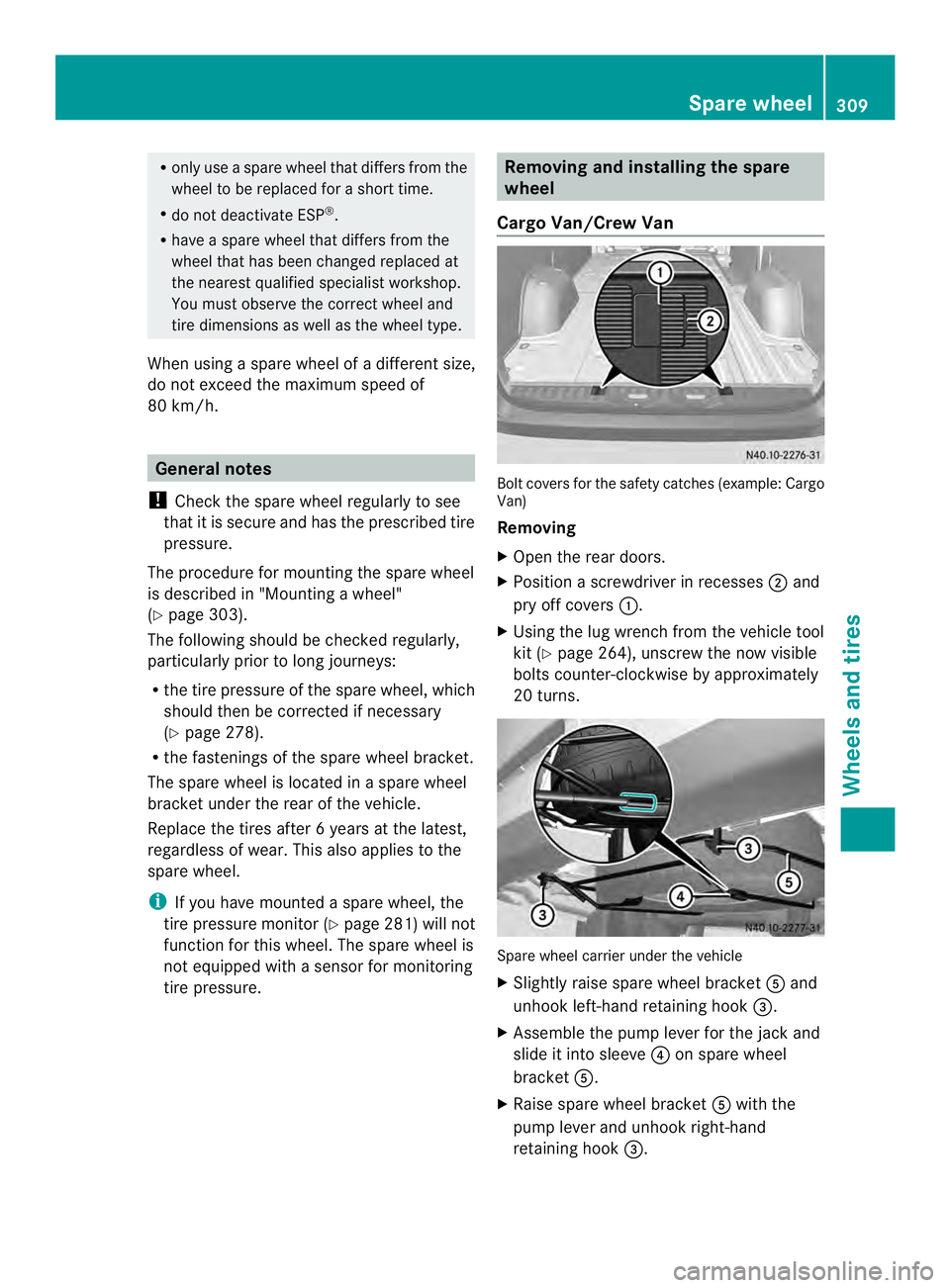
tire pressure. Removing and installing the spare
wheel
Cargo Van/Crew Van Bolt covers for the safety catches (example: Cargo
Van)
Removing
X
Open the rear doors.
X Position a screwdriver in recesses 0006and
pry off covers 0005.
X Using the lug wrench from the vehicle tool
kit (Y page 264), unscrew the now visible
bolts counter-clockwise by approximately
20 turns. Spare wheel carrier under the vehicle
X
Slightly raise spare wheel bracket 0023and
unhook left-hand retaining hook 0026.
X Assemble the pump lever for the jack and
slide it into sleeve 0025on spare wheel
bracket 0023.
X Raise spare wheel bracket 0023with the
pump lever and unhook right-hand
retaining hook 0026. Spare wheel
309Wheels and tires Z
Page 321 of 334
This can result in damage to the fuel
injection system, for example.
Flow improvers are fuel additives used to
improve the flow characteristics of diesel
fuels.
The effectiveness of flow improvers cannot be
guaranteed with all fuels. Observe the
manufacturer's recommendations.
Information about approved flow improvers is
available from any authorized Sprinter Dealer.
At outside temperatures below 14 ‡(002710 †),
and if using diesel with less resistance to low
temperatures, add flow improver, basing the
mixing ratio on the outside temperature.
Mix this fuel additive with the diesel in good
time before the flow properties of the diesel
are affected by paraffi nseparation.
Malfunctions resulting from paraffin
separation can only be rectified by heating
the entire fuel system. Park the vehicle in a
heated garage, for example.
Information on fuel consumption H
Environmental note
CO 2(carbon dioxide) is the gas which
scientists believe to be principally responsible
for global warming (the greenhouse effect).
Your vehicle's CO 2emissions are directly
related to fuel consumption and therefore
depend on:
R efficien tuse of the fuel by the engine
R driving style
R other non-technical factors, such as
environmental influences or road
conditions
You can minimize your vehicle's CO 2
emissions by driving carefully and having it
serviced regularly.
i Only for certain countries: the respective
current consumption and emission values
of your vehicle can be found in the COC
papers (EC CERTIFICATE OF
CONFORMITY). These documents are
supplied when the vehicle is delivered. Consumption figures were found in the
currently valid respective version:
R
for vehicles up to and including the
Euro 4 standard according to EU
Directive 80/1268/EEC
R for vehicles from the Euro 5 standard
according to regulation (EC) no.
715/2007
Fuel consumption depends on:
R the vehicle version
R the style of driving
R the operating conditions
R the type or quality of the fuel used
The vehicle will use more fuel than usual in
the following situations:
R at very low outside temperatures
R in city traffic
R during short journeys
R in mountainous terrain
R when towing a trailer
To keep fuel consumption low, observe the
advice in the "Protection of the environment"
section (Y page 22).
The following components of the different
vehicle versions influence fuel consumption:
R tire sizes, tire tread, tire pressure, tire
condition
R body
R transmission ratios for the drive
assemblies
R additional equipment (e.g. air-conditioning
system, auxiliary heating system).
For these reasons, the actual consumption
figures for your vehicle may deviate from the
consumption figures determined according
to EU Directive 80/1268/EEC.
Data concerning fuel consumption are
recorded in the on-board computer; use the
steering wheel buttons to call up the Trip
computer menu (Ypage 190). Service products and capacities
319Technical data Z