change wheel MERCEDES-BENZ SPRINTER 2013 MY13 Operator’s Manual
[x] Cancel search | Manufacturer: MERCEDES-BENZ, Model Year: 2013, Model line: SPRINTER, Model: MERCEDES-BENZ SPRINTER 2013Pages: 334, PDF Size: 3.88 MB
Page 8 of 334
Brake system
Malfunction .................................... 198
Warning lamp ................................. 210
Breakdown
Fire extinguisher ............................ 266
First-ai dkit.................................... 266
Jump-starting ................................. 267
Reflective safety jacket .................. 265
Vehicle tool kit ............................... 264
Warning lamp ................................. 265
Warning triangl e............................ 265
see Flat tire
see Towing away
see Tow-starting
Bulb
see Changing bulbs
Bulb failure indicator ..........................90C
Care Car wash ........................................ 256
Display ........................................... 260
Exterior lights ................................ 258
Notes ............................................. 255
Paint .............................................. 257
Plastic trim .................................... 260
Power washer ................................ 257
Rea rview camera .......................... 259
Roof lining ...................................... 261
Seat bel t........................................ 261
Seat cover ..................................... 261
Selector leve r................................ 260
Sensors ......................................... 259
Sliding door ................................... 259
Steering wheel ............................... 260
Step (electrical )............................. 260
Trim pieces .................................... 260
Washing by hand ........................... 256
Washing the engine .......................257
Wheels ........................................... 258
Windows ........................................ 257
Wiper blades .................................. 258
Cargo compartment
Activating/deactivating
ventilation ...................................... 129
Cargo compartment floor ...................28Cargo tie-down points and tie
downs
Important safety notes ..................234
Cargo tie-down rings
Installing ........................................ 236
Permissible tensile loa d................. 327
Car wash (care) ................................. 256
CD player/CD changer ......................183
Cell phone see Mobile phone
Center console overview ....................36
Central locking Automatic locking ............................ 69
Important safety notes ....................69
Locking/unlocking (buttons) ...........69
Locking/unlocking (SmartKey) ........64
Locking/unlocking manually ............ 69
Central locking system
see Centra llocking
Changing bulbs
Additional indicators (roof) ............101
Additional turn signals ...................101
Backup lamp (Chassis Cab) ...........100
Backup lamps .......................... 99, 101
Bi-Xenon bulbs ................................. 96
Brake lamps ............................ .99, 101
Brake lamps (Chassis Cab) ............100
Cornering lamps .............................. 98
Courtesy lights ............................... 101
Display message ............................ 201
Fog lamps ........................................ 98
Front interio rlight .......................... 102
High-beam headlamps .....................98
Important safety notes ....................96
Interior light ................................... 102
Interior lighting .............................. 102
License plate lamp ................100, 101
License plate lamp (Chassis Cab) ..100
Low-beam headlamps ......................98
Overview of lamp types (front
bulbs) .............................................. .97
Overview of lamp types (rear
bulbs, Cargo Van/Passenger Van) ...99
Overview of lamp types (rear
bulbs, Chassis Cab) .......................100
Parking lamps .................................. 98
Perimeter lamp .............................. 101
Rea rfog lamp .......................... 99, 1016
Index
Page 12 of 334
Engine speed setting (working
mode)
............................................ 168
Irregularr unning............................ 137
Jump-starting ................................. 267
Operating safety .............................. 25
Starting .......................................... 134
Starting problems ..........................137
Switching off .................................. 146
Tow-starting (vehicle) ..................... 271
Engine, jump-starting .......................267
Engine electronics Notes ............................................. 314
Problem (malfunction) ...................137
Engine oil
Adding ........................................... 244
Additives ........................................ 322
Checking the oil level (on-board
computer) ...................................... 242
Checking the oil level using the
dipstick .......................................... 243
Display message ............................ 206
Filling capacity ............................... 323
Information about oil
consumption .................................. 323
Mixing ............................................ 322
Notes about oil grades ................... 321
Oil change ...................................... 322
Oil leve l(note) ............................... 242
Viscosity ........................................ 321
Warning lamp ................................. 214
Engine spee dsetting (working
mode) ................................................. 167
Equipment/conversions .....................27
ESP ®
(Electronic Stability
Program) Display message ............................ 200
Function/notes ................................ 57
Indicator lamp ................................ 213
Warning lamp ................................. 210
Exhaus tcheck ................................... 148
Exhaust gas aftertreatment ...............27
DEF leve lindicato r......................... 178
DEF reducing agent .................27, 320
Diesel Exhaus tFluid (DEF) .............320
Display messages (vehicles
without steering wheel buttons) ....195
Display messages (vehicles with
steering wheel buttons) .................204Indicator lamp ................................ 213
Malfunction ...................................
.204
Refilling DEF .................................. 143
Exterior lighting
Daytime running lamp mode
(vehicles without steering wheel
buttons) ......................................... 179
Daytime running lamp mode
(vehicles with steering wheel
buttons) ......................................... 187
see Lights
Exterior mirrors
Adjusting ......................................... 86
Important safety notes ....................86
Eyeglasses compartment .................223 F
FAME fuel Bio-diesel ....................................... 317
Fire extinguisher ............................... 266
First-aid kit ......................................... 266
Flat tire Changing a wheel/mounting the
spare wheel ................................... 303
General notes ................................ 295
Preparing the vehicle .....................295
Using tire sealant ........................... 295
Fog lamps
Switching on/off .............................. 91
Folding seat ......................................... 82
Folding table ...................................... 225
Frequencies Mobile phone ................................. 314
Two-way radio ................................ 314
Front fog lamps
Changing the bulbs ..........................98
Switching on/off .............................. 91
Fron tinterior light
Changing bulbs .............................. 102
Fron twindshield
see Windshield
Fuel
Additives (diesel) ........................... 318
Bio-diesel (FAME fuel ).................... 317
Consumption information ..............319
Consumption statistics ..................19010
Index
Page 26 of 334
Your registratio
ndata is no tstored if:
R you did not purchase your vehicle at an
authorized Sprinte rDealer.
R your vehicle has never been inspected at
an authorized Sprinter Dealer.
It is advisable to register your vehicle with an
authorized Sprinter Dealer. Please infor mus
as soon as possible about any change of
address or vehicle ownership. Operating safety
Important safety notes
G
WARNING
Exhaust fumes, some of its constituents, and
certain vehicle components contain or emit
chemicals known to the State of California to
cause cancer and birth defects or other
heritable genetic damage.
In addition, certain fluid scontained in
vehicles, and certain products that are used
as components, contain chemicals known to
the State of California to cause cancer and
birth defects or other heritable genetic
damage.
Air bags and pyrotechnic Emergency
Tensioning Devices (ETDs) and remote
control batteries contain perchlorate
material, which may require special handling
and regard for the environment. Check with
your local government's disposal guidelines.
In California, see www.dtsc.ca.gov/
HazardousWaste/Perchlorate/ index.cfm. G
WARNING
If you do not have the prescribed service/
maintenance work or any required repairs
carried out, this can result in malfunctions or
system failures. There is a risk of an accident.
Always have the prescribed service/
maintenance work as well as any required
repairs carried out at a qualified specialist
workshop. G
WARNING
Modifications to electronic components, their
software as well as wiring can impair their
function and/or the function of other
networked components. In particular,
systems relevant to safety could also be
affected. As a result, these may no longer
function as intended and/or jeopardize the
operating safety of the vehicle. There is an
increased risk of an accident and injury.
Never tamper with the wiring as well as
electronic components or their software. You
should have all work to electrical and
electronic equipment carried out at a qualified
specialist workshop. G
WARNING
Flammable materials, e.g. leaves, grass or
branches, may ignite if they come into contact
with hot parts of the exhaust system for
extended periods. There is arisk of fire.
When driving off-road or on unpaved surfaces,
chec kthe underside of the vehicle at regular
intervals. In particular, remove any trapped
parts of plants or other flammable material. If
there is any damage, inform a qualified
specialist workshop.
The general operating permit for your vehicle
could be rendered invalid If you carry out
modifications to electronic components,
their software as well as wiring.
Driving off-road or on construction sites
increases the possibility of vehicle damage
which may in turn lead to the failure of certain
assemblies and systems.
There is a risk of damage to the vehicle if:
R the vehicle makes contact with the ground,
e.g. on a high curb or a loose road surface
R you drive too quickly over an obstacle, e.g.
a curb or a pothole
R a heavy object hits the underbody or
chassis component
In these or similar situations, the vehicle
body, the underbody, chassis components,
wheels or tires could be damaged even if this 24
Introduction
Page 35 of 334
Instrumen
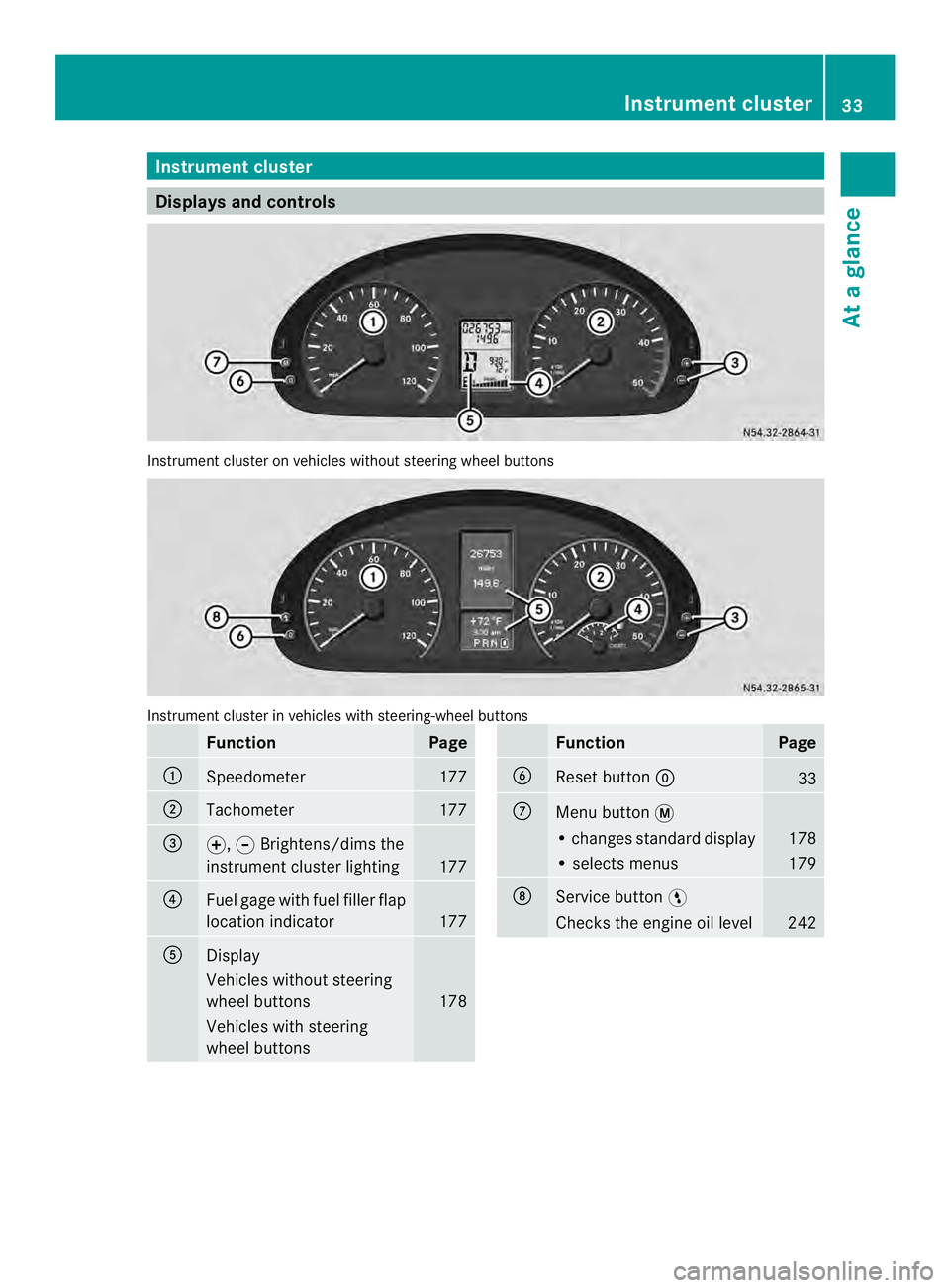
tcluster Displays and controls
Instrument cluster on vehicles without steering wheel buttons
Instrument cluster in vehicles with steering-wheel buttons
Function Page
0005
Speedometer 177
0006
Tachometer 177
0026
000E,
000FBrightens/dims the
instrumen tcluster lighting 177
0025
Fuel gage with fuel filler flap
location indicator
177
0023
Display
Vehicles without steering
wheel buttons
178
Vehicles with steering
wheel buttons Function Page
0024
Reset button
0007 33
0018
Menu button
0004 • changes standard display 178
• selects menus 179
0019
Service button
0012 Checks the engine oil level 242Instrument cluster
33At a glance
Page 45 of 334
When you switch on the ignition, the
0008
warning lamp in the instrument cluster lights
up for approximately 4seconds.
A malfunction has occurred if the 0008
warning lamp:
R does not light up when you switch on the
ignition, or
R does not go out within a few seconds of
switching on the ignition, or
R lights up again
Safet yguidelines for seat belts,
Emergency Tensioning Devices (ETDs)
and air bags G
WARNING
R Damaged sea tbelts or seat belts that have
been subjected to stress in an accident
must be replaced and their anchoring
points must also be checked. Only use seat
belts which have been installed or supplied
by a qualified specialist workshop.
R Air bags and pyrotechnic Emergency
Tensioning Devices (ETDs) contain
perchlorate material, which may require
special handling and regard for the
environment. Check with your local
government's disposal guidelines.
California residents, see
www.dtsc.ca.gov/HazardousWaste/
Perchlorate/index.cfm.
R Air bags and ETDs are designed to function
on a one-time-only basis. An air bag or ETD
that has deployed must be replaced.
R Do not pass seat belts over sharp edges.
They could tear.
R Do not make any modification that could
change the effectiveness of the seat belts.
R Do not bleach or dye seat belts as this may
severely weaken them. In a crash they may
not be able to provide adequate protection.
R No modifications of any kind may be made
to any components or wiring of the SRS.
R Do not change or remove any component
or part of the SRS. R
Do not install additional paneling, seat
covers, badges etc.o ver the steering wheel
hub, co-driver's front air bag cover,
outboard sides of the seat backrests, door
trim panels, or door frame trims.
R Do not install additional electrical/
electronic equipment on or near SRS
components and wiring.
R Keep the area between air bags and
occupants free of objects (e.g. packages,
purses, umbrellas etc.).
R Do not hang items such as coat hangers
from the coat hooks or handles over the
door. These items may be thrown around in
the vehicle and cause head and other
injuries when the window curtai nair bag is
deployed.
R Air bag system components will be hot after
an air bag has inflated. Do not touch them.
R Never place your feet on the instrument
panel or on the seat. Always keep both feet
on the floor in front of the seat.
R Improper repair work creates a risk of
rendering the SRS inoperative or causing
unintended air bag deployment. Work on
the SRS must therefore only be performed
by qualified technicians. Please contac ta
qualified specialist workshop.
R For your protection and the protection of
others, when scrapping the air bag unit or
ETD, our safety instructions must be
followed. These instructions are available
from any authorized Sprinter Dealer.
R Given the considerable deployment speed,
required inflation volume, and the material
of the air bags, there is the possibility of
abrasions or other, potentially more serious
injuries resulting from air bag deployment.
If you sell your vehicle, we strongly
recommend that you infor mthe subsequent
owner that the vehicle is equipped with SRS.
Also refer them to the applicable section in
the Operator's Manual. Occupant safety
43Safety Z
Page 82 of 334
Useful information
This Operator's Manual describes all models
as well as standard and optional equipment
of your vehicle that were available at the time
of going to print. Country-specific variations
are possible. Note that your vehicle may not
be equipped with all of the described
functions. This also applies to systems and
functions relevant to safety.
Read the information on qualified specialist
workshops (Y page 26). Seats
Important safety notes
G
WARNING
If the driver's seat is not engaged, it could
move unexpectedly while the vehicle is in
motion. This could cause you to lose control
of the vehicle. There is a risk of an accident.
Always make sure that the driver's seat is
engaged before starting the engine. G
WARNING
When you adjust a seat, you or other vehicle
occupants could become trapped, e.g. on the
seat guide rail. There is arisk of injury.
Make sure when adjusting aseat that no one
has any body parts in the sweep of the seat. G
WARNING
If head restraints are not installed and
adjusted correctly, they cannot provide
protection as intended. There is an increased
risk of injury in the head and neck area, e.g.
in the event of an accident or when braking.
Always drive with the head restraints
installed. Before driving off, make sure for
every vehicle occupant that the center of the
head restraint supports the back of the head
at about eye level. Observe also the safety notes in the sections
on "Air bags" (Y
page 44) and "Children in the
vehicle" ( Ypage 50).
Do not change over the head restraints for the
fron tand rea rseats. Otherwise, it will not be
possible to correctly adjust the height and
angle of the head restraints.
Use the head restraint pad to adjust the head
restraint so that it is as close as possible to
the back of your head.
Before the journey, make sure the head
restraints have been correctly set for each of
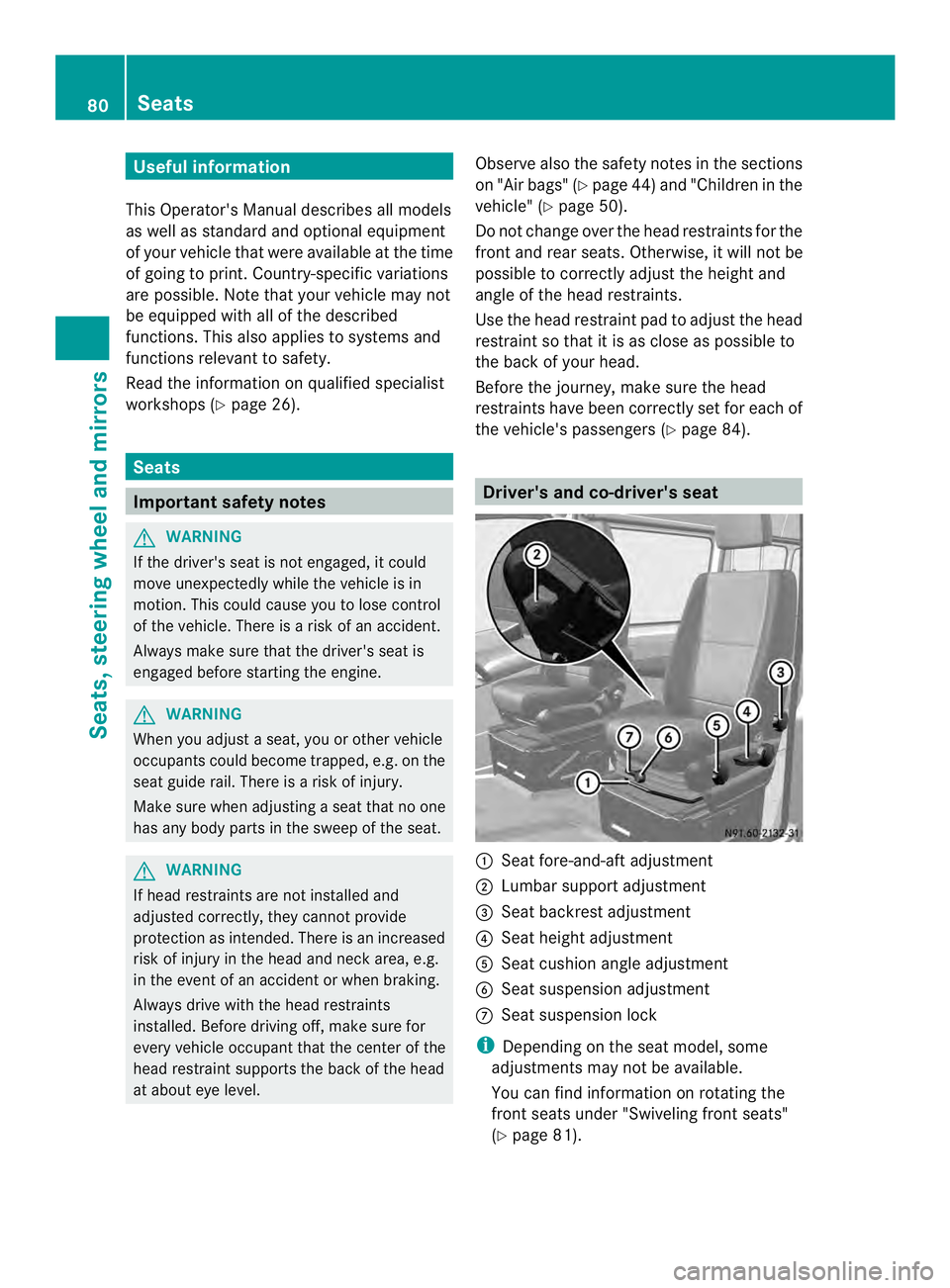
the vehicle's passengers (Y page 84). Driver's and co-driver's seat
0005
Seat fore-and-aft adjustment
0006 Lumbar support adjustment
0026 Seat backrest adjustment
0025 Seat height adjustment
0023 Seat cushion angle adjustment
0024 Seat suspension adjustment
0018 Seat suspension lock
i Depending on the seat model, some
adjustments may not be available.
You can find information on rotating the
fron tseats under "Swiveling fron tseats"
(Y page 81). 80
SeatsSeats, steering wheel and mirrors
Page 86 of 334
X
Slide the bench sea tforwards until you
hear the locking mechanisms engage.
X Check levers 0005on the anchorages of the
bench seat.
All levers 0005must be flush to the vehicle
floor. Head restraints
G
WARNING
If head restraints are not installed and
adjusted correctly, they cannot provide
protection as intended. There is an increased
risk of injury in the head and neck area, e.g.
in the event of an accident or when braking.
Always drive with the head restraints
installed. Before driving off, make sure for
every vehicle occupant that the center of the
head restraint supports the back of the head
at about eye level.
Do not change over the head restraints for the
front and rear seats. Otherwise, it will not be
possible to correctly adjust the height and
angle of the head restraints.
Adjust the head restraint so that it is as close
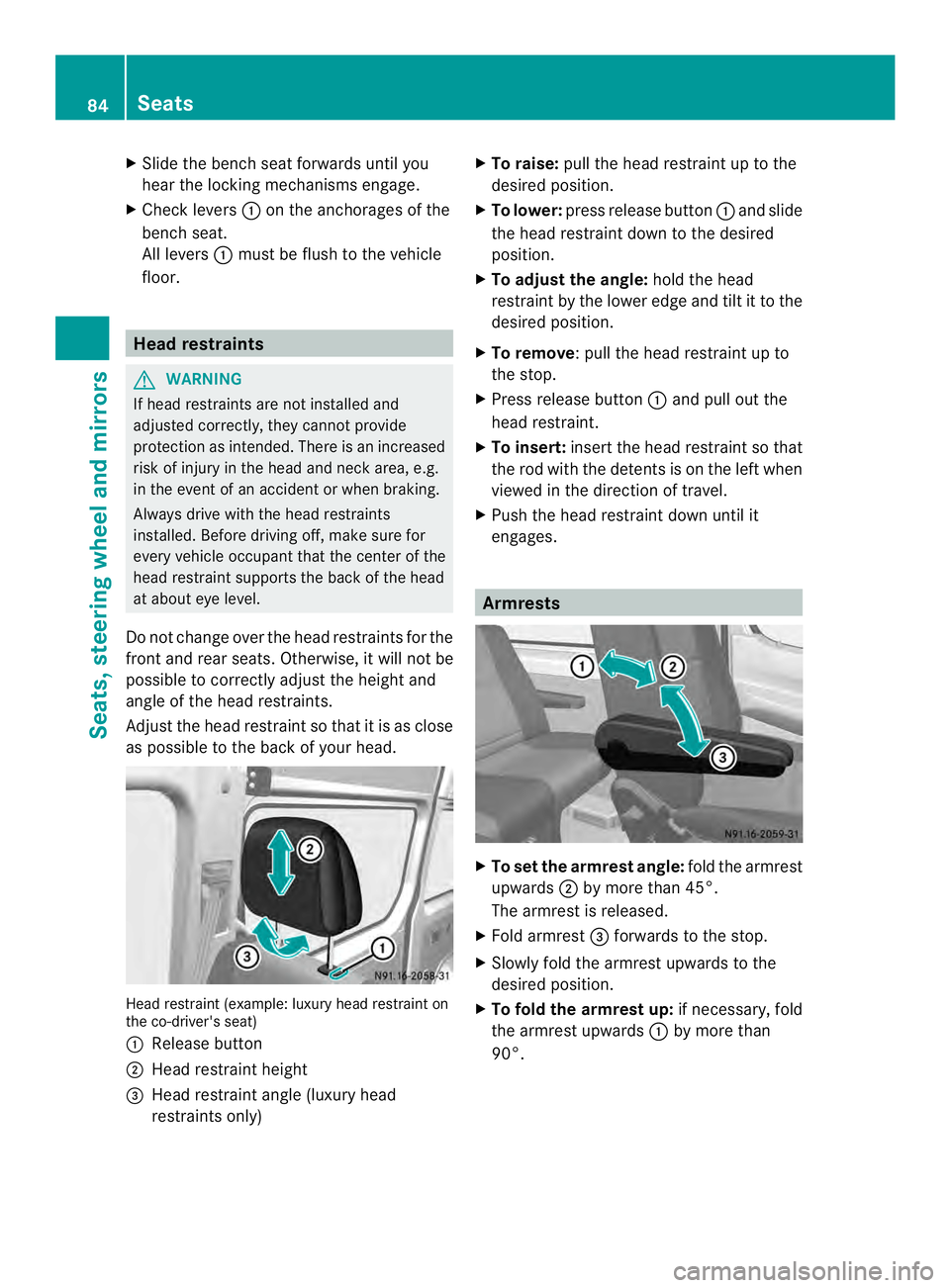
as possible to the back of your head. Head restraint (example: luxury head restraint on
the co-driver's seat)
0005
Release button
0006 Head restraint height
0026 Head restraint angle (luxury head
restraints only) X
To raise: pull the head restraint up to the
desired position.
X To lower: press release button 0005and slide
the head restraint down to the desired
position.
X To adjust the angle: hold the head
restraint by the lower edge and tilt it to the
desired position.
X To remove:p ull the head restraint up to
the stop.
X Press release button 0005and pull out the
head restraint.
X To insert: insert the head restraint so that
the rod with the detents is on the left when
viewed in the direction of travel.
X Push the head restraint down until it
engages. Armrests
X
To set the armrest angle: fold the armrest
upwards 0006by more than 45°.
The armres tis released.
X Fold armrest 0026forwards to the stop.
X Slowly fold the armrest upwards to the
desired position.
X To fold the armrest up: if necessary, fold
the armrest upwards 0005by more than
90°. 84
SeatsSeats, steering wheel and mirrors
Page 87 of 334
Seat heating
G
WARNING
Repeatedly switching on the seat heating can
cause the seat cushion and backrest pads to
become very hot. The health of persons with
limited temperature sensitivity or a limited
ability to react to excessively high
temperatures may be affected or they may
even suffer burn-like injuries. There is a risk
of injury.
Therefore, do not switch the seat heating on
repeatedly.
! When you leave your seat, do not place
anything on the seat and switch off the seat
heating. Do not switch the seat heating on
when the seat is not occupied, e.g. when
driving without a co-driver. The seat
heating may otherwise overheat, causing
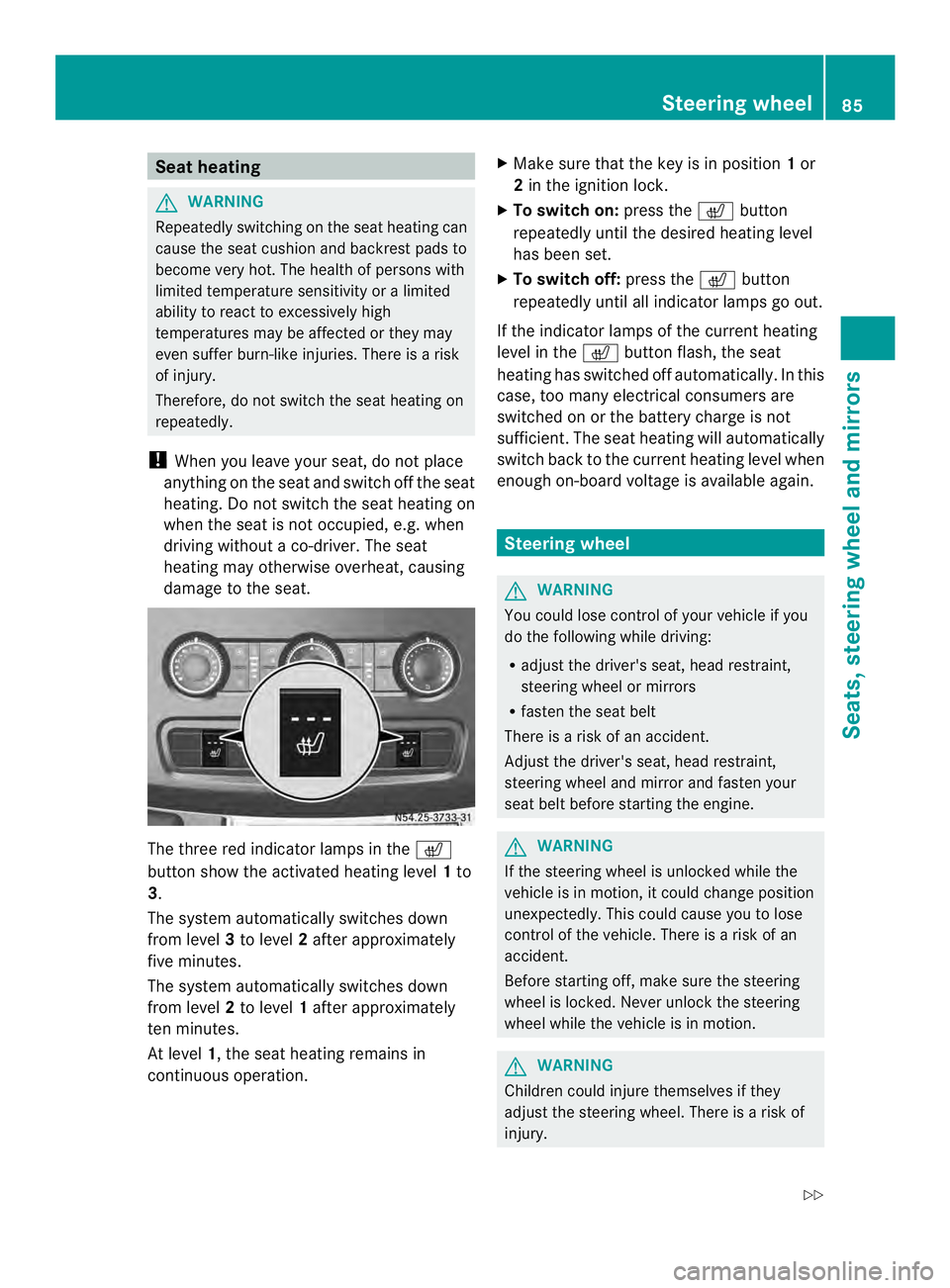
damage to the seat. The three red indicator lamps in the
0007
button show the activated heating level 1to
3.
The system automatically switches down
from level 3to level 2after approximately
five minutes.
The system automatically switches down
from level 2to level 1after approximately
ten minutes.
At level 1, the seat heating remains in
continuous operation. X
Make sure that the key is in position 1or
2 in the ignition lock.
X To switch on: press the0007button
repeatedly until the desired heating level
has been set.
X To switch off: press the0007button
repeatedly until all indicator lamps go out.
If the indicator lamps of the current heating
level in the 0007button flash, the seat
heating has switched off automatically. In this
case, too many electrical consumers are
switched on or the battery charge is not
sufficient. The seat heating will automatically
switch back to the current heating level when
enough on-board voltage is available again. Steering wheel
G
WARNING
You could lose control of your vehicle if you
do the following while driving:
R adjust the driver's seat, head restraint,
steering wheel or mirrors
R fasten the seat belt
There is a risk of an accident.
Adjust the driver's seat, head restraint,
steering wheel and mirror and fasten your
seat belt before starting the engine. G
WARNING
If the steering wheel is unlocked while the
vehicle is in motion, it could change position
unexpectedly. This could cause you to lose
control of the vehicle. There is a risk of an
accident.
Before starting off, make sure the steering
wheel is locked. Never unlock the steering
wheel while the vehicle is in motion. G
WARNING
Children could injure themselves if they
adjust the steering wheel. There is a risk of
injury. Steering wheel
85Seats, steering wheel and mirrors
Z
Page 95 of 334
X
To operate the high-beam flasher: turn
the key to position 1or 2in the ignition
lock.
X Pull the combinatio nswitch briefly in
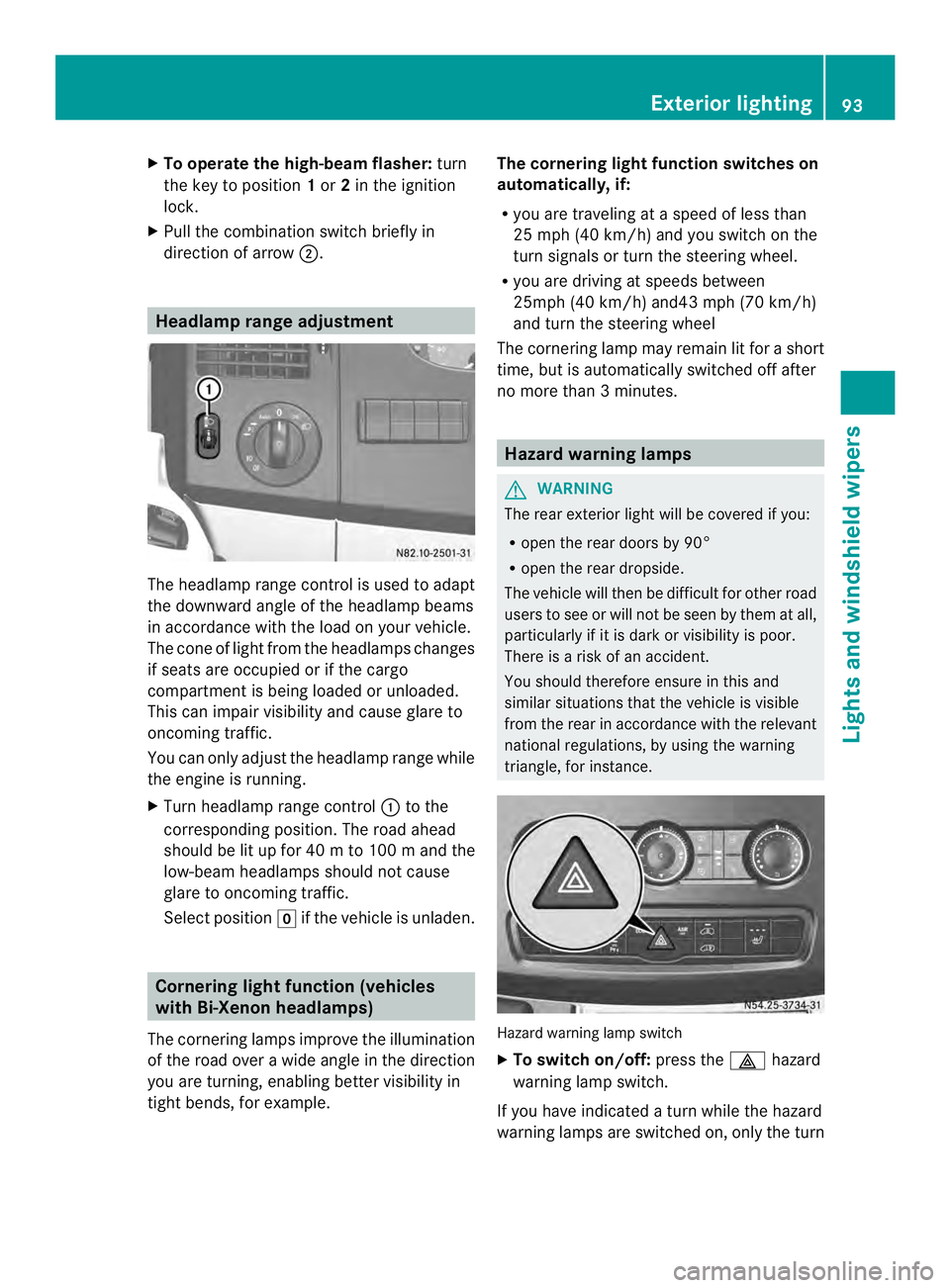
directio nofarrow0006. Headlamp range adjustment
The headlamp range control is used to adapt
the downward angle of the headlamp beams
in accordance with the loadony our vehicle.
The cone of light from the headlamps changes
if seats are occupied or if the cargo
compartment is being loaded or unloaded.
This can impair visibility and cause glare to
oncoming traffic.
You can only adjust the headlamp range while
the engine is running.
X Turn headlamp range control 0005to the
corresponding position. The road ahead
should be lit up for 40 mto 100 mand the
low-bea mheadlamps should not cause
glare to oncoming traffic.
Select position 0011if the vehicle is unladen. Cornering light function (vehicles
with Bi-Xenon headlamps)
The cornering lamps improve the illumination
of the road over a wide angle in the direction
you are turning, enabling better visibility in
tight bends, for example. The cornering light function switches on
automatically, if:
R
you are traveling at a speed of less than
25 mph (40 km/h) and you switch on the
turn signals or turn the steering wheel.
R you are driving at speeds between
25mph (40 km/h) and43 mph (70 km/h)
and turn the steering wheel
The cornering lamp may remain lit for a short
time, but is automatically switched off after
no more than 3 minutes. Hazard warning lamps
G
WARNING
The rear exterior light will be covered if you:
R open the rear doors by 90°
R open the rear dropside.
The vehicle will then be difficult for other road
users to see or will not be seen by them at all,
particularly if it is dark or visibility is poor.
There is a risk of an accident.
You should therefore ensure in this and
similar situations that the vehicle is visible
from the rear in accordance with the relevant
national regulations, by using the warning
triangle, for instance. Hazard warning lamp switch
X
To switch on/off: press the0011hazard
warning lamp switch.
If you have indicated a turn while the hazard
warning lamps are switched on, only the turn Exterior lighting
93Lights and windshield wipers Z
Page 141 of 334
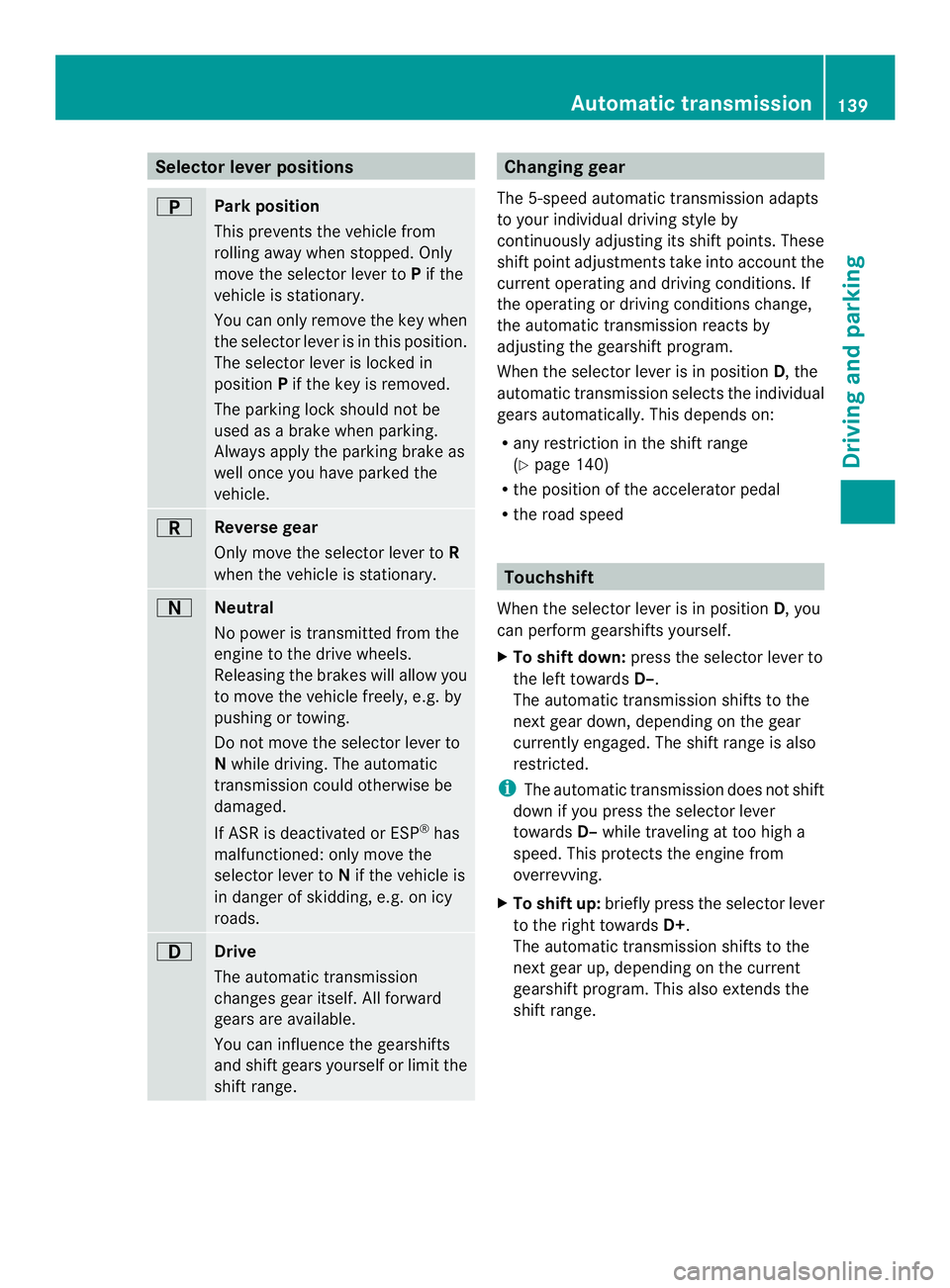
Selector lever positions
0002
Park position
This prevents the vehicle from
rolling away when stopped. Only
move the selector lever to
Pif the
vehicle is stationary.
You can only remove the key when
the selector lever is in this position.
The selector lever is locked in
position Pif the key is removed.
The parking lock should not be
used as a brake when parking.
Always apply the parking brake as
well once you have parked the
vehicle. 0003
Reverse gear
Only move the selector lever to
R
when the vehicle is stationary. 0001
Neutral
No power is transmitted from the
engine to the drive wheels.
Releasing the brakes will allow you
to move the vehicle freely, e.g. by
pushing or towing.
Do not move the selector lever to
N
while driving. The automatic
transmission could otherwise be
damaged.
If ASR is deactivated or ESP ®
has
malfunctioned: only move the
selector lever to Nif the vehicle is
in danger of skidding, e.g. on icy
roads. 0007
Drive
The automatic transmission
changes gear itself. All forward
gears are available.
You can influence the gearshifts
and shift gears yourself or limit the
shift range. Changing gear
The 5-speed automatic transmission adapts
to your individual driving style by
continuously adjusting its shift points. These
shift point adjustments take into account the
current operating and driving conditions. If
the operating or driving conditions change,
the automatic transmission reacts by
adjusting the gearshift program.
When the selector lever is in position D, the
automatic transmission selects the individual
gears automatically. This depends on:
R any restriction in the shift range
(Y page 140)
R the position of the accelerator pedal
R the road speed Touchshift
When the selector lever is in position D, you
can perform gearshifts yourself.
X To shift down: press the selector lever to
the left towards D–.
The automatic transmission shifts to the
next gear down, depending on the gear
currently engaged. The shift range is also
restricted.
i The automatic transmission does not shift
down if you press the selector lever
towards D–while traveling at too high a
speed. This protects the engine from
overrevving.
X To shift up: briefly press the selector lever
to the right towards D+.
The automatic transmission shifts to the
next gear up, depending on the current
gearshift program. This also extends the
shift range. Automatic transmission
139Driving and parking Z