tow MERCEDES-BENZ SPRINTER 2013 MY13 Operator’s Manual
[x] Cancel search | Manufacturer: MERCEDES-BENZ, Model Year: 2013, Model line: SPRINTER, Model: MERCEDES-BENZ SPRINTER 2013Pages: 334, PDF Size: 3.88 MB
Page 21 of 334
GAWR (Gross Axle Weigh
tRating)
(definition) ..................................... 293
GTW (Gross Trailer Weight)
(definition) ..................................... 293
GVW (Gross Vehicle Weight)
(definition) ..................................... 293
GVWR (Gross Vehicle Weight
Rating) (definition) .........................293
Important safety notes ..................274
Increased vehicle weight due to
optional equipment (definition) ......293
Kilopascal (kPa) (definition) ...........293
Labeling (overview )........................ 289
Load bearing index (definition) ......294
Load index ..................................... 291
Load index (definition) ...................294
M+S tires ....................................... 276
Maximum loaded vehicle weight
(definition) ..................................... 293
Maximum load on a tire
(definition) ..................................... 294
Maximum permissible tire
pressure (definition) ....................... 294
Maximum tire loa d......................... 291
Maximum tire load (definition) .......294
Optional equipment weight
(definition) ..................................... 294
PSI (pounds per square inch)
(definition) ..................................... 294
Replacing ....................................... 302
Service life ..................................... 276
Sidewall (definition) .......................294
Speed rating (definition) ................293
Storing ........................................... 303
Structure and characteristics
(definition) ..................................... 292
Summer tires ................................. 276
TIN (Tire Identification Number)
(definition) ..................................... 294
Tire bea d(definition) ...................... 294
Tire pressure (definition) ................294
Tire pressures (recommended )...... 293
Tire size (data) ............................... 285
Tire size designation, load-bearing
capacity, speed rating .................... 290
Tire tread ....................................... 275
Tire tread (definition) .....................294
Total load limit (definition) .............295 Traction (definition)
.......................295
TWR (permissible trailer drawbar
noseweight) (definition) .................295
Uniform Tire Quality Grading
Standard s(definition) .................... 293
Unladen weight (definition) ............294
valve, Snap-In ................................ 280
Wea rindicato r(definition) .............295
Whee lrim (definition ).................... 293
Tire sealant
Storage location ............................ 265
Using ............................................. 295
Top Tether ............................................ 53
Touchshift (automatic
transmission) ..................................... 139
Tow-away alarm Arming/deactivating ........................61
Deactivating .................................... .61
Operation ........................................ .60
Towing
If the vehicl eisstuck..................... 270
Important safety guidelines ...........268
Installing/removing the towing
eye. ................................................ 269
In the event of malfunction s.......... 269
With a raised front or rear axle ......269
Towing atrailer
Axle load ,permissible .................... 329
Cleaning the trailer tow hitch ......... 260
Coupling up atrailer ...................... 171
Decoupling atrailer ....................... 172
Driving tips .................................... 168
Important safety notes ..................168
Installing and removing the ball
coupling ......................................... 170
Notes on retrofitting ......................328
Power supply ................................. 174
Trailer loads ................................... 329
Towing away
With both axles on the ground .......270
Tow-starting
Emergency engine starting ............271
Important safety notes ..................268
Trailer
Brake force booster malfunction ...211
Trailer coupling
see Towing atrailer
see Trailer tow hitch Index
19
Page 22 of 334
Trailer loads and drawbar
noseweights
...................................... 173
Trailer towing PARKTRONI C................................. 160
Permissible trailer loads and
drawba rnoseweights ............169, 173
Transmission
see Automatic transmission
Transmission oil ................................ 323
Transport Loading guidelines .........................232
Vehicle .......................................... .271
Transportation
Rail ................................................ 150
Transport by rail ................................ 150
Transporting Load distribution ............................ 234
Securing aload .............................. 234
Trim pieces (cleaning instructions) .260
Trip computer (on-board
computer) .......................................... 189
Trip meter see Trip odometer
Trip odometer
Display (vehicles without steering
wheel buttons) ............................... 178
Display (vehicles with steering
wheel buttons) ............................... 182
Resetting ....................................... 177
see Trip computer (on-board computer)
Turn signals
Changing bulbs (front) .....................98
Changing bulbs (rear) ..............99, 101
Switching on/off .............................. 92
Turn signals (Chassis Cab)
Changing bulbs (rear) ....................100
Twin co-driver's seat
Folding tabl e.................................. 225
Stowag ecompartmen t.................. 224
Two-way radios
Type approval/frequency ..............314
TWR (Tongue Weight Rating)
(definition) ......................................... 295 U
Unlocking From inside the vehicle (central
unlocking button) ............................. 69 V
Vehicle Correct use ...................................... 26
Data acquisition ............................... 29
Display message ............................ 208
Electronics ..................................... 314
Equipment ....................................... 23
Individual settings (vehicles with
steering wheel buttons) .................183
Limited Warranty ............................. 29
Loading .......................................... 286
Locking (SmartKey) .......................... 64
Lowering ........................................ 307
Maintenance .................................... 23
Operating safety .............................. 24
Parking for a long period ................ 147
Pulling away ................................... 135
Raising ........................................... 304
Registration ..................................... 23
Reporting problems .........................28
Securing from rolling away ............145
Towing away .................................. 268
Transporting .................................. 271
Unlocking (SmartKey) ......................64
Vehicle battery
see Battery (vehicle)
Vehicle bodies
General notes .................................. 27
Vehicle data ....................................... 326
Vehicle identification number .......... 315
Vehicle identification plate ..............315
Vehicle tool kit .................................. 264
Voltage supply Fuse s............................................. 271 W
Warning and indicator lamps Brakes ........................................... 211
Check Engine ................................. 216
Coolant .......................................... 215
Diesel Exhaus tFluid (DEF) .............213 20
Index
Page 28 of 334
G
WARNING
Objects in the driver's footwell can restrict the
pedal travel or obstruct adepressed pedal.
The operating and road safety of the vehicle
is jeopardized. There is a risk of an accident.
Make sure that all objects in the vehicle are
stowed correctly, and that they cannot enter
the driver's footwell. Install the floormats
securely and as specified in order to ensure
sufficien tclearance for the pedals. Do not use
loose floormats.
! If the engine is switched off and a device
which is connected to the on-board
diagnostics connection is being used, the
battery may discharge.
Connecting equipmen tto the diagnostics
connections can lead to emissions
monitoring information being reset. The
possible outcome may be that the vehicle no
longer fulfills the emissions laws and
regulations. This may be acriminal offense or
breach of road traffic regulations in certain
countries. Qualified specialist workshops
An authorized Sprinter Deale ris a qualified
specialist workshop. Aqualified specialist
workshop has the necessary specialist
knowledge, tools and qualifications to
correctly carry out the work required on the
vehicle. This is especially the case for work
relevan tto safety.
Observe the information in the Maintenance
Booklet.
The following work should always be carried
out at qualified specialist workshop:
R work relevant to safety
R service and maintenance work
R repair work
R modifications as well as installations and
alterations
R work on electronic components For this reason, we recommend an authorized
Sprinter Dealer. Proper use
G
WARNING
Gases and fluids from substances that
constitute a health hazard or react
aggressively can escape even from securely
closed containers. When transporting such
substances in the vehicle interior, your ability
to concentrate or your health could be
affected during the journey. Malfunctions,
short circuits or electrical componen tsystem
failures may also result .There is a risk of an
accident and fire.
Do not store or transport any substances in
the vehicle interior which are hazardous to
health or react aggressively.
Do not store or transport any substances in
the vehicle interior which are hazardous to
health or react aggressively.
These include:
R solvents
R fuel
R oils and greases
R cleaning agents
R acids
There are various warning stickers affixed to
your vehicle. If you remove warning stickers,
others may fail to recognize the dangers.
Leave the warning stickers in their original
position.
Observe the following information when
operating your vehicle:
R the safety information in these instructions
R the “Technical data“ section in this
Operator's Manual
R traffic rules and regulations
R motor vehicle laws and safety standards 26
Introduction
Page 34 of 334
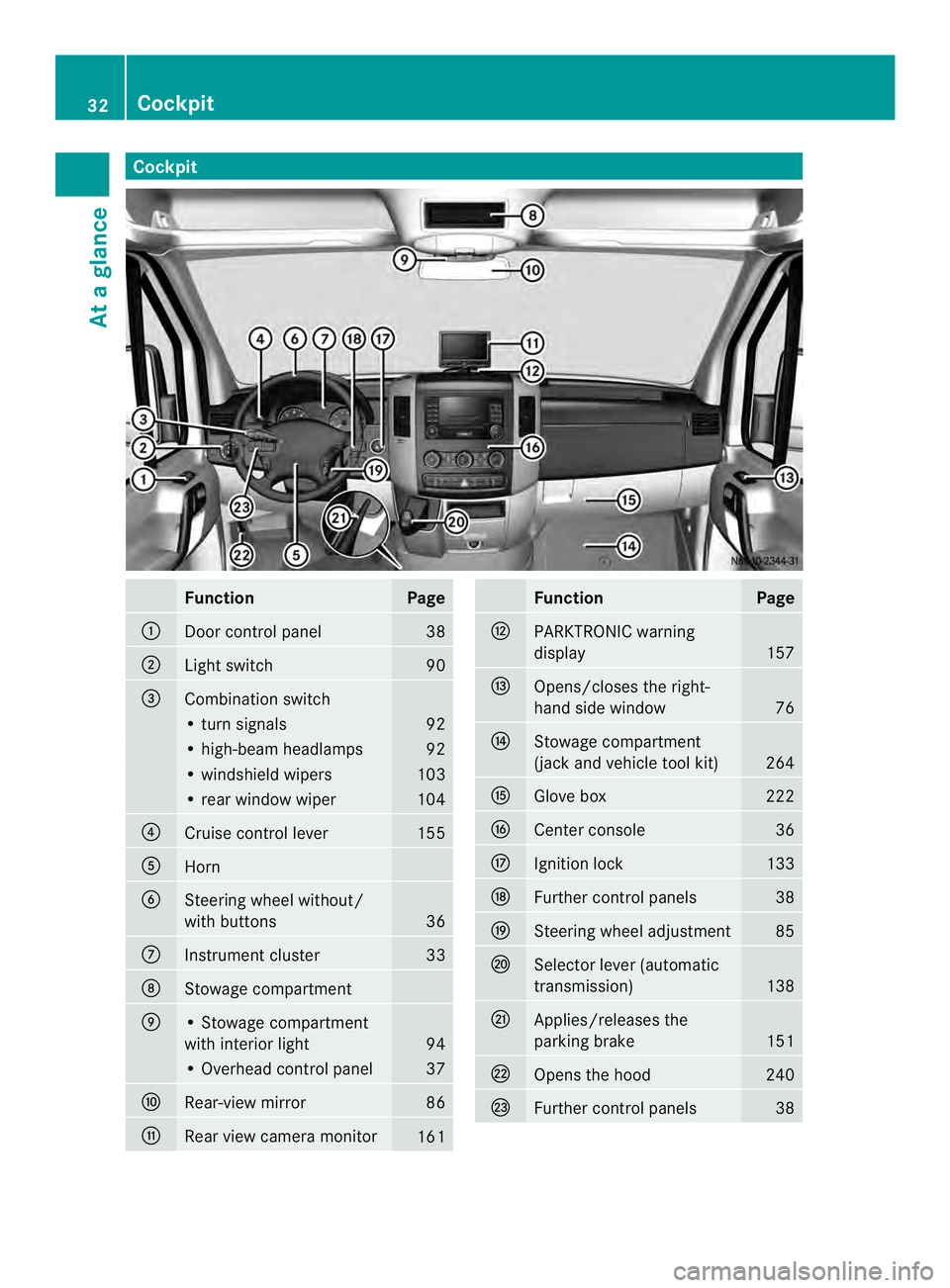
Cockpit
Function Page
0005
Door control panel 38
0006
Ligh
tswitch 90
0026
Combinatio
nswitch • tur
nsignals 92
• high-beam headlamps 92
• windshield wipers 103
• rear window wiper 104
0025
Cruise control lever 155
0023
Horn
0024
Steering wheel without/
with buttons
36
0018
Instrument cluster 33
0019
Stowage compartment
001A
• Stowage compartment
with interior light
94
• Overhead control panel 37
001B
Rear-view mirror 86
001C
Rear view camera monitor
161 Function Page
001D
PARKTRONIC warning
display 157
001E
Opens/closes the right-
hand side window
76
001F
Stowage compartment
(jac kand vehicle tool kit) 264
0020
Glove box 222
0021
Center console 36
0022
Ignitio
nlock 133
0028
Further control panels 38
0029
Steering wheel adjustment 85
002A
Selector lever (automatic
transmission)
138
002B
Applies/releases the
parking brake
151
002C
Opens the hood 240
0014
Further control panels 3832
CockpitAt a glance
Page 38 of 334
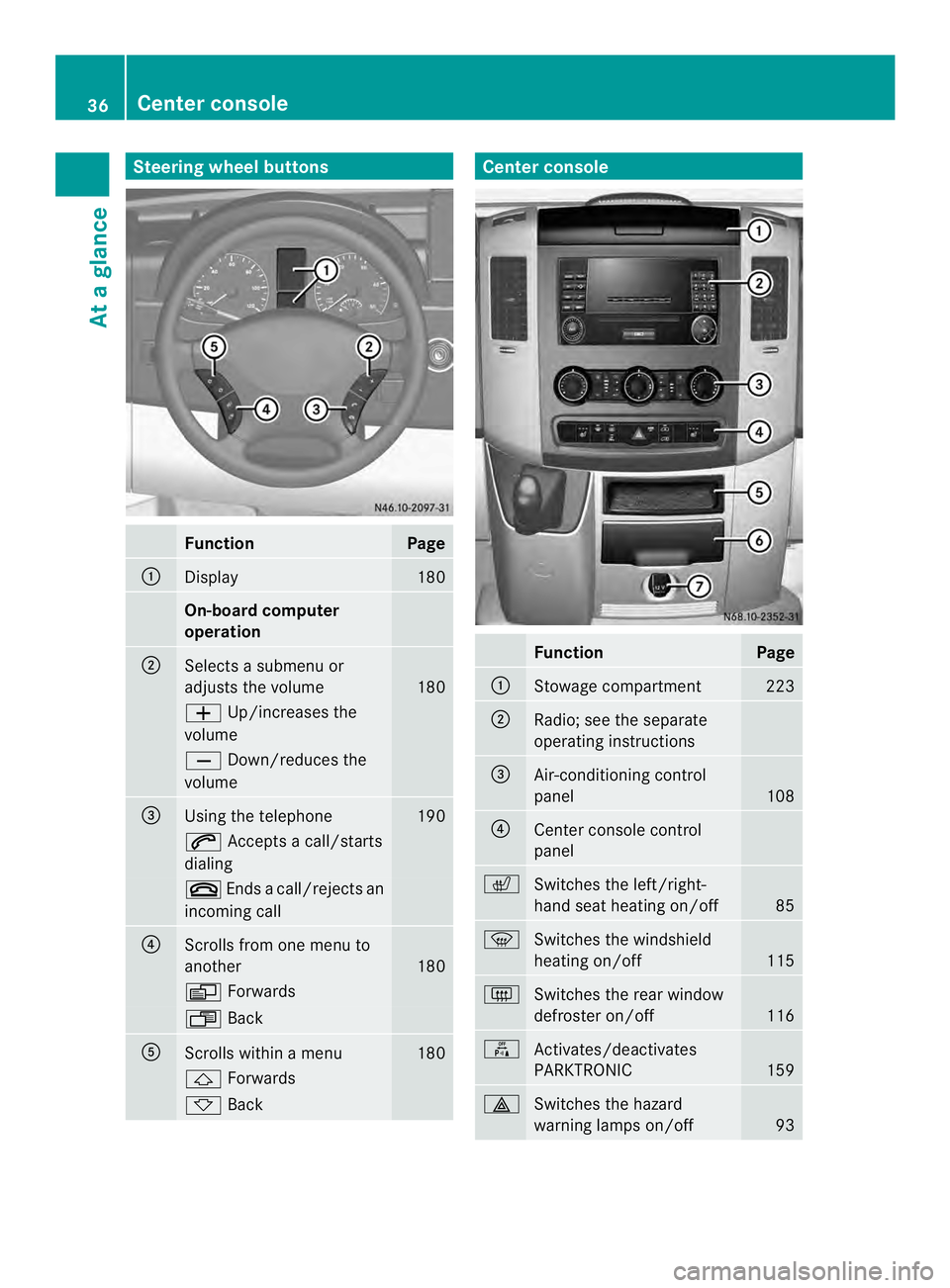
Steering wheel buttons
Function Page
0005
Display 180
On-board computer
operation
0006
Selects a submenu or
adjusts the volume
180
0011
Up/increases the
volume 0012
Down/reduces the
volume 0026
Using the telephone 190
0001
Accepts a call/starts
dialing 0005
Ends a call/rejects an
incoming call 0025
Scrolls from one menu to
another
180
0010
Forwards 0007
Back 0023
Scrolls within a menu 180
0001
Forwards 0009
Back Center console
Function Page
0005
Stowage compartment 223
0006
Radio; see the separate
operating instructions
0026
Air-conditioning control
panel
108
0025
Center console control
panel
0007
Switches the left/right-
hand seat heating on/off
85
0021
Switches the windshield
heating on/off
115
0019
Switches the rear window
defroster on/off
116
000C
Activates/deactivates
PARKTRONIC
159
0011
Switches the hazard
warning lamps on/off
9336
Center consoleAt a glance
Page 39 of 334
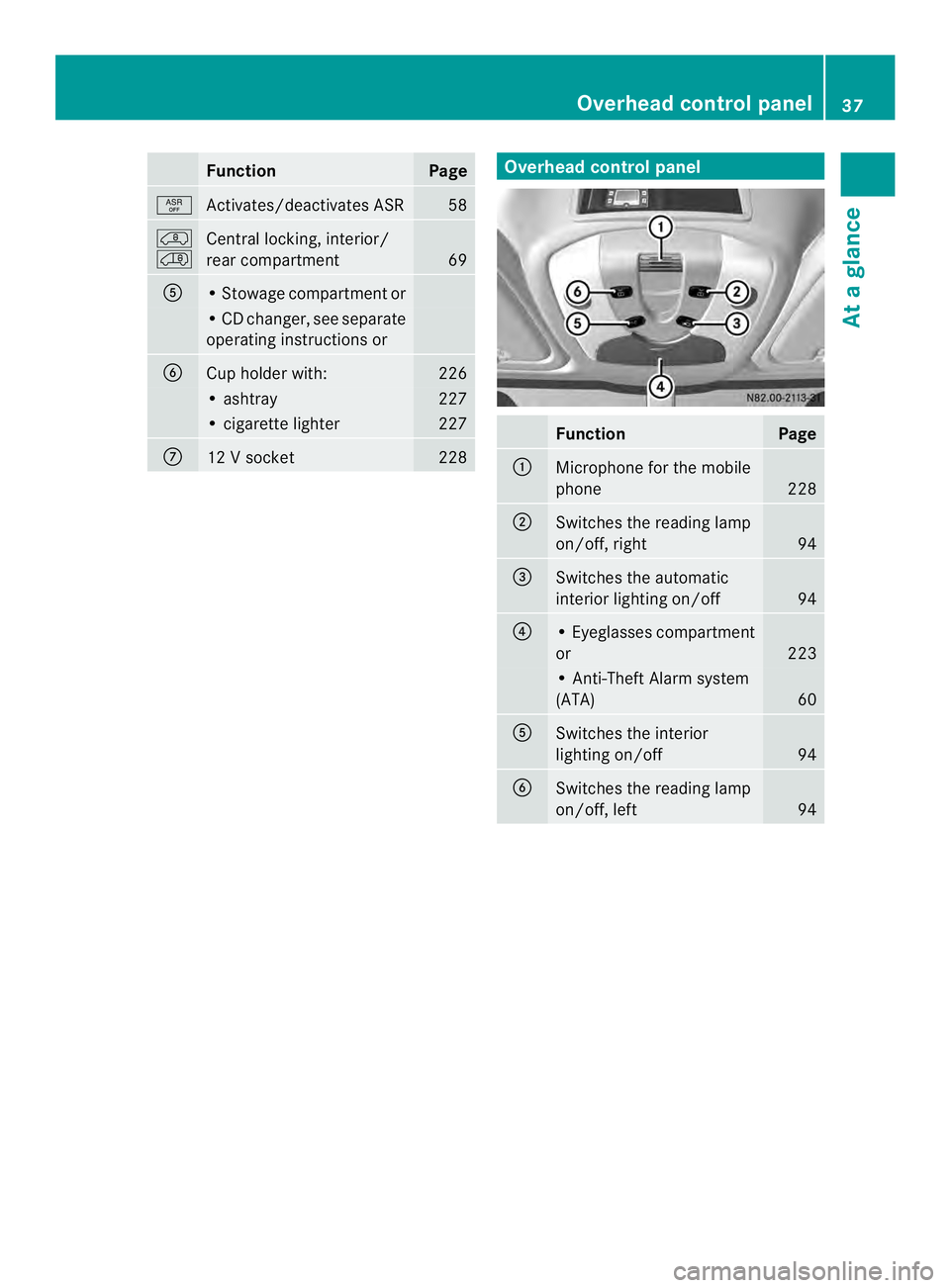
Function Page
0006
Activates/deactivates ASR 58
0006
0001
Central locking, interior/
rear compartment
69
0023
• Stowage compartmen
tor • CD changer, see separate
operating instructions or
0024
Cup holder with: 226
• ashtray 227
• cigarette lighter 227
0018
12 V socket 228 Overhea
dcontrol panel Function Page
0005
Microphone for the mobile
phone
228
0006
Switches the reading lamp
on/off, right
94
0026
Switches the automatic
interio
rlighting on/off 94
0025
• Eyeglasses compartment
or
223
• Anti-Theft Alarm system
(ATA)
60
0023
Switches the interior
lighting on/off
94
0024
Switches the reading lamp
on/off, left
94Overhead control panel
37At a glance
Page 46 of 334
Air bags
Important safety notes G
WARNING
To reduce the ris kofinjury when the front air
bags inflate, it is very important for the driver
and co-driver to always be in a properly seated
positio nand to wear thei rrespective seat
belt.
For maximum protection in the event of a
collision always be in normal seated position
with your back against the seat backrest.
Fasten your seat belt and make sure it is
properly positioned on your body.
Since the air bag inflates with considerable
speed and force, a proper seating position
and correct positioning of the hands on the
steering wheel will help to keep you at a safe
distance from the air bag. Occupants who are
not wearing their seat belt, are not seated
properly or are too close to the air bag can be
seriously injured or killed by an air bag as it
inflates with great force instantaneously:
R Sit with the seat belt properly fastened in a
position that is as upright as possible with
your back against the seat backrest.
R Move the driver's seat as far back as
possible, still permitting proper operation
of vehicle controls. The distance from the
center of the driver's chest to the center of
the air bag cover on the steering wheel
must be at least 10 inches (25 cm) or more.
You should be able to accomplish this by
adjusting the seat and steering wheel. If
you have any difficulties, please contact a
qualified specialist workshop.
R Do not lean your head or chest close to the
steering wheel or instrument panel.
R Keep hands on the outside of the steering
wheel rim. Placing hands and arms inside
the rim can increase the risk and potential
severity of hand/arm injury when the driver
front air bag inflates. R
Move the co-driver's seat as far as possible
away from the instrument panel when the
seat is occupied.
R Occupants, especially children, should
never place their bodies or lean their heads
in the area of the door where the side
impact air bag inflates .This could result in
serious injuries or death should the side
impact air bag be deployed. Always sit as
upright as possible, wear the seat belt
properly and use an appropriately sized
infant restraint, toddler restraint, or
booster seat recommended for the size and
weight of the child.
R Children twelve years old and under must
never travel on the co-driver's seat. They
will otherwise be struck by the co-driver's
front air bag when it inflates in a crash. This
could result in serious or fatal injury.
Failure to follow these instructions can result
in severe injuries to you or other occupants.
If you sell your vehicle, it is important that you
make the buyer aware of this safety
information. Be sure to give the buyer this
Operator's Manual. G
WARNING
The air bag parts are hot after the airbag has
been deployed. There is a risk of injury.
Do not touch the air bag parts. Have the
deployed air bags replaced at a qualified
specialist workshop as soon as possible.
i If the vehicle is still in running condition,
have it towed to a qualified specialist
workshop. G
WARNING
If you modify the air bag covers or affix objects
such as stickers to them, the air bags may not
function correctly. There is an increased risk
of injury.
Never modify the air bag covers or affix
objects to them. 44
Occupant safetySafety
Page 52 of 334
Emergency Tensioning Devices, seat
belt force limiters
G
WARNING
Pyrotechnic ETDs that were activated must be
replaced.
For your safety, when disposing of the
pyrotechnic ETDs always follow our safety
instructions. These instructions are available
from any authorized Sprinter Dealer.
! If the front-passenger seat is not
occupied, do no tengage the sea tbelt
tongue in the buckle on the front-
passenger seat. Otherwise, the Emergency
Tensioning Device could be triggered in the
event of an accident.
X In order to ensure that the pyrotechnic
Emergency Tensioning Devices have not
been triggered, always have the seat belts
checked after an accident.
If the Emergency Tensioning Devices have
been triggered, they must be replaced.
If the vehicle is equipped with a driver's air
bag, the seat belts on the driver's and co-
driver's seats have Emergency Tensioning
Devices and seat belt force limiters.
ETDs tighten the seat belts in an accident,
pulling them close against the seat
occupant's body.
ETDs do not correct incorrect seat positions
or incorrectly fastened seat belts.
ETDs do not pull vehicle occupants back
towards the backrest.
When activated, the seat belt force limiters
reduce the force exerted by the seat belt on
the driver or co-driver.
The seat belt force limiters are synchronized
with the fron tair bags, which absorb part of
the deceleration force, resulting in the force
exerted on the occupant being distributed
over a greater area.
The ETDs can only be triggered if the ignition
is switched on and the restraint systems are
operational, see " 0008warning lamp"
(Y page 42). The Emergency Tensioning Devices are
triggered depending on the type and severity
of an accident:
R
in the event of a head-on or rear-end
collision if the vehicle decelerates or
accelerates rapidly in a longitudinal
direction during the initial stages of the
impact
R in the event of a side impact if the vehicle
decelerates or accelerates rapidly in a
lateral direction and the vehicle is equipped
with thorax side impac tair bags and/or
window curtain air bags
If the ETDs are triggered, you will hear a bang
and powder may also be released .Only in rare
cases will the bang affect your hearing .The
powder emitted is not generally hazardous to
health. The 0008warning lamp lights up. Child restraint systems
Important safety notes
G
WARNING
If the child restraint system is not installed
correctly to a suitable seat, the child may not
be secured in the event of an accident or
sudden braking and may be seriously or even
fatally injured. Therefore, when installing a
child restraint system, you must observe the
manufacturer's installation instructions as
well as the notes on using the child restraint
system.
Child restraint systems should preferably be
installed to the rear seats. Children are
generally better protected there.
Never place objects, e.g. cushions, under the
child restraint system. The entire base of the
child restraint system must always rest on the
seat cushion.
A child restraint system must not be used
without the genuine cover designed for it.
Only replace damaged covers with genuine
covers. 50
Child restraint systemsSafety
Page 54 of 334

sweep of the roller sunblind. If someone
becomes trapped, briefly press the button
again. The opening or closing procedure will
be stopped.
G
WARNING
If the child restraint system is installed
incorrectly or is not secured, it can come
loose in the event of an accident, heavy
braking or a sudden change in direction. The
child restraint system could be thrown about,
striking vehicle occupants. There is an
increased risk of injury, possibly even fatal.
Always install child restraint systems
properly, even if they are not being used.
Make sure that you observe the child restraint
system manufacturer's installation
instructions.
Further information on secure stowage of
loads can be found under "Loading
guidelines".
If an infant or child is traveling in the vehicle:
R secure the child with a child or infant seat
restraint system appropriate to the age and
weight of the child
R make sure that the infant or child is
properly secured at all times while the
vehicle is in motion.
We recommend that you always properly
secure all infants and children in an infant or
child restraint system for the journey.
The use of seat belts and infant and child
restraint systems is required by law in:
R all 50 states
R the U.S. territories
R the District of Columbia
R all Canadian provinces
Infants and children must always be seated in
an appropriate infant or child restraint system
recommended for the size and weight of the
child. This must be properly secured in
accordance with the manufacturer's
installation instructions for the infant or child
seat restraint system. All infant or child restraint systems must meet
the following standards:
R
U.S. Federal Motor Vehicle Safety
Standards 213 and 225
R Canadian Motor Vehicle Safety Standards
213 and 210.2
A statement by the child restraint
manufacturer of compliance with these
standards can be found on the instruction
label on the child restraint system. You will
also find the statement in the instruction
manual provided with the child restraint
system.
When using any infant restraint, child
restraint or booster seat, make sure to
carefully read and follow all manufacturer's
instructions for installation and use.
Observe the warning labels in the vehicle
interior or on the infant or child restraint. LATCH-type (ISOFIX) child seat
securing system
G
WARNING
Children that are too large for a child restraint
must travel in seats using normal seat belts.
Position shoulderb elt across the chest and
shoulder, not face or neck.
Ab ooster seat may be necessary to achieve
proper seat belt positioning for children over
41 lb (18 kg) until they reach a height where
a lap/shoulder belt fits properly without a
booster.
Install the child restraint system in
accordance with the manufacturer's
instructions.
Attach the child restraint system to both
securing rings.
An incorrectly installed child restraint system
could come loose during an accident and
seriously or even fatally injure the child.
Child restraint systems or child seat securing
rings that are malfunctioning or damaged as
the result of a collision must be replaced. 52
Child restraint systemsSafety
Page 62 of 334
sure to explicitly point out the risks
described here.
R Only vehicle occupants who know how to
use the emergency exit window are
permitted to sit next to it.
R Access to the emergency exit window must
remain unobstructed. Do not place any
large or heavy objects on or in front of the
seats next to the emergency exit window.
R The window handles must not be used as
hooks, e.g. to hang up light objects, bags
or items of clothing.
R When exiting the vehicle through the
emergency exit window, pay attention to
the vehicle height and the local conditions.
Particularly children and smaller adults
may require assistance when exiting the
vehicle. Theft deterrent locking system
Immobilizer
X To activate: remove the key from the
ignition lock.
X To deactivate: turn the key to position 2
in the ignition lock.
The immobilizer prevents your vehicle from
being started without the correct key.
Always take the key with you and lock the
vehicle when leaving the vehicle. If you leave
the key in the vehicle, anyone can start the
engine.
i The immobilizer is always deactivated
when you start the engine.
In the event that the engine cannot be
started when the starter battery is fully
charged, the immobilizer may be faulty.
Contact an authorized Sprinter dealeror
call 1-877-762-8267 (in USA) or
1-800-387-0100 (in Canada). ATA (Anti-Theft Alarm system)
X To arm: close all doors.
X Lock the vehicle with the key.
The indicator lamp in the central locking
button (Y page 69) flashes.
X To deactivate: unlock the vehicle with the
key.
The indicator lamp in the central locking
button (Y page 69) goes out.
i Cargo Van and Crew Van only:
Unless you ope nadoor or the tailgate
within 40 seconds after unlocking the
vehicle:
R the vehicle will be locked again
R the anti-thef talarm system will be armed
again
If the alarm system is armed, a visual and
audible alarm is triggered by the following:
R Unlocking the vehicle fro minside
R Opening a door
R Opening the hood
i The alar mis not switched off, even if you
immediately close the open door that has
triggered it, for example.
X To stop the alarm: press the0009button
on the remote control.
Or
X Insert the key into the ignition lock.
The alarm stops. Tow-away alarm
Operation Av
isual and audible alarm is triggered if the
inclination of the vehicle changes when the
tow-away alarm is armed. This can be the
case if the vehicle is raised on one side, for
example. 60
Theft deterrent locking systemSafety