warning lights MERCEDES-BENZ SPRINTER 2013 MY13 Operator’s Manual
[x] Cancel search | Manufacturer: MERCEDES-BENZ, Model Year: 2013, Model line: SPRINTER, Model: MERCEDES-BENZ SPRINTER 2013Pages: 334, PDF Size: 3.88 MB
Page 52 of 334
Emergency Tensioning Devices, seat
belt force limiters
G
WARNING
Pyrotechnic ETDs that were activated must be
replaced.
For your safety, when disposing of the
pyrotechnic ETDs always follow our safety
instructions. These instructions are available
from any authorized Sprinter Dealer.
! If the front-passenger seat is not
occupied, do no tengage the sea tbelt
tongue in the buckle on the front-
passenger seat. Otherwise, the Emergency
Tensioning Device could be triggered in the
event of an accident.
X In order to ensure that the pyrotechnic
Emergency Tensioning Devices have not
been triggered, always have the seat belts
checked after an accident.
If the Emergency Tensioning Devices have
been triggered, they must be replaced.
If the vehicle is equipped with a driver's air
bag, the seat belts on the driver's and co-
driver's seats have Emergency Tensioning
Devices and seat belt force limiters.
ETDs tighten the seat belts in an accident,
pulling them close against the seat
occupant's body.
ETDs do not correct incorrect seat positions
or incorrectly fastened seat belts.
ETDs do not pull vehicle occupants back
towards the backrest.
When activated, the seat belt force limiters
reduce the force exerted by the seat belt on
the driver or co-driver.
The seat belt force limiters are synchronized
with the fron tair bags, which absorb part of
the deceleration force, resulting in the force
exerted on the occupant being distributed
over a greater area.
The ETDs can only be triggered if the ignition
is switched on and the restraint systems are
operational, see " 0008warning lamp"
(Y page 42). The Emergency Tensioning Devices are
triggered depending on the type and severity
of an accident:
R
in the event of a head-on or rear-end
collision if the vehicle decelerates or
accelerates rapidly in a longitudinal
direction during the initial stages of the
impact
R in the event of a side impact if the vehicle
decelerates or accelerates rapidly in a
lateral direction and the vehicle is equipped
with thorax side impac tair bags and/or
window curtain air bags
If the ETDs are triggered, you will hear a bang
and powder may also be released .Only in rare
cases will the bang affect your hearing .The
powder emitted is not generally hazardous to
health. The 0008warning lamp lights up. Child restraint systems
Important safety notes
G
WARNING
If the child restraint system is not installed
correctly to a suitable seat, the child may not
be secured in the event of an accident or
sudden braking and may be seriously or even
fatally injured. Therefore, when installing a
child restraint system, you must observe the
manufacturer's installation instructions as
well as the notes on using the child restraint
system.
Child restraint systems should preferably be
installed to the rear seats. Children are
generally better protected there.
Never place objects, e.g. cushions, under the
child restraint system. The entire base of the
child restraint system must always rest on the
seat cushion.
A child restraint system must not be used
without the genuine cover designed for it.
Only replace damaged covers with genuine
covers. 50
Child restraint systemsSafety
Page 58 of 334
Driving safet
ysystems Driving safety systems overview
In this section, you will find information about
the following driving safety systems:
R ABS ( Anti-lock BrakingSystem)
R BAS ( Brake Assist System)
R ASR (Acceleration SkidControl)
R ESP ®
(Electronic StabilityProgram)
R EBD ( Electronic Brake Force Distribution) Important safety notes
If you fail to adapt yourd riving style or if you
are inattentive, the driving safety systems can
neither reduce the risk of accident nor
override the laws of physics. Driving safety
systems are merely aids designed to assist
driving. You are responsible for the distance
to the vehicle in front, for vehicle speed and
for braking in good time. Always adapt your
driving style to the prevailing road and
weather conditions and maintai nasufficient,
safe distance from other road users. Drive
carefully.
The driving safety systems described can only
attain their maximum effectiveness when
there is optimum contact between the tires
and the road can. Therefore pay special
attention to the information on tires, the
recommended minimum tire tread, etc., in
the "Wheels and tires" section (Y page 274).
In wintry driving conditions, always use winter
tires (M+S tires) and if necessary, snow
chains. Only in this way will the driving safety
systems described in this section work as
effectively as possible. ABS (Anti-lock Braking System)
Important safety notes Note the section on 'Important safety notes'
(Y
page 56). G
WARNING
If ABS is faulty, the wheels could lock when
braking. The steerability and braking
characteristics may be severely impaired.
Additionally, further driving safety systems
are deactivated. There is an increased danger
of skidding and accidents.
Drive on carefully. Have ABS checked
immediately at a qualified specialist
workshop.
If ABS is malfunctioning, other systems will
also fail, including driving safety systems.
Observe the information relating to the 000E
(Y page 210) warning lamp.
ABS regulates brake pressure in such a way
that the wheels do not lock when you brake.
This allows you to continue steering the
vehicle when braking.
ABS acts from a speed of about 5 mph
(8 km/h) upwards, regardless of road surface
conditions. ABS works on slippery surfaces,
even when you only brake gently.
The yellow 000Ewarning lamp in the
instrument cluster lights up when the ignition
is switched on. The lamp goes out when the
engine starts running.
Braking X
If ABS intervenes: continue to depress the
brake pedal with force until the braking
situation is over.
X To make a full brake application:
depress the brake pedal with full force.
If ABS intervenes when braking, you will feel
a pulsating in the brake pedal.
The pulsating brake pedal can be an
indication of hazardous road conditions and
functions as a reminder to take extra care
while driving. BAS (Brake AssistS
ystem)
Note the section on 'Important safety notes'
(Y page 56). 56
Driving safety systemsSafety
Page 59 of 334
G
WARNING
If BAS is malfunctioning, the braking distance
in an emergency braking situation is
increased. There is a risk of an accident.
In an emergency braking situation, depress
the brake pedal with full force. ABS prevents
the wheels from locking.
Vehicles without steering wheel buttons: if
the BAS driving safety system is
malfunctioning, the 000Awarning lamp lights
up while the engine is running (Y page 210).
BAS operates in emergency braking
situations. If you depress the brake quickly,
BAS automatically increases the brake
pressure, thereby reducing the stopping
distance.
The brakes will function as usual once you
release the brake pedal. BAS is deactivated. EBD (electronic brake force
distribution)
Note the section on 'Important safety notes'
(Y page 56). G
WARNING
If EBD has malfunctioned, the rear wheels can
still lock, e.g. under full braking. This
increases the risk of skidding and an accident.
You should therefore adapt yourd riving style
to the different handling characteristics. Have
the brake system checked at a qualified
specialist workshop.
EBD monitors and controls the brake
pressure to the rear wheels. This enables EBD
to improve handling during braking.
Observe the information on warning and
indicator lamps (Y page 210). ESP
®
(Electronic Stability Program)
Note the section on 'Important safety notes'
(Y page 56). G
WARNING
If ESP ®
is malfunctioning it willn ot provide
any vehicle stabilization. There is an increased
risk of skidding or of an accident.
Exercise caution when continuing to drive.
Have ESP ®
checked at a qualified specialist
workshop.
! Only operate the vehicle briefly
(maximum of 10 seconds) on a brake
dynamometer. The key must be turned to
position 1in the ignition lock during this
time. You could otherwise damage the
drive train or the brake system.
! Do not run the vehicle on a roller
dynamometer (e.g. for performance tests).
If you must operate the vehicle on a roller
dynamometer, please consult a qualified
specialist workshop in advance. You could
otherwise damage the drive train or the
brake system.
If you activate or deactivate ESP ®
in a vehicle
with engageable all-wheel drive, ESP ®
will be
deactivated for the duration of the
activation/deactivation process.
If ESP ®
is malfunctioning, the 0002indicator
lamp lights up while the engine is running and
the engine power may be reduced
(Y page 210).
ESP ®
monitors driving stability and detects a
tendency of the vehicle to understeer or
oversteer (skidding) in good time. If ESP ®
detects that the vehicle is deviating from the
direction desired by the driver, one or more
wheels are braked to stabilize the vehicle. The
engine output is also modified to keep the
vehicle on the desired course within physical
limits. ESP ®
greatly assists you when driving
on wet or slippery road surfaces. ESP ®
also
stabilizes the vehicle when braking.
The 000D warning lamp in the instrument
cluster flashes when ESP ®
is intervening. Driving safety systems
57Safety Z
Page 60 of 334
If ESP
®
intervenes:
X Do not deactivate ASR under any
circumstances.
X When driving off, apply as little throttle as
possible.
X Adapt yours peed and driving style to the
prevailing road conditions.
i Only use wheels with the recommended
tire sizes. Only then will ESP ®
function
properly. ASR (acceleration skid control)
General notes Important safety notes
Note the section on 'Important safety notes'
(Y
page 56).
ASR can neither reduce the risk of an accident
nor suspend the laws of physics if the driver
does not pay attention when pulling away or
accelerating. ASR is only an aid. Always adapt
your driving style to suit the prevailing road
and weather conditions.
Vehicles without steering wheel buttons: if
ASR is malfunctioning, the 000Aindicator
lamp lights up while the engine is running and
the engine power may be reduced
(Y page 210).
ASR significantly improves traction, i.e. the
transmission of power from the tires to the
road surface, and thus increases the vehicle's
driving stability. If the driving wheels start to
spin, ASR brakes individual drive wheels and
limits the engine torque. ASR thus
significantly assists you when pulling away
and accelerating, especially on wet or
slippery roads.
If traction on the road surface is not sufficient,
even ASR will not allow you to pull away
without difficulty. The type of tires and total
weight of the vehicle as well as the gradient
of the road also play a crucial role. If ASR intervenes, the
000Dwarning lamp in
the instrument cluster flashes.
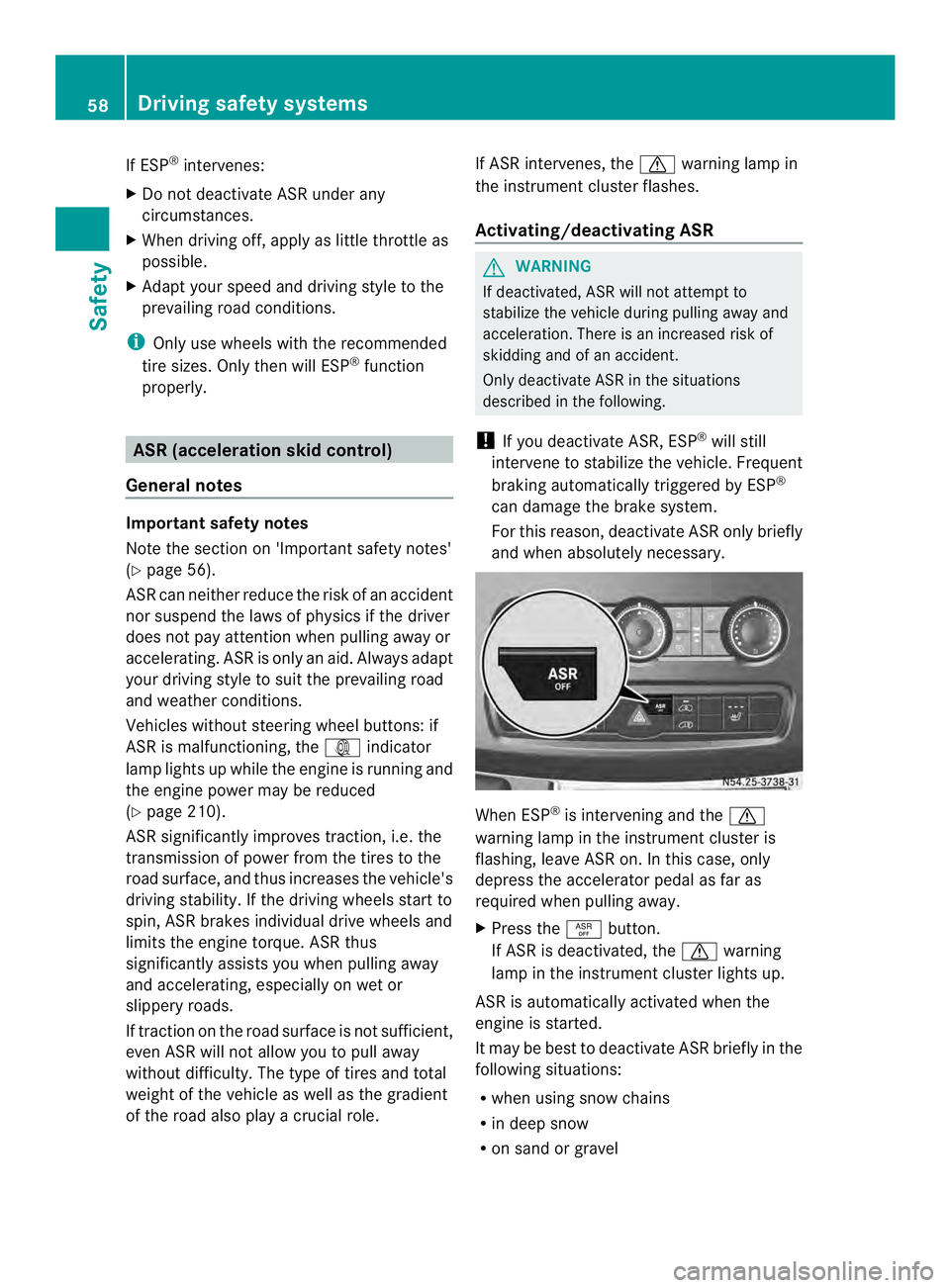
Activating/deactivating ASR G
WARNING
If deactivated, ASR will not attempt to
stabilize the vehicle during pulling away and
acceleration. There is an increased risk of
skidding and of an accident.
Only deactivate ASR in the situations
described in the following.
! If you deactivate ASR, ESP ®
will still
intervene to stabilize the vehicle. Frequent
braking automatically triggered by ESP ®
can damage the brake system.
For this reason, deactivate ASR only briefly
and when absolutely necessary. When ESP
®
is intervening and the 000D
warning lamp in the instrument cluster is
flashing, leave ASR on. In this case, only
depress the accelerator pedal as far as
required when pulling away.
X Press the 0006button.
If ASR is deactivated, the 000Dwarning
lamp in the instrument cluster lights up.
ASR is automatically activated when the
engine is started.
It may be best to deactivate ASR briefly in the
following situations:
R when using snow chains
R in deep snow
R on sand or gravel 58
Driving safet
ysystemsSafety
Page 68 of 334
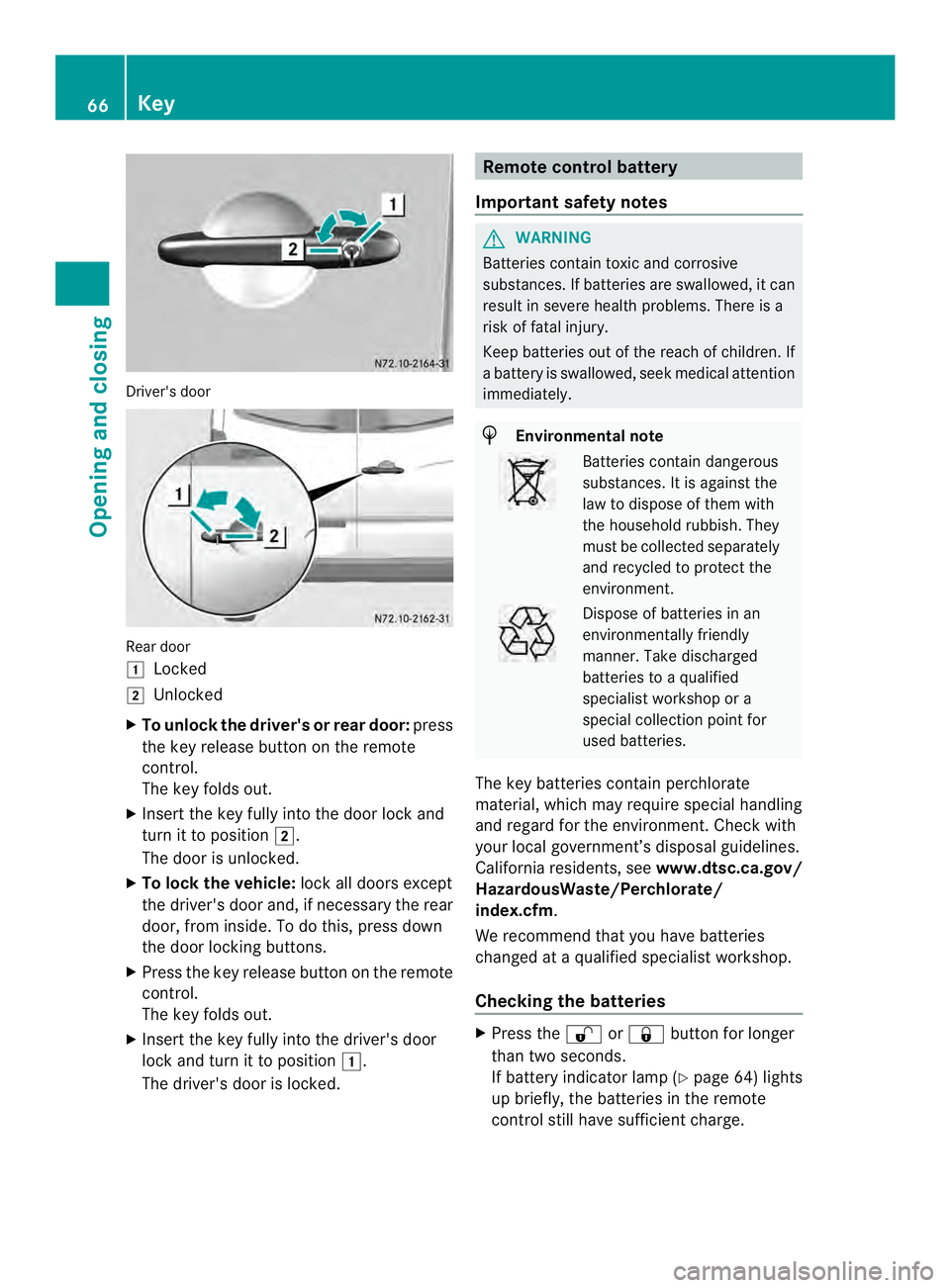
Driver's door
Rear door
0008
Locked
0009 Unlocked
X To unlock the driver' sor rear door: press
the key release button on the remote
control.
The key folds out.
X Insert the key fully into the door lock and
turn it to position 0009.
The door is unlocked.
X To lock the vehicle: lock all doors except
the driver's door and, if necessary the rear
door, fro minside .To do this, press down
the door locking buttons.
X Press the key release button on the remote
control.
The key folds out.
X Insert the key fully into the driver's door
lock and turn it to position 0008.
The driver's door is locked. Remote control battery
Important safety notes G
WARNING
Batteries contain toxic and corrosive
substances. If batteries are swallowed, it can
result in severe health problems. There is a
risk of fatal injury.
Keep batteries out of the reach of children. If
a battery is swallowed, seek medical attention
immediately. H
Environmental note Batteries contain dangerous
substances. It is against the
law to dispose of them with
the household rubbish. They
must be collected separately
and recycled to protect the
environment.
Dispose of batteries in an
environmentally friendly
manner
.Take discharged
batteries to a qualified
specialist workshop or a
special collectio npoint for
used batteries.
The key batteries contain perchlorate
material, which may require special handling
and regard for the environment. Check with
your local government’s disposal guidelines.
California residents, see www.dtsc.ca.gov/
HazardousWaste/Perchlorate/
index.cfm.
We recommend that you have batteries
changed at a qualified specialist workshop.
Checking the batteries X
Press the 0009or0008 button for longer
than two seconds.
If battery indicator lamp (Y page 64) lights
up briefly, the batteries in the remote
control still have sufficient charge. 66
KeyOpening and closing
Page 71 of 334
Central locking
Important safety notes
G
WARNING
Activate the child-proof door locks if children
are traveling in the vehicle .The children could
otherwise open the doors while the vehicle is
in motion, injuring themselves and others. G
WARNING
Do not leave children unsupervised in the
vehicle, even if they are secured in a child
restraint system. Children could otherwise
injure themselves on parts of the vehicle.
They could be severely or even fatally injured
by prolonged exposure to intense heat or
cold.
If children open a door, they could:
R injure other people
R get out of the vehicle and thereby injure
themselves or be injured by a passing
vehicle
R severely injure themselves by falling down,
in particular due to the vehicle height
Always take the key with you when leaving the
vehicle, even if you are only leaving for a short
time.
You can open a locked front door from the
inside at any time. You can only open a locked
sliding door or rear door from the inside if the
child-proof locks have not been activated. Locking and unlocking manually
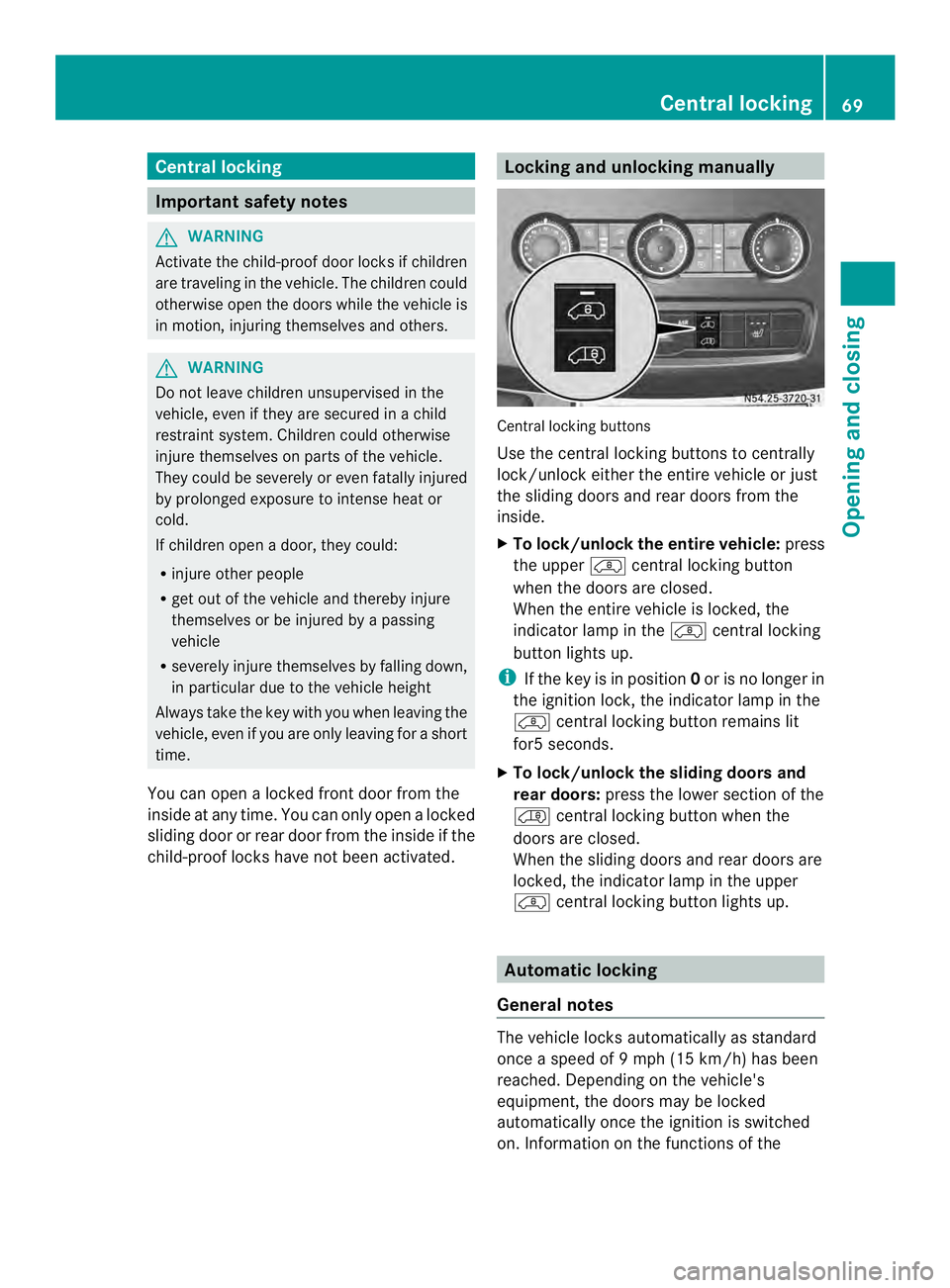
Central locking buttons
Use the central locking buttons to centrally
lock/unlocke
itherthe entire vehicle or just
the sliding doors and rear doors from the
inside.
X To lock/unlock the entire vehicle: press
the upper 0006central locking button
when the doors are closed.
When the entire vehicle is locked, the
indicator lamp in the 0006central locking
button lights up.
i If the key is in position 0or is no longer in
the ignition lock, the indicator lamp in the
0006 central locking button remains lit
for5 seconds.
X To lock/unlock the sliding doors and
rear doors: press the lower section of the
0001 central locking button when the
doors are closed.
When the sliding doors and rear doors are
locked, the indicator lamp in the upper
0006 central locking button lights up. Automatic locking
General notes The vehicle locks automatically as standard
once a speed of
9mph (15 km/h) has been
reached. Depending on the vehicle's
equipment, the doors may be locked
automatically once the ignition is switched
on. Information on the functions of the Central locking
69Opening and closing Z
Page 74 of 334
Electrical closing assist
If your vehicle is equipped with electrical
closing assist, you will require less force to
close the sliding door. Electrical step
Important safety notes
If you do no tuse the grab handle and the step,
you could injure yourselfw hen getting in and
out of the vehicle.
In order to reduce risks:
R draw the passengers' attention to the
electrical step. Wait until the electrical step
is fully extended.
R do not jump out of the vehicle.
R only use the grab handle and step. Only
they are designed for such a load.
R keep grab handles, access steps and entry
sills free from dirt, e.g. mud, clay, snow and
ice. Operation and obstacle detection
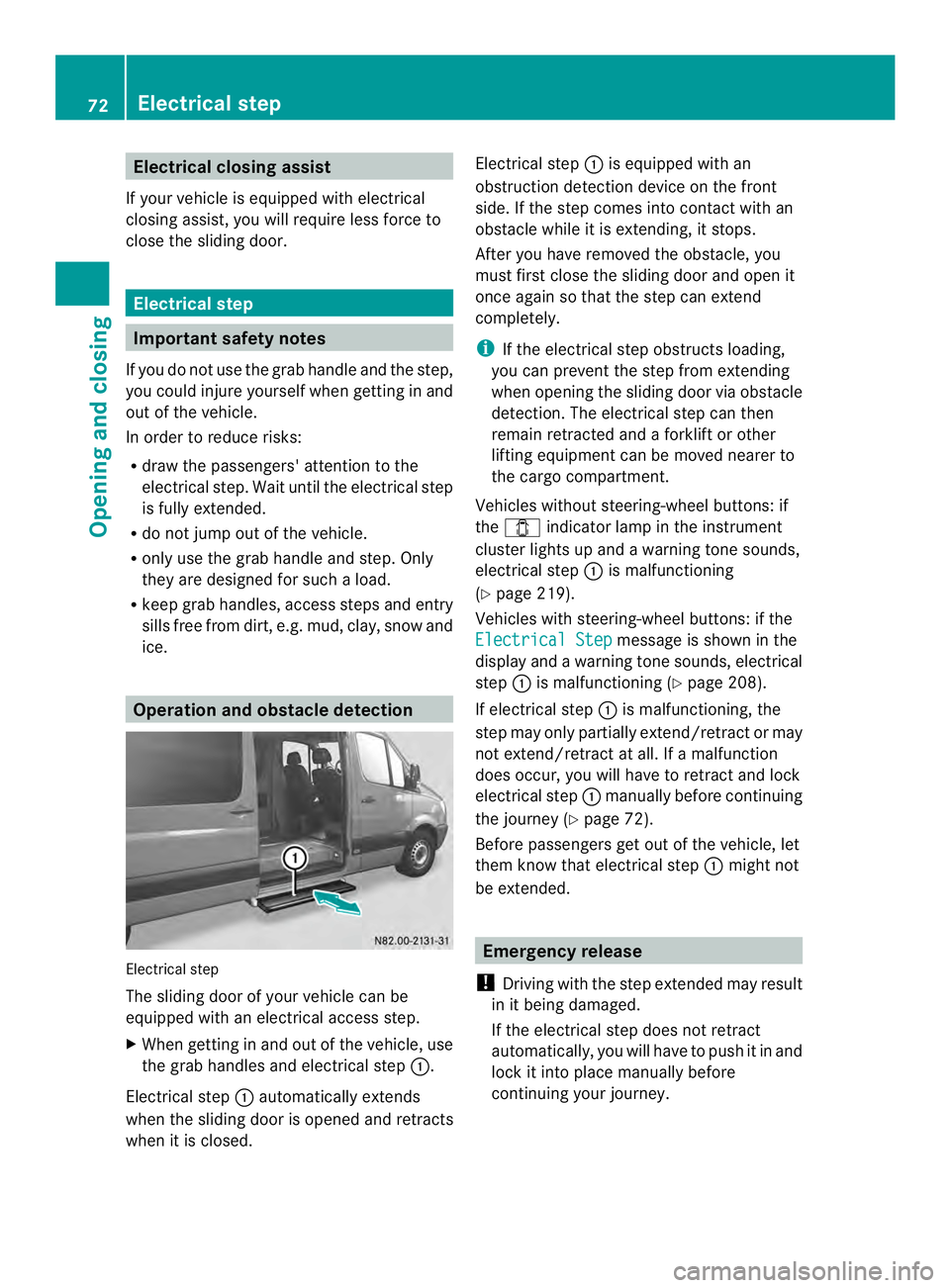
Electrical step
The sliding door of your vehicle can be
equipped with an electrical access step.
X When getting in and out of the vehicle, use
the grab handles and electrical step 0005.
Electrical step 0005automatically extends
when the sliding door is opened and retracts
when it is closed. Electrical step
0005is equipped with an
obstruction detection device on the front
side. If the step comes into contact with an
obstacle while it is extending, it stops.
After you have removed the obstacle, you
must first close the sliding door and open it
once again so that the step can extend
completely.
i If the electrical step obstructs loading,
you can prevent the step from extending
when opening the sliding door via obstacle
detection. The electrical step can then
remain retracted and aforklift or other
lifting equipment can be moved nearer to
the cargo compartment.
Vehicles without steering-wheel buttons: if
the 0004 indicator lamp in the instrument
cluster lights up and a warning tone sounds,
electrical step 0005is malfunctioning
(Y page 219).
Vehicles with steering-wheel buttons: if the
Electrical Step message is shown in the
display and a warning tones ounds, electrical
step 0005is malfunctioning (Y page 208).
If electrical step 0005is malfunctioning, the
step may only partially extend/retract or may
not extend/retract at all. If a malfunction
does occur, you will have to retrac tand lock
electrical step 0005manually before continuing
the journey (Y page 72).
Before passengers ge tout of the vehicle, let
them know that electrical step 0005might not
be extended. Emergency release
! Driving with the step extended may result
in it being damaged.
If the electrical step does not retract
automatically, you will have to push it in and
loc kiti nto place manually before
continuing your journey. 72
Electrical stepOpening and closing
Page 92 of 334
Useful information
This Operator's Manual describes all models
as well as standard and optional equipment
of your vehicle that were available at the time
of going to print. Country-specific variations
are possible. Note that your vehicle may not
be equipped with all of the described
functions. This also applies to systems and
functions relevant to safety.
Read the information on qualified specialist
workshops (Y page 26). Exterior lighting
Important safety notes
For reasons of safety, we recommend that
you drive with the lights switched on even
during the daytime. There may be differences
in operation due to legal requirements and
voluntary recommendations in some
countries. Lamp failure indicator
The bulb failure indicator is only an aid. You
are responsible for the proper functioning of
the vehicle lighting. Insufficient or non-
functioning vehicle lightin gputs the operating
safety of the vehicle at risk.
For this reason, check the condition and
function of your vehicle's lighting system and,
if necessary, that of the trailer before each
journey.
The bulb failure indicator monitors all of the
exterio rlighting lamps, except the perimeter
lamp and the trailer lighting. If a bulb fails,
either the 0002(Ypage 34) indicator lamp
lights up, or you will see a corresponding
message in the display (Y page 201).
i Depending on the equipment, the bulb
failure indicator can fail for all lamps with
the exceptio nofthe turn signal lamps. Light switch
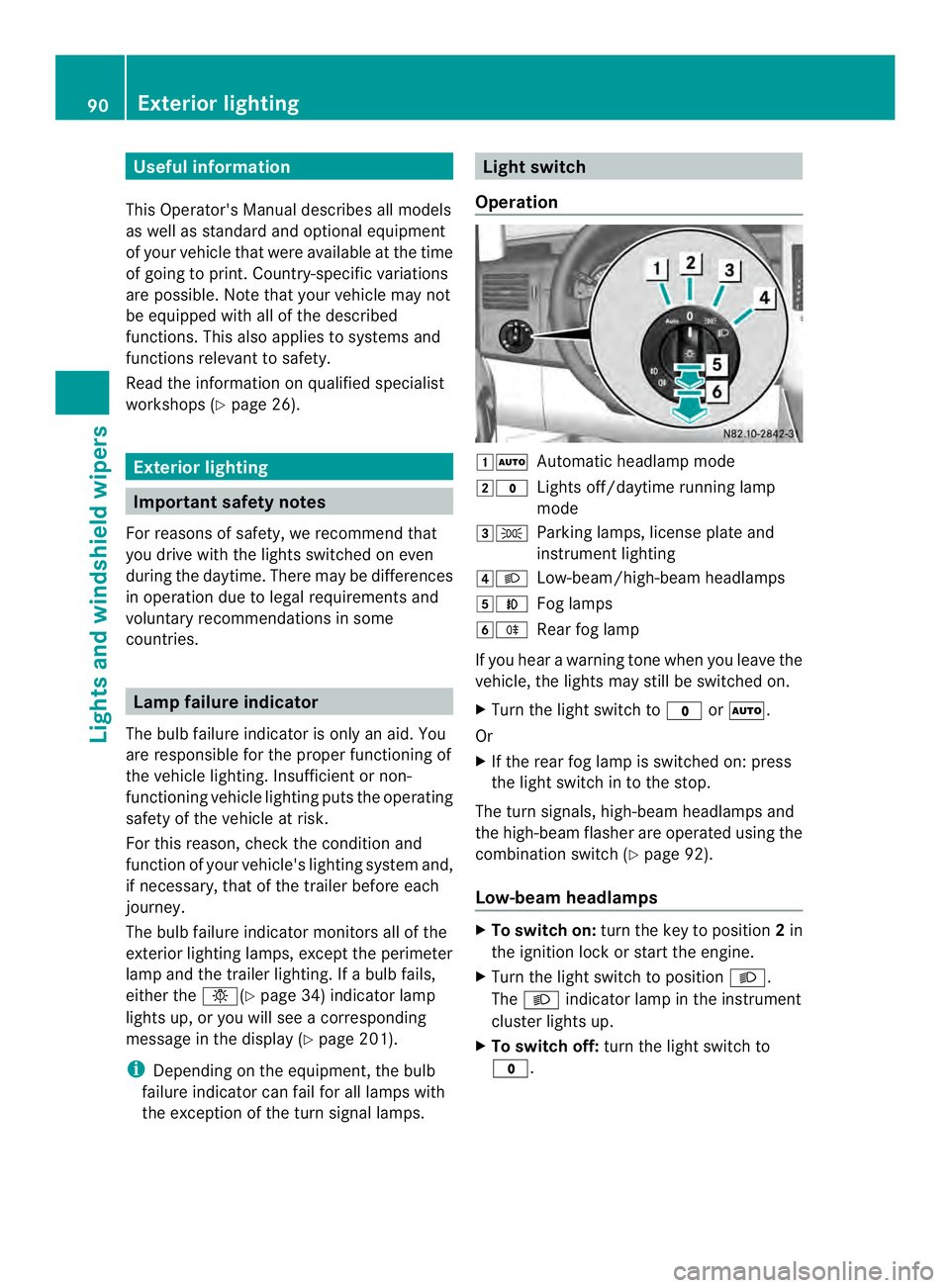
Operation 00080007
Automatic headlamp mode
0009000C Lights off/daytime running lamp
mode
000A000B Parking lamps, license plate and
instrumentl ighting
000E0004 Low-beam/high-beam headlamps
000F0005 Fog lamps
00100007 Rear fog lamp
If you hear a warning tone when you leave the
vehicle, the lights may still be switched on.
X Turn the light switch to 000Cor0007.
Or
X If the rear fog lamp is switched on: press
the light switch in to the stop.
The tur nsignals, high-beam headlamps and
the high-beam flasher are operated using the
combination switch (Y page 92).
Low-beam headlamps X
To switch on: turnthe key to position 2in
the ignition lock or start the engine.
X Turn the light switch to position 0004.
The 0004 indicator lamp in the instrument
cluster lights up.
X To switch off: turn the light switch to
000C. 90
Exterior lightingLights and windshield wipers
Page 93 of 334
Daytime running lamp mode
You can activate/deactivate daytime running
lamp mode using the on-board computer.
This is no tpossible in countries where
daytime running lamp mode is a legal
requirement.
Daytime running lamp mode must be
activated using the on-board computer:
R Vehicles with steering wheel
buttons(Y page 187)
R Vehicles without steering wheel buttons
(Y page 179)
X To switch on: turn the light switch to the
000C position.
The low-beam headlamps, parking lamps
and license plate lamp are switched on
when the engine is running. The 0004
indicator lamp in the instrument cluster
lights up.
i USA only:
If you turn the light switch to the 000Bor
0004 position, the parking lamps or low-
beam headlamps are switched on. If you
turn the light switch to the 0007position,
daytime running lamp mode stays switched
on.
i Canada only:
If you turn the light switch to the 0004
position, the low-beam headlamps are
switched on. If you turn the light switch to
the 000B or0007 position, daytime running
lamp mode stays switched on.
Automatic headlamp mode G
WARNING
If the light switch is set to 000Band it is foggy,
snowing or there is poor visibility, the low-
beam headlamps will not come on
automatically. There is a risk of an accident.
In such situations, turn the light switch to
0004. Automatic headlamp mode is only a driving
aid. You are responsible for the vehicle
lighting at all times.
If it is dark or foggy, turn the light switch
quickly from
0007to0004.Y ou could
otherwise briefly interrupt operation of the
headlamps.
Depending on ambient light, the rain and light
sensor automatically switches on the parking
lamps, low-beam headlamps and the license
plate lamp. This excludes weather-related
impairments to visibility, such as snow, fog or
spray.
X To switch on automatic headlamp
mode: turn the light switch to 0007.
Key in position 1in the ignition lock: the
parking lamps are switched on or off
automatically depending on the ambient
light.
When the engine is running: depending on
the ambient light, the parking lamps and
the low-beam headlamps are switched on
or off automatically.
When the low-beam headlamps are
switched on, the 0004indicator lamp in the
instrument cluster lights up.
Fog lamp/rear fog lamp G
WARNING
If you suspect that driving conditions will be
foggy, turn the light switch to 0004before you
start your journey. Your vehicle may
otherwise not be visible and you could
endanger yourself and others. G
WARNING
In low ambient lighting or foggy conditions,
only switch from position 0007to0004 with
the vehicle at a standstill in a safe location.
Switching from 0007to0004 will briefly
switch off the headlamps. Doing so while
driving in low ambient lighting conditions may
result in an accident. Exterior lighting
91Lights and windshiel dwipers Z
Page 95 of 334
X
To operate the high-beam flasher: turn
the key to position 1or 2in the ignition
lock.
X Pull the combinatio nswitch briefly in
directio nofarrow0006. Headlamp range adjustment
The headlamp range control is used to adapt
the downward angle of the headlamp beams
in accordance with the loadony our vehicle.
The cone of light from the headlamps changes
if seats are occupied or if the cargo
compartment is being loaded or unloaded.
This can impair visibility and cause glare to
oncoming traffic.
You can only adjust the headlamp range while
the engine is running.
X Turn headlamp range control 0005to the
corresponding position. The road ahead
should be lit up for 40 mto 100 mand the
low-bea mheadlamps should not cause
glare to oncoming traffic.
Select position 0011if the vehicle is unladen. Cornering light function (vehicles
with Bi-Xenon headlamps)
The cornering lamps improve the illumination
of the road over a wide angle in the direction
you are turning, enabling better visibility in
tight bends, for example. The cornering light function switches on
automatically, if:
R
you are traveling at a speed of less than
25 mph (40 km/h) and you switch on the
turn signals or turn the steering wheel.
R you are driving at speeds between
25mph (40 km/h) and43 mph (70 km/h)
and turn the steering wheel
The cornering lamp may remain lit for a short
time, but is automatically switched off after
no more than 3 minutes. Hazard warning lamps
G
WARNING
The rear exterior light will be covered if you:
R open the rear doors by 90°
R open the rear dropside.
The vehicle will then be difficult for other road
users to see or will not be seen by them at all,
particularly if it is dark or visibility is poor.
There is a risk of an accident.
You should therefore ensure in this and
similar situations that the vehicle is visible
from the rear in accordance with the relevant
national regulations, by using the warning
triangle, for instance. Hazard warning lamp switch
X
To switch on/off: press the0011hazard
warning lamp switch.
If you have indicated a turn while the hazard
warning lamps are switched on, only the turn Exterior lighting
93Lights and windshield wipers Z