door lock MERCEDES-BENZ SPRINTER 2013 MY13 Operator’s Manual
[x] Cancel search | Manufacturer: MERCEDES-BENZ, Model Year: 2013, Model line: SPRINTER, Model: MERCEDES-BENZ SPRINTER 2013Pages: 334, PDF Size: 3.88 MB
Page 77 of 334
and will no
tswivel back to its original
position.
Before closing the door, release door
retainer 0005from th edetent and return it to
its original position.
Closing the rear doors from the outside X
Pull the rear door away from magnetic door
retainer.
X Close the left-hand rear door firmly from
the outside.
X Close the right-hand rear door firmly from
the outside. Opening/closing from the inside
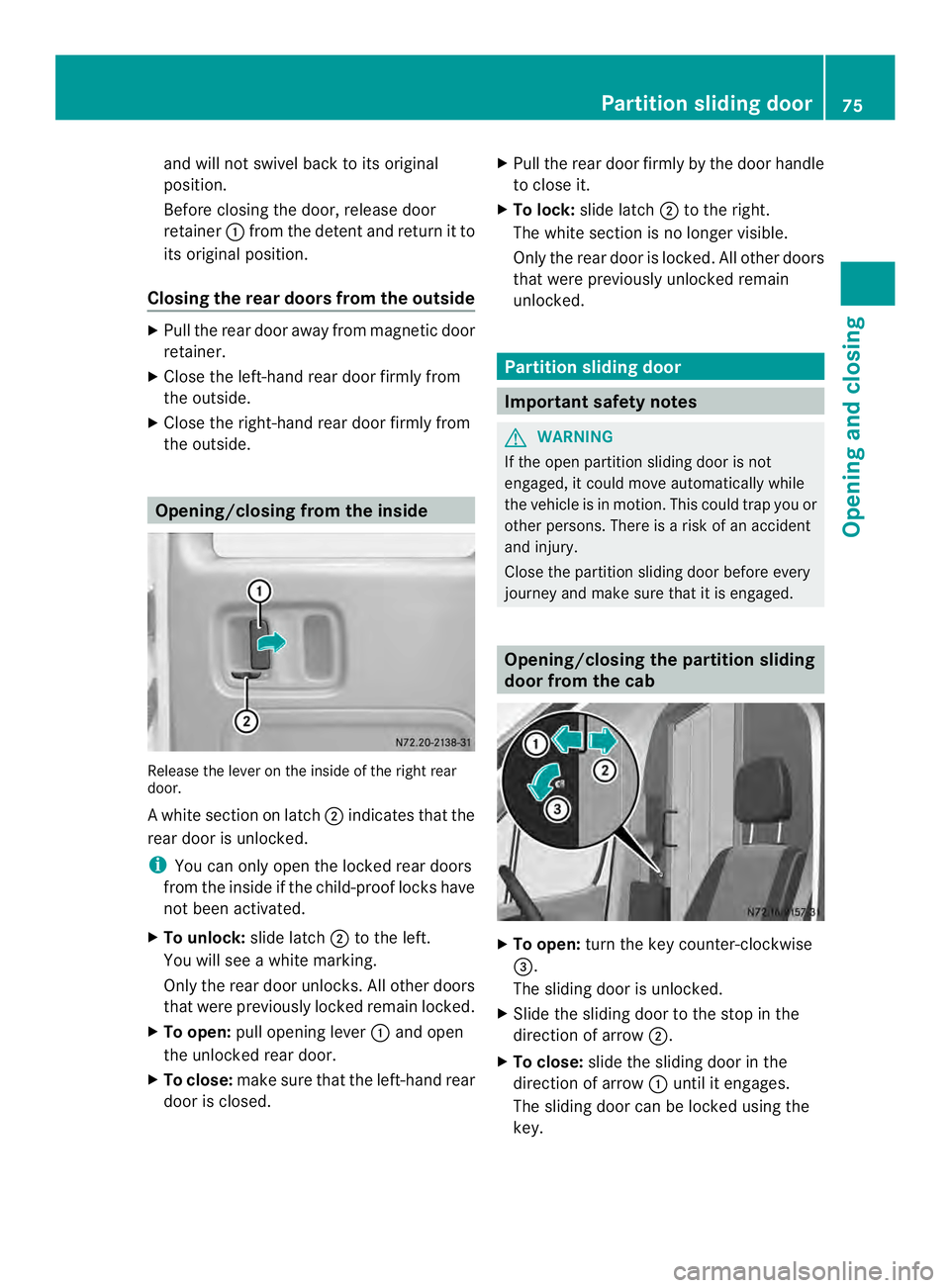
Release the lever on the inside of the right rear
door.
Aw
hite section on latch 0006indicates that the
rear door is unlocked.
i You can only open the locked rear doors
from the inside if the child-proof locks have
not been activated.
X To unlock: slide latch0006to the left.
You will see a white marking.
Only the rear door unlocks. All other doors
that were previously locked remain locked.
X To open: pull opening lever 0005and open
the unlocked rear door.
X To close: make sure that the left-hand rear
door is closed. X
Pull the rear door firmly by the door handle
to close it.
X To lock: slide latch 0006to the right.
The white section is no longer visible.
Only the rear door is locked. All other doors
that were previously unlocked remain
unlocked. Partition sliding door
Important safety notes
G
WARNING
If the open partition sliding door is not
engaged, it could move automatically while
the vehicle is in motion. This could trap you or
other persons. There is a risk of an accident
and injury.
Close the partition sliding door before every
journey and make sure that it is engaged. Opening/closing the partition sliding
door from the cab
X
To open: turn the key counter-clockwise
0026.
The sliding door is unlocked.
X Slide the sliding door to the stop in the
direction of arrow 0006.
X To close: slide the sliding door in the
direction of arrow 0005until it engages.
The sliding door can be locked using the
key. Partition sliding door
75Opening and closing Z
Page 78 of 334
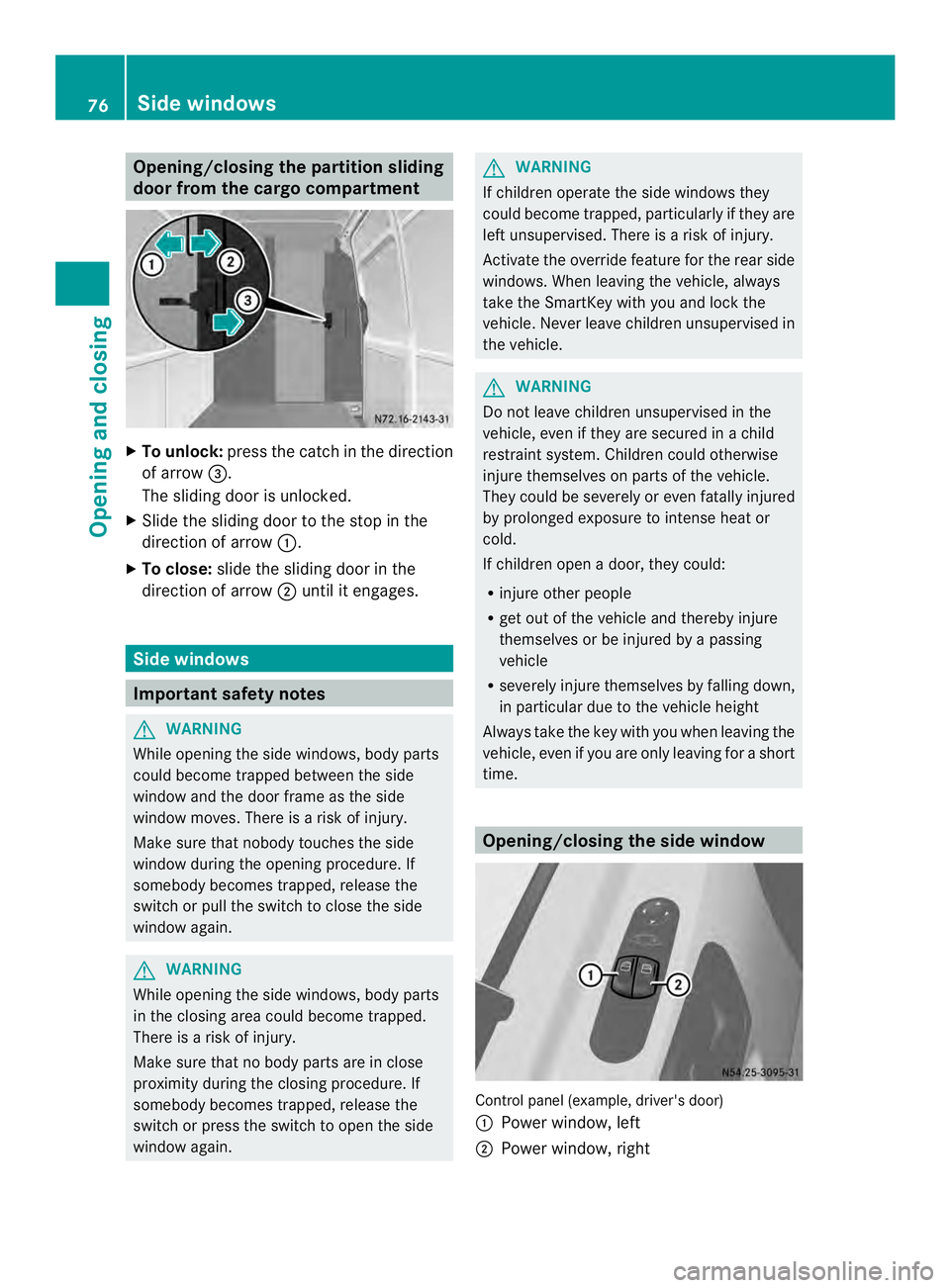
Opening/closing the partition sliding
door from the cargo compartment
X
To unlock: press the catch in the direction
of arrow 0026.
The sliding door is unlocked.
X Slide the sliding door to the stop in the
direction of arrow 0005.
X To close: slide the sliding door in the
direction of arrow 0006until it engages. Side windows
Important safety notes
G
WARNING
While opening the side windows, body parts
could become trapped between the side
window and the door frame as the side
window moves. There is a risk of injury.
Make sure that nobody touches the side
window during the opening procedure. If
somebody becomes trapped, release the
switch or pull the switch to close the side
window again. G
WARNING
While opening the side windows, body parts
in the closing area could become trapped.
There is a risk of injury.
Make sure that no body parts are in close
proximity during the closing procedure. If
somebody becomes trapped, release the
switch or press the switch to open the side
window again. G
WARNING
If children operate the side windows they
could become trapped, particularly if they are
left unsupervised. There is a risk of injury.
Activate the override feature for the rear side
windows. When leaving the vehicle, always
take the SmartKey with you and lock the
vehicle. Never leave children unsupervised in
the vehicle. G
WARNING
Do not leave children unsupervised in the
vehicle, even if they are secured in a child
restraint system. Children could otherwise
injure themselves on parts of the vehicle.
They could be severely or even fatally injured
by prolonged exposure to intense heat or
cold.
If children open a door, they could:
R injure other people
R get out of the vehicle and thereby injure
themselves or be injured by a passing
vehicle
R severely injure themselves by falling down,
in particular due to the vehicle height
Always take the key with you when leaving the
vehicle, even if you are only leaving for a short
time. Opening/closing the side window
Control panel (example, driver's door)
0005
Power window, left
0006 Power window, right 76
Side windowsOpening and closing
Page 85 of 334
Folding sea
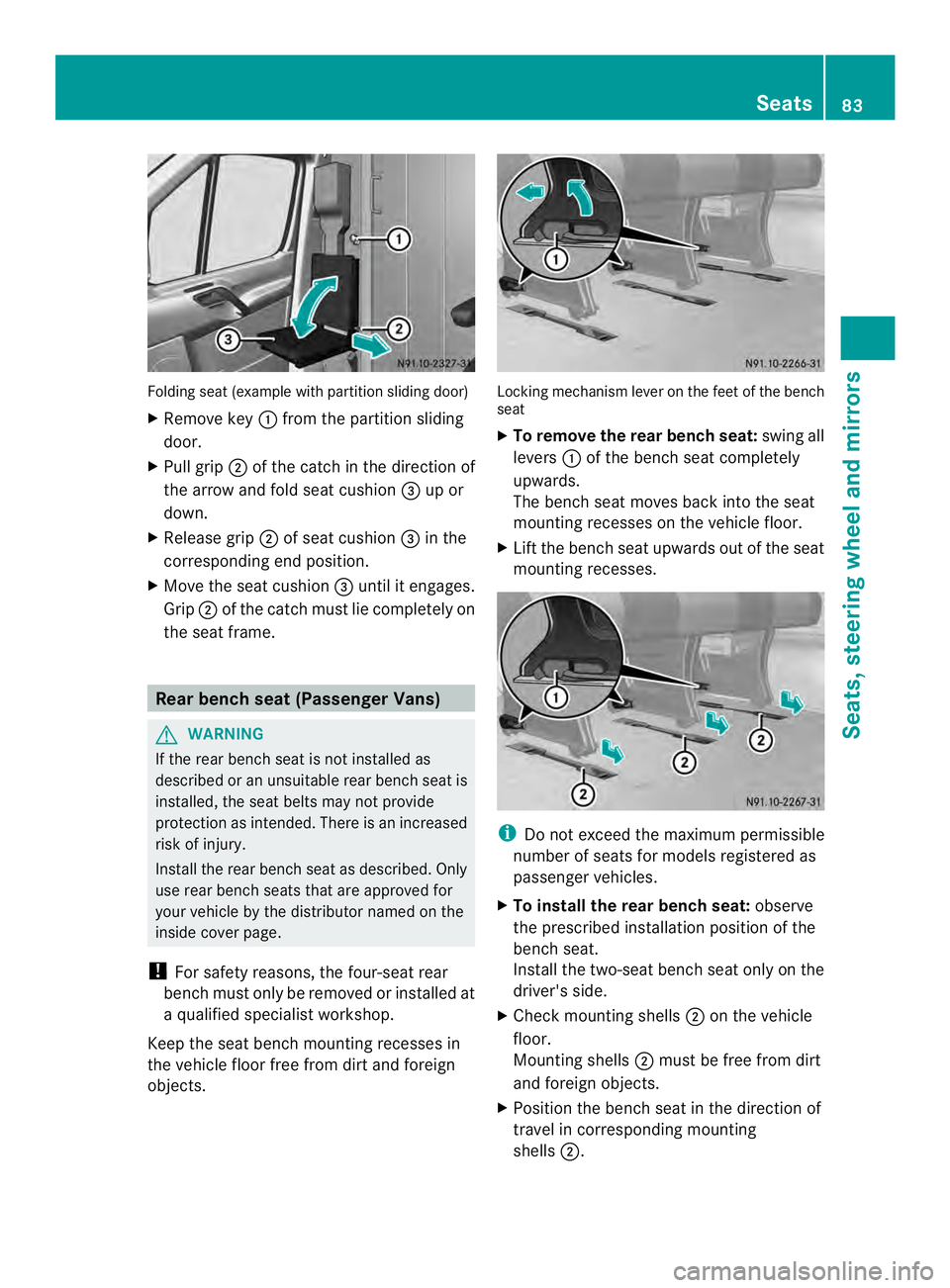
t(example with partition sliding door)
X Remove key 0005from the partition sliding
door.
X Pull grip 0006of the catch in the direction of
the arrow and fold seat cushion 0026up or
down.
X Release grip 0006of seat cushion 0026in the
corresponding end position.
X Move the seat cushion 0026until it engages.
Grip 0006of the catch must lie completely on
the seat frame. Rear bench seat (Passenger Vans)
G
WARNING
If the rear bench seat is not installed as
described or an unsuitable rear bench seat is
installed, the seat belts may not provide
protection as intended. There is an increased
risk of injury.
Install the rear bench seat as described. Only
use rear bench seats that are approved for
your vehicle by the distributor named on the
inside cover page.
! For safety reasons, the four-seat rear
bench must only be removed or installed at
a qualified specialist workshop.
Keep the seat bench mounting recesses in
the vehicle floor free from dirt and foreign
objects. Locking mechanism lever on the feet of the bench
seat
X
To remove the rear bench seat: swing all
levers 0005of the bench seat completely
upwards.
The bench seat moves back into the seat
mounting recesses on the vehicle floor.
X Lift the bench seat upwards out of the seat
mounting recesses. i
Do not exceed the maximum permissible
number of seats for models registered as
passenger vehicles.
X To install the rear bench seat: observe
the prescribed installation position of the
bench seat.
Install the two-seat bench seat only on the
driver's side.
X Check mounting shells 0006on the vehicle
floor.
Mounting shells 0006must be free from dirt
and foreign objects.
X Position the bench seat in the direction of
travel in corresponding mounting
shells 0006. Seats
83Seats, steering wheel and mirrors Z
Page 95 of 334
X
To operate the high-beam flasher: turn
the key to position 1or 2in the ignition
lock.
X Pull the combinatio nswitch briefly in
directio nofarrow0006. Headlamp range adjustment
The headlamp range control is used to adapt
the downward angle of the headlamp beams
in accordance with the loadony our vehicle.
The cone of light from the headlamps changes
if seats are occupied or if the cargo
compartment is being loaded or unloaded.
This can impair visibility and cause glare to
oncoming traffic.
You can only adjust the headlamp range while
the engine is running.
X Turn headlamp range control 0005to the
corresponding position. The road ahead
should be lit up for 40 mto 100 mand the
low-bea mheadlamps should not cause
glare to oncoming traffic.
Select position 0011if the vehicle is unladen. Cornering light function (vehicles
with Bi-Xenon headlamps)
The cornering lamps improve the illumination
of the road over a wide angle in the direction
you are turning, enabling better visibility in
tight bends, for example. The cornering light function switches on
automatically, if:
R
you are traveling at a speed of less than
25 mph (40 km/h) and you switch on the
turn signals or turn the steering wheel.
R you are driving at speeds between
25mph (40 km/h) and43 mph (70 km/h)
and turn the steering wheel
The cornering lamp may remain lit for a short
time, but is automatically switched off after
no more than 3 minutes. Hazard warning lamps
G
WARNING
The rear exterior light will be covered if you:
R open the rear doors by 90°
R open the rear dropside.
The vehicle will then be difficult for other road
users to see or will not be seen by them at all,
particularly if it is dark or visibility is poor.
There is a risk of an accident.
You should therefore ensure in this and
similar situations that the vehicle is visible
from the rear in accordance with the relevant
national regulations, by using the warning
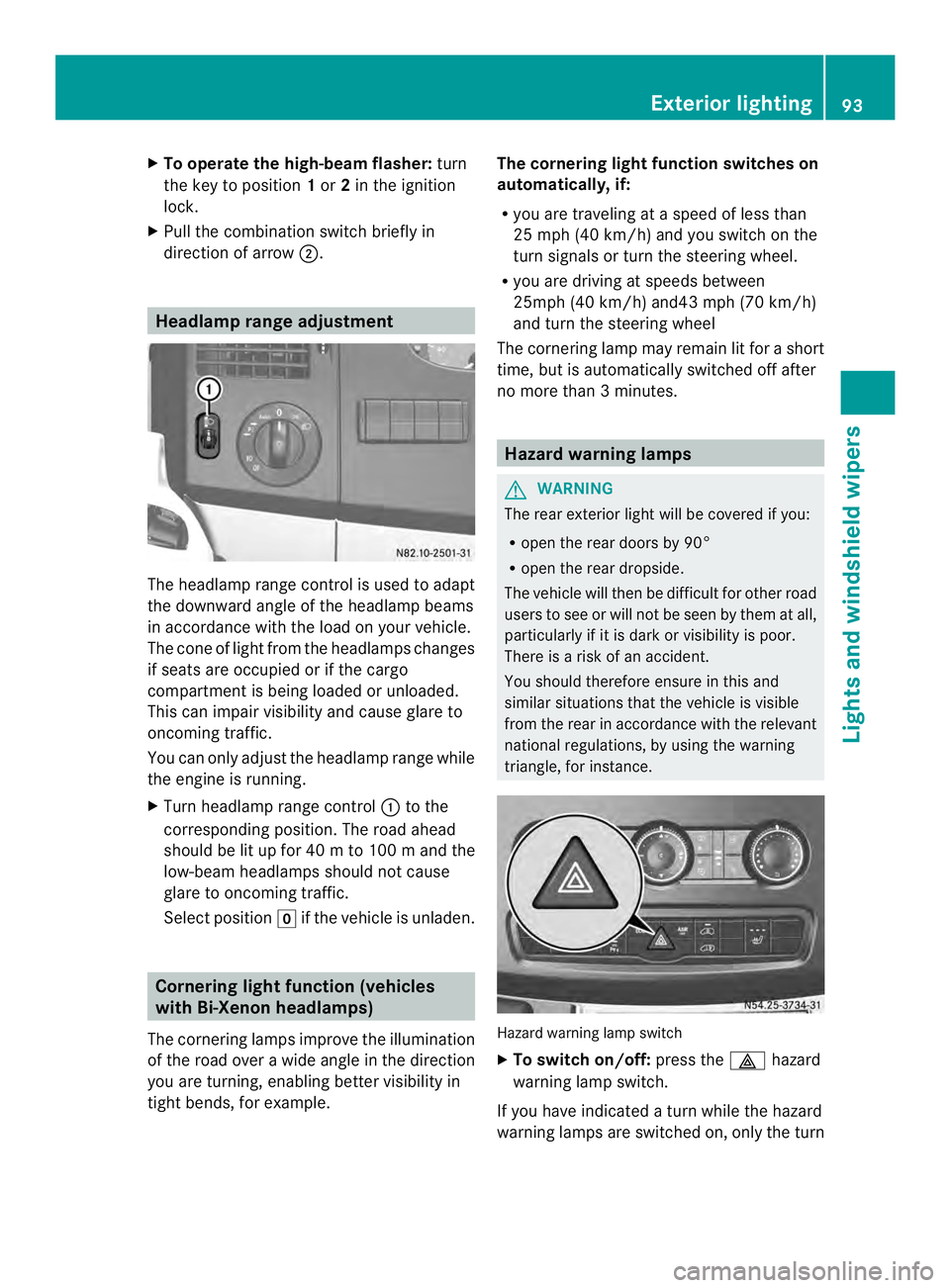
triangle, for instance. Hazard warning lamp switch
X
To switch on/off: press the0011hazard
warning lamp switch.
If you have indicated a turn while the hazard
warning lamps are switched on, only the turn Exterior lighting
93Lights and windshield wipers Z
Page 97 of 334
it switches off automatically after
20 minutes.
Automatic control
The interior light comes on if you:
R
unloc kthe vehicle
R open the driver's or the co-driver's door
R remove the key from the ignition lock
The interior light switches off again
automatically.
If a door is left open, the interior lighting
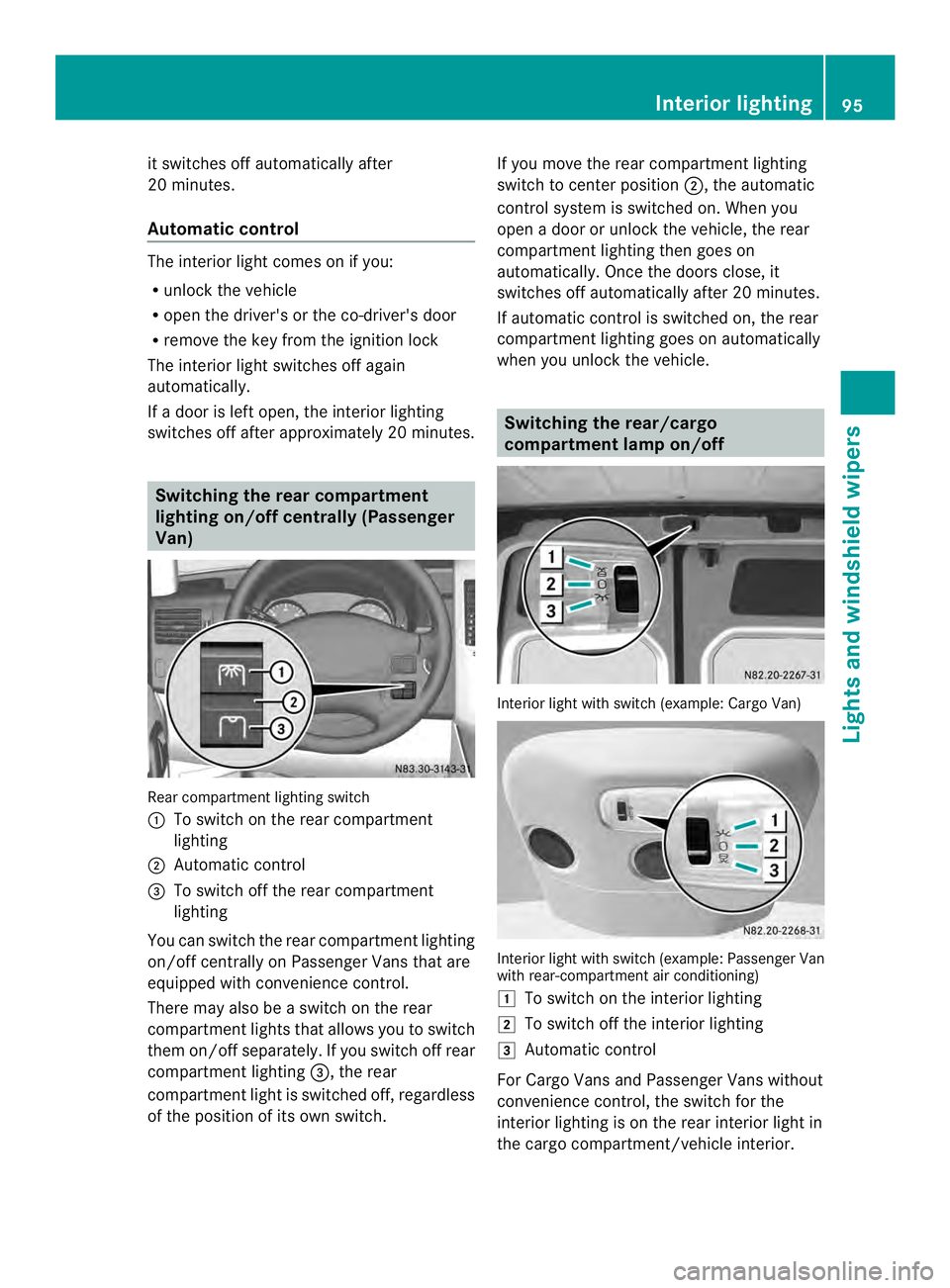
switches off after approximately 20 minutes. Switching the rear compartment
lighting on/off centrally (Passenger
Van) Rear compartmen
tlighting switch
0005 To switch on the rear compartment
lighting
0006 Automatic control
0026 To switch off the rear compartment
lighting
You can switch the rear compartmen tlighting
on/off centrally on Passenger Vans that are
equipped with convenience control.
There may also be a switch on the rear
compartmen tlights that allows you to switch
the mo n/off separately .Ifyou switch off rear
compartment lighting 0026, the rear
compartment light is switched off, regardless
of the position of its own switch. If you move the rear compartment lighting
switch to center position
0006, the automatic
control system is switched on. When you
open a door or unlock the vehicle, the rear
compartment lighting then goes on
automatically. Once the doors close, it
switches off automatically after 20 minutes.
If automatic control is switched on, the rear
compartment lighting goes on automatically
when you unlock the vehicle. Switching the rear/cargo
compartment lamp on/off
Interior light with switch (example: Cargo Van)
Interior light with switch (example: Passenger Van
with rear-compartment air conditioning)
0008
To switch on the interior lighting
0009 To switch off the interior lighting
000A Automatic control
For Cargo Vans and Passenger Vans without
convenience control, the switch for the
interior lighting is on the rear interior light in
the cargo compartment/vehicle interior. Interior lighting
95Lights and windshiel dwipers Z
Page 98 of 334
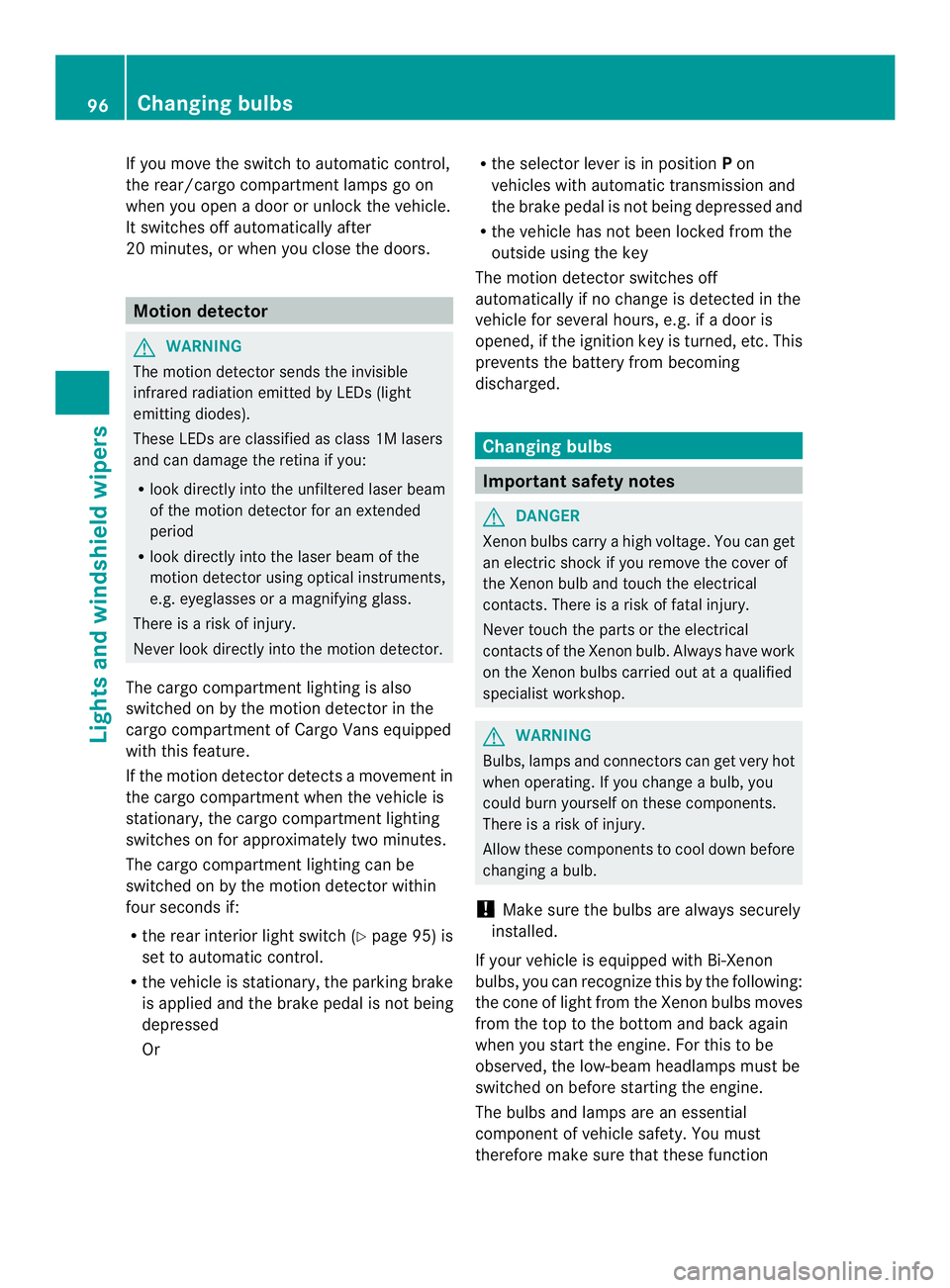
If you move the switch to automatic control,
the rear/cargo compartment lamps go on
when you open a door or unlock the vehicle.
It switches off automatically after
20 minutes, or when you close the doors.
Motion detector
G
WARNING
The motion detector sends the invisible
infrared radiation emitted by LEDs (light
emitting diodes).
These LEDs are classified as class 1M lasers
and can damage the retina if you:
R look directly into the unfiltered laserb eam
of the motion detector for an extended
period
R look directly into the laser beam of the
motion detector using optical instruments,
e.g. eyeglasses or a magnifying glass.
There is a risk of injury.
Never look directly into the motion detector.
The cargo compartment lighting is also
switched on by the motion detector in the
cargo compartment of Cargo Vans equipped
with this feature.
If the motion detector detects a movemen tin
the cargo compartment when the vehicle is
stationary, the cargo compartment lighting
switches on for approximately two minutes.
The cargo compartment lighting can be
switched on by the motion detecto rwithin
four seconds if:
R the rear interior light switch (Y page 95) is
set to automatic control.
R the vehicle is stationary, the parking brake
is applied and the brake pedal is not being
depressed
Or R
the selector lever is in position Pon
vehicles with automatic transmission and
the brake pedal is not being depressed and
R the vehicle has not been locked fro mthe
outside using the key
The motion detector switches off
automatically if no change is detected in the
vehicle for several hours, e.g. if a door is
opened, if the ignition key is turned, etc. This
prevents the battery from becoming
discharged. Changing bulbs
Important safety notes
G
DANGER
Xenon bulbs carry a high voltage. You can get
an electric shock if you remove the cover of
the Xenon bulb and touch the electrical
contacts. There is a risk of fatal injury.
Never touch the parts or the electrical
contacts of the Xenon bulb. Always have work
on the Xenon bulbs carried out at a qualified
specialist workshop. G
WARNING
Bulbs, lamps and connectors can get very hot
when operating. If you change a bulb, you
could burn yourself on these components.
There is a risk of injury.
Allow these components to cool down before
changing a bulb.
! Make sure the bulbs are always securely
installed.
If your vehicle is equipped with Bi-Xenon
bulbs, you can recognize this by the following:
the cone of light from the Xenon bulbs moves
from the top to the bottom and back again
when you start the engine. For this to be
observed, the low-beam headlamps must be
switched on before startingt he engine.
The bulbs and lamps are an essential
componentofv ehicle safety. You must
therefore make sure that these function 96
Changing bulbsLights and windshield wipers
Page 101 of 334
X
Switch off the lighting system.
X Ope nthe hood (Y page 240).
X Turn housing cover 0005counter-clockwise
and remove it.
X Pull out the bulb holder with the bulb.
X Pull the bulb out of the bulb holder.
X Press a new bulb into the bulb holder.
X Insert the bulb holder into the lamp.
X Position housing cover 0005and turn it
clockwise as far as it will go.
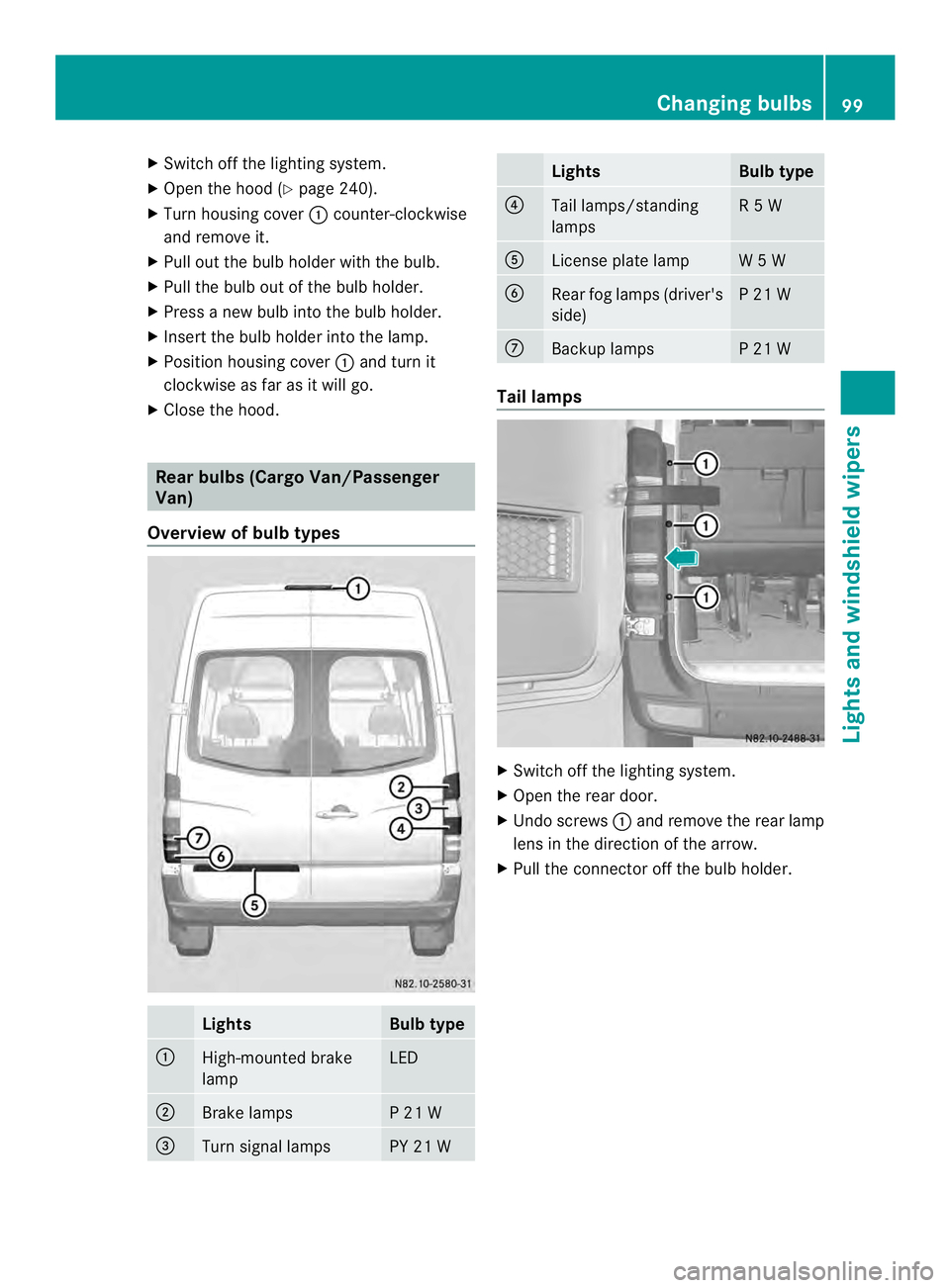
X Close the hood. Rear bulbs (Cargo Van/Passenger
Van)
Overview of bulb types Lights Bulb type
0005
High-mounted brake
lamp LED
0006
Brake lamps P 21 W
0026
Turn signal lamps PY 21 W Lights Bulb type
0025
Tail lamps/standing
lamps R 5 W
0023
License plate lamp W 5 W
0024
Rear fog lamps (driver's
side) P 21 W
0018
Backup lamps P 21 W
Tail lamps
X
Switch off the lighting system.
X Open the rear door.
X Undo screws 0005and remove the rear lamp
lens in the direction of the arrow.
X Pull the connector off the bulb holder. Changing bulbs
99Lights and windshield wipers Z
Page 136 of 334
i
To unlock the steering, move the steering
wheel slightly while turning the key to
position 1. Preparing for a journey
Visual check of the vehicle exterior X
In particular, check the following
components on the vehicle, and on the
trailer as necessary:
R
license plates, vehicle lighting, turn
signals, brake lamps and wiper blades for
dirt and damage
R tires and wheels for firm seating, correct
tire pressure and general condition
R trailer tow hitch for play and security
i The trailer coupling is one of the most
importan tvehicle parts with regard to road
safety. The separate instructions issued by
the manufacturer pertaining to operation,
care and maintenance should be observed.
X Rectify any noticeable defects before
commencing the journey.
Checks in the vehicle Emergency equipment/first-aid kit
X
Check the equipment to make sure that it
is accessible, complete and ready for use.
The first aid and breakdown assistance
equipment is in the fron tdoor stowage
compartments and behind the driver's seat.
Vehicle lighting
X Turn the key to position 2in the ignition
lock.
X Check the lighting system with the aid of a
second person.
X Replace defective bulbs (Y page 96). Before driving off
G
WARNING
Objects in the driver's footwell may restrict
the clearance around the pedals or block a
depressed pedal. This jeopardizes the
operating and road safety of the vehicle.
There is a risk of an accident.
Stow all objects securely in the vehicle so that
they do not get into the driver's footwell.
When using floormats or carpets, make sure
that they are properly secured so that they do
not slip or obstruct the pedals. Only use non-
slip floormats. G
WARNING
Unsuitable footwear can hinder correc tusage
of the pedals, e.g.:
R shoes with thick soles
R shoes with high heels
R slippers
There is a risk of an accident.
Wear suitable footwear to ensure correct
usage of the pedals.
X Secure the load as per the loading
guidelines (Y page 232).
X Make sure that the floormats and carpets
are properly secured so that they cannot
slip and obstruct the pedals.
X Close all doors. Starting the engine
G
WARNING
Combustion engines emit poisonous exhaust
gases such as carbon monoxide. Inhaling
these exhaust gases leads to poisoning. There
is a risk of fatal injury. Therefore never leave
the engine running in enclosed spaces
without sufficient ventilation.
! Do not depress the accelerator pedal
when starting the engine.
X Before starting the engine, make sure that: 134
DrivingDriving and parking
Page 137 of 334
R
all the doors are closed.
R all the vehicle occupants are wearing
their seat belts correctly.
R the parking brake is applied.
i If you depress the brake pedal before
starting the engine, th epedal travel is short
and pedal resistance is high.
If you depress the brake pedal again after
starting the engine, pedal travel and
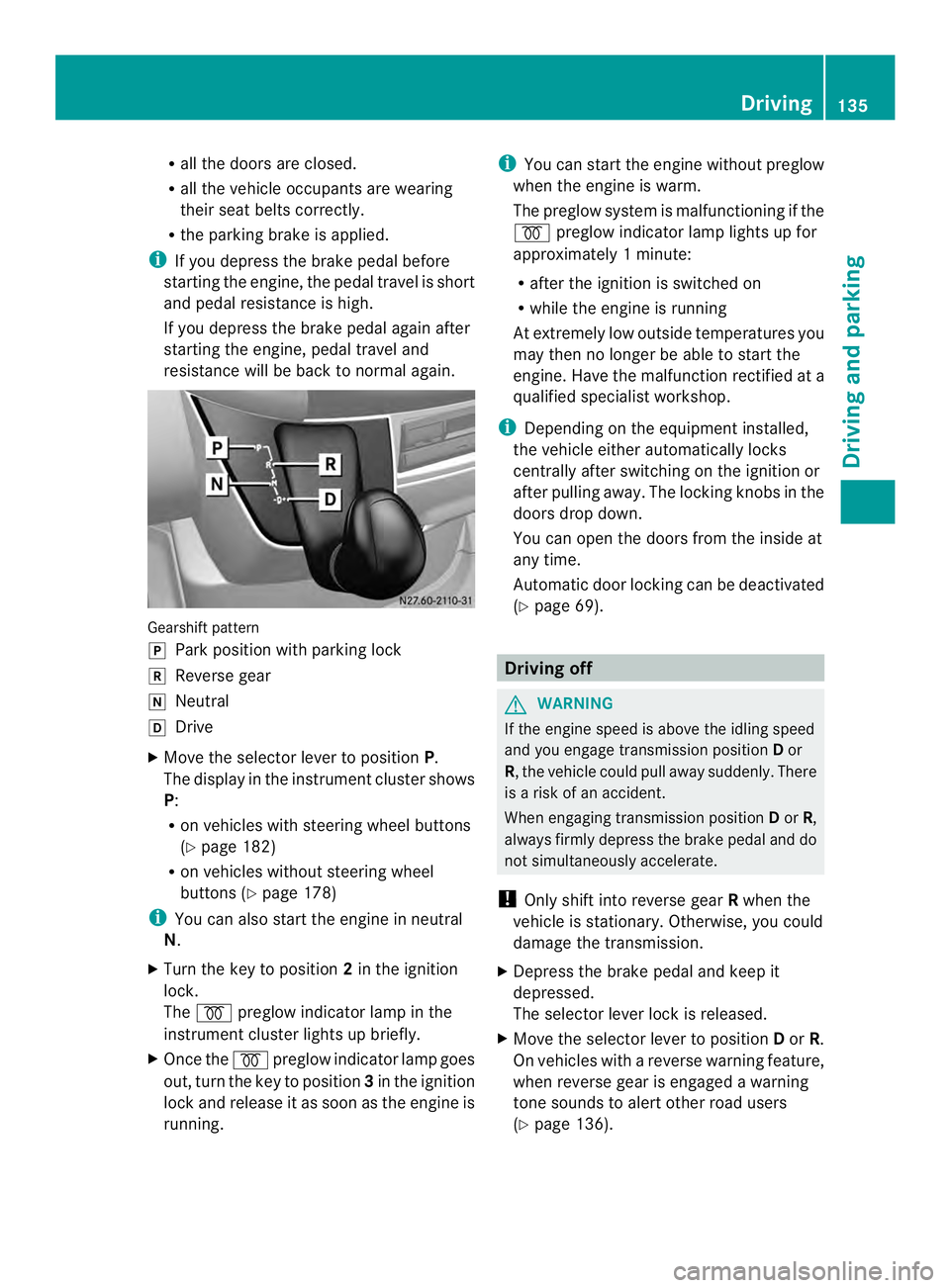
resistance will be back to normal again. Gearshift pattern
0016
Park position with parking lock
0012 Reverse gear
0013 Neutral
0015 Drive
X Move the selector lever to position P.
The display in the instrument cluster shows
P:
R on vehicles with steering wheel buttons
(Y page 182)
R on vehicles without steering wheel
buttons (Y page 178)
i You can also start the engine in neutral
N.
X Turn the key to position 2in the ignition
lock.
The 000D preglow indicator lamp in the
instrument cluster lights up briefly.
X Once the 000Dpreglow indicator lamp goes
out, turn the key to position 3in the ignition
lock and release it as soon as the engine is
running. i
You can start the engine without preglow
when the engine is warm.
The preglow system is malfunctioning if the
000D preglow indicator lamp lights up for
approximately 1minute:
R after the ignition is switched on
R while the engine is running
At extremely low outside temperatures you
may the nno longer be able to start the
engine. Have the malfunction rectified at a
qualified specialist workshop.
i Depending on the equipment installed,
the vehicle either automatically locks
centrally after switching on the ignition or
after pulling away.T he locking knobs in the
doors drop down.
You can open the doors from the inside at
any time.
Automatic door locking can be deactivated
(Y page 69). Driving off
G
WARNING
If the engine speed is above the idling speed
and you engage transmission position Dor
R, the vehicle could pull away suddenly. There
is a risk of an accident.
When engaging transmission position Dor R,
always firmly depress the brake pedal and do
not simultaneously accelerate.
! Only shift into reverse gear Rwhen the
vehicle is stationary. Otherwise, you could
damage the transmission.
X Depress the brake pedal and keep it
depressed.
The selector lever lock is released.
X Move the selector lever to position Dor R.
On vehicles with a reverse warning feature,
when reverse gear is engaged a warning
tone sounds to alert other road users
(Y page 136). Driving
135Driving and parking Z
Page 138 of 334
X
Release the parking brake (Y page 146).
The 000B indicator lamp in the instrument
cluste rgoes out.
X Release the brake pedal.
X Carefully depress the accelerator pedal.
i After pulling away or switching on the
ignition, the vehicle automatically locks
centrally. The locking knobs in the doors
drop down.
You can open the doors from the inside at
any time.
You can also deactivate the automatic
locking feature (Y page 69).Reverse warning device
G
WARNING
Other road users may ignore or fail to hear the
warning tone of the reverse warning feature.
There is a risk of injury if you fail to ensure
that the area in which you are maneuvering is
clear.
Make sure that there are no persons or
objects in the area in which you are
maneuvering. It may be necessary to enlist
the help of a second person when
maneuvering.
The reverse warning feature is a system
designed to assist you in ensuring the safety
of other road users.
Aw arning signal sounds to alert other road
users when reverse gear is engaged .The
volume of the warning tone can be reduced
for night-time driving.
X To reduce the volume of the warning
tone: engage reverse gear twice in quick
succession.
The warning tone is now quieter.
i The warning tone sounds at a normal
volume by default. The volume of the
warning tone has to be reduced each time
you engage reverse gear if necessary. 136
DrivingDriving and parking