trailer MERCEDES-BENZ SPRINTER 2013 MY13 Operator’s Manual
[x] Cancel search | Manufacturer: MERCEDES-BENZ, Model Year: 2013, Model line: SPRINTER, Model: MERCEDES-BENZ SPRINTER 2013Pages: 334, PDF Size: 3.88 MB
Page 270 of 334
Tow-starting and towing away
Important safety notes
G
WARNING
Functions relevant to safety are restricted or
no longe ravailable if:
R the engine is not running.
R the brake system or the powe rsteering is
malfunctioning.
R there is a malfunctio ninthe voltage supply
or the vehicle's electrical system.
If your vehicle is being towed, much more
force may be necessary to steer or brake.
There is a risk of an accident.
In such cases, use a tow bar. Before towing,
make sure that the steering moves freely. G
WARNING
You can no longer steer the vehicle if the
steering wheel lock has been engaged. There
is a risk of an accident.
Always switch off the ignition when towing the
vehicle with a tow cable or a tow bar. G
WARNING
If the weight of the vehicle to be towed or tow-
started is greater than the permissible gross
weight of your vehicle:
R the towing eye could detach itself
R the vehicle/trailer combination could
rollover.
There is a risk of an accident.
When towing or tow-starting another vehicle,
its weight should not be greater than the
permissible gross weight of your vehicle.
Information on your vehicle's gross vehicle
weight rating can be found on the vehicle
identification plate (Y page 315).
! Only secure the tow rope or tow bar at the
towing eyes. Otherwise, the vehicle could
be damaged. !
Observe the following points when towing
with a tow rope:
R Secure the tow rope on the same side on
both vehicles.
R Ensure that the tow cable is not longer
than legally permitted. Mark the tow
cable in the middle, e.g. with a white
cloth (30 x 30 cm). This will make other
road users aware that the vehicle is being
towed.
R Only secure the tow cable to the towing
eye.
R Observe the brake lamps of the towing
vehicle while driving. Always maintain a
distance so that the tow rope does not
sag.
R Do not use steel cables or chains to tow
your vehicle. You could otherwise
damage the vehicle.
! Do not use the towing eye for recovery,
this could damage the vehicle. If in doubt,
recover the vehicle with acrane.
! When towing, pull away slowly and
smoothly .Ifthe tractive power is too high,
the vehicles could be damaged.
Observe the legal requirements for the
relevant country when towing.
It is preferable to have the vehicle
transported on a transporter or trailer instead
of towing it.
The automatic transmission selector lever
must be in the Nposition when towing the
vehicle.
The battery must be connected and charged.
Otherwise, you:
R cannot turn the key in the ignition lock to
position 2
R cannot move the selector lever to position
Non vehicles with automatic transmission.
i Switch off the automatic locking feature
before the vehicle is towed (Y page 69). You
could otherwise lock yourself out of the
vehicle when pushing or towing away the
vehicle. 268
Tow-starting and towing awayBreakdown assistance
Page 271 of 334
Installing/removing the towing eye
The fixture for the fron
ttowing eye is located in the
bumper. Rear towing eye under the bumper, attached to the
chassis
Your vehicle may be equipped with rear
towing eye 0006. If you tow or tow-start a
vehicle, attach the towing device to rear
towing eye 0006.
If your vehicle is equipped with a trailer tow
hitch, attach the towing device to the trailer
tow hitch (Y page 168).
Installing the front towing eye
X Take the towing eye and screwdriver from
the vehicle tool kit (Y page 264).
X Press cover 0005and remove cover 0005from
the opening.
You will see the fixture for the towing eye.
X Screw in the towing eye clockwise to the
stop.
X Insert screwdriver into the towing eye and
tighten it. Removing the front towing eye
X
Remove the screwdriver from the vehicle
tool kit.
X Insert the screwdriver into the towing eye
and turn the screwdriver counter-
clockwise.
X Unscrew the towing eye.
X Insert cover 0005with the lug at the bottom
and press it in at the top until it engages.
X Place the towing eye and screwdriver back
in the vehicle tool kit. Towing in the event of malfunctions
With transmission damage !
Always use new bolts when installing the
propeller shafts.
If the vehicle has transmission damage, have
the propeller shaft removed before towing
away.
In the event of damage to the electrical
system If the battery is defective, the automatic
transmission will be locked in position
P. In
order to be able to shift the automatic
transmission to position N, you must provide
power to the vehicle's 12 Velectrical system
in the same way as when jump-starting
(Y page 267).
Have the vehicle transported on a transporter
or trailer. Towing with the front or rear axle
raised
General notes !
The ignition must be switched off if the
vehicle is being towed with the front or rear
axle raised. Otherwise, ESP ®
may intervene
and damage the brake system. Tow-starting and towing away
269Breakdown assistance Z
Page 273 of 334
If the drive wheels get trapped on loose or
muddy ground, recover the vehicle with the
utmost care. This is especially the case if the
vehicle is laden.
Never attempt to recover a vehicle with a
traile rattached.
Pull ou tthe vehicle backwards, if possible,
using the tracks it made when it became
stuck. Transporting the vehicle
! Only lash the vehicle down by the wheels
or wheel rims, not by parts of the vehicle
such as axle or steering components.
Otherwise, the vehicle could be damaged.
The towing eye or trailer tow hitch can be
used to pull the vehicle onto a trailer or
transporter if you wish to transport it.
X Turn the key to position 2in the ignition
lock.
X Move the selector lever of the automatic
transmission to position N.
If the vehicle is loaded:
X Apply the parking brake.
X Move the selector lever of the automatic
transmission to position P.
X Turn the key to position 0in the ignition
lock and remove it.
X Lash down the vehicle. Tow-starting (emergency engine
starting)
Vehicles with automatic transmission !
Vehicles with automatic transmission
must not be tow-started. You could
otherwise damage the automatic
transmission.
Information on "Jump-starting" can be found
at the beginning of the "Breakdown
assistance" section (Y page 267). Electrical fuses
G
WARNING
Only use fuses that have been approved for
your vehicle and which have the correct fuse
rating for the systems concerned. Do not
repair or bypass defective fuses. Acircuit
overload could otherwise cause afire. Have
the cause determined and rectified at a
qualified specialist workshop.
! Only use fuses that have been approved
for Sprinter vehicles and that have the
required fuse rating for the systems
concerned. Components or systems could
otherwise be damaged.
The fuses in your vehicle switch off defective
power circuits. If a fuse blows, all the
components on the circuit and their functions
will cease to operate.
Blown fuses must be replaced with fuses of
the same rating, which you can recognize by
the color and fuse rating.
Observe the information about fuse rating in
the fuse allocation chart.
You can obtain advice fro maqualified
specialist workshop.
The fuse allocation chart and other
information on the fuses can be found in the
"Fuse allocation chart" supplement. Electrical fuses
271Breakdown assistance Z
Page 288 of 334
Loading the vehicle
Instruction labels for tires and loads
G
WARNING
Overloaded tires can overheat, causing a
blowout .Overloaded tires can also impair the
steering and driving characteristics and lead
to brake failure. There is a risk of accident.
Observe the load rating of the tires. The load
rating must be at least halfoft he GAWR of
your vehicle. Never overload the tires by
exceeding the maximum load. The Tire and Loading Information placard on the
driver’s door B-pillar
Two instruction labels on your vehicle show
the maximum possible load.
(1) Only for vehicles with a gross weight of
less than 10,000 lbs (4,536 kg):
Tire and Loading Information placard 0005
is on the B-pillar on the driver's side. Tire
and Loading Information placard 0005
shows the permissible number of
occupants and the maximum permissible
load of the vehicle. It also contains details
of the tire sizes and corresponding
pressures for tires mounted at the
factory.
(2) The vehicle identification plate is located on the base of the driver's seat. The
vehicle identification plate informs you of
the gross vehicle weight rating. It is made
up of the vehicle weight, all vehicle
occupants, the fuel and the cargo. You
can also find information about the maximum Gross Axle Weight Rating on
the front and rear axle.
The maximum gross axle weight rating is
the maximum weight that can be carried
by one axle (front or rear axle). Do not
exceed the maximum gross vehicle
weight or the maximum gross axle weight
rating for the front or rear axle.
Tire and Loading Information placard
General notes Only vehicles with a gross weight of less than
10,000 lbs (4,536 kg) have a Tire and Loading
Information placard on the B-pillar on the
driver's side.
Maximum permissible gross vehicle
weight rating 0005
Maximum number of seats
0006 Maximum permissible gross vehicle
weight rating
X Specification for maximum gross vehicle
weight 0006is listed in the Tire and Loading
Information placard: "The gross weight of
occupants and luggage must not exceed
XXX kilograms or XXX lbs."
The gross weight of all vehicle occupants,
cargo, luggage and trailer load/noseweight (if
applicable) must not exceed the specified
value.
i The details on the Tire and Loading
Information placard illustration are only an 286
Loading the vehicleWheels and tires
Page 289 of 334
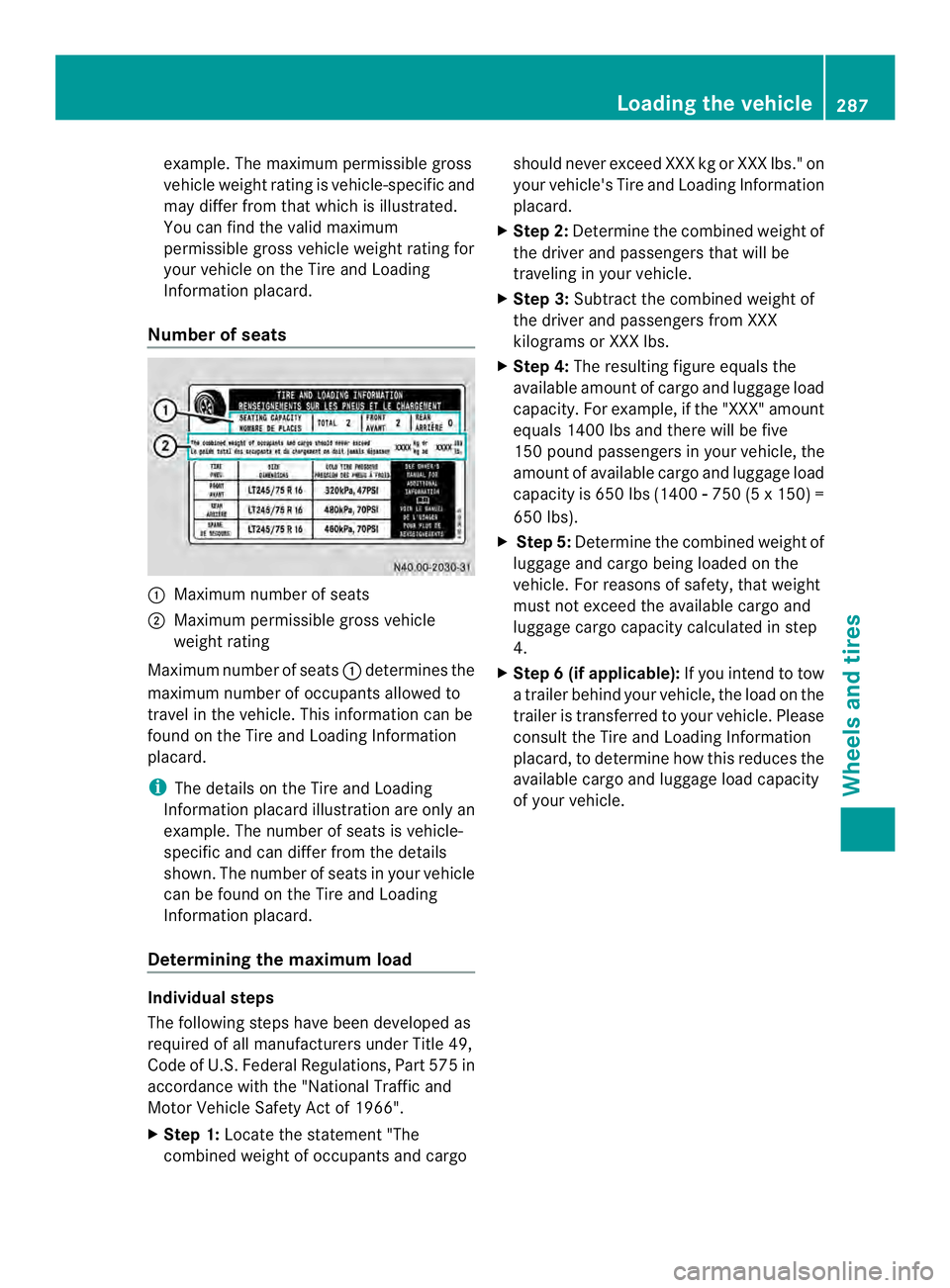
example. The maximum permissible gross
vehicle weight rating is vehicle-specific and
may differ from that which is illustrated.
You can find the valid maximum
permissible gross vehicle weight rating for
your vehicle on the Tire and Loading
Information placard.
Number of seats 0005
Maximum number of seats
0006 Maximum permissible gross vehicle
weight rating
Maximum number of seats 0005determines the
maximum number of occupants allowed to
travel in the vehicle. This information can be
found on the Tire and Loading Information
placard.
i The details on the Tire and Loading
Information placard illustration are only an
example. The number of seats is vehicle-
specific and can differ from the details
shown. The number of seats in your vehicle
can be found on the Tire and Loading
Information placard.
Determining the maximum load Individual steps
The following steps have been developed as
required of all manufacturers under Title 49,
Code of U.S.F ederal Regulations, Part 575 in
accordance with the "National Traffic and
Motor Vehicle Safety Act of 1966".
X Step 1: Locate the statement "The
combined weight of occupants and cargo should never exceed XXX kg or XXX lbs." on
your vehicle's Tire and Loading Information
placard.
X Step 2: Determine the combined weight of
the driver and passengers that will be
traveling in your vehicle.
X Step 3: Subtract the combined weight of
the driver and passengers from XXX
kilograms or XXX lbs.
X Step 4: The resulting figure equals the
available amount of cargo and luggage load
capacity. For example, if the "XXX" amount
equals 1400l bs and there will be five
150 pound passengers in your vehicle, the
amount of available cargo and luggage load
capacit yis6 50 lbs (1400 0027750 (5 x 150) =
650 lbs).
X Step 5: Determine the combined weight of
luggage and cargo being loaded on the
vehicle. For reasons of safety, that weight
must not exceed the available cargo and
luggage cargo capacity calculated in step
4.
X Step 6 (if applicable): If you intend to tow
a trailer behind you rvehicle, the load on the
trailer is transferred to your vehicle. Please
consult the Tire and Loading Information
placard, to determine how this reduces the
available cargo and luggage load capacity
of your vehicle. Loading the vehicle
287Wheels and tires Z
Page 291 of 334
Example 1 Example 2 Example 3
Step 3 Permissible cargo
and trailer load/
noseweight
(maximum gross
vehicle weight rating
from the Tire and
Loading Information
placard minus the
gross weight of all
occupants)
1500 lbs
(680 kg)
0027750 lbs
(340 kg) =
750 lbs (340 kg) 1500 lbs
(680 kg)
0027540 lbs
(245 kg) =
960 lbs (435 kg) 1500 lbs
(680 kg)
0027150 lbs (68 kg)
= 1350 lbs
(612 kg) The greater the combined weight of the occupants, th
elower the maximum luggage load.
Further information can be found under "Towing atrailer" (Y page 173). Vehicle identification plate
Even if you have calculated the total cargo
carefully, you should still make sure that the
gross vehicle weight rating and the gross axle
weight rating are not exceeded. Details about
this can be found on the vehicle identification
plate on the drive rseat frame of your vehicle
(Y page 315).
Gross vehicle weight: the gross weight of
the vehicle, all passengers, cargo and trailer
load/noseweight (if applicable) must not
exceed the permissible gross vehicle weight.
Gross axle weight rating: the maximum
permissible load that can be carried by one
axle (front or rear axle).
To ensure that your vehicle does not exceed
the maximum permissible values (gross
vehicle weight and maximum gross axle
weight rating), have your loaded vehicle
(including driver, occupants, cargo, and full
trailer load if applicable) weighed on a
suitable vehicle weighbridge. Trailer load/noseweight
The trailer load/noseweight affects the gross
weight of the vehicle. If a trailer is attached,
the trailer load/noseweight is included in the
load along with occupants and luggage. The trailer load/noseweight is usually
approximately 10% of the gross weight of the
trailer and its load. What you should know about wheels
and tires
Tire labeling
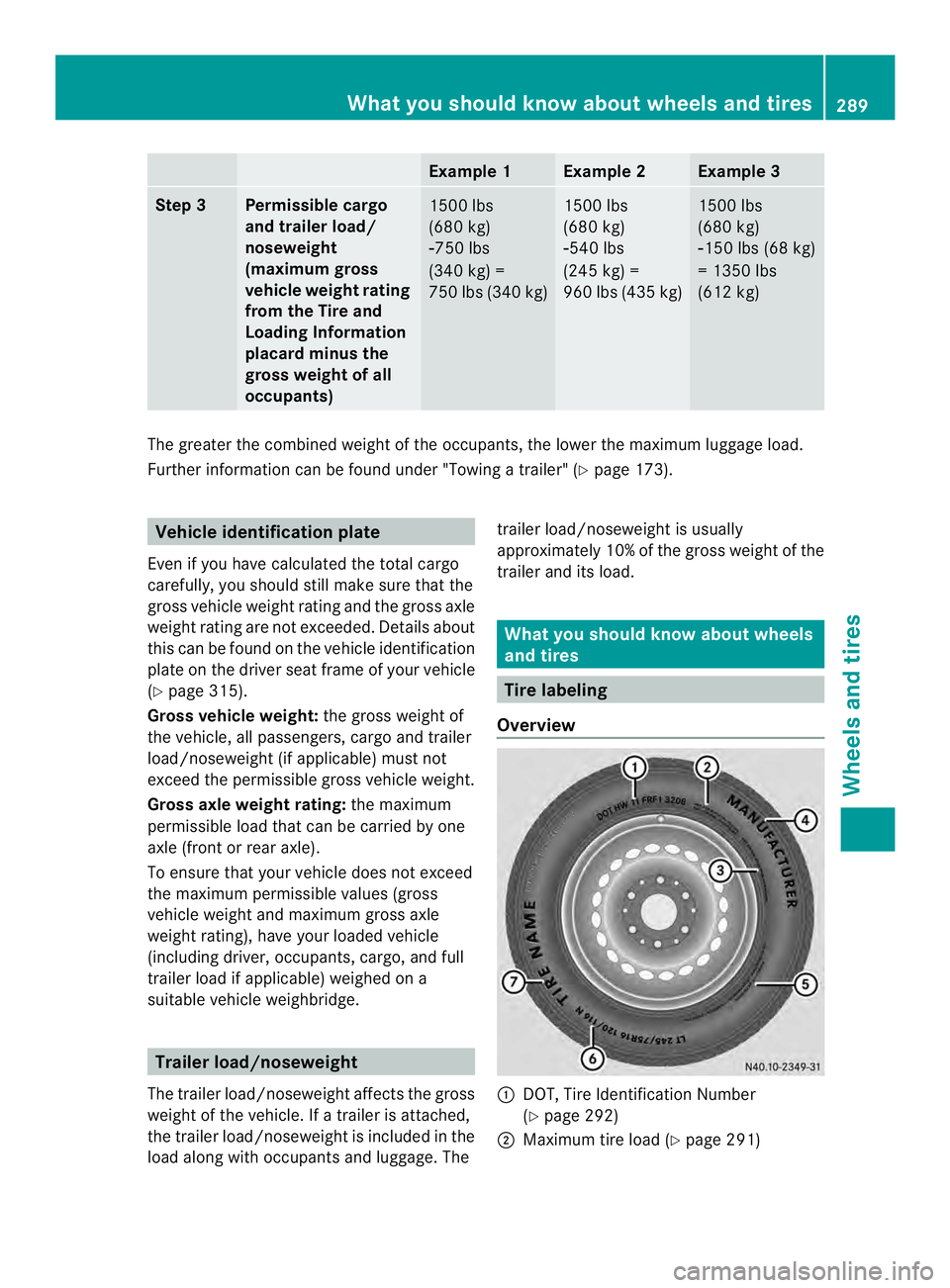
Overview 0005
DOT, Tire Identification Number
(Ypage 292)
0006 Maximum tire load (Y page 291) What you should know about wheels and tires
289Wheels and tires Z
Page 295 of 334
DOT (Department of Transportation)
DOT marked tires fulfill the requirements of
the United States Department of
Transportation.
Average weigh tofvehicle occupants
The number of occupants for which the
vehicle is designed multiplied by
68 kilograms (15 0lbs).
Uniform Tire Quality Grading Standards
Au niform standard to grade the quality of
tires with regard to tread quality, tractio nand
temperature characteristics. The quality
grading assessment is made by the
manufacturer following specifications from
the U.S government. The quality grade of a
tire is imprinted on the sidewall of the tire.
Recommended tire pressure
The recommended tire pressure are the
pressures specified for the tires mounted on
the vehicle at the factory.
The Tire and Loading Informatio nplacard 7
contains the recommended tire pressure for
cold tires, the maximum permissible load and
the maximum permissible vehicle speed.
The tire pressure table contains the
recommended tire pressure for cold tires
under various operating conditions, i.e.
loading and/or speed of the vehicle.
Increased vehicle weight due to optional
equipment
The combined weight of all standard and
optional equipmen tavailable for the vehicle,
regardless of whethe ritis actually installed
on the vehicle or not.
Wheel rim
The part of the wheel on which the tire is
mounted.
GAWR (Gross Axle Weight Rating)
GAWR is the maximum gross axle weight
rating. The actual load on an axle must never
exceed the gross axle weight rating. The Gross Axle Weight Rating can be found on the
vehicle identification plate on the driver seat
frame (Y
page 315).
Speed index
The speed index is part of the tire
identification. It specifies the speed range for
which the tire is approved.
GTW (Gross Trailer Weight)
GTW is the total of weight of a trailer and the
weight of the load, accessories etc. on the
trailer.
GVW (Gross Vehicle Weight)
The gross vehicle weight includes the weight
of the vehicle including fuel, tools, spare
wheel, accessories installed, occupants,
luggage and the drawbarn oseweight if
applicable. The gross vehicle weight may
never exceed the gross vehicle weight rating
(GVWR) specified on the vehicle identification
plate at the base of the driver's seat
(Y page 315).
GVWR (Gross Vehicle Weight Rating)
The GVWR is the maximum permitted gross
weight of the fully laden vehicle (weight of the
vehicle including all accessories, occupants,
fuel, luggage and the drawbar noseweight if
applicable). The Gross Vehicle Weight Rating
is specified on the vehicle identification plate
on the driver seat frame (Y page 315).
Maximum weight of the laden vehicle
The maximum weight is the sum of:
R the curb weight of the vehicle
R the weight of the accessories
R the load limit
R the weight of the factory installed optional
equipment
Kilopascal (kPa)
Metric unit for tire pressure. 6.9 kPa are the
equivalent of 1psi. Another tire pressure unit
7 Only for vehicles with a gross weight of less than 10,000 lbs (4,536 kg). What you should know about wheels and tires
293Wheels and tires Z
Page 297 of 334
Traction
Traction is the result of friction between the
tires and the road surface.
TWR (permissible trailer drawbar load)
The TWR is the maximu mpermissible weight
that may act on the ball coupling of the trailer
tow hitch.
Wear indicator
Narrow bars (tread wear bars) that are
distributed over the tire tread. If the tire tread
is level with the bars, the wear limit of 000Bin
(1.6 mm) has been reached.
Distribution of the vehicle occupants
The distribution of vehicle occupants over
designated seat positions in avehicle.
Maximum permissible payload weight
Nominal load and goods/luggage load plus
68 kg (150 lbs) multiplied by the number of
seats in the vehicle. Flat tire
General notes
Your vehicle may be equipped with Premium
tire sealant or with a spare wheel. The spare
wheel is under the vehicle at the rear
(Y page 308). The Premium tire sealant is
located in the stowage compartment in the
right-hand door sill (Y page 264).
You can find information on changing/
mounting wheels in the "Wheel change"
section (Y page 303).
When you replace a tire, we recommend that
you also replace the tire valve. Please observe
the safety-relevant information on tire valve
(Y page 280). Vehicle preparation
X Stop the vehicle as far away as possible
from traffic and on a level, firm and non-slip
surface.
X Switch on the hazard warning lamps if the
vehicle poses a hazard to passing vehicles.
X Turn the fron twheels to the straight-ahead
position.
X Move the selector lever of the automatic
transmission to position P.
X Switch off the engine.
X Passengers should leave the vehicle. Make
sure that the passengers are not
endangered as they do so.
X Make sure that no one is near the danger
area while a wheel is being changed.
Anyone who is not directly assisting in the
wheel change should, for example, stand
behind the barrier.
X Place the warning triangle or warning lamp
at a suitable distance.
Observe legal requirements. Using Premium tire sealant
Using Premium tire sealant You can use Premium tire sealant to seal
punctures of up to 0.23 in (6 mm), particularly
those in the tire tread. Tire sealant can be
used at outside temperatures down to
002722 ‡ (002730 †).
G
WARNING
In the following situations, the tire sealant is
unable to provide sufficient breakdown
assistance, as it is unable to seal the tire
properly:
R there are cuts or punctures in the tire larger
than those mentioned above.
R the wheel rim is damaged.
R you have driven at very low tire pressures
or on a flat tire.
There is a risk of an accident. Flat tire
295Wheels and tires
Z
Page 321 of 334
This can result in damage to the fuel
injection system, for example.
Flow improvers are fuel additives used to
improve the flow characteristics of diesel
fuels.
The effectiveness of flow improvers cannot be
guaranteed with all fuels. Observe the
manufacturer's recommendations.
Information about approved flow improvers is
available from any authorized Sprinter Dealer.
At outside temperatures below 14 ‡(002710 †),
and if using diesel with less resistance to low
temperatures, add flow improver, basing the
mixing ratio on the outside temperature.
Mix this fuel additive with the diesel in good
time before the flow properties of the diesel
are affected by paraffi nseparation.
Malfunctions resulting from paraffin
separation can only be rectified by heating
the entire fuel system. Park the vehicle in a
heated garage, for example.
Information on fuel consumption H
Environmental note
CO 2(carbon dioxide) is the gas which
scientists believe to be principally responsible
for global warming (the greenhouse effect).
Your vehicle's CO 2emissions are directly
related to fuel consumption and therefore
depend on:
R efficien tuse of the fuel by the engine
R driving style
R other non-technical factors, such as
environmental influences or road
conditions
You can minimize your vehicle's CO 2
emissions by driving carefully and having it
serviced regularly.
i Only for certain countries: the respective
current consumption and emission values
of your vehicle can be found in the COC
papers (EC CERTIFICATE OF
CONFORMITY). These documents are
supplied when the vehicle is delivered. Consumption figures were found in the
currently valid respective version:
R
for vehicles up to and including the
Euro 4 standard according to EU
Directive 80/1268/EEC
R for vehicles from the Euro 5 standard
according to regulation (EC) no.
715/2007
Fuel consumption depends on:
R the vehicle version
R the style of driving
R the operating conditions
R the type or quality of the fuel used
The vehicle will use more fuel than usual in
the following situations:
R at very low outside temperatures
R in city traffic
R during short journeys
R in mountainous terrain
R when towing a trailer
To keep fuel consumption low, observe the
advice in the "Protection of the environment"
section (Y page 22).
The following components of the different
vehicle versions influence fuel consumption:
R tire sizes, tire tread, tire pressure, tire
condition
R body
R transmission ratios for the drive
assemblies
R additional equipment (e.g. air-conditioning
system, auxiliary heating system).
For these reasons, the actual consumption
figures for your vehicle may deviate from the
consumption figures determined according
to EU Directive 80/1268/EEC.
Data concerning fuel consumption are
recorded in the on-board computer; use the
steering wheel buttons to call up the Trip
computer menu (Ypage 190). Service products and capacities
319Technical data Z
Page 330 of 334
!
The weight of any load carried on the roof,
including the roof carrier, must not exceed
the maximum permissible roof load.
The roof carrier supports must be mounted
at equal distances.
We recommend that you have a stabilizer
installed on the front axle.
! For safety reasons, we recommend that
you only use roof carrier systems that have
been tested and approved for the Sprinter.
This will help to avoid damage.
The data is valid for a load distributed evenly
over the entire roof area. Maximum roof load
and minimum number of pairs of roof carrier
supports on vehicles with: Maximum
roof load Minimum
number of pairs of
supports Standard
roof 660 lbs
(300 kg) 6
High roof 330 lbs
(150 kg) 3
Reduce the load on shorter roof carriers
proportionately. The maximum load per pair
of roof carrier supports is 110 lbs (50 kg).
Loading directions and other information
concerning load distribution and load
securing can be found in the "Transporting"
section (Y
page 232). Trailer tow hitch
General notes We recommend that you have the trailer tow
hitch mounted at an authorized Sprinter
Dealer.
Use only a trailer tow hitch that has been
tested and approved specially for your vehicle
by the distributor named on the inside of the
front cover. Only use a ball coupling that is
approved for your vehicle and Sprinter trailer tow hitch. You can also find information on
the permitted dimensions of the ball coupling
on the identification plate of the trailer tow
hitch.
You can obtain advice from a qualified
specialist workshop. Also observe the
information on towing a trailer in the "Driving
and parking" section (Y
page 168).328
Vehicle dataTechnical data