weight MERCEDES-BENZ SPRINTER 2013 MY13 Operator’s Manual
[x] Cancel search | Manufacturer: MERCEDES-BENZ, Model Year: 2013, Model line: SPRINTER, Model: MERCEDES-BENZ SPRINTER 2013Pages: 334, PDF Size: 3.88 MB
Page 295 of 334
DOT (Department of Transportation)
DOT marked tires fulfill the requirements of
the United States Department of
Transportation.
Average weigh tofvehicle occupants
The number of occupants for which the
vehicle is designed multiplied by
68 kilograms (15 0lbs).
Uniform Tire Quality Grading Standards
Au niform standard to grade the quality of
tires with regard to tread quality, tractio nand
temperature characteristics. The quality
grading assessment is made by the
manufacturer following specifications from
the U.S government. The quality grade of a
tire is imprinted on the sidewall of the tire.
Recommended tire pressure
The recommended tire pressure are the
pressures specified for the tires mounted on
the vehicle at the factory.
The Tire and Loading Informatio nplacard 7
contains the recommended tire pressure for
cold tires, the maximum permissible load and
the maximum permissible vehicle speed.
The tire pressure table contains the
recommended tire pressure for cold tires
under various operating conditions, i.e.
loading and/or speed of the vehicle.
Increased vehicle weight due to optional
equipment
The combined weight of all standard and
optional equipmen tavailable for the vehicle,
regardless of whethe ritis actually installed
on the vehicle or not.
Wheel rim
The part of the wheel on which the tire is
mounted.
GAWR (Gross Axle Weight Rating)
GAWR is the maximum gross axle weight
rating. The actual load on an axle must never
exceed the gross axle weight rating. The Gross Axle Weight Rating can be found on the
vehicle identification plate on the driver seat
frame (Y
page 315).
Speed index
The speed index is part of the tire
identification. It specifies the speed range for
which the tire is approved.
GTW (Gross Trailer Weight)
GTW is the total of weight of a trailer and the
weight of the load, accessories etc. on the
trailer.
GVW (Gross Vehicle Weight)
The gross vehicle weight includes the weight
of the vehicle including fuel, tools, spare
wheel, accessories installed, occupants,
luggage and the drawbarn oseweight if
applicable. The gross vehicle weight may
never exceed the gross vehicle weight rating
(GVWR) specified on the vehicle identification
plate at the base of the driver's seat
(Y page 315).
GVWR (Gross Vehicle Weight Rating)
The GVWR is the maximum permitted gross
weight of the fully laden vehicle (weight of the
vehicle including all accessories, occupants,
fuel, luggage and the drawbar noseweight if
applicable). The Gross Vehicle Weight Rating
is specified on the vehicle identification plate
on the driver seat frame (Y page 315).
Maximum weight of the laden vehicle
The maximum weight is the sum of:
R the curb weight of the vehicle
R the weight of the accessories
R the load limit
R the weight of the factory installed optional
equipment
Kilopascal (kPa)
Metric unit for tire pressure. 6.9 kPa are the
equivalent of 1psi. Another tire pressure unit
7 Only for vehicles with a gross weight of less than 10,000 lbs (4,536 kg). What you should know about wheels and tires
293Wheels and tires Z
Page 296 of 334
is bar. 100 kilopascals (kPa) are the
equivalen tof1bar.
Load index
In addition to the load bearing index, a load
index can be stamped onto the sidewall of the
tire. It specifies the load-bearing capacity of
the tire more precisely.
Curb weight
The weigh tofavehicle with standard
equipment including the maximu mfilling
capacity of fuel, oil, and coolant. It also
includes the air-conditionin gsystem and
optional equipmen tifthese are installed on
the vehicle, but does not include passengers
or luggage.
Maximum tire load
The maximum tire load in kilograms or
pounds is the maximum weight for which a
tire is approved.
Maximum permissible tire pressure
Maximum permissible tire pressure for one
tire.
Maximum load on one tire
Maximum load on one tire. This is calculated
by dividing the maximum axle load of one axle
by two.
PSI (Pounds per square inch)
Standard unit of measurement for tire
pressure.
Aspect ratio
Relationship between tire height and width in
percent.
Tire pressure
Pressure inside the tire applying an outward
force to every square inch of the tire's
surface. Tire pressure is specified in pounds
per square inch (psi), in kilopascal (kPa) or in
bar. Tire pressure should only be corrected
when the tires are cold. Cold tire pressure
The tires are cold:
R if the vehicle has been parked for at least
three hours without direct sunlight on the
tires, and
R if the vehicle has not been driven further
than 1 mile (1.6 km)
Tire tread
The part of the tire that comes into contact
with the road.
Tire bead
The tire bead ensures that the tire sits
securely on the wheel. There are several steel
wires in the bead to prevent the tire from
coming loose from the wheel rim.
Sidewall
The part of the tire between the tread and the
tire bead.
Weight of optional extras
The combined weight of those optional extras
that weigh more than the replaced standard
parts and more than 2.3 kg (5 lbs). These
optional extras, such as high-performance
brakes, level control, a roof rack or a high-
performance battery, are not included in the
curb weight and the weight of the
accessories.
TIN (Tire Identification Number)
Au nique identificatio nnumbe rwhich can be
used by a tire manufacturer to identify tires,
for example for a product recall, and thus
identify the purchasers. The TIN is composed
of the manufacturer identification code, tire
size, tire model code and manufacturing date.
Load bearing index
The load bearing index (also load index) is a
code that contains the maximum load bearing
capacity of a tire. 294
What you should know about wheels and tiresWheels and tires
Page 297 of 334
Traction
Traction is the result of friction between the
tires and the road surface.
TWR (permissible trailer drawbar load)
The TWR is the maximu mpermissible weight
that may act on the ball coupling of the trailer
tow hitch.
Wear indicator
Narrow bars (tread wear bars) that are
distributed over the tire tread. If the tire tread
is level with the bars, the wear limit of 000Bin
(1.6 mm) has been reached.
Distribution of the vehicle occupants
The distribution of vehicle occupants over
designated seat positions in avehicle.
Maximum permissible payload weight
Nominal load and goods/luggage load plus
68 kg (150 lbs) multiplied by the number of
seats in the vehicle. Flat tire
General notes
Your vehicle may be equipped with Premium
tire sealant or with a spare wheel. The spare
wheel is under the vehicle at the rear
(Y page 308). The Premium tire sealant is
located in the stowage compartment in the
right-hand door sill (Y page 264).
You can find information on changing/
mounting wheels in the "Wheel change"
section (Y page 303).
When you replace a tire, we recommend that
you also replace the tire valve. Please observe
the safety-relevant information on tire valve
(Y page 280). Vehicle preparation
X Stop the vehicle as far away as possible
from traffic and on a level, firm and non-slip
surface.
X Switch on the hazard warning lamps if the
vehicle poses a hazard to passing vehicles.
X Turn the fron twheels to the straight-ahead
position.
X Move the selector lever of the automatic
transmission to position P.
X Switch off the engine.
X Passengers should leave the vehicle. Make
sure that the passengers are not
endangered as they do so.
X Make sure that no one is near the danger
area while a wheel is being changed.
Anyone who is not directly assisting in the
wheel change should, for example, stand
behind the barrier.
X Place the warning triangle or warning lamp
at a suitable distance.
Observe legal requirements. Using Premium tire sealant
Using Premium tire sealant You can use Premium tire sealant to seal
punctures of up to 0.23 in (6 mm), particularly
those in the tire tread. Tire sealant can be
used at outside temperatures down to
002722 ‡ (002730 †).
G
WARNING
In the following situations, the tire sealant is
unable to provide sufficient breakdown
assistance, as it is unable to seal the tire
properly:
R there are cuts or punctures in the tire larger
than those mentioned above.
R the wheel rim is damaged.
R you have driven at very low tire pressures
or on a flat tire.
There is a risk of an accident. Flat tire
295Wheels and tires
Z
Page 300 of 334

tire inflatio
ncompressor to run for at least
10 minutes until tire sealant bottle 0019is
completely empty and the tire pressure is
at least 300 kPa (3.0 bar/43.5 psi).
If possible, inflate the tire to the
recommended tire pressure. You will find a
table of recommended tire pressure on the
Tire and Loading Information placard 8
or
the tire pressure plate on the B-pillar on the
driver's side of the vehicle ( Ypage 278).
X Then press 0on tire inflation compressor
switch 0005.
The tire inflation compressor is
deactivated.
X Quickly slide knob 001Bto the stop in valve
core extractor 001D.
X Turn knob 001Bclockwise until the valve core
is firmly screwed into tire valve 001E.
i Do not pull valve core extractor 001Doff tire
valve 001Ewhile the valve core is unscrewed
from tire valve 001E.The tire sealant could
otherwise run out and get on your skin or
clothes.
X Press lever 001Cand pull valve core extractor
001D from tire valve 001E.
X Screw the valve cap onto tire valve 001E.
X Observe the following notes and
instructions:
R
Tire pressure of 300 kPa (3.0 bar/
43.5 psi) not reached (Y page 301).
R Tire pressure of 300 kPa (3.0 bar/
43.5 psi) reached (Y page 301). Twin tires, inner wheel X
Unscrew the valve cap from valve
extension 001Aon the defective wheel.
X Screw valve core extractor 001Bclockwise as
far as it will go onto valve extension 001A.
X Screw valve core extractor 001B
approximately a further 0003turn to release
valve extension 001A.
X Unscrew valve extension 001Aand the valve
core extractor 001Bcounter-clockwise from
tire valve 001F.
X Unscrew valve extension 001Afrom valve
core extractor 001B. X
Pull knob 001Dout of valve core extractor
001B as far as it will go.
X Screw valve core extractor 001Bclockwise
onto tire valve 001F.
X Press knob 001Dinto the valve core of valve
001F, turning it gently as you do so, until the
shaft of valve core extractor 001Bengages.
8 Only for vehicles with a gross vehicle weight of less than 10,000 lbs(4,536 kg). 298
Flat tireWheels and tires
Page 301 of 334
X
Turn knob 001Dcounter-clockwise until the
valve core is unscrewed.
X Pull knob 001Dout of valve core extractor
001B as far as it will go.
This pulls the valve core into valve core
extractor 001Band seals it against valve core
extractor stop 001B.
X Hang tire sealant bottle 0019in the
uppermost wheel ventilation hole 001C.
X Push angled valve adapter 001Elocated on
the hose of tire sealant filler bottle 0019as
far as it will go on to valve core extractor
001B and fix it in place.
X Make sure that the pressure release screw
on pressure gauge 0023is closed.
X Connect connector 0024to the 12 V socket
(12 V, 25 A, 300 W) on the center console
(Y page 228).
X Start the engine.
X Press switch 0005on the tire inflation
compressor to move to position I.
The tire inflation compressor is activated.
The tire sealant is then pumped into the tire
and the tire pressure is increased. Allow the
tire inflation compressor to run for at least
10 minutes until tire sealant bottle 0019is
completely empty and the tire pressure is
at least 300 kPa (3.0 bar/43.5 psi).
If possible, inflate the tire to the
recommended tire pressure. You will find a
table of recommended tire pressure on the
Tire and Loading Information placard 9
or
the tire pressure plate on the B-pillar on the
driver's side of the vehicle ( Ypage 278).
X Then press 0on tire inflation compressor
switch 0005.
The tire inflation compressor is
deactivated.
X Quickly slide knob 001Dto the stop in valve
core extractor 001B.
X Turn knob 001Dclockwise until the valve core
is firmly screwed into tire valve 001F.i
Do not pull valve core extractor 001Bfrom
tire valve 001Fwhile the valve core is
unscrewed from tire valve 001F. The tire
sealant could otherwise run out and get on
your skin or clothes.
X Pull knob 001Dout of valve core extractor
001B as far as it will go.
X Unscrew valve core extractor 001Bcounter-
clockwise from tire valve 001F.
X Screw valve extension 001Aonto tire valve
001F and tighten it.
X Screw the valve cap onto valve extension
001A.
X Observe the following notes and
instructions:
R
Tire pressure of 300 kPa (3.0 bar/
43.5 psi) not reached (Y page 301).
R Tire pressure of 300 kPa (3.0 bar/
43.5p si) reached (Y page 301).
9 Only for vehicles with a gross vehicle weight of less than 10,000 lbs(4,536 kg). Flat tire
299Wheels and tires Z
Page 303 of 334
X
Loosen angled valve adapter 001Dfrom tire
valve 001Cand remove it.
X Screw in the valve core again using the
valve tool and remove the valve tool
through the opening.
i If the valve insert is damaged or lost when
it is unscrewed, you can use the valve insert
from tire sealant bottle 0019after you have
used the tire sealant.
X Unscrew the valve insert from the valve of
tire sealant bottle 0019using the valve
extractor.
X Push angled valve adapter 0006located on
hose 0026of the tire inflatio ncompressor as
far as it will go ontot ire valve001Cand clamp
it in place.
X Press tire inflation compressor switch 0005
to Iand inflate the tire.
If possible, inflate the tire to the
recommended tire pressure. You will find a
table of recommended tir epressure on the
Tire and Loading Information placard 10
or
the tire pressure plate on the B-pillar on the
driver's side of the vehicle (Y page 278).
X Then press 0on tire inflation compressor
switch 0005.
The tire inflation compresso ris
deactivated.
X Screw the valve cap onto tire valve 001C.
X Observe the following notes and
instructions:
R
Tire pressure of 300 kPa (3.0 bar/
43.5 psi) not reached (Y page 301).
R Tire pressure of 300 kPa (3.0 bar/
43. 5psi) reached (Y page 301).
Tire pressure of 300 kPa (3.0 bar/
43.5 psi) not reached G
WARNING
If the specified tire pressure is not reached,
the tire is too severely damaged.T he tire
sealant cannot offer assistance with a flat tire in this case. Damaged tires as well as tire
pressure that is too low can impair the braking
and driving characteristics. There is a risk of
an accident.
Do not drive any further. Notify a qualified
specialist workshop.
i The Mercedes-Benz Service24h
telephone numbers can be found on a
sticker in the driver's door entrance area
and in the vehicle Maintenance Booklet.
Tire pressure of 300 kPa (3.0 bar/
43.5 psi) reached G
WARNING
At ire temporarily sealed with tire sealant
impairs the driving characteristics and is not
suitable for higher speeds. There is a risk of
accident.
You should therefore adapt your driving style
accordingly and drive carefully. Do not exceed
the specified maximum speed with a tire that
has been repaired using tire sealant.
The maximum speed for a tire sealed with tire
sealant is 50 mph (80 km/h).
The "max. 50 mph" (80 km/h) sticker must
be affixed within the driver's field of vision.
X Turn the pressure release screw on
pressure gauge 0023counter-clockwise and
bleed the system.
X Turn the key in the ignition lock to
position 0.
X Pull connector 0024on the tire inflation
compressor out of the 12 V socket.
X Clean the valve core extractor with clean
water.
X Remove angled valve adapter 0006from valve
0018 of tire sealant filler bottle 0019and screw
the valve cap onto valve 0018.
X Stow the tire inflation compressor, tire
sealant bottle 0019with valve core extractor
10 Only for vehicles with a gross vehicle weight of less than 10,000 lbs(4,536 kg). Flat tire
301Wheels and tires Z
Page 310 of 334
X
Wheel with hub cap: position the opening
for the tire valve in the hub cap over the tire
valve.
X Push the edge of the hub cap with both
hands against the wheel until it clicks into
place. Make sure the hub cap retaining
catches engage on the steel wheel.
X Wheel with central hub cap: position the
retaining lugs of the central hub cap over
the wheel bolts.
X Hit the middle of the hub cap to engage it
on the wheel.
X Secure the faulty wheel in the spare wheel
bracket (Y page 309).
X Check the tire pressure of the newly
mounted wheel and adjust it if necessary.
Observe the recommended tire pressure
(Y page 278).
X Retighten the wheel bolts or wheel nuts to
the specified tightening torque after the
vehicle has been driven for 30 miles
(50 km).
When using a wheel/spare wheel with a new
or newly painted wheel rim, have the wheel
bolts/nuts retightened again after
approximately 600 to 3,000 miles (1,000 to
5,000 km). Observe the specified tightening
torque.
i Vehicles with the tire pressure monitor
system: all mounted wheels must be
equipped with functioning sensors. Wheel and tire combination
General notes
! Retreaded tires are neither tested nor
recommended for Sprinter vehicles, since
previous damage cannot always be
detected on retreaded tires. We can
therefore not guarantee driving safety. Do
not mount used tires if you have no
information about their previous usage. The recommended tire pressures can be
found:
R
on the Tire and Loading Information
placard 11
on the B-pillar on the driver's side
R on the tire pressure table on the B-pillar on
the driver's side
The recommended tire pressure can also be
found in the "Tire pressure table" section in
these Operating Instructions (Y page 285).
The wheel/tire combination for your vehicle
can be found on the tire pressure table.
Further information on wheel/tire
combination can be obtained at any qualified
specialist workshop.
Check tire pressures regularly and only when
the tires are cold. Observe the notes on the
recommended tire pressures (Y page 278).
Follow the maintenance recommendations in
the tire manufacturer's warranty book in your
vehicle documents.
Notes on the vehicle equipment –always
install the vehicle:
R with tires of the same size across an axle
(left/right)
R with the same type of tires on all wheels at
a given time (summer tires, winter tires) Spare wheel
Important safety notes
G
WARNING
Wheel and tire dimensions as well as the type
of tire can vary between the spare wheel and
the wheel to be replaced. When the spare
wheel is installed, driving characteristics may
be severely affected. There is a risk of an
accident.
In order to reduce risks:
R you should therefore adapt your driving
style and drive carefully.
R never install more than one spare wheel
that differs fro mthe wheel to be replaced.
11 Only for vehicles with a gross weight of less than 10,000 lbs(4,536 kg). 308
Spare wheelWheels and tires
Page 312 of 334
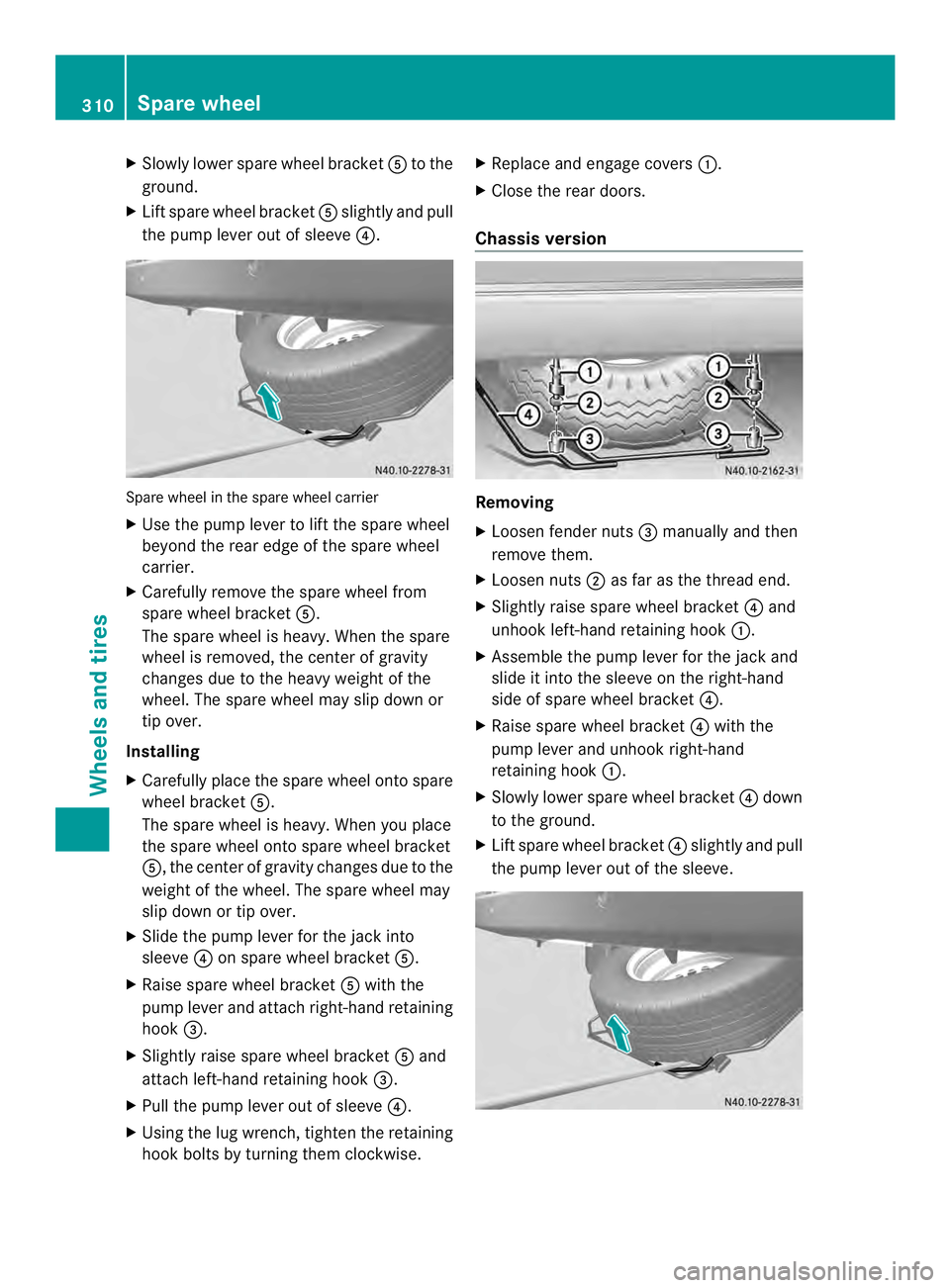
X
Slowly lowe rspare wheel bracket 0023to the
ground.
X Lift spare wheel bracket 0023slightly and pull
the pump lever out of sleeve 0025.Spare wheel in the spare wheel carrier
X
Use the pump lever to lift the spare wheel
beyond the rear edge of the spare wheel
carrier.
X Carefully remove the spare wheel from
spare wheel bracket 0023.
The spare wheel is heavy. When the spare
wheel is removed, the center of gravity
changes due to the heavy weight of the
wheel. The spare wheel may slip down or
tip over.
Installing
X Carefully place the spare wheel onto spare
wheel bracket 0023.
The spare wheel is heavy. When you place
the spare wheel onto spare wheel bracket
0023, the center of gravity changes due to the
weight of the wheel. The spare wheel may
slip down or tip over.
X Slide the pump lever for the jack into
sleeve 0025on spare wheel bracket 0023.
X Raise spare wheel bracket 0023with the
pump lever and attach right-hand retaining
hook 0026.
X Slightly raise spare wheel bracket 0023and
attach left-hand retaining hook 0026.
X Pull the pump lever out of sleeve 0025.
X Using the lug wrench, tighten the retaining
hook bolts by turning them clockwise. X
Replace and engage covers 0005.
X Close the rear doors.
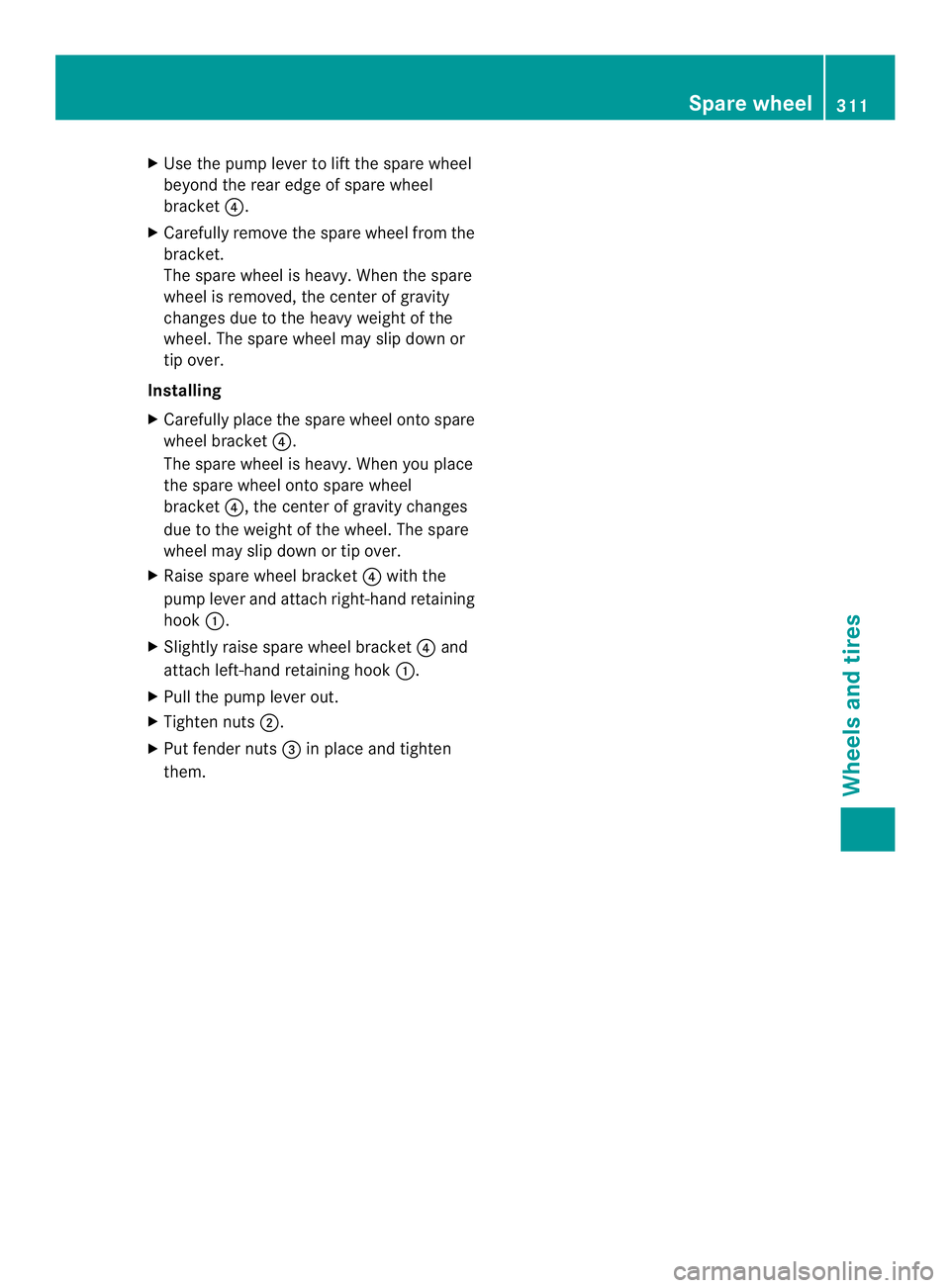
Chassis version Removing
X
Loosen fender nuts 0026manually and then
remove them.
X Loosen nuts 0006as far as the thread end.
X Slightly raise spare wheel bracket 0025and
unhook left-hand retaining hook 0005.
X Assemble the pump lever for the jack and
slide it into the sleeve on the right-hand
side of spare wheel bracket 0025.
X Raise spare wheel bracket 0025with the
pump lever and unhook right-hand
retaining hook 0005.
X Slowly lower spare wheel bracket 0025down
to the ground.
X Lift spare wheel bracket 0025slightly and pull
the pump lever out of the sleeve. 310
Spare wheelWheels and tires
Page 313 of 334
X
Use the pump lever to lift the spare wheel
beyond the rear edge of spare wheel
bracket 0025.
X Carefully remove the spare wheel from the
bracket.
The spare wheel is heavy. When the spare
wheel is removed, the center of gravity
changes due to the heavy weight of the
wheel. The spare wheel may slip down or
tip over.
Installing
X Carefully place the spare wheel onto spare
wheel bracket 0025.
The spare wheel is heavy. When you place
the spare wheel onto spare wheel
bracket 0025, the center of gravity changes
due to the weight of the wheel. The spare
wheel may slip down or tip over.
X Raise spare wheel bracket 0025with the
pump lever and attach right-hand retaining
hook 0005.
X Slightly raise spare wheel bracket 0025and
attach left-hand retaining hook 0005.
X Pull the pump lever out.
X Tighten nuts 0006.
X Put fender nuts 0026in place and tighten
them. Spare wheel
311Wheels and tires Z
Page 317 of 334
equipment of this kind is retrofitted, its
electromagnetic compatibility must be
checked and verified.
If these devices are linked to functions
associated with resistance to interference,
they must have type approval. This applies to
the device or its interfaces to the vehicle
electronics, e.g. charging brackets.
At elephone or two-way radio to be installed
in the vehicle must be approved. Further
information can be obtained from any
Sprinter Dealer.
For operation of mobile phones and two-way
radios, we recommend connection to an
approved exterior antenna. This is the only
way to ensure optimum reception quality
inside the vehicle and to minimize mutual
interference between the vehicle electronics,
mobile phones and two-way radios.
The transmission output of the mobile phone
or two-way radio may not exceed the
following maximum transmission output
(PEAK): Frequency range Maximum
transmission
output (PEAK)
Short wave
(f < 50 MHz) 100 W
4 m waveband 30 W
2 m waveband 50 W
Trunked radio/Tetra 35 W
70 cm waveband 35 W
GSM 900/AMPS 10 W
GSM 1800 10 W
UMTS 10 W Identification plates
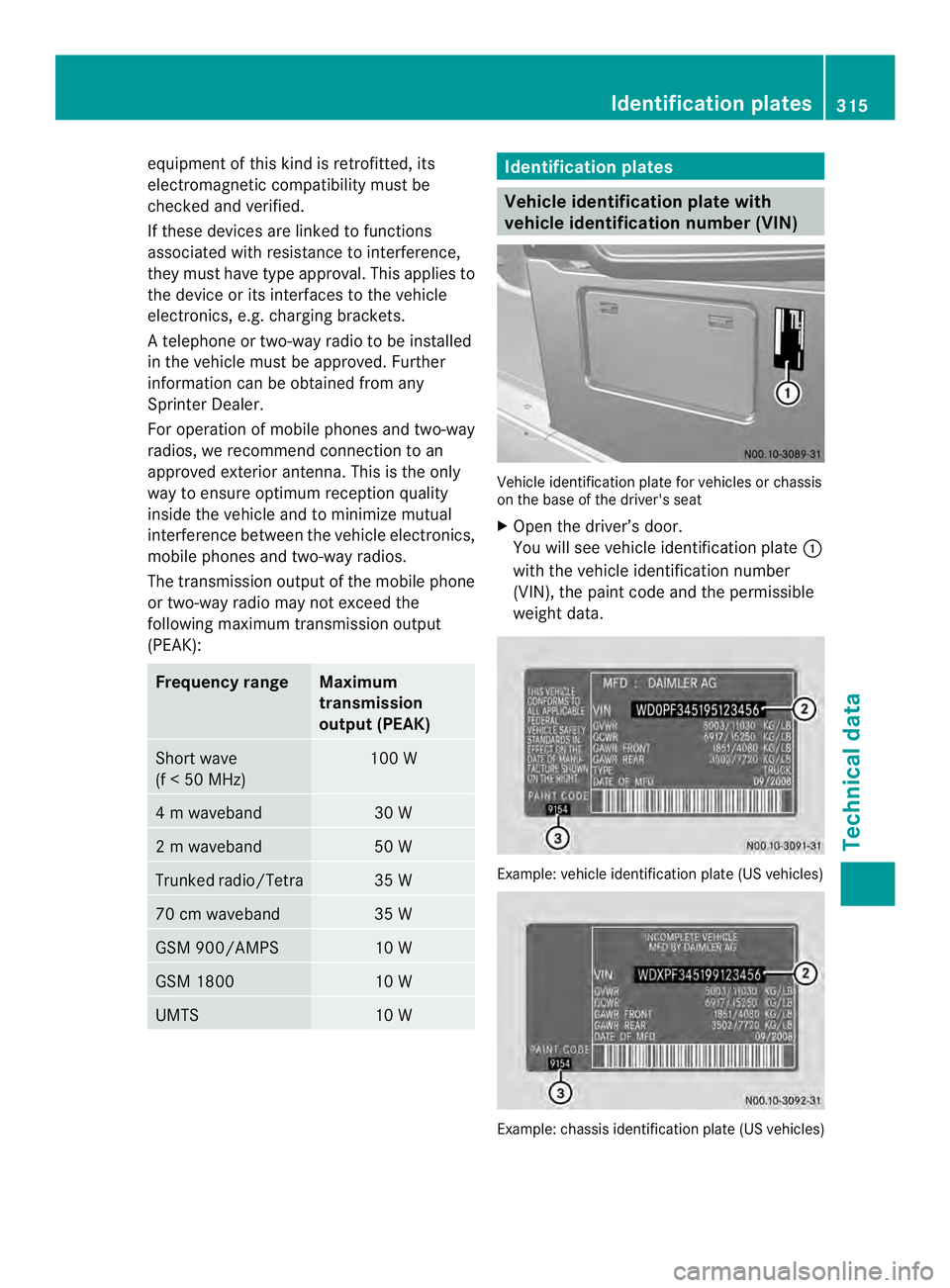
Vehicle identification plate with
vehicle identification number (VIN)
Vehicle identification plate for vehicles or chassis
on the base of the driver's seat
X
Open the driver’s door.
You will see vehicle identification plate 0005
with the vehicle identification number
(VIN), the paint code and the permissible
weight data. Example: vehicle identification plate (US vehicles)
Example: chassis identification plate (US vehicles) Identification plates
315Technical data Z