weight MERCEDES-BENZ SPRINTER 2013 MY13 Operator’s Manual
[x] Cancel search | Manufacturer: MERCEDES-BENZ, Model Year: 2013, Model line: SPRINTER, Model: MERCEDES-BENZ SPRINTER 2013Pages: 334, PDF Size: 3.88 MB
Page 328 of 334
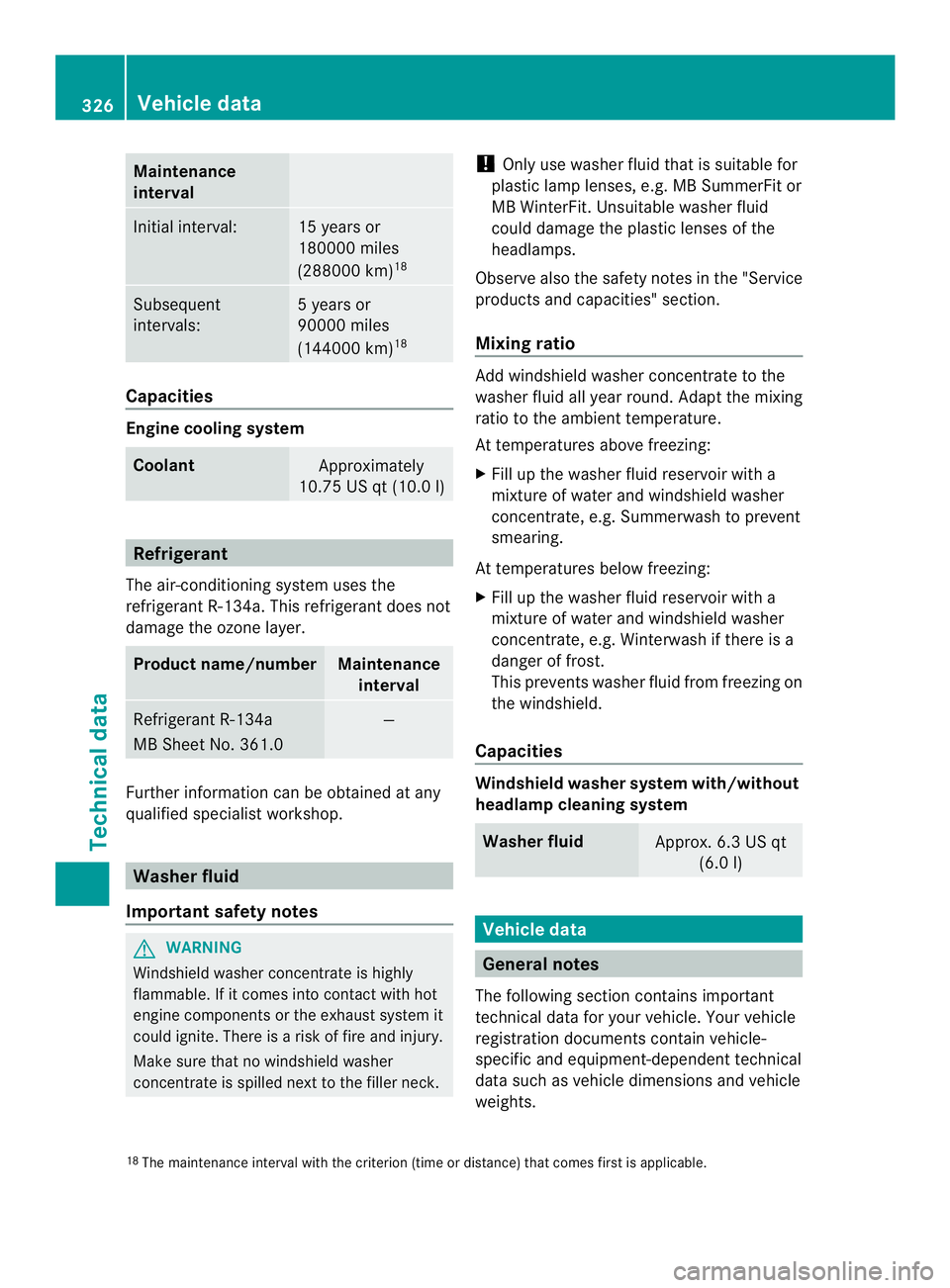
Maintenance
interval
Initial interval: 15 years or
180000 miles
(288000 km)
18 Subsequent
intervals: 5y
ears or
90000 miles
(144000 km) 18 Capacities
Engine cooling system
Coolant
Approximately
10.75 US qt (10.0 l) Refrigerant
The air-conditioning system uses the
refrigerant R-134a. This refrigerant does not
damage the ozone layer. Product name/number Maintenance
interval Refrigerant R-134a
MB Sheet No. 361.0 —
Further information can be obtained at any
qualified specialist workshop.
Washer fluid
Important safety notes G
WARNING
Windshield washer concentrate is highly
flammable. If it comes into contact with hot
engine components or the exhaust system it
could ignite. There is a risk of fire and injury.
Make sure that no windshield washer
concentrate is spilled next to the filler neck. !
Only use washer fluid that is suitable for
plastic lamp lenses, e.g. MB SummerFit or
MB WinterFit .Unsuitabl ewasher fluid
could damage the plastic lenses of the
headlamps.
Observe also the safety notes in the "Service
products and capacities" section.
Mixing ratio Add windshield washe
rconcentrate to the
washer fluid all year round. Adapt the mixing
ratio to the ambient temperature.
At temperatures above freezing:
X Fill up the washer fluid reservoir with a
mixture of water and windshield washer
concentrate, e.g. Summerwash to prevent
smearing.
At temperatures below freezing:
X Fill up the washer fluid reservoir with a
mixture of water and windshield washer
concentrate, e.g. Winterwash if there is a
danger of frost.
This prevents washer fluid from freezing on
the windshield.
Capacities Windshield washer system with/without
headlam
pcleaning system Washer fluid
Approx. 6.3 US qt
(6.0 l) Vehicle data
General notes
The following section contain simportant
technical data for yourv ehicle. Your vehicle
registration documents contain vehicle-
specific and equipment-dependen ttechnical
data such as vehicle dimensions and vehicle
weights.
18 The maintenance interval with the criterion (time or distance) that comes first is applicable. 326
Vehicle dataTechnical data
Page 329 of 334
Cargo tie-down points and carrier
systems
Cargo tie-down points General notes
!
Observe the informatio nonthe maximum
loading capacity of the individual cargo tie-
down points.
If you use several cargo tie-down points to
secure a load, you must always take the
maximum loading capacity of the weakest
cargo tie-down point into account.
If you brake hard, for example, the forces
acting could be up to several times the
weight force of the load. Always use
multiple cargo tie-down points in order to
distribute the force absorption. Load the
anchorages evenly.
You will find further information about cargo
tie-down points and cargo tie-down rings in
the "Transporting" section (Y page 234).
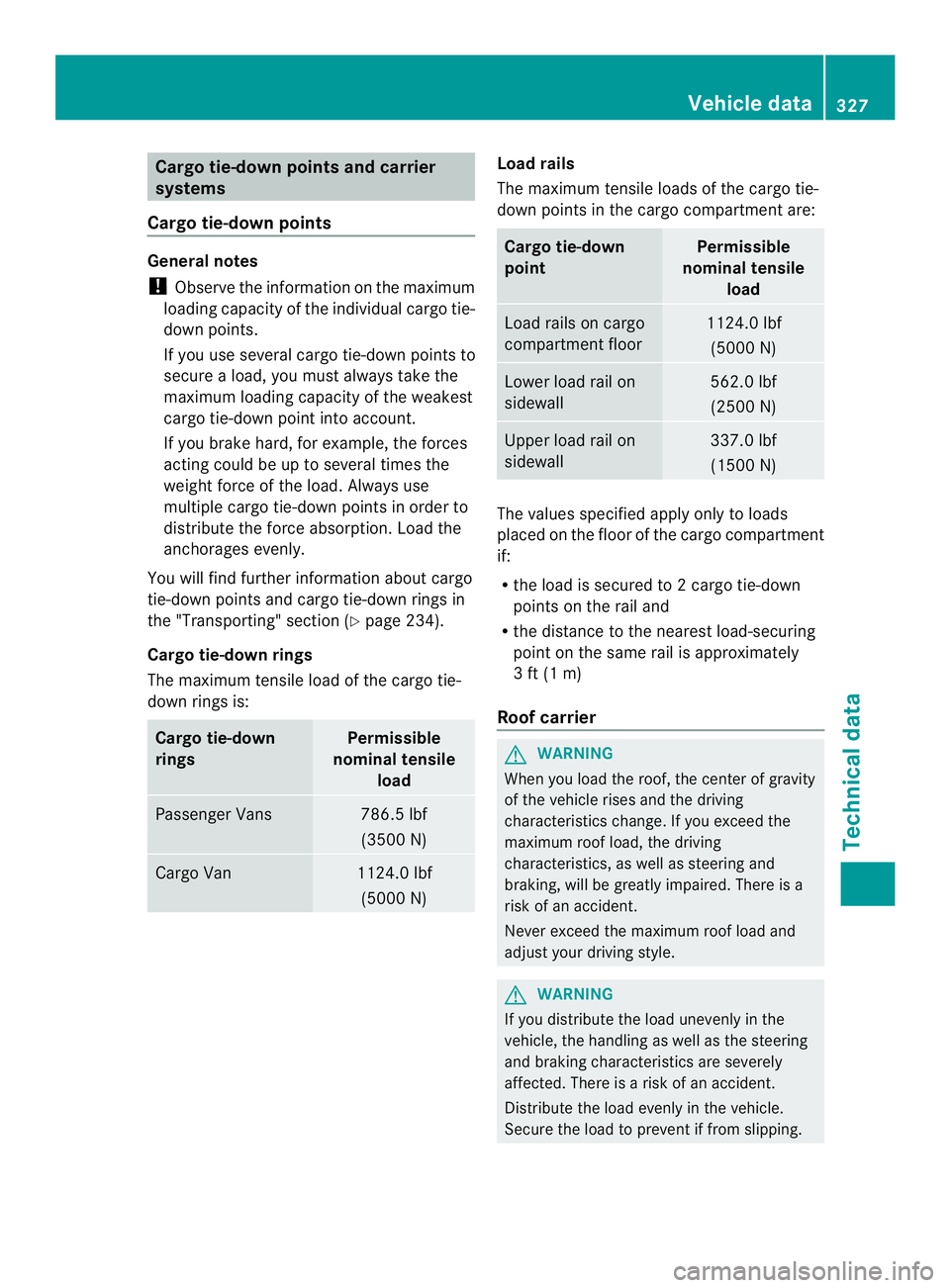
Cargo tie-down rings
The maximum tensile load of the cargo tie-
down rings is: Cargo tie-down
rings Permissible
nominal tensile load Passenger Vans 786.5 lbf
(3500 N) Cargo Van 1124.0 lbf
(5000 N) Load rails
The maximum tensile loads of the cargo tie-
down points in the cargo compartment are:
Cargo tie-down
point Permissible
nominal tensile load Load rails on cargo
compartment floor 1124.0 lbf
(5000 N) Lower load rail on
sidewall 562.0 lbf
(2500 N) Upper load rail on
sidewall 337.0 lbf
(1500 N) The values specified apply only to loads
placed on the floor of the cargo compartment
if:
R
the load is secured to 2cargo tie-down
points on the rail and
R the distance to the neares tload-securing
point on the same rail is approximately
3 ft (1 m)
Roof carrier G
WARNING
When you load the roof, the center of gravity
of the vehicle rises and the driving
characteristics change. If you exceed the
maximum roof load, the driving
characteristics, as well as steering and
braking, will be greatly impaired. There is a
risk of an accident.
Never exceed the maximum roof load and
adjust your driving style. G
WARNING
If you distribute the load unevenly in the
vehicle, the handling as well as the steering
and braking characteristics are severely
affected. There is a risk of an accident.
Distribute the load evenly in the vehicle.
Secure the load to prevent if from slipping. Vehicle data
327Technical data Z
Page 330 of 334
!
The weight of any load carried on the roof,
including the roof carrier, must not exceed
the maximum permissible roof load.
The roof carrier supports must be mounted
at equal distances.
We recommend that you have a stabilizer
installed on the front axle.
! For safety reasons, we recommend that
you only use roof carrier systems that have
been tested and approved for the Sprinter.
This will help to avoid damage.
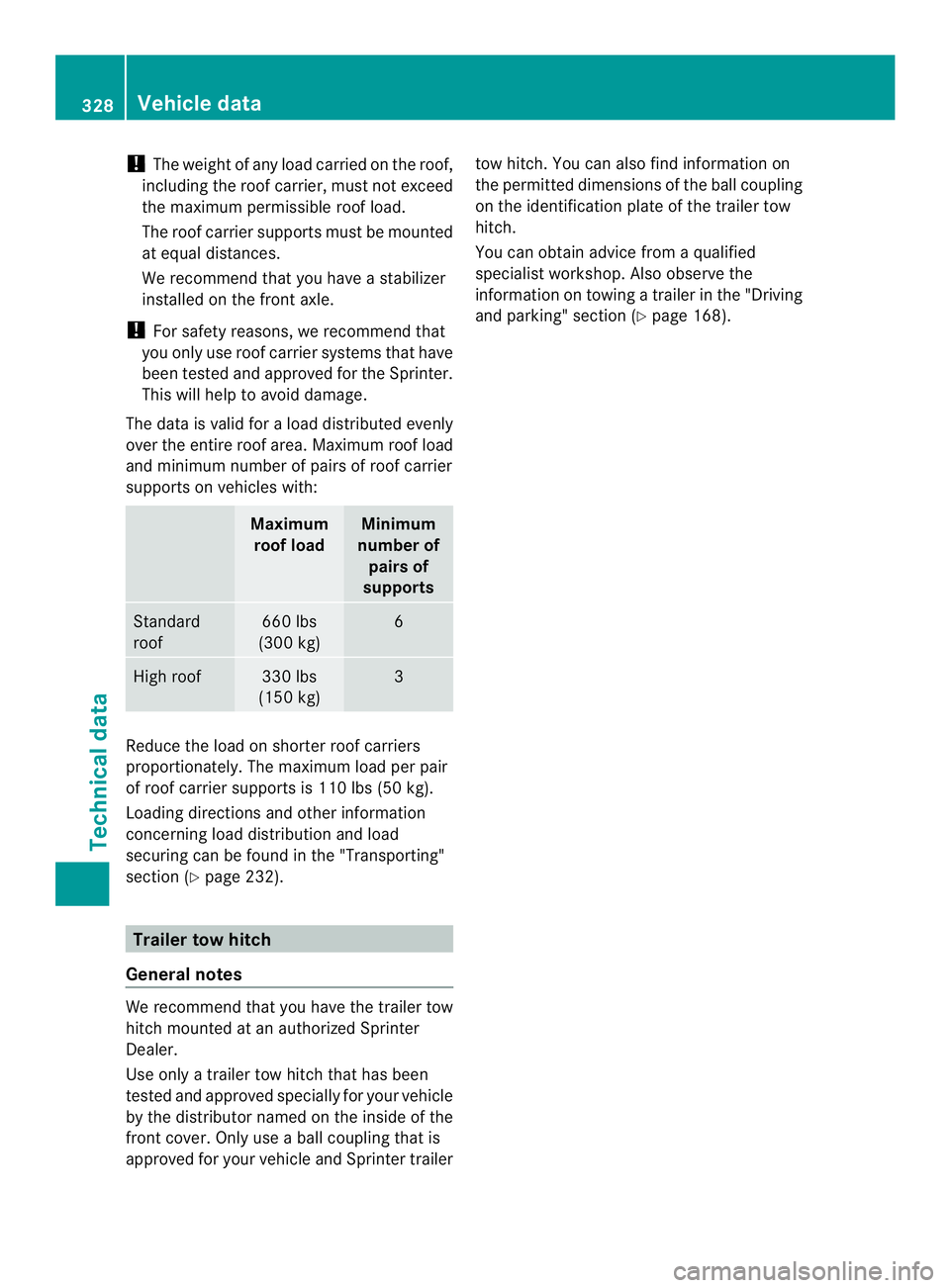
The data is valid for a load distributed evenly
over the entire roof area. Maximum roof load
and minimum number of pairs of roof carrier
supports on vehicles with: Maximum
roof load Minimum
number of pairs of
supports Standard
roof 660 lbs
(300 kg) 6
High roof 330 lbs
(150 kg) 3
Reduce the load on shorter roof carriers
proportionately. The maximum load per pair
of roof carrier supports is 110 lbs (50 kg).
Loading directions and other information
concerning load distribution and load
securing can be found in the "Transporting"
section (Y
page 232). Trailer tow hitch
General notes We recommend that you have the trailer tow
hitch mounted at an authorized Sprinter
Dealer.
Use only a trailer tow hitch that has been
tested and approved specially for your vehicle
by the distributor named on the inside of the
front cover. Only use a ball coupling that is
approved for your vehicle and Sprinter trailer tow hitch. You can also find information on
the permitted dimensions of the ball coupling
on the identification plate of the trailer tow
hitch.
You can obtain advice from a qualified
specialist workshop. Also observe the
information on towing a trailer in the "Driving
and parking" section (Y
page 168).328
Vehicle dataTechnical data
Page 331 of 334
Maximum permitted weights and loads
!
On vehicles with a permissible gross vehicle weight of 11030 lbs (5003 kg), the permissible
gross combination weight is less than the total of the permissible gross vehicle weight and
the permissible trailer load. Exceeding the permissible gross combination weight can lead
to damage to the drivetrain, to the transmission or to the trailer tow hitch.
If the vehicle or the trailer is fully laden, the relevant value for the permissible gross vehicle
weight or the permissible trailer load is therefore lower. In this case, the trailer or the vehicle
may only be partially loaded.
The permissible weights and loads which cannot be exceeded can also be found:
R in yourv ehicle documents and
R on the identification plates of the trailer tow hitch, trailer and vehicle (Y page 315).
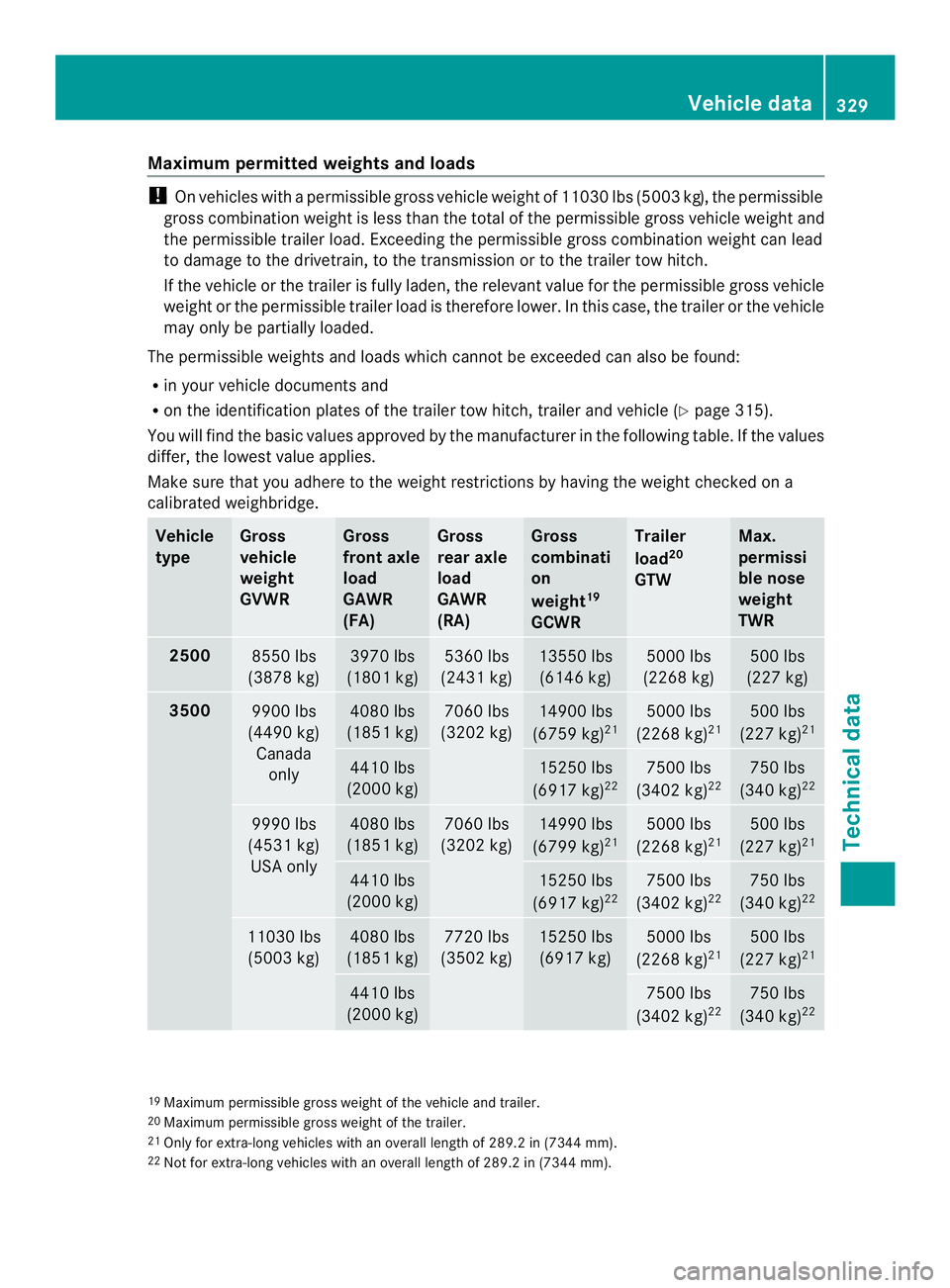
You will find the basic values approved by the manufacturer in the following table. If the values
differ, the lowest value applies.
Make sure that you adhere to the weight restrictions by having the weight checked on a
calibrated weighbridge. Vehicle
type Gross
vehicle
weight
GVWR Gross
front axle
load
GAWR
(FA) Gross
rear axle
load
GAWR
(RA) Gross
combinati
on
weight
19
GCWR Trailer
load
20
GTW Max.
permissi
ble nose
weight
TWR
2500
8550 lbs
(3878 kg) 3970 lbs
(1801 kg) 5360 lbs
(2431 kg) 13550 lbs
(6146 kg) 5000 lbs
(2268 kg) 500 lbs
(227 kg) 3500
9900 lbs
(4490 kg) Canada only 4080 lbs
(1851 kg) 7060 lbs
(3202 kg) 14900 lbs
(6759 kg) 21 5000 lbs
(2268 kg) 21 500 lbs
(227 kg) 21 4410 lbs
(2000 kg) 15250 lbs
(6917 kg) 22 7500 lbs
(3402 kg) 22 750 lbs
(340 kg) 22 9990 lbs
(4531 kg) USA only 4080 lbs
(1851 kg) 7060 lbs
(3202 kg) 14990 lbs
(6799 kg) 21 5000 lbs
(2268 kg) 21 500 lbs
(227 kg) 21 4410 lbs
(2000 kg) 15250 lbs
(6917 kg) 22 7500 lbs
(3402 kg) 22 750 lbs
(340 kg) 22 11030 lbs
(5003 kg) 4080 lbs
(1851 kg) 7720 lbs
(3502 kg) 15250 lbs
(6917 kg) 5000 lbs
(2268 kg) 21 500 lbs
(227 kg) 21 4410 lbs
(2000 kg) 7500 lbs
(3402 kg) 22 750 lbs
(340 kg) 22 19
Maximum permissible gross weight of the vehicle and trailer.
20 Maximum permissible gross weight of the trailer.
21 Only for extra-long vehicles with an overall length of 289.2 in (7344 mm).
22 Not for extra-long vehicles with an overall length of 289.2 in (7344 mm). Vehicle data
329Technical data Z