maintenance MERCEDES-BENZ SPRINTER 2013 MY13 Operator’s Manual
[x] Cancel search | Manufacturer: MERCEDES-BENZ, Model Year: 2013, Model line: SPRINTER, Model: MERCEDES-BENZ SPRINTER 2013Pages: 334, PDF Size: 3.88 MB
Page 283 of 334
X
Read the tire pressure and compare it with
the recommended value on the loading
information table or th etire pressure table
(Y page 278).
X If the tire pressure is too low, increase it to
the recommended value.
X If the tire pressure is too high, release air
by pressing down the metal pin in the valve.
Use the tip of a pen, for example. Then,
chec kthe tire pressure again using the tire
pressure gauge.
X Screw the valve cap onto the valve.
X Repeatt he steps for the other tires. Tire pressure monitor
Important safety notes G
WARNING
Each tire, including the spare (if provided),
should be checked at least once a month
when cold and inflated to the pressure
recommended by the vehicle manufacturer
on the Tire and Loading Information placard
on the driver's door B-pillar or the tire
pressure label on the inside of the fuel filler
flap. If your vehicle has tires of a different size
than the size indicated on the Tire and Loading
Information placard or the tire pressure label,
you should determine the proper tire pressure
for those tires.
As an added safety feature, your vehicle has
been equipped with a tire pressure monitoring
system (TPMS) that illuminates a low tire
pressure telltale when one or more of your
tires are significantly underinflated.
Accordingly, when the low tire pressure
telltale illuminates, you should stop and check
your tires as soon as possible, and inflate
them to the proper pressure. Driving on a
significantly underinflated tire causes the tire
to overheat and can lead to tire failure.
Underinflation also reduces fuel efficiency
and tire tread life, and may affect the vehicle's
handling and stopping ability. Please note that the TPMS is not a substitute
for proper tire maintenance, and it is the
driver's responsibility to maintain correct tire
pressure, even if underinflation has not
reached the level to trigger illumination of the
TPMS low tire pressure telltale.
USA only:
Your vehicle has also been equipped with a
TPMS malfunction indicator to indicate if the
system is not operating properly. The TPMS
malfunction indicator is combined with the
low tire pressure telltale. When the system
detects a malfunction, the warning lamp will
flash for approximately a minute and then
remain continuously illuminated. This
sequence will be repeated every time the
vehicle is started as long as the malfunction
exists.
When the malfunction indicator is illuminated,
the system may not be able to detect or signal
low tire pressure as intended. TPMS
malfunctions may occur for a variety of
reasons, including the installation of
incompatible replacement or alternate tires
or wheels on the vehicle that prevent the
TPMS from functioning properly. Always
check the TPMS malfunction telltale after
replacing one or more tires or wheels on your
vehicle to ensure that the replacement or
alternate tires and wheels allow the TPMS to
continue to function properly.
Vehicles with a tire pressure monitor are
equipped with sensors in the wheels that
monitor the tire pressure of all four tires. The
tire pressure monitor monitors the pressure
in all four tires; you set this pressure when
you activate the tire pressure monitor. The
tire pressure monitor warns you when the
pressure drops in one or more of the tires. The
tire pressure monitor only functions if the
corresponding sensors are installed to all
wheels.
You should always adjust the tire pressure
according to the vehicle load. Restart the tire
pressure monitor if you change the tire
pressure. Tire pressure
281Wheels and tires Z
Page 303 of 334
X
Loosen angled valve adapter 001Dfrom tire
valve 001Cand remove it.
X Screw in the valve core again using the
valve tool and remove the valve tool
through the opening.
i If the valve insert is damaged or lost when
it is unscrewed, you can use the valve insert
from tire sealant bottle 0019after you have
used the tire sealant.
X Unscrew the valve insert from the valve of
tire sealant bottle 0019using the valve
extractor.
X Push angled valve adapter 0006located on
hose 0026of the tire inflatio ncompressor as
far as it will go ontot ire valve001Cand clamp
it in place.
X Press tire inflation compressor switch 0005
to Iand inflate the tire.
If possible, inflate the tire to the
recommended tire pressure. You will find a
table of recommended tir epressure on the
Tire and Loading Information placard 10
or
the tire pressure plate on the B-pillar on the
driver's side of the vehicle (Y page 278).
X Then press 0on tire inflation compressor
switch 0005.
The tire inflation compresso ris
deactivated.
X Screw the valve cap onto tire valve 001C.
X Observe the following notes and
instructions:
R
Tire pressure of 300 kPa (3.0 bar/
43.5 psi) not reached (Y page 301).
R Tire pressure of 300 kPa (3.0 bar/
43. 5psi) reached (Y page 301).
Tire pressure of 300 kPa (3.0 bar/
43.5 psi) not reached G
WARNING
If the specified tire pressure is not reached,
the tire is too severely damaged.T he tire
sealant cannot offer assistance with a flat tire in this case. Damaged tires as well as tire
pressure that is too low can impair the braking
and driving characteristics. There is a risk of
an accident.
Do not drive any further. Notify a qualified
specialist workshop.
i The Mercedes-Benz Service24h
telephone numbers can be found on a
sticker in the driver's door entrance area
and in the vehicle Maintenance Booklet.
Tire pressure of 300 kPa (3.0 bar/
43.5 psi) reached G
WARNING
At ire temporarily sealed with tire sealant
impairs the driving characteristics and is not
suitable for higher speeds. There is a risk of
accident.
You should therefore adapt your driving style
accordingly and drive carefully. Do not exceed
the specified maximum speed with a tire that
has been repaired using tire sealant.
The maximum speed for a tire sealed with tire
sealant is 50 mph (80 km/h).
The "max. 50 mph" (80 km/h) sticker must
be affixed within the driver's field of vision.
X Turn the pressure release screw on
pressure gauge 0023counter-clockwise and
bleed the system.
X Turn the key in the ignition lock to
position 0.
X Pull connector 0024on the tire inflation
compressor out of the 12 V socket.
X Clean the valve core extractor with clean
water.
X Remove angled valve adapter 0006from valve
0018 of tire sealant filler bottle 0019and screw
the valve cap onto valve 0018.
X Stow the tire inflation compressor, tire
sealant bottle 0019with valve core extractor
10 Only for vehicles with a gross vehicle weight of less than 10,000 lbs(4,536 kg). Flat tire
301Wheels and tires Z
Page 304 of 334
and/or valve tool, warning triangle and
warning lamps in the vehicle.
X Pull away immediately.
This enables the tire sealan tto distribute
inside the tire and create a more effective
seal.
X After driving for approximately 3 minutes,
stop the vehicle at a suitable location, e.g.
at a car park or gas station.
X Check the tire pressure again.
The tire pressure must be at least
300 kPa (3.0 bar/43.5 psi). G
WARNING
If the required tire pressure is not reached
after driving for a short period, the tire is too
badly damaged. The tire sealant cannot repair
the tire in this instance. Damaged tires and a
tire pressure that is too low can significantly
impair the vehicle's braking and driving
characteristics. There is a risk of accident.
Do not continue driving. Contact a qualified
specialist workshop.
i The Mercedes-Benz Service24h
telephone numbers can be found on a
sticker in the driver's door entrance area
and in the vehicle Maintenance Booklet.
i If you check the tire pressure with the tire
inflation compressor, connect angled valve
adapter 0006on tire inflation compressor
hose 0026directly to the tire valve. The tire
pressure will increase when you switch the
tire inflation compressor on. You can
reduce the tire pressure by opening the
pressure release screw on pressure gauge
0023.
If the tire pressure is still at least 300 kPa
(3.0 bar/43.5 psi):
X If possible, inflate the tire to the
recommended tire pressure (Y page 278).
X Drive to the nearest qualified specialist
workshop as soon as possible and have the
tire and tire sealant 0019replaced. Changing wheels
Rotating the wheels
G
WARNING
Interchanging the front and rear wheels may
severely impair the driving characteristics if
the wheels or tires have different dimensions.
The wheel brakes or suspension components
may also be damaged. There is a risk of
accident.
Rotate front and rear wheels only if the wheels
and tires are of the same dimensions.
! On vehicles equipped with a tire pressure
monitor, electronic components are
located in the wheel.
Tire-mounting tools should not be used
near the valve. This could damage the
electronic components.
Only have tires changed at a qualified
specialist workshop.
Always observe the instructions and safety
notes in the "Mounting awheel" section
(Y page 303).
The wear patterns on the front and rear tires
differ, depending on the operating conditions.
Rotate the wheels before a clear wear pattern
has formed on the tires. Front tires typically
wear more on the shoulders and the rear tires
in the center.
If your vehicle's tire configuration allows, you
can rotate the wheels according to the
intervals in the tire manufacturer's warranty
book in your vehicle documents. If no
warranty book is available, the tires should be
rotated every 3,000 to 6,000 miles (5,000 to
10,000 km), or earlier if tire wear requires. Do
not change the direction of rotation.
Clean the contac tsurface softhe wheel and
the brake disc thoroughly every time a wheel
is rotated. Check the tire pressure and
reactivate the tire pressure monitor if
necessary. 302
Changing wheelsWheels and tires
Page 306 of 334
X
Take the vehicle tool kit and the jack from
the footwell on the co-driver's side
(Y page 264).
X Remove the spare wheel from the spare
wheel bracket (Y page 309). Observe the
safety notes in the "Spare wheel" section
(Y page 308).
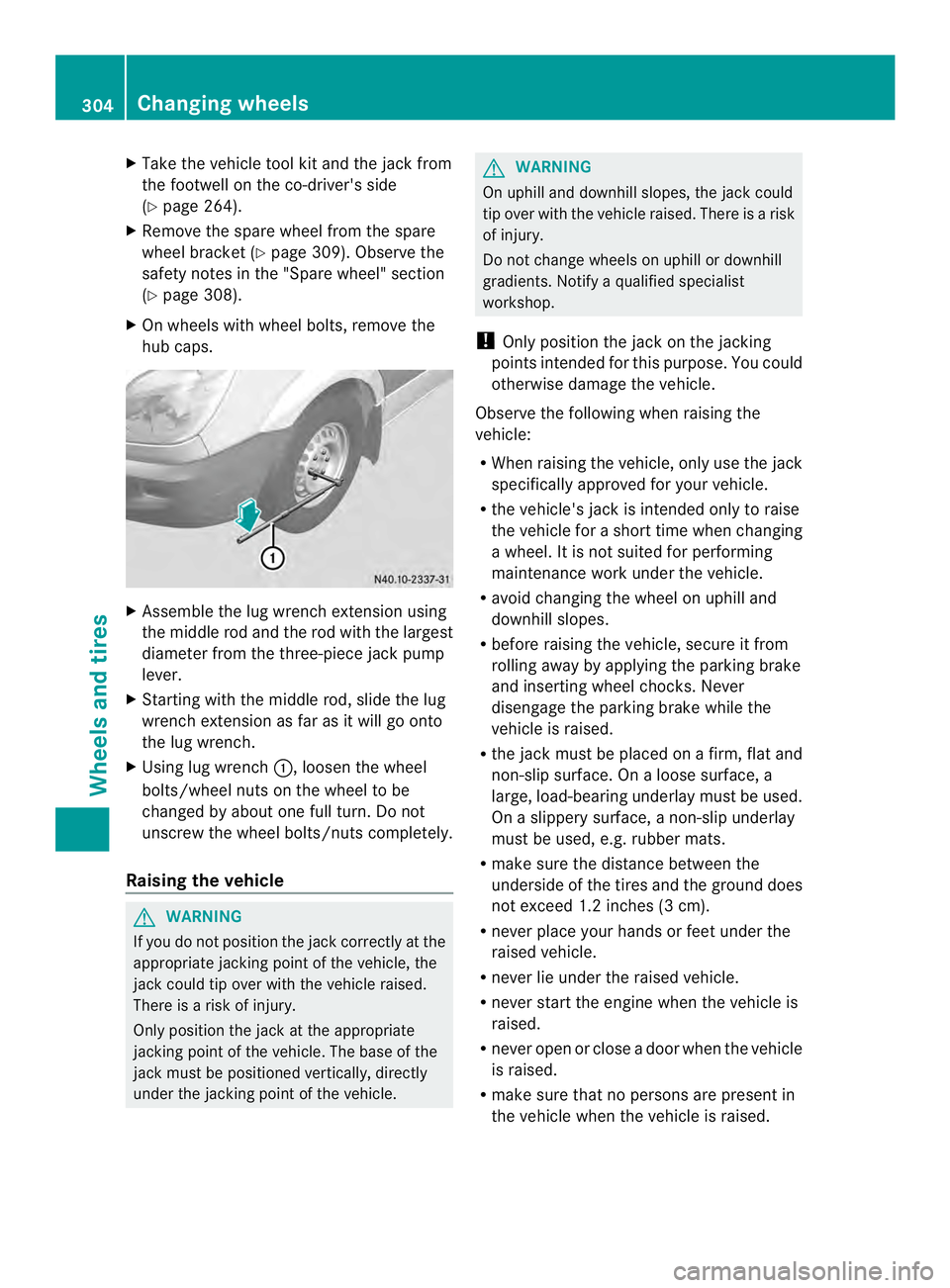
X On wheels with wheel bolts, remove the
hub caps. X
Assemble the lug wrench extension using
the middle rod and the rod with the largest
diameter from the three-piece jack pump
lever.
X Starting with the middle rod, slide the lug
wrench extension as far as it will go onto
the lug wrench.
X Using lug wrench 0005, loosen the wheel
bolts/wheel nuts on the wheel to be
changed by about one full turn. Do not
unscrew the wheel bolts/nuts completely.
Raising the vehicle G
WARNING
If you do not position the jack correctly at the
appropriate jacking point of the vehicle, the
jack could tip over with the vehicle raised.
There is a risk of injury.
Only position the jack at the appropriate
jacking point of the vehicle. The base of the
jack must be positioned vertically, directly
under the jacking point of the vehicle. G
WARNING
On uphill and downhill slopes, the jack could
tip over with the vehicle raised. There is a risk
of injury.
Do not change wheels on uphill or downhill
gradients. Notify a qualified specialist
workshop.
! Only position the jack on the jacking
points intended for this purpose. You could
otherwise damage the vehicle.
Observe the following when raising the
vehicle:
R When raising the vehicle, only use the jack
specifically approved for your vehicle.
R the vehicle's jack is intended only to raise
the vehicle for a short time when changing
a wheel. It is not suited for performing
maintenance work under the vehicle.
R avoid changing the wheel on uphill and
downhill slopes.
R before raising the vehicle, secure it from
rolling away by applying the parking brake
and inserting wheel chocks. Never
disengage the parking brake while the
vehicle is raised.
R the jack must be placed on a firm, flat and
non-slip surface. On a loose surface, a
large, load-bearing underlay must be used.
On a slippery surface, a non-slip underlay
must be used, e.g. rubber mats.
R make sure the distance between the
underside of the tires and the ground does
not exceed 1.2 inches (3 cm).
R never place your hands or feet under the
raised vehicle.
R never lie under the raised vehicle.
R never start the engine when the vehicle is
raised.
R never open or close a door when the vehicle
is raised.
R make sure that no persons are present in
the vehicle when the vehicle is raised. 304
Changing wheelsWheels and tires
Page 310 of 334
X
Wheel with hub cap: position the opening
for the tire valve in the hub cap over the tire
valve.
X Push the edge of the hub cap with both
hands against the wheel until it clicks into
place. Make sure the hub cap retaining
catches engage on the steel wheel.
X Wheel with central hub cap: position the
retaining lugs of the central hub cap over
the wheel bolts.
X Hit the middle of the hub cap to engage it
on the wheel.
X Secure the faulty wheel in the spare wheel
bracket (Y page 309).
X Check the tire pressure of the newly
mounted wheel and adjust it if necessary.
Observe the recommended tire pressure
(Y page 278).
X Retighten the wheel bolts or wheel nuts to
the specified tightening torque after the
vehicle has been driven for 30 miles
(50 km).
When using a wheel/spare wheel with a new
or newly painted wheel rim, have the wheel
bolts/nuts retightened again after
approximately 600 to 3,000 miles (1,000 to
5,000 km). Observe the specified tightening
torque.
i Vehicles with the tire pressure monitor
system: all mounted wheels must be
equipped with functioning sensors. Wheel and tire combination
General notes
! Retreaded tires are neither tested nor
recommended for Sprinter vehicles, since
previous damage cannot always be
detected on retreaded tires. We can
therefore not guarantee driving safety. Do
not mount used tires if you have no
information about their previous usage. The recommended tire pressures can be
found:
R
on the Tire and Loading Information
placard 11
on the B-pillar on the driver's side
R on the tire pressure table on the B-pillar on
the driver's side
The recommended tire pressure can also be
found in the "Tire pressure table" section in
these Operating Instructions (Y page 285).
The wheel/tire combination for your vehicle
can be found on the tire pressure table.
Further information on wheel/tire
combination can be obtained at any qualified
specialist workshop.
Check tire pressures regularly and only when
the tires are cold. Observe the notes on the
recommended tire pressures (Y page 278).
Follow the maintenance recommendations in
the tire manufacturer's warranty book in your
vehicle documents.
Notes on the vehicle equipment –always
install the vehicle:
R with tires of the same size across an axle
(left/right)
R with the same type of tires on all wheels at
a given time (summer tires, winter tires) Spare wheel
Important safety notes
G
WARNING
Wheel and tire dimensions as well as the type
of tire can vary between the spare wheel and
the wheel to be replaced. When the spare
wheel is installed, driving characteristics may
be severely affected. There is a risk of an
accident.
In order to reduce risks:
R you should therefore adapt your driving
style and drive carefully.
R never install more than one spare wheel
that differs fro mthe wheel to be replaced.
11 Only for vehicles with a gross weight of less than 10,000 lbs(4,536 kg). 308
Spare wheelWheels and tires
Page 324 of 334
significantly due to aging in use, especially
at low outside temperatures.
We recommend that you change the engine
oil before the cold season commences. Use
an approved engine oil of the specified SAE
class.
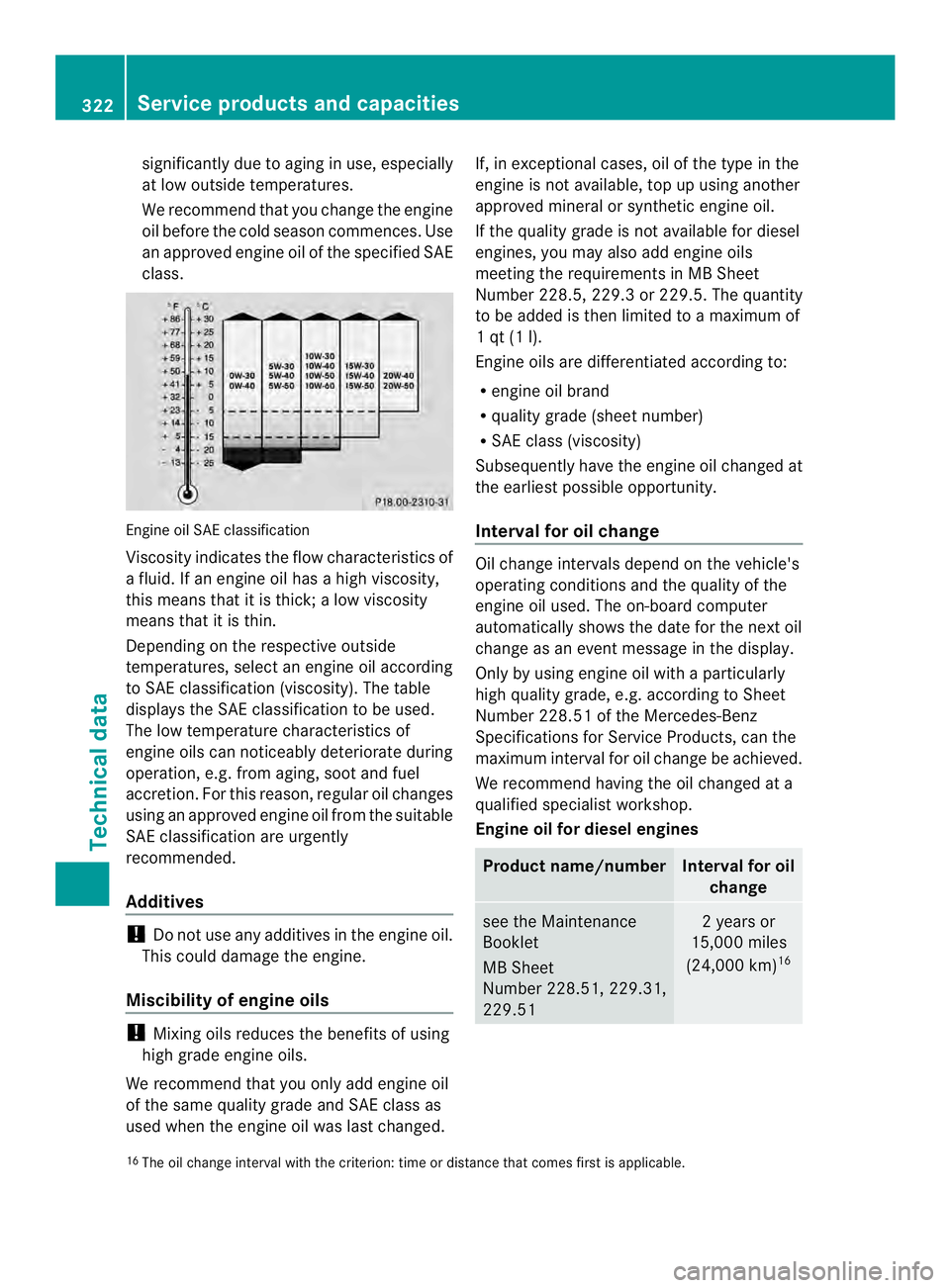
Engine oil SAE classification
Viscosity indicates the flow characteristics of
a fluid. If an engine oil has a high viscosity,
this means that it is thick; a low viscosity
means that it is thin.
Depending on the respective outside
temperatures, select an engine oil according
to SAE classification (viscosity). The table
displays the SAE classification to be used.
The low temperature characteristics of
engine oils can noticeably deteriorate during
operation, e.g. from aging, soot and fuel
accretion. For this reason, regularo il changes
using an approved engine oil fro mthe suitable
SAE classification are urgently
recommended.
Additives !
Do not use any additives in the engine oil.
This could damage the engine.
Miscibility of engine oils !
Mixing oils reduces the benefits of using
high grade engine oils.
We recommend that you only add engine oil
of the same quality grade and SAE class as
used when the engine oil was last changed. If, in exceptional cases, oil of the type in the
engine is not available, top up using another
approved mineral or synthetic engine oil.
If the quality grade is not available for diesel
engines, you may also add engine oils
meeting the requirements in MB Sheet
Number 228.5, 229.3 or 229.5. The quantity
to be added is then limited to a maximum of
1 qt (1 l).
Engine oils are differentiated according to:
R
engine oil brand
R quality grade (sheet number)
R SAE class (viscosity)
Subsequently have the engine oil changed at
the earliest possible opportunity.
Interval for oil change Oil change intervals depend on the vehicle's
operating conditions and the quality of the
engine oil used. The on-board computer
automatically shows the date for the next oil
change as an event message in the display.
Only by using engine oil with a particularly
high quality grade, e.g. according to Sheet
Number 228.51 of the Mercedes-Benz
Specifications for Service Products, can the
maximum interval for oil change be achieved.
We recommend having the oil changed at a
qualified specialist workshop.
Engine oil for diesel engines
Product name/number Interval for oil
change see the Maintenance
Booklet
MB Sheet
Number 228.51, 229.31,
229.51 2y
ears or
15,000 miles
(24,000 km) 16 16
The oil change interval with the criterion: time or distance that comes first is applicable. 322
Service products and capacitiesTechnical data
Page 325 of 334
Capacities
!
Do no tadd too much oil. adding too much
engine oil can result in damage to the
engine or to the catalytic converter. Have
excess engine oil siphoned off.
Oil change including oil filter Engine oil
Approximately
13.21 US qt. (12.5 l) Information about oil consumption
!
If the vehicle is predominantly used for
short-distance driving, this could lead to a
malfunction in the automatic cleaning
function for the diesel particle filter. As a
result, fuel may accumulate in the engine
oil and cause engine failure.
Therefore, if you mainly drive short
distances, you should drive on a highway or
on rural roads for 20 minutes every
310 miles (500 km). This ensures sufficient
regeneration of the diesel particle filter.
Depending on the driving style, the vehicle
consumes a maximum of 1.0 US qt (1.0 l)of
engine oil over a distance of 620 miles
(1000 km).
Oil consumption may be higher if:
R the vehicle is new.
R you mainly operate the vehicle under
arduous operating conditions.
R you frequently drive at high engine speeds.
Regula rmaintenance is one of the
preconditions for moderate rates of
consumption.
You can only estimate th eoil consumption
after you have drive naconsiderable distance.
Check the engine oil level on a regular basis,
e.g. weekly or each time you refuel
(Y page 242). Transmission and power steering oil
Automatic transmission Service product: automatic transmission
fluid
Product name/number Maintenance
interval Shell ATF 3403/M-115
MB Sheet No. 236.10 60000 miles
(96000 km) Fuchs/Shell ATF 3353
MB Sheet No. 236.12
Further information can be obtained at any
qualified specialist workshop.
Rear axle
Service product: transmission oil
Product name/number Maintenance
interval BP Energear Hypo DC
80W-90
MB Sheet No. 235.20 10 years or
180000 miles
(288000 km) 17 Mobil Delvac Synthetic
Gear Oil 75W-90
MB Sheet No. 235.8
Further information can be obtained at any
qualified specialist workshop.
Steering
Service product: power steering fluid
Product name/number Maintenance
interval Mobil ATF-D,
Exxon Mobil Corporation
or equivalent
MB Sheet No. 236.3 —
17
The maintenance interval with the criterion (time or distance) that comes first is applicable. Service products and capacities
323Technical data Z
Page 326 of 334
The steering is maintenance-free. Further
information can be obtained at any qualified
specialist workshop.
Brake fluid
G
WARNING
Brake fluid is hazardous to health. Do not
swallow brake fluid. See adoctor immediately
if you swallow brake fluid.
Make sure that brake fluid does not come into
contact with skin, clothing or eyes. Rinse
affected areas with plenty of clean water and
consult a doctor if necessary.
Always wear gloves and eye protection when
topping up brake fluid.
Store brake fluid only in the original closed
container and keep it out of the reach of
children. Comply with safety regulations
when handling brake fluid. G
WARNING
The brake fluid constantly absorbs moisture
from the air. This lowers the boiling point of
the brake fluid. If the boiling point of the brake
fluid is too low, vapor pockets may form in the
brake system when the brakes are applied
hard. This would impair braking efficiency.
There is a risk of an accident.
You should have the brake fluid renewed at
the specified intervals.
! Brake fluid corrodes paint, plastic and
rubber. If paint, plastic or rubber has come
into contact with brake fluid, rinse with
water immediately.
Only use brake fluids approved for Sprinter
vehicles. Always check for the identification
DOT 4plus.
Information about approved brake fluids can
be found in the Maintenance Booklet or
obtained at any qualified specialist workshop. Service product:
brake fluid Produc
tname/
number Intac B026E
R
Boiling point: 500 ‡
(260 †)
R Wet boiling point:
356 ‡ (180 †) MB Sheet No. 331.0
Maintenance
interval 2y
ears i
Have the brake fluid renewed every 2
years at a qualified specialist workshop.
There is usually a notice in the engine
compartment to remind you when the next
brake fluid change is due. Coolant
Important safety notes G
WARNING
Coolant contains glycol and is therefore toxic.
Do not swallow the coolant .See a doctor
immediately if you swallow coolant.
Make sure that coolant does not come into
contact with skin, eyes or clothing. In case of
contact with eyes, rinse immediately with
plenty of clean water. Clean affected areas of
skin and clothing with soap and water
immediately. Change any affected clothing
immediately. G
WARNING
If antifreeze comes into contact with hot
components in the engine compartment, it
may ignite. There is a risk of fire and injury.
Let the engine cool down before you add
antifreeze. Make sure that antifreeze is not
spilled nextt o the filler neck.T horoughly
clean the antifreeze from components before
starting the engine. 324
Service products and capacitiesTechnical data
Page 327 of 334
!
Take care not to spill any coolant on
painted surfaces. You could otherwise
damage the paintwork.
Coolant additive with corrosion/
antifreeze protection !
Use only approved antifreeze/corrosion
inhibitor that complies with MB
Specification for Service Products, Sheet
Number 325. Using other, non-approved
antifreeze/corrosion inhibitors may cause
damage to the coolant system and reduce
the engine's service life.
Coolant is a mixture of water and antifreeze/
corrosion inhibitor. It performs the following
tasks:
R corrosion protection
R antifreeze protection
R raises the boiling point
When the vehicle is first delivered, it is filled
with a coolant mixture that ensures adequate
antifreeze and corrosion protection. Coolant
must be used in the system all yearr ound to
ensure anti-corrosion protection and a raised
boiling point –even in countries with high
outside temperatures.
To prevent damage to the engine cooling
system, use only approved corrosion
inhibitor/antifreeze that comply with the
Mercedes-Benz Specifications for Service
Products. You will find information about
approved corrosio ninhibitor/antifreeze for
your vehicle in the Maintenance Booklet.
We recommend corrosion inhibitor/
antifreeze tha tmeets the requirements in MB
Specifications for Service Products Sheet
Number 325.
Check the antifreeze/corrosion inhibitor
concentration in the coolant every six
months. The percentage of corrosion inhibitor/
antifreeze additive in the engine cooling
system should:
R
be at least 50%. This way, the engine
cooling system is protected against
freezing down to approximately -35 ‡
(-37 †).
R not exceed 55% (antifreeze protection
down to -49 ‡ [-45 †]). Otherwise, heat
will not be dissipated as effectively.
If there has been coolant loss, do not refill
only with water. If the vehicle has lost coolant,
add equal parts water and corrosion
inhibitor/antifreeze additive. The water used
as part of the coolant mixture must fulfill
certain requirements; these are usually
fulfilled by drinking water. If the water quality
is not sufficient, you must treat the water.
Further information can be obtained at any
qualified specialist workshop.
Maintenance interval Service product: coolant
Product name/number
EURO Peak Coolant/Antifreeze,
OLD WORLD INDUSTRIES
MB Sheet No. 325.0
Zerex G05, The Valvoline Company
MB Sheet No. 325.0
Zerex G48, The Valvoline Company
MB Sheet No. 325.0
Glysantin G05, BASF AG
MB Sheet No. 325.0Service products and capacities
325Technical data Z
Page 328 of 334
Maintenance
interval
Initial interval: 15 years or
180000 miles
(288000 km)
18 Subsequent
intervals: 5y
ears or
90000 miles
(144000 km) 18 Capacities
Engine cooling system
Coolant
Approximately
10.75 US qt (10.0 l) Refrigerant
The air-conditioning system uses the
refrigerant R-134a. This refrigerant does not
damage the ozone layer. Product name/number Maintenance
interval Refrigerant R-134a
MB Sheet No. 361.0 —
Further information can be obtained at any
qualified specialist workshop.
Washer fluid
Important safety notes G
WARNING
Windshield washer concentrate is highly
flammable. If it comes into contact with hot
engine components or the exhaust system it
could ignite. There is a risk of fire and injury.
Make sure that no windshield washer
concentrate is spilled next to the filler neck. !
Only use washer fluid that is suitable for
plastic lamp lenses, e.g. MB SummerFit or
MB WinterFit .Unsuitabl ewasher fluid
could damage the plastic lenses of the
headlamps.
Observe also the safety notes in the "Service
products and capacities" section.
Mixing ratio Add windshield washe
rconcentrate to the
washer fluid all year round. Adapt the mixing
ratio to the ambient temperature.
At temperatures above freezing:
X Fill up the washer fluid reservoir with a
mixture of water and windshield washer
concentrate, e.g. Summerwash to prevent
smearing.
At temperatures below freezing:
X Fill up the washer fluid reservoir with a
mixture of water and windshield washer
concentrate, e.g. Winterwash if there is a
danger of frost.
This prevents washer fluid from freezing on
the windshield.
Capacities Windshield washer system with/without
headlam
pcleaning system Washer fluid
Approx. 6.3 US qt
(6.0 l) Vehicle data
General notes
The following section contain simportant
technical data for yourv ehicle. Your vehicle
registration documents contain vehicle-
specific and equipment-dependen ttechnical
data such as vehicle dimensions and vehicle
weights.
18 The maintenance interval with the criterion (time or distance) that comes first is applicable. 326
Vehicle dataTechnical data