lights MERCEDES-BENZ SPRINTER 2013 MY13 Operator’s Manual
[x] Cancel search | Manufacturer: MERCEDES-BENZ, Model Year: 2013, Model line: SPRINTER, Model: MERCEDES-BENZ SPRINTER 2013Pages: 334, PDF Size: 3.88 MB
Page 216 of 334
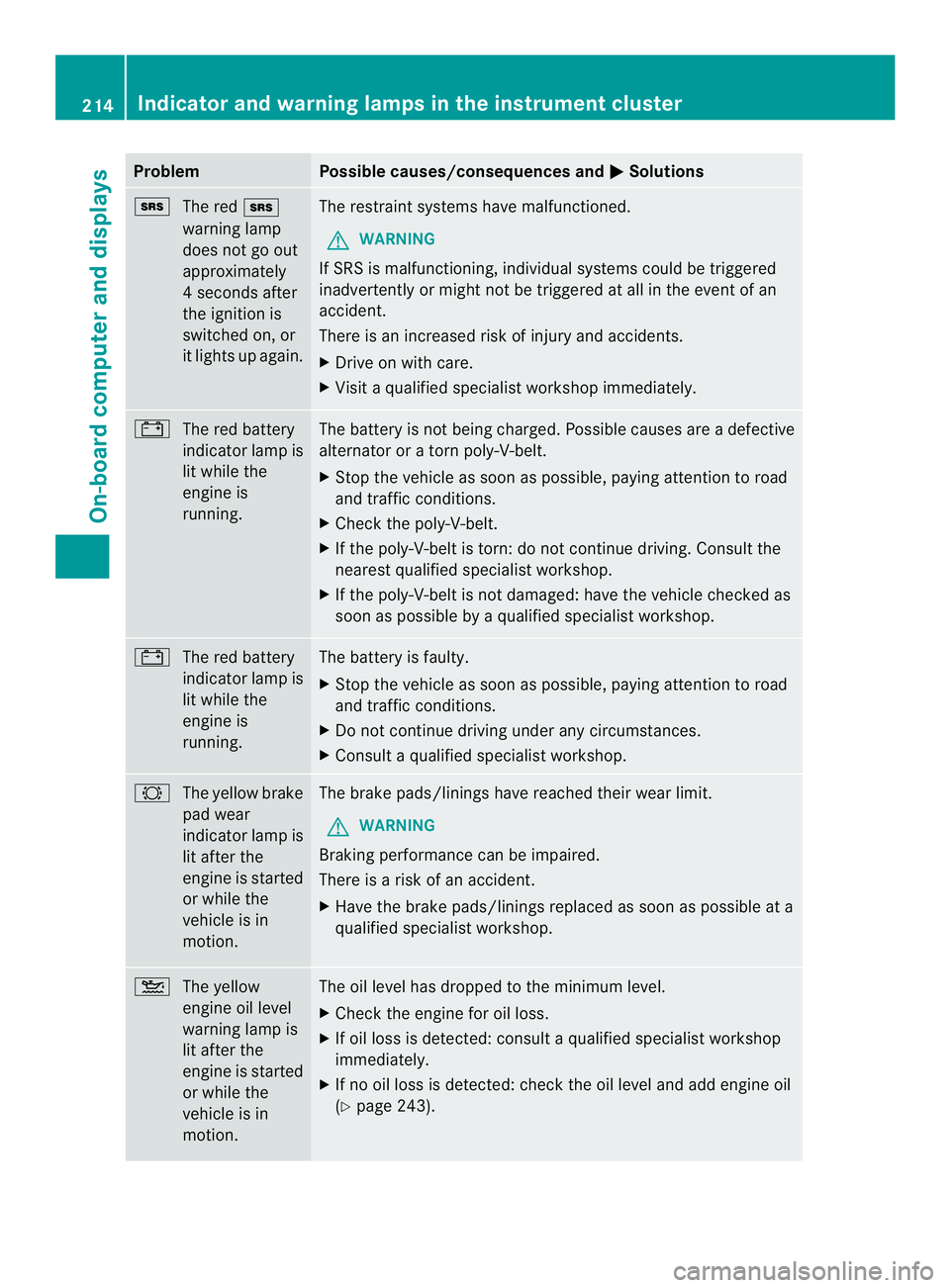
Problem Possible causes/consequences and
0004 Solutions
0008
The red 0008
warning lamp
does not go out
approximately
4s econds after
the ignition is
switched on, or
it lights up again. The restraint systems have malfunctioned.
G WARNING
If SRS is malfunctioning, individual systems could be triggered
inadvertently or might not be triggered at all in the event of an
accident.
There is an increased risk of injury and accidents.
X Drive on with care.
X Visit a qualified specialist workshop immediately. 0010
The red battery
indicator lamp is
lit while the
engine is
running. The battery is not being charged. Possible causes are a defective
alternator or a torn poly-V-belt.
X
Stop the vehicle as soon as possible, paying attention to road
and traffic conditions.
X Check the poly-V-belt.
X If the poly-V-belt is torn: do not continue driving. Consult the
nearest qualified specialist workshop.
X If the poly-V-belt is not damaged: have the vehicle checked as
soon as possible by a qualified specialist workshop. 0010
The red battery
indicator lamp is
lit while the
engine is
running. The battery is faulty.
X
Stop the vehicle as soon as possible, paying attention to road
and traffic conditions.
X Do not continue driving under any circumstances.
X Consult a qualified specialist workshop. 0005
The yellow brake
pad wear
indicator lamp is
lit after the
engine is started
or while the
vehicle is in
motion. The brake pads/linings have reached their wear limit.
G WARNING
Braking performance can be impaired.
There is a risk of an accident.
X Have the brake pads/linings replaced as soon as possible at a
qualified specialist workshop. 001D
The yellow
engine oil level
warning lamp is
lit after the
engine is started
or while the
vehicle is in
motion. The oil level has dropped to the minimum level.
X
Check the engine for oil loss.
X If oil loss is detected: consult a qualified specialist workshop
immediately.
X If no oil loss is detected: chec kthe oil level and add engine oil
(Y page 243). 214
Indicator and warning lamps in the instrument clusterOn-board computer and displays
Page 217 of 334
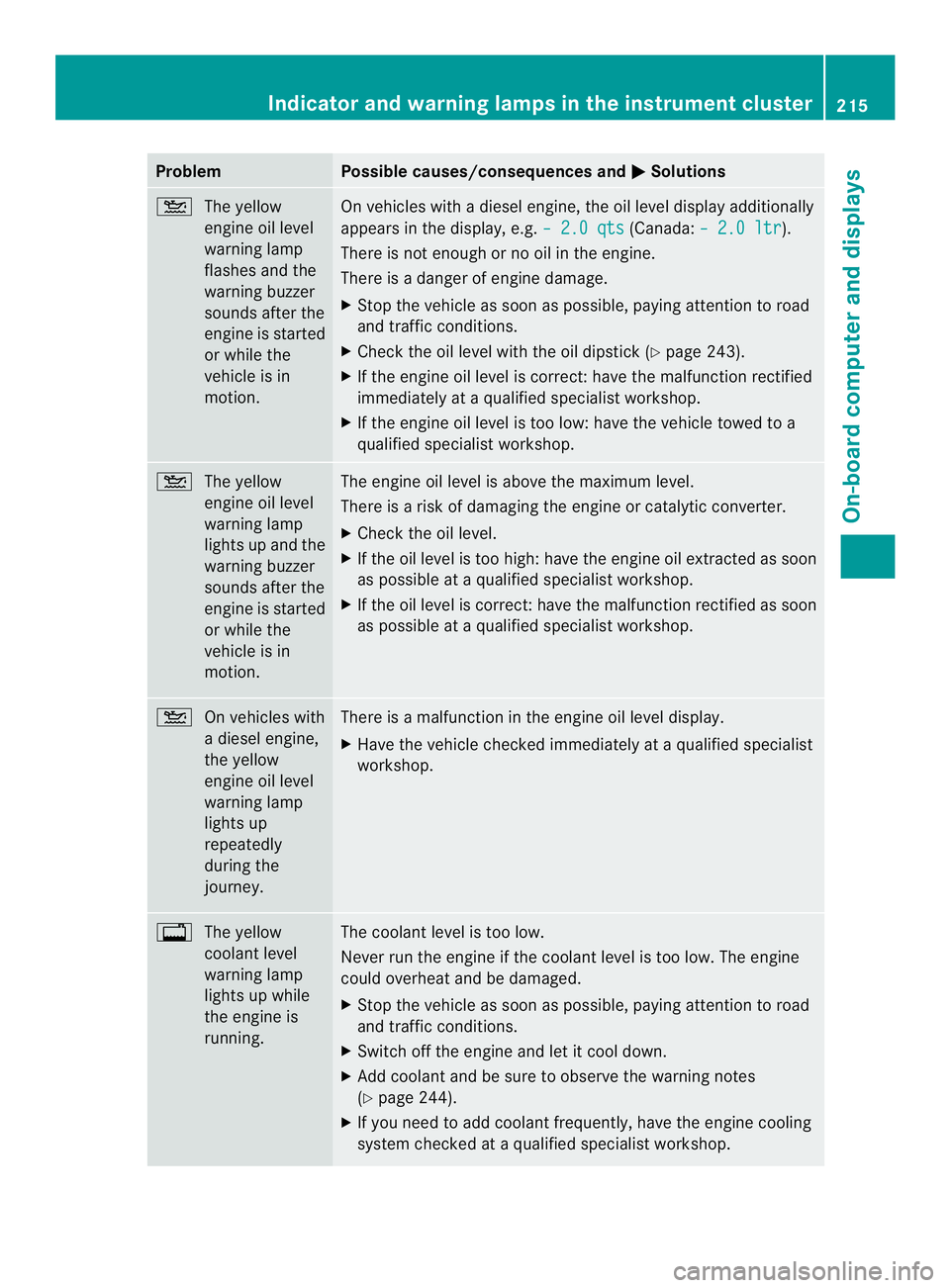
Problem Possible causes/consequences and
0004 Solutions
001D
The yellow
engine oil level
warning lamp
flashes and the
warning buzzer
sounds after the
engine is started
or while the
vehicle is in
motion. On vehicles with a diesel engine, the oil level display additionally
appears in the display, e.g.
– 2.0 qts (Canada:
– 2.0 ltr ).
There is not enough or no oil in the engine.
There is a danger of engine damage.
X Stop the vehicle as soon as possible, paying attention to road
and traffic conditions.
X Check the oil level with the oil dipstick (Y page 243).
X If the engine oil level is correct: have the malfunction rectified
immediately at a qualified specialist workshop.
X If the engine oil level is too low: have the vehicle towed to a
qualified specialist workshop. 001D
The yellow
engine oil level
warning lamp
lights up and the
warning buzzer
sounds after the
engine is started
or while the
vehicle is in
motion. The engine oil level is above the maximum level.
There is a risk of damaging the engine or catalytic converter.
X Check the oil level.
X If the oil level is too high: have the engine oil extracted as soon
as possible at a qualified specialist workshop.
X If the oil level is correct: have the malfunction rectified as soon
as possible at a qualified specialist workshop. 001D
On vehicles with
a diesel engine,
the yellow
engine oil level
warning lamp
lights up
repeatedly
during the
journey. There is a malfunction in the engine oil level display.
X
Have the vehicle checked immediately at a qualified specialist
workshop. 001A
The yellow
coolant level
warning lamp
lights up while
the engine is
running. The coolant level is too low.
Never run the engine if the coolant level is too low. The engine
could overheat and be damaged.
X
Stop the vehicle as soon as possible, paying attention to road
and traffic conditions.
X Switch off the engine and let it cool down.
X Add coolant and be sure to observe the warning notes
(Y page 244).
X If you need to add coolant frequently, have the engine cooling
system checked at a qualified specialist workshop. Indicator and warning lamps in the instrument cluster
215On-board computer and displays Z
Page 219 of 334
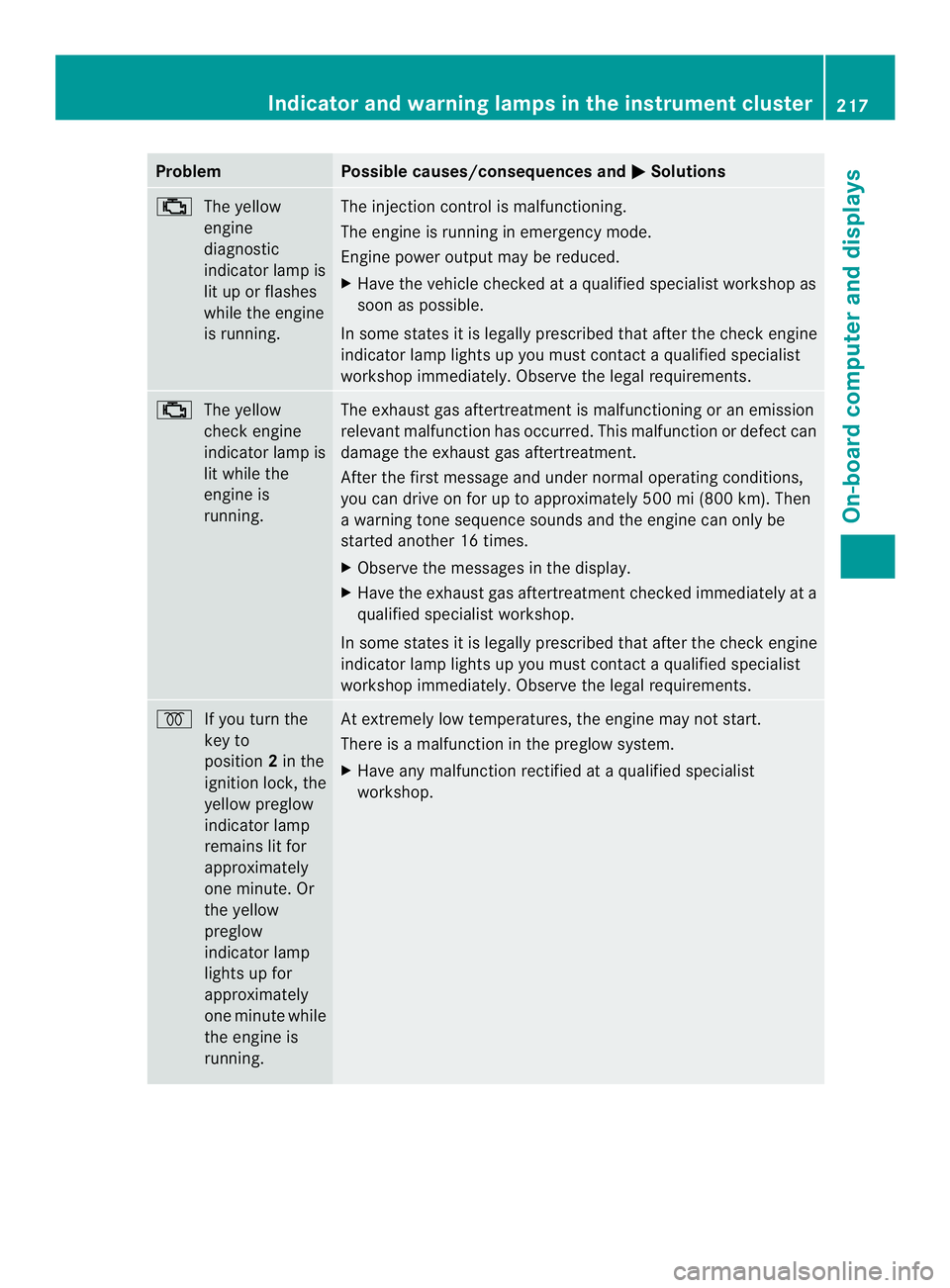
Problem Possible causes/consequences and
0004 Solutions
0018
The yellow
engine
diagnostic
indicator lamp is
lit up or flashes
while the engine
is running. The injection control is malfunctioning.
The engine is running in emergency mode.
Engine power output may be reduced.
X
Have the vehicle checked at a qualified specialist workshop as
soon as possible.
In some states it is legally prescribed that after the check engine
indicator lamp lights up you must contact a qualified specialist
workshop immediately. Observe the legal requirements. 0018
The yellow
check engine
indicator lamp is
lit while the
engine is
running. The exhaust gas aftertreatment is malfunctioning or an emission
relevant malfunction has occurred. This malfunction or defect can
damage the exhaust gas aftertreatment.
After the first message and under normal operating conditions,
you can drive on for up to approximately 500 mi (800 km). Then
a warning tone sequence sounds and the engine can only be
started another 16 times.
X
Observe the messages in the display.
X Have the exhaust gas aftertreatment checked immediately at a
qualified specialist workshop.
In some states it is legally prescribed that after the check engine
indicator lamp lights up you must contact a qualified specialist
workshop immediately. Observe the legal requirements. 000D
If you turn the
key to
position 2in the
ignition lock, the
yellow preglow
indicator lamp
remains lit for
approximately
one minute. Or
the yellow
preglow
indicator lamp
lights up for
approximately
one minute while
the engine is
running. At extremely low temperatures, the engine may not start.
There is a malfunction in the preglow system.
X
Have any malfunction rectified at a qualified specialist
workshop. Indicator and warning lamps in the instrument cluster
217On-board computer and displays Z
Page 221 of 334
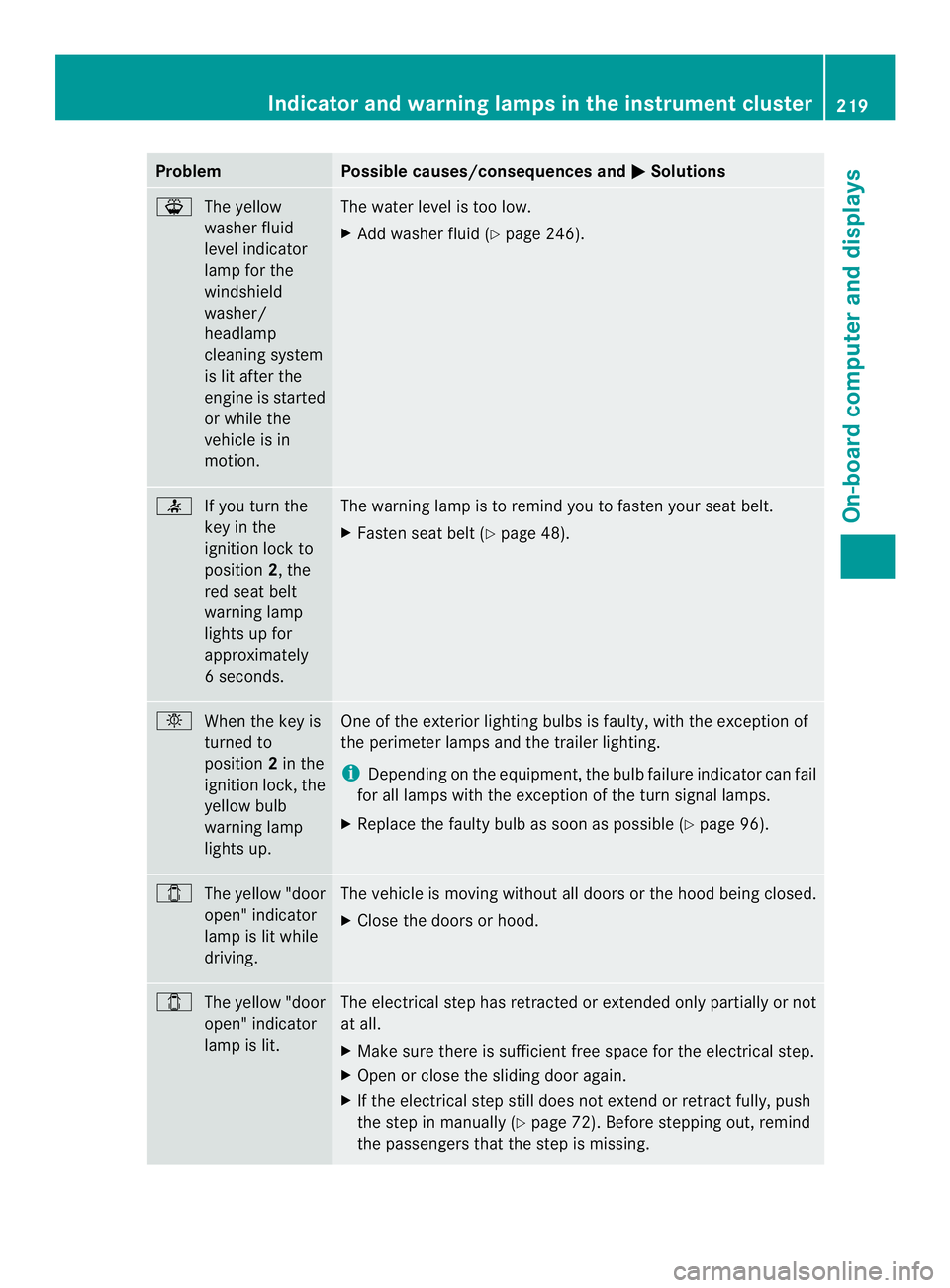
Problem Possible causes/consequences and
0004 Solutions
000F
The yellow
washer fluid
level indicator
lamp for the
windshield
washer/
headlamp
cleaning system
is lit after the
engine is started
or while the
vehicle is in
motion. The water level is too low.
X
Add washer fluid (Y page 246). 0014
If you turn the
key in the
ignition lock to
position 2, the
red seat belt
warning lamp
lights up for
approximately
6s econds. The warning lamp is to remind you to fasten your seat belt.
X
Fasten seat belt (Y page 48). 0002
When the key is
turned to
position 2in the
ignition lock, the
yellow bulb
warning lamp
lights up. One of the exterior lighting bulbs is faulty, with the exception of
the perimeter lamps and the trailer lighting.
i
Depending on the equipment, the bulb failure indicator can fail
for all lamps with the exception of the turn signal lamps.
X Replace the faulty bulb as soon as possible (Y page 96).0004
The yellow "door
open" indicator
lamp is lit while
driving. The vehicle is moving without all doors or the hood being closed.
X
Close the doors or hood. 0004
The yellow "door
open" indicator
lamp is lit. The electrical step has retracted or extended only partially or not
at all.
X Make sure there is sufficien tfree space for the electrical step.
X Open or close the sliding door again.
X If the electrical step still does not extend or retract fully, push
the step in manually (Y page 72). Before stepping out, remind
the passengers that the step is missing. Indicator and warnin
glamps in the instrument cluster
219On-board computer and displays Z
Page 249 of 334
Adding washer fluid
X
Mix the washe rfluid to the appropriate
mixing ratio in a container beforehand.
X Open the hood (Y page 240).
X Pull cap 0005on the washer fluid reservoir
upwards at the tab.
X Add the premixed washer fluid.
X Press cap 0005onto the filler neck until it
engages audibly.
X Close the hood. Fuel system
Draining the fuel filter G
WARNING
Fuel is highly flammable. Improper handing of
fuel creates a risk of fire and explosion.
Avoid fire, open flames ,smoking and creating
sparks under all circumstances. Switch off the
ignitio nand auxiliary heating before carrying
ou tw ork to the fuel system. Always wear
protective gloves. H
Environmental note
Dispose of the water-fuel mixture in an
environmentally responsible manner.
! When the 000Eindicator lamp lights up,
drain the fuel filter with water separator
immediately. Otherwise, the engine may be
damaged. If the
000E indicator lamp in the instrument
cluster goes on, drain the fuel filter with water
separator 0026immediately.
i We recommend that you have this
maintenance work carried out at a qualified
specialist workshop.
X Park the vehicle safely and secure it from
rolling away.
X Switch off the auxiliary heating system .
X Switch off the engine.
X Open the hood (Y page 240).
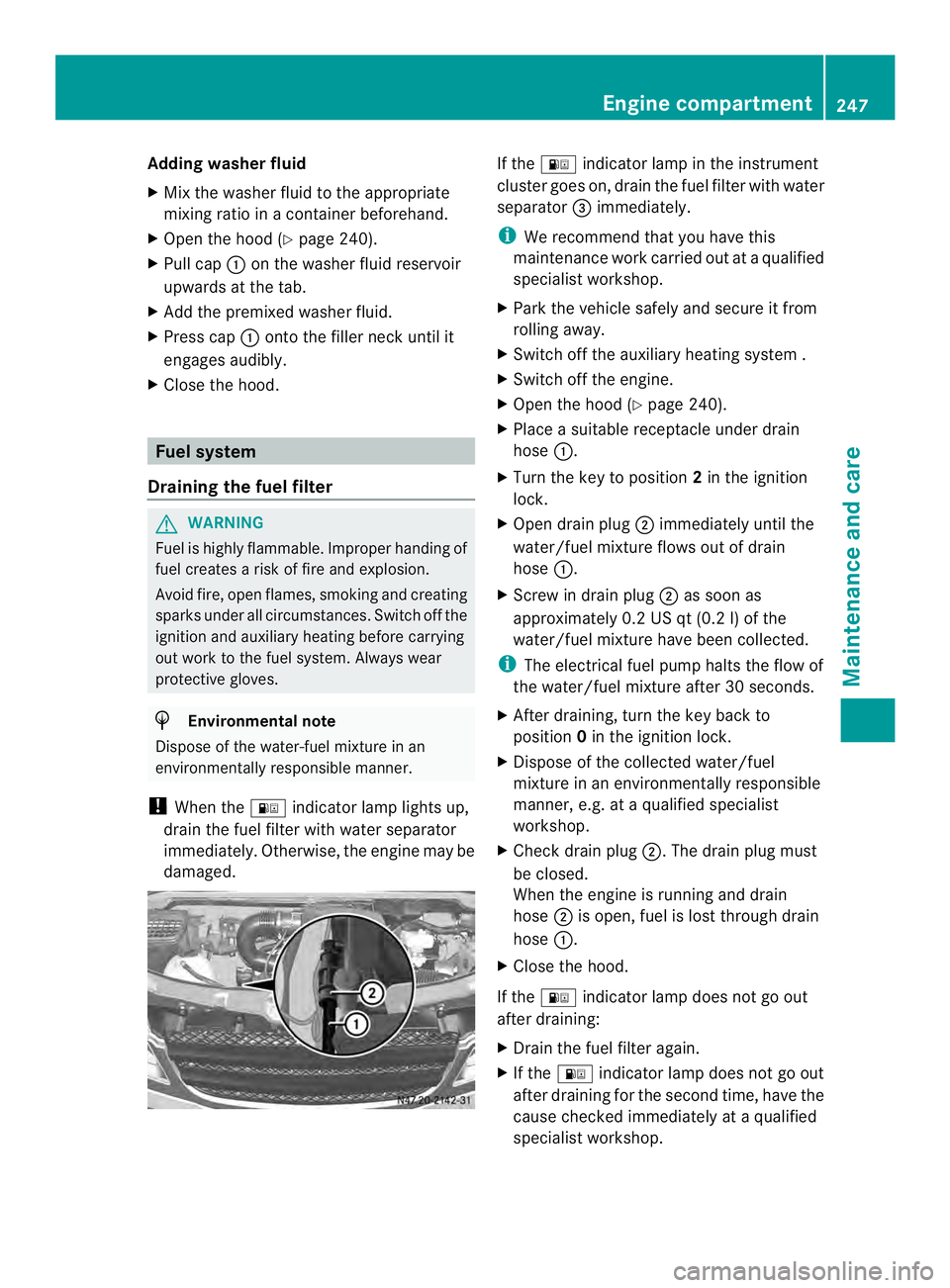
X Place a suitable receptacle under drain
hose 0005.
X Turn the key to position 2in the ignition
lock.
X Open drain plug 0006immediately until the
water/fuel mixture flows out of drain
hose 0005.
X Screw in drain plug 0006as soon as
approximately 0.2 US qt (0.2 l) of the
water/fuel mixture have been collected.
i The electrical fuel pump halts the flow of
the water/fuel mixture after 30 seconds.
X After draining, turn the key back to
position 0in the ignition lock.
X Dispose of the collected water/fuel
mixture in an environmentally responsible
manner, e.g. at a qualified specialist
workshop.
X Check drain plug 0006.The drain plug must
be closed.
When the engine is running and drain
hose 0006is open, fuel is lost through drain
hose 0005.
X Close the hood.
If the 000E indicator lamp does not go out
after draining:
X Drain the fuel filter again.
X If the 000E indicator lamp does not go out
after draining for the second time, have the
cause checked immediately at a qualified
specialist workshop. Engine compartment
247Maintenance and care Z
Page 284 of 334
The tire pressure monitor does not warn you
if a tire pressure is incorrect. Observe the
notes on the recommended tire pressure
(Y page 278).
The tire pressure monitor is not able to warn
you of a sudden loss of pressure, e.g.
following penetration by a foreign object .In
this event, brake the vehicle until it comes to
a standstill. Do not carry ou tany sudden
steering maneuvers.
The tire pressure monitor has a yellow 000A
warning lamp in the instrument cluster for
indicating pressure loss/malfunctions (USA)
or pressure loss (Canada). Depending on how
the warning lamp flashes or lights up, an
underinflated tire or a malfunction in the tire
pressure monitor is displayed:
R if the 000A warning lamp is li tcontinuously,
the tire pressure on one or more tires is
significantly too low. The tire pressure
monitor is not malfunctioning.
R USA only: if the 000Awarning lamp flashes
for 60 seconds and then remains lit
constantly, the tire pressure monitor is
malfunctioning.
Only vehicles with steerin gwheel buttons: the
on-board computer displays information on
tire pressure. After a few minutes of driving,
the current tire pressure of each tire is shown
in the on-board computer.
USA only: if the tire pressure monitor is
malfunctioning, it may be more than
10 minutes before the malfunction is shown.
The 000A tire pressure warning lamp flashes
for 60 seconds and then remains lit. When the
malfunction has been rectified, the 000Atire
pressure warning lamp goes out after a few
minutes of driving.
The tire pressure values indicated by the on-
board computer may differ from those
measured at a gas station with a pressure
gauge. The tire pressures shown by the on-
board computer refer to those measured at
sea level. At high altitudes, the tire pressure
value indicated by a pressure gauge are
higher than those shown by the on-board computer. In this case, do not reduce the tire
pressures.
If radio transmitting equipment (e.g. wireless
headphones, two-way radios) is operated
inside the vehicle or in the vicinity of the
vehicle, this can interfere with the operation
of the tire pressure monitor.
Checking the tire pressure
electronically (vehicles with steering
wheel buttons)
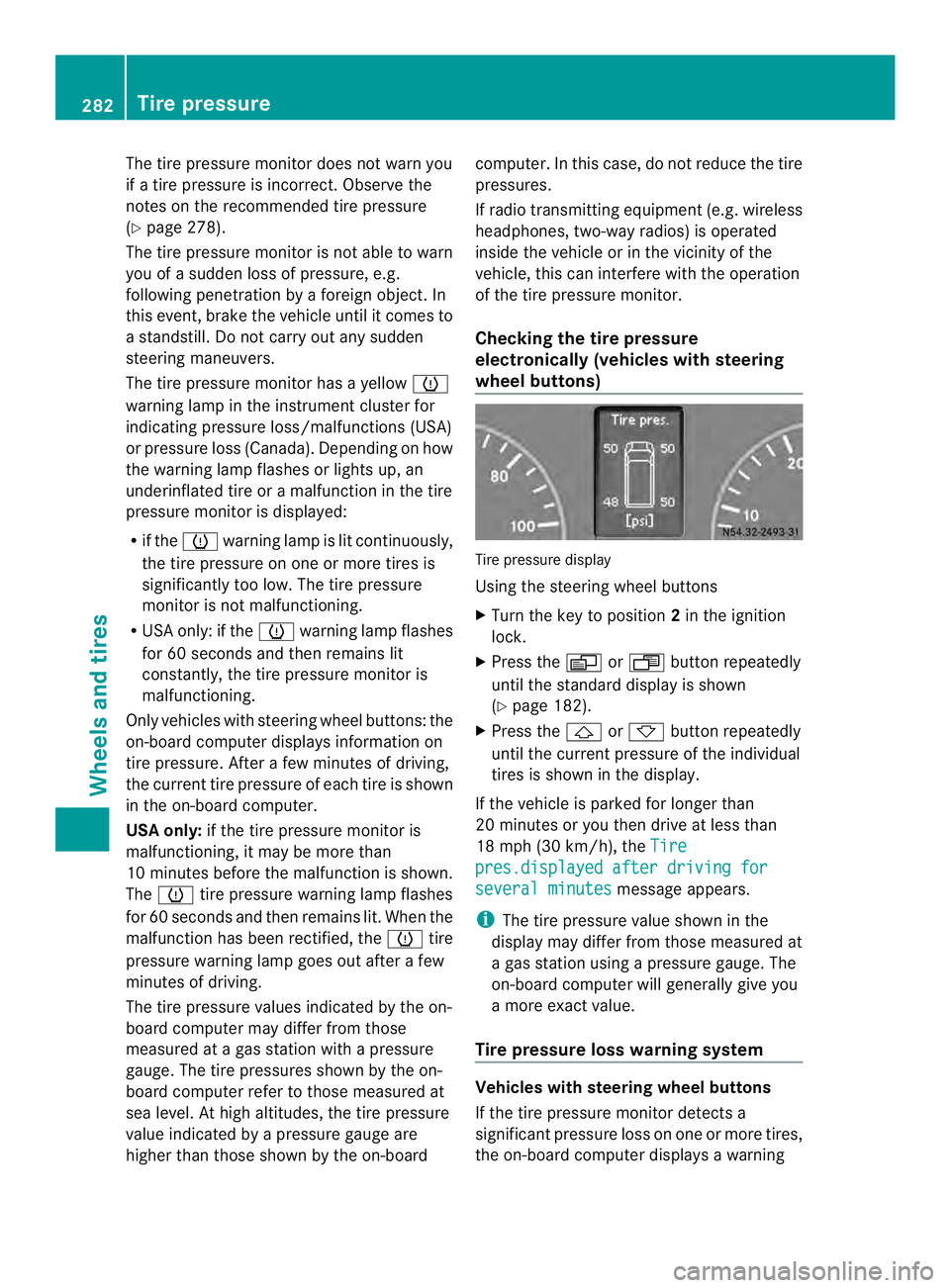
Tire pressure display
Using the steering wheel buttons
X
Turn the key to position 2in the ignition
lock.
X Press the 0010or0007 button repeatedly
until the standard display is shown
(Y page 182).
X Press the 0001or0009 button repeatedly
until the current pressure of the individual
tires is shown in the display.
If the vehicle is parked for longer than
20 minutes or you then drive at less than
18 mph (30 km/h), the Tire pres.displayed after driving for
several minutes message appears.
i The tire pressure value shown in the
display may differ from those measured at
a gas station using a pressure gauge. The
on-board computer will generally give you
a more exact value.
Tire pressure loss warning system Vehicles with steering wheel buttons
If the tire pressure monitor detects a
significant pressure loss on one or more tires,
the on-board computer displays a warning282
Tire pressureWheels and tires
Page 285 of 334
message. The
000Atire pressure loss warning
lamp in the instrument cluster (Y page 218)
lights up.
The tire pressure is show nin2red rectangles.
The pressure of the tire concerned is shown
in one of the two rectangles (Y page 192).
Additionally, a warning tone sounds.
Each tire that is affected by a significant loss
of pressure is highlighted in the pressure
display.
Restarting the tire pressure monitor When you restart the tire pressure monitor,
the currently set tire pressure are taken as
reference values for monitoring.
In most cases, the tire pressure monitor
detects the new reference values
automatically, e.g. after you have:
R changed the tire pressure
R changed wheels or tires
R installed new wheels or tires
However, you can also define reference
values manually as described here.
Before restarting the tire pressure
monitor:
X Set the tire pressure to the value
recommended on the Tire and Loading
Information placard or the tire pressure
table on the B-pillar on the driver's side
(Y page 278).
Observe the notes on tire pressure when
doing so (Y page 278).
X Make sure that the tire pressure is correct
on all four wheels. Restarting the tire pressure monitor
(vehicles without steering wheel
buttons):
X
Turn the key to position 2in the ignition
lock.
X Press the 0004menu button on the
instrument cluster repeatedly until the
display shows the following message:
+CAL- TPMS X
Press the 000Ebutton on the instrument
cluster.
The display shows:
OK TPMS The tire pressure monitor activation
process has begun. The tire pressures
measured for the individual wheels are
stored as the new reference values,
provided that the tire pressure monitor
considers them to be plausible.
If you wish to cancel the restart:
X Press the 000Fbutton or the 0004menu button
on the instrument cluster.
The activation process is canceled
automatically if 30 seconds elapse with no
input.
Restarting the tire pressure monitor
(vehicles with steering wheel buttons):
X Turn the key to position 2in the ignition
lock.
X Press the 0010or0007 button on the
steering wheel repeatedly until the
standard display is shown (Y page 182).
X Press the 0001or0009 button on the
steering wheel repeatedly until the current
pressure of the individual tires is displayed
or the display shows the following
message:
Tire pres. displayed after driving
for several minutes
X
Press the 0007reset button on the
instrument cluster.
The display shows the following message: Tire pressure
283Wheels and tires Z