tow MERCEDES-BENZ SPRINTER 2013 MY13 Operator’s Manual
[x] Cancel search | Manufacturer: MERCEDES-BENZ, Model Year: 2013, Model line: SPRINTER, Model: MERCEDES-BENZ SPRINTER 2013Pages: 334, PDF Size: 3.88 MB
Page 234 of 334
Useful information
This Operator's Manual describes all models
as well as standard and optional equipment
of your vehicle that were available at the time
of going to print. Country-specific variations
are possible. Note that your vehicle may not
be equipped with all of the described
functions. This also applies to systems and
functions relevant to safety.
Read the information on qualified specialist
workshops (Y page 26). Loading guidelines
Important safety notes
G
WARNING
As a result of improperly placed or unevenly
distributed loads, the center of gravity of the
load being transported may be too high or too
far back. This can significantly impair handling
as well as steering and braking
characteristics. There is a risk of an accident.
Always make sure that the center of gravity of
the load is:
R between the axles
and
R as low as possible, near the rear axle. G
WARNING
When objects are unsecured or inadequately
secured, they can slip, turn over or be thrown
about, striking vehicle occupants .This also
applies to:
R luggage or loads
R a rear bench seat which has been removed
and is being transported in the vehicle in an
exceptional case.
There is a risk of injury, particularly in the
event of braking maneuvers or abrupt
changes in direction.
Always stow objects in such a way that they
cannot be tossed about. Before traveling,
secure objects, luggage or loads to prevent them slipping or tipping over. If you remove a
rear bench seat, it is advisable to store it
outside the vehicle. G
WARNING
When the permissible wheel loads, axle loads
and/or the maximum permissible gross
vehicle weight are exceeded, driving safety is
compromised. The handling as well as
steering and braking characteristics may be
significantly impaired. Overloaded tires may
overheat, causing them to burst. There is a
risk of an accident.
When transporting a load, always observe the
permissible wheel loads, axle loads and the
maximum permissible gross vehicle weight
for the vehicle (including occupants). G
WARNING
When you load the roof, the center of gravity
of the vehicle rises and the driving
characteristics change. If you exceed the
maximum roof load, the driving
characteristics, as well as steering and
braking, will be greatly impaired. There is a
risk of an accident.
Never exceed the maximum roof load and
adjust your driving style.
! If you are using a roof carrier, observe the
maximum roof load and maximum roof
carrier load.
You will find information about the maximum
roof load in the "Technical data" section
(Y page 327) and information about roof
carriers in the "Carrier systems" section
(Y page 236).
R Do not stack luggage or loads higher than
the backrests.
R Objects to be transported should
preferably be stowed in the cargo
compartment. 232
Loading guidelinesTransporting loads
Page 235 of 334
R
When transporting luggage, always use the
cargo tie-down rings and a parcel net, if
present.
R Use cargo tie-down rings and fasteners
which are suitable for the weight and size
of the load.
Always observe the operating instructions of
the respective manufacturer when using
suitable load securing aids or tie downs. In
particular, the information on the end of
service life.
Load securing aids and tie downs may not be
used, for example, if:
R identification marks are missing or illegible
R there are yarn breakages, damage to
bearing seams or other signs of tearing
R there are signs of shearing, deformation,
pinching or other damage
R there is damage to clamping or connecting
elements
Load securing aids and tie downs in this
condition are ready for discard and must be
replaced. If you use load securing aids or tie
downs which are worn out, the load may not
be sufficiently secured and could cause
damage to property.
After an accident, the following must be
checked at a specialist workshop:
R a damaged cargo compartment floor
R a damaged loading area
R the cargo tie-down rings
R the tie downs
Otherwise, the load may not be correctly
secured the nextt ime anything is stowed.
Even if you follow all loading guidelines, the
load increases the risk of injury in the event
of an accident. Observe the tips in the
"Securing a load" (Y page 234) and "Load
distribution" (Y page 234) sections. Before loading
! The anti-slip mats cannot be used for
securing goods and must be replaced when
they show signs of:
R Permanent deformation and crushing
R Crack formation
R Cuts
X Tire pressure: checkthe tire pressure and
correct if necessary (Y page 278).
X Cargo compartment floor: clean the
cargo compartment floor.
The cargo compartmentf loor must be free
fro mo il and dust, dry and swept clean to
prevent the load fro mslipping.
X Place non-slip mats (anti-slip mats) on the
cargo compartment floor if necessary. During loading
! On passenger van versions with
maximum seating layout, the permissible
rear axle load would be exceeded if the full
payload were to be loaded in the cargo
compartment.
X Observe the gross axle weight rating and
permissible gross vehicle weight for your
vehicle.
Take into account that your vehicle's curb
weight is increased if accessories or
optional equipmen tare installed. The
maximu mpayload is thus reduced.
X Observe the notes on load distribution
(Y page 234).
The overall cente rofgravity of the load
should always be as low as possible,
centered and between the axles near the
rear axle.
X Secure the load (Y page 234).
Always observe the relevant country-
specific legal requirements, laws and
regulations. Loading guidelines
233Transporting loads Z
Page 236 of 334
Checks after loading
G
WARNING
Combustion engines emit poisonous exhaust
gases, such as carbon monoxide. If the sliding
door or rear door is open when the engine is
running, exhaust gases can ente rthe vehicle
interior, especially during the journey. There
is a risk of poisoning.
Always switch off the engine before opening
the sliding door or rear door. Never drive the
vehicle when the sliding door or rear door is
open.
X Securing loads: check that the load is
secure before every journey and at regular
intervals during a long journey, and correct
if necessary.
X Doors: close the sliding doors and rear
doors.
X Tire pressure: adjust the tire pressures
according to the vehicle load
(Y page 278).
X Driving style: adapt your driving style
according to the vehicle load. Load distribution
General notes
! Excessive loads on individualp oints of the
cargo floor or on the load surface impair
vehicle handling characteristics and could
cause damage to the floor covering.
The overall center of gravity of the load should
always be as low as possible, centered and
between the axles near the rear axle.
On Cargo Vans/Passenger Vans:
X Always transport loads in the cargo
compartment.
X Always place the load against the backrests
of the rear bench seat.
X Move large and heavy loads as far towards
the front of the vehicle as possible against the rear bench seat. Stow the load flush
with the rear bench seat.
X Always additionally secure the load with
suitable load-securing aids or tie downs.
Observe the following notes:
R Do not stack loads higher than the upper
edge of the backrests.
R Transport loads behind seats that are not
occupied.
R If the rear bench seat is not occupied, insert
the seat belts crosswise into the buckle of
the opposite seat belt. Securing loads
Important safety notes
G
WARNING
If you attach the tie-down incorrectly when
securing the load, the following may occur in
the event of abrupt changes in direction,
braking maneuvers or an accident:
R the cargo tie-down rings may become
detached or the tie-down may tear if the
permissible load is exceeded
R the load may not be restrained.
This may cause the load to slip, tip over or be
tossed about, striking vehicle occupants.
There is a risk of an accident and injury.
Always tension the tie-downs in the proper
manner and only between the described
cargo tie-down rings. Always use tie-downs
designed specifically for the loads. G
WARNING
You may not transport anyone in the cargo
compartment or on the load surface. Never
let more people ride in the vehicle than there
are seat belts available. Make sure everyone
riding in the vehicle is correctly restrained
with a separate seat belt. Never use a seat
belt for more than one person at a time. 234
Securing loadsTransporting loads
Page 238 of 334
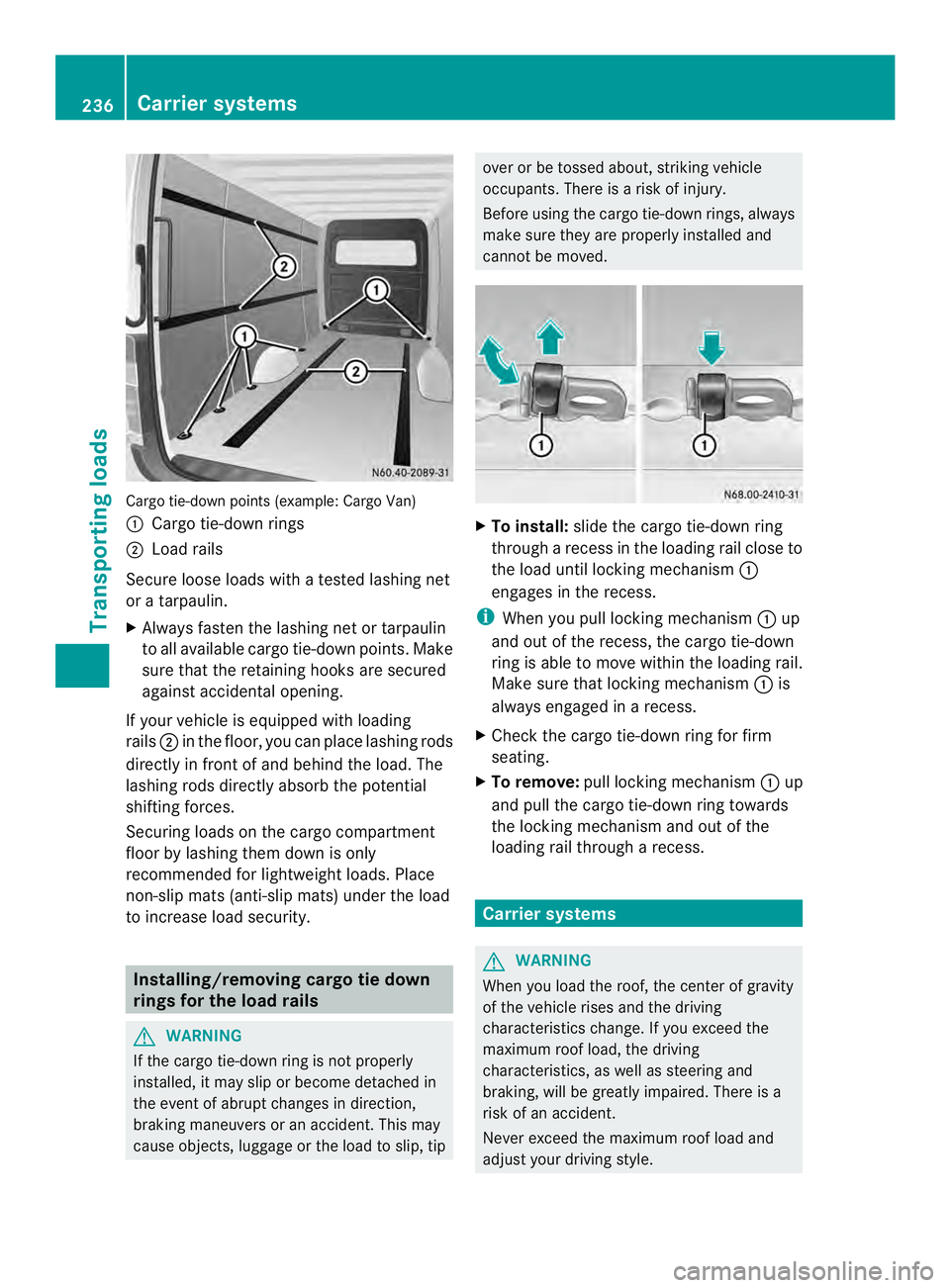
Cargo tie-down points (example
:Cargo Van)
0005 Cargo tie-down rings
0006 Load rails
Secure loose loads with a tested lashing net
or a tarpaulin.
X Always fasten the lashing net or tarpaulin
to all available cargo tie-down points .Make
sure that the retaining hooks are secured
against accidental opening.
If your vehicle is equipped with loading
rails 0006in the floor, you can place lashing rods
directly in fron tofand behind the load .The
lashing rods directly absorb the potential
shifting forces.
Securing loads on the cargo compartment
floor by lashing them down is only
recommended for lightweight loads. Place
non-slip mats (anti-slip mats) under the load
to increase load security. Installing/removing cargo tie down
rings for the load rails
G
WARNING
If the cargo tie-down ring is not properly
installed, it may slip or become detached in
the event of abrupt changes in direction,
braking maneuvers or an accident. This may
cause objects, luggage or the load to slip, tip over or be tossed about, striking vehicle
occupants. There is a risk of injury.
Before using the cargo tie-down rings, always
make sure they are properly installed and
cannot be moved.
X
To install: slide the cargo tie-down ring
through a recess in the loading rail close to
the load until locking mechanism 0005
engages in the recess.
i When you pull locking mechanism 0005up
and out of the recess, the cargo tie-down
ring is able to move within the loading rail.
Make sure that locking mechanism 0005is
always engaged in a recess.
X Check the cargo tie-down ring for firm
seating.
X To remove: pull locking mechanism 0005up
and pull the cargo tie-down ring towards
the locking mechanism and out of the
loading rail through a recess. Carrier systems
G
WARNING
When you load the roof, the center of gravity
of the vehicle rises and the driving
characteristics change. If you exceed the
maximum roof load, the driving
characteristics, as well as steering and
braking, will be greatly impaired. There is a
risk of an accident.
Never exceed the maximum roof load and
adjust your driving style. 236
Carrier systemsTransporting loads
Page 243 of 334
X
Secure the vehicle to prevent it from rolling
away.
X Pull release handle 0005on the hood.
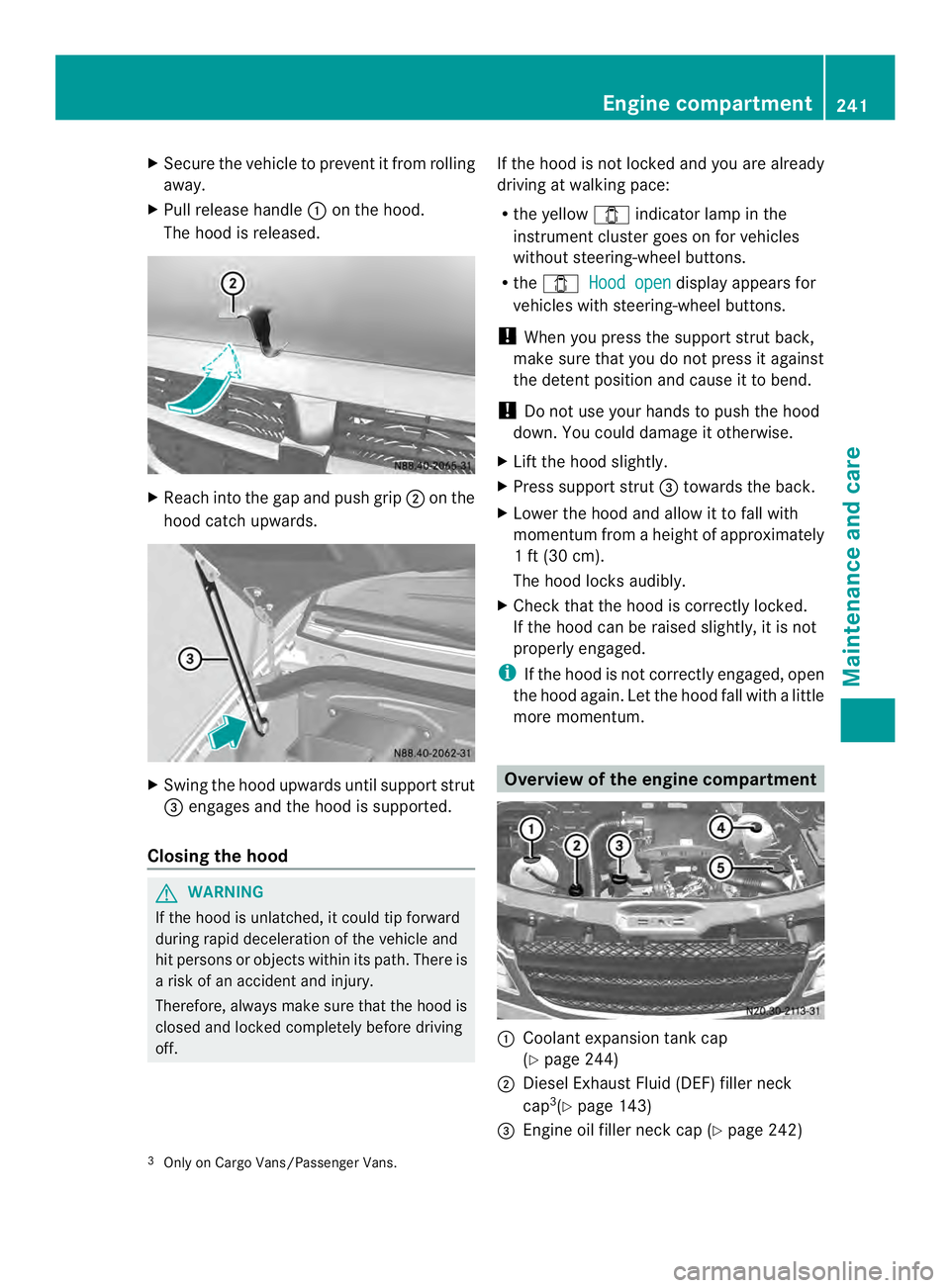
The hood is released. X
Reach into the gap and push grip 0006on the
hood catch upwards. X
Swing the hood upwards unti lsuppor tstrut
0026 engages and the hood is supported.
Closing the hood G
WARNING
If the hood is unlatched, it could tip forward
during rapid deceleratio nofthe vehicle and
hit persons or objects within its path. There is
a risk of an accident and injury.
Therefore, always make sure that the hood is
closed and locked completely before driving
off. If the hood is not locked and you are already
driving at walking pace:
R
the yellow 0004indicator lamp in the
instrumentc luster goes on for vehicles
without steering-wheel buttons.
R the 0004 Hood open display appears for
vehicles with steering-wheel buttons.
! When you press the support strut back,
make sure that you do not press it against
the detent position and cause it to bend.
! Do not use your hands to push the hood
down. You could damage it otherwise.
X Lift the hood slightly.
X Press support strut 0026towards the back.
X Lower the hood and allow it to fall with
momentum fro maheight of approximately
1 ft (30 cm).
The hood locks audibly.
X Check that the hood is correctly locked.
If the hood can be raised slightly, it is not
properly engaged.
i If the hood is not correctly engaged, open
the hood again. Let the hood fall with a little
more momentum. Overview of the engine compartment
0005
Coolant expansion tank cap
(Ypage 244)
0006 Diesel Exhaust Fluid (DEF) filler neck
cap 3
(Y page 143)
0026 Engine oil filler neck cap (Y page 242)
3 Only on Cargo Vans/Passenger Vans. Engine compartment
241Maintenance and care Z
Page 253 of 334
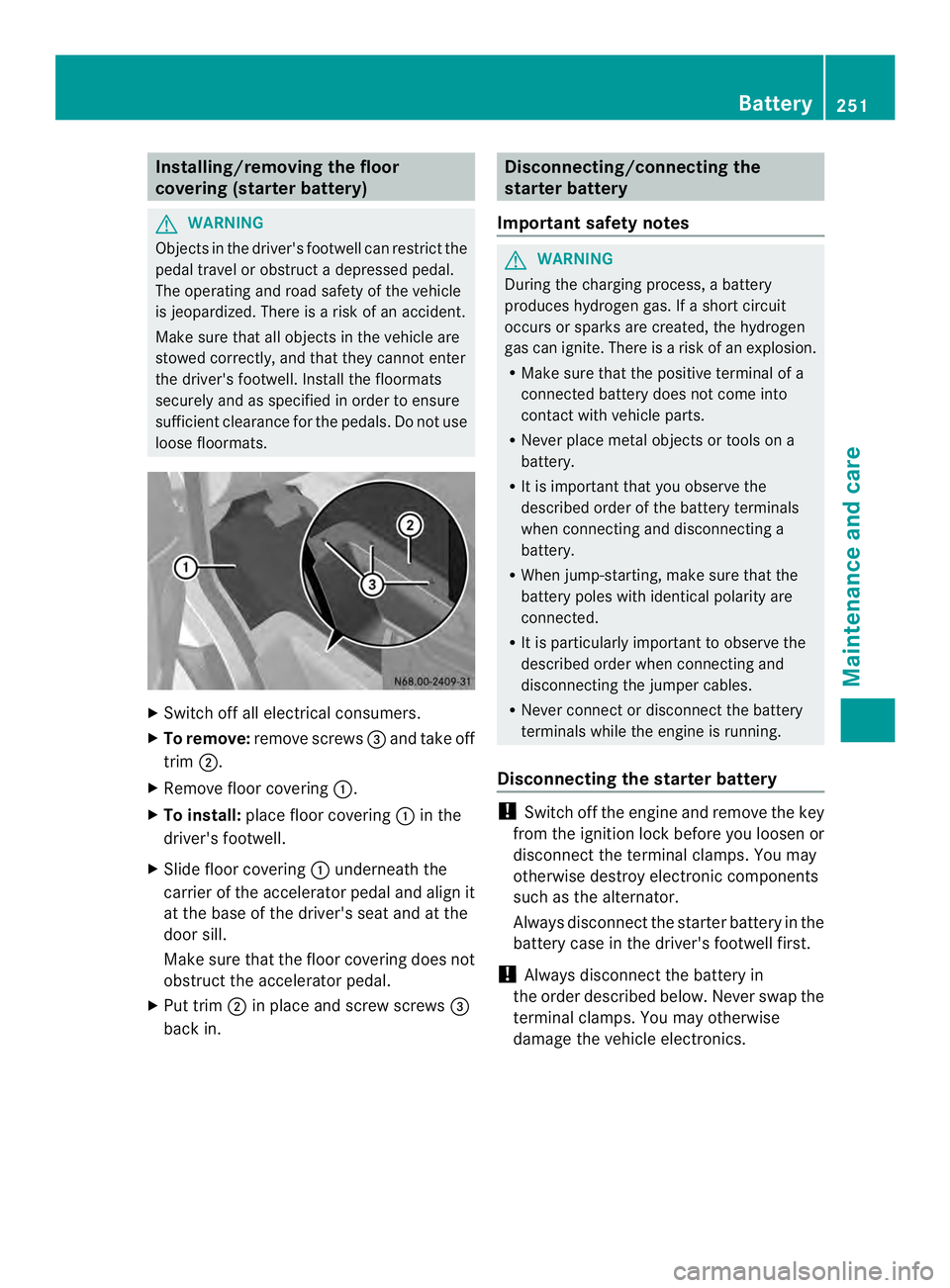
Installing/removing the floor
covering (starter battery)
G
WARNING
Objects in the driver' sfootwell can restric tthe
pedal travel or obstruct adepressed pedal.
The operating and road safety of the vehicle
is jeopardized. There is a risk of an accident.
Make sure that all objects in the vehicle are
stowed correctly, and that they cannot enter
the driver's footwell. Install the floormats
securely and as specified in order to ensure
sufficien tclearance for the pedals. Do not use
loose floormats. X
Switch off all electrical consumers.
X To remove: remove screws 0026and take off
trim 0006.
X Remove floor covering 0005.
X To install: place floor covering 0005in the
driver's footwell.
X Slide floor covering 0005underneath the
carrier of the accelerator pedal and align it
at the base of the driver's seat and at the
door sill.
Make sure that the floor covering does not
obstruct the accelerator pedal.
X Put trim 0006in place and screw screws 0026
back in. Disconnecting/connecting the
starter battery
Important safety notes G
WARNING
During the charging process, a battery
produces hydroge ngas. If a shor tcircuit
occurs or sparks are created, the hydrogen
gas can ignite. There is a risk of an explosion.
R Make sure that the positive terminal of a
connected battery does not come into
contact with vehicle parts.
R Never place metal objects or tools on a
battery.
R It is important that you observe the
described order of the battery terminals
when connecting and disconnecting a
battery.
R When jump-starting, make sure that the
battery poles with identical polarity are
connected.
R It is particularly important to observe the
described order when connecting and
disconnecting the jumper cables.
R Never connect or disconnect the battery
terminals while the engine is running.
Disconnecting the starter battery !
Switch off the engine and remove the key
fro mt he ignition lock before you loosen or
disconnectt he terminal clamps. You may
otherwise destroy electronic components
such as the alternator.
Always disconnectt he starter battery in the
battery case in the driver's footwell first.
! Always disconnectt he battery in
the order described below. Never swap the
terminal clamps. You may otherwise
damage the vehicle electronics. Battery
251Maintenance and care Z
Page 258 of 334
H
Environmental note
Only clean your vehicle at specially designed
wash bays. Dispose of empt ycontainers and
used cleaning products in an environmentally
responsible manner. H
Environmental note
Dispose of empty packaging and cleaning
cloths in an environmentally responsible
manner.
Regula rcare of your vehicle is a condition for
retaining the quality in the long term.
Use care products and cleaning agents
recommended and approved for Sprinter
vehicles. Washing the vehicle and cleaning the
paintwork
Automatic car wash G
WARNING
Braking efficiency is reduced after washing
the vehicle .There is a risk of an accident.
After the vehicle has been washed, brake
carefully while paying attention to the traffic
conditions until full braking power is restored.
! Never clean your vehicle in a Touchless
Automatic Car Wash as these use special
cleaning agents. These cleaning agents can
damage the paintwork or plastic parts.
! Make sure that the automatic car wash is
suitable for the size of the vehicle.
Before washing the vehicle in an automatic
car wash, fold in the exterior mirrors and
remove any additional antennas.
Otherwise, the exterior mirror, antenna or
the vehicle itself could be damaged.
Make sure that the exterior mirrors are fully
folded out again and that any additional
antennas are re-installed when you leave
the automatic car wash. !
Make sure that:
R the side windows and the roof are
completely closed
R the climate control blower is switched off
R the windshield wiper switch is at position
0
The vehicle could otherwise be damaged.
You can wash the vehicle in an automatic car
wash from the very start.
Wash off excess dirt before cleaning the
vehicle in an automatic car wash.
After putting the vehicle through an
automatic car wash, wipe off wax from:
R the rear view camera lens (Y page 259)
R the windshield
R the windshield wiper blades
This will prevent smears and reduce wiping
noises caused by residue on the
windshield.
Washing by hand In some countries, washing by hand is only
allowed at specially equipped washing bays.
Observe the legal requirements for each
individual country.
X
Do not use hot water and do not wash the
vehicle in direct sunlight.
X Use a soft car sponge.
X Use a mild cleaning agent, e.g. a car
shampoo approved for use with Sprinter
vehicles.
X Thoroughly hose down the vehicle with a
gentle jet of water.
X Do not point the water jet directly towards
the air inlets.
X Use plenty of water and rinse out the
sponge frequently.
X Rinse the vehicle with clean water and dry
thoroughly with a chamois.
X Do not let the cleaning agents dry on the
paintwork. 256
CareMaintenance and care
Page 262 of 334
Cleaning the electrical step
Clean the electrical step at least once a
month
.Make sure that no dirt accumulates in
the housing or on the step.
X Extend the electrical step (Y page 72).
X Close the sliding door until the door lock
engages.
The electrical step remains extended for
cleaning.
X Clean the electrical step and the housing
with a power washer.
X Afte rcleaning, spray the step guides on
each side with silicone spray when the
housing and electrical step are dry.
Do not use oil or grease as a lubricant.
X Retract the electric step.
Cleaning the trailer tow hitch !
Do not clean the ball coupling with a
power washer. Do not use solvents.
! Observe the notes on care in the
Operator's Manual for the trailer tow hitch
and the ball coupling manufacturer.
You can also have the maintenance work on
the ball coupling and the trailer tow hitch
carried out by a qualified specialist workshop. Interior
Cleaning the display !
For cleaning, do not use any of the
following:
R alcohol-based thinner or gasoline
R abrasive cleaning agents
R commercially-available household
cleaning agents
These may damage the display surface. Do
not put pressure on the display surface
when cleaning. This could lead to
irreparable damage to the display. X
Switch off the audio equipmen tormonitor
of the rear-view camera and allow to cool.
X Clean the display surface with a
commercially available microfiber cloth
and cleaner for TFT/LCD displays.
X Dry the display surface using a dry
microfiber cloth.
Cleaning the plastic trim G
WARNING
Care products and cleaning agents containing
solvents cause surfaces in the cockpit to
become porous. As a result, plastic parts may
come loose in the event of air bag
deployment. There is a risk of injury.
Do not use any care products and cleaning
agents to clean the cockpit.
! Do not affix the following to plastic
surfaces:
R stickers
R films
R scented oil bottles or similar items
You can otherwise damage the plastic.
! Do not allow cosmetics, insect repellent
or sunscreen to come into contact with the
plastic trim. This maintains the high-quality
look of the surfaces.
X Wipe the plastic trim and the cockpit with
a damp, lint-free cloth, e.g. a microfiber
cloth.
X Heavy soiling: use a mild detergent.
Cleaning the steering wheel and
selector lever X
Thoroughly wipe with a damp cloth.
Cleaning the trim elements !
Do not use solvent-based cleaning agents
such as tar remover, wheel cleaners,
polishes or waxes. There is otherwise a risk
of damaging the surface. 260
CareMaintenance and care
Page 265 of 334
Useful information
............................264
Where will I find...? ...........................264
Flat tire .............................................. 266
Jump-starting .................................... 267
Tow-starting and towing away ........268
Electrical fuses ................................. 271 263Breakdown assistance
Page 266 of 334
Useful information
This Operator's Manual describes all models
as well as standard and optional equipment
of your vehicle that were available at the time
of going to print. Country-specific variations
are possible. Note that your vehicle may not
be equipped with all of the described
functions. This also applies to systems and
functions relevant to safety.
Read the information on qualified specialist
workshops (Y page 26). Where will I find...?
Vehicle tool kit
General notes The vehicle tool kit is in the stowage
compartment in the footwell on the co-
driver's side. For vehicles without a spare
wheel, the Premium tire sealant and the tire
inflation compressor are in the stowage
compartment in the right-hand door sill.
The vehicle tool kit consists of:
R a towing eye
R a lug wrench
R 2o pen-end wrenches
R a screwdriver with Torx ,Phillips and slotted
bits
i Vehicles without a spare wheel are not
equipped with the tools needed to change
a wheel when they leave the factory, e.g. a
jack. In the event of a flat tire, these
vehicles are equipped with a tire sealant
and a tire inflation compressor. Country-
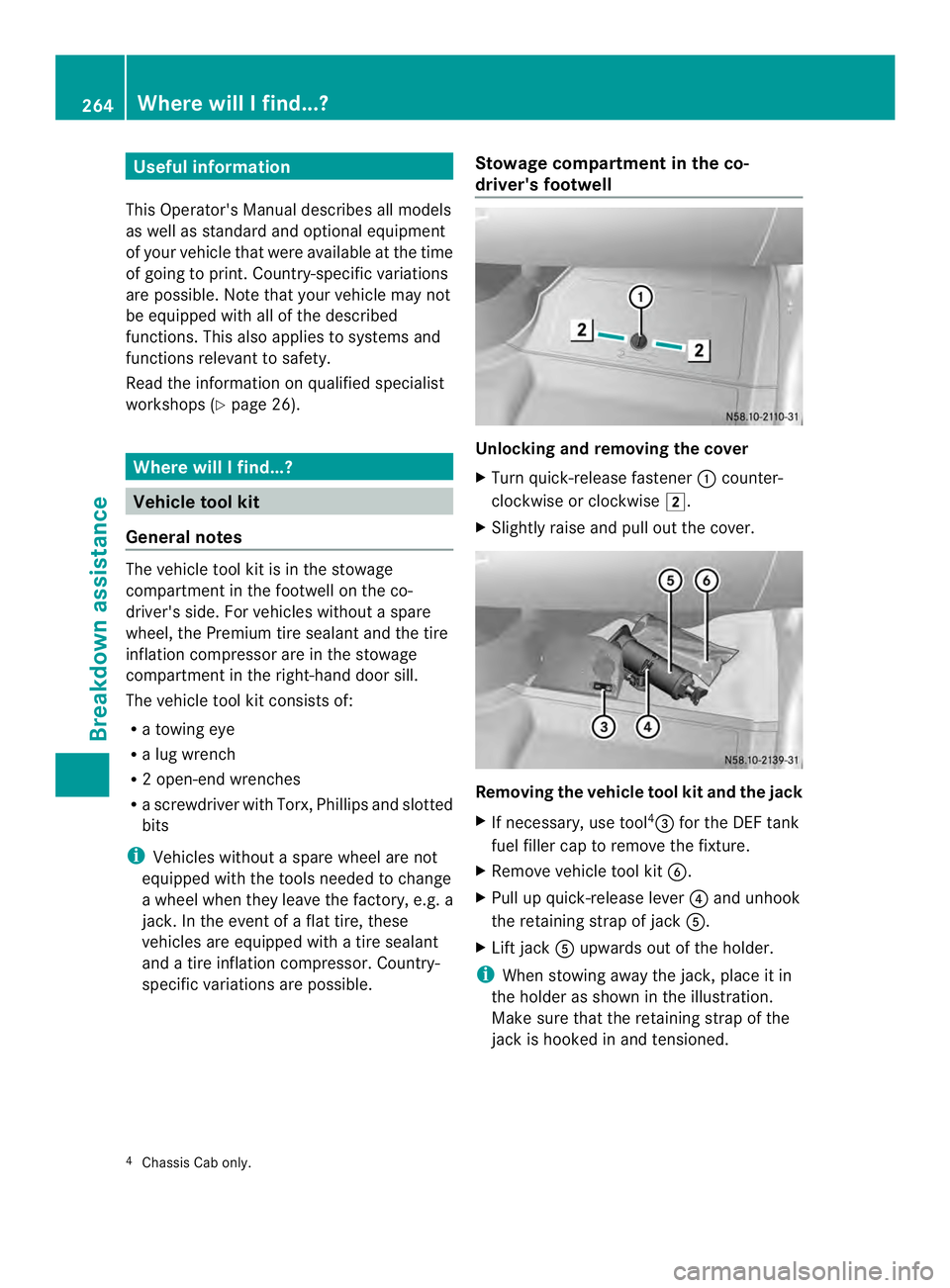
specific variations are possible. Stowage compartment in the co-
driver's footwell Unlocking and removing the cover
X
Turn quick-release fastener 0005counter-
clockwise or clockwise 0009.
X Slightly raise and pull out the cover. Removing the vehicle tool kit and the jack
X
If necessary, use tool 4
0026 for the DEF tank
fuel filler cap to remove the fixture.
X Remove vehicle tool kit 0024.
X Pull up quick-release lever 0025and unhook
the retaining strap of jack 0023.
X Lift jack 0023upwards out of the holder.
i When stowing away the jack, place it in
the holder as shown in the illustration.
Make sure that the retaining strap of the
jack is hooked in and tensioned.
4 Chassis Cab only. 264
Where will I find...?Breakdown assistance