ABS MERCEDES-BENZ SPRINTER 2013 MY13 Operator’s Manual
[x] Cancel search | Manufacturer: MERCEDES-BENZ, Model Year: 2013, Model line: SPRINTER, Model: MERCEDES-BENZ SPRINTER 2013Pages: 334, PDF Size: 3.88 MB
Page 6 of 334
1, 2, 3 ...
12 Vsocket ........................................ 228 A
ABS (Anti-lock Braking System) Display message ............................ 197
Function/notes ................................ 56
Important safety notes ....................56
Indicator lamp ................................ 210
Accessories and conversions
see Add-on equipment
Activating/deactivating cooling
with air dehumidification .................113
Activating/deactivating the roof
ventilator ........................................... 129
Additional indicators Changing bulbs (roof) ....................101
Additives
Diese l............................................ 318
Engine oil ....................................... 322
Flow improver ................................ 318
Add-on equipment ............................... 27
Adjusting Air vents ........................................ 117
Adjusting the headlamp range ...........93
ADR( working speed governor) ........167
Airb ags
Front air bag (driver, front
passenger )....................................... 45
Important safety notes ....................44
Safety guidelines ............................. 43
Thoraxbag ........................................ 45
Windo wcurtain air bag .................... 46
Air-conditioning system
Refrigerant ..................................... 326
see Climate control
Airf ilter
Indicator lamp ................................ 218
Air pressure
see Tire pressure
Air-recirculation mode
Importan tsafet ynotes .................. 116
Switching on/off ........................... 116
Airv ents ............................................ .117
Adjusting for the passenger
compartment ................................. 117Adjusting on the roof
.....................118
Important safety notes ..................117
Setting the center air vents ...........117
Setting the side air vents ...............117
see Climate control
Anti-loc kBraking System
see ABS (Anti-lock Braking System)
Anti-theft system
Interio rmotion sensor ..................... 61
Armrests .............................................. 84
Ashtray ............................................... 227
ASR (acceleration skid control) Activating/deactivating ...................58
Display message ............................ 198
Function/notes ................................ 58
Important safety notes ....................58
Indicator lamp ................................ 210
ATA (Anti-Theft Alarm system)
Activating/deactivating ...................60
Switching off the alarm ....................60
Attachments
see Add-on equipment
Authorized workshop
see Qualified specialist workshop
Automatic climate control
see Climate control
Automatic headlamp mode ................91
Automatic locking ............................... 69
Automatic transmission Accelerator pedal position .............140
Changing gea r............................... 139
Changing gea ryourself .................. 139
Driving tips .................................... 140
Emergency running mode ..............141
Important safety notes ..................138
Kickdow n....................................... 140
Maneuvering .................................. 140
Overview ........................................ 138
Problem (malfunction) ...................141
Releasing the parking lock
manually ........................................ 141
Selector leve r................................ 138
Selector leve rpositions ................. 139
Shift range s................................... 140
Starting the engine ........................134
Touchshift ...................................... 139
Trailer towing ................................. 140
Transmission oil change ................323 4
Index
Page 7 of 334
Automatic transmission
emergency mode
...............................141
Auxiliary heating Activating/deactivating heater
booster mode ................................ 125
Conditions for switching on ...........119
Important safety notes ..................118
Operating with the button (control
panel) ............................................ 119
Operation with the remote control .121
Operation with the timer ................122
Problem (malfunction) ...................128
Selecting a switch-on time ............. 119
Setting the switch-on time .............120
see Auxiliary heating
Axle load, permissible (trailer
towing) ............................................... 329B
Backup lamps Changing bulbs ........................ 99, 101
Backup lamps (Chassis Cab)
Changing bulbs .............................. 100
BAS (Brake Assist System)
Display message ............................ 198
Function/notes ................................ 56
Indicator lamp ................................ 210
Basic settings
see Settings
Battery
Isolating switch .............................. 132
Replacing (SmartKey) ................66, 67
Battery (SmartKey)
Checking .......................................... 66
Important safety notes ....................66
Replacing ................................... 66, 67
Battery (vehicle)
Care ............................................... 255
Charge indicator lamp ...................214
Charging ........................................ 254
Disconnecting and connecting
(driver's footwell) ........................... 251
Disconnecting and connecting
(engine compartment) ...................253
Display message ............................ 208
Important safety notes ..................250Installing/removing (driver's
footwell) ......................................... 252
Installing/removing (engine
compartment)
................................ 254
Jump starting ................................. 267
Location ......................................... 250
Removing/installing the floor
covering (driver's footwell) ............251
Belt
see Seat belts
Bio-diesel ........................................... 317
Bleeding the fuel system ..................137
Bodies Body/equipment mounting
directives for trucks .........................28
Bottle holder ...................................... 227
see Cuph older
Brake
EBD .................................................. 57
Brake Assist System
see BAS (Brake Assist System)
Brake fluid
Checking the level .........................245
Display message ............................ 199
Notes .................................... .245, 324
Warning lamp ................................. 211
Brake force distribution,
electronic
see EBD (electronic brake force
distribution)
Brake lamps
Changing bulbs ........................ 99, 101
Brake lamps (Chassis Cab)
Changing bulbs .............................. 100
Brake linings
Display message ............................ 199
Indicator lamp ................................ 214
Brakes
ABS .................................................. 56
Applying the parking brake ............146
BAS .................................................. 56
Brake fluid (notes) .................245, 324
Checking brake fluid leve l.............. 245
Display messages ..........................199
Driving tips .................................... 150
Important safety notes ..................150
Maintenance .................................. 210
Parking brake (notes) ..................... 151 Index
5
Page 11 of 334
Doors
Central locking/unlocking
(SmartKey) ...................................... .64
Control panel ................................... 38
Display message ............................ 209
Indicator lamp ................................ 219
Drinking and driving .........................148
Drinks holder see Bottle holder
see Cuph older
Driver's/co-driver's door
Unlocking ......................................... 70
Driver's seat
see Seats
Driving abroad ................................... 149
Driving off-road see Off-road driving
Driving on flooded roads ..................151
Driving safety systems ABS (Anti-lock Braking System) .......56
ASR (Acceleration Skid Control )...... 58
BAS (Brake Assist System) ..............56
EBD (electronic brake force
distribution) ..................................... 57
ESP ®
(Electronic Stability
Program) .......................................... 57
Important safety information ...........56
Overview .......................................... 56
Driving systems
Cruise control ................................ 155
Display message ............................ 207
PARKTRONI C................................. 157
Rea rview camera .......................... 161
Driving tips
Automatic transmission .................140
Brakes ........................................... 150
Break-in period .............................. 132
Downhill gradient ........................... 150
Drinking and driving .......................148
Driving abroad ............................... 149
Driving in winter ............................ .152
Driving on flooded road s................ 151
Driving on wet road s...................... 151
Exhaus tcheck ............................... 148
Fuel ................................................ 148
General .......................................... 147
Hydroplaning ................................. 151Icy road surfaces
........................... 152
Important safety notes ..................132
Limited braking efficiency on
salted road s................................... 151
Off-road driving .............................. 153
Overru ncut-off .............................. 148
Snow chains .................................. 277
Speed limitation ............................ .149
Towing atrailer .............................. 168
Transport by rail ............................ .150
Wet road surface ........................... 150 E
EBD (electronic brake force
distribution) Display message ............................ 200
Function/notes ................................ 57
Indicator lamps .............................. 210
Electrical closing assist ......................72
Electrical fuses see Fuses
Electrical step
Cleaning ......................................... 260
Display message ............................ 208
Emergency release ..........................72
Function .......................................... .72
Important safety notes ....................72
Indicator lamp ................................ 219
Manual retractio n............................ 72
Obstacle detection ........................... 72
Electrical system
Battery mai nswitc h....................... 132
Electronic Stability Program
see ESP ®
(Electroni cStability Program)
Emergenc yexit .................................... 59
Emergency exi twindow ..................... 59
Emergency Tensioning Devices Function .......................................... .50
Safety guideline s............................. 43
Emissions control
Service and warranty information ....23
Engine
ADR (working speed governor) ......167
Changing the power output .............25
Check Engine warning lamp ........... 216
Cleaning instructions .....................257
Engine number ............................... 316 Index
9
Page 23 of 334
Electrical ste
p................................ 219
ESP ®
.............................................. 210
ESP ®
function ................................ 213
Overview .......................................... 34
Seat bel t........................................ 219
Warning- and indicator lamps
ABS ................................................ 210
Air filter .......................................... 218
ASR ................................................ 210
BAS ................................................ 210
Battery charg e............................... 214
Brake wea r.................................... 214
Bulbs .............................................. 219
Doors ............................................. 219
Engine oil leve l............................... 214
Preglow .......................................... 217
Reserve fuel ................................... 216
Tire pressure monitor ....................218
Water separator ............................. 218
Windshield washer fluid .................219
Warning lamp .................................... 265
Warning triangle ................................ 265
Washer fluid Adding ........................................... 246
Capacities ...................................... 326
Display message ............................ 209
Indicator lamp ................................ 219
Notes ............................................. 326
Wiping with .................................... 103
Wheels
Changing awheel .......................... 302
Checking ........................................ 275
Cleaning ......................................... 258
Important safety notes ..................274
Interchanging/changing ................302
Mounting awheel .......................... 303
Removing and mounting the spare
wheel ............................................. 309
Storing ........................................... 303
Tightening torque ........................... 307
Window curtain air bag ....................... 46
Windows see Side windows
Windshiel dheating
Problem (malfunction) ...................115
Switching on/off ........................... 115Windshiel
dwasher fluid
Adding ........................................... 246
Indicator lamp ................................ 219
Windshiel dwipers
Problem (malfunction) ...................105
Rain and light sensor .....................103
Rea rwindow wiper ........................ 104
Replacing the wiper blades ....103, 104
Setting the sensitivity (vehicles
with steering wheel buttons and
rain/light sensor) ........................... 189
Switching on/off ........................... 103
Wiping with windshield washer
fluid ............................................... 103
Winte rdiesel ..................................... 318
Winte rdriving
Slippery roa dsurface s................... 152
Snow chains .................................. 277
Winter operation
General notes ................................ 276
Radiator cover ................................. 28
Winter tires
M+S tires ....................................... 276
Setting alimit speed ...................... 149
Wiper blades
Cleaning ......................................... 258
Replacing ....................................... 104
Workshop
see Qualified specialist workshop Index
21
Page 36 of 334
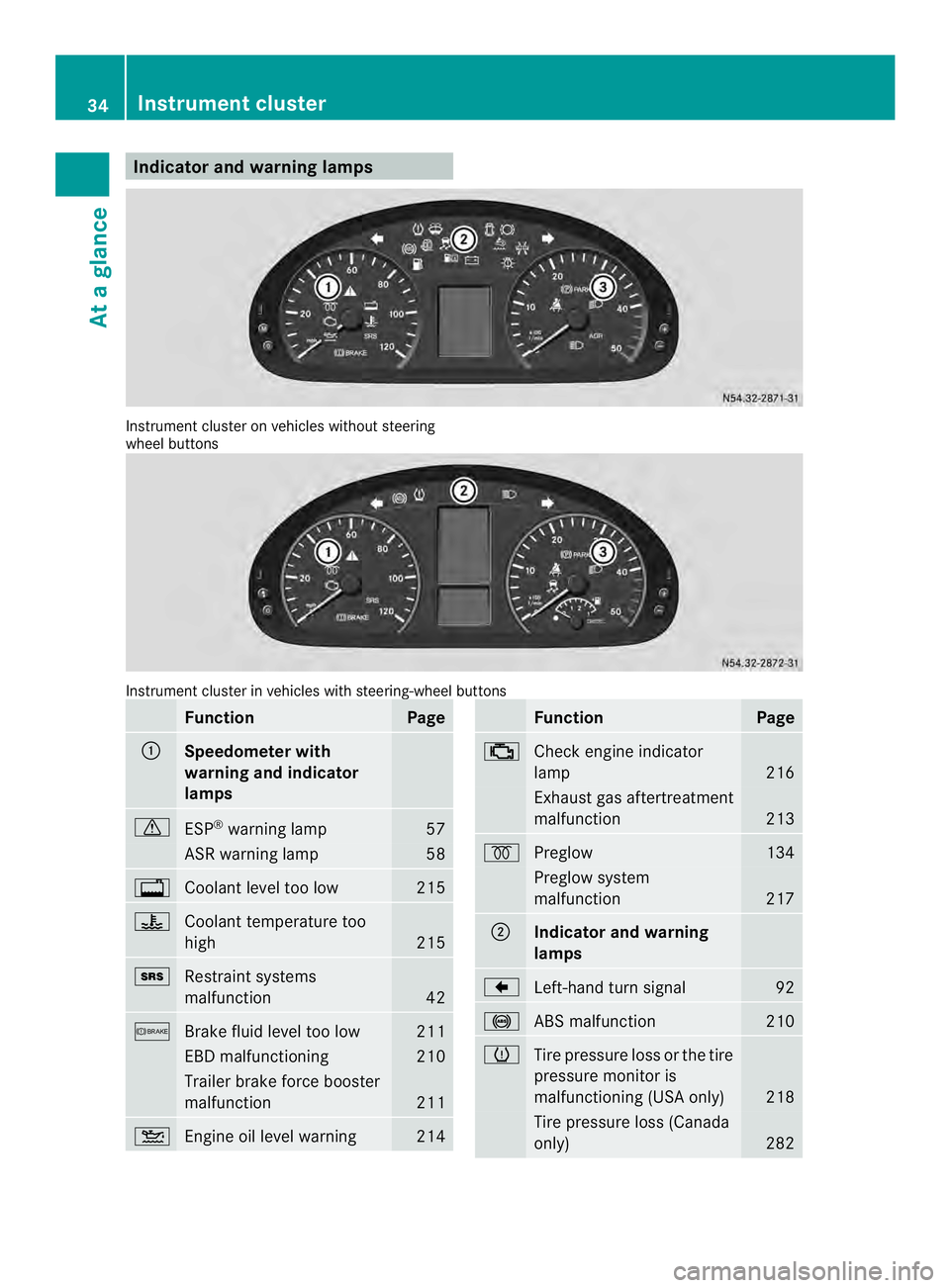
Indicator and warning lamps
Instrumen
tcluster on vehicles without steering
wheel buttons Instrument cluster in vehicles with steering-wheel buttons
Function Page
0005
Speedometer with
warning and indicator
lamps
000D
ESP
®
warning lamp 57
ASR warning lamp 58
001A
Coolant level too low 215
0014
Coolant temperature too
high
215
0008
Restraint systems
malfunction
42
0008
Brake fluid level too low 211
EBD malfunctioning 210
Trailer brake force booster
malfunction
211
001D
Engine oil level warning 214 Function Page
0018
Check engine indicator
lamp 216
Exhaust gas aftertreatment
malfunction 213
000D
Preglow 134
Preglow system
malfunction
217
0006
Indicator and warning
lamps
0002
Left-hand turn signal 92
000E
ABS malfunction 210
000A
Tire pressure loss or the tire
pressure monitor is
malfunctioning (USA only) 218
Tire pressure loss (Canada
only) 28234
Instrument clusterAt a glance
Page 52 of 334
Emergency Tensioning Devices, seat
belt force limiters
G
WARNING
Pyrotechnic ETDs that were activated must be
replaced.
For your safety, when disposing of the
pyrotechnic ETDs always follow our safety
instructions. These instructions are available
from any authorized Sprinter Dealer.
! If the front-passenger seat is not
occupied, do no tengage the sea tbelt
tongue in the buckle on the front-
passenger seat. Otherwise, the Emergency
Tensioning Device could be triggered in the
event of an accident.
X In order to ensure that the pyrotechnic
Emergency Tensioning Devices have not
been triggered, always have the seat belts
checked after an accident.
If the Emergency Tensioning Devices have
been triggered, they must be replaced.
If the vehicle is equipped with a driver's air
bag, the seat belts on the driver's and co-
driver's seats have Emergency Tensioning
Devices and seat belt force limiters.
ETDs tighten the seat belts in an accident,
pulling them close against the seat
occupant's body.
ETDs do not correct incorrect seat positions
or incorrectly fastened seat belts.
ETDs do not pull vehicle occupants back
towards the backrest.
When activated, the seat belt force limiters
reduce the force exerted by the seat belt on
the driver or co-driver.
The seat belt force limiters are synchronized
with the fron tair bags, which absorb part of
the deceleration force, resulting in the force
exerted on the occupant being distributed
over a greater area.
The ETDs can only be triggered if the ignition
is switched on and the restraint systems are
operational, see " 0008warning lamp"
(Y page 42). The Emergency Tensioning Devices are
triggered depending on the type and severity
of an accident:
R
in the event of a head-on or rear-end
collision if the vehicle decelerates or
accelerates rapidly in a longitudinal
direction during the initial stages of the
impact
R in the event of a side impact if the vehicle
decelerates or accelerates rapidly in a
lateral direction and the vehicle is equipped
with thorax side impac tair bags and/or
window curtain air bags
If the ETDs are triggered, you will hear a bang
and powder may also be released .Only in rare
cases will the bang affect your hearing .The
powder emitted is not generally hazardous to
health. The 0008warning lamp lights up. Child restraint systems
Important safety notes
G
WARNING
If the child restraint system is not installed
correctly to a suitable seat, the child may not
be secured in the event of an accident or
sudden braking and may be seriously or even
fatally injured. Therefore, when installing a
child restraint system, you must observe the
manufacturer's installation instructions as
well as the notes on using the child restraint
system.
Child restraint systems should preferably be
installed to the rear seats. Children are
generally better protected there.
Never place objects, e.g. cushions, under the
child restraint system. The entire base of the
child restraint system must always rest on the
seat cushion.
A child restraint system must not be used
without the genuine cover designed for it.
Only replace damaged covers with genuine
covers. 50
Child restraint systemsSafety
Page 53 of 334
On the rear seats, use only child restraint
systems that have been recommended for
use in the Sprinter. G
WARNING
Accident statistics show that children
secured in the rear seats are safer than
children secured in the co-driver's seat. For
this reason, we strongly advise that you
always secure children in the rear seats.
Regardless of the seat position, children
under 12 years must be secured correctly in
a suitable infant or child restraint system or
booster seat suitable for the size and weight
of the child.
Never place anything between the seat
cushion and child seat (e.g. pillow). The
bottom of the child seat must make full
contact with the vehicle seat cushion. An
incorrectly mounted child seat could cause
injuries to the child in the event of an
accident, instead of protecting the child.
The infant or child restraint must be properly
secured with the vehicle's seat belt, the seat
belt and Top Tether strap, or lower anchors
and Top Tether strap, fully in accordance with
the child seat manufacturer's instructions.
Always observe the manufacturer's
instructions when installing special child
restraint systems.
Occupants, in particular children, must sit as
upright as possible, fasten the seat belt
correctly and use a suitable infant restraint
system, child restraint system or booster seat
suitable for the size and weight of the child.
Children can be seriously or even fatally
injured by an air bag deploying. Observe the
following important information if it is
absolutely necessary to carry a child on the
co-driver's seat:
R The co-driver's front air bag is not
deactivated.
R Never secure your child in a rearward-
facing child restraint system on the co-
driver's seat. A child in a rearward-facing
child restraint system on the co-driver's seat can be seriously injured or even killed
if the co-driver's front air bag deploys. Only
install a rearward-facing child restraint
system on a suitable rear seat.
R Where permitted by state law, if you secure
your child in a forward-facing child restraint
system on the co-driver's seat, move the
co-driver's seat as far back to the rear as
possible.Y ou must then use an
appropriately sized child restraint system
recommended for the age, size and weight
of the child and secure it with the vehicle
seat belt in accordance with the child seat
manufacturer's instructions. G
WARNING
Infants and small children should never share
a seat belt with another occupant .Inthe event
of an accident, they could be crushed
between the occupant and seat belt.
Ac hild's risk of serious or fatal injuries is
significantly increased if the child restraints
are not properly secured in the vehicle and/
or the child is not properly secured in the child
restraint.
Children that are too large for a child restraint
must travel in seats using normal seat belts.
Position the shoulder belt across the chest
and shoulder, not the face or neck.Ab ooster
seat may be necessary to achieve proper seat
belt positioning for children over 41 lbs
(18 kg) until they reach a height where alap/
shoulder belt fits properly without a booster
seat.
When the child restraint is no tinuse, remove
it from the vehicle or secure it with the seat
belt to prevent the child restraint from
becoming a projectile in the event of an
accident. G
WARNING
When extending or retracting, parts of the
body could become trapped within the sweep
of the roller sunblind. There is a risk of injury.
When extending or retracting, make sure that
no one has any parts of the body within the Child restraint systems
51Safety
Z
Page 58 of 334
Driving safet
ysystems Driving safety systems overview
In this section, you will find information about
the following driving safety systems:
R ABS ( Anti-lock BrakingSystem)
R BAS ( Brake Assist System)
R ASR (Acceleration SkidControl)
R ESP ®
(Electronic StabilityProgram)
R EBD ( Electronic Brake Force Distribution) Important safety notes
If you fail to adapt yourd riving style or if you
are inattentive, the driving safety systems can
neither reduce the risk of accident nor
override the laws of physics. Driving safety
systems are merely aids designed to assist
driving. You are responsible for the distance
to the vehicle in front, for vehicle speed and
for braking in good time. Always adapt your
driving style to the prevailing road and
weather conditions and maintai nasufficient,
safe distance from other road users. Drive
carefully.
The driving safety systems described can only
attain their maximum effectiveness when
there is optimum contact between the tires
and the road can. Therefore pay special
attention to the information on tires, the
recommended minimum tire tread, etc., in
the "Wheels and tires" section (Y page 274).
In wintry driving conditions, always use winter
tires (M+S tires) and if necessary, snow
chains. Only in this way will the driving safety
systems described in this section work as
effectively as possible. ABS (Anti-lock Braking System)
Important safety notes Note the section on 'Important safety notes'
(Y
page 56). G
WARNING
If ABS is faulty, the wheels could lock when
braking. The steerability and braking
characteristics may be severely impaired.
Additionally, further driving safety systems
are deactivated. There is an increased danger
of skidding and accidents.
Drive on carefully. Have ABS checked
immediately at a qualified specialist
workshop.
If ABS is malfunctioning, other systems will
also fail, including driving safety systems.
Observe the information relating to the 000E
(Y page 210) warning lamp.
ABS regulates brake pressure in such a way
that the wheels do not lock when you brake.
This allows you to continue steering the
vehicle when braking.
ABS acts from a speed of about 5 mph
(8 km/h) upwards, regardless of road surface
conditions. ABS works on slippery surfaces,
even when you only brake gently.
The yellow 000Ewarning lamp in the
instrument cluster lights up when the ignition
is switched on. The lamp goes out when the
engine starts running.
Braking X
If ABS intervenes: continue to depress the
brake pedal with force until the braking
situation is over.
X To make a full brake application:
depress the brake pedal with full force.
If ABS intervenes when braking, you will feel
a pulsating in the brake pedal.
The pulsating brake pedal can be an
indication of hazardous road conditions and
functions as a reminder to take extra care
while driving. BAS (Brake AssistS
ystem)
Note the section on 'Important safety notes'
(Y page 56). 56
Driving safety systemsSafety
Page 59 of 334
G
WARNING
If BAS is malfunctioning, the braking distance
in an emergency braking situation is
increased. There is a risk of an accident.
In an emergency braking situation, depress
the brake pedal with full force. ABS prevents
the wheels from locking.
Vehicles without steering wheel buttons: if
the BAS driving safety system is
malfunctioning, the 000Awarning lamp lights
up while the engine is running (Y page 210).
BAS operates in emergency braking
situations. If you depress the brake quickly,
BAS automatically increases the brake
pressure, thereby reducing the stopping
distance.
The brakes will function as usual once you
release the brake pedal. BAS is deactivated. EBD (electronic brake force
distribution)
Note the section on 'Important safety notes'
(Y page 56). G
WARNING
If EBD has malfunctioned, the rear wheels can
still lock, e.g. under full braking. This
increases the risk of skidding and an accident.
You should therefore adapt yourd riving style
to the different handling characteristics. Have
the brake system checked at a qualified
specialist workshop.
EBD monitors and controls the brake
pressure to the rear wheels. This enables EBD
to improve handling during braking.
Observe the information on warning and
indicator lamps (Y page 210). ESP
®
(Electronic Stability Program)
Note the section on 'Important safety notes'
(Y page 56). G
WARNING
If ESP ®
is malfunctioning it willn ot provide
any vehicle stabilization. There is an increased
risk of skidding or of an accident.
Exercise caution when continuing to drive.
Have ESP ®
checked at a qualified specialist
workshop.
! Only operate the vehicle briefly
(maximum of 10 seconds) on a brake
dynamometer. The key must be turned to
position 1in the ignition lock during this
time. You could otherwise damage the
drive train or the brake system.
! Do not run the vehicle on a roller
dynamometer (e.g. for performance tests).
If you must operate the vehicle on a roller
dynamometer, please consult a qualified
specialist workshop in advance. You could
otherwise damage the drive train or the
brake system.
If you activate or deactivate ESP ®
in a vehicle
with engageable all-wheel drive, ESP ®
will be
deactivated for the duration of the
activation/deactivation process.
If ESP ®
is malfunctioning, the 0002indicator
lamp lights up while the engine is running and
the engine power may be reduced
(Y page 210).
ESP ®
monitors driving stability and detects a
tendency of the vehicle to understeer or
oversteer (skidding) in good time. If ESP ®
detects that the vehicle is deviating from the
direction desired by the driver, one or more
wheels are braked to stabilize the vehicle. The
engine output is also modified to keep the
vehicle on the desired course within physical
limits. ESP ®
greatly assists you when driving
on wet or slippery road surfaces. ESP ®
also
stabilizes the vehicle when braking.
The 000D warning lamp in the instrument
cluster flashes when ESP ®
is intervening. Driving safety systems
57Safety Z
Page 60 of 334
If ESP
®
intervenes:
X Do not deactivate ASR under any
circumstances.
X When driving off, apply as little throttle as
possible.
X Adapt yours peed and driving style to the
prevailing road conditions.
i Only use wheels with the recommended
tire sizes. Only then will ESP ®
function
properly. ASR (acceleration skid control)
General notes Important safety notes
Note the section on 'Important safety notes'
(Y
page 56).
ASR can neither reduce the risk of an accident
nor suspend the laws of physics if the driver
does not pay attention when pulling away or
accelerating. ASR is only an aid. Always adapt
your driving style to suit the prevailing road
and weather conditions.
Vehicles without steering wheel buttons: if
ASR is malfunctioning, the 000Aindicator
lamp lights up while the engine is running and
the engine power may be reduced
(Y page 210).
ASR significantly improves traction, i.e. the
transmission of power from the tires to the
road surface, and thus increases the vehicle's
driving stability. If the driving wheels start to
spin, ASR brakes individual drive wheels and
limits the engine torque. ASR thus
significantly assists you when pulling away
and accelerating, especially on wet or
slippery roads.
If traction on the road surface is not sufficient,
even ASR will not allow you to pull away
without difficulty. The type of tires and total
weight of the vehicle as well as the gradient
of the road also play a crucial role. If ASR intervenes, the
000Dwarning lamp in
the instrument cluster flashes.
Activating/deactivating ASR G
WARNING
If deactivated, ASR will not attempt to
stabilize the vehicle during pulling away and
acceleration. There is an increased risk of
skidding and of an accident.
Only deactivate ASR in the situations
described in the following.
! If you deactivate ASR, ESP ®
will still
intervene to stabilize the vehicle. Frequent
braking automatically triggered by ESP ®
can damage the brake system.
For this reason, deactivate ASR only briefly
and when absolutely necessary. When ESP
®
is intervening and the 000D
warning lamp in the instrument cluster is
flashing, leave ASR on. In this case, only
depress the accelerator pedal as far as
required when pulling away.
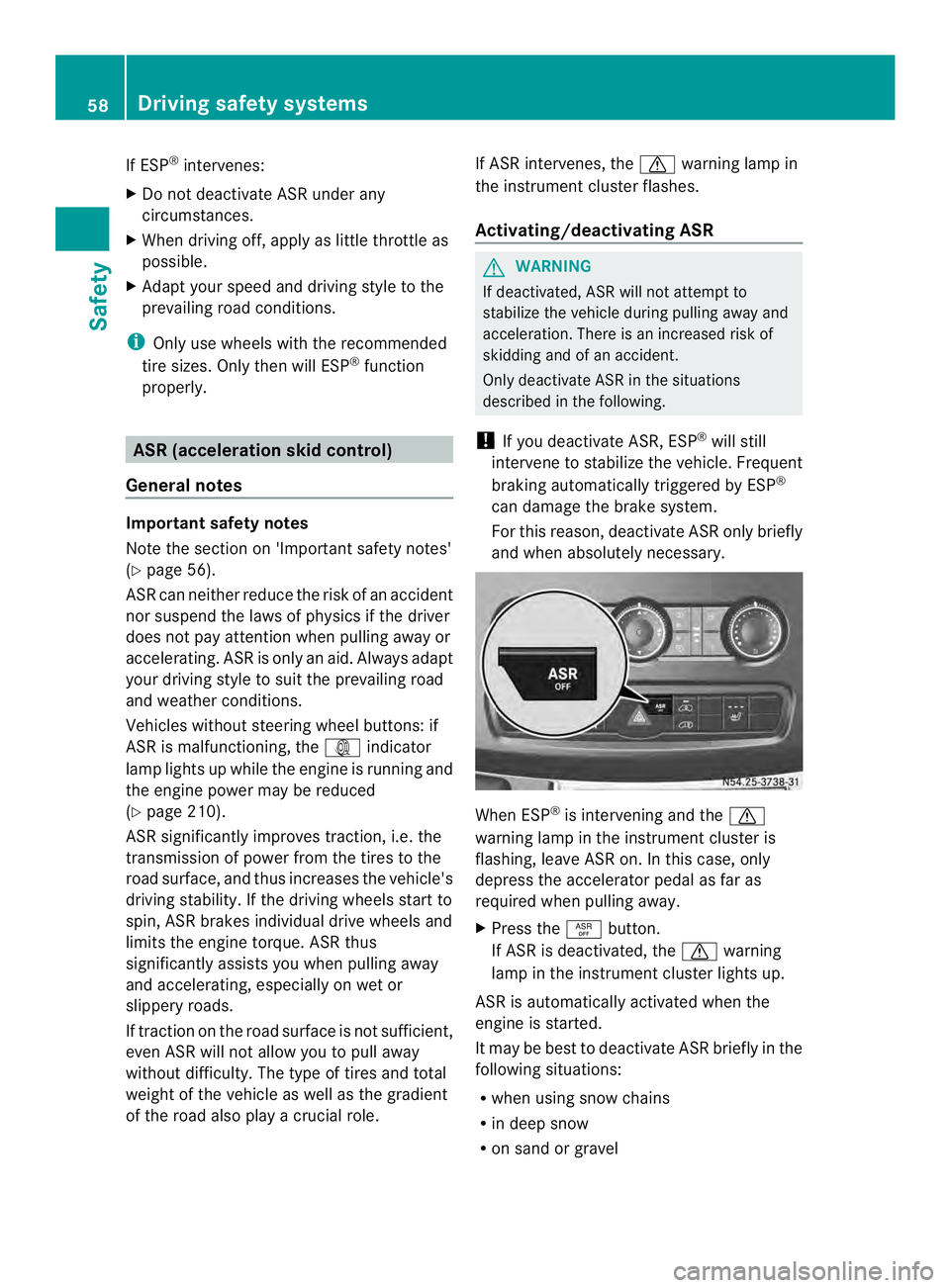
X Press the 0006button.
If ASR is deactivated, the 000Dwarning
lamp in the instrument cluster lights up.
ASR is automatically activated when the
engine is started.
It may be best to deactivate ASR briefly in the
following situations:
R when using snow chains
R in deep snow
R on sand or gravel 58
Driving safet
ysystemsSafety