mirror MERCEDES-BENZ SPRINTER 2015 MY15 Operator’s Manual
[x] Cancel search | Manufacturer: MERCEDES-BENZ, Model Year: 2015, Model line: SPRINTER, Model: MERCEDES-BENZ SPRINTER 2015Pages: 334, PDF Size: 5.94 MB
Page 85 of 334
R
Adjust the head restraint so that it supports
the back of the head at eye level.
R The distance from the pedals should be
such that you can depress them fully.
Observe also the safety notes in the section
on "Air bags" (Y page 47)and "Children in the
vehicle" (Y page 51).
If you swap over the head restraints for the
front and rear seats, you will not be able to
adjust the height and angle of the head
restraints to the correct position.
Use the head restraint pad to adjust the head
restraint so that it is as close as possible to
the back of your head.
Before the journey, make sure the head
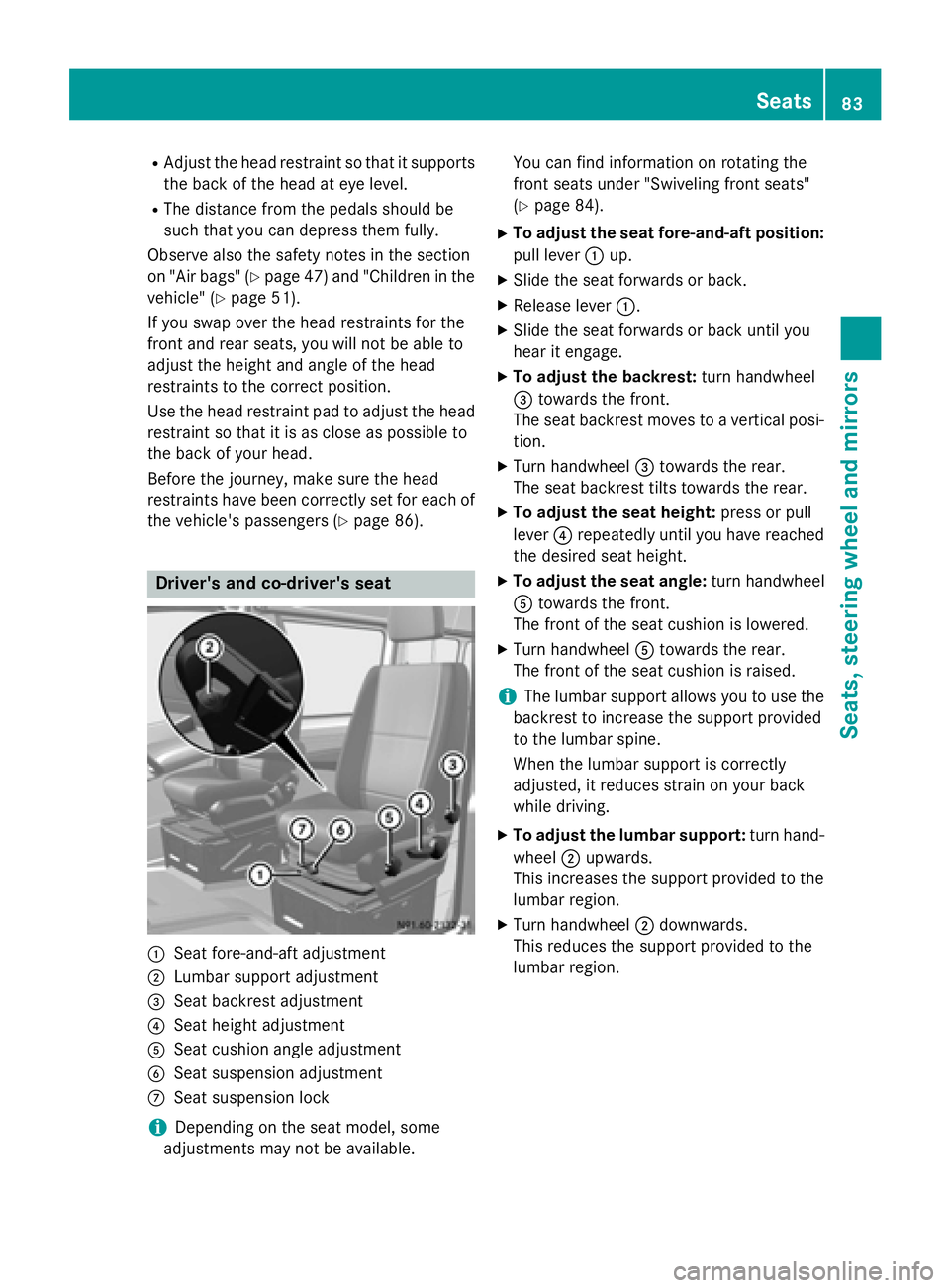
restraints have been correctly set for each of the vehicle's passengers (Y page 86).Driver's and co-driver's seat
0043
Seat fore-and-aft adjustment
0044 Lumbar support adjustment
0087 Seat backrest adjustment
0085 Seat height adjustment
0083 Seat cushion angle adjustment
0084 Seat suspension adjustment
006B Seat suspension lock
i Depending on the seat model, some
adjustments may not be available. You can find information on rotating the
front seats under "Swiveling front seats"
(Y
page 84).
X To adjust the seat fore-and-aft position:
pull lever 0043up.
X Slide the seat forwards or back.
X Release lever 0043.
X Slide the seat forwards or back until you
hear it engage.
X To adjust the backrest: turn handwheel
0087 towards the front.
The seat backrest moves to a vertical posi-
tion.
X Turn handwheel 0087towards the rear.
The seat backrest tilts towards the rear.
X To adjust the seat height: press or pull
lever 0085repeatedly until you have reached
the desired seat height.
X To adjust the seat angle: turn handwheel
0083 towards the front.
The front of the seat cushion is lowered.
X Turn handwheel 0083towards the rear.
The front of the seat cushion is raised.
i The lumbar support allows you to use the
backrest to increase the support provided
to the lumbar spine.
When the lumbar support is correctly
adjusted, it reduces strain on your back
while driving.
X To adjust the lumbar support: turn hand-
wheel 0044upwards.
This increases the support provided to the
lumbar region.
X Turn handwheel 0044downwards.
This reduces the support provided to the
lumbar region. Seats
83Seats, steering wheel and mirrors Z
Page 86 of 334
The seat suspension must be adapted to your
body weight. Adjust the seat suspension only while the seat is unoccupied.
X To adjust the seat suspension: take your
weight off the seat.
X Using handwheel 0084, set your body weight
(40 to 120 kg) for optimum seat suspen-
sion.
The seat suspension will become more rigid the higher you set the weight. It will then
not move as far.
If the seat moves up and down frequently and
to a great extent, you can lock the seat in the lower range.
X To engage the seat suspension lock:
turn lever 006Bupwards.
When it next moves, the seat will lock in
position.
X To release the seat suspension lock:
turn lever 006Bto the right.
The seat can now move up and down again. Swiveling front seats
G
WARNING
If the driver's and co-driver's seats are not
engaged facing the direction of travel while
driving, the restraint systems may not be able to provide the intended protection. There is an
increased risk of injury, possibly even fatal.
Engage the driver's and co-driver's seats so
they are facing the direction of travel before
starting the engine.
! When rotating the seats, make sure that
there is sufficient space to do so.
Move the seat forward or back first. This
will help to avoid contact with other parts of
the interior.
Push the handbrake lever down to the stop.
The parking brake or handbrake lever could
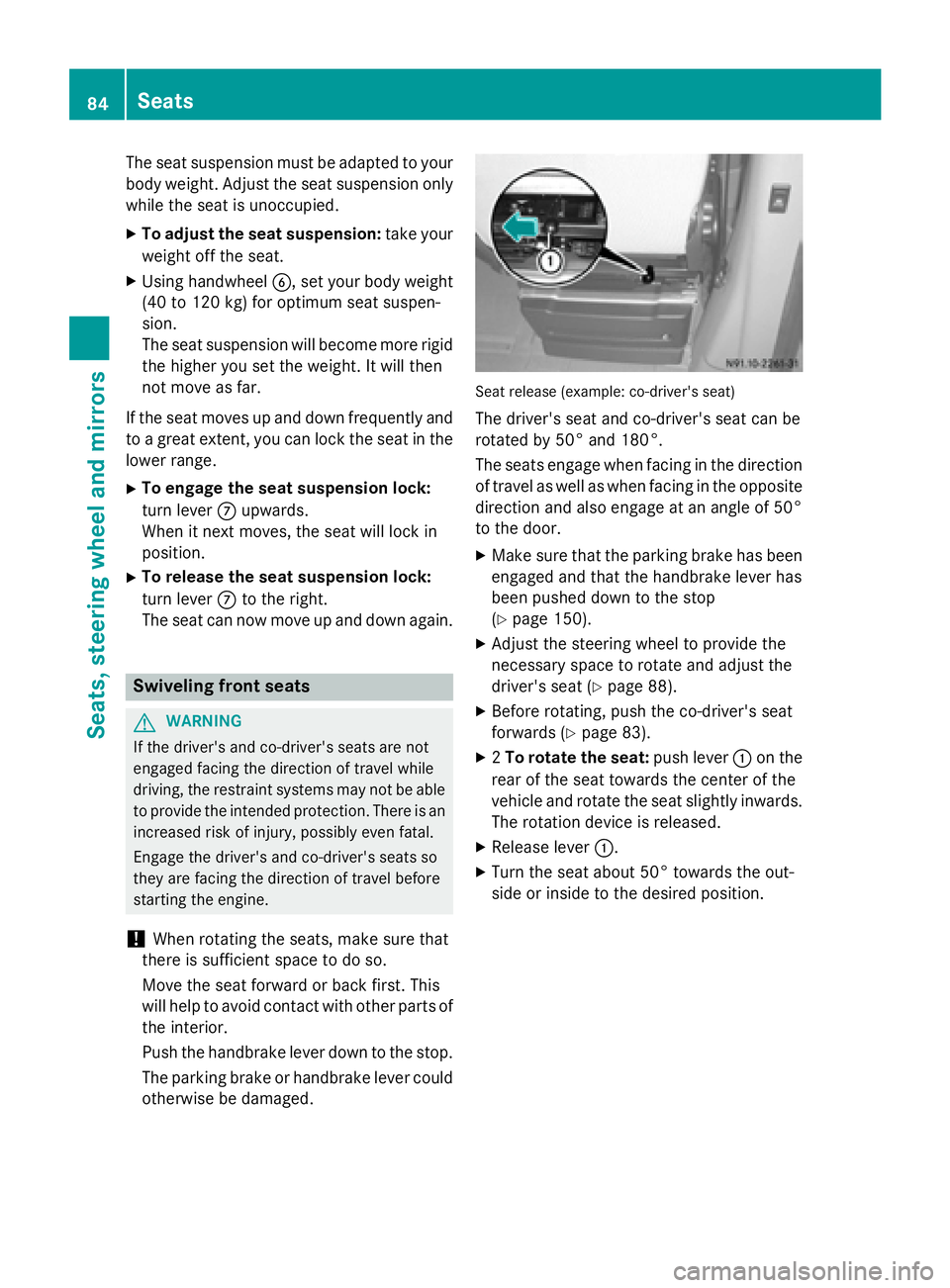
otherwise be damaged. Seat release (example: co-driver's seat)
The driver's seat and co-driver's seat can be
rotated by 50° and 180°.
The seats engage when facing in the direction of travel as well as when facing in the oppositedirection and also engage at an angle of 50°
to the door.
X Make sure that the parking brake has been
engaged and that the handbrake lever has
been pushed down to the stop
(Y page 150).
X Adjust the steering wheel to provide the
necessary space to rotate and adjust the
driver's seat (Y page 88).
X Before rotating, push the co-driver's seat
forwards (Y page 83).
X 2To rotate the seat: push lever0043on the
rear of the seat towards the center of the
vehicle and rotate the seat slightly inwards. The rotation device is released.
X Release lever 0043.
X Turn the seat about 50° towards the out-
side or inside to the desired position. 84
SeatsSeats, steering wheel and mirrors
Page 87 of 334
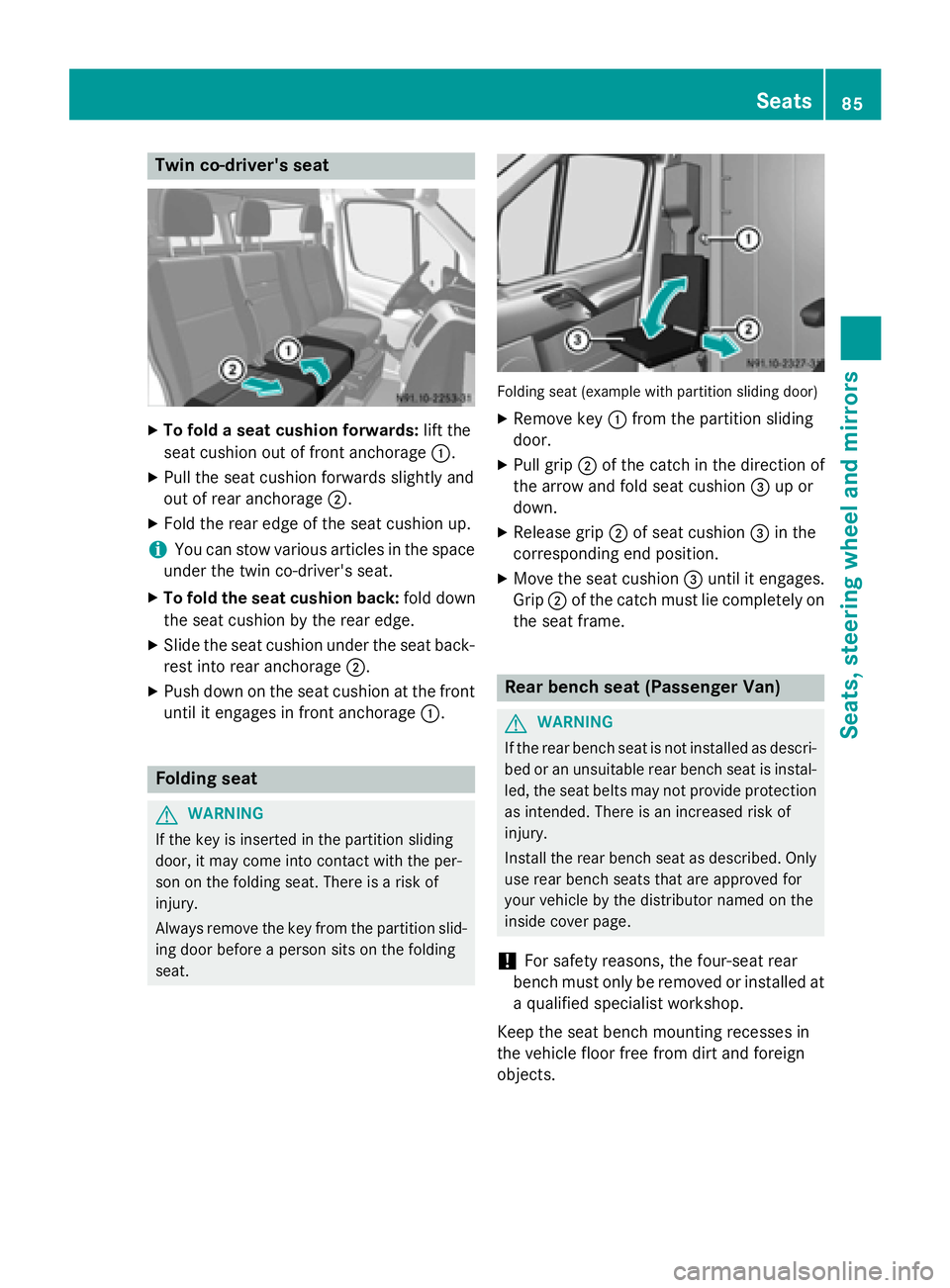
Twin co-driver's seat
X
To fold a seat cushion forwards: lift the
seat cushion out of front anchorage 0043.
X Pull the seat cushion forwards slightly and
out of rear anchorage 0044.
X Fold the rear edge of the seat cushion up.
i You can stow various articles in the space
under the twin co-driver's seat.
X To fold the seat cushion back: fold down
the seat cushion by the rear edge.
X Slide the seat cushion under the seat back-
rest into rear anchorage 0044.
X Push down on the seat cushion at the front
until it engages in front anchorage 0043.Folding seat
G
WARNING
If the key is inserted in the partition sliding
door, it may come into contact with the per-
son on the folding seat. There is a risk of
injury.
Always remove the key from the partition slid- ing door before a person sits on the folding
seat. Folding seat (example with partition sliding door)
X Remove key 0043from the partition sliding
door.
X Pull grip 0044of the catch in the direction of
the arrow and fold seat cushion 0087up or
down.
X Release grip 0044of seat cushion 0087in the
corresponding end position.
X Move the seat cushion 0087until it engages.
Grip 0044of the catch must lie completely on
the seat frame. Rear bench seat (Passenger Van)
G
WARNING
If the rear bench seat is not installed as descri- bed or an unsuitable rear bench seat is instal-
led, the seat belts may not provide protection as intended. There is an increased risk of
injury.
Install the rear bench seat as described. Only
use rear bench seats that are approved for
your vehicle by the distributor named on the
inside cover page.
! For safety reasons, the four-seat rear
bench must only be removed or installed at
a qualified specialist workshop.
Keep the seat bench mounting recesses in
the vehicle floor free from dirt and foreign
objects. Seats
85Seats, steering wheel and mirrors Z
Page 88 of 334
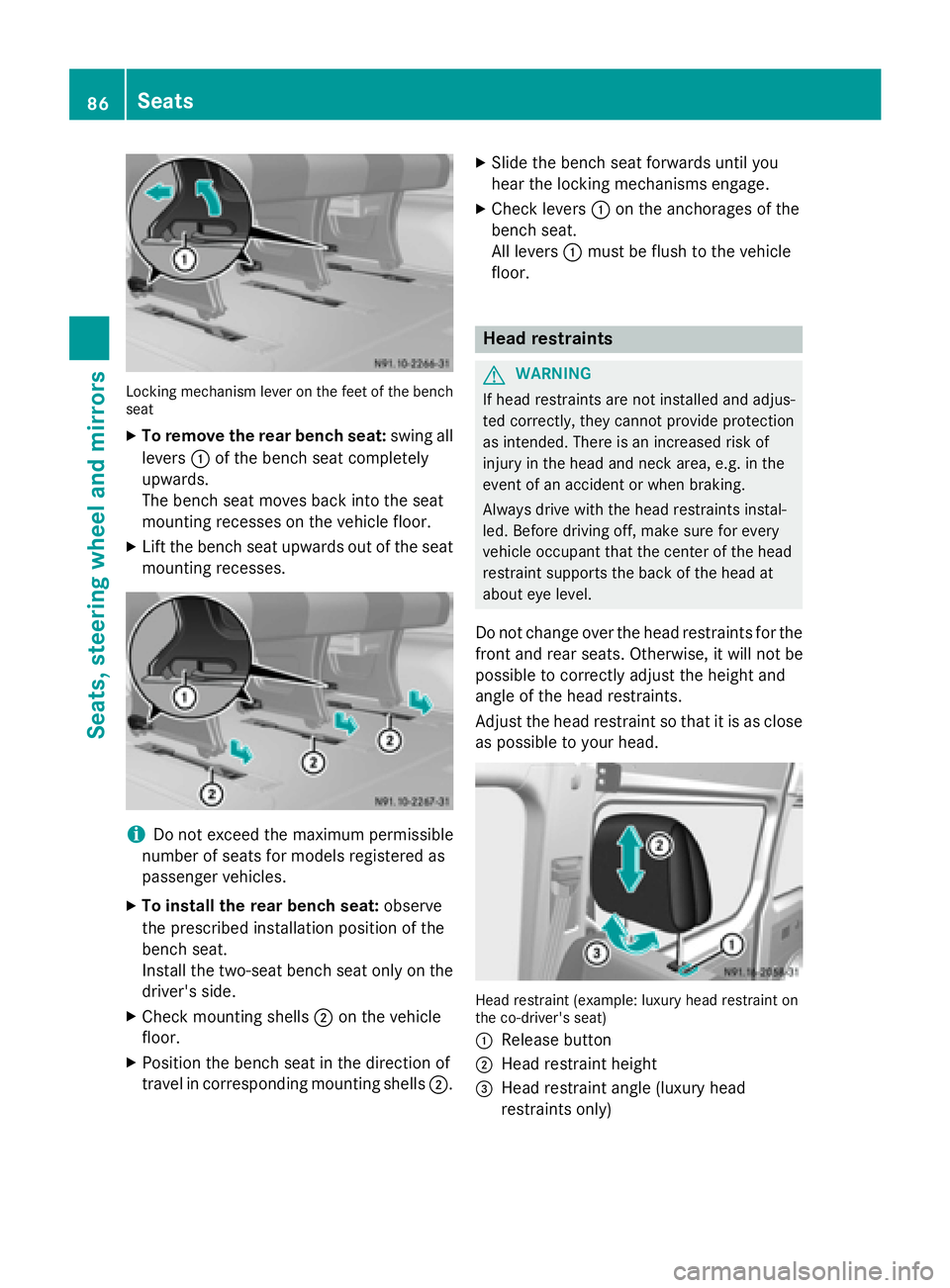
Locking mechanism lever on the feet of the bench
seat
X To remove the rear bench seat: swing all
levers 0043of the bench seat completely
upwards.
The bench seat moves back into the seat
mounting recesses on the vehicle floor.
X Lift the bench seat upwards out of the seat
mounting recesses. i
Do not exceed the maximum permissible
number of seats for models registered as
passenger vehicles.
X To install the rear bench seat: observe
the prescribed installation position of the
bench seat.
Install the two-seat bench seat only on the
driver's side.
X Check mounting shells 0044on the vehicle
floor.
X Position the bench seat in the direction of
travel in corresponding mounting shells 0044.X
Slide the bench seat forwards until you
hear the locking mechanisms engage.
X Check levers 0043on the anchorages of the
bench seat.
All levers 0043must be flush to the vehicle
floor. Head restraints
G
WARNING
If head restraints are not installed and adjus-
ted correctly, they cannot provide protection
as intended. There is an increased risk of
injury in the head and neck area, e.g. in the
event of an accident or when braking.
Always drive with the head restraints instal-
led. Before driving off, make sure for every
vehicle occupant that the center of the head
restraint supports the back of the head at
about eye level.
Do not change over the head restraints for the
front and rear seats. Otherwise, it will not be
possible to correctly adjust the height and
angle of the head restraints.
Adjust the head restraint so that it is as close as possible to your head. Head restraint (example: luxury head restraint on
the co-driver's seat)
0043 Release button
0044 Head restraint height
0087 Head restraint angle (luxury head
restraints only) 86
SeatsSeats, steering wheel and mirrors
Page 89 of 334
X
To raise: pull the head restraint up to the
desired position.
X To lower: press release button 0043and slide
the head restraint down to the desired posi- tion.
X To adjust the angle: hold the front part of
the luxury head restraint by the lower edge
and tilt it to the desired position.
X To remove : pull the head restraint up to
the stop.
X Press release button 0043and pull out the
head restraint.
X To insert: insert the head restraint so that
the rod with the detents is on the left when viewed in the direction of travel.
X Press and hold release button 0043.
X Push the head restraint down until it
engages. Armrests
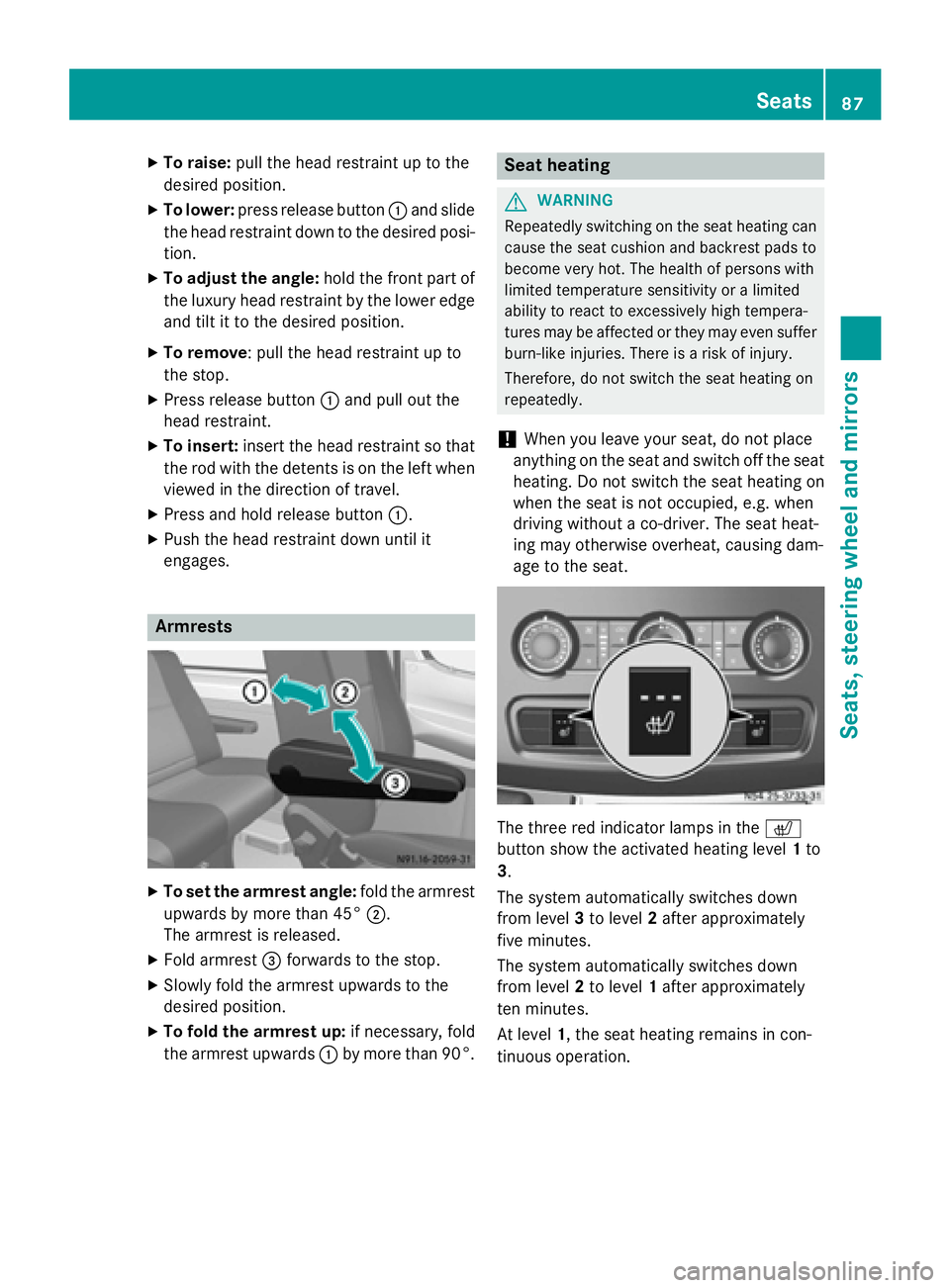
X
To set the armrest angle: fold the armrest
upwards by more than 45° 0044.
The armrest is released.
X Fold armrest 0087forwards to the stop.
X Slowly fold the armrest upwards to the
desired position.
X To fold the armrest up: if necessary, fold
the armrest upwards 0043by more than 90°. Seat heating
G
WARNING
Repeatedly switching on the seat heating can
cause the seat cushion and backrest pads to
become very hot. The health of persons with
limited temperature sensitivity or a limited
ability to react to excessively high tempera-
tures may be affected or they may even suffer burn-like injuries. There is a risk of injury.
Therefore, do not switch the seat heating on
repeatedly.
! When you leave your seat, do not place
anything on the seat and switch off the seat
heating. Do not switch the seat heating on
when the seat is not occupied, e.g. when
driving without a co-driver. The seat heat-
ing may otherwise overheat, causing dam-
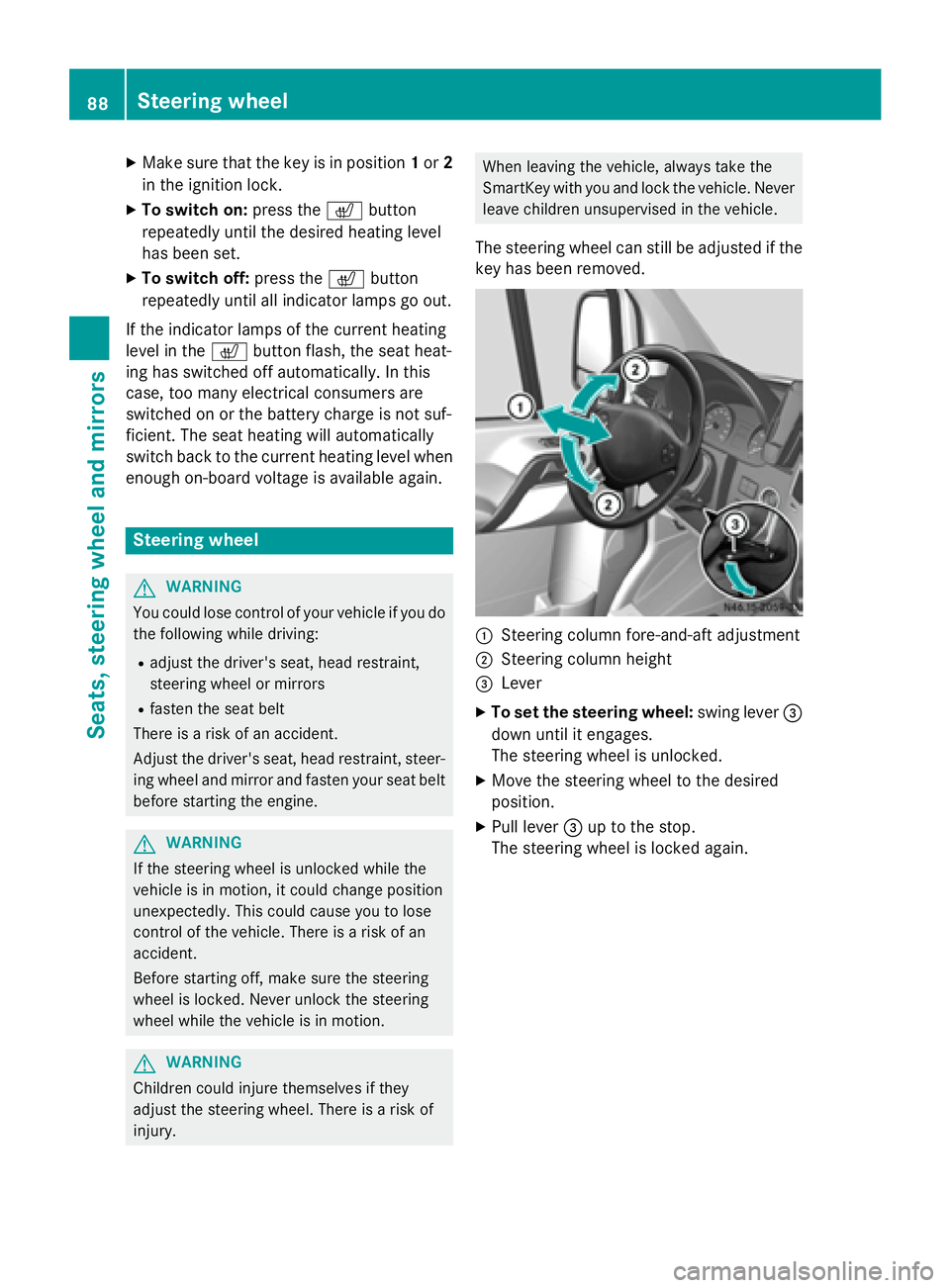
age to the seat. The three red indicator lamps in the
0072
button show the activated heating level 1to
3.
The system automatically switches down
from level 3to level 2after approximately
five minutes.
The system automatically switches down
from level 2to level 1after approximately
ten minutes.
At level 1, the seat heating remains in con-
tinuous operation. Seats
87Seats, steering wheel and mirrors Z
Page 90 of 334
X
Make sure that the key is in position 1or 2
in the ignition lock.
X To switch on: press the0072button
repeatedly until the desired heating level
has been set.
X To switch off: press the0072button
repeatedly until all indicator lamps go out.
If the indicator lamps of the current heating
level in the 0072button flash, the seat heat-
ing has switched off automatically. In this
case, too many electrical consumers are
switched on or the battery charge is not suf-
ficient. The seat heating will automatically
switch back to the current heating level when
enough on-board voltage is available again. Steering wheel
G
WARNING
You could lose control of your vehicle if you do the following while driving:
R adjust the driver's seat, head restraint,
steering wheel or mirrors
R fasten the seat belt
There is a risk of an accident.
Adjust the driver's seat, head restraint, steer-
ing wheel and mirror and fasten your seat belt before starting the engine. G
WARNING
If the steering wheel is unlocked while the
vehicle is in motion, it could change position
unexpectedly. This could cause you to lose
control of the vehicle. There is a risk of an
accident.
Before starting off, make sure the steering
wheel is locked. Never unlock the steering
wheel while the vehicle is in motion. G
WARNING
Children could injure themselves if they
adjust the steering wheel. There is a risk of
injury. When leaving the vehicle, always take the
SmartKey with you and lock the vehicle. Never
leave children unsupervised in the vehicle.
The steering wheel can still be adjusted if the
key has been removed. 0043
Steering column fore-and-aft adjustment
0044 Steering column height
0087 Lever
X To set the steering wheel: swing lever0087
down until it engages.
The steering wheel is unlocked.
X Move the steering wheel to the desired
position.
X Pull lever 0087up to the stop.
The steering wheel is locked again. 88
Steering wheelSeats, steering wheel and mirrors
Page 91 of 334
Mirrors
Rear-view mirror
X
Anti-glare mode: push anti-glare lever 0043
in the direction of the arrow. Exterior mirrors
Important safety notes G
WARNING
The additional mirrors in the exterior mirrors
reduce the size of the image. Objects visible in the mirrors are closer than they appear. You
could misjudge the distance from road users
driving behind you when changing lanes, for
instance. There is a risk of an accident.
You should therefore always determine the
actual distance from road users driving
behind you, e.g.:
R by looking over your shoulder
R by looking in the main mirror in the exterior
mirror.
Adjusting manually X
Before starting off, manually adjust the
exterior mirrors in such a way that you can
get a good overview of road and traffic con- ditions. Adjusting electrically
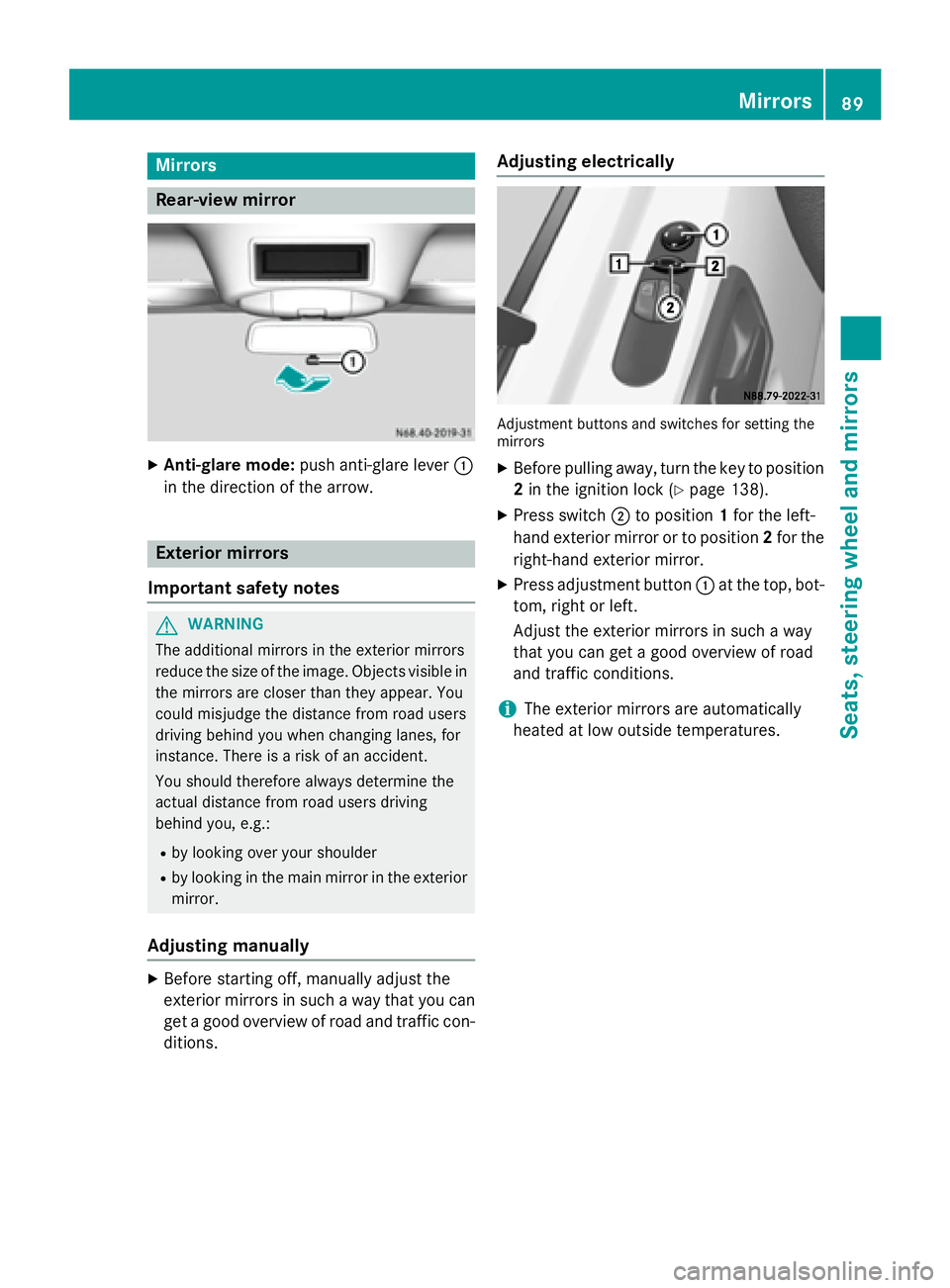
Adjustment buttons and switches for setting the
mirrors
X Before pulling away, turn the key to position
2 in the ignition lock (Y page 138).
X Press switch 0044to position 1for the left-
hand exterior mirror or to position 2for the
right-hand exterior mirror.
X Press adjustment button 0043at the top, bot-
tom, right or left.
Adjust the exterior mirrors in such a way
that you can get a good overview of road
and traffic conditions.
i The exterior mirrors are automatically
heated at low outside temperatures. Mirrors
89Seats, steering wheel and mirrors Z
Page 102 of 334
R
Do not use a bulb that has been dropped or
that has scratches on its glass tube.
The bulb could explode.
R Only use bulbs in closed lamps which have
been designed for this purpose.
R Only use spare bulbs of the same type and
with the prescribed voltage
R Protect the bulbs from moisture when in
use.
If the new bulb still does not light up, consult a qualified specialist workshop.
R Have the LEDs and bulbs of the following
lamps changed at a qualified specialist
workshop:
- the additional turn signals in the exterior
mirrors
- the high-mounted brake lamp
- LED daytime running lamps (Bi-Xenon
headlamps)
- Bi-Xenon lamps (Bi-Xenon headlamps)
- front fog lamps
If you require assistance changing bulbs, con-
sult a qualified specialist workshop. Front bulbs
Overview of bulb replacement – bulb
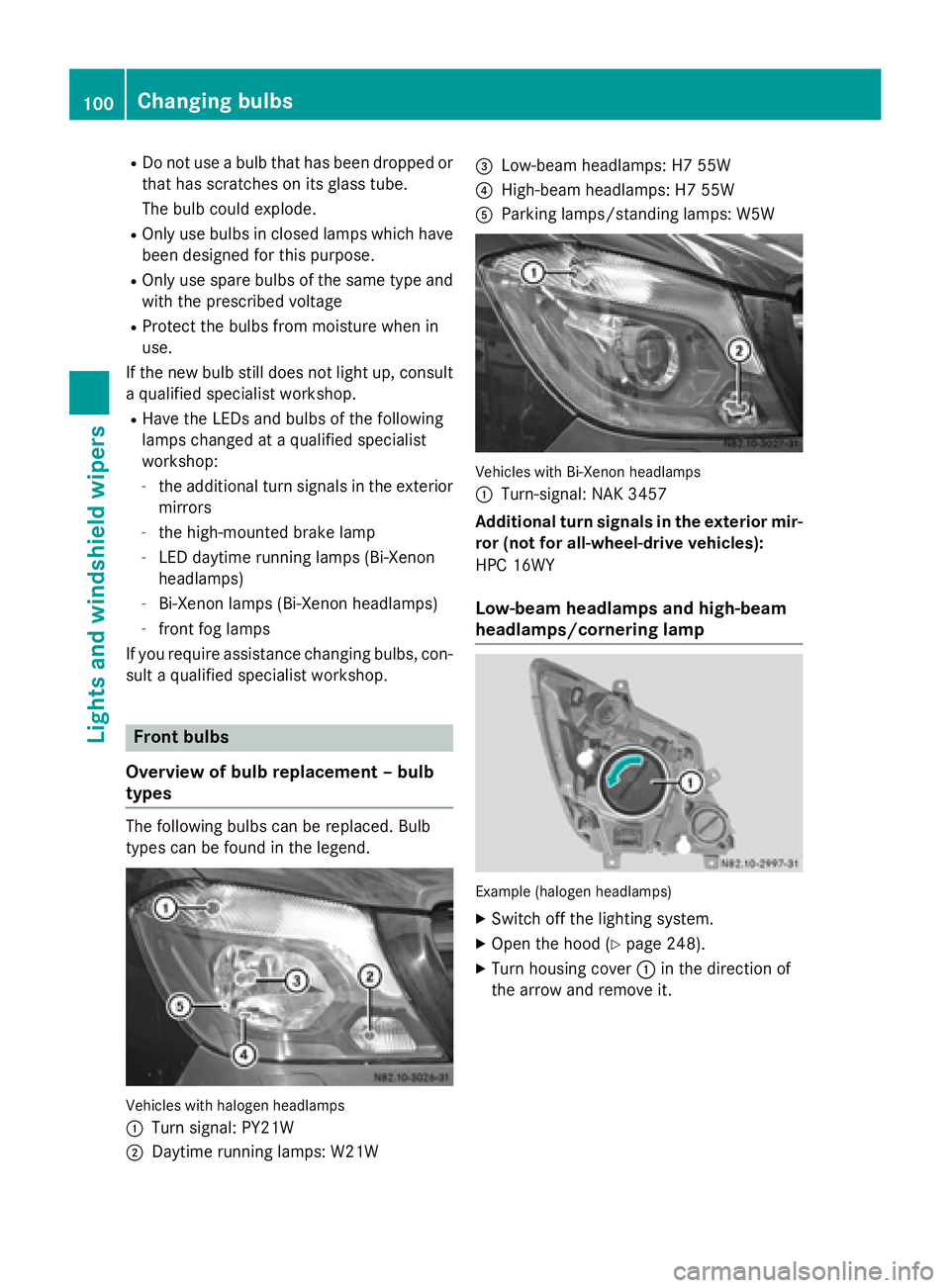
types The following bulbs can be replaced. Bulb
types can be found in the legend. Vehicles with halogen headlamps
0043
Turn signal: PY21W
0044 Daytime running lamps: W21W 0087
Low-beam headlamps: H7 55W
0085 High-beam headlamps: H7 55W
0083 Parking lamps/standing lamps: W5W Vehicles with Bi-Xenon headlamps
0043
Turn-signal: NAK 3457
Additional turn signals in the exterior mir-
ror (not for all-wheel-drive vehicles):
HPC 16WY
Low-beam headlamps and high-beam
headlamps/cornering lamp Example (halogen headlamps)
X Switch off the lighting system.
X Open the hood (Y page 248).
X Turn housing cover 0043in the direction of
the arrow and remove it. 100
Changing bulbsLights and
windshield wipers
Page 160 of 334
cable and a folding spade are carried in the
vehicle.
X Wheels and tires: check the tire tread
depth (Y page 285) and tire pressure
(Y page 288).
Rules for driving off-road !
Always bear the vehicle's ground clear-
ance in mind and avoid obstacles, e.g. deep ruts.
Obstacles may damage the following parts
of the vehicle:
R the chassis
R the drive train
R the fuel and supply tanks
For this reason, you should always drive
slowly when driving off-road. If you have to drive over obstacles, have the co-driver
direct you.
i We recommend that you additionally
carry a shovel and a recovery rope with
shackle in the vehicle.
R Ensure that loads and items of luggage are
securely stowed or lashed down
(Y page 240).
R Before driving off-road, stop the vehicle and
shift to a low gear.
R If the surface demands it, temporarily deac-
tivate ASR when pulling away (Y page 58).
R Only drive off-road with the engine running
and a gear engaged.
R Drive slowly and smoothly. Walking pace is
necessary in many situations.
R Avoid spinning the drive wheels.
R Make sure that the wheels always remain in
contact with the ground.
R Drive with extreme care over unknown ter-
rain where you can only see for a short dis-
tance. As a precaution, get out of the vehi-
cle to take a look at the route to be taken in
advance.
R Check the water depth before fording. R
Watch out for obstacles (e.g. rocks, holes,
tree stumps and ruts).
R Avoid edges where the surface could crum-
ble or break away.
Checklist after driving off-road !
If you detect damage to the vehicle after
driving off-road, have the vehicle checked
immediately at a qualified specialist work-
shop.
Off-road driving places a higher demand on
your vehicle than normal road operation.
Check your vehicle after driving on rough ter- rain. By doing so you will notice any damage in
good time and reduce the risk of an accident for yourself and other road users. Clean your
vehicle thoroughly before driving on public
roads.
Observe the following points after driving off-
road, on construction sites and before driving on public roads:
X Activate ASR (Y page 58).
X Clean the headlamps and tail lamps and
check them for damage.
X Clean the front and rear license plates.
X Clean the windshield, windows and exterior
mirrors.
X Clean the steps, door sills and grab han-
dles.
This increases safety of footing.
X Clean the wheels/tires, wheel housings
and the underbody of the vehicle with a
water jet.
This increases road grip, especially on wet
road surfaces.
X Check the wheels/tires and wheel hous-
ings for trapped foreign objects and
remove them.
Trapped foreign objects can damage the
wheels/tires and may be flung out from the
vehicle when you continue driving.
X Check the underbody for trapped branches
or other parts of plants and remove them.
Trapped branches or other parts of plants
increase the risk of fire and can cause dam- 158
Driving tipsDriving and parking
Page 165 of 334
Adaptive Brake Assist aids you when braking
during hazardous situations at speeds above
20 mph (30 km/h). With the help of Adaptive Brake Assist, the distance warning signal can
detect obstacles that are in the path of your
vehicle for an extended period of time.
When you approach an obstacle and adaptive Brake Assist detects that there is a risk of a
collision, adaptive Brake Assist calculates the
braking force necessary to avoid a collision.
Should you apply the brakes forcefully, adap- tive Brake Assist will automatically increase
the braking force to the calculated level.
X Keep the brake pedal depressed until the
emergency braking situation is over.
ABS prevents the wheels from locking.
The brakes function as usual again if:
R you release the brake pedal
R there is no longer any danger of a collision
R no obstacle is detected in front of your
vehicle
Adaptive Brake Assist is then deactivated.
Up to the maximum vehicle speed, adaptive
Brake Assist can react to moving obstacles
that have already been recognized as such at least once over the period of observation.
Adaptive Brake Assist does not react to sta-
tionary obstacles.
In particular, the detection of obstacles can
be impaired if:
R there is dirt on the sensors or anything else
covering the sensors
R it is snowing or raining heavily
R there is interference from other radar sour-
ces
R there are strong radar reflections, for
example in parking garages
R a narrow vehicle traveling in front, e.g. a
motorbike
R a vehicle traveling in front on a different line
If adaptive Brake Assist is not available due to a malfunction in the radar sensor system, thefull brake boosting effect with the help of BAS
remains available. Following damage to the front end of the vehi-
cle, have the configuration and operation of
the radar sensor checked at a qualified spe-
cialist workshop. This also applies to colli-
sions at slow speeds where there is no visible damage to the front of the vehicle. Lane Tracking package
Blind Spot Assist General notes
Blind Spot Assist uses a radar sensor system
to monitor the areas on both sides of your
vehicle. It supports you from speeds of
approximately 20 mph (30 km/h). A warning
display in the exterior mirrors draws your
attention to vehicles detected in the moni-
tored area. If you then switch on the corre-
sponding turn signal to change lane, you will
also receive an optical and audible collision
warning. For this purpose, Blind Spot Assist
uses sensors in the rear bumper and behind
the protective strips of the B-pillars.
Important safety notes G
WARNING
Blind Spot Assist does not react to:
R vehicles overtaken too closely on the side,
placing them in the blind spot area
R vehicles which approach with a large speed
differential and overtake your vehicle
As a result, Blind Spot Assist may not give
warnings in such situations. There is a risk of an accident.
Always observe the traffic conditions care-
fully, and maintain a safe lateral distance.
Blind Spot Assist is only an aid. It may fail to
detect some vehicles and is no substitute for
attentive driving.
i USA only:
This device has been approved by the FCC as a "Vehicular Radar System". The radar
sensor is intended for use in an automotive Driving systems
163Driving and parking Z