ABS MERCEDES-BENZ SPRINTER 2019 MY19 with 7” screen
[x] Cancel search | Manufacturer: MERCEDES-BENZ, Model Year: 2019, Model line: SPRINTER, Model: MERCEDES-BENZ SPRINTER 2019Pages: 354, PDF Size: 6.15 MB
Page 161 of 354
Depending on
theve hicle's equipment, thera dar
sensors are integrated behind the bumpers
and/or behind thera diator grill. Keep these parts
free of dirt, ice and slush (/ page212). The se n‐
sors must not be co vered, forex ample bybicycle
ra ck s, overhanging loads or sticke rs. Af ter a colli‐
sion, ha vethe function of thera dar sensors
ch ecked at a qualified specialist workshop as
damage (bo thvisible or non-visible) may ha ve
occur redto the bumper or radiator trim. Fu
nction of driving sy stems and driving
saf ety sy stems In
this section, you will find information about the
fo llowing driving sy stems and driving saf ety sys‐
te ms:
R ABS ( Anti-lock braking system)
(/ page 137)
R ASC (Acceleration SkidControl)
(/ page 137)
R BAS (B rake Assist System) (/ page137)
R ESP ®
(Electronic Stability Program)
(/ page 138)
R EBD ( Electronic Brakeforce Distribution)
(/ page 139)
R Active Brake Assi st (/ page 139)
R Cruise co ntrol (/ page 141)
R Active Dis tance Assi stDISTRONIC
(/ page 143)
R Hill start assist
R HOLD function (/ page145)
R Parking Assist PARKTRONIC ( /page 145)
R Rear view camera (/ page147)
R 360° Camera (/ page149)
R ATTENTION ASSIST (/ page151)
R Blind Sp otAssi st (/ page 152)
R Active Lane Keeping Assist (/ page155) Fu
nctions of ABS (Anti-lock Braking Sy stem) Obser
vethe impor tant sa fety guidelines forthe
driving saf ety sy stem.
ABS cont rols the brake pressure in critical situa‐
tions:
R the wheels are pr evented from lo cking when
braking, e.g. during maximum full-s top brak‐
ing or when there is insuf ficient tire traction. R
thesteerability of theve hicle in term s of
ph ysical possibilities is ensured when brak‐
ing.
R ABS is active from speeds of appr ox. 3 mph
(5 km/h). On a slippery road sur face, ABS
inter venes even if you on lybrake gently.
Sy stem limitations
If th ere is a malfunction and theye llow 0025 ABS
wa rning lamp lights up continuously in the instru‐
ment display af terst arting the engine, ABS may
be impaired or inoperative.
If ABS inter venes, you will feel a pulsing in the
brake pedal. The pulsating brake pedal may be an
indication of hazardous road conditions and func‐
tions as a reminder totake extra care while driv‐
ing.
If ABS in terv enes: keep the brake pedal firm ly
depressed until the braking situation has passed.
To car ryout maximum full-s top braking:
dep ress the brake pedal with full forc e. Fu
nction of BAS (Brake Assist Sy stem) &
WARNING Risk of an accident caused by
a malfunction in BAS (Brake Assi stSys‐
te m)
If BA S is malfunctioning, the braking dis tance
in an emergency braking situation is
increased. #
Depress the brake pedal with full force
in emer gency braking situations. ABS
pr eve nts the wheels from locking. BA
S suppo rts yo u with additional braking forc e in
an emer gency braking situation.
If yo u depress the brake pedal quickl y,BA S is
acti vated:
R BAS au tomatically boosts the braking forc e of
th e brakes
R BAS can sho rten the braking dis tance
R ABS pr events the wheels from locking
When youre lease the brake pedal, the brakes
function as usual again. BAS is deactivated. Fu
nctions of ASR (Acceleration Skid Control) ASR can neither
reduce therisk of an accident
nor override the la wsof ph ysics if the driver does
not pay attention when pulling away or accelerat‐
ing. ASR is only an aid. Alw ays adapt your driving Driving and parking
137
Page 221 of 354
lation and any ensuing consequences.
Obser
vecountr y-specific la ws.
Make sure that the load is secure before every
jou rney and at regular inter vals during a long
journe y.Ad just the load securing as necessar y.
Information on how tosecure loads cor rectly can
be obtained from the manufacturers of load
securing aids or tie downs for load-securing, for
ex ample.
When securing loads, obse rveth efo llowing:
R Fill spaces between the load and the cargo
compartment walls or wheel wells. Forth is
purpose, use rigid load securing aids, such as
we dges, wooden fixings or padding.
R Attach secured and stabilized loads in all
directions.
Use the cargo tie-down points or tie-down
ey es and the loading rails in the cargo com‐
partment or on the load sur face.
Only use tie downs, such as lashing rods, lock
ro ds or lashing nets and lashing stra ps, which
has been tested in accordance with cur rent
st andards (e.g. DIN EN). Alw ays use the cargo
tie-down point closest tothe load; pad sharp
edges.
Loads, and heavy loads in particular, should
preferably be secured using the tie-down
ey es.
% Yo
u will obtain tie downs tested in accord‐
ance with cur rent standards (e.g. DIN EN)
from any specialist company or from a quali‐
fi ed specialist workshop.
Note s onthe pa rtition
Wi thout a partition, vehicles that are appr oved as
commercial vehicles (N1, N2) do not fulfill ISO
27 956, whi chdescribes the equipment for prop‐
erly securing a load in deli very vehicles. If the
ve hicle is used totranspo rtgoods, retrofitting the
partition is stro ng lyrecommended, as prope rly
securing the load in vehicles without a partition
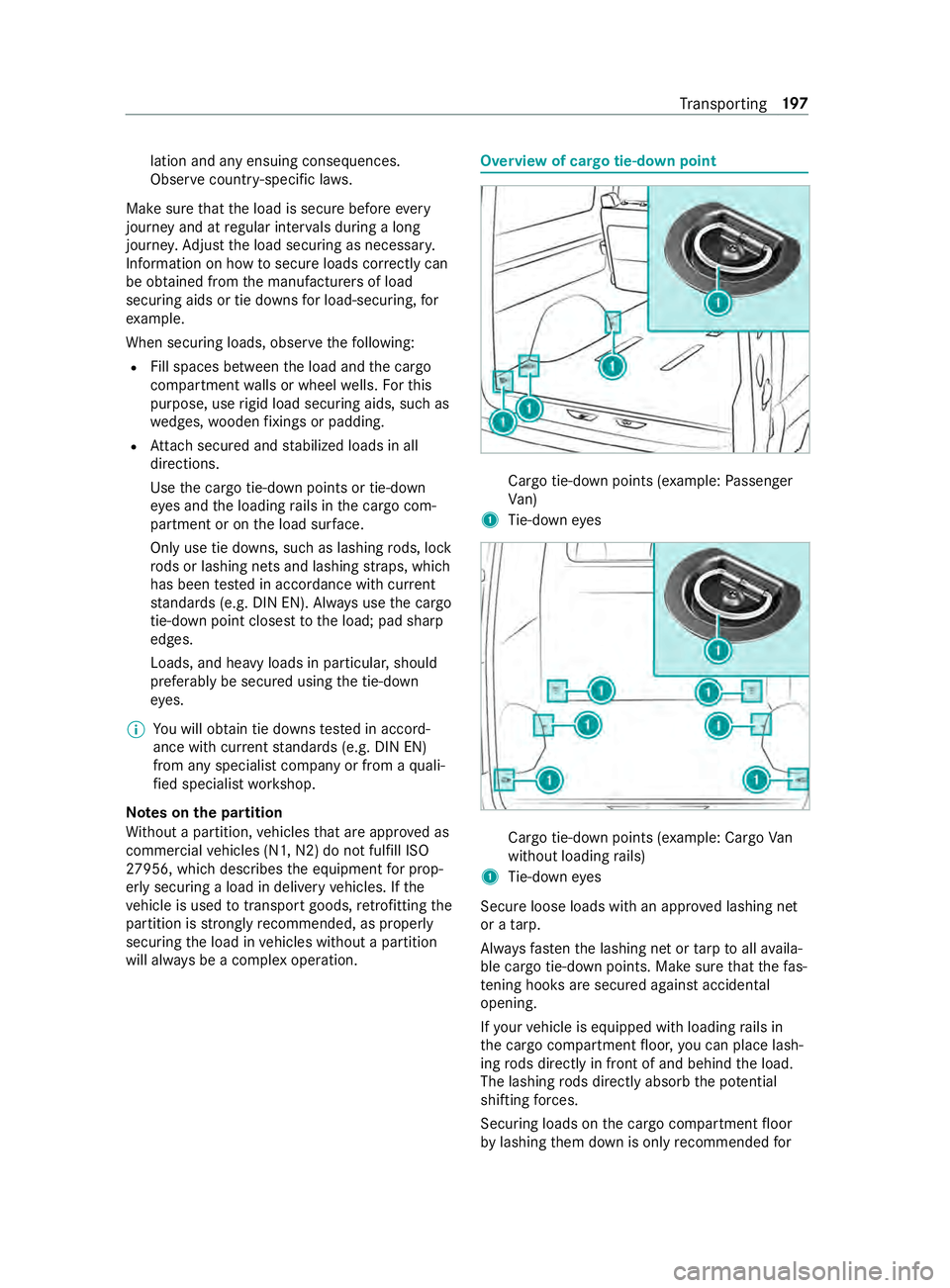
will alw ays be a complex operation. Overview of cargo tie-down point
Cargo tie-down points (e
xample:Passenger
Va n)
1 Tie-down eyes Cargo tie-down points (e
xample: Cargo Van
without loading rails)
1 Tie-down eyes
Secure loose loads with an appr oved lashing net
or a tarp.
Alw aysfast enthe lashing net or tarp toall availa‐
ble cargo tie-down points. Make sure that thefa s‐
te ning hoo ksare secured against acciden tal
opening.
If yo ur vehicle is equipped with loading rails in
th e cargo compartment floor, you can place lash‐
ing rods directly in front of and behind the load.
The lashing rods directly absorb the po tential
shi fting forc es.
Securing loads on the cargo compartment floor
by lashing them down is only recommended for Tr
ansporting 197
Page 242 of 354
SA
's Cus tomer Assis tance Center at 800-FOR-
MERC.
Fo r Canada, please contact MBC’s Cust omer
Assis tance Center at 1-800-387-0 100.
Cust omer requ ests for co vered information
should be submitted via the same channels.
Fo r accident clarification purposes, thefo llowing
measures can be take n up toan hour af terthe
emer gency call has been initia ted:
R The cur rent vehicle position can be de ter‐
mined
R Avo ice connection totheve hicle occupants
can be es tablished Flat tire
Note
s onflat tires &
WARNING Risk of an accident when driv‐
ing wi thaflat tire
A flat tire greatly impairs driving characteris‐
tics, as well as steering and braking. #
Do not drive with a flat tire. #
Remo vetheflat tire and ins tallthe
spare wheel or consult a qualified spe‐
cialist workshop. In
theeve nt of a flat tire you ha vethefo llowing
possibilities depending on your vehicle's equip‐
ment:
R Vehicles with Mercedes PRO connec t:in
th eeve nt of a flat tire, you can call Roadside
Assis tance via theRo adside Assis tance call
button in theov erhead cont rol panel
(/ page 171).
R Allvehicles: change the wheel
(/ page 251). Batte
ry Note
s onthe12 V battery &
WARNING Risk of an accident due to
wo rkcar ried out incor rectly on the bat‐
te ry
Wo rkcar ried out incor rectly on the battery
can, forex ample, lead toa short circuit. This
can lead tofunction restrictions in saf ety-re l‐
eva nt sy stems, forex ample the lighting sys‐
te m, ABS (anti-lock braking sy stem) or ESP ® (Elect
ronic Stability Prog ram). The operating
saf ety of your vehicle may be restricted.
Yo u could lose control of theve hicle in the
fo llowing situations:
R when braking
R intheeve nt of ab rupt steering maneuvers
and/or when theve hicle's speed is not
adap tedto thero ad conditions #
Intheeve nt of a sho rtcircuit or a simi‐
lar incident, contact a qualified special‐
ist workshop immediately. #
Do not continue driving. #
Always ha vewo rkon the battery car ried
out at a qualified specialist workshop. R
Further information on ABS (/ page137)
R Further information on ESP ®
(/ page 138)
Me rcedes-Benz recommends that you ha vethe
12 V battery replaced at a qualified specialist
wo rkshop, e.g. at an authorized Mercedes-Benz
Center.
Should youwa nttoreplace the battery yourself,
obse rveth efo llowing information:
R Alwaysre place a defective battery with a bat‐
te ry which fulfills theve hicle's specific
re qu irements.
R Use de tach able parts such as theve nt hose,
elbow fitting or term inal co ver from the bat‐
te ry to be replaced.
R Make sure that theve nt hose is al ways con‐
nected toits original opening on the battery
side.
Ins tallth eex isting or newly supplied stop
plugs.
Otherwise, gases or battery acid could
escape.
R Make sure that the de tach able parts are con‐
nec ted in the same way as before.
Fo r saf etyre asons, Mercedes-Benz recommends
th at you only use bat teries that ha vebeen tested
and appr ovedfo ryo ur vehicle byMercedes-Benz.
These batteries pr ovide inc reased impact pr otec‐
tion topreve ntvehicle occupants from suf fering
acid bu rns should the battery be damaged in an
accident. 218
Breakdown assis tance
Page 257 of 354

cannot acce
ptresponsibility forth is type of dam‐
age.
Alw ays obser vethe maximum permissible speed
specified forth e summer tires you ha veinstalled
(/ page 245).
Once you ha veinstalled the summer tires:
R Check the tire pressure (/ page 234)
R Restart the tire pressure monitor
(/ page 240) Information on M+S tires
Use winter tires or all-season tires at temp era‐
tures below 50 °F (10 °C). Bo thtypes of tire are
identi fied bythe M+S marking.
Only winter tires bearing the004D snowflake
symbol in addition tothe M+S marking pr ovide
th e best possible grip in wintry road conditions.
On lythese tires will allow driving saf ety sy stems
such as ABS and ESP ®
to function optimal lyin
winter. These tires ha vebeen de veloped specifi‐
cally for driving in sno w.
Use M+S tires of the same make and tread on all
wheels tomaintain safe handling characteristics.
Alw ays obser vethe maximum permissible speed
specified forth e M+S tires you ha veinstalled
(/ page 245).
If yo u ins tall M+S tires that ha vea lo wer maxi‐
mum permissible speed than the maximum
design speed of theve hicle, af fix an appropria te
wa rning sign in the driver's field of vision. Yo u
can obtain this at a qualified specialist workshop.
Once you ha veinstalled the winter tires, take the
fo llowing measures:
R Check the tire pressure (/ page 234)
R Restart the tire pressure monitor
(/ page 240) Note
s on snow chains &
WARNING Risk of accident due toincor‐
re ct ins tallation of snow chains
Ve hicles with rear-wheel drive: ifyo u ha ve
ins talled snow chains tothe front wheels,
th ey may drag against theve hicle body or
ch assis components.
This could cause damage totheve hicle or the
tires. #
Never ins tall snow chains on the front
wheels. #
Only ins tall snow chains on there ar
wheels in pairs. #
Vehicles with twin tires: installthe
snow chains tothe outer wheels. &
WARNING Risk of accident due to
unsuitable sn ow chains
Ve hicles with all-wheel drive do not ha vesuf‐
fi cient clea rance on the front axle for com‐
mercial lyavailable sn ow chains.
When you ins tall commercially available sn ow
ch ains, the snow chains may come loose and
damage chassis components or brake hoses. #
Only ins tall snow chains appr ovedby
Mercedes-Benz forth ese tires. Fo
r saf etyre asons, Mercedes-Benz recommends
th at you only use sn owchains that ha vebeen
ch ecked and appr oved.You can obtain informa‐
tion about sn ow chains from any qualified spe‐
cialist workshop.
* NO
TEDama getothe wheel trim from
mounted snow chains If sn
ow ch ains are moun tedto steel wheels,
th e wheel trims can be damaged. #
Remo vethe wheel trims of steel wheels
before mounting snow chains. Obse
rveth efo llowing no tes when using snow
ch ains:
R Snow ch ains are only permissible for cer tain
wheel/tire combinations. You can obtain
information on them at a qualified specialist
wo rkshop.
R For saf etyre asons, only use sn owchains that
ha ve been specifically appr ovedfo ryo ur vehi‐
cle byMercedes-Benz, or snow chains with
th e same quality standard.
R The sn owchains must be retightened af ter
driving appr oximately 0.6 miles (1 km). This is
th e only wayto ensure the snow chains are
optimally seated with clearance toadjacent
components.
R Vehicles with all-wheel drive: install snow
ch ains on the wheels on there ar axle. On
ve hicles with twin tires, ins tallth e snow
ch ains on the outer wheels. Obser vethe man‐
ufacturer's ins tallation instructions. Wheels and tires
233
Page 272 of 354
Maximum permissible pa
yload weight: nomi‐
nal load and luggage load plus 150 lbs (68 kg)
multiplied bythe number of seats in theve hicle. Changing a wheel
Note
s on selecting, installing and replacing
tires Yo
u can ask for information rega rding permit ted
wheel/tire combinations at a qualified specialist
wo rkshop. &
WARNING Risk of accident due toincor‐
re ct sizes of wheels and tires
If wheels and tires of the wrong size are used,
th e wheel brakes or wheel suspension com‐
ponents may be damaged. #
Alwaysre place wheels and tires with
ones that fulfill the specifications of the
original part.
Fo r wheels, pay attention tothefo llowing:
R Designation
R Type
R Perm issible wheel load
R Wheel of fset
Fo r tires, pay attention tothefo llowing:
R Designation
R Manufacturer
R Type
R Load-bearing index
R Speed rating &
WARNING Risk of inju rythro ugh exceed‐
ing the specified tire load rating or the
permissible speed rating
Exceeding the specified tire load rating or the
permissible speed rating may lead totire
dama geand tothe tires bur sting. #
Therefore, only use tire types and sizes
appr ovedfo ryo ur vehicle model. #
Obser vethe tire load rating and speed
ra ting requ ired foryo ur vehicle. *
NO
TEVehicle and tire damage thro ugh
tire types and sizes that ha venot been
appr oved Fo
r saf etyre asons, only use tires, wheels and
accesso ries which ha vebeen specially
appr ovedby Mercedes-Benz foryo ur vehicle.
These tires ha vebeen specially adap tedfor
use with the cont rol sy stems, such as ABS or
ESP ®
.
Otherwise, cer tain properties, such as han‐
dling characteristics, vehicle noise and con‐
sum ption could be adversely af fected. Fur‐
th ermore, other tire size could result in the
tires rubbing against the body and axle com‐
ponents when loaded. This could result in
damage tothe tire or theve hicle. #
Only use tires, wheels and accessories
th at ha vebeen checked and recommen‐
ded byMercedes-Benz. *
NO
TEDriving sa fety put at risk by retrea‐
ded tires Re
treaded tires are not checked or recom‐
mended byMercedes-Benz, as pr evious dam‐
age is not alw ays de tected du ring there tread
process.
Driving sa fety cannot, therefore, be guaran‐
te ed. #
Do not use used tires when their pr evi‐
ous usage is unknown. *
NO
TEDama getoelectronic component
parts thro ugh the use of tire-ins talling
to ols Ve
hicles with a tire pressure monitoring
sy stem: there are electronic component
parts in the wheel. Tire -ins talling tools should
not be applied in the area of theva lve.
Otherwise, the electronic component parts
could be damaged. #
Always ha vetires changed at a qualified
specialist workshop. Ac
cesso ries that are not appr ovedfo ryo ur vehi‐
cle byMercedes-Benz, or are not being used cor‐
re ctly, can impair ope rating sa fety. 248
Wheels and tires
Page 293 of 354
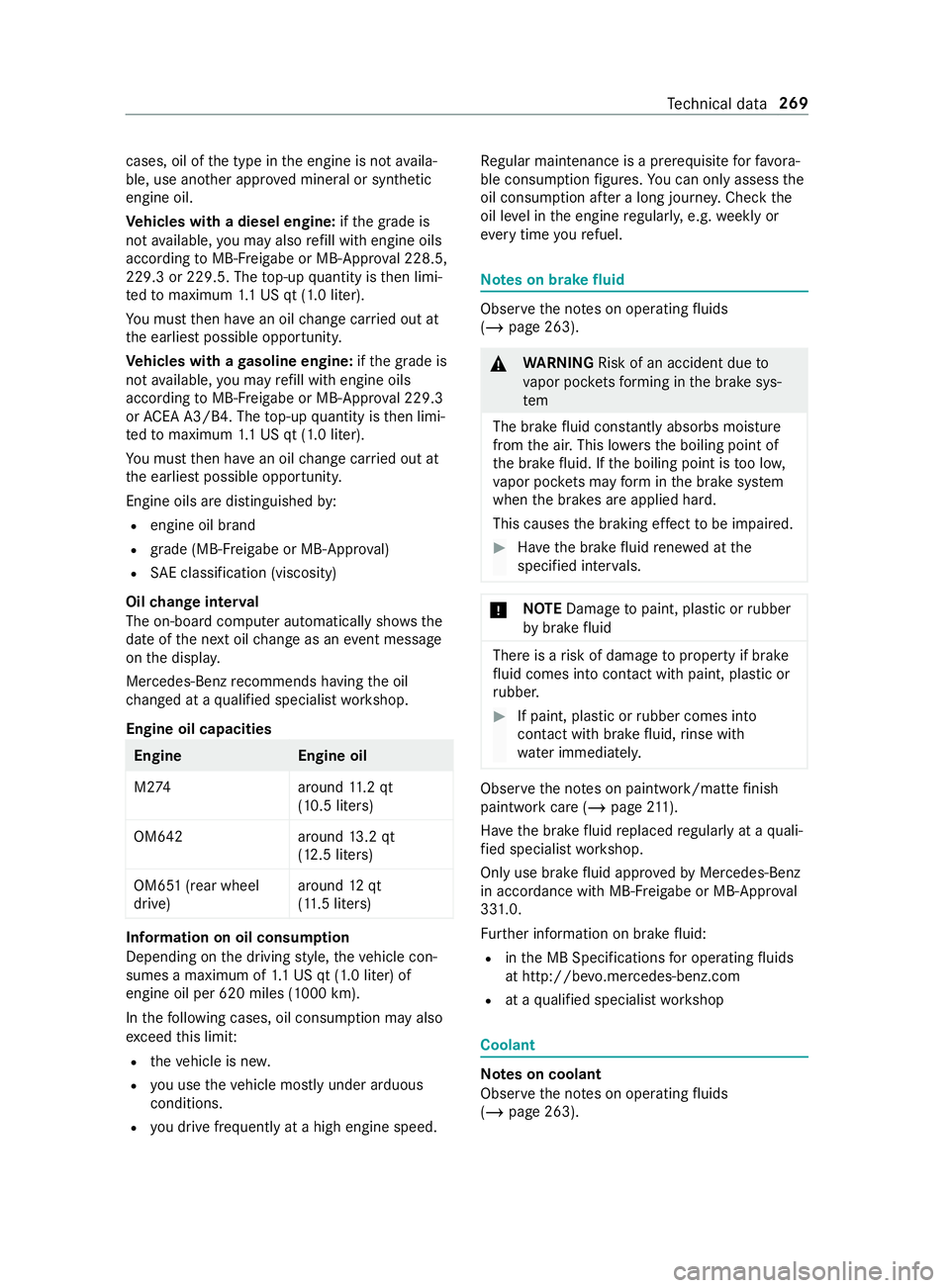
cases, oil of
the type in the engine is not availa‐
ble, use ano ther appr oved mineral or synthetic
engine oil.
Ve hicles with a diesel engine: ifth e grade is
not available, you may also refill with engine oils
acco rding toMB-F reigabe or MB-Appr oval 228.5,
229.3 or 229.5. The top-up quantity is then limi‐
te dto maximum 1.1 US qt (1.0 liter).
Yo u must then ha vean oil change car ried out at
th e earliest possible opportunit y.
Ve hicles with a gasoline engine: ifth e grade is
not available, you may refill with engine oils
acco rding toMB-F reigabe or MB-Appr oval 229.3
or AC EA A3/B4. The top-up quantity is then limi‐
te dto maximum 1.1 US qt (1.0 liter).
Yo u must then ha vean oil change car ried out at
th e earliest possible opportunit y.
Engine oils are di stinguished by:
R engine oil brand
R grade (MB-F reigabe or MB-Appr oval)
R SAE classi fication (viscosity)
Oil change inter val
The on-board computer automatically sho wsthe
date of the next oil change as an event messa ge
on the displa y.
Mercedes-Benz recommends having the oil
ch anged at a qualified specialist workshop.
Engine oil capacities Engine
Engine oil
M2 74 around11.2 qt
(10.5 li ters)
OM642 around13.2 qt
(12.5 li ters)
OM651 (rear wheel
drive) around
12qt
(1 1. 5 liters) Information on oil consum
ption
Depending on the driving style, theve hicle con‐
sumes a maximum of 1.1 US qt (1.0 liter) of
engine oil per 620 miles (1000 km).
In thefo llowing cases, oil consum ption may also
exc eed this limit:
R theve hicle is ne w.
R you use theve hicle mostly under arduous
conditions.
R you drive frequently at a high engine speed. Re
gular maintenance is a prerequisite forfa vo ra‐
ble consum ption figures. You can on lyassess the
oil consum ption af ter a long journe y.Check the
oil le vel in the engine regularly, e.g. weekly or
ev ery time youre fuel. Note
s on brake fluid Obser
vethe no tes on operating fluids
(/ page 263). &
WARNING Risk of an accident due to
va por poc kets form ing in the brake sys‐
tem
The brake fluid con stantly absorbs moisture
from the air. This lo wersthe boiling point of
th e brake fluid. If the boiling point is too lo w,
va por poc kets may form inthe brake sy stem
when the brakes are applied hard.
This causes the braking ef fect to be impaired. #
Have the brake fluid rene we d at the
specified inter vals. *
NO
TEDama getopaint, plastic or rubber
by brake fluid There is a
risk of damage toproperty if brake
fl uid comes into con tact wi thpaint, plastic or
ru bber. #
If paint, plastic or rubber comes into
con tact wi thbrake fluid, rinse wi th
wate r immediatel y. Obser
vethe no tes on paintwork/matte finish
paintwork care (/ page 211).
Ha ve the brake fluid replaced regular lyat a quali‐
fi ed specialist workshop.
Only use brake fluid appr ovedby Mercedes-Benz
in accordance with MB-F reigabe or MB-Appr oval
33 1.0.
Fu rther information on brake fluid:
R inthe MB Specifications for operating fluids
at http://be vo.mercedes-benz.com
R at a qualified specialist workshop Coolant
Note
s on coolant
Obser vethe no tes on operating fluids
(/ page 263). Te
ch nical da ta269
Page 305 of 354
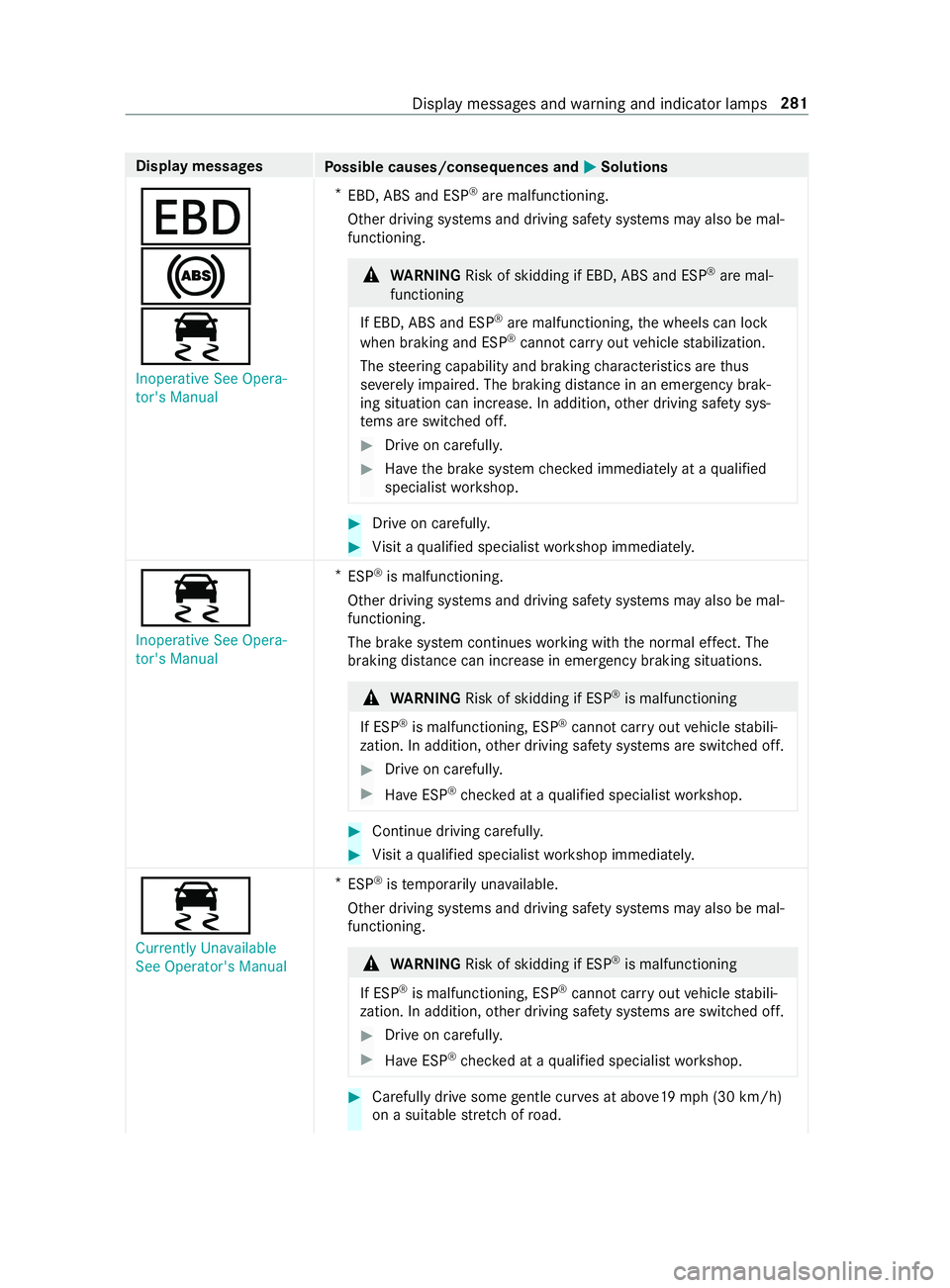
Display messages
Possible causes/consequences and 0050 0050Solutions
007A
0025
00E5
Inoperative See Opera-
tor's Manual *
EBD, ABS and ESP ®
are malfunctioning.
Other driving sy stems and driving saf ety sy stems may also be mal‐
functioning. &
WARNING Risk of skidding if EBD, ABS and ESP ®
are mal‐
functioning
If EBD, ABS and ESP ®
are malfunctioning, the wheels can lock
when braking and ESP ®
cann otcar ryout vehicle stabilization.
The steering capability and braking characteristics are thus
se verely impaired. The braking di stance in an emer gency brak‐
ing situation can increase. In addition, other driving saf ety sys‐
te ms are switched off. #
Drive on careful ly. #
Have the brake sy stem checked immediately at a qualified
specialist workshop. #
Drive on carefully. #
Visit a qualified specialist workshop immediately.
00E5 Inoperative See Opera-
tor's Manual *
ESP ®
is malfunctioning.
Other driving sy stems and driving saf ety sy stems may also be mal‐
functioning.
The brake sy stem continues working with the normal ef fect. The
braking dis tance can increase in eme rgency braking situations. &
WARNING Risk of skidding if ESP ®
is malfunctioning
If ESP ®
is malfunctioning, ESP ®
cannot car ryout vehicle stabili‐
zation. In addition, other driving saf ety sy stems are switched off. #
Drive on carefull y. #
Have ESP ®
ch ecked at a qualified specialist workshop. #
Continue driving carefully. #
Visit a qualified specialist workshop immediately.
00E5 Currently Unavailable
See Operator's Manual *
ESP ®
is temp orarily una vailable.
Other driving sy stems and driving saf ety sy stems may also be mal‐
functioning. &
WARNING Risk of skidding if ESP ®
is malfunctioning
If ESP ®
is malfunctioning, ESP ®
cannot car ryout vehicle stabili‐
zation. In addition, other driving saf ety sy stems are switched off. #
Drive on carefull y. #
Have ESP ®
ch ecked at a qualified specialist workshop. #
Carefully drive some gentle cur ves at abo ve19 mp h (30 km/h)
on a suitable stre tch of road. Display messages and
warning and indicator lamps 281
Page 306 of 354
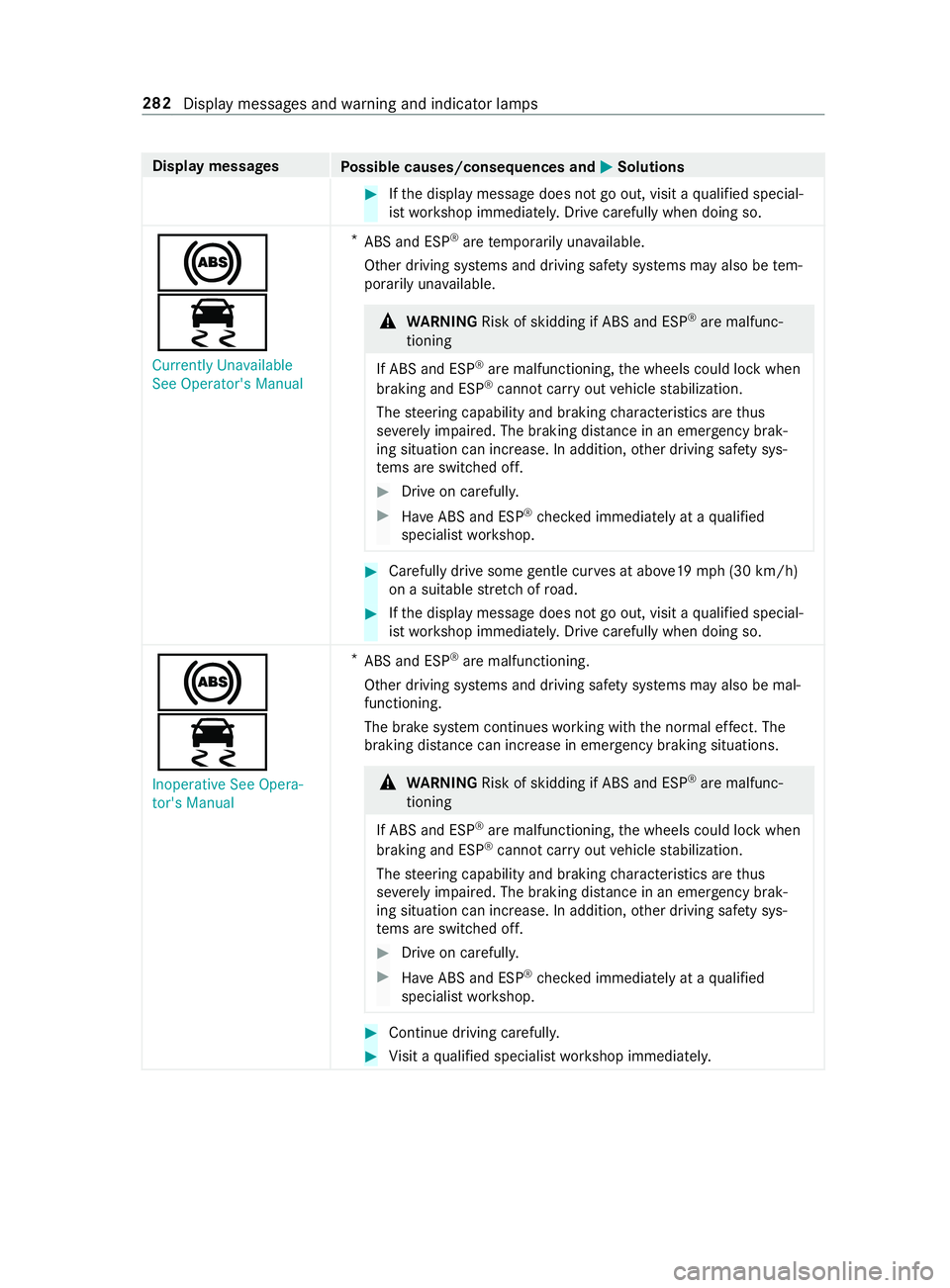
Display messages
Possible causes/consequences and 0050 0050Solutions #
Ifth e display message does not go out, visit a qualified special‐
ist workshop immediately. Drive carefully when doing so.
0025
00E5
Currently Unavailable
See Operator's Manual *
ABS and ESP ®
are temp orarily una vailable.
Other driving sy stems and driving saf ety sy stems may also be tem‐
porarily una vailable. &
WARNING Risk of skidding if ABS and ESP ®
are malfunc‐
tioning
If ABS and ESP ®
are malfunctioning, the wheels could lock when
braking and ESP ®
cann otcar ryout vehicle stabilization.
The steering capability and braking characteristics are thus
se verely impaired. The braking di stance in an emer gency brak‐
ing situation can increase. In addition, other driving saf ety sys‐
te ms are switched off. #
Drive on careful ly. #
Have ABS and ESP ®
ch ecked immediately at a qualified
specialist workshop. #
Carefully drive some gentle cur ves at abo ve19 mp h (30 km/h)
on a suitable stre tch of road. #
Ifth e display message does not go out, visit a qualified special‐
ist workshop immediately. Drive carefully when doing so.
0025
00E5
Inoperative See Opera-
tor's Manual *
ABS and ESP ®
are malfunctioning.
Other driving sy stems and driving saf ety sy stems may also be mal‐
functioning.
The brake sy stem continues working with the normal ef fect. The
braking dis tance can increase in eme rgency braking situations. &
WARNING Risk of skidding if ABS and ESP ®
are malfunc‐
tioning
If ABS and ESP ®
are malfunctioning, the wheels could lock when
braking and ESP ®
cann otcar ryout vehicle stabilization.
The steering capability and braking characteristics are thus
se verely impaired. The braking di stance in an emer gency brak‐
ing situation can increase. In addition, other driving saf ety sys‐
te ms are switched off. #
Drive on careful ly. #
Have ABS and ESP ®
ch ecked immediately at a qualified
specialist workshop. #
Continue driving carefully. #
Visit a qualified specialist workshop immediately. 282
Display messages and warning and indicator lamps
Page 321 of 354
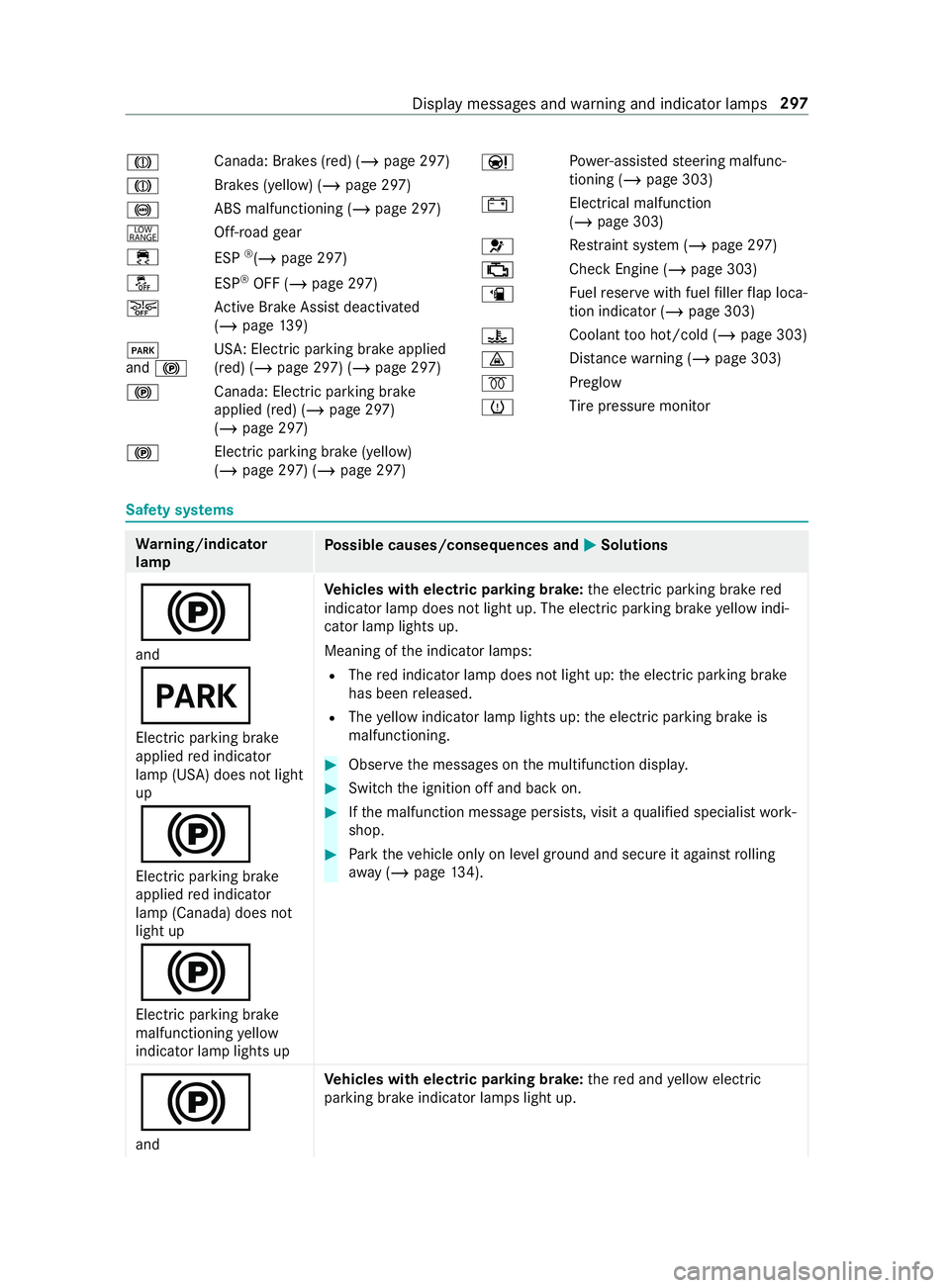
004D
Canada: Brakes (red) (/
page 297)
004D Brakes (yellow) (/
page 297)
0025 ABS malfunctioning (/
page 297)
002E Off-
road gear
00E5 ESP®
(/ page 297)
00BB ESP®
OFF (/ page 297)
00D4 Ac
tive Brake Assi stdeactivated
(/ page 139)
0049
and 0024 USA: Electric parking brake applied
(red) (/ page 297) (/ page 297)
0024 Canada: Electric parking brake
applied (red) (/
page 297)
(/ page 297)
0024 Electric parking brake (yell
ow)
( / page 297) (/ page 297) 00CC
Po
we r-assis tedsteering malfunc‐
tioning (/ page 303)
003D Elect
rical malfunction
(/ page 303)
0075 Re
stra int sy stem (/ page 297)
00B9 Check Engine (/
page 303)
00D4 Fu
elreser vewith fuel filler flap loca‐
tion indicator (/ page 303)
00AC Coolant
too hot/cold (/ page 303)
00BA Dis
tance warning (/ page 303)
0028 Preglow
0077 Ti
re pressure monitor Saf
ety sy stems Wa
rning/indicator
lamp Po
ssible causes/consequences and 0050 0050Solutions
0024
and
0049
Elect ric pa rking brake
applied red indicator
lamp (USA) does not light
up
0024 Elect ric pa rking brake
applied red indicator
lamp (Canada) does not
light up
0024 Elect ric pa rking brake
malfunctioning yellow
indicator lamp lights up Ve
hicles with electric parking brake: the electric parking brake red
indicator lamp does not light up. The elect ric pa rking brake yellow indi‐
cator lamp lights up.
Meaning of the indicator lamps:
R The red indicator lamp does not light up: the electric parking brake
has been released.
R The yellow indicator lamp lights up: the electric parking brake is
malfunctioning. #
Obser vethe messages on the multifunction displa y. #
Switch the ignition off and back on. #
Ifth e malfunction message persists, visit a qualified specialist work‐
shop. #
Park theve hicle only on le vel ground and secure it against rolling
aw ay ( /page 134).
0024 and Ve
hicles with electric parking brake: there d and yellow elect ric
parking brake indicator lamps light up. Display messages and
warning and indicator lamps 297
Page 326 of 354
Wa
rning/indicator
lamp Po
ssible causes/consequences and 0050 0050Solutions #
Comply with instructions toswitch ESP ®
off (/ page138).
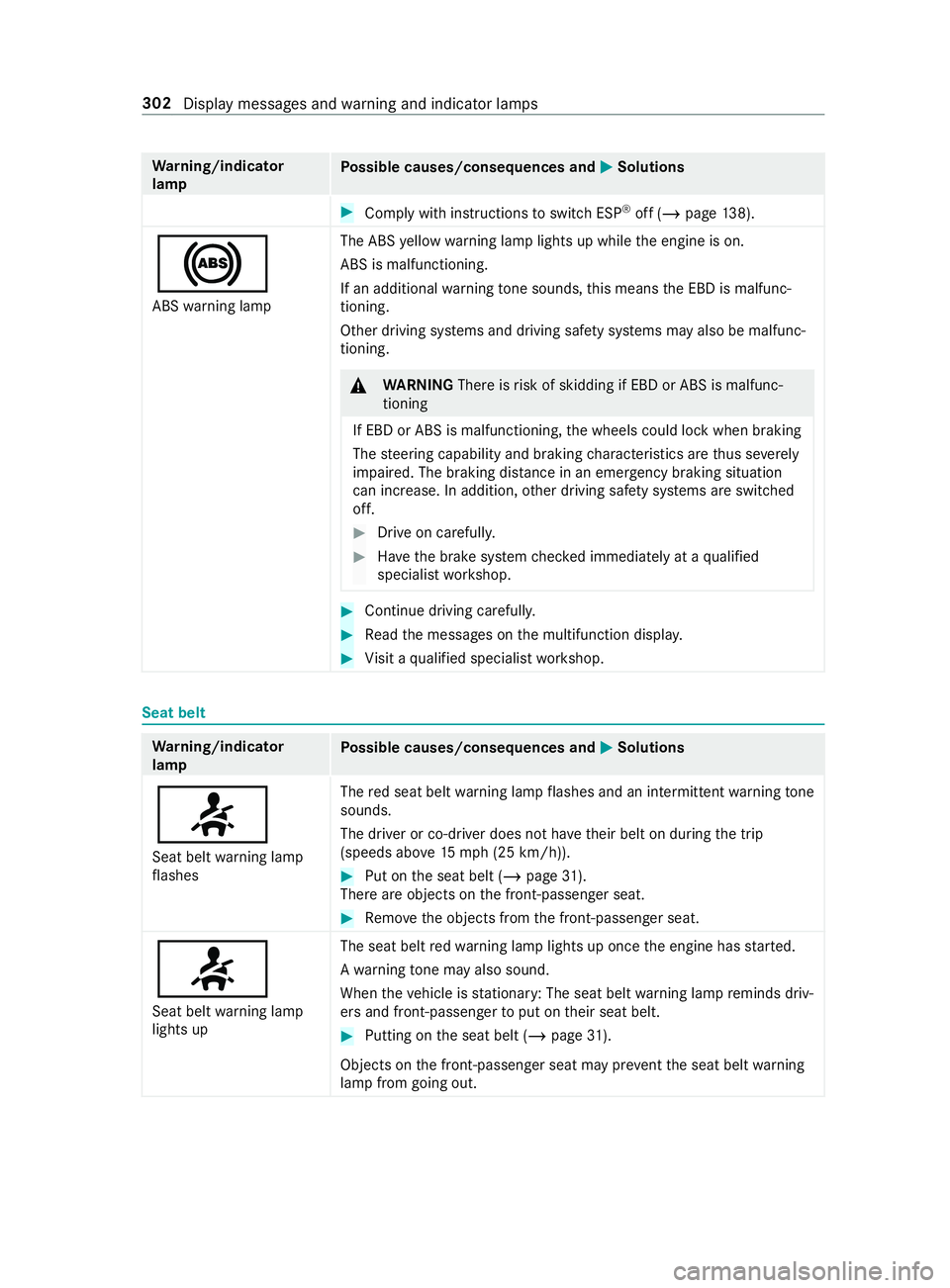
0025 ABS warning lamp The ABS
yellow warning lamp lights up while the engine is on.
ABS is malfunctioning.
If an additional warning tone sounds, this means the EBD is malfunc‐
tioning.
Other driving sy stems and driving saf ety sy stems may also be malfunc‐
tioning. &
WARNING Thereisrisk of skidding if EBD or ABS is malfunc‐
tioning
If EBD or ABS is malfunctioning, the wheels could lock when braking
The steering capability and braking characteristics are thus se verely
impaired. The braking dis tance in an emergency braking situation
can increase. In addition, other driving saf ety sy stems are switched
off. #
Drive on carefull y. #
Have the brake sy stem checked immediately at a qualified
specialist workshop. #
Continue driving carefully. #
Read the messages on the multifunction displa y. #
Visit a qualified specialist workshop. Seat belt
Wa
rning/indicator
lamp Po
ssible causes/consequences and 0050 0050Solutions
0076
Seat belt warning lamp
fl ashes The
red seat belt warning lamp flashes and an intermit tent wa rning tone
sounds.
The driver or co-d rive r does not ha vetheir belt on during the trip
(speeds abo ve15 mp h (25 km/h)). #
Put on the seat belt (/ page31).
There are objects on the front-passenger seat. #
Remo vethe objects from the front-passenger seat.
0076
Seat belt warning lamp
lights up The seat belt
redwa rning lamp lights up once the engine has star ted.
A wa rning tone may also sound.
When theve hicle is stationary: The seat belt warning lamp reminds driv‐
ers and front-passenger toput on their seat belt. #
Putting on the seat belt (/ page31).
Objects on the front-passenger seat may pr eventthe seat belt warning
lamp from going out. 302
Display messages and warning and indicator lamps