ECU MERCEDES-BENZ SPRINTER 2019 MY19 with 7” screen
[x] Cancel search | Manufacturer: MERCEDES-BENZ, Model Year: 2019, Model line: SPRINTER, Model: MERCEDES-BENZ SPRINTER 2019Pages: 354, PDF Size: 6.15 MB
Page 60 of 354
#
Toinstall a child restra int sy stem: when
ins talling a child restra int sy stem, alw ays
obser vethe manufacturer's ins tallation and
operating instructions as well as the informa‐
tion in this Operator's Manual. #
Pull the seat belt smoo thly from the seat belt
outlet. #
Enga gethe seat belt tongue in the seat belt
buckle. #
Toactivate the special seat belt retractor:
pull the seat belt out fully and let the inertia
re el retract it again.
When the special seat belt retractor is acti va‐
te d, you should hear a ratcheting sound. #
Push thech ild restra int sy stem down until the
seat belt sits tightl y. #
Todeactivate the special seat belt retrac‐
to r:press there lease button of the seat belt
buckle. #
Hold the seat belt tongue and guide ba ckto
th e seat belt outlet. Installing
theLA TC H-type (ISOFIX) child
re stra int sy stem on there ar seat Note
s onLATC H-type (ISOFIX) child seat
securing sy stems &
WARNING Risk of inju ryor death if the
permissible gross mass of thech ild and
ch ild restra int sy stem is exceeded
Fo rLA TC H-type (ISOFIX) child restra int sys‐
te ms in which thech ild is secured using the
integ rated seat belt in thech ild restra int sys‐
te m, the permissible gross mass of thech ild
and child restra int sy stem is 73lb (33 kg).
If th ech ild and thech ild restra int sy stem
to ge ther we igh more than 73 lb (33 kg),the
LA TC H-type (ISOFIX) child restra int sy stem
with integrated seat belt does not of fer suf fi‐
cient pr otection. An excessive load may be
placed on theLA TC H-type (ISOFIX) child seat
attachments and thech ild may not be
re stra ined in theeve nt of an accident, for
ex ample. #
Ifth ech ild and thech ild restra int sys‐
te m toge ther we igh more than 73 lb
(33 kg), use only a LATC H-type (ISOFIX)
ch ild restra int sy stem that secures the
ch ild with theve hicle seat belt. #
Also secure thech ild restra int sy stem
with theTo pTe ther belt, if available. Alw
ays comply with the information about the
mass of thech ild restra int sy stem:
R Inthe manufacturer's ins tallation and operat‐
ing instructions forth ech ild restra int sy stem
used
R On a label on thech ild restra int sy stem, if
av ailable
Check regularly that the permissible gross mass
of thech ild plus thech ild restra int sy stem is not
exc eeded.
When ins talling a child restra int sy stem, be sure
to obser vethe manufacturer's ins tallation and
operating instructions and the cor rect use of the
ch ild restra int sy stem as well as consider the
suitability of the seats.
ISOFIX is a standardized securing sy stem for spe‐
cial restra int sy stems. LATC H-type (ISOFIX) child
re stra int sy stems are appr oved in accordance
with UN-R44.
Only child restra int sy stems that ha vebeen
appr oved in accordance with UN-R44 may be
attached toLATC H-type (ISOFIX) mounting brack‐
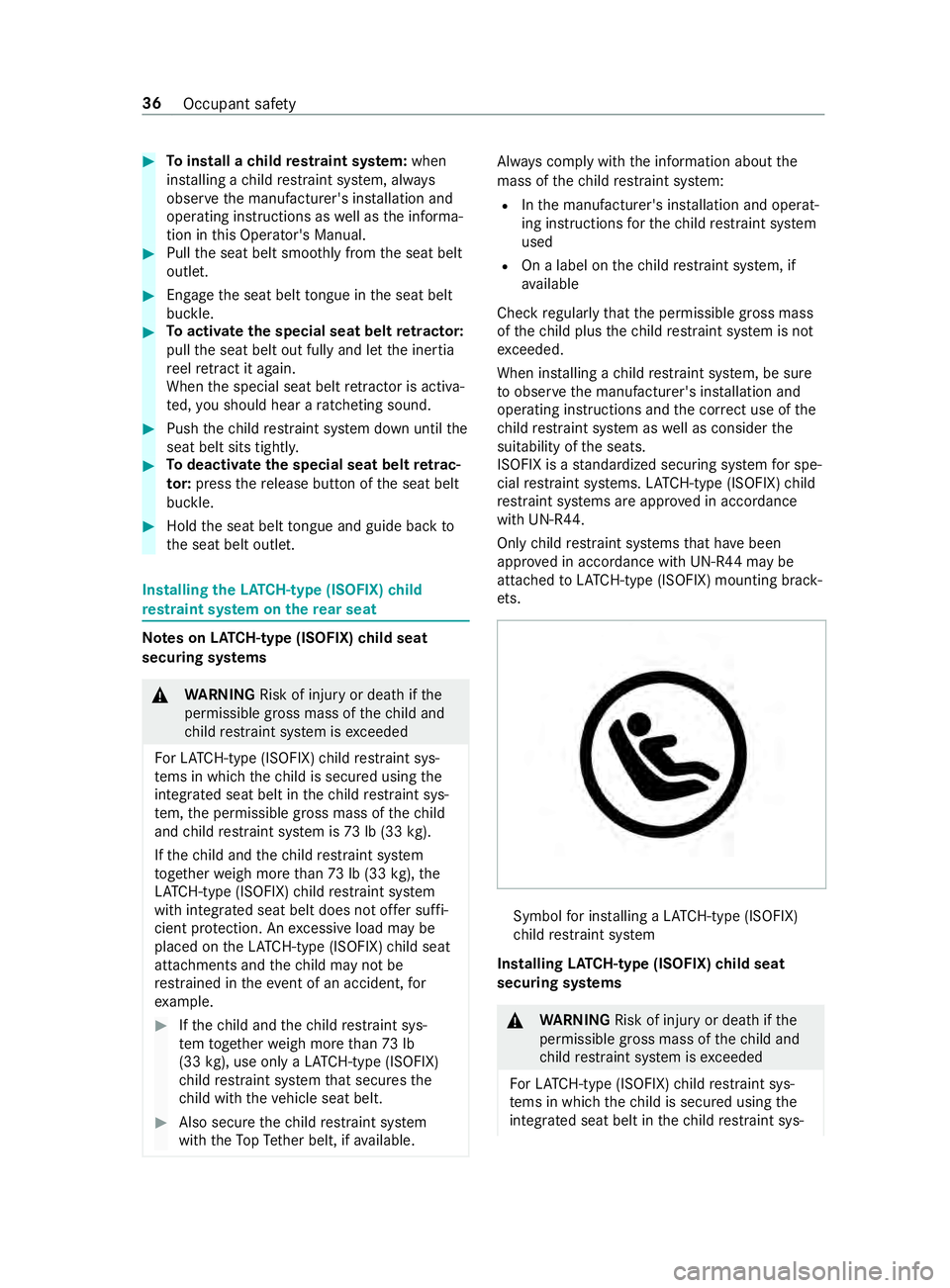
et s. Symbol
for ins talling a LATC H-type (ISOFIX)
ch ild restra int sy stem
Installing LATC H-type (ISOFIX) child seat
securing sy stems &
WARNING Risk of inju ryor death if the
permissible gross mass of thech ild and
ch ild restra int sy stem is exceeded
Fo rLA TC H-type (ISOFIX) child restra int sys‐
te ms in which thech ild is secured using the
integ rated seat belt in thech ild restra int sys‐ 36
Occupant saf ety
Page 61 of 354
te
m, the permissible gross mass of thech ild
and child restra int sy stem is 73lb (33 kg).
If th ech ild and thech ild restra int sy stem
to ge ther we igh more than 73 lb (33 kg),the
LA TC H-type (ISOFIX) child restra int sy stem
with integrated seat belt does not of fer suf fi‐
cient pr otection. An excessive load may be
placed on theLA TC H-type (ISOFIX) child seat
attachments and thech ild may not be
re stra ined in theeve nt of an accident, for
ex ample. #
Ifth ech ild and thech ild restra int sys‐
te m toge ther we igh more than 73 lb
(33 kg), use only a LATC H-type (ISOFIX)
ch ild restra int sy stem that secures the
ch ild with theve hicle seat belt. #
Also secure thech ild restra int sy stem
with theTo pTe ther belt, if available. Alw
ays comply with the information about the
mass of thech ild restra int sy stem:
R Inthe manufacturer's ins tallation and operat‐
ing instructions forth ech ild restra int sy stem
used
R On a label on thech ild restra int sy stem, if
av ailable
Check regularly that the permissible gross mass
of thech ild plus thech ild restra int sy stem is not
exc eeded.
When ins talling a child restra int sy stem, be sure
to obser vethe manufacturer's ins tallation and
operating instructions and the cor rect use of the
ch ild restra int sy stem as well as consider the
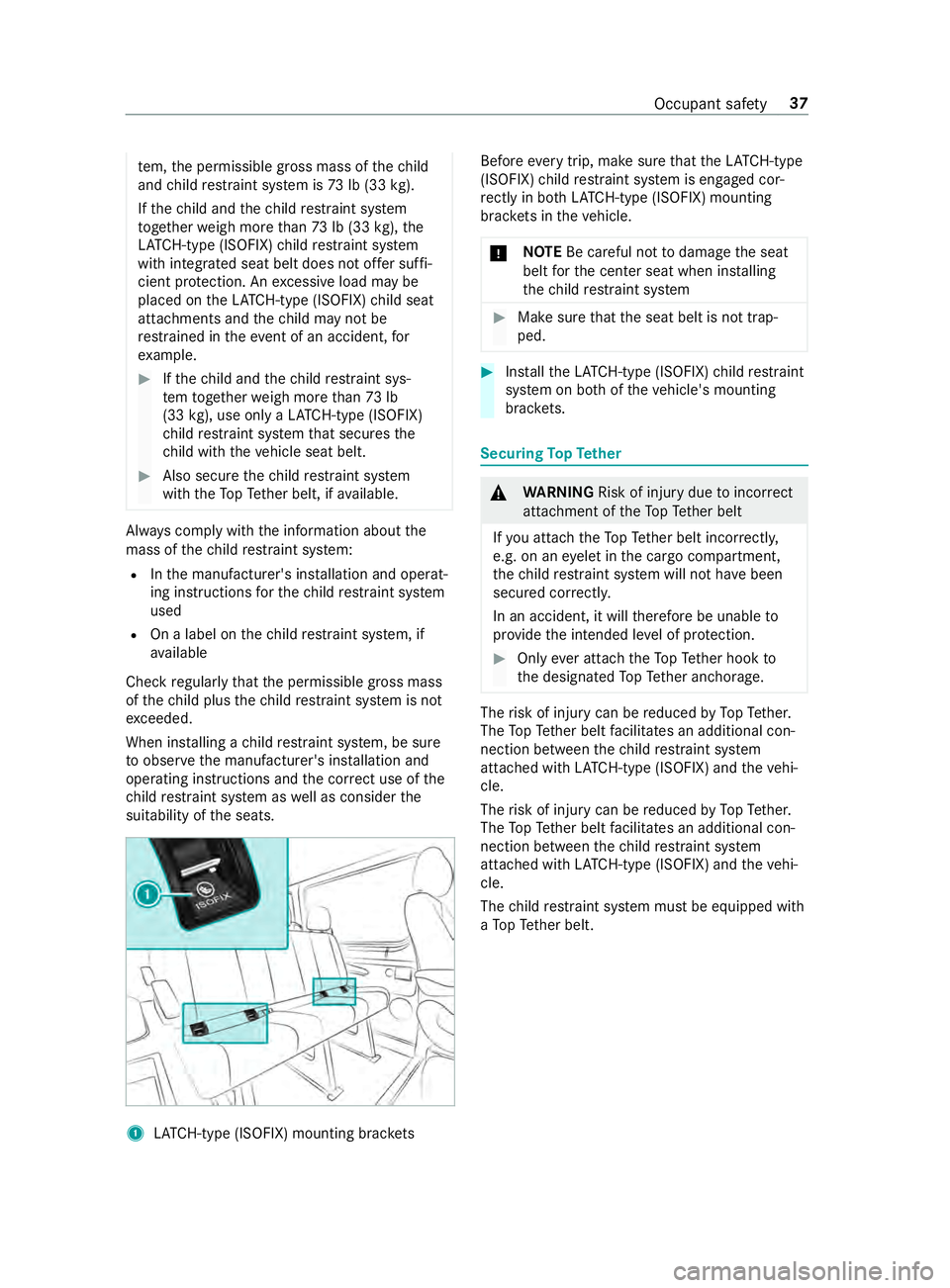
suitability of the seats. 1
LATC H-type (ISOFIX) mounting brac kets Before
every trip, make sure that theLA TC H-type
(ISOFIX) child restra int sy stem is engaged cor‐
re ctly in bo thLATC H-type (ISOFIX) mounting
brac kets in theve hicle.
* NO
TEBe careful not todamage the seat
belt forth e center seat when ins talling
th ech ild restra int sy stem #
Make sure that the seat belt is not trap‐
ped. #
Installth eLA TC H-type (ISOFIX) child restra int
sy stem on bo thoftheve hicle's mounting
brac kets. Secu
ring TopTe ther &
WARNING Risk of inju rydue toincor rect
attachment of theTo pTe ther belt
If yo u attach theTo pTe ther belt incor rectl y,
e.g. on an eyelet in the cargo compartment,
th ech ild restra int sy stem will not ha vebeen
secured cor rectly.
In an accident, it will therefore be unable to
pr ov ide the intended le vel of pr otection. #
Only ever attach theTo pTe ther hook to
th e designated TopTe ther anchorage. The
risk of injury can be reduced byTopTe ther.
The TopTe ther belt facilitates an additional con‐
nection between thech ild restra int sy stem
attached with LATC H-type (ISOFIX) and theve hi‐
cle.
The risk of injury can be reduced byTopTe ther.
The TopTe ther belt facilitates an additional con‐
nection between thech ild restra int sy stem
attached with LATC H-type (ISOFIX) and theve hi‐
cle.
The child restra int sy stem must be equipped with
a To pTe ther belt. Occupant saf
ety37
Page 62 of 354
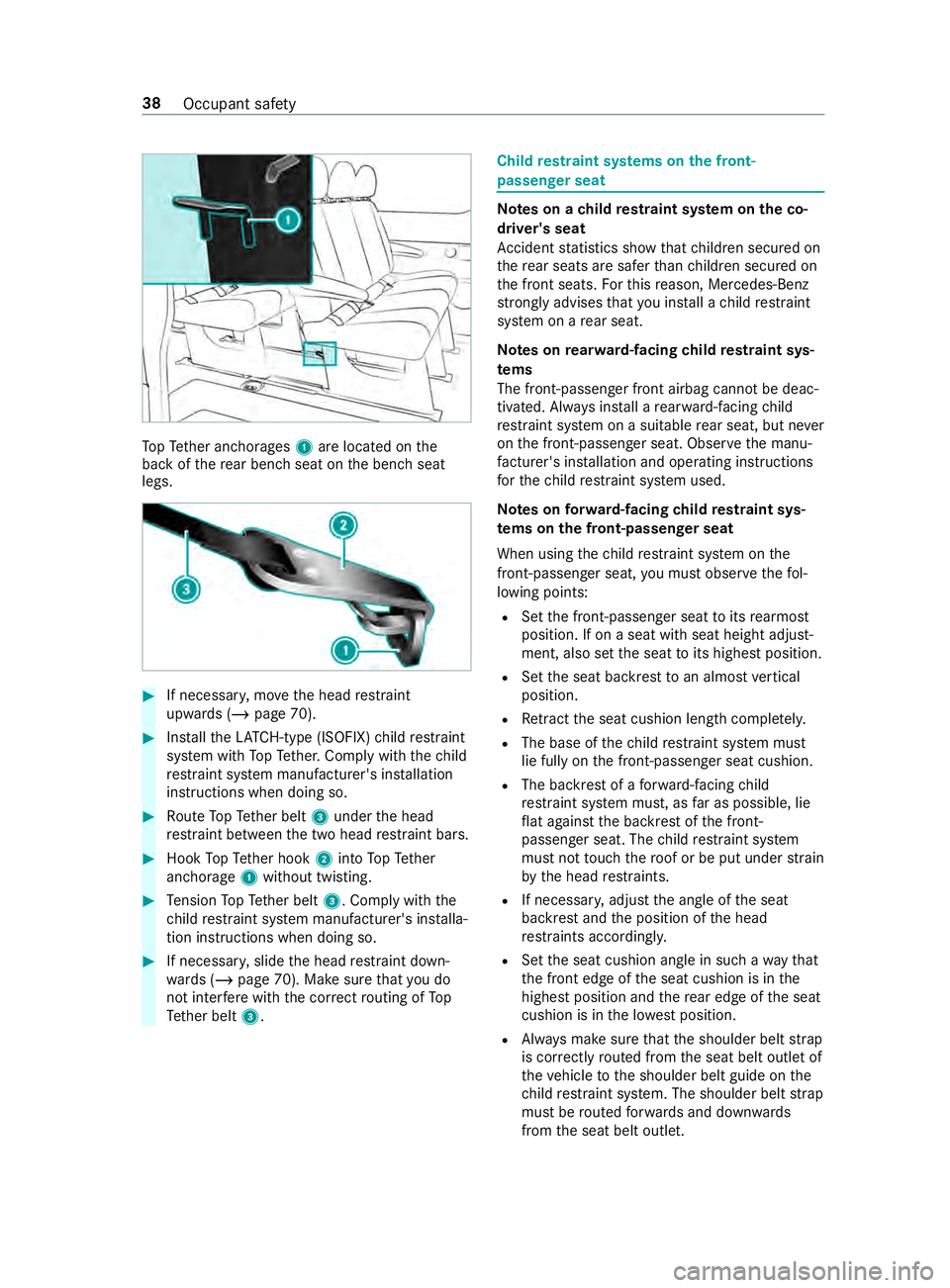
To
pTe ther anchorages 1are located on the
back of there ar ben chseat on the bench seat
legs. #
If necessar y,mo vethe head restra int
upwards (/ page 70). #
Installth eLA TC H-type (ISOFIX) child restra int
sy stem with TopTe ther. Comply with thech ild
re stra int sy stem manufacturer's ins tallation
instructions when doing so. #
Route TopTe ther belt 3under the head
re stra int between the two head restra int bars. #
Hook TopTe ther hook 2into TopTe ther
anchorage 1without twisting. #
Tension TopTe ther belt 3. Comply with the
ch ild restra int sy stem manufacturer's ins talla‐
tion instructions when doing so. #
If necessar y,slide the head restra int down‐
wa rds (/ page 70). Make sure that you do
not inter fere with the cor rect routing of To p
Te ther belt 3. Child
restra int sy stems on the front-
passenger seat Note
s on a child restra int sy stem on the co-
driver's seat
Ac cident statistics show that children secured on
th ere ar seats are safer than children secured on
th e front seats. Forth is reason, Mercedes-Benz
stro ngly advises that you ins tall a child restra int
sy stem on a rear seat.
Note s onrear wa rd-facing child restra int sys‐
te ms
The front-passen ger front airbag cannot be deac‐
tivated. Alw ays ins tall a rear wa rd-facing child
re stra int sy stem on a suitable rear seat, but ne ver
on the front-passen ger seat. Obser vethe manu‐
fa cturer's ins tallation and operating instructions
fo rth ech ild restra int sy stem used.
Note s onforw ard-facing child restra int sys‐
te ms on the front-passenger seat
When using thech ild restra int sy stem on the
front-passenger seat, you must obse rveth efo l‐
lowing points:
R Set the front-passen ger seat toits rearmost
position. If on a seat with seat height adjust‐
ment, also set the seat toits highest position.
R Set the seat backrest toan almost vertical
position.
R Retract the seat cushion length comple tely.
R The base of thech ild restra int sy stem must
lie fully on the front-passen ger seat cushion.
R The backrest of a forw ard-facing child
re stra int sy stem must, as far as possible, lie
fl at against the backrest of the front-
passenger seat. The child restra int sy stem
must not touch thero of or be put under stra in
by the head restra ints.
R If necessar y,adjust the angle of the seat
backrest and the position of the head
re stra ints acco rding ly.
R Set the seat cushion angle in such a wayth at
th e front edge of the seat cushion is in the
highest position and there ar edge of the seat
cushion is in the lo west position.
R Always make sure that the shoulder belt strap
is cor rectly routed from the seat belt outlet of
th eve hicle tothe shoulder belt guide on the
ch ild restra int sy stem. The shoulder belt strap
must be routed forw ards and down wards
from the seat belt outlet. 38
Occupant saf ety
Page 63 of 354
R
If necessar y,adjust the seat belt outlet and
th e front-passenger seat as appropriate.
R Never place objects under or behind thech ild
re stra int sy stem, e.g. cushions.
Alw ays obser vethe manufacturer's ins tallation
and operating instructions forth ech ild restra int
sy stem being used. Ac
tivating/deactivating child saf ety loc ksfor
th e doors &
WARNING Risk of accident and inju ry
due tochildren left unat tended in the
ve hicle
If ch ildren are left unat tended in theve hicle,
th ey could:
R Open doo rs,th ereby endangering other
persons or road users.
R Get out and be stru ck byoncoming traf‐
fi c.
R Ope rate ve hicle equipment and become
trapped, forex ample.
In addition, thech ildren could also set the
ve hicle in motion, forex ample by:
R Releasing the parking brake.
R Changing the transmission position.
R Starting theve hicle. #
Never lea vechildren unat tended in the
ve hicle. #
When leaving theve hicle, alw aysta ke
th eke y with you and lock theve hicle. #
Keep theve hicle key out of reach of
ch ildren. &
WARNING Risk offata l injury due to
ex posure toextreme heat or cold in the
ve hicle
If people – particular lych ildren – are exposed
to extreme temp eratures over an extended
pe riod of time, there is a risk of serious or
eve nfa ta l injur y. #
Never lea veanyone – pa rticularly chil‐
dren – unat tended in theve hicle. #
Never lea veanimals in theve hicle unat‐
te nded. &
WARNING Risk of accident and injury
due tochildren left unat tended in the
ve hicle
When children are tra veling in theve hicle,
th ey could:
R open doo rs,th ereby endangering other
people or road users
R getout of theve hicle and be hit bytraf fic
R operate vehicle equipment and become
trapped, forex ample #
When children are tra veling in theve hi‐
cle, alw ays activate theav ailable child
saf ety loc ks. #
Never lea vechildren unat tended in the
ve hicle. #
When leaving theve hicle, alw aysta ke
th eke y with you and lock theve hicle. The
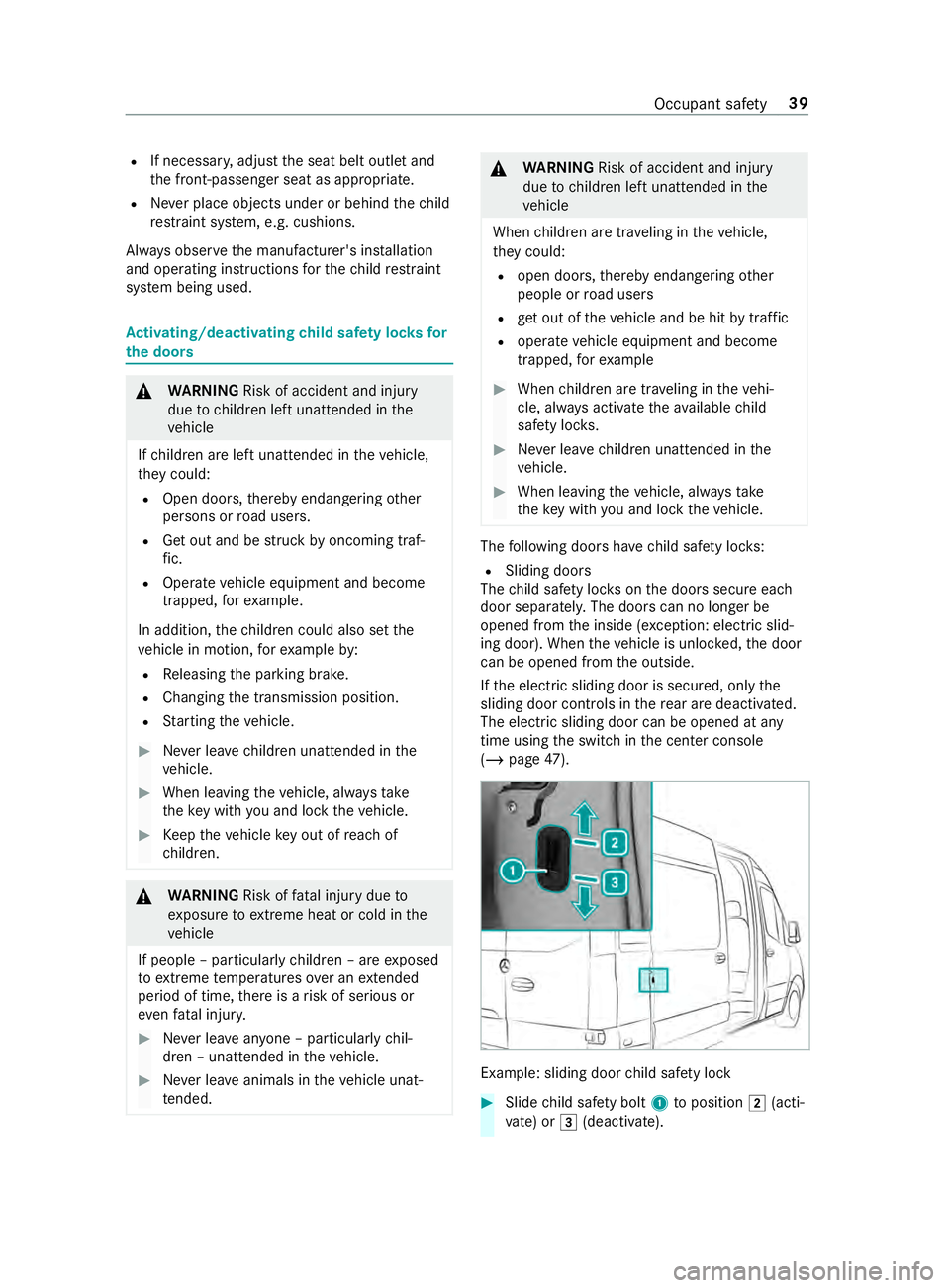
following doors ha vechild saf ety loc ks:
R Sliding doo rs
The child saf ety loc kson the doors secure each
door separatel y.The doors can no longer be
opened from the inside (e xception: electric slid‐
ing door). When theve hicle is unloc ked, the door
can be opened from the outside.
If th e electric sliding door is secured, only the
sliding door contro ls inthere ar are deactivated.
The electric sliding door can be opened at any
time using the switch in the center console
(/ page 47). Example: sliding door
child saf ety lock #
Slide child saf ety bolt 1toposition 0048(acti‐
va te) or 0049(deactivate). Occupant saf
ety39
Page 64 of 354
#
Make sure that thech ild saf ety loc ksare
wo rking properly. Note
s on pets in theve hicle &
WARNING Risk of accident and inju ry
due toanimals left unsecured or unat ten‐
ded in theve hicle
If yo u lea veanimals in theve hicle unattended
or unsecured, they could possib lypress down
buttons or switches.
Thereby an animal may:
R activate vehicle equipment and become
trapped, forex ample
R swit chsystems on or off and endanger
ot her road users
Un secured animals may be throw n around in
th eve hicle in theeve nt of an accident or sud‐
den steering and braking maneuver and injure
ve hicle occupants in the process. #
Never lea veanimals in theve hicle unat‐
te nded. #
Always cor rectly secu reanimals while
driving, forex ample using a suitable ani‐
mal car rier. 40
Occupant saf ety
Page 77 of 354
#
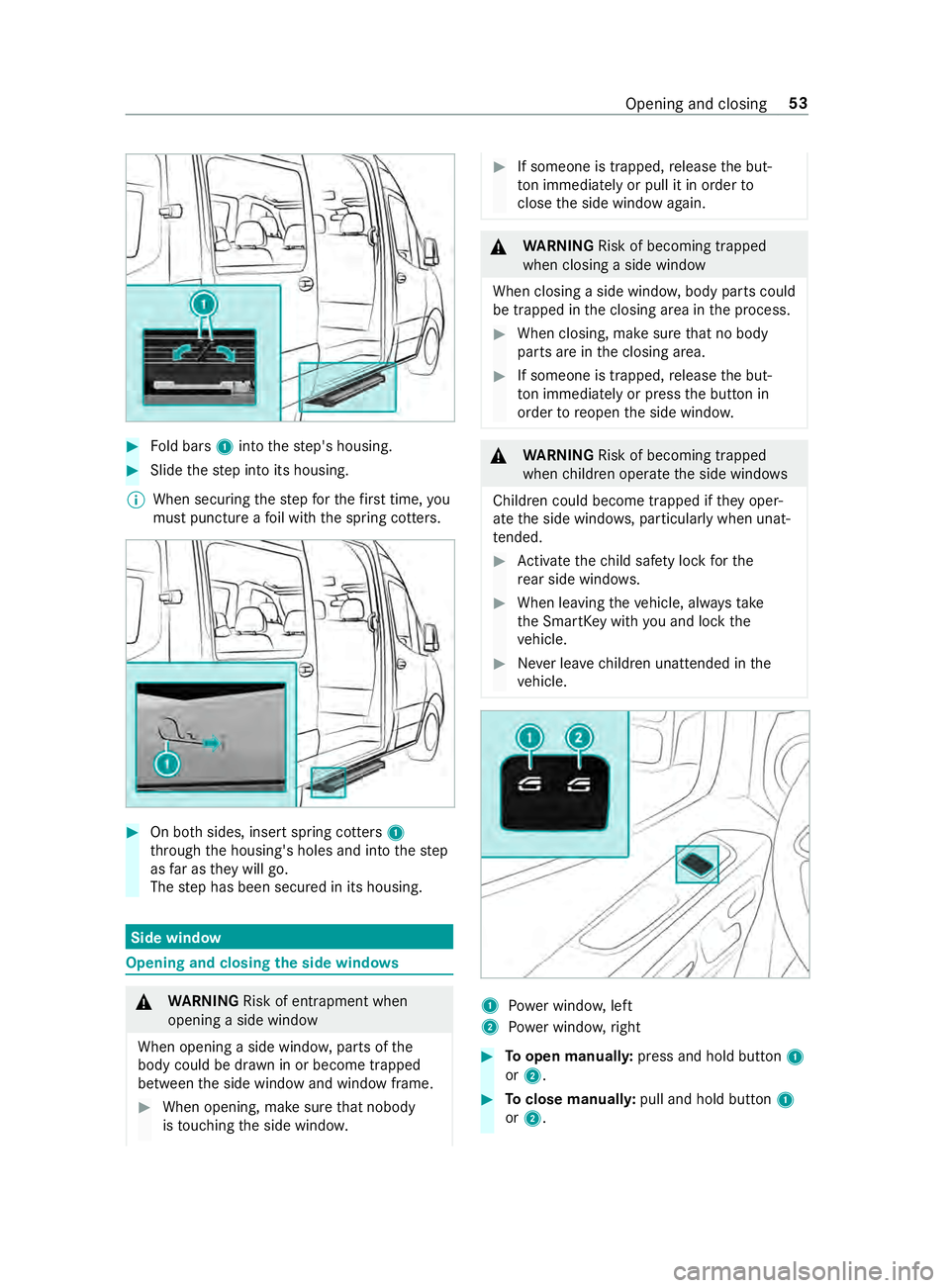
Fold bars 1into thestep's housing. #
Slide thestep into its housing.
% When securing
thestep forth efirs t time, you
must puncture a foil with the spring cotters. #
On bo thsides, insert spring cotters 1
th ro ugh the housing's holes and into thestep
as far as they will go.
The step has been secured in its housing. Side window
Opening and closing
the side windo ws &
WARNING Risk of entrapment when
opening a side window
When opening a side windo w,parts of the
body could be dr awn in or become trapped
between the side window and window frame. #
When opening, make sure that nobody
is touching the side windo w. #
If someone is trapped, release the but‐
to n immedia tely or pull it in order to
close the side window again. &
WARNING Risk of becoming trapped
when closing a side window
When closing a side windo w,body parts could
be trapped in the closing area in the process. #
When closing, make sure that no body
parts are in the closing area. #
If someone is trapped, release the but‐
to n immedia tely or press the button in
order toreopen the side windo w. &
WARNING Risk of becoming trapped
when children opera tethe side windo ws
Children could become trapped if they oper‐
ate the side windo ws, particularly when unat‐
te nded. #
Activate thech ild saf ety lock forthe
re ar side wind ows. #
When leaving theve hicle, alw aysta ke
th e SmartK eywith you and lock the
ve hicle. #
Never lea vechildren unat tended in the
ve hicle. 1
Powe r windo w,left
2 Powe r windo w,right #
Toopen manuall y:press and hold button 1
or 2. #
Toclose manuall y:pull and hold button 1
or 2. Opening and closing
53
Page 83 of 354
Cor
rect driver's seat position &
WARNING Risk of inju ryfrom adju sting
th eve hicle settings while theve hicle is in
motion
Yo u could lose control of theve hicle in the
fo llowing situations:
R ifyo u adjust the driver's seat, the head
re stra int, thesteering wheel or the mir ror
while theve hicle is in motion
R ifyo ufast enyour seat belt while theve hi‐
cle is in motion #
Before starting the engine: adjust the
driver's seat, the head restra int, the
st eering wheel or the mir ror and fasten
yo ur seat belt. Comply with
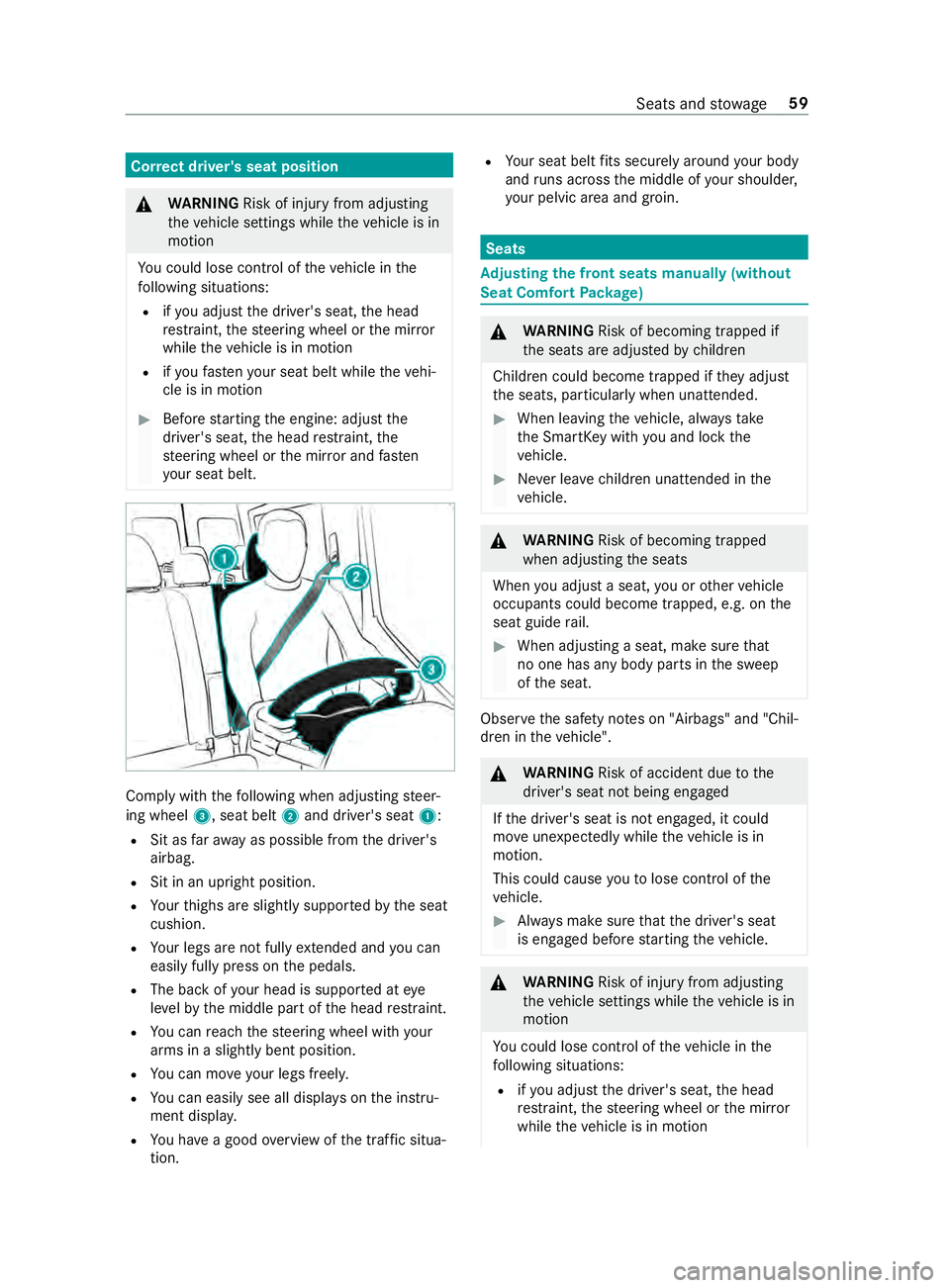
thefo llowing when adjusting steer‐
ing wheel 3, seat belt 2and driver's seat 1:
R Sit as faraw ay as possible from the driver's
airbag.
R Sit in an upright position.
R Your thighs are slight lysuppor tedby the seat
cushion.
R Your legs are not fully extended and you can
easily fully press on the pedals.
R The back of your head is suppo rted at eye
le ve lby the middle part of the head restra int.
R You can reach thesteering wheel with your
arms in a slightly bent position.
R You can mo veyour legs freel y.
R You can easily see all displ ays on the instru‐
ment displa y.
R You ha vea good overview of the traf fic situa‐
tion. R
Your seat belt fits securely around your body
and runs across the middle of your shoulder,
yo ur pelvic area and groin. Seats
Ad
justing the front seats manually (without
Seat Comfort Package) &
WARNING Risk of becoming trapped if
th e seats are adjus tedby children
Children could become trapped if they adjust
th e seats, particular lywhen unat tended. #
When le aving theve hicle, alw aysta ke
th e SmartK eywith you and lock the
ve hicle. #
Never lea vechildren unat tended in the
ve hicle. &
WARNING Risk of becoming trapped
when adjusting the seats
When you adjust a seat, you or other vehicle
occupants could become trapped, e.g. on the
seat guide rail. #
When adjusting a seat, make sure that
no one has any body parts in the sweep
of the seat. Obser
vethe saf ety no tes on "Airbags" and "Chil‐
dren in theve hicle". &
WARNING Risk of accident due tothe
driver's seat not being engaged
If th e driver's seat is not engaged, it could
mo veunexpectedly while theve hicle is in
motion.
This could cause youto lose control of the
ve hicle. #
Always make sure that the driver's seat
is engaged before starting theve hicle. &
WARNING Risk of inju ryfrom adju sting
th eve hicle settings while theve hicle is in
motion
Yo u could lose control of theve hicle in the
fo llowing situations:
R ifyo u adjust the driver's seat, the head
re stra int, thesteering wheel or the mir ror
while theve hicle is in motion Seats and
stowage 59
Page 93 of 354
#
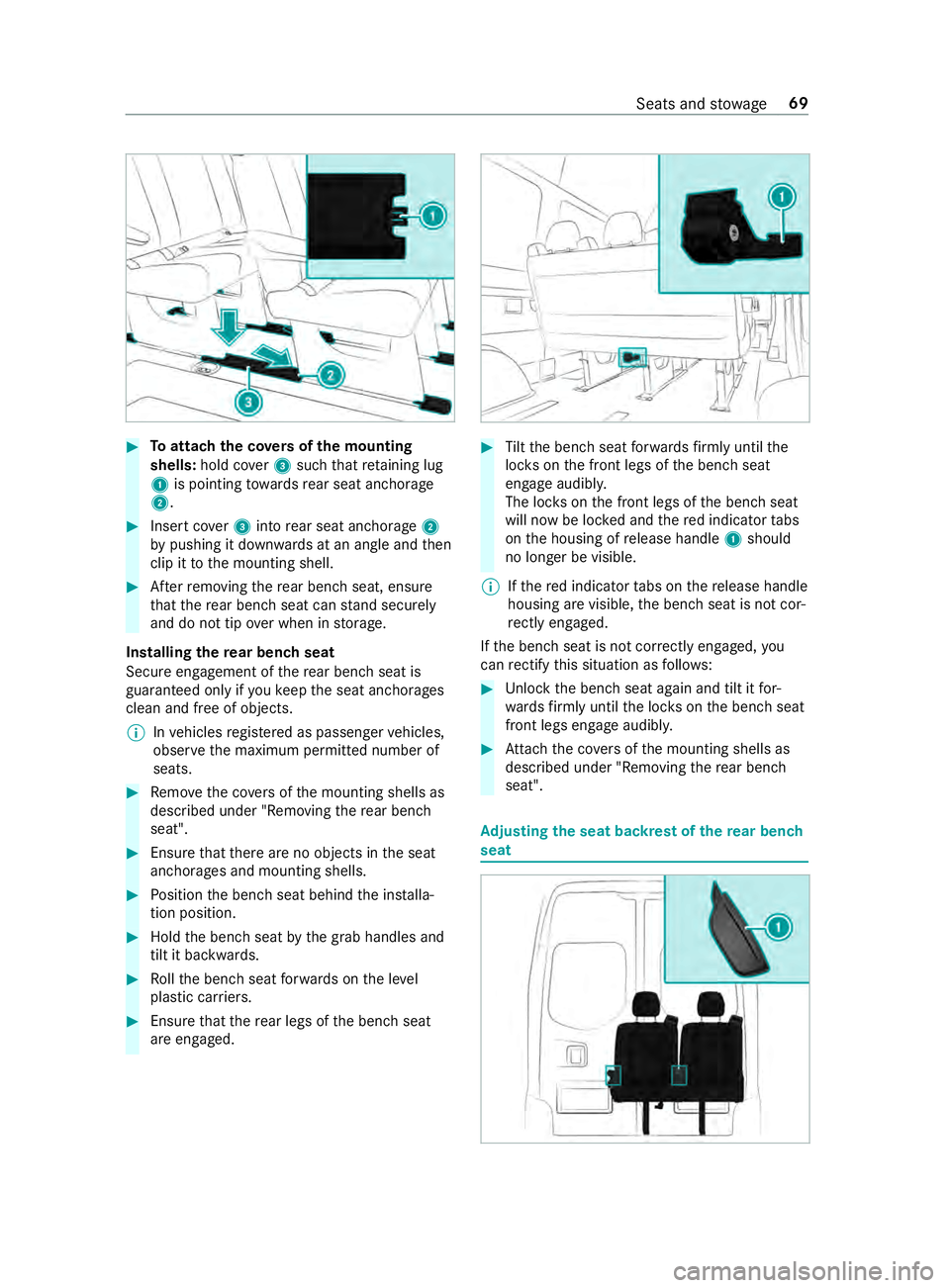
Toattach the co vers of the mounting
shells: hold cover3 such that retaining lug
1 is pointing towa rdsre ar seat anchorage
2. #
Insert co ver3 into rear seat anchorage 2
by pushing it down wards at an angle and then
clip it tothe mounting shell. #
Afterre moving there ar ben chseat, ensure
th at there ar ben chseat can stand securely
and do not tip over when in storage.
Installing there ar ben chseat
Secure engagement of there ar ben chseat is
guaranteed only if youke ep the seat anchorages
clean and free of objects.
% In
vehicles regis tere d as passenger vehicles,
obser vethe maximum permitted number of
seats. #
Remo vethe co vers of the mounting shells as
described under "Removing there ar ben ch
seat". #
Ensure that there are no objects in the seat
anchorages and mounting shells. #
Position the bench seat behind the ins talla‐
tion position. #
Hold the bench seat bythe grab handles and
tilt it backwards. #
Rollth e bench seat forw ards on the le vel
plastic car riers. #
Ensure that there ar legs of the bench seat
are engaged. #
Tilt th e bench seat forw ards firm lyuntil the
loc kson the front legs of the bench seat
engage audibly.
The loc kson the front legs of the bench seat
will now be loc ked and there d indicator tabs
on the housing of release handle 1should
no longer be visible.
% If
th ere d indicator tabs on there lease handle
housing are visible, the bench seat is not cor‐
re ctly engaged.
If th e bench seat is not cor rectly engaged, you
can rectify this situation as follo ws: #
Unlock the bench seat again and tilt it for‐
wa rdsfirm ly until the loc kson the bench seat
front legs engage audibly. #
Attach the co vers of the mounting shells as
described under "Removing there ar ben ch
seat". Ad
justing the seat backrest of the rear ben ch
seat Seats and
stowage 69
Page 96 of 354
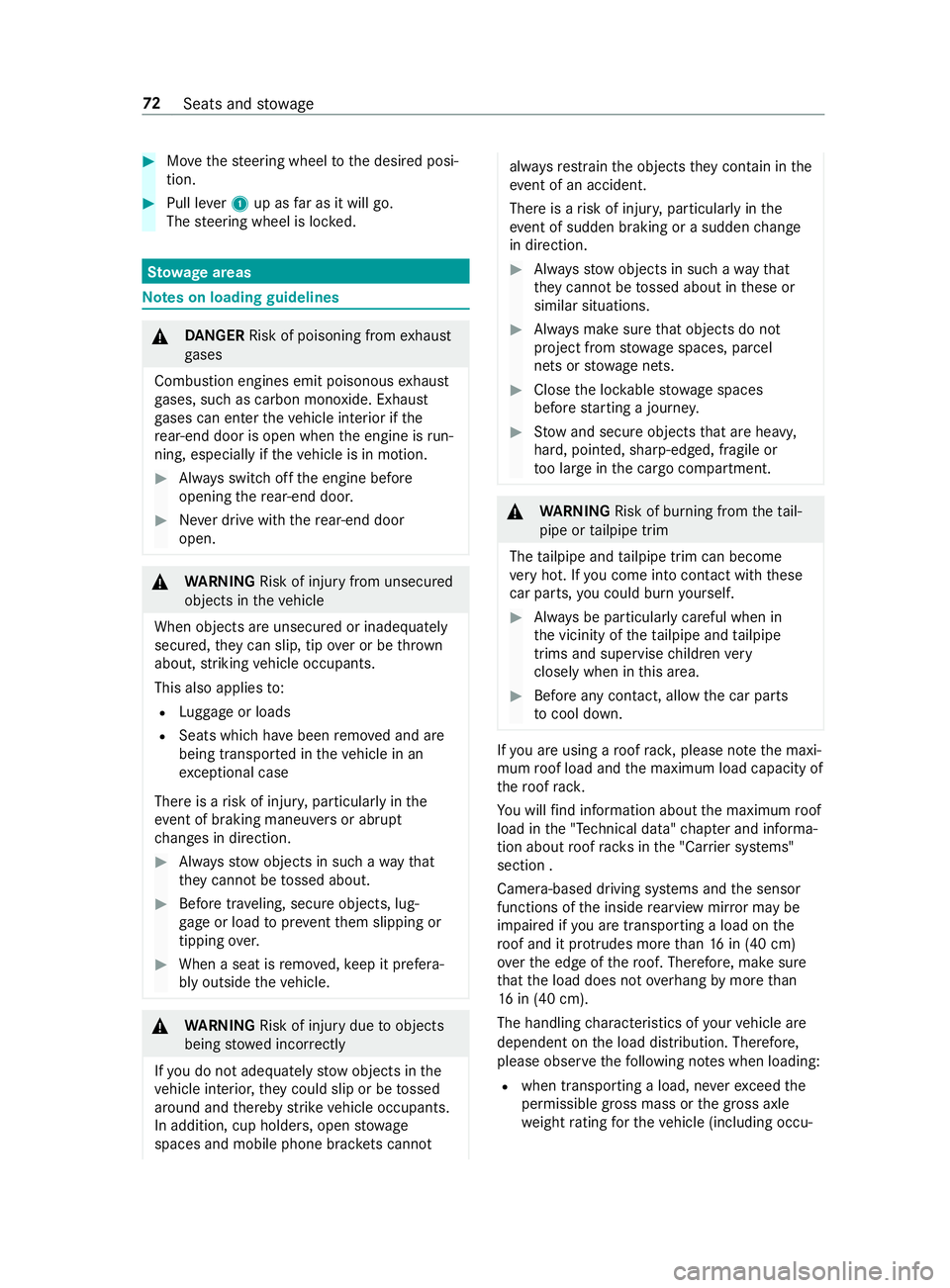
#
Movethesteering wheel tothe desired posi‐
tion. #
Pull le ver1 up as far as it will go.
The steering wheel is loc ked. St
ow age areas Note
s on loading guidelines &
DANG ER Risk of poisoning from exhaust
ga ses
Combustion engines emit poisonous exhaust
ga ses, such as carbon monoxide. Exhaust
ga ses can enter theve hicle interior if the
re ar-end door is open when the engine is run‐
ning, especially if theve hicle is in motion. #
Always switch off the engine before
opening there ar-end door. #
Never drive with there ar-end door
open. &
WARNING Risk of inju ryfrom unsecu red
objects in theve hicle
When objects are unsecured or inadequately
secured, they can slip, tip over or be thro wn
about, striking vehicle occupants.
This also applies to:
R Luggage or loads
R Seats which ha vebeen remo ved and are
being transpor ted in theve hicle in an
ex ceptional case
The reis a risk of injur y,particular lyin the
eve nt of braking maneuvers or ab rupt
ch anges in direction. #
Alwaysstow objects in such a wayth at
th ey cannot be tossed about. #
Before tr aveling, secure objects, lug‐
ga ge or load topreve ntthem slipping or
tipping over. #
When a seat is remo ved, keep it prefera‐
bly outside theve hicle. &
WARNING Risk of inju rydue toobjects
being stowed incor rectly
If yo u do not adequately stowobjects in the
ve hicle interior, they could slip or be tossed
around and thereby strike vehicle occupants.
In addition, cup holders, open stowage
spaces and mobile phone brac kets cannot al
wa ys restra in the objects they contain in the
eve nt of an accident.
The reis a risk of injur y,particular lyin the
eve nt of sudden braking or a sudden change
in direction. #
Alwaysstow objects in such a wayth at
th ey cannot be tossed about in these or
similar situations. #
Always make sure that objects do not
project from stowage spaces, parcel
nets or stowage nets. #
Close the loc kable stow age spaces
before starting a journe y. #
Stow and secure objects that are heavy,
hard, poin ted, sharp-edged, fragile or
to o lar geinthe cargo compartment. &
WARNING Risk of bu rning from theta il‐
pipe or tailpipe trim
The tailpipe and tailpipe trim can become
ve ry hot. If you come into con tact wi th these
car parts, you could burn yourself. #
Always be particularly careful when in
th e vicinity of theta ilpipe and tailpipe
trims and supervise children very
closely when in this area. #
Before any con tact, allow the car parts
to cool down. If
yo u are using a roof rack , please no tethe maxi‐
mum roof load and the maximum load capacity of
th ero of rack.
Yo u will find information about the maximum roof
load in the "Technical data" chap ter and informa‐
tion about roof rack s in the "Car rier sy stems"
section .
Camera-based driving sy stems and the sensor
functions of the inside rearview mir ror may be
impaire d ifyou are transpo rting a load on the
ro of and it pr otru des more than 16 in (40 cm)
ove rth e edge of thero of. Therefore, make sure
th at the load does not overhang bymore than
16 in (40 cm).
The handling characteristics of your vehicle are
dependent on the load distribution. Therefore,
please obser vethefo llowing no tes when loading:
R when transporting a load, ne verex ceed the
permissible gross mass or the gross axle
we ight rating forth eve hicle (including occu‐ 72
Seats and stowage
Page 98 of 354
#
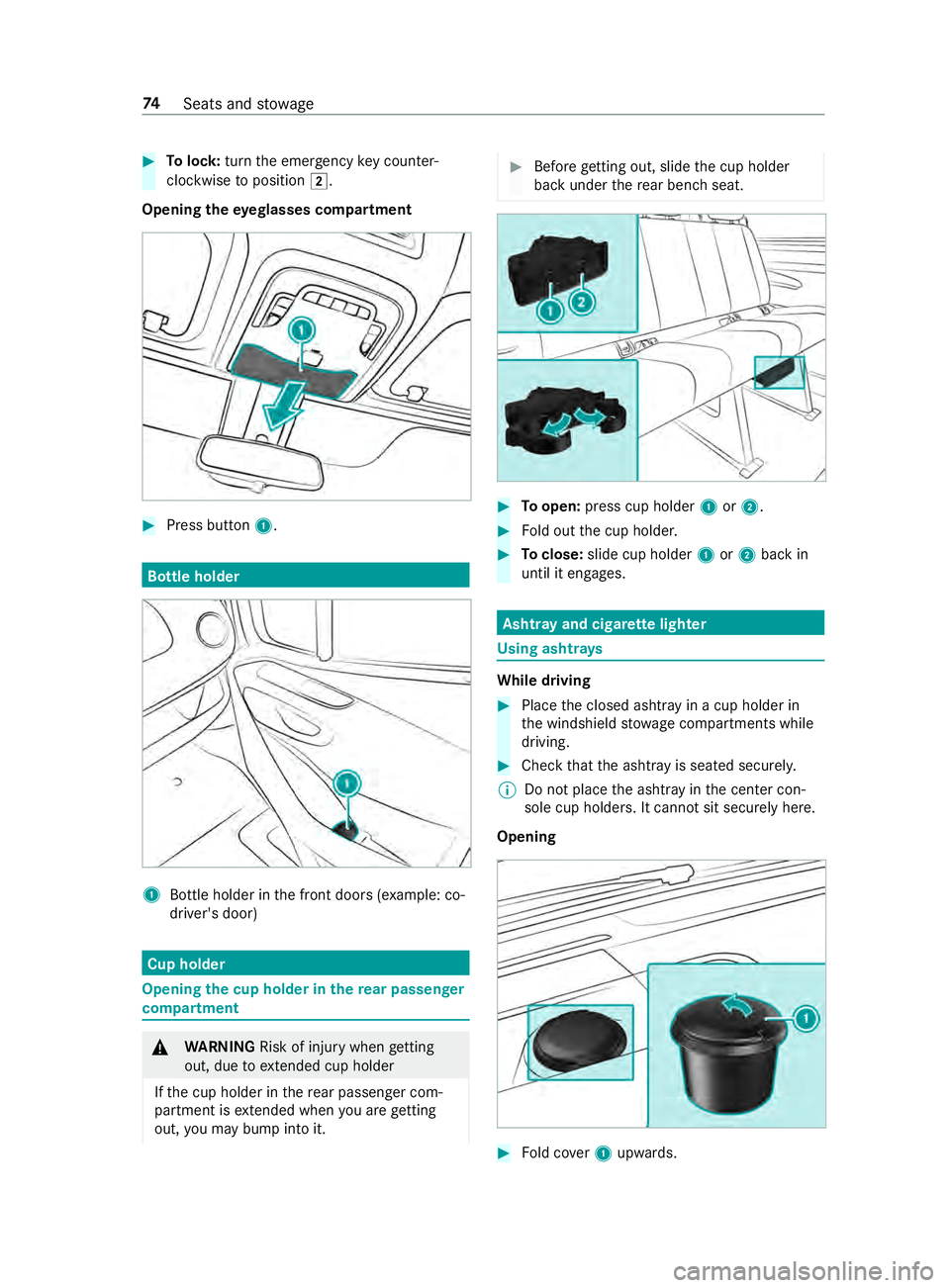
Tolock: turnthe emer gency key counter-
clo ckwise toposition 0048.
Opening theey eglasses compa rtment #
Press button 1. Bottle holder
1
Bottle holder in the front doors (e xample: co-
driver's door) Cup holder
Opening
the cup holder in there ar passen ger
compa rtment &
WARNING Risk of inju rywhen getting
out, due toextended cup holder
If th e cup holder in there ar passenger com‐
partment is extended when you are getting
out, you may bump into it. #
Before getting out, slide the cup holder
back under there ar ben chseat. #
Toopen: press cup holder 1or2. #
Fold out the cup holder. #
Toclose: slide cup holder 1or2 back in
until it engages. Asht
ray and cigar ette lighter Using asht
rays While driving
#
Place the closed ashtr ayin a cup holder in
th e windshield stowage compartments while
driving. #
Check that the ashtray is seated securely.
% Do not place
the ashtray in the center con‐
sole cup holders. It cann otsit securely here.
Opening #
Fold co ver1 upwards. 74
Seats and stowage