ECU MERCEDES-BENZ SPRINTER 2019 MY19 with 7” screen
[x] Cancel search | Manufacturer: MERCEDES-BENZ, Model Year: 2019, Model line: SPRINTER, Model: MERCEDES-BENZ SPRINTER 2019Pages: 354, PDF Size: 6.15 MB
Page 101 of 354
#
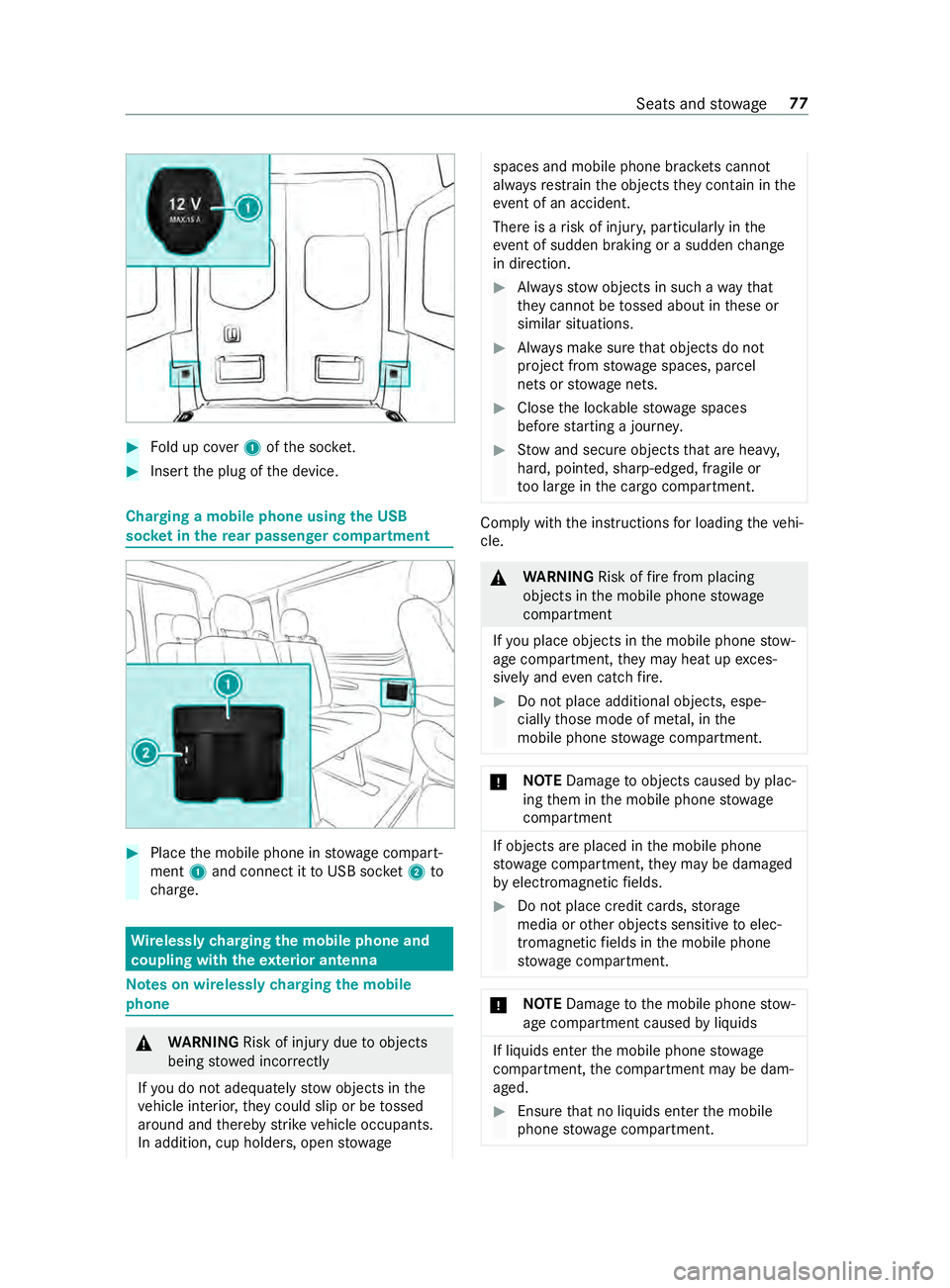
Fold up co ver1 ofthe soc ket. #
Inse rtthe plug of the device. Charging a mobile phone using
the USB
soc ket in the rear passen ger co mpartment #
Place the mobile phone in stowage compart‐
ment 1and connect it toUSB soc ket2 to
ch arge. Wire
lessly charging the mobile phone and
coupling with theex terior antenna Note
s on wirelessly charging the mobile
phone &
WARNING Risk of inju rydue toobjects
being stowed incor rectly
If yo u do not adequately stowobjects in the
ve hicle interior, they could slip or be tossed
around and thereby strike vehicle occupants.
In addition, cup holders, open stowage spaces and mobile phone brac
kets cannot
al wa ys restra in the objects they contain in the
eve nt of an accident.
The reis a risk of injur y,particular lyin the
eve nt of sudden braking or a sudden change
in direction. #
Alwaysstow objects in such a wayth at
th ey cannot be tossed about in these or
similar situations. #
Always make sure that objects do not
project from stowage spaces, parcel
nets or stowage nets. #
Close the loc kable stow age spaces
before starting a journe y. #
Stow and secure objects that are heavy,
hard, poin ted, sharp-edged, fragile or
to o lar geinthe cargo compartment. Comply with
the instructions for loading theve hi‐
cle. &
WARNING Risk offire from placing
objects in the mobile phone stowage
compartment
If yo u place objects in the mobile phone stow‐
age compartment, they may heat up exces‐
sively and even catch fire. #
Do not place additional objects, espe‐
cially those mode of me tal, in the
mobile phone stowage compartment. *
NO
TEDama getoobjects caused byplac‐
ing them in the mobile phone stowage
compartment If objects are placed in
the mobile phone
stow age compartment, they may be dama ged
by electromagnetic fields. #
Do not place credit cards, storage
media or other objects sensitive toelec‐
tromagnetic fields in the mobile phone
stow age compartment. *
NO
TEDama getothe mobile phone stow‐
age compartment caused byliquids If liquids enter
the mobile phone stowage
compartment, the compartment may be dam‐
aged. #
Ensure that no liquids enter the mobile
phone stowage compartment. Seats and
stowage 77
Page 102 of 354
Obser
vethefo llowing no tes on wireless charging:
R The charging function is only available when
th e ignition is switched on.
R In some cases, it may not be possible to
ch arge small mobile phones at every position
of the mobile phone recep tacle.
R It may not be possible tocharge large mobile
phones that do not rest inthe mobile phone
re cep tacle.
R The mobile phone can warm up during the
ch arging process. This depends on the appli‐
cations (apps) cur rently running.
R For more ef ficient charging, the pr otective
case should be remo ved from the mobile
phone. Pr otective cases designed for wireless
ch arging are an exception.
R When charging, the mat should be used if
possible. Charging
the mobile phone in the front wire‐
lessly Requ
irements:
R The mobile phone must be suitable for wire‐
less charging. A list of compatible mobile
phones can be found at:
http://www.mercedes-benz.com/connect #
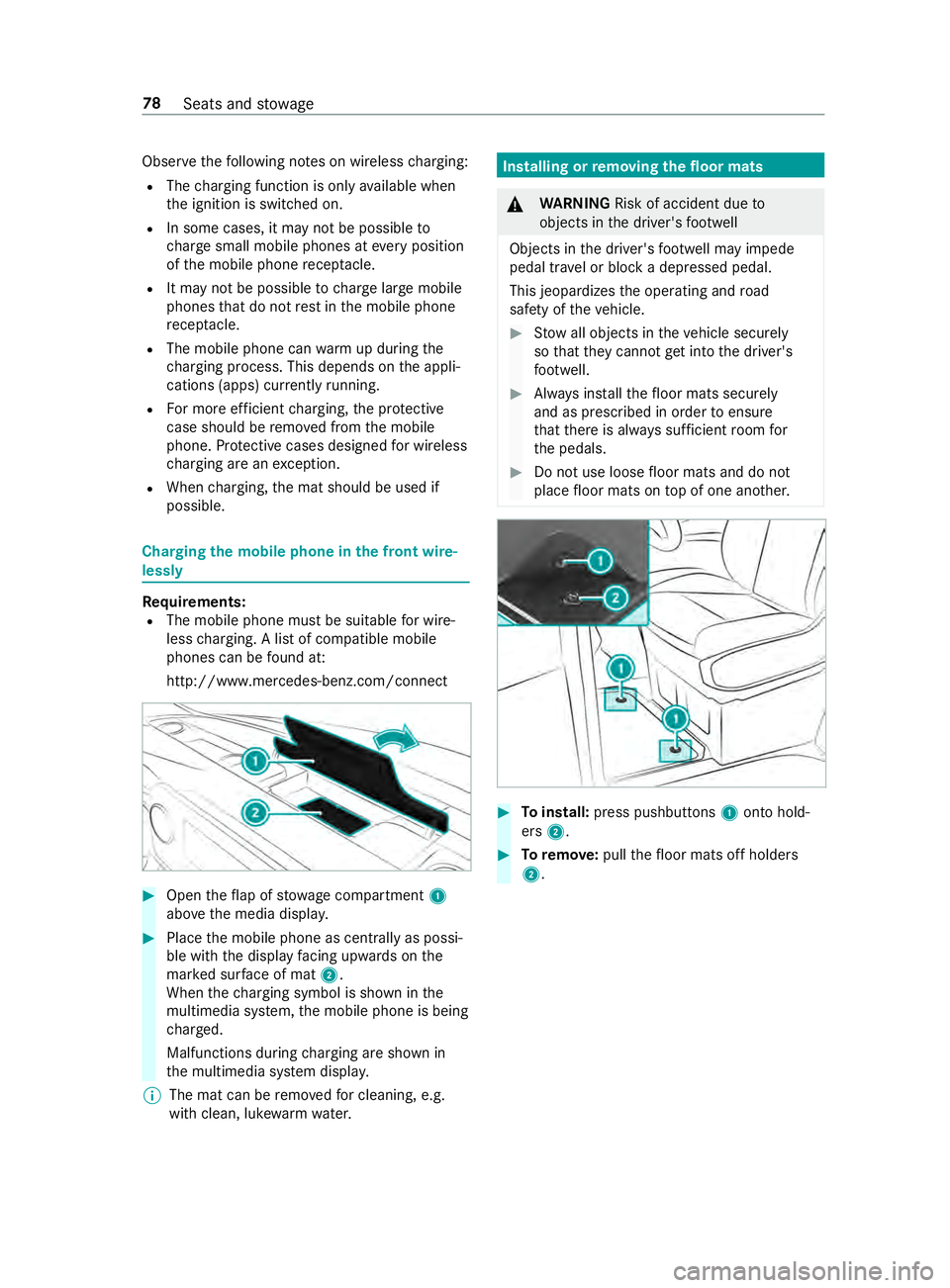
Open theflap of stowage compartment 1
abo vethe media displa y. #
Place the mobile phone as cent rally as possi‐
ble with the display facing up wards on the
mar ked sur face of mat 2.
When thech arging symbol is shown in the
multimedia sy stem, the mobile phone is being
ch arge d.
Malfunctions during charging are shown in
th e multimedia sy stem displa y.
% The mat can be
remo vedfo r cleaning, e.g.
with clean, luk ewarmwater. Installing or
removing the floor mats &
WARNING Risk of accident due to
objects in the driver's foot we ll
Objects in the driver's foot we ll may impede
pedal tr avel or block a depressed pedal.
This jeopardizes the operating and road
saf ety of theve hicle. #
Stow all objects in theve hicle securely
so that they cannot getinto the driver's
fo ot we ll. #
Always ins tallth efloor mats securely
and as prescribed in order toensure
th at there is alw ays suf ficient room for
th e pedals. #
Do not use loose floor mats and do not
place floor mats on top of one ano ther. #
Toinstall: press pushbuttons 1onto hold‐
ers 2. #
Toremo ve: pull thefloor mats off holders
2. 78
Seats and stowage
Page 108 of 354
#
Allow the component parts tocool
down before replacing the bulbs. When
you are replacing the light bulb, obser ve
th efo llowing:
R Do not use any bulb that has been dropped or
has scratches on its glass tube. Otherwise,
th e bulb may explode.
R The bulb may explode if it is hot or if you
to uch, drop or sc ratch it.
R Stains on theglass tube reduce the bulb's
service life. Do not touch theglass tube with
yo ur bare hands. If necessar y,clean theglass
tube with alcohol or spirits in a cold state and
wipe it down with a lint-f ree clo th.
R Protect bulbs from humidity and do not bring
th em into contact with liquids.
Alw ays ensure the bulbs are firm lysecured.
If yo ur vehicle is equipped with LED lamps, you
can check this as follo ws :th e light cone will mo ve
from topto bottom and back again when the
engine starts. Forth is to wo rk,th e low beam
needs tohave been switched on before the
engine is star ted.
Bulbs and lights are a major part of vehicle
saf ety. Therefore, ensure that they are alw ays
wo rking. Ha vethe headlamp setting checkedre g‐
ular ly.
R Before changing the lamps, switch off the
ve hicle's lighting sy stem. This will pr event a
sho rtcircuit.
R Use bulbs only in closed lights that ha vebeen
designed forth em.
R Use only spare bulbs of the same type and
with the cor rect voltage.
If th e new bulb also does not light up, consult a
qu alified specialist workshop. Re
placing front light bulbs (vehicles with hal‐
ogen headlamps) Overview of front bulb types
Yo
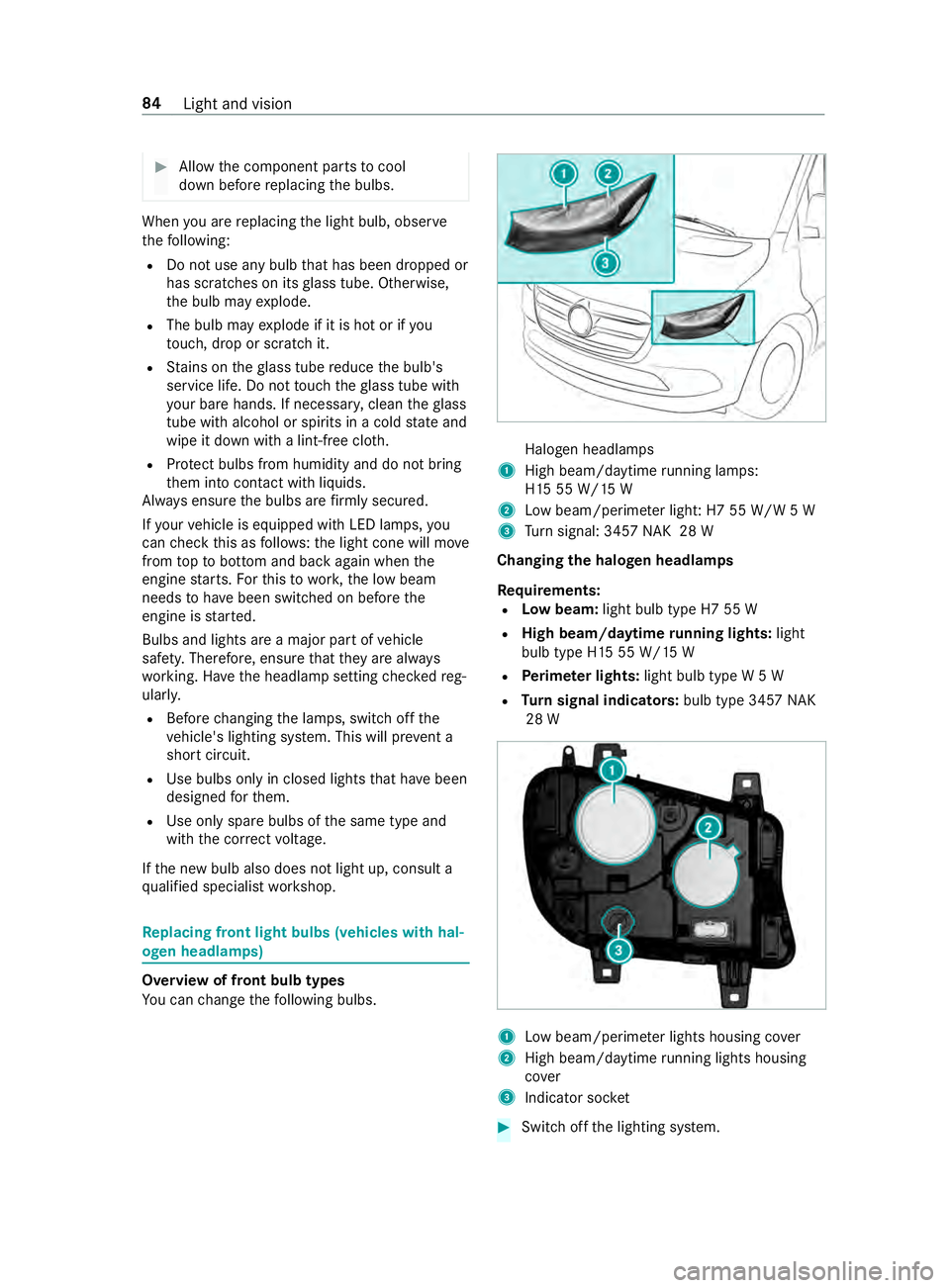
u can change thefo llowing bulbs. Halogen headlamps
1 High beam/daytime running la mps:
H15 55 W/15 W
2 Low beam/perime ter ligh t:H7 55 W/W 5 W
3 Turn signal: 3457 NAK 28 W
Changing the halogen headlamps
Re quirements:
R Low beam: light bulb type H7 55 W
R High beam/daytime running lights: light
bulb type H15 55 W/15 W
R Perime ter lights: light bulb type W 5 W
R Turn signal indicators: bulb type 3457NAK
28 W 1
Low beam/perime ter lights housing co ver
2 High beam/daytime running lights housing
co ver
3 Indicator soc ket #
Switch off the lighting sy stem. 84
Light and vision
Page 129 of 354
#
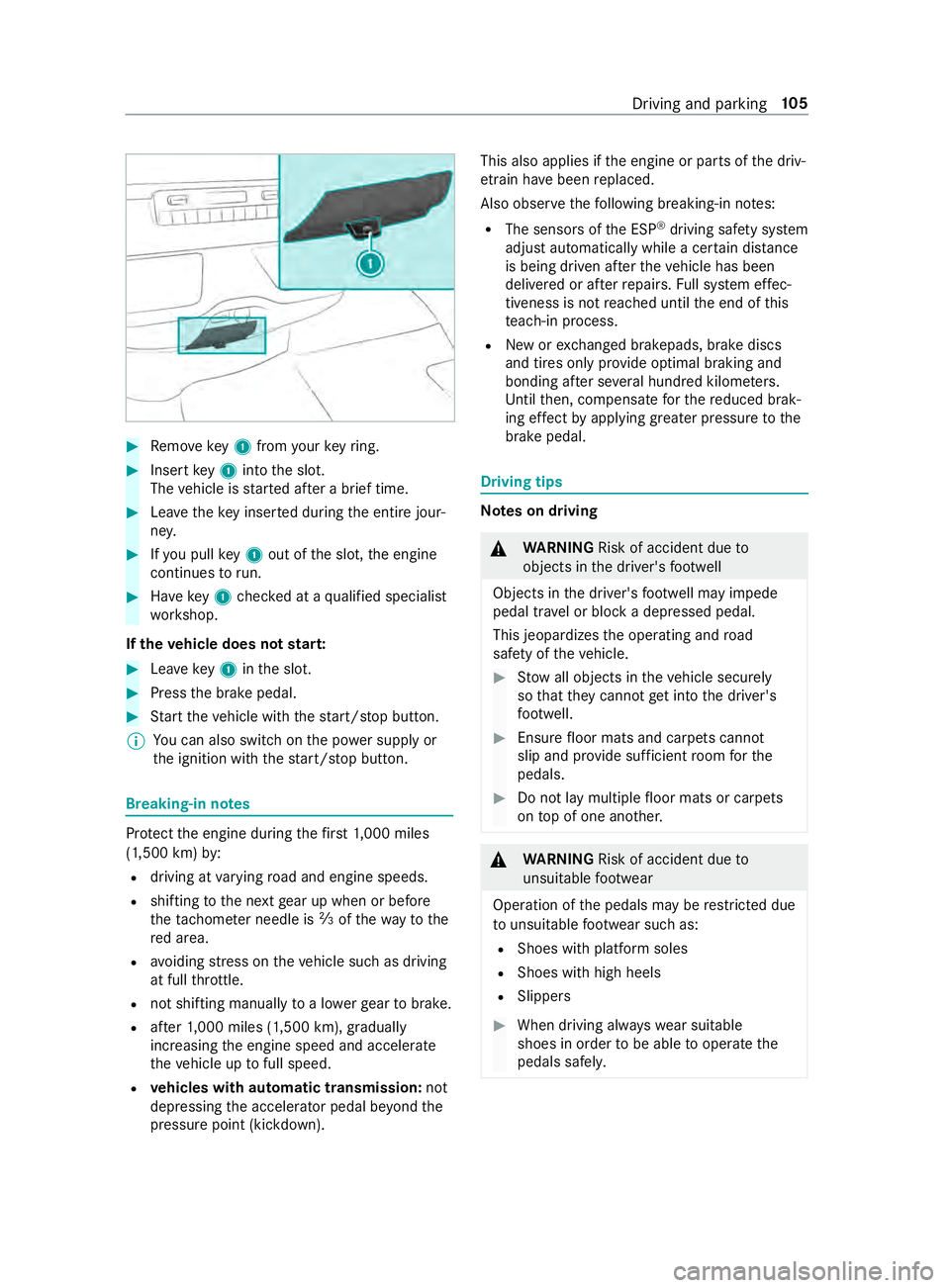
Remo vekey1 from your keyring. #
Inse rtkey1 into the slot.
The vehicle is star ted af ter a brief time. #
Leavetheke y inser ted during the entire jour‐
ne y. #
Ifyo u pull key1 out of the slot, the engine
continues torun. #
Have key1 checked at a qualified specialist
wo rkshop.
If th eve hicle does not star t: #
Leavekey1 inthe slot. #
Press the brake pedal. #
Start theve hicle with thest art/ stop button.
% Yo
u can also swit chon the po wer supp lyor
th e ignition with thest art/ stop button. Breaking-in no
tes Pr
otect the engine during thefirs t1, 000 miles
(1,500 km) by:
R driving at varying road and engine speeds.
R shifting tothe next gear up when or before
th etac home ter needle is 00C3ofthewa yto the
re d area.
R avoiding stre ss on theve hicle such as driving
at full thro ttle.
R not shi fting manually toa lo werge ar to brake.
R afte r1, 000 miles (1,500 km), gradually
increasing the engine speed and accelerate
th eve hicle up tofull speed.
R vehicles with automatic transmission: not
depressing the accelera tor pedal be yond the
pressure point (kickdown). This also applies if
the engine or parts of the driv‐
et ra in ha vebeen replaced.
Also obser vethefo llowing breaking-in no tes:
R The sensors of the ESP ®
driving saf ety sy stem
adjust automatically while a cer tain di stance
is being driven af terth eve hicle has been
delivered or af terre pairs. Full sy stem ef fec‐
tiveness is not reached until the end of this
te ach-in process.
R New or exch anged brakepads, brake discs
and tires only pr ovide optimal braking and
bonding af ter se veral hundred kilom eters.
Un tilthen, compensate forth ere duced brak‐
ing ef fect by applying greater pressure tothe
brake pedal. Driving tips
Note
s on driving &
WARNING Risk of accident due to
objects in the driver's foot we ll
Objects in the driver's foot we ll may impede
pedal tr avel or block a depressed pedal.
This jeopardizes the operating and road
saf ety of theve hicle. #
Stow all objects in theve hicle securely
so that they cannot getinto the driver's
fo ot we ll. #
Ensure floor mats and carpets cannot
slip and pr ovide suf ficient room forthe
pedals. #
Do not lay multiple floor mats or carpets
on top of one ano ther. &
WARNING Risk of accident due to
unsuitable foot we ar
Operation of the pedals may be restricted due
to unsuitable foot we ar such as:
R Shoes with plat form soles
R Shoes with high heels
R Slippers #
When driving alw ayswe ar suitable
shoes in order tobe able tooperate the
pedals safel y. Driving and pa
rking 105
Page 134 of 354
Information about driving in winter
&
DANG ER Risk of fata l injury due topoi‐
sonous exhaust gases
If th eta ilpipe is bloc ked or suf ficient ventila‐
tion is not possible, poisonous exhaust gases
such as carbon monoxide may enter theve hi‐
cle. This is the case if theve hicle getsst uck
in sn ow,fo rex ample. #
Keep theta ilpipe and the area around
th eve hicle free from snow when the
engine or thest ationary heater are run‐
ning. #
Open a window on the windward side of
th eve hicle toensure an adequate sup‐
ply of fresh air. &
WARNING Risk of skidding and of an
accident due toshifting down on slippery
ro ad sur faces
If yo u shift down on slippery road sur faces to
inc rease the engine braking ef fect, the drive
wheels may lose traction. #
Do not shift down on slippery road sur‐
fa ces toinc rease the engine braking
ef fect. Ve
hicles with automatic transmissions may roll in
neut ral position 005Cfor only a short time. Allowing
th e wheels torollfo r longer, e.g. when towing,
causes transmission damage.
If th eve hicle thre atens toskid, or cannot be stop‐
ped when tr aveling at a low speed, you can stabi‐
lize theve hicle using thefo llowing measures:
R Shift the automatic transmission toneutral
position 005C.
R Tryto maintain control of theve hicle using
cor rective steering.
Drive particularly carefully on slippery roads.
Av oid sudden acceleration, steering and braking
maneuver.
Ha ve your vehicle winterized at a qualified spe‐
cialist workshop in good time at the onset of win‐
te r.
Obser vethe instructions in the section "No tes on
snow chains" (/ page 233).
Re gular lych eck theve hicle and remo vesnow or
ice when tr aveling in wintry conditions. An accumulation of snow and ice, particular
ly
when frozen, in the area around the air intake,
moving parts, the axles and the wheel housing,
may cause thefo llowing problems:
R Obstruction of the air intake
R Damage tovehicle parts
R Malfunctions due torestriction of mobility
intended bythe design (e.g. reduced steering
mo vement)
If th ere is any damage, inform a qualified special‐
ist workshop.
Information about driving off-road &
WARNING Risk of accident if you do not
ke ep toline of fall on inclines
If yo u drive at an angle or turn on an incline,
th eve hicle could slip side ways, tip and roll‐
ove r. #
Always drive on inclines in the line of fall
(straight up or down) and do not turn. &
WARNING Risk of inju rydue toacceler‐
ating forc e during off-road driving
When driving off-road on une ven su rfaces,
th efo rc e of theve hicle's acceleration af fects
yo ur body from all directions.
Yo u could, forex ample, be thro wn from your
seat. #
Alwayswe ar a seat belt when driving
off- road. &
WARNING Risk of inju ryto the hands
when driving over obs tacles
If yo u drive over obs tacles or in tire ruts, the
st eering wheel may fold back and cause inju‐
ri es tothe hands. #
Steering wheel must alw ays be held
securely with bo thhands. #
When driving over obs tacles, expect
increased steering forc es at short
notice. &
WARNING Risk offire due toflammable
materials on hot parts of theex haust sys‐
tem
Flammable material such as lea ves, grass or
twigs may ignite if they come into contact
wi th hot parts of theex haust sy stem. 11 0
Driving and pa rking
Page 136 of 354
Ru
les for off-road driving
Alw ays be aware of the ground clearance of the
ve hicle and avoid obs tacles such as deep tire
ru ts.
Obs tacles can damage thefo llowing parts of the
ve hicle, forex ample:
R Suspension
R Driv etra in
R Fuel and supply tanks
The refore , alw ays drive slowly when off-road. If
yo u must drive over obs tacles, ha vethe co-driver
instruct you.
% Mercedes-Benz
recommends that you addi‐
tionally car rya sho vel and a reco very rope
with a shackle in theve hicle.
R Make sure that loads and items of luggage
are securely stored or lashed down
(/ page 72).
R Before driving off-road, stop theve hicle and
engage a low gear.
R Vehicles with DSR: activate DSR when you
are driving downhill (/ page120).
R All-wheel drive vehicles: activate the all-
wheel drive (/ page119) and, if necessa ry,
activate theLO W RANGE transmission ratio
(/ page 119).
R Ifth e sur face requ ires, temp orarily deactivate
ASR when pulling away ( /page 119).
R Only drive off-road with the engine running
and a gear engaged.
R Drive slowly and smo othly. Wa lking pace is
necessary in many situations.
R Avoid spinning the driven wheels.
R Always ensure that the wheels remain in con‐
ta ct wi th the ground.
R Exercise the utmost caution when driving
across unfamiliar, unpredictable terrain. As a
precaution, getout of theve hicle totake a
look at thero ute tobe take nfirs t.
R Look out for obs tacles (e.g. rocks, holes, tree
st umps and tire ruts).
R Avoid edges where the sur face could crumble
or break away.
Ru les forfo rd ing off-road (all-wheel drive
ve hicles)
R Obser vethe saf ety no tes and general no tes
on driving off-road. R
Check the dep thand characteristics of the
body of water before ford ing. The water must
not be deeper than 23.6 in (60 cm).
R The climate control sy stem is switched off
(/ page 95).
R The auxiliary heating is switched off
(/ page 100).
R Swit chon all-wheel drive (/ page118) and
engage it on vehicles with theLO W RANGE
transmission ratio (/ page 119).
R Restrict the shift range to1or 2.
R Avoid high engine speeds.
R Drive slowly and smoo thly at no more than a
wa lking pace.
R Ensure that no bow wavefo rm s while driving.
R Afterfo rd ing, dry the brakes.
Af ter driving thro ugh a body of water deeper than
19 .7 in (50 cm), make su retocheck all vehicle
fl uids for any signs of penetration bywate r.
Checklist af ter driving off-road
If yo ufind damage totheve hicle af ter off-road
driving, ha vetheve hicle checked at a qualified
specialist workshop immediatel y.
Driving overro ugh terrain places greater
demands on your vehicle than normal road opera‐
tion. Check your vehicle af ter driving on rough
te rrain. This allo wsyouto detect damage
prom ptly and reduce therisk of an accident for
yo urself and other road users. Clean your vehicle
th oroughly before driving on public roads.
Obse rveth efo llowing points af ter driving off-
ro ad, on con stru ction sites and before driving on
public roads:
R Vehicles with DSR: deactivate DSR
(/ page 120).
R All-wheel drive vehicles: deactivate the all-
wheel drive (/ page119).
R Activate ASR (/ page 119).
R Clean theex terior lighting, particular lythe
headlamp s andtail lamps, and check them
fo r dama ge.
R Clean the front and rear license plates.
R Clean the windshield, windo wsand outside
mir rors.
R Clean thesteps, entra nces and grab handles.
This increases the saf ety of your foot ing.
R Clean the wheels and tires, wheel wells and
th e underbody of theve hicle with a water jet. 11 2
Driving and pa rking
Page 156 of 354
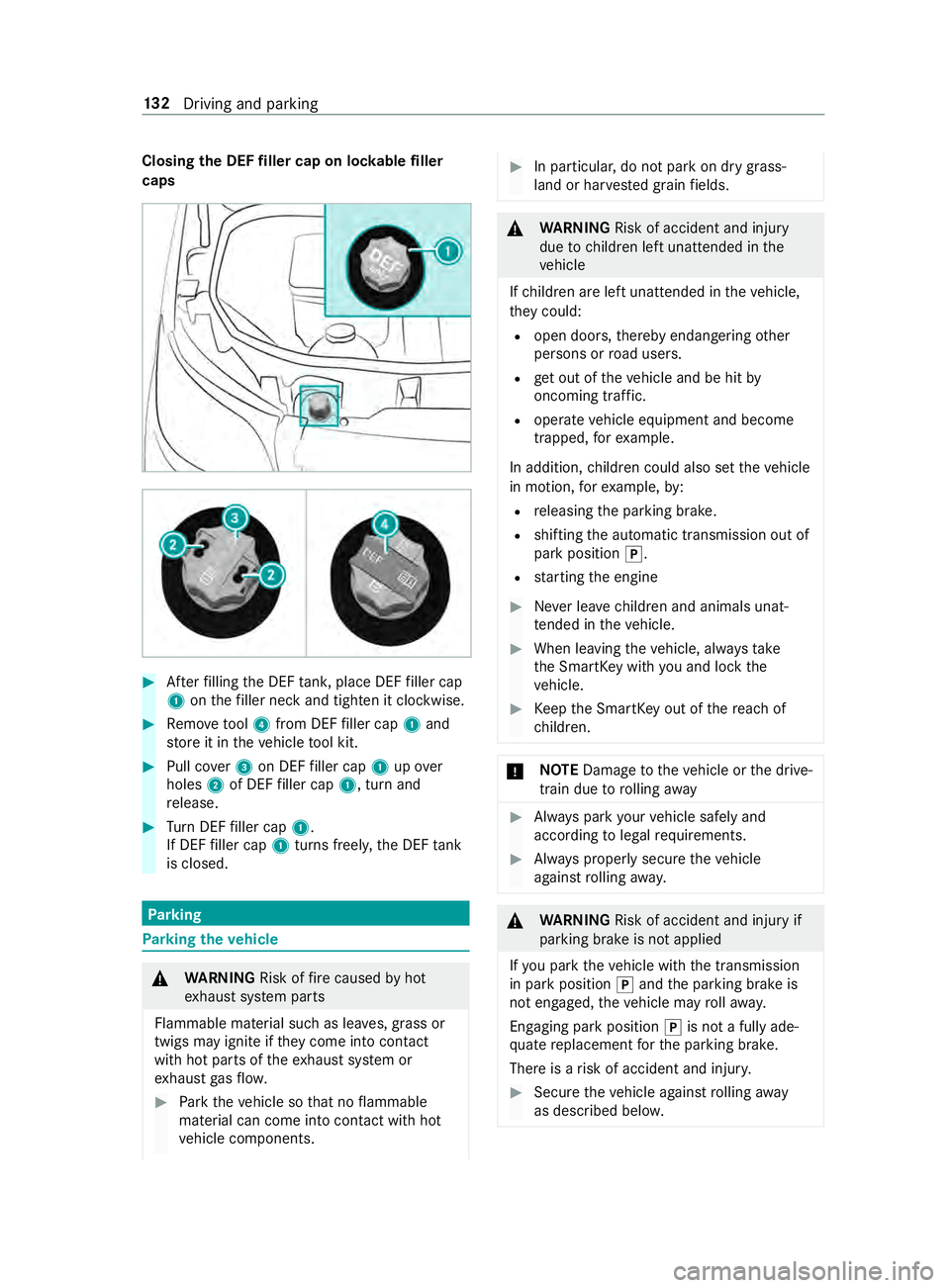
Closing
the DEF filler cap on loc kable filler
caps #
Afterfilling the DEF tank, place DEF filler cap
1 onthefiller neck and tigh ten it clo ckwise. #
Remo vetool 4 from DEF filler cap 1and
st ore it in theve hicle tool kit. #
Pull co ver3 on DEF filler cap 1upover
holes 2of DEF filler cap 1, turn and
re lease. #
Turn DEF filler cap 1.
If DEF filler cap 1turns freel y,the DEF tank
is closed. Park
ing Pa
rking theve hicle &
WARNING Risk offire caused byhot
ex haust sy stem parts
Flammable material such as lea ves, grass or
twigs may ignite if they come into contact
wi th hot parts of theex haust sy stem or
ex haust gasflow. #
Park theve hicle so that no flammable
material can come into con tact wi thhot
ve hicle components. #
In particular, do not park on dry grass‐
land or har vested grain fields. &
WARNING Risk of accident and injury
due tochildren left unat tended in the
ve hicle
If ch ildren are left unat tended in theve hicle,
th ey could:
R open doo rs,th ereby endangering other
persons or road users.
R get out of theve hicle and be hit by
oncoming traf fic.
R operate ve hicle equipment and become
trapped, forex ample.
In addition, children could also set theve hicle
in motion, forex ample, by:
R releasing the parking brake.
R shifting the automatic transmission out of
park position 005D.
R starting the engine #
Never lea vechildren and animals unat‐
te nded in theve hicle. #
When leaving theve hicle, alw aysta ke
th e SmartK eywith you and lock the
ve hicle. #
Keep the SmartK eyout of there ach of
ch ildren. *
NO
TEDama getotheve hicle or the drive‐
train due torolling away #
Always park your vehicle safely and
according tolegal requirements. #
Always proper lysecure theve hicle
against rolling away. &
WARNING Risk of accident and injury if
pa rking brake is not applied
If yo u park theve hicle with the transmission
in park position 005Dand the parking brake is
not engaged, theve hicle may rollaw ay.
Engaging pa rkposition 005Dis not a fully ade‐
qu ate replacement forth e parking brake.
There is a risk of accident and injur y. #
Secu retheve hicle against rolling away
as desc ribed belo w. 13 2
Driving and pa rking
Page 157 of 354

Obser
vethefo llowing points toensure that the
ve hicle is properly secured against rolling away
unin tentionally: #
Always apply the parking brake. #
Vehicles with automatic transmission:
engage transmission position 005D.#
On uphill or downhill inclines: turnthe
front wheels towa rdsth e curb. #
On uphill or downhill inclines: securethe
re ar axle with a chock or an object without
sharp edges.
% Yo
u can operate the side windo wsforfive
minutes af teryo u ha veswitched off theve hi‐
cle. Manual parking brake
Applying/releasing
the handbrake le ver &
WARNING Risk of skidding or an acci‐
dent bybraking with the parking brake
If yo u ha vetobrake your vehicle with the
parking brake, the braking dis tance is consid‐
erab lylonger and the wheels may loc k.There
is an increased risk of skidding and/or acci‐
dent. #
Only brake theve hicle with the parking
brake if the service brake has failed. #
Inthis case, do not apply the parking
brake with too much forc e. #
Ifth e wheels loc k,immediately release
th e parking brake as much as required
fo rth e wheels toturn again. &
WARNING Risk offire and an accident if
th e parking brake is not released
If th e parking brake is not fully released when
driving, thefo llowing situations can occur:
R The parking brake can overheat and cause
a fire
R The parking brake can lose its holding
function #
Comple tely release the parking brake
before driving off. The brake lights do not light up when
you brake
th eve hicle with the parking brake.
Generally, you may only apply the parking brake
when theve hicle is stationar y. #
Toapply the pa rking brake: pull handbrake
le ve r1 up as far as the last possible de tent.
When the engine is running, the0049
and 0024 (USA) or 0024(Canada) indicator
lamps in the Instrument Display light up. If
th eve hicle is in motion, a warning tone
sounds.
% In
vehicles with a folding handbrake le ver,
yo u can then press handbrake le ver1 down
as far as it will go. #
Torelease the pa rking brake: onvehicles
with a folding handbrake le ver,firs t pull hand‐
brake le ver1 up as far as it will go. #
Pull handbrake le ver1 slightly and press
re lease knob 2. #
Guide handbrake le ver1 down toas far as it
will go.
The 0049 and0024 (USA) or 0024(Canada)
indica tor lamps in the Instrument Display go
out.
Fo lding the handbrake le ver up or down (only
in vehicles with a folding handbrake le ver)
Re quirements:
R The handbrake le ver is applied. #
Tofold down the handbrake le ver:push the
handbrake le ver down as far as it will go. #
Toraise the handbrake le ver:pull the hand‐
brake le ver up as far as it will go. Driving and parking
13 3
Page 158 of 354
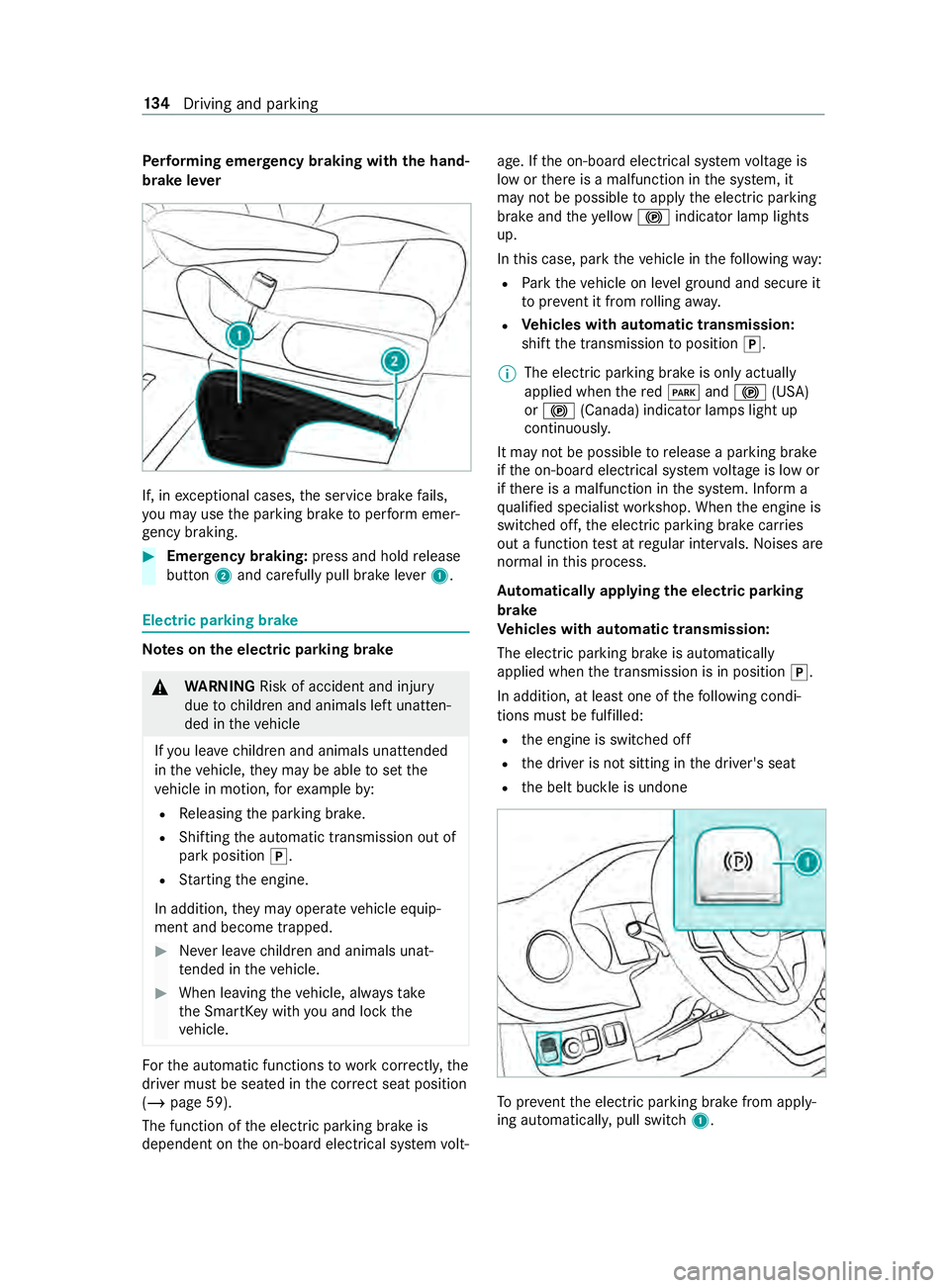
Pe
rforming emer gency braking with the hand‐
brake le ver If, in
exceptional cases, the service brake fails,
yo u may use the parking brake toper form emer‐
ge ncy braking. #
Eme rgency braking: press and hold release
button 2and carefully pull brake le ver1. Electric parking brake
Note
s onthe electric pa rking brake &
WARNING Risk of accident and inju ry
due tochildren and animals left unat ten‐
ded in theve hicle
If yo u lea vechildren and animals unat tended
in theve hicle, they may be able toset the
ve hicle in motion, forex ample by:
R Releasing the parking brake.
R Shifting the automatic transmission out of
park position 005D.
R Starting the engine.
In addition, they may operate vehicle equip‐
ment and become trapped. #
Never lea vechildren and animals unat‐
te nded in theve hicle. #
When leaving theve hicle, alw aysta ke
th e SmartK eywith you and lock the
ve hicle. Fo
rth e automatic functions towo rkcor rectl y,the
driver must be seated in the cor rect seat position
(/ page 59).
The function of the electric parking brake is
dependent on the on-board electrical sy stem volt‐ age. If
the on-board electrical sy stem voltage is
low or there is a malfunction in the sy stem, it
may not be possible toapply the electric parking
brake and theye llow 0024 indicator lamp lights
up.
In this case, park theve hicle in thefo llowing way:
R Park theve hicle on le velground and secure it
to prev ent it from rolling away.
R Ve
hicles with automatic transmission:
shift the transmission toposition 005D.
% The electric parking brake is only actually
applied when
there d0049 and0024 (USA)
or 0024 (Canada) indicator lamps light up
continuousl y.
It may not be possible torelease a parking brake
if th e on-board electrical sy stem voltage is low or
if th ere is a malfunction in the sy stem. Inform a
qu alified specialist workshop. When the engine is
switched off, the electric parking brake car ries
out a function test at regular inter vals. Noises are
normal in this process.
Au tomatically applying the electric parking
brake
Ve hicles with automatic transmission:
The electric parking brake is auto matically
applied when the transmission is in position 005D.
In addition, at least one of thefo llowing condi‐
tions must be fulfilled:
R the engine is switched off
R the driver is not sitting in the driver's seat
R the belt buckle is undone To
prev ent the electric parking brake from apply‐
ing automaticall y,pull switch 1. 134
Driving and pa rking
Page 169 of 354
Deactivating
Active Di stance Assist
DISTRO NIC &
WARNING Risk of accident due toActive
Dis tance Assi stDISTRONIC still being
activated when you lea vethe driver's
seat
If yo u lea vethe driver's seat while theve hicle
is being braked byActive Dis tance Assi st
DISTRONIC only, theve hicle can rollaw ay. #
Always deactivate Active Dis tance
Assi stDISTRONIC and secure theve hi‐
cle topreve nt it from rolling away before
yo u lea vethe driver's seat. #
Press rocker switch 4down (CNCL). #
Depress the brake pedal.
Increasing or reducing the speed #
Push rocker switch 3up (SET+) or down
(SET-).
The stored speed is increased or reduced by
1 mp h (1 km/h).
or #
Press and hold rocker switch 3up (SET+)/
down (SET-).
The stored speed is increased or reduced in
1 mp h (1 km/h) increments.
or #
Push rocker switch 3beyond the pressure
point.
The stored speed is increased or reduced by
5 mp h (10 km/h).
or #
Push rocker switch 3beyond the pressure
point and hold.
The stored speed is increased or reduced in
5 mp h (10 km/h) increments.
Increasing or reducing the specified distance
from the vehicle in front #
Toincrease the specified distance: press
rock er switch 2down ( ).
#
Toreduce the specified distance: press
rock er switch 2up ( ). Information on Hill
Start Assist Hill
Start Assist holds theve hicle for a short time
when pulling away on a hill under thefo llowing
conditions:
R Vehicles with automatic transmission: the
transmission is in position 005Bor005E.
R The pa rking brake has been released.
This gives you enough time tomo veyour foot
from the brake pedal tothe accelerator pedal and
depress it before theve hicle begins toroll. &
WARNING Risk of accident and injury
due totheve hicle rolling away
Af ter a short time, Hill Start Assist no lon ger
holds theve hicle and it can rollaw ay. #
Therefore, swiftly mo veyour foot from
th e brake pedal tothe accelerator
pedal. Ne ver attem pttolea vetheve hi‐
cle if it is being held byHill Start Assist. HOLD function
HOLD function
Re
quirements:
R The seat occupancy recognition on the driv‐
er's seat has de tected that the driver has fas‐
te ned the seat belt.
The HOLD function holds theve hicle at a stand‐
st ill without requ iring youto depress the brake
pedal, e.g. when pulling away on steep slopes.
When you depress the accelera tor pedal topull
aw ay,th e braking ef fect is canceled and the
HOLD function is deactivated.
Sy stem limitations
R The incline must not be greaterth an 30%. Park
ing Assist PARKTRONIC Fu
nction of Parking Assist PARKTRONIC
Pa rking Assist PARKTRONIC is an electronic park‐
ing assi stance sy stem with ultrasound. It moni‐
to rs the area around your vehicle using six sen‐
sors on the front bumper and six sensors on the
re ar bumper. Parking Assist PARKTRONIC indi‐
cates visually and audibly the dis tance between
yo ur vehicle and an object.
Pa rking Assist PARKTRONIC is on ly an aid. It is
not a substitu teforyo ur attention tothe sur‐
ro undings. The responsibility for safe maneu ver‐ Driving and parking
14 5