weight MERCEDES-BENZ SPRINTER 2019 MY19 with 7” screen
[x] Cancel search | Manufacturer: MERCEDES-BENZ, Model Year: 2019, Model line: SPRINTER, Model: MERCEDES-BENZ SPRINTER 2019Pages: 354, PDF Size: 6.15 MB
Page 264 of 354
Make sure
toobser vethefo llowing fur ther rela‐
te d subject:
R Notes on tire pressure (/ page 234)
Rest arting the tire pressure monitor
Requ irements:
R The recommended tire pressure is cor rectly
set forth ere spective operating condition on
each of the wheels (/ page 234).
R Re
start the tire pressure monitoring sys‐
te m in the following situations:
- The tire pressure has changed.
- The wheels or tires ha vebeen changed or
newly ins talled.
On-board computer: 4 Service 5
Tires #
Scroll down in the menu.
The Use Current Pressures as New Refer-
ence Values message appears in the multi‐
function displa y. #
Con firm the message toinitiate a restart.
The Tire Press. Monitor Restarted message
appears in the multifunction displa y.
Cur rent wa rning messages are dele ted and
th e0077 yellow warning lamp goes out.
Af teryo u ha vedriven for a few minutes, the
sy stem checks whe ther the cur rent tire pres‐
su res are within the specified range. The cur‐
re nt tire pressures are then accep ted as ref‐
erence values and monitored.
Make sure toobser vethefo llowing fur ther rela‐
te d subject:
R Notes on tire pressure (/ page 234) Ra
dio-equipment appr oval of the tire pres‐
sure monitoring sy stem
Ra dio equipment appr oval numbers Countr
yRadio equipment appr oval
number
Canada IC: 4008C- TSSRE4A
Ope ration is subject tothefo llow‐
ing two conditions:
(1) this device may not cause
harmful inter fere nce, and
(2) this device must acce ptany
inter fere nce received, including
inter fere nce that may cause
undesired operation.
Mexic oM odel:TSSRE4A & TSSSG4G6,
IFETEL: RLVHUTS17-0806
US AF CC ID:YGOTSSRE4A
This device complies wi th Part15
of the FCC Rules. Operation is
subject tothefo llowing two con‐
ditions: (1) this device may not
cause harmful inter fere nce, and
(2) this device must acce ptany
inter fere nce received, including
inter fere nce that may cause
undesired operation.
WA RNING: Any changes or modi fi‐
cation not expressly appr ovedby
th e party responsible for compli‐
ance could void the user's author‐
ity tooperate this equipment. Loading the
vehicle Ti
re and Loading Information placard &
WARNING Risk of an accident when driv‐
ing wi than ove rloaded tire
Overloaded tires may overheat and bur stas a
consequence. Overloaded tires can also
impair thesteering and handling characteris‐
tics and lead tobrake failure. #
Obser vethe load rating of the tires. #
The load rating mu stbe at least half the
gross axleweight rating of theve hicle.
Mercedes-Benz recommends you use
th e load-bearing index, which is given in
th eve hicle documents. 240
Wheels and tires
Page 265 of 354
#
Neverove rload the tires by exceeding
th e maximum load. Only
vehicles with a gross vehicle weight of less
th an 10,000 lbs (4,536 kg) ha veaTire and Load‐
ing In form ation placard on the B-pillar on the driv‐
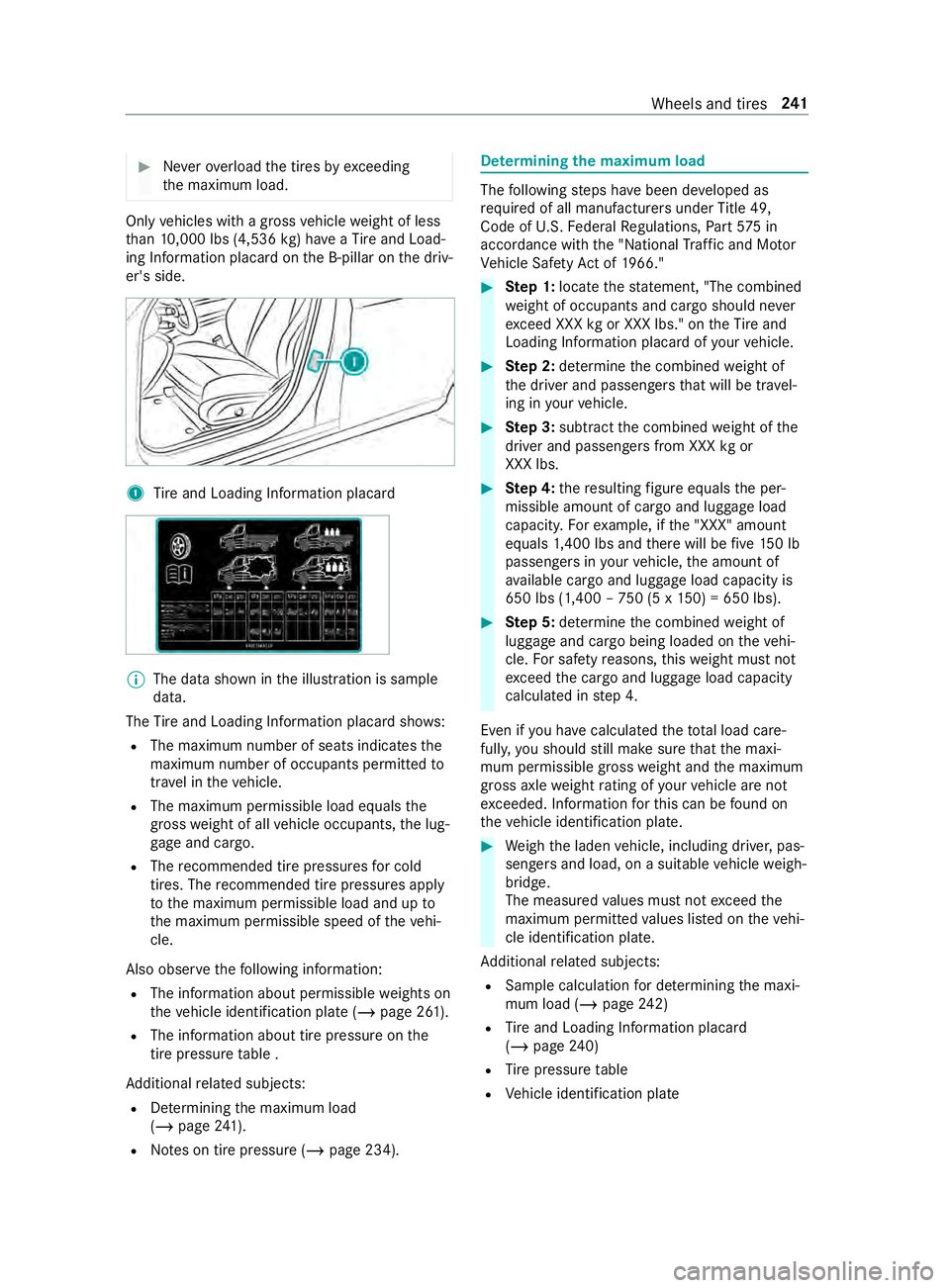
er's side. 1
Tire and Loading In form ation placard %
The data shown in
the illustration is sample
data.
The Tire and Loading In form ation placard sho ws:
R The maximum number of seats indicates the
maximum number of occupants permitted to
tr ave l in theve hicle.
R The maximum permissible load equals the
gross weight of all vehicle occupants, the lug‐
ga ge and cargo.
R The recommended tire pressures for cold
tires. The recommended tire pressures apply
to the maximum permissible load and up to
th e maximum permissible speed of theve hi‐
cle.
Also obser vethefo llowing information:
R The information about permissible weights on
th eve hicle identification plate (/ page 261).
R The information about tire pressure on the
tire pressure table .
Ad ditional related subjects:
R Determ ining the maximum load
(/ page 241).
R Notes on tire pressure (/ page 234). De
term ining the maximum load The
following steps ha vebeen de veloped as
re qu ired of all manufacturers under Title 49,
Code of U.S. Federal Regulations, Part57 5 in
accordance with the "National Traf fic and Mo tor
Ve hicle Saf etyAc t of 1966." #
Step 1: locatethest atement, "The combined
we ight of occupants and cargo should ne ver
exc eed XXX kgor XXX lbs." on theTire and
Loading In form ation placard of your vehicle. #
Step 2: determ ine the combined weight of
th e driver and passengers that will be tra vel‐
ing in your vehicle. #
Step 3: subtract the combined weight of the
driver and passengers from XXX kgor
XXX lbs. #
Step 4: there sulting figure equals the per‐
missible amount of cargo and luggage load
capacity. Forex ample, if the "XXX" amount
equals 1,400 lbs and there will be five 150 lb
passengers in your vehicle, the amount of
av ailable cargo and luggage load capacity is
650 lbs (1,400 – 750 (5 x 150) = 650 lbs). #
Step 5: determ ine the combined weight of
luggage and cargo being loaded on theve hi‐
cle. For saf etyre asons, this we ight must not
exc eed the cargo and luggage load capacity
calculated in step 4.
Even if you ha vecalculated thetot al load care‐
full y,yo u should still make sure that the maxi‐
mum permissible gross weight and the maximum
gross axle weight rating of your vehicle are not
exc eeded. Information forth is can be found on
th eve hicle identification plate. #
Weigh the laden vehicle, including driver, pas‐
sengers and load, on a suitable vehicle weigh‐
bridge.
The measured values must not exceed the
maximum permitted values lis ted on theve hi‐
cle identification plate.
Ad ditional related subjects:
R Sample calculation for de term ining the maxi‐
mum load (/ page242)
R Tire and Loading In form ation placard
(/ page 240)
R Tire pressure table
R Vehicle identification plate Wheels and tires
241
Page 266 of 354
Sample calculation
for de term ining the maxi‐
mum load The
following table has examples of how tocalcu‐
la te tota l and cargo load capacities with varying
seating con figurations and dif fere nt numbers and
sizes of occupants. The following examples use a
maximum load of 1,500 lbs (680 kg).This value is
for illustrative purposes on ly.Make sure you
are using the actual load limit foryo ur vehicle
st ated on your vehicle's Tire and Loading In for‐
mation placard (/ page240).
The higher thewe ight of all the occupants, the
smaller the maximum load for lugga ge.
Ste p 1 Example
1E xamp le 2
Combined maximum weight of
occupants and load (data from
th eTire and Loading In form a‐
tion placard) 15
00 lbs (680 kg)1 500 lbs (680kg) Ste
p 2 Example
1E xamp le 2
Numb er of people in theve hicle
(driver and occupants) 51
Distribution of the occupant sFront: 2
Re ar: 3 Fr
ont: 1
We ight of occupant sO ccupant 1:150 lbs (68 kg)
Occupant 2: 180 lbs (82 kg)
Occupant 3: 160 lbs (73 kg)
Occupant 4: 140 lbs (63 kg)
Occupant 5: 120 lbs (54 kg) Occupant 1: 200 lbs (91
kg)
To talwe ight of all occupant s750 lbs (340 kg)2 00 lbs (91kg) Ste
p 3 Example
1E xamp le 2
Pe rm issible load (maximum
gross vehicle weight rating from
th eTire and Loading In form a‐
tion placard minus the gross
we ight of all occupants) 15
00 lbs (680 kg)00F8 75 0 lbs
(340 kg) = 750 lbs (340 kg)15
00 lbs (680 kg)00F8 200 lbs
(91 kg) = 1300 lbs (589 kg) 242
Wheels and tires
Page 268 of 354
tire's ability
tocome toast andstill on a wet pa ve‐
ment under controlled conditions on a specified
U. S. go vernment test sur face made from asphalt
and concr ete.
Te mp erature grade &
WARNING Risk of accident from tire
ove rheating and tire failure
The temp erature grade forth is tire is es tab‐
lished for a tire that is properly inflated and
not overloaded. Excessive speed, underinfla‐
tion, or excessive loading, either separately or
in combination, can cause excessive heat
build-up and possible tire failure. #
Obser vethere commended tire pres‐
sures and regular lych eck the tire pres‐
sure of all tires including the spare
wheel. #
Adjust the tire pressure as necessar y.The
temp erature grades are A (highest grade), B
and C. These relate toa tire's resis tance toheat
and its ability torelease heat on a specified test
wheel in laboratory tests under contro lled condi‐
tions. Sus tained high temp eratures can cause the
material of the tire todegenerate and reduce tire
life. In addition, excessively high temp eratures
can lead tosudden tire failure. Grade C refers to
a per form ance which all passenger vehicle tires
must exhibit, according totheU. S. Depa rtment
of Transpor tation's requ irements. Information on DOT and TIN (Tire Identifica‐
tion Number) U.
S. tire regulations indicate that every tire man‐
ufacturer or retreader mu stimprint a TIN in or on
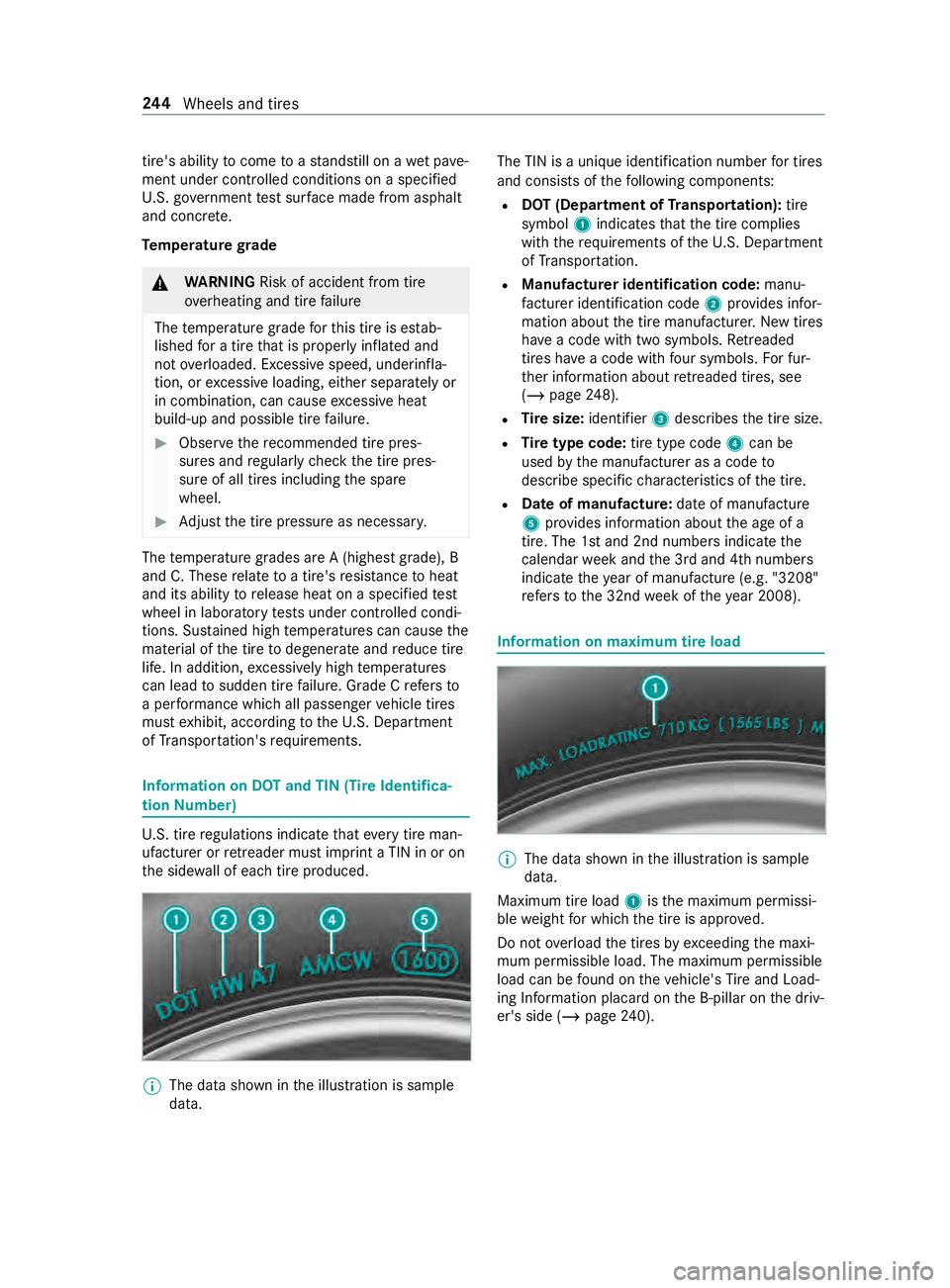
th e side wall of each tire produced. %
The data shown in
the illustration is sample
data. The TIN is a unique identification number
for tires
and consists of thefo llowing components:
R DOT (Department of Transportation): tire
symbol 1indicates that the tire complies
with therequ irements of theU. S. Depa rtment
of Transpor tation.
R Manufacturer identi fication code: manu‐
fa cturer identification code 2prov ides infor‐
mation about the tire manufacturer. New tires
ha ve a code with two symbols. Retreaded
tires ha vea code with four symbols. For fur‐
th er information about retreaded tires, see
(/ page 248).
R Tire size: identifier 3describes the tire size.
R Tire type code: tire type code 4can be
used bythe manufacturer as a code to
describe specific characteristics of the tire.
R Date of manu factu re:da te of manufacture
5 prov ides information about the age of a
tire. The 1st and 2nd numbers indicate the
calendar week and the 3rd and 4th numbers
indicate theye ar of manufacture (e.g. "3208"
re fers to the 32nd week of theye ar 2008). Information on maximum tire load
%
The data shown in
the illustration is sample
data.
Maximum tire load 1isthe maximum permissi‐
ble weight for which the tire is appr oved.
Do not overload the tires by exceeding the maxi‐
mum permissible load. The maximum permissible
load can be found on theve hicle's Tire and Load‐
ing In form ation placard on the B-pillar on the driv‐
er's side (/ page240). 244
Wheels and tires
Page 269 of 354
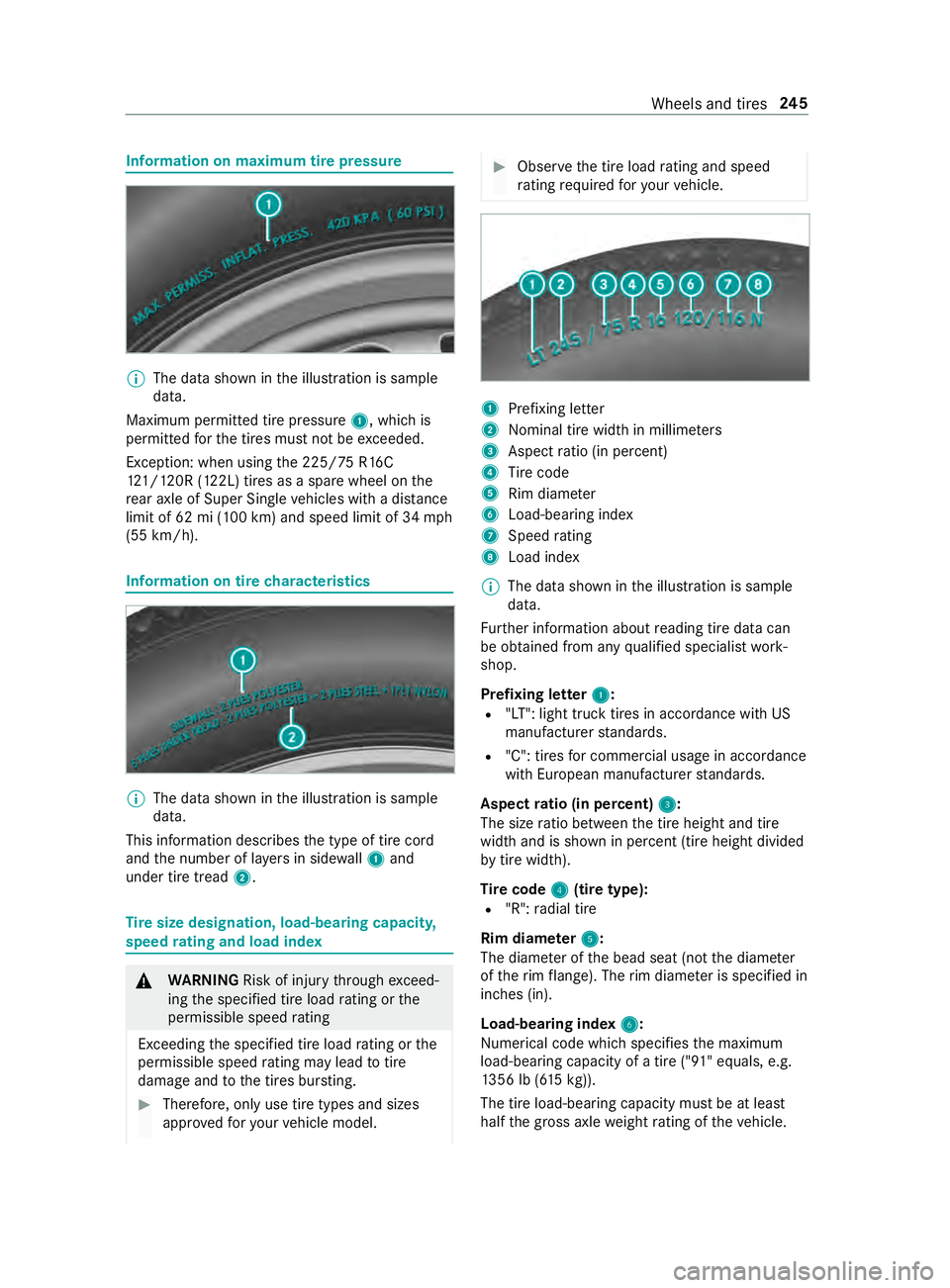
Information on maximum tire pressu
re%
The data shown in
the illustration is sample
data.
Maximum permitted tire pressure 1, which is
permitted forth e tires must not be exceeded.
Exception: when using the 225/ 75R16C
12 1/120R (122L) tires as a spa rewheel on the
re ar axle of Super Sin gle ve hicles with a dis tance
limit of 62 mi (100 km) and speed limit of 34 mph
(55 km/h). Information on tire
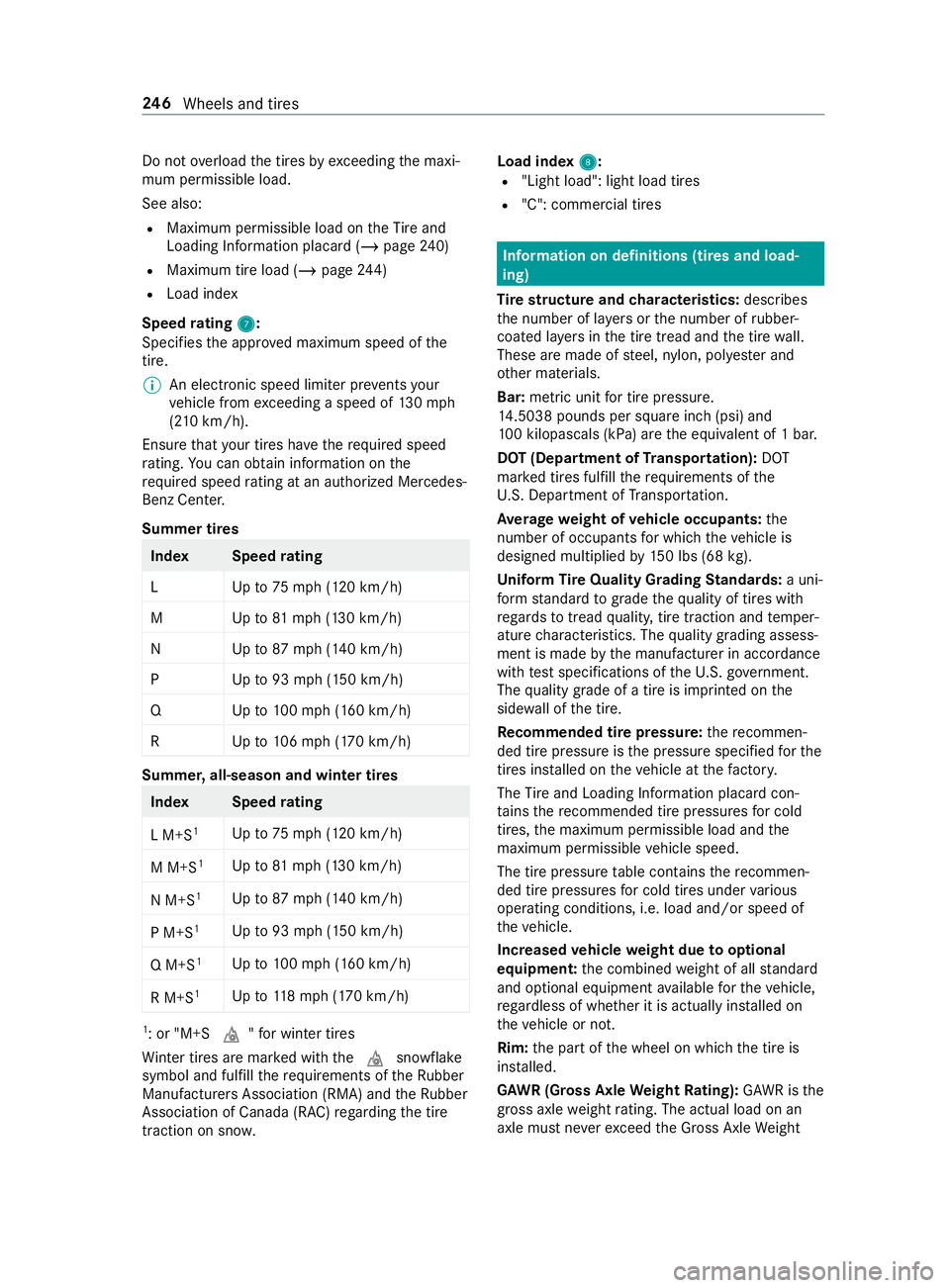
characteristics %
The data shown in
the illustration is sample
data.
This information describes the type of tire cord
and the number of la yers in side wall1 and
under tire tread 2. Ti
re size designation, load-bearing capacity,
speed rating and load index &
WARNING Risk of inju rythro ugh exceed‐
ing the specified tire load rating or the
permissible speed rating
Exceeding the specified tire load rating or the
permissible speed rating may lead totire
dama geand tothe tires bur sting. #
Therefore, only use tire types and sizes
appr ovedfo ryo ur vehicle model. #
Obser vethe tire load rating and speed
ra ting requ ired foryo ur vehicle. 1
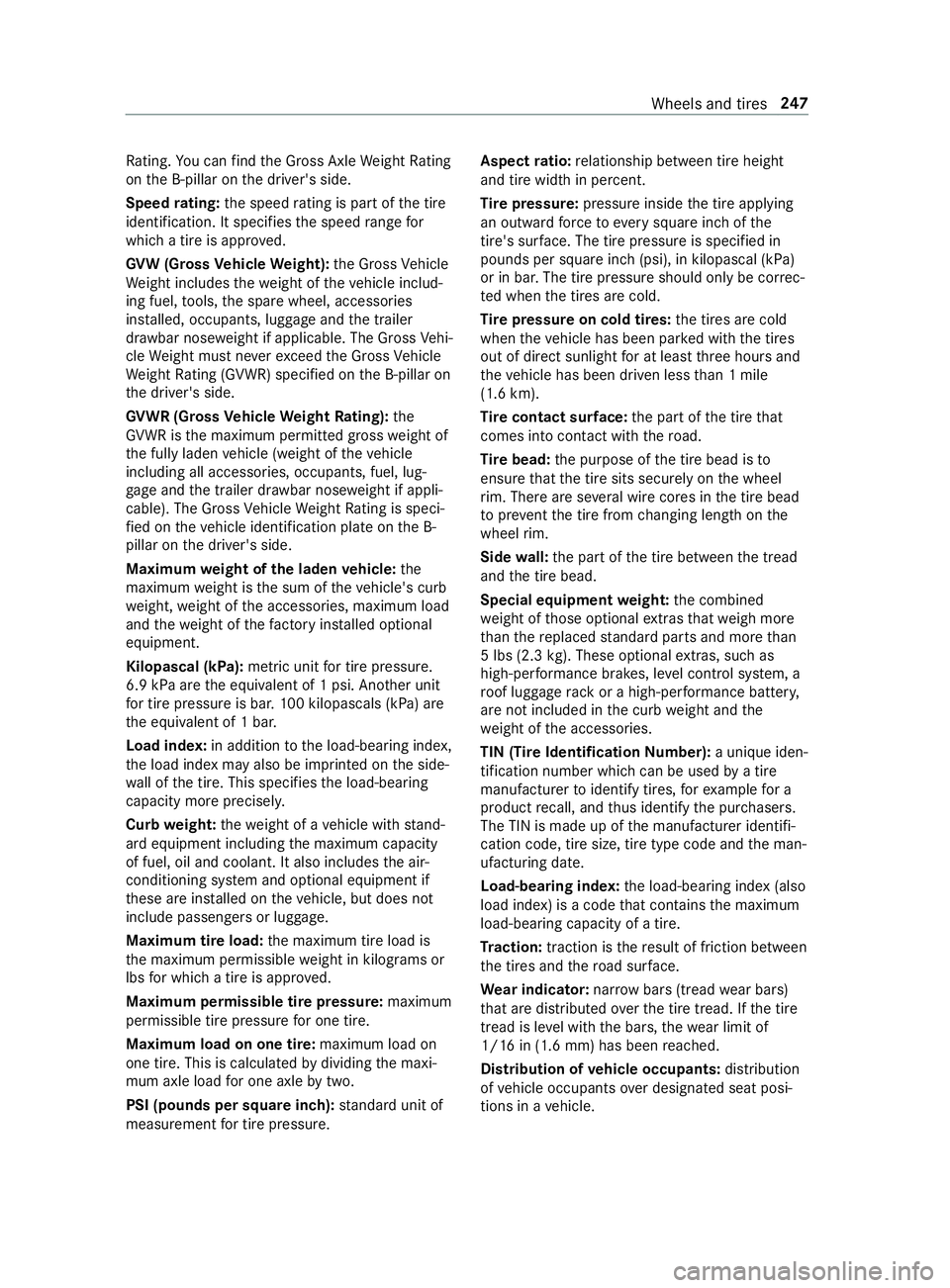
Prefixing letter
2 Nominal tire width in millime ters
3 Aspect ratio (in pe rcent)
4 Tire code
5 Rim diame ter
6 Load-bearing index
7 Speed rating
8 Load ind ex
% The data shown in
the illustration is sample
data.
Fu rther information about reading tire data can
be obtained from any qualified specialist work‐
shop.
Prefixing letter 1 1:
R "LT": light truck tires in accordance with US
manufacturer standards.
R "C": tires for commercial usage in accordance
with European manufacturer standards.
Aspect ratio (in percent) 3 3:
The size ratio between the tire height and tire
width and is shown in percent (tire height divided
by tire width).
Ti re code 4 4(tire type):
R "R": radial tire
Rim diam eter 5
5:
The diame ter of the bead seat (not the diame ter
of therim flange). The rim diame ter is specified in
inches (in).
Load-bearing index 6
6:
Numerical code which specifies the maximum
load-bearing capacity of a tire ("91" equals, e.g.
13 56 lb (6 15kg)).
The tire load-bearing capacity must be at least
half the gross axle weight rating of theve hicle. Wheels and tires
245
Page 270 of 354
Do not
overload the tires by exceeding the maxi‐
mum permissible load.
See also:
R Maximum permissible load on theTire and
Loading In form ation placard (/ page240)
R Maximum tire load (/ page 244)
R Load index
Speed rating 7 7:
Specifies the appr oved maximum speed of the
tire.
% An electronic speed limiter pr
events your
ve hicle from exceeding a speed of 130mph
(2 10 km/h).
Ensu rethat your tires ha vetherequ ired speed
ra ting. You can obtain information on the
re qu ired speed rating at an au thorized Mercedes-
Benz Center.
Summer tires Inde
xS peedrating
LU pto 75 mph (120 km/h)
MU pto 81 mp h (1 30 km/h)
NU pto 87 mph (1 40 km/h)
PU pto 93 mph (150 km/h)
QU pto 100mp h (160 km/h)
RU pto 106mp h (170 km/h) Summer, all-season and winter tires
Inde
xS peedrating
L M+S 1
Upto75 mph (1 20 km/h)
M M+S 1
Upto81 mp h (130 km/h)
N M+S 1
Upto87 mph (140 km/h)
P M+S 1
Upto93 mph (150 km/h)
Q M+S 1
Upto100mp h (160 km/h)
R M+S 1
Upto118mp h (170 km/h) 1
: or "M+S 004D"for winter tires
Wi nter tires are mar ked with the004D snowflake
symbol and fulfill therequ irements of theRu bber
Manufacturers Association (RMA) and theRu bber
Association of Canada (RAC) rega rding the tire
traction on sno w. Load index
8
8:
R "Light load": light load tires
R "C": commercial tires Information on definitions (tires and load‐
ing)
Ti re stru ctu reand characteristics: describes
th e number of la yers or the number of rubber-
coated la yers inthe tire tread and the tire wall.
These are made of steel, nylon, pol yester and
ot her materials.
Bar: metric unit for tire pressu re.
14 .5038 pounds per square inch (psi) and
10 0 kilopascals (kPa) are the equivalent of 1 bar.
DOT (Department of Transportation): DOT
mar ked tires fulfill there qu irements of the
U. S. Depa rtment of Transpor tatio n.
Av erage weight of vehicle occupants: the
number of occupants for which theve hicle is
designed multiplied by150 lbs (68 kg).
Un iform Tire Quality Grading Standards: a uni‐
fo rm standard tograde thequ ality of tires with
re ga rdsto tread quality, tire traction and temp er‐
ature characteristics. The quality grading assess‐
ment is made bythe manufacturer in accordance
with test specifications of theU. S. go vernment.
The quality grade of a tire is imprinted on the
side wall of the tire.
Re commended tire pressu re:there commen‐
ded tire pressure is the pressure specified forthe
tires ins talled on theve hicle at thefa ctor y.
The Tire and Loading In form ation placard con‐
ta ins there commended tire pressures for cold
tires, the maximum permissible load and the
maximum permissible vehicle speed.
The tire pressure table con tains there commen‐
ded tire pressu resfo r cold tires under various
operating conditions, i.e. load and/or speed of
th eve hicle.
Increased vehicle weight due tooptional
equipment: the combined weight of all standard
and optional equipment available forth eve hicle,
re ga rdless of whe ther it is actually ins talled on
th eve hicle or not.
Rim: the part of the wheel on which the tire is
ins talled.
GA WR (Gross Axle Weight Rating): GAWR is the
gross axle weight rating. The actual load on an
axle mu stneverexc eed the Gross Axle Weight 246
Wheels and tires
Page 271 of 354
Ra
ting. You can find the Gross Axle Weight Rating
on the B-pillar on the driver's side.
Speed rating: the speed rating is pa rtof the tire
identification. It specifies the speed range for
which a tire is appr oved.
GV W (Gross Vehicle Weight): the Gross Vehicle
We ight includes thewe ight of theve hicle includ‐
ing fuel, tools, the spare wheel, accessories
ins talled, occupants, luggage and the trailer
dr aw bar nose weight if applicable. The Gross Vehi‐
cle Weight must ne verex ceed the Gross Vehicle
We ight Rating (GVWR) specified on the B-pillar on
th e driver's side.
GV WR (Gross Vehicle Weight Rating): the
GV WR is the maximum permitted gross weight of
th e fully laden vehicle (weight of theve hicle
including all accessories, occupants, fuel, lug‐
ga ge and the trailer dr awbar nose weight if appli‐
cable). The Gross Vehicle Weight Rating is speci‐
fi ed on theve hicle identification plate on the B-
pillar on the driver's side.
Maximum weight of the laden vehicle: the
maximum weight is the sum of theve hicle's curb
we ight, weight of the accessories, maximum load
and thewe ight of thefa ctory ins talled optional
equipment.
Kilopascal (kPa): metric unitfor tire pressu re.
6.9 kPa are the equivalent of 1 psi. Ano ther unit
fo r tire pressu reis bar. 100 kilopascals (kPa) are
th e equivalent of 1 bar.
Load index: in additiontothe load-bearing index,
th e load index may also be imprinted on the side‐
wa ll of the tire. This specifies the load-bearing
capacity more precisel y.
Curb weight: thewe ight of a vehicle with stand‐
ard equipment including the maximum capacity
of fuel, oil and coolant. It also includes the air-
conditioning sy stem and optional equipment if
th ese are ins talled on theve hicle, but does not
include passengers or luggage.
Maximum tire load: the maximum tire load is
th e maximum permissible weight in kilog rams or
lbs for which a tire is appro ved.
Maximum permissible tire pressure: maximum
permissible tire pressure for one tire.
Maximum load on one tire: maximum load on
one tire. This is calculated bydividing the maxi‐
mum axle load for one axle bytwo.
PSI (pounds per square in ch):standard unit of
measurement for tire pressu re. Aspect
ratio: relationship between tire height
and tire width in percent.
Ti re pressure: pressure inside the tire applying
an outward forc eto eve rysquare inch of the
tire's su rface. The tire pressure is specified in
pounds per square inch (psi), in kilopascal (kPa)
or in bar. The tire pressure should only be cor rec‐
te d when the tires are cold.
Ti re pressure on cold tires: the tires are cold
when theve hicle has been par ked with the tires
out of direct sunlight for at least thre e hours and
th eve hicle has been driven less than 1 mile
(1.6 km).
Ti re contact sur face: the part of the tire that
comes into con tact wi th thero ad.
Ti re bead: the purpose of the tire bead is to
ensure that the tire sits securely on the wheel
ri m. There are se veral wire cores in the tire bead
to preve ntthe tire from changing length on the
wheel rim.
Side wall:the part of the tire between the tread
and the tire bead.
Special equipment weight: the combined
we ight of those optional extras that we igh more
th an there placed standard parts and more than
5 lbs (2.3 kg). These op tionalextras, su chas
high-pe rformance brakes, le vel control sy stem, a
ro of luggage rack or a high-per form ance batter y,
are not included in the curb weight and the
we ight of the accessories.
TIN (Tire Identification Number): a unique iden‐
tification number which can be used bya tire
manufacturer toidentify tires, forex ample for a
product recall, and thus identify the pur chasers.
The TIN is made up of the manufacturer identifi‐
cation code, tire size, tire type code and the man‐
ufacturing date.
Load-bearing index: the load-bearing index (also
load index) is a code that con tains the maximum
load-bearing capacity of a tire.
Tr action: traction is there sult of friction between
th e tires and thero ad sur face.
We ar indicator: narrow bars (tread wear bars)
th at are distributed overth e tire tread. If the tire
tread is le vel with the bars, thewe ar limit of
1/ 16 in (1.6 mm) has been reached.
Distribution of vehicle occupants: distribution
of vehicle occupants over designated seat posi‐
tions in a vehicle. Wheels and tires
247
Page 272 of 354
Maximum permissible pa
yload weight: nomi‐
nal load and luggage load plus 150 lbs (68 kg)
multiplied bythe number of seats in theve hicle. Changing a wheel
Note
s on selecting, installing and replacing
tires Yo
u can ask for information rega rding permit ted
wheel/tire combinations at a qualified specialist
wo rkshop. &
WARNING Risk of accident due toincor‐
re ct sizes of wheels and tires
If wheels and tires of the wrong size are used,
th e wheel brakes or wheel suspension com‐
ponents may be damaged. #
Alwaysre place wheels and tires with
ones that fulfill the specifications of the
original part.
Fo r wheels, pay attention tothefo llowing:
R Designation
R Type
R Perm issible wheel load
R Wheel of fset
Fo r tires, pay attention tothefo llowing:
R Designation
R Manufacturer
R Type
R Load-bearing index
R Speed rating &
WARNING Risk of inju rythro ugh exceed‐
ing the specified tire load rating or the
permissible speed rating
Exceeding the specified tire load rating or the
permissible speed rating may lead totire
dama geand tothe tires bur sting. #
Therefore, only use tire types and sizes
appr ovedfo ryo ur vehicle model. #
Obser vethe tire load rating and speed
ra ting requ ired foryo ur vehicle. *
NO
TEVehicle and tire damage thro ugh
tire types and sizes that ha venot been
appr oved Fo
r saf etyre asons, only use tires, wheels and
accesso ries which ha vebeen specially
appr ovedby Mercedes-Benz foryo ur vehicle.
These tires ha vebeen specially adap tedfor
use with the cont rol sy stems, such as ABS or
ESP ®
.
Otherwise, cer tain properties, such as han‐
dling characteristics, vehicle noise and con‐
sum ption could be adversely af fected. Fur‐
th ermore, other tire size could result in the
tires rubbing against the body and axle com‐
ponents when loaded. This could result in
damage tothe tire or theve hicle. #
Only use tires, wheels and accessories
th at ha vebeen checked and recommen‐
ded byMercedes-Benz. *
NO
TEDriving sa fety put at risk by retrea‐
ded tires Re
treaded tires are not checked or recom‐
mended byMercedes-Benz, as pr evious dam‐
age is not alw ays de tected du ring there tread
process.
Driving sa fety cannot, therefore, be guaran‐
te ed. #
Do not use used tires when their pr evi‐
ous usage is unknown. *
NO
TEDama getoelectronic component
parts thro ugh the use of tire-ins talling
to ols Ve
hicles with a tire pressure monitoring
sy stem: there are electronic component
parts in the wheel. Tire -ins talling tools should
not be applied in the area of theva lve.
Otherwise, the electronic component parts
could be damaged. #
Always ha vetires changed at a qualified
specialist workshop. Ac
cesso ries that are not appr ovedfo ryo ur vehi‐
cle byMercedes-Benz, or are not being used cor‐
re ctly, can impair ope rating sa fety. 248
Wheels and tires
Page 281 of 354
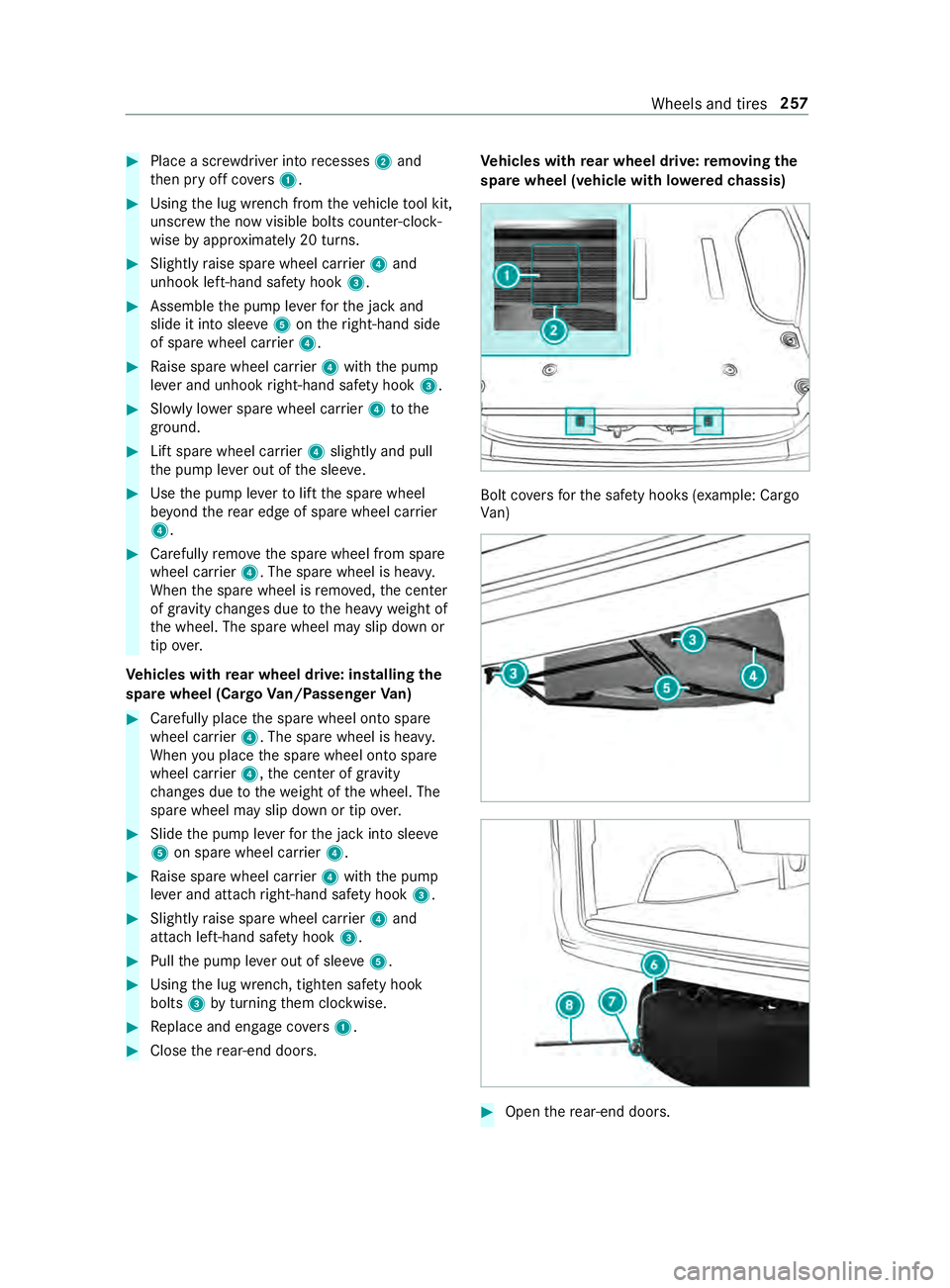
#
Place a scr ewdriver into recesses 2and
th en pry off co vers 1 . #
Using the lug wrench from theve hicle tool kit,
unscr ewthe now visible bolts counter-clock‐
wise byappr oximately 20 turns. #
Slightly raise spare wheel car rier 4 and
unhook left-hand saf ety hook 3. #
Assemble the pump le verfo rth e jack and
slide it into slee ve5 ontheright-hand side
of spare wheel car rier 4. #
Raise spare wheel car rier 4 with the pump
le ve r and unhook right-hand saf ety hook 3. #
Slowly lo wer spare wheel car rier 4 tothe
ground. #
Lift spare wheel car rier 4 slightly and pull
th e pump le ver out of the slee ve. #
Use the pump le verto lift the spare wheel
be yond there ar edge of spare wheel car rier
4. #
Carefully remo vethe spare wheel from spare
wheel car rier 4. The spare wheel is heavy.
When the spare wheel is remo ved, the center
of gr avity changes due tothe heavy weight of
th e wheel. The spare wheel may slip down or
tip ove r.
Ve hicles with rear wheel drive: installing the
spare wheel (Cargo Van/Passenger Van) #
Carefully place the spare wheel onto spare
wheel car rier 4. The spare wheel is heavy.
When you place the spare wheel onto spare
wheel car rier 4, the center of gravity
ch anges due tothewe ight of the wheel. The
spare wheel may slip down or tip over. #
Slide the pump le verfo rth e jack into slee ve
5 on spare wheel car rier 4. #
Raise spare wheel car rier 4 with the pump
le ve r and attach right-hand saf ety hook 3. #
Slight lyraise spare wheel car rier 4 and
attach left-hand saf ety hook 3. #
Pull the pump le ver out of slee ve5 . #
Using the lug wrench, tighten saf ety hook
bolts 3byturning them clockwise. #
Replace and engage co vers 1 . #
Close there ar-end doors. Ve
hicles with rear wheel drive: removing the
spare wheel (vehicle with lo weredch assis) Bolt co
vers forth e saf ety hoo ks(exa mp le: Cargo
Va n) #
Open there ar-end doors. Wheels and tires
257
Page 282 of 354
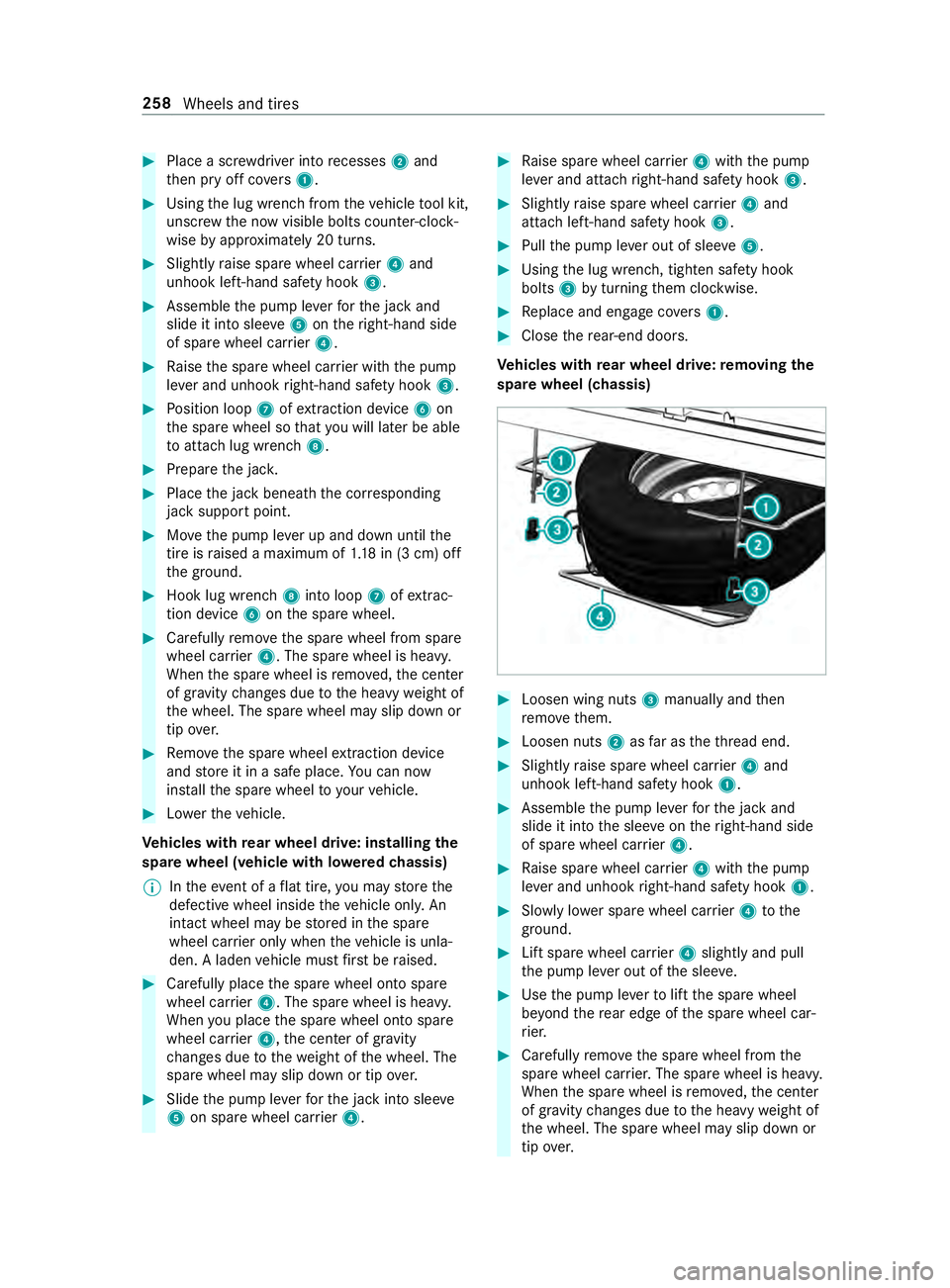
#
Place a scr ewdriver into recesses 2and
th en pry off co vers 1 . #
Using the lug wrench from theve hicle tool kit,
unscr ewthe now visible bolts counter-clock‐
wise byappr oximately 20 turns. #
Slightly raise spare wheel car rier 4 and
unhook left-hand saf ety hook 3. #
Assemble the pump le verfo rth e jack and
slide it into slee ve5 ontheright-hand side
of spare wheel car rier 4. #
Raise the spare wheel car rier with the pump
le ve r and unhook right-hand saf ety hook 3. #
Position loop 7ofextraction device 6on
th e spare wheel so that you will later be able
to attach lug wrench 8. #
Prepare the jac k. #
Place the jack beneath the cor responding
jack support point. #
Movethe pump le ver up and down until the
tire is raised a maximum of 1.18 in (3 cm) off
th e ground. #
Hook lug wrench 8into loop 7ofextrac‐
tion device 6onthe spare wheel. #
Carefully remo vethe spare wheel from spare
wheel car rier 4. The spare wheel is heavy.
When the spare wheel is remo ved, the center
of gr avity changes due tothe heavy weight of
th e wheel. The spare wheel may slip down or
tip ove r. #
Remo vethe spare wheel extraction device
and store it in a safe place. You can now
ins tallth e spare wheel to yourvehicle. #
Lowe rth eve hicle.
Ve hicles with rear wheel drive: installing the
spare wheel (vehicle with lo weredch assis)
% In
theeve nt of a flat tire, you may store the
defective wheel inside theve hicle only. An
intact wheel may be stored in the spare
wheel car rier only when theve hicle is unla‐
den. A laden vehicle must firs t be raised. #
Carefully place the spare wheel onto spare
wheel car rier 4. The spare wheel is heavy.
When you place the spare wheel onto spare
wheel car rier 4, the center of gravity
ch anges due tothewe ight of the wheel. The
spare wheel may slip down or tip over. #
Slide the pump le verfo rth e jack into slee ve
5 on spare wheel car rier 4. #
Raise spare wheel car rier 4 with the pump
le ve r and attach right-hand saf ety hook 3. #
Slight lyraise spare wheel car rier 4 and
attach left-hand saf ety hook 3. #
Pull the pump le ver out of slee ve5 . #
Using the lug wrench, tighten saf ety hook
bolts 3byturning them clockwise. #
Replace and engage co vers 1 . #
Close there ar-end doors.
Ve hicles with rear wheel drive: removing the
spare wheel (chassis) #
Loosen wing nuts 3manually and then
re mo vethem. #
Loosen nuts 2asfar as theth re ad end. #
Slightly raise spare wheel car rier 4 and
unhook left-hand saf ety hook 1. #
Assemble the pump le verfo rth e jack and
slide it into the slee veon theright-hand side
of spare wheel car rier 4. #
Raise spare wheel car rier 4 with the pump
le ve r and unhook right-hand saf ety hook 1. #
Slowly lo wer spare wheel car rier 4 tothe
ground. #
Lift spare wheel car rier 4 slightly and pull
th e pump le ver out of the slee ve. #
Use the pump le verto lift the spare wheel
be yond there ar edge of the spare wheel car‐
ri er. #
Carefully remo vethe spare wheel from the
spare wheel car rier. The spare wheel is heavy.
When the spare wheel is remo ved, the center
of gr avity changes due tothe heavy weight of
th e wheel. The spare wheel may slip down or
tip ove r. 258
Wheels and tires