heating MERCEDES-BENZ SPRINTER 2019 MY19 with 7” screen
[x] Cancel search | Manufacturer: MERCEDES-BENZ, Model Year: 2019, Model line: SPRINTER, Model: MERCEDES-BENZ SPRINTER 2019Pages: 354, PDF Size: 6.15 MB
Page 149 of 354
Problems with
the electronic le vel control Problem
Possible causes/consequences and 0050 0050Solutions
Yo u cannot raise or lo wer
th eve hicle le vel when
st ationar y. The compressor is in danger of
overheating. Af terre peatedly raising and
lo we ring theve hicle, electronic le vel control (play pr otection) is deactiva‐
te d. #
Tryto set theve hicle le vel manually again af ter appro ximately
one minute.
Electri c level control has been deactivated due tounde rvoltage. The bat‐
te ry may not be charging.
Handling and ride comfort may suf fer. #
Start the engine. #
Consult a qualified specialist workshop as soon as possible. Re
fueling Re
fueling theve hicle &
WARNING Risk offire or explosion from
fuel
Fu els are highly flammable. #
Fire, open flames, smoking and creation
of spar ksmust be avoided. #
Swit choff the ignition and, if available,
th est ationary heater, before and while
re fueling theve hicle. &
WARNING Risk of inju ryfrom fuels
Fu els are poisonous and hazardous to your
health. #
Do not swallow fuel or let it come into
con tact wi thskin, eyes or clo thing. #
Do not inhale fuel vapor. #
Keep children away from fuel. #
Keep doors and windo wsclosed du ring
th ere fueling process.
If yo u or other people come into contact with
fuel, obser vethefo llowing: #
Immediately rinse fuel off your skin with
soap and water. #
If fuel comes into contact with your
ey es, immediately rinse them thor‐
oughly with clean water.Seek medical
attention immediately. #
Ifyo u swallow fuel, seek medical atten‐
tion immediatel y.Do not induce vomit‐
ing. #
Change immediately out of clo thing that
has come into con tact wi thfuel. &
WARNING Risk offire or explosion from
electros tatic charge
Electros tatic charge can crea tespar ksand
th ereby ignite fuel vapors. #
Before opening the fuel filler cap or tak‐
ing hold of the pump nozzle, touch the
me tallic body of theve hicle.
This dischar ges any electros tatic charge
th at may ha vebuilt up. #
Do not get into theve hicle again during
th ere fueling process.
Otherwise, electros tatic charge could
build up again. &
WARNING Risk offire from fuel mixture
Ve hicles with a diesel engine:
If yo u mix diesel fuel with gasoline, theflash
point of the fuel mixture is lo werth an that of
pure diesel fuel.
While the engine is running, component pa rts
in theex haust sy stem may overheat without
wa rning. #
Neverre fuel using gasoline. #
Never mix gasoline with diesel fuel. Driving and parking
12 5
Page 150 of 354
*
NO
TEDo not use diesel torefuel vehicles
with a gasoline engine. If
yo u acciden tally refuel with the wrong fuel:
R Do not switch the ignition on. Otherwise
fuel can enter the engine.
Even small amounts of the wrong fuel
could result in damage tothe fuel sy stem
and the engine. The repair costs are high. #
Consult a qualified specialist workshop. #
Have the fuel tank and fuel lines drained
comple tely. *
NO
TEDo not use gasoline torefuel vehi‐
cles with a diesel engine. If
yo u acciden tally refuel with the wrong fuel:
R Do not switch the ignition on. Otherwise,
fuel can enter the fuel sy stem.
Even small amounts of the wrong fuel
could result in damage tothe fuel sy stem
and the engine. The repair costs are high. #
Consult a qualified specialist workshop. #
Have the fuel tank and fuel lines drained
comple tely. *
NO
TEDama getothe fuel sy stem caused
by ove rfilled fuel tanks. #
Only fill th e fuel tank until the pump
nozzle switches off. *
NO
TEFuel may spr ayout when you
re mo vethe fuel pump nozzle. #
Only fill th e fuel tank until the pump
nozzle switches off. *
NO
TEDama getopainted sur faces due to
fuel #
Do not spill any fuel on painted sur fa‐
ces. +
ENVI
RONMENTAL NOTEEnvironmental
damage due toimproper handling of fuel If fuels are handled improperly,
they pose a
danger topersons and the environment. #
Do not allow fuels torun into the sew‐
age sy stem, the sur face wate rs,the
ground water or into the ground. Re
quirements:
R The vehicle is unloc ked.
R The auxiliary heating is deactivated.
R The ignition is switched off
R The front left-hand door is open.
% Do not
get ba ckinto theve hicle during the
re fueling process. Otherwise, electros tatic
ch arge could build up again.
Obser vethe no tes on operating fluids
(/ page 263). 1
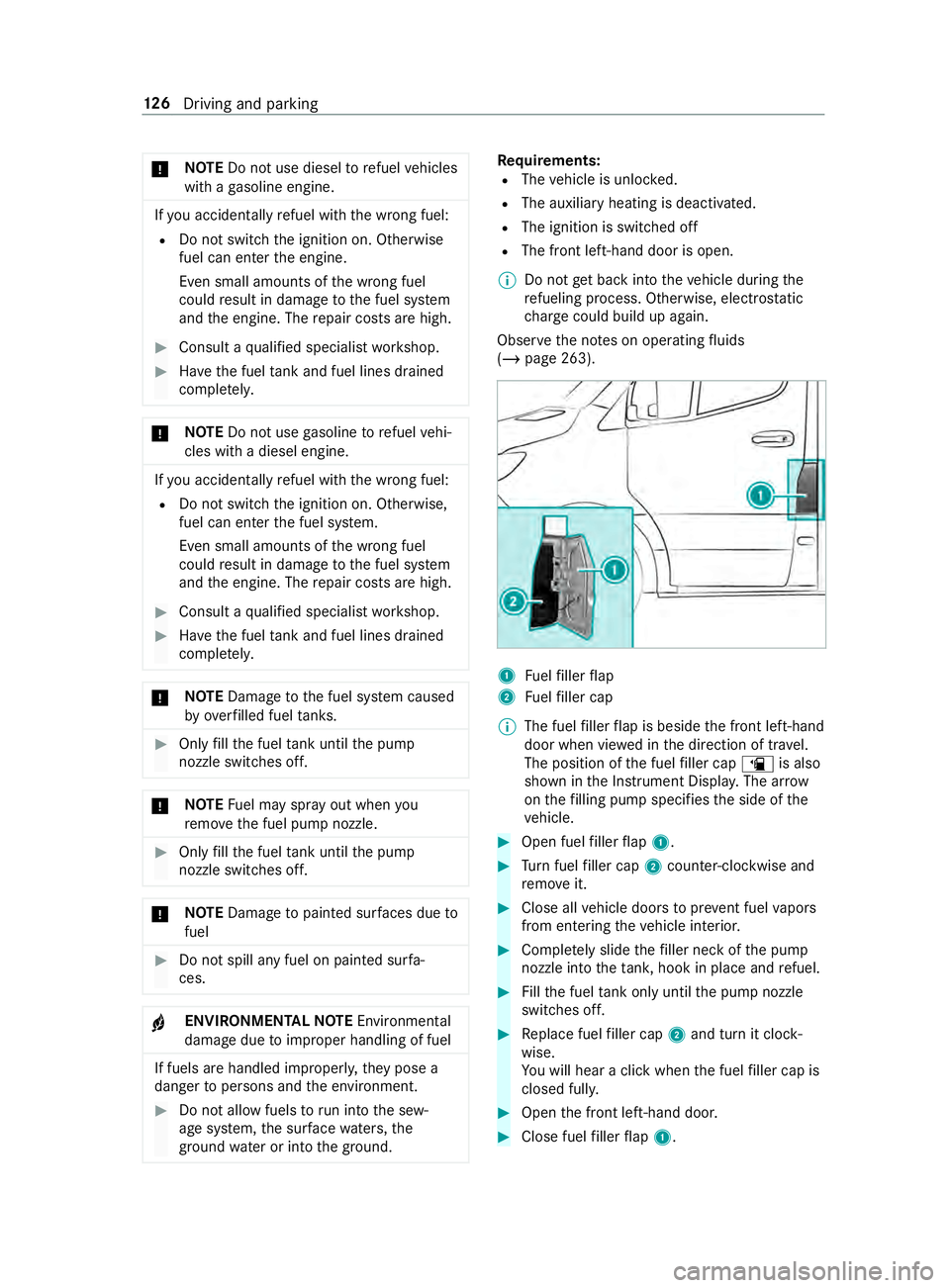
Fuelfiller flap
2 Fuelfiller cap
% The fuel
filler flap is beside the front left-hand
door when vie wed in the direction of tr avel.
The position of the fuel filler cap 00D4is also
shown in the Instrument Displa y.The ar row
on thefilling pump specifies the side of the
ve hicle. #
Open fuel filler flap 1. #
Turn fuel filler cap 2coun ter-clockwise and
re mo veit. #
Close all vehicle doors topreve nt fuel vapors
from entering theve hicle interior. #
Comple tely slide thefiller neck of the pump
nozzle into theta nk, hook in place and refuel. #
Fillthe fuel tank only until the pump nozzle
switches off. #
Replace fuel filler cap 2and turn it clock‐
wise.
Yo u will hear a click when the fuel filler cap is
closed full y. #
Open the front left-hand door. #
Close fuel filler flap 1. 12 6
Driving and pa rking
Page 152 of 354
R
Diluting DEF #
Only use DEF in acco rdance with ISO
22 241. #
Do not mix additives. #
Do not dilu teDEF. *
NO
TEDama geand malfunctions caused
by impurities in DEF Impurities in DEF
result in thefo llowing:
R Higher emission values
R Damage tothe catalytic con verter
R Engine damage
R Malfunctions in the DEF exhaust gas
af te rtre atment sy stem #
Avoid impurities in DEF. *
NO
TEDEF residue cr ystallizes af ter
some time. Remo veDEF residue. #
Immediately rinse su rfaces that come in
con tact wi thDEF when filling with
wate r. #
DEF can also be remo ved with a damp
clo thand cold water. #
If DEF has already cr ystallized, clean
using a spon geand cold water. DEF is a li
quid urea solution used forex haust gas
af te rtre atment of diesel engines. In order forthe
ex haust gas af tertre atment tofunction properly,
only use DEF in accordance with ISO 222 41 .
DEF has thefo llowing properties:
R non-t oxic
R colorless and odorless
R non-flammable
DEF availability:
R you can ha veDEF added byfast service at a
qu alified specialist workshop, e.g. an author‐
ized Mercedes-Benz Center.
R DEF is available at numerous gasst ations via
DEF filling pumps.
R alternatively, DEF is available at qualified spe‐
cialist workshops, e.g. an authorized
Mercedes-Benz Center, and at numerous gas
st ations as a DEF refill canis ter or DEF refill
bottle. %
DEF freezes at a
temp erature of appr ox‐
imately 12.2 °F (-11 °C). The vehicle is equip‐
ped with a DEF preheating sy stem at thefa c‐
to ry. This means that winter operation is also
ensured forte mp eratures below 12.2 °F
(-11 °C). If you add DEF at temp eratures
below 12.2 °F (-11 °C), the DEF le vel in the
instrument clus ter may not be displa yed cor‐
re ctly. If the DEF is frozen, drive for at least
20 minutes and then park theve hicle for a
minimum of 30 seconds, so that the le vel is
cor rectly displa yed. In extreme winter condi‐
tions, the time needed todetect theto p-up
amount may be considerably longer. Park the
ve hicle in a warm garage tospeed up this
process.
% Ensure
the connection between there fill con‐
ta iner and vehicle filler neck does not drip.
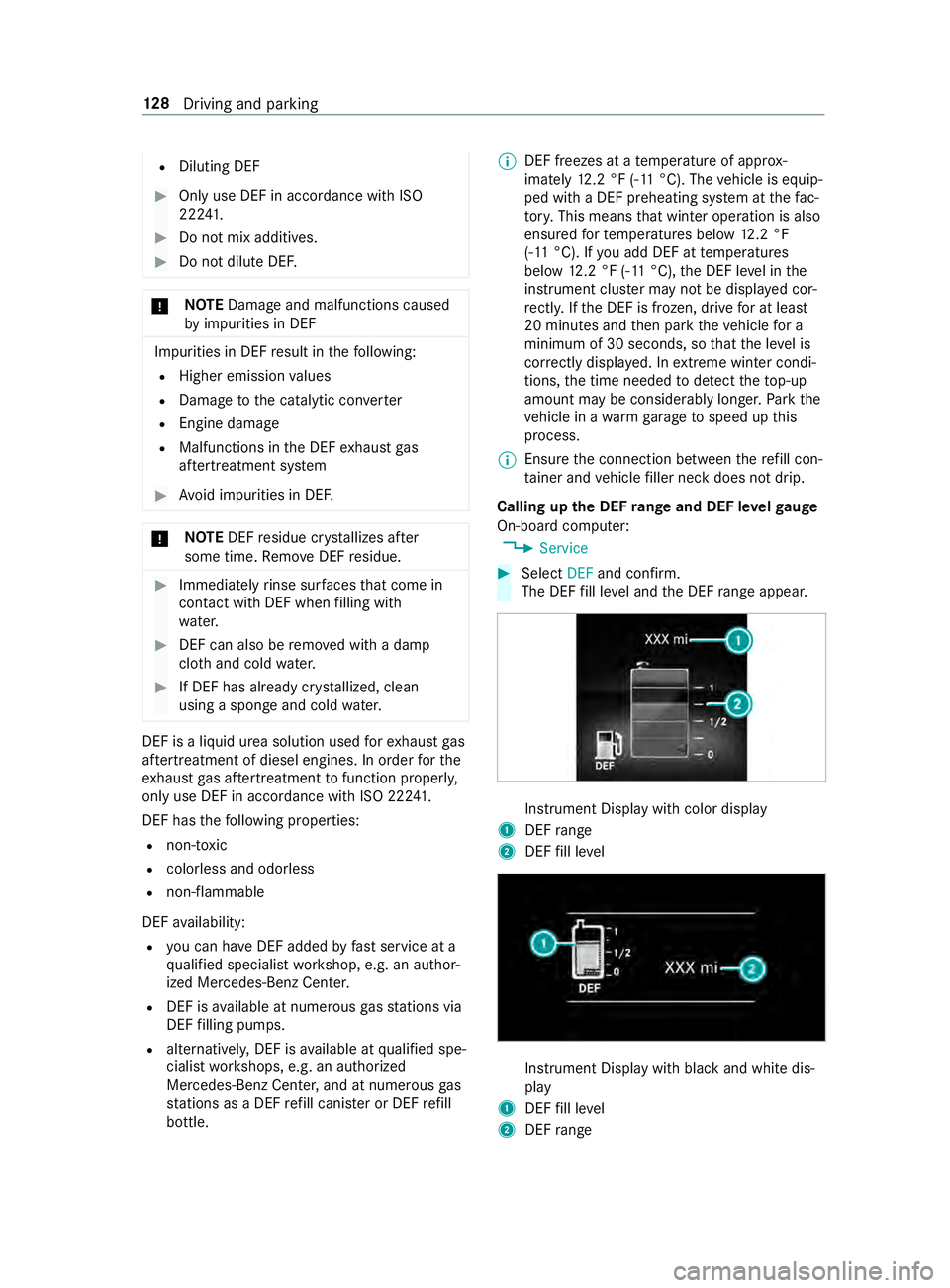
Calling up the DEF range and DEF le velga uge
On-board computer:
4 Service #
Select DEFand confirm.
The DEF fill le vel and the DEF range appear. Instrument Display wi
thcolor display
1 DEF range
2 DEF fill le vel Instrument Display with black
and white dis‐
play
1 DEF fill le vel
2 DEF range 12 8
Driving and pa rking
Page 166 of 354
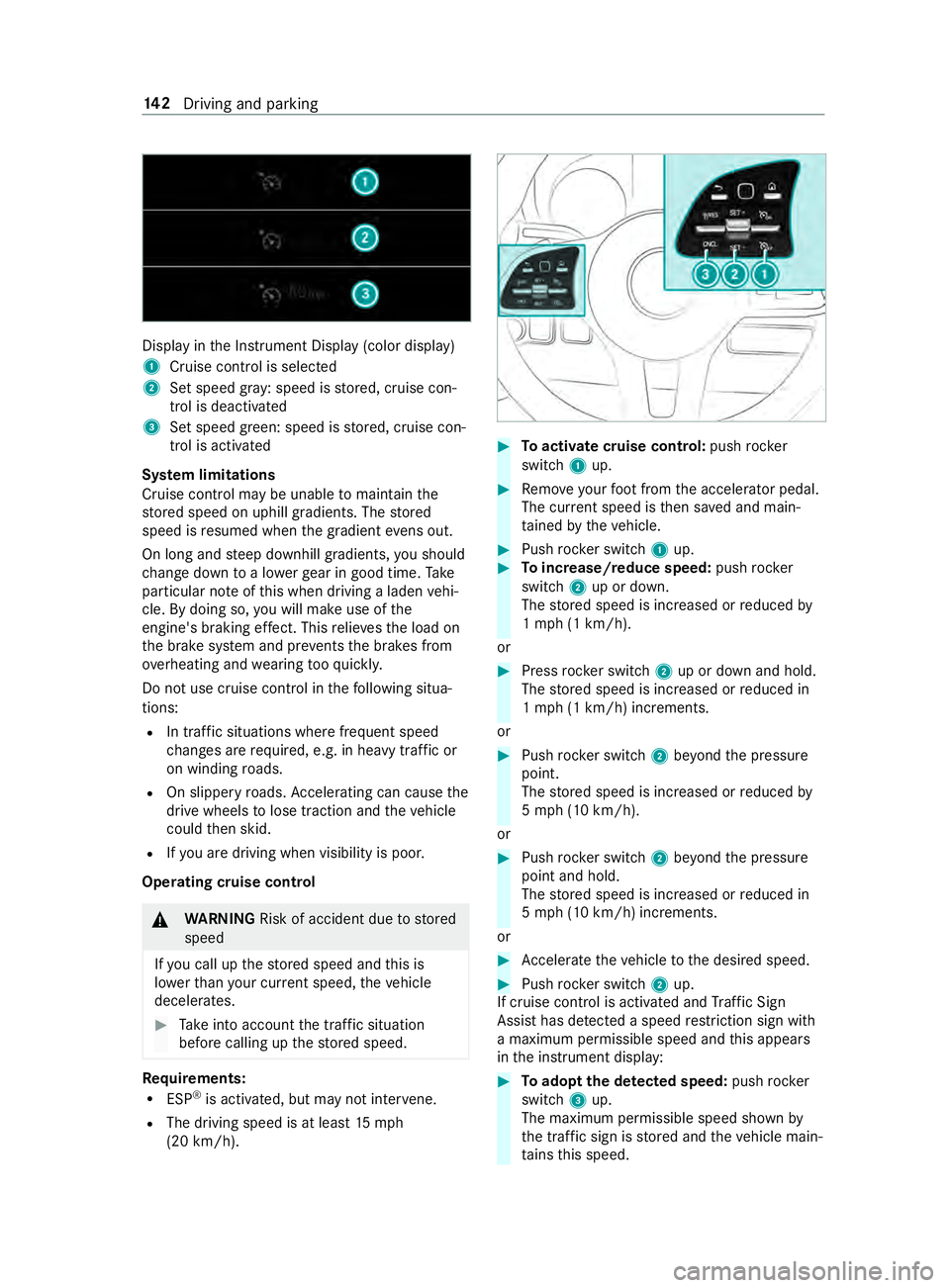
Displ
ayinthe Instrument Display (color display)
1 Cruise cont rol is selec ted
2 Set speed gr ay: speed is stored, cruise con‐
trol is deactivated
3 Set speed green: speed is stored, cruise con‐
trol is activated
Sy stem limitations
Cruise control may be unable tomaintain the
st ored speed on uphill gradients. The stored
speed is resumed when the gradient evens out.
On long and steep downhill gradients, you should
ch ange down toa lo werge ar in good time. Take
particular no teofthis when driving a laden vehi‐
cle. By doing so, you will make use of the
engine's braking ef fect. This relie vesth e load on
th e brake sy stem and pr events the brakes from
ove rheating and wearing tooqu ickl y.
Do not use cruise control in thefo llowing situa‐
tions:
R In traf fic situations whe refrequent speed
ch anges are requ ired, e.g. in heavy traf fic or
on winding roads.
R On slippe ryroads. Accele rating can cause the
drive wheels tolose traction and theve hicle
could then skid.
R Ifyo u are driving when visibility is poor.
Operating cruise cont rol&
WARNING Risk of accident due tostored
speed
If yo u call up thestored speed and this is
lo we rth an your cur rent speed, theve hicle
decelerates. #
Take into account the tra ffic situation
before calling up thestored speed. Re
quirements:
R ESP ®
is activated, but may not inter vene.
R The driving speed is at least 15mph
(20 km/h). #
Toactivate cruise control: pushrock er
switch 1up. #
Remo veyour foot from the accelerator pedal.
The cur rent speed is then sa ved and main‐
ta ined bytheve hicle. #
Push rocker switch 1up. #
Toincrease/reduce speed: pushrock er
switch 2up or down.
The stored speed is increased or reduced by
1 mp h (1 km/h).
or #
Press rocker switch 2up or down and hold.
The stored speed is increased or reduced in
1 mp h (1 km/h) increments.
or #
Push rocker switch 2beyond the pressure
point.
The stored speed is increased or reduced by
5 mp h (10 km/h).
or #
Push rocker switch 2beyond the pressure
point and hold.
The stored speed is increased or reduced in
5 mp h (10 km/h) increments.
or #
Accele rate theve hicle tothe desired speed. #
Push rocker switch 2up.
If cruise cont rol is activated and Traf fic Sign
Assi sthas de tected a speed restriction sign wi th
a maximum permissible speed and this appears
in the instrument display: #
Toadopt the de tected speed: pushrocker
switch 3up.
The maximum permissible speed shown by
th e traf fic sign is stored and theve hicle main‐
ta ins this speed. 14 2
Driving and pa rking
Page 181 of 354
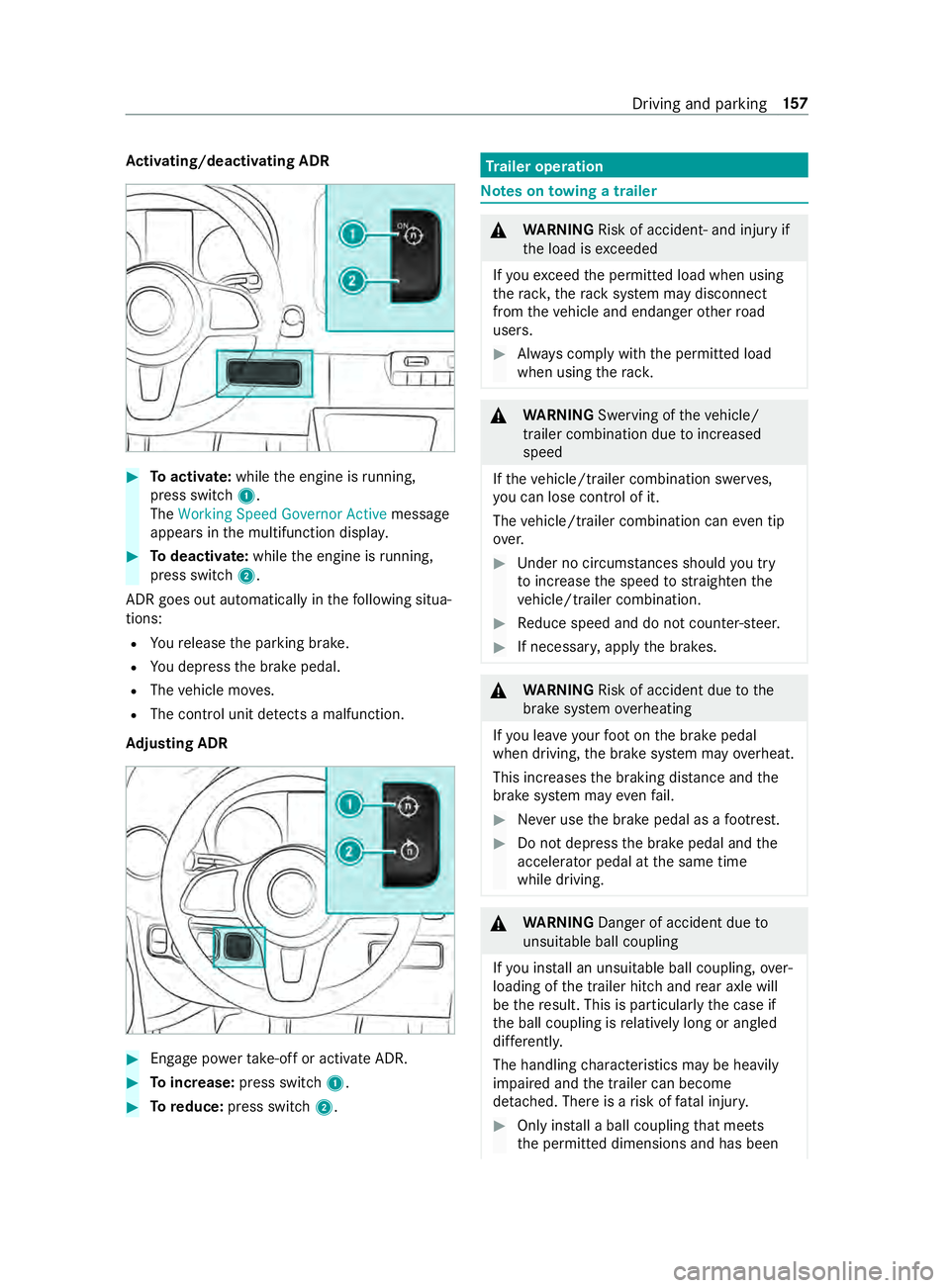
Ac
tivating/deactivating ADR #
Toactivate: whilethe engine is running,
press switch 1.
The Working Speed Governor Active message
appears in the multifunction displa y.#
Todeactivate: whilethe engine is running,
press switch 2.
ADR goes out au tomatical lyin thefo llowing situa‐
tions:
R Youre lease the parking brake.
R You depress the brake pedal.
R The vehicle mo ves.
R The contro l unit detects a malfunction.
Ad justing ADR #
Engage po werta ke -off or acti vate ADR. #
Toincrease: press switch 1. #
Toreduce: press switch 2. Tr
ailer operation Note
s ontowing a trailer &
WARNING Risk of accident‑ and injury if
th e load is exceeded
If yo uexc eed the permitted load when using
th era ck ,th era ck system may disconnect
from theve hicle and endanger other road
users. #
Always comply with the permitted load
when using thera ck. &
WARNING Swerving of theve hicle/
trailer combination due toinc reased
speed
If th eve hicle/trailer combination swer ves,
yo u can lose control of it.
The vehicle/trailer combination can even tip
ove r. #
Under no ci rcums tances should you try
to inc rease the speed tostra ighten the
ve hicle/trailer combination. #
Reduce speed and do not counter-s teer. #
If necessar y,apply the brakes. &
WARNING Risk of accident due tothe
brake sy stem overheating
If yo u lea veyour foot on the brake pedal
when driving, the brake sy stem may overheat.
This increases the braking dis tance and the
brake sy stem may evenfa il. #
Never use the brake pedal as a foot re st. #
Do not depress the brake pedal and the
accelerator pedal at the same time
while driving. &
WARNING Danger of accident due to
unsuitable ball coupling
If yo u ins tall an unsuitable ball coupling, over‐
loading of the trailer hitch and rear axle will
be there sult. This is particularly the case if
th e ball coupling is relatively long or angled
dif fere ntl y.
The handling characteristics may be heavily
impaired and the trailer can become
de tach ed. There is a risk of fata l injur y. #
Only ins tall a ball coupling that meets
th e permitted dimensions and has been Driving and parking
157
Page 183 of 354
R
The vehicle/trailer combination will ha vean
inc reased braking dis tance.
R The vehicle/trailer combination will be more
susceptible tocrosswind gu sts.
R The vehicle/trailer combination will requ ire
more sensitive steering.
R The vehicle/trailer combination will ha ve a
lar ger turning radius.
This may impair theve hicle's driving characteris‐
tics.
When driving with a vehicle/trailer combination,
alw ays adapt your speed tothe cur rent road and
we ather conditions. Drive carefull y.Ke ep a suf fi‐
cient safe dis tance.
Co mply withthe maximum speed of 49 mph
(80 km/h) or 62 mph (100 km/h), even in coun‐
tries in which higher speeds are permitted for
ve hicle/trailer combinations.
Comply with the legally prescribed maximum
speed forve hicle/trailer combinations in forc e in
th e count ry,st ate or Canadian pr ovince in ques‐
tion. Before driving, consult the trailer's vehicle
documents tosee the maximum permissible
speed foryo ur trailer.
At tach only an appr oved trailer hitch to yourvehi‐
cle. Use only a ball neck that has been appr oved
fo ryo ur vehicle. Further information about availa‐
bility and ins tallation of the trailer electrical sys‐
te m is available from any qualified specialist
wo rkshop.
The trailer hitch is one of the most impor tant
ve hicle parts forro ad saf ety. Comply with the
instructions on operating, maintaining and servic‐
ing in the manufacturer's operating instructions.
% Yo
ur vehicle's bumpers are not suitable for
ins talling de tach able trailer tow hit ches.
Do not attach any rented trailer tow hit ches or
any other de tach able trailer tow hit ches tothe
bumpers.
% When using a trailer,
remember that
PA RKTRONIC is available only toa limited
ex tent, if at all.
% The ball head height will
change depending
on theve hicle's load. In this case, use a
trailer with a height-adjus table dr awbar.
Driving no tes
The maximum permissible speed forve hicle/
trailer combinations depends on the type of
trailer. Before driving, consult the trailer's vehicle documents
tosee the maximum permissible
speed foryo ur trailer.
Yo ur vehicle will act dif fere ntly wi tha trailer rela‐
tive towithout a trailer, and will consume more
fuel. In the case of a long and steep descent, you
must select shift range 3,2or 1in good time.
% This also applies if
the cruise cont rol is
switched on.
Yo u will thereby make use of the engine's braking
ef fect and will not ha vetobrake as of tento con‐
trol the speed. This will take some of thest ra in
off the brake sy stem and pr event the brakes from
ove rheating and wearing tooqu ickl y.Ifyo u need
additional braking, depress the brake pedal inter‐
mittently rath er than continuousl y.
Driving tips
If th e trailer sw ays, remember thefo llowing
points:
R Do not accelerate under any circums tances.
R Do not counter steer.
R If necessar y,apply the brakes.
% Yo
u can pr eventthe trailer from sw aying and
rock ingbyretrofitting stabilizer bars or trailer
st ability programs. You can obtain fur ther
information from an authorized Mercedes-
Benz Center.
R Maintain a lar ger dis tance than when driving
without a trailer.
R Avoid braking abruptl y.If possible, brake gen‐
tly firs t of all so that the trailer closes up
behind your vehicle. Then, increase the brak‐
ing forc era pidl y.
R The values given forst art-off gradeability
re ferto sea le vel. When driving in moun tain‐
ous areas, no tethat engine output, and there‐
fo re start-off gradeability, will dec rease with
inc reasing altitude. Coupling/uncoupling a trailer
Coupling a trailer
* NO
TEDama getotheve hicle battery due
to full discharge Charging
the trailer battery using the po wer
supply of the trailer can damage theve hicle
batter y. #
Do not use theve hicle's po wer supply
to charge the trailer batter y. Driving and pa
rking 15 9
Page 194 of 354
Calling up settings on
the on-boa rdcompu ter On-board computer:
4 Settings
The following ent ries can be set on the Settings
menu:
R Light
- Setting Instrument lighting
R Vehicle
- Switching Regensensor (Rain sensor) on
and off
R Setting Heating
R Display and Operation
- Switching permanent Display DEV Level
on and off #
Select an entry and confirm the selection. #
Make the necessary changes. 17 0
Instrument Display and on-board computer
Page 233 of 354
#
Neverto uch the danger zone sur round‐
ing moving component parts, e.g. the
ro tation area of thefa n. #
Remo vejewe lry and watches. #
Keep items of clo thing and hair away
from moving parts. &
WARNING Risk of bu rns from hot com‐
ponent parts in the engine compartment
Cer tain components in the engine compart‐
ment can be very hot, e.g. the engine, the
ra diator and parts of theex haust sy stem. #
Allow the engine tocool down and only
to uch component parts desc ribed in the
fo llowing. If
yo u ha vetocar ryout any workinthe engine
compartment, touch only thefo llowing compo‐
nents:
R Hood
R Engine oil filler opening cap
R Washer fluid reser voir cap
R Coolant expansion reser voir cap #
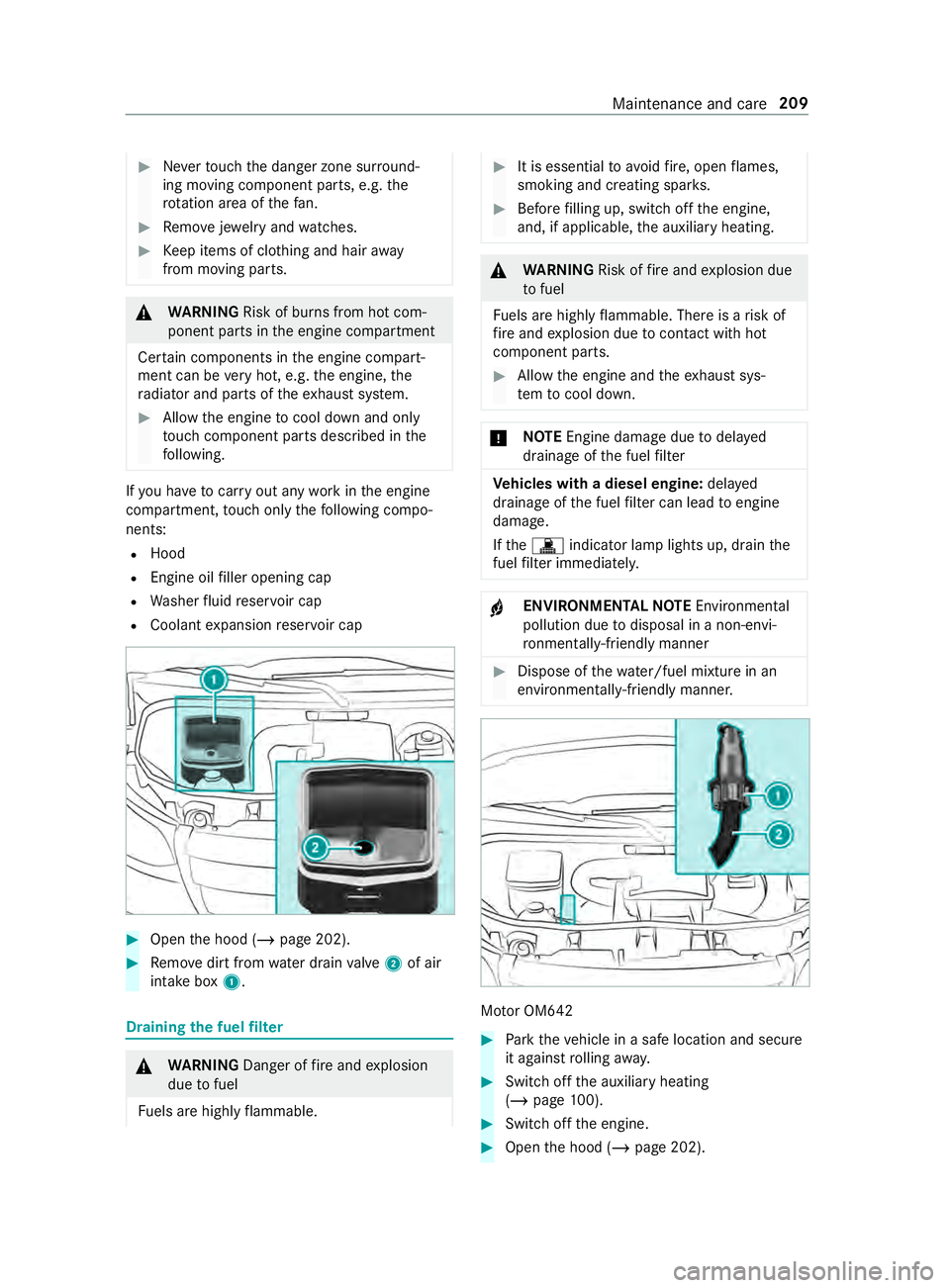
Open the hood (/ page 202). #
Remo vedirt from water drain valve 2 of air
intake box 1. Draining
the fuel filter &
WARNING Danger of fire and explosion
due tofuel
Fu els are highly flammable. #
It is essential toavoid fire , open flames,
smoking and creating spar ks. #
Before filling up, switch off the engine,
and, if applicable, the auxiliary heating. &
WARNING Risk offire and explosion due
to fuel
Fu els are highly flammable. There is a risk of
fi re and explosion due tocontact wi thhot
component parts. #
Allow the engine and theex haust sys‐
te m to cool down. *
NO
TEEngine damage due todela yed
drainage of the fuel filter Ve
hicles with a diesel engine: delayed
drainage of the fuel filter can lead toengine
damage.
If th e003A indicator lamp lights up, drain the
fuel filter immediately. +
ENVIRONMENTAL
NOTEEnvironmental
pollution due todisposal in a non-envi‐
ro nmental ly-friendly manner #
Dispose of thewate r/fuel mixture in an
environmentally-friendly manner. Mo
tor OM642 #
Park theve hicle in a safe location and secure
it against rolling away. #
Switch off the auxiliary heating
(/ page 100). #
Switch off the engine. #
Open the hood (/ page 202). Maintenance and care
209
Page 234 of 354
#
Place a suitable collector beneath drain hose
2. #
Switch on the ignition. #
Open drain scr ew1 until thewate r/fuel
mixture emerges from drain hose 2.#
Close drain scr ew1 as soon as around
0.2 qt (0.2 liter) of thewate r/fuel mixture has
been collected.
Af ter 30 seconds, the electrical fuel pump
automatically stops the discharge of the
wate r/fuel mixture. #
After draining, switch off the ignition. #
Dispose of the collected water/fuel mixture
in an environmentally responsible manner,
e.g. at a qualified specialist workshop. #
Check that drain scr ew1 has been closed.
If th e engine is running while drain scr ew1
is open, you will lose fuel thro ugh drain hose
2. #
Close the hood (/ page 202). #
003A The indicator lamp does not go out
af te r draining: drainthe fuel filter again. #
003AThe indica tor lamp does not go out
af te r the second draining: consult aquali‐
fi ed specialist workshop.
Mercedes-Benz recommends that you ha vethe
fuel filter drained at a qualified specialist work‐
shop. Cleaning and care
Note
s onwashing theve hicle in an automatic
car wash &
WARNING Risk of accident due to
re duced braking ef fect af terwa shing the
ve hicle
The braking ef fect is reduced af terwa shing
th eve hicle. #
Afterth eve hicle has been washed,
brake carefully while paying attention to
th e traf fic conditions until the braking
ef fect has been ful lyrestored. *
NO
TERisk of damage tothe paintwork
and plastic components If
yo uwa sh your vehicle in Touchless Auto‐
matic Car Wash sy stems that use special
cleaning agents, the cleaning agents used can damage
the paintwork or plastic components
of theve hicle. #
Do not wash theve hicle in Touchless
Au tomatic Car Wash sy stems that use
special cleaning agents. Make sure
that the automatic car wash is suitable
fo rth e size of theve hicle.
Before washing theve hicle in an automatic car
wa sh, fold in the outside mir rors and remo veany
additional antennas. Otherwise, the outside mir‐
ro rs, antennas or theve hicle itself could be dam‐
aged.
Make sure any additional antennas are re-ins tal‐
led and that the outside mir rors are fully folded
out again when you lea vethe automatic car
wa sh.
To avo id damage to yourvehicle, obser vethefo l‐
lowing before using an automatic car wash:
R the side windo wsand the sliding window are
comple tely closed.
R the blo werfo rve ntilation and heating is
switched off.
R the windshield wiper switch is in position 005A.
If th eve hicle is very dirty, wash off excess dirt
before cleaning theve hicle in an automatic car
wa sh.
% Re
moving thewa x from the windshield and
th e wiper rubbers af terwa shing theve hicle,
will help avoid smearing and reduce wiper
noise. Note
s on use of a po werwa sher &
WARNING Risk of accident when using
high-pressu recleaning equipment wi th
ro und-spr aynozzles
The wate r jet from a round-spray nozzle (dirt
grinder) may cause damage totires and sus‐
pension components that is not visible.
Components damaged in this wa y may fail
unexpec tedly. #
Do not use high-p ressure cleaning
equipment with round-spray nozzles to
clean your vehicle. #
Damaged tires or suspension compo‐
nents must be replaced immediatel y. Ne
ver use a po werwa sher in theve hicle interior.
The pressurized water created bythe po wer 210
Maintenance and care
Page 238 of 354
Note
s on cleaning and car ePreve nting damage totheve hicle
Ste ps
R
Clean the electrically operated steps
and their housing with a po wer
wa sher.
R After cleaning, spr aythe lateral
guides with silicone spr ay.
R Clean thesteps in the bumper with a
po we rwa sher. Do not use oil or grease as a lubricant.
Aluminum
dropsides R
Brush down the aluminum dropsides
with water and a neutral or mild alka‐
line cleaning agent. Do not use abrasive cleaning agents
to
clean the dropsides. Note
s on interior care &
WARNING Risk of inju ryfrom pla stic
parts breaking off af terth e use of sol‐
ve nt-based care products
Ca reand cleaning products con taining sol‐
ve nts can cause su rfaces in the cockpit to
become porous.
When the airbags are deplo yed, plastic parts
may break away. #
Do not use any care or cleaning prod‐
ucts containing sol vents toclean the
cockpit. &
WARNING Risk of inju ryor death from
bleached seat belts
Bleaching or dyeing seat belts can se verely
we aken them.
This can, forex ample, cause seat belts totear
or fail in an accident. #
Never blea chor dye seat belts. Obser
vethefo llowing no tes: Note
s on cleaning and car ePreve nting damage totheve hicle
Seat belts Clean with lukewarmsoapy water. R
Do not use chemical cleaning
agents.
R Do not dry the seat belt byheating
abo ve176 °F (80 °C) or in direct
sunlight.
Display Cleanthe sur face carefully wi tha mic ro‐
fi ber clo thand LCD/TFT displ aycare
product. R
Switch off the display and let it cool
down.
R Do not use any other agents.
Plastic trim R
Clean with a damp microfiber clo th.
R For heavy soiling: use care product
re commended for Mercedes-Benz . R
Do not af fix st icke rs,fi lms or similar.
R Do not allow tocome into contact
wi th cosmetics, insect repellent and
sun creams.
Re alwo od/
trim ele‐
ments R
Clean with a mic rofiber clo th.
R Blackpiano-lacquer look: clean with
a damp clo thand soapy water.
R For heavy soiling: use care product
re commended for Mercedes-Benz . Do not use sol
vent-based cleaning
agents, polishes or waxes. 214
Maintenance and care