heating MERCEDES-BENZ SPRINTER 2019 MY19 with 7” screen
[x] Cancel search | Manufacturer: MERCEDES-BENZ, Model Year: 2019, Model line: SPRINTER, Model: MERCEDES-BENZ SPRINTER 2019Pages: 354, PDF Size: 6.15 MB
Page 119 of 354
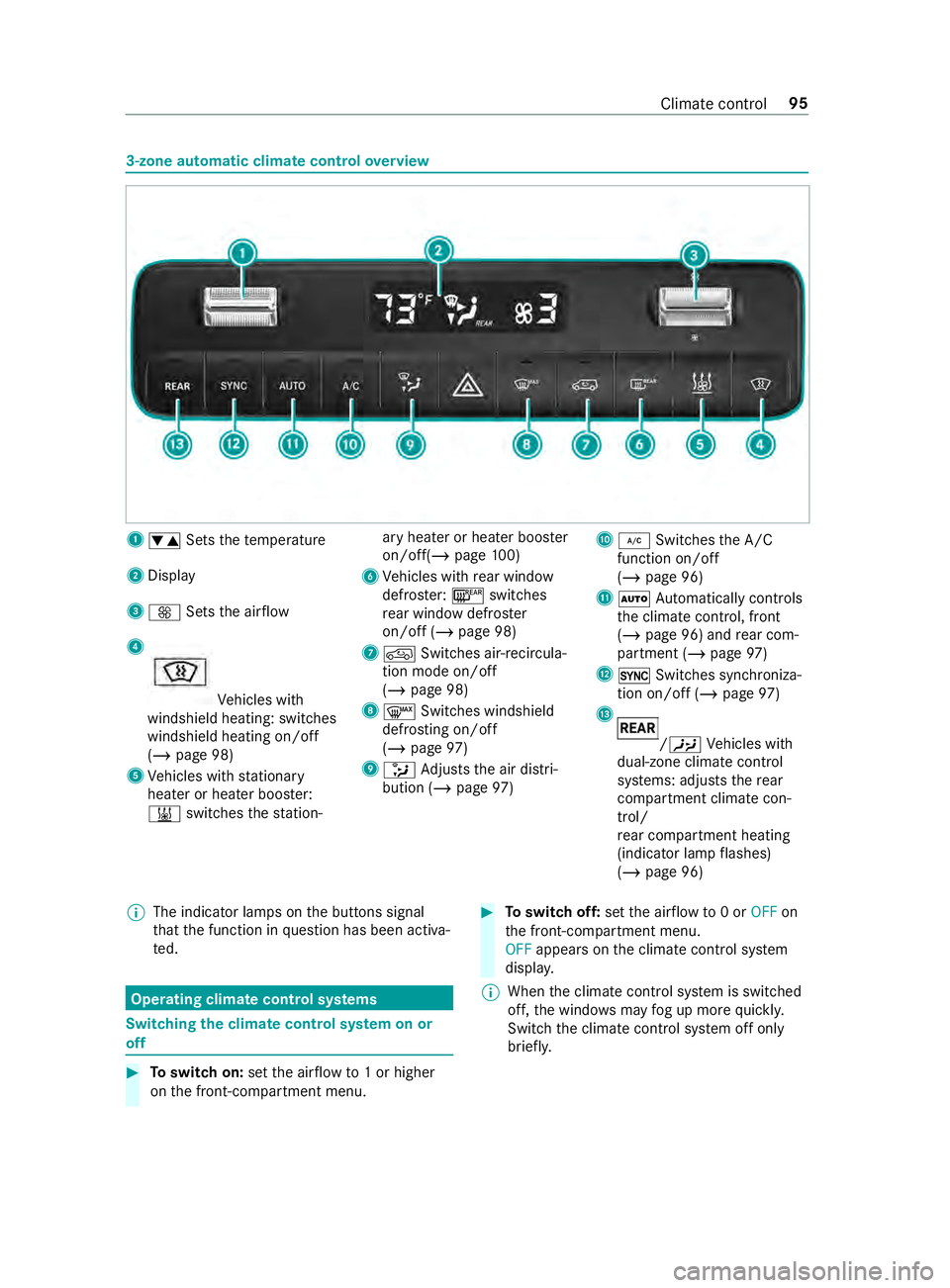
3-zone automatic climate control
overview 1
0082 Setsthete mp erature
2 Display
3 0097 Setsthe air flow
4 Ve
hicles with
windshield heating: switches
windshield heating on/off
(/ page 98)
5 Vehicles with stationary
heater or heater boos ter:
003B switches thest ation‐ ary heater or heater boos
ter
on/off(/ page100)
6 Vehicles with rear wind ow
defros ter: 006C switches
re ar wind owdefros ter
on/off (/ page 98)
7 0089 Switches air-recircula‐
tion mode on/off
(/ page 98)
8 0064 Switches windshield
defrosting on/off
(/ page 97)
9 008F Adjusts the air distri‐
bution (/ page97) A
005A Switches the A/C
function on/o ff
( / page 96)
B 0058 Automatically controls
th e climate cont rol, front
(/ page 96) and rear com‐
partment (/ page97)
C 0015 Switches synchroniza‐
tion on/off (/ page 97)
D /
00A4 Vehicles with
dual-zone climate control
sy stems: adjusts there ar
compartment climate con‐
trol/
re ar compartment heating
(indicator lamp flashes)
(/ page 96)
% The indicator lamps on
the buttons signal
th at the function in question has been activa‐
te d. Operating climate control sy
stems Switching
the clima tecontrol sy stem on or
off #
Toswitch on: setthe air flow to1 or higher
on the front-compartment menu. #
Toswitch off: setthe air flow to0 or OFF on
th e front-compartment menu.
OFF appears on the climate cont rol sy stem
displa y.
% When
the climate cont rol sy stem is switched
off, the windo wsmay fog up more quickl y.
Switch the climate cont rol sy stem off only
brief ly. Climate cont
rol95
Page 120 of 354
%
If
th e front-compartment sy stem has already
been switched on and there ar-compartment
sy stem has been switched off, you can
swit chit on byturning up thefa n on there ar-
compartment menu. If the front-compart‐
ment sy stem is switched on, there ar-com‐
partment sy stem will automatically switch on
as well. Ad
justing the rear comp artment climate con‐
trol Re
quirements:
R The climate control sy stem has been
switched on (/ page 95).
Switching on thetemp erature and airflow
and adju sting dual-zone and 3-zone automatic
climate control #
Press the /00A4
button.
The indicator lamp on the /00A4
but‐
to n and the /00A4
symbol on the cli‐
mate cont rol sy stem display will flash.
The display swit ches tothete mp erature and
th e blo wer in there ar menu. #
Use rocker switches 0082and0097 toset
th ere qu ired temp erature and air flow onthe
re ar menu.
% If
th ere are significant dif fere nces between
th ete mp erature settings of the front and rear
sy stems, these cann otbe controlled accu‐
ra tely.
% If
th ere ar compartment climate control has
been swit ched off, you can swit chit on auto‐
matically bypressing the0015 button.
Depending on theve hicle equipment, climate
contro l switches on theove rhead air-conditioning
sy stem or rear compartment heating as requ ired:
R Ve
hicles with an overhead air-condition‐
ing sy stem: there ar compartment can be
cooled onl y.
R Ve
hicles with rear comp artment heating:
th ere ar compartment can be heated onl y.Switching off
rear comp artment air condition‐
ing with dual and 3-zone automatic climate
control #
Press the /00A4
button. #
Ifth e indicator lamp on the /00A4
but‐
to n and the /00A4
symbol on the cli‐
mate cont rol sy stem display flash, set the air‐
fl ow to0 on there ar menu.
% Indicator lamp on:
rear compartment climate
control has been swit ched on.
Indicator lamp off: rear compartment climate
control has been swit ched off.
Indicator lamp flashes: the setting mode of
th ere ar compartment climate control is
active. Swit
ching the A/C function on and off Re
quirements:
R The climate control sy stem has been
switched on (/ page 95).
The A/C function cont rols the climate and dries
th e air inside theve hicle. #
Press the 005A button.
% Switch off
the A/C function only brief ly. Oth‐
erwise, the windo wscould fog up faster.
% Condensation may leak from
the underside of
th eve hicle in cooling mode. This is not a sign
of a defect. Au
tomatically regulating climate control Re
quirements:
R The climate control sy stem is switched on
(/ page 95).
Switching on automatic climate control
In automatic mode, thete mp erature, air flow and
air distribution are regulated and kept cons tant. #
Press the 0058 button.
The display will show thete mp erature. The
air flow and air distribution will disappear from
th e displa y.
If th ere ar-compartment climate control has
been swit ched on, the setting forth ere ar
compartment is car ried over. 96
Climate cont rol
Page 121 of 354
Switching off automatic climate control
#
Use the0097 rocker switch tochange the air‐
fl ow setting and air distribution
(/ page 97) .
The other setting remains unaf fected bythe
ch ange. Au
tomatically controlling the climate control
in the rear comp artment Re
quirements:
R Rear-compartment climate control has been
swit ched on (/ page 96).
In automatic mode, thete mp erature, air flow and
air distribution are regulated and kept cons tant. #
Press the /00A4
button. #
Press the 0058 button.
% Even if
the front-compartment sy stem is in
automatic mode, there ar-compartment sys‐
te m can exit automatic mode if you adjust
th e blo wer on there ar-compartment menu.
% If
th e air is cooled and the driver, front
passenger or sliding door is opened, there ar
air conditioning sy stem blo wer is turned
down af ter around 15minutes.
When all doors ha vebeen closed again, the
blo wer will be reset tothe pr evious setting
af te r around one minute. Information on
the air distribution settings The symbols on
the display indicate theve nts
th ro ugh which the air is being directed.
TEMPMATIC R 0087 Defros ter and center vents
R 008F Allvents
R 009C Center vents
R 009F Center and foot we llve nts
3-zone au tomatic clima tecontrol
R 0061 Defros terve nts
R 0087 Defros ter and center vents
R 008F Allvents
R 0086 Defros ter and foot we llve nts
R 009C Center vents
R 009F Center and foot we llve nts
R 009B Footwe llve nts Setting the air distribution
Re
quirements:
R The climate control sy stem is switched on. #
Press the 008F button repeatedly until the
desired air distribution appears in the air con‐
ditioning sy stem displa y. Switching
the synchronization function on
and off Re
quirements:
R The climate control sy stem has been
switched on (/ page 95).
The synchronization function cont rols the climate
cont rol function centrally. The settings forthe
te mp erature and air flow inthe front zone are
automatically adop tedfo rth ere ar zone. #
Press the 0015 button.
% If
th ere ar-compartment climate control has
been swit ched off, you can swit chit on auto‐
matically bypressing the0015 button. Re
moving condensation from the windo ws Misting on
the inside of windo ws #
Press the 0064 button.
When the windshield defros ter is switched on,
th ete mp erature and air flow cannot be adjus‐
te d. #
Invehicles with a heating sy stem and a man‐
ual air-conditioning sy stem, also close the
side and center air vent (/ page 98) as well
as the air vents forth ere ar compartment
(/ page 99). #
Vehicles with dual or 3-zone automatic cli‐
mate control: pressthe005A button and, if
necessar y,use the008F button todirect the
air onto the windshield 0061. #
Incre asethe air flow as necessary and close
all air vents (/ page 98). #
Ifth e windo wsremain fogged up: press
th e0064 button.
When the windshield defros ter is switched on,
th ete mp erature and air flow cannot be adjus‐
te d.
0064 or no symbol will appear on the climate
cont rol sy stem displa y. Climate cont
rol97
Page 122 of 354
#
Vehicles with windshield heating: press
th e button.
#
Close the center air vent (/ page 98) and
air vents forth e headroom (/ page 99) and
re ar compartment (/ page 99).
Misting on the outside of windo ws #
Switch on the windshield wiper (/ page 88).Switching air-recirculation mode on and off
#
Press the0089 button.
The interior air is recirculated.
The ai r-re circulation mode switches off au tomati‐
cally.
% When air-recirculation mode is switched off,
th
e windo wsmay fog up more quickl y.Switch
on ai r-re circulation mode only briefly.
Air-recirculation mode au tomatical lyswitches on
in thefo llowing cases:
R at high outside temp eratures
R while theve hicle is driving in a tunnel (only
ve hicles with 3-zone automatic climate con‐
trol)
R when the windshield wipers are switched on
(/ page 88)
The indicator lamp on the0089 button will not
light up in this case. Af ter a maximum of
30 minutes, outside air is automatically intro‐
duced again. Switching
the windshield heating on and off %
In
theeve nt of high outside temp eratures,
th e windshield heating may not turn on. #
Press the button forth e windshield heating.
If th e indicator lamp lights up, the windshield
heating is switched on.
% The windshield heating switches off automat‐
ically af ter a few minutes.
% If
th e battery voltage is too lo w,it may not be
possible toswitch the windshield heating on.
If th e battery voltage becomes too low while
th e windshield heating is in operation, the
windshield heating will swit choff automati‐
cally. Switching
there ar window defros ter on or off #
Press the006C button.
If th e indicator lamp lights up, there ar win‐
dow defros ter is switched on. Operating air
vents Ad
justing the front-compartment air vents &
WARNING ‑ Danger of bu rns or frostbite
due tobeing too close tothe air vents
Ve ry hot or very cold air can flow from the air
ve nts.
This could result in burns or frostbite in the
immediate vicinity of the air vents. #
Makesure that all vehicle occupants
alw ays maintain a suf ficient dis tance to
th e air vents. #
If necessa ry, direct the air flow to
ano ther area of theve hicle interior. #
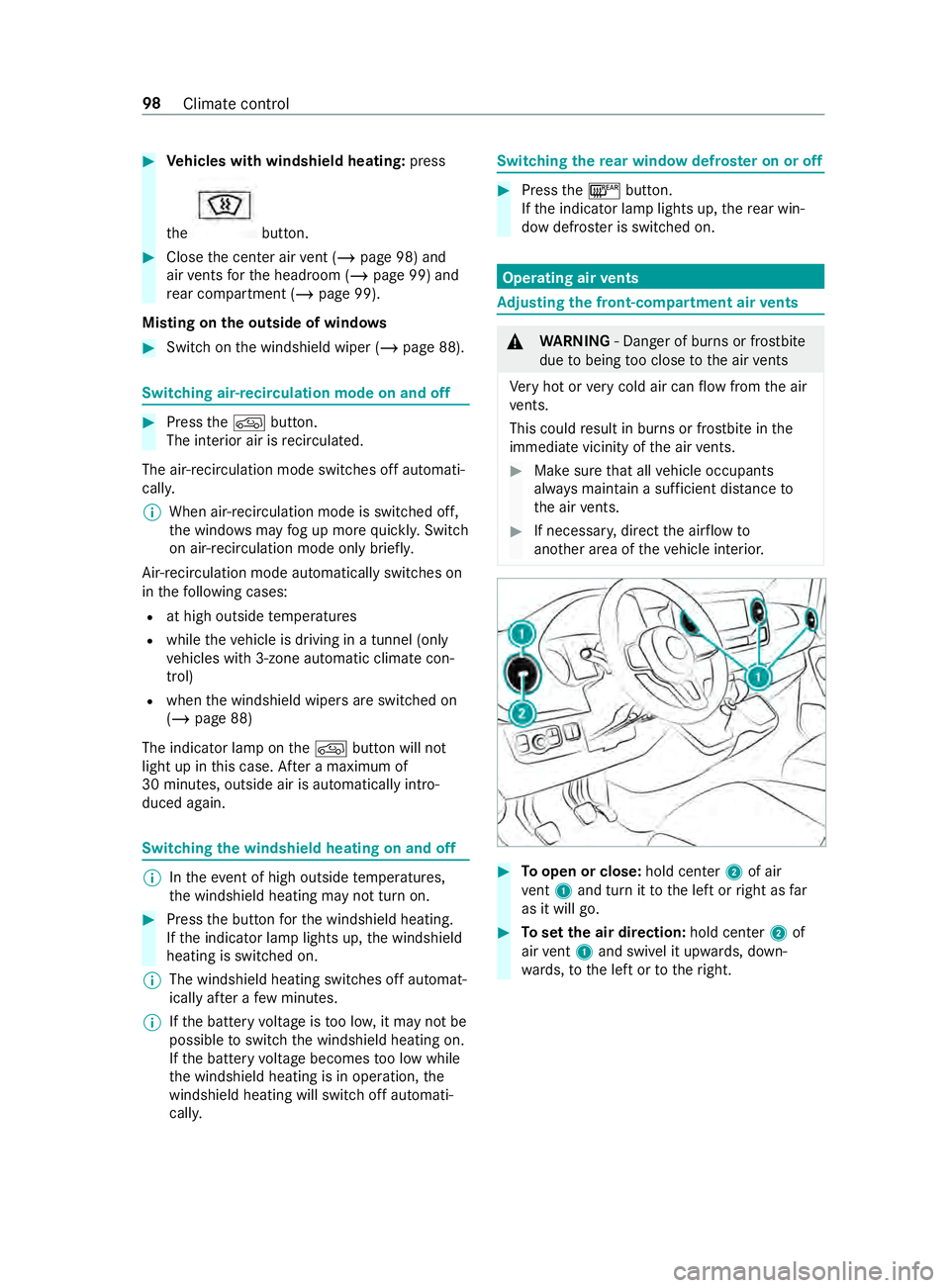
Toopen or close: hold center2 of air
ve nt 1 and turn it tothe left or right as far
as it will go. #
Toset the air direction: hold center2 of
air vent 1 and swivel it up wards, down‐
wa rds, to the left or totheright. 98
Climate control
Page 123 of 354
#
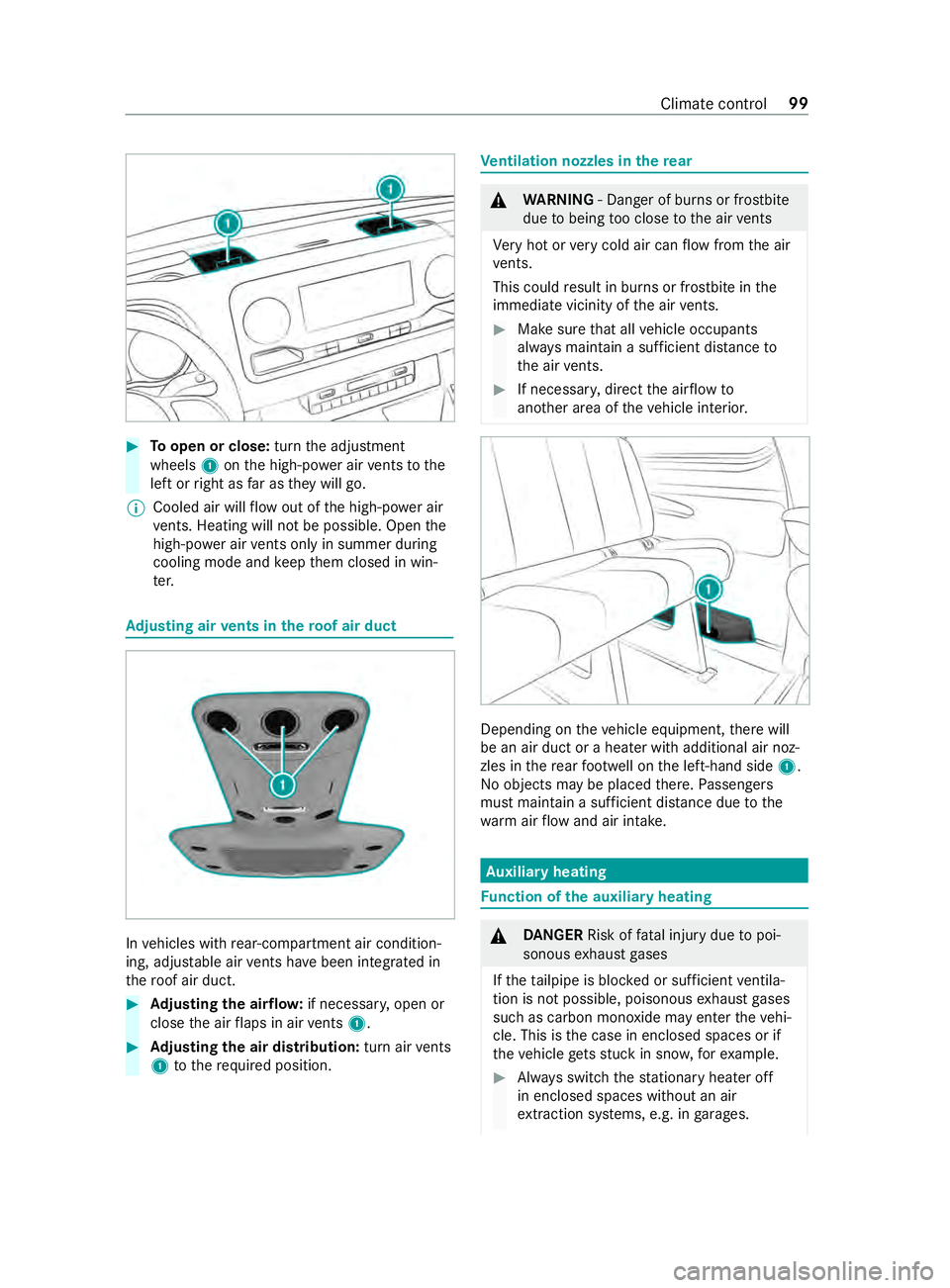
Toopen or close: turnthe adjustment
wheels 1onthe high-po wer air vents tothe
left or right as far as they will go.
% Cooled air will
flow out of the high-po wer air
ve nts. Heating will not be possible. Open the
high-po wer air vents only in summer du ring
cooling mode and keep them closed in win‐
te r. Ad
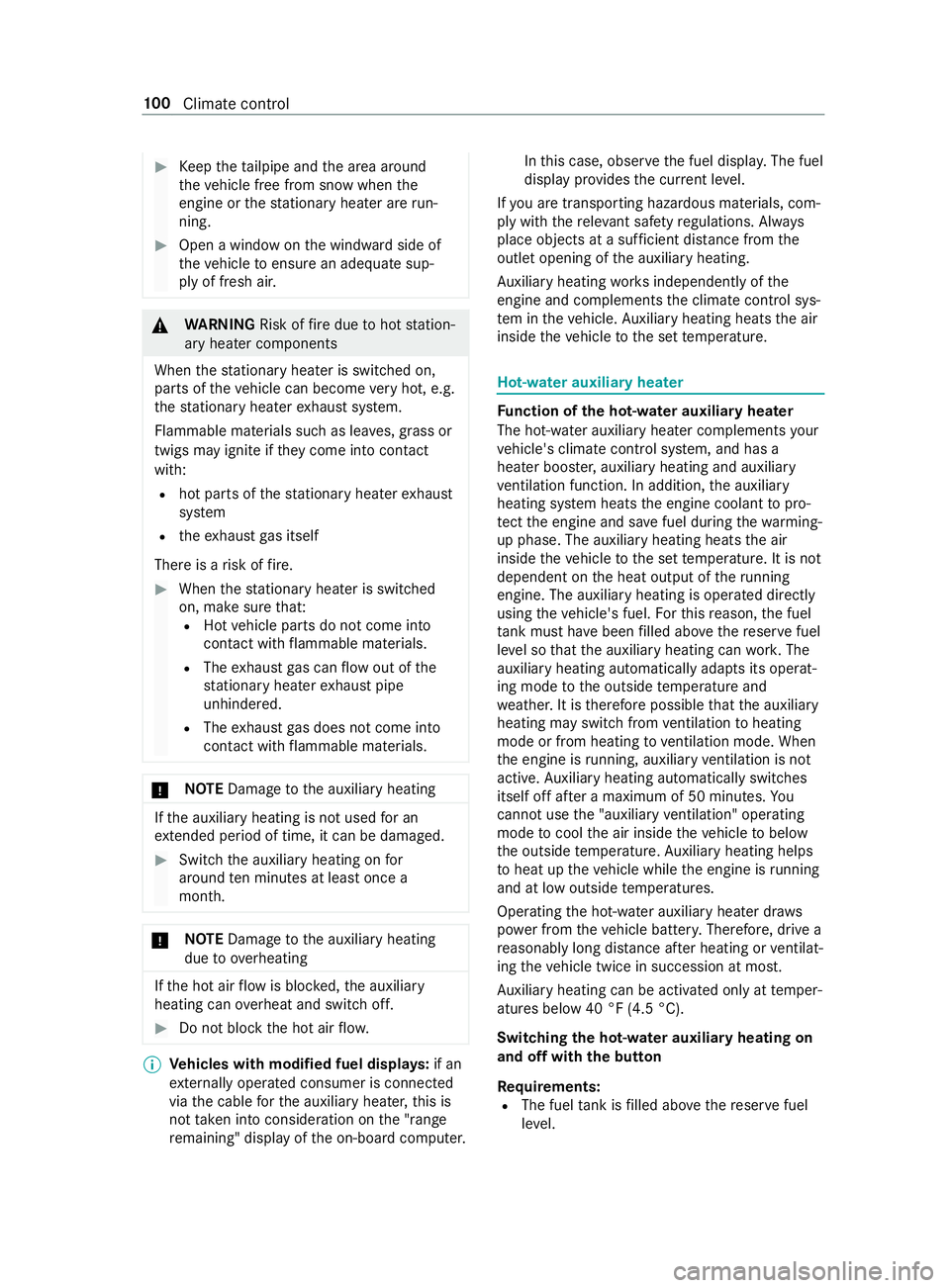
justing air vents in thero of air duct In
vehicles with rear-compartment air condition‐
ing, adjus table air vents ha vebeen integrated in
th ero of air duct. #
Adjusting the air flow: if necessar y,open or
close the air flaps in air vents 1. #
Adjusting the air distribution: turn airvents
1 tothere qu ired position. Ve
ntilation nozzles in there ar &
WARNING ‑ Danger of bu rns or frostbite
due tobeing too close tothe air vents
Ve ry hot or very cold air can flow from the air
ve nts.
This could result in burns or frostbite in the
immediate vicinity of the air vents. #
Makesure that all vehicle occupants
alw ays maintain a suf ficient dis tance to
th e air vents. #
If necessa ry, direct the air flow to
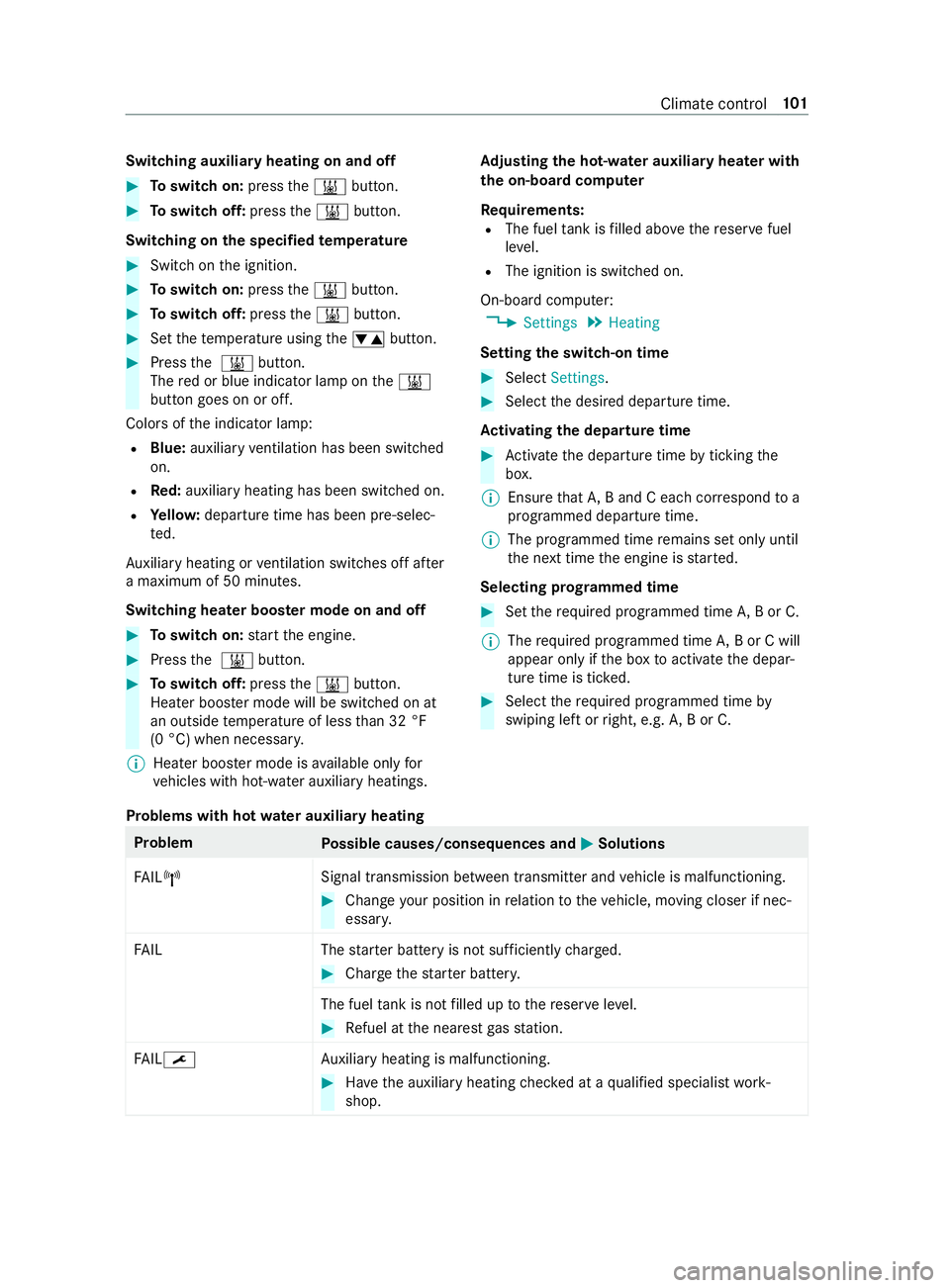
ano ther area of theve hicle interior. Depending on
theve hicle equipment, there will
be an air duct or a heater with additional air noz‐
zles in there ar foot we ll on the left-hand side 1.
No objects may be placed there. Passengers
must maintain a suf ficient dis tance due tothe
wa rm airflow and air intake. Au
xiliary heating Fu
nction of the auxiliary heating &
DANG ER Risk of fata l injury due topoi‐
sonous exhaust gases
If th eta ilpipe is bloc ked or suf ficient ventila‐
tion is not possible, poisonous exhaust gases
such as carbon monoxide may enter theve hi‐
cle. This is the case in enclosed spaces or if
th eve hicle getsst uck in sn ow,fo rex ample. #
Always switch thest ationary heater off
in enclosed spaces without an air
ex traction sy stems, e.g. in garage s. Climate
control 99
Page 124 of 354
#
Keep theta ilpipe and the area around
th eve hicle free from snow when the
engine or thest ationary heater are run‐
ning. #
Open a window on the windward side of
th eve hicle toensure an adequate sup‐
ply of fresh air. &
WARNING Risk offire due tohot station‐
ary heater components
When thest ationary heater is swit ched on,
parts of theve hicle can become very hot, e.g.
th est ationary heater exhaust sy stem.
Flammable materials such as lea ves, grass or
twigs may ignite if they come into contact
wi th:
R hot parts of thest ationary heater exhaust
sy stem
R theex haust gas itself
There is a risk of fire. #
When thest ationary heater is swit ched
on, make sure that:
R Hot vehicle parts do not come into
contact with flammable materials.
R The exhaust gas can flow out of the
st ationary heater exhaust pipe
unhindered.
R The exhaust gas does not come into
contact with flammable materials. *
NO
TEDama getothe auxiliary heating If
th e auxiliary heating is not used for an
ex tended pe riod of time, it can be damaged. #
Switch the auxiliary heating on for
around ten minu tes at least once a
month. *
NO
TEDama getothe auxiliary heating
due toove rheating If
th e hot air flow is bloc ked, the auxiliary
heating can overheat and switch off. #
Do not block the hot air flow. %
Ve
hicles with modified fuel displa ys:if an
ex tern ally operated consumer is connec ted
via the cable forth e auxiliary heater, this is
not take n into conside ration on the "range
re maining" display of the on-board computer. In
this case, obser vethe fuel displa y.The fuel
display pr ovides the cur rent le vel.
If yo u are transpo rting hazardous materials, com‐
ply with there leva nt sa fety regulations. Alw ays
place objects at a suf ficient dis tance from the
outlet opening of the auxiliary heating.
Au xilia ryheating works independently of the
engine and complements the climate cont rol sys‐
te m in theve hicle. Auxilia ryheating heats the air
inside theve hicle tothe set temp erature. Hot-water auxiliary heater
Fu
nction of the hot- water auxiliary hea ter
The hot-water auxiliary heater complements your
ve hicle's climate contro l system, and has a
heater boos ter,auxiliary heating and auxiliary
ve ntilation function. In addition, the auxiliary
heating sy stem heats the engine coolant topro‐
te ct the engine and sa vefuel during thewa rming-
up phase. The auxiliary heating heats the air
inside theve hicle tothe set temp erature. It is not
dependent on the heat output of theru nning
engine. The auxilia ryheating is operated directly
using theve hicle's fuel. Forth is reason, the fuel
ta nk must ha vebeen filled abo vethere ser vefuel
le ve l so that the auxiliary heating can work. The
auxilia ryheating automatically adapts its operat‐
ing mode tothe outside temp erature and
we ather. It is therefore possible that the auxiliary
heating may switch from ventilation toheating
mode or from heating toventilation mode. When
th e engine is running, auxilia ryventilation is not
acti ve.Au xilia ryheating automatically switches
itself off af ter a maximum of 50 minutes. Yo u
cannot use the "auxiliary ventilation" ope rating
mode tocool the air inside theve hicle tobelow
th e outside temp erature. Auxilia ryheating helps
to heat up theve hicle while the engine is running
and at low outside temp eratures.
Operating the hot-wa ter auxiliary heater draws
po we r from theve hicle batter y.Therefore, drive a
re asonably long dis tance af ter heating or ventilat‐
ing theve hicle twice in succession at most.
Au xilia ryheating can be activated only at temp er‐
atures below 40 °F (4.5 °C).
Switching the hot- water auxiliary heating on
and off with the button
Re quirements:
R The fuel tank is filled abo vethere ser vefuel
le ve l. 100
Climate cont rol
Page 125 of 354
Switching auxiliary heating on and off
#
Toswitch on: pressthe003B button. #
Toswitch off: pressthe003B button.
Switching on the specified temperature #
Swit chon the ignition. #
Toswitch on: pressthe003B button. #
Toswitch off: pressthe003B button. #
Set thete mp erature using the0082 button. #
Press the 003B button.
The red or blue indicator lamp on the003B
button goes on or off.
Colors of the indicator lamp:
R Blue: auxiliary ventilation has been switched
on.
R Red:auxilia ryheating has been switched on.
R Yello w: departure time has been pre-selec‐
te d.
Au xilia ryheating or ventilation switches off af ter
a maximum of 50 minutes.
Swit ching heater boos ter mode on and off #
Toswitch on: start the engine. #
Press the 003B button. #
Toswitch off: pressthe003B button.
Heater boos ter mode will be switched on at
an outside temp erature of less than 32 °F
(0 °C) when necessar y.
% Heater boo
ster mode is available only for
ve hicles with hot-water auxiliary heatings.Ad
justing the hot-water auxiliary hea ter with
the on-board co mputer
Re quirements:
R The fuel tank is filled abo vethere ser vefuel
le ve l.
R The ignition is switched on.
On-board computer: 4 Settings 5
Heating
Setting the switch-on time #
Select Settings. #
Select the desired departure time.
Ac tivating the departure time #
Activate the departure time byticking the
box.
% Ensure
that A, B and C ea chcor respond to a
programmed departure time.
% The programmed time
remains set only until
th e next time the engine is star ted.
Selecting prog rammed time #
Set therequ ired programmed time A,B or C.
% The
requ ired prog rammed time A,B or C will
appear only if the box toactivate the depar‐
ture time is tic ked. #
Select there qu ired prog rammed time by
swiping left or right, e.g. A,B or C.
Problems with hot water auxiliary heating Problem
Possible causes/consequences and 0050 0050Solutions
FA IL00A3 Signal transmission between transmitter and
vehicle is malfunctioning. #
Change your position in relation totheve hicle, moving closer if nec‐
essar y.
FA IL Thestar ter battery is not suf ficiently charge d. #
Charge thest ar ter batter y.
The fuel tank is not filled up tothere ser veleve l. #
Refuel at the nearest gasst ation.
FA IL0099 Au
xilia ryheating is malfunctioning. #
Have the auxiliary heating checked at a qualified specialist work‐
shop. Climate
control 101
Page 130 of 354

&
WARNING Risk of accident when switch‐
ing off the ignition when driving
If yo u swit choff the ignition while driving,
saf ety functions are restricted or no longer
av ailable. This may af fect the po werst eering
sy stem and the brake forc e boosting, for
ex ample.
Yo u will then need touse considerably more
fo rc eto steer and brake. #
Do not switch off the ignition while driv‐
ing. &
DANG ER Risk of fata l injuries due to
ex haust gases
Combustion engines emit poisonous exhaust
ga ses such as carbon monoxide. Inhaling
th ese exhaust gases is hazardous tohealth
and can lead topoisoning. #
Never lea vethe engine running in an
enclosed space wi thout suf ficient venti‐
lation. &
DANG ER Risk of fata l injury due topoi‐
sonous exhaust gases
If th eta ilpipe is bloc ked or suf ficient ventila‐
tion is not possible, poisonous exhaust gases
such as carbon monoxide may enter theve hi‐
cle. This is the case if theve hicle getsst uck
in sn ow,fo rex ample. #
Keep theta ilpipe and the area around
th eve hicle free from snow when the
engine or thest ationary heater are run‐
ning. #
Open a window on the windward side of
th eve hicle toensure an adequate sup‐
ply of fresh air. &
WARNING Risk of accident and inju ry
due tobeing under the influence of alco‐
hol and drugs while driving
Driving when under the influence of alcohol
and/or drugs is an extreme lydangerous com‐
bination. Even small quantities of alcohol or
drugs may af fect your reflexe s, perception
and judgment.
The probability of a serious or evenfa ta l acci‐
dent greatly inc reases if you drive when
under the influence of alcohol or drugs. #
Do not drink alcohol or take drugs while
driving, and do not allow an yone todrive who has been drinking alcohol or
taking
drugs. &
WARNING Risk of accident and injury
from ope rating mobile communications
equipment
If yo u operate mobile communication equip‐
ment when driving, you will be distracted
from the traf fic situation. This could also
cause youto lose control of theve hicle.
The probability of a serious or evenfa ta l acci‐
dent inc reases greatly if you operate mobile
communication equipment when driving. #
Only operate mobile communication
equipment when theve hicle is station‐
ar y. Fo
ryo ur ow n sa fety, al ways obser vethefo llowing
points when operating mobile communications
equipmen t:
R Obser vethe legal requ irements forth e coun‐
try in which you are driving.
R While driving, on lyoperate mobile communi‐
cations equipment when the tra ffic conditions
permit it. You may otherwise be distracted
from the traf fic conditions and cause an acci‐
dent, inju ring yourself and others. &
WARNING Risk of accident due toove r‐
heated brake sy stem
If yo ure st your foot on the brake pedal during
while driving, the brake sy stem may overheat.
This increases the braking dis tance and the
brake sy stem may evenfa il. #
Never use the brake pedal as a foot re st. #
Do not press the brake pedal and accel‐
erator pedal simultaneously while driv‐
ing. On long and
steep downhill gradients, you should
ch ange down toa lo werge ar in good time. Take
particular no teofthis when driving a laden vehi‐
cle. By doing so, you will make use of the
engine's braking ef fect. This relie vesth e load on
th e brake sy stem and pr events the brakes from
ove rheating and wearing tooqu ickl y. 106
Driving and pa rking
Page 132 of 354
Information about transport
byrail
Tr ansporting your vehicle byrail may be subject
to cer tain restrictions or requ ire special meas‐
ures tobe take n in some countries due tovarying
tunnel heights and loading standards.
Yo u can obtain information about this from any
authorized Mercedes-Benz Center.
Note s on brakes &
WARNING Risk of skidding and of an
accident due toshifting down on slippery
ro ad sur faces
If yo u shift down on slippery road sur faces to
inc rease the engine braking ef fect, the drive
wheels may lose traction. #
Do not shift down on slippery road sur‐
fa ces toinc rease the engine braking
ef fect. &
WARNING Risk of accident due tothe
brake sy stem overheating
If yo u lea veyour foot on the brake pedal
when driving, the brake sy stem may overheat.
This increases the braking dis tance and the
brake sy stem may evenfa il. #
Never use the brake pedal as a foot re st. #
Do not depress the brake pedal and the
accelerator pedal at the same time
while driving. Downhill
gradients
On long and steep downhill gradients you should
obse rveth efo llowing instructions:
R invehicles with an automatic transmission,
shift down toshift ranges 2or 1in good time
so that the engine is running at a medium to
high engine speed (/ page117).
% Cha
nge the shift range in good time when
cruise control is acti vated. Obser vethe driv‐
ing tips (/ page105).
Yo uth ereby make use of the braking ef fect of the
engine and do not ha vetobrake as of tento main‐
tai nth e speed. This relie vesth e load on the
service brake and pr events the brakes from over‐
heating and wearing tooqu ickl y. Heavy and light loads &
WARNING Risk of accident due tothe
brake sy stem overheating
If yo u lea veyour foot on the brake pedal
when driving, the brake sy stem may overheat.
This increases the braking dis tance and the
brake sy stem may evenfa il. #
Never use the brake pedal as a foot re st. #
Do not depress the brake pedal and the
accelerator pedal at the same time
while driving. If
th e brakes ha vebeen subjected toa heavy
load, do not stop theve hicle immediately. Drive
on for a short while. The brakes cool down more
qu ickly in the air flow.
If th e brakes ha vebeen used only moderatel y,
yo u should occasionally test their ef fectiveness.
To do this, brake more firm lyfrom a higher speed
while paying attention tothe tra ffic conditions.
The brakes will grip better as a result.
We tro ad sur faces
If yo u ha vebeen driving for a long time in heavy
ra in without braking, there may be a dela yed
re sponse when youfirs t apply the brakes. This
may also occur af ter driving thro ugh a car wash
or deep water.Yo u must depress the brake pedal
more firm ly. Main tain a longer di stance tothe
ve hicle in front.
While paying attention tothe tra ffic conditions,
yo u should brake theve hicle firm ly af ter driving
on a wetro ad sur face or thro ugh a car wash. This
heats the brake discs so that they dry more
qu ickl y,which pr otects them against cor rosion.
Limited braking ef fect on salt-trea tedro ads:
R a layer of salt on the brake discs or brakepads
can increase braking dis tances conside rably,
or braking may happen on only one side
R maintain an especially lar gesafe dis tance to
th eve hicle in front
To remo vethe la yer of salt:
R apply the brakes from time totime, paying
attention totraf fic conditions
R carefully dep ress the brake pedal at the end
of a journey and af terth est art of a new jour‐
ney
Checking the brakepad thickness
In addition tomonitoring using the brakepad wear
sensor, regular lymonitor and check all of the 108
Driving and pa rking
Page 136 of 354
Ru
les for off-road driving
Alw ays be aware of the ground clearance of the
ve hicle and avoid obs tacles such as deep tire
ru ts.
Obs tacles can damage thefo llowing parts of the
ve hicle, forex ample:
R Suspension
R Driv etra in
R Fuel and supply tanks
The refore , alw ays drive slowly when off-road. If
yo u must drive over obs tacles, ha vethe co-driver
instruct you.
% Mercedes-Benz
recommends that you addi‐
tionally car rya sho vel and a reco very rope
with a shackle in theve hicle.
R Make sure that loads and items of luggage
are securely stored or lashed down
(/ page 72).
R Before driving off-road, stop theve hicle and
engage a low gear.
R Vehicles with DSR: activate DSR when you
are driving downhill (/ page120).
R All-wheel drive vehicles: activate the all-
wheel drive (/ page119) and, if necessa ry,
activate theLO W RANGE transmission ratio
(/ page 119).
R Ifth e sur face requ ires, temp orarily deactivate
ASR when pulling away ( /page 119).
R Only drive off-road with the engine running
and a gear engaged.
R Drive slowly and smo othly. Wa lking pace is
necessary in many situations.
R Avoid spinning the driven wheels.
R Always ensure that the wheels remain in con‐
ta ct wi th the ground.
R Exercise the utmost caution when driving
across unfamiliar, unpredictable terrain. As a
precaution, getout of theve hicle totake a
look at thero ute tobe take nfirs t.
R Look out for obs tacles (e.g. rocks, holes, tree
st umps and tire ruts).
R Avoid edges where the sur face could crumble
or break away.
Ru les forfo rd ing off-road (all-wheel drive
ve hicles)
R Obser vethe saf ety no tes and general no tes
on driving off-road. R
Check the dep thand characteristics of the
body of water before ford ing. The water must
not be deeper than 23.6 in (60 cm).
R The climate control sy stem is switched off
(/ page 95).
R The auxiliary heating is switched off
(/ page 100).
R Swit chon all-wheel drive (/ page118) and
engage it on vehicles with theLO W RANGE
transmission ratio (/ page 119).
R Restrict the shift range to1or 2.
R Avoid high engine speeds.
R Drive slowly and smoo thly at no more than a
wa lking pace.
R Ensure that no bow wavefo rm s while driving.
R Afterfo rd ing, dry the brakes.
Af ter driving thro ugh a body of water deeper than
19 .7 in (50 cm), make su retocheck all vehicle
fl uids for any signs of penetration bywate r.
Checklist af ter driving off-road
If yo ufind damage totheve hicle af ter off-road
driving, ha vetheve hicle checked at a qualified
specialist workshop immediatel y.
Driving overro ugh terrain places greater
demands on your vehicle than normal road opera‐
tion. Check your vehicle af ter driving on rough
te rrain. This allo wsyouto detect damage
prom ptly and reduce therisk of an accident for
yo urself and other road users. Clean your vehicle
th oroughly before driving on public roads.
Obse rveth efo llowing points af ter driving off-
ro ad, on con stru ction sites and before driving on
public roads:
R Vehicles with DSR: deactivate DSR
(/ page 120).
R All-wheel drive vehicles: deactivate the all-
wheel drive (/ page119).
R Activate ASR (/ page 119).
R Clean theex terior lighting, particular lythe
headlamp s andtail lamps, and check them
fo r dama ge.
R Clean the front and rear license plates.
R Clean the windshield, windo wsand outside
mir rors.
R Clean thesteps, entra nces and grab handles.
This increases the saf ety of your foot ing.
R Clean the wheels and tires, wheel wells and
th e underbody of theve hicle with a water jet. 11 2
Driving and pa rking