ESP MERCEDES-BENZ SPRINTER 2019 MY19 with 7” screen
[x] Cancel search | Manufacturer: MERCEDES-BENZ, Model Year: 2019, Model line: SPRINTER, Model: MERCEDES-BENZ SPRINTER 2019Pages: 354, PDF Size: 6.15 MB
Page 258 of 354
R
Use snow chains only when thero ad sur face
is comple tely sno w-covered. Re mo vethe
snow chains as soon as possible when you
come toaro ad that is not sn ow-co vered.
R Local regulations may restrict the use of
snow chains. Obse rveth e applicable regula‐
tions before ins talling snow chains.
R Activate all-wheel drive be fore driving off with
snow chains (/ page119).
R If sn ow ch ains are ins talled, the maximum
permissible speed is 30 mph (5 0 km/h).
R Vehicles with Parking Assis t:do not use
Pa rking Assist PARKTRONIC if sn ow chains
are ins talled.
% You can deactivate ESP ®
to pull away
( / page 138). This all ows the wheels to
spin, achieving an increased driving forc e. Ti
re pressure Note
s on tire pressure &
WARNING Risk of accident due toinsuf‐
fi cient or excessive tire pressure
Underinfla ted or overinfla ted tires pose the
fo llowing risks:
R The tires may bur st, especially as the load
and vehicle speed increase.
R The tires may wearexcessively and/or
une venly, which may greatly impair tire
traction.
R The driving characteristics, as well as
st eering and braking, may be greatly
impaired. #
Comply with there commended tire
pressure and check the tire pressure of
all tires including the spare wheel regu‐
larly:
R at least once a month
R when the load changes
R before embarking on a lon ger journey
R if operating conditions change, e.g. off-
ro ad driving #
Adjust the tire pressure as necessar y.Driving wi
thtire pressure that is too high or too
low can:
R Shor tenth e service life of the tires. R
Cause increased tire damage.
R Adversely af fect handling characteristics and
th us driving saf ety, e.g. due to hydroplaning. &
WARNING Risk of an accident due to
insuf ficient tire pressu re
Ti re s with pressure that is too low can over‐
heat and bur stas a result.
In addition, they also suf fer from excessive
and/or ir regular wear, which can significantly
impair the braking properties and the han‐
dling characteristics. #
Avoid excessively low tire pressures in
all the tires, including the spare wheel. Ti
re pressure which is too low can cause:
R Tire malfunctions as a result of overheating
R Impaired handling characteristics
R Irre gular wear
R Increased fuel consum ption &
WARNING Risk of accident from exces‐
sive tire pressure
Ti re s with excessively high pressure can bur st
because they are damaged more easily by
highw ayfill, pot holes etc.
In addition, they also suf fer from ir regular
we ar, which can significantly impair the brak‐
ing properties and the handling characteris‐
tics. #
Avoid excessively high tire pressures in
all the tires, including the spare wheel. Excessively high tire pressure can
result in:
R Increased braking dis tance
R Impaired handling characteristics
R Irre gular wear
R Impaired driving com fort
R Susceptibility todamage &
WARNING Risk of accident caused by
re peated drop in tire pressure
If th e tire pressure drops repeatedly, the
wheel, valve or tire may be damaged.
Insuf ficient tire pressu recan cause the tires
to bur st. #
Inspect the tire for signs of fore ign
objects. 234
Wheels and tires
Page 263 of 354
re
placement or alternate tires or wheels on
th eve hicle that pr event the TPMS from func‐
tioning proper ly.
Alw aysch eck the TPMS malfunction warning
lamp af terre placing one or more tires or
wheels on your vehicle toensure that the
re placement or alternate tires and wheels
allow the TPMS tocontinue tofunction prop‐
er ly. The sy
stem checks the tire pressure and thete m‐
perature of the tires ins talled totheve hicle by
means of a tire pressure sensor.
New tire pressure sensors, e.g. in winter tires,
are automatically taught-in thefirs t time they are
driven.
The tire pressure and the tire temp erature appear
in the multifunction display (/ page165).
If th ere is a subs tantial loss of tire pressure, a
wa rning is issued:
R via display messages (/ page 290)
R viathe0077 warning lamp in the instrument
clus ter
It is the driver's responsibility toset the tire pres‐
sure tothere commended cold tire pressure suit‐
able forth e operating situation. Set the tire pres‐
sure for cold tires using a tire pressu regauge.
No tethat the cor rect tire pressure forth e cur rent
ope rating situation mu stfirs t be taught-in tothe
tire pressure moni toring sy stem.
In most cases, the tire pressure monitoring sys‐
te m will automatically update the new refere nce
va lues af teryo u ha vechanged the tire pressure.
Yo u can, ho wever,also update there fere nce val‐
ues byrestarting the tire pressure monitoring
sy stem manually (/ page240).
Sy stem limitations
The sy stem may be impaired or may not function
in thefo llowing situations:
R ifth e tire pressure is set incor rectly
R ifth ere is a sudden pressure loss caused by a
fo re ign object penetrating the tire, forex am‐
ple
R ifth ere is a malfunction caused byano ther
ra dio signal source
Make sure toobser vethefo llowing fur ther rela‐
te d subject:
R Notes on tire pressure (/ page 234) Checking
the tire pressure with the tire pres‐
sure monitoring sy stem
Requ irements:
R The ignition is switched on
On-board computer: 4 Service 5
Tires
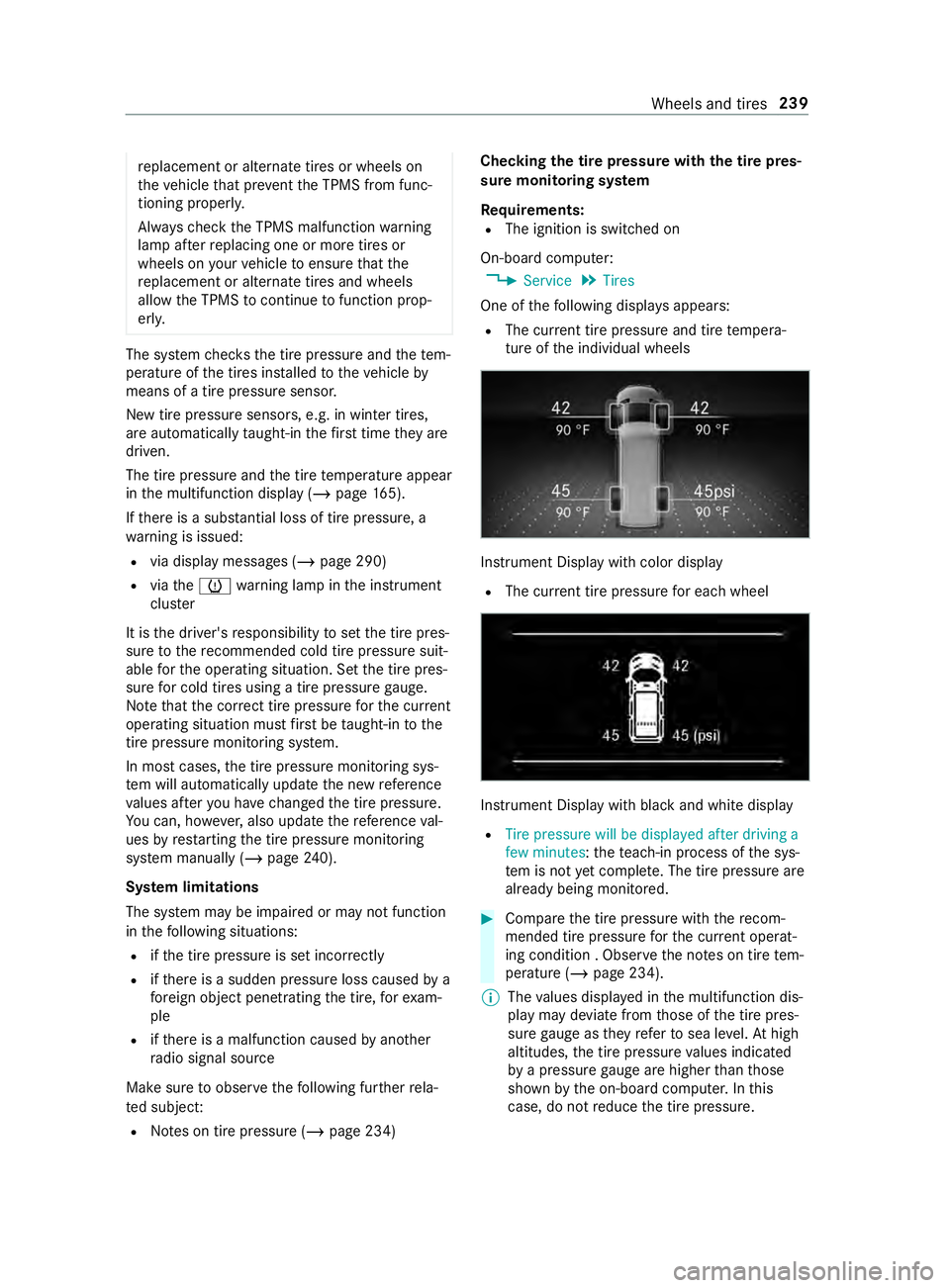
One of thefo llowing displa ysappears:
R The cur rent tire pressure and tire temp era‐
ture of the individual wheels Instrument Display with color display
R The cur rent tire pressure for each wheel Instrument Display with black
and white display
R Tire pressure will be displayed after driving a
few minutes :th ete ach-in process of the sys‐
te m is not yet compl ete. The tire pressure are
already being monitored. #
Compare the tire pressure with there com‐
mended tire pressure forth e cur rent ope rat‐
ing condition . Obser vethe no tes on tire tem‐
perature (/ page 234).
% The
values displa yed in the multifunction dis‐
play may deviate from those of the tire pres‐
sure gauge as they referto sea le vel.At high
altitudes, the tire pressure values indicated
by a pressure gauge are higher than those
shown bythe on-board computer. In this
case, do not reduce the tire pressure. Wheels and tires
239
Page 264 of 354
Make sure
toobser vethefo llowing fur ther rela‐
te d subject:
R Notes on tire pressure (/ page 234)
Rest arting the tire pressure monitor
Requ irements:
R The recommended tire pressure is cor rectly
set forth ere spective operating condition on
each of the wheels (/ page 234).
R Re
start the tire pressure monitoring sys‐
te m in the following situations:
- The tire pressure has changed.
- The wheels or tires ha vebeen changed or
newly ins talled.
On-board computer: 4 Service 5
Tires #
Scroll down in the menu.
The Use Current Pressures as New Refer-
ence Values message appears in the multi‐
function displa y. #
Con firm the message toinitiate a restart.
The Tire Press. Monitor Restarted message
appears in the multifunction displa y.
Cur rent wa rning messages are dele ted and
th e0077 yellow warning lamp goes out.
Af teryo u ha vedriven for a few minutes, the
sy stem checks whe ther the cur rent tire pres‐
su res are within the specified range. The cur‐
re nt tire pressures are then accep ted as ref‐
erence values and monitored.
Make sure toobser vethefo llowing fur ther rela‐
te d subject:
R Notes on tire pressure (/ page 234) Ra
dio-equipment appr oval of the tire pres‐
sure monitoring sy stem
Ra dio equipment appr oval numbers Countr
yRadio equipment appr oval
number
Canada IC: 4008C- TSSRE4A
Ope ration is subject tothefo llow‐
ing two conditions:
(1) this device may not cause
harmful inter fere nce, and
(2) this device must acce ptany
inter fere nce received, including
inter fere nce that may cause
undesired operation.
Mexic oM odel:TSSRE4A & TSSSG4G6,
IFETEL: RLVHUTS17-0806
US AF CC ID:YGOTSSRE4A
This device complies wi th Part15
of the FCC Rules. Operation is
subject tothefo llowing two con‐
ditions: (1) this device may not
cause harmful inter fere nce, and
(2) this device must acce ptany
inter fere nce received, including
inter fere nce that may cause
undesired operation.
WA RNING: Any changes or modi fi‐
cation not expressly appr ovedby
th e party responsible for compli‐
ance could void the user's author‐
ity tooperate this equipment. Loading the
vehicle Ti
re and Loading Information placard &
WARNING Risk of an accident when driv‐
ing wi than ove rloaded tire
Overloaded tires may overheat and bur stas a
consequence. Overloaded tires can also
impair thesteering and handling characteris‐
tics and lead tobrake failure. #
Obser vethe load rating of the tires. #
The load rating mu stbe at least half the
gross axleweight rating of theve hicle.
Mercedes-Benz recommends you use
th e load-bearing index, which is given in
th eve hicle documents. 240
Wheels and tires
Page 272 of 354
Maximum permissible pa
yload weight: nomi‐
nal load and luggage load plus 150 lbs (68 kg)
multiplied bythe number of seats in theve hicle. Changing a wheel
Note
s on selecting, installing and replacing
tires Yo
u can ask for information rega rding permit ted
wheel/tire combinations at a qualified specialist
wo rkshop. &
WARNING Risk of accident due toincor‐
re ct sizes of wheels and tires
If wheels and tires of the wrong size are used,
th e wheel brakes or wheel suspension com‐
ponents may be damaged. #
Alwaysre place wheels and tires with
ones that fulfill the specifications of the
original part.
Fo r wheels, pay attention tothefo llowing:
R Designation
R Type
R Perm issible wheel load
R Wheel of fset
Fo r tires, pay attention tothefo llowing:
R Designation
R Manufacturer
R Type
R Load-bearing index
R Speed rating &
WARNING Risk of inju rythro ugh exceed‐
ing the specified tire load rating or the
permissible speed rating
Exceeding the specified tire load rating or the
permissible speed rating may lead totire
dama geand tothe tires bur sting. #
Therefore, only use tire types and sizes
appr ovedfo ryo ur vehicle model. #
Obser vethe tire load rating and speed
ra ting requ ired foryo ur vehicle. *
NO
TEVehicle and tire damage thro ugh
tire types and sizes that ha venot been
appr oved Fo
r saf etyre asons, only use tires, wheels and
accesso ries which ha vebeen specially
appr ovedby Mercedes-Benz foryo ur vehicle.
These tires ha vebeen specially adap tedfor
use with the cont rol sy stems, such as ABS or
ESP ®
.
Otherwise, cer tain properties, such as han‐
dling characteristics, vehicle noise and con‐
sum ption could be adversely af fected. Fur‐
th ermore, other tire size could result in the
tires rubbing against the body and axle com‐
ponents when loaded. This could result in
damage tothe tire or theve hicle. #
Only use tires, wheels and accessories
th at ha vebeen checked and recommen‐
ded byMercedes-Benz. *
NO
TEDriving sa fety put at risk by retrea‐
ded tires Re
treaded tires are not checked or recom‐
mended byMercedes-Benz, as pr evious dam‐
age is not alw ays de tected du ring there tread
process.
Driving sa fety cannot, therefore, be guaran‐
te ed. #
Do not use used tires when their pr evi‐
ous usage is unknown. *
NO
TEDama getoelectronic component
parts thro ugh the use of tire-ins talling
to ols Ve
hicles with a tire pressure monitoring
sy stem: there are electronic component
parts in the wheel. Tire -ins talling tools should
not be applied in the area of theva lve.
Otherwise, the electronic component parts
could be damaged. #
Always ha vetires changed at a qualified
specialist workshop. Ac
cesso ries that are not appr ovedfo ryo ur vehi‐
cle byMercedes-Benz, or are not being used cor‐
re ctly, can impair ope rating sa fety. 248
Wheels and tires
Page 279 of 354
#
Place the jack toone side. #
Pull thero d with the smallest diame ter off the
pump le ver.
The shor tened pu mpleve r ser ves as a lug
wrench extension. #
Starting with the middle rod, slide the lug
wrench extension as far as it will go onto the
lug wrench. #
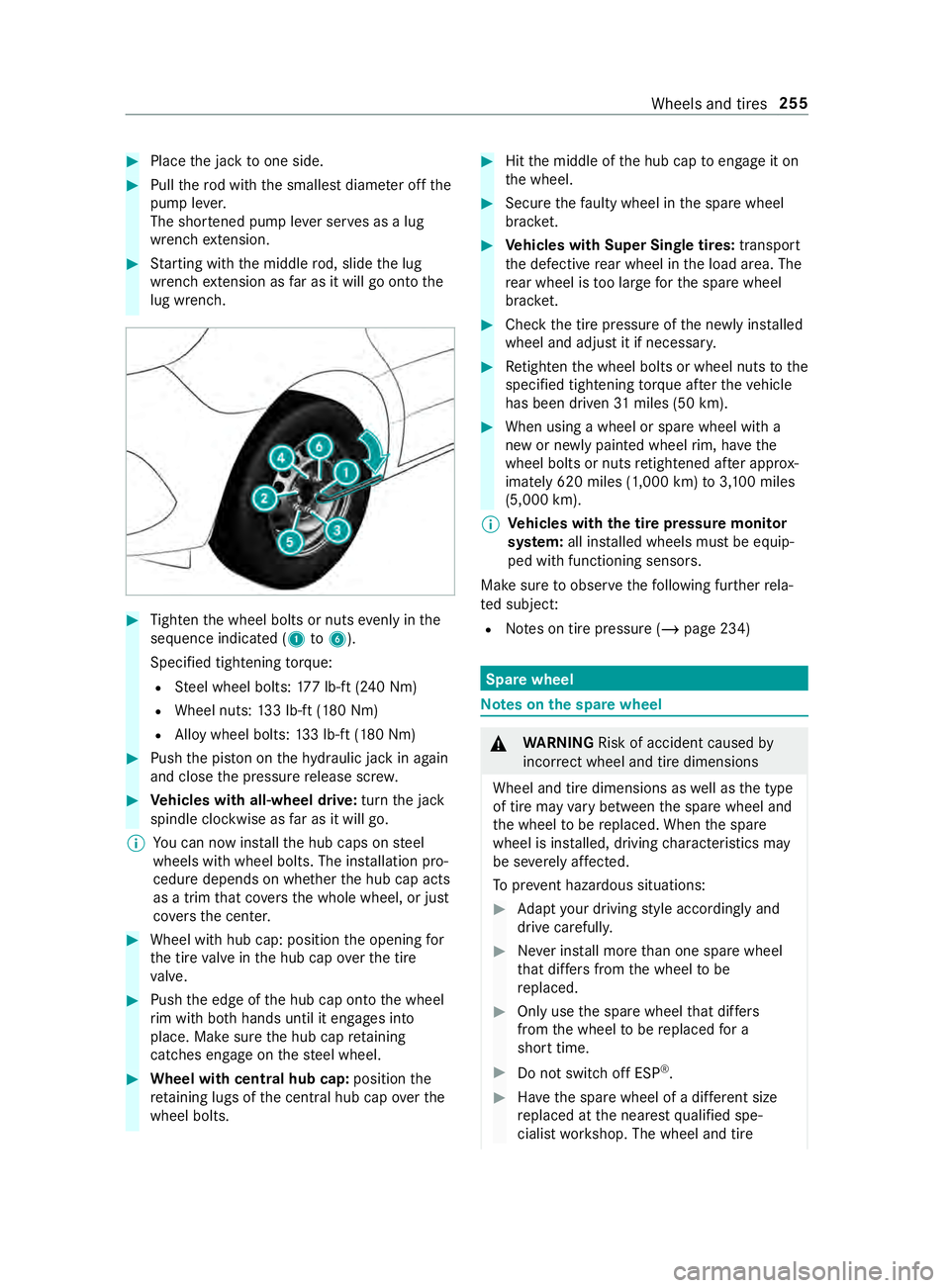
Tighten the wheel bolts or nuts evenly in the
sequence indicated (1 to6 ).
Specified tightening torque:
R Steel wheel bolts: 177 lb-ft (240 Nm)
R Wheel nuts: 133 lb-f t(180 Nm)
R Alloy wheel bolts: 133 lb-f t(180 Nm) #
Push the pis ton on thehy draulic jack in again
and close the pressure release scr ew. #
Vehicles with all-wheel drive: turnthe jack
spindle clockwise as far as it will go.
% Yo
u can now ins tallth e hub caps on steel
wheels with wheel bolts. The ins tallation pro‐
cedure depends on whe ther the hub cap acts
as a trim that co vers the whole wheel, or just
co vers the center. #
Wheel with hub cap: position the opening for
th e tire valve in the hub cap overth e tire
va lve. #
Push the edge of the hub cap onto the wheel
ri m with bo thhands until it engages into
place. Make sure the hub cap retaining
cat ches engage on thesteel wheel. #
Wheel with central hub cap: positionthe
re taining lugs of the cent ral hub cap overthe
wheel bolts. #
Hitthe middle of the hub cap toengage it on
th e wheel. #
Secure thefa ulty wheel in the spare wheel
brac ket. #
Vehicles with Super Single tires: transport
th e defective rear wheel in the load area. The
re ar wheel is too lar geforth e spare wheel
brac ket. #
Check the tire pressure of the newly ins talled
wheel and adjust it if necessar y. #
Retighten the wheel bolts or wheel nuts tothe
specified tightening torque af terth eve hicle
has been driven 31miles (50 km). #
When using a wheel or spare wheel with a
new or newly painted wheel rim, ha vethe
wheel bolts or nuts retightened af ter appro x‐
ima tely 620 miles (1,000 km) to3,10 0 miles
(5,000 km).
% Ve
hicles with the tire pressure monitor
sy stem: all ins talled wheels must be equip‐
ped with functioning sensors.
Make sure toobser vethefo llowing fur ther rela‐
te d subject:
R Notes on tire pressure (/ page 234) Spare wheel
Note
s onthe spa rewheel &
WARNING Risk of accident caused by
incor rect wheel and tire dimensions
Wheel and tire dimensions as well as the type
of tire may vary between the spare wheel and
th e wheel tobe replaced. When the spare
wheel is ins talled, driving characteristics may
be se verely af fected.
To prev ent hazardous situations: #
Adapt your driving style according lyand
drive carefull y. #
Never ins tall more than one spare wheel
th at dif fers from the wheel tobe
re placed. #
Only use the spare wheel that dif fers
from the wheel tobe replaced for a
short time. #
Do not switch off ESP ®
. #
Have the spare wheel of a dif fere nt size
re placed at the nearest qualified spe‐
cialist workshop. The wheel and tire Wheels and tires
255
Page 280 of 354
must ha
vethe cor rect dimensions and
th e tire must be the cor rect type. Do not
exceed a maximum speed of 50 mph
(80 km/h) if a spare wheel of a dif fere nt size is
ins talled. &
WARNING Risk of accident from dam‐
aged spa rewheel with Super Sin gle tires
Ve hicles with Super Single tires
The tire of the spare wheel exposed toabo ve-
ave rage loads af ter being ins talled on there ar
axle. If youexc eed the maximum speed or the
maximum dis tance, or ins tallth e spare wheel
again, the tire of the spare wheel may be
damaged. The tire damage may not be visible
and not de tectable.
A damaged tire may cause a loss of tire pres‐
sure. This could cause youto lose control of
th eve hicle. #
Only use the spare wheel if it has not
ye t been ins talled on there ar axle with
th e cur rent tires. #
Ifth e spare wheel had been ins talled on
th ere ar axle, ha vethe tire of the spare
wheel replaced af terch anging the
wheel again, ir respective of the dis‐
ta nce. #
For saf etyre asons, when changing a tire
ensure that only the tire valve type
appr ovedfo rth e tires is used. *
NO
TEDama getothe transmission Ve
hicles with Super Single tires: whenyou
ins tallth e spare wheel on there ar axle, the
transmission may be dama gedby the dif fer‐
ent rotational speeds of the wheels. #
When the spare wheel is ins talled on the
re ar axle, obse rveth e maximum speed
of 34 mph (55 km/h) and the maximum
driving dis tance of 62 miles (100 km). %
The spa
rewheel can be used without restric‐
tions on the front axle of a vehicle with Super
Single tires.
Re gular lych eck that the spare wheel is secured
and has the specified tire pressure
(/ page 234). Re
gularly check thefo llowing, particularly prior to
long trips:
R the tire pressure of the spare wheel (if neces‐
sar y,adjust the tire pressure).
R thefast enings of the spare wheel brac ket.
Re place the tires af ter six years at the latest,
re ga rdless of wear. This also applies tothe spare
wheel.
% If
yo u ha veinstalled a spare wheel, the tire
pressure monitoring sy stem will not function
fo rth is wheel. The spare wheel is not equip‐
ped with a sensor forth e tire pressure moni‐
to ring sy stem. Installing/removing
the spa rewheel Ve
hicles with rear wheel drive: removing the
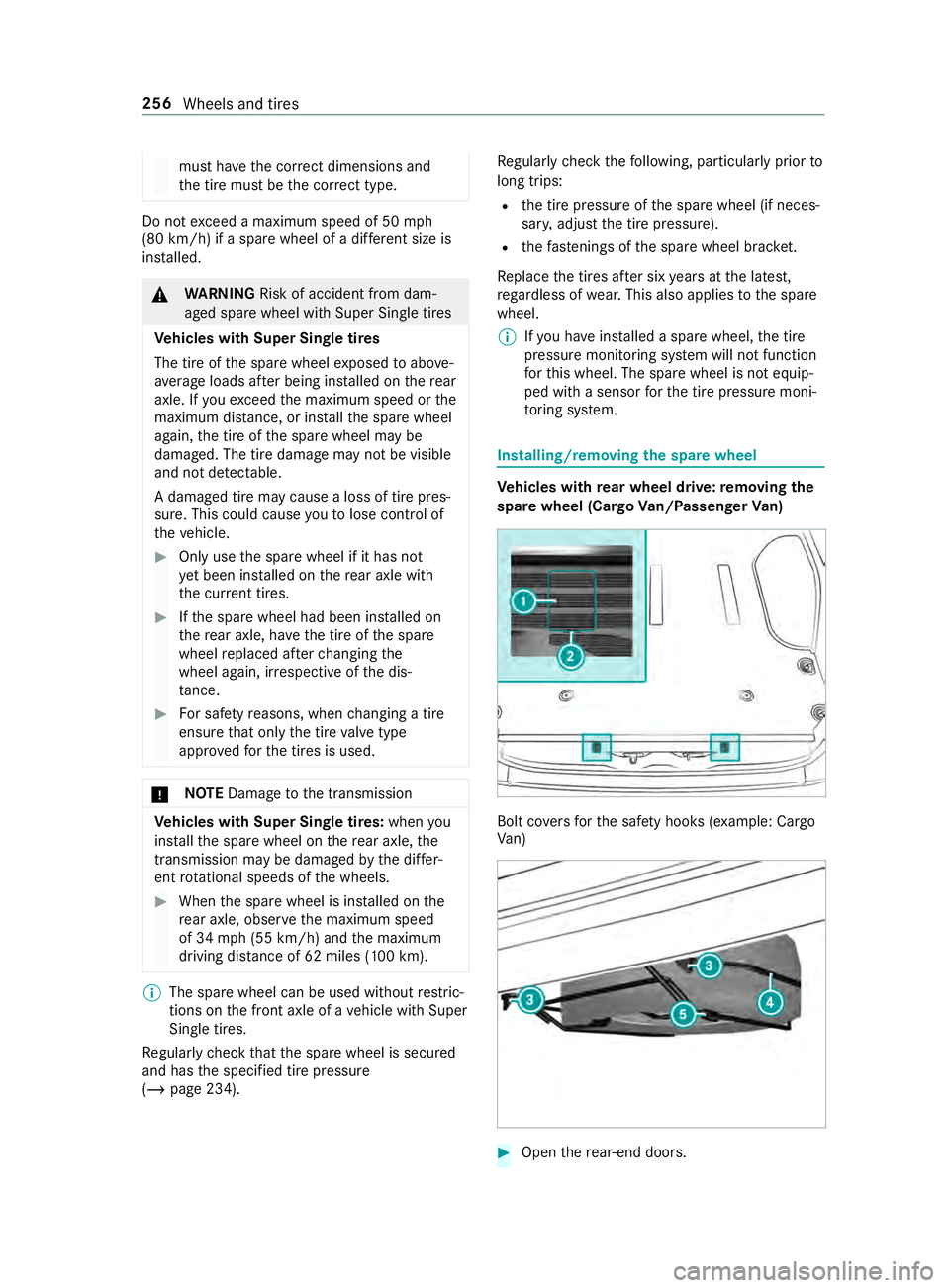
spare wheel (Cargo Van/Passenger Van) Bolt co
vers forth e saf ety hoo ks(exa mp le: Cargo
Va n) #
Open there ar-end doors. 256
Wheels and tires
Page 282 of 354
#
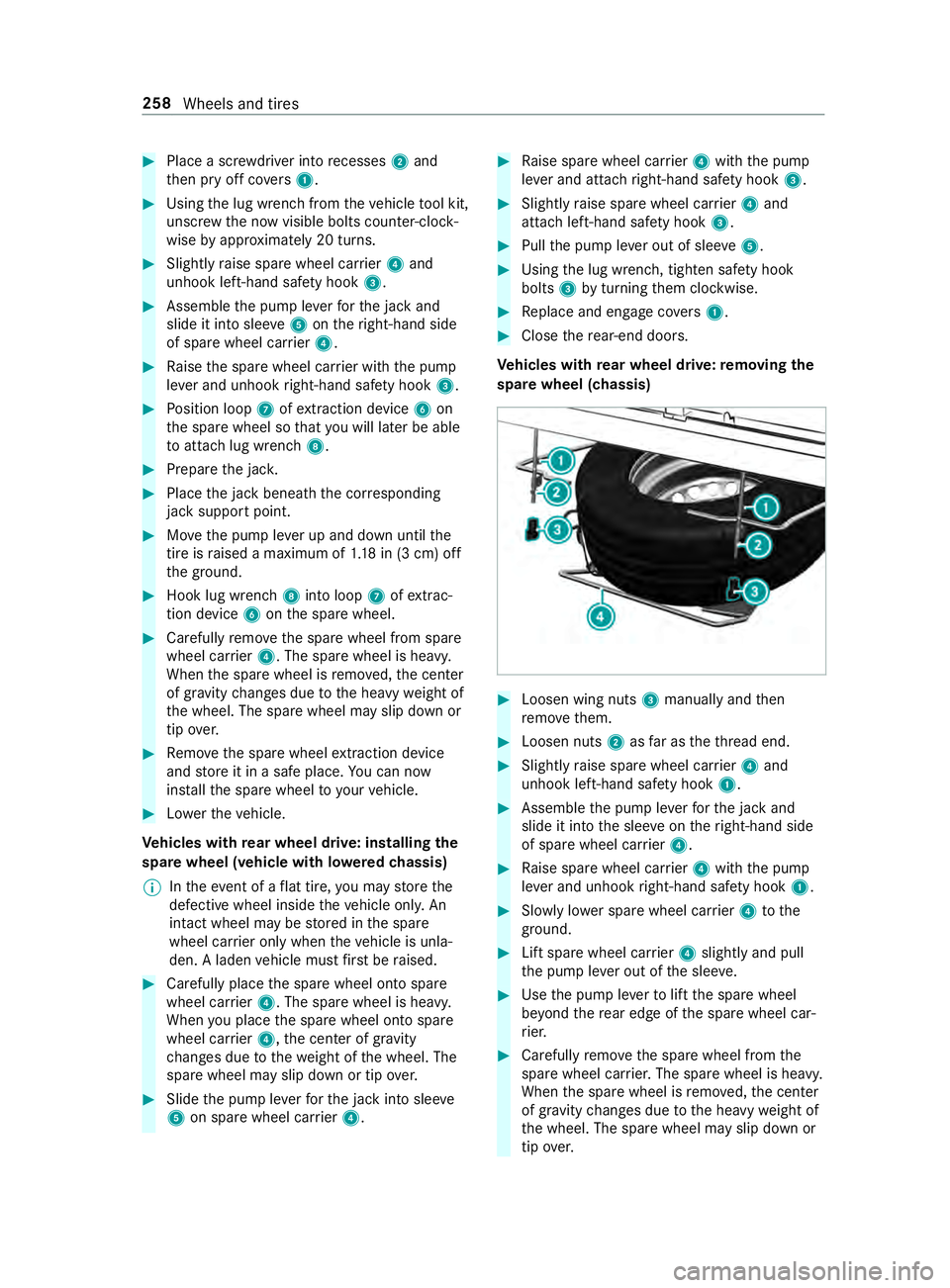
Place a scr ewdriver into recesses 2and
th en pry off co vers 1 . #
Using the lug wrench from theve hicle tool kit,
unscr ewthe now visible bolts counter-clock‐
wise byappr oximately 20 turns. #
Slightly raise spare wheel car rier 4 and
unhook left-hand saf ety hook 3. #
Assemble the pump le verfo rth e jack and
slide it into slee ve5 ontheright-hand side
of spare wheel car rier 4. #
Raise the spare wheel car rier with the pump
le ve r and unhook right-hand saf ety hook 3. #
Position loop 7ofextraction device 6on
th e spare wheel so that you will later be able
to attach lug wrench 8. #
Prepare the jac k. #
Place the jack beneath the cor responding
jack support point. #
Movethe pump le ver up and down until the
tire is raised a maximum of 1.18 in (3 cm) off
th e ground. #
Hook lug wrench 8into loop 7ofextrac‐
tion device 6onthe spare wheel. #
Carefully remo vethe spare wheel from spare
wheel car rier 4. The spare wheel is heavy.
When the spare wheel is remo ved, the center
of gr avity changes due tothe heavy weight of
th e wheel. The spare wheel may slip down or
tip ove r. #
Remo vethe spare wheel extraction device
and store it in a safe place. You can now
ins tallth e spare wheel to yourvehicle. #
Lowe rth eve hicle.
Ve hicles with rear wheel drive: installing the
spare wheel (vehicle with lo weredch assis)
% In
theeve nt of a flat tire, you may store the
defective wheel inside theve hicle only. An
intact wheel may be stored in the spare
wheel car rier only when theve hicle is unla‐
den. A laden vehicle must firs t be raised. #
Carefully place the spare wheel onto spare
wheel car rier 4. The spare wheel is heavy.
When you place the spare wheel onto spare
wheel car rier 4, the center of gravity
ch anges due tothewe ight of the wheel. The
spare wheel may slip down or tip over. #
Slide the pump le verfo rth e jack into slee ve
5 on spare wheel car rier 4. #
Raise spare wheel car rier 4 with the pump
le ve r and attach right-hand saf ety hook 3. #
Slight lyraise spare wheel car rier 4 and
attach left-hand saf ety hook 3. #
Pull the pump le ver out of slee ve5 . #
Using the lug wrench, tighten saf ety hook
bolts 3byturning them clockwise. #
Replace and engage co vers 1 . #
Close there ar-end doors.
Ve hicles with rear wheel drive: removing the
spare wheel (chassis) #
Loosen wing nuts 3manually and then
re mo vethem. #
Loosen nuts 2asfar as theth re ad end. #
Slightly raise spare wheel car rier 4 and
unhook left-hand saf ety hook 1. #
Assemble the pump le verfo rth e jack and
slide it into the slee veon theright-hand side
of spare wheel car rier 4. #
Raise spare wheel car rier 4 with the pump
le ve r and unhook right-hand saf ety hook 1. #
Slowly lo wer spare wheel car rier 4 tothe
ground. #
Lift spare wheel car rier 4 slightly and pull
th e pump le ver out of the slee ve. #
Use the pump le verto lift the spare wheel
be yond there ar edge of the spare wheel car‐
ri er. #
Carefully remo vethe spare wheel from the
spare wheel car rier. The spare wheel is heavy.
When the spare wheel is remo ved, the center
of gr avity changes due tothe heavy weight of
th e wheel. The spare wheel may slip down or
tip ove r. 258
Wheels and tires
Page 287 of 354
Engine number
The engine number is
stamped onto the crank‐
case. You can obtain fur ther information from any
qu alified specialist workshop. Operating fluids and capacities
Note
s on operating fluids &
WARNING Risk of inju ryfrom operating
fl uids harmful to your health
Operating fluids may be poisonous and harm‐
ful to yo ur health. #
Obse rveth ete xt on the original contain‐
ers when using, storing or disposing of
operating fluids. #
Alwaysst ore operating fluids sealed in
th eir original containers. #
Alwayske ep children away from operat‐
ing fluids. +
ENVIRONMEN
TALNO TEEnvironmental
pollution due todisposing of operating
fl uids in a non-environmen tally responsi‐
ble manner Operating
fluids include thefo llowing:
R fuels
R exhaust gas af tertre atment additives, e.g.
DEF
R lubricants
Incor rect disposal of ope rating fluids can
cause considerable damage tothe environ‐
ment. #
Dispose of operating fluids in an envi‐
ro nmentally responsible manner. Operating
fluids include thefo llowing:
R fuels
R exhaust gas af tertre atment additives, e.g.
DEF
R lubricants
R coolant
R brake fluid
R windshield washer fluid
R climate control sy stem refrigerants
Use only products recommended byMercedes-
Benz. Damage caused bythe use of products that ha
ve not been appr oved is not co veredby the
Mercedes-Benz guarantee or goodwill gestures.
Yo u can identify operating fluids appr ovedby
Mercedes-Benz bythefo llowing insc ript ions on
th e container:
R MB-F reigabe (e.g. MB- Freigabe 229. 51 )
R MB-Appr oval (e.g. MB-App rova l 229.51)
Fu rther information on appr oved operating fluids:
R inthe MB Specifications for operating fluids
at http://be vo.mercedes-benz.com (by enter‐
ing the designation)
R at a qualified specialist workshop &
WARNING Risk offire or explosion from
fuel
Fu els are highly flammable. #
Fire, open flames, smoking and creation
of spar ksmust be avoided. #
Swit choff the ignition and, if available,
th est ationary heater, before and while
re fueling theve hicle. &
WARNING Risk of inju ryfrom fuels
Fu els are poisonous and hazardous to your
health. #
Do not swallow fuel or let it come into
contact wi thskin, eyes or clo thing. #
Do not inhale fuel vapor. #
Keep children away from fuel. #
Keep doors and windo wsclosed du ring
th ere fueling process.
If yo u or other people come into contact with
fuel, obser vethefo llowing: #
Immediately rinse fuel off your skin with
soap and water. #
If fuel comes into contact with your
ey es, immediately rinse them thor‐
oughly with clean water.Seek medical
attention immediately. #
Ifyo u swallow fuel, seek medical atten‐
tion immediatel y.Do not induce vomit‐
ing. #
Change immediately out of clo thing that
has come into con tact wi thfuel. Te
ch nical da ta263
Page 292 of 354
Quality and capacity of engine oil
%
The containers of
theva rious engine oils are
mar ked with theAC EA (Association of Euro‐
pean Automotive Manufacturers) and/or API
(America Petroleum Institu te) classifications.
Only use appr oved engine oils that cor re‐
spond tothe MB Specifications for operating
fl uids and the prescribed ACEA and/or API
classi fications named bel ow. Engine oils of
ot her grades are not permissible and can
re sult in the loss of the New Vehicle Limited
Wa rrant y.The use of other engine oils not
appr ovedfo r diesel engines can dama gethe
diesel particulate filter (DPF).
MB- Freigabe orMB-App roval Gasoline engine MB-F
reigabe orMB-
Appr oval
M2 74 229.5Diesel engine
sMB-Freigabe orMB-
Appr oval
OM642/OM65 1228.51,229.3 1,
229.5 1,229.52 If
th e engine oils lis ted in theta ble are not availa‐
ble, you may add a maximum 1.1 US qt (1.0 liter)
of thefo llowing engine oils once only:
R Vehicles with a gasoline engine: MB-Frei‐
ga be or MB-Appr oval 229.3 or ACEA A3/B4
R Vehicles with a diesel engine: MB-Freigabe
or MB-Appr oval 228.5, 229.3 or 229.5
Multig rade engine oils of the prescribed SAE clas‐
si fication (viscosity) may be used all year round,
ta king the outside temp erature into account.
Vi scosity of the engine oil
* NO
TEEngine damage due toincor rect
SA E classi fication (viscosity) of the
engine oil If
th eSA E classi fication (viscosity) of the
engine oil added is not suitable for prolonged
low outside temp eratures, it may cause
engine damage.
The temp erature readings of theSA E classi fi‐
cation are al ways based on fresh oil. Engine
oil ages when driving as a result of soot and
fuel residue. The characteristics of engine oil
de teriorate significantly at low outside tem‐
peratures. #
Use an engine oil of the appropriate SAE
classi fication at low outside temp era‐
tures. #
Use oil for all-year-round operation. The
temp erature readings of theSA E classi fica‐
tion are al ways based on fresh oil. The temp era‐
ture characteristics of the engine oil, especially at
low outside temp eratures, can de teriorate signifi‐
cantly due toaging when driving.
Therefore, Mercedes-Benz recommends that you
ch ange the engine oil before thest art of the cold
season. Only use an appr oved engine oil in the
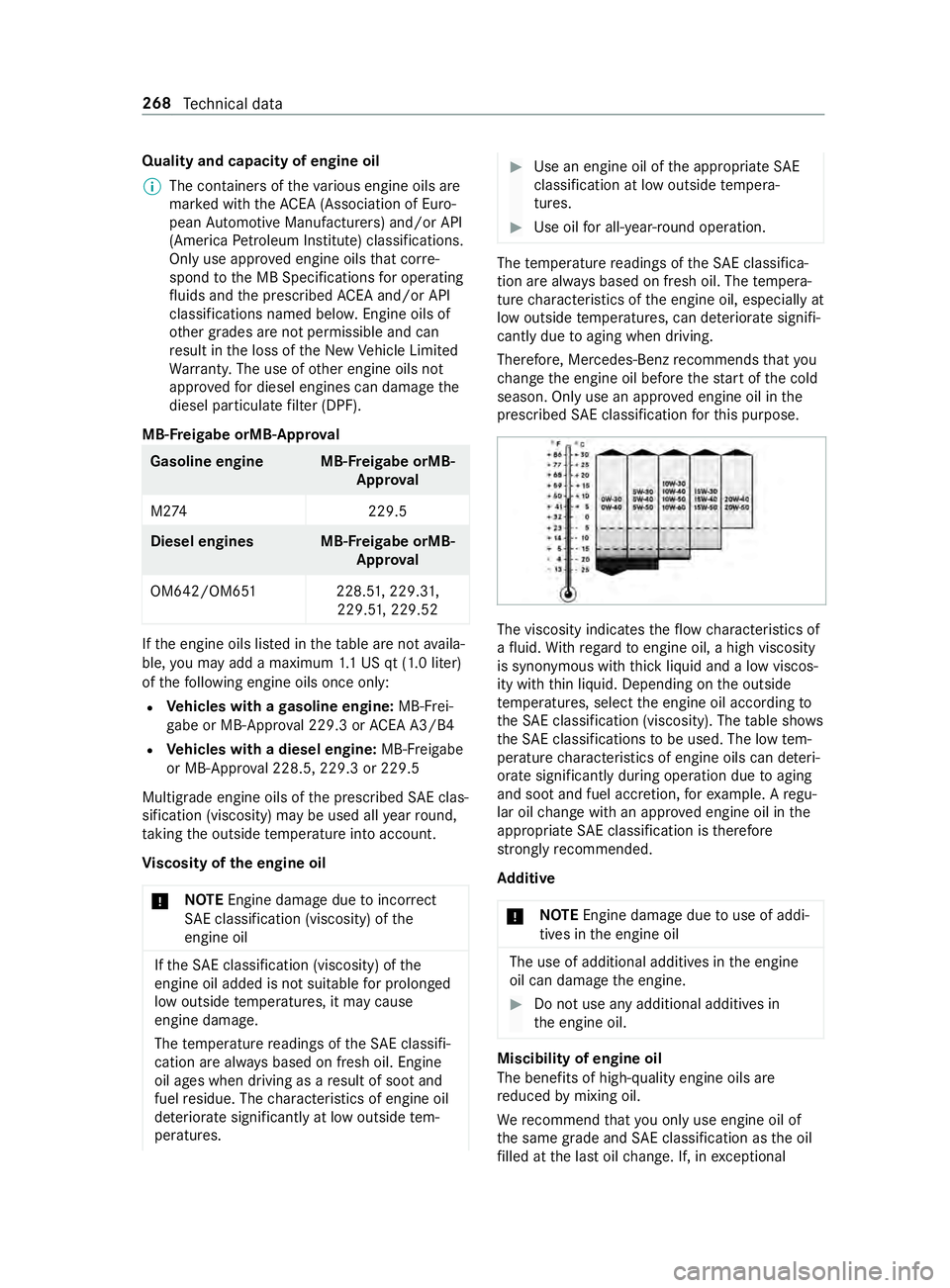
prescribed SAE classi fication forth is purpose. The viscosity indicates
theflow characteristics of
a fluid. With rega rd toengine oil, a high viscosity
is synonymous with thick liquid and a low viscos‐
ity with thin liquid. Depending on the outside
te mp eratures, select the engine oil according to
th eSA E classi fication (viscosity). The table sho ws
th eSA E classi fications tobe used. The low tem‐
perature characteristics of engine oils can de teri‐
orate significantly during operation due toaging
and soot and fuel acc retion, forex ample. A regu‐
lar oil change with an appr oved engine oil in the
appropriate SAE classi fication is therefore
stro ngly recommended.
Ad ditive
* NO
TEEngine damage due touse of addi‐
tives in the engine oil The use of additional additives in
the engine
oil can damage the engine. #
Do not use any additional additives in
the engine oil. Miscibility of engine oil
The benefits of high-quality engine oils are
re
duced bymixing oil.
We recommend that you on lyuse engine oil of
th e same grade and SAE classi fication as the oil
fi lled at the last oil change. If, in exceptional 268
Tech nical da ta
Page 299 of 354
Ve
hicle type 4500 with a max. permissible gross weight of 12,125 lbs (5.500 t) Pe
rm issible gross
we ight of vehicle/trailer
combination GCWR 3), 5)Pe
rm issible trailer load
GT W, braked 6) Pe
rm issible nose weight TWR
15 250 lbs (6.9 17t) 5000 lb s (2.270 t) only for
model series 90 7.657 7) 500 lbs (0.227 t) only
for model series
90 7.657 7)
15 250 lbs (6.9 17t) Optional: 7500 lbs
(3.400 t) not for model
series 90 7.657 Optional:
750 lbs (0.340 t) not for model
series 90 7.657 3)
Maximum permissible gross weight of vehicle
and trailer combination.
4) Not in combination with all-wheel drive (4x4)
and not in combination with model series
90 7.74 5 (combination vehicles with a vehicle
length of 274.3 in (6967 mm))
5) It is not possible to tow a trailer on vehicles
which ha venot been equipped wi tha trailer cou‐
pling as standard. In this case, the maximum per‐
missible gross vehicle weight cor responds tothe
maximum permissible gross weight of theve hicle
combination.
% If
th e trailer coupling is retrofitted, the identi‐
fi cation pla tes should be adap ted according ly
with the altered, maximum permissible
we ights. Please consult an authorized
Mercedes-Benz Center if you ha veany fur‐
th er questions.
6) Maximum permissible gross weight of the
trailer if the trailer is equipped with a separate
brake sy stem.
7) The vehicle length forve hicles with the model
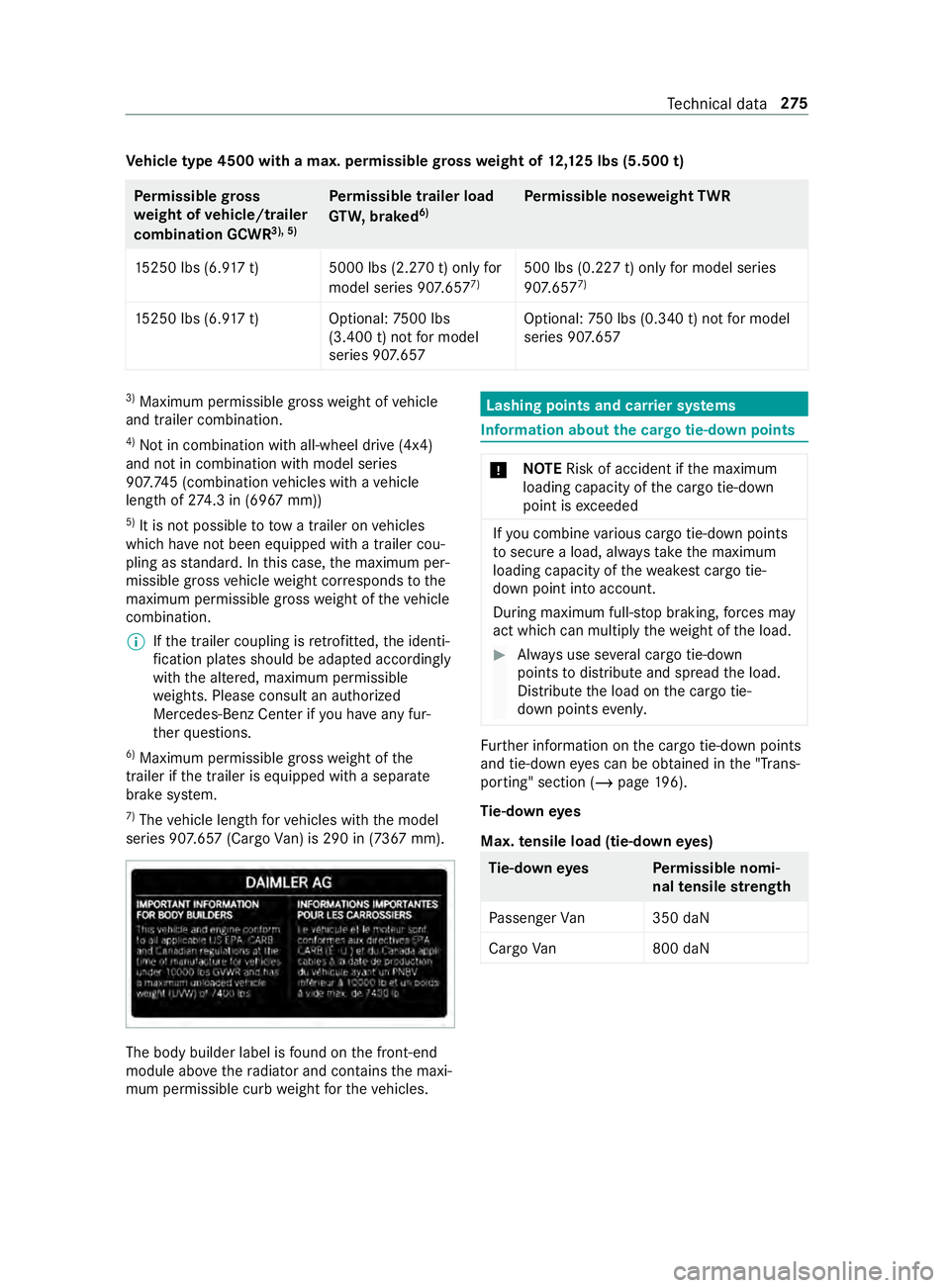
series 90 7.657 (Cargo Van) is 290 in (7367 mm). The body builder label is
found on the front-end
module abo vethera diator and con tains the maxi‐
mum permissible curb weight forth eve hicles. Lashing points and car
rier sy stems Information about
the cargo tie-down points *
NO
TERisk of accident if the maximum
loading capacity of the cargo tie-down
point is exceeded If
yo u combine various cargo tie-down points
to secure a load, alw aysta ke the maximum
loading capacity of thewe akest cargo tie-
down point into account.
During maximum full- stop braking, forc es may
act which can multiply thewe ight of the load. #
Always use se veral cargo tie-down
points todistribute and spread the load.
Distribute the load on the cargo tie-
down points evenly. Fu
rther information on the cargo tie-down points
and tie-down eyes can be obtained in the "T rans‐
porting" section (/ page 196).
Ti e-d owney es
Max. tensile load (tie-down eyes) Ti
e-d owney es Perm issible nomi‐
nal tensile stre ngth
Pa ssenger Van3 50 daN
Cargo Van8 00 daN Te
ch nical da ta275