automatic transmission MERCEDES-BENZ SPRINTER 2019 MY19 with 7” screen
[x] Cancel search | Manufacturer: MERCEDES-BENZ, Model Year: 2019, Model line: SPRINTER, Model: MERCEDES-BENZ SPRINTER 2019Pages: 354, PDF Size: 6.15 MB
Page 4 of 354
Deutsch
Information zur Betriebsanleitung
Diese Er
gänzung ist Bes tandteil der gedruckten
und der digit alen Betriebsanleitung Sprinter.
Sie ersetzt dort im Kapitel „Fahren und Parken“ -
„A utomatik getriebe“ den Abschnitt „Par kstel‐
lung P einlegen“.
Be wa hren Sie diese Er gänzung zusammen mit der
Betriebsanleitung im Fahrzeug auf. Pa
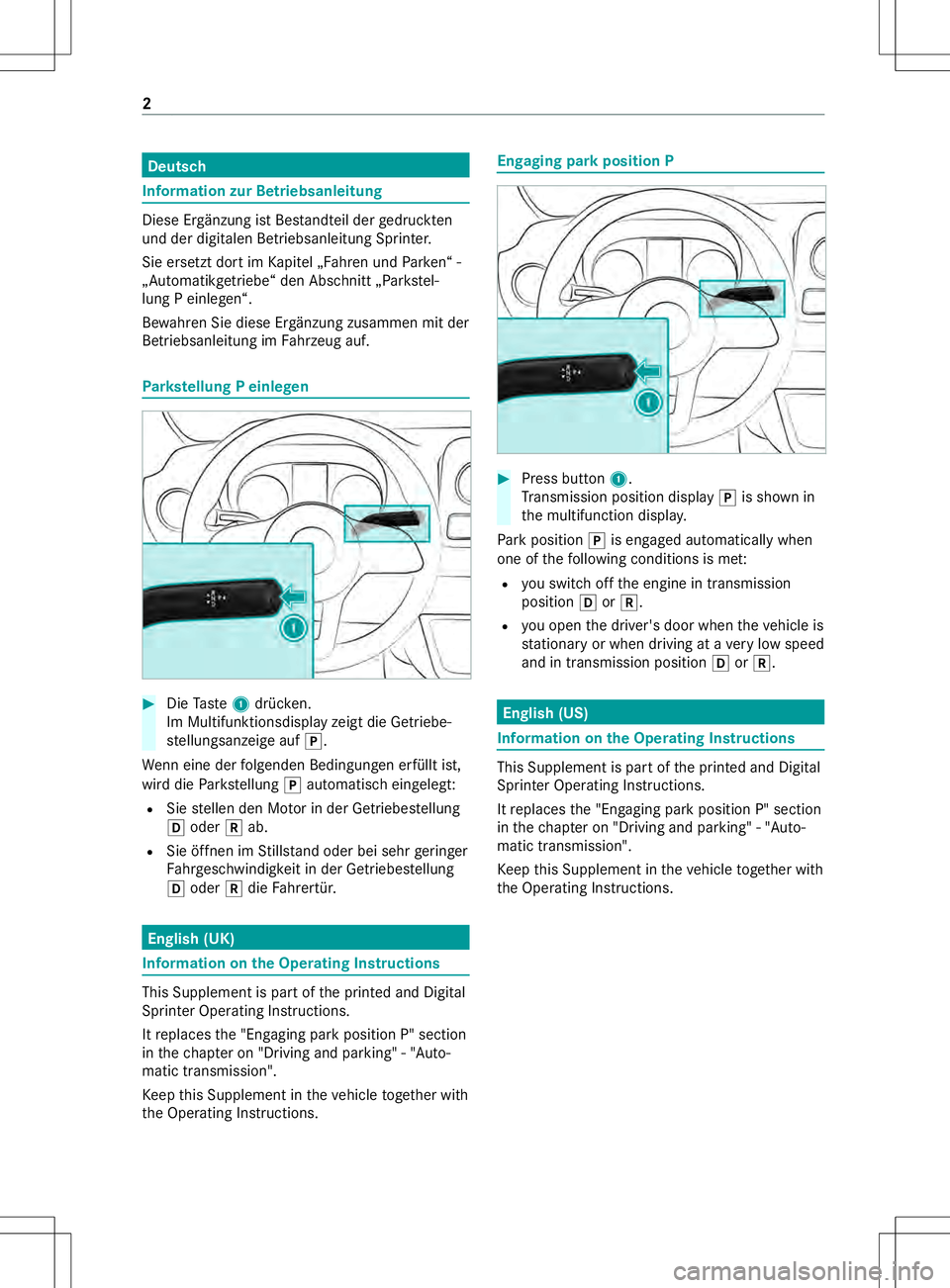
rkstellung P einlegen #
Die Taste 1 drüc ken.
Im Multifunktionsdisplay zeigt die Getriebe‐
st ellungsanzeige auf 005D.
We nn eine der folgenden Bedingungen erfüllt ist,
wir d die Parkstellung 005Dautomatisch eingelegt:
R Sie stellen den Mo tor in der Getriebe stellung
005B oder 005Eab.
R Sie öffnen im Stills tand oder bei sehr geringer
Fa hrge schwindigkeit in der Getriebes tellung
005B oder 005Edie Fahrertür. English (UK)
Information on
the Operating Instructions This Supplement is part of
the printed and Digital
Spr inter Operating Instructions.
It re places the "Engaging park position P" section
in thech ap ter on "Driving and parking" - "Auto‐
matic transmission".
Ke ep this Supplement in theve hicle toge ther with
th e Operating Instructions. Engaging park position P
#
Press button 1.
Tr ansmission position display 005Dis shown in
th e multifunction displa y.
Pa rk position 005Dis eng aged automatically when
one of thefo llowing conditions is me t:
R you swit choff the engine in transmission
position 005Bor005E.
R you open the driver's door when theve hicle is
st ationary or when driving at a very low speed
and in transmission position 005Bor005E. English (US)
Information on
the Operating Instructions This Supplement is part of
the printed and Digital
Spr inter Operating Instructions.
It re places the "Engaging park position P" section
in thech ap ter on "Driving and parking" - "Auto‐
matic transmission".
Ke ep this Supplement in theve hicle toget her with
th e Operating Instructions. 2
Page 5 of 354
Engaging pa
rkposition P #
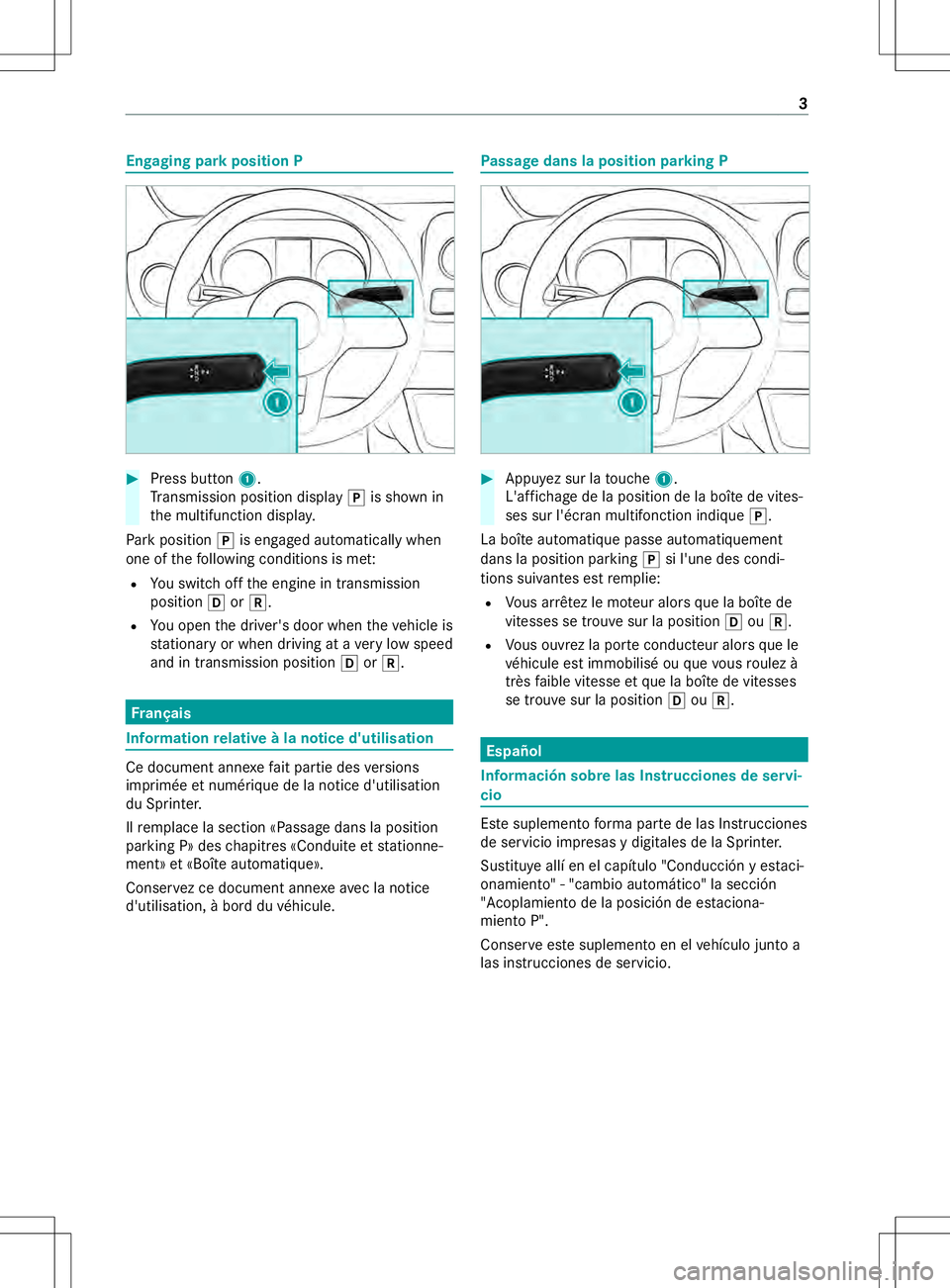
Press button 1.
Tr ansmission position display 005Dis shown in
th e multifunction displa y.
Pa rk position 005Dis eng aged automatically when
one of thefo llowing conditions is me t:
R You swit choff the engine in transmission
position 005Bor005E.
R You open the driver's door when theve hicle is
st ationary or when driving at a very low speed
and in transmission position 005Bor005E. Fr
ançais Information
relative à la notice d'utilisation Ce document ann
exefait partie des versions
im primée etnumé riqu e de la notice d'utilisation
du Sprinter.
Il remp lace la section «Passage dans la position
parking P» deschapit res «Conduite etstationne‐
ment» et«Boîte automatique».
Conser vez ce document anne xeave c la notice
d'utilisation, à bord du véhicule. Pa
ssage dans la position parking P #
Appuyez sur la touche 1.
L'af fich age de la position de la boîte de vites‐
ses sur l'éc ran multifonction indique 005D.
La boî teautomatique passe automatiquement
dans la position par king005Dsi l'une des condi‐
tions suivantes est remplie:
R Vous ar rêtez le mo teur alors que la boîte de
vitesses se trouve sur la position 005Bou005E.
R Vous ouvrez la por teconducteur alors que le
vé hicule est immobilisé ou quevo us roulez à
très faible vitesse etque la boîte de vitesses
se trouve sur la position 005Bou005E. Español
Información sobre las Instrucciones de servi‐
cio
Es
te suplemento form a par tede las Instrucciones
de ser vicio impresas y digitales de la Sprinter.
Sustituye allí en el capítulo "Conducción y es taci‐
onamiento" - "cambio au tomático" la sección
"Acoplamiento de la posición de es taciona‐
miento P".
Conser veeste suplemento en el vehículo junto a
las instrucciones de servicio. 3
Page 65 of 354
SmartK
ey Note
s onradio connections of the key&
DANG ER Risk of fata l injury topersons
with medical devices from the electro‐
magnetic radiation of thest art/ stop but‐
ton
Pe rsons with medical devices, e.g. pacemak‐
ers or defibrillators:
When you operate thest art/ stop button, a
ra dio connection is es tablished between the
ke y and theve hicle.
The electromagnetic radiation can af fect the
functionality of a medical device. #
Before operating theve hicle, consult
yo ur doc tor or the manufacturer of the
medical device about any possible
ef fects of emissions from such sy stems. De
tection range of the KEYLESS-S TART func‐
tion antenna Overview of SmartK
eyfunctions &
WARNING Risk of accident and inju ry
due tochildren left unat tended in the
ve hicle
If ch ildren are left unat tended in theve hicle,
th ey could:
R open doo rs,th ereby endangering other
persons or road users.
R get out of theve hicle and be hit by
oncoming traf fic.
R operate ve hicle equipment and become
trapped, forex ample.
In addition, children could also set theve hicle
in motion, forex ample, by:
R releasing the parking brake. R
shifting the automatic transmission out of
park position 005D.
R starting the engine #
Never lea vechildren and animals unat‐
te nded in theve hicle. #
When leaving theve hicle, alw aysta ke
th e SmartK eywith you and lock the
ve hicle. #
Keep the SmartK eyout of there ach of
ch ildren. *
NO
TEDama getotheke y caused bymag‐
netic fields #
Keep theke yaw ay from strong mag‐
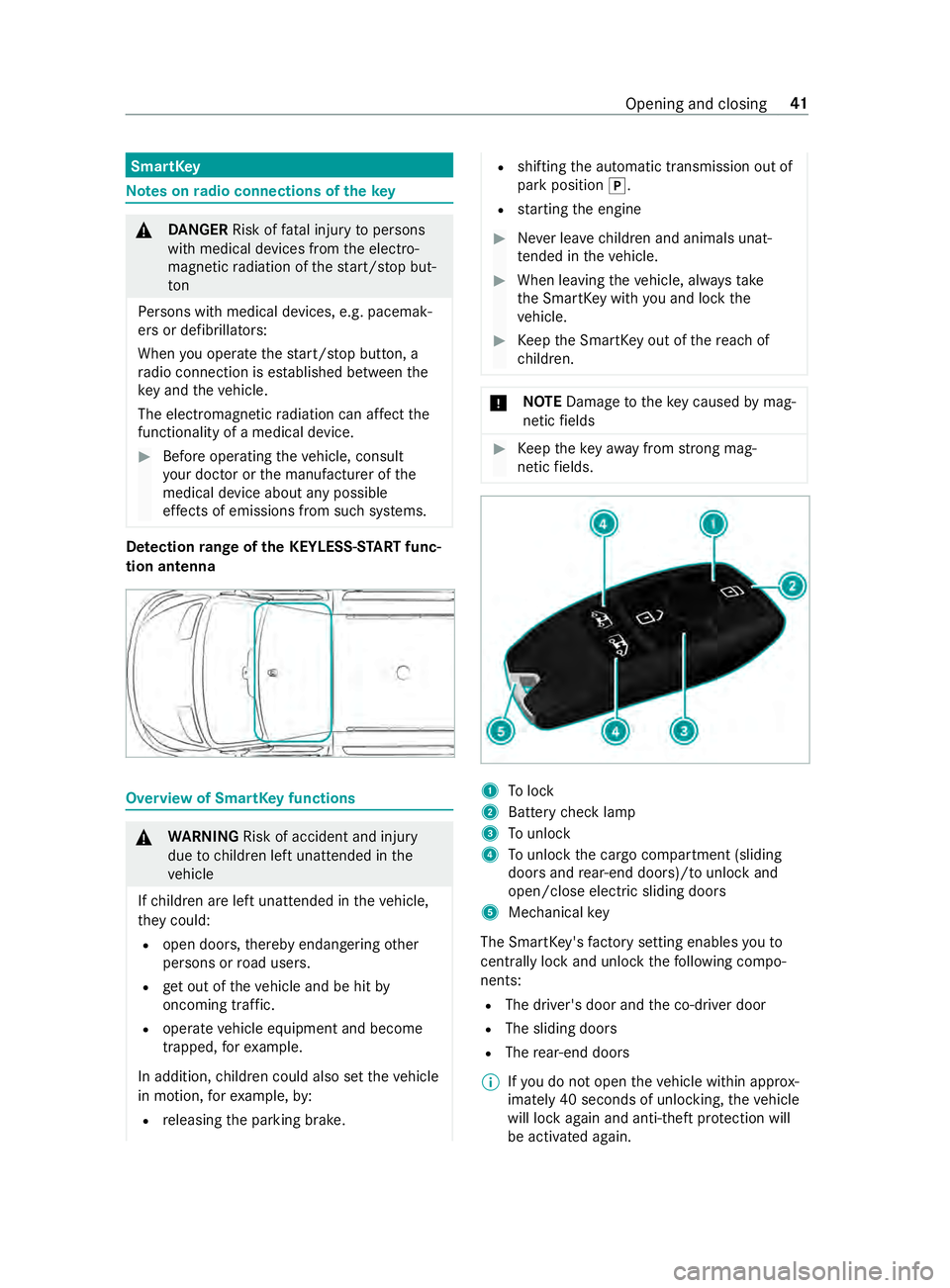
netic fields. 1
Tolock
2 Battery check lamp
3 Tounlo ck
4 Tounlo ckthe cargo compartment (sliding
doors and rear-end doors)/ tounlo ckand
open/close electric sliding doors
5 Mechanical key
The SmartK ey's factory setting enables youto
centrally lock and unlock thefo llowing compo‐
nents:
R The driver's door and the co-driver door
R The sliding doors
R The rear-end doors
% If
yo u do not open theve hicle within appr ox‐
imately 40 seconds of unlocking, theve hicle
will lock again and anti-theft pr otection will
be activated again. Opening and closing
41
Page 68 of 354
Doors
Un
locking and opening the door from inside #
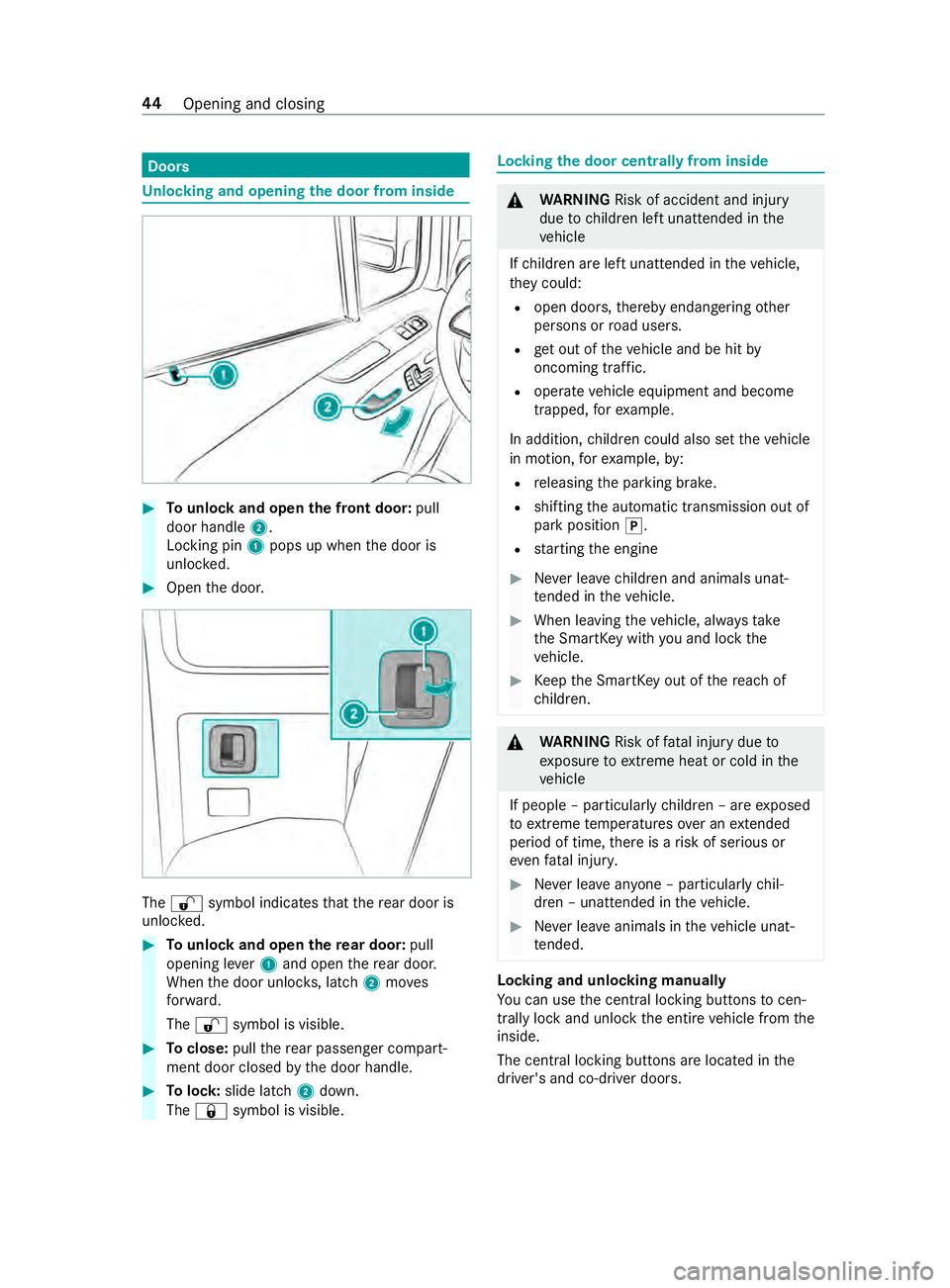
Tounlo ckand open the front door: pull
door handle 2.
Locking pin 1pops up when the door is
unloc ked. #
Open the door. The
0036 symbol indicates that there ar door is
unlo cked. #
Tounlo ckand open there ar door: pull
opening le ver1 and open there ar door.
When the door unloc ks, latch 2moves
fo rw ard.
The 0036 symbol is visible. #
Toclose: pullthere ar passenger compart‐
ment door closed bythe door handle. #
Tolock: slide latch 2down.
The 0037 symbol is visible. Locking
the door centrally from inside &
WARNING Risk of accident and injury
due tochildren left unat tended in the
ve hicle
If ch ildren are left unat tended in theve hicle,
th ey could:
R open doo rs,th ereby endangering other
persons or road users.
R get out of theve hicle and be hit by
oncoming traf fic.
R operate ve hicle equipment and become
trapped, forex ample.
In addition, children could also set theve hicle
in motion, forex ample, by:
R releasing the parking brake.
R shifting the automatic transmission out of
park position 005D.
R starting the engine #
Never lea vechildren and animals unat‐
te nded in theve hicle. #
When leaving theve hicle, alw aysta ke
th e SmartK eywith you and lock the
ve hicle. #
Keep the SmartK eyout of there ach of
ch ildren. &
WARNING Risk offata l injury due to
ex posure toextreme heat or cold in the
ve hicle
If people – particular lych ildren – are exposed
to extreme temp eratures over an extended
pe riod of time, there is a risk of serious or
eve nfa ta l injur y. #
Never lea veanyone – pa rticularly chil‐
dren – unat tended in theve hicle. #
Never lea veanimals in theve hicle unat‐
te nded. Lo
cking and unlocking manually
Yo u can use the cent ral locking buttons tocen‐
trally lock and unlock the entire vehicle from the
inside.
The central locking buttons are located in the
driver's and co-driver doors. 44
Opening and closing
Page 107 of 354
#
1004A Activates/deacti vates interior light‐
ing Re
ar interior lighting #
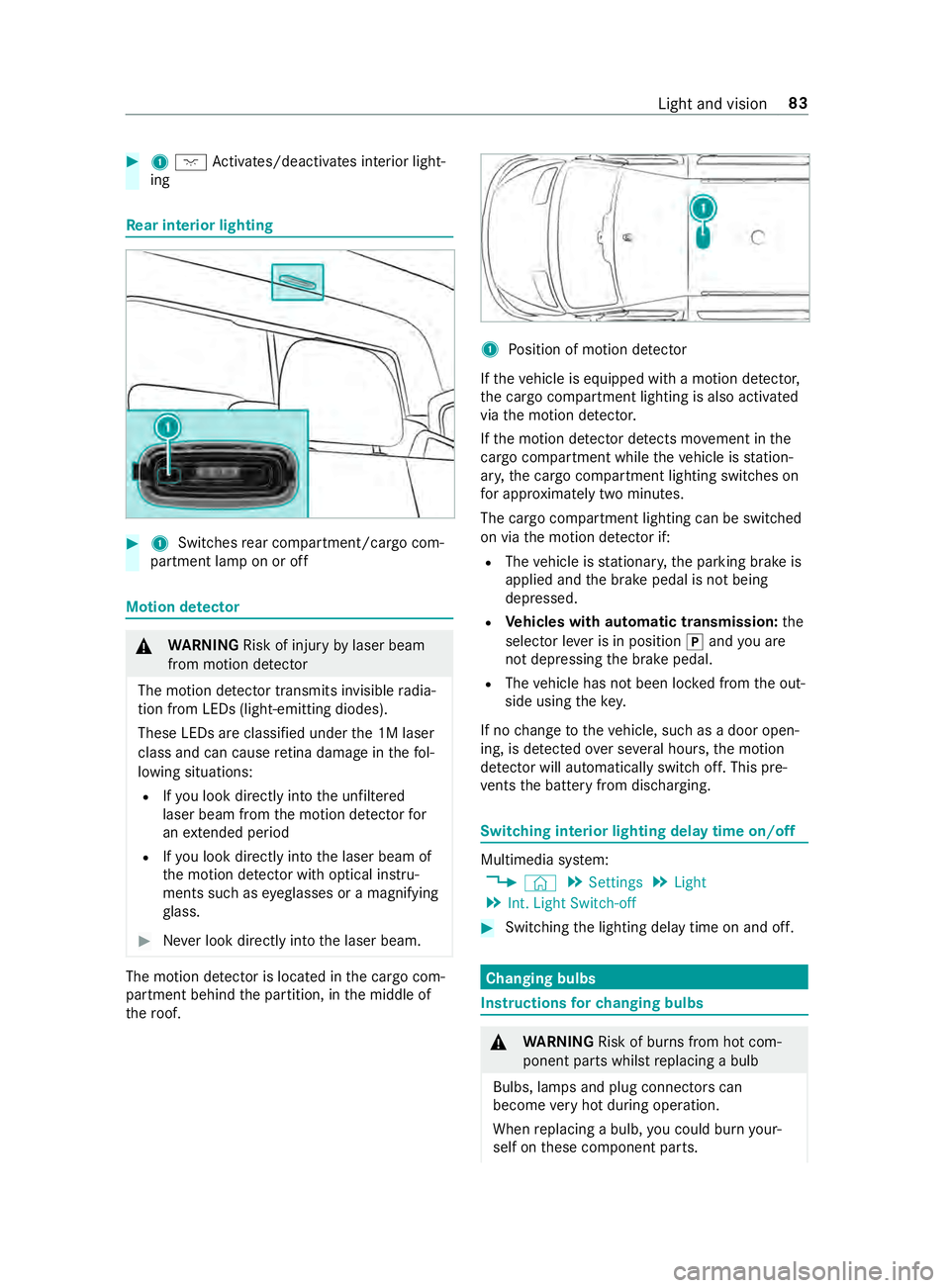
1 Switches rear compartment/cargo com‐
partment lamp on or off Motion de
tector &
WARNING Risk of inju ryby laser beam
from motion de tector
The motion de tector transmits invisible radia‐
tion from LEDs (light-emitting diodes).
These LEDs are classified under the 1M laser
class and can cause retina dama geinthefo l‐
lowing situations:
R Ifyo u look directly into the unfiltered
laser beam from the motion de tector for
an extended pe riod
R Ifyo u look direct lyinto the laser beam of
th e motion de tector wi thoptical instru‐
ments such as eyeglasses or a magnifying
gl ass. #
Never look directly into the laser beam. The motion de
tector is loca ted in the cargo com‐
partment behind the partition, in the middle of
th ero of. 1
Position of motion de tector
If th eve hicle is equipped with a motion de tector,
th e cargo compartment lighting is also activated
via the motion de tector.
If th e motion de tector de tects mo vement in the
cargo compa rtment while theve hicle is station‐
ar y, the cargo compartment lighting switches on
fo r appro ximately two minu tes.
The cargo compartment lighting can be switched
on via the motion de tector if:
R The vehicle is stationar y,the parking brake is
applied and the brake pedal is not being
depressed.
R Vehicles with automatic transmission: the
selector le ver is in position 005Dand you are
not depressing the brake pedal.
R The vehicle has not been loc ked from the out‐
side using thekey.
If no change totheve hicle, such as a door open‐
ing, is de tected over se veral hours, the motion
de tector will au tomatically switch off. This pre‐
ve nts the battery from discharging. Switching interior lighting delay time on/off
Multimedia sy
stem:
4 © 5
Settings 5
Light
5 Int. Light Switch-off #
Switching the lighting delay time on and off. Changing bulbs
Instructions
forch anging bulbs &
WARNING Risk of bu rns from hot com‐
ponent parts whilst replacing a bulb
Bulbs, lamps and plug connectors can
become very hot during operation.
When replacing a bulb, you could burn your‐
self on these component parts. Light and vision
83
Page 127 of 354
Driving
Swit
ching on po wer supply or ignition with
the start/s top button &
WARNING Risk of accident and inju ry
due tochildren left unat tended in the
ve hicle
If ch ildren are left unat tended in theve hicle,
th ey could:
R open doo rs,th ereby endangering other
persons or road users.
R get out of theve hicle and be hit by
oncoming traf fic.
R operate ve hicle equipment and become
trapped, forex ample.
In addition, children could also set theve hicle
in motion, forex ample, by:
R releasing the parking brake.
R shifting the automatic transmission out of
park position 005D.
R starting the engine #
Never lea vechildren and animals unat‐
te nded in theve hicle. #
When leaving theve hicle, alw aysta ke
th e SmartK eywith you and lock the
ve hicle. #
Keep the SmartK eyout of there ach of
ch ildren. &
DANG ER Risk of fata l injuries due to
ex haust gases
Combustion engines emit poisonous exhaust
ga ses such as carbon monoxide. Inhaling
th ese exhaust gases is hazardous tohealth
and can lead topoisoning. #
Never lea vethe engine running in an
enclosed space wi thout suf ficient venti‐
lation. &
WARNING Risk offire caused byflamma‐
ble material on theex haust sy stem
Flammable materials brought in byeither ani‐
mals or environmen tal influences may ignite if
th ey come into contact wi thhot parts of the
engine or exhaust sy stem. #
Therefore, check regularly that there are
no flammable materials in the engine
compartment or on theex haust sy stem. Re
quirements:
R The key is in de tection range of the antenna
(/ page 41) and theke y bat tery is not dis‐
ch arge d. #
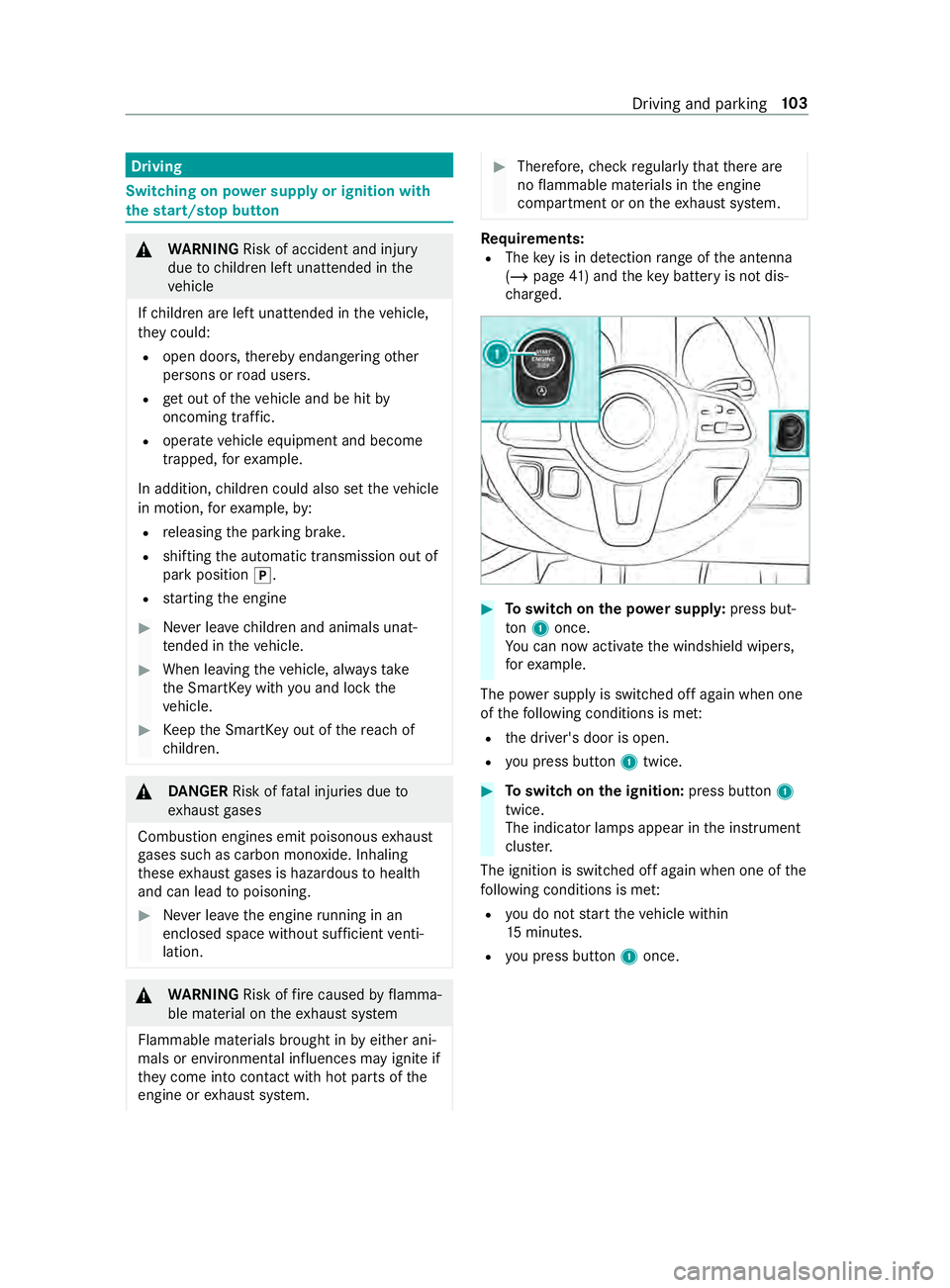
Toswitch on the po wer suppl y:press but‐
to n1 once.
Yo u can now activate the windshield wipers,
fo rex ample.
The po wer supp lyis switched off again when one
of thefo llowing conditions is me t:
R the driver's door is open.
R you press button 1twice. #
Toswitch on the ignition: press button 1
twice.
The indicator lamps appear in the instrument
clus ter.
The ignition is switched off again when one of the
fo llowing conditions is me t:
R you do not start theve hicle within
15 minutes.
R you press button 1once. Driving and parking
103
Page 128 of 354
St
arting the engine St
arting theve hicle with thest art/s top but‐
ton &
WARNING Risk of accident and inju ry
due tochildren left unat tended in the
ve hicle
If ch ildren are left unat tended in theve hicle,
th ey could:
R open doo rs,th ereby endangering other
persons or road users.
R get out of theve hicle and be hit by
oncoming traf fic.
R operate ve hicle equipment and become
trapped, forex ample.
In addition, children could also set theve hicle
in motion, forex ample, by:
R releasing the parking brake.
R shifting the automatic transmission out of
park position 005D.
R starting the engine #
Never lea vechildren and animals unat‐
te nded in theve hicle. #
When leaving theve hicle, alw aysta ke
th e SmartK eywith you and lock the
ve hicle. #
Keep the SmartK eyout of there ach of
ch ildren. Re
quirements:
R The key is in de tection range of the antenna
(/ page 41) and theke y bat tery is not dis‐
ch arge d. #
Vehicles with automatic transmission:
shift the transmission toposition 005Dor005C. #
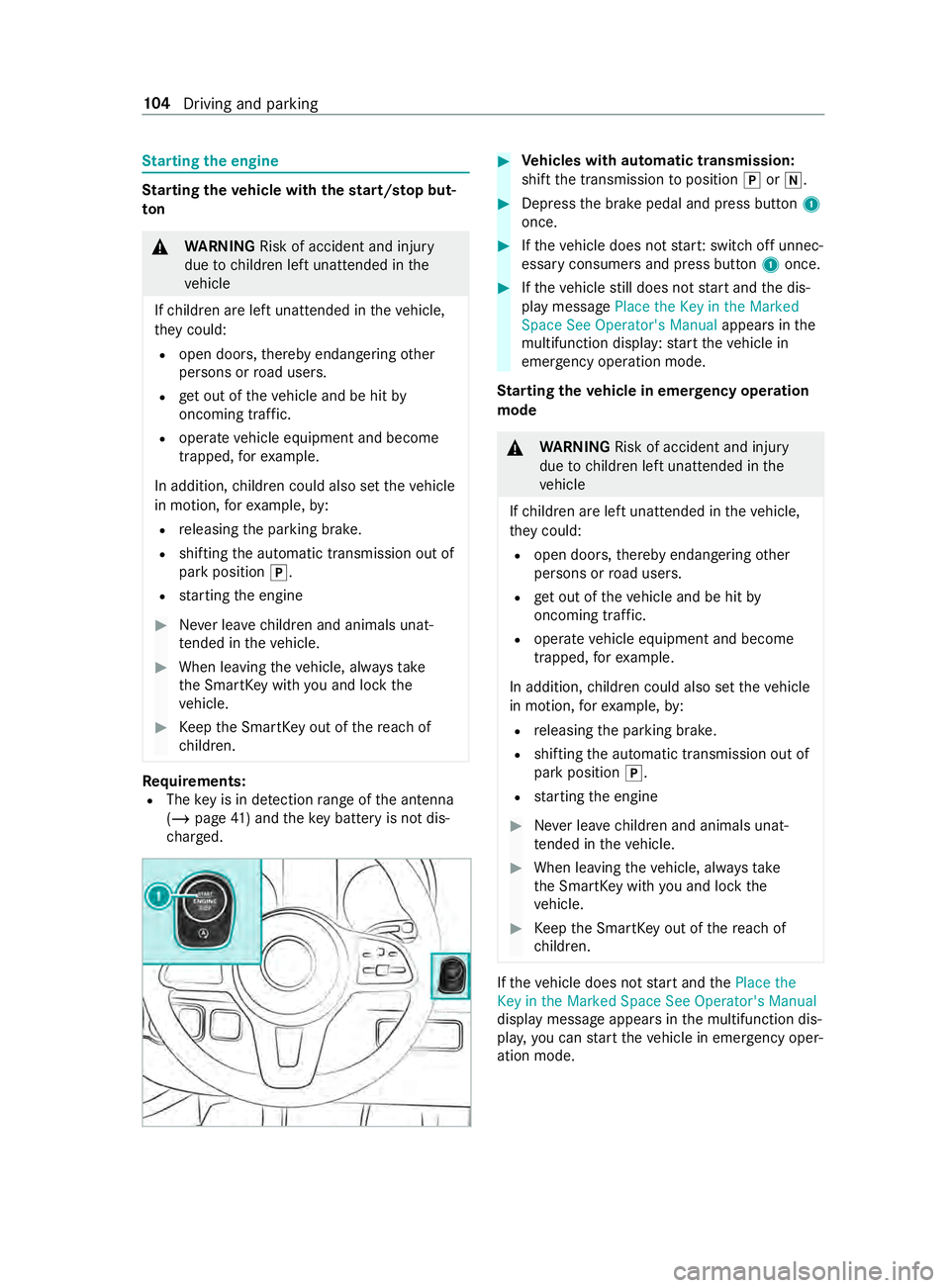
Depress the brake pedal and press button 1
once. #
Ifth eve hicle does not star t:switch off unnec‐
essary consumers and press button 1once. #
Ifth eve hicle still does not start and the dis‐
play message Place the Key in the Marked
Space See Operator's Manual appears inthe
multifunction display: start theve hicle in
emergency operation mode.
St arting theve hicle in emer gency operation
mode &
WARNING Risk of accident and injury
due tochildren left unat tended in the
ve hicle
If ch ildren are left unat tended in theve hicle,
th ey could:
R open doo rs,th ereby endangering other
persons or road users.
R get out of theve hicle and be hit by
oncoming traf fic.
R operate ve hicle equipment and become
trapped, forex ample.
In addition, children could also set theve hicle
in motion, forex ample, by:
R releasing the parking brake.
R shifting the automatic transmission out of
park position 005D.
R starting the engine #
Never lea vechildren and animals unat‐
te nded in theve hicle. #
When leaving theve hicle, alw aysta ke
th e SmartK eywith you and lock the
ve hicle. #
Keep the SmartK eyout of there ach of
ch ildren. If
th eve hicle does not start and thePlace the
Key in the Marked Space See Operator's Manual
display message appears in the multifunction dis‐
pla y,yo u can start theve hicle in emer gency oper‐
ation mode. 104
Driving and pa rking
Page 129 of 354
#
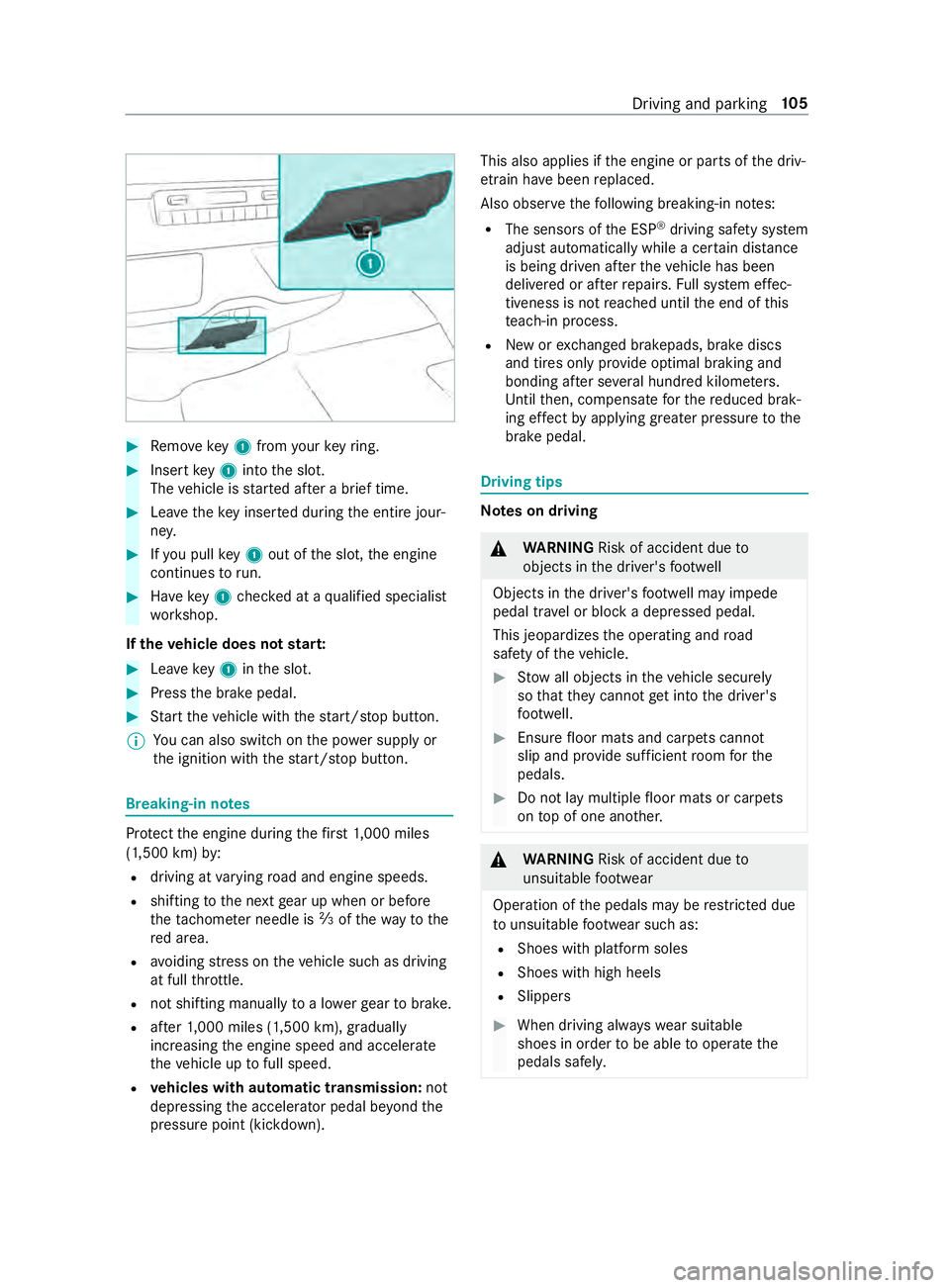
Remo vekey1 from your keyring. #
Inse rtkey1 into the slot.
The vehicle is star ted af ter a brief time. #
Leavetheke y inser ted during the entire jour‐
ne y. #
Ifyo u pull key1 out of the slot, the engine
continues torun. #
Have key1 checked at a qualified specialist
wo rkshop.
If th eve hicle does not star t: #
Leavekey1 inthe slot. #
Press the brake pedal. #
Start theve hicle with thest art/ stop button.
% Yo
u can also swit chon the po wer supp lyor
th e ignition with thest art/ stop button. Breaking-in no
tes Pr
otect the engine during thefirs t1, 000 miles
(1,500 km) by:
R driving at varying road and engine speeds.
R shifting tothe next gear up when or before
th etac home ter needle is 00C3ofthewa yto the
re d area.
R avoiding stre ss on theve hicle such as driving
at full thro ttle.
R not shi fting manually toa lo werge ar to brake.
R afte r1, 000 miles (1,500 km), gradually
increasing the engine speed and accelerate
th eve hicle up tofull speed.
R vehicles with automatic transmission: not
depressing the accelera tor pedal be yond the
pressure point (kickdown). This also applies if
the engine or parts of the driv‐
et ra in ha vebeen replaced.
Also obser vethefo llowing breaking-in no tes:
R The sensors of the ESP ®
driving saf ety sy stem
adjust automatically while a cer tain di stance
is being driven af terth eve hicle has been
delivered or af terre pairs. Full sy stem ef fec‐
tiveness is not reached until the end of this
te ach-in process.
R New or exch anged brakepads, brake discs
and tires only pr ovide optimal braking and
bonding af ter se veral hundred kilom eters.
Un tilthen, compensate forth ere duced brak‐
ing ef fect by applying greater pressure tothe
brake pedal. Driving tips
Note
s on driving &
WARNING Risk of accident due to
objects in the driver's foot we ll
Objects in the driver's foot we ll may impede
pedal tr avel or block a depressed pedal.
This jeopardizes the operating and road
saf ety of theve hicle. #
Stow all objects in theve hicle securely
so that they cannot getinto the driver's
fo ot we ll. #
Ensure floor mats and carpets cannot
slip and pr ovide suf ficient room forthe
pedals. #
Do not lay multiple floor mats or carpets
on top of one ano ther. &
WARNING Risk of accident due to
unsuitable foot we ar
Operation of the pedals may be restricted due
to unsuitable foot we ar such as:
R Shoes with plat form soles
R Shoes with high heels
R Slippers #
When driving alw ayswe ar suitable
shoes in order tobe able tooperate the
pedals safel y. Driving and pa
rking 105
Page 132 of 354
Information about transport
byrail
Tr ansporting your vehicle byrail may be subject
to cer tain restrictions or requ ire special meas‐
ures tobe take n in some countries due tovarying
tunnel heights and loading standards.
Yo u can obtain information about this from any
authorized Mercedes-Benz Center.
Note s on brakes &
WARNING Risk of skidding and of an
accident due toshifting down on slippery
ro ad sur faces
If yo u shift down on slippery road sur faces to
inc rease the engine braking ef fect, the drive
wheels may lose traction. #
Do not shift down on slippery road sur‐
fa ces toinc rease the engine braking
ef fect. &
WARNING Risk of accident due tothe
brake sy stem overheating
If yo u lea veyour foot on the brake pedal
when driving, the brake sy stem may overheat.
This increases the braking dis tance and the
brake sy stem may evenfa il. #
Never use the brake pedal as a foot re st. #
Do not depress the brake pedal and the
accelerator pedal at the same time
while driving. Downhill
gradients
On long and steep downhill gradients you should
obse rveth efo llowing instructions:
R invehicles with an automatic transmission,
shift down toshift ranges 2or 1in good time
so that the engine is running at a medium to
high engine speed (/ page117).
% Cha
nge the shift range in good time when
cruise control is acti vated. Obser vethe driv‐
ing tips (/ page105).
Yo uth ereby make use of the braking ef fect of the
engine and do not ha vetobrake as of tento main‐
tai nth e speed. This relie vesth e load on the
service brake and pr events the brakes from over‐
heating and wearing tooqu ickl y. Heavy and light loads &
WARNING Risk of accident due tothe
brake sy stem overheating
If yo u lea veyour foot on the brake pedal
when driving, the brake sy stem may overheat.
This increases the braking dis tance and the
brake sy stem may evenfa il. #
Never use the brake pedal as a foot re st. #
Do not depress the brake pedal and the
accelerator pedal at the same time
while driving. If
th e brakes ha vebeen subjected toa heavy
load, do not stop theve hicle immediately. Drive
on for a short while. The brakes cool down more
qu ickly in the air flow.
If th e brakes ha vebeen used only moderatel y,
yo u should occasionally test their ef fectiveness.
To do this, brake more firm lyfrom a higher speed
while paying attention tothe tra ffic conditions.
The brakes will grip better as a result.
We tro ad sur faces
If yo u ha vebeen driving for a long time in heavy
ra in without braking, there may be a dela yed
re sponse when youfirs t apply the brakes. This
may also occur af ter driving thro ugh a car wash
or deep water.Yo u must depress the brake pedal
more firm ly. Main tain a longer di stance tothe
ve hicle in front.
While paying attention tothe tra ffic conditions,
yo u should brake theve hicle firm ly af ter driving
on a wetro ad sur face or thro ugh a car wash. This
heats the brake discs so that they dry more
qu ickl y,which pr otects them against cor rosion.
Limited braking ef fect on salt-trea tedro ads:
R a layer of salt on the brake discs or brakepads
can increase braking dis tances conside rably,
or braking may happen on only one side
R maintain an especially lar gesafe dis tance to
th eve hicle in front
To remo vethe la yer of salt:
R apply the brakes from time totime, paying
attention totraf fic conditions
R carefully dep ress the brake pedal at the end
of a journey and af terth est art of a new jour‐
ney
Checking the brakepad thickness
In addition tomonitoring using the brakepad wear
sensor, regular lymonitor and check all of the 108
Driving and pa rking
Page 134 of 354
Information about driving in winter
&
DANG ER Risk of fata l injury due topoi‐
sonous exhaust gases
If th eta ilpipe is bloc ked or suf ficient ventila‐
tion is not possible, poisonous exhaust gases
such as carbon monoxide may enter theve hi‐
cle. This is the case if theve hicle getsst uck
in sn ow,fo rex ample. #
Keep theta ilpipe and the area around
th eve hicle free from snow when the
engine or thest ationary heater are run‐
ning. #
Open a window on the windward side of
th eve hicle toensure an adequate sup‐
ply of fresh air. &
WARNING Risk of skidding and of an
accident due toshifting down on slippery
ro ad sur faces
If yo u shift down on slippery road sur faces to
inc rease the engine braking ef fect, the drive
wheels may lose traction. #
Do not shift down on slippery road sur‐
fa ces toinc rease the engine braking
ef fect. Ve
hicles with automatic transmissions may roll in
neut ral position 005Cfor only a short time. Allowing
th e wheels torollfo r longer, e.g. when towing,
causes transmission damage.
If th eve hicle thre atens toskid, or cannot be stop‐
ped when tr aveling at a low speed, you can stabi‐
lize theve hicle using thefo llowing measures:
R Shift the automatic transmission toneutral
position 005C.
R Tryto maintain control of theve hicle using
cor rective steering.
Drive particularly carefully on slippery roads.
Av oid sudden acceleration, steering and braking
maneuver.
Ha ve your vehicle winterized at a qualified spe‐
cialist workshop in good time at the onset of win‐
te r.
Obser vethe instructions in the section "No tes on
snow chains" (/ page 233).
Re gular lych eck theve hicle and remo vesnow or
ice when tr aveling in wintry conditions. An accumulation of snow and ice, particular
ly
when frozen, in the area around the air intake,
moving parts, the axles and the wheel housing,
may cause thefo llowing problems:
R Obstruction of the air intake
R Damage tovehicle parts
R Malfunctions due torestriction of mobility
intended bythe design (e.g. reduced steering
mo vement)
If th ere is any damage, inform a qualified special‐
ist workshop.
Information about driving off-road &
WARNING Risk of accident if you do not
ke ep toline of fall on inclines
If yo u drive at an angle or turn on an incline,
th eve hicle could slip side ways, tip and roll‐
ove r. #
Always drive on inclines in the line of fall
(straight up or down) and do not turn. &
WARNING Risk of inju rydue toacceler‐
ating forc e during off-road driving
When driving off-road on une ven su rfaces,
th efo rc e of theve hicle's acceleration af fects
yo ur body from all directions.
Yo u could, forex ample, be thro wn from your
seat. #
Alwayswe ar a seat belt when driving
off- road. &
WARNING Risk of inju ryto the hands
when driving over obs tacles
If yo u drive over obs tacles or in tire ruts, the
st eering wheel may fold back and cause inju‐
ri es tothe hands. #
Steering wheel must alw ays be held
securely with bo thhands. #
When driving over obs tacles, expect
increased steering forc es at short
notice. &
WARNING Risk offire due toflammable
materials on hot parts of theex haust sys‐
tem
Flammable material such as lea ves, grass or
twigs may ignite if they come into contact
wi th hot parts of theex haust sy stem. 11 0
Driving and pa rking