oil pressure MERCEDES-BENZ SPRINTER 2019 MY19 with 7” screen
[x] Cancel search | Manufacturer: MERCEDES-BENZ, Model Year: 2019, Model line: SPRINTER, Model: MERCEDES-BENZ SPRINTER 2019Pages: 354, PDF Size: 6.15 MB
Page 131 of 354
*
NO
TEWearing out the brake linings by
continuously dep ressing the brake pedal #
Do not depress the brake pedal continu‐
ously whilst driving. #
Touse the braking ef fect of the engine,
shift toa lo werge ar in good time. *
NO
TEDama getothe driv etra in and
engine when pulling away #
Do not warm upthe engine while the
ve hicle is stationar y.Pull away immedi‐
atel y. #
Avoid high engine speeds and driving at
full thro ttle until the engine has reached
its operating temp erature. *
NO
TEDama getothe catalytic con verter
due tonon-combu sted fuel The engine is not
running smo othly and is
misfiring.
Non-combus ted fuel may getinto the cata‐
lytic con verter. #
Only depress the accelera tor pedal
slightly. #
Have the cause rectified immedia tely at
a qualified speciali st workshop. Exhaust emission monitoring
Specific engine sy
stems are designed tokeep
poisonous components of exhaust emissions
within legal limits.
These sy stems only workoptimally if they are
main tained exactly according tomanufacturer's
specifications. It is forth is reason that all work
on the engine should only be per form ed byquali‐
fi ed and authorized Mercedes-Benz Center tech‐
nicians.
Under no circum stances should engine settings
be changed. In addition, all specific main tenance
wo rkmust be per form ed at regular inter vals and
in compliance with the service regulations of the
dealer named in the imprint. Referto the mainte‐
nance booklet for de tails.
Information about short-distance trips
If th eve hicle is predominantly used for short-dis‐
ta nce driving, fuel may accumulate in the engine
oil and cause engine damage.
If yo u main lydrive short dis tances, you should
drive on a free way or go for a country drive for 20 minutes
every300 km (480 miles). This facili‐
ta testh ere ge neration of the diesel particulate fil‐
te r.
Note s onthe speed limitation &
WARNING Risk of inju rythro ugh exceed‐
ing the specified tire load rating or the
permissible speed rating
Exceeding the specified tire load rating or the
permissible speed rating may lead totire
dama geand tothe tires bur sting. #
Therefore, only use tire types and sizes
appr ovedfo ryo ur vehicle model. #
Obser vethe tire load rating and speed
ra ting requ ired foryo ur vehicle. As
the driver, you must find out about the maxi‐
mum permissible speed forth e tires (tire and tire
pressure). In particular, obser vethe legal requ ire‐
ments for tires forth e count ryyou are in.
Yo u can permanently limit the speed of your vehi‐
cle.
Mercedes-Benz recommends a qualified special‐
ist workshop for programming the speed limita‐
tion.
Before overtaking, take into consideration that
th e engine speed limiter pr events the speed
increasing be yond the programmed speed limita‐
tion.
On downhill gradients, the speed limitation may
be exc eeded. Apply the brakes if necessar y.
Displ aymessages indica tethat you are approach‐
ing the limit speed.
Information about fore ign trips
Service
An extensive Mercedes-Benz service is also avail‐
able abroad. Ne vertheless, please remember that
services or spare parts may not be available
immediatel y.The releva nt wo rkshop directories
are available from an authorized Mercedes-Benz
Center.
Fu el
In some countries, only fuels with an inc reased
sulfur con tent are available.
Uns uitable fuel can cause engine damage. In for‐
mation about fuel can be found in the "Fuel" sec‐
tion (/ page 264). Driving and parking
107
Page 135 of 354
#
When driving on unpa vedro ads or off-
ro ad, regular lych eck theve hicle under‐
side. #
Remo vetrapped plants or other flam‐
mable material. #
Ifth ere is damage, consult a qualified
specialist workshop immediately. *
NO
TEDama getotheve hicle af ter driving
off-road When driving off-road or on unpa
ved sur fa‐
ces, fore ign bodies such as stones and
branches could become trapped on theve hi‐
cle underside, on wheels and tires, causing
damage totheve hicle.
Fo reign bodies could cause thefo llowing
damage:
R Damage the suspension, the fuel tank or
th e brake sy stem.
R Disturb the balance and cause vibrations. #
Regular lyremo veany trapped fore ign
bodies, e.g. stones and branches. #
After driving off-road, check carefully
whe ther there is any damage tothe
ve hicle. #
Ifth ere is damage, ha vetheve hicle
ch ecked at a qualified specialist work‐
shop. When driving off-road or on unpa
ved sur faces,
ch eck theve hicle underside, wheels and tires
re gularly at regular inter vals. In particular,
re mo veany trapped fore ign bodies, e.g. stones
and branches.
Obser vethefo llowing no tesre ga rding fore ign
bodies of this kind:
R They may damage the suspension, the fuel
ta nk or the brake sy stem.
R They may disturb the balance and cause
vibrations.
R They may be flung out from theve hicle when
yo u continue driving.
If th ere is any damage, inform a qualified special‐
ist workshop.
When driving off-road on steep inclines, you must
make sure that the DEF tank is su fficiently filled.
Therefore, ensure a le vel of at least ten li ters
before off-road driving. When driving off-road and on con
stru ction sites,
sand, mud and water,also mixed with oil, can get
into the brakes. This may lead toare duction in
braking ef fect or total brake failure, also as a
re sult of increased wear. The braking characteris‐
tics will vary depending on the material that has
got into the sy stem. Clean the brakes af ter driv‐
ing off-road. If youth en notice a reduced braking
ef fect or hear scraping noises, ha vethe brake
sy stem checked immediately at a qualified spe‐
cialist workshop. Adjust your driving style to the
ch anged braking characteristics.
Driving off- road or on con stru ction sites increa‐
ses the possibility of vehicle damage which may
in turn lead tothefa ilure of cer tain major assem‐
blies and sy stems. Adapt your driving style to the
off-road driving conditions. Drive carefull y.Ha ve
any vehicle damage rectified at a qualified spe‐
cialist workshop as soon as possible.
When driving on rough cross-country terrain, do
not shift the transmission into the neutral posi‐
tion and do not disengage the clutch. You could
lose control when attem pting tobrake theve hicle
with the service brake. If your vehicle cannot
manage an uphill incline, drive back down in
re ve rsege ar.
When loading your vehicle for off-road driving or
on a construction site, keep theve hicle's center
of gr avity as low as possible.
Checklist before off-road driving R Check the fuel and DEF le vels (/ page163)
and add if necessary (/ page 125).
R Engine: check the oil le vel and add oil if nec‐
essary (/ page 205). Before driving up or
down extreme inclines or slopes, fill th e oil to
th e maximum le vel.
% If
yo u drive up or down extreme inclines or
slopes, the00B2 symbol may appear in the
multifunction displa y.The engine operating
saf ety is not put at risk if you ha vefilled the
engine oil tothe maximum le vel before the
jou rney.
R Vehicle tool kit: check that the jack is work‐
ing (/ page 250).
R Make sure that a lug wrench (/ page 250), a
wo oden underlay forth e jac k,aro bust tow
ro pe, a folding spade and a wheel chock are
car ried in theve hicle.
R Tire s and wheels: check the tire tread dep th
( / page 232) and the tire pressure
(/ page 239). Driving and parking
111
Page 190 of 354
DSR (/
page 120)
00D9 HOLD fu
nction (/ page 145)
00CE Ad
aptive Highbeam Assist(/ page81 )
00D7 AT
TENTION ASSIST deactivated
003E A door is not fully closed.
00C5 Re
ar wind owwiper swit ched on
(/ page 89)
002E LO
W RANGE active (/ page119)
SOS
NOT
RE ADY Emergency call sy
stem not active Ac
tive Lane Keeping Assist switched
off (/ page155)
00D4 Ac
tive Brake Assi stdeactivated
(/ page 139) Blind Sp
otAssi stswitched off
(/ page 152) Se
tting the in strument lighting #
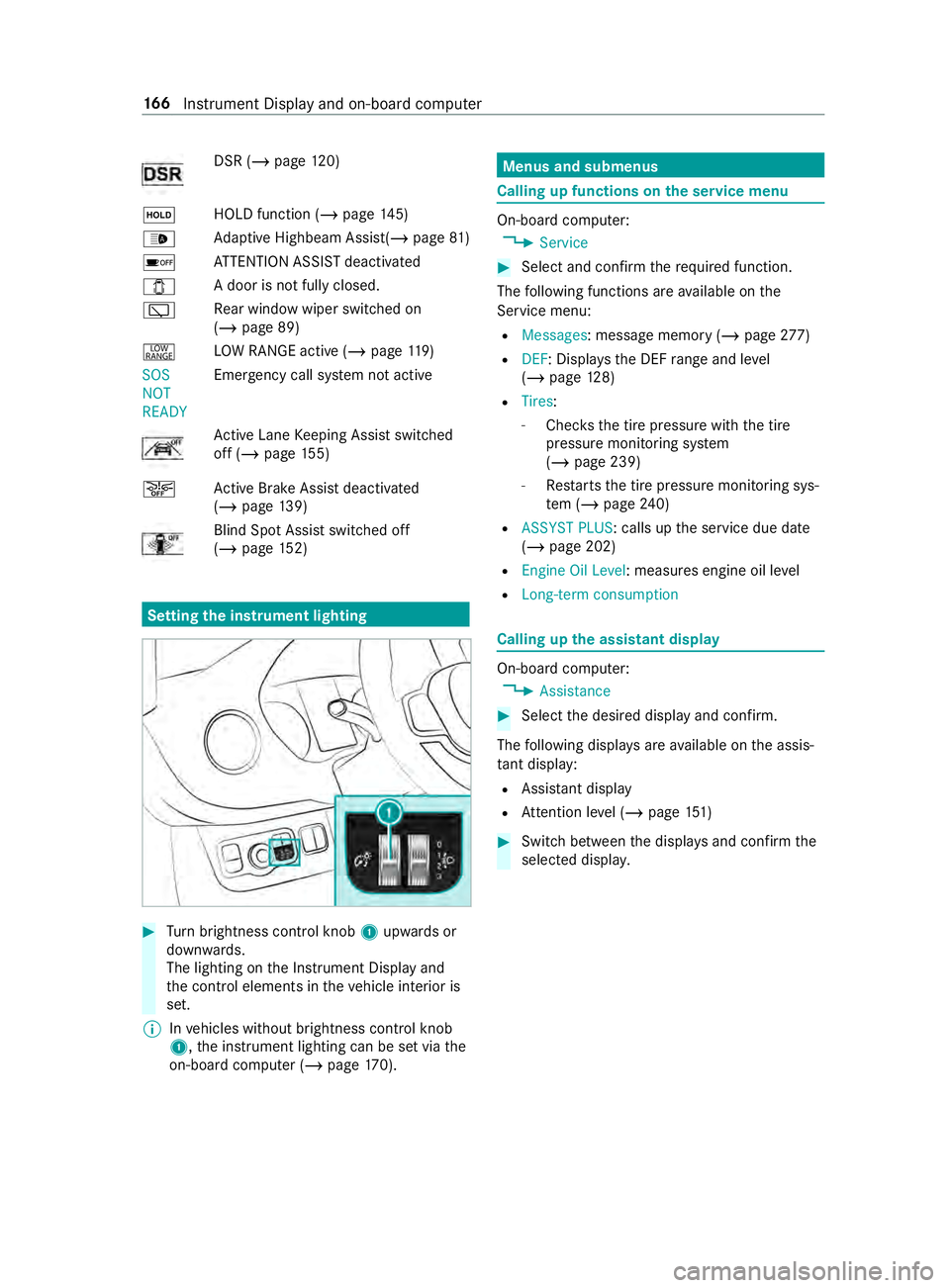
Turn brightness control knob 1upwards or
down wards.
The lighting on the Instrument Display and
th e cont rol elements in theve hicle interior is
set.
% In
vehicles without brightness contro l knob
1, the instrument lighting can be set via the
on-board computer (/ page170). Menus and submenus
Calling up functions on
the service menu On-board computer:
4 Service #
Select and con firm there qu ired function.
The following functions are available on the
Service menu:
R Messages: message memo ry (/ page 277)
R DEF : Displ aysth e DEF range and le vel
( / page 128)
R Tires :
- Che cksth e tire pressure with the tire
pressure monitoring sy stem
(/ page 239)
- Restarts the tire pressure monitoring sys‐
te m (/ page240)
R ASSYST PLUS: calls up the service due date
(/ page 202)
R Engine Oil Level : measures engine oil le vel
R Long-term consumption Calling up
the assistant display On-board computer:
4 Assistance #
Select the desired display and confirm.
The following displa ysare available on the assis‐
ta nt displ ay:
R Assi stant display
R Attention le vel (/ page 151) #
Swit chbetween the displa ysand con firm the
selected displa y. 16 6
Instrument Display and on-board computer
Page 228 of 354
#
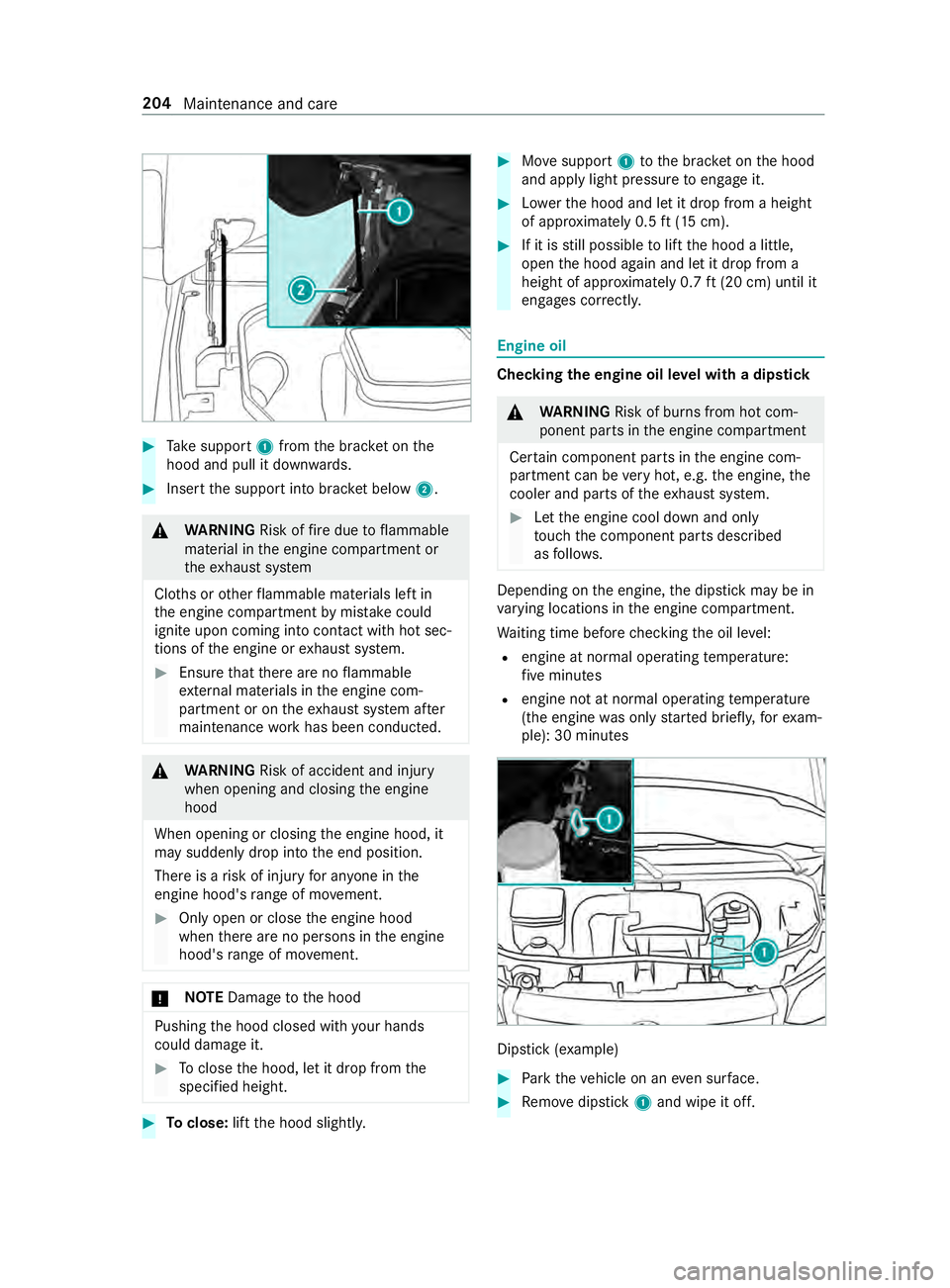
Take support 1from the brac ket on the
hood and pull it down wards. #
Inse rtthe support into brac ket below 2. &
WARNING Risk offire due toflammable
material in the engine compartment or
th eex haust sy stem
Clo ths or other flammable materials left in
th e engine compartment bymis take could
igni teupon coming into con tact wi thhot sec‐
tions of the engine or exhaust sy stem. #
Ensure that there are no flammable
ex tern al materials in the engine com‐
partment or on theex haust sy stem af ter
maintenance workhas been conducted. &
WARNING Risk of accident and inju ry
when opening and closing the engine
hood
When opening or closing the engine hood, it
may suddenly drop into the end position.
There is a risk of injury for an yone in the
engine hood's range of mo vement. #
Only open or close the engine hood
when there are no persons in the engine
hood's range of mo vement. *
NO
TEDama getothe hood Pushing
the hood closed with your hands
could damage it. #
Toclose the hood, let it drop from the
specified height. #
Toclose: liftthe hood slightl y. #
Movesupport 1tothe brac ket on the hood
and apply light pressure toengage it. #
Lowe rth e hood and let it drop from a height
of appr oximately 0.5 ft(15 cm). #
If it is still possible tolift the hood a little,
open the hood again and let it drop from a
height of appr oximately 0.7 ft(20 cm) until it
engages cor rectly. Engine oil
Che
cking the engine oil le vel with a dip stick &
WARNING Risk of bu rns from hot com‐
ponent parts in the engine compartment
Cer tain component pa rts in the engine com‐
partment can be very hot, e.g. the engine, the
cooler and pa rts of theex haust sy stem. #
Let the engine cool down and only
to uch the component parts described
as follo ws. Depending on
the engine, the dipstick may be in
va rying locations in the engine compartment.
Wa iting time before checking the oil le vel:
R engine at normal operating temp erature:
fi ve minutes
R engine not at normal operating temp erature
(the engine was only star ted briefly, forex am‐
ple): 30 minutes Dip
stick (e xamp le) #
Park theve hicle on an even sur face. #
Remo vedipstick 1and wipe it off. 204
Maintenance and care
Page 231 of 354
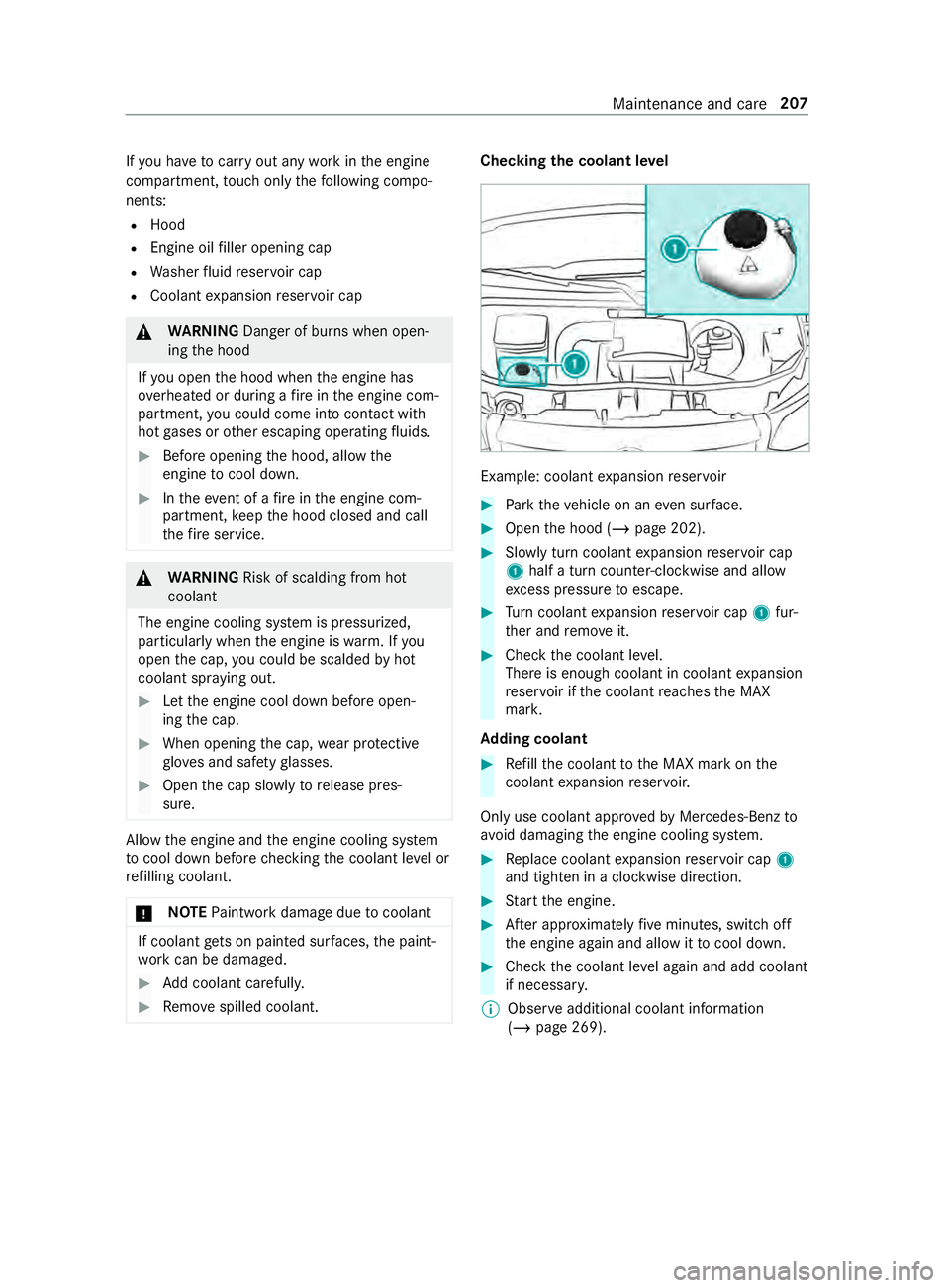
If
yo u ha vetocar ryout any workinthe engine
compartment, touch only thefo llowing compo‐
nents:
R Hood
R Engine oil filler opening cap
R Washer fluid reser voir cap
R Coolant expansion reser voir cap &
WARNING Danger of bu rns when open‐
ing the hood
If yo u open the hood when the engine has
ove rheated or during a fire inthe engine com‐
partment, you could come into con tact wi th
hot gases or other escaping operating fluids. #
Before opening the hood, allow the
engine tocool down. #
Intheeve nt of a fire inthe engine com‐
partment, keep the hood closed and call
th efire service. &
WARNING Risk of scalding from hot
coolant
The engine cooling sy stem is pressurized,
particular lywhen the engine is warm. If you
open the cap, you could be scalded byhot
coolant spr aying out. #
Let the engine cool down before open‐
ing the cap. #
When opening the cap, wear pr otective
gl ove s and saf etygl asses. #
Open the cap slowly torelease pres‐
sure. Allow
the engine and the engine cooling sy stem
to cool down before checking the coolant le vel or
re filling coolant.
* NO
TEPaint wo rkdamage due tocoolant If coolant
gets on painted sur faces, the paint‐
wo rkcan be damaged. #
Add coolant carefully. #
Remo vespilled coolant. Checking
the coolant le vel Example: coolant
expansion reser voir #
Park theve hicle on an even sur face. #
Open the hood (/ page 202). #
Slowly turn coolant expansion reser voir cap
1 half a turn coun ter-clockwise and allow
exc ess pressure toescape. #
Turn coolant expansion reser voir cap 1fur‐
th er and remo veit. #
Check the coolant le vel.
There is enough coolant in coolant expansion
re ser voir if the coolant reaches the MAX
mar k.
Ad ding coolant #
Refill th e coolant tothe MAX mark on the
coolant expansion reser voir.
Only use coolant appr oved byMercedes-Benz to
avo id damaging the engine cooling sy stem. #
Replace coolant expansion reser voir cap 1
and tigh ten in a clo ckwise direction. #
Start the engine. #
After appro ximately five minutes, switch off
th e engine again and allow it tocool down. #
Che ckthe coolant le vel again and add coolant
if necessar y.
% Obser
veadditional coolant information
(/ page 269). Main
tenance and care 207
Page 271 of 354
Ra
ting. You can find the Gross Axle Weight Rating
on the B-pillar on the driver's side.
Speed rating: the speed rating is pa rtof the tire
identification. It specifies the speed range for
which a tire is appr oved.
GV W (Gross Vehicle Weight): the Gross Vehicle
We ight includes thewe ight of theve hicle includ‐
ing fuel, tools, the spare wheel, accessories
ins talled, occupants, luggage and the trailer
dr aw bar nose weight if applicable. The Gross Vehi‐
cle Weight must ne verex ceed the Gross Vehicle
We ight Rating (GVWR) specified on the B-pillar on
th e driver's side.
GV WR (Gross Vehicle Weight Rating): the
GV WR is the maximum permitted gross weight of
th e fully laden vehicle (weight of theve hicle
including all accessories, occupants, fuel, lug‐
ga ge and the trailer dr awbar nose weight if appli‐
cable). The Gross Vehicle Weight Rating is speci‐
fi ed on theve hicle identification plate on the B-
pillar on the driver's side.
Maximum weight of the laden vehicle: the
maximum weight is the sum of theve hicle's curb
we ight, weight of the accessories, maximum load
and thewe ight of thefa ctory ins talled optional
equipment.
Kilopascal (kPa): metric unitfor tire pressu re.
6.9 kPa are the equivalent of 1 psi. Ano ther unit
fo r tire pressu reis bar. 100 kilopascals (kPa) are
th e equivalent of 1 bar.
Load index: in additiontothe load-bearing index,
th e load index may also be imprinted on the side‐
wa ll of the tire. This specifies the load-bearing
capacity more precisel y.
Curb weight: thewe ight of a vehicle with stand‐
ard equipment including the maximum capacity
of fuel, oil and coolant. It also includes the air-
conditioning sy stem and optional equipment if
th ese are ins talled on theve hicle, but does not
include passengers or luggage.
Maximum tire load: the maximum tire load is
th e maximum permissible weight in kilog rams or
lbs for which a tire is appro ved.
Maximum permissible tire pressure: maximum
permissible tire pressure for one tire.
Maximum load on one tire: maximum load on
one tire. This is calculated bydividing the maxi‐
mum axle load for one axle bytwo.
PSI (pounds per square in ch):standard unit of
measurement for tire pressu re. Aspect
ratio: relationship between tire height
and tire width in percent.
Ti re pressure: pressure inside the tire applying
an outward forc eto eve rysquare inch of the
tire's su rface. The tire pressure is specified in
pounds per square inch (psi), in kilopascal (kPa)
or in bar. The tire pressure should only be cor rec‐
te d when the tires are cold.
Ti re pressure on cold tires: the tires are cold
when theve hicle has been par ked with the tires
out of direct sunlight for at least thre e hours and
th eve hicle has been driven less than 1 mile
(1.6 km).
Ti re contact sur face: the part of the tire that
comes into con tact wi th thero ad.
Ti re bead: the purpose of the tire bead is to
ensure that the tire sits securely on the wheel
ri m. There are se veral wire cores in the tire bead
to preve ntthe tire from changing length on the
wheel rim.
Side wall:the part of the tire between the tread
and the tire bead.
Special equipment weight: the combined
we ight of those optional extras that we igh more
th an there placed standard parts and more than
5 lbs (2.3 kg). These op tionalextras, su chas
high-pe rformance brakes, le vel control sy stem, a
ro of luggage rack or a high-per form ance batter y,
are not included in the curb weight and the
we ight of the accessories.
TIN (Tire Identification Number): a unique iden‐
tification number which can be used bya tire
manufacturer toidentify tires, forex ample for a
product recall, and thus identify the pur chasers.
The TIN is made up of the manufacturer identifi‐
cation code, tire size, tire type code and the man‐
ufacturing date.
Load-bearing index: the load-bearing index (also
load index) is a code that con tains the maximum
load-bearing capacity of a tire.
Tr action: traction is there sult of friction between
th e tires and thero ad sur face.
We ar indicator: narrow bars (tread wear bars)
th at are distributed overth e tire tread. If the tire
tread is le vel with the bars, thewe ar limit of
1/ 16 in (1.6 mm) has been reached.
Distribution of vehicle occupants: distribution
of vehicle occupants over designated seat posi‐
tions in a vehicle. Wheels and tires
247
Page 310 of 354
Display messages
Possible causes/consequences and 0050 0050Solutions
00AC *T
hefan mo tor is defective. #
Without a high engine load, continue tothe nearest qualified
specialist workshop. Ensure that the coolant temp erature dis‐
play remains below 248 °F (120 °C).
003A Check Fuel Filter *T
hewaterth at has accumulated in thewate r sepa rato r has reached
th e maximum le vel. #
Drain thewate r sepa rator (/ page 209).
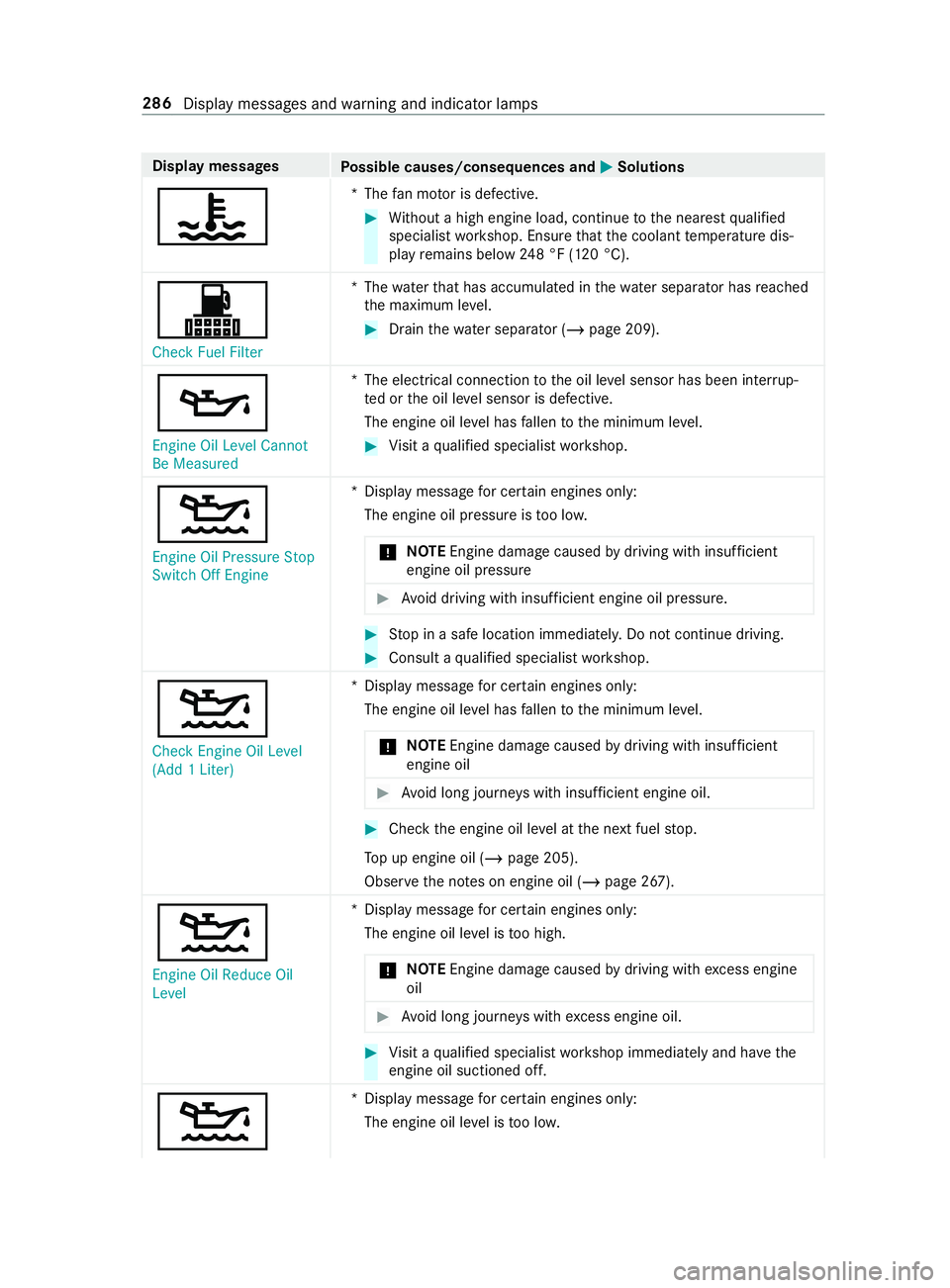
00B3 Engine Oil Level Cannot
Be Measured *T
he electrical connection tothe oil le vel sensor has been inter rup‐
te d or the oil le vel sensor is defective.
The engine oil le vel has fallen tothe minimum le vel. #
Visit a qualified specialist workshop.
00B2
Engine Oil Pressure Stop
Switch Off Engine *D
isplay message for cer tain engines only:
The engine oil pressure is too lo w.
* NO
TEEngine damage caused bydriving with insuf ficient
engine oil pressure #
Avoid driving with insuf ficient engine oil pressure. #
Stop in a safe location immediately. Do not continue driving. #
Consult a qualified specialist workshop.
00B2
Check Engine Oil Level
(Add 1 Liter) *D
isplay message for cer tain engines only:
The engine oil le vel has fallen tothe minimum le vel.
* NO
TEEngine damage caused bydriving with insuf ficient
engine oil #
Avoid long journe yswith insuf ficient engine oil. #
Che ckthe engine oil le vel at the next fuel stop.
To p up engine oil (/ page 205).
Obser vethe no tes on engine oil (/ page 267).
00B2
Engine Oil Reduce Oil
Level *D
isplay message for cer tain engines only:
The engine oil le vel is too high.
* NO
TEEngine damage caused bydriving with excess engine
oil #
Avoid long journe yswith excess engine oil. #
Visit a qualified specialist workshop immediately and ha vethe
engine oil suctioned off.
00B2 *D
isplay message for cer tain engines only:
The engine oil le vel is too lo w. 286
Display messages and warning and indicator lamps
Page 335 of 354
Ad
aptive Highbeam Assist Cur‐
re ntly Una vailable See Opera tor's
Manual ............................................. 296
Ad aptive Highbeam Assist Inopera‐
tive .................................................. .296
0099 Additive Sy stem Fault Emer‐
ge ncy Op.: XXX mph See Opera‐
to r's Manual .................................... .290
0099 Additive Sy stem Fault See
Operator's Manual ...........................289
0099 Additive Sy stem Fault Starts
until Emerg. Op.: XXX See Opera‐
to r's Manual .................................... .289
Air Conditioning Malfunction See
Operator's Manual ............................ 294
Apply Brake toShift from 'P' ............ 295
00AD ATTENTION ASSIST Inopera‐
tive ................................................... 285
00AD ATTENTION ASSIS T:Take a
Break! ............................................... 285
0049 AutoLamp Function Inopera‐
tive ................................................... 296
Au xilia ryBattery Malfunction ........... 294
Blind Spot Assi stCur rently
Un available See Operator's Manual
.......................................................... 284
Blind Spot Assist Inoperative ............ 284
Blind Spot Assist Trailer NotMoni‐
to re d ................................................ 284
004D Check Brake Fluid Le vel.......... 279
Check Brake Pads See Operator's
Manual .............................................2 79
00AC CheckCoolant Le vel See
Opera tor's Manual ........................... 288
00B2 Check Engine Oil AtNext
Re fueling .......................................... 287
00B2Che ckEngine Oil Le vel (Add 1
Liter) ................................................ 286
003ACheck Fuel Filter ......................2 86
0049Che ckLeft Low Beam (e xam‐
ple) .................................................. .296
0077Che ckTire s .............................. 291
00B2 Check Washer Fluid ................2 9200AC
Coolant Too Hot Stop Vehicle
Tu rn Engine Off ................................ 288
Cruise Control Inoperati ve............... 283
00CE Currently Un available Cam‐
era Dirty .......................................... .283
Curr ently Un available Radar Sen‐
sors Dirty .........................................2 84
0025 Currently Una vailable See
Opera tor's Manual ........................... 282
00E5Curr ently Unavailable See
Operator's Manual ............................ 281
00AFDon't Forget Your Key.............. .291
Driver's Door Open & Transmission
Not in P Risk of Vehicle Rolling
Aw ay ................................................ 295
00B3Engine Oil Le vel Cann otBe
Measured ......................................... 286
00B2 Engine Oil Le vel Low Stop
Ve hicle Turn Engine Off .................... 286
00B2Engine Oil Pressure Stop
Switch Off Engine ............................. 286
00B2 Engine Oil Reduce Oil Le vel.... .2 86
0075Fr ont Left Malfunction
Service Required (e xample).............. 277
00D4 Fuel Le vel Low ........................ .285
0024Incline TooSt eep See Opera‐
to r's Manual ..................................... 278
003B Inoperative Battery Low ...........293
003B Inoperative Refuel Vehicle .......2 93
0025 Inoperative See Operator's
Manual ............................................. 282
00E5Inope rative See Operator's
Manual ............................................ .281
007A Inoperative See Operator's
Manual .............................................2 81
003B Inoperative See Operator ’s
Manual ............................................. 293
00AFKe yNot De tected (red dis‐
pl ay messa ge)...................................2 91
00AF KeyNot De tected (white dis‐
pl ay messa ge).................................. 292 Index
311