seats MERCEDES-BENZ SPRINTER 2019 MY19 with 7” screen
[x] Cancel search | Manufacturer: MERCEDES-BENZ, Model Year: 2019, Model line: SPRINTER, Model: MERCEDES-BENZ SPRINTER 2019Pages: 354, PDF Size: 6.15 MB
Page 26 of 354
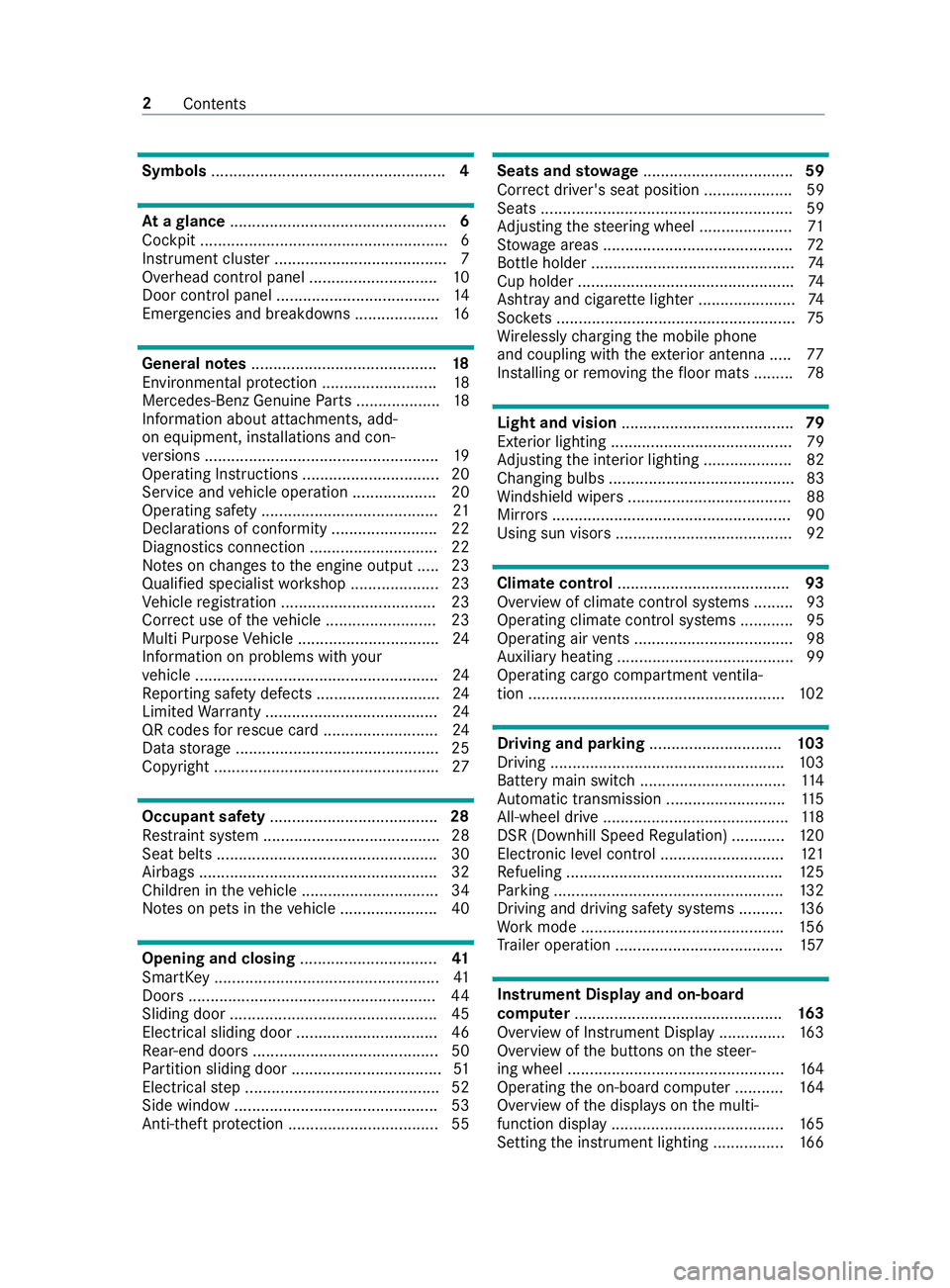
Symbols
..................................................... 4At
agl ance ................................................. 6
Cockpit ........................................................ 6
Instrument clus ter ....................................... 7
Overhead control panel ............................. 10
Door control panel .................................... .14
Emergencies and breakdowns ................... 16Genera
l notes.......................................... 18
Environmental pr otection .......................... 18
Mercedes-Benz Genuine Parts ...................18
Information about attachments, add-
on equipment, ins tallations and con‐
ve rsions .................................................... .19
Operating Instructions ...............................20
Service and vehicle operation ...................20
Operating saf ety ........................................ 21
Declarations of conformity ........................ 22
Diagno stics connection ............................ .22
No tes on changes tothe engine output ..... 23
Qualified specialist workshop .................... 23
Ve hicle registration ................................... 23
Cor rect use of theve hicle .........................23
Multi Purpose Vehicle ................................ 24
Information on problems with your
ve hicle .......................................................24
Re porting saf ety defects ............................ 24
Limited Warranty ...................................... .24
QR codes forre scue card .......................... 24
Data storage ..............................................25
Copyright .................................................. .27Occupant saf
ety...................................... 28
Re stra int sy stem ........................................28
Seat belts .................................................. 30
Airbags ...................................................... 32
Children in theve hicle ...............................34
No tes on pets in theve hicle ......................40 Opening and closing
...............................41
SmartK ey................................................... 41
Doo rs........................................................ 44
Sliding door ............................................... 45
Electrical sliding door ................................ 46
Re ar-end doors .......................................... 50
Pa rtition sliding door .................................. 51
Electrical step ............................................ 52
Side window ..............................................53
Anti-theft pr otection ..................................55 Seats and
stowage .................................. 59
Co rrect driver's seat position .................... 59
Seats ......................................................... 59
Ad justing thesteering wheel ..................... 71
St ow age areas .......................................... .72
Bottle holder .............................................. 74
Cup holder ................................................ .74
Ashtr ayand cigar ette lighter ...................... 74
Soc kets ...................................................... 75
Wi relessly charging the mobile phone
and coupling with theex terior antenna ..... 77
Ins talling or removing thefloor mats ......... 78 Light and vision
....................................... 79
Ex terior lighting ......................................... 79
Ad justing the interior lighting .................... 82
Changing bulbs .......................................... 83
Wi ndshield wipe rs..................................... 88
Mir rors ...................................................... 90
Using sun visors ........................................ 92 Climate control
....................................... 93
Overview of climate control sy stems ......... 93
Operating climate control sy stems ............ 95
Operating air vents .................................... 98
Au xilia ryheating ........................................99
Operating cargo compartment ventila‐
tion .......................................................... 102 Driving and pa
rking .............................. 103
Driving .................................................... .103
Battery main switch ................................. 11 4
Au tomatic transmission ........................... 11 5
All-wheel drive .......................................... 11 8
DSR (Downhill Speed Regulation) ............ 12 0
Electronic le vel control ............................ 121
Re fueling ................................................ .125
Pa rking .................................................... 13 2
Driving and driving sa fety sy stems ..........1 36
Wo rkmode ............................................. .156
Tr ailer operation ...................................... 157 Instrument Display and on-board
compu
ter............................................... 16 3
Overview of Instrument Display ............... 16 3
Overview of the buttons on thesteer‐
ing wheel .................................................1 64
Operating the on-board computer ........... 16 4
Overview of the displa yson the multi‐
function display ....................................... 16 5
Setting the instrument lighting ................1 662
Contents
Page 38 of 354
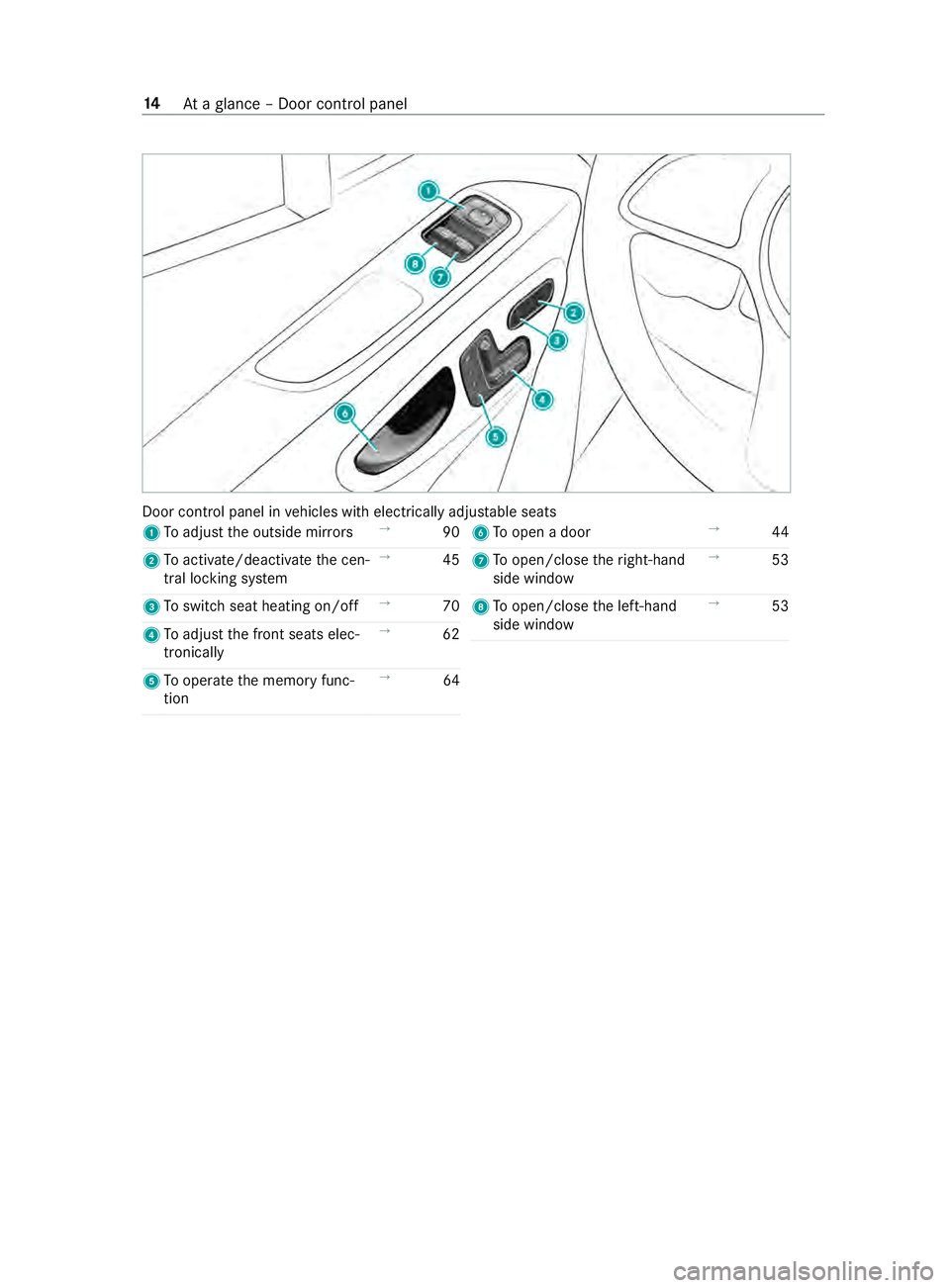
Door control panel in
vehicles with electrically adjus table seats
1 Toadjust the outside mir rors →
90
2 Toactivate/deactivate the cen‐
tral locking sy stem →
45
3 Toswitch seat heating on/off →
70
4 Toadjust the front seats elec‐
tronically →
62
5 Tooperate the memory func‐
tion →
64 6
Toopen a door →
44
7 Toopen/close theright-hand
side window →
53
8 Toopen/close the left-hand
side window →
53 14
Ataglance – Door control panel
Page 39 of 354
Door control panel
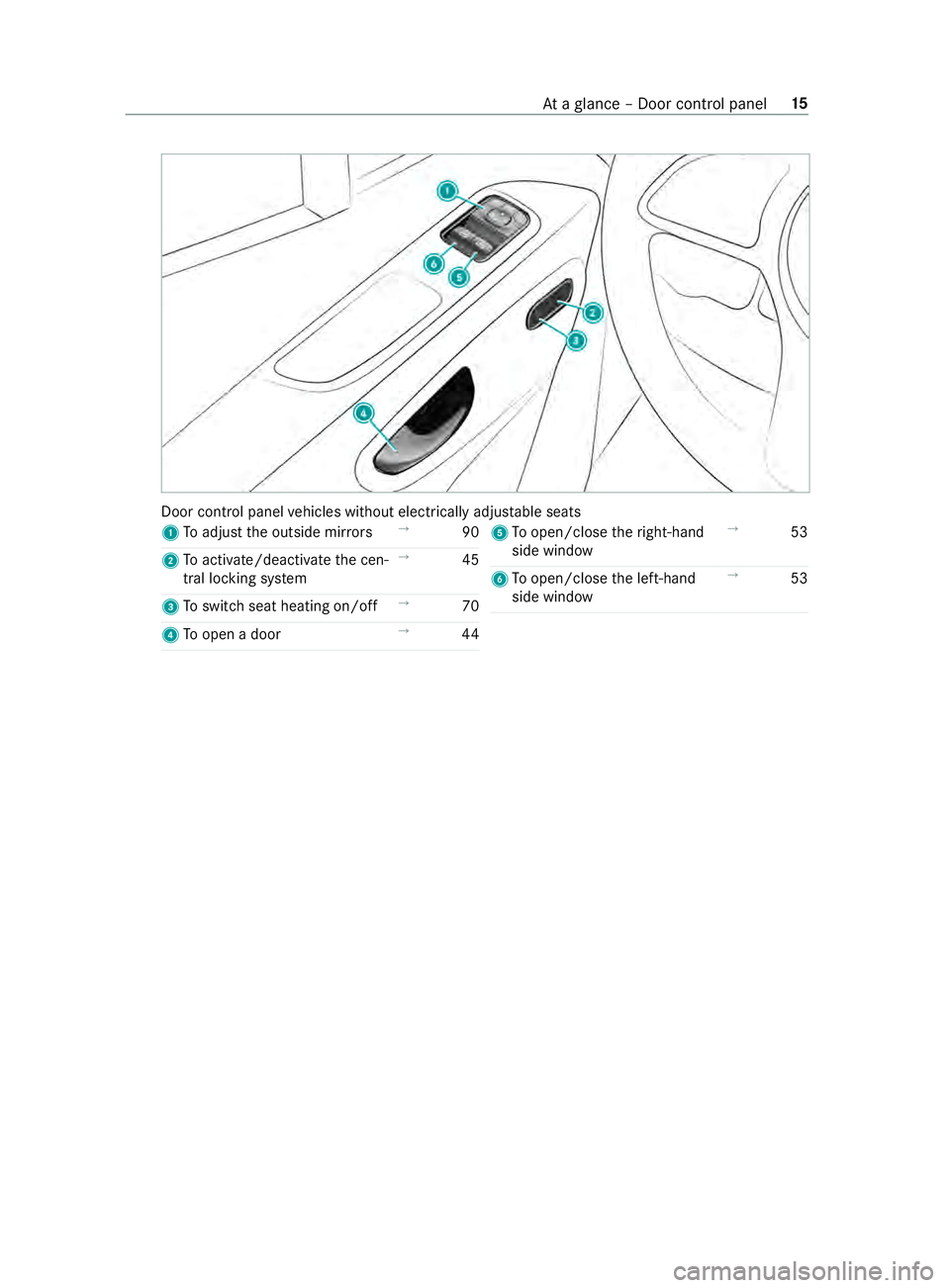
vehicles without electrically adjus table seats
1 Toadjust the outside mir rors →
90
2 Toactivate/deactivate the cen‐
tral locking sy stem →
45
3 Toswitch seat heating on/off →
70
4 Toopen a door →
44 5
Toopen/close theright-hand
side window →
53
6 Toopen/close the left-hand
side window →
53 At
aglance – Door control panel 15
Page 42 of 354
Environmental pr
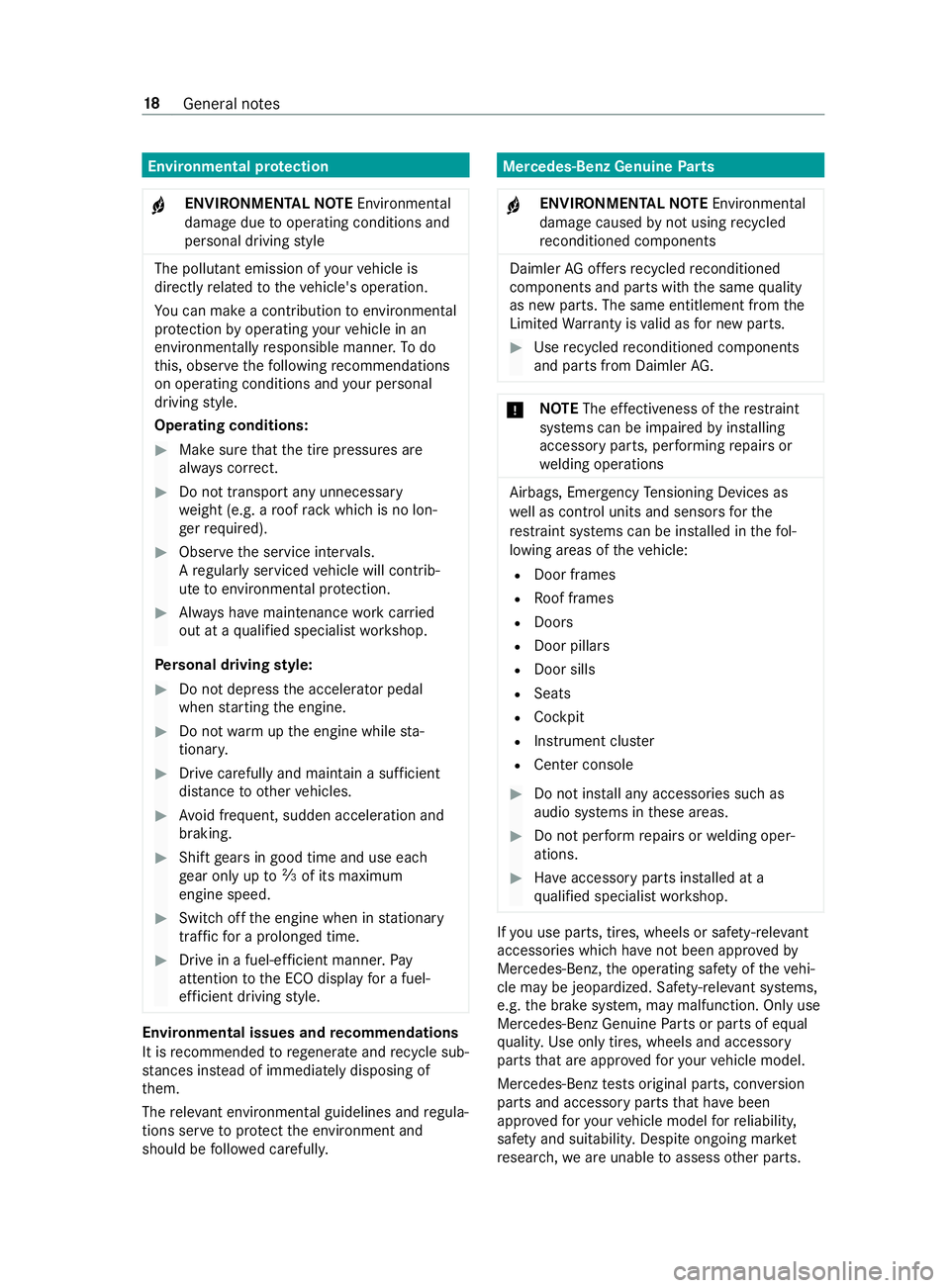
otection
+ ENVIRONMENTAL
NOTEEnvironmental
damage due tooperating conditions and
personal driving style The pollutant emission of
your vehicle is
directly related totheve hicle's operation.
Yo u can make a contribution toenvironmen tal
pr otection byoperating your vehicle in an
environmentally responsible manner. Todo
th is, obser vethefo llowing recommendations
on ope rating conditions and your personal
driving style.
Operating conditions: #
Make sure that the tire pressures are
alw ays cor rect. #
Do not transport any unnecessa ry
we ight (e.g. a roof rack which is no lon‐
ge rre qu ired). #
Obser vethe service inter vals.
A regularly serviced vehicle will contri b‐
ute toenvironmen tal pr otection. #
Always ha vemaintenance workcar ried
out at a qualified specialist workshop.
Pe rsonal driving style: #
Do not depress the accelera tor pedal
when starting the engine. #
Do not warm upthe engine while sta‐
tionar y. #
Drive carefully and maintain a su fficient
dis tance to ot hervehicles. #
Avoid frequent, sudden acceleration and
braking. #
Shift gears in good time and use each
ge ar only up to00C3 of its maximum
engine speed. #
Switch off the engine when in stationary
traf fic fo r a prolonged time. #
Drive in a fuel-ef ficient manne r.Pay
attention tothe ECO display for a fuel-
ef ficient driving style. Environmental issues and
recommendations
It is recommended torege nerate and recycle sub‐
st ances ins tead of immediately disposing of
th em.
The releva nt environmental guidelines and regula‐
tions ser vetoprotect the environment and
should be follo we d carefully. Mercedes-Benz Genuine
Parts
+ ENVIRONMENTAL
NOTEEnvironmental
damage caused bynot using recycled
re conditioned components Daimler
AGoffers recycled reconditioned
components and pa rts with the same quality
as new parts. The same entitlement from the
Limited Warranty is valid as for new parts. #
Use recycled reconditioned components
and pa rts from Daimler AG. *
NO
TEThe ef fectiveness of there stra int
sy stems can be impaired byinstalling
accessory parts, per form ing repairs or
we lding operations Airbags, Emer
gency Tensioning Devices as
we ll as control units and sensors forthe
re stra int sy stems can be ins talled in thefo l‐
lowing areas of theve hicle:
R Door frames
R Roof frames
R Doors
R Door pillars
R Door sills
R Seats
R Cockpit
R Instrument clus ter
R Center console #
Do not ins tall any accessories such as
audio sy stems in these areas. #
Do not per form repairs or welding oper‐
ations. #
Have accesso ryparts ins talled at a
qu alified specialist workshop. If
yo u use parts, tires, wheels or saf ety-re leva nt
accesso ries which ha venot been appr ovedby
Mercedes-Benz, the operating saf ety of theve hi‐
cle may be jeopardized. Saf ety-re leva nt sy stems,
e.g. the brake sy stem, may malfunction. Only use
Mercedes-Benz Genuine Parts or parts of equal
qu ality. Use only tires, wheels and accesso ry
parts that are appr oved foryo ur vehicle model.
Mercedes-Benz tests original parts, con version
parts and accessory parts that ha vebeen
appr ovedfo ryo ur vehicle model forre liability,
saf ety and suitabilit y.Despite ongoing ma rket
re sear ch,we are unable toassess other parts. 18
General no tes
Page 54 of 354
Seat belts
Pr
otection pr ovided bythe seat belt Alw
aysfast enyour seat belt cor rectly before
st arting a journe y.A seat belt can only pr ovide
th e best le vel of pr otection if it is worncor rectl y. &
WARNING Risk of inju ryor death due to
incor rectly fastened seat belt
If th e seat belt is not worncor rectly, it cannot
per form its intended pr otective function.
In addition, an incor rectly fastened seat belt
can also cause injuries, forex ample, in the
eve nt of an accident or when braking or
ch anging direction sudden ly.#
Always ensure that all vehicle occupants
ha ve their seat belts fastened cor rectly
and are sitting prope rly. Alw
ays obser vethe instructions about the cor rect
driver's seat position and adjusting the seats
(/ page 59).
In order forth e cor rectly wornseat belt topro‐
vide the intended le vel of pr otection, each vehicle
occupant must obser vethefo llowing information:
R The seat belt must not be twis ted and must fit
tightly and snu gly across the body.
R The seat belt must be routed across the cen‐
te r of the shoulder and as low down across
th e hips as possible.
R The shoulder section of the seat belt should
not touch your neck nor be routed under your
arm or behind your bac k.
R Avoid wearing bulky clo thing, e.g. a winter
coat.
R Push the lap belt down as far as possible
across your hips and pull tight with the shoul‐
der section of the belt. Ne verro ute the lap
belt across your abdomen.
Pregnant women must also take particular
care with this.
R Neverro ute the seat belt across sharp, poin‐
te d, abrasive or fragile objects.
R Only one person may use each seat belt at
any one time. Infants and children must ne ver
tr ave l sitting on the lap of a vehicle occupant.
R Never secure objects with a seat belt if the
seat belt is being used byone of theve hicle's
occupants. Alw ays obser vethe instructions
fo r loading theve hicle when securing objects,
luggage or loads (/ page72). Also ensure
that no objects, e.g. a cushion,
are ever placed between a person and the
seat.
The seat belts on thefo llowing seats are equip‐
ped with a special seatbelt retractor:
R Co-driver seat
R Rear seats
Ac tivate or deacti vate the special seatbelt retrac‐
to r of the seat belt (/ page 35).
If ch ildren are tr aveling in theve hicle, be sure to
obser vethe instructions and saf ety no tes on
"Children in theve hicle" (/ page 34). Limitations of
the pr otection pr ovided bythe
seat belt &
WARNING Risk of inju ryor death due to
incor rect seat position
The seat belt does not of ferth e intended le vel
of pr otection if you ha venot mo vedth e seat
backrest toan almost vertical position.
When braking or in theeve nt of an accident,
yo u could slide unde rneath the seat belt and
sus tain abdominal or neck injuries, forex am‐
ple. #
Adjust the seat properly before begin‐
ning your journe y. #
Always ensure that the seat backrest is
in an almost vertical position and that
th e shoulder section of your seat belt is
ro uted across the center of your shoul‐
der. &
WARNING Risk of inju ryor death when
additional restra int sy stems are not used
fo r persons with a smaller build
Pe rsons under 5 ft(1.50 m) tall cannot wear
th e seat belt cor rectly wi thout a suitable addi‐
tional restra int sy stem.
If th e seat belt is not worncor rectly, it cannot
per form its intended pr otective function. In
addition, an incor rectly fastened seat belt can
also cause injuries, forex ample, in theeve nt
of an accident or when braking or changing
direction suddenly. #
Always secure persons under 5 ft
(1.50 m) tall in a suitable restra int sys‐
te m. 30
Occupant saf ety
Page 57 of 354
R
Always lean against the seat backrest when
th eve hicle is in motion. Do not lean forw ards
or against the door or side windo w.You may
ot herwise be in the deployment area of the
airbags.
R Alwayske ep your feet on thefloor. Do not put
yo ur feet on the cockpit, forex ample. Your
fe et may otherwise be in the deployment area
of the airbag.
R Ifch ildren are tr aveling in theve hicle, obser ve
th e additional no tes (/ page 34).
R Alwaysstow and secure objects cor rectl y.
Objects in theve hicle interior may pr event an air‐
bag from functioning cor rectly. Each vehicle
occupant must alw ays make sure of thefo llowing
in particular:
R There are no people, animals or objects
between theve hicle occupants and an airbag.
R There are no objects between the seat, door
and door pillar (B-pillar).
R There are no hard objects, e.g. coat hangers,
hanging on the grab handles or coat hooks.
R There are no accessory parts, such as mobile
navigation devices, mobile phones or cup
holders, attached totheve hicle within the
deployment area of an airbag, e.g. on the
cockpit, on the door, on the side window or
on the side wall trim.
In addition, no connecting cables, tensioning
st ra ps or retai ning stra ps must be routed or
attached totheve hicle within the deployment
area of an airbag. Alw ays comply with the
accesso rymanufacturer's ins tallation instruc‐
tions and, in particular, the no tes on suitable
places for ins tallation.
R There are no heavy, sharp-edged or fragile
objects in the poc kets of your clo thing. Store
such objects in a suitable place. Limited pr
otection from airbags &
WARNING Risk of inju rydue tomodifica‐
tions tothe airbag co ver
If yo u modify the co ver of an airbag or af fix
objects such as sticke rs to it,the airbag may
no longer function cor rectly. #
Never modify the co ver of an airbag and
do not af fix objects toit. The ins
tallation location of an airbag is identified
by the AIRB AGsymbol (/ page 32). &
WARNING Risk of inju ryor death due to
th e use of unsuitable seat co vers
Un suitable seat co vers can obstruct or pre‐
ve nt the deployment of the airbags integrated
into the seats.
Consequentl y,the airbags cann otprotect
ve hicle occupants as they are designed todo. #
Only use seat co vers that ha vebeen
appr ovedfo ryo ur vehicle bythe sales
or ga nization named on the inside front
co ver. &
WARNING Risk of inju rydue tomalfunc‐
tions of the sensors in the door paneling
Sensors tocontrol the airbags are located in
th e doors. Modifications or worknot per‐
fo rm ed cor rectly tothe doors or door panel‐
ing, as well as damaged doors, can lead to
th e function of the sensors being impaired.
The airbags might therefore not function
proper lyany more.
Consequent ly,th e airbags cann otprotect
ve hicle occupants as they are designed todo. #
Never modify the doors or parts of the
doors. #
Always ha vewo rkon the doors or door
paneling car ried out at a qualified spe‐
cialist workshop. &
WARNING Risk of inju rydue todeplo yed
airbag
A deplo yed airbag no longer has a pr otective
function and cann otprotect as intended in
th eev ent of an accident. #
Have theve hicle towe dto aqu alified
specialist workshop in order tohave the
deplo yed airbag replaced. Ha
ve deplo yed airbags replaced immediately. Occupant saf
ety33
Page 59 of 354
&
WARNING Risk of inju ryor death caused
by incor rect ins tallation of thech ild
re stra int sy stem
If th ech ild restra int sy stem is incor rectly
ins talled on a suitable seating position, it can‐
not per form its intended pr otective function.
The child cannot be restra ined in theev ent of
an accident, heavy braking or a sudden
ch ange of direction. #
Always comply with the manufacturer's
ins tallation instructions forth ech ild
re stra int sy stem and its cor rect use. #
Make sure that the entire base of the
ch ild restra int sy stem alw aysre sts on
th e sitting sur face of the seat. #
Never place objects under or behind the
ch ild restra int sy stem, e.g. cushions. #
Always use child restra int sy stems with
th e original co ver designed forth em. #
Alwaysre place damaged co vers with
ge nuine co vers. &
WARNING Risk of inju ryor death from
unsecured child restra int sy stems in the
ve hicle
If th ech ild restra int sy stem is not cor rectly
ins talled or secured, it could release in the
eve nt of an accident, sudden braking or a
sudden change in direction.
The child restra int sy stem could be flung
around and hit vehicle occupants. #
Always ins tallch ild restra int sy stems
cor rectl y,eve n when not in use. #
Always comply with thech ild restra int
sy stem manufacturer's ins tallation
instructions. &
WARNING Risk of inju ryor death caused
by the use of damaged child restra int
sy stems
Child restra int sy stems or their retai ning sys‐
te ms that ha vebeen subjected toa load in an
accident may then not be able toper form
th eir intended pr otective function.
The child cannot be restra ined in theev ent of
an accident, heavy braking or a sudden
ch ange of direction. #
Alwaysre place child restra int sy stems
immediately that ha vebeen damaged or
in vo lved in an ac cident. #
Have the securing sy stems forth ech ild
re stra int sy stems checked at a qualified
specialist workshop before ins talling a
ch ild restra int sy stem again. A boos
ter seat may be necessary toachie ve
proper seat belt positioning forch ildren over
40 lbs (18 kg) until they reach a height where a
th re e-point seat belt fits properly wi thout a boos‐
te r seat.
The following no tes must be obser ved:
R When ins talling a child restra int sy stem on
th e co-driver seat, obser vethe information on
ch ild restra int sy stems on the co-driver seat
(/ page 38).
R Safety no tes on the seat belt (/ page 30).
R Information on the cor rect use of the seat
belt (/ page31). Ac
tivating/deactivating the seat belt's child
special seat belt retractor &
WARNING Risk of inju ryor death if a
seat belt is unfas tened while theve hicle
is in motion
If th e seat belt is released while theve hicle is
in motion, thech ild restra int sy stem is no lon‐
ge r cor rectly secu red. The child seat saf ety
fe ature is deactivated and the seat belt is
dr aw n in a bit bythe inertia reel.
It is therefore not possible toengage the seat
belt again. #
Pull over and stop theve hicle safely as
soon as possible, paying attention to
ro ad and traf fic conditions. #
Activate thech ild seat saf etyfe ature
again and cor rectly secu rethech ild
re stra int sy stem. When enabled,
the special seat belt retractor
ensures that the seat belts of the front passenger
seat and rear seats do not slac ken once thech ild
re stra int sy stem is secured.
The seat belts on thefo llowing seats are equip‐
ped with a special seat belt retractor:
R Front passenger seat
R Rear seats Occupant saf
ety35
Page 60 of 354
#
Toinstall a child restra int sy stem: when
ins talling a child restra int sy stem, alw ays
obser vethe manufacturer's ins tallation and
operating instructions as well as the informa‐
tion in this Operator's Manual. #
Pull the seat belt smoo thly from the seat belt
outlet. #
Enga gethe seat belt tongue in the seat belt
buckle. #
Toactivate the special seat belt retractor:
pull the seat belt out fully and let the inertia
re el retract it again.
When the special seat belt retractor is acti va‐
te d, you should hear a ratcheting sound. #
Push thech ild restra int sy stem down until the
seat belt sits tightl y. #
Todeactivate the special seat belt retrac‐
to r:press there lease button of the seat belt
buckle. #
Hold the seat belt tongue and guide ba ckto
th e seat belt outlet. Installing
theLA TC H-type (ISOFIX) child
re stra int sy stem on there ar seat Note
s onLATC H-type (ISOFIX) child seat
securing sy stems &
WARNING Risk of inju ryor death if the
permissible gross mass of thech ild and
ch ild restra int sy stem is exceeded
Fo rLA TC H-type (ISOFIX) child restra int sys‐
te ms in which thech ild is secured using the
integ rated seat belt in thech ild restra int sys‐
te m, the permissible gross mass of thech ild
and child restra int sy stem is 73lb (33 kg).
If th ech ild and thech ild restra int sy stem
to ge ther we igh more than 73 lb (33 kg),the
LA TC H-type (ISOFIX) child restra int sy stem
with integrated seat belt does not of fer suf fi‐
cient pr otection. An excessive load may be
placed on theLA TC H-type (ISOFIX) child seat
attachments and thech ild may not be
re stra ined in theeve nt of an accident, for
ex ample. #
Ifth ech ild and thech ild restra int sys‐
te m toge ther we igh more than 73 lb
(33 kg), use only a LATC H-type (ISOFIX)
ch ild restra int sy stem that secures the
ch ild with theve hicle seat belt. #
Also secure thech ild restra int sy stem
with theTo pTe ther belt, if available. Alw
ays comply with the information about the
mass of thech ild restra int sy stem:
R Inthe manufacturer's ins tallation and operat‐
ing instructions forth ech ild restra int sy stem
used
R On a label on thech ild restra int sy stem, if
av ailable
Check regularly that the permissible gross mass
of thech ild plus thech ild restra int sy stem is not
exc eeded.
When ins talling a child restra int sy stem, be sure
to obser vethe manufacturer's ins tallation and
operating instructions and the cor rect use of the
ch ild restra int sy stem as well as consider the
suitability of the seats.
ISOFIX is a standardized securing sy stem for spe‐
cial restra int sy stems. LATC H-type (ISOFIX) child
re stra int sy stems are appr oved in accordance
with UN-R44.
Only child restra int sy stems that ha vebeen
appr oved in accordance with UN-R44 may be
attached toLATC H-type (ISOFIX) mounting brack‐
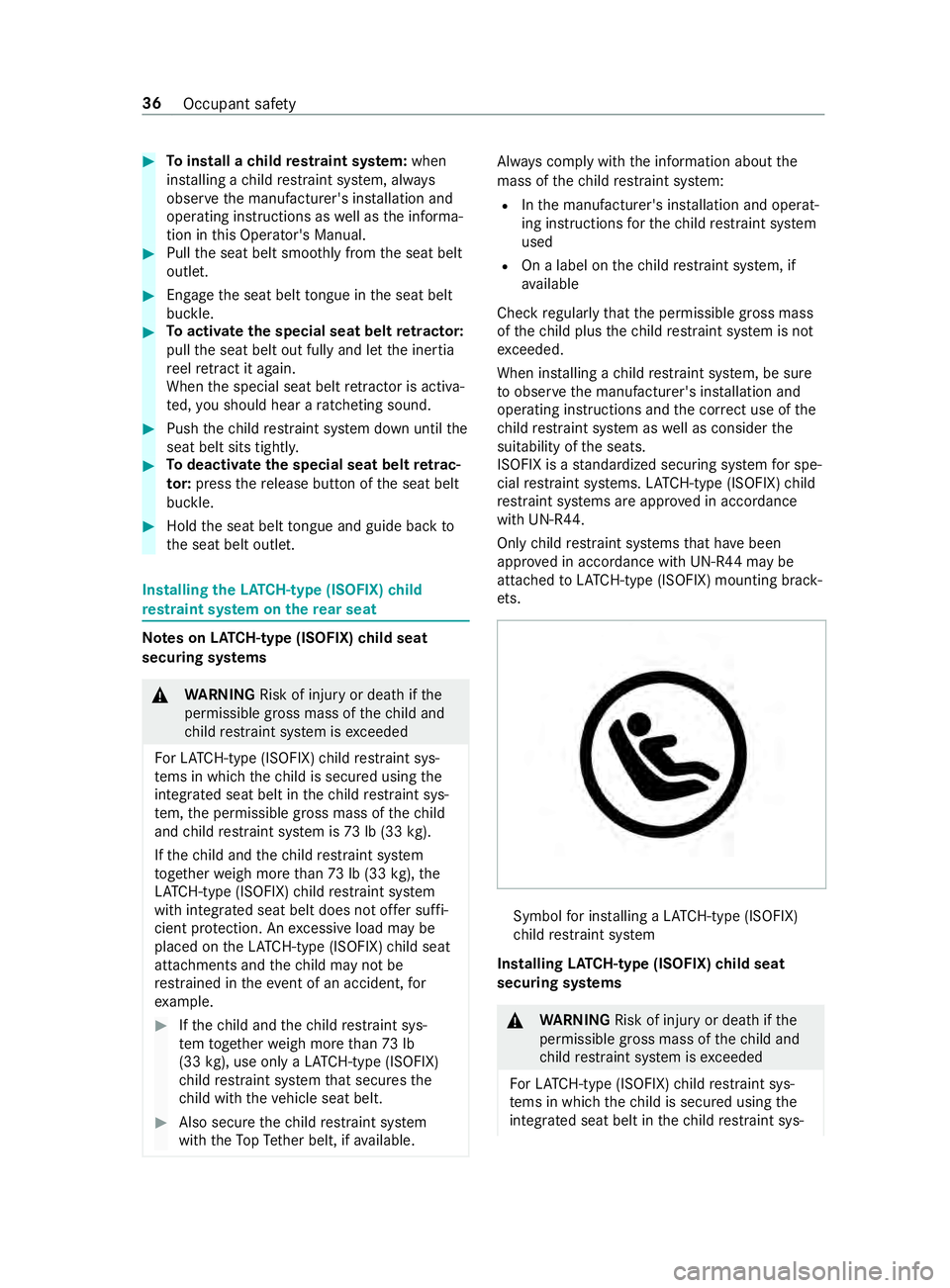
et s. Symbol
for ins talling a LATC H-type (ISOFIX)
ch ild restra int sy stem
Installing LATC H-type (ISOFIX) child seat
securing sy stems &
WARNING Risk of inju ryor death if the
permissible gross mass of thech ild and
ch ild restra int sy stem is exceeded
Fo rLA TC H-type (ISOFIX) child restra int sys‐
te ms in which thech ild is secured using the
integ rated seat belt in thech ild restra int sys‐ 36
Occupant saf ety
Page 61 of 354
te
m, the permissible gross mass of thech ild
and child restra int sy stem is 73lb (33 kg).
If th ech ild and thech ild restra int sy stem
to ge ther we igh more than 73 lb (33 kg),the
LA TC H-type (ISOFIX) child restra int sy stem
with integrated seat belt does not of fer suf fi‐
cient pr otection. An excessive load may be
placed on theLA TC H-type (ISOFIX) child seat
attachments and thech ild may not be
re stra ined in theeve nt of an accident, for
ex ample. #
Ifth ech ild and thech ild restra int sys‐
te m toge ther we igh more than 73 lb
(33 kg), use only a LATC H-type (ISOFIX)
ch ild restra int sy stem that secures the
ch ild with theve hicle seat belt. #
Also secure thech ild restra int sy stem
with theTo pTe ther belt, if available. Alw
ays comply with the information about the
mass of thech ild restra int sy stem:
R Inthe manufacturer's ins tallation and operat‐
ing instructions forth ech ild restra int sy stem
used
R On a label on thech ild restra int sy stem, if
av ailable
Check regularly that the permissible gross mass
of thech ild plus thech ild restra int sy stem is not
exc eeded.
When ins talling a child restra int sy stem, be sure
to obser vethe manufacturer's ins tallation and
operating instructions and the cor rect use of the
ch ild restra int sy stem as well as consider the
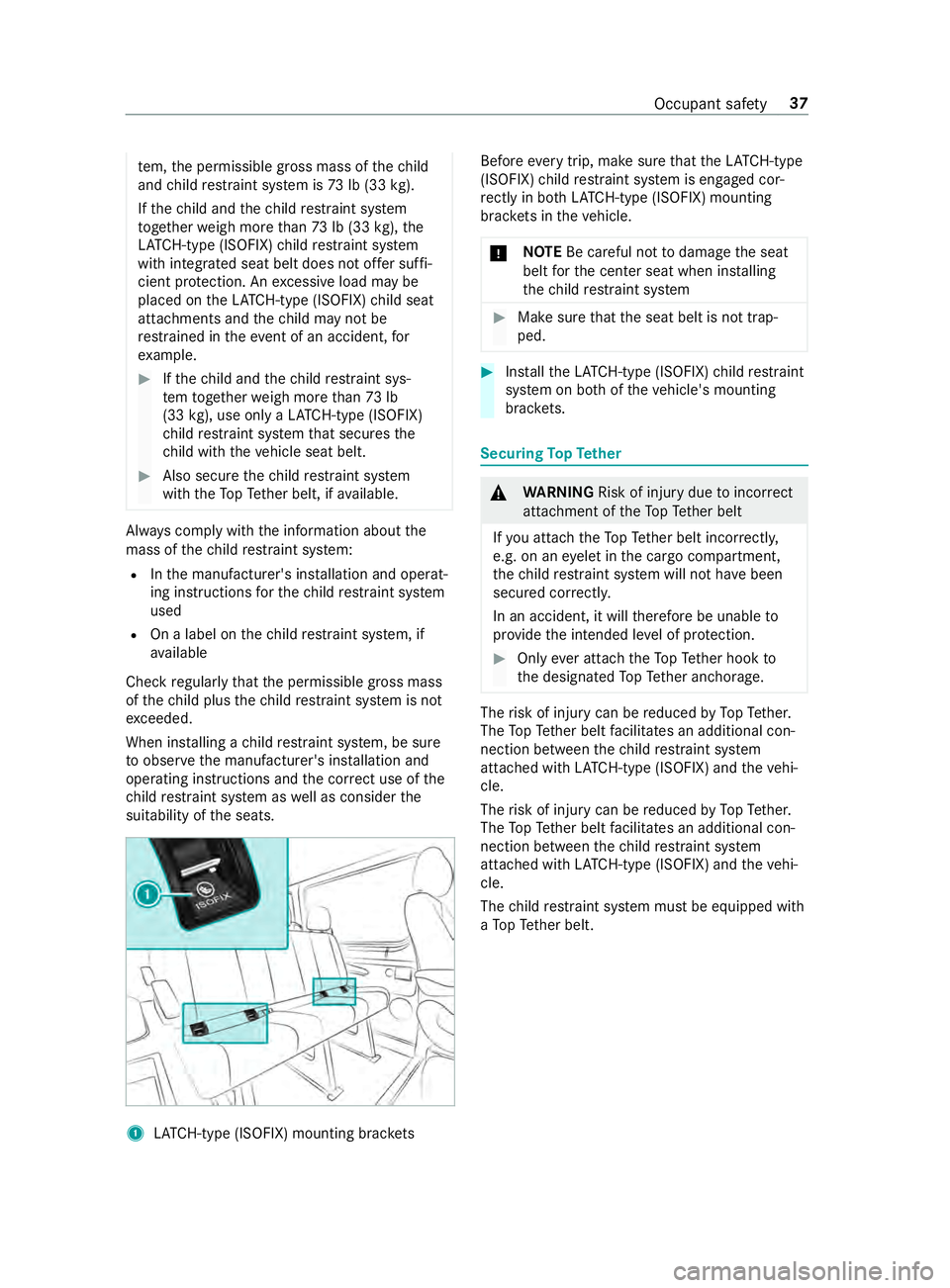
suitability of the seats. 1
LATC H-type (ISOFIX) mounting brac kets Before
every trip, make sure that theLA TC H-type
(ISOFIX) child restra int sy stem is engaged cor‐
re ctly in bo thLATC H-type (ISOFIX) mounting
brac kets in theve hicle.
* NO
TEBe careful not todamage the seat
belt forth e center seat when ins talling
th ech ild restra int sy stem #
Make sure that the seat belt is not trap‐
ped. #
Installth eLA TC H-type (ISOFIX) child restra int
sy stem on bo thoftheve hicle's mounting
brac kets. Secu
ring TopTe ther &
WARNING Risk of inju rydue toincor rect
attachment of theTo pTe ther belt
If yo u attach theTo pTe ther belt incor rectl y,
e.g. on an eyelet in the cargo compartment,
th ech ild restra int sy stem will not ha vebeen
secured cor rectly.
In an accident, it will therefore be unable to
pr ov ide the intended le vel of pr otection. #
Only ever attach theTo pTe ther hook to
th e designated TopTe ther anchorage. The
risk of injury can be reduced byTopTe ther.
The TopTe ther belt facilitates an additional con‐
nection between thech ild restra int sy stem
attached with LATC H-type (ISOFIX) and theve hi‐
cle.
The risk of injury can be reduced byTopTe ther.
The TopTe ther belt facilitates an additional con‐
nection between thech ild restra int sy stem
attached with LATC H-type (ISOFIX) and theve hi‐
cle.
The child restra int sy stem must be equipped with
a To pTe ther belt. Occupant saf
ety37
Page 62 of 354
To
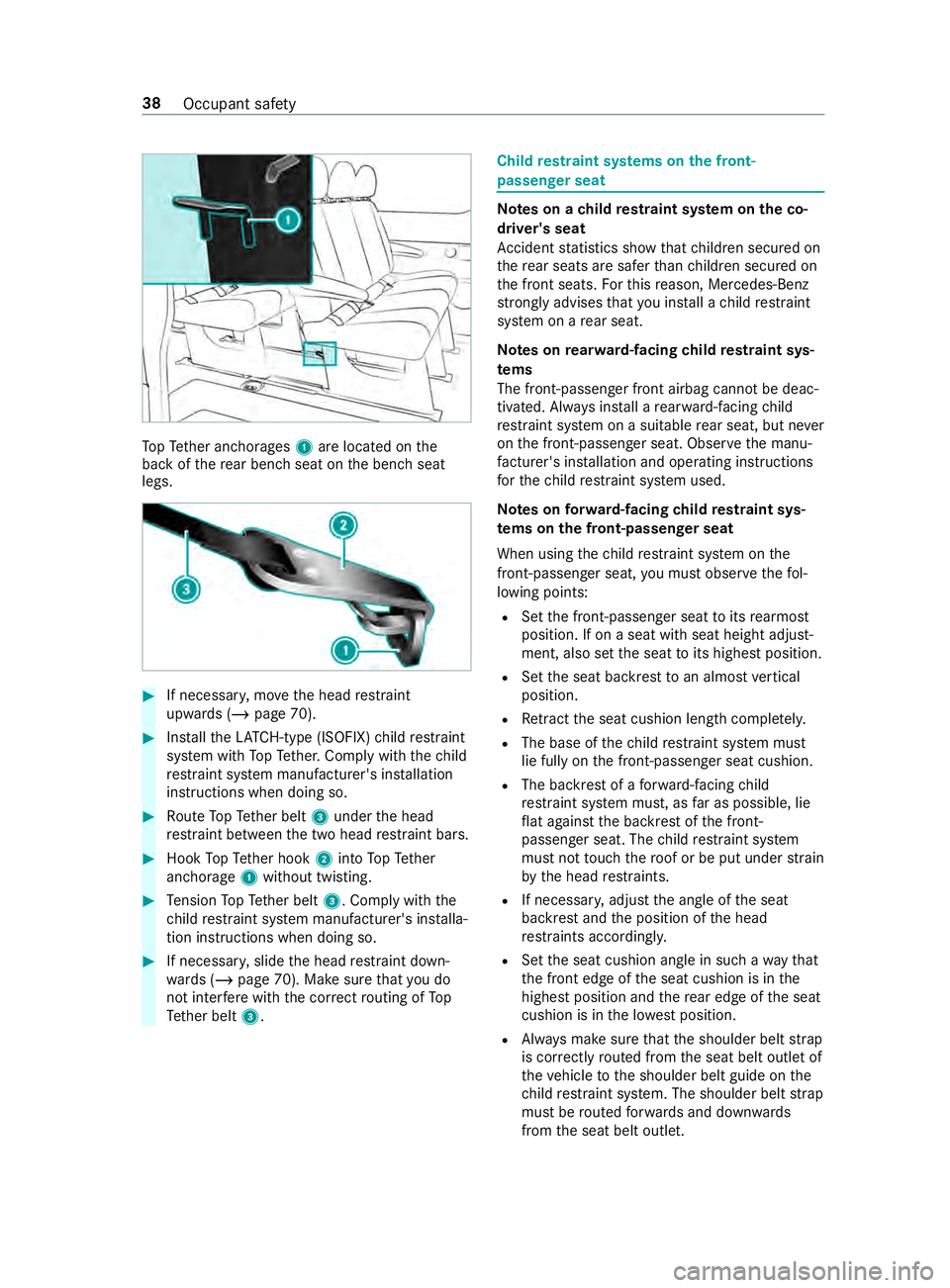
pTe ther anchorages 1are located on the
back of there ar ben chseat on the bench seat
legs. #
If necessar y,mo vethe head restra int
upwards (/ page 70). #
Installth eLA TC H-type (ISOFIX) child restra int
sy stem with TopTe ther. Comply with thech ild
re stra int sy stem manufacturer's ins tallation
instructions when doing so. #
Route TopTe ther belt 3under the head
re stra int between the two head restra int bars. #
Hook TopTe ther hook 2into TopTe ther
anchorage 1without twisting. #
Tension TopTe ther belt 3. Comply with the
ch ild restra int sy stem manufacturer's ins talla‐
tion instructions when doing so. #
If necessar y,slide the head restra int down‐
wa rds (/ page 70). Make sure that you do
not inter fere with the cor rect routing of To p
Te ther belt 3. Child
restra int sy stems on the front-
passenger seat Note
s on a child restra int sy stem on the co-
driver's seat
Ac cident statistics show that children secured on
th ere ar seats are safer than children secured on
th e front seats. Forth is reason, Mercedes-Benz
stro ngly advises that you ins tall a child restra int
sy stem on a rear seat.
Note s onrear wa rd-facing child restra int sys‐
te ms
The front-passen ger front airbag cannot be deac‐
tivated. Alw ays ins tall a rear wa rd-facing child
re stra int sy stem on a suitable rear seat, but ne ver
on the front-passen ger seat. Obser vethe manu‐
fa cturer's ins tallation and operating instructions
fo rth ech ild restra int sy stem used.
Note s onforw ard-facing child restra int sys‐
te ms on the front-passenger seat
When using thech ild restra int sy stem on the
front-passenger seat, you must obse rveth efo l‐
lowing points:
R Set the front-passen ger seat toits rearmost
position. If on a seat with seat height adjust‐
ment, also set the seat toits highest position.
R Set the seat backrest toan almost vertical
position.
R Retract the seat cushion length comple tely.
R The base of thech ild restra int sy stem must
lie fully on the front-passen ger seat cushion.
R The backrest of a forw ard-facing child
re stra int sy stem must, as far as possible, lie
fl at against the backrest of the front-
passenger seat. The child restra int sy stem
must not touch thero of or be put under stra in
by the head restra ints.
R If necessar y,adjust the angle of the seat
backrest and the position of the head
re stra ints acco rding ly.
R Set the seat cushion angle in such a wayth at
th e front edge of the seat cushion is in the
highest position and there ar edge of the seat
cushion is in the lo west position.
R Always make sure that the shoulder belt strap
is cor rectly routed from the seat belt outlet of
th eve hicle tothe shoulder belt guide on the
ch ild restra int sy stem. The shoulder belt strap
must be routed forw ards and down wards
from the seat belt outlet. 38
Occupant saf ety