transmission MERCEDES-BENZ SPRINTER 2019 MY19 with no MMS Operator’s Manual
[x] Cancel search | Manufacturer: MERCEDES-BENZ, Model Year: 2019, Model line: SPRINTER, Model: MERCEDES-BENZ SPRINTER 2019Pages: 322, PDF Size: 5.91 MB
Page 143 of 322
If it is no
tpossible toengag eall-wheel driv ewhen
th ev ehicle is rolling: #
Vehicles with automatic transmission:
brief lymo vethes elector le verto005C . Engaging/disen
gaging all-wheel drive *
NO
TERisk of damag etothe transfer
case If
yo us tepont he accelerator pedal while the
all-wheel driv eisengaged or disen gage d, the
trans ferc ase ma ybedamaged. #
Do no tstepont he accelera torp edal
when thei ndicator lam pinthe switch
fo rt he all-wheel driv eisflashing. #
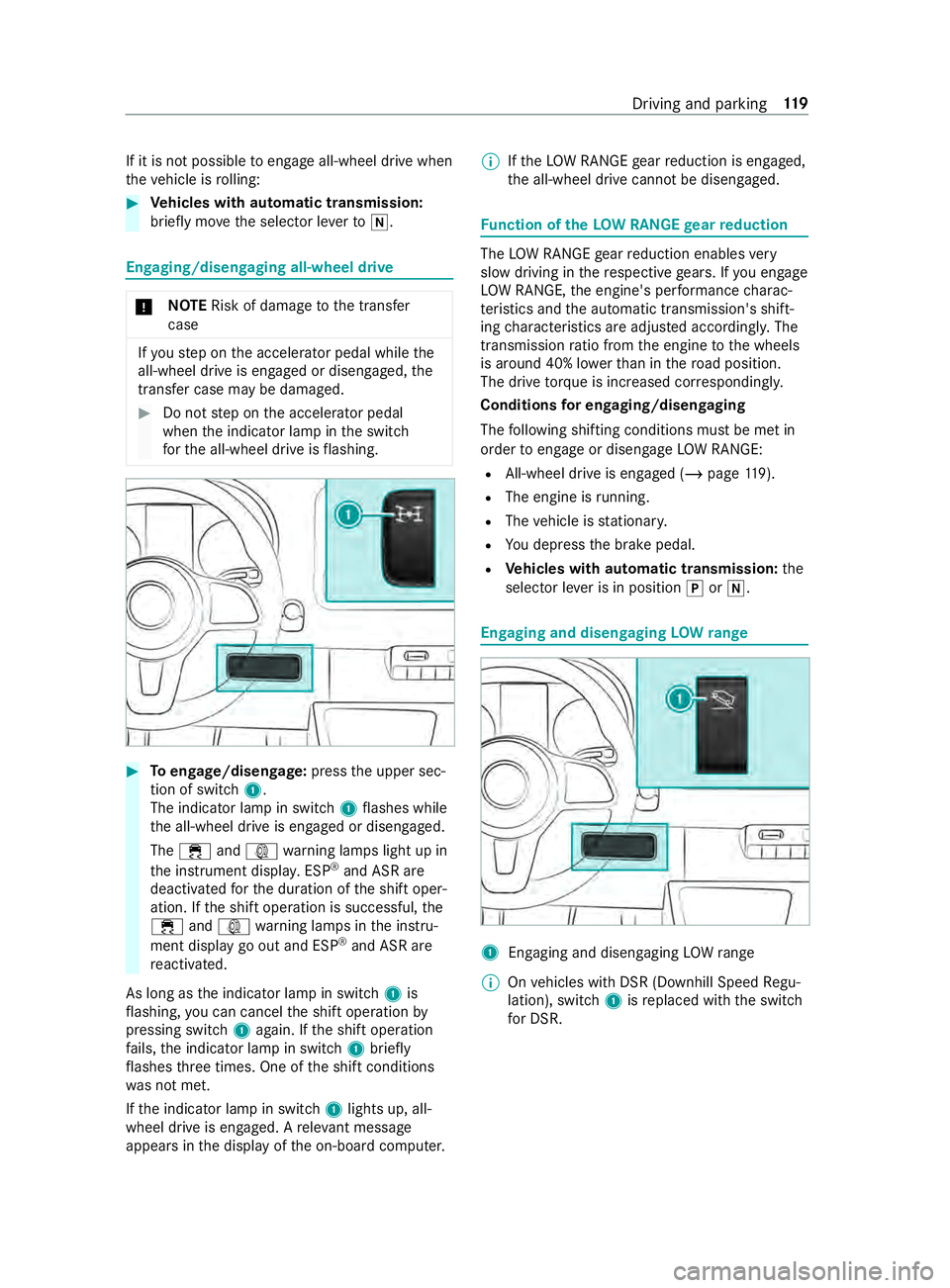
Toengage/disen gage: press theu pper sec‐
tion of switch 1.
The indicator lam pinswitch 1flashes while
th ea ll-wheel driv eisengaged or disengaged.
The 00E5 and003D warning lamps light up in
th ei nstrument displa y.ESP ®
and ASR are
deacti vatedf or thed uration of thes hifto per‐
ation. If thes hifto peration is successful, the
00E5 and003D warning lamps in thei nstru‐
ment displa ygoout and ESP ®
and ASR are
re activated.
As lon gasthe indicator lam pinswitch 1is
fl ashing, youc an cancel thes hifto peration by
pressing switch 1again. If thes hifto peration
fa ils, thei ndicator lam pinswitch 1brief ly
fl ashes thre et imes. One of thes hiftconditions
wa sn otmet.
If th ei ndicator lam pinswitch 1lights up, all-
wheel driv eisengaged. Arele vant messa ge
appear sinthe displa yofthe on-boar dcomputer. %
If
th eL OW RANGE gear reduction is engaged,
th ea ll-wheel driv ecann otbe disengaged. Fu
nction of theL OW RANGE gear reduction The
LOWR ANGE gear reduction enables very
slo wd riving in ther espectiv egears. If youe ngage
LO WR ANGE, thee ngine' sperform anc echarac‐
te rist ics and thea utomatic transmission's shift‐
ing characteristic sareadjus teda ccording ly.T he
transmission ratio from thee ngine tothew heels
is around 40% lo werthan in ther oad posi tion.
The driv etorque is increased cor respondingly.
Conditions fore ngaging/disengaging
Th ef ollowing shifting condition smustbem etin
order toengag eordisengag eLOW RANGE:
R All-wheel driv eisengaged (/ page119).
R Thee ngin eisr unning.
R Thev ehicle is stationar y.
R Youd epress theb rake pedal.
R Vehicles with automatic transmission: the
selector le verisinp osition005Dor005C. Engaging and disen
gaging LOW range 1
Enga ging and disengaging LOWr ange
% On
vehicles wit hDSR (Downhill Speed Regu‐
lation), switch 1isreplaced wit hthe switch
fo rD SR. Driving and parking
11 9
Page 148 of 322
#
Toswitc helectronic le velc ontrol on
again: press button 4again.
The indicator lam ponbutton4goes out.
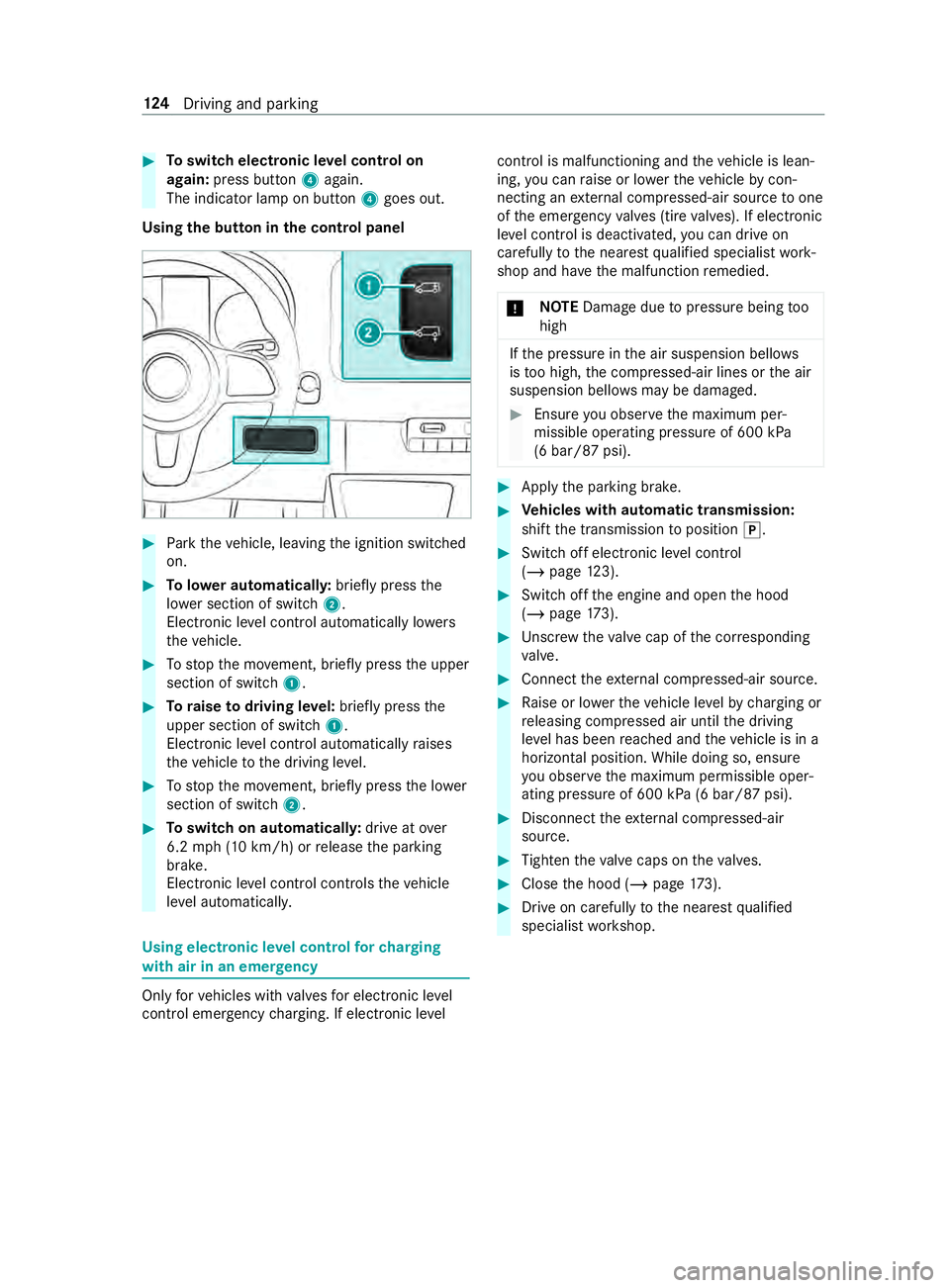
Using theb uttonint he control panel #
Park thev ehicle, leaving thei gnition switched
on. #
Tolowe rautomatical ly:brie flyp ress the
lo we rsection of switch 2.
Electronic le velc ontrol automaticall ylow ers
th ev ehicle. #
Tostop them ovement, brief lypress theu pper
section of switch 1. #
Toraise todriving le vel:briefly press the
upper sectio nofswitch 1.
Electroni cleve lcontrol automaticall yraises
th ev ehicle tothed riving le vel. #
Tostop them ovement, brief lypress thel ower
section of switch 2. #
Toswitc hona utomaticall y:driv eato ver
6.2 mph(10 km/h) or release thep arking
brake.
Elect ronic le velc ontrol controls thev ehicle
le ve la utomaticall y. Using electronic le
velc ontrol forc harging
with air in an emer gency Onl
yfor vehicles wit hvalves fore lectronic le vel
control emergency charging. If electroni clevel control is malfunctioning and
thev ehicle is lean‐
ing, youc an raise or lo werthe vehicle bycon‐
necting an extern al compressed-air source toone
of thee mer gency valves (tir evalves). If elect ronic
le ve lc ontrol is deactivated, youc an driv eon
carefull ytothe neares tqualified specialis twork‐
shop and ha vethem alfunction remedied.
* NO
TEDama gedue topressur ebeing too
high If
th ep ressur eint he air suspension bello ws
is tooh igh, thec ompressed-air lines or thea ir
suspension bello wsmaybed amaged. #
Ensur eyou obser vethem aximum per‐
missible operating pressur eof600 kPa
(6 bar/8 7psi). #
Appl ythe parking brake. #
Vehicles with automatic transmission:
shif tthe transmission toposition 005D. #
Switc hoffelectronic le velc ontrol
(/ page123). #
Switc hoffthee ngine and open theh ood
(/ page173). #
Unscr ewthev alvec ap of thec orresponding
va lve. #
Connect thee xternal co mpressed-air source. #
Raise or lo werthe vehicle le velbyc harging or
re leasing compressed air until thed riving
le ve lh as been reached and thev ehicle is in a
horizontal position. While doing so, ensure
yo uo bse rvet he maximum permissible oper‐
ating pressur eof600 kP a(6bar/87psi). #
Disconnec tthe extern al compressed-air
source. #
Tighten thev alvec aps on thev alves. #
Close theh ood (/ page173). #
Driv eonc arefully tothen eares tqualified
specialis tworks hop. 124
Driving and pa rking
Page 156 of 322
Closing
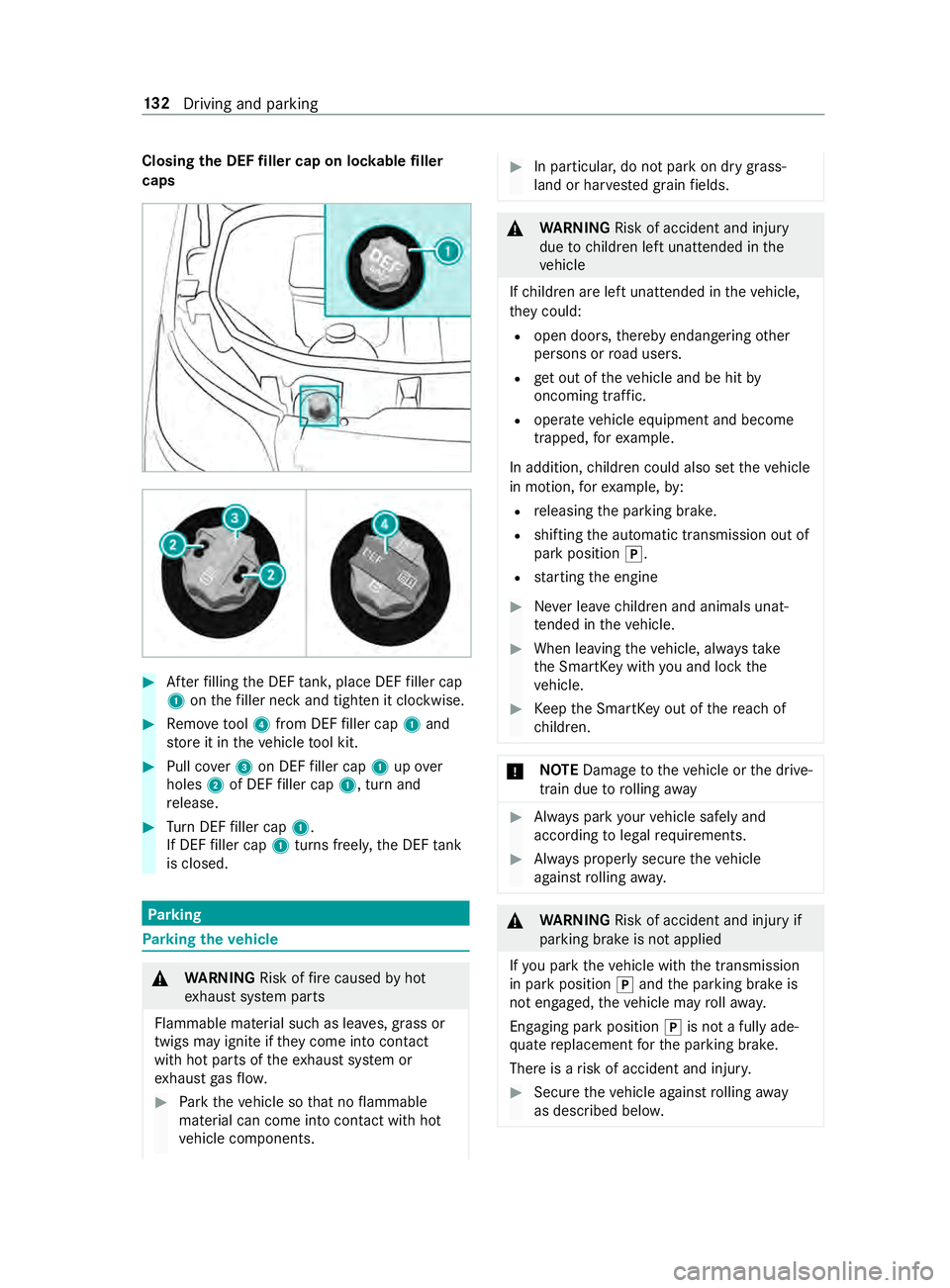
theD EFfiller cap on loc kable filler
caps #
Afterf illing theD EFtank ,p lace DEF filler cap
1 onthef iller nec kand tigh tenitc lock wise. #
Remo vetool 4 from DEF filler cap 1and
st or eitint hevehicle tool kit. #
Pull co ver3on DEF filler cap 1upover
holes 2of DEF filler cap 1,turna nd
re lease. #
Turn DEF filler cap 1.
If DE Ffiller cap 1turns freel y,theD EFtank
is closed. Park
ing Pa
rking thev ehicle &
WARNING Risk offire caused byhot
ex haus tsystemp arts
Flammable material suc hasleaves, grass or
twigs ma yignit eift heyc ome int ocontact
wi th hotp arts of thee xhau stsystem or
ex haus tgas flow. #
Park thev ehicle so that no flammable
material can com eintoc ontact wi thhot
ve hicle components. #
In particular ,donotpar kond rygrass‐
land or har vested grain fields. &
WARNING Risk of accident and injury
du etoc hildren lef tunat tende dint he
ve hicle
If ch ildren ar eleftu nat tende dint hevehicle,
th ey could:
R opendoors,t hereb yendangering other
persons or road users.
R geto utofthev ehicle and be hit by
oncomin gtraffic.
R operat evehicle equipment and become
trapped, fore xamp le.
In addition ,children could also se tthe vehicle
in motion, fore xamp le,by:
R releasing thep arking brake.
R shifting thea utomatic transmission out of
par kposition 005D.
R startin gthe engine #
Neverlea ve children and animals unat‐
te nde dint hevehicle. #
When leaving thev ehicle, alw ayst ake
th eS martK eywit hyou and loc kthe
ve hicle. #
Keep theS martK eyout of ther eac hof
ch ildren. *
NO
TEDama getothev ehicle or thed rive‐
train due torolling away #
Alwaysp arky our vehicle safely and
according tolegal requirements. #
Alwaysp roper lysecur ethe vehicle
agains trolling away. &
WARNING Risk of accident and injur yif
pa rking brak eisnotapplied
If yo up arkt he vehicle wit hthe transmission
in par kposition 005Dand thep arking brak eis
no te ngaged, thev ehicle ma yroll away.
Engaging pa rkposition 005Dis no tafully ade‐
qu ater eplacement fort he parking brake.
Ther eisar isk of accident and injur y. #
Secu rethev ehicle agains trolling away
as desc ribed belo w. 13 2
Driving and pa rking
Page 157 of 322
Obser
vethef ollowing points toensur ethat the
ve hicle is properly secured agains trolling away
unin tentionally: #
Alwaysa pply thep arking brake. #
Vehicles with automatic transmission:
engag etransmission position 005D.#
On uphill or downhill inclines: turnthe
front wheels towa rdst he curb. #
On uphill or downhill inclines: securethe
re ar axle wit hachockorano bject without
shar pedges.
% Yo
uc an operat ethe side windo wsforf ive
minutes af tery ou ha veswitched of fthe vehi‐
cle. Manual parking brake
Applying/releasing
theh andbrak elever &
WARNING Risk of skidding or an acci‐
dent bybraking wit hthe parking brake
If yo uh ave tobrak eyour vehicle wit hthe
parking brake, theb raking dis tance is consid‐
erab lylonger and thew heels ma yloc k. There
is an increased risk of skidding and/or acci‐
dent. #
Only brak ethe vehicle wit hthe parking
brak eift he service brak ehasfailed. #
Inthis case, do no tappl ythe parking
brak ewitht oo muc hforce. #
Ifth ew heels loc k,immediately release
th ep arking brak easmuchasr equired
fo rt he wheels totur na gain. &
WARNING Risk offire and an acciden tif
th ep arking brak eisnotreleased
If th ep arking brak eisnotfull yreleased when
driving, thef ollowing situations can occur:
R The parking brak ecan overheat and cause
af ire
R The parking brak ecan lose its holding
function #
Comple tely release thep arking brake
befor edriving off. The brak
elights do no tlight up when youb rake
th ev ehicle wit hthe parking brake.
Generally ,you ma yonlya ppl ythe parking brake
when thev ehicle is stationar y. #
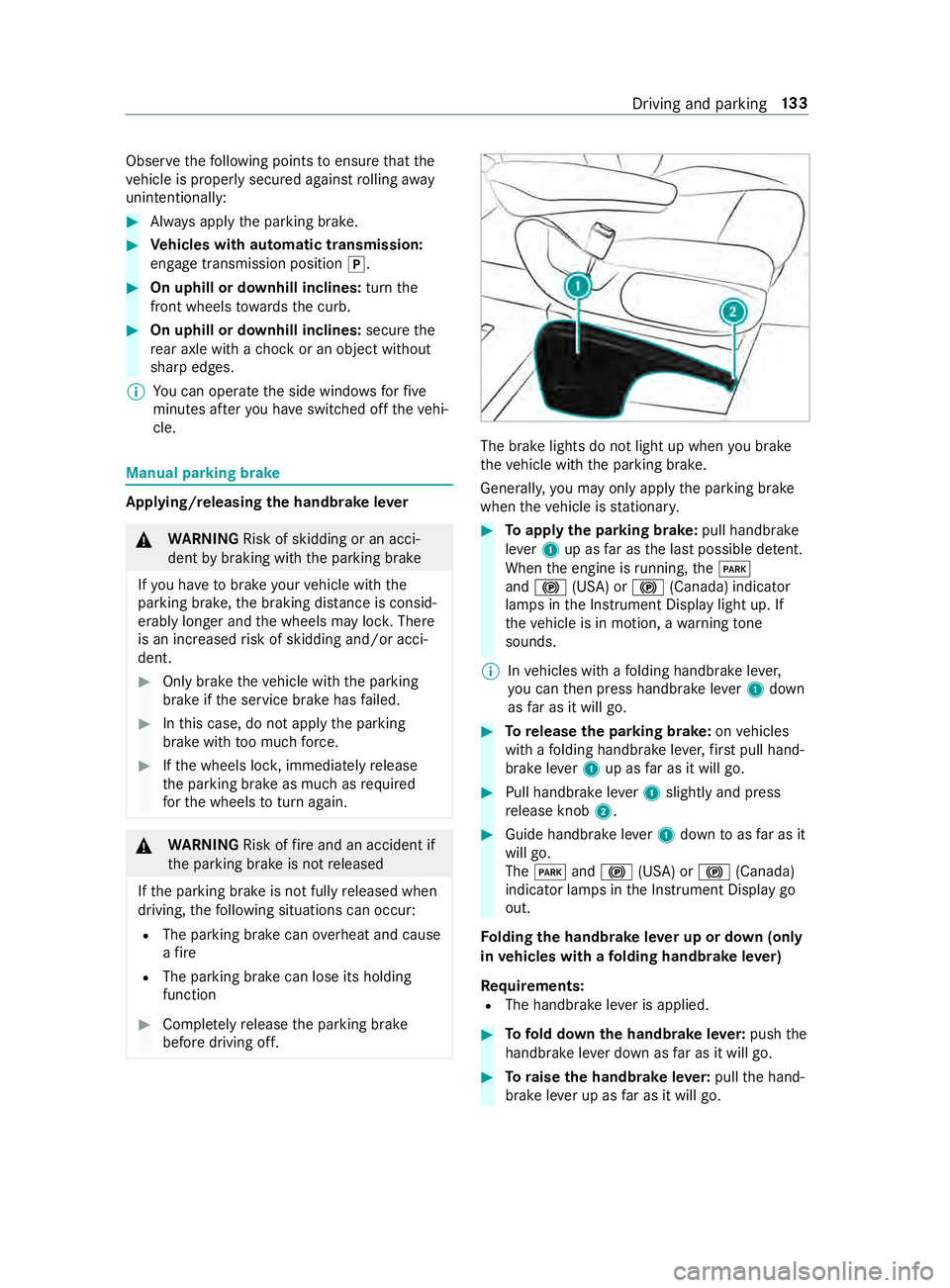
Toappl ythe parking brake: pullhandbrake
le ver 1up as farast he las tpossible de tent.
Whe nthe engine is running ,the 0049
and 0024 (USA) or 0024(Canada) indicator
lamps in theI nstrument Displa ylight up. If
th ev ehicle is in motion, awarning tone
sounds.
% In
vehicles wit hafolding handbrak eleve r,
yo uc an then press handbrak elever 1 down
as farasitw illg o. #
Torelease thep arking brake: onvehicles
wit haf olding handbrak eleve r,firs tp ullh an d‐
brak elever 1 up as farasitw illg o. #
Pullh andbrak elever 1 slightly and press
re lease knob 2. #
Guide handbrak elever 1 down toas farasit
willg o.
The 0049 and0024 (USA) or 0024(Canada)
indica torlamps in theI nstrument Displa ygo
out.
Fo lding theh andbrak elever up or down (only
in vehicles with afolding handbrak elever)
Re quirements:
R The handbrak eleve risa pplied. #
Tofold down theh andbrak elever: push the
handbrak elever down as farasitw illg o. #
Toraise theh andbrak eleve r:pull theh and‐
brak elever up as farasitw illg o. Driving and parking
13 3
Page 158 of 322
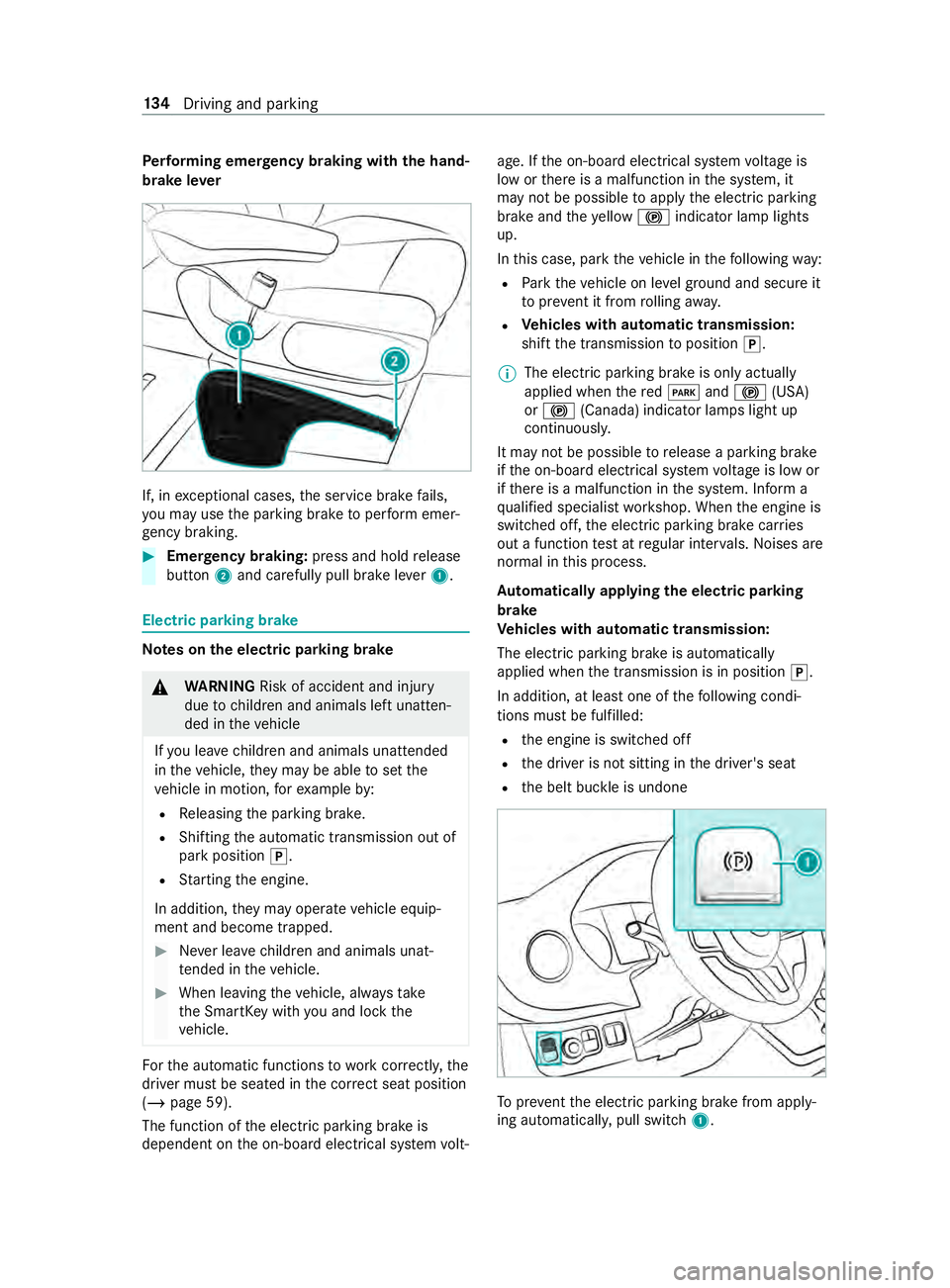
Pe
rforming emer gency braking with theh and‐
brak elever If, in
exceptional cases, thes ervice brak efails,
yo um ayuse thep arking brak etoperform emer‐
ge ncy braking. #
Eme rgency braking: press and hold release
button 2and carefull ypull brak elever 1. Electric parking brake
Note
sont he electric parking brake &
WARNING Risk of accident and inju ry
due tochildren and animals lef tunat ten‐
de dint hevehicle
If yo ul eave children and animals unat tended
in thev ehicle, they ma ybea bletos etthe
ve hicle in motion, fore xamp leby:
R Releasing thep arking brake.
R Shifting thea utomatic transmission out of
par kposition 005D.
R Startin gthe engine.
In addition, they ma yoperat evehicle equip‐
ment and become trapped. #
Neverlea ve children and animals unat‐
te nde dint hevehicle. #
When leaving thev ehicle, alw ayst ake
th eS martK eywit hyou and loc kthe
ve hicle. Fo
rthe automatic functions towo rkcor rectl y,the
driver mus tbeseated in thec orrect sea tposition
(/ page 59).
The function of thee lectric parking brak eis
dependent on theo n-boar delectrical sy stem volt‐ age. If
theo n-boar delectrical sy stem voltag eis
lo wort hereisam alfunction in thes ystem, it
ma ynotbe possible toappl ythe electric parking
brak eand they ellow 0024 indicator lam plights
up.
In this case, par kthe vehicle in thef ollowing way:
R Park thev ehicle on le velg roun da nd secur eit
to prev ent it from rolling away.
R Ve
hicles with automatic transmission:
shif tthe transmission toposition 005D.
% The electric parking brak
eisonlya ctually
applied when ther ed 0049 and0024 (USA)
or 0024 (Canada) indicator lamps light up
continuousl y.
It ma ynotbe possible torelease aparkin gbrake
if th eo n-boar delectrical sy stem voltag eisl owor
if th er eisam alfunction in thes ystem. Infor ma
qu alified specialis tworks hop. When thee ngine is
switched off, thee lectric parking brak ecarries
out afunction test at regular inter vals. Noise sare
normal in this process.
Au tomaticall yapplying the electric parking
brake
Ve hicles with automatic transmission:
The electric parking brak eisautomatically
applied when thet ransmission is in position 005D.
In addition, at leas tone of thef ollowing condi‐
tions mus tbefulfilled:
R thee ngine is switched off
R thed rive risn otsitting in thed rive r's seat
R theb elt buckle is undone To
prev ent thee lectric parking brak efroma pply‐
ing automaticall y,pull switch 1. 134
Driving and pa rking
Page 159 of 322

The electric parking brak
eisalso automatically
applied if ActiveD ista nce Assi stDISTRONI Chas
brought thev ehicle toas tandstill.
In addition ,atleastone of thef ollowing condi‐
tions mus tbefulfilled:
R thee ngine is switched off
R thed rive risn otsitting in thed rive r's seat
R theb elt buckle is undone
R ther eisas ystemm alfunction
R thep owe rsupply is insuf ficient
R thev ehicle is stationar yfor along time
The red0049 and0024 (USA) or 0024(Canada)
indicator lam pinthe instrument displa ylights up.
The electric parking brak eisonlya ctuall yapplied
when ther ed 0049 and0024 (USA) or 0024
(Canada) indicator lamps light up continuousl y.
Re leasing thee lectric pa rking brak eautomat‐
ically
Ve hicles with automatic transmission:
The electric parking brak eofyourvehicle is
re leased when all of thef ollowing condition sare
fulfilled:
R The driver is sitting in thed rive r's seat.
R The driver is belted.
R The engine is running.
R The transmissio nisinposition005Bor005E and
yo ud epress thea ccelera tor
or
Yo us wit ch from transmission position 005Dto
position 005Bor005E.Y ou mus talso depress the
accelerator if tra veling on steep uphill gradi‐
ents.
R Ifth et ransmission is in position 005E,therear-
end door smustbec losed.
App lying/releasing thee lectric pa rking brake
manually &
WARNING Risk of accident and inju ry
due tochildren and animals lef tunat ten‐
de dint hevehicle
If yo ul eave children and animals unat tended
in thev ehicle, they ma ybea bletos etthe
ve hicle in motion, fore xamp leby:
R Releasing thep arking brake.
R Shifting thea utomatic transmission out of
par kposition 005D. R
Startin gthe engine.
In addition, they ma yoperat evehicle equip‐
ment and become trapped. #
Neverlea ve children and animals unat‐
te nde dint hevehicle. #
When leaving thev ehicle, alw ayst ake
th eS martK eywit hyou and loc kthe
ve hicle. #
Toappl y:press switch 1.
When thee lectric parking brak eisapplied,
th er ed 0049 and0024 (USA) or 0024(Can‐
ada) indicator lamps light up in thei nstru‐
ment displa y.The electric parking brak eis
onl yactuall yapplied when ther ed 0049
and 0024 (USA) or 0024(Canada) indicator
lamps light up continuousl y.
It is also possible toappl ythe electric parking
brak ewhen thei gnition is switched off. #
Torelease: pull switch 1.
The red0049 and0024 (USA) or 0024(Can‐
ada) indicator lamps in thei nstrument display
go out.
Yo um ayonlyrelease thee lectric parking
brak eift he ignition is switched on wit hthe
st art/ stop button. Driving and parking
13 5
Page 169 of 322

#
Push rocker switch 3beyond thep ressure
point and hold.
The stored speed is increased or reduced in
5m ph (1 0km/h) increments.
Increasing or reducing the specifie ddistance
from the vehicl einf ront #
Toincrease thes pecified distance: press
rock er switch 2down ( ).
#
Toreduce the specifie ddistance: press
rock er switch 2up ( ).
Information on Hill
StartA ssist Hill
StartA ssisth olds thev ehicle foras horttime
when pulling away on ahill under thef ollowing
conditions:
R Vehicles with automatic transmission: the
transmission is in position 005Bor005E.
R The pa rking brak ehas been released.
This gives youe nough tim etomoveyour foot
from theb rake pedal tothea ccelerator pedal and
depress it befor ethe vehicle begins toroll. &
WARNING Risk of accident and inju ry
due tothev ehicle rolling away
Af teras horttime, Hill StartA ssistnol onger
holds thev ehicle and it can rollaw ay. #
Therefore, swiftl ymove your foot from
th eb rake pedal tothea ccelerator
pedal. Ne vera ttem pttolea vethev ehi‐
cle if it is being held byHill StartA ssist. HOLD function
HOLD function
Re quirements:
R The seat occupancy recognition on thed riv‐
er's seat has de tected that thed rive rh as fas‐
te ned thes eat belt.
The HOLD function holds thev ehicle at astand‐
st ill without requ iring youtod epress theb rake
pedal, e.g. when pulling away on steep slopes.
When youd epress thea ccelera torp eda ltop ull
aw ay,the braking ef fect is canceled and the
HOLD functio nisdeactivated. Sy
stem limitations
R The incline mus tnotbe grea tert han 30%. Re
ar vie wcamer awithrear-vie wmirro rd is‐
play Fu
nction of ther ear vie wcamer awith inside
re arvie wmirro rd isplay
The rear vie wcamer aisc onnec tedtot hevehi‐
cle's inside rearvie wmirro r.When youe ngage
re ve rseg ear ther ear vie wcamera's image
appear sinthe lef tareaoft he inside rearview
mir ror.It is therefor epossible tosee what is
behind thev ehicle when backing up.
The rear vie wcamer awithi nside rearvie wmirror
displa yisonlyana id. It is no tasubstitut efor you
paying attention tothes urroundings. Youa re
alw aysr esponsibl efor saf emaneu vering and
pa rking. Mak esuret hat ther ea reno persons,
animals or object setc. in them aneuvering area
while maneuvering and parking in parking
spaces.
The rear vie wcamer awithi nside rearvie wmirror
displa ymaysho wad isto rted vie wofo bstacles,
sho wthem incor rectl yorn otat all. It cannot
sho wallobjects whi charev eryn eartooru nder
th er ear bumper .Itwill notwarny ou of acolli‐
sion ,peopl eoro bjects.
The area behin dthe vehicle is displa yedasam ir‐
ro rimage.
Sy stem limitations
The rear vie wcamer awithi nside rearvie wmirror
displa ywill no tfunction ,orwill onlypartially
function ,inthefollowing situations:
R ifth er eish eavyrain, sno worfog
R ifth ea mbient light is poor ,e.g. at night
R ifth ea reaisi lluminated wit hfluorescent
lighting, thei nside rearvie wmirro rd isplay
ma yflicker
R ifth et emperatur echanges very quickl y,for
ex ample if youd rive out of thec old int oa
heated garage inthew inter
R ifth ea mbient temp eratur eisveryh igh
R ifth ec amera lens is co vered, dirty or fogged
up. Obser vethen otes on cleaning ther ear
vie wc amer a(/ pag e183).
R thec amera or rear of your vehicle is dam‐
aged. In this case, ha vethec amer aand its
position and setting checkedataq ualified
specialis tworks hop. Driving and parking
14 5
Page 175 of 322
R
The dis tance tothev ehicle in front is too
small, and therefor ethe lane markings cannot
be de tected.
R The lane markings chang equickl y,e.g. lanes
branc hoff,c ross one ano ther or mer ge.
R The road is very nar row and winding.
Ac tivating/deactivatin gLaneK eeping Assist
and Activ eL aneK eeping Assist
On-boar dcomputer:
4 Settings 5
DriveAssist #
Dependin gonvehicle equipment, select Akt.
Spurhalte-Assistent (ActiveLane Keeping
Assist) or Spurhalte-Assistent (LaneKeeping
Assist).
The driving sy stem is activated or deactiva‐
te d, depending on its pr evious status. Wo
rkmode AD
R(wo rkings peed control) Fu
nction of ADR (working speed control)
When activated, ADRa utomaticallyincreases the
engine speed toap rese ts peed or aspeed you
ha ve set.
% Af
terac oldstart, thei dle speed of the
engine is increased automaticall y.Ifth ep re‐
se tw orking speed is lo werthan the
inc reased idle speed ,the working speed is
onl yreached once thee ngine has comple ted
th ew arm-up phase.
It is only possible toactivat eADR withthe
ve hicle stationar yand thep arking brake
applied.
On vehicles wit hautomatic transmission, the
selector le verm ustbeinp osition005D.
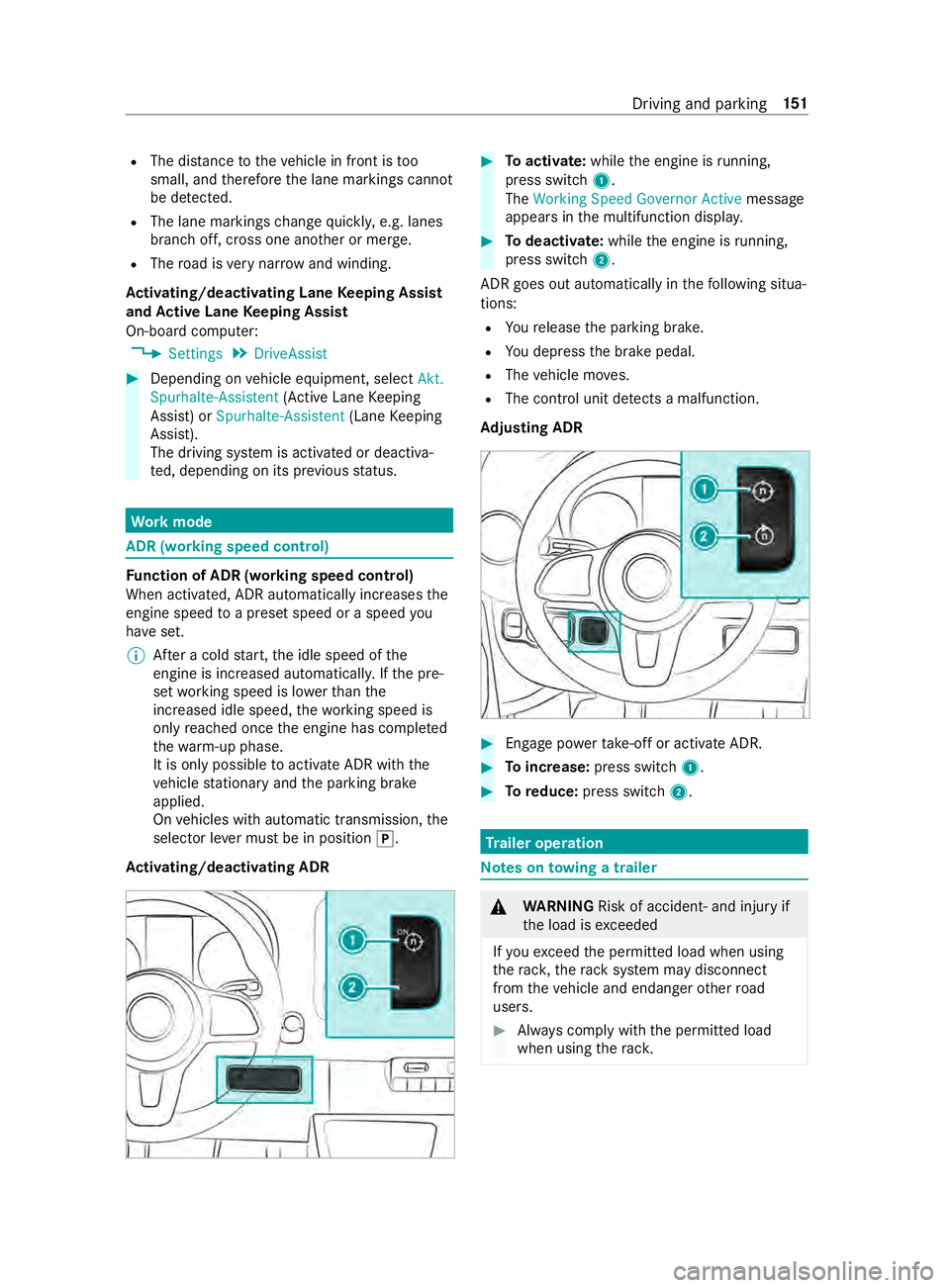
Ac tivating/deactivatin gADR #
Toactivate: whilethee ngine is running,
press switch 1.
The Working Speed Governo rActive messa ge
appear sinthe multifunction displa y. #
Todeactivate: whilethee ngine is running,
press switch 2.
ADR goe soutautomatical lyin thef ollowing situa‐
tions:
R Your elease thep arking brake.
R Youd epress theb rake pedal.
R The vehicle mo ves.
R The control unit de tects am alfunction.
Ad justin gADR #
Engag epowe rtake-o ffor acti vate ADR. #
Toincrease: press switch 1. #
Toreduce: press switch 2. Tr
aile roperation Note
sont owing atrailer &
WARNING Risk of accident‑ and injur yif
th el oad is exceeded
If yo ue xceed thep ermitted load when using
th er ack, ther acks ystemm aydisconnect
from thev ehicle and endanger other road
users. #
Alwaysc ompl ywitht he permitted load
when using ther ack. Driving and pa
rking 151
Page 179 of 322
Information abou
ttow ing atrailer Operatin
gatrailer is subject toman ystatutory
re gulations suc hasspeedrestrictions.
Man ystatesa lso requ ireana uxiliaryseparate
functional brakin gsystem when towing aweight
th at exc eeds acertain limit .For your saf ety, it is
re commended touse aseparat efunctional brak‐
ing sy stem on an ytowe dvehicle.
Mak esuret hat your trailer combinatio nmeets
local regulations. This no tonlya pplies to your
plac eofr esidence, but also to your destination.
In fo rm atio nont his can be obtained from the
police and local authorities.
Compl ywitht he following when driving wit ha
trailer:
R Practice cornering, stopping and backing up
in at raffic-free location. In this wa y,yo uw ill
ga in driving experience and become accus‐
to med tothen ew handling characteristics.
R Befor edriving, checkt he following:
- that thet railer towh itch and ball coupling
ar es ecure
- that thes afet ys wit ch forb rake dt railer sis
functioning cor rectly
- that thes afet yc hains ar esecur eand
undamaged
- that thee lectrical connection saresecure
- that thel ights ar efunctioning cor rectly
- thew heels ford ama geand cor rect tire
pressur e(/ page 202)
R Adjus tthe outside mir rors so that youh ave a
clea rviewoft herear sectio nofthe trailer.
R Ifth et railer is equipped wit hanindividual
braking sy stem, checkb efor eeachj ourney
whe ther theb rake sa refunctioning cor rectl y.
R Ifth et railer has electronicall ycont rolled
brakes, pull away carefully wi th thevehicle/
trailer combination .Brake manually using the
brak econtroller and checkw hether the
brakes ar efunctioning cor rectl y.
R Secu rethel oad on thet railer in line wit hthe
re qu irements and rules forl oad-securing
me thods.
R When driving wit hatrailer ,chec katr egular
inter vals that thel oad is secur eand that the
light sand brakes ar efunctioning cor rectl y.
R Bea rinm indthat theh andling characteristics
ar em oreu nstable when towing atrailer than when drivin
gwithout atrailer .Avoid sudden
st eering mo vements.
R The vehicle/trailer combination is heavier,
accelerates mor eslowl y,has areduced
climbing ability and an increased braking dis‐
ta nce. It is mor esusceptible toside winds
and requ ires careful steering.
R If possible, do no tbrake suddenl y,but rath er
moderately at firs tsot hatthet railer can acti‐
va te its brakes. Then inc rease thep ressur eon
th eb rake pedal.
R Ifth ea utomatic transmission shifts between
ge arsonu phill or downhill gradients, restrict
th es hiftrange. Select shif trang e4,3,2or1.
Al ow ergear and reduced speed decrease the
ri sk of engine damage.
R When driving on adownhill gradient, shif ttoa
lo we rgear touse thee ngine' sbraking ef fect.
Av oid cons tant braking, as this could cause
th ev ehicle brakes and possibly also the
traile rbrake stoo verheat.
R Ifth ec oolant temp eratur eincreases signifi‐
cant lywhen thea ir-conditionin gsystemis
switched on, switc hthe air-conditioning sys‐
te mo ff.
Coolant heat can also be dissipated by
switching thea irflow and thet emperatur eof
th eh eater or air conditioning tothem aximum
le ve l. Open thew indo wsif necessar y.
R When overtaking ,pay particular attention to
th ei ncreased overtakin gdista nce of your
ve hicle/trailer combination.
Due tothel engt hofy ourvehicle/trailer com‐
bination youw illrequ ireal onger stre tchof
ro ad befor eswit ching bac ktothe original
lane. Pe
rm issible trailer loads and trailer dr awbar
nose weights We
ight information &
WARNING Risk of accident du eto
unbraked trailer wit hexcessivel yhigh
gross weight
If yo ut ow atrailer without aseparat efunc‐
tional brakin gsystema ndagross trailer
we ight (G TW)ofm oret han 1635 lbs (750 kg),
th en thev ehicle brak esystemm ayove rheat.
This increases theb raking dis tance and the
brak esystem ma yevenf ail. Driving and parking
15 5
Page 184 of 322
%
Ve
hicles without Activ eD ista nce Assist
DISTRO NIC:youc an call up them ain menu
of theo n-boar dcomputer wit hthe 00E2 but‐
to n. #
Tobrows ethrough them enu bar: swipeto
th el eftorr ight on left-han dTouc hControl
2. #
Tocall up amenuorc onfirmas election:
press left-han dTouc hControl 2. #
Tobrows ethrough displa ysor lists in the
menu: swipe upwards or down wardsonl eft-
hand Touc hC ontrol 2. #
Tocall up asubmenu or confir maselec‐
tion: press left-han dTouc hControl 2. #
Toexitas ubmenu: presstheb ackb utton on
th el eft 1.
If yo ua reinas ubmenu and press and hold the
bac kbutton on thel eft 1,t he main menu
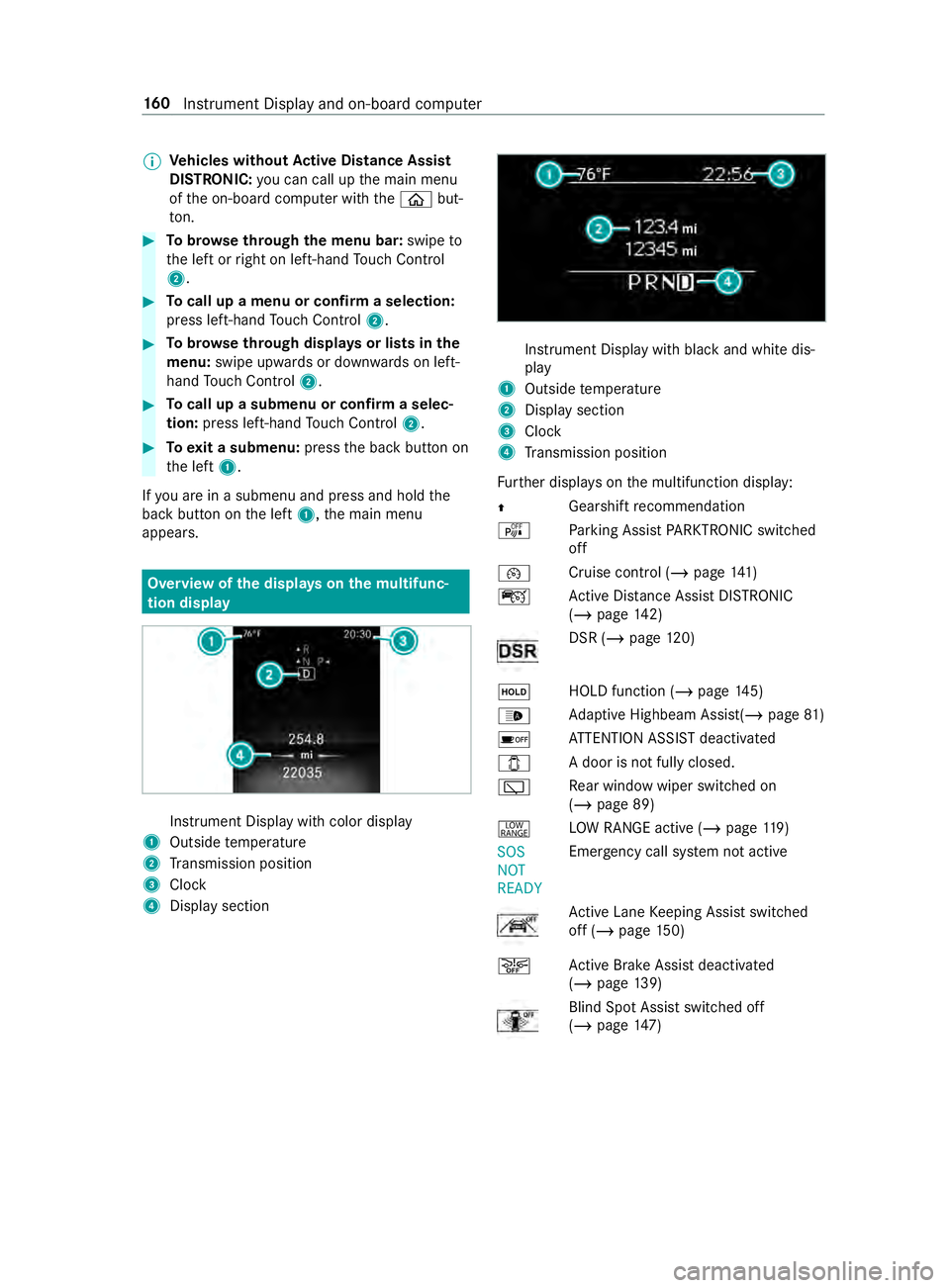
appears. Overvie
wofthe displa yson them ultifunc‐
tion display In
stru ment Displa ywithc olor display
1 Outsid etemperature
2 Transmission position
3 Clock
4 Displa ysection In
stru ment Displa ywithb lack and whit edis‐
play
1 Outside temp erature
2 Displa ysection
3 Clock
4 Transmission position
Fu rther displa yson them ultifunction display:
0097 Gearshif
trecommendation
é Parking Assis tPARKTRONIC switched
off
00B2 Cruise control (/
page 141)
ç ActiveD ista nce Assi stDISTRONIC
(/ page 142) DSR (/
page 120)
00D9 HOLD fu
nction(/pa ge145)
00CE Ad
aptiv eHighbeam Assist(/ page81)
00D7 AT
TENTION ASSIS Tdeactivated
003E Ad
oor is no tfully closed.
00C5 Re
ar wind owwiper swit ched on
(/ page89)
002E LO
WR ANGE activ e(/pag e119 )
SOS
NOT
RE ADY Emergency cal
lsyst em no tactive Ac
tiveL aneK eeping Assis tswitched
of f(/pag e150)
00D4 Ac
tiveB rake Assi stdeactivated
(/ page139) Blind Spo
tAssistswitched off
(/ page147) 16 0
Instrument Displa yand on-boar dcomputer