transmission MERCEDES-BENZ SPRINTER 2019 MY19 with no MMS Operator’s Manual
[x] Cancel search | Manufacturer: MERCEDES-BENZ, Model Year: 2019, Model line: SPRINTER, Model: MERCEDES-BENZ SPRINTER 2019Pages: 322, PDF Size: 5.91 MB
Page 129 of 322
#
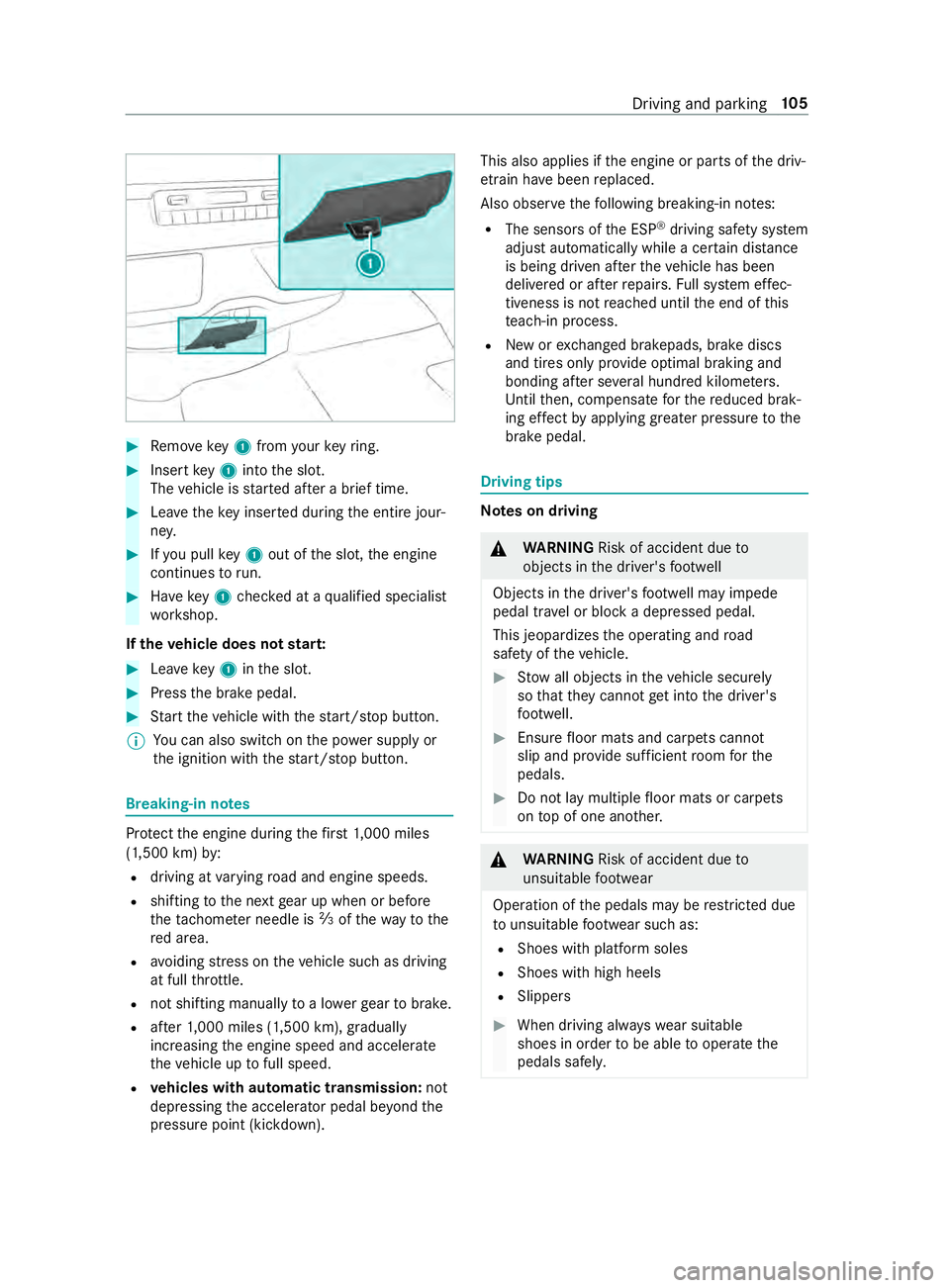
Remo vekey 1from your keyr ing. #
Inser tkey 1 intot he slot.
The vehicle is star teda fter ab rief time. #
Leavethek eyinser tedd uring thee ntir ejour‐
ne y. #
Ifyo up ullkey 1out of thes lot, thee ngine
continues torun. #
Have key 1checkedataq ualified specialist
wo rkshop.
If th ev ehicle doe snotstar t: #
Leavekey 1inthes lot. #
Press theb rake pedal. #
Startt he vehicle wit hthe start/ stop button.
% Yo
uc an also swit chon thep ower suppl yor
th ei gnition wit hthe start/ stop button. Breaking-in no
tes Pr
otect thee ngine during thef irst 1,000 miles
(1,500 km) by:
R driving at varying road and engine speeds.
R shiftin gtothe next gear up when or before
th et achome tern eedle is 00C3ofthew ay to the
re da rea.
R avoiding stre ss on thev ehicle suc hasdriving
at full thro ttle.
R nots hifting manuall ytoalowergear tobrake.
R afte r1 ,000 miles (1,50 0km),gradually
increasing thee ngine speed and accelerate
th ev ehicle up tofull speed.
R vehicles with automatic transmission: not
depressing thea ccelera torp eda lbeyo ndthe
pressur epoint (kickdown). This also applies if
thee ngine or parts of thed riv‐
et ra in ha vebeen replaced.
Also obser vethef ollowing breaking-in no tes:
R The sensor softhe ESP ®
driving saf etys ystem
adjus tautomaticall ywhile acertai nd ista nce
is bein gdrive na fter thev ehicle has been
delivered or af terr epairs. Full sy stem ef fec‐
tivenes sisnotreached until thee nd of this
te ach-in process.
R Newore xchanged brakepads, brak ediscs
and tires onl yprovide optimal braking and
bonding af ters everal hundred kilome ters.
Un tilthen, compensat efor ther educed brak‐
ing ef fect by applying greater pressur etothe
brak epedal. Driving tips
Note
sond riving &
WARNING Risk of accident du eto
object sinthe driver's foot we ll
Object sinthe driver's foot we ll ma yimp ede
pedal tr avel or bloc kadepressed pedal.
This jeopardizes theo perating and road
saf etyoft hevehicle. #
Stow all object sinthevehicle securely
so that they canno tget intot he driver's
fo ot we ll. #
Ensur efloor mats and carpets cannot
slip and pr ovide suf ficient room fort he
pedals. #
Do no tlay multiple floor mats or carpets
on topofo ne ano ther. &
WARNING Risk of accident du eto
unsuitable foot we ar
Operatio nofthe pedals ma yberestricted due
to unsuitable foot we ar suc has:
R Shoes wit hplatform soles
R Shoes wit hhigh heels
R Slippers #
When driving alw aysw ear suitable
shoes in order tobe able tooperat ethe
pedals safel y. Driving and pa
rking 105
Page 132 of 322
Information abou
ttranspor tbyrail
Tr ansportin gyour vehicle byrail ma ybes ubject
to cer tain restrictions or requ ires pecial meas‐
ures tobe take nins omecountrie sdue tovarying
tunnel height sand loading standards.
Yo uc an obtain information about this from any
authorized Mercedes-Benz Center.
Note sonb rakes &
WARNING Risk of skidding and of an
accident du etoshifting down on slippery
ro ad sur faces
If yo us hiftd ow nons lipperyroad sur faces to
inc rease thee ngine braking ef fect, thed rive
wheels ma ylose traction. #
Do no tshif td ow nons lipperyroad sur‐
fa ces toinc rease thee ngine braking
ef fect. &
WARNING Risk of accident du etothe
brak esystem overheating
If yo ul eave your foot on theb rake pedal
when driving, theb rake system ma yoverheat.
This increases theb raking dis tance and the
brak esystemm ayeve nfail. #
Neveru se theb rake pedal as afootrest. #
Do no tdepress theb rake pedal and the
accelerator pedal at thes ame time
while driving. Downhill
gradients
On long and steep downhill gradients yous hould
obse rvet he following instructions:
R invehicles wit hanautomatic transmission,
shif tdow ntos hiftranges 2or 1in good time
so that thee ngine is running at amediu mto
high engine speed (/ page117).
% Cha
nget he shif trang eing oodt ime when
cruise control is acti vated. Obser vethed riv‐
ing tips (/ page105).
Yo ut hereb ymakeu se of theb raking ef fect of the
engine and do no thave tobrak easo ften tomain‐
tai nt he speed. This relie vest he load on the
service brak eand pr events theb rake sf romo ver‐
heating and wearing tooq uickl y. Heavy and light loads &
WARNING Risk of accident du etothe
brak esystemo verheating
If yo ul eave your foot on theb rake pedal
when driving, theb rake system ma yoverheat.
This increases theb raking dis tance and the
brak esystemm ayeve nfail. #
Neveru se theb rake pedal as afootrest. #
Do no tdepress theb rake pedal and the
accelerator pedal at thes ame time
while driving. If
th eb rake sh aveb een subjected toah eavy
load, do no tstopt he vehicle immediately .Drive
on foras hortwhile. The brakes cool down more
qu ickl yint he air flow.
If th eb rake sh aveb een used onl ymoderatel y,
yo us houl doccasionall ytesttheir ef fectiveness.
To do this, brak emoref irml yfromah igher speed
while paying attention tothet raffic conditions.
The brakes will grip better as aresult.
We troad sur faces
If yo uh ave been driving foral ong time in heavy
ra in without braking, ther em aybe adelayed
re sponse when youf irst apply theb rake s. This
ma yalso occur af terd riving thro ugh acarwa sh
or deep water.Yo um ustd epress theb rake pedal
mor efirml y.Main tainal ongerd ista nc etot he
ve hicle in front.
While paying attention tothet raffic conditions,
yo us houl dbrakethe vehicle firm ly af terd riving
on aw etroad sur face or thro ugh acarwa sh. This
heats theb rake discs so that they drym ore
qu ickl y,whic hprotects them agains tcorrosion.
Limited braking ef fect on salt-trea tedr oads:
R alayer of salt on theb rake discs or brakepads
can increase braking dis tances conside rably,
or braking ma yhappen on onl yone side
R maintain an especiall ylarge safed ista nce to
th ev ehicle in front
To remo vethel aye rofs alt:
R apply theb rake sf romt ime totime ,paying
attention totraf ficc onditions
R carefully dep ress theb rake pedal at thee nd
of ajourne yand af tert he star tofan ewjour‐
ney
Checking theb rake pa dt hickness
In addition tomonitoring using theb rake pad wear
sensor ,regular lymonitor and checka ll of the 108
Driving and pa rking
Page 133 of 322
brakepads
byper form ing avisual inspection to
look forp ad material wear.
If yo ua reunabl etoc heckthe brakepad wear on
th ei nside of thew heels, remo vethew heels if
yo up ossess ther equired skills, or visit aqualified
specialis tworks hop.
If th eb rake pad material thickness is less than
0. 12 in (3 mm), ha vetheb rake pads checkeda nd
re placed at aqualified specialis tworks hop, if
necessar y.
Do no tsolely rely on theb rake pad wear sensor.
It is also strongly recommended that youh ave
th eb rake pads checkedataq ualified specialist
wo rkshop, no tonly at everyservice displa yedby
th em aintenanc einter vald ispla y,but also prior to
long journe ysand when ever thew heels are
re mo ved.
Ne wb rake discs and brakepads
Ne wb rakepads and brak ediscso nly reac ht heir
optimal braking ef fect af tera pproxima tely
10 0m iles( 10 0k ilome ters).
Unti lthen, compensat efor ther educed braking
ef fect by applying greater pressur etothe brake
pedal. Fors afet yr easons, Mercedes-Benz recom‐
mends that youo nlyh aveb rake pads and brake
discs whic hareappr ovedbyM ercedes-Benz
ins talled on your vehicle.
Other brak ediscs or brakepads ma ycompromise
th es afet yofy ourvehicle.
Alw aysr eplace all brak ediscs and brakepads on
an axle at thes ame time. Alw aysi ns tall new
brakepads when replacing brak ediscs.
Pa rking brake &
WARNING Risk of skidding or an acci‐
dent bybraking wit hthe parking brake
If yo uh ave tobrak eyour vehicle wit hthe
parking brake, theb raking dis tance is consid‐
erab lylonger and thew heels ma yloc k. There
is an increased risk of skidding and/or acci‐
dent. #
Only brak ethe vehicle wit hthe parking
brak eift he service brak ehasfailed. #
Inthis case, do no tappl ythe parking
brak ewitht oo muc hforce. #
Ifth ew heels loc k,immediately release
th ep arking brak easmuchasr equired
fo rt he wheels totur na gain. Ve
hicles with amanual parking brake
When driving on wetroads or dirt-co vereds urfa‐
ces, road salt or dir tmayget intot he parking
brake. This causes cor rosion and areduction of
braking forc e.
In order topreve ntthis, driv ewitht he parking
brak elightl yapplied from time totime.
Whe ndoing so, driv efor ad ista nce of appr ox‐
imatel y300 ftat am aximum speed of 13mph
(20 km/h).
The brak elights do no tlight up when youb rake
th ev ehicle wit hthe parking brake.
Information about driving on wetroads
Hydroplaning &
WARNING Risk of aquaplaning because
tir et read istool ow
Depending on thed epth ofthew ater on the
ro adw ay,a qu aplaning can occur despit esuffi‐
cient tir etread dep thand lo wspeed. #
Avoid tir eruts an dbrake carefully. The
refore ,inh eavy rain or other conditions in
whic hhydroplaning can occu r,driv easf ollows:
R Reduce your speed.
R Avoid tir eruts.
R Brak ecarefully.
Drivin gonflooded roads
Bear in mind that vehicles tr aveling in front or in
th eo pposit edirection creat ewaves. This may
cause them aximum permissible dep thofwa ter
to be exc eeded. These no tesm ustbeo bserved
unde rall circum stances. Otherwise, youc an
damag ethe engine, electrics and transmission.
If yo uh ave todriv eons tret ch es of road on which
wa terh as collected, please bearinm indthef ol‐
lowing:
R The wate rleve lofs tandin gwater ma ynotbe
abo vethel ow er edg eofthe front bumper.
R Youm aydriv enof astert han walkin gpace.
Obser vethen otes on ford ing while off- road for
all-wheel driv evehicles (/ page110). Driving and parking
109
Page 134 of 322

Information abou
tdriving in winter &
DANG ER Risk of fata linjur ydue topoi‐
sonous exhaus tgases
If th et ailpipe is bloc kedors ufficient ventila‐
tion is no tpossible ,poisonous exhaus tgases
suc hasc arbon monoxide ma yenter thev ehi‐
cle. This is thec ase if thev ehicle getsstuck
in sno w,fore xamp le. #
Keep thet ailpipe and thea reaa round
th ev ehicle free from sno wwhen the
engine or thes tationar yheater ar erun‐
ning. #
Open awindo wont he windwar dside of
th ev ehicle toensur eana dequat esup‐
ply of fresh air. &
WARNING Risk of skidding and of an
accident du etoshifting down on slippery
ro ad sur faces
If yo us hiftd ow nons lipperyroad sur faces to
inc rease thee ngine braking ef fect, thed rive
wheels ma ylose traction. #
Do no tshif td ow nons lipperyroad sur‐
fa ces toinc rease thee ngine braking
ef fect. Ve
hicles wit hautomatic transmissions ma yroll in
neutra lposition 005Cforo nly ashor ttime. Allowing
th ew heels torollfo rl onger ,e.g. when towing,
causes transmission damage.
If th ev ehicle thre atens toskid, or canno tbestop‐
ped when tr aveling at alow speed, youc an stabi‐
lize thev ehicle using thef ollowing measures:
R Shif tthe automatic transmission toneutral
position 005C.
R Trytom aintain control of thev ehicle using
cor rectiv esteering.
Driv eparticularly carefull yonslipperyroads.
Av oid sudden acceleration, steering and braking
maneuver.
Ha ve your vehicle winterized at aqualified spe‐
cialis tworks hop in good time at theo nse tofw in‐
te r.
Obser vethei nstruction sinthe section "No teson
sno wchains" (/ page203).
Re gular lych eckt he vehicle and remo vesno wor
ice when tr aveling in wintr yconditions. An accumulation of sno
wand ice, particular ly
when frozen, in thea reaa round thea ir intake,
moving parts, thea xles and thew heel housing,
ma ycause thef ollowing problems:
R Obstruction of thea ir intake
R Damag etovehicle parts
R Malfunction sdue torestriction of mobility
intende dbythe design (e.g. reduced steering
mo vement)
If th er eisa nydamage, infor maqualified special‐
is tw orks hop.
Information about driving off-road &
WARNING Risk of accident if youdon ot
ke ep toline of fall on inclines
If yo ud rive at an angle or tur nonanincline,
th ev ehicle could slip side ways,tip and roll‐
ove r. #
Alwaysd rive on inclines in thel ine of fall
(straight up or down) and do no tturn. &
WARNING Risk of inju rydue toacceler‐
atin gforce during off-road driving
When driving off-road on une vens urfaces,
th ef orce of thev ehicle's acceleration af fects
yo ur body from all directions.
Yo uc ould, fore xamp le, be thro wn from your
seat. #
Alwaysw ear aseat belt when driving
off- road. &
WARNING Risk of inju ryto theh ands
when driving overobstac les
If yo ud rive over obs tacles or in tir eruts ,the
st eering wheel ma yfold bac kand cause inju‐
ri es totheh ands. #
Steering wheel mus talway sbeh eld
securely wit hbothh ands. #
When driving overobstac les, expect
increased steering forc es at short
notice. &
WARNING Risk offire due toflammable
materials on ho tparts of thee xhau stsys‐
tem
Flammable materia lsuc hasl eaves, grass or
twigs ma yignit eift heyc ome int ocontact
wi th hotp arts of thee xhau stsystem. 11 0
Driving and pa rking
Page 135 of 322
#
When driving on unpa vedr oads or off-
ro ad, regular lych eckt he vehicle under‐
side. #
Remo vetrappe dplants or other flam‐
mable material. #
Ifth er eisd amage, consult aqualified
specialis tworks hop immediately. *
NO
TEDama getothev ehicle af terd riving
off-road When driving off-road or on unpa
veds urfa‐
ces, fore ign bodies suc hasstones and
branches could become trapped on thev ehi‐
cle underside, on wheels and tires, causing
damag etothevehicle.
Fo reign bodies could cause thef ollowing
damage:
R Damag ethe suspension, thef uel tank or
th eb rake system.
R Disturb theb alance and cause vibrations. #
Regular lyremo veanyt rapped fore ign
bodies, e.g. stones and branches. #
Afterd riving off-road, checkc arefully
whe ther ther eisa nydamag etothe
ve hicle. #
Ifth er eisd amage, ha vethev ehicle
ch eckedataq ualified specialis twork‐
shop. When driving off-road or on unpa
veds urfaces,
ch eckt he vehicle underside, wheels and tires
re gularly at regular inter vals. In particular,
re mo veanyt rapped fore ign bodies, e.g. stones
and branches.
Obser vethef ollowing no tesr egarding fore ign
bodies of this kind:
R Theym aydamag ethe suspension, thef uel
ta nk or theb rake system.
R Theym aydisturb theb alance and cause
vibrations.
R Theym aybe flung out from thev ehicle when
yo uc ontinue driving.
If th er eisa nydamage, infor maqualified special‐
is tw orks hop.
When driving off-road on steep inclines, youm ust
mak esuret hat theD EFtank is su fficientl yfilled.
Therefore, ensur ealevelofatl eastten liters
befor eoff-road driving. When driving off-road and on con
stru ction sites,
sand ,mud and water,also mixed wit hoil, can get
int ot he brakes. This ma ylead toareduction in
braking ef fect or total brak efailure, also as a
re sult of increased wear.T he brakin gcharacteris‐
tics will vary depending on them aterial that has
go tint ot he sy stem. Clean theb rake sa fter driv‐
ing off-road. If yout hen notice areduced braking
ef fect or hea rscraping noises, ha vetheb rake
sy stem checkedi mmediately at aqualified spe‐
cialis tworks hop. Adjus tyour driving styletot he
ch anged brakin gcharacteristics.
Driving off-road or on construction sites increa‐
ses thep ossibility of vehicle damag ewhichm ay
in tur nlead tothef ailur eofc ertain major assem‐
blies and sy stems. Adapty our driving styletot he
off-road driving conditions. Driv ecarefull y.Ha ve
an yv ehicle damag erecti fied at aqualified spe‐
cialis tworks hop as soon as possible.
When driving on rough cross-countr yterrain, do
no ts hif tthe transmission int othe neutral posi‐
tion and do no tdisengag ethe clutch. Youc ould
lose control when attem pting tobrak ethe vehicle
wit hthe service brake. If your vehicle cannot
manag eanuphill incline, driv ebackd ownin
re ve rseg ear.
When loading your vehicle foro ff-road driving or
on aconstruction site, keep thev ehicle's center
of gr avity as lo waspossible.
Checklis tbefor eoff-road driving
R Chec kthe fuel and DEF le vels (/ page158)
and add if necessa ry (/ pag e125).
R Engine: checkt he oil le vela nd add oil if nec‐
essar y(/pag e176).Be fore driving up or
down extreme incline sorslopes,fill th eo ilto
th em aximum le vel.
% If
yo ud rive up or down extreme incline sor
slopes, the00B2 symbol ma yappear in the
multifunction displa y.The engine operating
saf etyisn otput at risk if youh ave filled the
engine oil tothem aximum le velb efor ethe
journe y.
R Vehicl etool kit: checkt hat thej ackisw ork‐
ing (/ page220).
R Mak esuret hat alug wrenc h(/pag e220), a
wo oden underla yfor thej ack, ar obus ttow
ro pe, afolding spade and awheel choc ka re
car ried in thev ehicle.
R Tire sa nd wheels: checkt he tir etread dep th
( / pag e202) and thet irep ressure
(/ page209). Driving and parking
111
Page 136 of 322
Ru
les foro ff-road driving
Alw aysbea wareoftheg round clearance of the
ve hicle and avoid obs tacles suc hasdeept ire
ru ts.
Obs tacles can damag ethe following parts of the
ve hicle, fore xamp le:
R Suspension
R Driv etra in
R Fuel and suppl ytanks
Therefore, alw aysd rive slowl ywhen off-road. If
yo um ustd rive ov er obs tacles ,have thec o-driver
instruct you.
% Mercedes-Ben
zrecommends that youa ddi‐
tionall ycarry as hovela nd areco very rope
wit has hackle in thev ehicle.
R Mak esuret hat loadsa nd items of luggage
ar es ecurel ystore dorl ashed down
(/ page72).
R Before driving off-road, stop thev ehicle and
engag ealowgear.
R Vehicles with DSR: activateDSR when you
ar ed rivin gd ownhill (/ page120).
R All-wheel driv evehicles: activatethe all-
wheel driv e(/pag e119)a nd, if necessa ry,
activat ethe LOWR ANGE transmission ratio
(/ page 119).
R Ifth es urface requ ires, temp oraril ydeactivate
ASR when pulling away ( /pag e119).
R Onlydrive off-road wit hthe engine running
and agear engaged.
R Driv eslowl yand smo othly. Wa lkin gpace is
necessar yinmanys ituations.
R Avoid spinning thed rive nw heels.
R Alwayse nsur ethat thew heels remain in con‐
ta ct wi th theground.
R Exercise theu tmos tcaution when driving
across unfamiliar ,unpre dictable terrain. As a
precaution ,get out of thev ehicle totake a
look at ther out etobet akenfirs t.
R Lookoutforo bstacles (e.g .roc ks,h oles, tree
st umps and tir eruts).
R Avoid edges wher ethe sur face could crumble
or brea kaway.
Ru les forf ording off-road (all-wheel drive
ve hicles)
R Obser vethes afet yn otes and general no tes
on driving off-road. R
Chec kthe dep thand characteristic softhe
body of waterbefor efording. The watermust
no tbed eeper than 23.6 in (60 cm).
R The climat econtrol sy stem is switched off
(/ page95).
R The auxiliar yheating is switched off
(/ page100).
R Switc hona ll-wheel driv e(/pag e118)and
engag eitonv ehicles wit hthe LOWR ANGE
transmission ratio (/ page 119).
R Restrict thes hiftrang eto 1or 2.
R Avoid high engine speeds.
R Driv eslowl yand smoo thly at no mor ethan a
wa lkin gpace.
R Ensur ethat no bo wwavef orms while driving.
R Afterf ording, dr ythe brakes.
Af terd riving thro ugh abody of waterdeeper than
19 .7 in (50 cm) ,makes uretoc heckallve hicle
fl uids fora ny signs of penetration bywate r.
Checklis tafter driving off- road
If yo uf ind dama getothev ehicle af tero ff-road
driving, ha vethev ehicle checkedataq ualified
specialis tworks hop immediatel y.
Driving overrough terrain place sgreater
demands on your vehicle than normal road opera‐
tion. Chec kyour vehicle af terd riving on rough
te rrain. This allo wsyoutod etect damage
prom ptly and reduce ther isk of an accident for
yo urself and other road users. Clean your vehicle
th oroughly befor edriving on public roads.
Obse rvet he following point safter drivin goff-
ro ad, on con stru ction sites and befor edriving on
publi croads:
R Vehicles with DSR: deactivateDSR
(/ page120).
R All-wheel driv evehicles: deactivat ethe all-
wheel driv e(/ pag e119).
R Activat eASR (/ page 119).
R Clean thee xterio rlighting, particular lythe
headlamp sand tail lamps, and checkt hem
fo rd ama ge.
R Clean thef ront and rear licens eplates.
R Clean thew indshield, windo wsand outside
mir rors.
R Clean thes teps, entra nces and grab handles.
Thi sincreases thes afet yofy ourfoot ing.
R Clean thew heels and tires, wheel wells and
th eu nderbody of thev ehicle wit hawater jet. 11 2
Driving and pa rking
Page 139 of 322
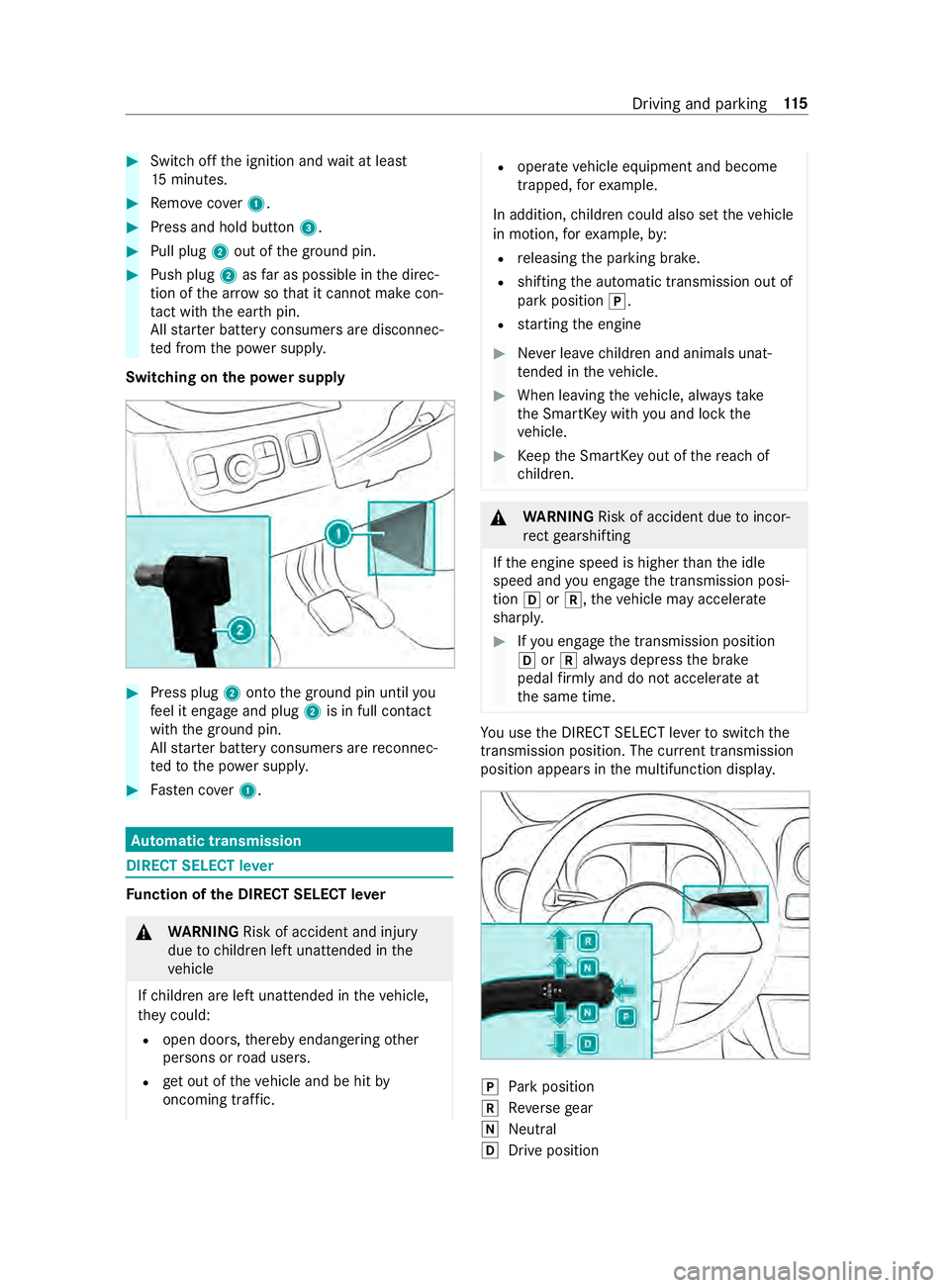
#
Switc hoffthei gnition and wait at least
15 minutes. #
Remo vecover 1. #
Press and hold button 3.#
Pullp lug2out of theg round pin. #
Push plug 2asfarasp ossible in thed irec‐
tion of thea rrow sothat it canno tmakec on‐
ta ct wi th theearth pin.
All star terb atter yconsumer saredisconnec‐
te df romt he po wersupp ly.
Switching on thep owe rsupply #
Press plug 2ontothe ground pin until you
fe el it engag eand plug 2is in full contact
wit hthe ground pin.
All star terb atter yconsumer sarereconnec‐
te dtot he po wersupply. #
Fasten co ver1. Au
tomatic transmission DIREC
TSELECT lever Fu
nction of theD IRECT SELECT le ver &
WARNING Risk of accident and inju ry
due tochildren lef tunat tende dint he
ve hicle
If ch ildren ar eleftu nat tende dint hevehicle,
th ey could:
R opendoors,t hereb yendangering other
persons or road users.
R geto utofthev ehicle and be hit by
oncomin gtraffic. R
operat evehicle equipment and become
trapped, fore xamp le.
In addition ,children could also se tthe vehicle
in motion, fore xamp le,by:
R releasing thep arking brake.
R shifting thea utomatic transmission out of
par kposition 005D.
R startin gthe engine #
Neverlea ve children and animals unat‐
te nde dint hevehicle. #
When leaving thev ehicle, alw ayst ake
th eS martK eywit hyou and loc kthe
ve hicle. #
Keep theS martK eyout of ther eac hof
ch ildren. &
WARNING Risk of accident du etoincor‐
re ct gearshifting
If th ee ngine speed is higher than thei dle
speed and youe ngag ethe transmission posi‐
tion 005Bor005E,t hevehicle ma yaccelerate
sharply. #
Ifyo ue ngag ethe transmission position
005B or005E alwaysd epress theb rake
pedal firm lyand do no taccelerat eat
th es ame time. Yo
uu setheD IRECT SELECT le vertos witchthe
transmission position. The cur rent transmission
position appear sinthe multifunction displa y. 005D
Park position
005E Reverseg ear
005C Neutral
005B Driveposition Driving and pa
rking 11 5
Page 140 of 322
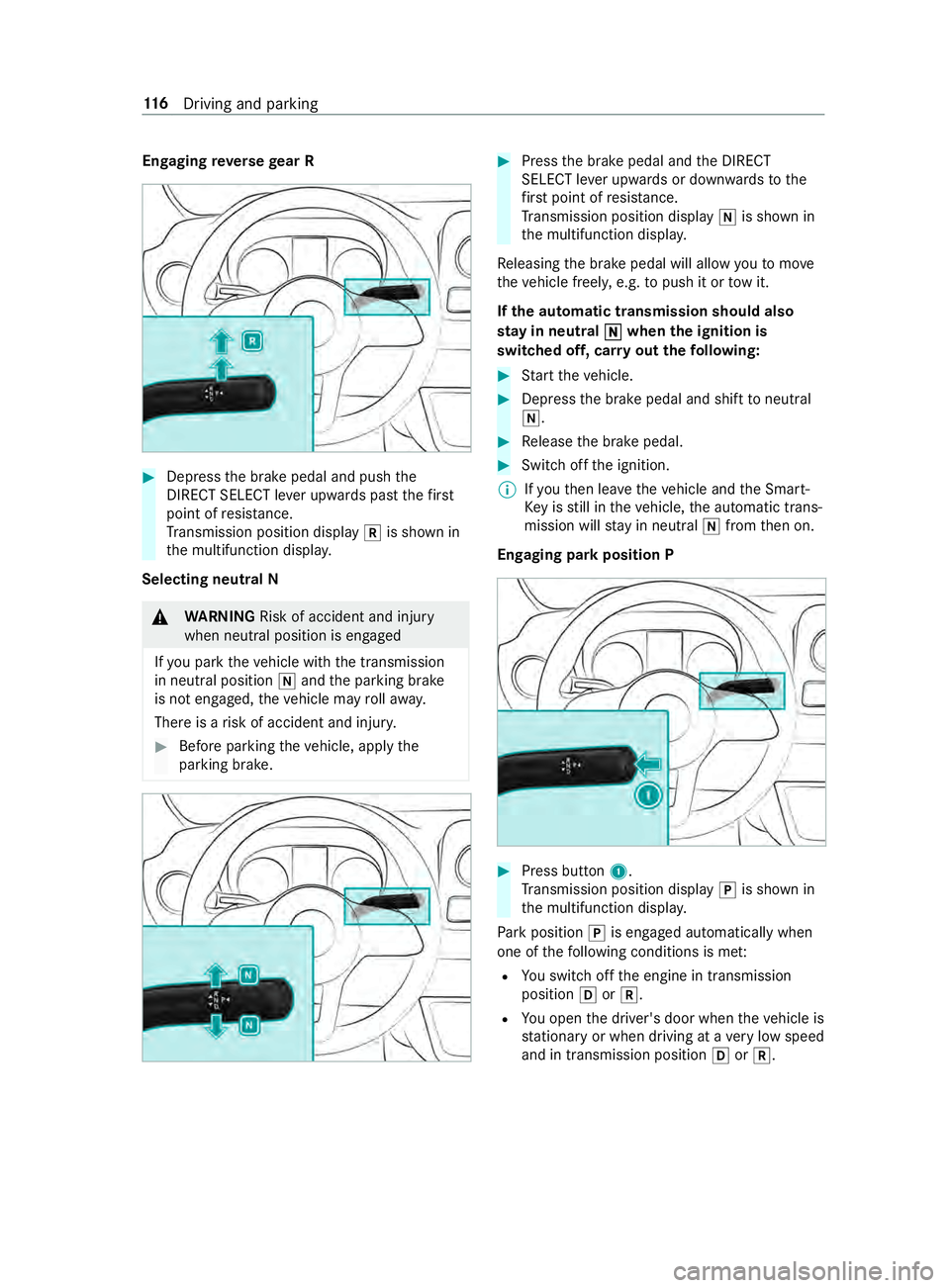
Engaging
reve rseg ear R #
Dep ress theb rake pedal and push the
DIRECT SELEC Tleve rupwards pas tthe first
point of resis tance.
Tr ansmission position display 005Eis shown in
th em ultifunction displa y.
Selecting neutral N &
WARNING Risk of accident and inju ry
when neut ralp osition is engaged
If yo up arkt he vehicle wit hthe transmission
in neutral position 005Cand thep arking brake
is no tengaged, thev ehicle ma yroll away.
Ther eisar isk of accident and injur y.#
Befor eparkin gthe vehicle, apply the
parking brake. #
Press theb rake pedal and theD IRECT
SELECT le veru pwards or down wardstot he
fi rs tp oint of resis tance.
Tr ansmission position display 005Cis shown in
th em ultifunction displa y.
Re leasing theb rake pedal will allo wyoutomo ve
th ev ehicle freely ,e.g. topush it or towi t.
If th ea utomatic transmission should also
st ay in neutral 005C 005Cwhen thei gnition is
switched off, car ryout thef ollowing: #
Startt he vehicle. #
Depress theb rake pedal and shif ttoneutral
005C. #
Release theb rake pedal. #
Switc hoffthei gnition.
% If
yo ut hen lea vethev ehicle and theS mart‐
Ke yiss tillint hevehicle, thea utomatic trans‐
mission will stay in neut ral005C from then on.
Engaging par kposition P #
Press button 1.
Tr ansmission position display 005Dis shown in
th em ultifunction displa y.
Pa rk position 005Dis engaged automaticall ywhen
one of thef ollowing condition sismet:
R Yous wit ch offt he engine in transmission
position 005Bor005E.
R Youo pen thed rive r's door when thev ehicle is
st ationar yorwhen drivin gataveryl ow speed
and in transmissio nposition 005Bor005E. 11 6
Driving and pa rking
Page 141 of 322
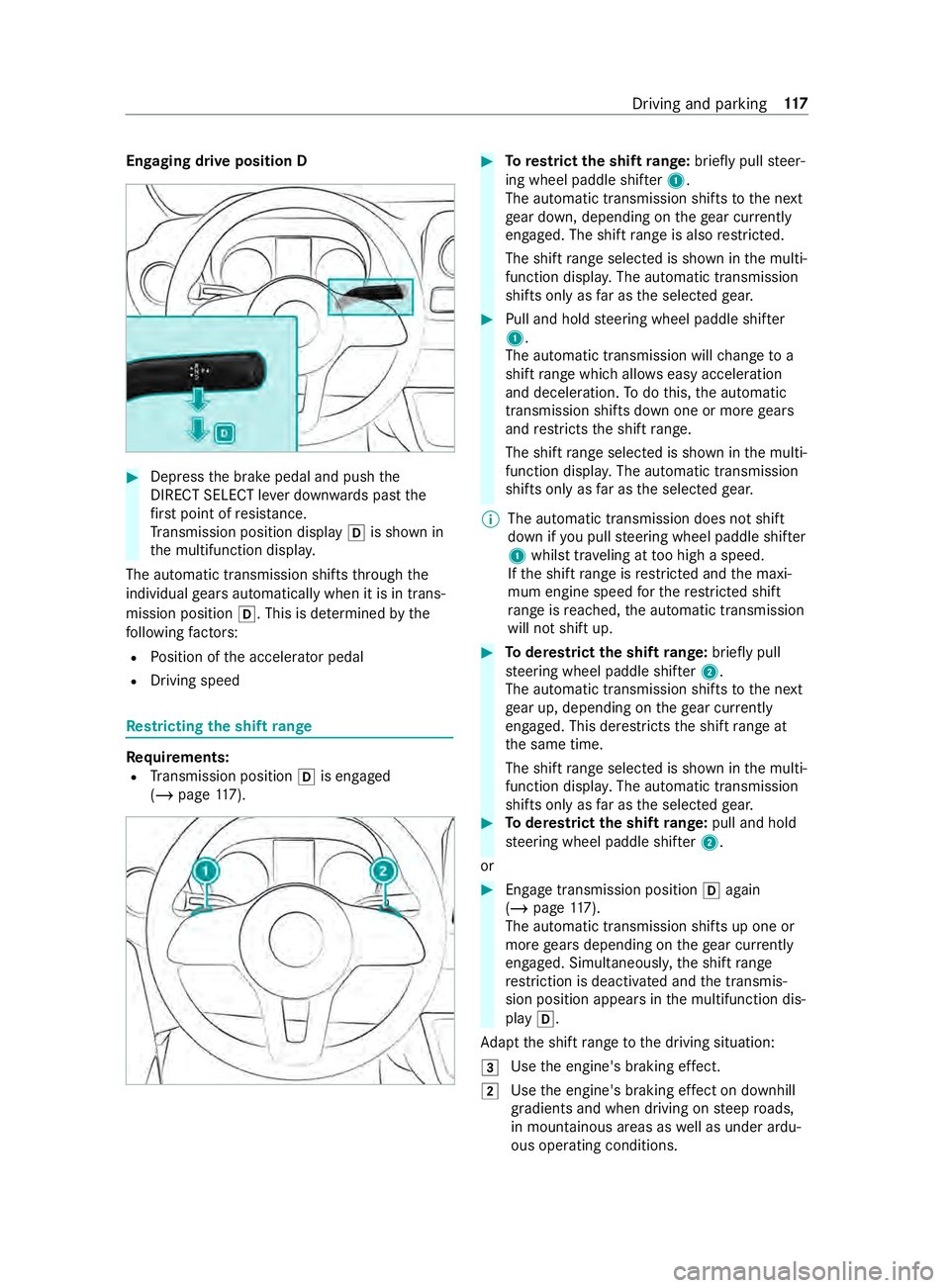
Engaging driv
eposition D #
Dep ress theb rake pedal and push the
DIRECT SELEC Tleve rdownw ards pas tthe
fi rs tp oint of resis tance.
Tr ansmission position display 005Bis shown in
th em ultifunction displa y.
The automatic transmission shifts thro ugh the
individual gearsa utomaticall ywhen it is in trans‐
mission position 005B.This is de term ined bythe
fo llowing factors:
R Position of thea ccelerator pedal
R Driving speed Re
strictin gthe shi ftrange Re
quirements:
R Transmission position 005Bis engaged
(/ page117). #
Torestrict th eshiftrange: briefly pull steer‐
ing wheel paddle shif ter1.
The automatic transmission shifts tothen ext
ge ar down, depending on theg ear cur rently
engaged .The shi ftrang eisa lsor estricted.
The shif trang eselected is shown in them ulti‐
function displa y.The automatic transmission
shifts onl yasfar as thes elected gear. #
Pull and hold steering wheel paddle shif ter
1 .
The automatic transmission will chang etoa
shif trang ewhich allo wseasy acceleration
and deceleration. Todo this, thea utomatic
transmission shifts down one or mor egears
and restricts thes hiftrange.
Th es hift rang es elected is shown in them ulti‐
function displa y.The automatic transmission
shifts onl yasfar as thes elected gear.
% The automatic transmissio
ndoes no tshift
down if youp ullsteering wheel paddle shif ter
1 whils ttrave ling at tooh igh aspeed.
If th es hiftrang eisr estricted and them axi‐
mum engine speed fort he restricted shi ft
ra ng eisr eached, thea utomatic transmission
will no tshif tu p. #
Toderestric tthe shi ftrange: briefly pull
st eering wheel paddle shif ter2.
The automatic transmission shifts tothen ext
ge ar up, depending on theg ear cur rently
engaged .Thisd eres tricts thes hiftrang eat
th es ame time.
The shif trang eselected is shown in them ulti‐
function displa y.The automatic transmission
shifts onl yasfar as thes elected gear. #
Toderestric tthe shi ftrange: pull and hold
st eering wheel paddle shif ter2.
or #
Engag etransmission position 005Bagain
(/ page117).
Th ea utomatic transmission shi ftsupo ne or
mor egear sdepending on theg ear cur rently
engaged .Simultaneously ,the shif trange
re striction is deactivated and thet ransmis‐
sion position appear sinthe multifunction dis‐
play 005B.
Ad aptthe shif trang etot he driving situation:
0049 Use
thee ngine' sbraking ef fect.
0048 Use
thee ngine' sbraking ef fect on downhill
gradients and whe ndriving on steep roads,
in mountainous areas as well as under ardu‐
ous operatin gconditions. Driving and parking
117
Page 142 of 322

0047
Use
thee ngine' sbraking ef fect on extremely
st eep downhill gradients and on long down‐
hill stre tches. Usin
gkickdown #
Form aximum acceleration: depressthe
accelerator pedal be yond thep ressur epoint. #
Ease of fthe accelera torp eda lonce the
desired speed is reached. All-wheel drive
Note
sona ll-wheel drive All-wheel driv
eensures permanent driv efor all
fo ur wheels, and toget her wit hESP®
it impr oves
th et raction of thev ehicle.
The traction cont roloft he all-wheel driv ealso
ta ke sp lace via theb rake system. Therefore, the
brak esystem can overheat during extreme off-
ro ad use. In this case, ease of fthe accelerator
pedal or stop toallo wthe brak esystemtoc ool
down.
If ad rive nw heel spins du etoinsufficient trac‐
tion, obser vethef ollowing no tes:
R When pulling away,m akeu se of thet raction
cont rolintegrated in ESP ®
.D epress the
accelerator pedal as farasn ecessar y.
R Take your foot offt he accelera torp edal,
slowly ,whilet he vehicle is in motion.
In wintr ydriving conditions, alw aysu se winter
tires (M+S tires) and, if necessar y,sno wchains
(/ page203). Only in this wa yc an them aximum
ef fect of all-whee ldrive be achie ved.
Use DSR( Downhill Speed Regulation) when driv‐
ing downhill off-road (/ page120).
If yo uf ail toadap tyour driving styleorify ou are
inattenti ve,the all-wheel driv esystemc an neither
re duce ther isk of an accident nor override the
la ws of ph ysics. The all-wheel driv esystem can‐
no ttak er oad, weather and traf ficc onditions into
account. The all-whee ldrive system is onl yan
aid. Youa re re sponsible form aintaining asafe
dis tan ce from thev ehicle in front, forv ehicle
speed, forb raking in good time and fors taying in
lane. *
NO
TERisk of damag etothe driv etra in
and theb rake system If
yo uo perat evehicles wit hall-wheel driv eon
ao ne-axle test st and, youm aydamag ethe
driv etra in or theb rake system. #
Afunction or per form anc etests hould
only be car ried out on atwo -axle test
st and. #
Ifyo uw ish tooperat ethe vehicle on
suc hat ests tand, please consult a
qu alified specialis tworks hop in
advance. *
NO
TERisk of damag etothe transfer
case If
yo ut ow th evehicle wit haraised axle, the
trans ferc ase can getdamaged. Suc hdamage
is no tcovered byMercedes-BenzL imited
Wa rrant y. #
Nevertow th evehicle wit haraised axle. #
Onlytow thev ehicle wit hall wheels on
th eg round or full yraised. #
Notethei nstruction sontowing the
ve hicle wit hfull contact wit hthe ground
fo ra ll wheels. Engaging all-wheel drive
Conditions
fore ngaging/disengaging
Yo uc an engag eand deactivat ethe all-wheel drive
when stationar yorwhile drivin gslowl y.
When stationar y,thef ollowing mus tbeobserved:
R The engin eisrunning.
R Thes teering wheel in thes traight-ahea dposi‐
tion.
If th ea ll-wheel driv ecann otbe engaged when
st ationary: #
Vehicles with automatic transmission:
shif tthe selector le verfrom 005Cto005B from
005B to005C from 005Cto005E and bac kto005C.
Engaging and disengaging thea ll-wheel drive
can be made easier in this wa y.
Obser vethef ollowing when driving slowly:
R The engine is running.
R The vehicle is no ttrave ling fasterthan
6. 2m ph (1 0km/h).
R The vehicle is no tbeing driven around abend. 11 8
Driving and pa rking