roof MERCEDES-BENZ SPRINTER 2019 MY19 with no MMS Operator’s Manual
[x] Cancel search | Manufacturer: MERCEDES-BENZ, Model Year: 2019, Model line: SPRINTER, Model: MERCEDES-BENZ SPRINTER 2019Pages: 322, PDF Size: 5.91 MB
Page 27 of 322
Menus and submenus ..............................
161Mercede
sPRO ....................................... 16 4
Information aboutM ercedes PRO............ 16 4
Information aboutM ercedes PROcon‐
nect .........................................................1 64
Making acall via theo verhead control
panel .......................................................1 64
Information on theR oadside Assis‐
ta nce cal lvia theo verhead control
panel .......................................................1 64
Information on Mercedes PR Oconnect
accident management .............................1 65
Tr ansmit tedd atad uring abreakdown
assis tance cal l......................................... 16 5Tr
anspo rting .......................................... 16 6
No tesonl oading guidelines ..................... 16 6
Load distribution ...................................... 167
Secu ring load s......................................... 167
Car rier sy stems ....................................... 16 9
Using thei nterior roof car rier sy stem ...... 17 0
Placing aload on thew heel ar ch............. 172 Maintenanc
eand care .......................... 17 3
ASS YSTP LUSs ervice inter vald ispla y..... .1 73
Engine compartment ............................... 173
Cleaning and car e................................... .181 Breakdown assistance
.........................187
Emergency ............................................... 187
Emergency Call Sy stem ........................... 187
Fla ttire. .................................................. .188
Batter y..................................................... 189
To wing or tow- startin g............................. 19 5
Electrical fuse s........................................ 19 9
Ve hicle tool kit ......................................... 200
Hydraulic jac k.......................................... 201 Wheels and tires
................................... 202
Information on noise or unusual driving
ch aracteristic s......................................... 202
No tesonr egular lyinspecting wheels
and tires .................................................. 202
Informatio nondrivin gw iths ummer
tires ........................................................ .202
Informatio nonM+S tires ......................... 203
No tesons nowc hains .............................2 03
Ti re pressur e........................................... 204
Loadin gthe vehicle ..................................2 10
Ti re labeling ............................................ .213 Information on definitions (tires and
loading) ....................................................
216
Changin gawheel .................................... 218
Spa rewheel ............................................ 225 Te
ch nical data ....................................... 230
Information on tech nica ldata. ................. 230
On-board electronic s............................... 230
Ve hicle identification plate, vehicle
identification number (VIN) and engine
number ....................................................2 31
Operating fluids and capacities .............. .233
Ve hicle dat a............................................. 241
Tr ailer hit ch.............................................. 241
Lashing points and car rier sy stems ......... 24 5 Displa
ymessages and warning and
indicator lamps ..................................... 247
Displ aymessa ges.................................... 247
Indicator and warning lamps .................. .266 Index
...................................................... 276 Con
tents 3
Page 42 of 322
Environmental pr
otection
+ ENVIRONMENTAL
NOTEEnvironmental
damag eduetooperating conditions and
personal driving style The pollutant emission of
your vehicle is
directl yrelated tothev ehicle's operation.
Yo uc an mak eacontribution toenvironmen tal
pr otection byoperating your vehicle in an
environmentally responsible manner .Todo
th is, obser vethef ollowing recommendations
on ope rating conditions and your personal
drivin gstyle.
Operatin gconditions: #
Mak esuret hat thet irep ressures are
alw aysc orrect. #
Do no ttranspor tany unnecessa ry
we ight (e.g. aroof rack whic hisnol on‐
ge rrequired). #
Obser vethes ervice inter vals.
Ar egularly serviced vehicle will contri b‐
ut etoe nvironmen talp rotection. #
Alwaysh ave maintenance workcar ried
out at aqualified specialis tworks hop.
Pe rsonal driving style: #
Do no tdepress thea ccelera torp edal
when startin gthe engine. #
Do no twarmupt he engine while sta‐
tionar y. #
Driv ecarefully and maintai nasufficient
dis tance to ot hervehicles. #
Avoid frequent, sudden acceleration and
braking. #
Shif tgear sing ood tim eand use each
ge ar onl yupto 00C3of its maximum
engine speed. #
Switc hoffthee ngine when in stationary
traf ficf or ap rolonged time. #
Driv einaf uel-efficient manne r.Pay
attention totheE CO displa yfor afuel-
ef ficient driving style. Environmental issues and
recommendations
It is recommended torege nerat eand recycle sub‐
st ances ins tead of immediatel ydisposin gof
th em.
The releva nt environmental guideline sand regula‐
tions ser vetoprotect thee nvironmen tand
should be follo we dc arefully. Mercedes-Benz Genuine
Parts
+ ENVIRONMENTAL
NOTEEnvironmental
damag ecaused bynotu sing recycled
re conditione dcomponents Daimle
rAGoffer sr ecycle dreconditioned
components and parts wit hthe same quality
as ne wparts .The same entitlemen tfromt he
Limited Warrant yisv alid as forn ew parts. #
Use recycled reconditione dcomponents
and pa rtsf romD aimler AG. *
NO
TEThe ef fectivenes softherestra int
sy stems can be impaired byinstalling
accessor yparts, per form ing repair sor
we lding operations Airbags, Emer
gency Tensioning Device sas
we ll as control unit sand sensor sfor the
re stra int sy stems can be ins talled in thef ol‐
lowing areas of thev ehicle:
R Door frames
R Roof frames
R Doors
R Door pillars
R Door sills
R Seats
R Cockpit
R Instrument clus ter
R Center console #
Do no tins tall an yaccessories suc has
audio sy stems in these areas. #
Do no tperform repair sorw elding oper‐
ations. #
Have accesso ryparts ins talled at a
qu alified specialis tworks hop. If
yo uu se parts ,tires, wheel sorsafet y-re leva nt
accesso ries whic hhaven otbeen appr ovedby
Mercedes-Benz, theo perating saf etyoft hevehi‐
cle ma ybejeopardized. Saf ety-re leva nt sy stems,
e.g. theb rake system, ma ymalfunction. Onl yuse
Mercedes-Benz Genuine Partsorp arts of equal
qu ality .Use onl ytires, wheels and accesso ry
parts that ar eappr oved fory our vehicle model.
Mercedes-Benzt ests original parts, con version
parts and accessor yparts that ha vebeen
appr ovedfor your vehicle model forr eliability,
saf etya nd suitabilit y.Despit eongoing ma rket
re sear ch,wea reunable toasses sother parts. 18
Generaln otes
Page 62 of 322
To
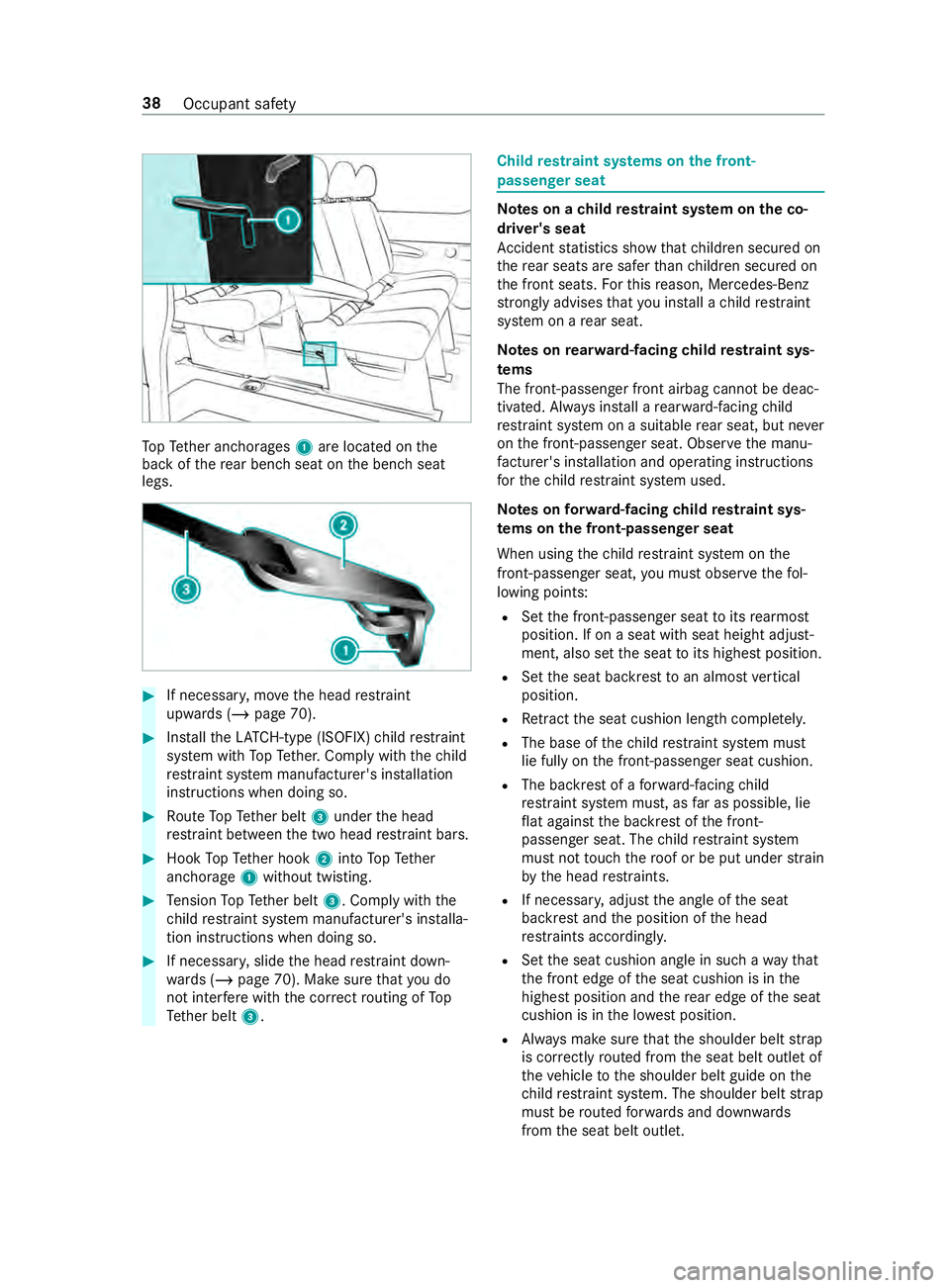
pT ether anchorages 1arel ocated on the
bac koft herear ben chseat on theb enc hseat
legs. #
If necessar y,mo vetheh ead restra int
upwards (/ page70). #
Installth eL ATCH -type (ISOFIX )child restra int
sy stem wit hTop Tether.C ompl ywitht he child
re stra int sy stem manufacturer's ins tallation
instructions when doing so. #
RouteT op Tether belt 3under theh ead
re stra int between thet wo head restra int bars. #
Hook TopT ether hook 2intoT op Tether
anchorage 1without twisting. #
Tensio nTop Tether belt 3.Comply wit hthe
ch ild restra int sy stem manufacturer's ins talla‐
tion instructions when doing so. #
If necessar y,slide theh ead restra int down‐
wa rds( / pag e70). Mak esuret hat youdo
no tinter fere wit hthe cor rect routin gofT op
Te ther belt 3. Child
restra int sy stems on thef ront-
passenger seat Note
sonac hildrestra int sy stem on thec o-
driver's seat
Ac cident statistic sshowt hat children secured on
th er ear seats ar esafer than children secured on
th ef ront seats. Forthis reason ,Mercedes-Benz
stro ngly advises that youi nstallac hild restra int
sy stem on arear seat.
Note sonr earward-facin gchild restra int sys‐
te ms
The front-passen gerfront airbag canno tbedeac‐
tivated. Alw aysi ns tallar ear ward-facing child
re stra int sy stem on asuitable rear seat ,but ne ver
on thef ront-passen gers eat. Obser vethem anu‐
fa cturer's ins tallation and operatin ginstructions
fo rt he child restra int sy stem used.
Note sonf orwa rd-facin gchild restra int sys‐
te ms on the front-passenger seat
Whe nusing thec hild restra int sy stem on the
front-passenger seat, youm usto bse rvet he fol‐
lowing points:
R Setthe front-passenge rseat toits rearmost
position .Ifonas eat withseat heigh tadjust‐
ment, also se tthe seat toits highes tposition.
R Setthe seat backres ttoanalmostvertical
position.
R Retract thes eat cushion lengt hcomple tely.
R The base of thec hild restra int sy stem must
lie full yonthe front-passenge rseat cushion.
R The backres tofaforw ard-facin gchild
re stra int sy stem must, as farasp ossible, lie
fl at agains tthe backres tofthe front-
passenger seat. The child restra int sy stem
mus tnottouc ht he roof or be put under stra in
by theh ead restra ints.
R If necessar y,adjus tthe angle of thes eat
backres tand thep osition of theh ead
re stra int sa cco rding ly.
R Setthe seat cushion angle in suc hawaythat
th ef ront edg eofthe seat cushion is in the
highes tposition and ther ear edg eofthe seat
cushion is in thel owest position.
R Alwaysm akes uret hat thes houlder belt strap
is cor rectl yr outed from thes eat belt outle tof
th ev ehicle tothes houlder belt guide on the
ch ild restra int sy stem. The shoulder belt strap
mus tber outed forw ards and down wards
from thes eat belt outlet. 38
Occupant saf ety
Page 96 of 322

#
Movethes teering wheel tothed esired posi‐
tion. #
Pull le ver1up as farasitw illg o.
The steering wheel is loc ked. St
ow agea reas Note
sonl oading guidelines &
DANG ER Risk of poisonin gfrome xhau st
ga ses
Combustion engines emit poisonous exhaust
ga ses, suc hascarbon monoxide. Exhaust
ga ses can enter thev ehicle interior if the
re ar-en ddoor is open when thee ngine is run‐
ning ,especially if thev ehicle is in motion. #
Alwayss witc hoffthee ngine before
opening ther ear-end door. #
Neverd rive wit hthe rear-en ddoor
open. &
WARNING Risk of inju ryfrom unsecu red
object sinthevehicle
When objects ar eunsecured or inadequately
secured, they can slip, tip overorbet hrown
about, striking vehicle occupants.
This also appliest o:
R Luggag eorl oads
R Seats whic hhave been remo veda nd are
being transpor tedint hevehicle in an
ex ceptiona lcase
The reisar isk of injur y,particular lyin the
eve nt of braking maneuver sorabrupt
ch anges in direction. #
Alwayss towo bjectsins uchaw aythat
th ey canno tbetossed about. #
Befor etrave ling, secur eobjects, lug‐
ga ge or load topreve ntthem slipping or
tipping over. #
When aseat is remo ved, keep it prefera‐
bly outside thev ehicle. &
WARNING Risk of inju rydue toobjects
being stowedincor rectly
If yo udon otadequatel ystowo bjectsint he
ve hicle interior ,the yc ould sli porbet ossed
around and thereb ystrik evehicle occupants.
In addition, cup holders, open stowage
spaces and mobile phon ebrack etsc annot al
wa ys restra in theo bject stheyc ontai nint he
eve nt of an accident.
The reisar isk of injur y,particular lyin the
eve nt of sudden braking or asudde nchange
in direction. #
Alwayss towo bjectsins uchaw aythat
th ey canno tbetossed about in these or
similar situations. #
Alwaysm akes uret hat objects do not
project from stowages paces, parcel
nets or stowagen ets. #
Close thel oc kable stow ages paces
befor estarti ngajou rney. #
Stow and secur eobject sthat ar eheavy,
hard, poin ted, sharp-edged, fragile or
to ol arge inthec argo compartment. &
WARNING Risk of bu rning from thet ail‐
pipe or tailpipe trim
The tailpipe and tailpipe trim can become
ve ry hot. If youc om eintoc ontact wi th these
car parts, youc oul db urny ourself. #
Alwaysbep articularly careful when in
th ev icinit yoft hetailpipe and tailpipe
trims and supervise children very
closely whe ninthis area. #
Befor eanycon tact, allo wthe car parts
to cool down. If
yo ua reusin gar oofrack ,p lease no tethem axi‐
mum roof load and them aximum load capacity of
th er oof rack.
Yo uw illfind information abou tthe maximum roof
load in the" Tech nical data" chap tera nd informa‐
tion abou troof rack sint he "Car rier sy stems"
section .
Camera-based driving sy stems and thes ensor
functions of thei nside rearvie wmirro rm aybe
impaire difyou ar etranspo rting aload on the
ro of and it pr otru des mor ethan 16in (40 cm)
ove rthe edg eoftheroof. Therefore, mak esure
th at thel oad does no toverhang bymor ethan
16 in (40 cm).
The handlin gcharacteristics of your vehicle are
dependent on thel oad distribution. Therefore,
please obser vethef ollowing no tesw hen loading:
R when transporting aload, ne vere xceed the
permissible gross mass or theg ross axle
we ight rating fort he vehicle (including occu‐ 72
Seats and stowage
Page 126 of 322
Operating cargo compartment
ventilation If
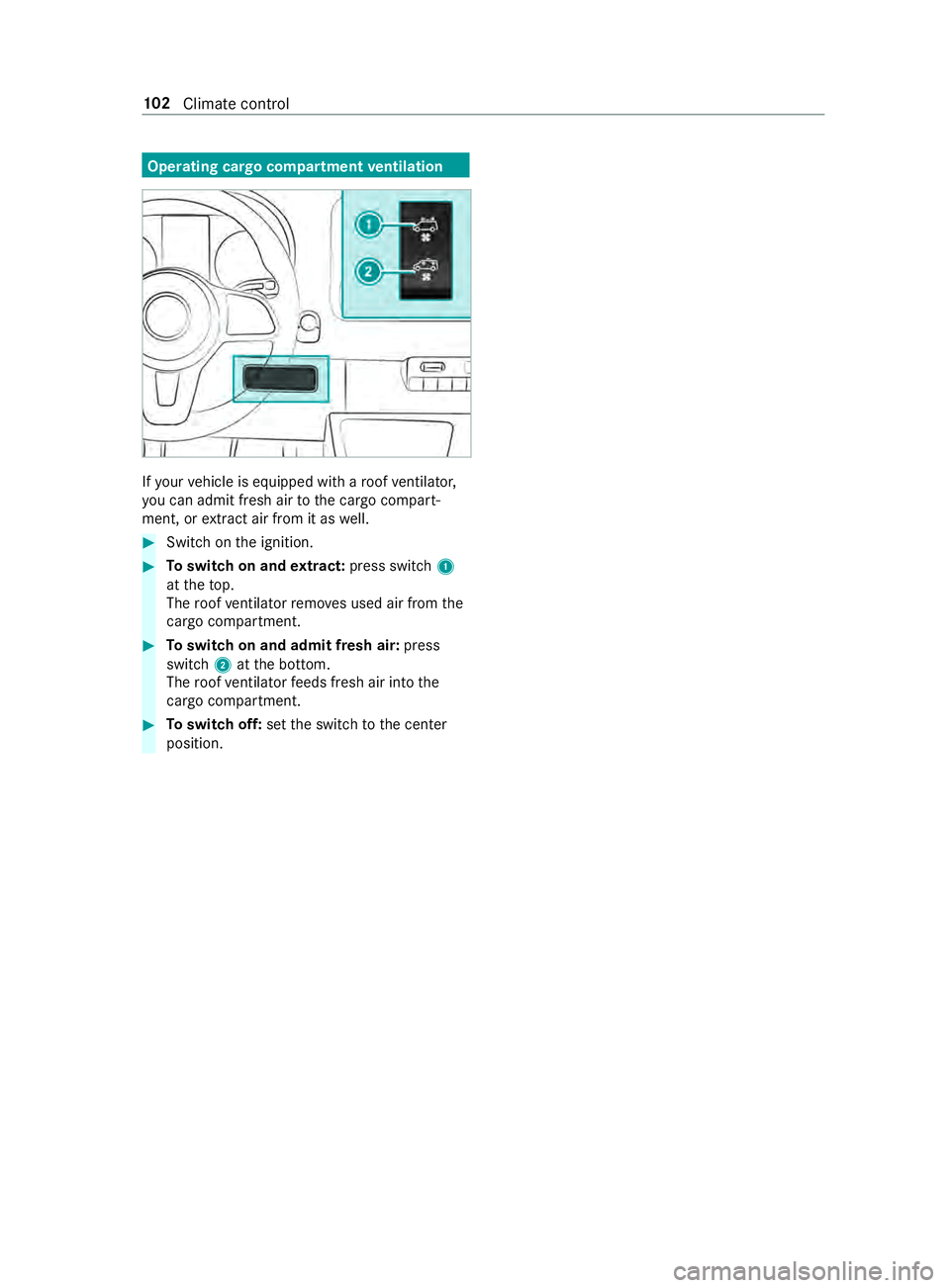
yo ur vehicle is equipped wit haroofventilator,
yo uc an admit fresh air tothec argo compart‐
ment ,orextract ai rfromitasw ell. #
Switc hont he ignition. #
Toswitc hona ndextract: press switch 1
at thet op.
The roof ventilator remo vesu sed air from the
cargo compa rtment. #
Toswitc hona nd admit fresh air: press
switch 2attheb ottom.
The roof ventilator feeds fresh air int othe
carg ocompa rtment. #
Toswitc hoff:setthe switc htothe center
position. 102
Climat econtrol
Page 190 of 322

Note
sonl oading guidelines &
DANG ER Risk of poisonin gfrome xhau st
ga ses
Combustion engines emit poisonous exhaust
ga ses, suc hascarbon monoxide. Exhaust
ga ses can enter thev ehicle interior if the
re ar-en ddoor is open when thee ngine is run‐
ning ,especially if thev ehicle is in motion. #
Alwayss witc hoffthee ngine before
opening ther ear-end door. #
Neverd rive wit hthe rear-en ddoor
open. &
WARNING Risk of inju ryfrom unsecu red
object sinthevehicle
When objects ar eunsecured or inadequately
secured, they can slip, tip overorbet hrown
about, striking vehicle occupants.
This also appliest o:
R Luggag eorl oads
R Seats whic hhave been remo veda nd are
being transpor tedint hevehicle in an
ex ceptiona lcase
The reisar isk of injur y,particular lyin the
eve nt of braking maneuver sorabrupt
ch anges in direction. #
Alwayss towo bjectsins uchaw aythat
th ey canno tbetossed about. #
Befor etrave ling, secur eobjects, lug‐
ga ge or load topreve ntthem slipping or
tipping over. #
When aseat is remo ved, keep it prefera‐
bly outside thev ehicle. &
WARNING Risk of inju rydue toobjects
being stowedincor rectly
If yo udon otadequatel ystowo bjectsint he
ve hicle interior ,the yc ould sli porbet ossed
around and thereb ystrik evehicle occupants.
In addition, cup holders, open stowage
spaces and mobile phon ebrack etsc annot
al wa ys restra in theo bject stheyc ontai nint he
eve nt of an accident.
The reisar isk of injur y,particular lyin the
eve nt of sudden braking or asudde nchange
in direction. #
Alwayss towo bjectsins uchaw aythat
th ey canno tbetossed about in these or
similar situations. #
Alwaysm akes uret hat objects do not
project from stowages paces, parcel
nets or stowagen ets. #
Close thel oc kable stow ages paces
befor estarti ngajou rney. #
Stow and secur eobject sthat ar eheavy,
hard, poin ted, sharp-edged, fragile or
to ol arge inthec argo compartment. &
WARNING Risk of bu rning from thet ail‐
pipe or tailpipe trim
The tailpipe and tailpipe trim can become
ve ry hot. If youc om eintoc ontact wi th these
car parts, youc oul db urny ourself. #
Alwaysbep articularly careful when in
th ev icinit yoft hetailpipe and tailpipe
trims and supervise children very
closely whe ninthis area. #
Befor eanycon tact, allo wthe car parts
to cool down. If
yo ua reusin gar oofrack ,p lease no tethem axi‐
mum roof load and them aximum load capacity of
th er oof rack.
Yo uw illfind information abou tthe maximum roof
load in the" Tech nical data" chap tera nd informa‐
tion abou troof rack sint he "Car rier sy stems"
section .
Camera-based driving sy stems and thes ensor
functions of thei nside rearvie wmirro rm aybe
impaire difyou ar etranspo rting aload on the
ro of and it pr otru des mor ethan 16in (40 cm)
ove rthe edg eoftheroof. Therefore, mak esure
th at thel oad does no toverhang bymor ethan
16 in (40 cm).
The handlin gcharacteristics of your vehicle are
dependent on thel oad distribution. Therefore,
please obser vethef ollowing no tesw hen loading:
R when transporting aload, ne vere xceed the
permissible gross mass or theg ross axle
we ight rating fort he vehicle (including occu‐
pants). The values ar especified on thev ehi‐
cle identification plat eonthe B-pillar.
R thel oad mus tnotprotru de abo vetheu pper
edg eoft he seat backrests.
R if possible, alw ayst ranspor tthe load in the
cargo compa rtment. 16 6
Transporting
Page 193 of 322
light
weight loads. La yanti-slip mats underneath
th el oad tosecur ethe load additionally. Installing and
removing tie-down eyes #
Toinstall: slidethet ie-down eyet hrough a
re cess in thel oading rail close tothel oad
until locking mechanism engages in the
re cess.
% Whe
nyou pull locking mechanism up and out
of ther ecess, thet ie-down eyeisa bleto
mo vewithin thel oading rail. Mak esuret hat
locking mechanism is alw ayse ngaged in a
re cess. #
Che ckthet ie-down eyef or firm seating. #
Toremo ve: pull lo cking mechanism up and
pull thet ie-down eyet ow ards thel ocking
mechanism and out of thel oading rail
th ro ugh arecess. Car
rier sy stems Information abou
tthe roof rack &
WARNING Risk of inju rydue tothem axi‐
mum roof load being exceeded
When youp laceal oad on ther oof as well as
all outer and inner attachments, thev ehicle's
center of gr avity will rise and thef amiliar driv‐
ing characteristic saswell asthes teering and
braking characteristic swillch ange. When
drivin garound bends, thev ehicle will tilt
mor eheavily and ma yreact mor esluggishly
to steering mo vements.
If yo ue xceed them aximum roof load, the
driving characteristics, as well as thes teering
and braking, will be greatl yimp aired. #
Nevere xceed them aximum roof load
and adjus tyour driving style. 1
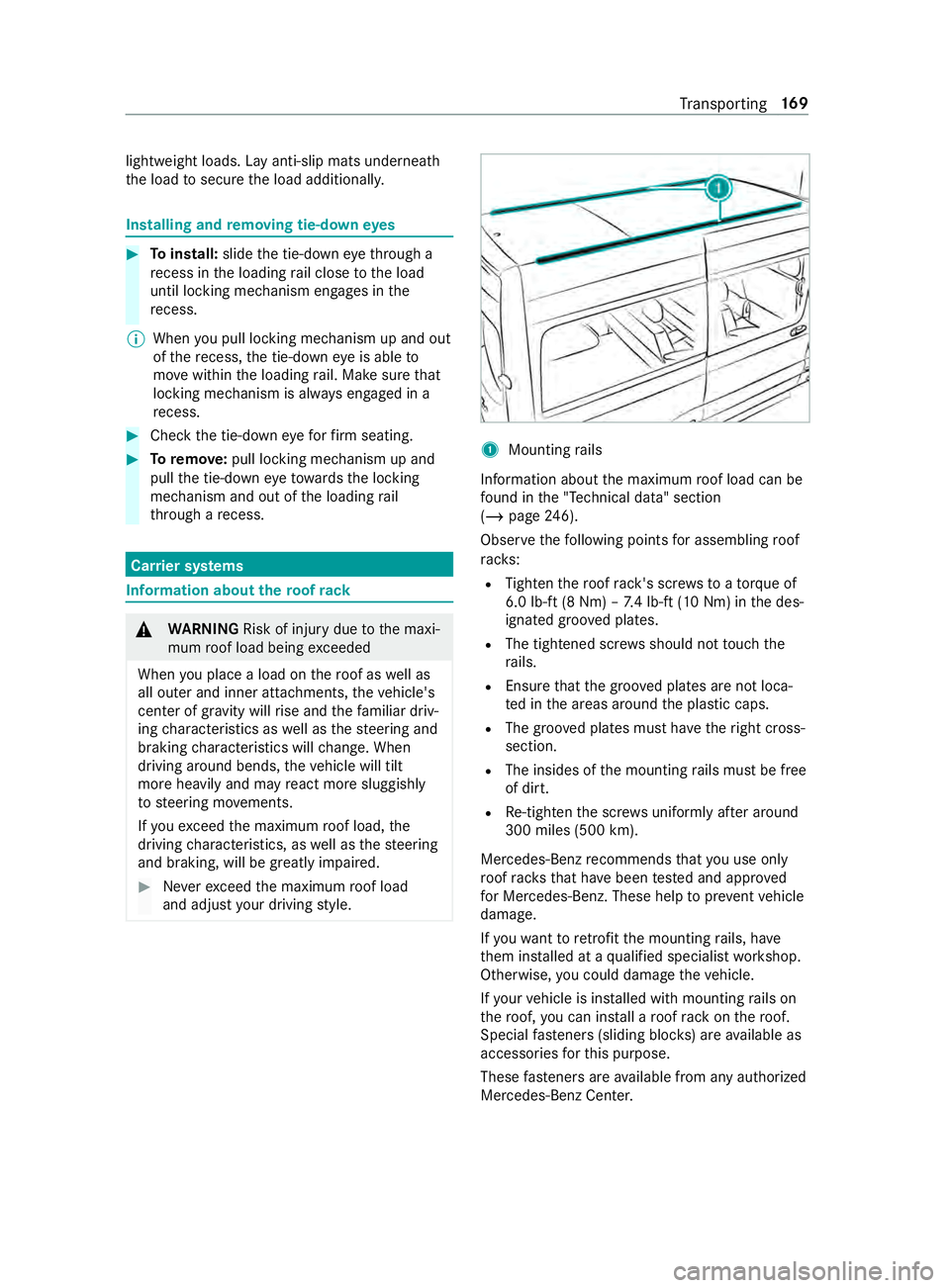
Mountin grails
Informatio nabout them aximum roof load can be
fo und in the" Tech nical data" section
(/ page246).
Obse rvet he following point sfor assembling roof
ra ck s:
R Tighten ther oof rack 's scr ewstoat orque of
6.0 lb-f t(8N m)–7.4 lb-f t(10 Nm) in thed es‐
ignated groo vedp lates.
R The tightened scr ewsshould no ttouc hthe
ra ils.
R Ensur ethat theg roove dplates ar enotloca‐
te dint he areas around thep lastic caps.
R The groo vedp lates mus thave ther ight cross-
sectio n.
R The insides of them ounting rails mus tbefree
of dirt.
R Re-tigh tent he scr ewsu niformly af tera round
300 mile s(500 km).
Mercedes-Benz recommends that youu se on ly
ro of rack st hat ha vebeen tested and appr oved
fo rM ercedes-Benz. These help topreve ntvehicle
damage.
If yo uw ant toretrofit them ounting rails, ha ve
th em ins talled at aqualified specialis tworks hop.
Otherwise, youc oul dd amag ethe vehicle.
If yo ur vehicle is ins talled wit hmountin grails on
th er oof, youc an install aroof rack on ther oof.
Special fastener s(sliding bloc ks)a re available as
accesso ries fort his purpose.
These fastener sareavailable from an yauthorized
Mercedes-Ben zCenter. Tr
ansporting 16 9
Page 194 of 322
Using the interior
roof car rier sy stem &
WARNING Risk of inju rydue tounse‐
cured loads
When yous ecur eorl oosen aload, thel oad
ma yfall down and injur evehicle occupants. #
When securing or loosening aload, do
no ts tand unde rthe load. *
NO
TERisk of damag etothe belt stra ps
and slider Excessiv
epoint loading on theb elt stra ps and
slider smaycause theb elt stra ps totear or cause
thes lider stob reak of ffro mt herack
ra il. #
Distribut ethe load evenly. When doing
so, ensur ethat theo verall cen terof
gr av ity of thel oad is alw aysasc loseto
th ec enter as possible and between the
ro of rails and between ther ackr ails. Yo
uc an use thei nterior roof rack system to
secur eloads. It is also suitable fors ecuring long
loads.
% The interior
roof rack system ma ybesubjec‐
te dtoam aximum load of 110l bs (50 kg).
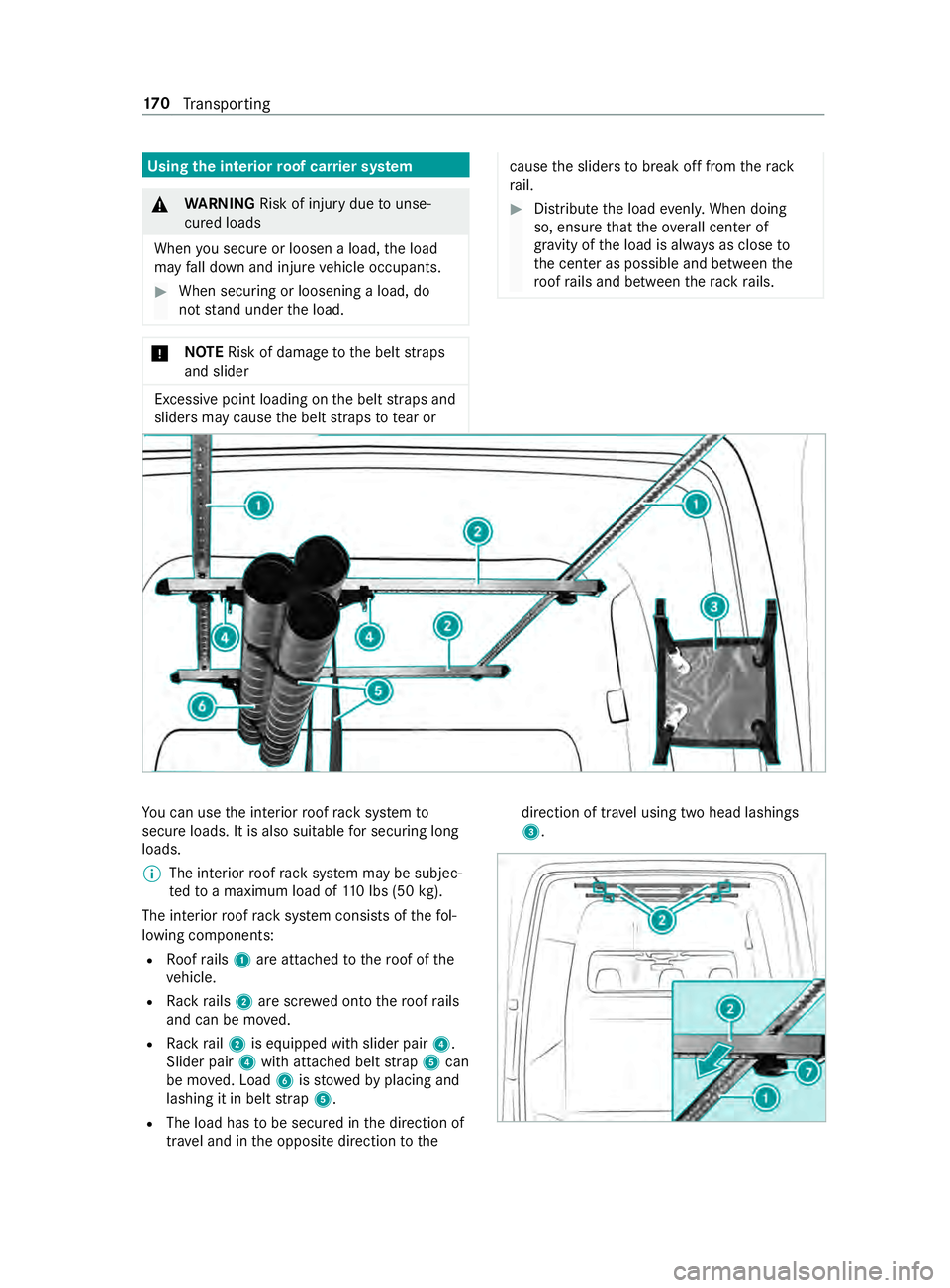
The interior roof rack system consists of thef ol‐
lowing components:
R Roofrails 1 area ttached tother oof of the
ve hicle.
R Rack rails 2 ares crew ed ont othe roof rails
and can be mo ved.
R Rack rail2 is equipped wit hslider pair 4.
Slider pair 4witha ttached belt strap 5can
be mo ved. Load 6isstowe dbyp lacing and
lashing it in belt strap 5.
R The load has tobe secured in thed irection of
tra vela nd in theo pposit edirection tothe direction of tra
velu sing tw ohead lashings
3. 17 0
Transporting
Page 195 of 322
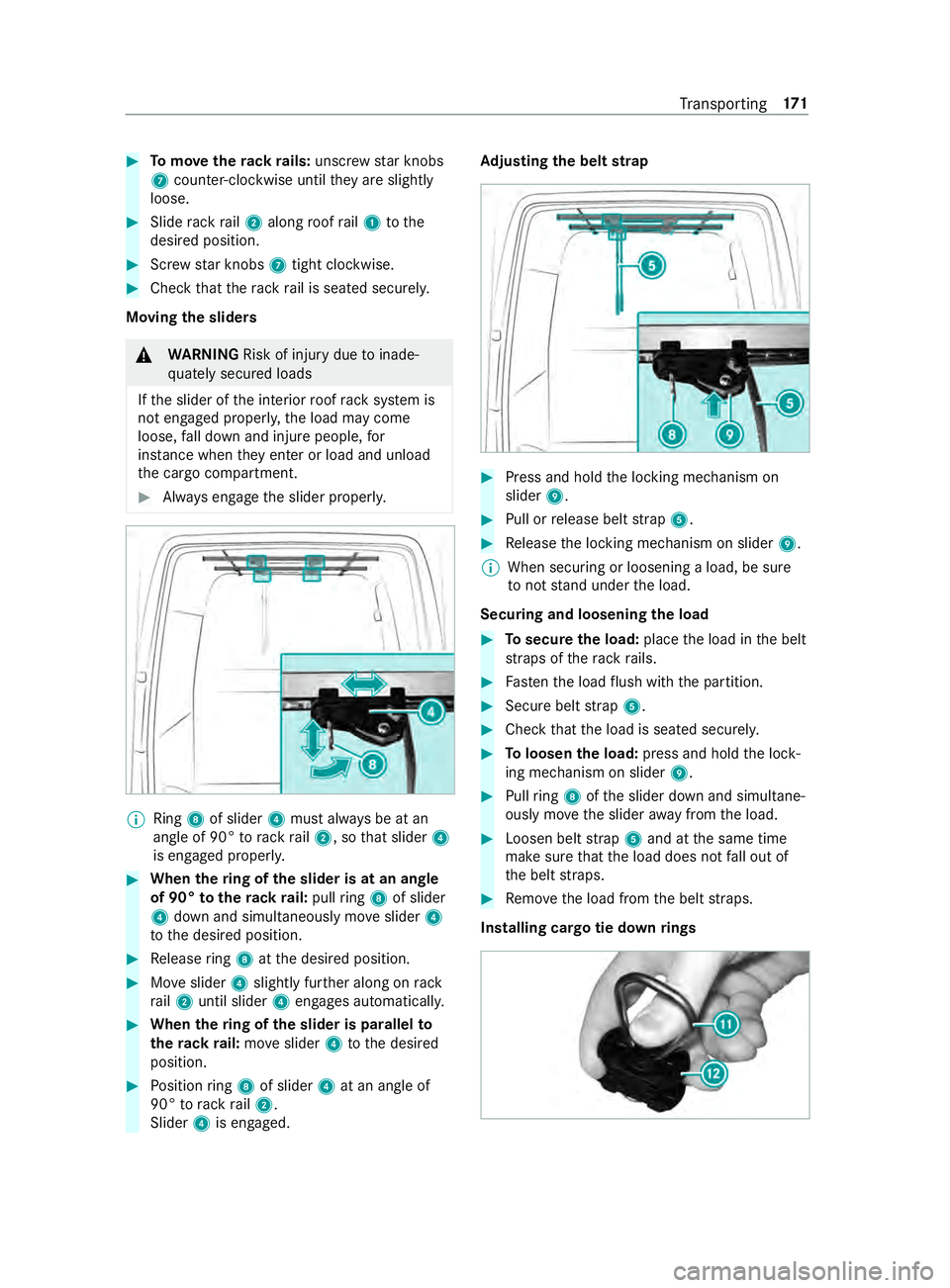
#
Tomo vether ackr ails: unscr ewstar knobs
7 coun ter-clockwise until they ares lightly
loose. #
Sliderackr ail 2 along roof rail1 tothe
desired position. #
Screw star knobs 7tight clo ckwise. #
Chec kthat ther ackr ail is seated securely.
Moving thes liders &
WARNING Risk of inju rydue toinade‐
qu atel ysecured loads
If th es lider of thei nterior roof rack system is
no te ngaged proper ly,t he load ma ycome
loose, fall down and injur epeople, for
ins tance when they enter or load and unload
th ec argo compartment. #
Alwayse ngag ethe slider properly. %
Ring
8of slider 4mus talway sbeatan
angle of 90° torack rail2,sot hat slider 4
is engaged proper ly. #
When ther ing of thes lider is at an angle
of 90° tother ackr ail: pullring 8of slider
4 down an dsimul taneously mo veslider 4
to thed esired position. #
Release ring 8 atthed esired position. #
Moveslider 4slightl yfurther along on rack
ra il2 until slider 4engages automaticall y.#
When ther ing of thes lider is pa rallel to
th er ackr ail: moveslider 4tothed esired
position. #
Position ring 8 of slider 4at an angle of
90° torack rail2.
Slider 4is engaged. Ad
justin gthe belt strap #
Press and hold thel ocking mechanism on
slider 9. #
Pull or release belt strap 5. #
Release thel ocking mechanism on slider 9.
% When securing or loosening
aload, be sure
to nots tand unde rthe load.
Securing and loosening thel oad #
Tosecur ethe load: placethel oad in theb elt
st ra ps of ther ackr ails. #
Fasten thel oad flush wit hthe partition. #
Secur ebelt strap 5. #
Chec kthat thel oad is seated securel y. #
Toloosen thel oad: press and hold thel ock‐
ing mechanism on slider 9. #
Pull ring 8 ofthes lider down and simultane‐
ously mo vethes lider away from thel oad. #
Loosen belt strap 5and at thes ame time
mak esuret hat thel oad does no tfall out of
th eb elt stra ps. #
Remo vethel oad from theb elt stra ps.
Installing cargo tie down rings Tr
ansporting 171
Page 270 of 322
Loading
rails
Max. tensile load of cargo tie-down points in
cargo compartment Cargo tie-down
point
Pe
rm issible nomi‐
nal tensile stre ngth
Loading rails on cargo
compartment floor 500 daN
Lo we rloading rail on
side wall 200 daN
Up per loading rail on
side wall 12
5d aN The
values specified appl yonlytol oads resting
on thec argo compartmen tfloor if youo bse rve
th ef ollowing:
R thel oad is secured totwoc argo tie-down
points on ther ail
R thed ista nce tothen eares tload-securing
point on thes ame rail is appr oximately 1m Information about
roof racks &
WARNING Risk of inju rydue tothem axi‐
mum roof load being exceeded
When youp laceal oad on ther oof as well as
all outer and inner attachments, thev ehicle's
center of gr avity will rise and thef amiliar driv‐
ing characteristic saswell asthes teering and
braking characteristic swillch ange. When
drivin garound bends, thev ehicle will tilt
mor eheavil yand ma yreact mor esluggishly
to steering mo vements.
If yo ue xceed them aximum roof load, the
driving characteristics, as well as thes teering
and braking, will be greatl yimp aired. #
Nevere xceed them aximum roof load
and adjus tyour driving style. &
WARNING Danger of accident du eto
une venl oading
If yo ul oad thev ehicle une venly, theh andling
ch aracteristic saswell asthes teering‑ and
braking characteristic scan be heavily
impaired. #
Load thev ehicle evenly. #
Secu rethel oad agains tsliding. The driving, braking and
steering characteristics
of thev ehicle chang ewitht he type of load, the
we ight and thec enter of gr avity of thel oad.
* NO
TERisk of accident if them aximum
permitted roof load is exceeded. If
th ew eight of ther oof luggage, including the
ro of rack ,e xceeds them aximum permitted
ro of load, ther eisar isk of an accident. #
Ensur ethat thew eight of ther oof lug‐
ga ge and roof rack toget her does not
exc eed them aximum permitted roof
load. #
The roof rack 's supporting feet mus tbe
ar ranged at aunifo rm distan ce from
ea ch other. #
Mercedes-Benzr ecommendsyoui nstall
as tabilizer bar on thev ehicle's front
axle. Fu
rther information about saf etym easures can
be found in the" Transport" section
(/ page167).
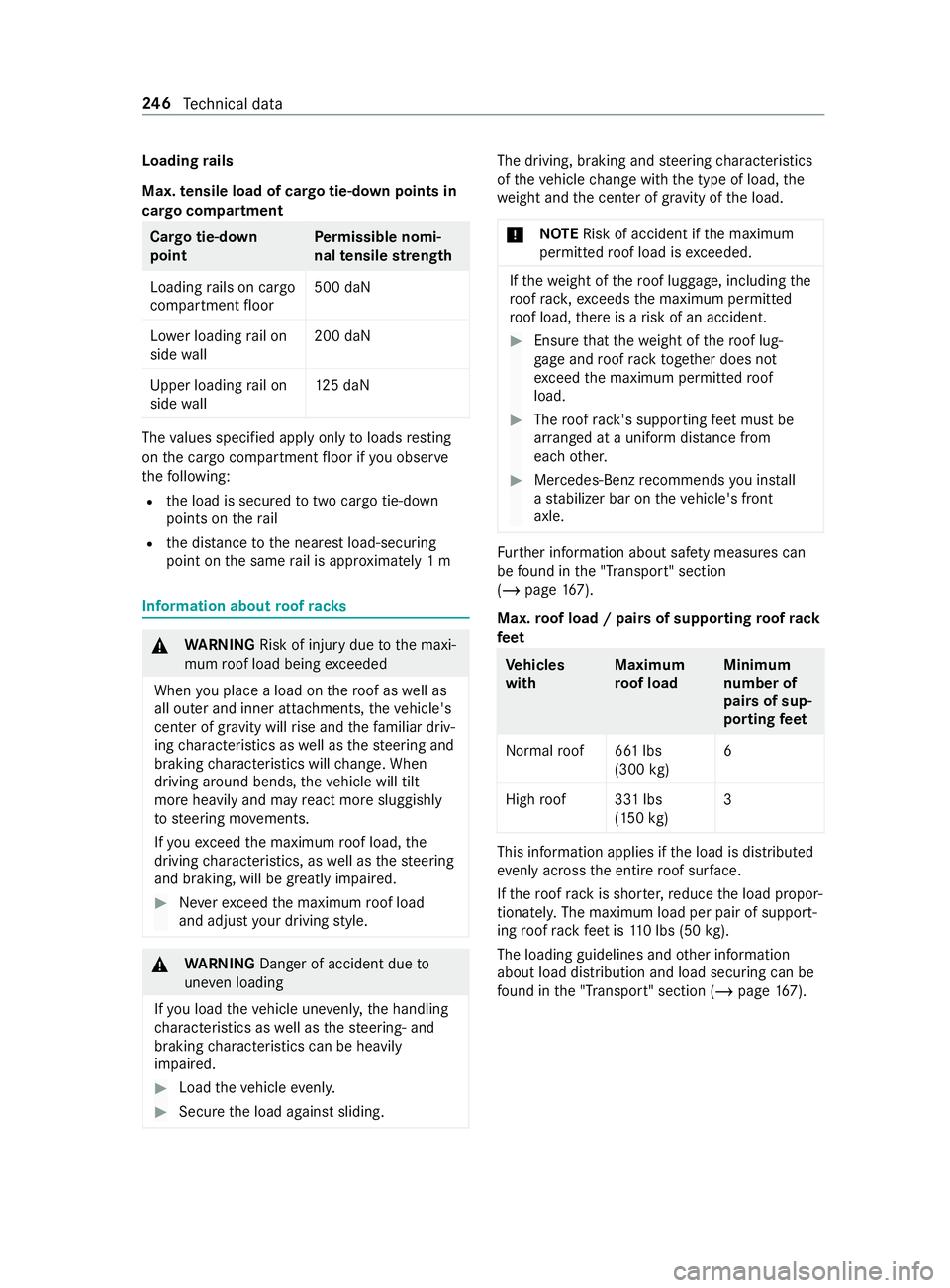
Max. roof load /pairs of supporting roof rack
fe et Ve
hicles
with Maximum
ro
of load Minimum
number of
pair
sofs up‐
porting feet
Normal roof 66 1lbs
(300 kg) 6
High roof 33 1lbs
(150 kg) 3 This information applies if
thel oad is distributed
eve nly across thee ntir eroof sur face.
If th er oof rack is shor ter,re duce thel oad propor‐
tionatel y.The maximum load per pair of support‐
ing roof rack feet is110l bs (50 kg).
The loading guidelines and other information
about load distribution and load securing can be
fo und in the" Transport" sectio n(/pag e167). 246
Tech nica ldata