ABS MITSUBISHI 3000GT 1991 Owners Manual
[x] Cancel search | Manufacturer: MITSUBISHI, Model Year: 1991, Model line: 3000GT, Model: MITSUBISHI 3000GT 1991Pages: 1146, PDF Size: 76.68 MB
Page 866 of 1146
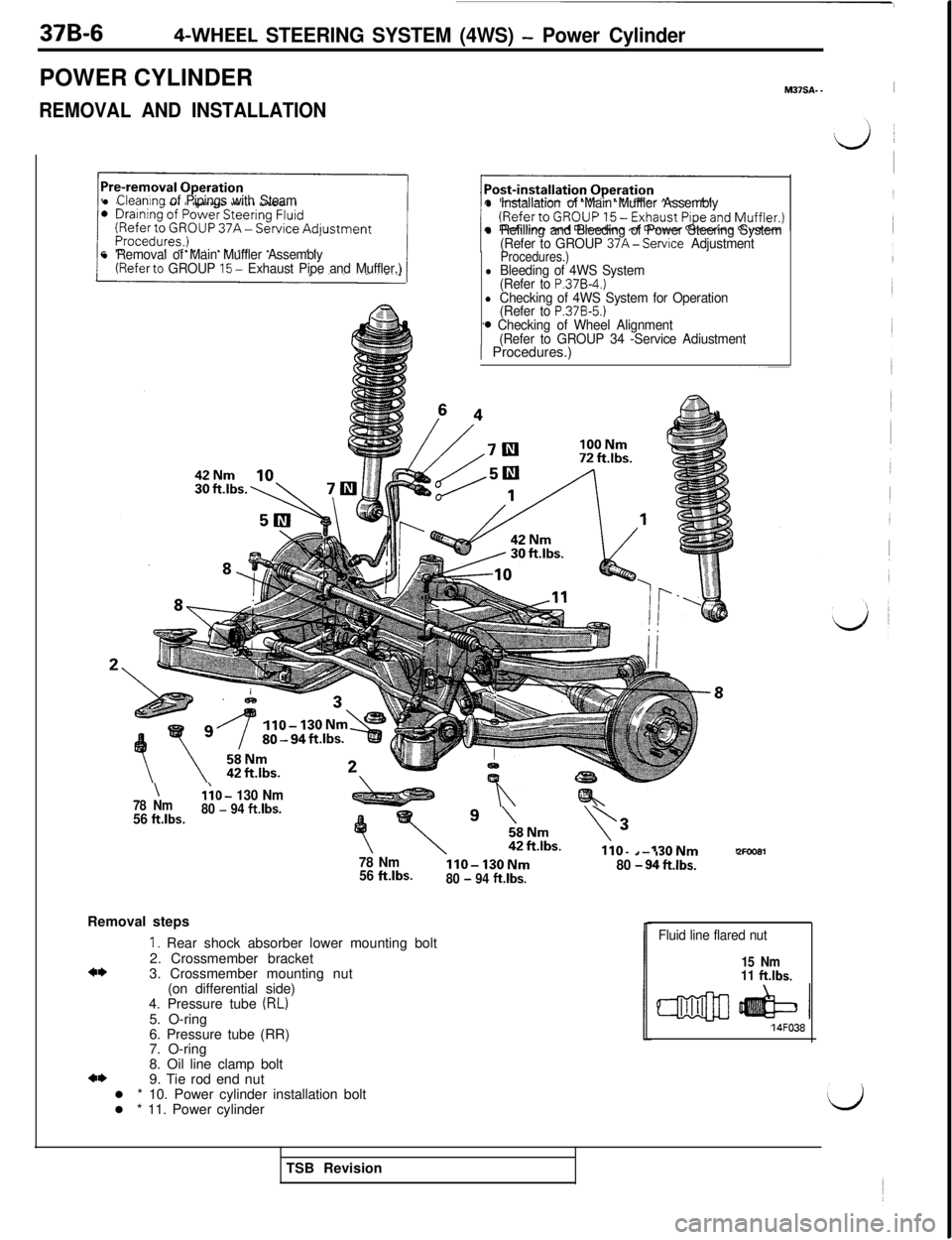
37B-64-WHEEL STEERING SYSTEM (4WS) - Power CylinderPOWER CYLINDER
REMOVAL AND INSTALLATION
M37S&~I
l Cleaning of Pipings with Steam
l Removal of Main Muffler Assembly(Referto GROUP 15- Exhaust Pipe and Muffler.)
Ilo-130Nm
l Installation of Main Muffler Assembly
l Refilling and Bleeding of Power Steering System
(Refer to GROUP 37A-Service Adjustment
\78 Nml;O- 130 Nm
56
ft.lbs.80 - 94 ft.lbs.
Procedures.)l Bleeding of 4WS System
(Refer to P.37B-4.)l Checking of 4WS System for Operation
(Refer to P.37B-5.)‘0 Checking of Wheel Alignment
(Refer to GROUP 34 -Service Adiustment
1 Procedures.)
f @, ’ i%,s. yf ,30Nm,
78 NmIIO-130Nm80 -94 ft.lbs.56 ft.lbs.
80 - 94 ft.lbs.Removal steps
1. Rear shock absorber lower mounting bolt
2. Crossmember bracket
a*3. Crossmember mounting nut
(on differential side)
4. Pressure tube
(RL)5. O-ring
6. Pressure tube (RR)
7. O-ring
8. Oil line clamp bolt
4*9. Tie rod end nut
l * 10. Power cylinder installation bolt
l * 11. Power cylinder
Fluid line flared nut
15 Nm
11 ft.lbs.14FO38
‘dTSB Revision
Page 871 of 1146
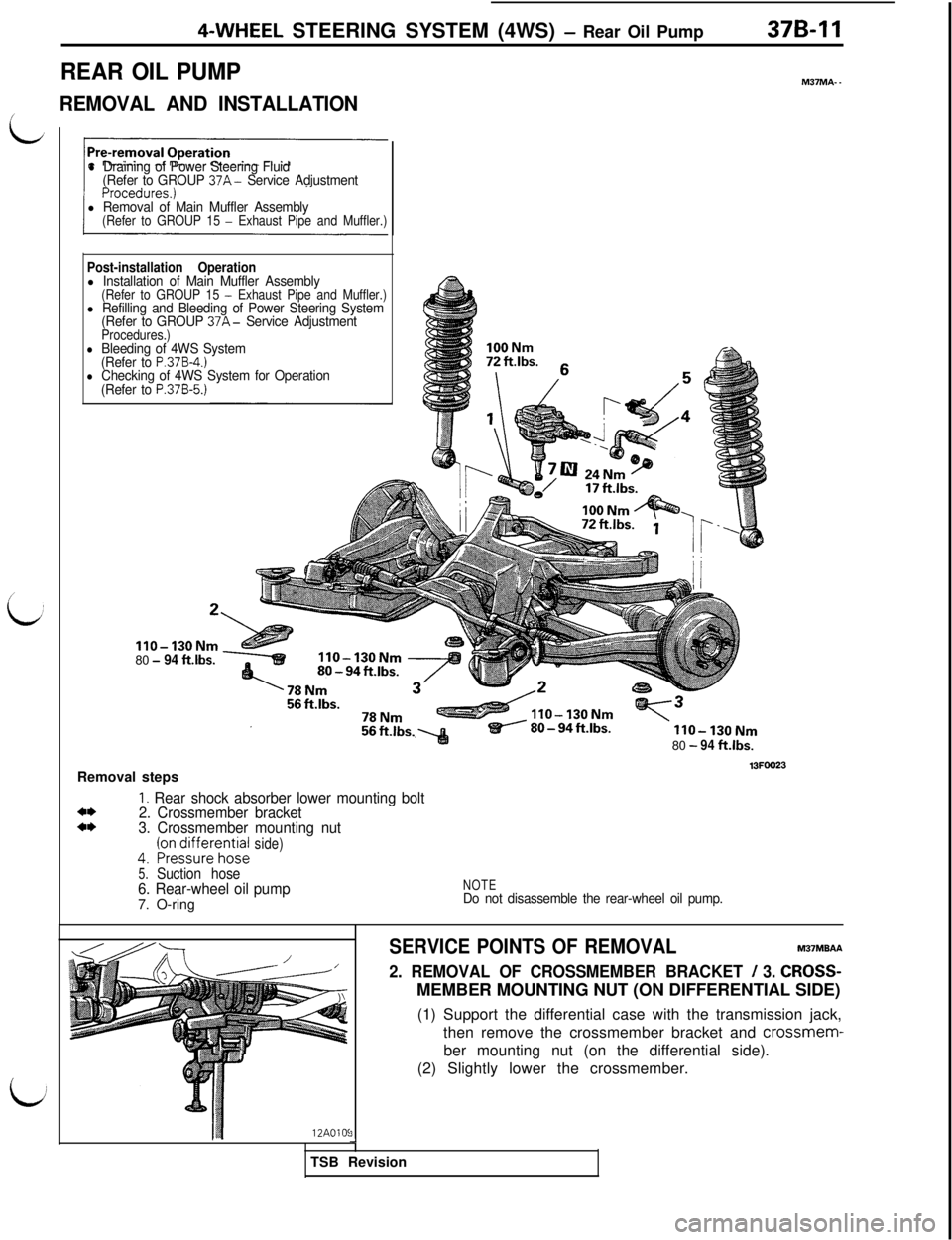
4-WHEEL STEERING SYSTEM (4WS) - Rear Oil Pump37B-11
REAR OIL PUMP
REMOVAL AND INSTALLATION/
l Draining of Power Steering Fluid
(Refer to GROUP 37A- Service Adjustment
l Removal of Main Muffler Assembly(Refer to GROUP 15 - Exhaust Pipe and Muffler.)
Post-installation Operationl Installation of Main Muffler Assembly(Refer to GROUP 15 - Exhaust Pipe and Muffler.)l Refilling and Bleeding of Power Steering System
(Refer to GROUP 37A- Service AdjustmentProcedures.)l Bleeding of 4WS System
(Refer to P.37B-4.)l Checking of 4WS System for Operation
(Refer to P.37B-5.)
IIO-130Nm80- 94 ft.lbs.Removal steps
1. Rear shock absorber lower mounting bolt4*2. Crossmember bracketa*3. Crossmember mounting nut4.~rry~~,ff~h;t~Jside)
5.Suction hose6. Rear-wheel oil pump7. O-ring80
-94ft.lbs.
13FOO23
NOTEDo not disassemble the rear-wheel oil pump.
M3?MA- -12AOlOS
3
SERVICE POINTS OF REMOVALM37MBAA
2. REMOVAL OF CROSSMEMBER BRACKET / 3. CROSS-MEMBER MOUNTING NUT (ON DIFFERENTIAL SIDE)
(1) Support the differential case with the transmission jack,
then remove the crossmember bracket and crossmem-
ber mounting nut (on the differential side).
(2) Slightly lower the crossmember.
2TSB Revision
Page 951 of 1146
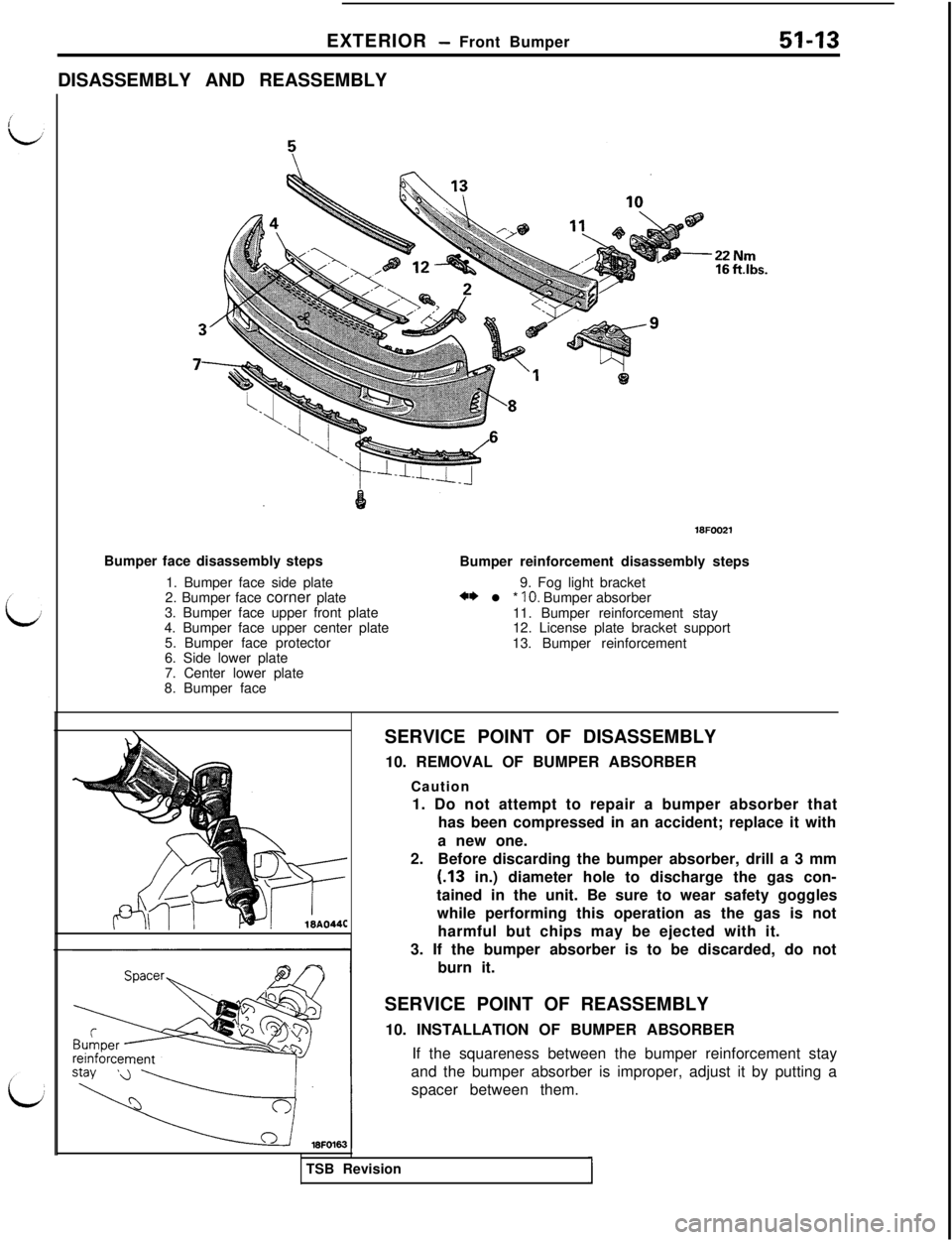
EXTERIOR - Front Bumper51-13DISASSEMBLY AND REASSEMBLY
22 Nm16 ftlbs.
Bumper face disassembly steps
1. Bumper face side plate
2. Bumper face corner plate
3. Bumper face upper front plate
4. Bumper face upper center plate
5. Bumper face protector
6. Side lower plate
7. Center lower plate
8. Bumper faceBumper reinforcement disassembly steps
9. Fog light bracket
** l * IO. Bumper absorber
11. Bumper reinforcement stay
12. License plate bracket support
13. Bumper reinforcement
SERVICE POINT OF DISASSEMBLY
10. REMOVAL OF BUMPER ABSORBER
Caution
1. Do not attempt to repair a bumper absorber that
has been compressed in an accident; replace it with
a new one.
2.Before discarding the bumper absorber, drill a 3 mm(.13 in.) diameter hole to discharge the gas con-
tained in the unit. Be sure to wear safety goggles
while performing this operation as the gas is not
harmful but chips may be ejected with it.
3. If the bumper absorber is to be discarded, do not
burn it.
SERVICE POINT OF REASSEMBLY
10. INSTALLATION OF BUMPER ABSORBER
If the squareness between the bumper reinforcement stay
and the bumper absorber is improper, adjust it by putting a
spacer between them.
TSB Revision
Page 953 of 1146
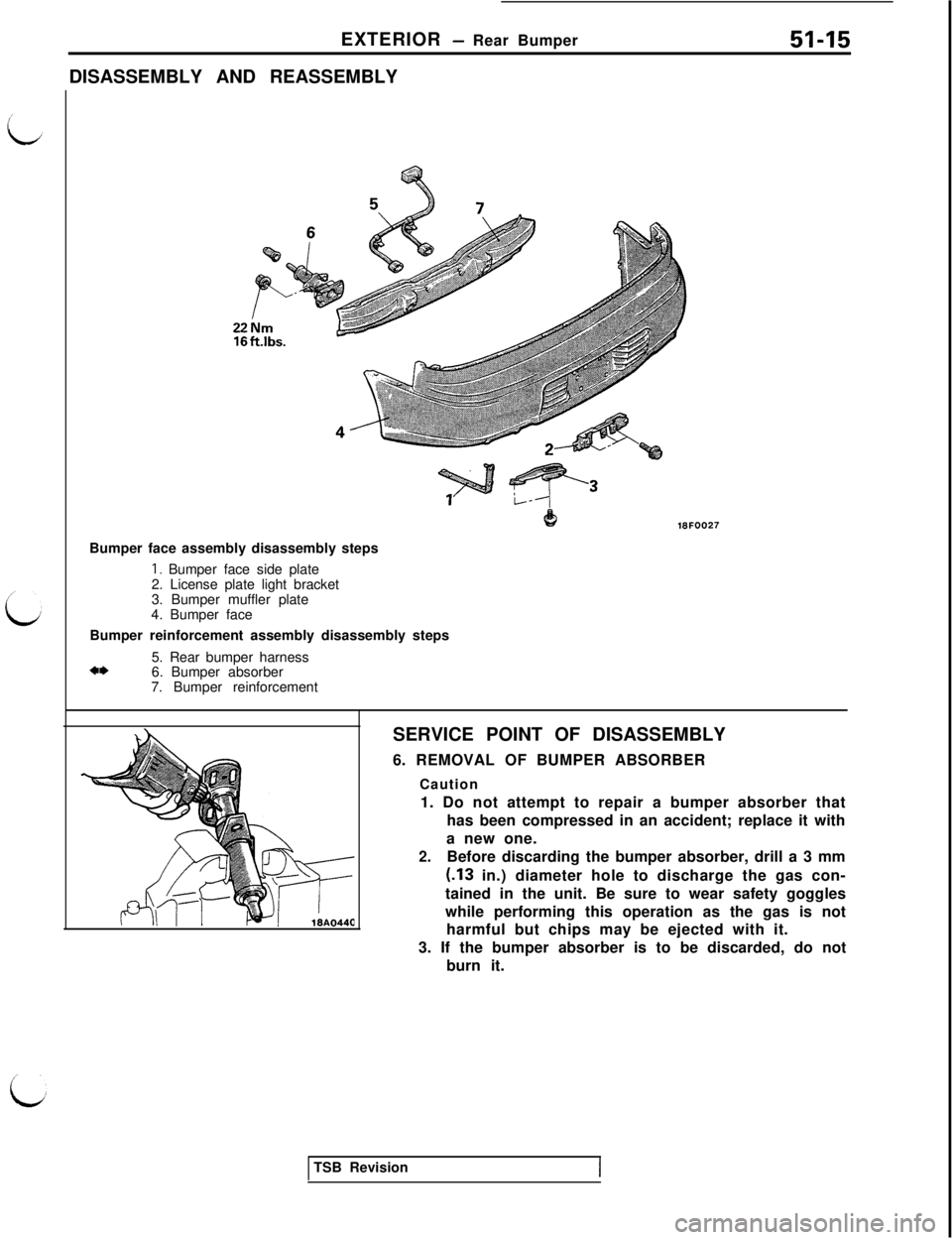
EXTERIOR - Rear Bumper
DISASSEMBLY AND REASSEMBLY51-15
221618FOO27
Bumper face assembly disassembly steps
I. Bumper face side plate
2. License plate light bracket
3. Bumper muffler plate
4. Bumper face
Bumper reinforcement assembly disassembly steps
5. Rear bumper harness
+I)6. Bumper absorber
7. Bumper reinforcement
SERVICE POINT OF DISASSEMBLY
6. REMOVAL OF BUMPER ABSORBER
Caution
1. Do not attempt to repair a bumper absorber that
has been compressed in an accident; replace it with
a new one.
2.Before discarding the bumper absorber, drill a 3 mm(.13 in.) diameter hole to discharge the gas con-
tained in the unit. Be sure to wear safety goggles
while performing this operation as the gas is not
harmful but chips may be ejected with it.
3. If the bumper absorber is to be discarded, do not
burn it.
TSB Revision
Page 998 of 1146
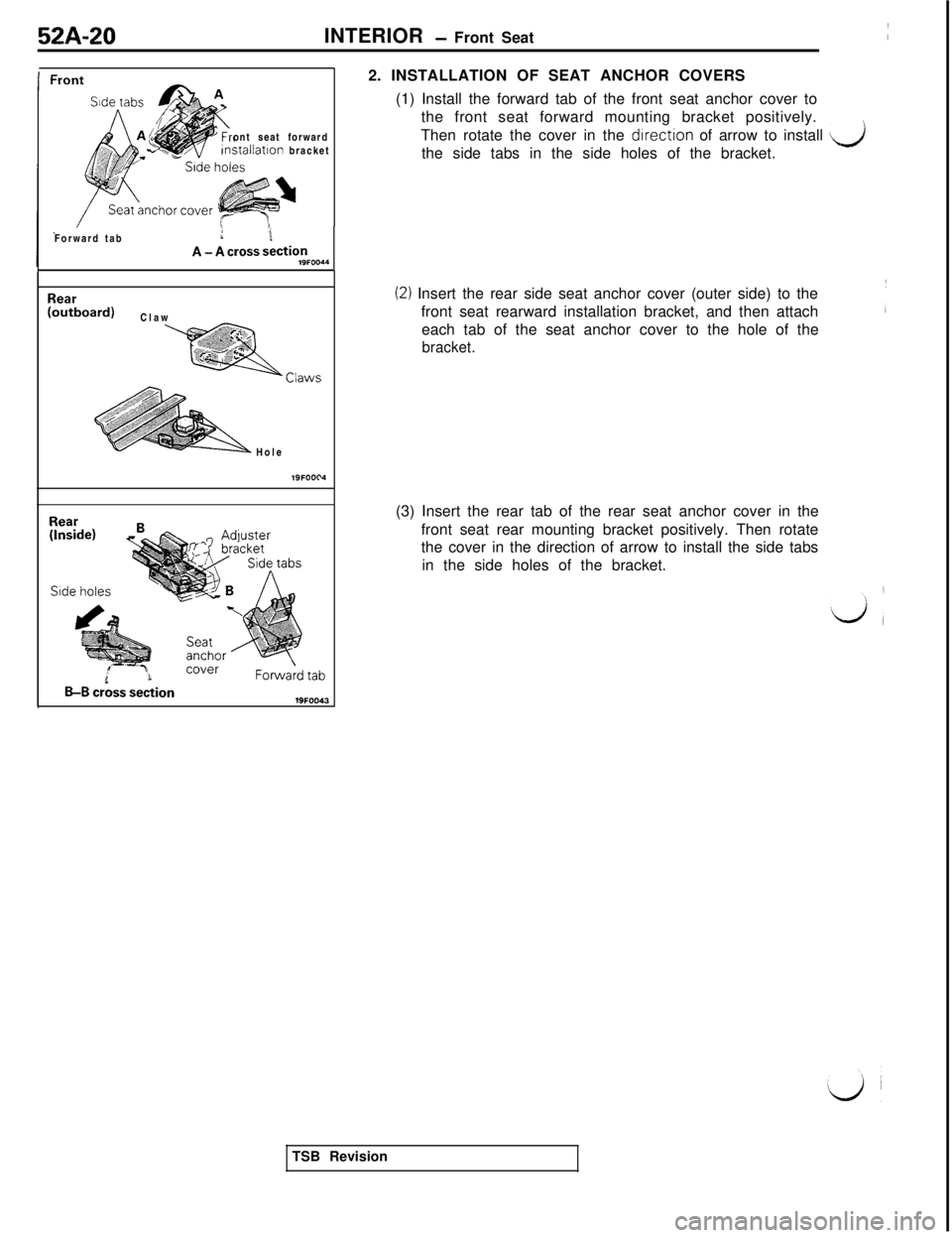
52A-20INTERIOR - Front Seat
ont seat forward
lnstallatlon bracket
Forward tab
:iA - A cross sectionlSFOO44
Rear(outboard)Claw
Hole
lSFOOC4
B-B crbss section2. INSTALLATION OF SEAT ANCHOR COVERS
(1) Install the forward tab of the front seat anchor cover to
the front seat forward mounting bracket positively.
Then rotate the cover in the drrection of arrow to install
dthe side tabs in the side holes of the bracket.
(2) Insert the rear side seat anchor cover (outer side) to the
front seat rearward installation bracket, and then attach
each tab of the seat anchor cover to the hole of the
bracket.(3) Insert the rear tab of the rear seat anchor cover in the
front seat rear mounting bracket positively. Then rotate
the cover in the direction of arrow to install the side tabs
in the side holes of the bracket.
TSB Revision
Page 1077 of 1146
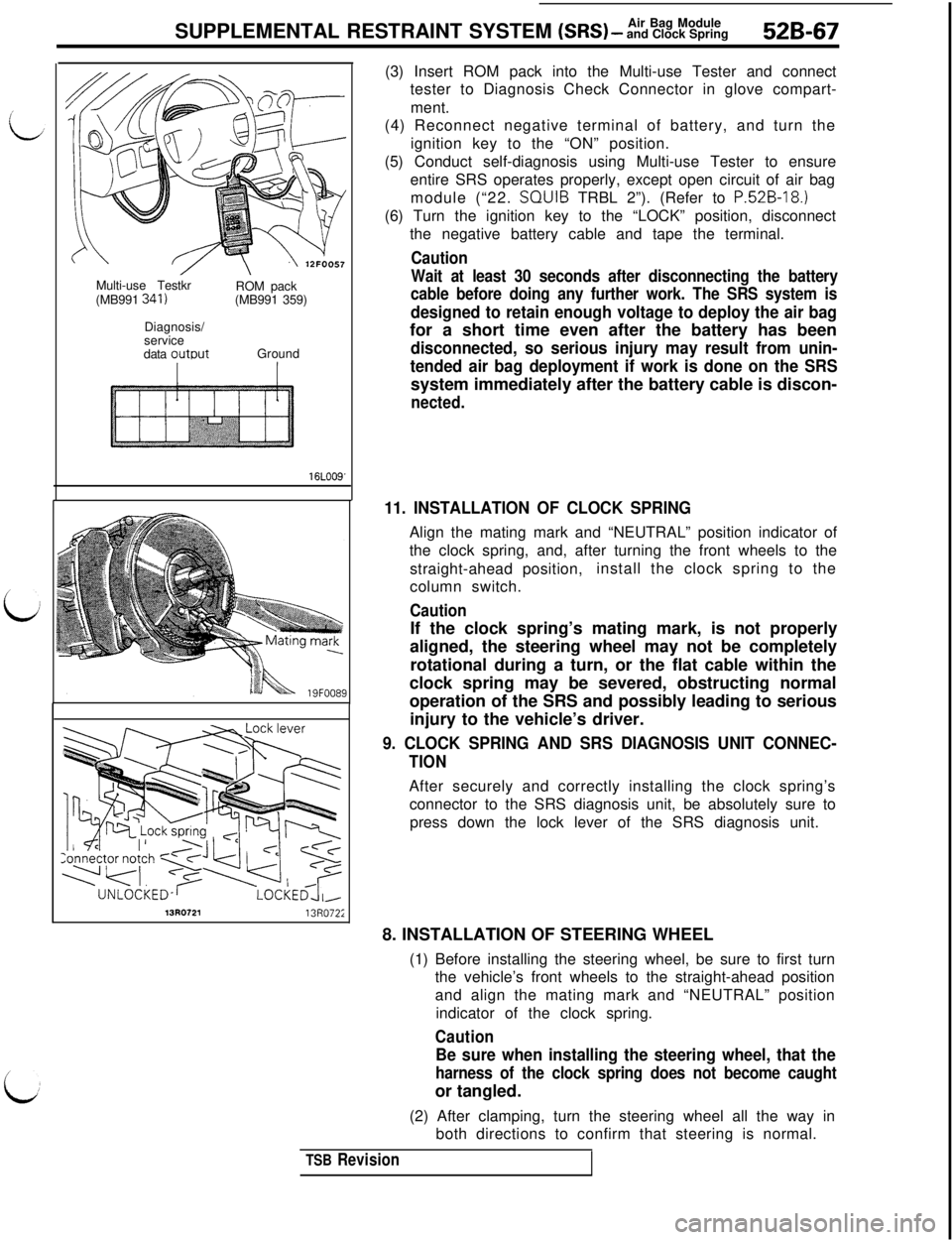
Air Bag Module
SUPPLEMENTAL RESTRAINT SYSTEM (SRS) - and Clock Spring52B-67Multi-use Testkr
ROM pack
(MB991 341)(MB991 359)
Diagnosis/
service
data
oumutGround
16LOO9'(3) Insert ROM pack into the Multi-use Tester and connect
tester to Diagnosis Check Connector in glove compart-
ment.
(4) Reconnect negative terminal of battery, and turn the
ignition key to the “ON” position.
(5) Conduct self-diagnosis using Multi-use Tester to ensure
entire SRS operates properly, except open circuit of air bag
module (“22. SQUIB TRBL 2”). (Refer to
P.52B-18.)(6) Turn the ignition key to the “LOCK” position, disconnect
the negative battery cable and tape the terminal.
Caution
Wait at least 30 seconds after disconnecting the battery
cable before doing any further work. The SRS system is
designed to retain enough voltage to deploy the air bagfor a short time even after the battery has been
disconnected, so serious injury may result from unin-
tended air bag deployment if work is done on the SRSsystem immediately after the battery cable is discon-
nected.
11. INSTALLATION OF CLOCK SPRINGAlign the mating mark and “NEUTRAL” position indicator of
the clock spring, and, after turning the front wheels to the
straight-ahead position,install the clock spring to the
column switch.
CautionIf the clock spring’s mating mark, is not properly
aligned, the steering wheel may not be completely
rotational during a turn, or the flat cable within the
clock spring may be severed, obstructing normal
operation of the SRS and possibly leading to serious
injury to the vehicle’s driver.
9. CLOCK SPRING AND SRS DIAGNOSIS UNIT CONNEC-
TIONAfter securely and correctly installing the clock spring’s
connector to the SRS diagnosis unit, be absolutely sure to
press down the lock lever of the SRS diagnosis unit.
13R072113R072;8. INSTALLATION OF STEERING WHEEL
(1) Before installing the steering wheel, be sure to first turn
the vehicle’s front wheels to the straight-ahead position
and align the mating mark and “NEUTRAL” position
indicator of the clock spring.
Caution
Be sure when installing the steering wheel, that the
harness of the clock spring does not become caughtor tangled.
(2) After clamping, turn the steering wheel all the way in
both directions to confirm that steering is normal.
TSB Revision
Page 1091 of 1146
HEATERS AND MANUAL AIR CONDITIONER - safety Pre=utm55-9
SAFETY PRECAUTIONSR-12 refrigerant is a chlorofluoro-carbon
(CFC) that
can contribute to the depletion of the ozone layer in
the upper atmosphere.
Ozone filters out harmful radiation from the sun.
To assist in protecting the ozone layer, Mitsubishi
Motor Sales of America recommends that a R-12
refrigerant recycling device that meets SAE stan-
dard
J1991 be used.
Contact an automotive service equipment supplier
for refrigerant recycling equipment that is available
in your area.
The refrigerant used in all air conditioner is R-l 2. It is
transparent and colorless in both the liquid and
vapor state. Since it has a boiling point of
-29.8”C(-21.7”F), at atmospheric pressure, it will be a vapor
at all normal temperatures and pressures. The vapor
is heavier than air, non-flammable, and nonexplo-
sive. It is nonpoisonous except when it is in direct
contact with open flame. It is noncorrosive except
when combined with water. The following precau-
tions must be observed when handling R-12.
CautionWear safety goggles when servicing the refri-
geration system.R-12 evaporates so rapidly at normal atmospheric
pressures and temperatures that it tends to freeze
anything it contacts. For this reason, extreme care
must be taken to prevent any liquid refrigerant from
contacting the skin and especially the eyes. Always
wear safety goggles when servicing the refrigera-
tion part of the air conditioning system. Keep a
bottle of sterile mineral oil handy when working on
the refrigeration system. Should any liquid re-
frigerant get into the eyes, use a few drops of
mineral oil to wash them out. R-12 is rapidly
absorbed by the oil. Next splash the eyes with
plenty of cold water. Call your doctor immediately
even though irritation has ceased after treatment.
CautionDo not heat R-12 above 52°C
(125.6”F).
M55PAAFIn most instances, moderate heat is required to
bring the pressure of the refrigerant in its container
above the pressure of the system when charging or
adding refrigerant. A bucket or large pan of hot
water not over 52°C
(125.6”F) is all the heat required
for this purpose. Do not heat the refrigerant contain-
er with a blow torch or any other means that would
raise temperature and pressure above this tempera-
ture. Do not weld or steam clean on or near the
system components or refrigerant lines.
Caution
Keep R-12 containers upright when charging the
system.When metering R-12 into the refrigeration system,
keep the supply tank or cans in an upright position. If
the refrigerant container is on its side or upside
down, liquid refrigerant will enter the system and
damage the compressor.
CautionAlways work in a well-ventilated room.
Good ventilation is vital in the working area.
Although R-12 vapor is normally nonpoisonous,
contact with an open flame can cause the vapor to
become very poisonous. A poisonous gas is pro-
duced when using the flame-type leak detector.
Avoid inhaling the fumes from the leak detector.
CautionDo not allow liquid refrigerant to touch bright
metal.Refrigerant will tarnish bright metal and chrome
surfaces, and in combination with moisture can
severely corrode all metal surfaces.
1 TSB Revision