coolant temperature MITSUBISHI 3000GT 1991 User Guide
[x] Cancel search | Manufacturer: MITSUBISHI, Model Year: 1991, Model line: 3000GT, Model: MITSUBISHI 3000GT 1991Pages: 1146, PDF Size: 76.68 MB
Page 108 of 1146
13-2
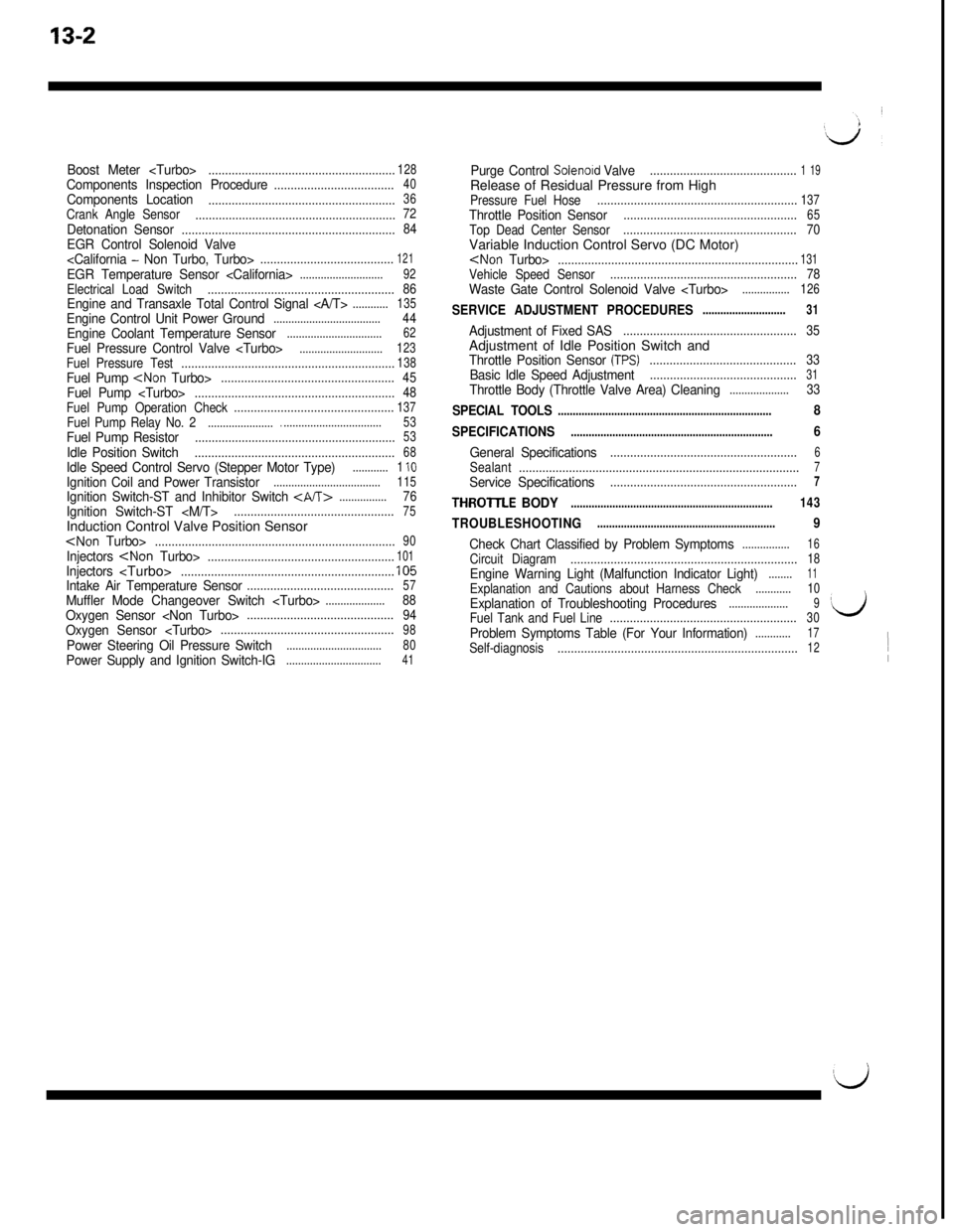
Boost Meter
Components Location........................................................36
Crank Angle Sensor
............................................................72Detonation Sensor................................................................84EGR Control Solenoid Valve
EGR Temperature Sensor
Fuel Pump Operation Check................................................137Fuel Pump Relay No. 2........................................................53Fuel Pump Resistor............................................................53
Idle Position Switch............................................................68Idle Speed Control Servo (Stepper Motor Type)............1 IOIgnition Coil and Power Transistor....................................115Ignition Switch-ST and Inhibitor Switch ................76Ignition Switch-ST
Injectors
94
Oxygen Sensor
Power Steering Oil Pressure Switch................................80Power Supply and Ignition Switch-IG................................41
Purge Control Solenord Valve............................................1 19Release of Residual Pressure from High
Pressure Fuel Hose............................................................137Throttle Position Sensor....................................................65Top Dead Center Sensor....................................................70Variable Induction Control Servo (DC Motor)
SERVICE ADJUSTMENT PROCEDURES............................31
Adjustment of Fixed SAS....................................................35Adjustment of Idle Position Switch and
Throttle Position Sensor (TPS)............................................33Basic Idle Speed Adjustment............................................31Throttle Body (Throttle Valve Area) Cleaning....................33
SPECIAL TOOLS........................................................................8
SPECIFICATIONS
....................................................................6
General Specifications........................................................6Sealant....................................................................................7Service Specifications........................................................7
THROlTLE BODY....................................................................143
TROUBLESHOOTING............................................................9
Check Chart Classified by Problem Symptoms................16Circuit Diagram....................................................................18Engine Warning Light (Malfunction Indicator Light)........11Explanation and Cautions about Harness Check............10Explanation of Troubleshooting Procedures....................9Fuel Tank and Fuel Line........................................................30
Problem Symptoms Table (For Your Information)............17Self-diagnosis........................................................................12)
I
Page 112 of 1146
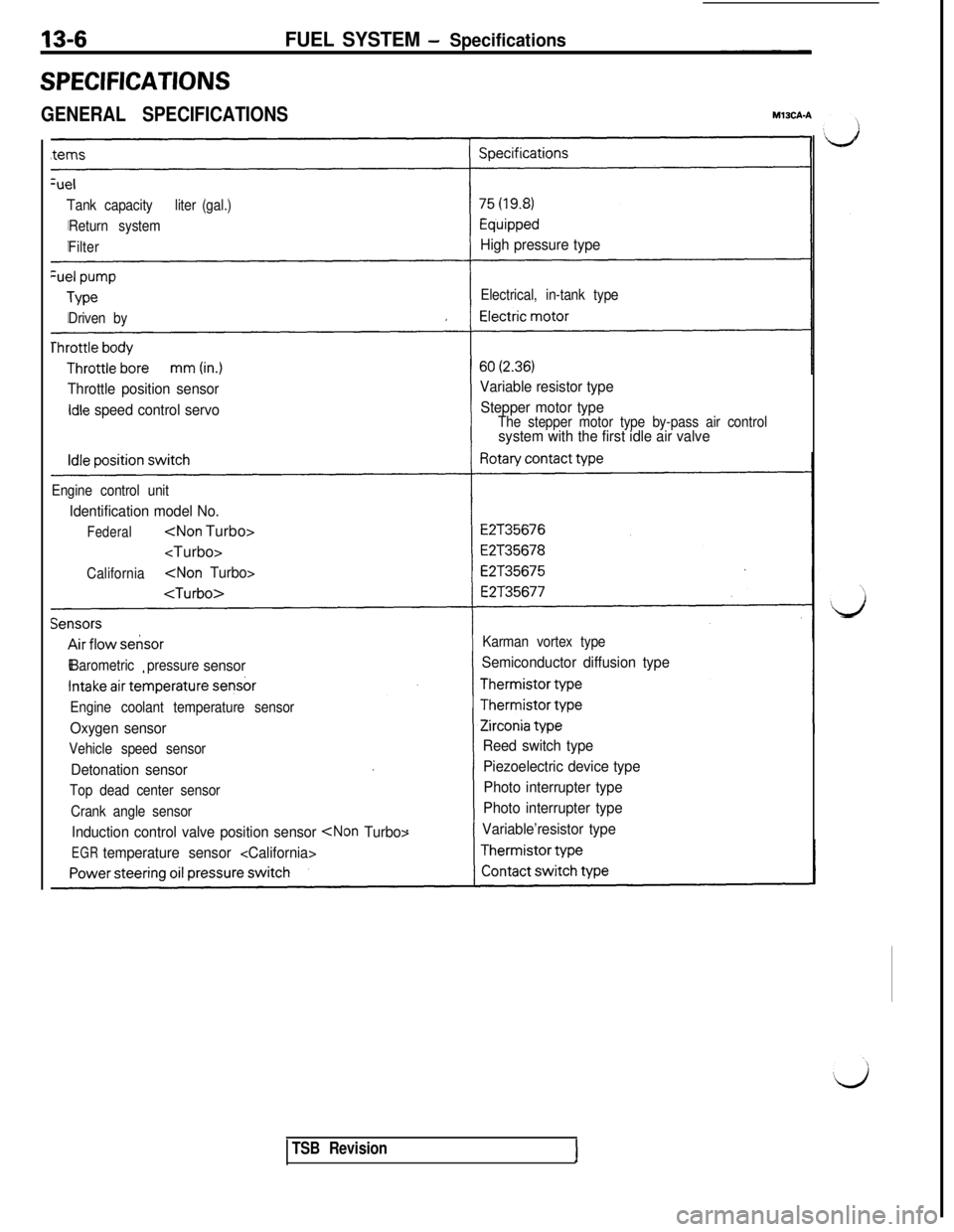
Tank capacityliter (gal.)
Return system
Filter
High pressure type
Electrical, in-tank type
Driven by
Throttle position sensor
idle speed control servoVariable resistor type
Stepper motor typeThe stepper motor type by-pass air controlsystem with the first idle air valve
Engine control unit
Identification model No.
Federal
California
Karman vortex type
Barometric pressure
sensorSemiconductor diffusion type
Engine coolant temperature sensor
Oxygen sensor
Vehicle speed sensor
Detonation sensor
Top dead center sensor
Crank angle sensor
Induction control valve position sensor
EGRtemperature sensor
Piezoelectric device type
Photo interrupter type
Photo interrupter type
Variable’resistor type
13-6FUEL SYSTEM - Specifications
SPECIFICATIONS
GENERAL SPECIFICATIONS
TSB Revision
Page 113 of 1146
FUEL SYSTEM - SDecifications
L
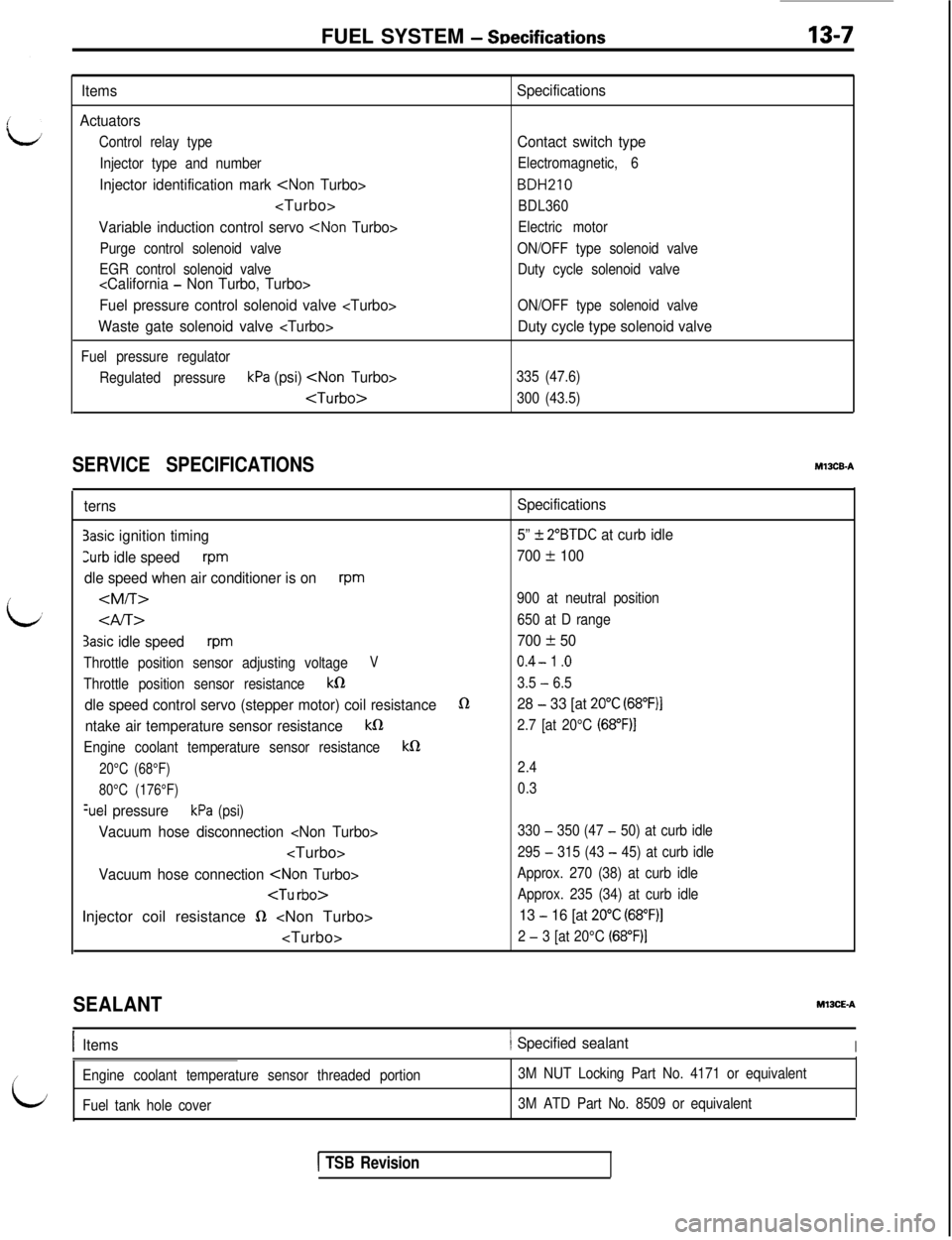
Items
Actuators
Control relay type
Injector type and number
Injector identification mark
Variable induction control servo
Purge control solenoid valve
EGR control solenoid valve
Fuel pressure control solenoid valve
Waste gate solenoid valve
Fuel pressure regulator
Regulated pressure
kPa (psi)
Specifications
Contact switch type
Electromagnetic, 6
BDH210
BDL360
Electric motor
ON/OFF type solenoid valve
Duty cycle solenoid valve
ON/OFF type solenoid valve
Duty cycle type solenoid valve
335 (47.6)
300 (43.5)
SERVICE SPECIFICATIONS
i
ternsSpecifications
3asic ignition timing5” -t 2”BTDC at curb idle
3urb idle speedrpm700 * 100
dle speed when air conditioner is on
rpm
3asic idle speedrpm700 + 50
Throttle position sensor adjusting voltageV0.4- 1 .o
Throttle position sensor resistancek03.5 - 6.5
dle speed control servo (stepper motor) coil resistance028 - 33 [at 20°C (68”F)I
ntake air temperature sensor resistancekfi2.7 [at 20°C (68”F)I
Engine coolant temperature sensor resistancekQ
20°C (68°F)
2.4
80°C (176°F)0.3
%el pressurekPa (psi)
Vacuum hose disconnection
295 - 315 (43 - 45) at curb idle
Vacuum hose connection
Sz
2 - 3 [at 20°C (68”F)I
SEALANTMlXE-A
IItems1 Specified sealantI
/
L
Engine coolant temperature sensor threaded portion3M NUT Locking Part No. 4171 or equivalent
Fuel tank hole cover3M ATD Part No. 8509 or equivalent
1 TSB Revision
Page 117 of 1146
FUEL SYSTEM - Troubleshooting13-11
L
L
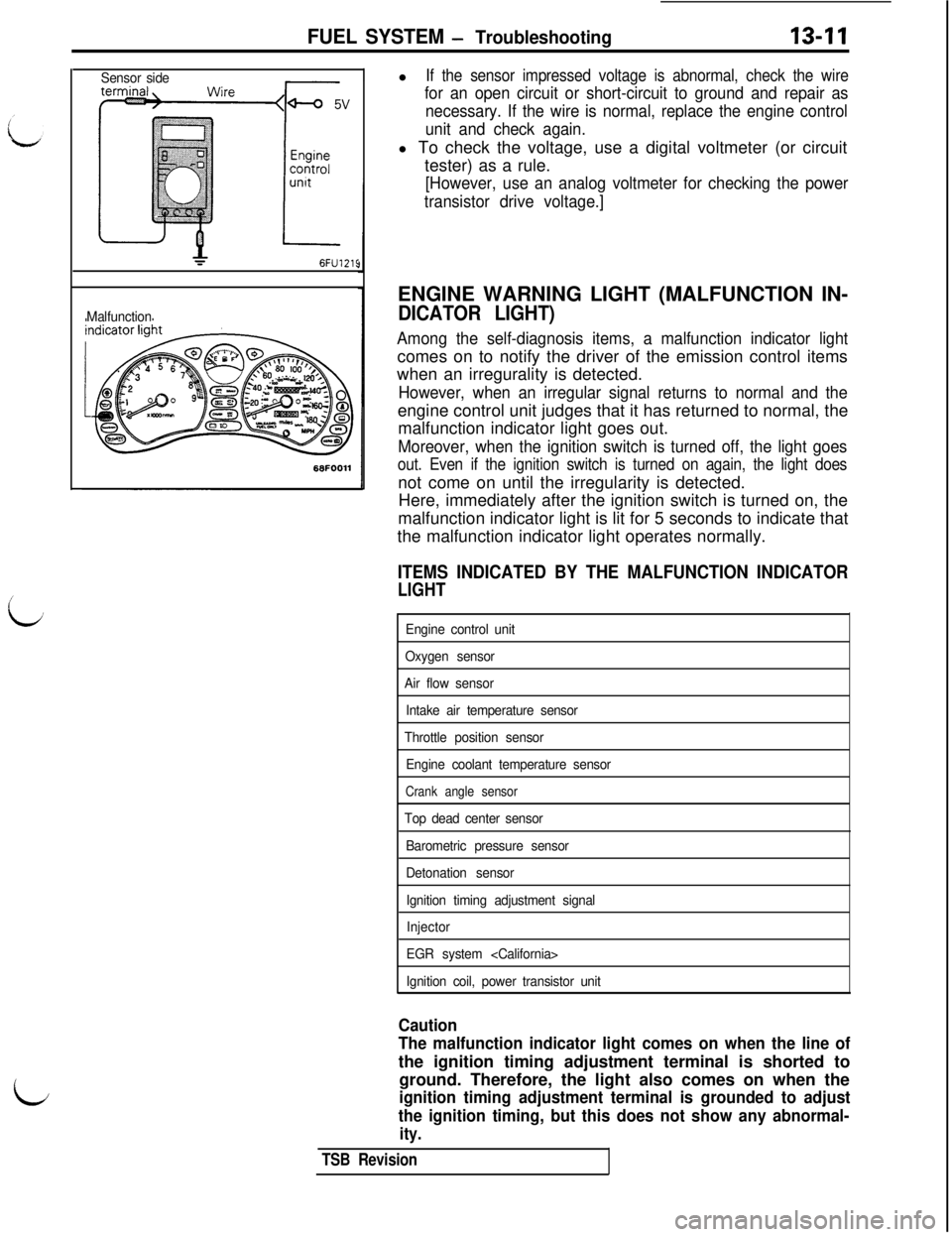
Sensor side6FU1215
Malfunctionl
If the sensor impressed voltage is abnormal, check the wire
for an open circuit or short-circuit to ground and repair as
necessary. If the wire is normal, replace the engine control
unit and check again.l To check the voltage, use a digital voltmeter (or circuit
tester) as a rule.
[However, use an analog voltmeter for checking the power
transistor drive voltage.]ENGINE WARNING LIGHT (MALFUNCTION IN-
DICATOR LIGHT)
Among the self-diagnosis items, a malfunction indicator lightcomes on to notify the driver of the emission control items
when an irregurality is detected.
However, when an irregular signal returns to normal and theengine control unit judges that it has returned to normal, the
malfunction indicator light goes out.
Moreover, when the ignition switch is turned off, the light goes
out. Even if the ignition switch is turned on again, the light doesnot come on until the irregularity is detected.
Here, immediately after the ignition switch is turned on, the
malfunction indicator light is lit for 5 seconds to indicate that
the malfunction indicator light operates normally.
ITEMS INDICATED BY THE MALFUNCTION INDICATOR
LIGHT
Engine control unit
Oxygen sensor
Air flow sensor
Intake air temperature sensor
Throttle position sensor
Engine coolant temperature sensor
Crank angle sensor
Top dead center sensor
Barometric pressure sensor
Detonation sensor
Ignition timing adjustment signal
Injector
EGR system
Ignition coil, power transistor unit
Caution
The malfunction indicator light comes on when the line ofthe ignition timing adjustment terminal is shorted to
ground. Therefore, the light also comes on when the
ignition timing adjustment terminal is grounded to adjust
the ignition timing, but this does not show any abnormal-
ity.
TSB Revision
Page 119 of 1146
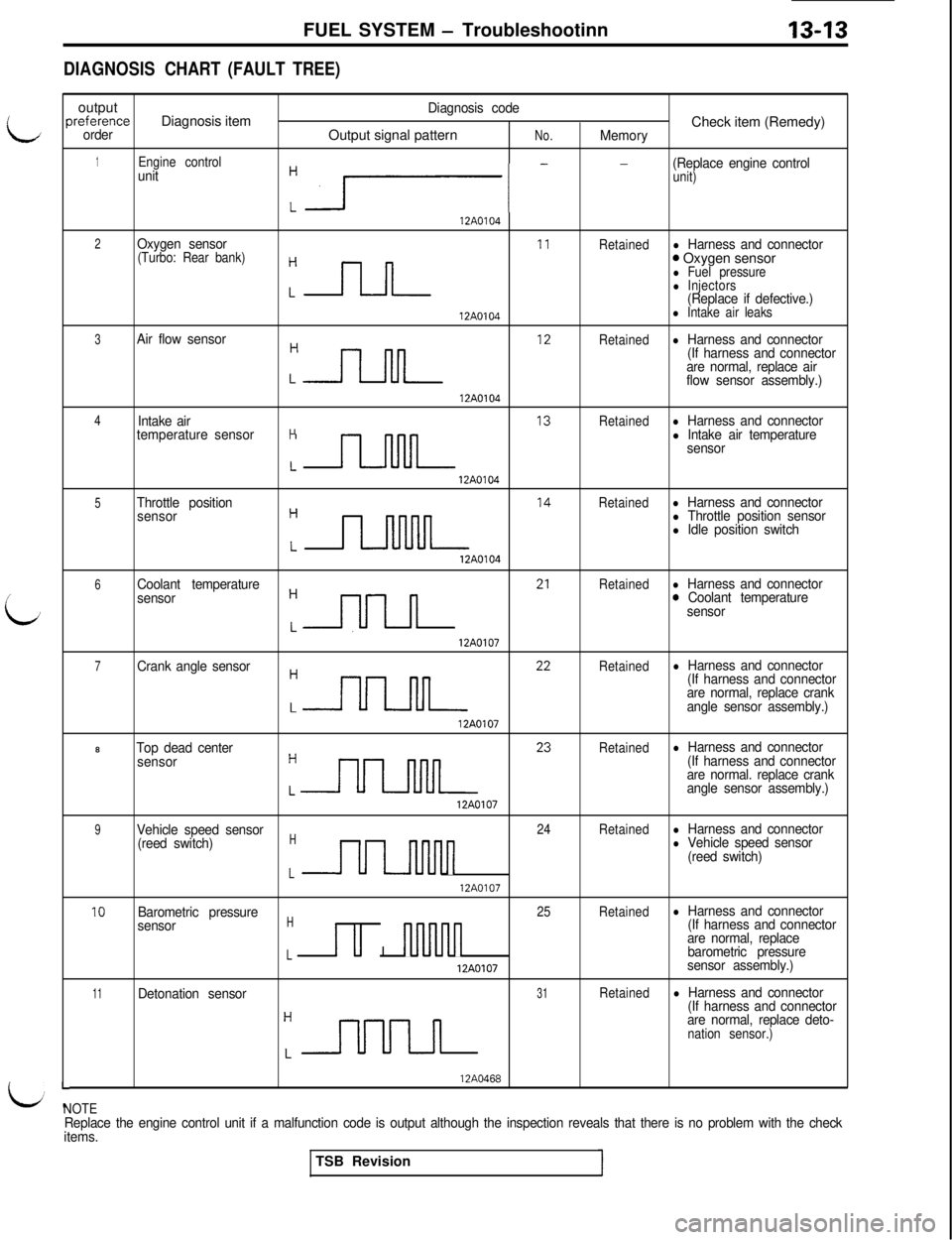
FUEL SYSTEM - Troubleshootinn
DIAGNOSISCHART (FAULT TREE)
i
L
Foutput
Diagnosis codeIreferenceDiagnosis item
Check item (Remedy)orderOutput signal patternNo.Memory
1Engine controlunit
:r- -
(Replace engine controlunit)
12A0104
2Oxygen sensorRetainedl Harness and connector(Turbo: Rear bank)
Cnn I’
0 Oxygen sensorl Fuel pressurel Injectors(Replace if defective.)
12A0104l Intake air leaks
3Air flow sensor
:n ‘*
Retainedl Harness and connector
(If harness and connector
are normal, replace air
flow sensor assembly.)
12A0104
4Intake airRetainedl Harness and connector
temperature sensorH
Ln I3
l Intake air temperature
sensor
12A0104
5Throttle position
sensor
:n I4
Retainedl Harness and connectorl Throttle position sensorl Idle position switch
12AO104
6Coolant temperature
:nn 21
Retainedl Harness and connector
sensor0 Coolant temperature
sensor12A0107
7Crank angle sensor
:nn 22
Retainedl Harness and connector
(If harness and connector
are normal, replace crank
angle sensor assembly.)
12A01078
Top dead centerRetainedl Harness and connector
sensor
:nn 23
(If harness and connector
are normal. replace crank
angle sensor assembly.)
12A0107
9Vehicle speed sensor24Retainedl Harness and connector
(reed switch)H
UInnnn
l Vehicle speed sensor
(reed switch)
L12A0107
10Barometric pressure25Retainedl Harness and connector
sensorHu I
nnluln
(If harness and connector
are normal, replace
Lbarometric pressure
12A0107sensor assembly.)
11Detonation sensor31Retainedl Harness and connector
:-r-uuuL
(If harness and connector
are normal, replace deto-
nation sensor.)
L-NOTE
12A0468
Replace the engine control unit if a malfunction code is output although the inspection reveals that there is no problem with the check
items.TSB Revision
Page 128 of 1146
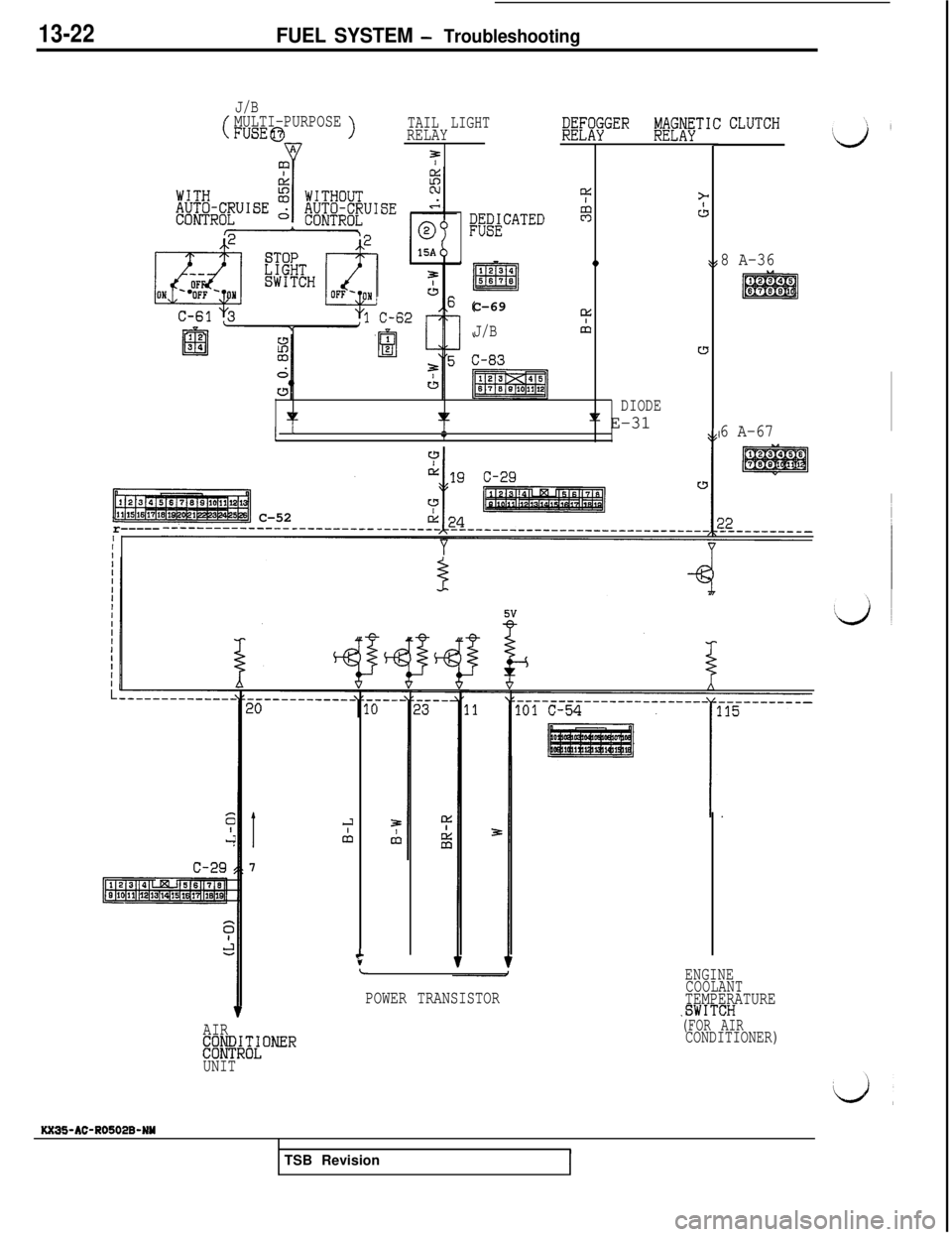
13-22FUEL SYSTEM - Troubleshooting
J/B
(MULTI-PURPOSEFUSE@>TAIL LIGHTRELAYiE;;FGER ikli$IC
5I7
>
;;iZ;CATED gJ
0\IC-69
[1:
J/B&I
w
8 A-36
7
DIODE*Ire E-31I ’1IT6 A-67C-52
r-----IY
6I1
J
CA
7
.i
tc
POWER TRANSISTOR
ENGINE
COOLANT
TEMPERATURE.SWITCH
(FOR AIR
CONDITIONER)AIR~X$Il$T~ONER
UNITKX35-AC-R05025-NY
TSB Revision
Page 137 of 1146
SERVICE ADJUSTMENT PROCEDURES
MlBFHSU
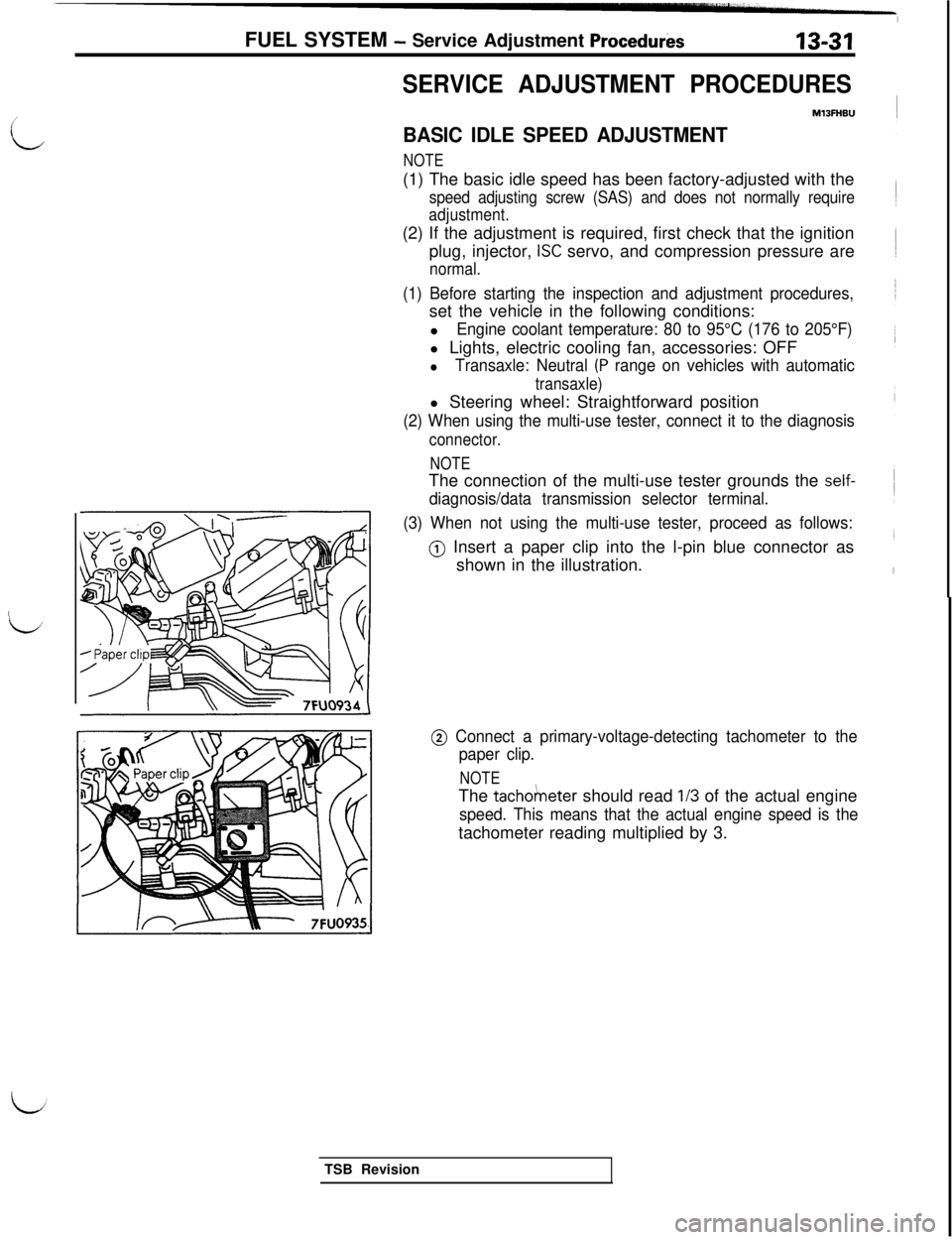
BASIC IDLE SPEED ADJUSTMENT
NOTE(1) The basic idle speed has been factory-adjusted with the
speed adjusting screw (SAS) and does not normally require
adjustment.(2) If the adjustment is required, first check that the ignition
plug, injector,
ISC servo, and compression pressure are
normal.
(1) Before starting the inspection and adjustment procedures,set the vehicle in the following conditions:
l
Engine coolant temperature: 80 to 95°C (176 to 205°F)l Lights, electric cooling fan, accessories: OFF
lTransaxle: Neutral (P range on vehicles with automatic
transaxle)l Steering wheel: Straightforward position
(2) When using the multi-use tester, connect it to the diagnosis
connector.
NOTEThe connection of the multi-use tester grounds the
self-
diagnosis/data transmission selector terminal.
(3) When not using the multi-use tester, proceed as follows:
@) Insert a paper clip into the l-pin blue connector as
shown in the illustration. FUEL SYSTEM
- Service Adjustment Procedurks13-31
i
@ Connect a primary-voltage-detecting tachometer to the
paper clip.
NOTEThe
tacho/neter should read l/3 of the actual engine
speed. This means that the actual engine speed is thetachometer reading multiplied by 3.
TSB Revision
Page 142 of 1146
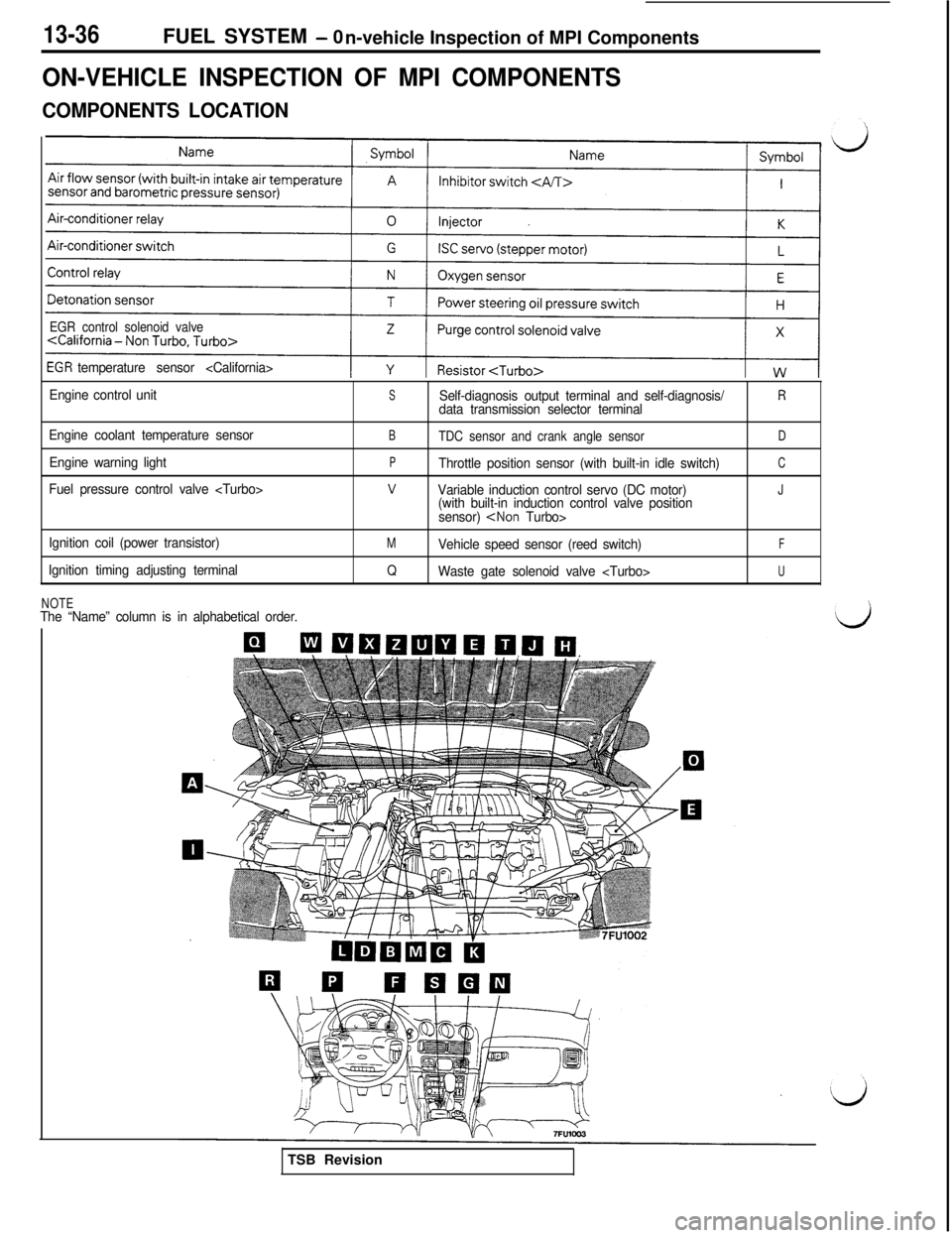
13-36FUEL SYSTEM - 0
n-vehicle Inspection of MPI Components
ON-VEHICLE INSPECTION OF MPI COMPONENTS
COMPONENTS LOCATION
EGR control solenoid valve
temperature sensor
Engine control unit
Engine coolant temperature sensor
Engine warning light
Fuel pressure control valve
Ignition coil (power transistor)
Ignition timing adjusting terminal
SSelf-diagnosis output terminal and self-diagnosis/Rdata transmission selector terminal
BTDC sensor and crank angle sensorD
PThrottle position sensor (with built-in idle switch)C
vVariable induction control servo (DC motor)J(with built-in induction control valve position
sensor)
MVehicle speed sensor (reed switch)F
QWaste gate solenoid valve
NOTEThe “Name” column is in alphabetical order.TSB Revision
Page 168 of 1146
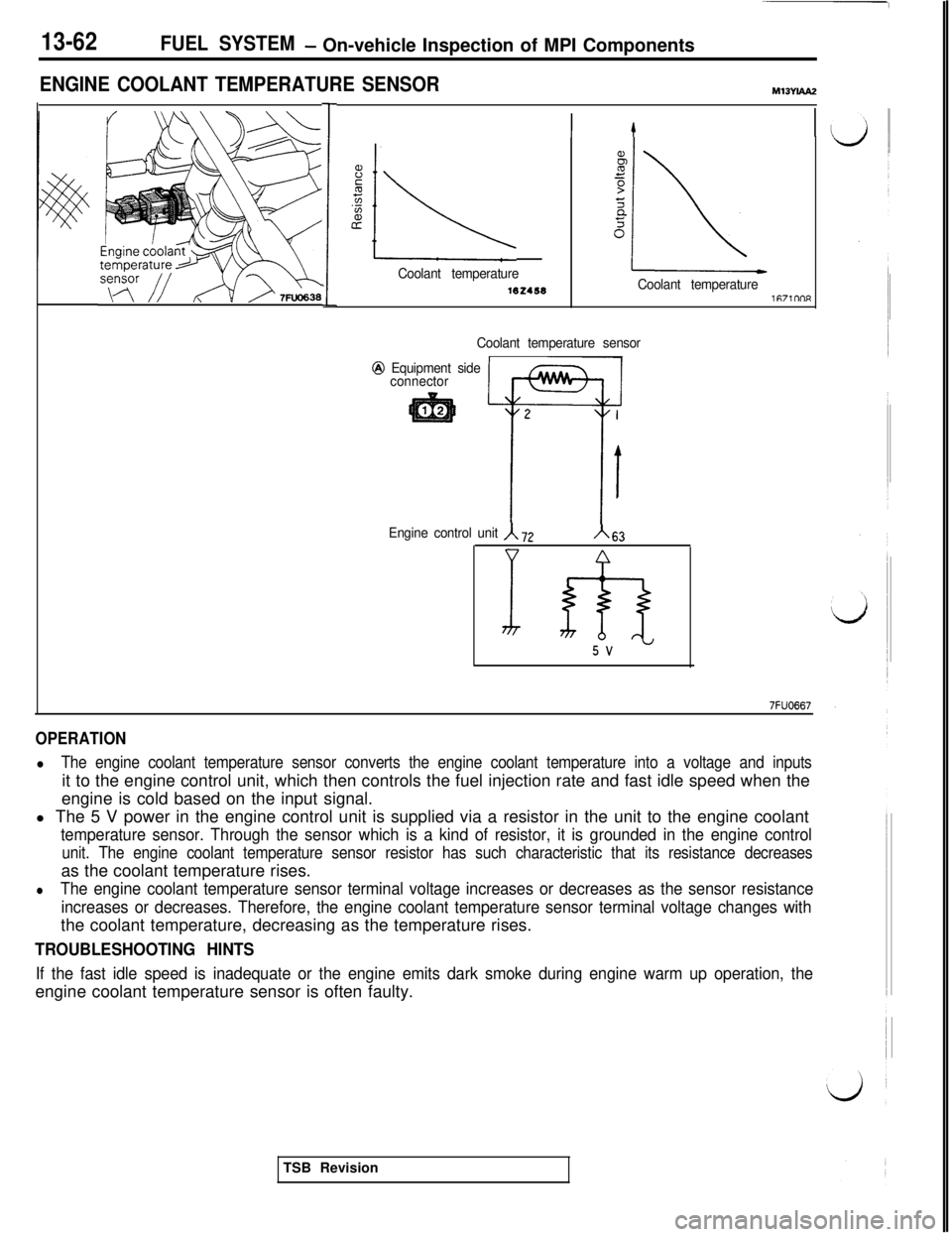
13-62FUEL SYSTEM- On-vehicle Inspection of MPI Components
ENGINE COOLANT TEMPERATURE SENSORM13Ybu2
1
If
il\__ ;I\*
Coolant temperature
162458Coolant temperaturei67im-m
Coolant temperature sensor
@ Equipment side
connector
2
fi
I
Engine control unit ), 72A63
1 ff35V
7FUO667
OPERATION
lThe engine coolant temperature sensor converts the engine coolant temperature into a voltage and inputsit to the engine control unit, which then controls the fuel injection rate and fast idle speed when the
engine is cold based on the input signal.
l The 5 V power in the engine control unit is supplied via a resistor in the unit to the engine coolant
temperature sensor. Through the sensor which is a kind of resistor, it is grounded in the engine control
unit. The engine coolant temperature sensor resistor has such characteristic that its resistance decreasesas the coolant temperature rises.
lThe engine coolant temperature sensor terminal voltage increases or decreases as the sensor resistance
increases or decreases. Therefore, the engine coolant temperature sensor terminal voltage changes withthe coolant temperature, decreasing as the temperature rises.
TROUBLESHOOTING HINTS
If the fast idle speed is inadequate or the engine emits dark smoke during engine warm up operation, theengine coolant temperature sensor is often faulty.
TSB Revision
Page 169 of 1146
id
LFUEL SYSTEM
- On-vehicle Inspection of MPI Components13-63
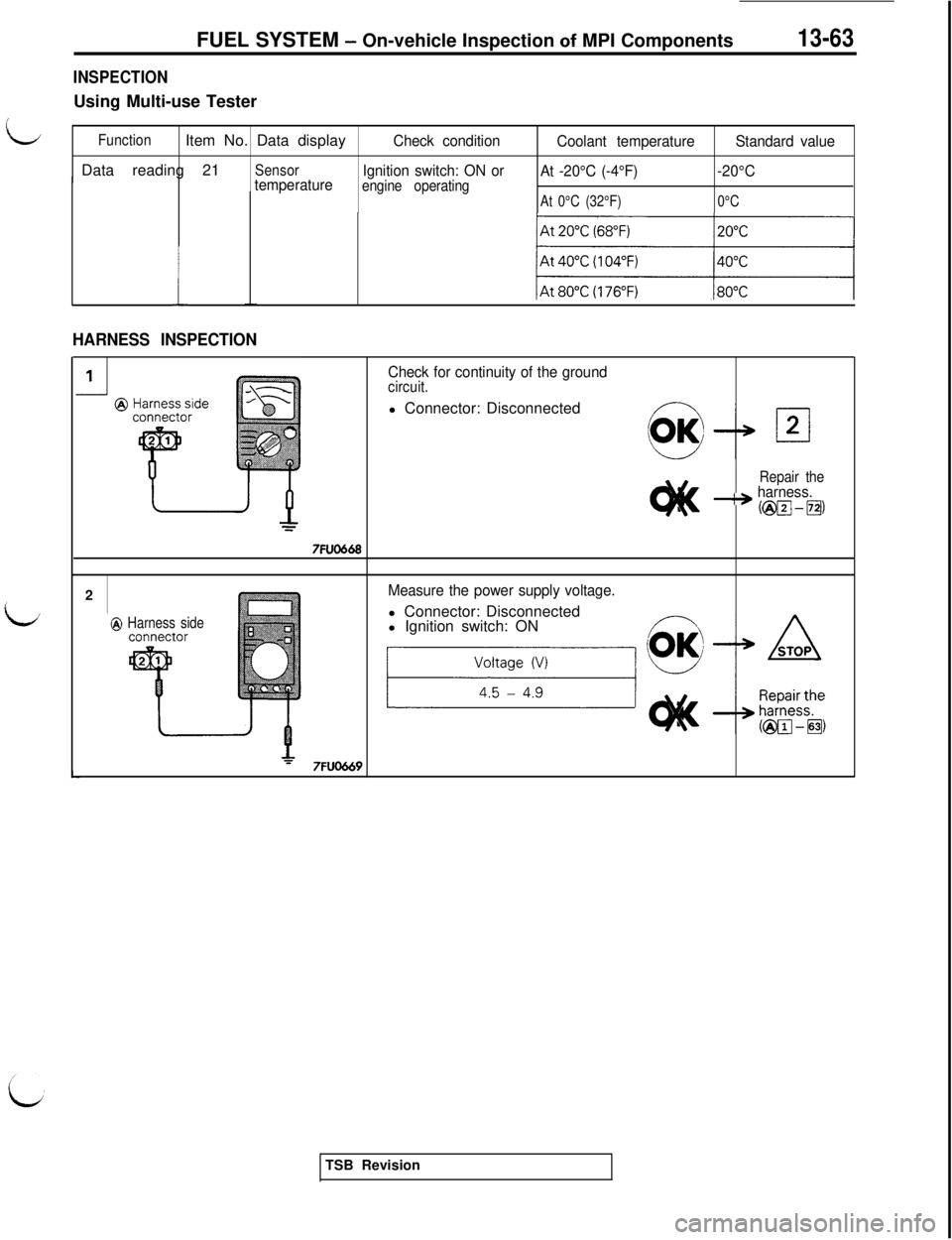
INSPECTIONUsing Multi-use Tester
LFunctionItem No. Data displayCheck condition
Coolant temperatureStandard valueData reading 21
SensorIgnition switch: ON or
At -20°C (-4°F)-20°C
temperatureengine operatingAt 0°C (32°F)0°C
HARNESS INSPECTION
Check for continuity of the groundcircuit.l Connector: Disconnected
Repair the---+ harness.
7FUO6682
Measure the power supply voltage.l Connector: Disconnected
@ Harness sidel Ignition switch: ON
7FUO669TSB Revision