coolant temperature MITSUBISHI 3000GT 1991 Service Manual
[x] Cancel search | Manufacturer: MITSUBISHI, Model Year: 1991, Model line: 3000GT, Model: MITSUBISHI 3000GT 1991Pages: 1146, PDF Size: 76.68 MB
Page 19 of 1146
GENERAL - Precautions before Service0045
c
mm (in.)so005
PRECAUTIONS BEFORE SERWCEMOOOAAOSERVICING ELECTRICAL SYSTEM
1. Note the following before proceeding with work on the
electrical system.
Note that the following must never be done:
Unauthorized modifications of any electrical device or
wiring, because such modifications might lead to a vehicle
malfunction, over-capacity or short-circuit that could result
in a fire in the vehicle.
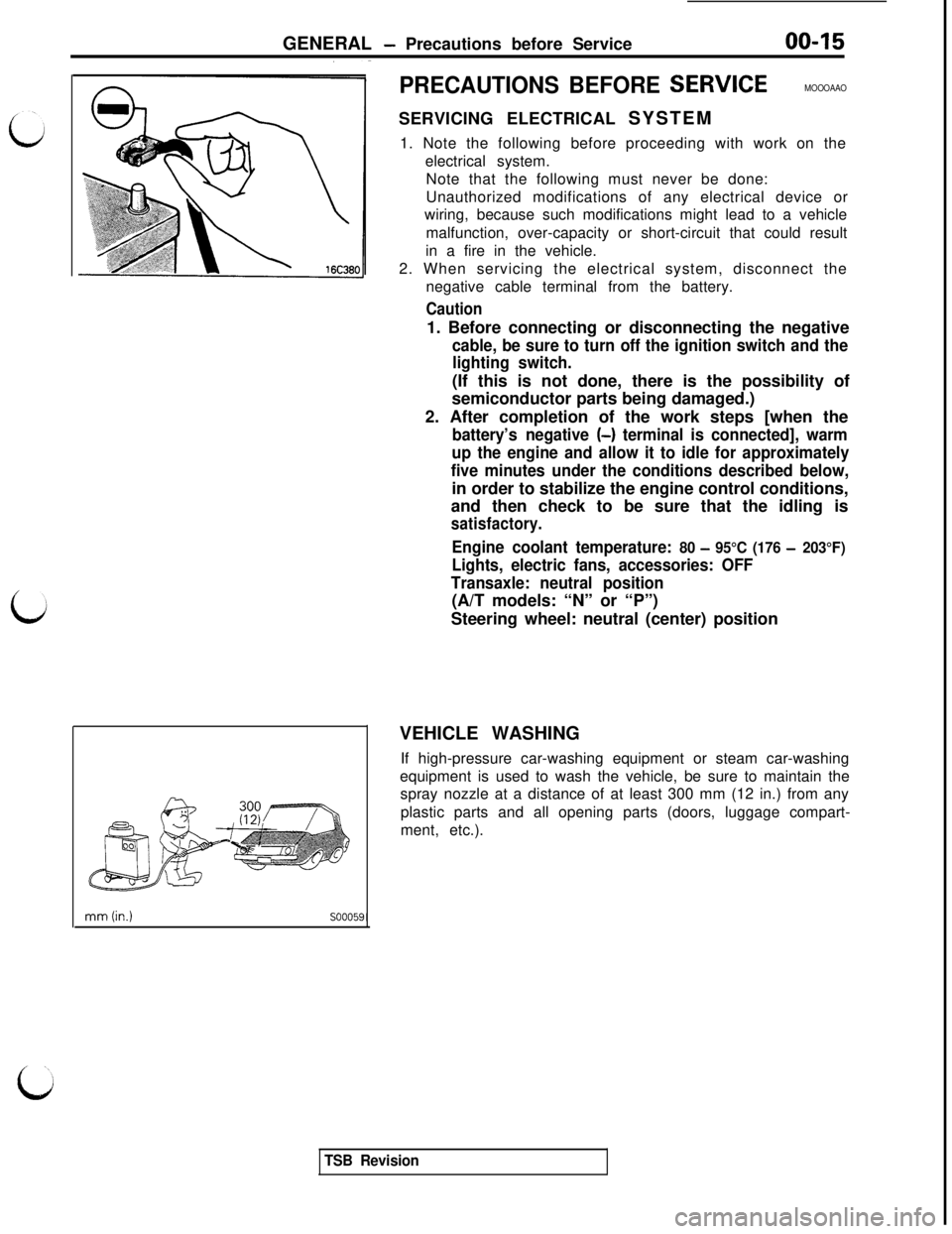
2. When servicing the electrical system, disconnect the
negative cable terminal from the battery.
Caution1. Before connecting or disconnecting the negative
cable, be sure to turn off the ignition switch and the
lighting switch.(If this is not done, there is the possibility of
semiconductor parts being damaged.)
2. After completion of the work steps [when the
battery’s negative (-) terminal is connected], warm
up the engine and allow it to idle for approximately
five minutes under the conditions described below,in order to stabilize the engine control conditions,
and then check to be sure that the idling is
satisfactory.
Engine coolant temperature: 80 - 95°C (176 - 203°F)
Lights, electric fans, accessories: OFF
Transaxle: neutral position(A/T models: “N” or “P”)
Steering wheel: neutral (center) position
VEHICLE WASHING
If high-pressure car-washing equipment or steam car-washing
equipment is used to wash the vehicle, be sure to maintain the
spray nozzle at a distance of at least 300 mm (12 in.) from any
plastic parts and all opening parts (doors, luggage compart-
ment, etc.).
c
TSB Revision
Page 38 of 1146

00-34 GENERAL - Recommended Lubricants and Lubricant Capacities Table
SELECTION OF COOLANT
COOLANTRelation between Antifreeze Concentration and Specific Gravity
I
\
‘d I
ExampleThe safe operating temperature is -15°C (5°F) when the measured specific gravity is 1.058 at the coolant
temperature of 20°C (68°F).
Caution1. If the concentration of the coolant is below 30%, the anti-corrosion property will be adversely
affected. In addition, if the concentration is above 60%, both the anti-freeze and engine cooling
properties will decrease, affecting the engine adversely. For these reasons, be sure to maintain theconcentration level within the specified range.
2. Do not use a mixture of different brands of anti-freeze.
-/‘.
1 TSB RevisionI
Page 42 of 1146
00-38GENERAL - Maintenance Service
00F0006
:Vehicles with air conditioner>OOFOO07
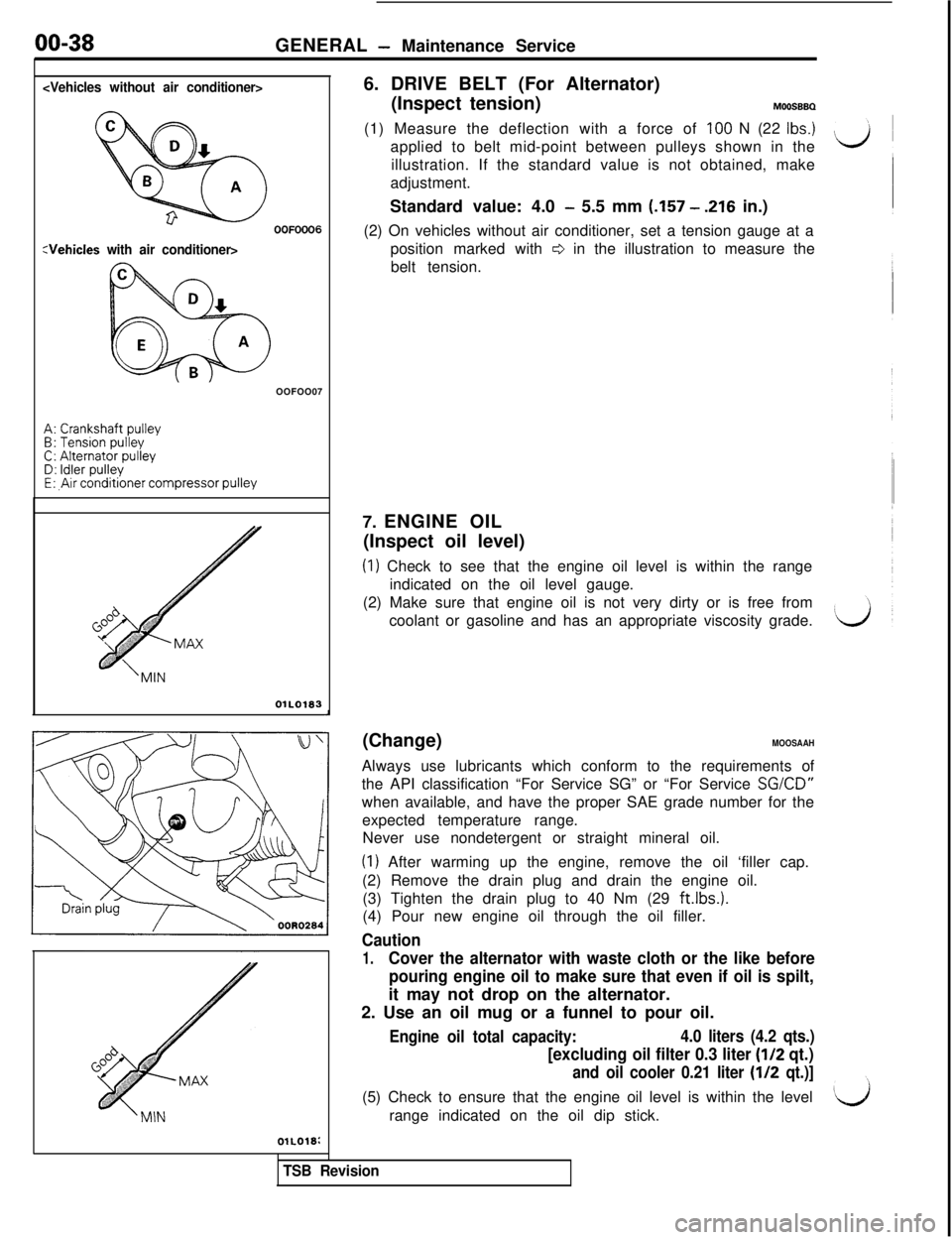
A: Crankshaft pulleyB: Tension pulleyC: Alternator pulleyD: Idler pulleyE: ,Air conditioner compressor pulley
OlLO183
OlLO18:(Inspect tension)
MOOS88(1(1) Measure the deflection with a force of
100 N (22 Ibs.)applied to belt mid-point between pulleys shown in the
illustration. If the standard value is not obtained, make
adjustment.
Standard value: 4.0
- 5.5 mm (.157 - 216 in.)
(2) On vehicles without air conditioner, set a tension gauge at a
position marked with
r3 in the illustration to measure the
belt tension.
7. ENGINE OIL
(Inspect oil level)
(I) Check to see that the engine oil level is within the range
indicated on the oil level gauge.
(2) Make sure that engine oil is not very dirty or is free from
coolant or gasoline and has an appropriate viscosity grade.J
(Change)
MOOSAAHAlways use lubricants which conform to the requirements of
the API classification “For Service SG” or “For Service
SGKD”when available, and have the proper SAE grade number for the
expected temperature range.
Never use nondetergent or straight mineral oil.
(1) After warming up the engine, remove the oil ‘filler cap.
(2) Remove the drain plug and drain the engine oil.
(3) Tighten the drain plug to 40 Nm (29 ft.lbs.).
(4) Pour new engine oil through the oil filler.
Caution
1.Cover the alternator with waste cloth or the like before
pouring engine oil to make sure that even if oil is spilt,it may not drop on the alternator.
2. Use an oil mug or a funnel to pour oil.
Engine oil total capacity:4.0 liters (4.2 qts.)
[excluding oil filter 0.3 liter (l/2 qt.)
and oil cooler 0.21 liter (l/2 qt.)](5) Check to ensure that the engine oil level is within the level
range indicated on the oil dip stick.
TSB Revision
Page 45 of 1146
GENERAL - Maintenance Service00-41
Good
t-lVA0283
I04FOOOd(4) Check the oil filter for clogging and damage and replace if
necessary.
(5) Clean drain plug and tighten drain plug with gasket to 30
-35 Nm (22
- 25 ft.lbs.).
(6) Clean both gasket surfaces of transaxle case and oil pan.
(7) Install oil pan with new gasket and tighten oil pan bolts to
10 - 12 Nm (7.5 - 8.5 ft.lbs.).
(8) Pour 4.5 liters (4.8 qts.) of specified ATF into case through
dipstick hole. [Total quantity of ATF required is approx. 7.5
liters (7.9 qts.). Actually however, approx. 4.5 liters (4.8 qts.)
of fluid can be replaced because rest of fluid remains in
torque converter.]
Specified fluid: Dia ATF SP or MITSUBISHI PLUS ATF or
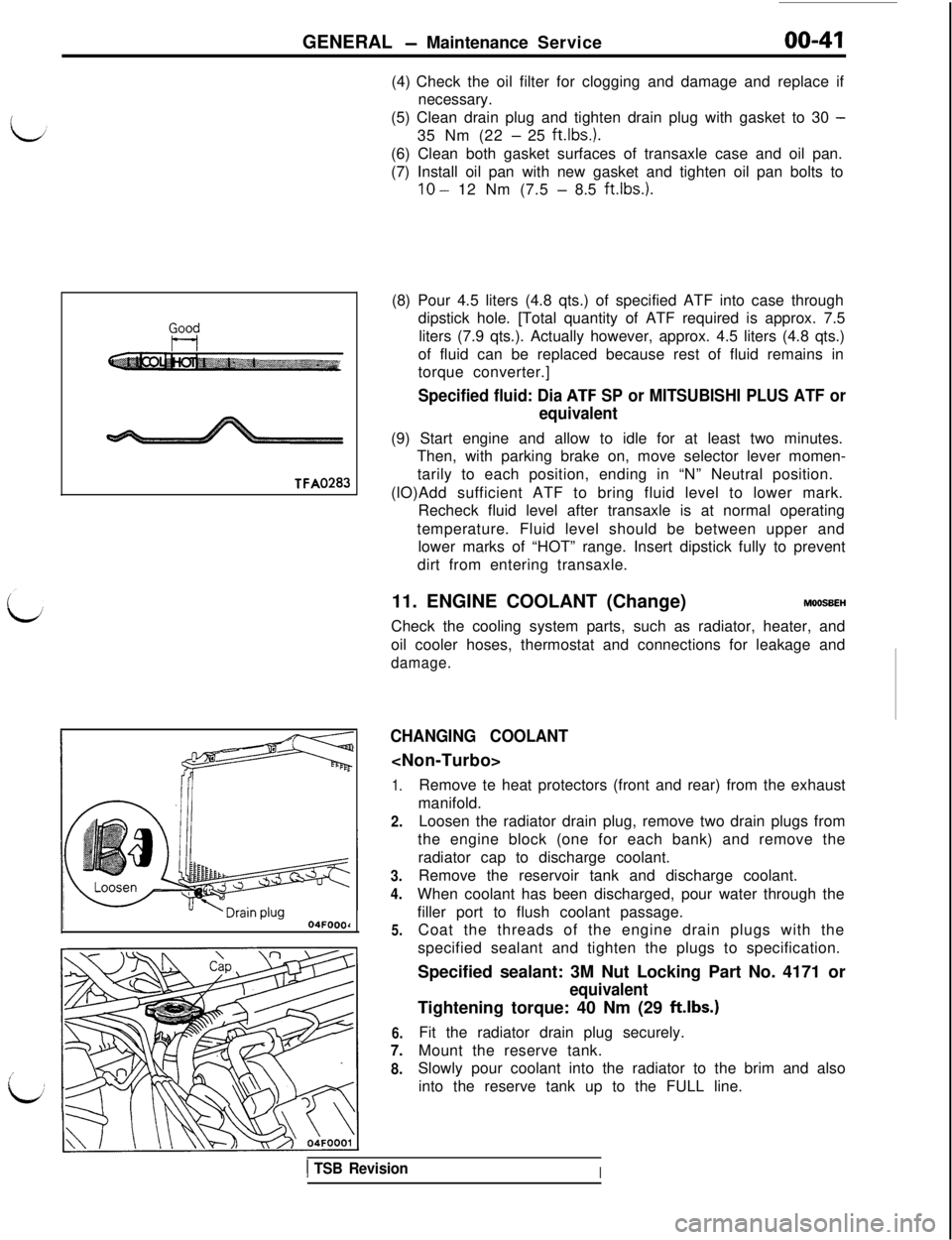
equivalent(9) Start engine and allow to idle for at least two minutes.
Then, with parking brake on, move selector lever momen-
tarily to each position, ending in “N” Neutral position.
(lO)Add sufficient ATF to bring fluid level to lower mark.
Recheck fluid level after transaxle is at normal operating
temperature. Fluid level should be between upper and
lower marks of “HOT” range. Insert dipstick fully to prevent
dirt from entering transaxle.
11. ENGINE COOLANT (Change)
MOOSBEHCheck the cooling system parts, such as radiator, heater, and
oil cooler hoses, thermostat and connections for leakage and
damage.
CHANGING COOLANT
1.
2.
3.
4.
5.
6.
7.
8.Remove te heat protectors (front and rear) from the exhaust
manifold.
Loosen the radiator drain plug, remove two drain plugs from
the engine block (one for each bank) and remove the
radiator cap to discharge coolant.
Remove the reservoir tank and discharge coolant.
When coolant has been discharged, pour water through the
filler port to flush coolant passage.
Coat the threads of the engine drain plugs with the
specified sealant and tighten the plugs to specification.
Specified sealant: 3M Nut Locking Part No. 4171 or
equivalentTightening torque: 40 Nm (29
ftlbs.)Fit the radiator drain plug securely.
Mount the reserve tank.
Slowly pour coolant into the radiator to the brim and also
into the reserve tank up to the FULL line.
1 TSB RevisionI
Page 48 of 1146
00-44
GENERAL - Main Sealant and Adhesive Table
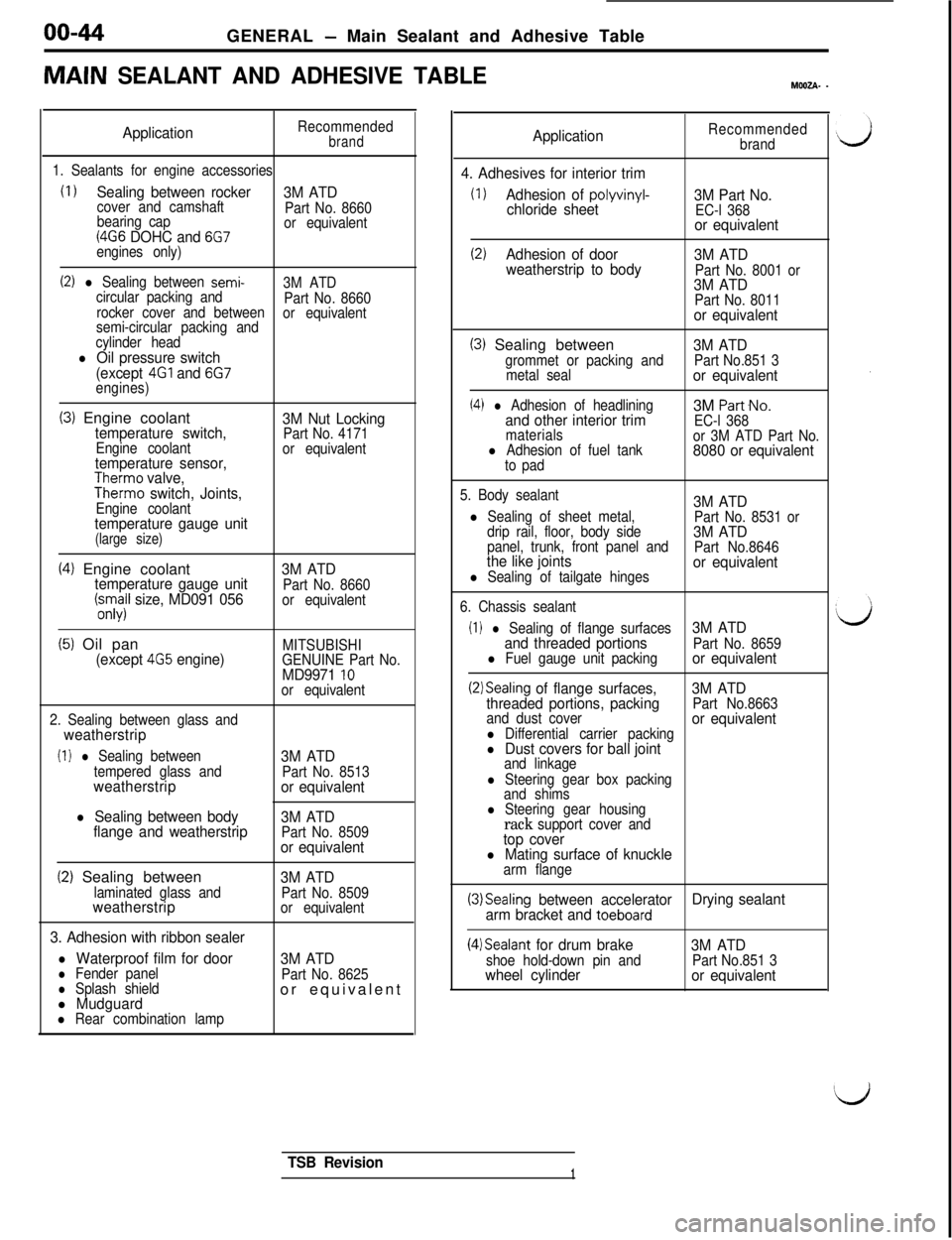
MAIN SEALANT AND ADHESIVE TABLEMWZA- -
ApplicationRecommendedbrand
1. Sealants for engine accessories
(I 1Sealing between rocker
3M ATDcover and camshaft
Part No. 8660
bearing cap
(4G6 DOHC and 6G7or equivalent
engines only)
(2) l Sealing between semi-3M ATD
circular packing and
Part No. 8660
rocker cover and between
semi-circular packing andor equivalent
cylinder head
l Oil pressure switch
(except 4Gl and 6G7engines)
(3) Engine coolanttemperature switch,Engine coolanttemperature sensor,Therm0 valve,Therm0 switch, Joints,Engine coolanttemperature gauge unit(large size)
3M Nut LockingPart No. 4171
or equivalent
(4) Engine coolanttemperature gauge unit(;.s;il size, MD091 0563M ATDPart No. 8660
or equivalent
(5) Oil pan(except 4G5 engine)MITSUBISHI
GENUINE Part No.
MD9971 10or equivalent
2. Sealing between glass and
weatherstrip
(I 1 l Sealing between
tempered glass and
weatherstrip
l Sealing between body
flange and weatherstrip3M ATD
Part No. 8513or equivalent
3M ATD
Part No. 8509or equivalent
(2) Sealing betweenlaminated glass andweatherstrip
3. Adhesion with ribbon sealer
l Waterproof film for doorl Fender panell Splash shieldl Mudguardl Rear combination lamp
3M ATDPart No. 8509
or equivalent
3M ATDPart No. 8625or equivalent
ApplicationRecommended
brand
4. Adhesives for interior trim
(1)Adhesion of polyvinyl-chloride sheet3M Part No.EC-l 368or equivalent
(2)Adhesion of door
3M ATD
weatherstrip to body
Part No. 8001 or3M ATDPart No. 8011or equivalent
(3) Sealing betweengrommet or packing and
metal seal
(4) l Adhesion of headliningand other interior trimmaterialsl Adhesion of fuel tank
to pad
3M ATDPart No.851 3or equivalent3M
Part-No.
EC-l 368
or 3M ATD Part No.
8080 or equivalent
5. Body sealant3M ATDl Sealing of sheet metal,
Part No. 8531 or
drip rail, floor, body side3M ATDpanel, trunk, front panel and
Part No.8646the like jointsl Sealing of tailgate hingesor equivalent
6. Chassis sealant
(I 1 l Sealing of flange surfaces3M ATD
and threaded portions
Part No. 8659l Fuel gauge unit packingor equivalent
(2)Sealing of flange surfaces,3M ATD
threaded portions, packingPart No.8663
and dust cover
l Differential carrier packingor equivalent
l Dust covers for ball jointand linkage
l Steering gear box packing
and shims
l Steering gear housingrack support cover andtop coverl Mating surface of knucklearm flange
(3)Sealing between accelerator
arm bracket and toeboardDrying sealant
(4)Sealant for drum brakeshoe hold-down pin andwheel cylinder3M ATDPart No.851 3or equivalent
TSB Revision1
Page 63 of 1146
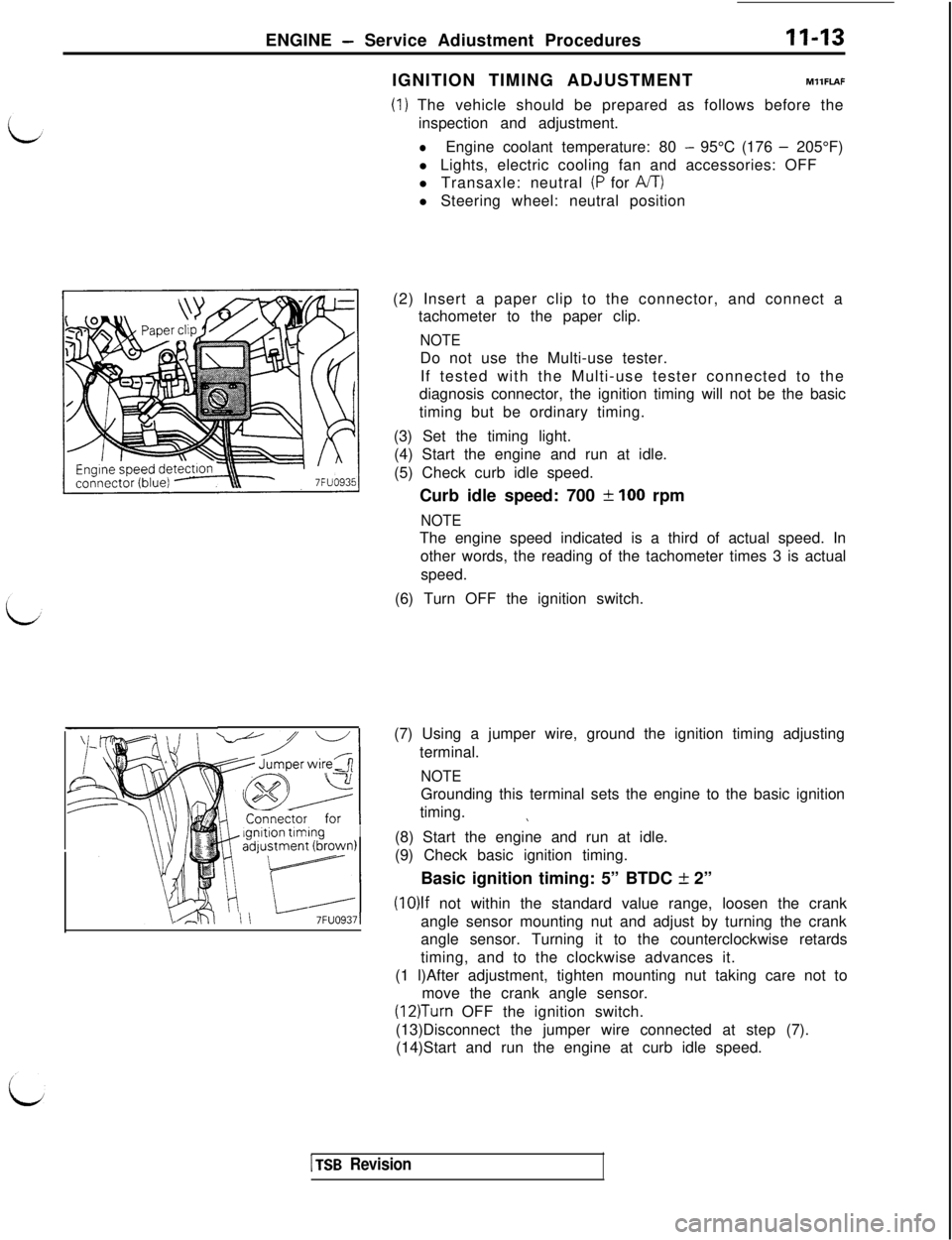
ENGINE - Service Adiustment ProceduresII-13
I_ ianltion tlminaI!H Connector for Igdpstment 6rown)
4tll II -7FUO9371IGNITION TIMING ADJUSTMENTMllFLAF
(1) The vehicle should be prepared as follows before the
inspection and adjustment.
lEngine coolant temperature: 80 - 95°C (176 - 205°F)
l Lights, electric cooling fan and accessories: OFF
l Transaxle: neutral
(P for A/T)l Steering wheel: neutral position
(2) Insert a paper clip to the connector, and connect a
tachometer to the paper clip.
NOTEDo not use the Multi-use tester.
If tested with the Multi-use tester connected to the
diagnosis connector, the ignition timing will not be the basic
timing but be ordinary timing.
(3) Set the timing light.
(4) Start the engine and run at idle.
(5) Check curb idle speed.
Curb idle speed: 700
f 100 rpm
NOTEThe engine speed indicated is a third of actual speed. In
other words, the reading of the tachometer times 3 is actual
speed.
(6) Turn OFF the ignition switch.
(7) Using a jumper wire, ground the ignition timing adjusting
terminal.
NOTEGrounding this terminal sets the engine to the basic ignition
timing.
\(8) Start the engine and run at idle.
(9) Check basic ignition timing.
Basic ignition timing: 5” BTDC
k 2”
(10)lf not within the standard value range, loosen the crank
angle sensor mounting nut and adjust by turning the crank
angle sensor. Turning it to the counterclockwise retards
timing, and to the clockwise advances it.
(1 l)After adjustment, tighten mounting nut taking care not to
move the crank angle sensor.
(12)Turn OFF the ignition switch.
(13)Disconnect the jumper wire connected at step (7).
(14)Start and run the engine at curb idle speed.
1 TSB Revision
Page 64 of 1146
11-14ENGINE - Service Adjustment Procedures
(15)Check to be sure that the idling ignition timing is the correct
timing.
Actual ignition timing: Approx. 15” BTDC
NOTE:d
(1) Ignition timing is variable even under normal operation.
(2) And it is automatically advanced at higher altitudes.
CURB IDLE SPEED INSPECTIONMllFMAB
(1) The vehicle should be prepared as follows before the
inspection.
lEngine coolant temperature: 80 - 95°C (176 - 205°F)
l Lights, electric cooling fan and accessories: OFF
l Transaxle: neutral
(P for A/T)l Steering wheel: neutral position
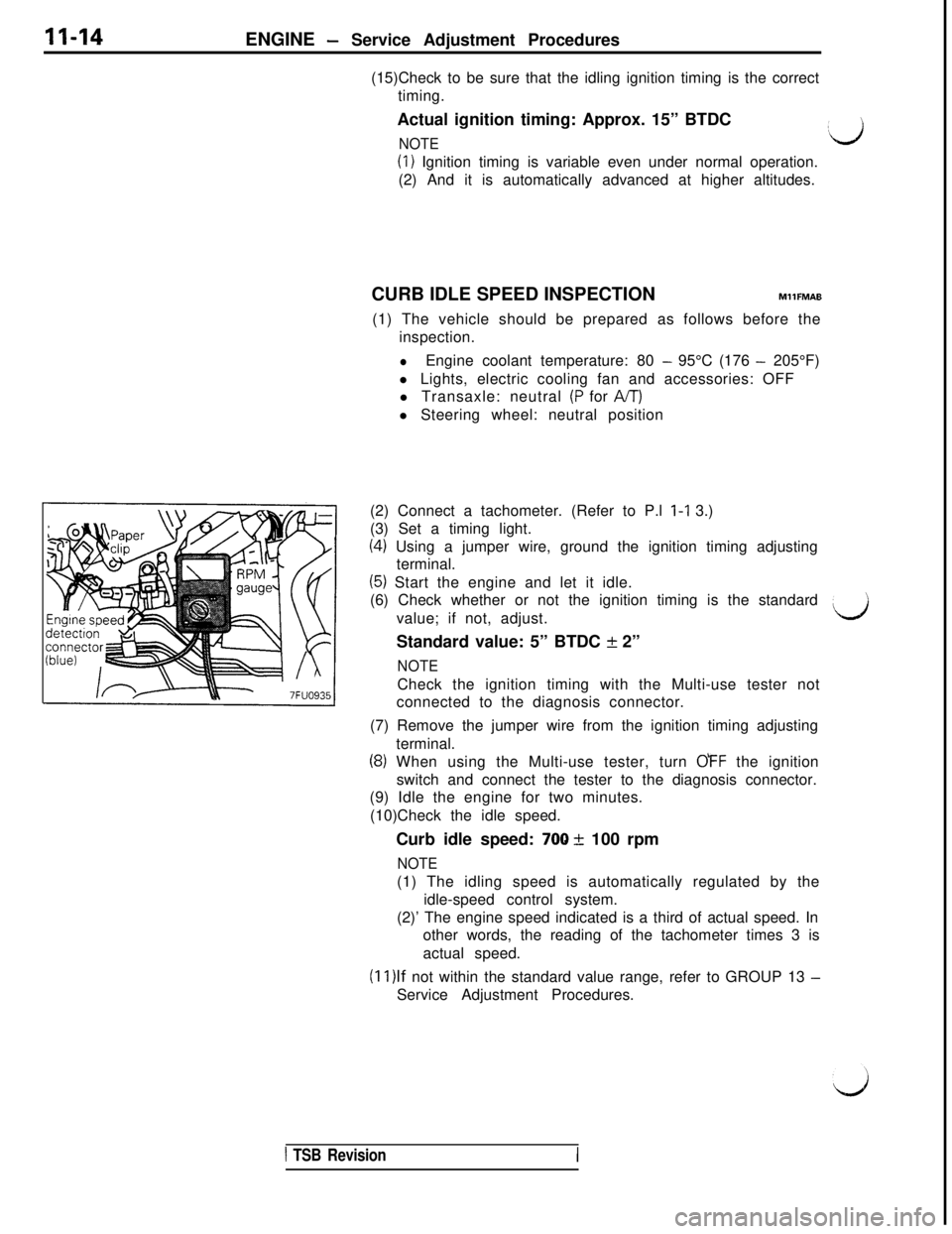
(2) Connect a tachometer. (Refer to P.l l-1 3.)
(3) Set a timing light.
(4) Using a jumper wire, ground the ignition timing adjusting
terminal.
(5) Start the engine and let it idle.
(6) Check whether or not the ignition timing is the standard
value; if not, adjust.
Standard value: 5” BTDC + 2”
NOTECheck the ignition timing with the Multi-use tester not
connected to the diagnosis connector.
(7) Remove the jumper wire from the ignition timing adjusting
terminal.
(8) When using the Multi-use tester, turn OFF the ignition
switch and connect the tester to the diagnosis connector.
(9) Idle the engine for two minutes.
(10)Check the idle speed.
Curb idle speed:
700 + 100 rpm
NOTE(1) The idling speed is automatically regulated by the
idle-speed control system.
(2)’ The engine speed indicated is a third of actual speed. In
other words, the reading of the tachometer times 3 is
actual speed.
(1l)lf not within the standard value range, refer to GROUP 13 -Service Adjustment Procedures.
d
1 TSB RevisionI
Page 65 of 1146
ENGINE - Service Adjustment Procedures11-15COMPRESSION PRESSURE CHECKMllFFAK
(1) Before checking compression, ensure that engine oil, the
starter motor, and battery are all in normal operating
condition.
(2) Start the engine and wait until engine coolant temperature
has risen to 80
- 95°C (176 - 205°F).
(3) Remove the all spark plugs.
(4) Crank the engine to remove any foreign objects in the
cylinders.
CautionCover the spark plug holes with shop towel, etc., in
order to keep expelled foreign objects from flying out,and keep away from the holes. When measuring
compression with water, oil, or fuel having entered the
cylinder through a crack, etc., these will come flying out
of the spark plug hole hot and fast, so be sure to take
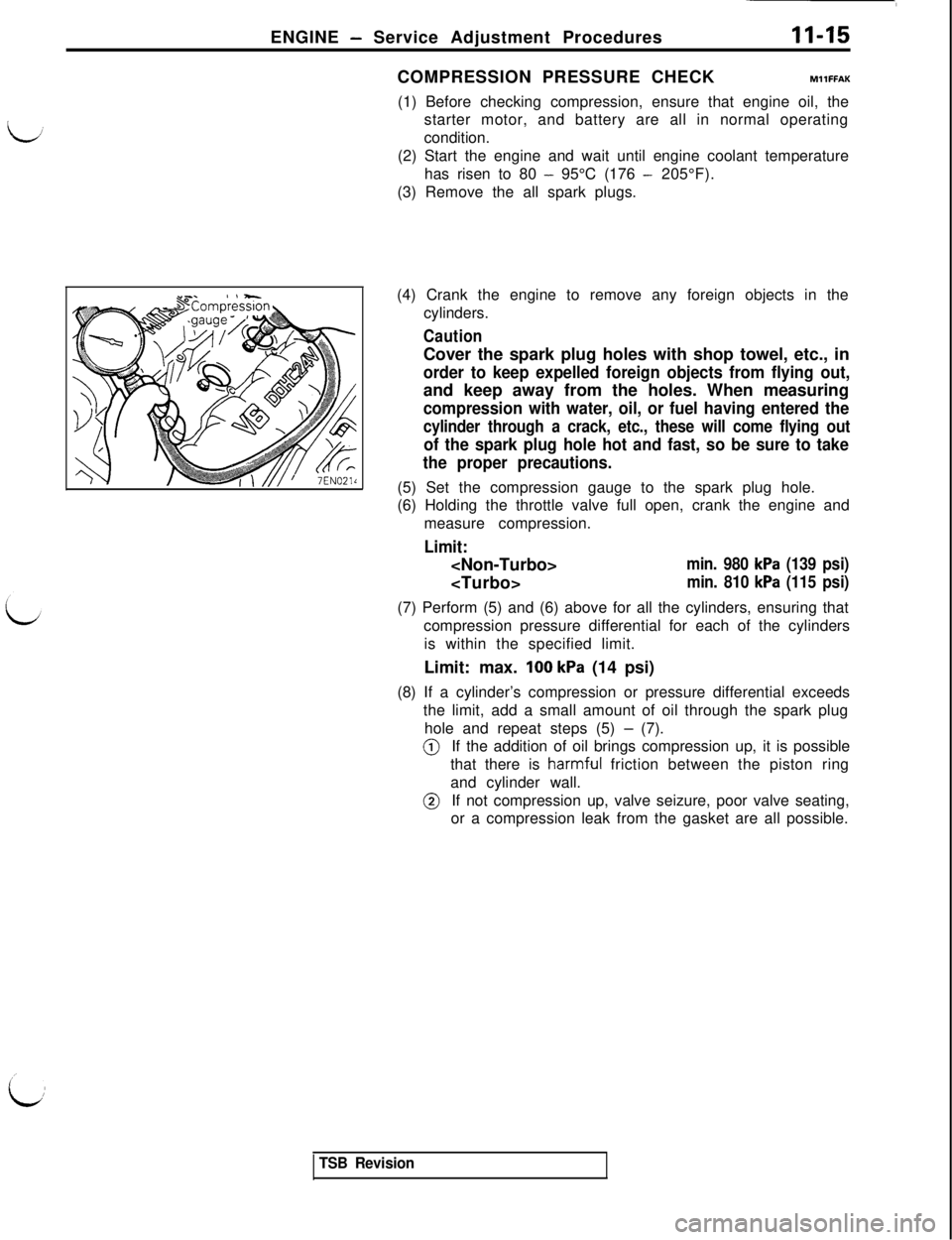
the proper precautions.(5) Set the compression gauge to the spark plug hole.
(6) Holding the throttle valve full open, crank the engine and
measure compression.
Limit:
min. 980 kPa (139 psi)
min. 810 kPa (115 psi)(7) Perform (5) and (6) above for all the cylinders, ensuring that
compression pressure differential for each of the cylinders
is within the specified limit.
Limit: max.
100 kPa (14 psi)
(8) If a cylinder’s compression or pressure differential exceeds
the limit, add a small amount of oil through the spark plug
hole and repeat steps (5)
- (7).@If the addition of oil brings compression up, it is possible
that there is
harmf,uI friction between the piston ring
and cylinder wall.@If not compression up, valve seizure, poor valve seating,
or a compression leak from the gasket are all possible.
TSB Revision
Page 66 of 1146
11-16ENGINE - Service Adjustment Procedures
MANIFOLD VACUUM INSPECTION
MllFNAR
(1) The vehicle should be repaired as follows before the
inspection.
lEngine coolant temperature: 80 - 95°C (176 - 205°F)‘dl Lights, electric cooling fan, and accessories: OFF
l Transaxle: Neutral
(P for A/T)l Steering wheel: neutral position
(2) Connect a tachometer. (Refer to P.l l-l 3.)
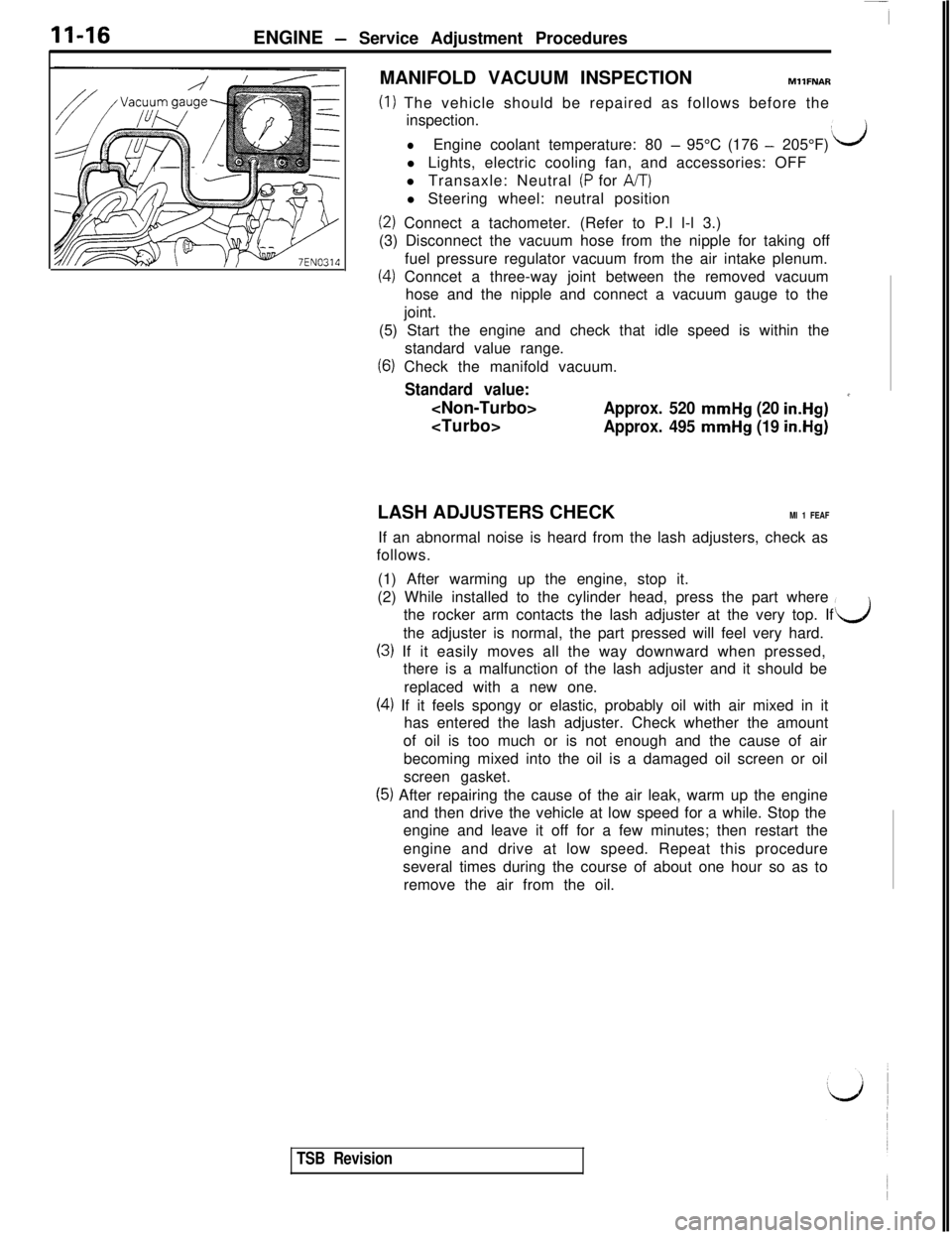
(3) Disconnect the vacuum hose from the nipple for taking off
fuel pressure regulator vacuum from the air intake plenum.
(4) Conncet a three-way joint between the removed vacuum
hose and the nipple and connect a vacuum gauge to the
joint.
(5) Start the engine and check that idle speed is within the
standard value range.
(6) Check the manifold vacuum.
Standard value:
*
Approx. 495 mmHg (19 in.Hg)LASH ADJUSTERS CHECK
Ml 1 FEAFIf an abnormal noise is heard from the lash adjusters, check as
follows.
(1) After warming up the engine, stop it.
(2) While installed to the cylinder head, press the part where
the rocker arm contacts the lash adjuster at the very top. If
the adjuster is normal, the part pressed will feel very hard.
d
(3) If it easily moves all the way downward when pressed,
there is a malfunction of the lash adjuster and it should be
replaced with a new one.
(4) If it feels spongy or elastic, probably oil with air mixed in it
has entered the lash adjuster. Check whether the amount
of oil is too much or is not enough and the cause of air
becoming mixed into the oil is a damaged oil screen or oil
screen gasket.
(5) After repairing the cause of the air leak, warm up the engine
and then drive the vehicle at low speed for a while. Stop the
engine and leave it off for a few minutes; then restart the
engine and drive at low speed. Repeat this procedure
several times during the course of about one hour so as to
remove the air from the oil.
TSB Revision
Page 68 of 1146
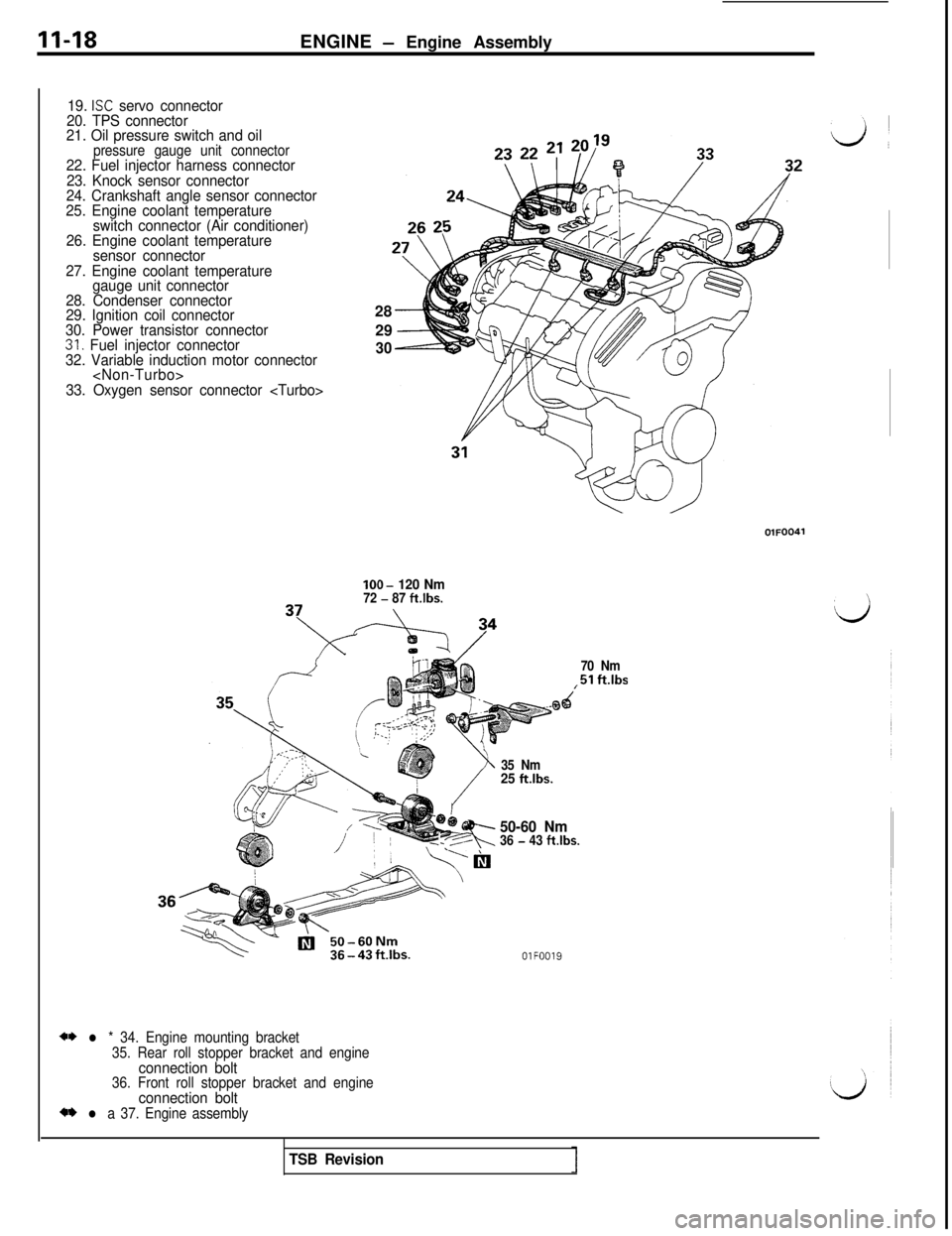
II-18ENGINE - Engine Assembly
19. ISC servo connector
20. TPS connector
21. Oil pressure switch and oil
pressure gauge unit connector22. Fuel injector harness connector
23. Knock sensor connector
24. Crankshaft angle sensor connector
25. Engine coolant temperature
switch connector (Air conditioner)
26. Engine coolant temperature
sensor connector
27. Engine coolant temperature
gauge unit connector
28. Condenser connector
29. Ignition coil connector
30. Power transistor connector
31. Fuel injector connector
32. Variable induction motor connector
33. Oxygen sensor connector
2930lOO-
120 Nm72 - 87 ft.lbs.
70 Nm
,51 ftlbs
** l * 34. Engine mounting bracket
35. Rear roll stopper bracket and engine
connection bolt36. Front roll stopper bracket and engineconnection bolt** l a 37. Engine assembly35 Nm
25 ft.lbs.
?I,---R
50-60 Nm36 - 43 ftlbs.
OlFOO19
TSB Revision