coolant temperature MITSUBISHI 3000GT 1991 Owner's Guide
[x] Cancel search | Manufacturer: MITSUBISHI, Model Year: 1991, Model line: 3000GT, Model: MITSUBISHI 3000GT 1991Pages: 1146, PDF Size: 76.68 MB
Page 297 of 1146

COOLING - Specifications / Troubleshooting
SEALANT AND ADHESIVE14-3
MMCE- -
/
id
ItemsSpecified sealants and adhesive/
Engine coolant temperature gauge unit
Engine coolant temperature sensor (Engine control)
Engine coolant temperature sensor (Air conditioner)3M Nut Locking Part No. 4171
TROUBLESHOOTING
L
MllEAAL
Symptom
OverheatProbable cause
Insufficient engine coolant
Too high an anti-freeze concentration
Inoperative electric cooling fan
Faulty thermosensor
Faulty electrical motor
Faulty radiator fan relayRemedy
Replenish
Correct anti-freeze concentration
Replace
Damaged or blocked (insufficiently ventilated)
radiator finsCorrect
Water leaks
Damaged radiator core joint
Corroded or cracked hoses
(radiator hose, heater hose, etc.)
Faulty cap valve or setting of spring
Cracked thermostat housing
Loose water pump mounting bolt or leaking
gasket
Replace
Loose bolt or leaking gasket in water outlet
I
Correct or replacefitting
Loose bolt or leaking gasket in water inletfitting
Loose thermostat housing bolts or leakingfrom gasket
Retorque bolts or replace gasket
Faulty automatic transaxle oil cooler operation
Blocked or collapsed hose and pipeReplace
Loose hose and pipe connectionCorrect
Faulty thermostat operationReplace
Faulty water pump operationReplace
Water passage clogged with slime or rust depositClean
or foreign substance
No rise in temperature
Faulty thermostatReplace
( TSB Revision
Page 300 of 1146
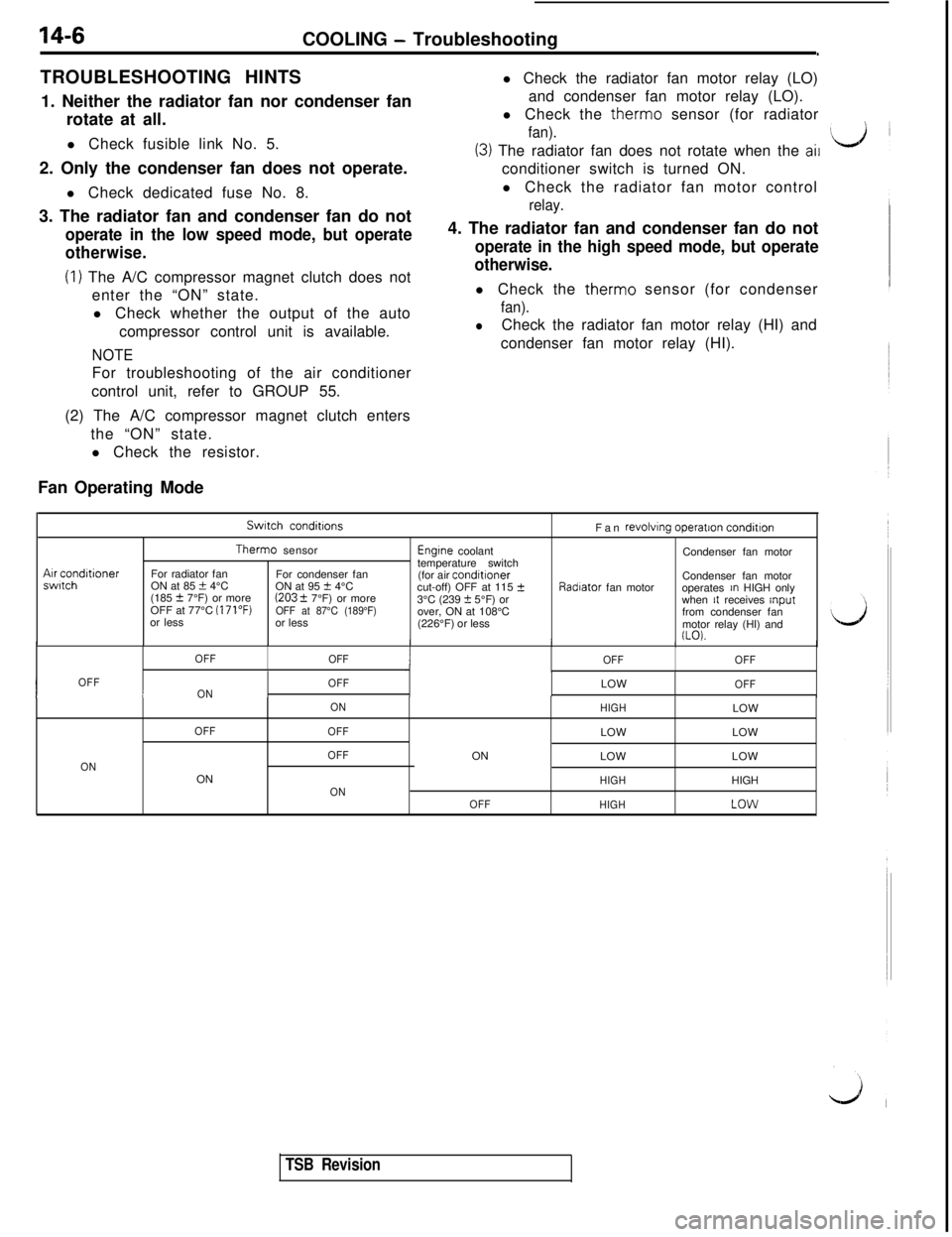
14-6COOLING - Troubleshooting.TROUBLESHOOTING HINTS
1. Neither the radiator fan nor condenser fan
rotate at all.
l Check fusible link No. 5.
2. Only the condenser fan does not operate.
l Check dedicated fuse No. 8.
3. The radiator fan and condenser fan do not
operate in the low speed mode, but operate
otherwise.
(1) The A/C compressor magnet clutch does not
enter the “ON” state.
l Check whether the output of the auto
compressor control unit is available.
NOTEFor troubleshooting of the air conditioner
control unit, refer to GROUP 55.
(2) The A/C compressor magnet clutch enters
the “ON” state.
l Check the resistor.
Fan Operating Model Check the radiator fan motor relay (LO)
and condenser fan motor relay (LO).
l Check the therm0 sensor (for radiator
fan).
(3) The radiator fan does not rotate when the ailconditioner switch is turned ON.
l Check the radiator fan motor control
relay.4. The radiator fan and condenser fan do not
operate in the high speed mode, but operate
otherwise.l Check the therm0 sensor (for condenser
fan).
lCheck the radiator fan motor relay (HI) and
condenser fan motor relay (HI).Air
conditionerswitch
Switch conditionsTherm0 sensor
For radiator fan
For condenser fan
ON at 85
k 4°C
ON at 95 t 4°C
(185 f 7°F) or more(203 + 7°F) or more
OFF at 77°C (171°F)
OFF at 87°C (189°F)or less
or lessEngine coolant
temperature switch
(for air conditioner
cut-off) OFF at 115
+3°C (239 2 5°F) or
over, ON at 108°C
(226°F) or lessFan revolving operation
conditionCondenser fan motor
Condenser fan motorRadiator fan motor
operates
In HIGH only
when it receives input
from condenser fan
motor relay (HI) and
U-0).I/I/
OFF
OFF
OFFOFF
IOFFIOFF
ONLOWOFF
ON
HIGHLOW
OFF
OFFLOWLOW
OFF
ONON
LOWLOW
ON
HIGH
ONHIGH
OFF
HIGHLOW
TSB Revision
Page 309 of 1146
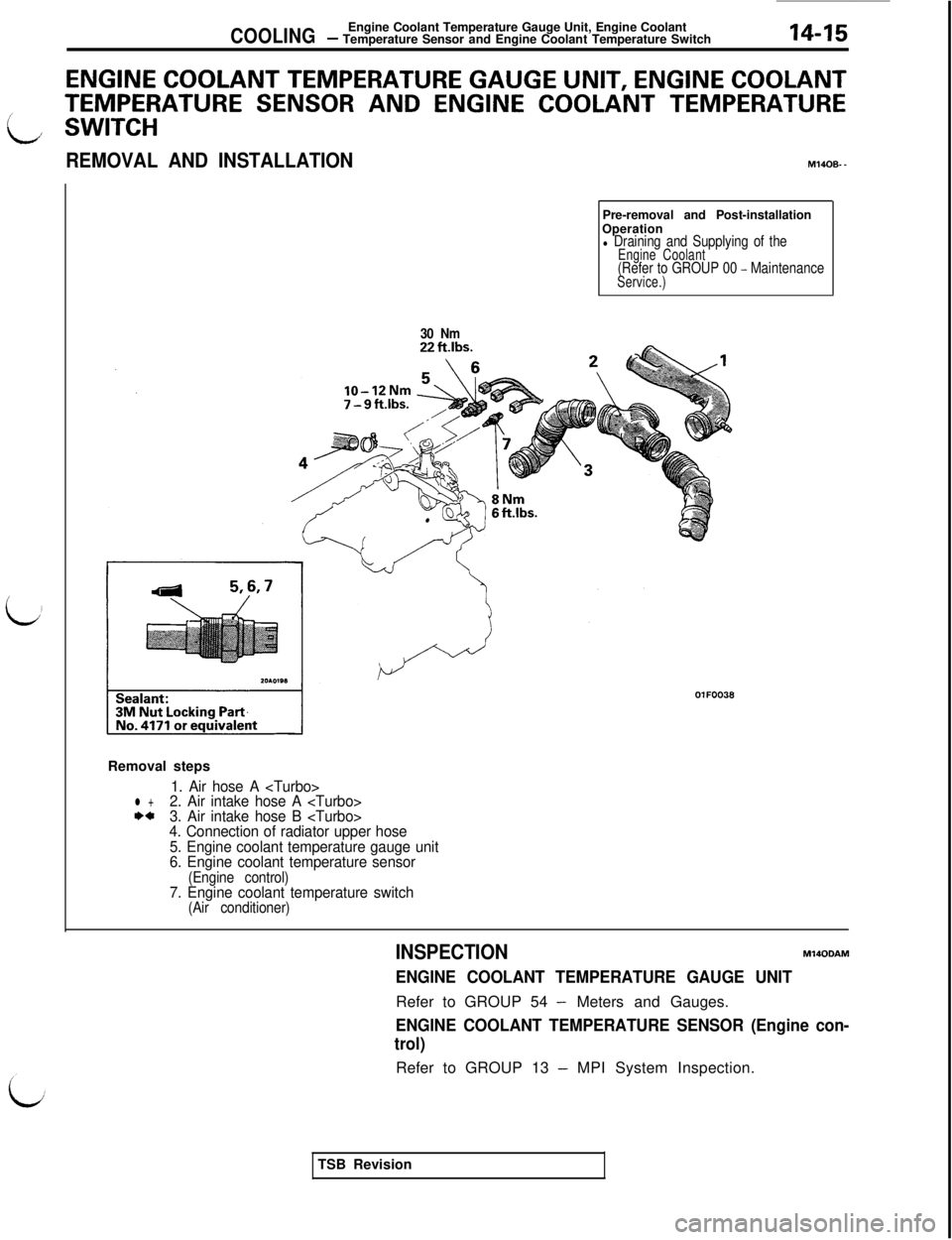
COOLINGEngine Coolant Temperature Gauge Unit, Engine Coolant- Temperature Sensor and Engine Coolant Temperature Switch14-15
ENGINE COOLANT TEMPERATURE GAUGE UNIT, ENGINE COOLANT
TEMPERATURE SENSOR AND ENGINE COOLANT TEMPERATURE
L,SWITCH
REMOVAL AND INSTALLATIONM140B. -Pre-removal and Post-installation
Operation
l Draining and Supplying of theEngine Coolant(Refer to GROUP 00 - MaintenanceService.)
30 NmOlFOO38
Removal steps
1. Air hose A
4. Connection of radiator upper hose
5. Engine coolant temperature gauge unit
6. Engine coolant temperature sensor
(Engine control)7. Engine coolant temperature switch(Air conditioner)
INSPECTIONM140DAM
ENGINE COOLANT TEMPERATURE GAUGE UNITRefer to GROUP 54
- Meters and Gauges.
ENGINE COOLANT TEMPERATURE SENSOR (Engine con-
trol)Refer to GROUP 13
- MPI System Inspection.
TSB Revision
Page 310 of 1146
14-16
I
COOLINGEngine Coolant Temperature Gauge Unit, Engine Coolant- Temperature Sensor and Engine Coolant Temperature SwitchI
Air Intake hose B
05FOO2:
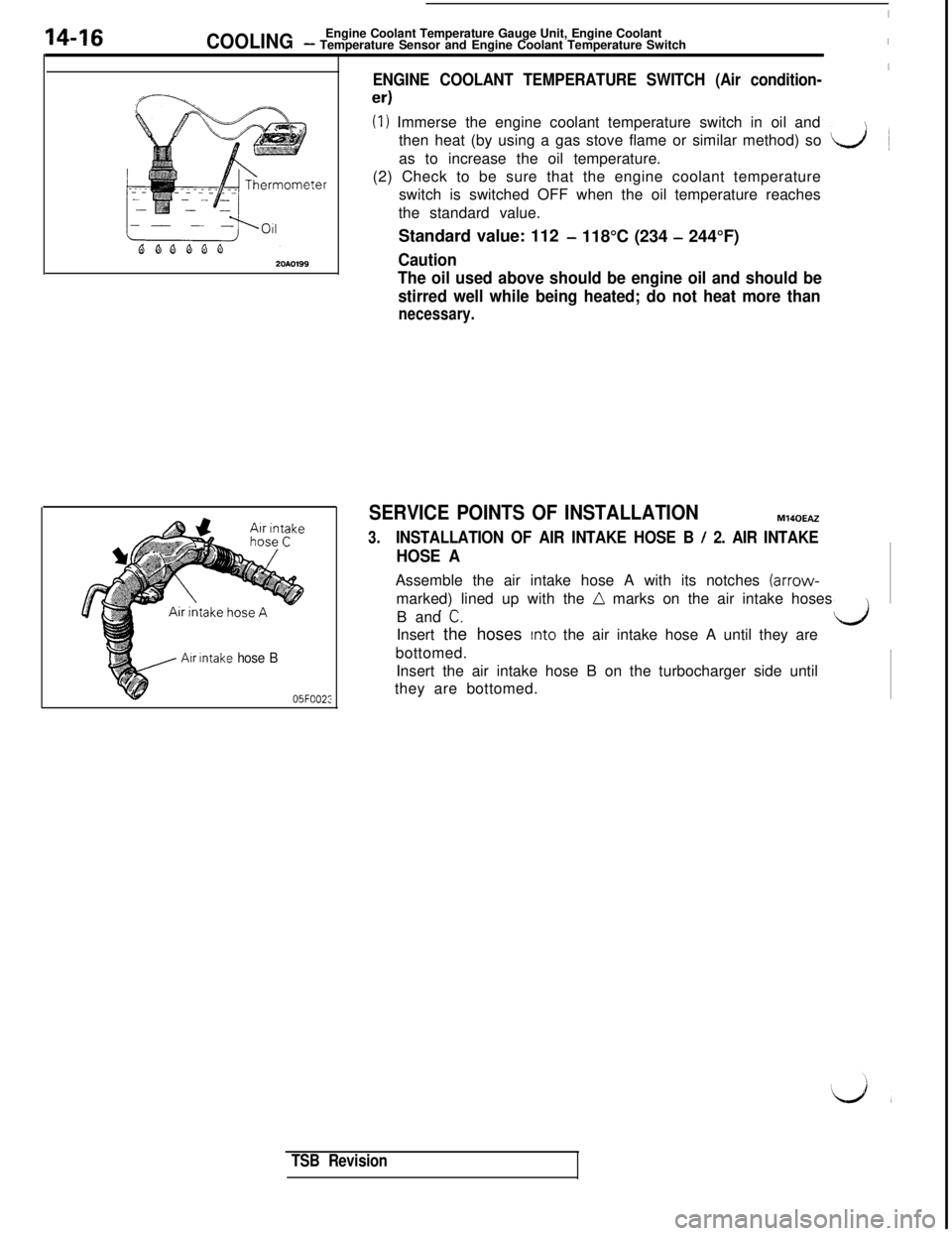
ENGINE COOLANT TEMPERATURE SWITCH (Air condition-I
4
(1) Immerse the engine coolant temperature switch in oil and
then heat (by using a gas stove flame or similar method) so
as to increase the oil temperature.
L.2~(2) Check to be sure that the engine coolant temperature
switch is switched OFF when the oil temperature reaches
the standard value.
Standard value: 112
- 118°C (234 - 244°F)
Caution
The oil used above should be engine oil and should be
stirred well while being heated; do not heat more than
necessary.
SERVICE POINTS OF INSTALLATIONM140EAz
3.INSTALLATION OF AIR INTAKE HOSE B / 2. AIR INTAKE
HOSE AB and L. Assemble the air intake hose A with its notches (arrow-
marked) lined up with the
n marks on the air intake hoses
. -dInsert the hoses Into the air intake hose A until they are
bottomed.
Insert the air intake hose B on the turbocharger side until
they are bottomed.
TSB Revision
Page 345 of 1146
17-1
EMISSIONCONTROL
.~
CATALYTIC CONVERTER............................:...Inspection
............................................................Removal and Installation
................................
CONTENTSM17.U. -
CRANKCASE EMISSION CONTROL
SYSTEM. . . . . . . . . . . . . . . . . . . . . . . . . . . . . . . . . . .ComponentsLocation
. . . . . . . . . . . . . . . . . . . . . . . . . . . . . . . . . . . .Crankcase Ventilation System Inspection
._..Positive Crankcase Ventilation Valve
. . . . . . . . . . . .
EVAPORATIVE EMISSION CONTROL
SYSTEM................................................................Air Conditioner Switch
....................................Air Flow Sensor, Engine Coolant
Temperature Sensor and Intake Air
Temperature Sensor
........................................Canister
............................................................Components Location
....................................
FuelFiller CapInspection................................OverfillLimiter (Two-way Valve)
....................Purge Control Solenoid Valve
........................Purge Control System Inspection
............................................................Purge Control Valve
........................
PurgePort VacuumCheck................................14
14
14
6
10
10
10
6
10
10
9
7
8
9
9EXHAUST GAS RECIRCULATION
(EGR)
SYSTEM. . . . . ..____._.._........__........_____.........................Air-FuelRatio Control (MPI) System. . . . . . . .
Components Location
. . . . . . . . . . . . . . . . . . . . . . . . . . . . . . . . . . . .EGR Control Solenoid Valve
. . . . . . . .EGR Valve
EGR Valve Control Vacuum Check
SPECIFICATIONS................................................General Specifications
....................................Service Specifications
....................................
TROUBLESHOOTING. . . . . . . . . . . . . . . . . ..______...............
VACUUM HOSES................................................Inspection
............................................................Installation
........................................................VacuumHosesRouting
....................................
11
14
11
13
12
13
13
12
2
2
22
Page 351 of 1146
EMISSION CONTROL - Evaporative Emission Control System17-7
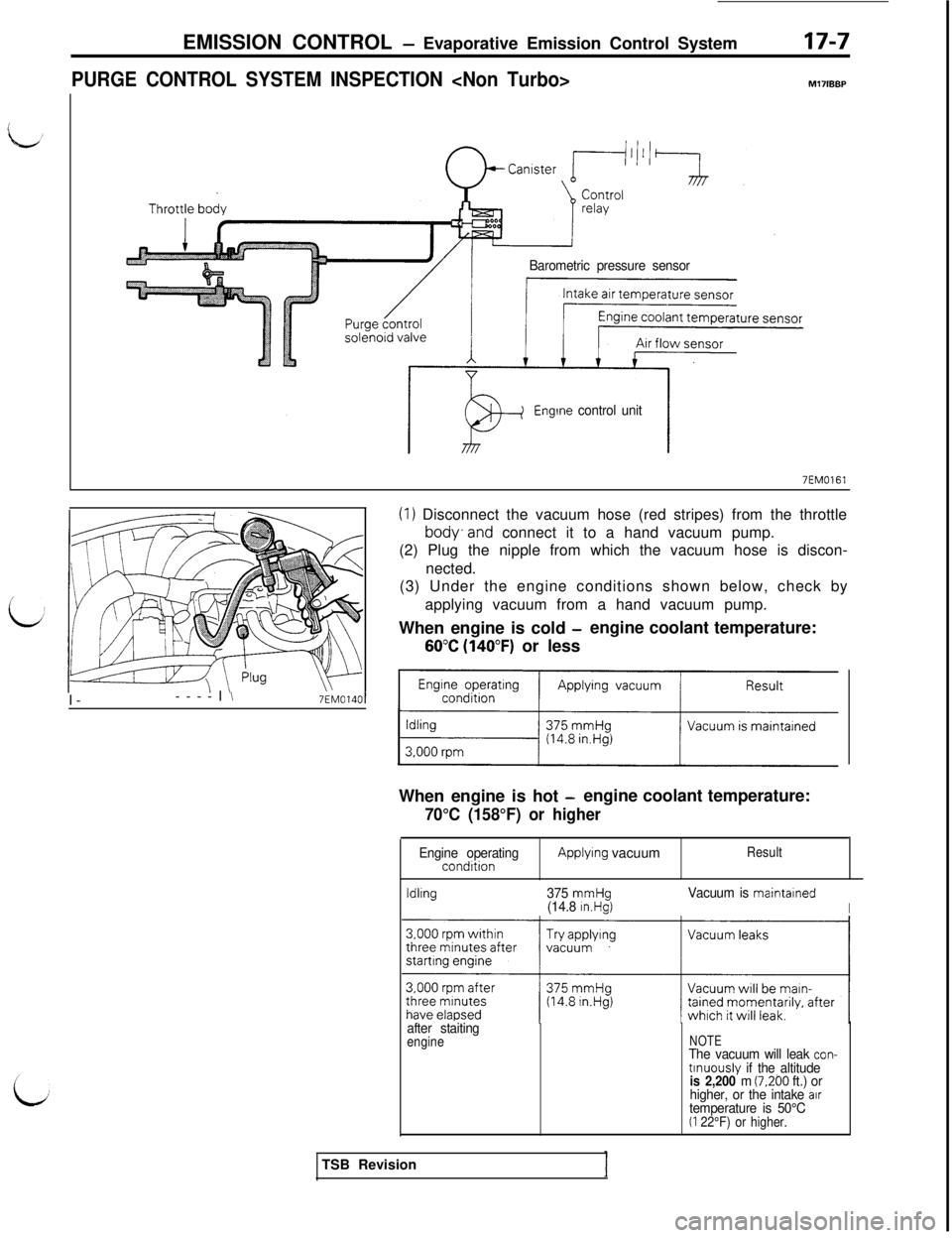
PURGE CONTROL SYSTEM INSPECTION
Barometric pressure sensor
Engine control unit
7EM0161I-----I
\7EM0140t
(1) Disconnect the vacuum hose (red stripes) from the throttle
body,and connect it to a hand vacuum pump.
(2) Plug the nipple from which the vacuum hose is discon-
nected.
(3) Under the engine conditions shown below, check by
applying vacuum from a hand vacuum pump.
When engine is cold
-engine coolant temperature:
60°C (140°F) or less
When engine is hot
-engine coolant temperature:
70°C (158°F) or higher
Engine operatingcondttionApplying vacuumResult
ldllng375 mmHg(14.8 In.Hg)Vacuum is maintalned
I
after staitingengineNOTEThe vacuum will leak con-tenuously if the altitudeis 2,200 m (7.200 ft.) or
higher, or the intake airtemperature is 50°C(I 22°F) or higher.TSB Revision
Page 352 of 1146

17-8EMISSION CONTROL - Evaporative Emission Control System
PURGE CONTROL SYSTEM INSPECTION
Canister
Purge control
valve\
PI IrnQ rnntrnlI.1 I
kXffo~~~~r~~ ’ I I-J
relay
Barometric pressure sensor
Intake air temperature sensor
Engine coolant temperature sensor
II1 I IAir flow sensor
Engine control unit
6EM0215(1) Disconnect the purge air hose from the air intake hose, and
plug the air intake hose. Then, connect the hand vacuum
pump to the purge air hose.
(2) Under the engine conditions shown below, check by
applying vacuum from a hand vacuum pump.
When engine is cold
-engine coolant temperature:
60°C (140°F) or less
Engine operating
conditionApplying vacuumResult
Idling
375 mmHgVacuum is maintained
3,000 rpm(14.8 in.Hg)When engine is hot
-engine coolant temperature:
70°C (158°F) or higher
Engine operating
condition
Idling
3,000 rpm within
three minutes after
starting engine
3,000 rpm after
three minutes
have elapsedafter startingengine
Applying vacuum
375
mmHg(14.8 in.Hg)
Try applyingvacuum
375
mmHg(14.8 in.Hg)
Result
Vacuum is marntained
Vacuum leaks
Vacuum WIII be main-tained momentarily, after
which it will leak.
NOTEThe vacuum WIII leak con-
tinuously if the altitude
is 2,200 m
(7,200 ft.) orhrgher. or the Intake arrtemperature is 50°C(122°F) or higher.
1 TSB Revision
Page 353 of 1146
EMISSION CONTROL - EvaporativeEmission Control System
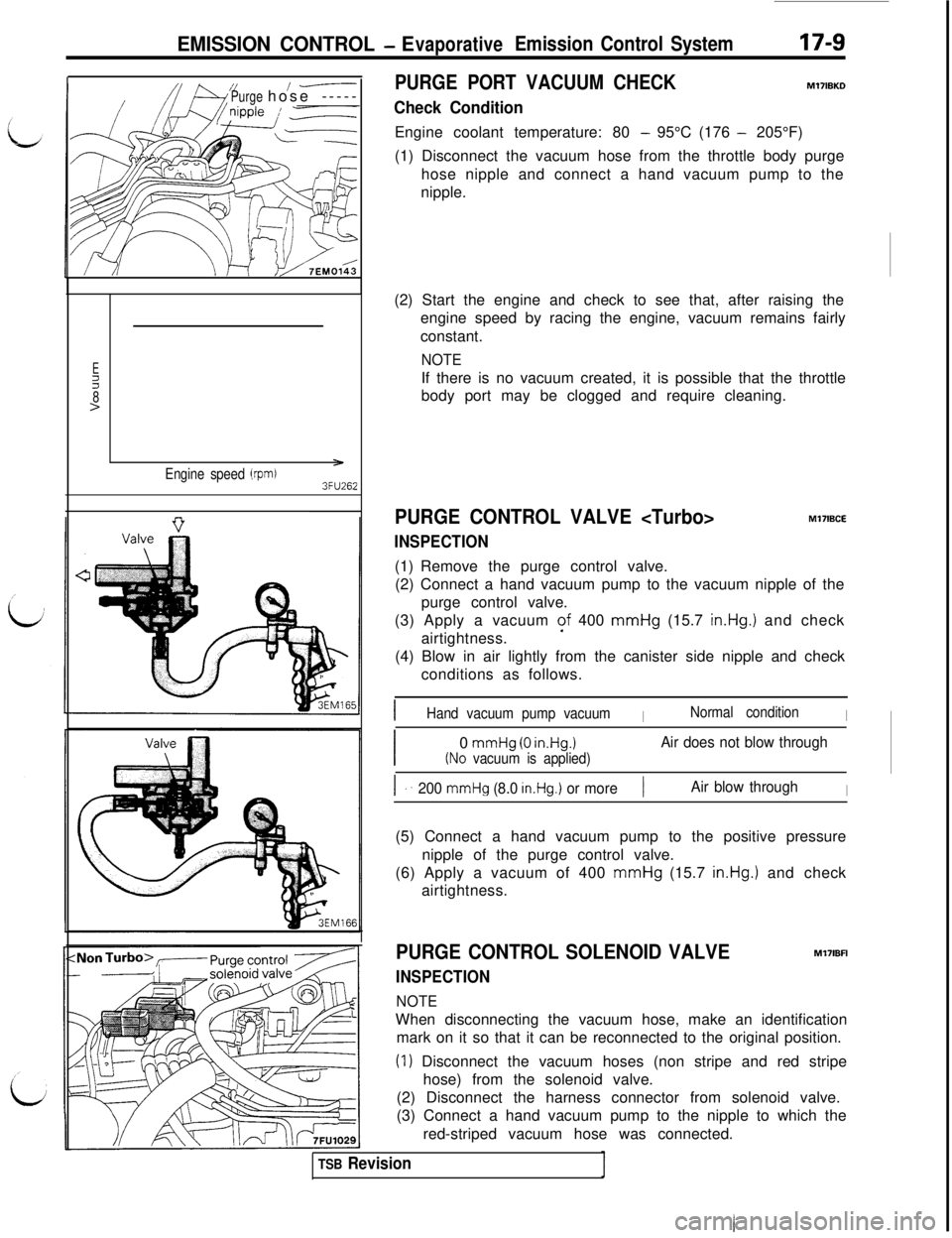
Purge/-----hose -----PURGE PORT VACUUM CHECK
Check Condition
17-9
M17lBKDEngine coolant temperature: 80
- 95°C (176 - 205°F)
(1) Disconnect the vacuum hose from the throttle body purge
hose nipple and connect a hand vacuum pump to the
nipple.
Ez8>
Engine speed (rprd3FU262(2) Start the engine and check to see that, after raising the
engine speed by racing the engine, vacuum remains fairly
constant.
NOTEIf there is no vacuum created, it is possible that the throttle
body port may be clogged and require cleaning.
PURGE CONTROL VALVE
INSPECTIONMl7IBCE
(1) Remove the purge control valve.
(2) Connect a hand vacuum pump to the vacuum nipple of the
purge control valve.
(3) Apply a vacuum of 400 mmHg (15.7
in.Hg.1 and check
airtightness.
(4) Blow in air lightly from the canister side nipple and check
conditions as follows.
IHand vacuum pump vacuumINormal conditionI
I0
mmHg (0 in.Hg.1Air does not blow through
(No vacuum is applied)
I ..200 mmHg (8.0 in.Hg.) or more1Air blow throughI(5) Connect a hand vacuum pump to the positive pressure
nipple of the purge control valve.
(6) Apply a vacuum of 400 mmHg (15.7
in.Hg.1 and check
airtightness.
PURGE CONTROL SOLENOID VALVE
INSPECTION
NOTEMl7lBFI
When disconnecting the vacuum hose, make an identification
mark on it so that it can be reconnected to the original position.
(I) Disconnect the vacuum hoses (non stripe and red stripe
hose) from the solenoid valve.
(2) Disconnect the harness connector from solenoid valve.
(3) Connect a hand vacuum pump to the nipple to which the
red-striped vacuum hose was connected.
TSB Revision
Page 356 of 1146
17-12EMISSION CONTROL - Exhaust Gas Recirculation (EGR) System
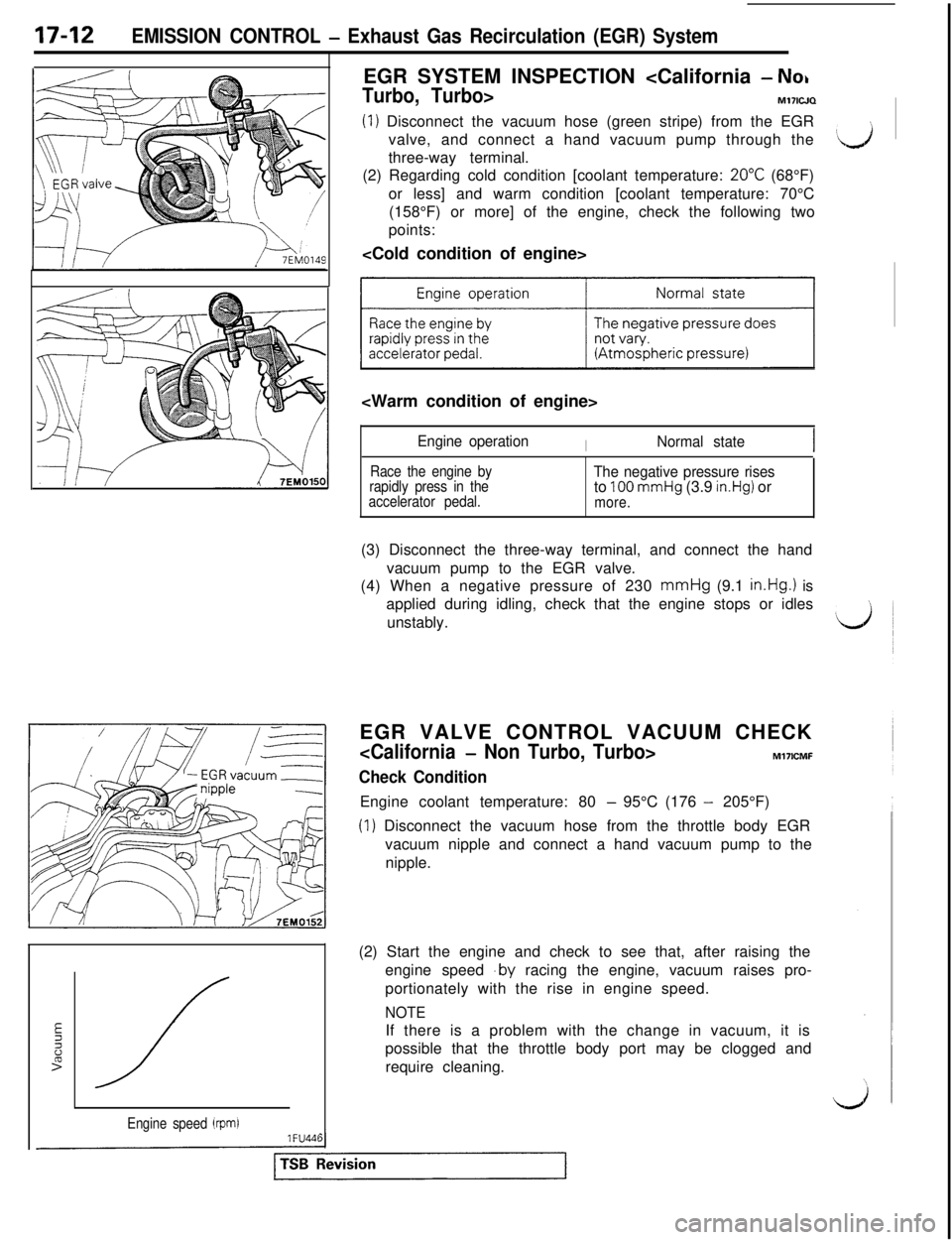
Engine speed (rpm)1 FU44lEGR SYSTEM INSPECTION
Turbo, Turbo>M171WQ
(1) Disconnect the vacuum hose (green stripe) from the EGR
valve, and connect a hand vacuum pump through the
three-way terminal.
(2) Regarding cold condition [coolant temperature:
20°C (68°F)
or less] and warm condition [coolant temperature: 70°C
(158°F) or more] of the engine, check the following two
points:
~1
Engine operationINormal state
Race the engine by
rapidly press in the
accelerator pedal.The negative pressure risesto 100 mmHg (3.9 in.Hg) ormore.(3) Disconnect the three-way terminal, and connect the hand
vacuum pump to the EGR valve.
(4) When a negative pressure of 230 mmHg (9.1
in.Hg.1 is
applied during idling, check that the engine stops or idles
unstably.
EGR VALVE CONTROL VACUUM CHECK
Check ConditionEngine coolant temperature: 80
- 95°C (176 - 205°F)
(1) Disconnect the vacuum hose from the throttle body EGR
vacuum nipple and connect a hand vacuum pump to the
nipple.
(2) Start the engine and check to see that, after raising the
engine speed
.by racing the engine, vacuum raises pro-
portionately with the rise in engine speed.
NOTEIf there is a problem with the change in vacuum, it is
possible that the throttle body port may be clogged and
require cleaning.
Page 495 of 1146
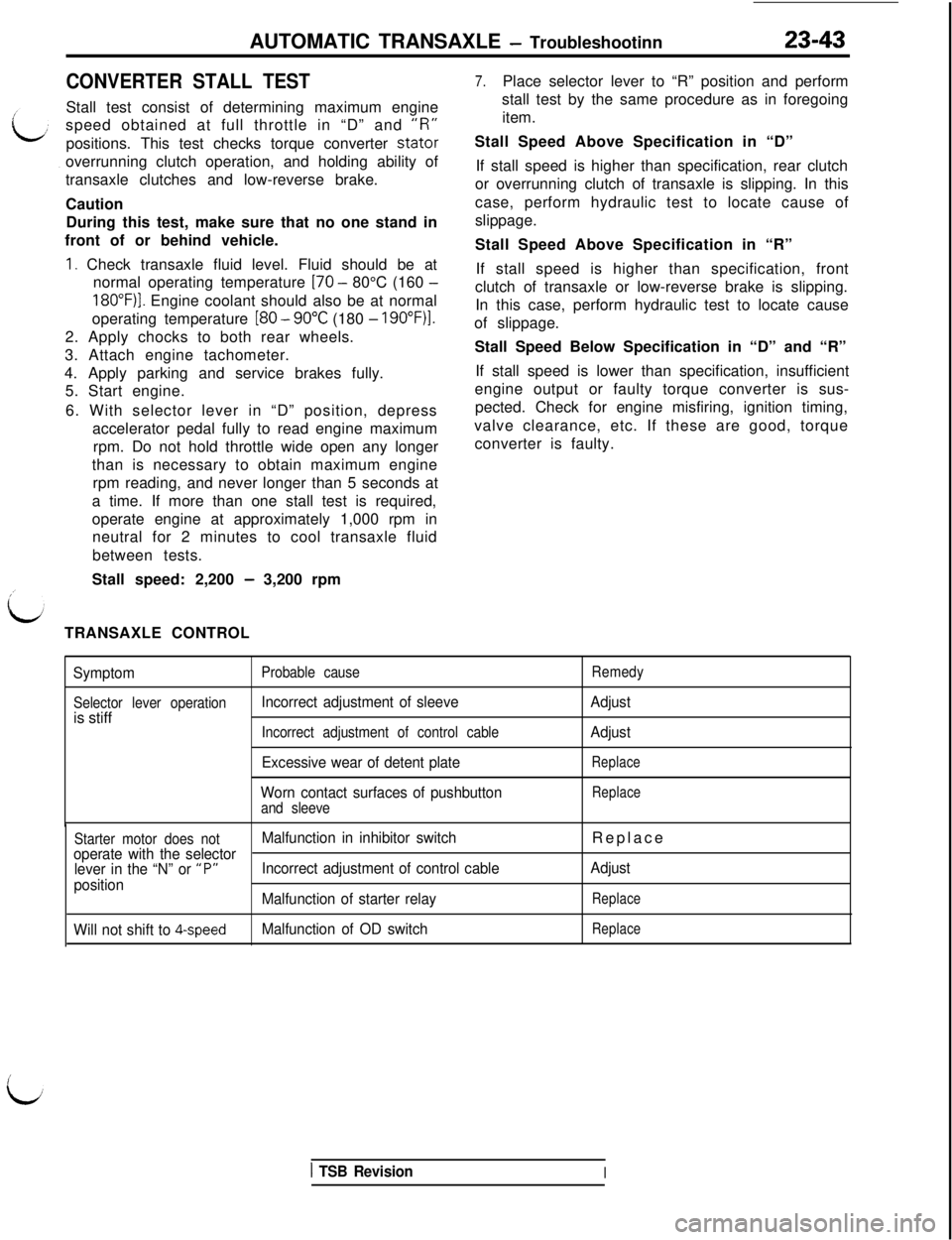
AUTOMATIC TRANSAXLE - Troubleshootinn23-43
CONVERTER STALL TESTStall test consist of determining maximum engine
speed obtained at full throttle in “D” and
“I?”positions. This test checks torque converter
statoroverrunning clutch operation, and holding ability of
transaxle clutches and low-reverse brake.
Caution
During this test, make sure that no one stand in
front of or behind vehicle.
1. Check transaxle fluid level. Fluid should be at
normal operating temperature
[70 - 80°C (160 -
18O”F)I. Engine coolant should also be at normal
operating temperature
[80 - 90°C (180 - 19O”F)l.2. Apply chocks to both rear wheels.
3. Attach engine tachometer.
4. Apply parking and service brakes fully.
5. Start engine.
6. With selector lever in “D” position, depress
accelerator pedal fully to read engine maximum
rpm. Do not hold throttle wide open any longer
than is necessary to obtain maximum engine
rpm reading, and never longer than 5 seconds at
a time. If more than one stall test is required,
operate engine at approximately 1,000 rpm in
neutral for 2 minutes to cool transaxle fluid
between tests.
Stall speed: 2,200
- 3,200 rpm
7.Place selector lever to “R” position and perform
stall test by the same procedure as in foregoing
item.
Stall Speed Above Specification in “D”
If stall speed is higher than specification, rear clutch
or overrunning clutch of transaxle is slipping. In this
case, perform hydraulic test to locate cause of
slippage.
Stall Speed Above Specification in “R”
If stall speed is higher than specification, front
clutch of transaxle or low-reverse brake is slipping.
In this case, perform hydraulic test to locate cause
of slippage.
Stall Speed Below Specification in “D” and “R”
If stall speed is lower than specification, insufficient
engine output or faulty torque converter is sus-
pected. Check for engine misfiring, ignition timing,
valve clearance, etc. If these are good, torque
converter is faulty.
TRANSAXLE CONTROL
Symptom
Selector lever operationis stiff
Probable cause
Incorrect adjustment of sleeve
Remedy
Adjust
Incorrect adjustment of control cable
Excessive wear of detent plate
Worn contact surfaces of pushbutton
and sleeve
Adjust
Replace
Replace
Starter motor does notMalfunction in inhibitor switchReplace
operate with the selector
lever in the “N” or “P”Incorrect adjustment of control cableAdjust
position
Will not shift to
4-speed
Malfunction of starter relay
Malfunction of OD switchReplace
Replace
1 TSB RevisionI