stop start MITSUBISHI 3000GT 1991 User Guide
[x] Cancel search | Manufacturer: MITSUBISHI, Model Year: 1991, Model line: 3000GT, Model: MITSUBISHI 3000GT 1991Pages: 1146, PDF Size: 76.68 MB
Page 285 of 1146
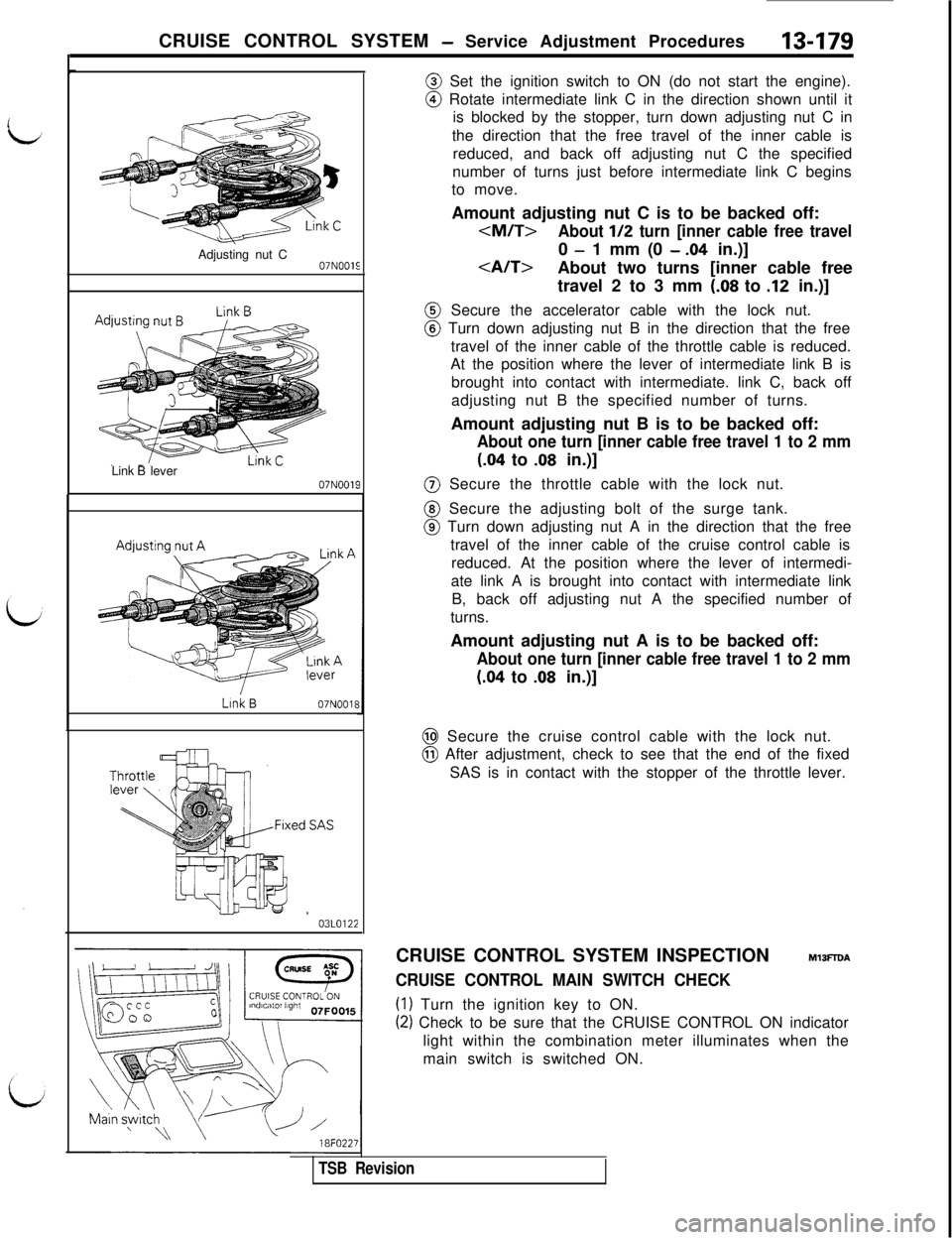
CRUISE CONTROL SYSTEM - Service Adjustment Procedures13-179Adjusting nut C
07NOOlELink Blever
07N0019Link
B07NOOlE
y,jj--ww ,03LO122
\\ \18FO2.2'@ Set the ignition switch to ON (do not start the engine).@ Rotate intermediate link C in the direction shown until it
is blocked by the stopper, turn down adjusting nut C in
the direction that the free travel of the inner cable is
reduced, and back off adjusting nut C the specified
number of turns just before intermediate link C begins
to move.
Amount adjusting nut C is to be backed off:
- 1 mm (0 - .04 in.)]
About two turns [inner cable free
travel 2 to 3 mm
(.08 to .12 in.)]@ Secure the accelerator cable with the lock nut.@ Turn down adjusting nut B in the direction that the free
travel of the inner cable of the throttle cable is reduced.
At the position where the lever of intermediate link B is
brought into contact with intermediate. link C, back off
adjusting nut B the specified number of turns.
Amount adjusting nut B is to be backed off:
About one turn [inner cable free travel 1 to 2 mm
(.04 to .08 in.)]@ Secure the throttle cable with the lock nut.@ Secure the adjusting bolt of the surge tank.@ Turn down adjusting nut A in the direction that the free
travel of the inner cable of the cruise control cable is
reduced. At the position where the lever of intermedi-
ate link A is brought into contact with intermediate link
B, back off adjusting nut A the specified number of
turns.
Amount adjusting nut A is to be backed off:
About one turn [inner cable free travel 1 to 2 mm
(.04 to .08 in.)]@ Secure the cruise control cable with the lock nut.@ After adjustment, check to see that the end of the fixed
SAS is in contact with the stopper of the throttle lever.
CRUISE CONTROL SYSTEM INSPECTION
MlBFlDA
CRUISE CONTROL MAIN SWITCH CHECK
(1) Turn the ignition key to ON.
(2) Check to be sure that the CRUISE CONTROL ON indicator
light within the combination meter illuminates when the
main switch is switched ON.
TSB Revision
Page 356 of 1146
17-12EMISSION CONTROL - Exhaust Gas Recirculation (EGR) System
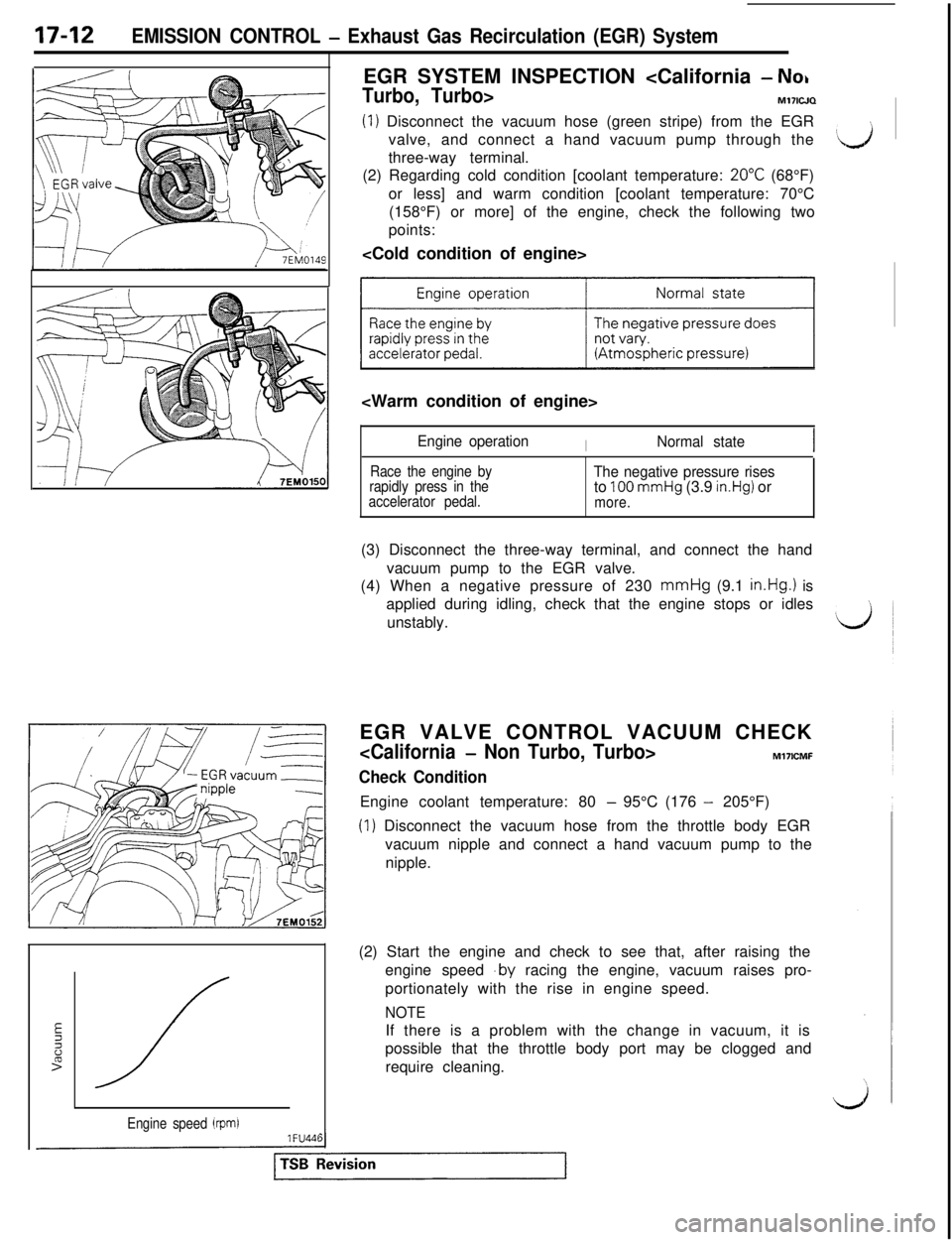
Engine speed (rpm)1 FU44lEGR SYSTEM INSPECTION
Turbo, Turbo>M171WQ
(1) Disconnect the vacuum hose (green stripe) from the EGR
valve, and connect a hand vacuum pump through the
three-way terminal.
(2) Regarding cold condition [coolant temperature:
20°C (68°F)
or less] and warm condition [coolant temperature: 70°C
(158°F) or more] of the engine, check the following two
points:
~1
Engine operationINormal state
Race the engine by
rapidly press in the
accelerator pedal.The negative pressure risesto 100 mmHg (3.9 in.Hg) ormore.(3) Disconnect the three-way terminal, and connect the hand
vacuum pump to the EGR valve.
(4) When a negative pressure of 230 mmHg (9.1
in.Hg.1 is
applied during idling, check that the engine stops or idles
unstably.
EGR VALVE CONTROL VACUUM CHECK
Check ConditionEngine coolant temperature: 80
- 95°C (176 - 205°F)
(1) Disconnect the vacuum hose from the throttle body EGR
vacuum nipple and connect a hand vacuum pump to the
nipple.
(2) Start the engine and check to see that, after raising the
engine speed
.by racing the engine, vacuum raises pro-
portionately with the rise in engine speed.
NOTEIf there is a problem with the change in vacuum, it is
possible that the throttle body port may be clogged and
require cleaning.
Page 364 of 1146
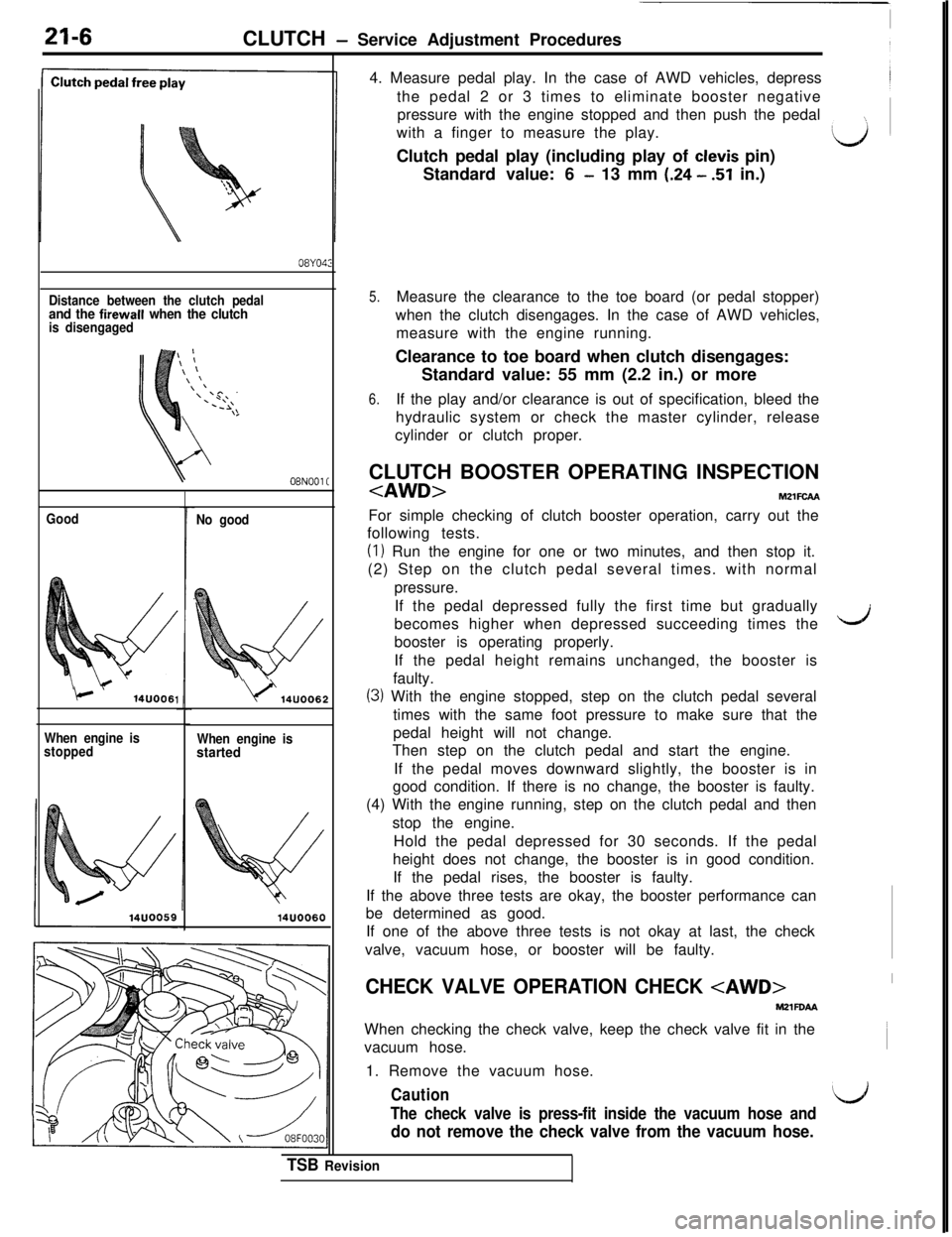
21-6CLUTCH - Service Adjustment Procedures
08YO4Z
Distance between the clutch pedaland the firewall when the clutchis disengaged
08NOOl C
Good
c1‘14UOO61
When engine is
stoppedNo good
\)‘14UOO6:
When engine isstarted
14UOO604. Measure pedal play. In the case of AWD vehicles, depress~
the pedal 2 or 3 times to eliminate booster negative
pressure with the engine stopped and then push the pedal
with a finger to measure the play.
LJClutch pedal play (including play of clevis pin)
Standard value: 6
- 13 mm (.24 - 51 in.)
2
CHECK VALVE OPERATION CHECK
MZlFOAAWhen checking the check valve, keep the check valve fit in the
vacuum hose.
1. Remove the vacuum hose.
CautionL’The check valve is press-fit inside the vacuum hose and
do not remove the check valve from the vacuum hose.
5.Measure the clearance to the toe board (or pedal stopper)
when the clutch disengages. In the case of AWD vehicles,
measure with the engine running.
Clearance to toe board when clutch disengages:
Standard value: 55 mm (2.2 in.) or more
6.If the play and/or clearance is out of specification, bleed the
hydraulic system or check the master cylinder, release
cylinder or clutch proper.
CLUTCH BOOSTER OPERATING INSPECTION
following tests.
(I) Run the engine for one or two minutes, and then stop it.
(2) Step on the clutch pedal several times. with normal
pressure.
If the pedal depressed fully the first time but gradually
becomes higher when depressed succeeding times the
dbooster is operating properly.
If the pedal height remains unchanged, the booster is
faulty.
(3) With the engine stopped, step on the clutch pedal several
times with the same foot pressure to make sure that the
pedal height will not change.
Then step on the clutch pedal and start the engine.
If the pedal moves downward slightly, the booster is in
good condition. If there is no change, the booster is faulty.
(4) With the engine running, step on the clutch pedal and then
stop the engine.
Hold the pedal depressed for 30 seconds. If the pedal
height does not change, the booster is in good condition.
If the pedal rises, the booster is faulty.
If the above three tests are okay, the booster performance can
be determined as good.
If one of the above three tests is not okay at last, the check
valve, vacuum hose, or booster will be faulty.
TSB Revision
Page 395 of 1146
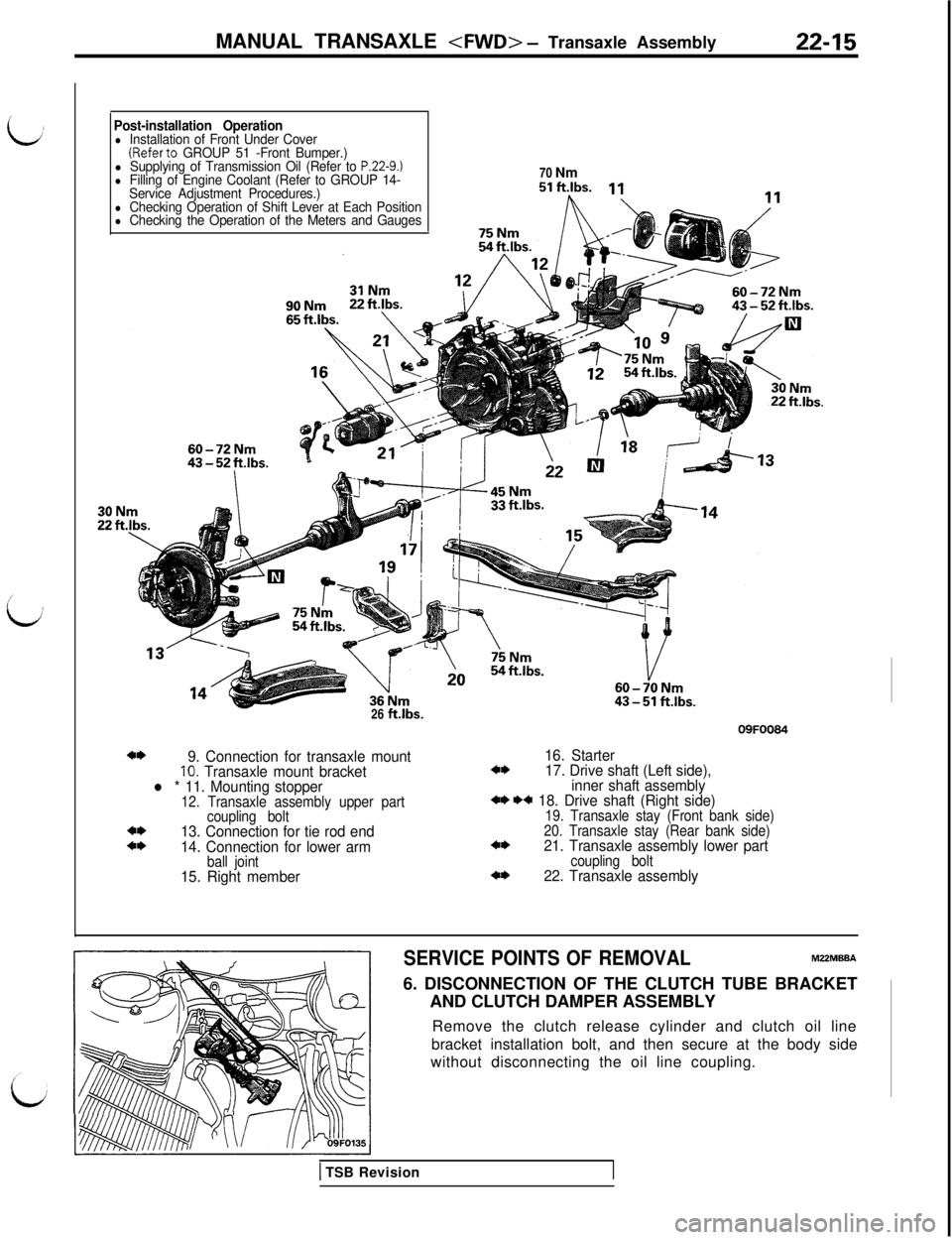
MANUAL TRANSAXLE
idPost-installation Operationl Installation of Front Under Cover(Referto GROUP 51 -Front Bumper.)l Supplying of Transmission Oil (Refer to P.22-9.)l Filling of Engine Coolant (Refer to GROUP 14-
Service Adjustment Procedures.)70 Nm
l Checking Operation of Shift Lever at Each Positionl Checking the Operation of the Meters and Gauges26
ft.lbs.09FOO84
4*9. Connection for transaxle mount16. Starter10. Transaxle mount bracket4*17. Drive shaft (Left side),
l * 11. Mounting stopperinner shaft assembly12. Transaxle assembly upper part+* ** 18. Drive shaft (Right side)
coupling bolt19. Transaxle stay (Front bank side)4*13. Connection for tie rod end20. Transaxle stay (Rear bank side)4*14. Connection for lower arm4*21. Transaxle assembly lower part
ball jointcoupling bolt15. Right member4*22. Transaxle assembly
SERVICE POINTS OF REMOVALMZZMBBA6. DISCONNECTION OF THE CLUTCH TUBE BRACKET
AND CLUTCH DAMPER ASSEMBLY
Remove the clutch release cylinder and clutch oil line
bracket installation bolt, and then secure at the body side
without disconnecting the oil line coupling.
1 TSB Revision
Page 437 of 1146

MANUAL TRANSAXLE
22-57
45 Nmaa 33ftlbs..,.,
31 Nm
09FOO91.15
28
50-72Nm43 - 52 ft.lbs.
\
22 ftlbs.9.0Nm
4.0 ftlbs.
10. Connection for clutch tube bracket11. Connection for clutch release cylinder
12. Connection for transaxle mount
13. Plug
14. Transaxle mount bracket (Body side)I)* 15. Mounting stopper16. Transaxle mount bracket (Transaxle side)17. Transaxle assembly lower part
coupling bolt
4*18. Connection for tie rod endl *19. Connection for lower armball joint
20. Right member
21. Starter cover
22. Starter
Mb23. Drive shaft (Left side),Inner shaft assembly+* l * 24. Drive shaft (Right side)25. Connection for transaxle stay (Front bankside)26. Connection for transaxle stay(Rear bank side)27. Transaxle assembly lower part
coupling bolt
28. Transaxle assembly
TSB Revision
Page 474 of 1146
![MITSUBISHI 3000GT 1991 User Guide 23-22AUTOMATIC TRANSAXLE - Troubleshooting
0”
TM362
DIAGNOSIS AND TEST
FLUID LEVEL AND CONDITION
1.Drive until the fluid temperature reaches the usual tempera-
ture
[70 - 80°C (160 - 18O”F)].2.](/img/19/57085/w960_57085-473.png "MITSUBISHI 3000GT 1991 User Guide 23-22AUTOMATIC TRANSAXLE - Troubleshooting
0”
TM362
DIAGNOSIS AND TEST
FLUID LEVEL AND CONDITION
1.Drive until the fluid temperature reaches the usual tempera-
ture
[70 - 80°C (160 - 18O”F)].2.")
23-22AUTOMATIC TRANSAXLE - Troubleshooting
0”
TM362
DIAGNOSIS AND TEST
FLUID LEVEL AND CONDITION
1.Drive until the fluid temperature reaches the usual tempera-
ture
[70 - 80°C (160 - 18O”F)].2. Place vehicle on level floor.
3. Move selector lever sequentially to every position to fill
torque converter and hydraulic circuit with fluid, then place
lever in “N” Neutral position. This operation is necessary to
be sure that fluid level check is accurate.
4. Before removing dipstick, wipe all dirt from area around
dipstick. Then take out the dipstick and check the condition
of the fluid.
The transaxle should be overhauled under the following
conditions.
l If there is a “burning” odor.
l If the fluid color has become noticeably blacker.
lIf there is a noticeably great amount of metal particles in
the fluid.
5.Check to see if fluid level is in “HOT” range on dipstick. If
fluid level is low, add automatic transaxle fluid until level
reaches “HOT” range.
Low fluid level can cause a variety of conditions because it
allows pump to take in air along with fluid. Air trapped in
hydraulic circuit forms bubbles which make fluid spongy.
Therefore, pressures will be erratic.
Improper filling can also raise fluid level too high. When
transaxle has too much fluid, gears churn up foam and
cause same conditions which occur with low fluid level,
resulting in accelerated deterioration of automatic transaxle
fluid.
dIn either case, air bubbles can cause overheating, fluid
oxidation, which can interfere with normal valve, clutch, and
servo operation. Foaming can also result in fluid escaping
from transaxle vent where it may be mistaken for a leak.
6. Be sure to examine fluid on dipstick closely.
,CONTROL CABLEWhether control cable is properly adjusted can be confirmed by
checking whether inhibitor switch is performing well.
1. Apply parking brakes and service brakes securely.
2. Place selector lever to “R” range.
3. Set ignition key to “ST” position.
4. Slowly move the selector lever upward until it clicks as it
fits in notch of “P” range. If starter motor operates when
lever makes a click, “P” position is correct.
5.Then slowly move selector lever to “N” range by the same
procedure as in foregoing paragraph. If starter motor
operates when selector lever fits in
“N”, “N” position is
correct.
6. Also check to be sure the vehicle doesn’t begin to move
and the lever doesn’t stop between P-R-N-D.
7. The control cable is properly adjusted if, as described
above, the starter motor starts at both the “P” range and
the “N” range.
TSB Revision
Page 483 of 1146
AUTOMATIC TRANSAXLE - Troubleshooting
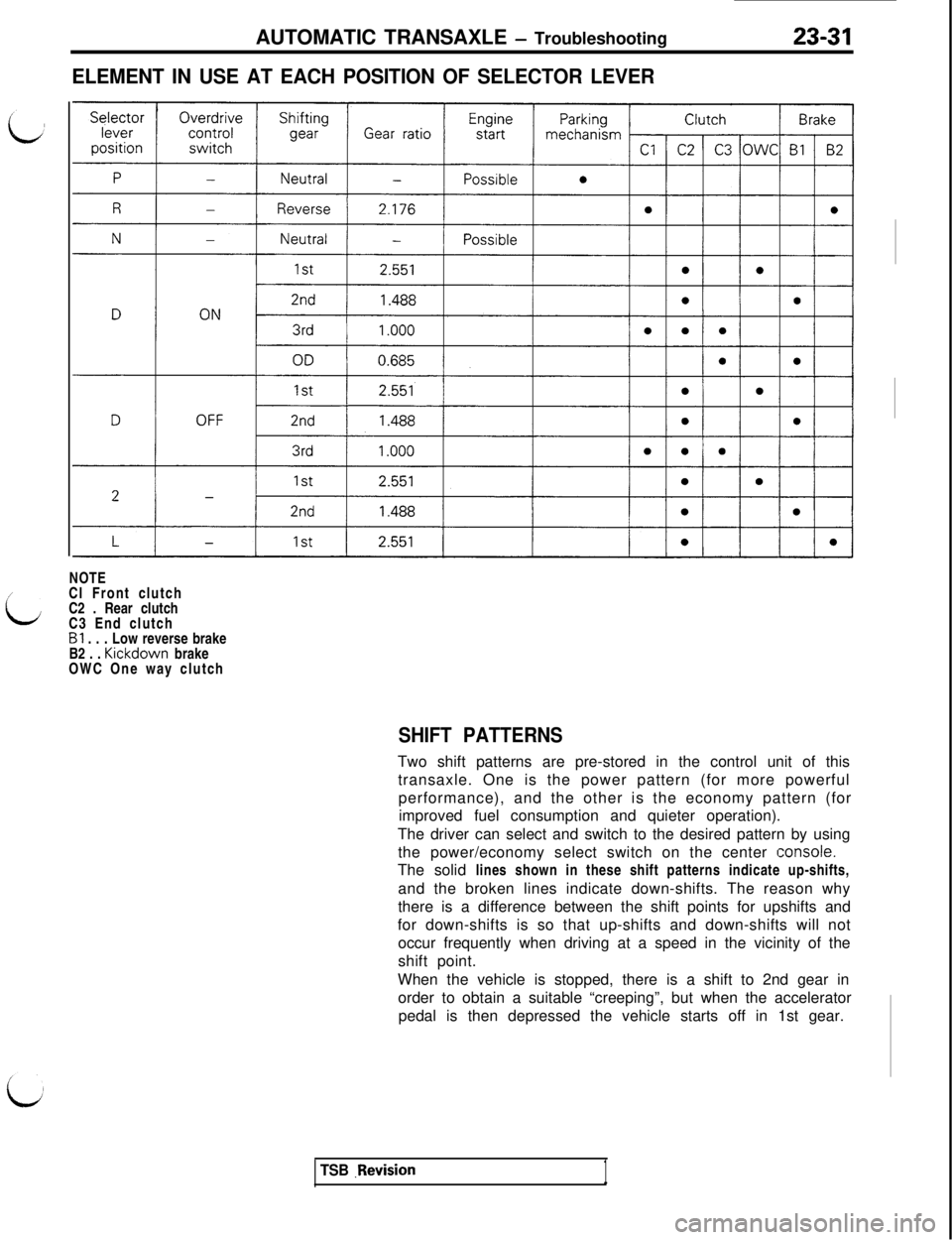
ELEMENT IN USE AT EACH POSITION OF SELECTOR LEVER
23-31NOTE
/
LCl Front clutch
C2 . Rear clutch
C3 End clutch
Bl . . . Low reverse brake
B2 . . Kickdown brake
OWC One way clutch
SHIFT PATTERNSTwo shift patterns are pre-stored in the control unit of this
transaxle. One is the power pattern (for more powerful
performance), and the other is the economy pattern (for
improved fuel consumption and quieter operation).
The driver can select and switch to the desired pattern by using
the power/economy select switch on the center
Iconsole.The solid lines shown in these shift patterns indicate up-shifts,
and the broken lines indicate down-shifts. The reason why
there is a difference between the shift points for upshifts and
for down-shifts is so that up-shifts and down-shifts will not
occur frequently when driving at a speed in the vicinity of the
shift point.
When the vehicle is stopped, there is a shift to 2nd gear in
order to obtain a suitable “creeping”, but when the accelerator
pedal is then depressed the vehicle starts off in 1st gear.
TSB .Revision1
Page 502 of 1146
23-50AUTOMATIC TRANSAXLE - service AdiustmentProcedures
09FO117
m09FOO19
L Pushbuttonv09FOO61
@ Button pressed (while brakepedal is depressed)c Button not pressed@ Button pressed
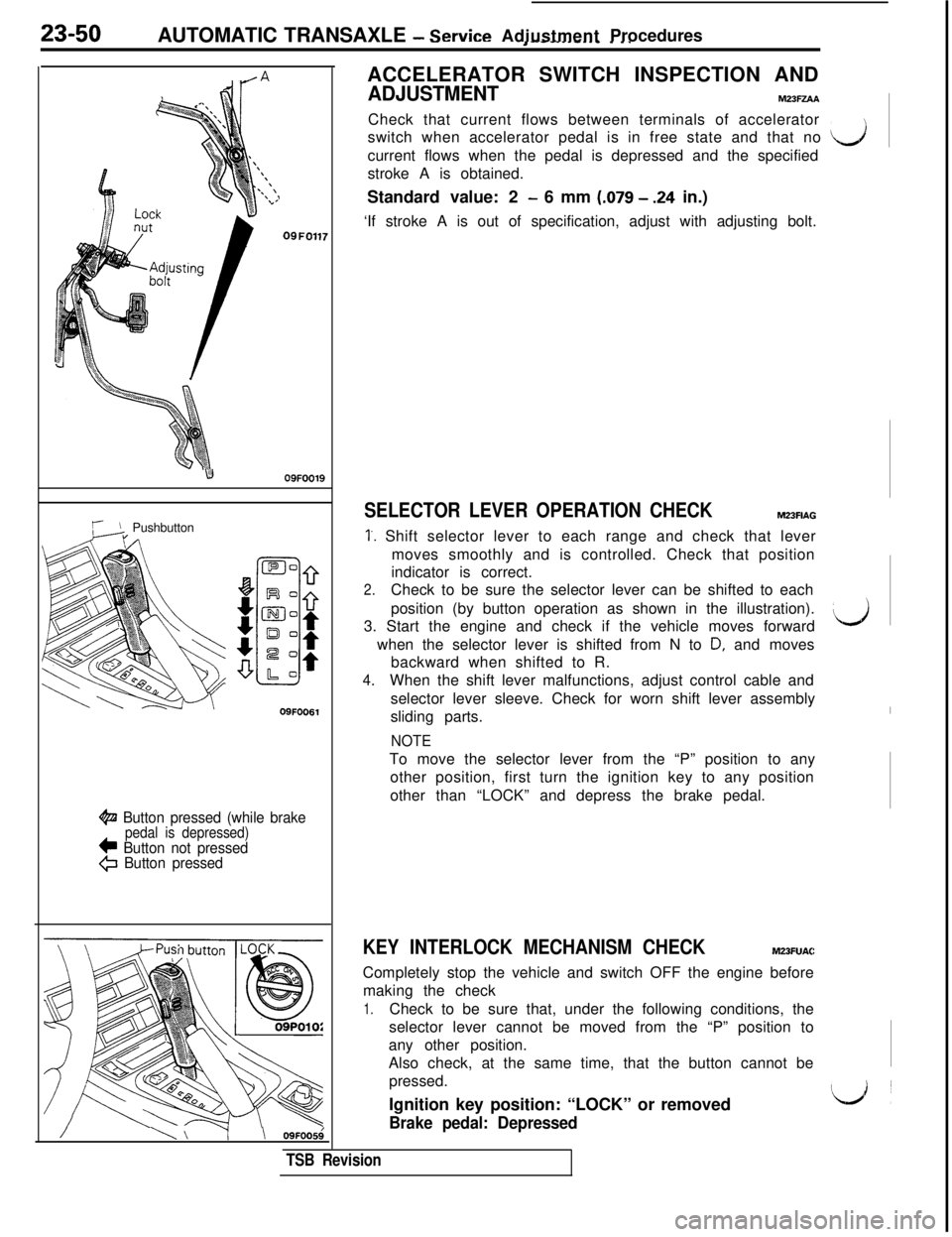
/\ \\ OSFODdACCELERATOR SWITCH INSPECTION AND
ADJUSTMENTM23FZAACheck that current flows between terminals of accelerator
switch when accelerator pedal is in free state and that no
dcurrent flows when the pedal is depressed and the specified
stroke A is obtained.
Standard value: 2
- 6 mm (.079 - .24 in.)
‘If stroke A is out of specification, adjust with adjusting bolt.
SELECTOR LEVER OPERATION CHECKM23FIAG
1.. Shift selector lever to each range and check that lever
moves smoothly and is controlled. Check that position
indicator is correct.
2.Check to be sure the selector lever can be shifted to each
position (by button operation as shown in the illustration).
3. Start the engine and check if the vehicle moves forward
dwhen the selector lever is shifted from N to
D, and moves
backward when shifted to R.
4.When the shift lever malfunctions, adjust control cable and
selector lever sleeve. Check for worn shift lever assembly
sliding parts.
I
NOTETo move the selector lever from the “P” position to any
other position, first turn the ignition key to any position
other than “LOCK” and depress the brake pedal.
KEY INTERLOCK MECHANISM CHECKM23FlJACCompletely stop the vehicle and switch OFF the engine before
making the check
1.Check to be sure that, under the following conditions, the
selector lever cannot be moved from the “P” position to
any other position.
Also check, at the same time, that the button cannot be
pressed.
Ignition key position: “LOCK” or removed
Brake pedal: Depressed
TSB Revision
Page 734 of 1146
35-12SERVICE BRAKES -Anti-lock Braking System Troubleshooting
METHOD OF CLEARING DIAGNOSIS
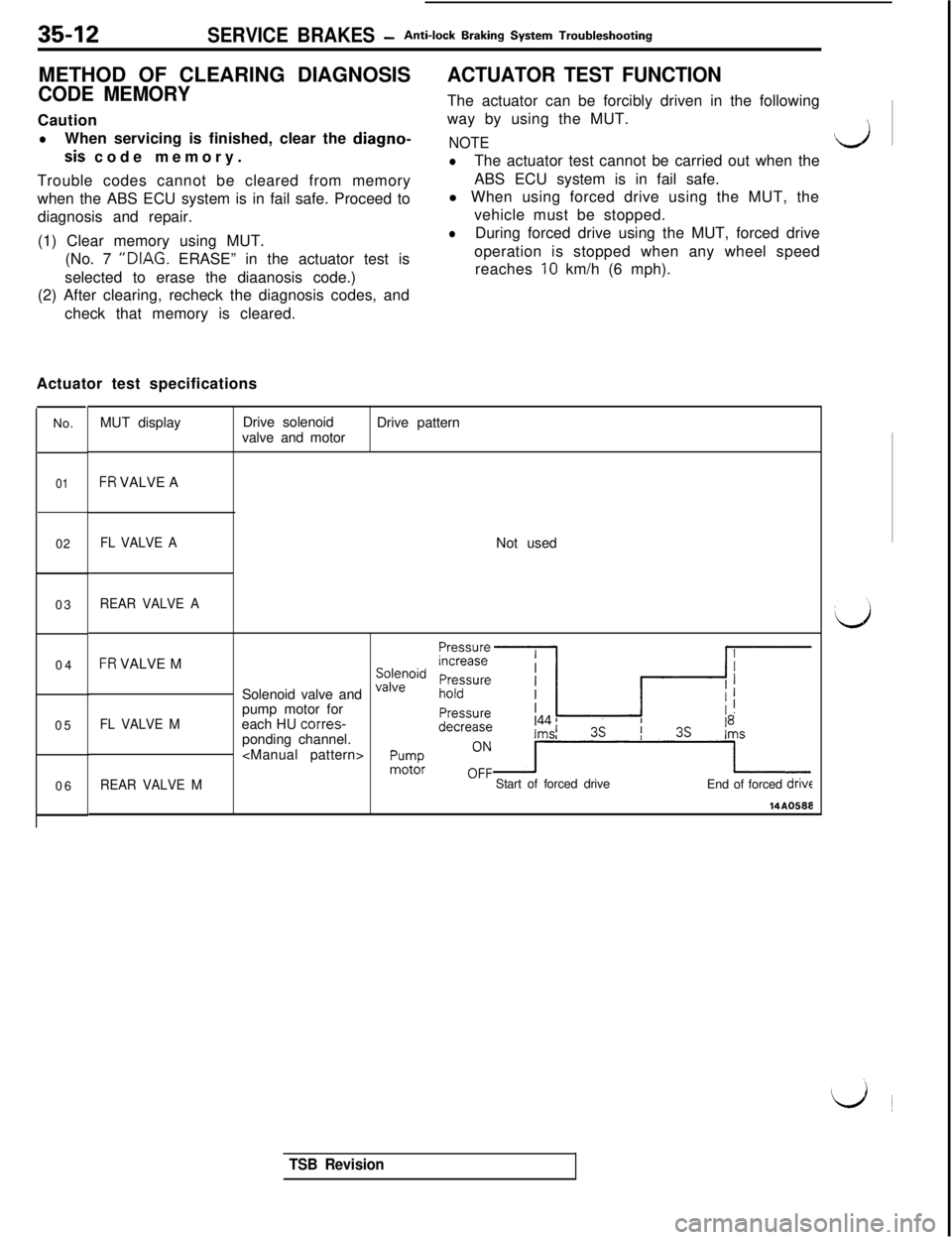
ACTUATOR TEST FUNCTION
CODE MEMORYThe actuator can be forcibly driven in the following
Cautionway by using the MUT.
lWhen servicing is finished, clear the diagno-
sis code memory.NOTEd
lThe actuator test cannot be carried out when the
Trouble codes cannot be cleared from memoryABS ECU system is in fail safe.
when the ABS ECU system is in fail safe. Proceed tol When using forced drive using the MUT, the
diagnosis and repair.vehicle must be stopped.
(1) Clear memory using MUT.
lDuring forced drive using the MUT, forced drive
(No. 7
“DIAG. ERASE” in the actuator test isoperation is stopped when any wheel speed
selected to erase the diaanosis code.)reaches 10 km/h (6 mph).
(2) After clearing, recheck the diagnosis codes, and
check that memory is cleared.
Actuator test specifications
No.MUT display
01FR VALVE A
02
FL VALVE A03
REAR VALVE A04
FR VALVE M
05
FL VALVE M06
REAR VALVE MDrive solenoid
valve and motorDrive pattern
Not used
Solenoid valve and
pump motor for
each HU corres-
ponding channel.
Start of forced drive
End of forced drive
1440588
TSB Revision
Page 752 of 1146
35-30SERVICE BRAKES -Anti-lock Braking System Troubleshooting
METHOD OF CLEARING DIAGNOSIS
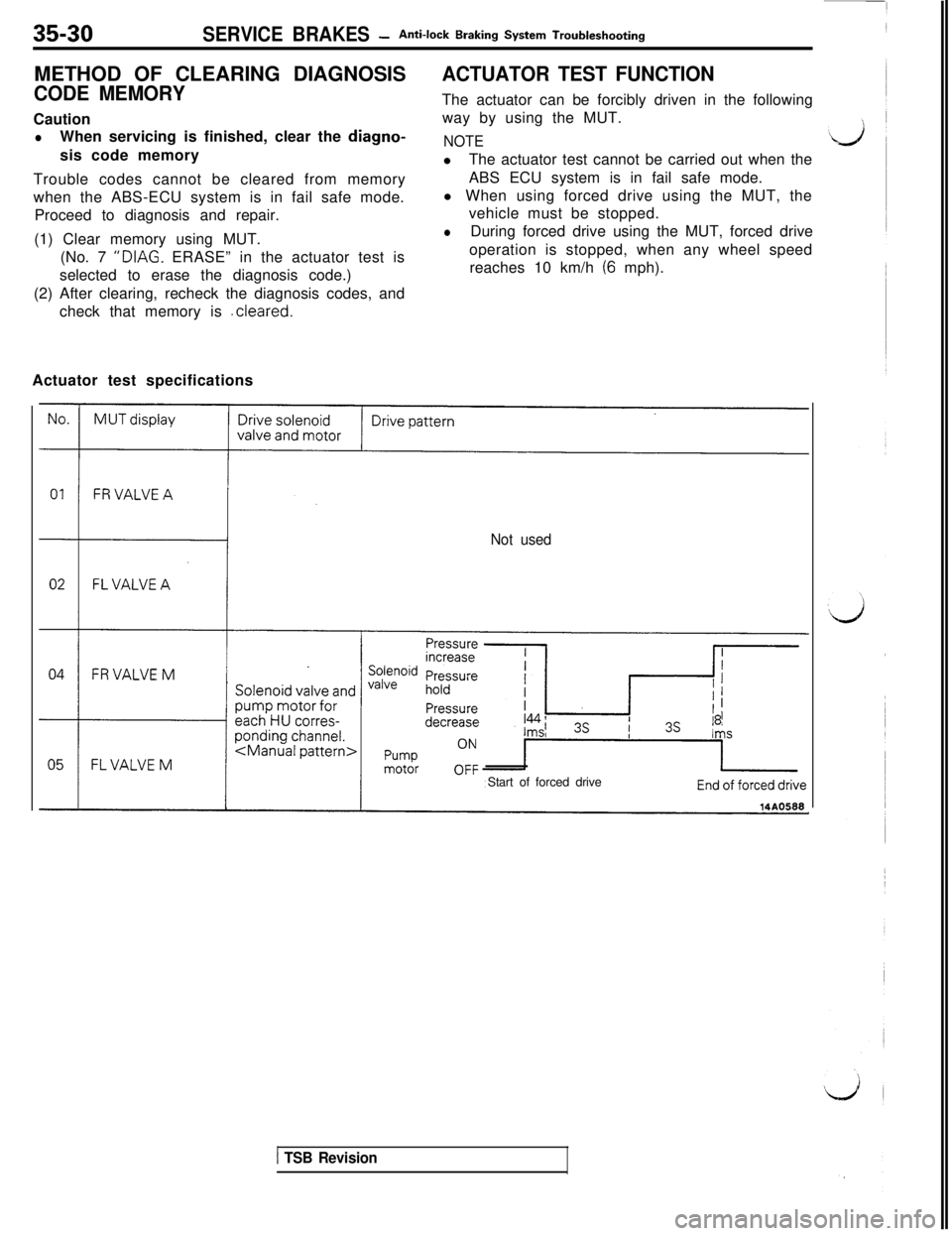
ACTUATOR TEST FUNCTION
CODE MEMORYCautionThe actuator can be forcibly driven in the following
way by using the MUT.
lWhen servicing is finished, clear the diagno-
sis code memoryNOTElThe actuator test cannot be carried out when the
Trouble codes cannot be cleared from memoryABS ECU system is in fail safe mode.
when the ABS-ECU system is in fail safe mode.
Proceed to diagnosis and repair.l When using forced drive using the MUT, the
vehicle must be stopped.
(1) Clear memory using MUT.
lDuring forced drive using the MUT, forced drive
(No. 7
“DIAG. ERASE” in the actuator test isoperation is stopped, when any wheel speed
selected to erase the diagnosis code.)reaches 10 km/h (6 mph).
(2) After clearing, recheck the diagnosis codes, and
check that memory is .cleared.
Actuator test specifications
Not usedStart of forced drive
1 TSB Revision