torque MITSUBISHI 3000GT 1991 Service Manual
[x] Cancel search | Manufacturer: MITSUBISHI, Model Year: 1991, Model line: 3000GT, Model: MITSUBISHI 3000GT 1991Pages: 1146, PDF Size: 76.68 MB
Page 5 of 1146
,
b
00-I
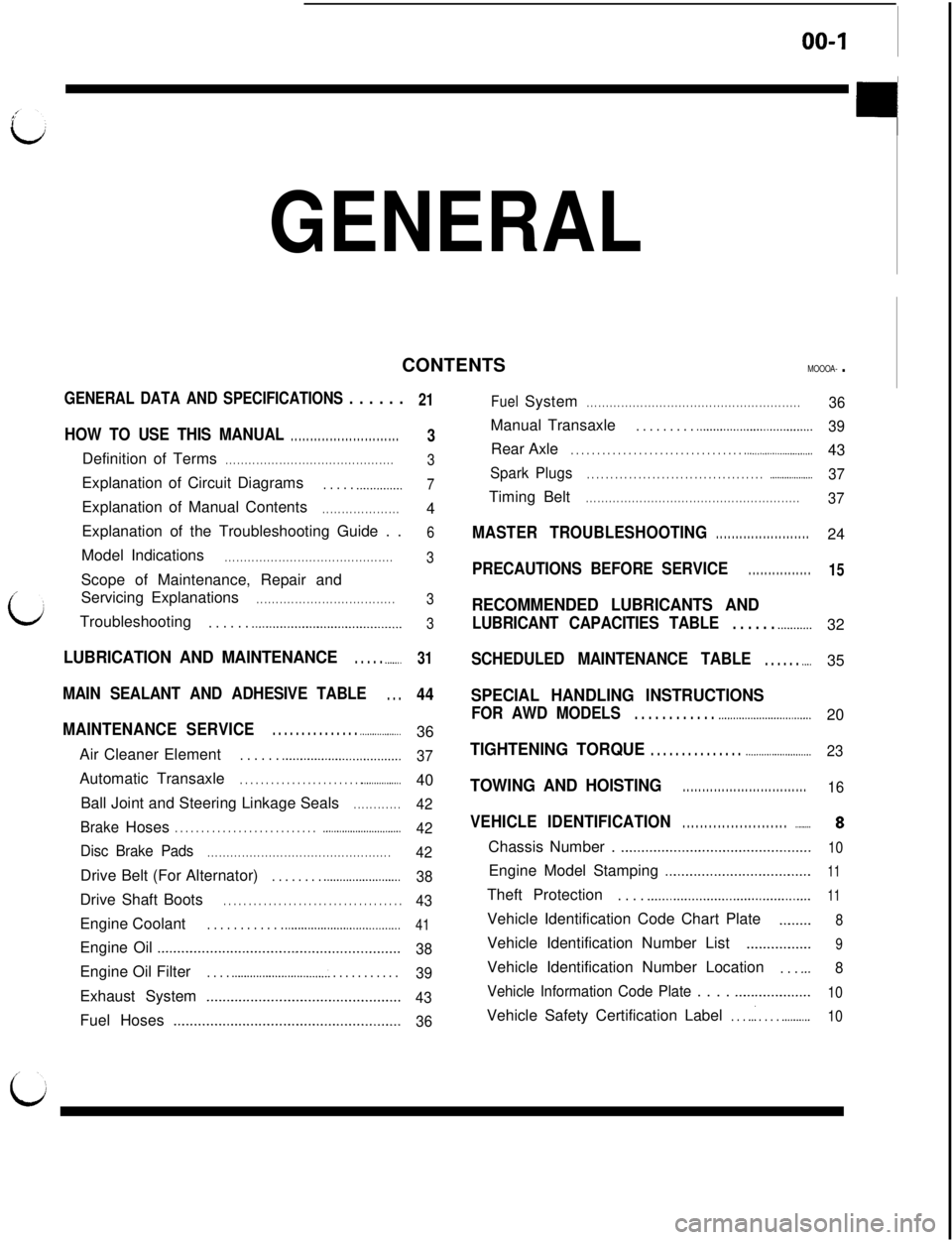
GENERALCONTENTS
MOOOA- .
GENERAL DATA AND SPECIFICATIONS . . . . . .21
HOW TO USE THIS MANUAL. . . . . . . . . . . . . . . . . . . . . . . . . . . .3Definition of Terms
. . . . . . . . . . . . . . . . . . . . . . . . . . . . . . . . . . . . . . . . . . . .3Explanation of Circuit Diagrams
. . . . . .._...........7Explanation of Manual Contents
. . . . . . . . . . . . . . . . . . . .4
Explanation of the Troubleshooting Guide . .
6ModelIndications
. . . . . . . . . . . . . . . . . . . . . . . . . . . . . . . . . . . . . . . . . . . .3Scope of Maintenance, Repair and
ServicingExplanations
. . . . . . . . . . . . . . . . . . . . . . . . . . . . . . . . . . . .3Troubleshooting
. . . . . . .._.......................................3
LUBRICATION AND MAINTENANCE. . . . . .._....31SCHEDULED MAINTENANCE TABLE. . . . . . .._.
MAIN SEALANT AND ADHESIVE TABLE. . .44
MAINTENANCE SERVICE
. . . . . . . . . . . . . . . .._......_.....__Air Cleaner Element
. . . . . . .._......._......_................Automatic Transaxle
. . . . . . . . . . . . . . . . . . . . . . . . .._......._.....Ball Joint and Steering Linkage Seals
. . . . . . . . . . . .
BrakeHoses. . . . . . . . . . . . . . . . . . . . . . . . . . . .._......._.._...._......._..
Disc Brake Pads. . . . . . . . . . . . . . . . . . . . . . . . . . . . . . . . . . . . . . . . . . . . . . . .Drive Belt (For Alternator)
. . . . . . . . .._.........._..........Drive Shaft Boots
. . . . . . . . . . . . . . . . . . . . . . . . . . . . . . . . . . . .Engine Coolant
. . . . . . . . . . . . ..__.._.............................Engine Oil
.._....__._.................................................Engine Oil Filter
. . . . .._._.......__.................. . . . . . . . . . . .Exhaust System
_....._......._.....__._............,...........Fuel Hoses
..__......__............................................36
3740
42
42
42
38
43
41
38
39
43
36
FuelSystem. . . . . . . . . . . . . . . . . . . . . . . . . . . . . . . . . . . . . . . . . . . . . . . . . . . . . . . .Manual Transaxle
. . . . . . . . . .._........................_.......Rear Axle
. . . . . . . . . . . . . . . . . . . . . . . . . . . . . . . . . . .._..._.._..____.._.......
SparkPlugs. . . . . . . . . . . . . . . . . . . . . . . . . . . . . . . . . . . . . . .._...............TimingBelt
. . . . . . . . . . . . . . . . . . . . . . . . . . . . . . . . . . . . . . . . . . . . . . . . . . . . . . . .
MASTER TROUBLESHOOTING. . . . . . . . . . . . . . . . . . . . . . . .
PRECAUTIONS BEFORE SERVICE. . . . . . . . . . . . . . . .
RECOMMENDED LUBRICANTS AND
LUBRICANT CAPACITIES TABLE. . . . . . .._........
SPECIAL HANDLING INSTRUCTIONS
FOR AWD MODELS. . . . . . . . . . . . .._...._........................
TIGHTENING TORQUE. . . . . . . . . . . . . . . ..__.....................
TOWING AND HOISTING. . . . . . . . . . . . . . . . . . . . . . . . . . . . . . . .
VEHICLE IDENTIFICATION. . . . . . . . . . . . . . . . . . . . . . . . .._.....Chassis Number .
.._............................................Engine Model Stamping
.._..........................._...._Theft Protection
. . . . .._.........................................Vehicle Identification Code Chart Plate
.._.....Vehicle Identification Number List
.._._....._..._.Vehicle Identification Number Location
. . . .._
Vehicle Information Code Plate . . . . .._._......_.......Vehicle Safety Certification Label
. . . ..I . . . . .._..._...
36
3943
37
3724
1532
35
20
23
16
8
10
11
11
8
9
8
10
10
Page 7 of 1146
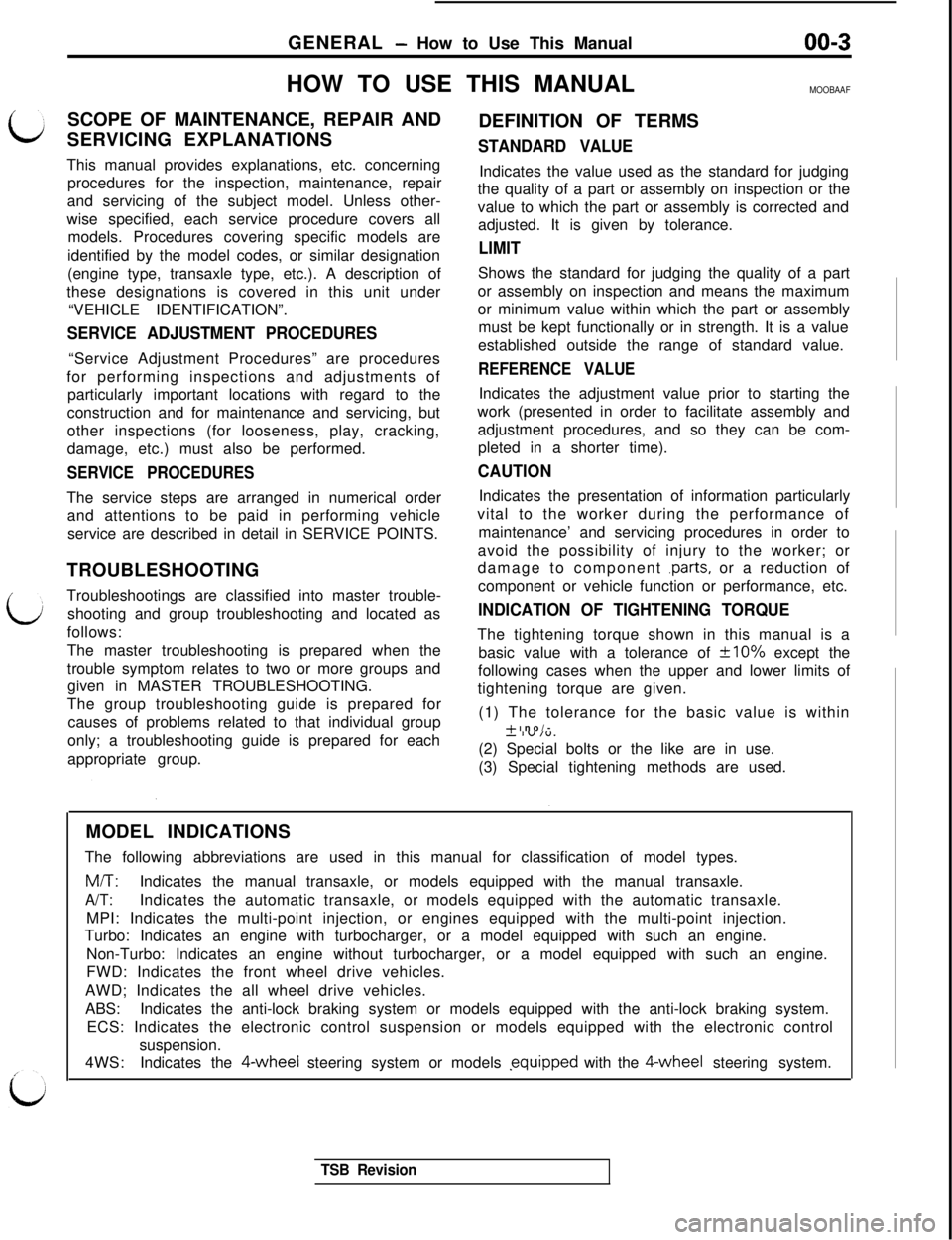
GENERAL - How to Use This Manual00-3HOW TO USE THIS MANUAL
MOOBAAF
c;SCOPE OF MAINTENANCE, REPAIR AND
DEFINITION OF TERMS
SERVICING EXPLANATIONSSTANDARD VALUE
bThis manual provides explanations, etc. concerning
procedures for the inspection, maintenance, repair
and servicing of the subject model. Unless other-
wise specified, each service procedure covers all
models. Procedures covering specific models are
identified by the model codes, or similar designation
(engine type, transaxle type, etc.). A description of
these designations is covered in this unit under
“VEHICLE IDENTIFICATION”.
SERVICE ADJUSTMENT PROCEDURES“Service Adjustment Procedures” are procedures
for performing inspections and adjustments of
particularly important locations with regard to the
construction and for maintenance and servicing, but
other inspections (for looseness, play, cracking,
damage, etc.) must also be performed.
SERVICE PROCEDURESThe service steps are arranged in numerical order
and attentions to be paid in performing vehicle
service are described in detail in SERVICE POINTS.
TROUBLESHOOTING
Troubleshootings are classified into master trouble-
shooting and group troubleshooting and located as
follows:
The master troubleshooting is prepared when the
trouble symptom relates to two or more groups and
given in MASTER TROUBLESHOOTING.
The group troubleshooting guide is prepared for
causes of problems related to that individual groupIndicates the value used as the standard for judging
the quality of a part or assembly on inspection or the
value to which the part or assembly is corrected and
adjusted. It is given by tolerance.
LIMITShows the standard for judging the quality of a part
or assembly on inspection and means the maximum
or minimum value within which the part or assembly
must be kept functionally or in strength. It is a value
established outside the range of standard value.
REFERENCE VALUEIndicates the adjustment value prior to starting the
work (presented in order to facilitate assembly and
adjustment procedures, and so they can be com-
pleted in a shorter time).
CAUTIONIndicates the presentation of information particularly
vital to the worker during the performance of
maintenance’ and servicing procedures in order to
avoid the possibility of injury to the worker; or
damage to component
.parts, or a reduction of
component or vehicle function or performance, etc.
INDICATION OF TIGHTENING TORQUEThe tightening torque shown in this manual is a
basic value with a tolerance of
+lO% except the
following cases when the upper and lower limits of
tightening torque are given.
(1) The tolerance for the basic value is within
+ I no/-
only; a troubleshooting guide is prepared for eachI iv,“.appropriate group.(2) Special bolts or the like are in use.
(3) Special tighteningmethods are used.
MODEL INDICATIONS
The following abbreviations are used in this manual for classification of model types.M/T:Indicates the manual transaxle, or models equipped with the manual transaxle.
A/T:Indicates the automatic transaxle, or models equipped with the automatic transaxle.
MPI: Indicates the multi-point injection, or engines equipped with the multi-point injection.
Turbo: Indicates an engine with turbocharger, or a model equipped with such an engine.
Non-Turbo: Indicates an engine without turbocharger, or a model equipped with such an engine.
FWD: Indicates the front wheel drive vehicles.
AWD; Indicates the all wheel drive vehicles.
ABS:Indicates the anti-lock braking system or models equipped with the anti-lock braking system.
ECS: Indicates the electronic control suspension or models equipped with the electronic control
suspension.
4WS:Indicates the 4-wheel steering system or models .equipped with the 4-wheel steering system.
TSB Revision
Page 8 of 1146
GENERAL - How to Use This Manual
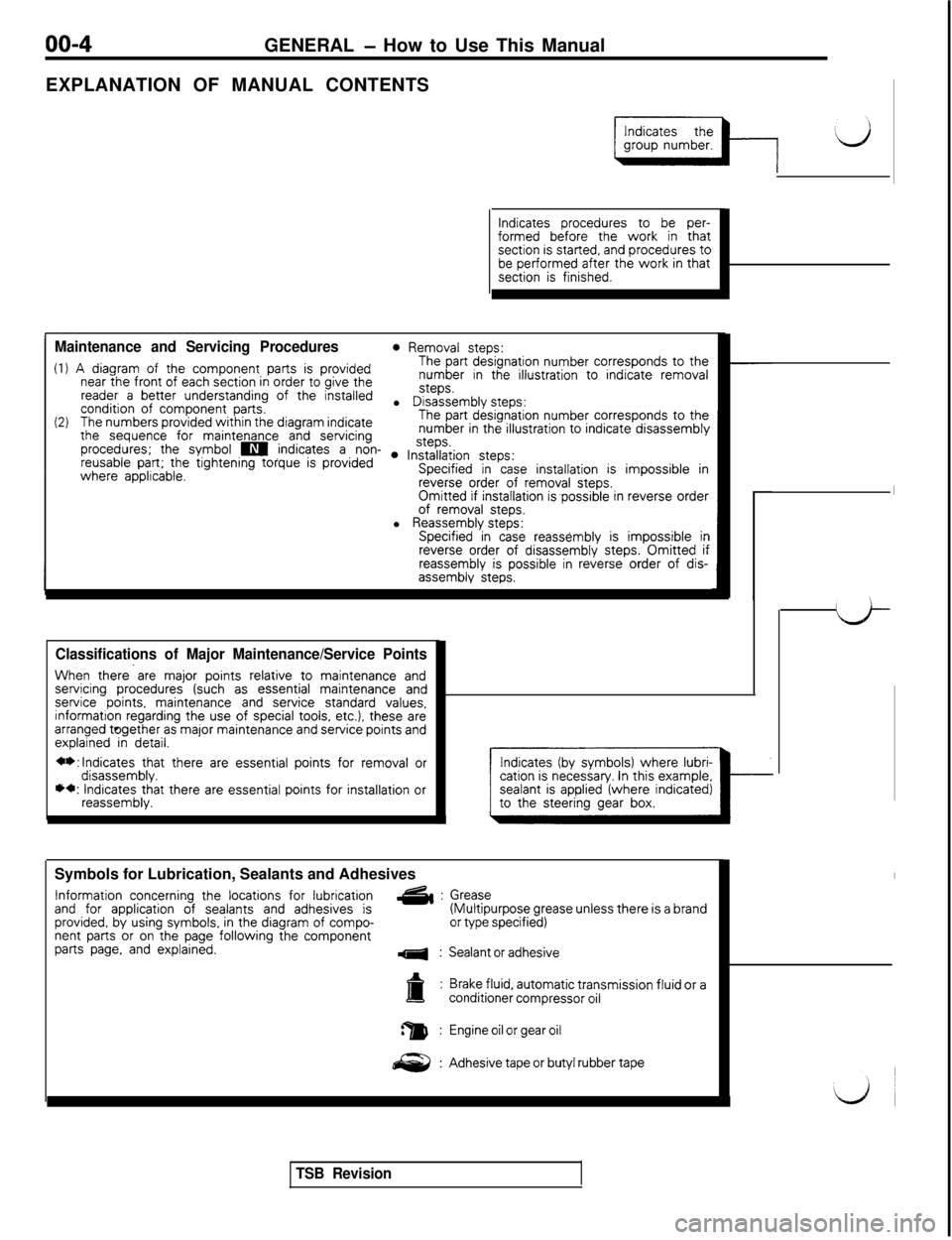
EXPLANATION OF MANUAL CONTENTS
Indicates procedures to be per-formed before the work in thatsection is started, and procedures tobe performed after the work in thatsection is finished.
Maintenance and Servicing Procedures0 Removal steps:
(1) A diagram of the component parts is providedThe part designation number corresponds to the
near the front of each section in order to give thenumber in the illustration to indicate removal
reader a better understanding of the installedsteps.
condition of component parts.l Disassembly steps:
(2)The numbers provided within the diagram indicateThe part designation number corresponds to the
the sequence for maintenance and servicingnumber in the illustration to indicate disassembly
procedures; the symbol m indicates a non- . ln~~~~iion steps:reusable part; the tightening torque is providedwhere applicable.Specified in case installation is impossible inreverse order of removal steps.Omitted if installation is,possible in reverse orderof removal steps.l Reassembly steps:Specified in case reassembly is impossible inreverse order of disassembly steps. Omitted ifreassembly is possible in reverse order of dis-assembly steps.
Classifications of Major Maintenance/Service Points
When there’are major points relative to maintenance andservicing procedures (such as essential maintenance andservice points, maintenance and service standard values,informatton regarding the use of special toois, etc.), these arearranged together as major maintenance and service points andexplained in detail.
**:lndicates that there are essential points for removal ordisassembly.*+: Indicates that there are essential points for installation orreassembly.Symbols for Lubrication, Sealants and Adhesives
Information concerning the locations for lubricationand for application of sealants and adhesives isG&:
provided, by using symbols, in the diagram of compo-nent parts or on the page following the componentparts page, and explained.4:
Indicates (by symbols) where lubri-cation is necessary. In this example,
Grease(Multipurpose grease unless there is a brandor type specified)
Sealant or adhesive
Brake fluid, automatic transmission fluid or aconditioner compressor oil
Engine oil or gear oil
Adhesive tape or butyl rubber tape
TSB Revision
Page 27 of 1146
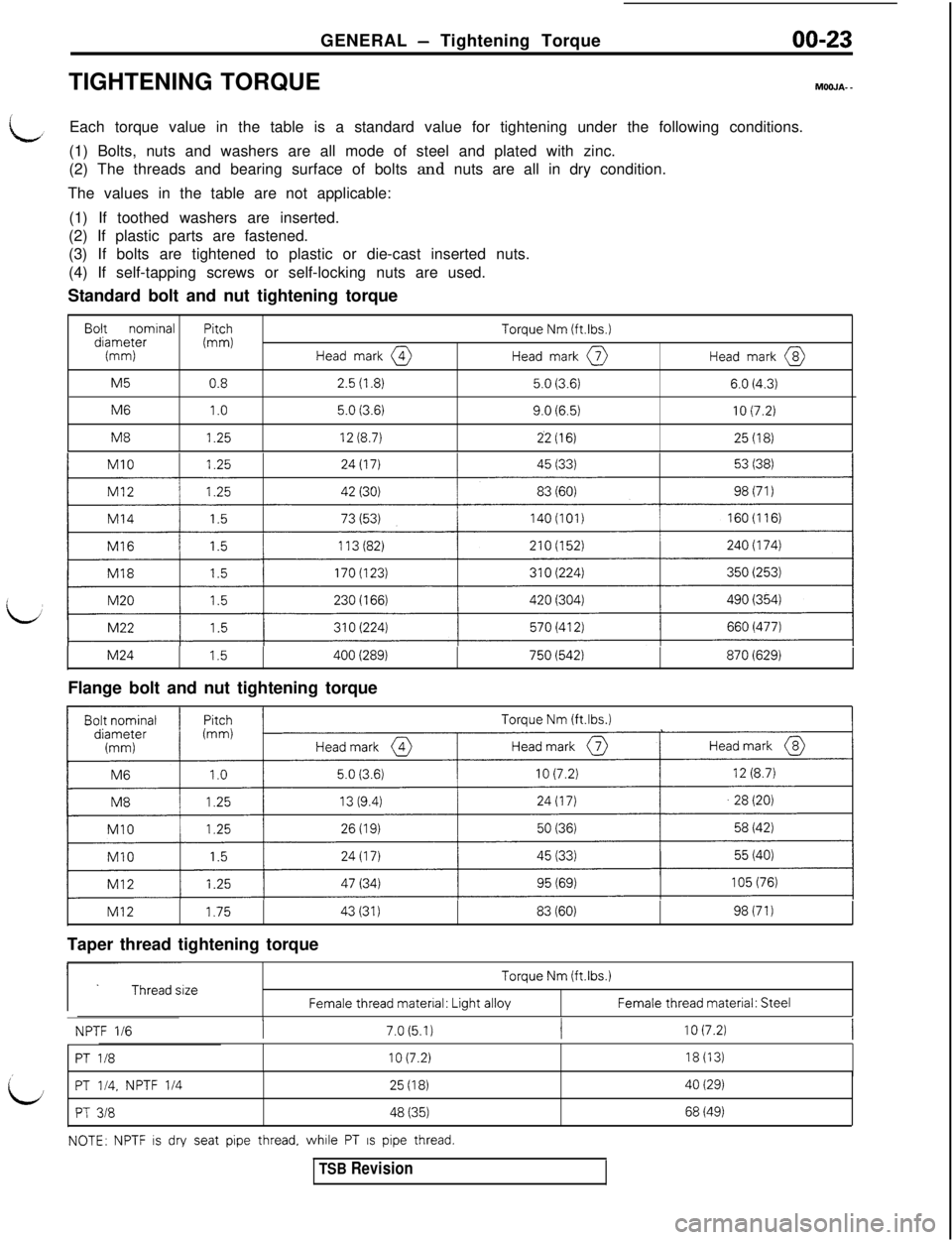
GENERAL - Tightening Torque00-23TIGHTENING TORQUE
MOOJA- -Each torque value in the table is a standard value for tightening under the following conditions.
(1) Bolts, nuts and washers are all mode of steel and plated with zinc.
(2) The threads and bearing surface of bolts and nuts are all in dry condition.
The values in the table are not applicable:
(1) If toothed washers are inserted.
(2) If plastic parts are fastened.
(3) If bolts are tightened to plastic or die-cast inserted nuts.
(4) If self-tapping screws or self-locking nuts are used.
Standard bolt and nut tightening torque
Bolt nominaldiameter(mm)
M5
M6
M8
Pitchb-m-n)
0.8
1.0
1.25
Head mark @
2.5 (1.8)
5.0 (3.6)
12 (8.7)
Torque Nm (ft.lbs.)
Head mark @
5.0 (3.6)
9.0 (6.5)
22 (16)
Head mark @
6.0 (4.3)
10 (7.2)
25 (18)
M241.5400 (289)Flange bolt and nut tightening torque750 (542)870 (629)
Ml21.7543 (31)83 (60)98 (71)Taper thread tightening torque
Thread sizeTorque Nm (ft.lbs.1
Female thread material: Light alloyFemale thread material: Steel
NPTF 116I7.0 (5.1)I10 (7.2)I
PT 11810 (7.2)18 (13)
/I
idPT 114, NPTF 11425 (18140 (29)
PT 31848 (35)68 (49)
NOTE: NPTF is dry seat pipe thread, whrle PT IS pipe thread.
TSB Revision
Page 41 of 1146
GENERAL - Maintenance Service00-37
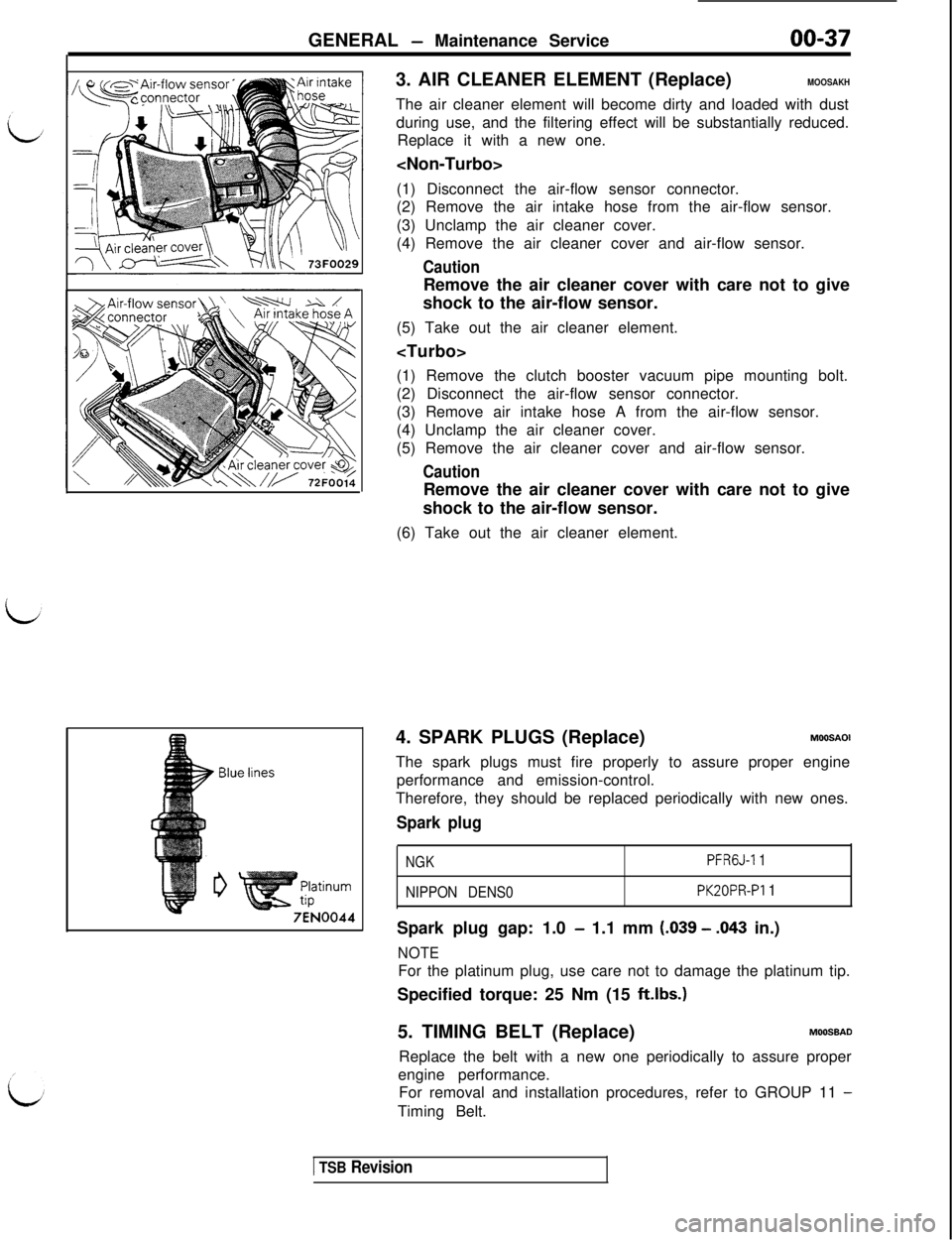
3. AIR CLEANER ELEMENT (Replace)
MOOSAKHThe air cleaner element will become dirty and loaded with dust
during use, and the filtering effect will be substantially reduced.
Replace it with a new one.
(1) Disconnect the air-flow sensor connector.
(2) Remove the air intake hose from the air-flow sensor.
(3) Unclamp the air cleaner cover.
(4) Remove the air cleaner cover and air-flow sensor.
CautionRemove the air cleaner cover with care not to give
shock to the air-flow sensor.
(5) Take out the air cleaner element.
(1) Remove the clutch booster vacuum pipe mounting bolt.
(2) Disconnect the air-flow sensor connector.
(3) Remove air intake hose A from the air-flow sensor.
(4) Unclamp the air cleaner cover.
(5) Remove the air cleaner cover and air-flow sensor.
CautionRemove the air cleaner cover with care not to give
shock to the air-flow sensor.
(6) Take out the air cleaner element.
4. SPARK PLUGS (Replace)
MOOSAOIThe spark plugs must fire properly to assure proper engine
performance and emission-control.
Therefore, they should be replaced periodically with new ones.
Spark plug
NGKPFRGJ-1 1
NIPPON DENS0
PK20PR-PI 1Spark plug gap: 1.0
- 1.1 mm LO39 - -043 in.)
NOTEFor the platinum plug, use care not to damage the platinum tip.
Specified torque: 25 Nm (15
ft.lbs.15. TIMING BELT (Replace)
MOOSBADReplace the belt with a new one periodically to assure proper
engine performance.
For removal and installation procedures, refer to GROUP 11
-Timing Belt.
1 TSB Revision
Page 43 of 1146
GENERAL - Maintenance Service00-39ogPOO268. ENGINE OIL FILTER (Change)
MOOEAEJThe quality of replacement filters varies considerably. Only high
quality filters should be used to assure most efficient service.
Genuine oil filters require that the filter be capable of
withstanding a pressure of 256 psi are high quality filters and
are recommended as follows:
Oil Filter Part No.
MITSUBISHI Genuine Parts: MD136790
ENGINE OIL FILTER SELECTIONThis vehicle is equipped with a full-flow, throw-away oil filter.
The same type of replacement filter is recommended as a
replacement filter for this vehicle. It is possible, particularly in
cold weather, that this vehicle may develop high oil pressure
for a short duration. You should be sure that any replacement
filter used on this vehicle is a high-quality filter and is capable of
withstanding a pressure of 256 psi (1,765
kpa) (manufacturer’s
specifications) to avoid filter and engine damage. The following
is a highquality filter and is strongly recommended for use on
this vehicle: Mitsubishi Engine Oil Filter P/N MD136790.
Any replacement oil filter should be installed in accordance with
the oil filter manufacturer’s installation instructions.
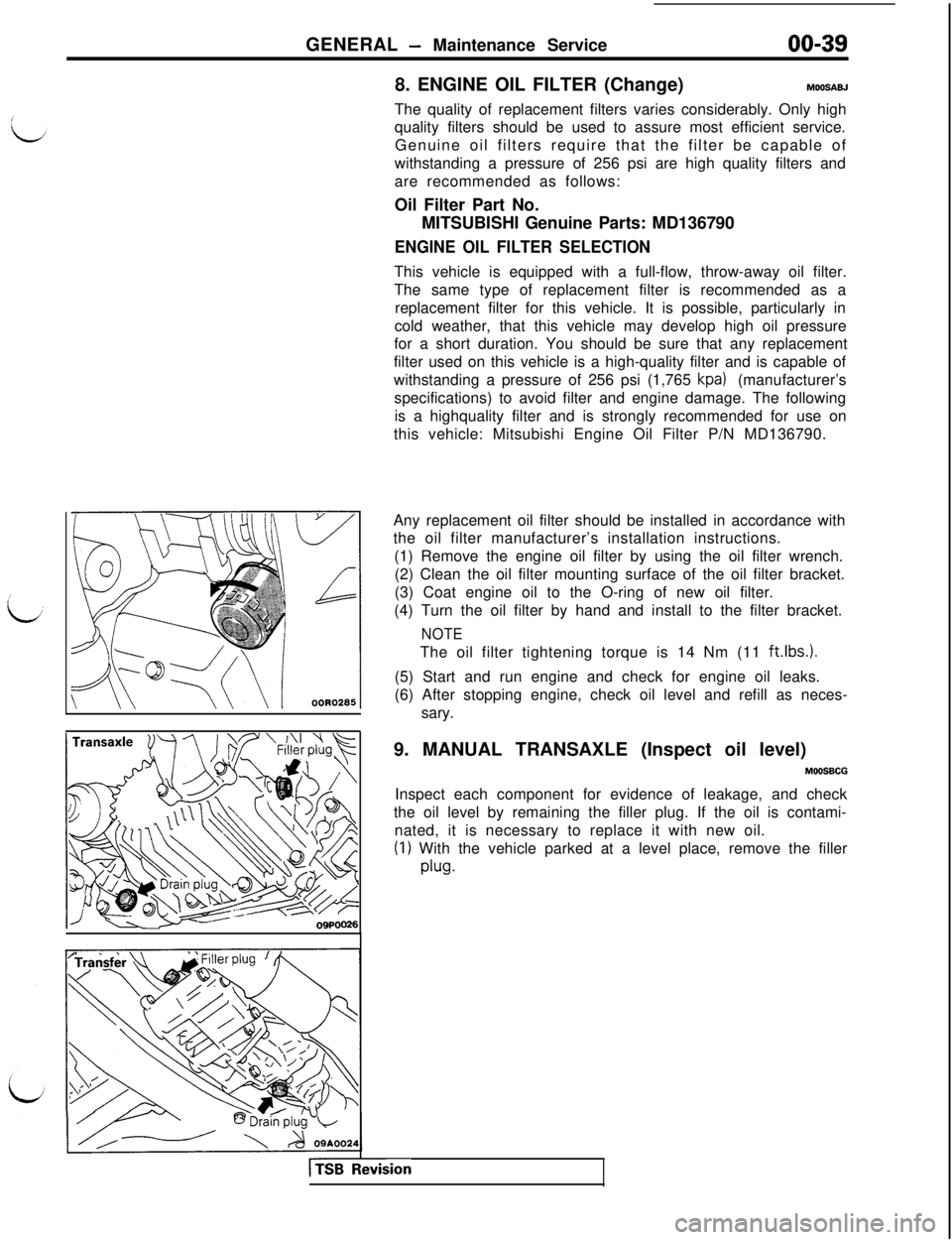
(1) Remove the engine oil filter by using the oil filter wrench.
(2) Clean the oil filter mounting surface of the oil filter bracket.
(3) Coat engine oil to the O-ring of new oil filter.
(4) Turn the oil filter by hand and install to the filter bracket.
NOTEThe oil filter tightening torque is 14 Nm (11
ft.lbs.1.(5) Start and run engine and check for engine oil leaks.
(6) After stopping engine, check oil level and refill as neces-
sary.
9. MANUAL TRANSAXLE (Inspect oil level)
MOOSBCGInspect each component for evidence of leakage, and check
the oil level by remaining the filler plug. If the oil is contami-
nated, it is necessary to replace it with new oil.
(1) With the vehicle parked at a level place, remove the filler
plug.
-Revision
Page 44 of 1146
00-40
GENERAL - Maintenance Service
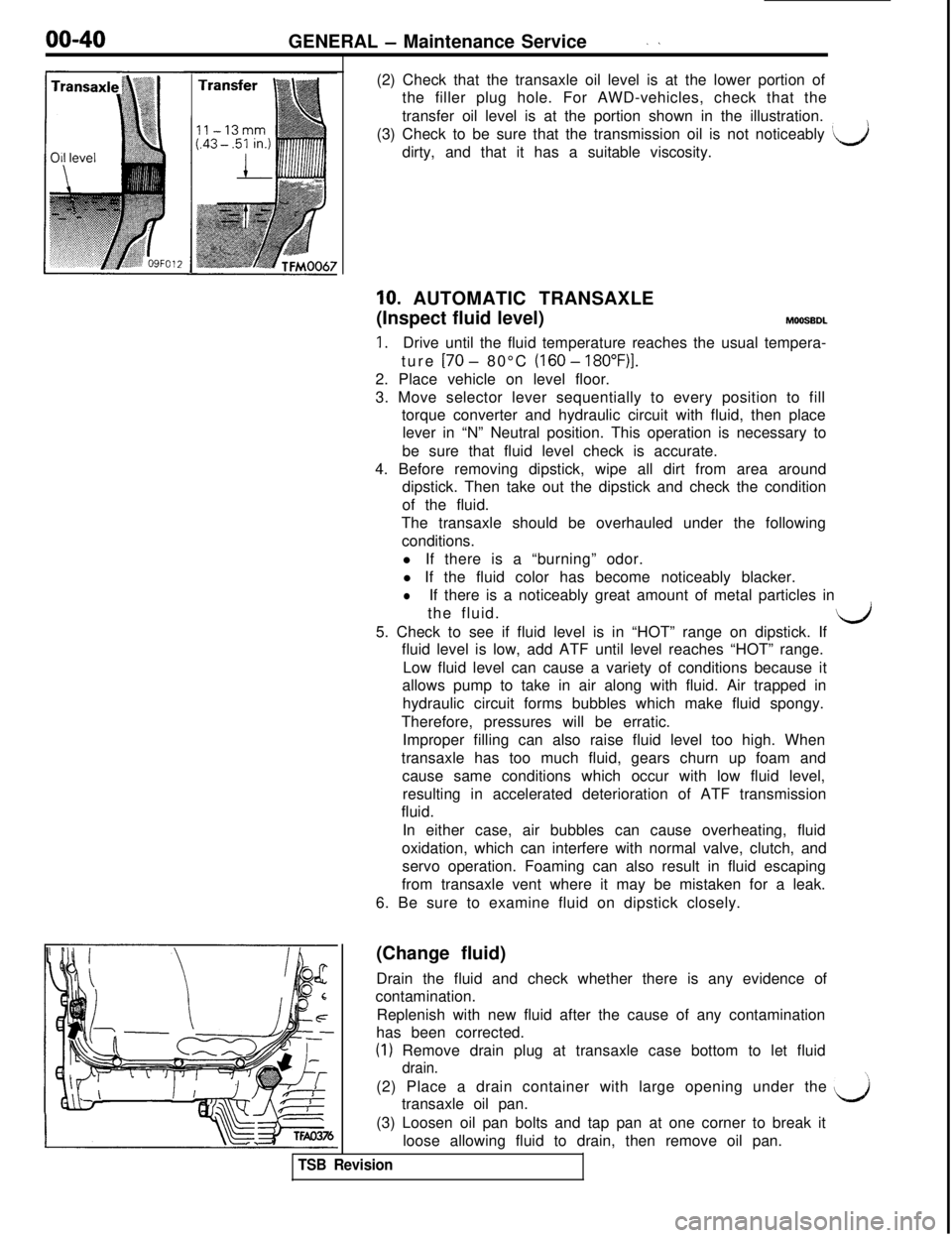
(2) Check that the transaxle oil level is at the lower portion of
the filler plug hole. For AWD-vehicles, check that the
transfer oil level is at the portion shown in the illustration.
(3) Check to be sure that the transmission oil is not noticeably
‘ddirty, and that it has a suitable viscosity.
10. AUTOMATIC TRANSAXLE
(Inspect fluid level)
MOOSEDL
1.Drive until the fluid temperature reaches the usual tempera-
ture
[70 - 80°C (160 - 18O”F)I.2. Place vehicle on level floor.
3. Move selector lever sequentially to every position to fill
torque converter and hydraulic circuit with fluid, then place
lever in “N” Neutral position. This operation is necessary to
be sure that fluid level check is accurate.
4. Before removing dipstick, wipe all dirt from area around
dipstick. Then take out the dipstick and check the condition
of the fluid.
The transaxle should be overhauled under the following
conditions.
l If there is a “burning” odor.
l If the fluid color has become noticeably blacker.
lIf there is a noticeably great amount of metal particles in
the fluid.
5. Check to see if fluid level is in “HOT” range on dipstick. If
fluid level is low, add ATF until level reaches “HOT” range.
Low fluid level can cause a variety of conditions because it
allows pump to take in air along with fluid. Air trapped in
hydraulic circuit forms bubbles which make fluid spongy.
Therefore, pressures will be erratic.
Improper filling can also raise fluid level too high. When
transaxle has too much fluid, gears churn up foam and
cause same conditions which occur with low fluid level,
resulting in accelerated deterioration of ATF transmission
fluid.
In either case, air bubbles can cause overheating, fluid
oxidation, which can interfere with normal valve, clutch, and
servo operation. Foaming can also result in fluid escaping
from transaxle vent where it may be mistaken for a leak.
6. Be sure to examine fluid on dipstick closely.
L/(Change fluid)
Drain the fluid and check whether there is any evidence of
contamination.
Replenish with new fluid after the cause of any contamination
has been corrected.
(1) Remove drain plug at transaxle case bottom to let fluid
drain.(2) Place a drain container with large opening under the
transaxle oil pan.
(3) Loosen oil pan bolts and tap pan at one corner to break it
loose allowing fluid to drain, then remove oil pan.
d
TSB Revision
Page 45 of 1146
GENERAL - Maintenance Service00-41
Good
t-lVA0283
I04FOOOd(4) Check the oil filter for clogging and damage and replace if
necessary.
(5) Clean drain plug and tighten drain plug with gasket to 30
-35 Nm (22
- 25 ft.lbs.).
(6) Clean both gasket surfaces of transaxle case and oil pan.
(7) Install oil pan with new gasket and tighten oil pan bolts to
10 - 12 Nm (7.5 - 8.5 ft.lbs.).
(8) Pour 4.5 liters (4.8 qts.) of specified ATF into case through
dipstick hole. [Total quantity of ATF required is approx. 7.5
liters (7.9 qts.). Actually however, approx. 4.5 liters (4.8 qts.)
of fluid can be replaced because rest of fluid remains in
torque converter.]
Specified fluid: Dia ATF SP or MITSUBISHI PLUS ATF or
equivalent(9) Start engine and allow to idle for at least two minutes.
Then, with parking brake on, move selector lever momen-
tarily to each position, ending in “N” Neutral position.
(lO)Add sufficient ATF to bring fluid level to lower mark.
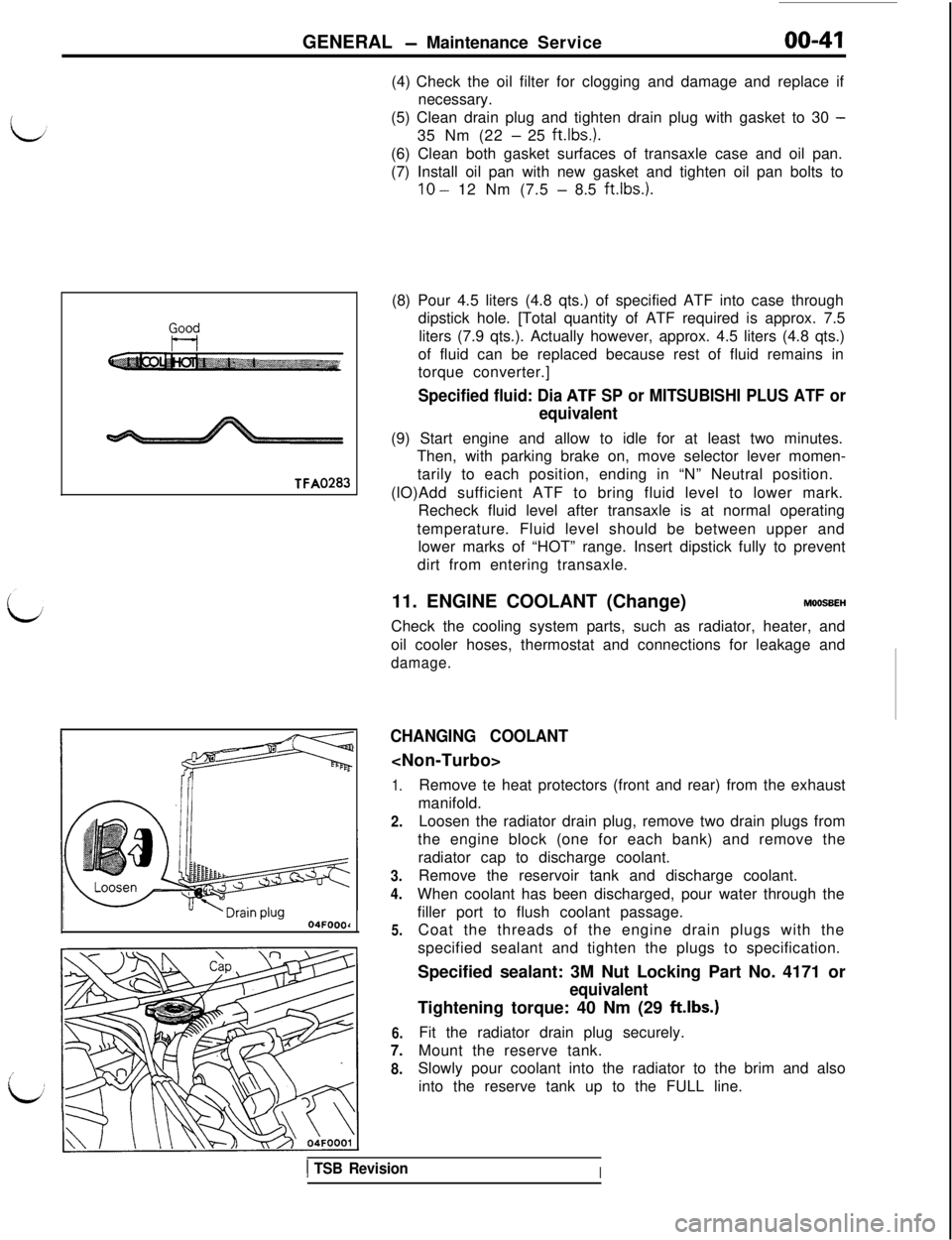
Recheck fluid level after transaxle is at normal operating
temperature. Fluid level should be between upper and
lower marks of “HOT” range. Insert dipstick fully to prevent
dirt from entering transaxle.
11. ENGINE COOLANT (Change)
MOOSBEHCheck the cooling system parts, such as radiator, heater, and
oil cooler hoses, thermostat and connections for leakage and
damage.
CHANGING COOLANT
1.
2.
3.
4.
5.
6.
7.
8.Remove te heat protectors (front and rear) from the exhaust
manifold.
Loosen the radiator drain plug, remove two drain plugs from
the engine block (one for each bank) and remove the
radiator cap to discharge coolant.
Remove the reservoir tank and discharge coolant.
When coolant has been discharged, pour water through the
filler port to flush coolant passage.
Coat the threads of the engine drain plugs with the
specified sealant and tighten the plugs to specification.
Specified sealant: 3M Nut Locking Part No. 4171 or
equivalentTightening torque: 40 Nm (29
ftlbs.)Fit the radiator drain plug securely.
Mount the reserve tank.
Slowly pour coolant into the radiator to the brim and also
into the reserve tank up to the FULL line.
1 TSB RevisionI
Page 62 of 1146
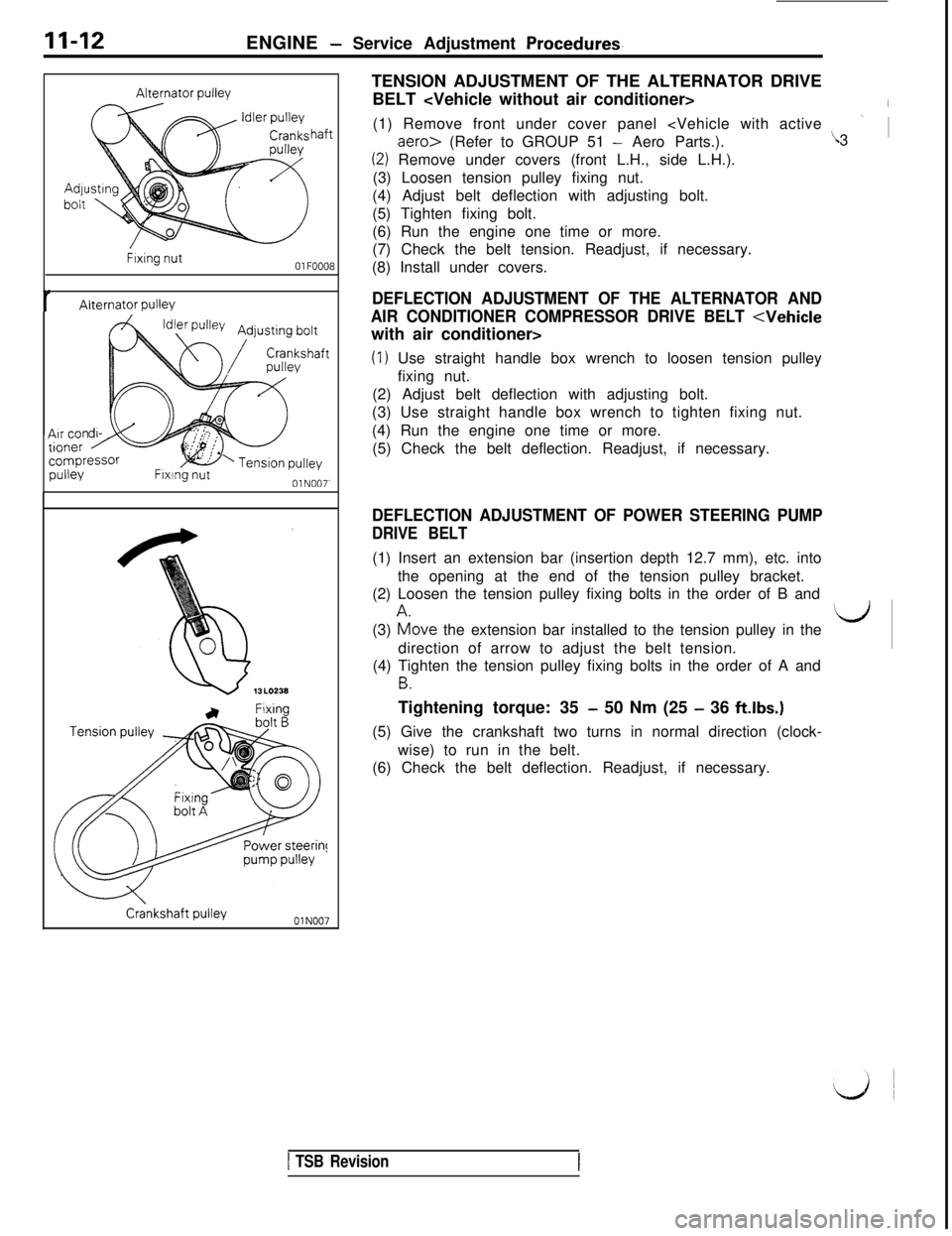
II-12ENGINE - Service Adjustment Procedures-
r
AdJl
bolt
Alternator wllev
haft
Fixing nutOlFOOO8
Alternator pulley
Adjusting bolt
/Crankshaftpulley
Air contionercompressorpulleyw Tension pulleyFlxtng nutOlN007.
Crankshaft pulleyOlN007TENSION ADJUSTMENT OF THE ALTERNATOR DRIVE
BELT
I(1) Remove front under cover panel
aero> (Refer to GROUP 51 - Aero Parts.).\\
3 ’
(2) Remove under covers (front L.H., side L.H.).
(3) Loosen tension pulley fixing nut.
(4) Adjust belt deflection with adjusting bolt.
(5) Tighten fixing bolt.
(6) Run the engine one time or more.
(7) Check the belt tension. Readjust, if necessary.
(8) Install under covers.
DEFLECTION ADJUSTMENT OF THE ALTERNATOR AND
AIR CONDITIONER COMPRESSOR DRIVE BELT
(1) Use straight handle box wrench to loosen tension pulley
fixing nut.
(2) Adjust belt deflection with adjusting bolt.
(3) Use straight handle box wrench to tighten fixing nut.
(4) Run the engine one time or more.
(5) Check the belt deflection. Readjust, if necessary.
DEFLECTION ADJUSTMENT OF POWER STEERING PUMP
DRIVE BELT(1) Insert an extension bar (insertion depth 12.7 mm), etc. into
the opening at the end of the tension pulley bracket.
(2) Loosen the tension pulley fixing bolts in the order of B and
(3)
iove the extension bar installed to the tension pulley in the‘LJdirection of arrow to adjust the belt tension.
(4) Tighten the tension pulley fixing bolts in the order of A and
8.Tightening torque: 35
- 50 Nm (25 - 36 ftlbs,)(5) Give the crankshaft two turns in normal direction (clock-
wise) to run in the belt.
(6) Check the belt deflection. Readjust, if necessary.
1 TSB Revision
Page 74 of 1146
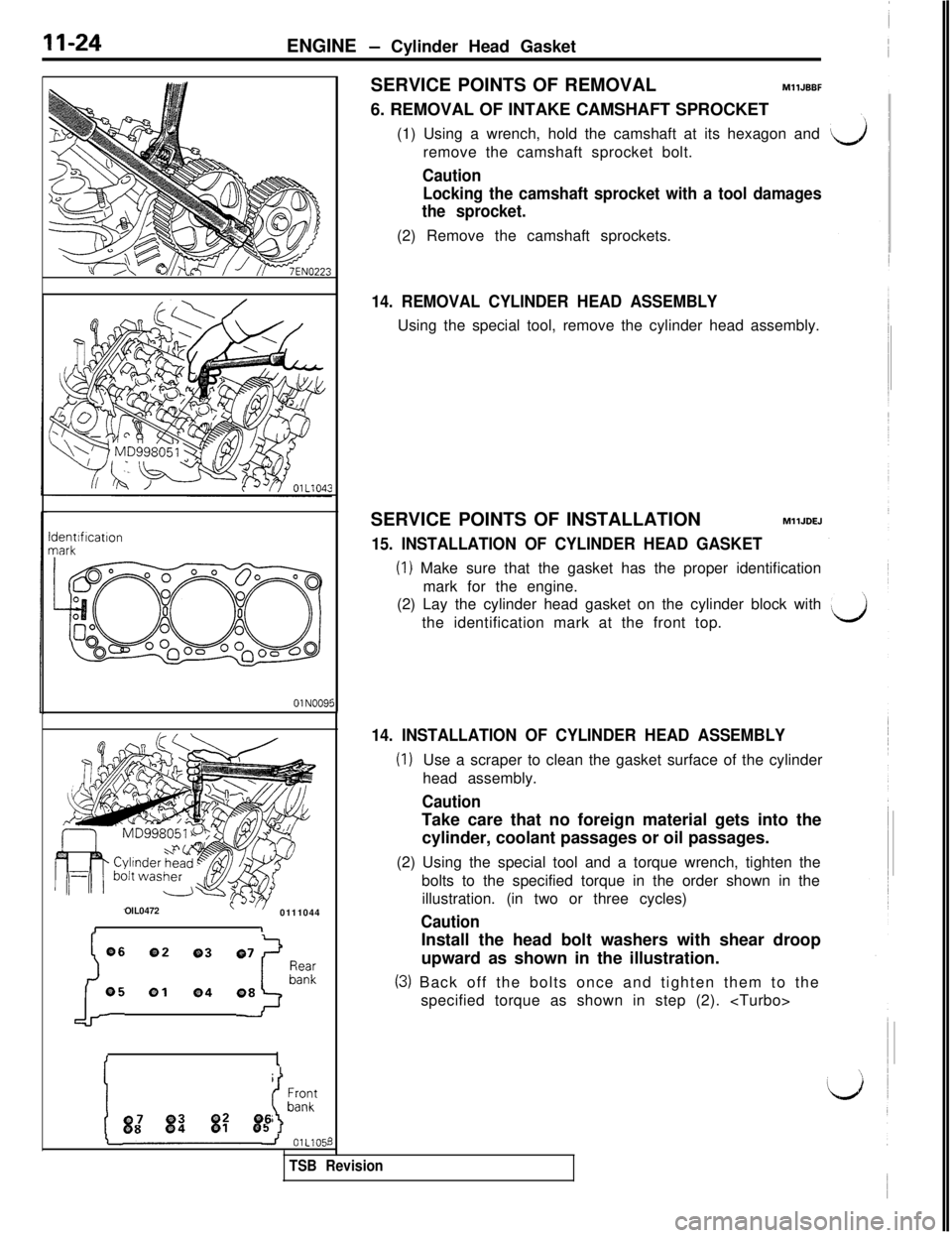
11-24ENGINE - Cylinder Head Gasket
ldentlfrcatlonmark
01 N009iOlL0472
0111044
JI
j:: 1: :: ::p:i
c1
Q80401Q5 c
Frontbank074930296
- OlL105j8
TSB Revision
5SERVICE POINTS OF REMOVALMllJBBF
6. REMOVAL OF INTAKE CAMSHAFT SPROCKET
(1) Using a wrench, hold the camshaft at its hexagon and
remove the camshaft sprocket bolt.
Caution
Locking the camshaft sprocket with a tool damages
the sprocket.(2) Remove the camshaft sprockets.
14. REMOVAL CYLINDER HEAD ASSEMBLYUsing the special tool, remove the cylinder head assembly.
SERVICE POINTS OF INSTALLATION
MllJDEJ
15. INSTALLATION OF CYLINDER HEAD GASKET
(1) Make sure that the gasket has the proper identification
mark for the engine.
(2) Lay the cylinder head gasket on the cylinder block with
the identification mark at the front top.
14. INSTALLATION OF CYLINDER HEAD ASSEMBLY
(1)Use a scraper to clean the gasket surface of the cylinder
head assembly.
CautionTake care that no foreign material gets into the
cylinder, coolant passages or oil passages.
(2) Using the special tool and a torque wrench, tighten the
bolts to the specified torque in the order shown in the
illustration. (in two or three cycles)
CautionInstall the head bolt washers with shear droop
upward as shown in the illustration.
(3) Back off the bolts once and tighten them to the
specified torque as shown in step (2).