stop start MITSUBISHI 3000GT 1991 Owner's Guide
[x] Cancel search | Manufacturer: MITSUBISHI, Model Year: 1991, Model line: 3000GT, Model: MITSUBISHI 3000GT 1991Pages: 1146, PDF Size: 76.68 MB
Page 837 of 1146
STEERING - Service Adjustment Procedures37A-9
LL:13N002E
FluId f[uctuatlon
While
engineWhile engme
runningstopped13uo13:
Return ho
Vinyl hose13AO142
j
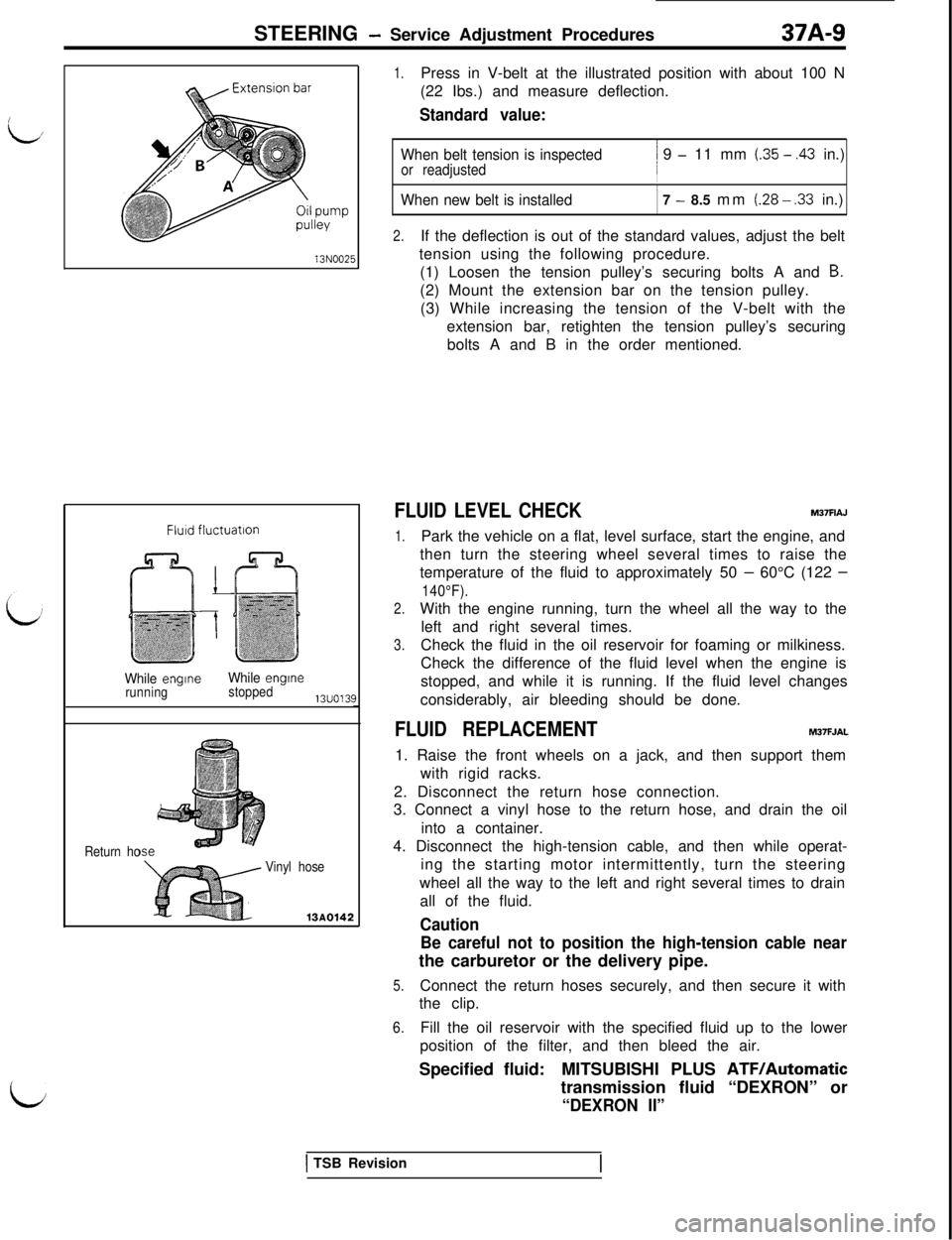
1.Press in V-belt at the illustrated position with about 100 N
(22 Ibs.) and measure deflection.
Standard value:
When belt tension is inspectedor readjusted
When new belt is installed
/ 9 - 11 mm (.35 - .43 in.)
I
’ 7 - 8.5 mm (.28 - .33 in.)
2.If the deflection is out of the standard values, adjust the belt
tension using the following procedure.
(1) Loosen the tension pulley’s securing bolts A and
B.(2) Mount the extension bar on the tension pulley.
(3) While increasing the tension of the V-belt with the
extension bar, retighten the tension pulley’s securing
bolts A and B in the order mentioned.
FLUID LEVEL CHECKM37FlAJ
1.Park the vehicle on a flat, level surface, start the engine, and
then turn the steering wheel several times to raise the
temperature of the fluid to approximately 50
- 60°C (122 -
140°F).
2.With the engine running, turn the wheel all the way to the
left and right several times.
3.Check the fluid in the oil reservoir for foaming or milkiness.
Check the difference of the fluid level when the engine is
stopped, and while it is running. If the fluid level changes
considerably, air bleeding should be done.
FLUID REPLACEMENTM37FJAL1. Raise the front wheels on a jack, and then support them
with rigid racks.
2. Disconnect the return hose connection.
3. Connect a vinyl hose to the return hose, and drain the oil
into a container.
4. Disconnect the high-tension cable, and then while operat-
ing the starting motor intermittently, turn the steering
wheel all the way to the left and right several times to drain
all of the fluid.
Caution
Be careful not to position the high-tension cable nearthe carburetor or the delivery pipe.
5.Connect the return hoses securely, and then secure it with
the clip.
6.Fill the oil reservoir with the specified fluid up to the lower
position of the filter, and then bleed the air.
Specified fluid:MITSUBISHI PLUS ATF/Automatic
transmission fluid “DEXRON” or
“DEXRON II”
1 TSB Revision
Page 838 of 1146
37A-10STEERING - Service Adjustment Procedures
BLEEDINGM37FKAl
1.Jack up the front wheels and support them by using a floor
stand.
2. Manually turn the oil pump pulley a few times.
3. Turn the steering wheel all the way to the left and to the
right several times.
4. Disconnect the high-tension cable, and then, while operat-
ing the starting motor intermittently, turn the steering
wheel all the way to the left and right several times (for 15
to 20 seconds).
Caution1. During air bleeding, replenish the fluid supply so
that the level never falls below the lower position ofthe filter.
2. If air bleeding is done while engine is running, the
air will be broken up and absorbed into the fluid; besure to do the bleeding only while cranking.
5. Connect the ignition cable, and then start the engine
(idling).
6.Turn the steering wheel to the left and right until there are
no air bubbles in the oil reservoir.
7.Confirm that the fluid is not milky, and that the level is up to
the specified position on the level gauge.
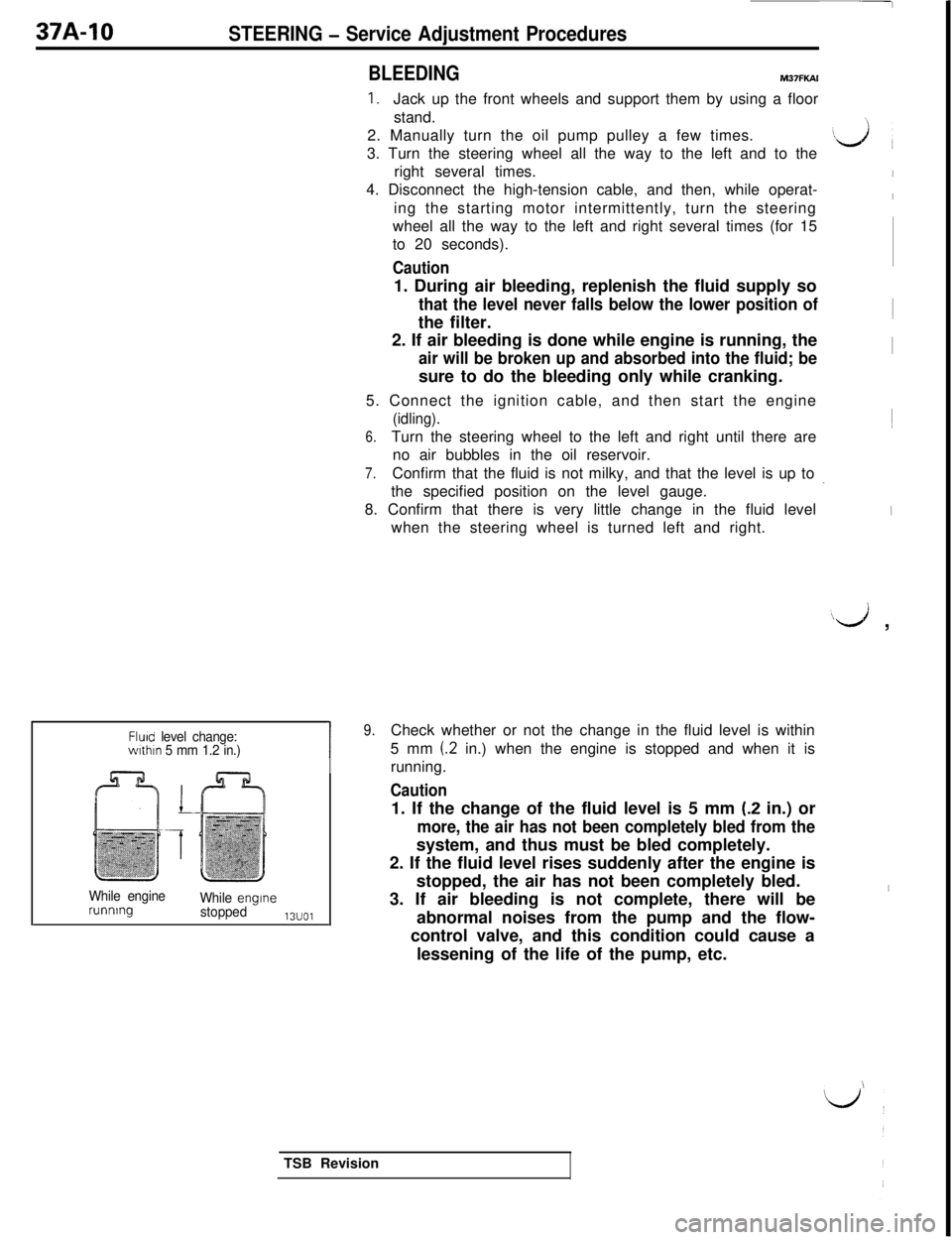
8. Confirm that there is very little change in the fluid level
when the steering wheel is turned left and right.
Fluid level change:wlthln 5 mm 1.2 in.)I
9.Check whether or not the change in the fluid level is within
5 mm
(.2 in.) when the engine is stopped and when it is
Irunning.
Caution
While enginerunningWhile enginestopped13UOl1. If the change of the fluid level is 5 mm
I.2 in.) or
more, the air has not been completely bled from thesystem, and thus must be bled completely.
2. If the fluid level rises suddenly after the engine is
stopped, the air has not been completely bled.
3. If air bleeding is not complete, there will be
abnormal noises from the pump and the flow-
control valve, and this condition could cause a
lessening of the life of the pump, etc.
LJ
I
I~
I~
I
LJ ,
I
\TSB Revision
Page 864 of 1146
37B44-WHEEL STEERING SYSTEM (4WS) -Service Adjustment ProceduresSERVICE ADJUSTMENT PROCEDURES
M37FKAH
BLEEDING,LJ(1) Bleed air from power steering system (Refer to GROUP
37A
- Service Adjustment Procedures.)
(2) Lift up the vehicle.
(3) Start the engine and let it idle.
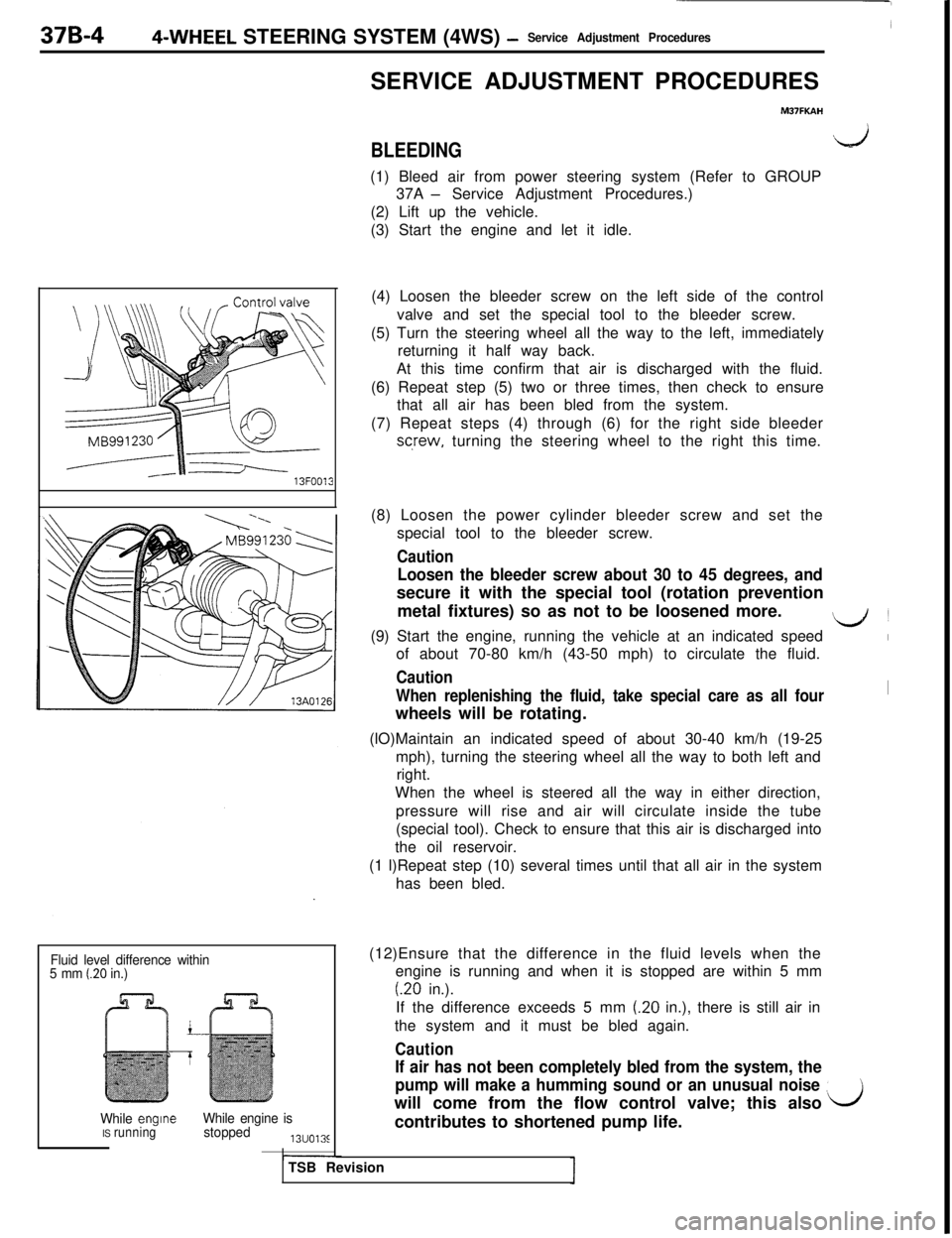
(4) Loosen the bleeder screw on the left side of the control
valve and set the special tool to the bleeder screw.
(5) Turn the steering wheel all the way to the left, immediately
returning it half way back.
At this time confirm that air is discharged with the fluid.
(6) Repeat step (5) two or three times, then check to ensure
that all air has been bled from the system.
(7) Repeat steps (4) through (6) for the right side bleeder
sc,rew, turning the steering wheel to the right this time.
(8) Loosen the power cylinder bleeder screw and set the
special tool to the bleeder screw.
Caution
Loosen the bleeder screw about 30 to 45 degrees, andsecure it with the special tool (rotation prevention
metal fixtures) so as not to be loosened more.
(9) Start the engine, running the vehicle at an indicated speed
I/l1Iof about 70-80 km/h (43-50 mph) to circulate the fluid.
-13FOO13
Caution
When replenishing the fluid, take special care as all fourIwheels will be rotating.
Fluid level difference within
5 mm (.20 in.)
While
engineWhile engine isIS runningstopped13lJO13~(lO)Maintain an indicated speed of about 30-40 km/h (19-25
mph), turning the steering wheel all the way to both left and
right.
When the wheel is steered all the way in either direction,
pressure will rise and air will circulate inside the tube
(special tool). Check to ensure that this air is discharged into
the oil reservoir.
(1 l)Repeat step (10) several times until that all air in the system
has been bled.
(12)Ensure that the difference in the fluid levels when the
engine is running and when it is stopped are within 5 mm(.20 in.).
If the difference exceeds 5 mm
(.20 in.), there is still air in
the system and it must be bled again.
Caution
If air has not been completely bled from the system, the
pump will make a humming sound or an unusual noise ,,
will come from the flow control valve; this also
dcontributes to shortened pump life.
TSB Revision
Page 1094 of 1146
55-12 HEATERS AND MANUAL AIR CONDITIONER - Service Adjustment Procedures
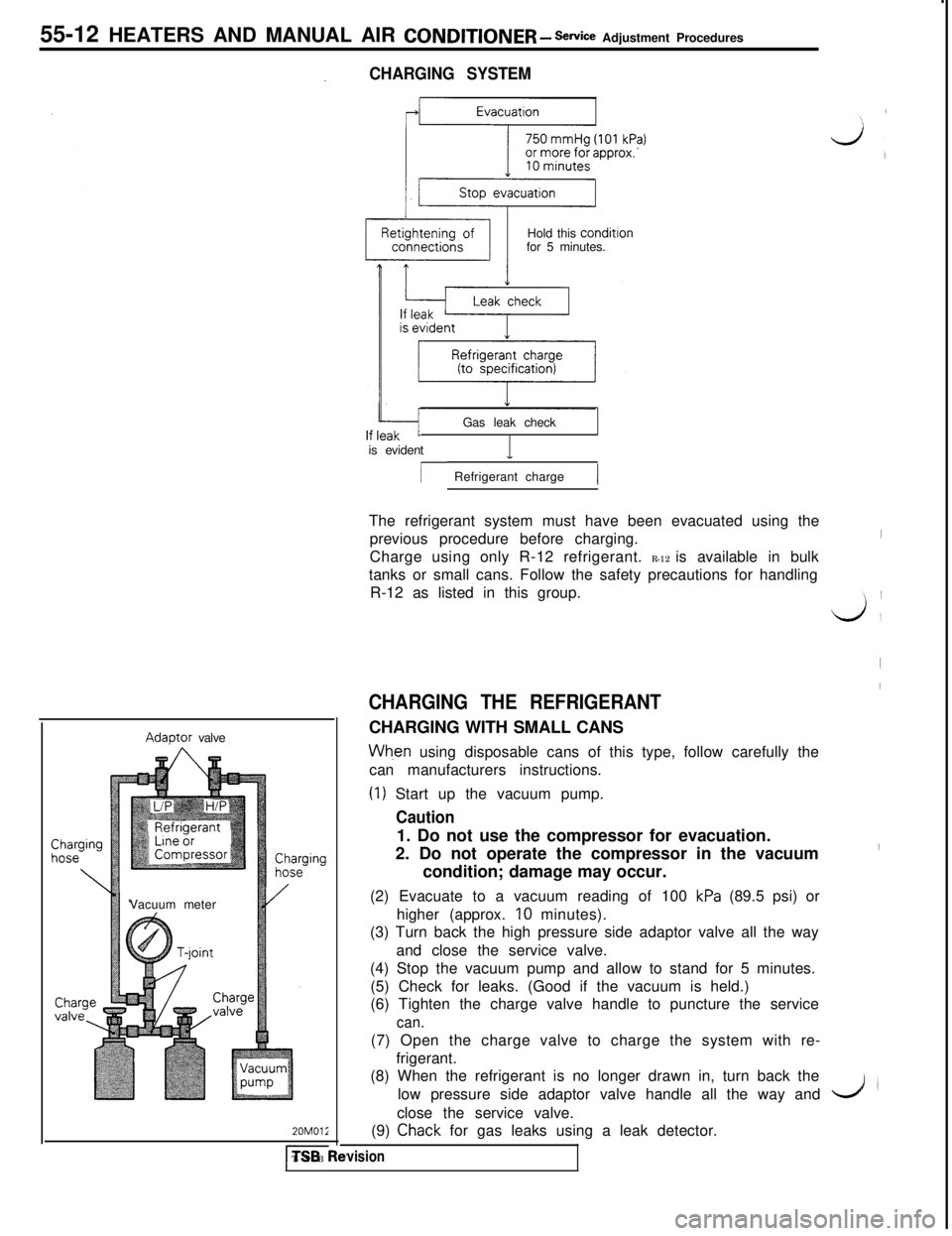
CHARGING SYSTEMAdaDtor valve
Vacuum meter20MOli
l-TSB IHold this conditron
for 5 minutes.
Gas leak check
is evident
1
/ Refrigerant charge1The refrigerant system must have been evacuated using the
previous procedure before charging.
Charge using only R-12 refrigerant. R-12 is available in bulk
tanks or small cans. Follow the safety precautions for handling
R-12 as listed in this group.
CHARGING THE REFRIGERANTCHARGING WITH SMALL CANS
Wh,en using disposable cans of this type, follow carefully the
can manufacturers instructions.
(1) Start up the vacuum pump.
Caution1. Do not use the compressor for evacuation.
2. Do not operate the compressor in the vacuum
condition; damage may occur.
(2) Evacuate to a vacuum reading of 100
kPa (89.5 psi) or
higher (approx. IO minutes).
(3) Turn back the high pressure side adaptor valve all the way
and close the service valve.
(4) Stop the vacuum pump and allow to stand for 5 minutes.
(5) Check for leaks. (Good if the vacuum is held.)
(6) Tighten the charge valve handle to puncture the service
can.(7) Open the charge valve to charge the system with re-
frigerant.
(8) When the refrigerant is no longer drawn in, turn back the
low pressure side adaptor valve handle all the way and
close the service valve.
(9)
Chack for gas leaks using a leak detector.
vision
I
J’
I
I
I
L./l
Page 1122 of 1146
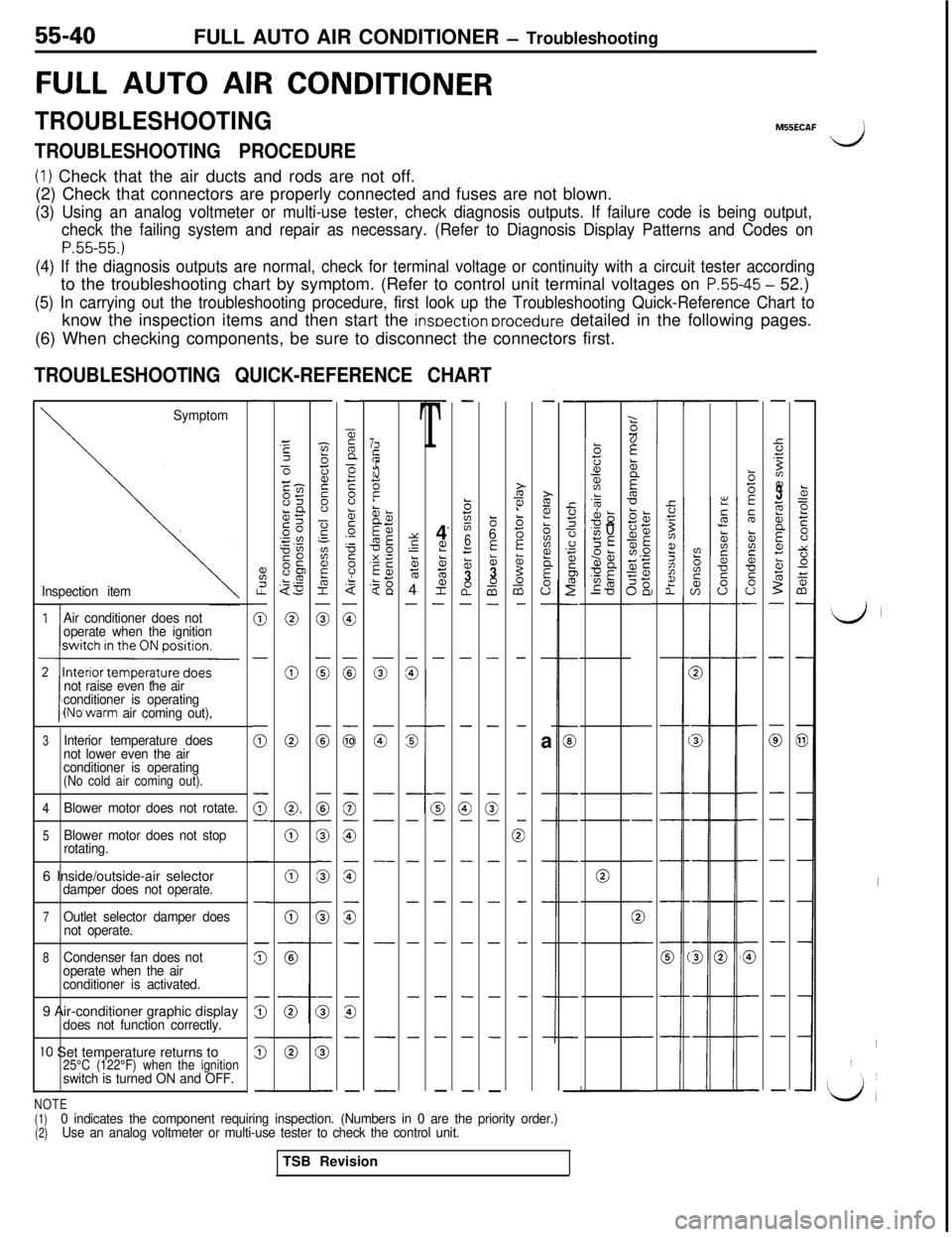
55-40FULL AUTO AIR CONDITIONER - Troubleshooting
FULL AUTO AIR CONDITIONER
TROUBLESHOOTINGM55ECAF
TROUBLESHOOTING PROCEDUREd
(1) Check that the air ducts and rods are not off.
(2) Check that connectors are properly connected and fuses are not blown.
(3) Using an analog voltmeter or multi-use tester, check diagnosis outputs. If failure code is being output,
check the failing system and repair as necessary. (Refer to Diagnosis Display Patterns and Codes on
P.55-55.)
(4) If the diagnosis outputs are normal, check for terminal voltage or continuity with a circuit tester accordingto the troubleshooting chart by symptom. (Refer to control unit terminal voltages on
P.55-45 - 52.)
(5) In carrying out the troubleshooting procedure, first look up the Troubleshooting Quick-Reference Chart toknow the inspection items and then start the
insoection orocedure detailed in the following pages.
(6) When checking components, be sure to disconnect the connectors first.
TROUBLESHOOTING QUICK-REFERENCE CHART
-
%I.?
0
-
(i;
0-
-
-
z
s
5
-
z3Ec-l-cm85LQgc .”0”SO0s“E$3
0
0
0
0.
0
0
0
-
-zbij2s”
-?‘-
aF&I
0
0
0
0
0
0
G
-
s
5
-
-
55n
>F8b5.-
F
8.$
0
:
G
0
G
is
z
-
G-
-
-
-
T4
L??ctE;
2-
-
-
G-
-
-
-
-
-
-.
-
b725
6
f53a0-
-
-
G-
-
-
-
-
-
-
86
E&3-0a-
-
-
-
3-
-
-
-
-
-
-
-
i?i?!
biiz?
E
0”-
-a
-
-
-
-
-
-
-
GE
21z6:1D-
-
-
-
-
0
-
-
-
-
-
;(if
zzit
5
5‘dTC
T-
-:
2
2
::ii3z;
2%;sjE1.0
;g5E
-
:
,,
,
1
-
-
-
-
0
-
-
-
-
-
k=eE00
t:0+i
-
-
a
-
-
-
-
-
-
-
-
b5E
5
&is*
s0-
-
-
-
-
-
-
G
-
-
-
-
5.T
Bz??3;i;b
Ecz
5-
-
0
-
-
-
-
-
-
-
-
1
225cn-
s
s----
s---
Symptom
Inspection item
7i;if
II:.?t.!
1E5z
iT-a,?z
5g< 13;$
zg
z
G-
-
-
-
-
-
-
.k?alL-0s
‘v, 0SE95anUE
ma‘0Y
s‘-5764
-
-
%G
-
-
-
-
-
-
-
Air conditioner does not
operate when the ignition
not raise even the air
conditioner is operating
(No’warm air coming out).
LJ
I
I~
‘L/,
3Interior temperature does
not lower even the air
conditioner is operating
(No cold air coming out).
4
Blower motor does not rotate.
5Blower motor does not stop
rotating.
06 Inside/outside-air selectordamper does not operate.
7Outlet selector damper does
not operate.
8Condenser fan does not
operate when the air
conditioner is activated.9 Air-conditioner graphic display
does not function correctly.
IO Set temperature returns to25°C (122°F) when the ignitionswitch is turned ON and OFF.
NOTE(1)
(2)0 indicates the component requiring inspection. (Numbers in 0 are the priority order.)
Use an analog voltmeter or multi-use tester to check the control unit.TSB Revision