wheel MITSUBISHI 3000GT 1991 User Guide
[x] Cancel search | Manufacturer: MITSUBISHI, Model Year: 1991, Model line: 3000GT, Model: MITSUBISHI 3000GT 1991Pages: 1146, PDF Size: 76.68 MB
Page 32 of 1146
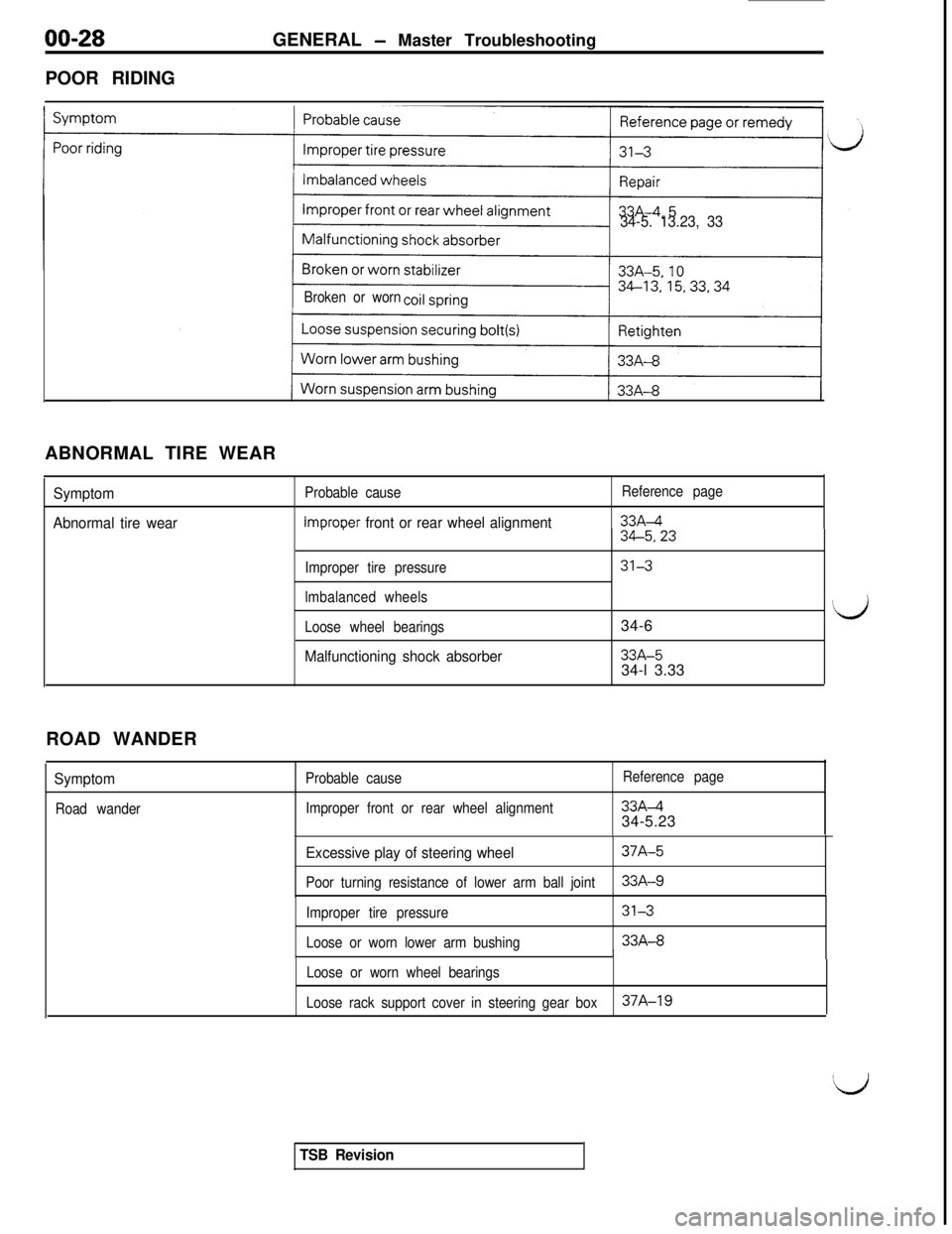
00-28GENERAL - Master Troubleshooting
POOR RIDING
34-5. 13.23, 33
Broken or wornABNORMAL TIRE WEAR
Symptom
Abnormal tire wearProbable cause
lmorooer front or rear wheel alignment, ,
Improper tire pressure
lmbalanced wheels
Loose wheel bearings
Malfunctioning shock absorber
Reference page
33Ad34-5,23
31334-6
LJ33A-5
34-l 3.33
ROAD WANDER
Symptom
Road wanderProbable cause
Improper front or rear wheel alignmentReference page33A&34-5.23
Excessive play of steering wheel
Poor turning resistance of lower arm ball joint37A-533A-9
Improper tire pressure
Loose or worn lower arm bushing31333A-8
III
Loose or worn wheel bearings
Loose rack support cover in steering gear box37A-19
TSB Revision
Page 33 of 1146
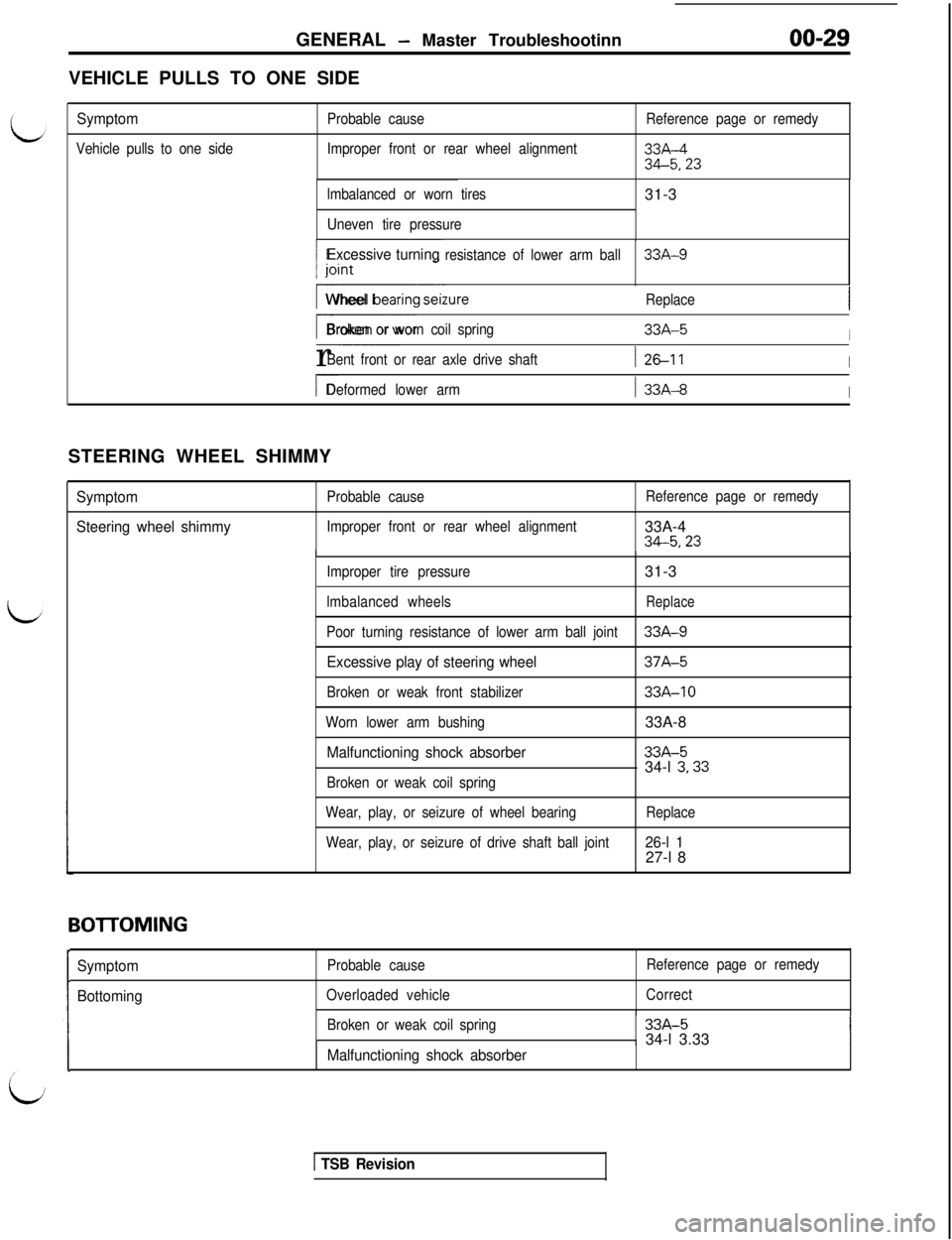
GENERAL - Master Troubleshootinn
VEHICLE PULLS TO ONE SIDE
Symptom
Vehicle pulls to one sideProbable cause
Improper front or rear wheel alignmentReference page or remedy33A-4
34-5,23
lmbalanced or worn tires
Uneven tire pressure31-3
Excessive turningresistance of lower arm ball33A-9
I--_Wheel beanng serzureReplace
I---Broken or worn coil spring33A-5Ir
~~~~~~Bent front or rear axle drive shaft126-11I
I-Deformed lower arm1 33A-8I
Improper tire pressure31-3
lmbalanced wheelsReplace
Poor turning resistance of lower arm ball joint33A-9
Excessive play of steering wheel37A-5
Broken or weak front stabilizer33A-10
Worn lower arm bushing33A-8
Malfunctioning shock absorber33A-5
34-l 3,33
Broken or weak coil spring
Wear, play, or seizure of wheel bearing
Wear, play, or seizure of drive shaft ball jointReplace
26-l 127-l 8 STEERING WHEEL SHIMMY
SymptomProbable cause
Steering wheel shimmyImproper front or rear wheel alignmentReference page or remedy33A-434-5,23
Boll-OMING
Symptom
BottomingProbable cause
Overloaded vehicleReference page or remedy
Correct
Broken or weak coil spring33A-5
34-l 3.33
IMalfunctioning shock absorber
1 TSB Revision
Page 34 of 1146
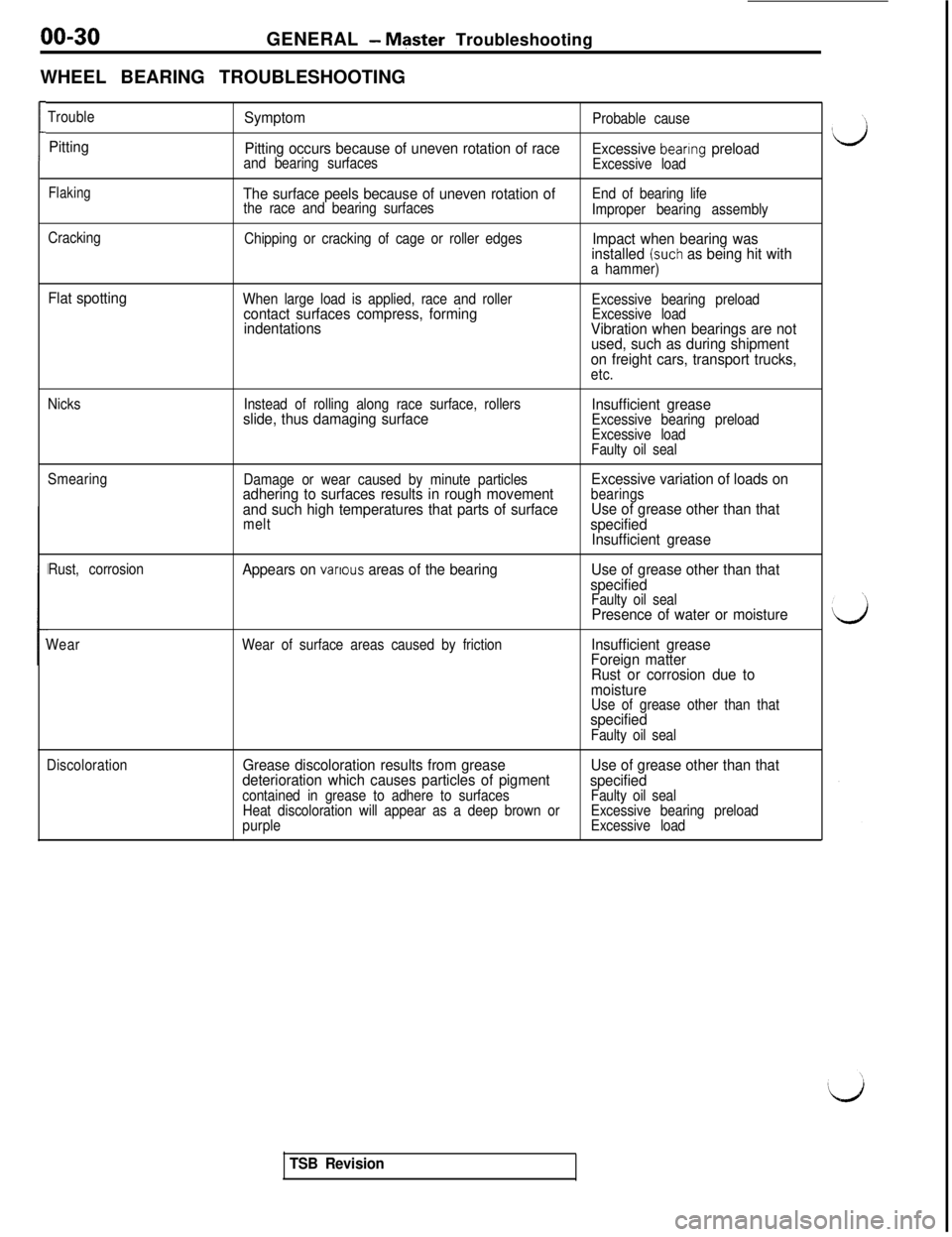
00-30GENERAL - Master Troubleshooting
WHEEL BEARING TROUBLESHOOTING
1
Trouble
PittingSymptom
Pitting occurs because of uneven rotation of race
and bearing surfacesProbable causeExcessive bearing preloadExcessive load
FlakingThe surface peels because of uneven rotation ofthe race and bearing surfacesEnd of bearing life
Improper bearing assembly
Cracking
Chipping or cracking of cage or roller edges
Impact when bearing was
installed (such as being hit witha hammer)
Flat spottingWhen large load is applied, race and rollercontact surfaces compress, forming
indentationsExcessive bearing preload
Excessive load
Vibration when bearings are not
used, such as during shipment
on freight cars, transport trucks,
etc.
NicksInstead of rolling along race surface, rollers
slide, thus damaging surfaceInsufficient greaseExcessive bearing preload
Excessive load
Faulty oil seal
Smearing
Damage or wear caused by minute particles
adhering to surfaces results in rough movement
and such high temperatures that parts of surface
melt
Excessive variation of loads onbearingsUse of grease other than that
specified
Insufficient grease
Rust, corrosionAppears on various areas of the bearingUse of grease other than that
specified
Faulty oil sealPresence of water or moisture
WearWear of surface areas caused by frictionInsufficient grease
Foreign matter
Rust or corrosion due to
moisture
Use of grease other than thatspecifiedFaulty oil seal
Discoloration
Grease discoloration results from grease
deterioration which causes particles of pigment
contained in grease to adhere to surfaces
Heat discoloration will appear as a deep brown or
purple
Use of grease other than that
specified
Faulty oil seal
Excessive bearing preload
Excessive load
TSB Revision
Page 46 of 1146
00-42GENERAL - Maintenance Service
14UOO729. Install the radiator cap securely.
10.
Start’the engine and warm up until the thermostat opens.
11. Race the engine up to around 3,000 rpm several times, then
stop the engine.,12. When the enkine has cooled down, remove the radiator cap
L/and add coolant up to the brim. Add coolant to the reserve
tank up to the FULL line.
1. Lift up the vehicle.
2.Loosen the radiator drain plug, remove the drain plug from
the rear bank of the engine and remove the radiator cap to
discharge coolant.
3. Follow the same steps 3 to 12 above.
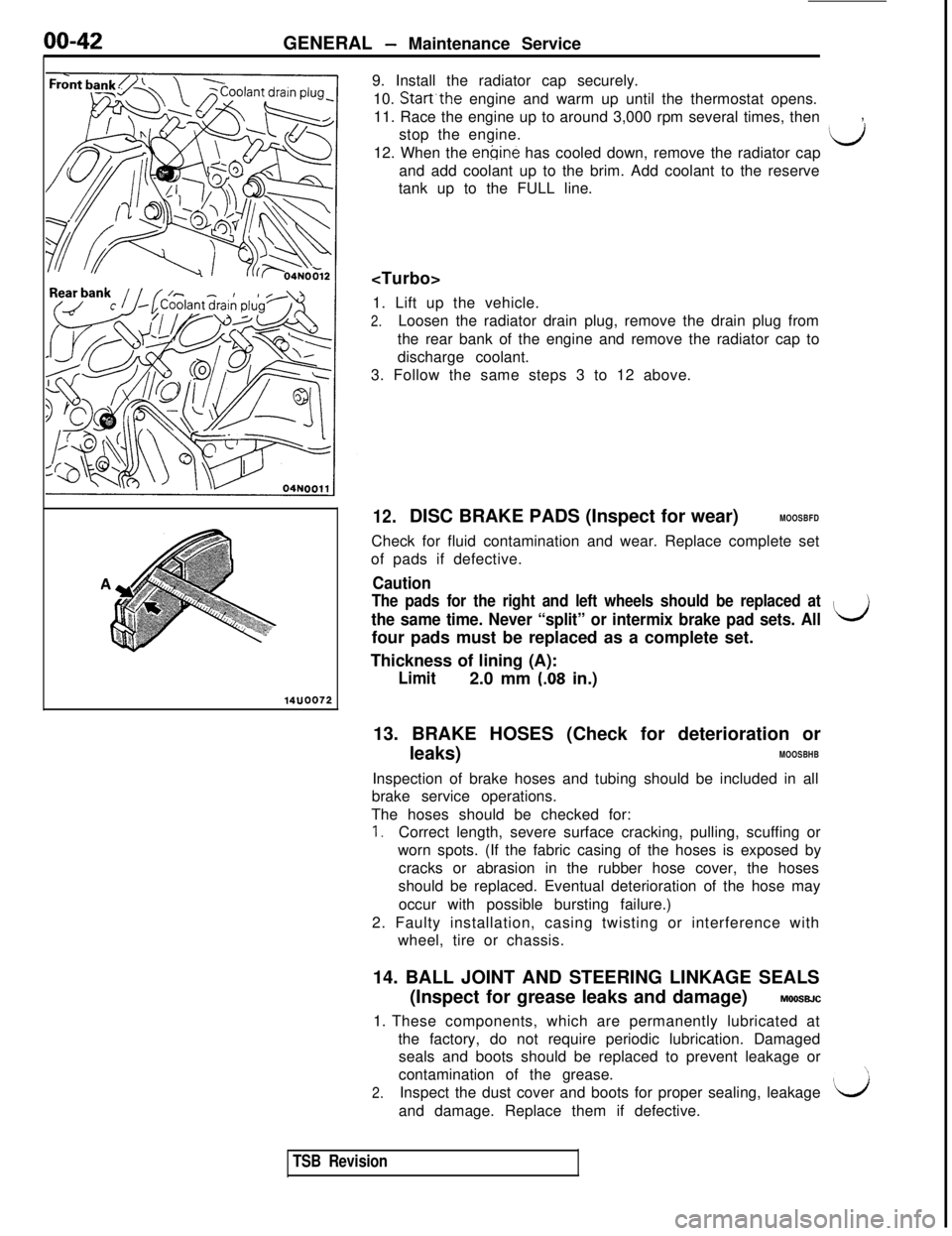
12.DISC BRAKE PADS (Inspect for wear)MOOSBFDCheck for fluid contamination and wear. Replace complete set
of pads if defective.
Caution
The pads for the right and left wheels should be replaced atIIthe same time. Never “split” or intermix brake pad sets. AllUfour pads must be replaced as a complete set.
Thickness of lining (A):
Limit2.0 mm (.08 in.)
13. BRAKE HOSES (Check for deterioration or
leaks)
MOOSBHBInspection of brake hoses and tubing should be included in all
brake service operations.
The hoses should be checked for:
1.Correct length, severe surface cracking, pulling, scuffing or
worn spots. (If the fabric casing of the hoses is exposed by
cracks or abrasion in the rubber hose cover, the hoses
should be replaced. Eventual deterioration of the hose may
occur with possible bursting failure.)
2. Faulty installation, casing twisting or interference with
wheel, tire or chassis.
14. BALL JOINT AND STEERING LINKAGE SEALS
(Inspect for grease leaks and damage)
MOOSglC1. These components, which are permanently lubricated at
the factory, do not require periodic lubrication. Damaged
seals and boots should be replaced to prevent leakage or
contamination of the grease.
2.Inspect the dust cover and boots for proper sealing, leakageIdand damage. Replace them if defective.
TSB Revision
Page 48 of 1146
00-44
GENERAL - Main Sealant and Adhesive Table
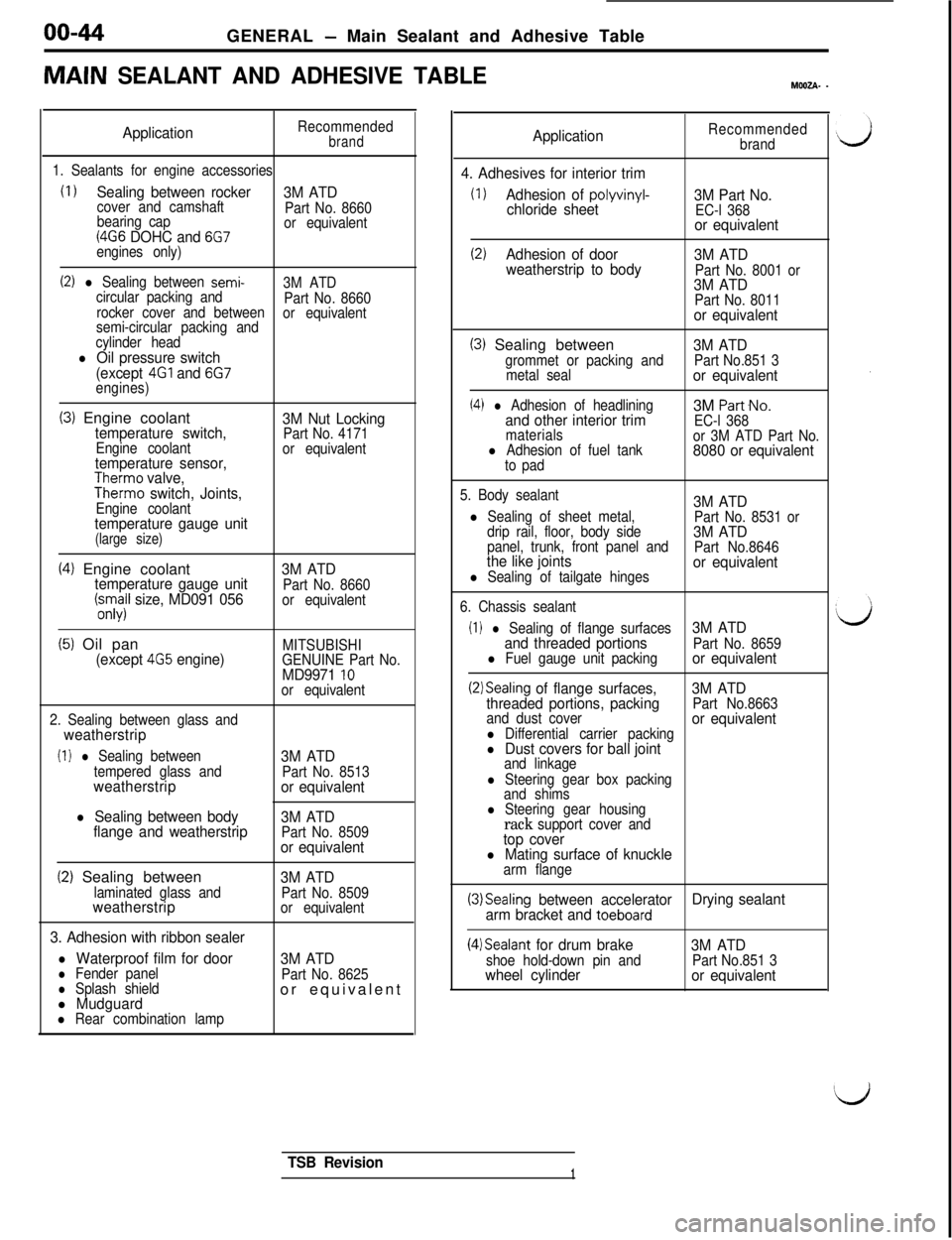
MAIN SEALANT AND ADHESIVE TABLEMWZA- -
ApplicationRecommendedbrand
1. Sealants for engine accessories
(I 1Sealing between rocker
3M ATDcover and camshaft
Part No. 8660
bearing cap
(4G6 DOHC and 6G7or equivalent
engines only)
(2) l Sealing between semi-3M ATD
circular packing and
Part No. 8660
rocker cover and between
semi-circular packing andor equivalent
cylinder head
l Oil pressure switch
(except 4Gl and 6G7engines)
(3) Engine coolanttemperature switch,Engine coolanttemperature sensor,Therm0 valve,Therm0 switch, Joints,Engine coolanttemperature gauge unit(large size)
3M Nut LockingPart No. 4171
or equivalent
(4) Engine coolanttemperature gauge unit(;.s;il size, MD091 0563M ATDPart No. 8660
or equivalent
(5) Oil pan(except 4G5 engine)MITSUBISHI
GENUINE Part No.
MD9971 10or equivalent
2. Sealing between glass and
weatherstrip
(I 1 l Sealing between
tempered glass and
weatherstrip
l Sealing between body
flange and weatherstrip3M ATD
Part No. 8513or equivalent
3M ATD
Part No. 8509or equivalent
(2) Sealing betweenlaminated glass andweatherstrip
3. Adhesion with ribbon sealer
l Waterproof film for doorl Fender panell Splash shieldl Mudguardl Rear combination lamp
3M ATDPart No. 8509
or equivalent
3M ATDPart No. 8625or equivalent
ApplicationRecommended
brand
4. Adhesives for interior trim
(1)Adhesion of polyvinyl-chloride sheet3M Part No.EC-l 368or equivalent
(2)Adhesion of door
3M ATD
weatherstrip to body
Part No. 8001 or3M ATDPart No. 8011or equivalent
(3) Sealing betweengrommet or packing and
metal seal
(4) l Adhesion of headliningand other interior trimmaterialsl Adhesion of fuel tank
to pad
3M ATDPart No.851 3or equivalent3M
Part-No.
EC-l 368
or 3M ATD Part No.
8080 or equivalent
5. Body sealant3M ATDl Sealing of sheet metal,
Part No. 8531 or
drip rail, floor, body side3M ATDpanel, trunk, front panel and
Part No.8646the like jointsl Sealing of tailgate hingesor equivalent
6. Chassis sealant
(I 1 l Sealing of flange surfaces3M ATD
and threaded portions
Part No. 8659l Fuel gauge unit packingor equivalent
(2)Sealing of flange surfaces,3M ATD
threaded portions, packingPart No.8663
and dust cover
l Differential carrier packingor equivalent
l Dust covers for ball jointand linkage
l Steering gear box packing
and shims
l Steering gear housingrack support cover andtop coverl Mating surface of knucklearm flange
(3)Sealing between accelerator
arm bracket and toeboardDrying sealant
(4)Sealant for drum brakeshoe hold-down pin andwheel cylinder3M ATDPart No.851 3or equivalent
TSB Revision1
Page 51 of 1146

11-I
ENGINECONTENTS
IMllAA--
CAMSHAFT OIL SEALS....................................
CRANKSHAFT, FLYWHEEL AND
DRIVEPLATE........................................................
CYLINDER BLOCK................................................
CYLINDER HEAD AND VALVE........................
CYLINDER HEAD GASKET................................
ENGINE ASSEMBLY............................................
ENGINE OIL COOLER........................................
GENERAL INFORMATION................................
lbLubricationSystem............................................SectionalView
....................................................
OIL PAN AND OIL PUMP....................................
OIL PAN AND OIL SCREEN................................20
49
5334
23
17
552
3
240
22
PISTON AND CONNECTING ROD....................
ROCKER ARM AND CAMSHAFT....................
SERVICE ADJUSTMENT PROCEDURES........Compression Pressure Check
........................Curb Idle Speed Inspection
............................Drive Belts Tension Adjustment
....................Ignition Timing Adjustment
............................
LashAdjusters
Check........................................Manifold Vacuum
Inspection
.............................
SPECIAL TOOLS....................................................
SPECIFICATIONS................................................General Specifications
....................................
Sealants
.......................................
.....................Service Specifications
....................................
TIMING BELT........................................................
TROUBLESHOOTING........................................44
31
11
15
14
11
13
16
16
84
4
84
26
10
Page 63 of 1146
ENGINE - Service Adiustment ProceduresII-13
I_ ianltion tlminaI!H Connector for Igdpstment 6rown)
4tll II -7FUO9371IGNITION TIMING ADJUSTMENTMllFLAF
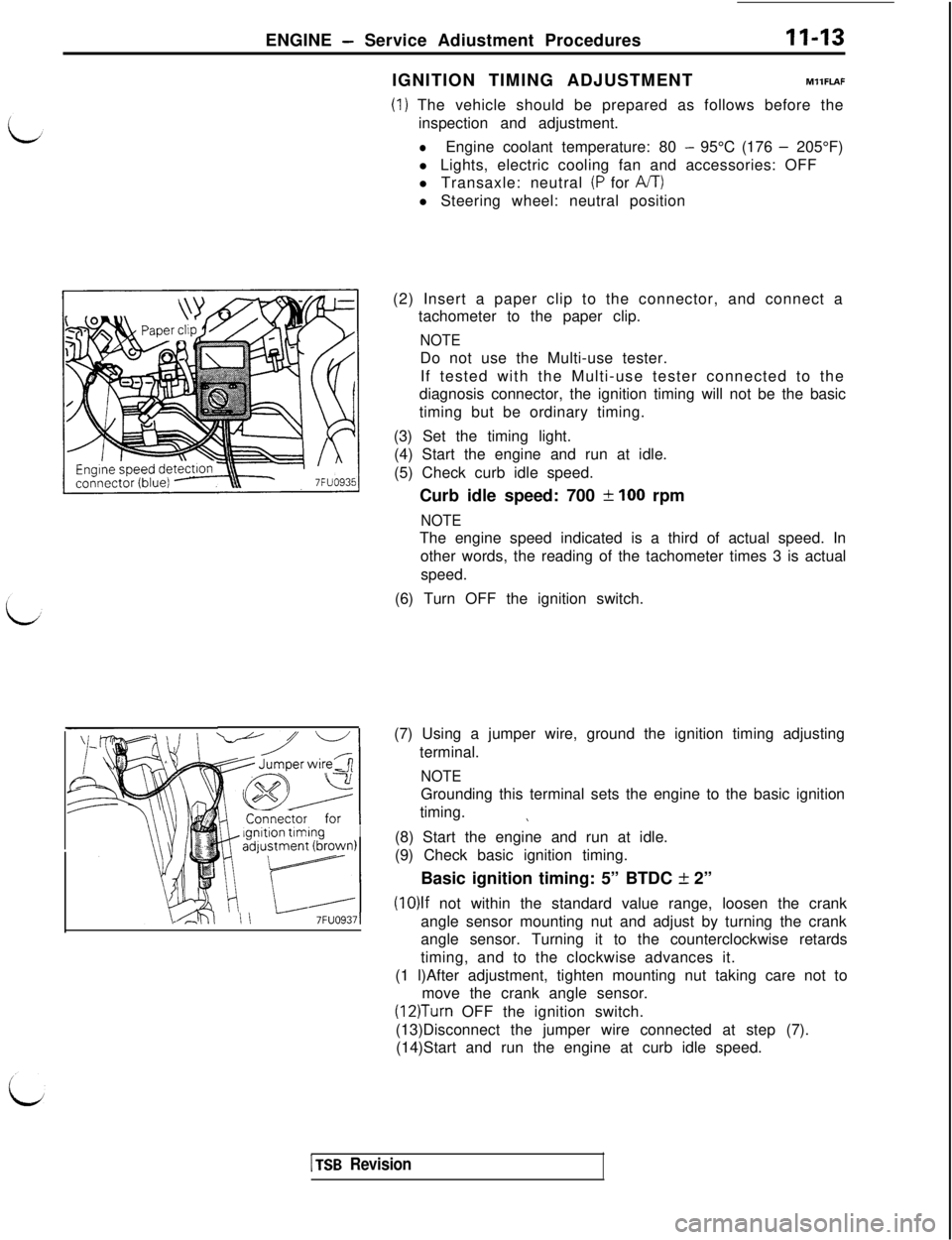
(1) The vehicle should be prepared as follows before the
inspection and adjustment.
lEngine coolant temperature: 80 - 95°C (176 - 205°F)
l Lights, electric cooling fan and accessories: OFF
l Transaxle: neutral
(P for A/T)l Steering wheel: neutral position
(2) Insert a paper clip to the connector, and connect a
tachometer to the paper clip.
NOTEDo not use the Multi-use tester.
If tested with the Multi-use tester connected to the
diagnosis connector, the ignition timing will not be the basic
timing but be ordinary timing.
(3) Set the timing light.
(4) Start the engine and run at idle.
(5) Check curb idle speed.
Curb idle speed: 700
f 100 rpm
NOTEThe engine speed indicated is a third of actual speed. In
other words, the reading of the tachometer times 3 is actual
speed.
(6) Turn OFF the ignition switch.
(7) Using a jumper wire, ground the ignition timing adjusting
terminal.
NOTEGrounding this terminal sets the engine to the basic ignition
timing.
\(8) Start the engine and run at idle.
(9) Check basic ignition timing.
Basic ignition timing: 5” BTDC
k 2”
(10)lf not within the standard value range, loosen the crank
angle sensor mounting nut and adjust by turning the crank
angle sensor. Turning it to the counterclockwise retards
timing, and to the clockwise advances it.
(1 l)After adjustment, tighten mounting nut taking care not to
move the crank angle sensor.
(12)Turn OFF the ignition switch.
(13)Disconnect the jumper wire connected at step (7).
(14)Start and run the engine at curb idle speed.
1 TSB Revision
Page 64 of 1146
11-14ENGINE - Service Adjustment Procedures
(15)Check to be sure that the idling ignition timing is the correct
timing.
Actual ignition timing: Approx. 15” BTDC
NOTE:d
(1) Ignition timing is variable even under normal operation.
(2) And it is automatically advanced at higher altitudes.
CURB IDLE SPEED INSPECTIONMllFMAB
(1) The vehicle should be prepared as follows before the
inspection.
lEngine coolant temperature: 80 - 95°C (176 - 205°F)
l Lights, electric cooling fan and accessories: OFF
l Transaxle: neutral
(P for A/T)l Steering wheel: neutral position
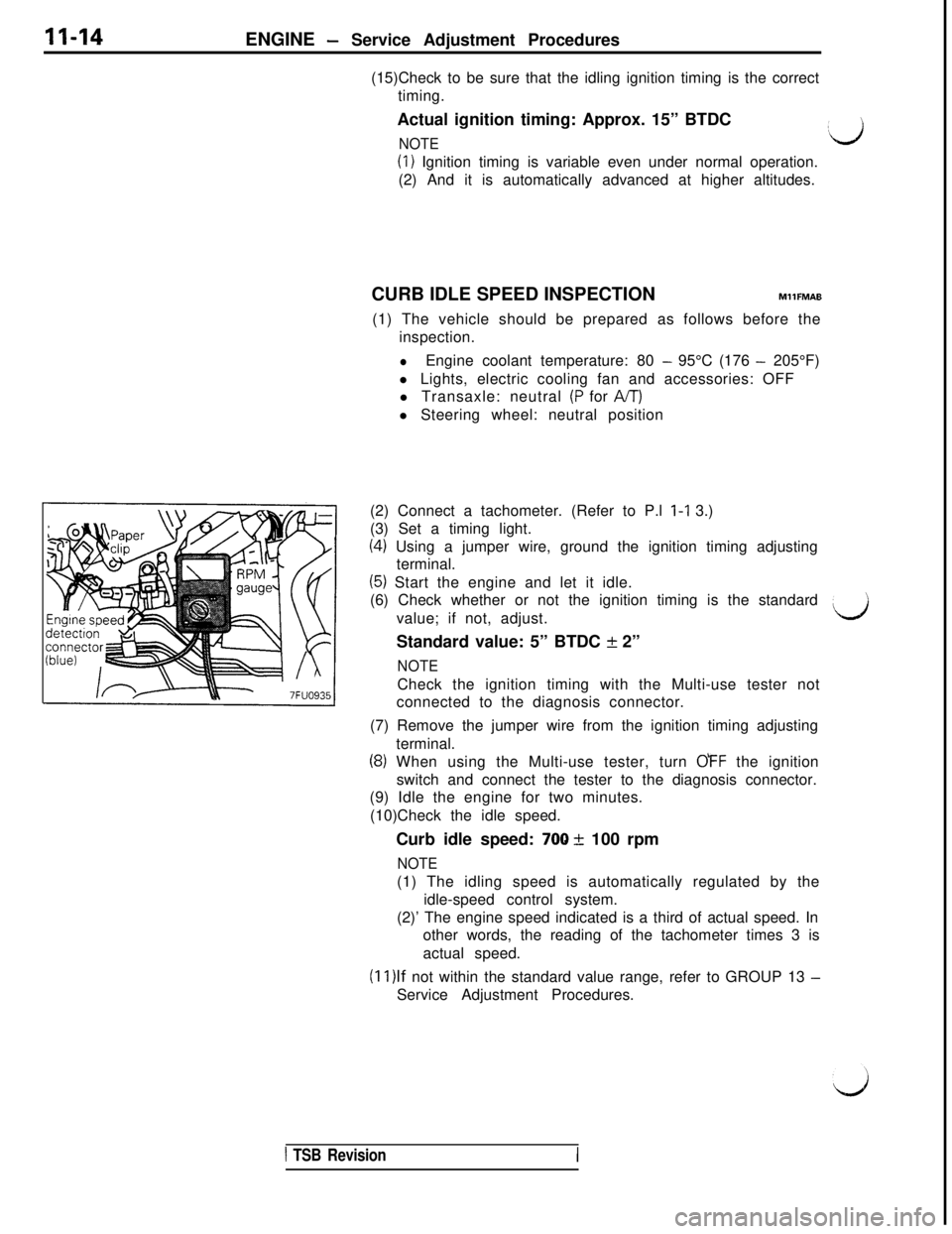
(2) Connect a tachometer. (Refer to P.l l-1 3.)
(3) Set a timing light.
(4) Using a jumper wire, ground the ignition timing adjusting
terminal.
(5) Start the engine and let it idle.
(6) Check whether or not the ignition timing is the standard
value; if not, adjust.
Standard value: 5” BTDC + 2”
NOTECheck the ignition timing with the Multi-use tester not
connected to the diagnosis connector.
(7) Remove the jumper wire from the ignition timing adjusting
terminal.
(8) When using the Multi-use tester, turn OFF the ignition
switch and connect the tester to the diagnosis connector.
(9) Idle the engine for two minutes.
(10)Check the idle speed.
Curb idle speed:
700 + 100 rpm
NOTE(1) The idling speed is automatically regulated by the
idle-speed control system.
(2)’ The engine speed indicated is a third of actual speed. In
other words, the reading of the tachometer times 3 is
actual speed.
(1l)lf not within the standard value range, refer to GROUP 13 -Service Adjustment Procedures.
d
1 TSB RevisionI
Page 66 of 1146
11-16ENGINE - Service Adjustment Procedures
MANIFOLD VACUUM INSPECTION
MllFNAR
(1) The vehicle should be repaired as follows before the
inspection.
lEngine coolant temperature: 80 - 95°C (176 - 205°F)‘dl Lights, electric cooling fan, and accessories: OFF
l Transaxle: Neutral
(P for A/T)l Steering wheel: neutral position
(2) Connect a tachometer. (Refer to P.l l-l 3.)
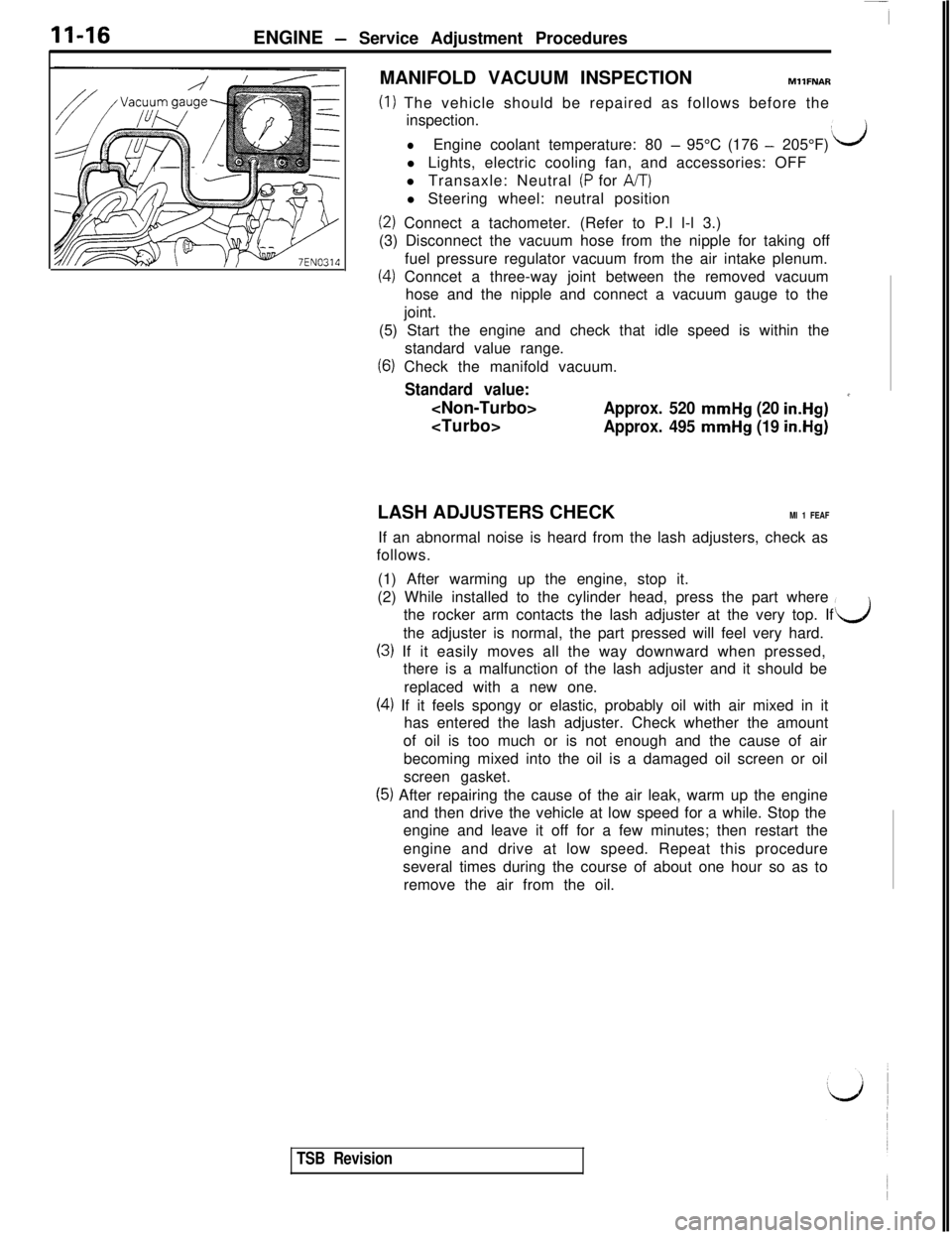
(3) Disconnect the vacuum hose from the nipple for taking off
fuel pressure regulator vacuum from the air intake plenum.
(4) Conncet a three-way joint between the removed vacuum
hose and the nipple and connect a vacuum gauge to the
joint.
(5) Start the engine and check that idle speed is within the
standard value range.
(6) Check the manifold vacuum.
Standard value:
*
Approx. 495 mmHg (19 in.Hg)LASH ADJUSTERS CHECK
Ml 1 FEAFIf an abnormal noise is heard from the lash adjusters, check as
follows.
(1) After warming up the engine, stop it.
(2) While installed to the cylinder head, press the part where
the rocker arm contacts the lash adjuster at the very top. If
the adjuster is normal, the part pressed will feel very hard.
d
(3) If it easily moves all the way downward when pressed,
there is a malfunction of the lash adjuster and it should be
replaced with a new one.
(4) If it feels spongy or elastic, probably oil with air mixed in it
has entered the lash adjuster. Check whether the amount
of oil is too much or is not enough and the cause of air
becoming mixed into the oil is a damaged oil screen or oil
screen gasket.
(5) After repairing the cause of the air leak, warm up the engine
and then drive the vehicle at low speed for a while. Stop the
engine and leave it off for a few minutes; then restart the
engine and drive at low speed. Repeat this procedure
several times during the course of about one hour so as to
remove the air from the oil.
TSB Revision
Page 99 of 1146
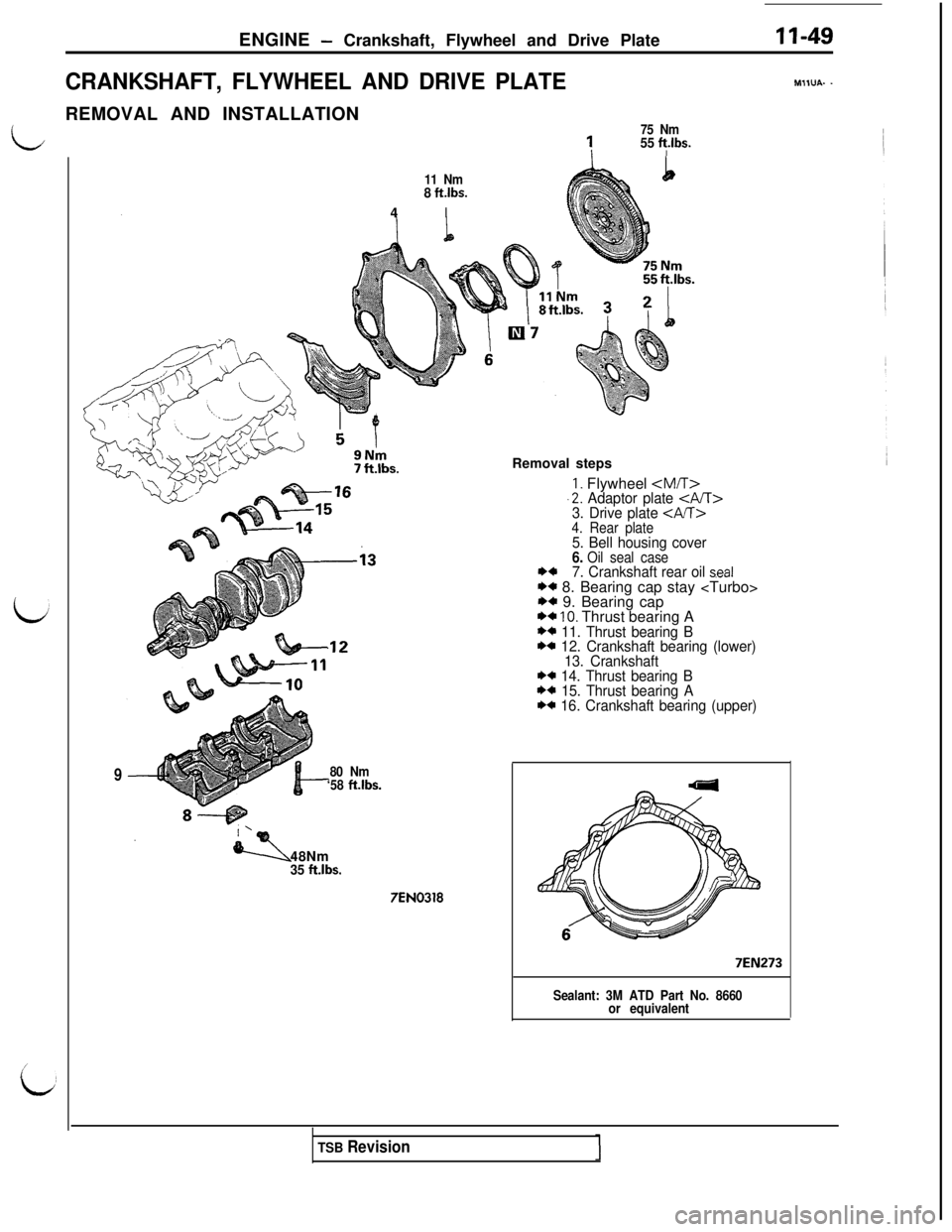
ENGINE - Crankshaft, Flywheel and Drive Plate
CRANKSHAFT, FLYWHEEL AND DRIVE PLATE
II-49
MIIUA- -REMOVAL AND INSTALLATION
L
/
id
75 Nm
155 ft.lbs.
11 Nmb4
8 ft.lbs.
I
9Removal steps
,12
80 Nm
‘58 ft.lbs.48Nm
35 ft.lbs.
7EN0318
1. Flywheel
13. Crankshaft
** 14. Thrust bearing B*+ 15. Thrust bearing AI)* 16. Crankshaft bearing (upper)
7EN273
Sealant: 3M ATD Part No. 8660
or equivalent
TSB Revision