service indicator MITSUBISHI 3000GT 1991 Service Manual
[x] Cancel search | Manufacturer: MITSUBISHI, Model Year: 1991, Model line: 3000GT, Model: MITSUBISHI 3000GT 1991Pages: 1146, PDF Size: 76.68 MB
Page 108 of 1146
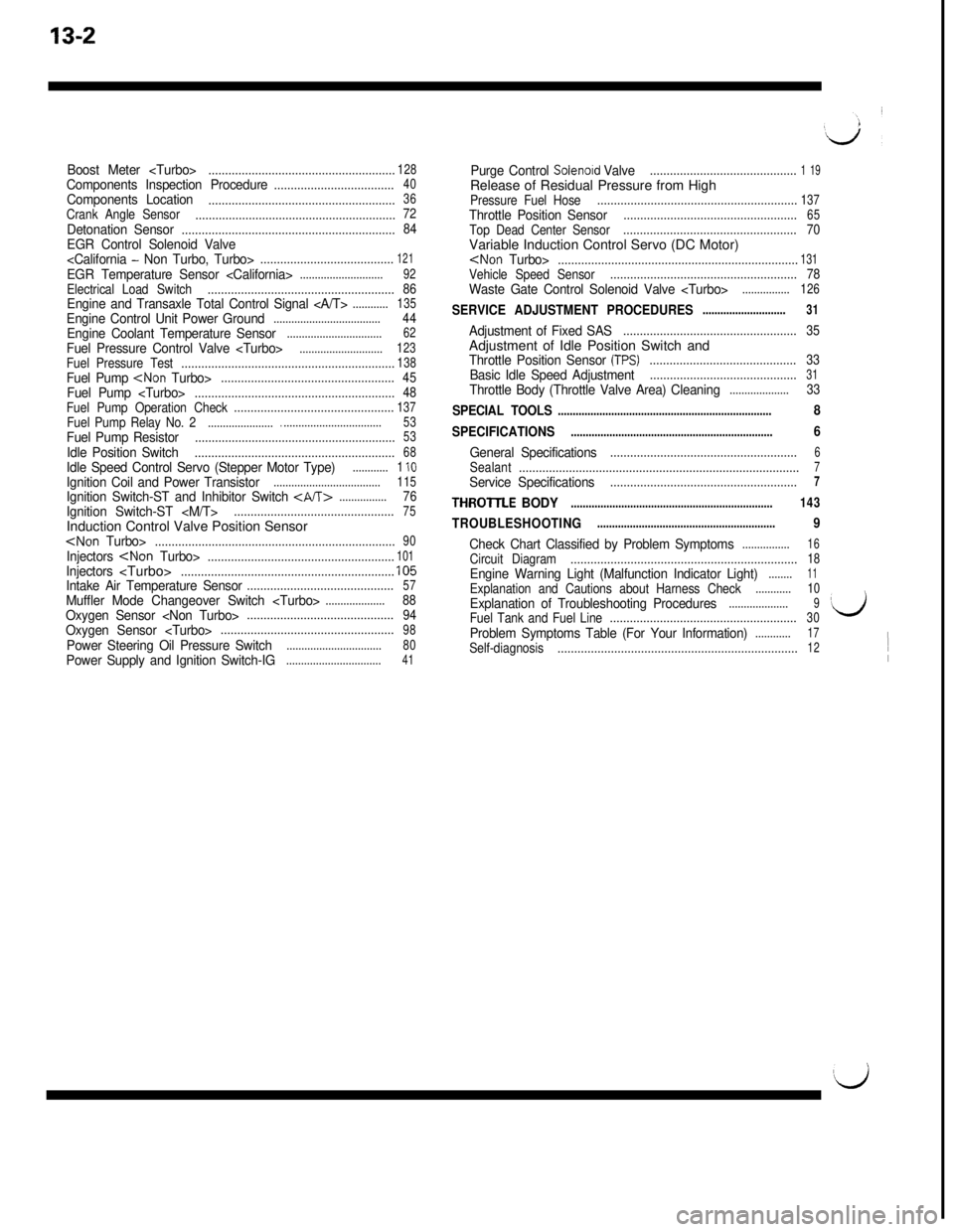
13-2
Boost Meter
Components Location........................................................36
Crank Angle Sensor
............................................................72Detonation Sensor................................................................84EGR Control Solenoid Valve
EGR Temperature Sensor
Fuel Pump Operation Check................................................137Fuel Pump Relay No. 2........................................................53Fuel Pump Resistor............................................................53
Idle Position Switch............................................................68Idle Speed Control Servo (Stepper Motor Type)............1 IOIgnition Coil and Power Transistor....................................115Ignition Switch-ST and Inhibitor Switch ................76Ignition Switch-ST
Injectors
94
Oxygen Sensor
Power Steering Oil Pressure Switch................................80Power Supply and Ignition Switch-IG................................41
Purge Control Solenord Valve............................................1 19Release of Residual Pressure from High
Pressure Fuel Hose............................................................137Throttle Position Sensor....................................................65Top Dead Center Sensor....................................................70Variable Induction Control Servo (DC Motor)
SERVICE ADJUSTMENT PROCEDURES............................31
Adjustment of Fixed SAS....................................................35Adjustment of Idle Position Switch and
Throttle Position Sensor (TPS)............................................33Basic Idle Speed Adjustment............................................31Throttle Body (Throttle Valve Area) Cleaning....................33
SPECIAL TOOLS........................................................................8
SPECIFICATIONS
....................................................................6
General Specifications........................................................6Sealant....................................................................................7Service Specifications........................................................7
THROlTLE BODY....................................................................143
TROUBLESHOOTING............................................................9
Check Chart Classified by Problem Symptoms................16Circuit Diagram....................................................................18Engine Warning Light (Malfunction Indicator Light)........11Explanation and Cautions about Harness Check............10Explanation of Troubleshooting Procedures....................9Fuel Tank and Fuel Line........................................................30
Problem Symptoms Table (For Your Information)............17Self-diagnosis........................................................................12)
I
Page 285 of 1146
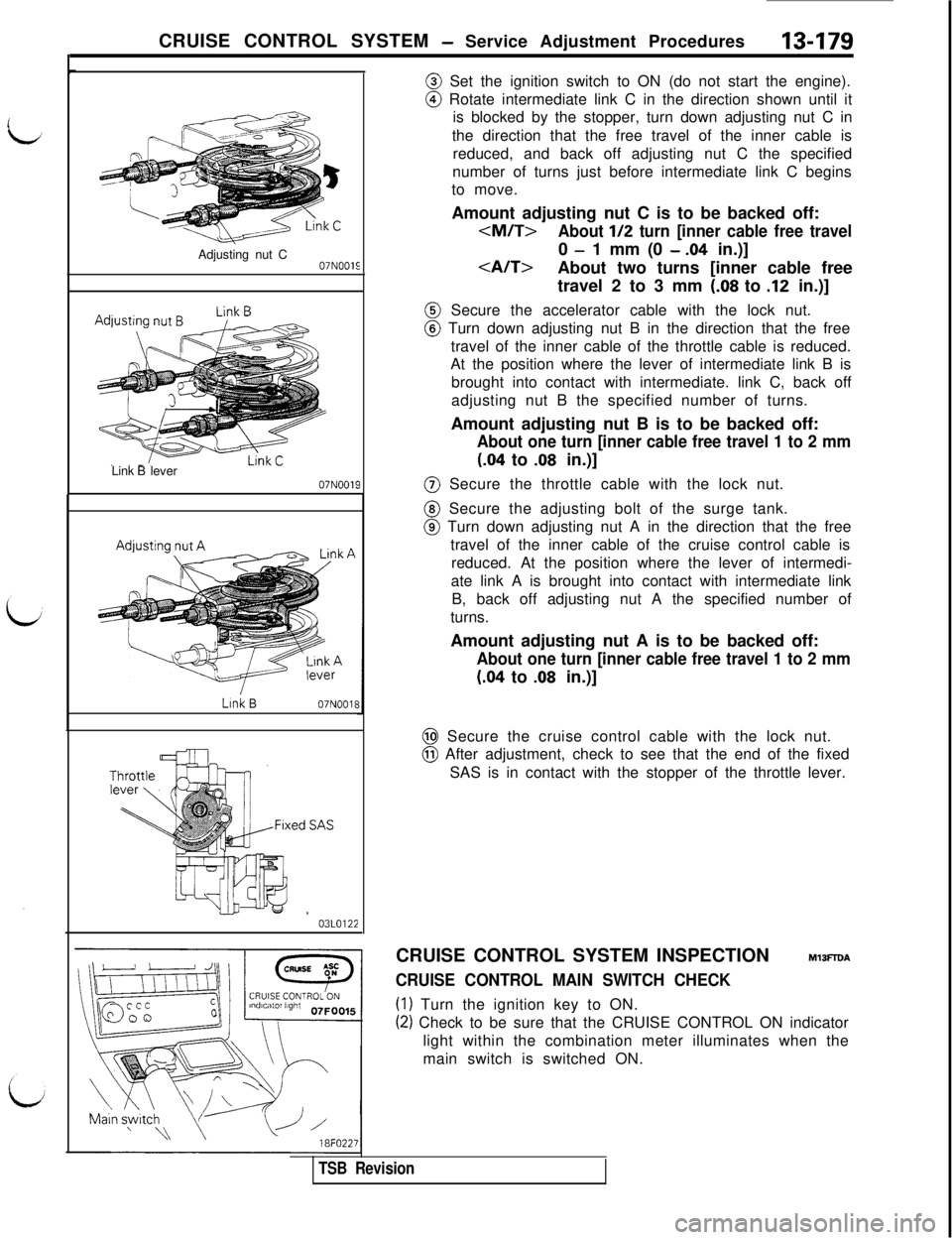
CRUISE CONTROL SYSTEM - Service Adjustment Procedures13-179Adjusting nut C
07NOOlELink Blever
07N0019Link
B07NOOlE
y,jj--ww ,03LO122
\\ \18FO2.2'@ Set the ignition switch to ON (do not start the engine).@ Rotate intermediate link C in the direction shown until it
is blocked by the stopper, turn down adjusting nut C in
the direction that the free travel of the inner cable is
reduced, and back off adjusting nut C the specified
number of turns just before intermediate link C begins
to move.
Amount adjusting nut C is to be backed off:
- 1 mm (0 - .04 in.)]
About two turns [inner cable free
travel 2 to 3 mm
(.08 to .12 in.)]@ Secure the accelerator cable with the lock nut.@ Turn down adjusting nut B in the direction that the free
travel of the inner cable of the throttle cable is reduced.
At the position where the lever of intermediate link B is
brought into contact with intermediate. link C, back off
adjusting nut B the specified number of turns.
Amount adjusting nut B is to be backed off:
About one turn [inner cable free travel 1 to 2 mm
(.04 to .08 in.)]@ Secure the throttle cable with the lock nut.@ Secure the adjusting bolt of the surge tank.@ Turn down adjusting nut A in the direction that the free
travel of the inner cable of the cruise control cable is
reduced. At the position where the lever of intermedi-
ate link A is brought into contact with intermediate link
B, back off adjusting nut A the specified number of
turns.
Amount adjusting nut A is to be backed off:
About one turn [inner cable free travel 1 to 2 mm
(.04 to .08 in.)]@ Secure the cruise control cable with the lock nut.@ After adjustment, check to see that the end of the fixed
SAS is in contact with the stopper of the throttle lever.
CRUISE CONTROL SYSTEM INSPECTION
MlBFlDA
CRUISE CONTROL MAIN SWITCH CHECK
(1) Turn the ignition key to ON.
(2) Check to be sure that the CRUISE CONTROL ON indicator
light within the combination meter illuminates when the
main switch is switched ON.
TSB Revision
Page 286 of 1146
 Switc")
13-180CRUISE CONTROL SYSTEM - Service Adjustment Procedures.
4
ET: ON
07FOOl;Control switch
\E: ON
t
07FOOliControl switch
\
SET: ON
07FOOlControl switch
\
07FOOl
CRUISE CONTROL SETTING CHECK(1) Switch ON the main switch.
(2) Drive at the desired speed within the range of approximate-
ly 40
- 145 km/h (25 - 90 mph).
(3) Operate the control switch downward. (SET switch: ON)
(4) Check to be sure that the speed is the desired constant
speed when the switch is released, and also check to be
sure that the CRUISE indicator light (within the combination
meter) illuminates.
NOTEIf the vehicle speed decreases to approximately 15 km/h (9
mph) below the set speed, because of climbing a hill for
example, the cruise control will be cancelled.
SPEED-INCREASE SETTING CHECK(1) Set to the desired speed.
(2) Operate the control switch upward. (RESUME switch: ON)
(3) Check to be sure that acceleration continues while the
switch is hold, and that when it is released the constant.
speed at the time when it was released becomes the
driving speed.
NOTEEven if, during acceleration, the vehicle speed reaches or
exceeds the high limit [approximately 145 km/h (90 mph)],
acceleration will continue, however, when the switch is
released, the set speed (“memorized speed”) will become
the high limit of the vehicle speed.
SPEED REDUCTION SETTING CHECK(1) Set to the desired speed.
(2) Operate the control switch downward. (SET switch: ON)
(3) Check to be sure that deceleration continues while the
switch is held, and that when it is released the constant
speed at the time when it was released becomes the
driving speed.
NOTEWhen the vehicle speed reaches the low limit [approx-
imately 40 km/h (25 mph)] during deceleration, the cruise
control will be cancelled.
CRUISE CONTROL CANCELLATION AND SET SPEED RE-
SUME CHECK(1) Set cruise control.
(2) In the cruising condition of the cruise control mode, check
that when any of the following operations are performed,
the normal drive mode is restored and
,the vehicle coasts
smoothly.@ Move the control switch toward you. (CANCEL switch:@ Depress the brake pedal.@ Depress the clutch pedal.
TSB Revision
Page 301 of 1146
COOLING - Service Adiustment Procedures.14-7
SERVICE ADJUSTMENT PROCEDURES
ENGINE COOLANT LEAK CHECKMl4FAAF
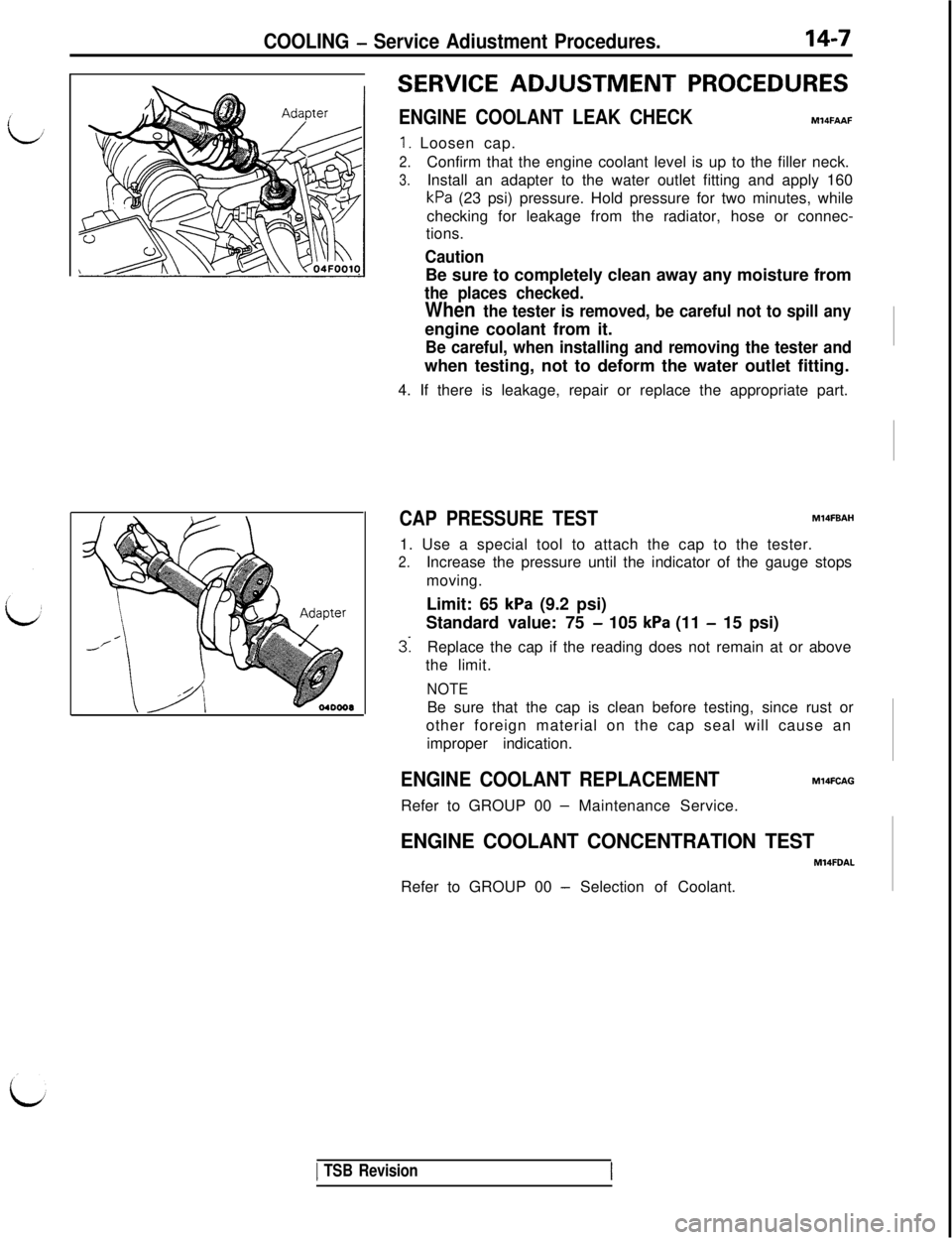
1. Loosen cap.
2.Confirm that the engine coolant level is up to the filler neck.
3.Install an adapter to the water outlet fitting and apply 160
kPa (23 psi) pressure. Hold pressure for two minutes, while
checking for leakage from the radiator, hose or connec-
tions.
CautionBe sure to completely clean away any moisture from
the places checked.
When the tester is removed, be careful not to spill anyengine coolant from it.
Be careful, when installing and removing the tester andwhen testing, not to deform the water outlet fitting.
4. If there is leakage, repair or replace the appropriate part.
CAP PRESSURE TESTM14FBAH1. Use a special tool to attach the cap to the tester.
2.Increase the pressure until the indicator of the gauge stops
moving.
Limit: 65
kPa (9.2 psi)
Standard value: 75
- 105 kPa (11 - 15 psi)
3:Replace the cap if the reading does not remain at or above
the limit.
NOTEBe sure that the cap is clean before testing, since rust or
other foreign material on the cap seal will cause an
improper indication.
ENGINE COOLANT REPLACEMENTM14FCAGRefer to GROUP 00
- Maintenance Service.
ENGINE COOLANT CONCENTRATION TEST
M14FDALRefer to GROUP 00
- Selection of Coolant.
1 TSB Revision
Page 358 of 1146
17-14 EMISSION CONTROL -Exhaust Gas Recirculation (EGR) System / Catalytic Converter
6EM01871
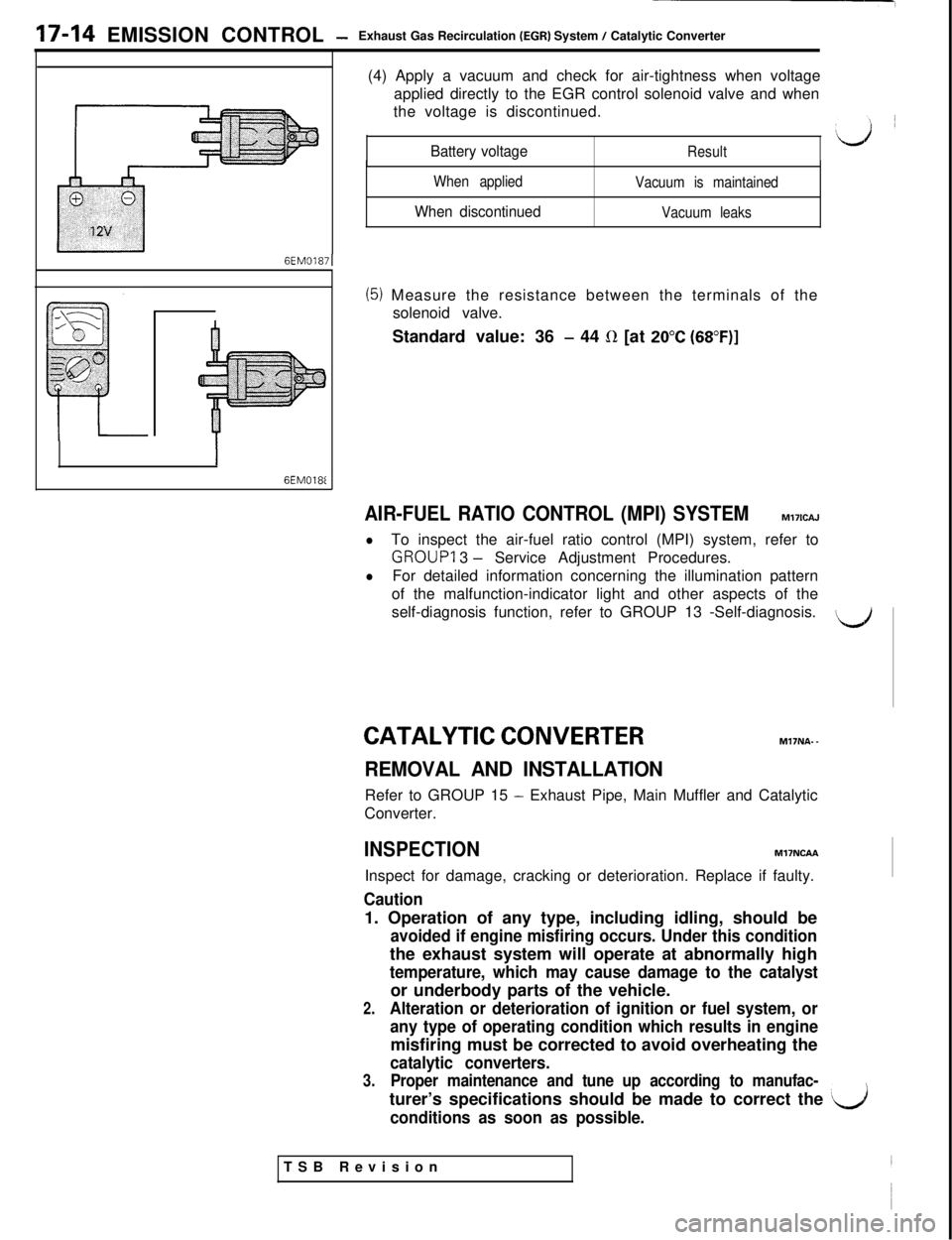
6EM0181(4) Apply a vacuum and check for air-tightness when voltage
applied directly to the EGR control solenoid valve and when
the voltage is discontinued.
Battery voltageResult
When applied
When discontinued
Vacuum is maintained
Vacuum leaks
(5) Measure the resistance between the terminals of the
solenoid valve.
Standard value: 36
- 44 R [at 20°C (68”F)]
AIR-FUEL RATIO CONTROL (MPI) SYSTEMM17ICAJ
lTo inspect the air-fuel ratio control (MPI) system, refer to
GROUP1 3 - Service Adjustment Procedures.
lFor detailed information concerning the illumination pattern
of the malfunction-indicator light and other aspects of the
self-diagnosis function, refer to GROUP 13 -Self-diagnosis.
\.J
CATALYTIC CONVERTERMl7N& -
REMOVAL AND INSTALLATIONRefer to GROUP 15
- Exhaust Pipe, Main Muffler and Catalytic
Converter.
INSPECTIONMl7NCAA
Inspect for damage, cracking or deterioration. Replace if faulty.
Caution1. Operation of any type, including idling, should be
avoided if engine misfiring occurs. Under this conditionthe exhaust system will operate at abnormally high
temperature, which may cause damage to the catalystor underbody parts of the vehicle.
2.Alteration or deterioration of ignition or fuel system, or
any type of operating condition which results in enginemisfiring must be corrected to avoid overheating the
catalytic converters.
3.Proper maintenance and tune up according to manufac-turer’s specifications should be made to correct the
‘bi
conditions as soon as possible.TSB Revision
Page 502 of 1146
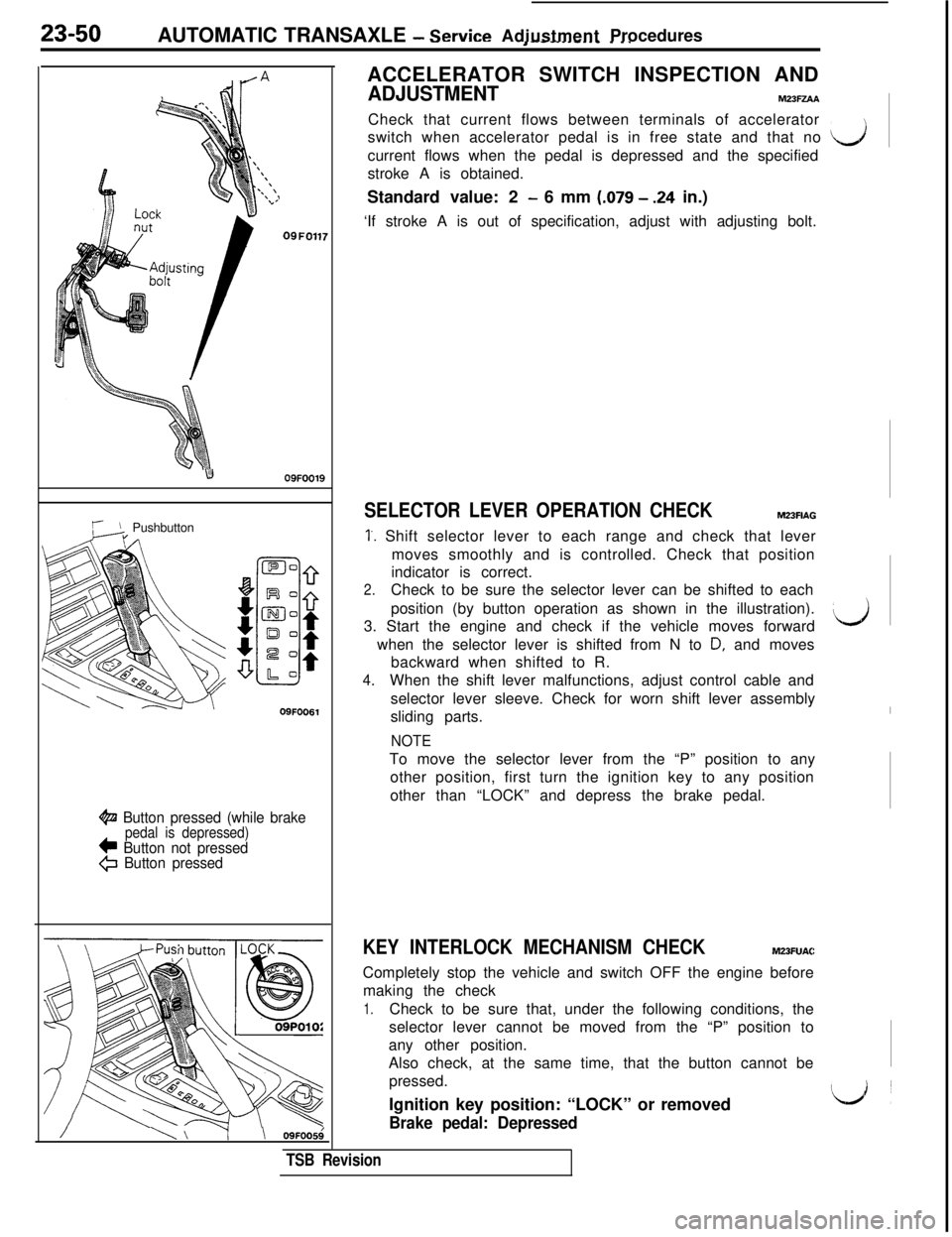
23-50AUTOMATIC TRANSAXLE - service AdiustmentProcedures
09FO117
m09FOO19
L Pushbuttonv09FOO61
@ Button pressed (while brakepedal is depressed)c Button not pressed@ Button pressed
/\ \\ OSFODdACCELERATOR SWITCH INSPECTION AND
ADJUSTMENTM23FZAACheck that current flows between terminals of accelerator
switch when accelerator pedal is in free state and that no
dcurrent flows when the pedal is depressed and the specified
stroke A is obtained.
Standard value: 2
- 6 mm (.079 - .24 in.)
‘If stroke A is out of specification, adjust with adjusting bolt.
SELECTOR LEVER OPERATION CHECKM23FIAG
1.. Shift selector lever to each range and check that lever
moves smoothly and is controlled. Check that position
indicator is correct.
2.Check to be sure the selector lever can be shifted to each
position (by button operation as shown in the illustration).
3. Start the engine and check if the vehicle moves forward
dwhen the selector lever is shifted from N to
D, and moves
backward when shifted to R.
4.When the shift lever malfunctions, adjust control cable and
selector lever sleeve. Check for worn shift lever assembly
sliding parts.
I
NOTETo move the selector lever from the “P” position to any
other position, first turn the ignition key to any position
other than “LOCK” and depress the brake pedal.
KEY INTERLOCK MECHANISM CHECKM23FlJACCompletely stop the vehicle and switch OFF the engine before
making the check
1.Check to be sure that, under the following conditions, the
selector lever cannot be moved from the “P” position to
any other position.
Also check, at the same time, that the button cannot be
pressed.
Ignition key position: “LOCK” or removed
Brake pedal: Depressed
TSB Revision
Page 566 of 1146
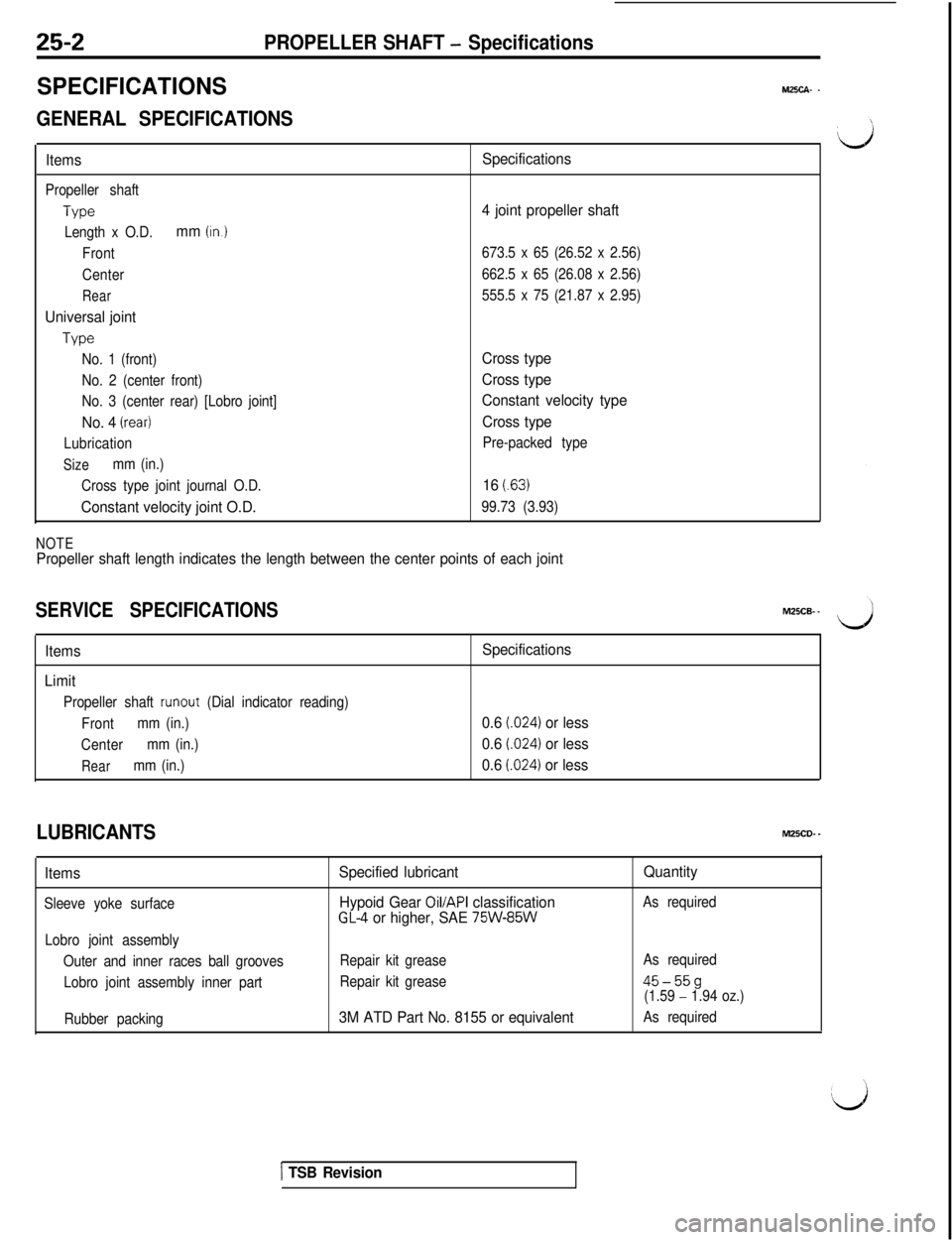
25-2PROPELLER SHAFT - Specifications
SPECIFICATIONSM25CA- -
GENERAL SPECIFICATIONS
Items
Propeller shaft
Type
Length x O.D.
mm (In.)
Front
Center
Rear
Universal joint
Type
No. 1 (front)
No. 2 (center front)
No. 3 (center rear) [Lobro joint]
No. 4 (rear)
Lubrication
Sizemm (in.)
Cross type joint journal O.D.
Constant velocity joint O.D.Specifications
4 joint propeller shaft
673.5 x 65 (26.52 x 2.56)
662.5 x 65 (26.08 x 2.56)
555.5 x 75 (21.87 x 2.95)
Cross type
Cross type
Constant velocity type
Cross type
Pre-packed type
16 t.63)
99.73 (3.93)
NOTEPropeller shaft length indicates the length between the center points of each joint
SERVICE SPECIFICATIONSM25CE -d
Items
Limit
Propeller shaft runout (Dial indicator reading)
Frontmm (in.)
Centermm (in.)
Rearmm (in.)
Specifications
0.6
l.024) or less
0.6
i.024) or less
0.6
t.024) or less
LUBRICANTSM25CD..
Items
Sleeve yoke surface
Lobro joint assembly
Outer and inner races ball grooves
Lobro joint assembly inner part
Rubber packing
Specified lubricant
Hypoid Gear
Oil/API classificationGL-4 or higher, SAE 75W-85W
Repair kit grease
Repair kit grease
3M ATD Part No. 8155 or equivalentQuantity
As required
As required
45-55g(1.59 - 1.94 oz.)
As required
1 TSB Revision
Page 568 of 1146
25-4PROPELLER SHAFT - ProDeller ShaftPropeller
LGbro joint
shaftL6bro Jointbootassembly
SERVICE POINTS OF REMOVALM25GEAI
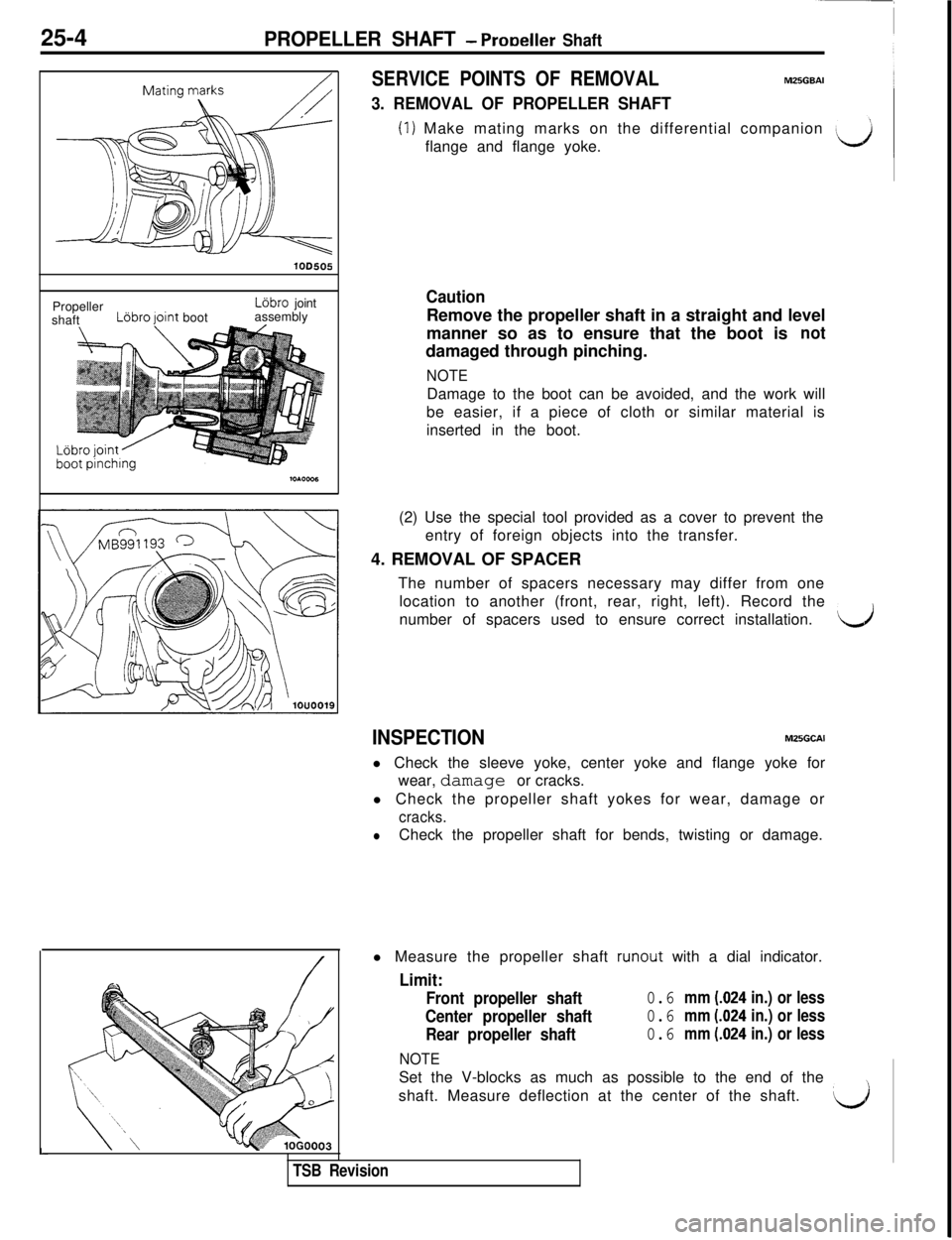
3. REMOVAL OF PROPELLER SHAFT
(1) Make mating marks on the differential companion
flange and flange yoke.
CautionRemove the propeller shaft in a straight and level
manner so as to ensure that the boot is
notdamaged through pinching.
NOTEDamage to the boot can be avoided, and the work will
be easier, if a piece of cloth or similar material is
inserted in the boot.
(2) Use the special tool provided as a cover to prevent the
entry of foreign objects into the transfer.
4. REMOVAL OF SPACER
The number of spacers necessary may differ from one
location to another (front, rear, right, left). Record the
number of spacers used to ensure correct installation.
INSPECTIONM25GCAIl Check the sleeve yoke, center yoke and flange yoke for
wear, damage or cracks.
l Check the propeller shaft yokes for wear, damage or
cracks.
lCheck the propeller shaft for bends, twisting or damage.
l Measure the propeller shaft runout with a dial indicator.
Limit:
Front propeller shaft0.6 mm (.024 in.) or less
Center propeller shaft0.6 mm (.024 in.) or less
Rear propeller shaft0.6 mm (.024 in.) or less
NOTESet the V-blocks as much as possible to the end of the
shaft. Measure deflection at the center of the shaft.
d
Lj
TSB Revision
Page 581 of 1146
FRONT AXLE - Troubleshooting / Service Adjustment Procedures
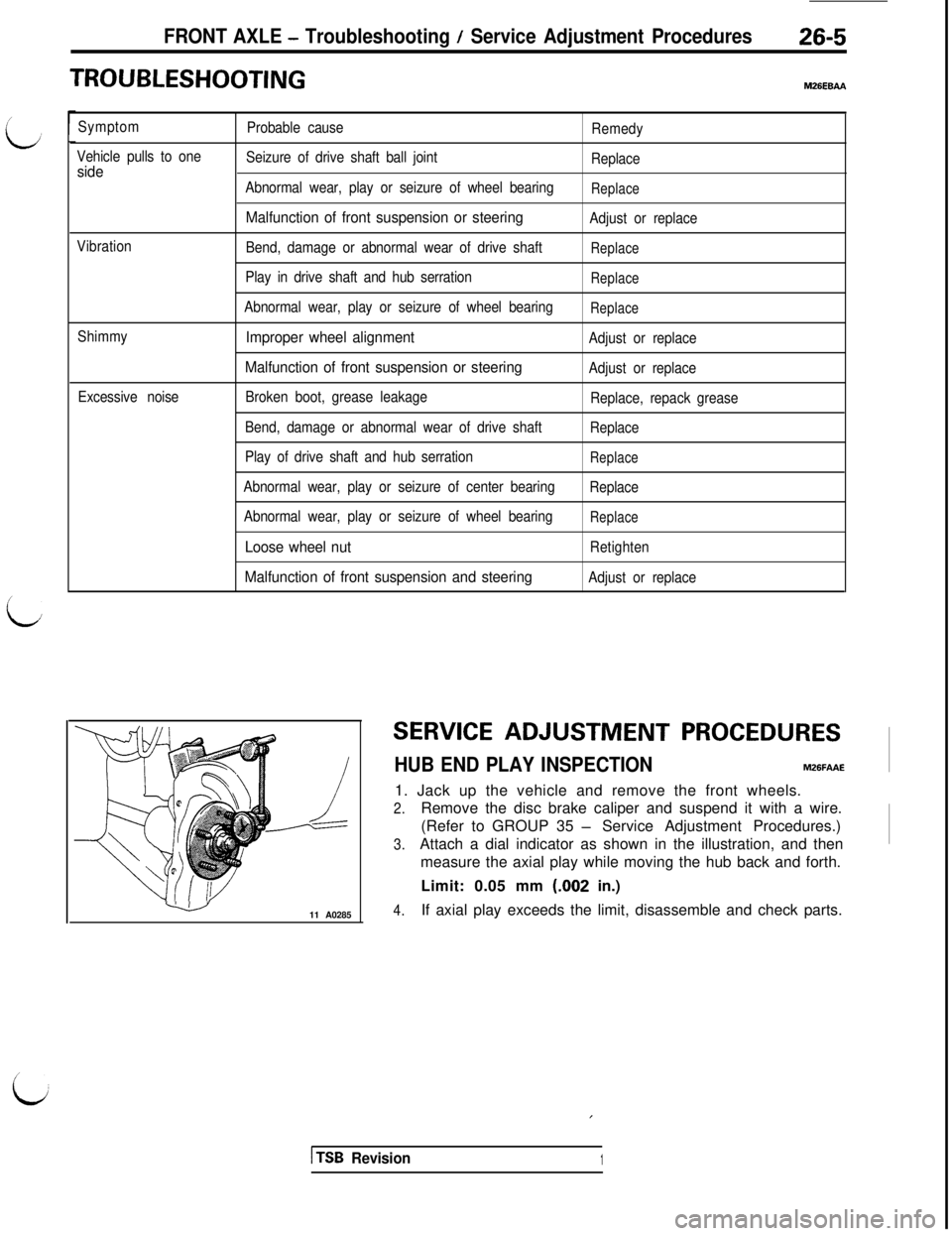
TROUBLESHOOTING
26-5
MPBEBAA
i.
Symptom
Vehicle pulls to one
side
Vibration
Shimmy
Excessive noiseProbable cause
Seizure of drive shaft ball joint
Abnormal wear, play or seizure of wheel bearing
Malfunction of front suspension or steering
Bend, damage or abnormal wear of drive shaft
Play in drive shaft and hub serration
Abnormal wear, play or seizure of wheel bearing
Improper wheel alignment
Malfunction of front suspension or steering
Broken boot, grease leakage
Bend, damage or abnormal wear of drive shaft
Play of drive shaft and hub serration
Abnormal wear, play or seizure of center bearing
Abnormal wear, play or seizure of wheel bearing
Loose wheel nut
Malfunction of front suspension and steering
Remedy
Replace
Replace
Adjust or replace
Replace
Replace
Replace
Adjust or replace
Adjust or replace
Replace, repack grease
Replace
Replace
Replace
Replace
Retighten
Adjust or replace
u11 A0285
SERVICE ADJUSTMENT PROCEDURES
HUB END PLAY INSPECTIONM26FAAE1. Jack up the vehicle and remove the front wheels.
2.Remove the disc brake caliper and suspend it with a wire.
(Refer to GROUP 35
- Service Adjustment Procedures.)
3.Attach a dial indicator as shown in the illustration, and then
measure the axial play while moving the hub back and forth.
Limit: 0.05 mm (.002 in.)
4.If axial play exceeds the limit, disassemble and check parts.
,
1 TSB Revision1
i
Page 622 of 1146
27-26
REAR AXLE
SERVICE POINTS OF INSTALLATION
7. INSTALLATION OF DIFFERENTIAL CARRIERm27lDAL
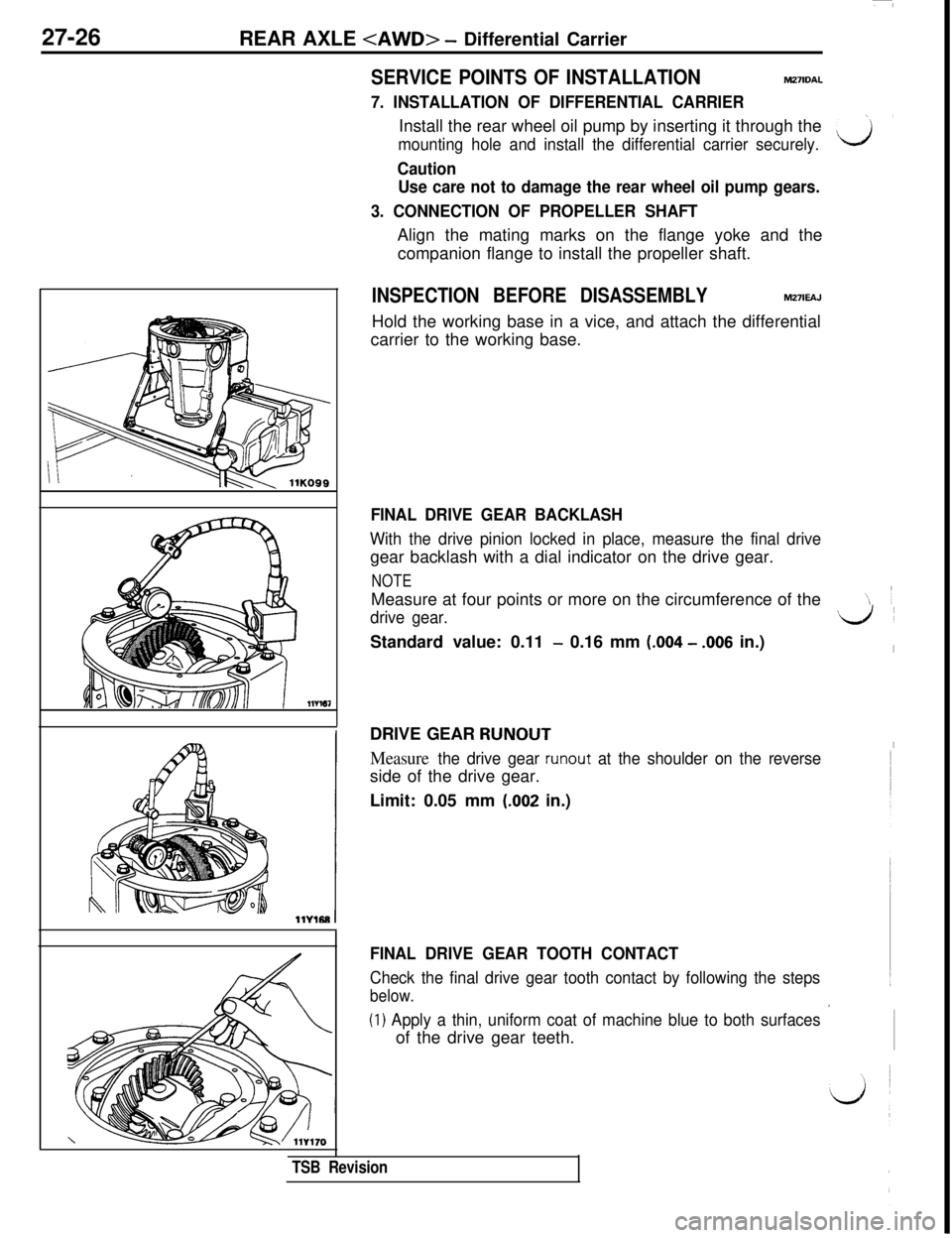
Install the rear wheel oil pump by inserting it through the
mounting hole and install the differential carrier securely.\yiIlYl61
Caution
Use care not to damage the rear wheel oil pump gears.
3. CONNECTION OF PROPELLER SHAFTAlign the mating marks on the flange yoke and the
companion flange to install the propeller shaft.
INSPECTION BEFORE DISASSEMBLYM27lEAJHold the working base in a vice, and attach the differential
carrier to the working base.
FINAL DRIVE GEAR BACKLASH
With the drive pinion locked in place, measure the final drivegear backlash with a dial indicator on the drive gear.
NOTEMeasure at four points or more on the circumference of the
drive gear.d’Standard value: 0.11
- 0.16 mm (.004 - .006 in.)IDRIVE GEAR
RUNOUTI
Measure the drive gear runout at the shoulder on the reverseside of the drive gear.
Limit: 0.05 mm
(.002 in.)
FINAL DRIVE GEAR TOOTH CONTACT
Check the final drive gear tooth contact by following the steps
below.
(1) Apply a thin, uniform coat of machine blue to both surfaces ’of the drive gear teeth.
TSB Revision