battery MITSUBISHI 3000GT 1991 Owner's Manual
[x] Cancel search | Manufacturer: MITSUBISHI, Model Year: 1991, Model line: 3000GT, Model: MITSUBISHI 3000GT 1991Pages: 1146, PDF Size: 76.68 MB
Page 203 of 1146
FUEL SYSTEM - On-vehicle Inspection of MPI ComDonents13-97
,
7FU1014
7FUlOl5
SENSOR INSPECTION
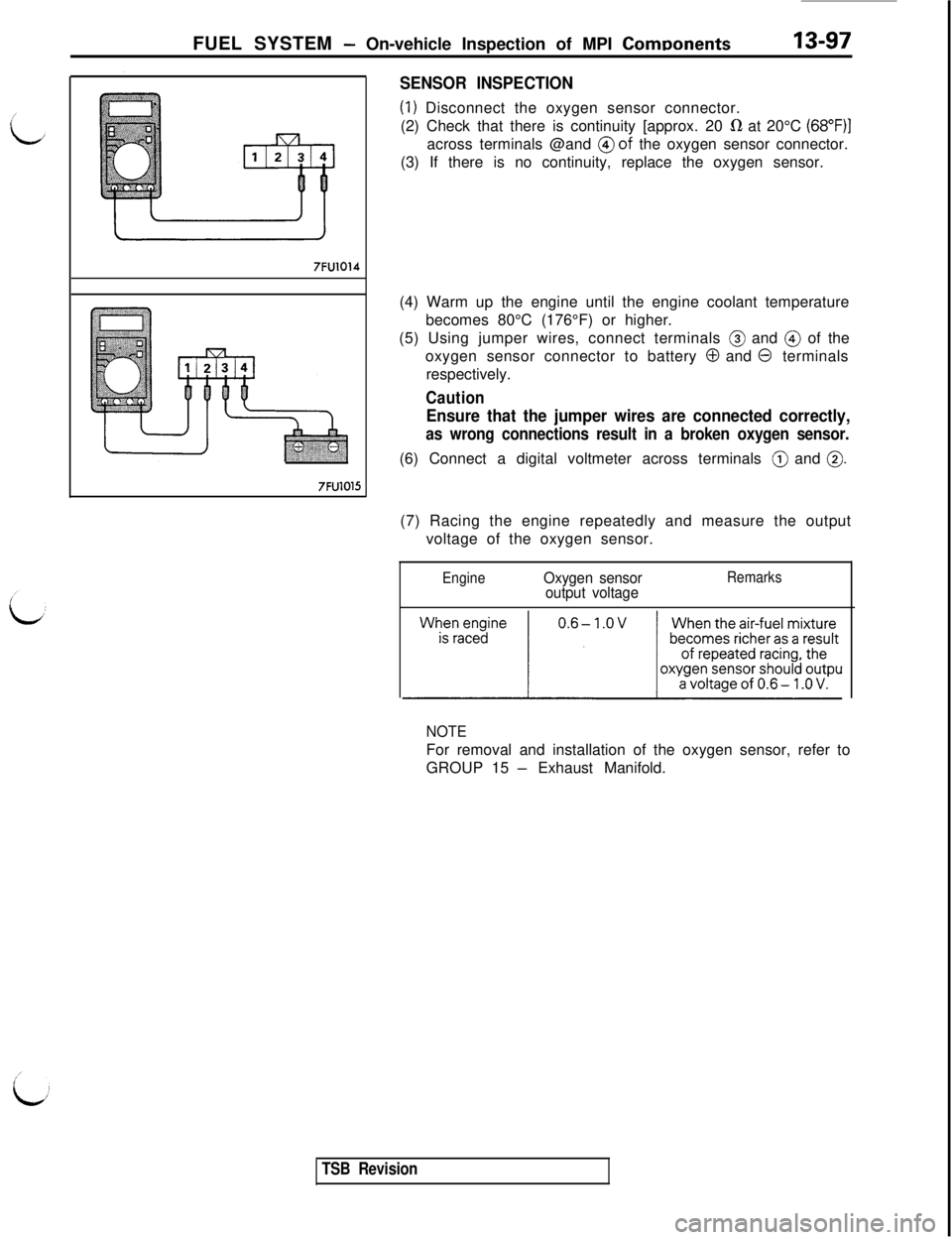
(1) Disconnect the oxygen sensor connector.
(2) Check that there is continuity [approx. 20
IR at 20°C (68”F)jacross terminals @and
@of the oxygen sensor connector.
(3) If there is no continuity, replace the oxygen sensor.
(4) Warm up the engine until the engine coolant temperature
becomes 80°C (176°F) or higher.
(5) Using jumper wires, connect terminals @ and @ of the
oxygen sensor connector to battery
0 and 0 terminals
respectively.
Caution
Ensure that the jumper wires are connected correctly,
as wrong connections result in a broken oxygen sensor.(6) Connect a digital voltmeter across terminals @ and
0.(7) Racing the engine repeatedly and measure the output
voltage of the oxygen sensor.
EngineOxygen sensor
output voltageRemarks
NOTEFor removal and installation of the oxygen sensor, refer to
GROUP 15
- Exhaust Manifold.
TSB Revision
Page 206 of 1146
13-100FUEL SYSTEM - 0
n-vehicleInspection of MPI Components
SENSOR INSPECTION
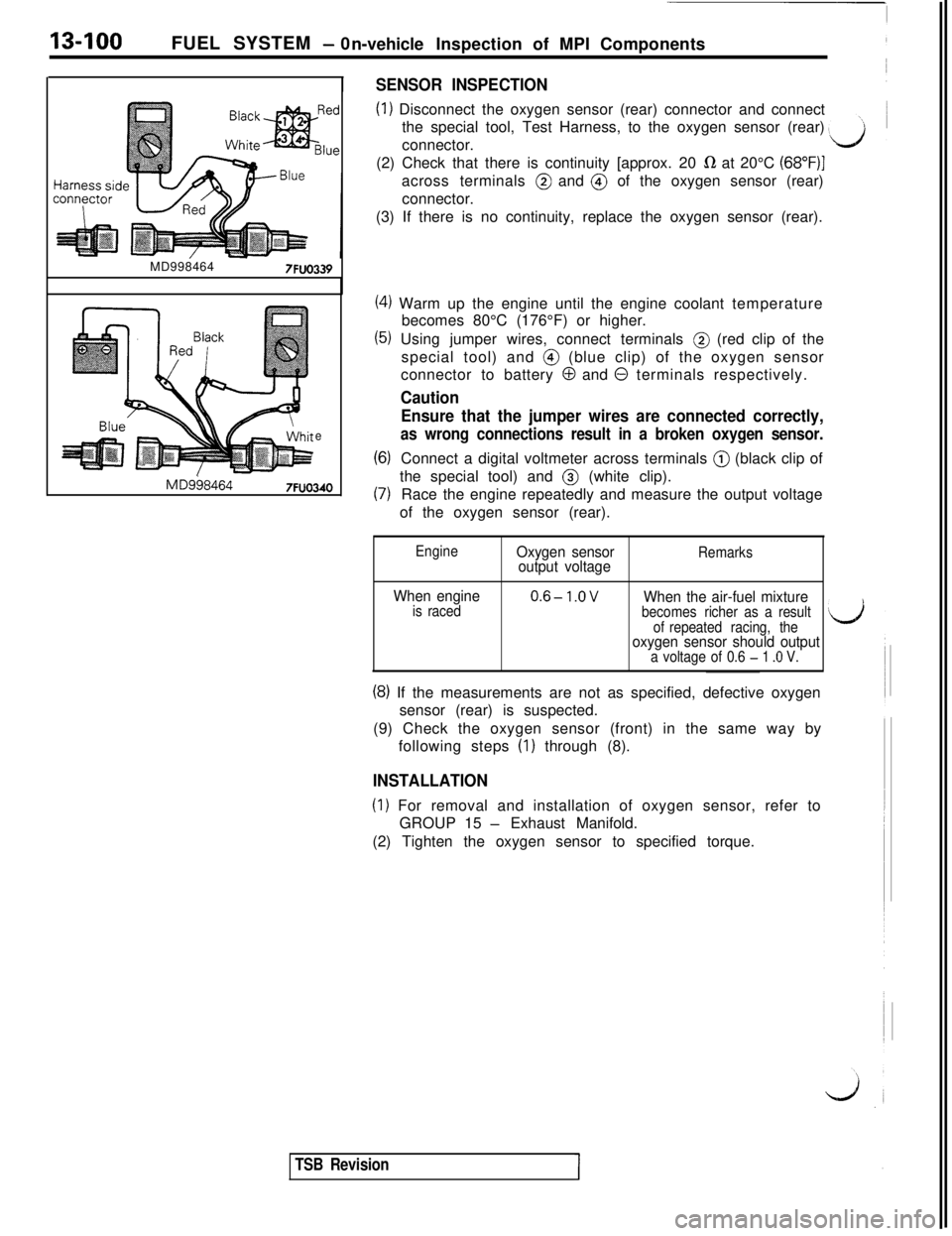
(1) Disconnect the oxygen sensor (rear) connector and connect
the special tool, Test Harness, to the oxygen sensor (rear)
connector.
MD998464
7FUO339
e
MD9584647FUO340(2) Check that there is continuity [approx. 20
R at 20°C (68”F)Iacross terminals @ and @ of the oxygen sensor (rear)
connector.
(3) If there is no continuity, replace the oxygen sensor (rear).
(4) Warm up the engine until the engine coolant temperature
becomes 80°C (176°F) or higher.
(5) Using jumper wires, connect terminals @ (red clip of the
special tool) and @ (blue clip) of the oxygen sensor
connector to battery
0 and 0 terminals respectively.
Caution
Ensure that the jumper wires are connected correctly,
as wrong connections result in a broken oxygen sensor.
(6)Connect a digital voltmeter across terminals @ (black clip of
(7)the special tool) and @ (white clip).
Race the engine repeatedly and measure the output voltage
of the oxygen sensor (rear).
EngineOxygen sensor
output voltageRemarks
When engineis raced0.6-l.OVWhen the air-fuel mixturebecomes richer as a result
of repeated racing, the
oxygen sensor should outputa voltage of 0.6 - 1 .O V.
(8) If the measurements are not as specified, defective oxygen
sensor (rear) is suspected.
(9) Check the oxygen sensor (front) in the same way by
following steps
(I) through (8).
INSTALLATION
(1) For removal and installation of oxygen sensor, refer to
GROUP 15
- Exhaust Manifold.
(2) Tighten the oxygen sensor to specified torque.
TSB Revision
Page 207 of 1146
FUEL SYSTEM - On-vehicle Inspection of MPI Components13-101INJECTORS
M13YTAC2
IInjectorII\- 7FUO803
7FI
FuelFilter
@Injection
7FUO83:2Connector for
rear bank
Engine control unit7FUO833
Engine control unit connector
7FUO653
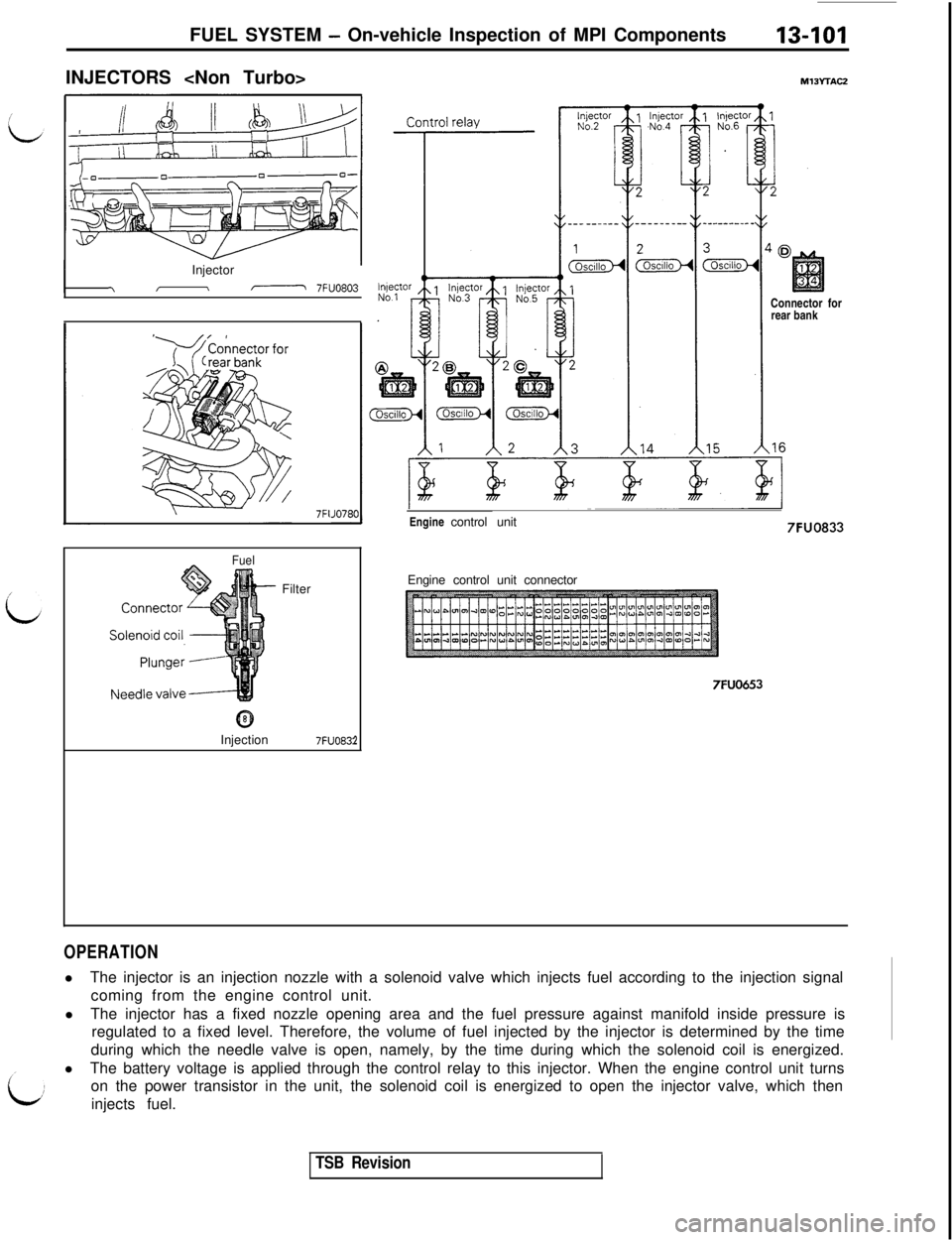
OPERATIONlThe injector is an injection nozzle with a solenoid valve which injects fuel according to the injection signal
coming from the engine control unit.
lThe injector has a fixed nozzle opening area and the fuel pressure against manifold inside pressure is
regulated to a fixed level. Therefore, the volume of fuel injected by the injector is determined by the time
during which the needle valve is open, namely, by the time during which the solenoid coil is energized.
lThe battery voltage is applied through the control relay to this injector. When the engine control unit turns
on the power transistor in the unit, the solenoid coil is energized to open the injector valve, which then
injects fuel.
TSB Revision
Page 216 of 1146
\
7FUO64;Ball beam
‘9
L PlntleControl relay
@ Harness side
connector
\/1, \,\/“1“3 “4 â")
13-110FUEL SYSTEM - On-vehicle Inspection of MPI Components
IDLE SPEED CONTROL SERVO (STEPPER MOTOR TYPE)\
7FUO64;Ball beam
‘9
L PlntleControl relay
@ Harness side
connector
\/1, \,\/“1“3 “4 “6Idle speed
control servo
OSCIIIOOSCIIIOOSClllOosclllomu--
/(a /(IT ),!j /I,, Enginecontrol unit
BPPP
7FUO518Engine control unit connector
7FUO653
OPERATION
lThe intake air volume during idling is controlled by opening ‘or closing the servo valve provided in the air
path that bypasses the throttle valve.’
lThe servo valve is opened or closed by operating the stepper motor in the speed control servo in normal or
reverse direction.
lThe battery power is supplied to the stepper motor through the control relay. As the engine control unit
turns on power transistors in the unit one after another, the stepper motor coil is energized and the motor
rotates in normal or reverse direction.
TROUBLESHOOTING HINTSHint 1:If the stepper motor step increases to 100 to 120 steps or decreases to 0 step, faulty stepper motor
or open circuit in the harness is suspected.
Hint 2: If the idle speed control servo harness and individual part checks have resulted normal but the
stepper motor steps are out of specification, the following faults are suspected.
(I) Poorly adjusted reference idle speed
(2) Deposit on the throttle valve
(3) Air leaking into the intake manifold through gasket gap
(4) Loose EGR valve seat
(5)Poor combustion in the cylinder (faulty ignition plug, ignition coil, injector, low compression
pressure, etc.)
\L.J
1 TSB RevisionI
Page 221 of 1146
FUEL SYSTEM - On-vehicle Inspection of MPI Components
IGNITION COIL AND POWER TRANSISTOR
MlBYVABEquipment side
connector@ Harness side
connector@ Harness side connector
Tachometer
-1Battery
/gnition coil1 3
Engine control unit
\/\/\IAL“8 “6.,,523No. 2No. 3
No 5No. 6
* transistor
5Y
lgnltlontamingadjust-
mentconnectof
11104
d
w5V
7FU1059Engine control unitconnector
7FUO453
OPERATION
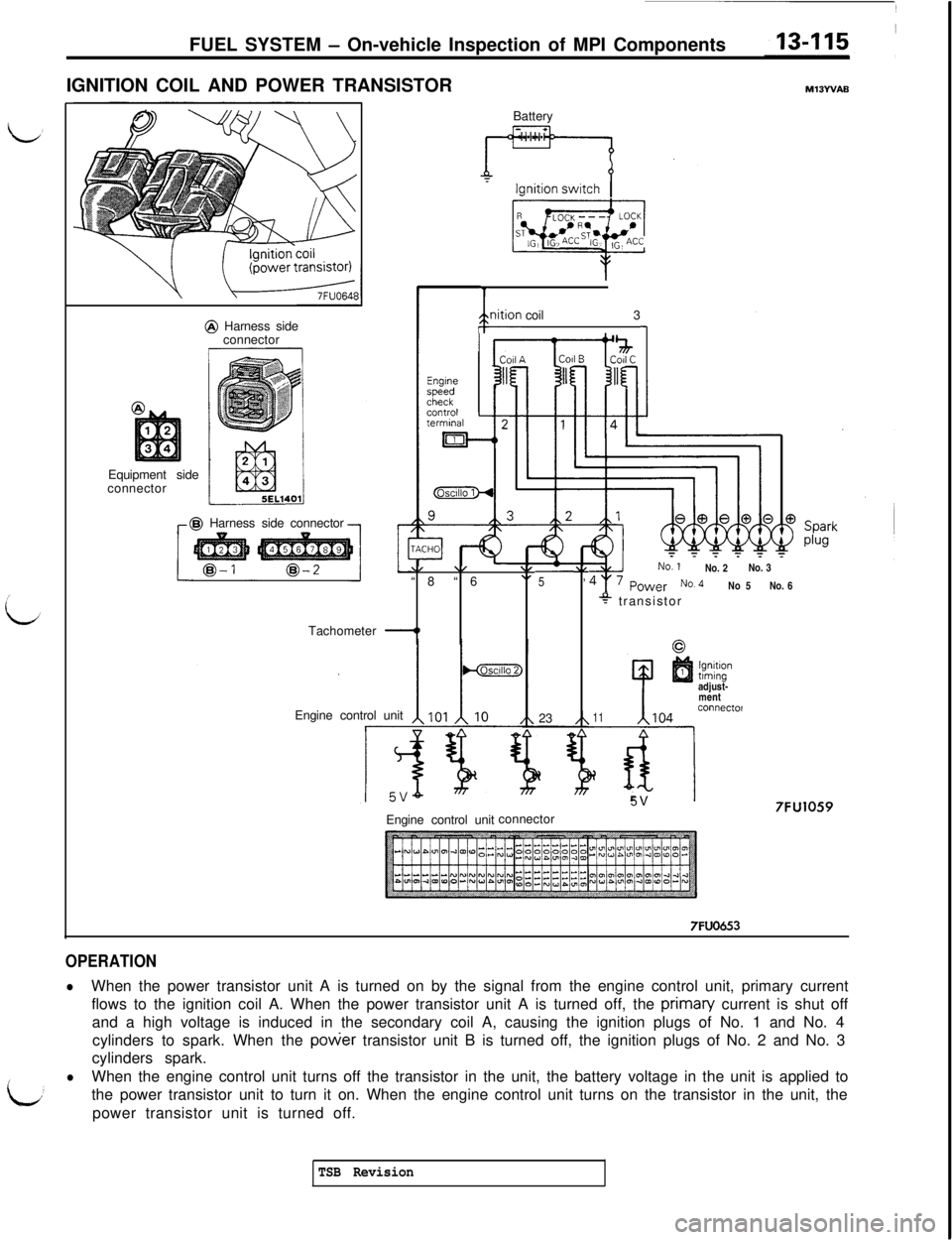
lWhen the power transistor unit A is turned on by the signal from the engine control unit, primary current
flows to the ignition coil A. When the power transistor unit A is turned off, the primaty current is shut off
and a high voltage is induced in the secondary coil A, causing the ignition plugs of No. 1 and No. 4
cylinders to spark. When the
power transistor unit B is turned off, the ignition plugs of No. 2 and No. 3
cylinders spark.
L
lWhen the engine control unit turns off the transistor in the unit, the battery voltage in the unit is applied to
the power transistor unit to turn it on. When the engine control unit turns on the transistor in the unit, the
power transistor unit is turned off.
TSB Revision
Page 225 of 1146
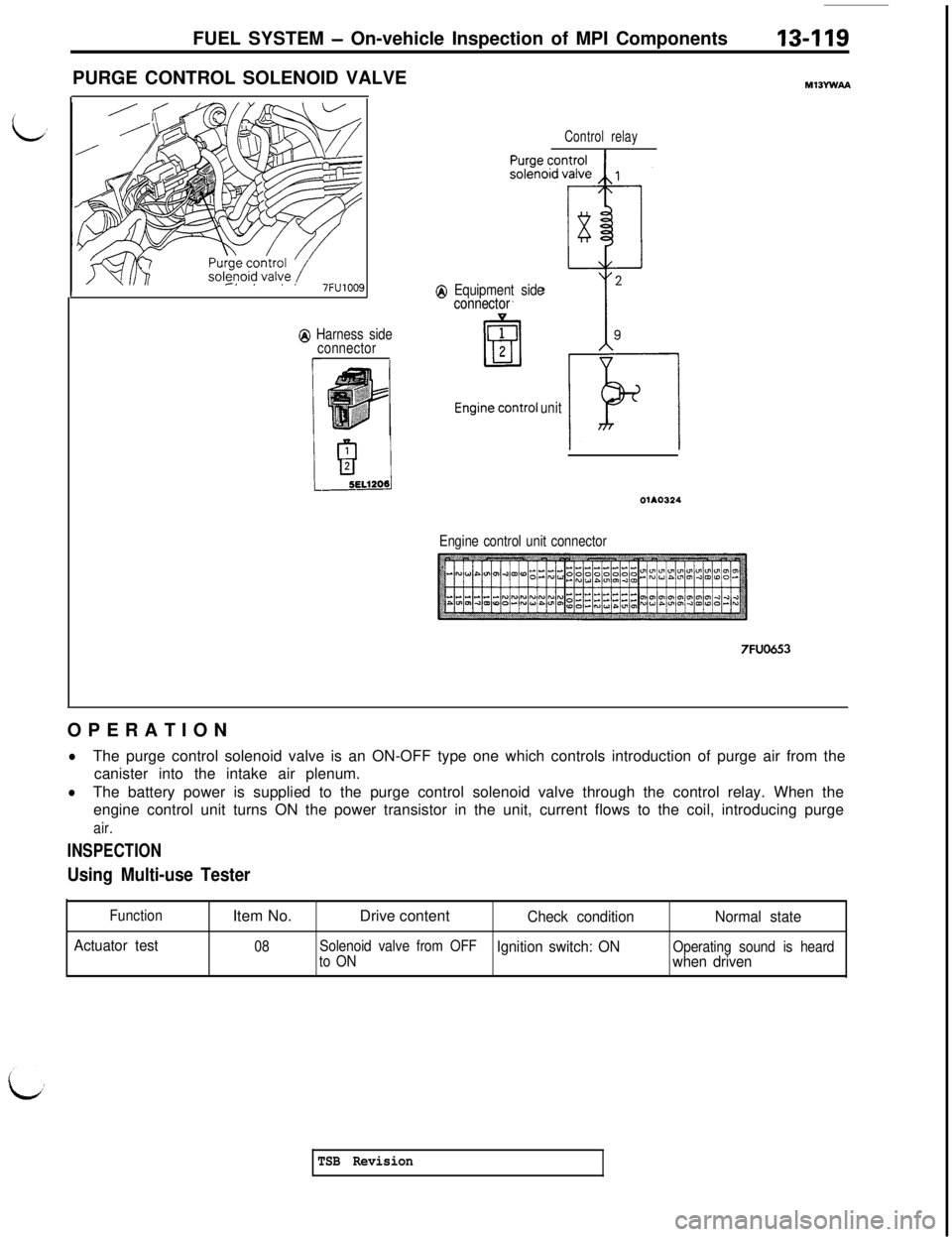
FUEL SYSTEM - On-vehicle Inspection of MPI Components13-119PURGE CONTROL SOLENOID VALVE
Q Harness side
connector
I
Control relay
@ Equipment side
connector connector
unit
OlAO324
Engine control unit connector
7FUO653OPERATION
lThe purge control solenoid valve is an ON-OFF type one which controls introduction of purge air from the
canister into the intake air plenum.
lThe battery power is supplied to the purge control solenoid valve through the control relay. When the
engine control unit turns ON the power transistor in the unit, current flows to the coil, introducing purge
air.
INSPECTION
Using Multi-use Tester
Function
Actuator testItem No.Drive content
Check conditionNormal state
08Solenoid valve from OFFIgnition switch: ONOperating sound is heard
to ONwhen driven
TSB Revision
Page 227 of 1146
FUEL SYSTEM - On-vehicle lnwection of MPI ComDonents13-121
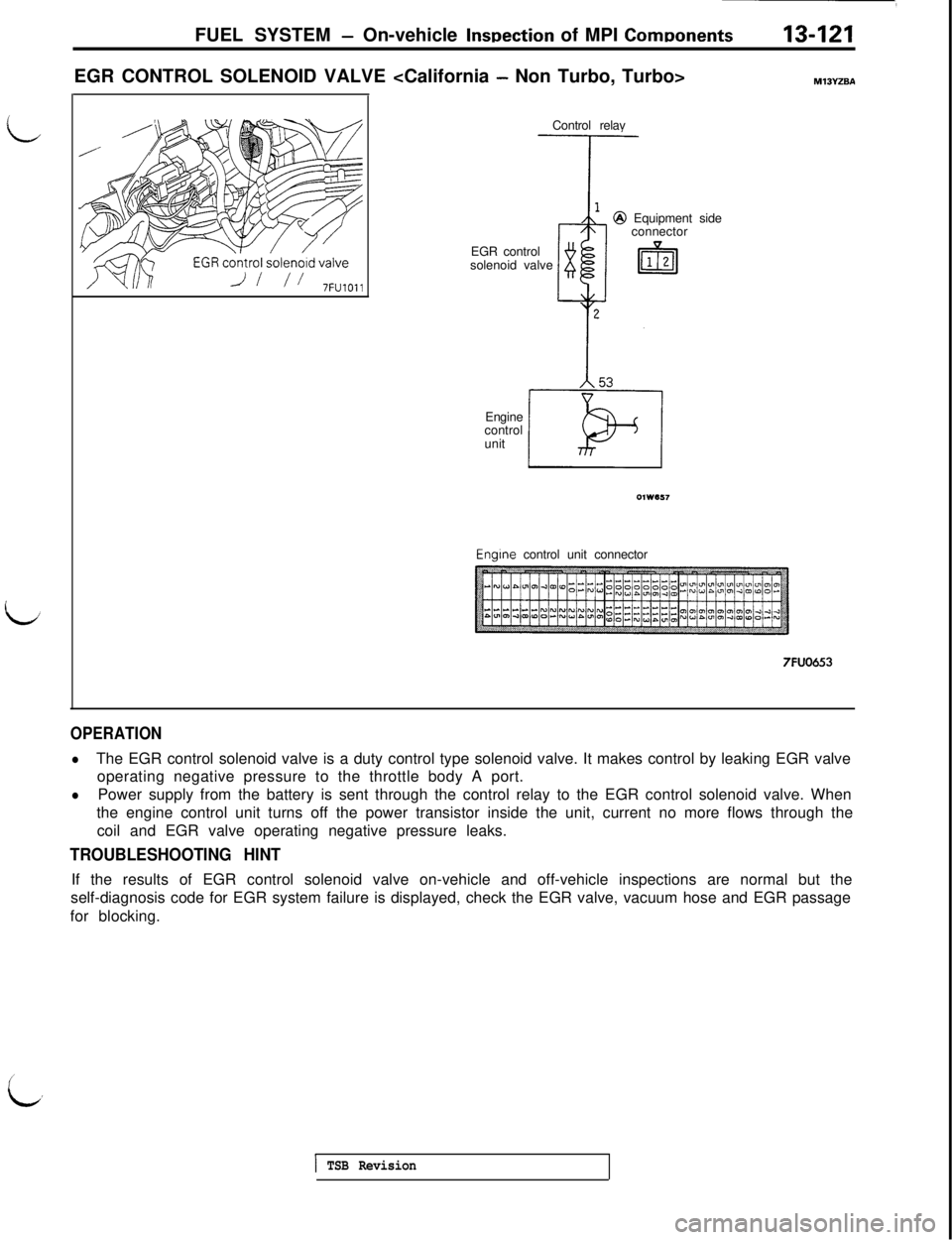
LEGR CONTROL SOLENOID VALVE
EGR control
solenoid valve@ Equipment side
connector
Engine
control
unitEngine control unit connector
7FUO653
OPERATION
lThe EGR control solenoid valve is a duty control type solenoid valve. It makes control by leaking EGR valve
operating negative pressure to the throttle body A port.
lPower supply from the battery is sent through the control relay to the EGR control solenoid valve. When
the engine control unit turns off the power transistor inside the unit, current no more flows through the
coil and EGR valve operating negative pressure leaks.
TROUBLESHOOTING HINTIf the results of EGR control solenoid valve on-vehicle and off-vehicle inspections are normal but the
self-diagnosis code for EGR system failure is displayed, check the EGR valve, vacuum hose and EGR passage
for blocking.
c.
1 TSB Revision
Page 229 of 1146
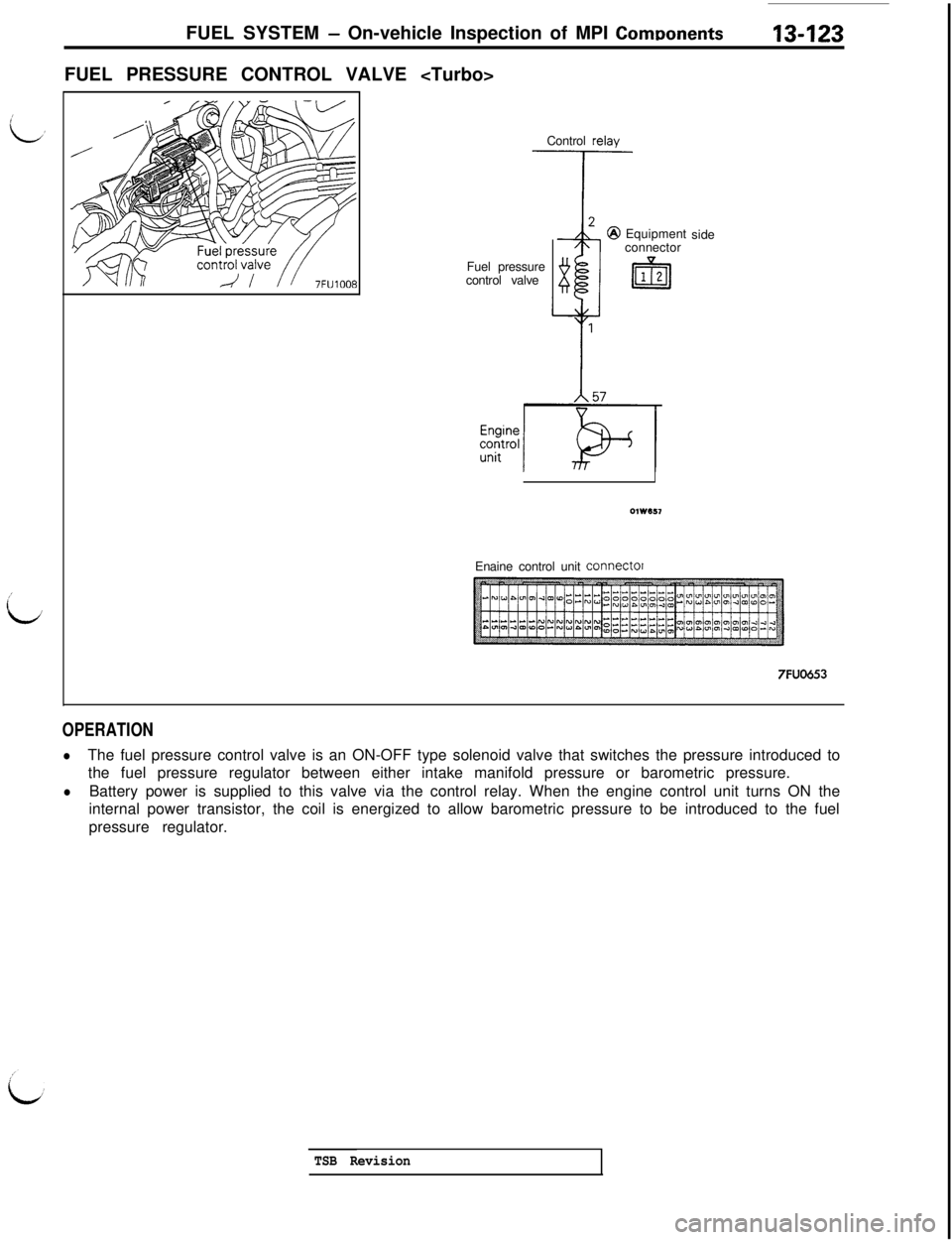
FUEL SYSTEM - On-vehicle Inspection of MPI ComDonents13-123FUEL PRESSURE CONTROL VALVE
Control relay
Fuel pressure
control valveEquipment
connectorside
Enaine control unit
connector
7FUO653
OPERATION
lThe fuel pressure control valve is an ON-OFF type solenoid valve that switches the pressure introduced to
the fuel pressure regulator between either intake manifold pressure or barometric pressure.
lBattery power is supplied to this valve via the control relay. When the engine control unit turns ON the
internal power transistor, the coil is energized to allow barometric pressure to be introduced to the fuel
pressure regulator.
TSB Revision
Page 231 of 1146
FUEL SYSTEM - On-vehicle Inspection of MPI Components13-125
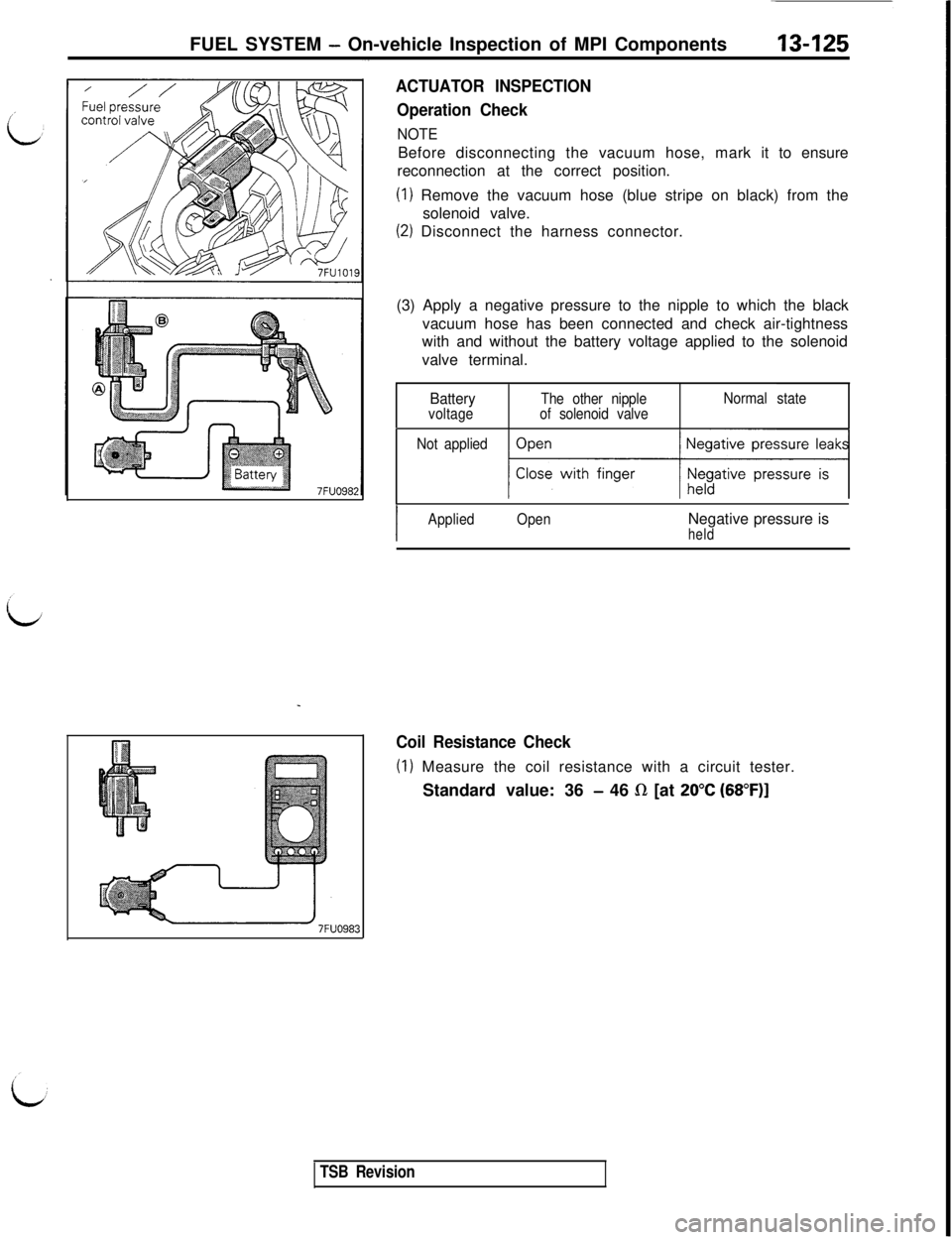
ACTUATOR INSPECTION
Operation Check
NOTEBefore disconnecting the vacuum hose, mark it to ensure
reconnection at the correct position.
(1) Remove the vacuum hose (blue stripe on black) from the
solenoid valve.
(2) Disconnect the harness connector.
(3) Apply a negative pressure to the nipple to which the black
vacuum hose has been connected and check air-tightness
with and without the battery voltage applied to the solenoid
valve terminal.
BatteryvoltageThe other nipple
of solenoid valveNormal state
Not applied
qj
I
AppliedOpenNegative pressure isheld
Coil Resistance Check
(I) Measure the coil resistance with a circuit tester.
Standard value: 36
- 46 R [at 20°C (68”F)]
TSB Revision
Page 232 of 1146
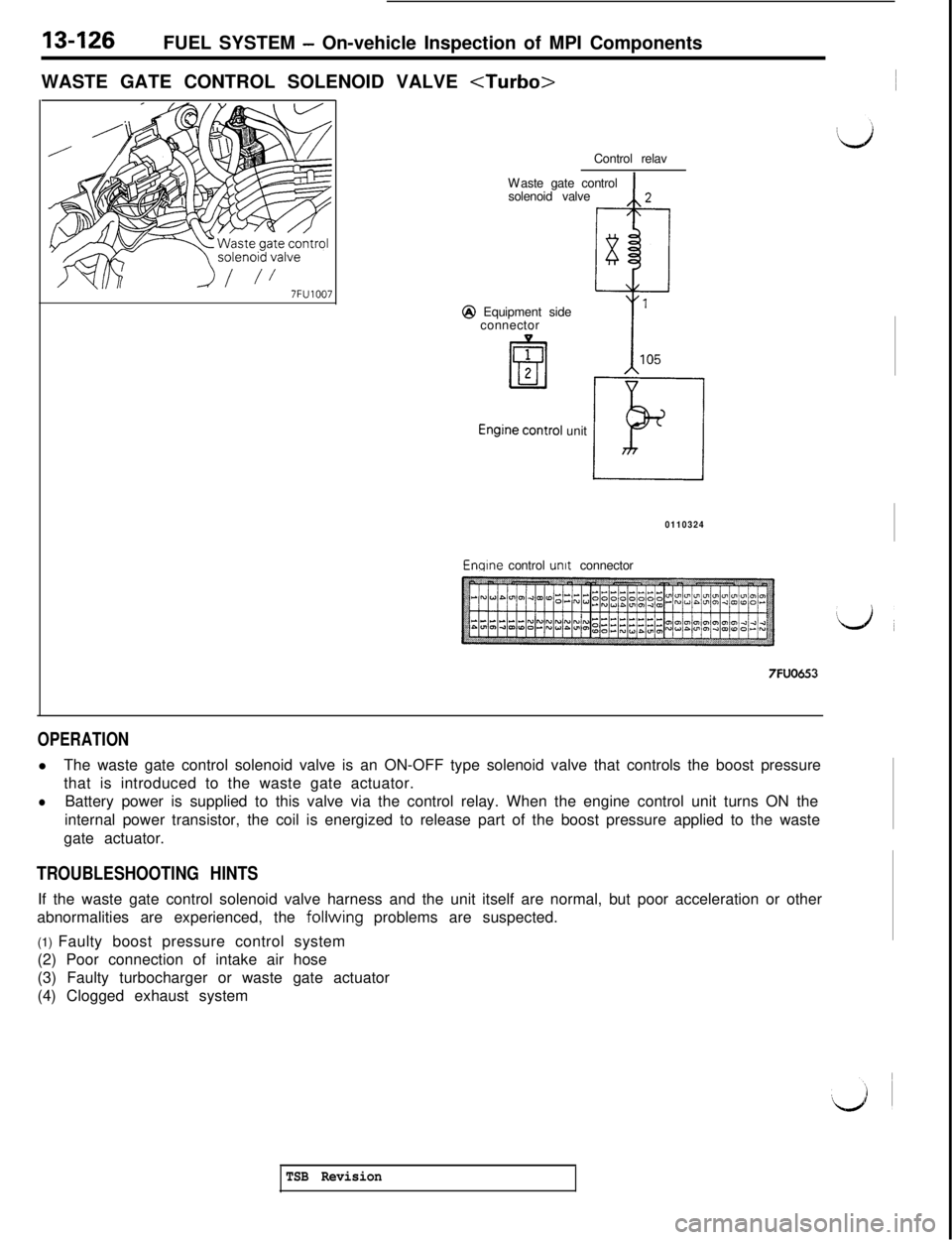
13-126FUEL SYSTEM - On-vehicle Inspection of MPI Components
WASTE GATE CONTROL SOLENOID VALVE
7FU1007Control relav
Waste gate control
solenoid valve
Q Equipment side
connector
unit
0110324Enqlne control unit connector
7FUO653
OPERATIONlThe waste gate control solenoid valve is an ON-OFF type solenoid valve that controls the boost pressure
that is introduced to the waste gate actuator.
lBattery power is supplied to this valve via the control relay. When the engine control unit turns ON the
internal power transistor, the coil is energized to release part of the boost pressure applied to the waste
gate actuator.
TROUBLESHOOTING HINTSIf the waste gate control solenoid valve harness and the unit itself are normal, but poor acceleration or other
abnormalities are experienced, the
follwing problems are suspected.
(1) Faulty boost pressure control system
(2) Poor connection of intake air hose
(3) Faulty turbocharger or waste gate actuator
(4) Clogged exhaust system
TSB Revision