battery MITSUBISHI 3000GT 1991 Workshop Manual
[x] Cancel search | Manufacturer: MITSUBISHI, Model Year: 1991, Model line: 3000GT, Model: MITSUBISHI 3000GT 1991Pages: 1146, PDF Size: 76.68 MB
Page 303 of 1146
COOLING - Radiator14-S
- 04N0002
SERVICE POINT OF REMOVALM14QBAK8. DISCONNECTION OF AUTOMATIC TRANSAXLE OIL
COOLER HOSESUse a plug or otherwise cover the hose and nipple part of
the radiator so that dust, dirt, foreign materials, etc. do not
enter after the hose has been disconnected from the
radiator.
INSPECTIONM14QCAN
l Check for foreign material between radiator fins.
l Check the radiator fins for bent, or damage.
l Check the radiator for corrosion, damage rust or scale.
lCheck the radiator hoses for cracks, damage or deteriora-
tion.
l Check the reserve tank for damage.
lCheck the automatic transaxle oil cooler hoses for cracking,
damage or deterioration.
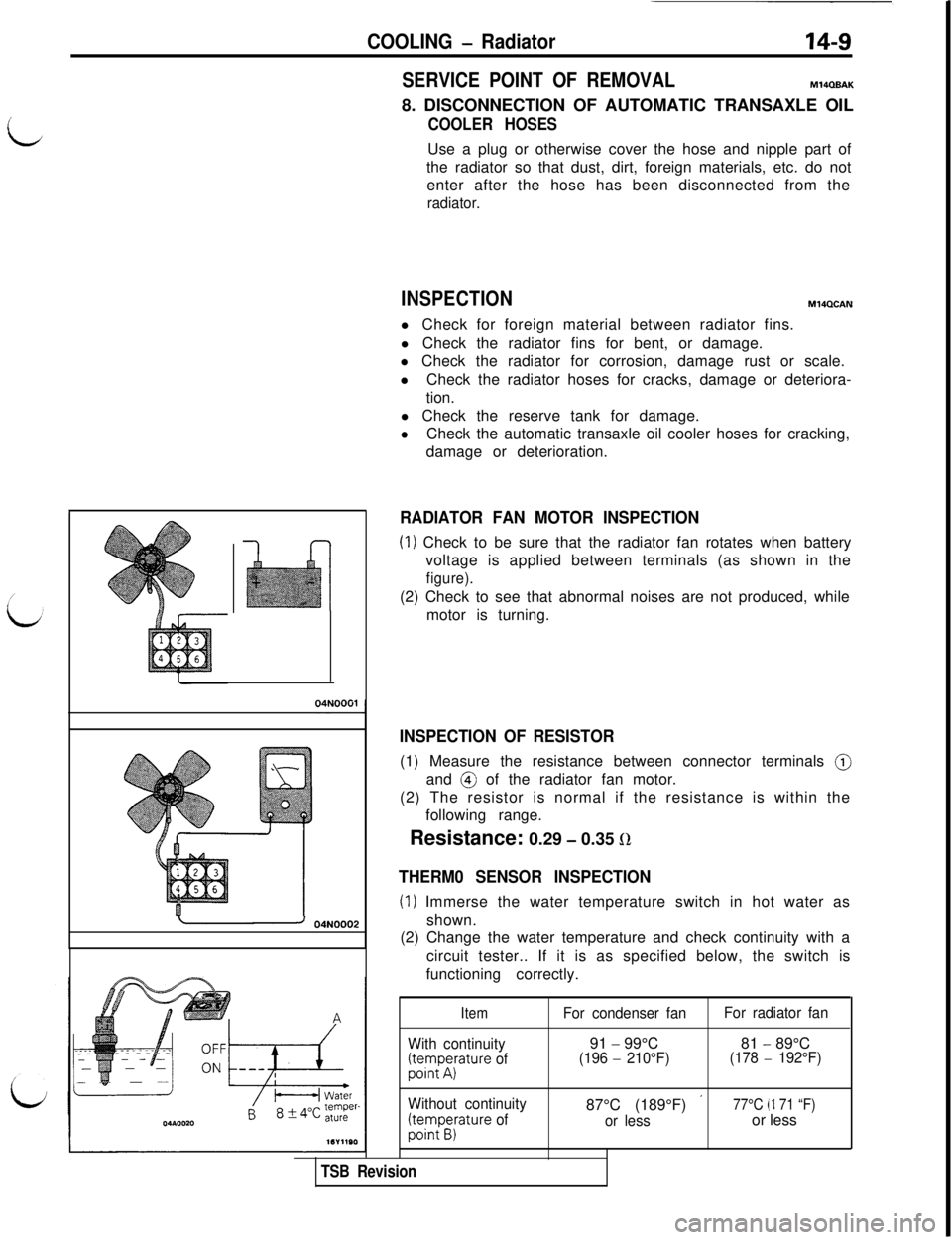
RADIATOR FAN MOTOR INSPECTION
(1) Check to be sure that the radiator fan rotates when battery
voltage is applied between terminals (as shown in the
figure).(2) Check to see that abnormal noises are not produced, while
motor is turning.
INSPECTION OF RESISTOR(1) Measure the resistance between connector terminals @
and @ of the radiator fan motor.
(2) The resistor is normal if the resistance is within the
following range.
Resistance: 0.29
- 0.35 IZ
THERM0 SENSOR INSPECTION
(1) Immerse the water temperature switch in hot water as
shown.
(2) Change the water temperature and check continuity with a
circuit tester.. If it is as specified below, the switch is
functioning correctly.
Item
With continuityb;F;;ature of
Without continuity
(t;,n-r3;rature ofFor condenser fanFor radiator fan91
- 99°C81 - 89°C(196 - 210°F)(178 - 192°F)87°C (189°F)
’77°C (I 71 “F)
or lessor less
TSB Revision
Page 304 of 1146
14-10COOLING - Radiator
r-----I
113
EY
4 :
2 :
i.-.-..i
0312161908
Ionnector04FOOO8
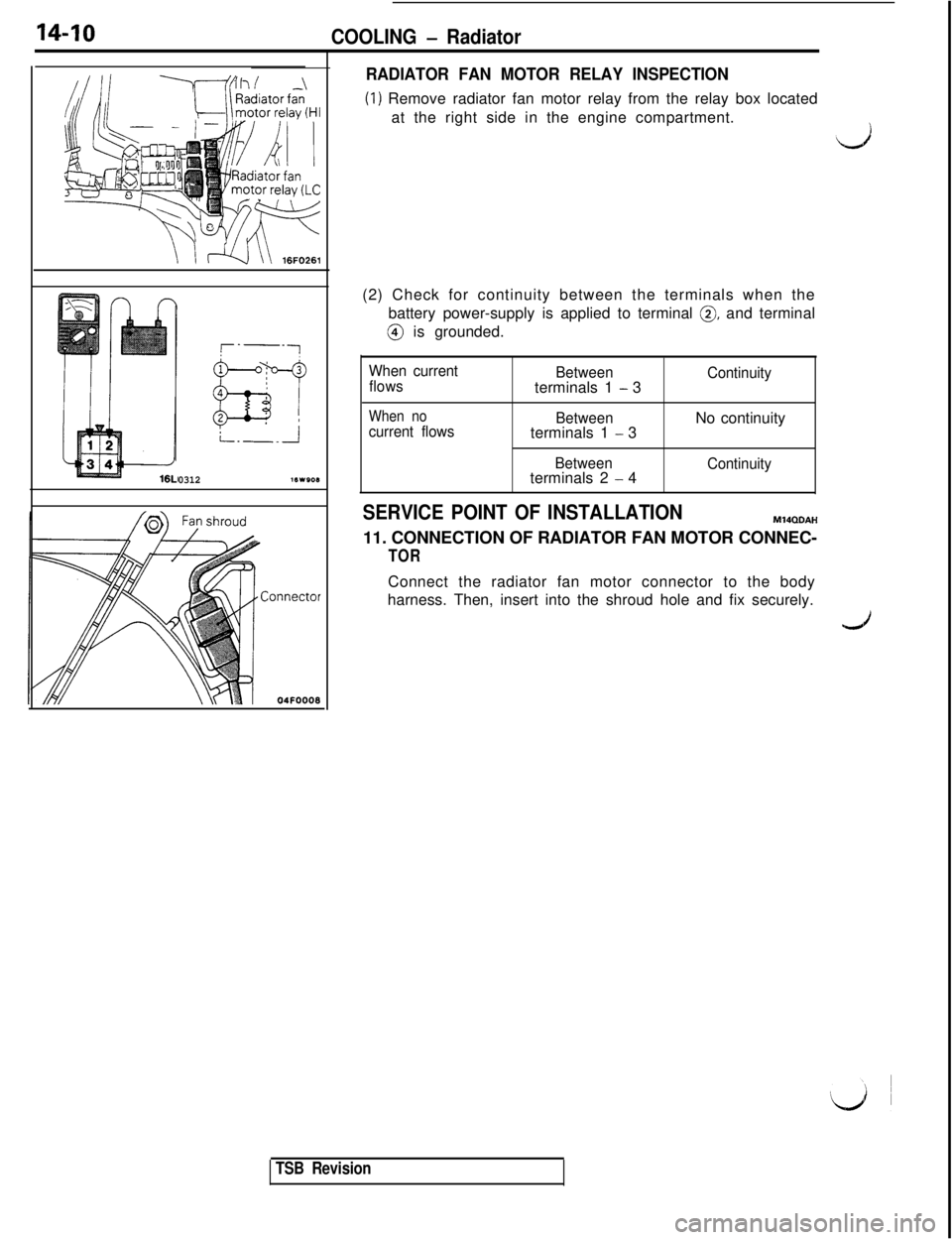
RADIATOR FAN MOTOR RELAY INSPECTION
(1) Remove radiator fan motor relay from the relay box located
at the right side in the engine compartment.
Ll(2) Check for continuity between the terminals when the
battery power-supply is applied to terminal
0, and terminal@ is grounded.
When current
flowsBetweenterminals 1
- 3Continuity
When nocurrent flowsBetweenterminals 1 - 3No continuity
Betweenterminals 2 - 4Continuity
SERVICE POINT OF INSTALLATIONM14QDAH
11. CONNECTION OF RADIATOR FAN MOTOR CONNEC-
TORConnect the radiator fan motor connector to the body
harness. Then, insert into the shroud hole and fix securely.
TSB Revision
Page 314 of 1146
15-4INTAKE AND EXHAUST -Troubleshooting (Active Exhaust System)
TROUBLESHOOTING (ACTIVE EXHAUST SYSTEM)MlSEBAA
TROUBLESHOOTING PROCEDURE(1) Make sure that the valve operating cable is not dislocated.
(2) Make sure that the connectors of each component are positively connected and that no fuse has blown.
(3) Have an overall understanding of the substance and procedure of checking by reference to the
Troubleshooting Quick-Reference Table and perform check in the proper sequence.
(4) Check each component with its connectors disconnected.
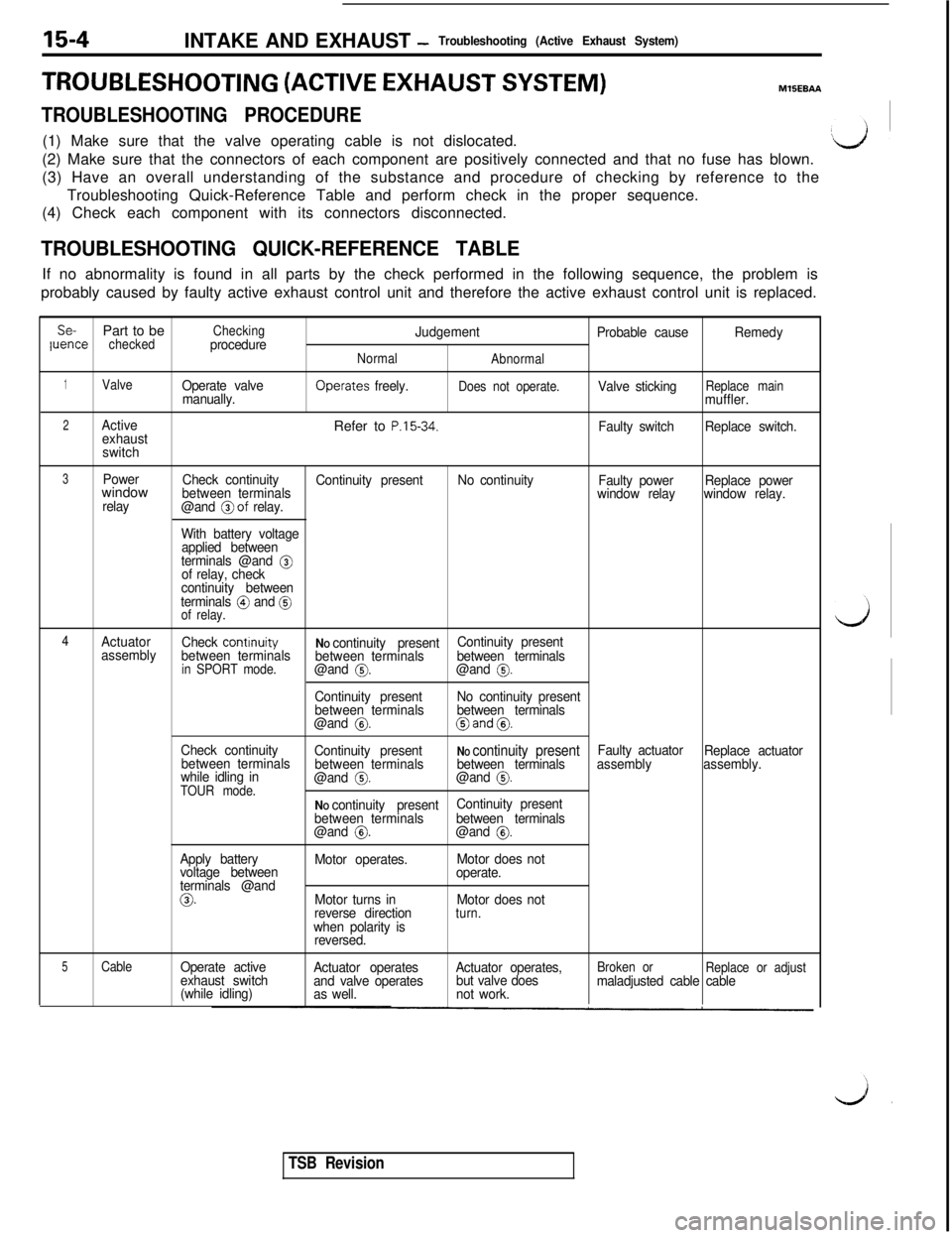
TROUBLESHOOTING QUICK-REFERENCE TABLEIf no abnormality is found in all parts by the check performed in the following sequence, the problem is
probably caused by faulty active exhaust control unit and therefore the active exhaust control unit is replaced.
Se-Part to becheckedCheckingprocedureJudgement
Probable causeluenceRemedy
Normal
Abnormal
1ValveOperate valve
manually.Operates freely.Does not operate.Valve stickingReplace mainmuffler.
2ActiveRefer to P.15-34.exhaustFaulty switchReplace switch.
switch
3PowerwindowCheck continuity
between terminalsContinuity presentNo continuity
Faulty power
relay
@and @of
relay.window relayReplace power
window relay.
With battery voltage
applied between
terminals @and
@of relay, check
continuity between
terminals
@ and @of relay.
4
Actuator
Check contrnuityassembly
between terminalsNO continuity present
between terminalsContinuity present
between terminals
in SPORT mode.@and 0.@and 0.
Continuity present
between terminalsNo continuity present
between terminals
@and
0.@and 0.
Check continuity
between terminalsContinuity present
between terminalsNO continuity presentbetween terminalsFaulty actuator
Replace actuator
while idling in
@and 0.@and @assemblyassembly.
TOUR mode.NO continuity present
between terminalsContinuity present
between terminals
@and
0.@and 0.
Apply battery
Motor operates.Motor does not
voltage between
terminals @andoperate.
0.Motor turns inMotor does not
reverse directionturn.when polarity is
reversed.
5CableOperate activeBroken orexhaust switchActuator operates
and valve operatesActuator operates,
but valve doesReplace or adjust
(while idling)
as well.not work.maladjusted cable cable
TSB Revision
Page 315 of 1146
INTAKE AND EXHAUST -Troubleshooting (Active Exhaust.System)15-5
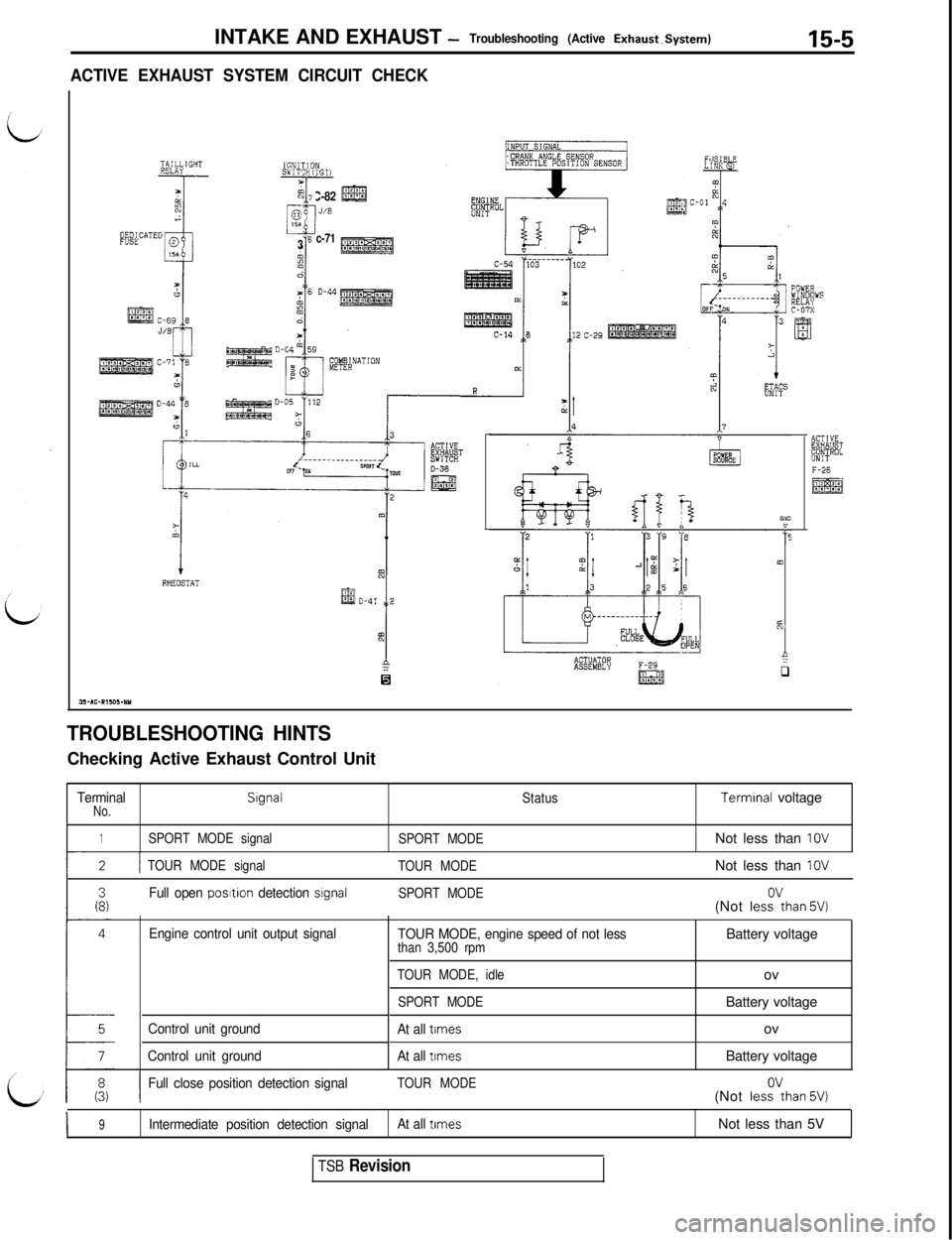
ACTIVE EXHAUST SYSTEM CIRCUIT CHECK
5= i C-82
-i
@g
0J/S1%
‘I
‘6 c-71
3
1
+RHEOSTATmACTUATOR
1::ASSEMBLYF-29
&$jq
ACTlYEFXoQBIlBZ"NIT
TROUBLESHOOTING HINTSChecking Active Exhaust Control Unit
TerminalNo.Signal
StatusTerminal voltage
1SPORT MODE signal
SPORT MODENot less than IOV
I-2 TTOUR MODE signal
TOUR MODENot less than IOV
Full open posrtion detection srgnalSPORT MODE(Not lesi’than 5V)
Engine control unit output signal
Control unit ground
Control unit groundTOUR MODE, engine speed of not lessthan 3,500 rpm
TOUR MODE, idle
SPORT MODE
At all times
At all
trmesBattery voltage
ov
Battery voltage
ov
Battery voltage
IFull close position detection signalTOUR MODE(Not lesk?than 5V)
I9Intermediate position detection signalAt all timesNot less than 5V
TSB Revision
Page 317 of 1146
INTAKE AND EXHAUST - Service Adiustment Procedures15-7
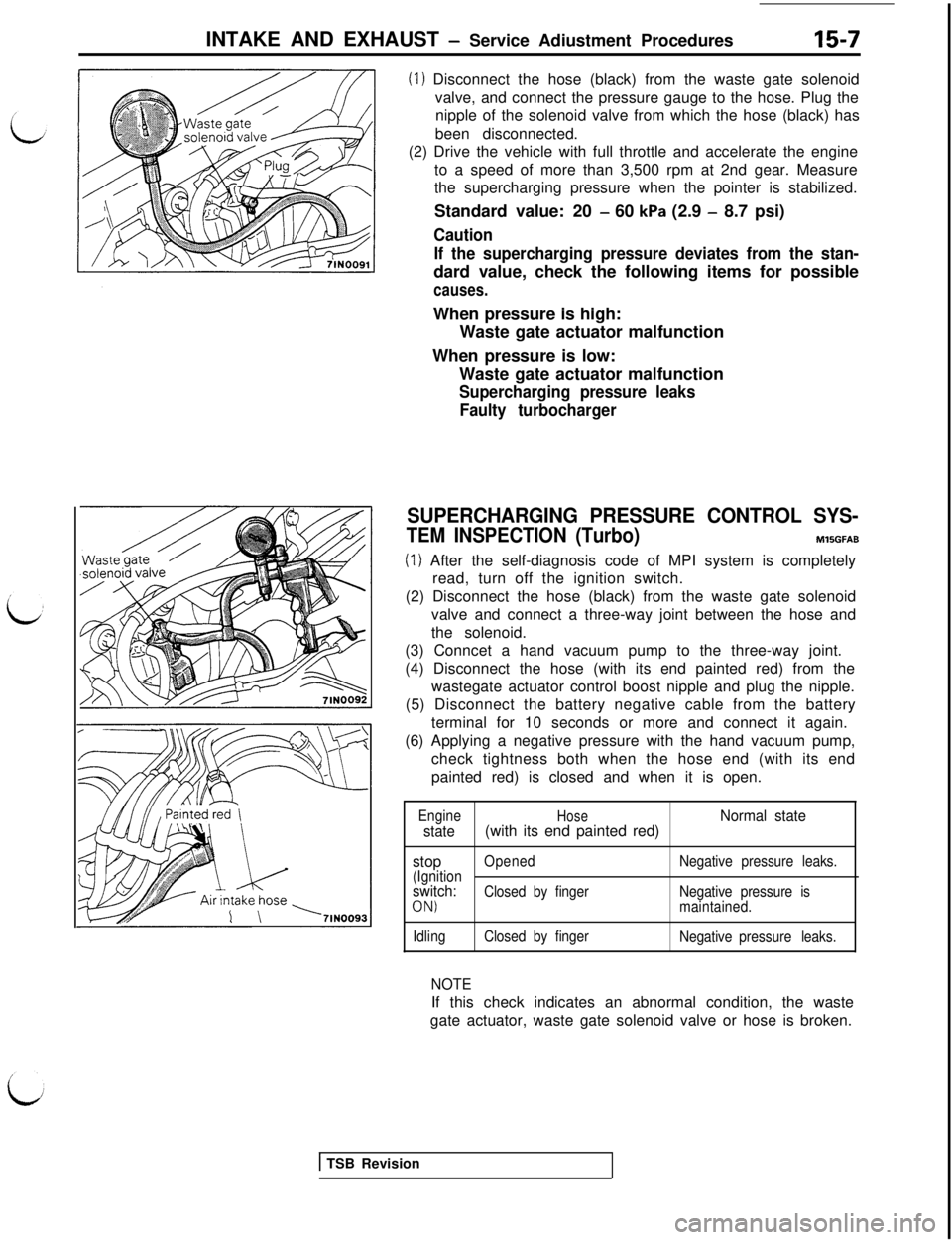
(1) Disconnect the hose (black) from the waste gate solenoid
valve, and connect the pressure gauge to the hose. Plug the
nipple of the solenoid valve from which the hose (black) has
been disconnected.
(2) Drive the vehicle with full throttle and accelerate the engine
to a speed of more than 3,500 rpm at 2nd gear. Measure
the supercharging pressure when the pointer is stabilized.
Standard value: 20
- 60 kPa (2.9 - 8.7 psi)
Caution
If the supercharging pressure deviates from the stan-dard value, check the following items for possible
causes.When pressure is high:
Waste gate actuator malfunction
When pressure is low:
Waste gate actuator malfunction
Supercharging pressure leaks
Faulty turbocharger
SUPERCHARGING PRESSURE CONTROL SYS-
TEM INSPECTION (Turbo)MlSGFAB
(1) After the self-diagnosis code of MPI system is completely
read, turn off the ignition switch.
(2) Disconnect the hose (black) from the waste gate solenoid
valve and connect a three-way joint between the hose and
the solenoid.
(3) Conncet a hand vacuum pump to the three-way joint.
(4) Disconnect the hose (with its end painted red) from the
wastegate actuator control boost nipple and plug the nipple.
(5) Disconnect the battery negative cable from the battery
terminal for 10 seconds or more and connect it again.
(6) Applying a negative pressure with the hand vacuum pump,
check tightness both when the hose end (with its end
painted red) is closed and when it is open.
EngineHoseNormal state
state(with its end painted red)
stop
OpenedNegative pressure leaks.
(Ignition
switch:Closed by fingerNegative pressure is
ON)maintained.
IdlingClosed by finger
Negative pressure leaks.
NOTEIf this check indicates an abnormal condition, the waste
gate actuator, waste gate solenoid valve or hose is broken.
1 TSB Revision
Page 318 of 1146
INTAKE AND EXHAUST - Service Adiustment Procedures
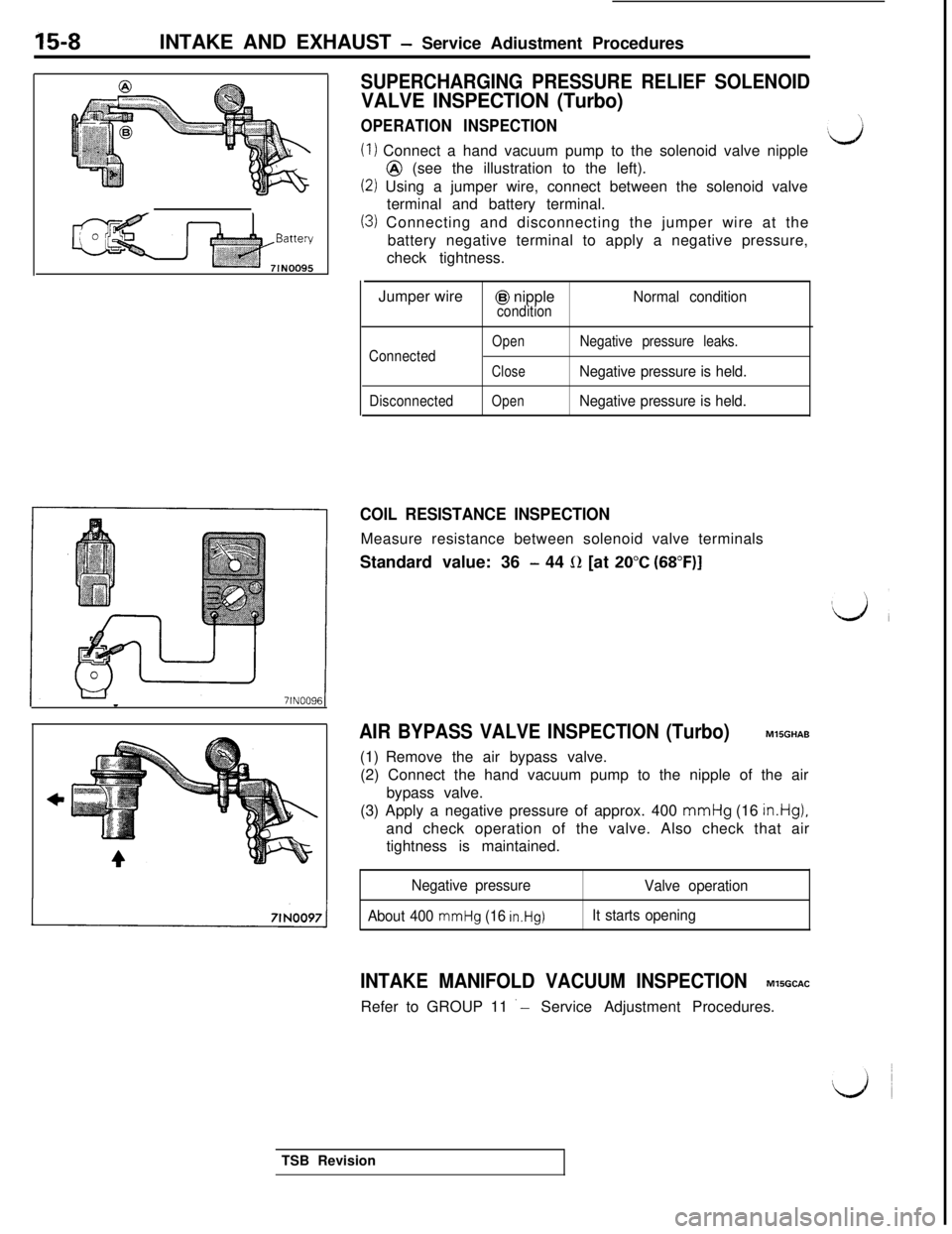
SUPERCHARGING PRESSURE RELIEF SOLENOID
VALVE INSPECTION (Turbo)
OPERATION INSPECTION
(1) Connect a hand vacuum pump to the solenoid valve nipple@ (see the illustration to the left).
(2) Using a jumper wire, connect between the solenoid valve
terminal and battery terminal.
(3) Connecting and disconnecting the jumper wire at the
battery negative terminal to apply a negative pressure,
check tightness.
Jumper wire
@I nippleNormal conditioncondition
Connected
Disconnected
OpenNegative pressure leaks.
CloseNegative pressure is held.
OpenNegative pressure is held.
COIL RESISTANCE INSPECTIONMeasure resistance between solenoid valve terminals
Standard value: 36
- 44 0 [at 20°C (68”F)I
AIR BYPASS VALVE INSPECTION (Turbo)MlSGHAB
(1) Remove the air bypass valve.
(2) Connect the hand vacuum pump to the nipple of the air
bypass valve.
(3) Apply a negative pressure of approx. 400 mmHg (16
in.Hg),and check operation of the valve. Also check that air
tightness is maintained.
Negative pressure
About 400
mmHg (16 in.Hg)
Valve operation
It starts opening
INTAKE MANIFOLD VACUUM INSPECTIONM’ISGCACRefer to GROUP 11
‘- Service Adjustment Procedures.
TSB Revision
Page 331 of 1146
INTAKE AND EXHAUST - Turbocharger (Rear)15-21
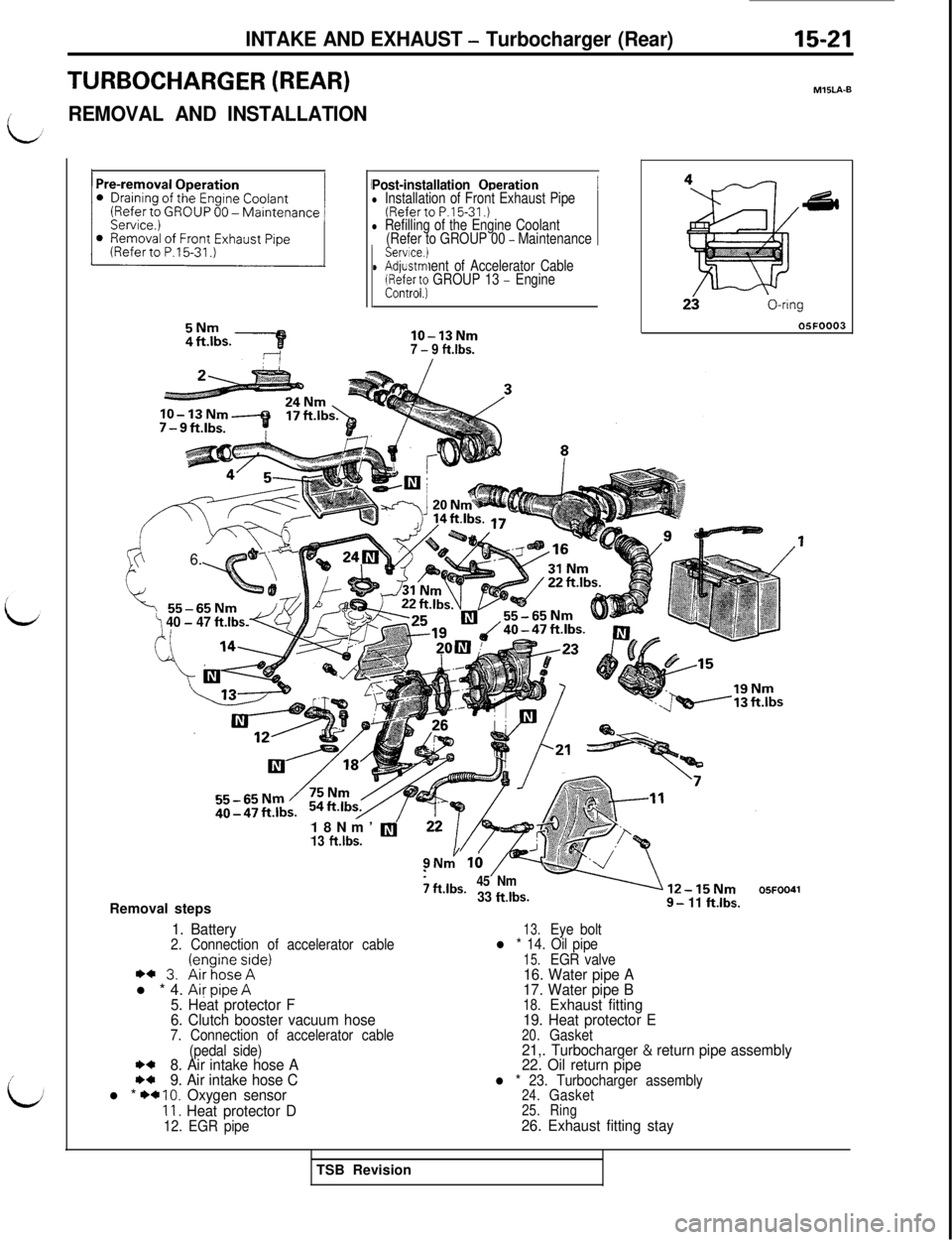
TURBOCHARGER (REAR)
iREMOVAL AND INSTALLATION
/
id
Post-installation ODerationIl Installation of Front Exhaust Pipe(Referto P.15-31.)l Refilling of the Engine Coolant
(Refer to GROUP 00 - Maintenance
l Adjustment of Accelerator Cable1~~~~o~~ GROUP 13 - Engine
lo-13Nm7 - 9 ft.lbs.
6.
7 55-65Nmb
5 40 - 47 ft.lbs.i18Nm’
d13 ft.lbs.
MlSLA-B
0-nng
05FOOO3Removal steps
1. Battery2. Connection of accelerator cable
** 3, pg,t;eye)l * 4.
AirpipeA5. Heat protector F
6. Clutch booster vacuum hose
7. Connection of accelerator cable
(pedal side)
I)+8. Air intake hose AO+9. Air intake hose Cl * I)* 10. Oxygen sensor
11. Heat protector D12. EGR pipe
9Nmv 10 //--!
-7 ft.lbs.45 Nm33 ft.lbs.LIZ-15NmOSFOO419- 11 ft.lbs.
13.Eye boltl * 14. Oil pipe15.EGR valve16. Water pipe A
17. Water pipe B
18.Exhaust fitting
19. Heat protector E
20.Gasket21,. Turbocharger & return pipe assembly
22. Oil return pipe
l * 23. Turbocharger assembly24.Gasket25.Ring26. Exhaust fitting stayTSB Revision
Page 354 of 1146
17-10EMISSION CONTROL - Evaporative Emission Control System
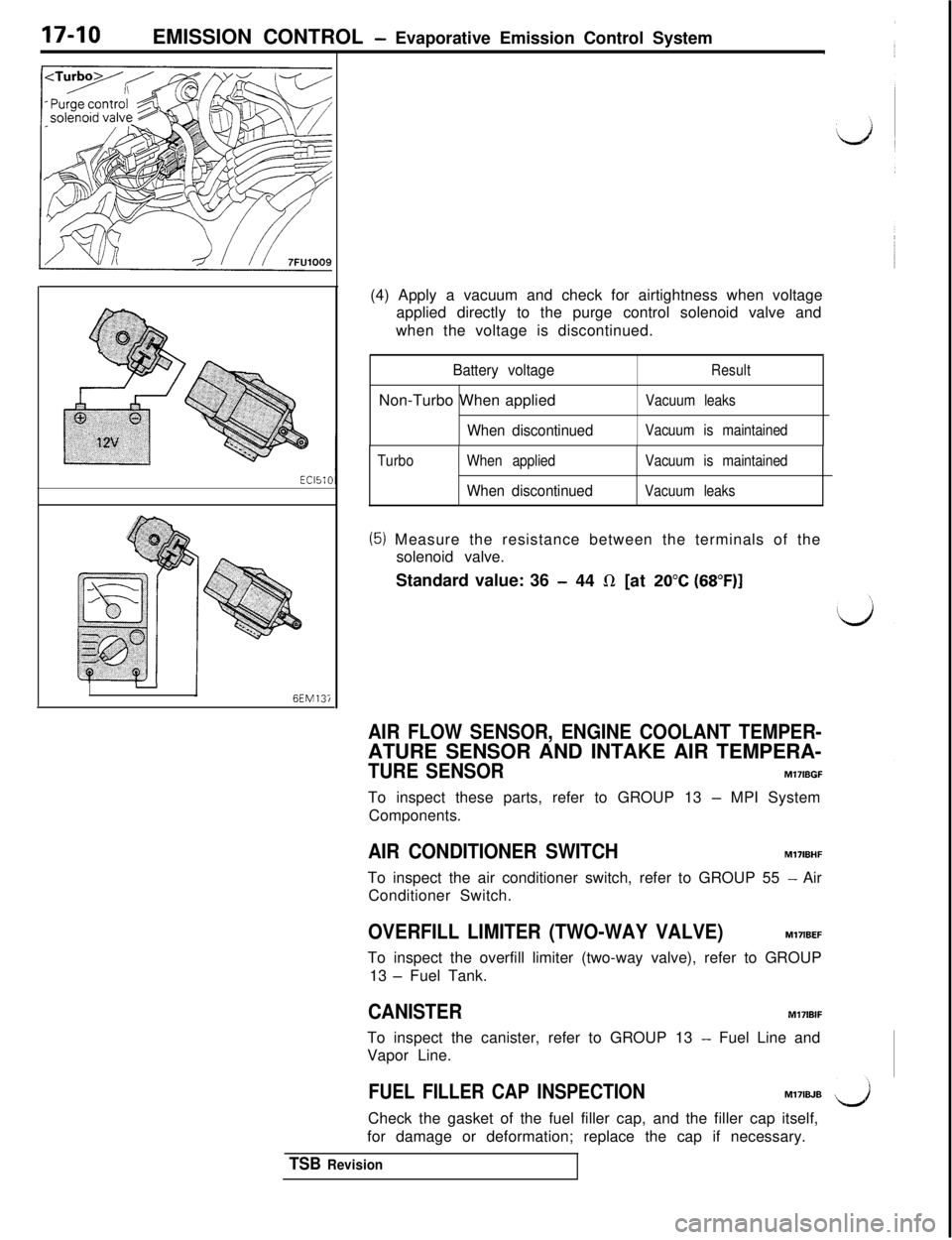
I-6EM13i(4) Apply a vacuum and check for airtightness when voltage
applied directly to the purge control solenoid valve and
when the voltage is discontinued.
Battery voltageResultNon-Turbo When applied
Vacuum leaks
When discontinuedVacuum is maintained
TurboWhen applied
When discontinued
Vacuum is maintained
Vacuum leaks
(5) Measure the resistance between the terminals of the
solenoid valve.
Standard value: 36
- 44 R [at 20°C (68”F)]
AIR FLOW SENSOR, ENGINE COOLANT TEMPER-ATURE SENSOR AND INTAKE AIR TEMPERA-
TURE SENSORM17lBGFTo inspect these parts, refer to GROUP 13
- MPI System
Components.
AIR CONDITIONER SWITCHMl7IBHF
To inspect the air conditioner switch, refer to GROUP 55
- Air
Conditioner Switch.
OVERFILL LIMITER (TWO-WAY VALVE)M17IBEFTo inspect the overfill limiter (two-way valve), refer to GROUP
13
- Fuel Tank.
CANISTERM17lBIFTo inspect the canister, refer to GROUP 13
- Fuel Line and
Vapor Line.
FUEL FILLER CAP INSPECTIONM17IBJBCheck the gasket of the fuel filler cap, and the filler cap itself,
for damage or deformation; replace the cap if necessary.
TSB Revision
Page 358 of 1146
17-14 EMISSION CONTROL -Exhaust Gas Recirculation (EGR) System / Catalytic Converter
6EM01871
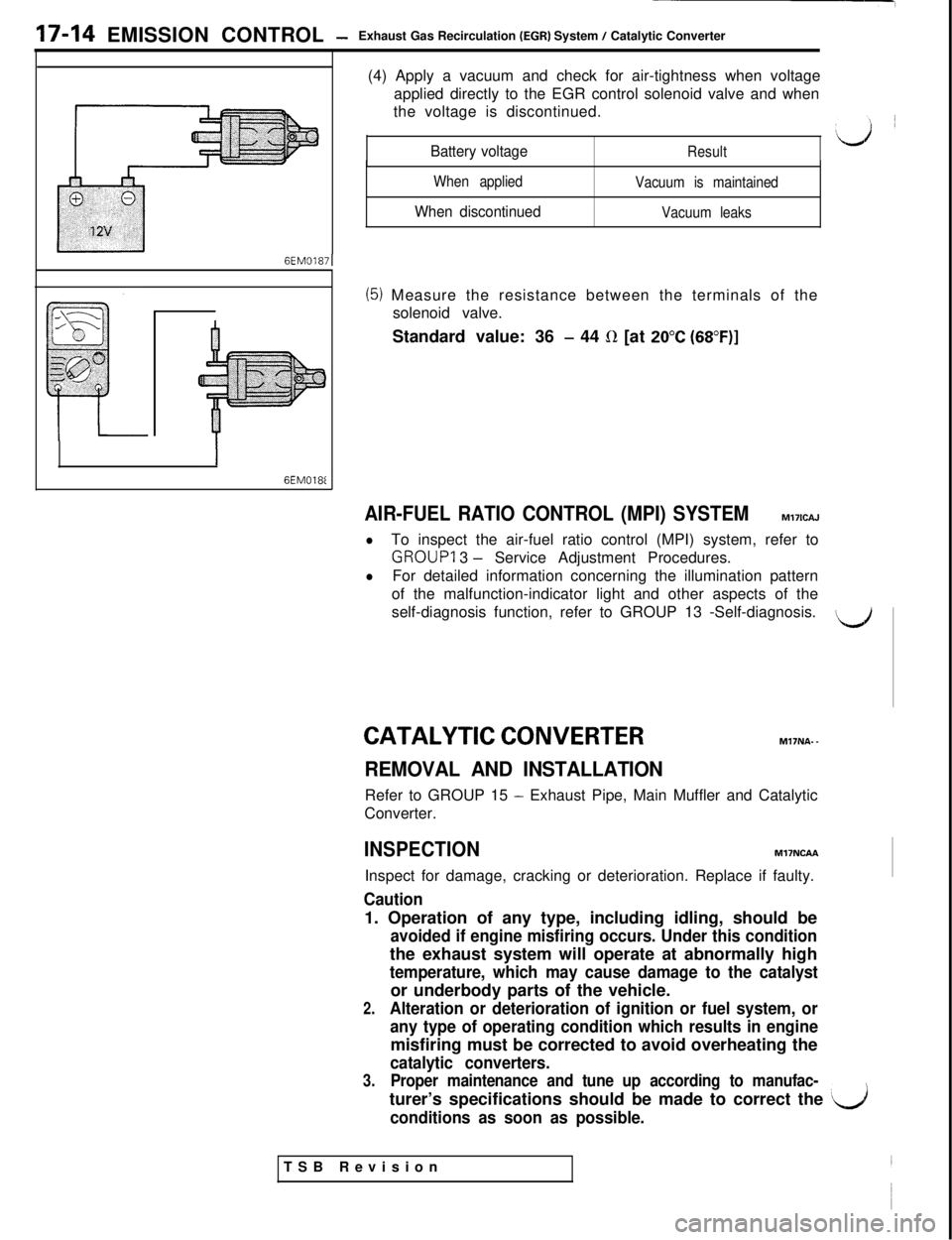
6EM0181(4) Apply a vacuum and check for air-tightness when voltage
applied directly to the EGR control solenoid valve and when
the voltage is discontinued.
Battery voltageResult
When applied
When discontinued
Vacuum is maintained
Vacuum leaks
(5) Measure the resistance between the terminals of the
solenoid valve.
Standard value: 36
- 44 R [at 20°C (68”F)]
AIR-FUEL RATIO CONTROL (MPI) SYSTEMM17ICAJ
lTo inspect the air-fuel ratio control (MPI) system, refer to
GROUP1 3 - Service Adjustment Procedures.
lFor detailed information concerning the illumination pattern
of the malfunction-indicator light and other aspects of the
self-diagnosis function, refer to GROUP 13 -Self-diagnosis.
\.J
CATALYTIC CONVERTERMl7N& -
REMOVAL AND INSTALLATIONRefer to GROUP 15
- Exhaust Pipe, Main Muffler and Catalytic
Converter.
INSPECTIONMl7NCAA
Inspect for damage, cracking or deterioration. Replace if faulty.
Caution1. Operation of any type, including idling, should be
avoided if engine misfiring occurs. Under this conditionthe exhaust system will operate at abnormally high
temperature, which may cause damage to the catalystor underbody parts of the vehicle.
2.Alteration or deterioration of ignition or fuel system, or
any type of operating condition which results in enginemisfiring must be corrected to avoid overheating the
catalytic converters.
3.Proper maintenance and tune up according to manufac-turer’s specifications should be made to correct the
‘bi
conditions as soon as possible.TSB Revision
Page 368 of 1146
a-10CLUTCH - Clutch Control
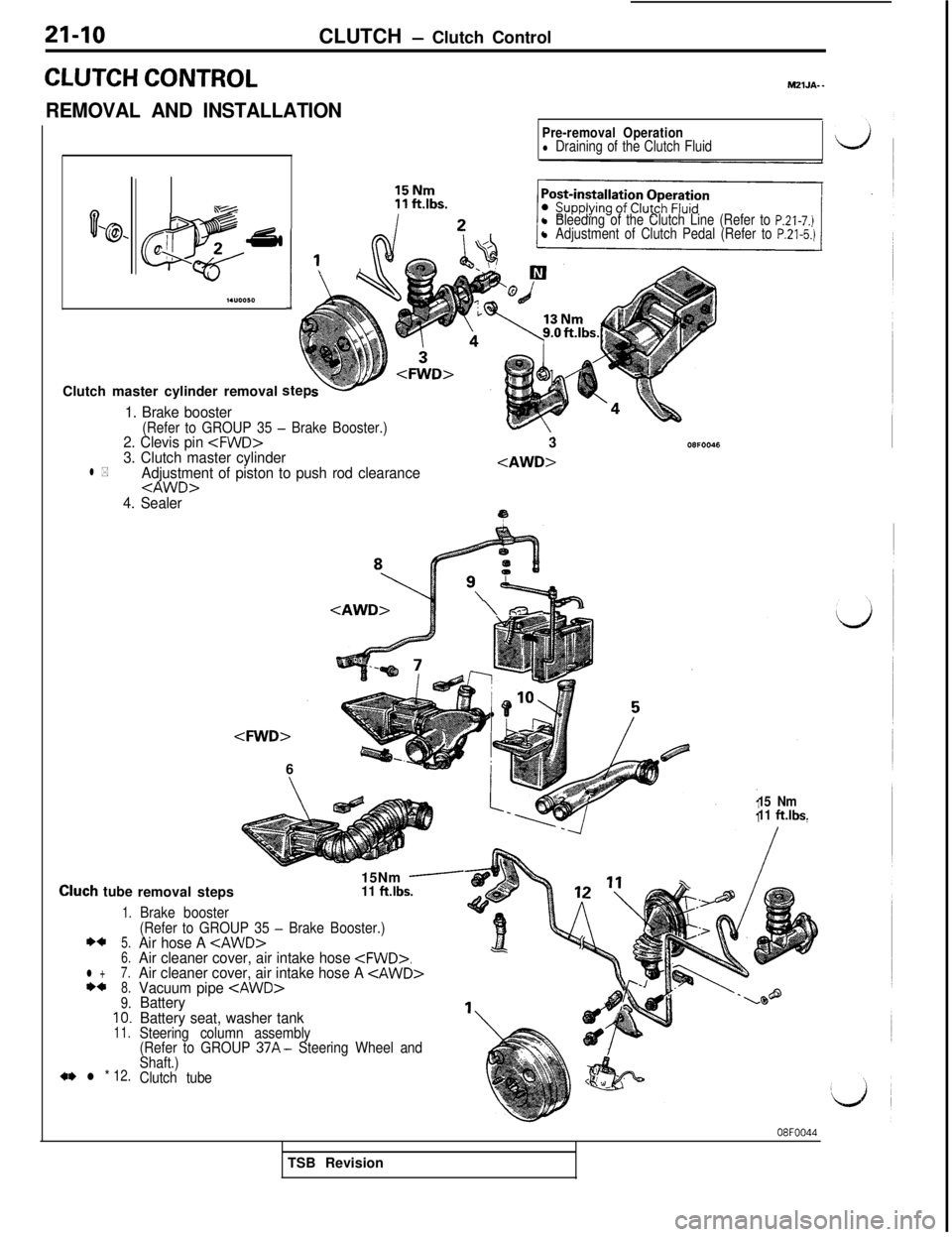
CLUTCH CONTROL
REMOVAL AND INSTALLATIONMZlJA-
-
03% J 2’ti
m
I.“0050I
Pre-removal Operationl Draining of the Clutch Fluid
l Bleeding of the Clutch Line (Refer to P.21-7.)l Adjustment of Clutch Pedal (Refer to P.21-5.)Clutch master cylinder removalstep
1. Brake booster(Refer to GROUP 35 - Brake Booster.)2. Clevis pin
4. Sealer3
9
Cluch tube
1.
**5.
6.
l +7.**8.9.IO.11.
a* l * 12.
removal steps
Brake booster15Nm
-11 ft.lbs.
(Refer to GROUP 35
- Brake Booster.)Air hose A
Battery seat, washer tank
Steering column assembly
(Refer to GROUP 37A- Steering Wheel and
Shaft.)
Clutch tube15 Nm
11
ft.lbs.
08FOO44TSB Revision