battery MITSUBISHI 3000GT 1991 User Guide
[x] Cancel search | Manufacturer: MITSUBISHI, Model Year: 1991, Model line: 3000GT, Model: MITSUBISHI 3000GT 1991Pages: 1146, PDF Size: 76.68 MB
Page 152 of 1146
13-46FUEL SYSTEM - On-vehicle Inspection of MPI Components
INSPECTIONUsing Multi-use Tester
FunctionItem No.DriveCheck condition
Check contentNormal statedActuator test 07
Fuel pump isl Engine cranking
Hold return hose withPulsation is felt
driven to cir-l Forced drive of fuelculate fuelfingers to feel pulsation
pump
Check is made forindicating fuel flow
above two conditions
Listen to pump operating
sound near fuel tankOperating sound isheard
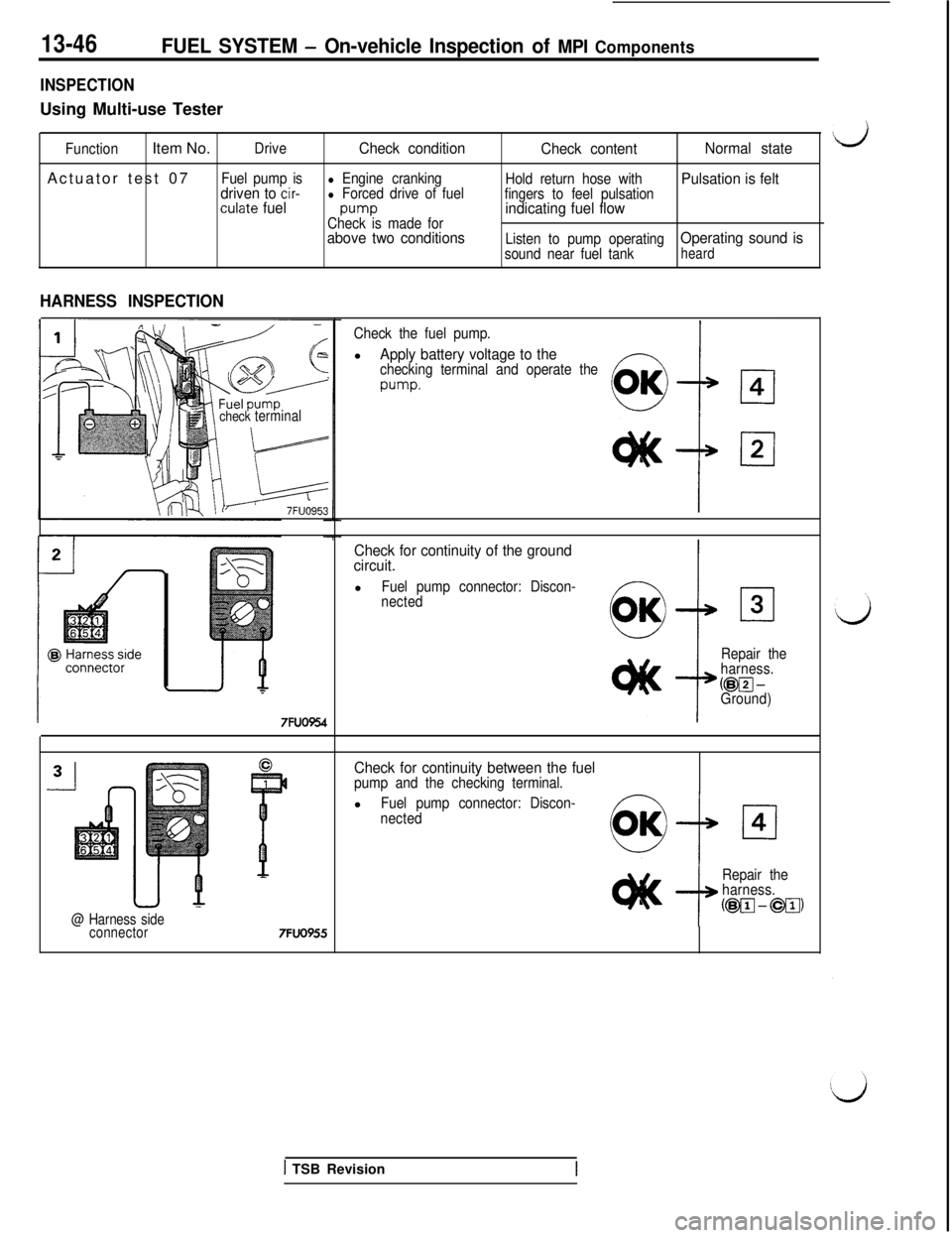
HARNESS INSPECTION
check terminal
7FUO954
@ Harness side
connector7FUO955
Check the fuel pump.l
Apply battery voltage to thechecking terminal and operate the
w-w
Check for continuity of the ground
circuit.l
Fuel pump connector: Discon-
nected
Repair the
harness.
@FJ-Ground)
Check for continuity between the fuelpump and the checking terminal.l
Fuel pump connector: Discon-
nectedcl4
Repair the
harness.
@vJ-@g)
1 TSB Revision
Page 156 of 1146
13-50FUEL SYSTEM - 0
n-vehicle Inspection of MPI Components
OPERATIONControl Relay Operation
l Drives the fuel pump during cranking and engine operation.
l
When the ignition switch is set to START, current flows from the ignition switch through the control relay
coil to ground. This turns on the control relay switch and drive power is supplied from the battery throughthe control relay switch to the fuel pump.
lWhile the engine is running, the engine control unit keeps the power transistor on and energizes the
control relay coil so that drive power is supplied to the fuel pump.
Fuel Pump Relay No. 2 Operation
lChange the fuel pump discharge in two stages by ON-OFF operation of the relay switch for fuel pumprelay No. 2.
lIf the amount of inlet air is small (the engine load is low), the engine control unit turns on the power
transistor to energize the coil of fuel pump relay No. 2, sending drive power to the fuel pump through the
resistor. If the amount of inlet air is large (the engine load is high), the engine control unit turns off thepower transistor to send drive power directly to the fuel pump without passing through the resistor.
INSPECTIONUsing Multi-use Tester
Function
ActuatortestItem No.
Operation
Check conditionCheck itemNormal condition
07Fuel pump isdriven to cir-l Engine crankingHold return hose withl Forced drive of fuelPulsation is felt
culate fuelfingers to feel pulsationpump
Check is made for aboveindicating fuel flow
two conditionsListen to pump operating
sound near fuel tankOperating sound isheard
I/IIII
cFunctionItem No.Operation
Check conditionNormal condition
Actuatortest
13Turn the fuel pump relayNo. 2 from OFF to ONIgnition switch: ONOperating soundis heard.
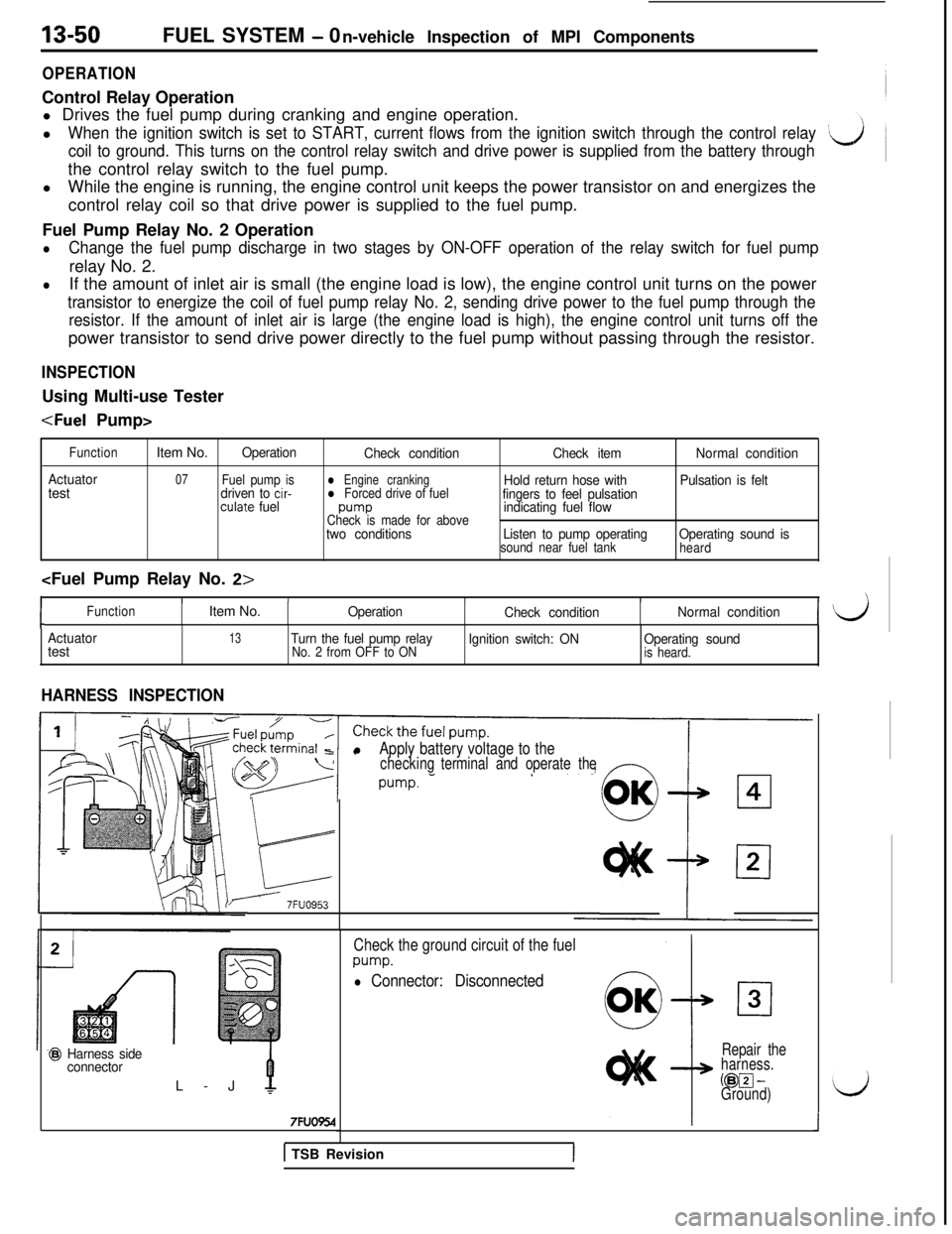
HARNESS INSPECTION
k
J------ 7FUO953
lApply battery voltage to thecheckingterminal and operate the
Check the ground circuit of the fuel
pump.
l Connector: Disconnected
@I Harness side
connectorL-J
7FUO554
Repair the
harness.
@pJ-Ground)
J
1 TSB Revision
Page 159 of 1146
FUEL SYSTEM - On-vehicle Inspection of MPI Components13-53
7FU104:
Fuel pump /resistor
///I/ \\/7FU1041
7FU1043
I-TSB I
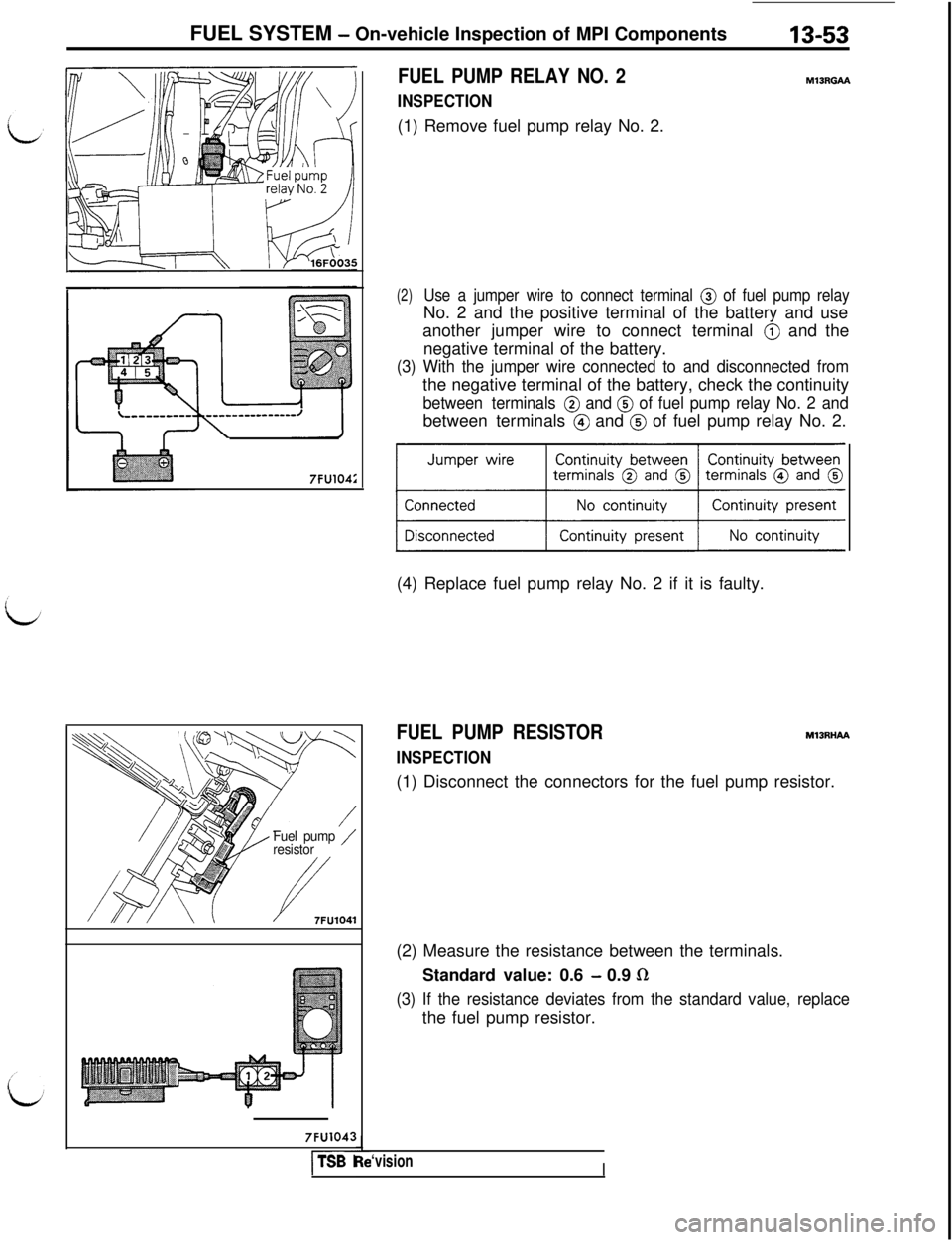
FUEL PUMP RELAY NO. 2
INSPECTION(1) Remove fuel pump relay No. 2.
M13RGAh
(2)Use a jumper wire to connect terminal @ of fuel pump relayNo. 2 and the positive terminal of the battery and use
another jumper wire to connect terminal
@ and the
negative terminal of the battery.
(3) With the jumper wire connected to and disconnected fromthe negative terminal of the battery, check the continuity
between terminals @ and @ of fuel pump relay No. 2 andbetween terminals
@ and @ of fuel pump relay No. 2.
(4) Replace fuel pump relay No. 2 if it is faulty.
FUEL PUMP RESISTOR
INSPECTION
MlBRHAA(1) Disconnect the connectors for the fuel pump resistor.
(2) Measure the resistance between the terminals.
Standard value: 0.6
- 0.9 LR
(3) If the resistance deviates from the standard value, replacethe fuel pump resistor.
‘visionI
Page 181 of 1146
FUEL SYSTEM - On-vehicle Inspection of MPI Components
L
L
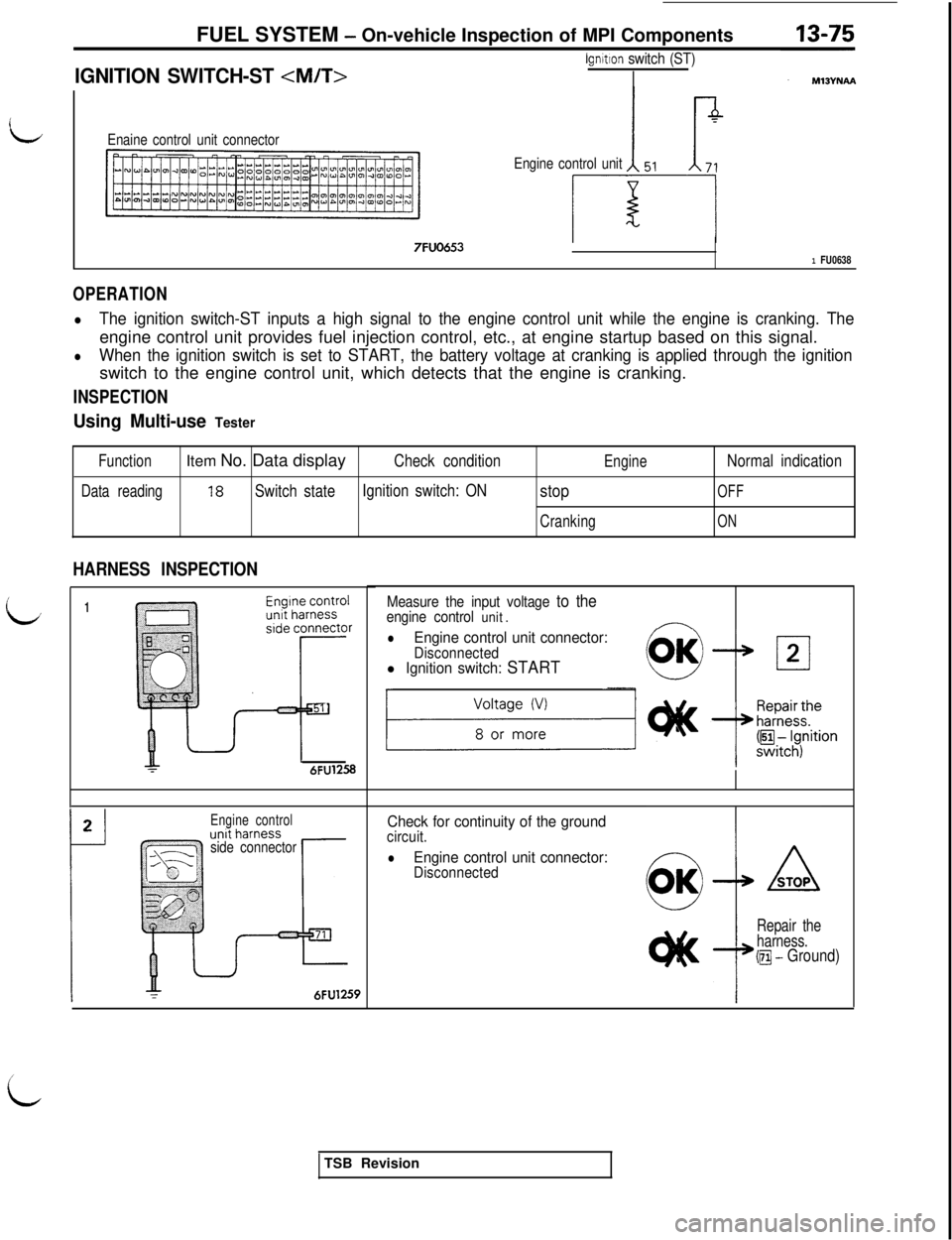
IGNITION SWITCH-ST
lgnitlon switch (ST)
I
Enaine control unit connector
7FUO653
Engine control unit
1 FU0638
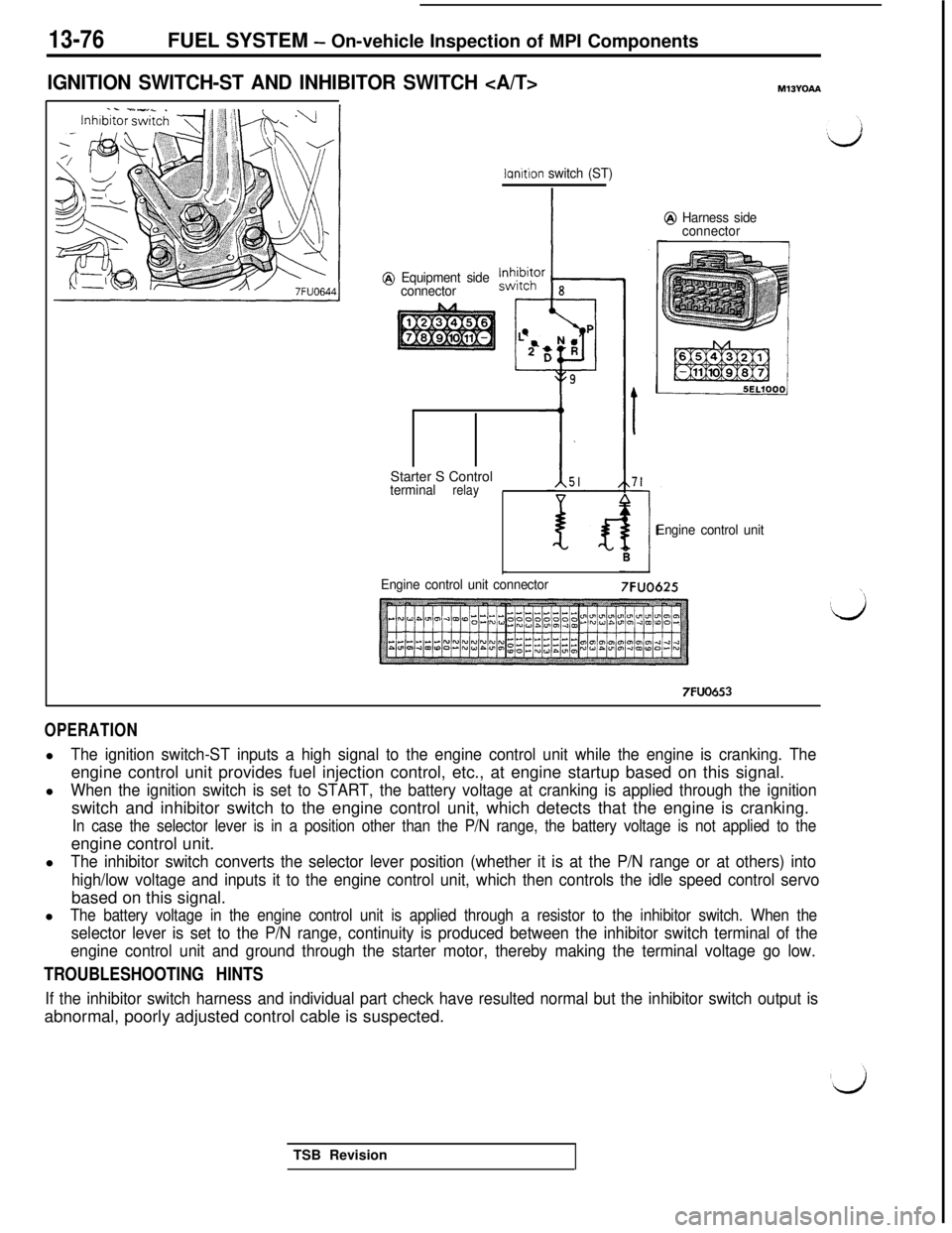
OPERATION
lThe ignition switch-ST inputs a high signal to the engine control unit while the engine is cranking. Theengine control unit provides fuel injection control, etc., at engine startup based on this signal.
lWhen the ignition switch is set to START, the battery voltage at cranking is applied through the ignitionswitch to the engine control unit, which detects that the engine is cranking.
INSPECTION
Using Multi-use Tester
FunctionItem No. Data displayCheck conditionEngineNormal indication
Data reading18Switch stateIgnition switch: ONstopOFF
CrankingON
HARNESS INSPECTION
1
L6FU1258
2
1
Engine control
side connector
IY-6FU1259
Measure the input voltage to theengine control unit.nlEngine control unit connector:Disconnectedl Ignition switch: START
Check for continuity of the groundcircuit.
lEngine control unit connector:Disconnected
Repair the
harness.
(m - Ground)
iTSB Revision
Page 182 of 1146
Page 186 of 1146

13-80FUEL SYSTEM - 0
n-vehicle Inspection of MPI Components
POWER STEERING OIL PRESSURE SWITCHMlOYQAA
B
$-
Engine control unit
'107
@ Harness side
connector
ml-
Power steering oil
Pressure switch
7FUO536700-2.000 1.500-2.000(100-284) (213-284)Pressure [kPa (psi)]
0, l.oIu
OPERATIONl
The power steering oil pressure switch converts presence/absence of power steering load into low/high
voltage and inputs it to the engine control unit, which then controls the idle speed control servo based on
this signal.l The battery voltage in the engine control unit is applied through a resistor to the power steering oil
pressure switch. Steering operation causes the power steering oil pressure to increase, turning the
switch on. As a result, continuity is produced between the battery voltage applied and ground. This
causes the power steering oil pressure terminal voltage to go from high to low.
TSB Revision
Page 188 of 1146

13-82FUEL SYSTEM - On-vehicle Inspection of MPI Components
AIR CONDITIONER SWITCH AND POWER RELAY
\
*I \\-- \
Air conditronerAir conditioner
control unitAir conditioner
compressor lock
controllerr
Engine control unit
Dual pressureswitch
M13YRAA2
b1IFF
Air conditioner
compressor
Engine control
unit connector
7FUO966
7FUO653
OPERATION
lThe air conditioner switch applies the battery voltage to the engine control unit when the air conditioner is
turned on.
lWhen the air conditioner ON signal is input, the engine control unit drives the idle speed control servo and
turns ON the power transistor. As a result, the air conditioner power relay coil is energized to turn on therelay switch, which activates the air compressor magnetic clutch.
TROUBLESHOOTING HINTS
If the air compressor magnet clutch is not activated when the air conditioner switch is turned on during idling,faulty air conditioner control system is suspected.
INSPECTION
Using Multi-use Tester
AIR CONDITIONER SWITCH
Function1 Item No. 1 Data display 1Check condition) Air conditioner switch 1 Normal indication IData reading 28
Switch stateEngine: Idling (airOFFOFFcompressor to be running
when air conditionerONONswitch is ON)\k”JTSB Revision
Page 192 of 1146
13-86FUEL SYSTEM - On-vehicle Inspection of MPI Components
ELECTRICAL LOAD SWITCH16FO29;
Tail-lightrelayDefog.wrelaystoplight
t;1
switch
ti* . .
Engine control unit connector
Engine
control
unit7FUO653
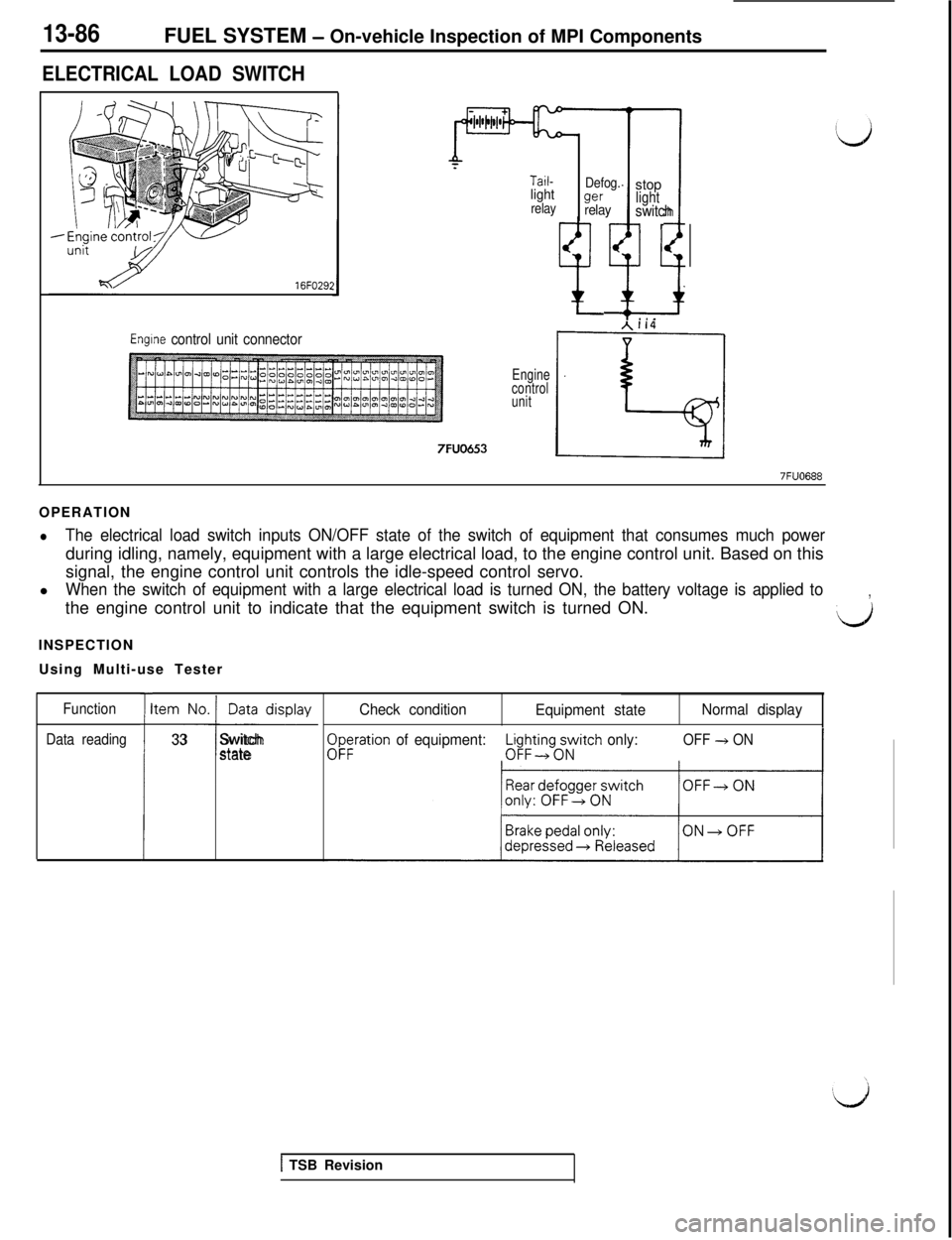
7FUO688OPERATION
lThe electrical load switch inputs ON/OFF state of the switch of equipment that consumes much powerduring idling, namely, equipment with a large electrical load, to the engine control unit. Based on this
signal, the engine control unit controls the idle-speed control servo.
l
When the switch of equipment with a large electrical load is turned ON, the battery voltage is applied tothe engine control unit to indicate that the equipment switch is turned ON.,
LJINSPECTION
Using Multi-use Tester
Function
Data reading
I
tem No. Data display
-I-
33Switchstate
Check condition
Equipment stateNormal display
$;ration of equipment:L$ing;Atch only:OFF + ON-3
1 TSB Revision
Page 194 of 1146
13-88FUEL SYSTEM - On-vehicle Inspection of MPI Components
MUFFLER MODE CHANGEOVER SWITCH
Engine control unit
r
@ Equipment sideconnector3
-Muffler
modeOFF changeover
ONswitch
2
r
7FU1053
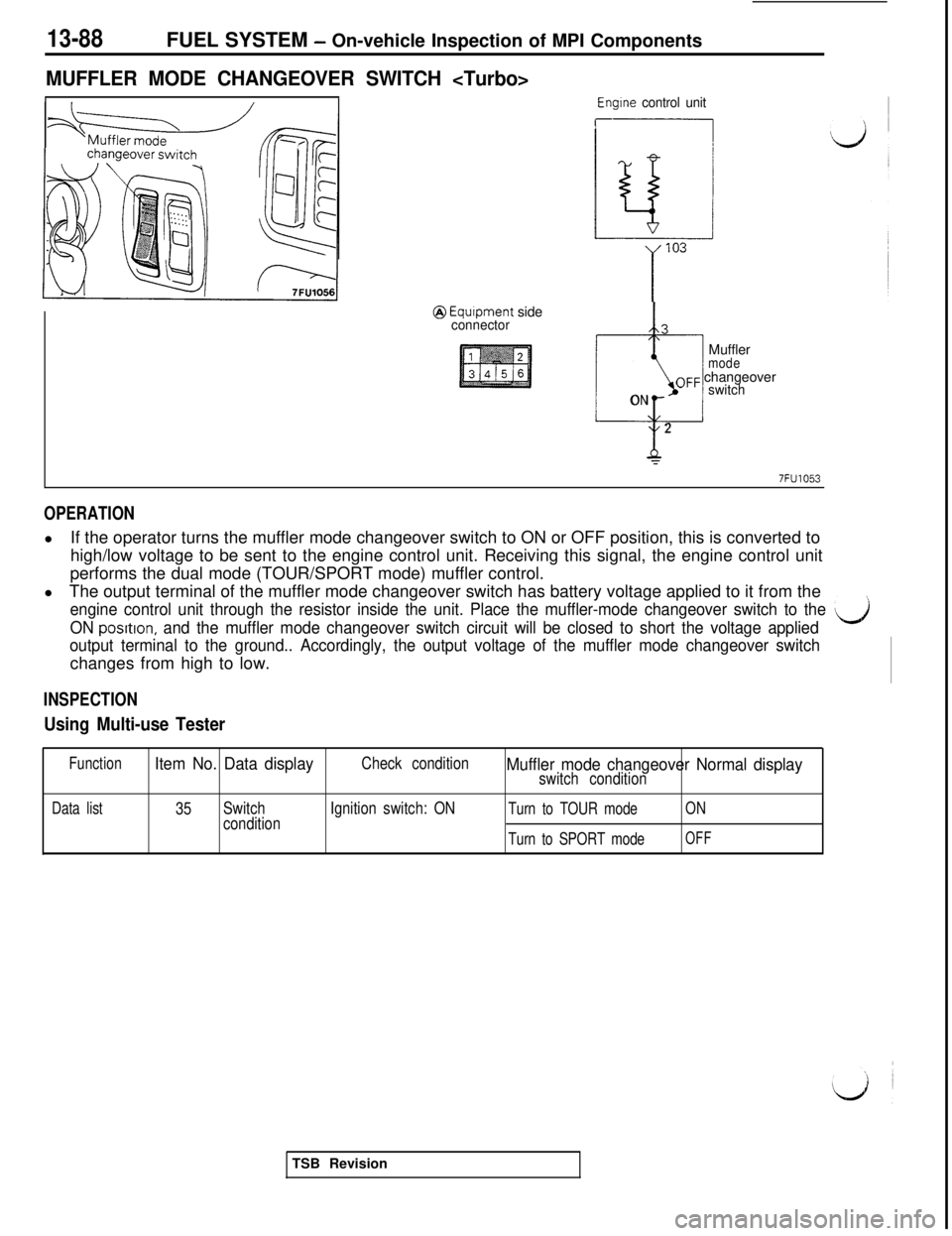
OPERATIONlIf the operator turns the muffler mode changeover switch to ON or OFF position, this is converted to
high/low voltage to be sent to the engine control unit. Receiving this signal, the engine control unit
performs the dual mode (TOUR/SPORT mode) muffler control.
lThe output terminal of the muffler mode changeover switch has battery voltage applied to it from the
engine control unit through the resistor inside the unit. Place the muffler-mode changeover switch to the ‘LJj
ON posrtton, and the muffler mode changeover switch circuit will be closed to short the voltage applied
output terminal to the ground.. Accordingly, the output voltage of the muffler mode changeover switchchanges from high to low.
INSPECTION
Using Multi-use Tester
FunctionItem No. Data displayCheck conditionMuffler mode changeover Normal displayswitch condition
Data list35Switch
conditionIgnition switch: ONTurn to TOUR mode
Turn to SPORT modeON
OFFTSB Revision
Page 200 of 1146
FUEL SYSTEM - On-vehicle Inspection of MPI Components
OXYGEN SENSOR
7FUO786
Theoretical A/F
14
1516A/FEClOOiControl relay
2 dI 1:
Engine control unit
@ Equipment side
connector
7FUO969
Engine control unit connector
7FUO653
OPERATION
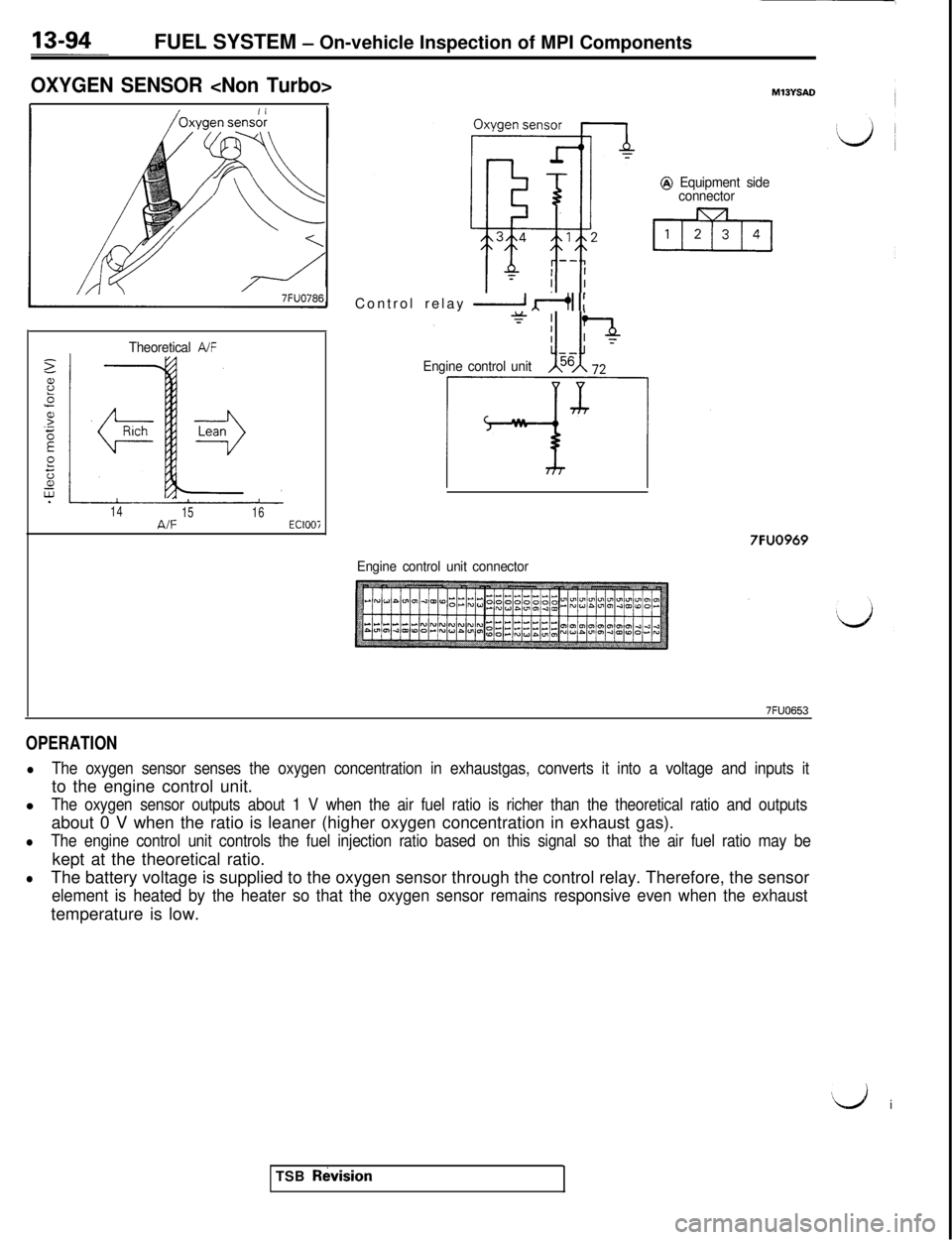
lThe oxygen sensor senses the oxygen concentration in exhaustgas, converts it into a voltage and inputs itto the engine control unit.
l
The oxygen sensor outputs about 1 V when the air fuel ratio is richer than the theoretical ratio and outputsabout 0 V when the ratio is leaner (higher oxygen concentration in exhaust gas).
lThe engine control unit controls the fuel injection ratio based on this signal so that the air fuel ratio may bekept at the theoretical ratio.
lThe battery voltage is supplied to the oxygen sensor through the control relay. Therefore, the sensor
element is heated by the heater so that the oxygen sensor remains responsive even when the exhausttemperature is low.
‘d i
TSB
RtkisionI