belt MITSUBISHI 3000GT 1991 Owner's Manual
[x] Cancel search | Manufacturer: MITSUBISHI, Model Year: 1991, Model line: 3000GT, Model: MITSUBISHI 3000GT 1991Pages: 1146, PDF Size: 76.68 MB
Page 93 of 1146
/
iENGINE
- Oil Pan and Oil Pump11-43
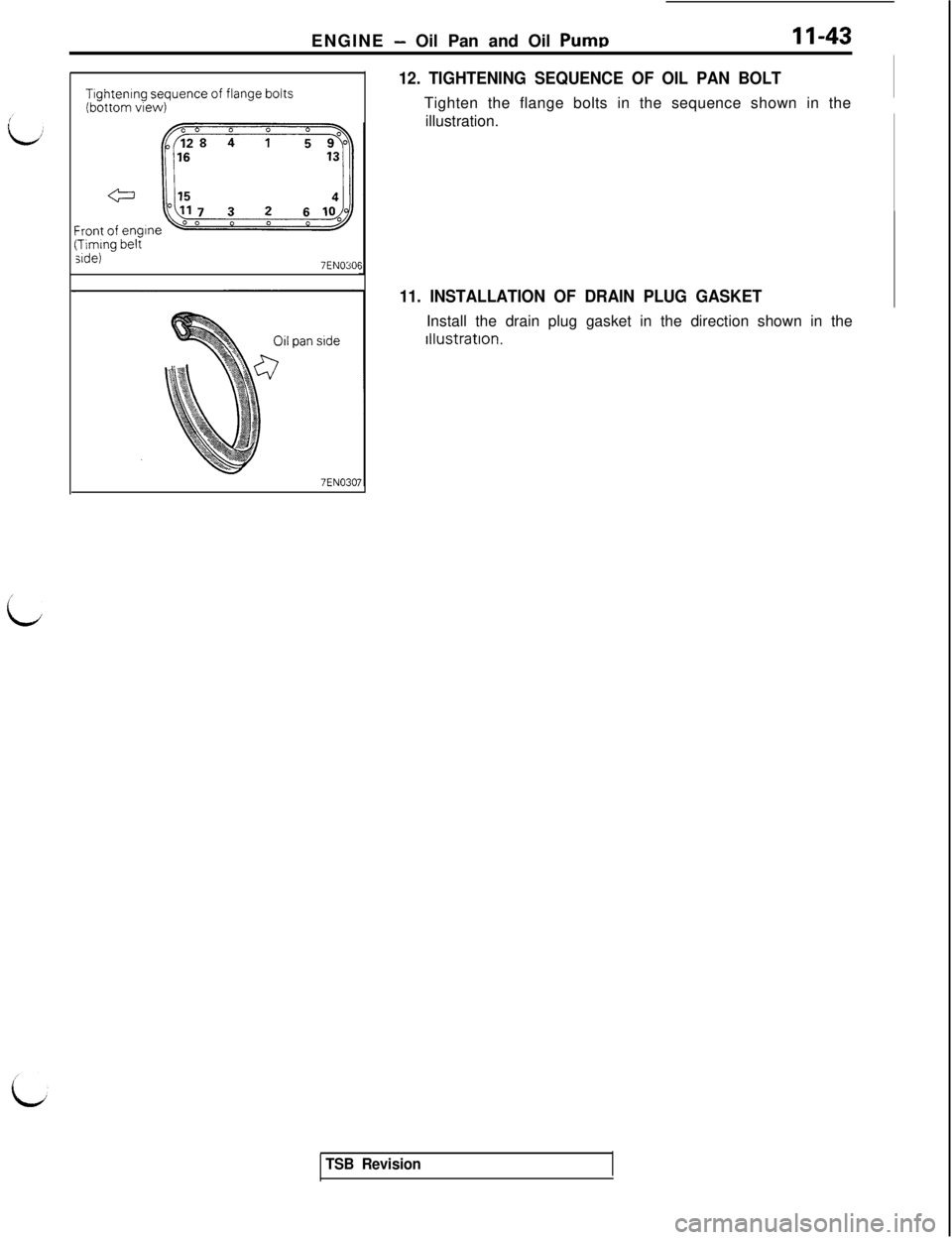
Tlghtenlng sequence of flange bolts(bottom view)
iTiming beltside)7EN030f
7EN030
12. TIGHTENING SEQUENCE OF OIL PAN BOLTTighten the flange bolts in the sequence shown in the
illustration.illustration.
11. INSTALLATION OF DRAIN PLUG GASKETInstall the drain plug gasket in the direction shown in the
TSB Revision
Page 98 of 1146
11-48ENGINE - Piston and Connecting Rod
Side railNo.1
spacer slotrail
6ENO41
7EN0032
Cylindcnumbe
Stopper notch4. INSTALLATION OF PISTON, CONNECTING ROD~
ASSEMBLY
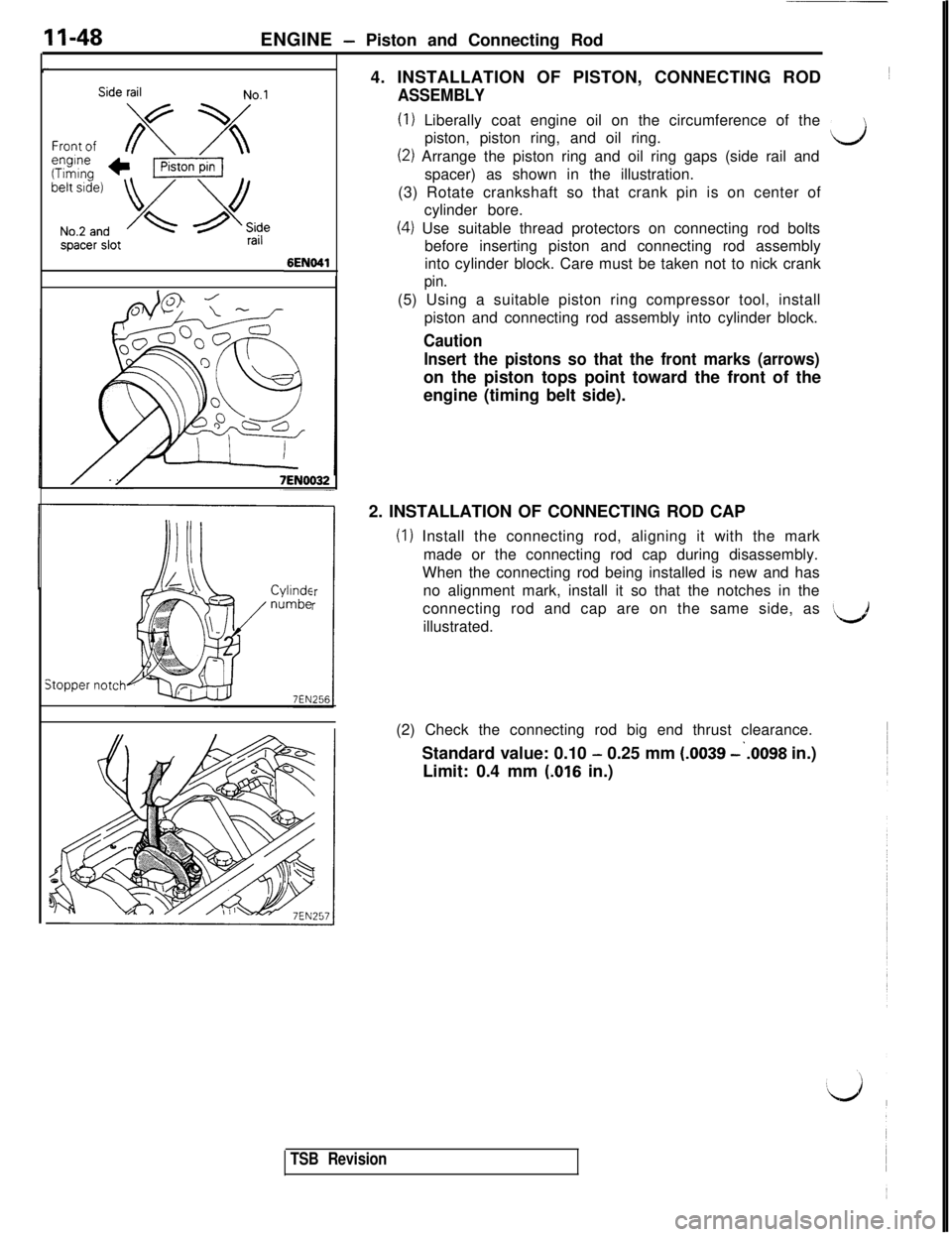
(1) Liberally coat engine oil on the circumference of the
piston, piston ring, and oil ring.
d
(2) Arrange the piston ring and oil ring gaps (side rail and
spacer) as shown in the illustration.
(3) Rotate crankshaft so that crank pin is on center of
cylinder bore.
(4) Use suitable thread protectors on connecting rod bolts
before inserting piston and connecting rod assembly
into cylinder block. Care must be taken not to nick crank
pin.(5) Using a suitable piston ring compressor tool, install
piston and connecting rod assembly into cylinder block.
Caution
Insert the pistons so that the front marks (arrows)on the piston tops point toward the front of the
engine (timing belt side).
2. INSTALLATION OF CONNECTING ROD CAP
(1) Install the connecting rod, aligning it with the mark
made or the connecting rod cap during disassembly.
When the connecting rod being installed is new and has
no alignment mark, install it so that the notches in the
connecting rod and cap are on the same side, as
illustrated.
‘d(2) Check the connecting rod big end thrust clearance.
Standard value: 0.10
- 0.25 mm (.0039 -‘.0098 in.)
Limit: 0.4 mm
(-016 in.)
TSB Revision
Page 101 of 1146
ENGINE - Crankshaft. Flvwheel and Drive Plate11-51
id
PLASTIGAGE METHODMllUlAA
Plastigage may be used to measure the clearance.
(1) Remove oil and grease and any other dirt from bearings and
journals.(2) Cut plastigage to the same length as the width of the
bearing and place it in parallel with the journal, off oil holes.
(3) Install the crankshaft, bearings and caps and tighten them
to the specified torques. During this operation, do NOT turn
the crankshaft. Remove the caps. Measure the width-of the
plastigage at the widest part by using a scale printed on the
plastigage sleeve.
If the clearance exceeds the repair limit, the bearing should
be replaced.
Should the standard clearance not be obtained even after
bearing replacement, replace the crankshaft.
SERVICE POINTS OF INSTALLATIONMllUDAM
16. INSTALLATION OF CRANKSHAFT BEARING (UPPER) /
15.10. THRUST BEARING A / 14.11. THRUST BEARING
B
/ 12. CRANKSHAFT BEARING (LOWER)
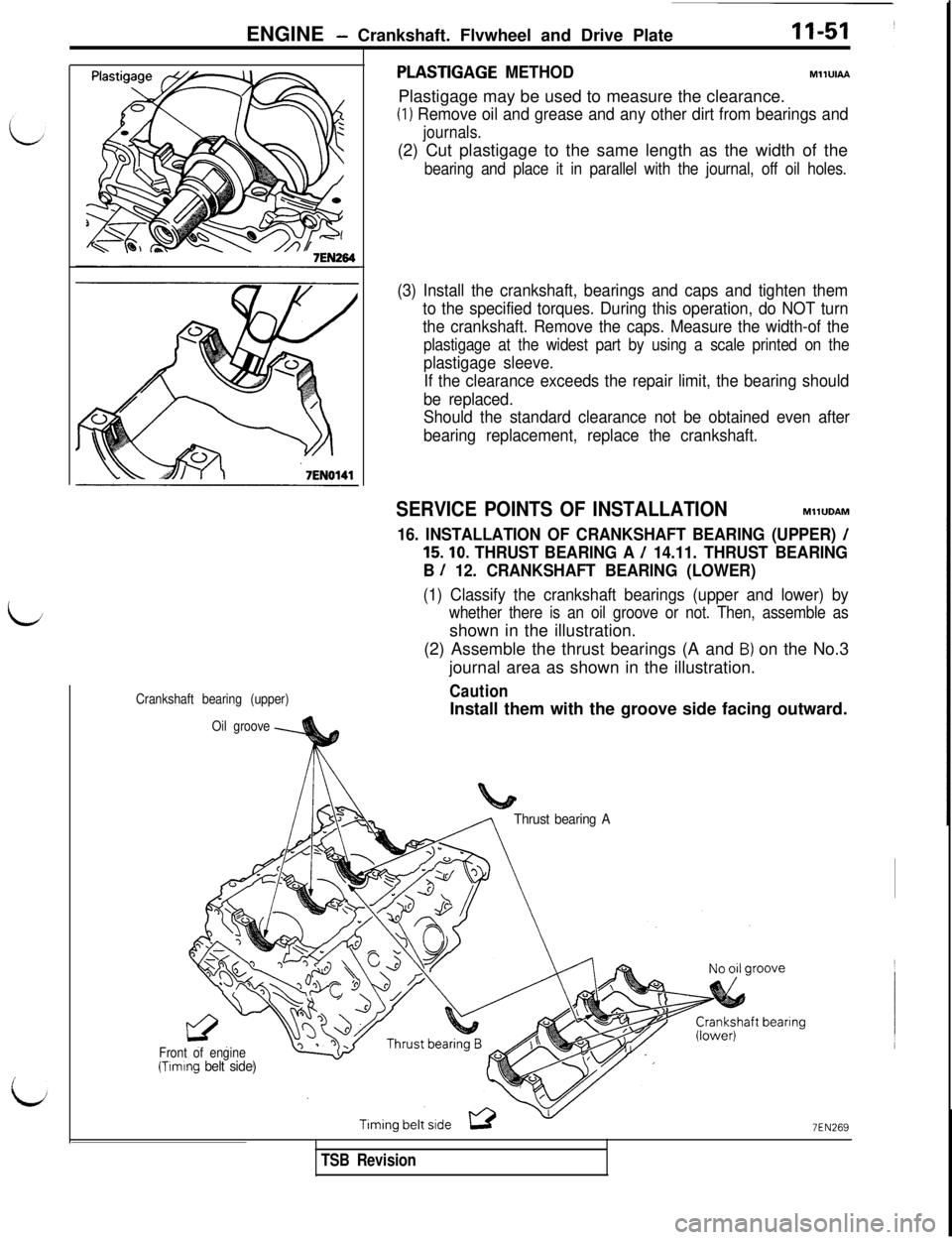
(1) Classify the crankshaft bearings (upper and lower) by
whether there is an oil groove or not. Then, assemble asshown in the illustration.
(2) Assemble the thrust bearings (A and
B) on the No.3
journal area as shown in the illustration.
CautionInstall them with the groove side facing outward.Crankshaft bearing (upper)
Oil groove
Thrust bearing A
Front of engine(Tlmlng belt side)
EN269
TSB Revision
Page 102 of 1146
11-52ENGINE - Crankshaft, Flywheel and Drive Plate
9. INSTALLATION OF BEARING CAP
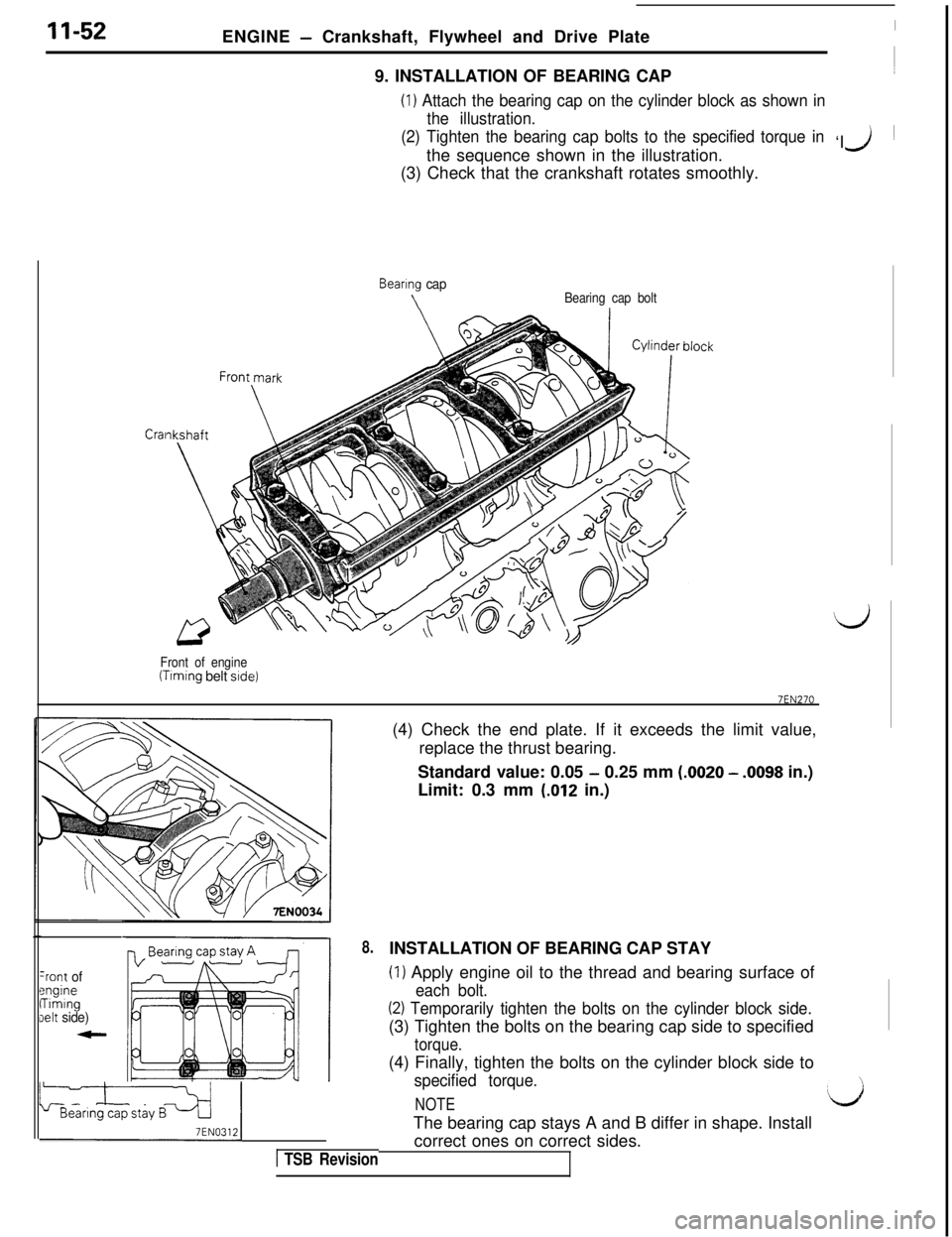
(1) Attach the bearing cap on the cylinder block as shown in
the illustration.
(2) Tighten the bearing cap bolts to the specified torque in‘I
the sequence shown in the illustration.
J ~
(3) Check that the crankshaft rotates smoothly.
Cral
Bearing cap
\Bearing cap bolt
Front of engine
(Timing belt side)
7EN270(4) Check the end plate. If it exceeds the limit value,
replace the thrust bearing.
Standard value: 0.05
- 0.25 mm (.0020 - .0098 in.)
Limit: 0.3 mm
(.012 in.)
-rent ofengineTimingIelt side)
8.
LLiN03,ij
1 TSB RevisionINSTALLATION OF BEARING CAP STAY
(1) Apply engine oil to the thread and bearing surface of
each bolt.
(2) Temporarily tighten the bolts on the cylinder block side.(3) Tighten the bolts on the bearing cap side to specified
torque.(4) Finally, tighten the bolts on the cylinder block side to
specified torque.
NOTEThe bearing cap stays A and B differ in shape. Install
correct ones on correct sides.d
Page 178 of 1146

13-72FUEL SYSTEM - On-vehicle Inspection of MPI Components
CRANK ANGLE SENSOR
co.ntiector
Output characteristic
LTime
7FUO682
MllYiAC
Control relay-I-
Crank angle sensorsideA3
Crank angle sensor/\
‘=
Engine controlunft69I
1
h5v
7FUO499
OPERATIONl
The crank angle sensor senses the crank angle (piston position) of each cylinder, converts it into a pulse
signal and inputs it to the engine control unit, which then computes the engine speed and controls the fuelinjection timing and ignition timing based on the input signal.
lPower to the crank angle sensor is supplied from the control relay and is grounded to the body. The crank
angle sensor generates a pulse signal as it repeatedly connects and disconnects between 5 V voltagesupplied from the engine control unit and ground.
TROUBLESHOOTING HINTSHint 1: If unexpected shocks are felt during driving or the engine stalls suddenly during idling, shake the
crank angle sensor harness. If this causes the engine to stall, poor contact of the sensor connector is
suspected.Hint 2: If the crank angle sensor outputs a pulse signal when the ignition switch is turned ON (with the
engine not running), a faulty crank angle sensor or engine control unit is suspected.
Hint 3:
If the tachometer reads 0 rpm when the engine that has failed to start is cranked, faulty crank angleHint 4:sensor or broken timing belt is suspected.
If the tachometer reads 0 rpm when the engine that has failed to start is cranked, the primary current
of the ignition coil is not turned on and off. Therefore, troubles in the ignition circuit and ignition coil orfaulty power transistor is suspected.
Hint 5: If the engine can be run at idle even though the crank angle sensor reading is out of specification,troubles are often in other than the crank angle sensor.
[Examples](1) Faulty engine coolant temperature sensor
(2) Faulty idle speed control servo
(3) Poorly adjusted reference idle speed
TSB Revision
Page 307 of 1146
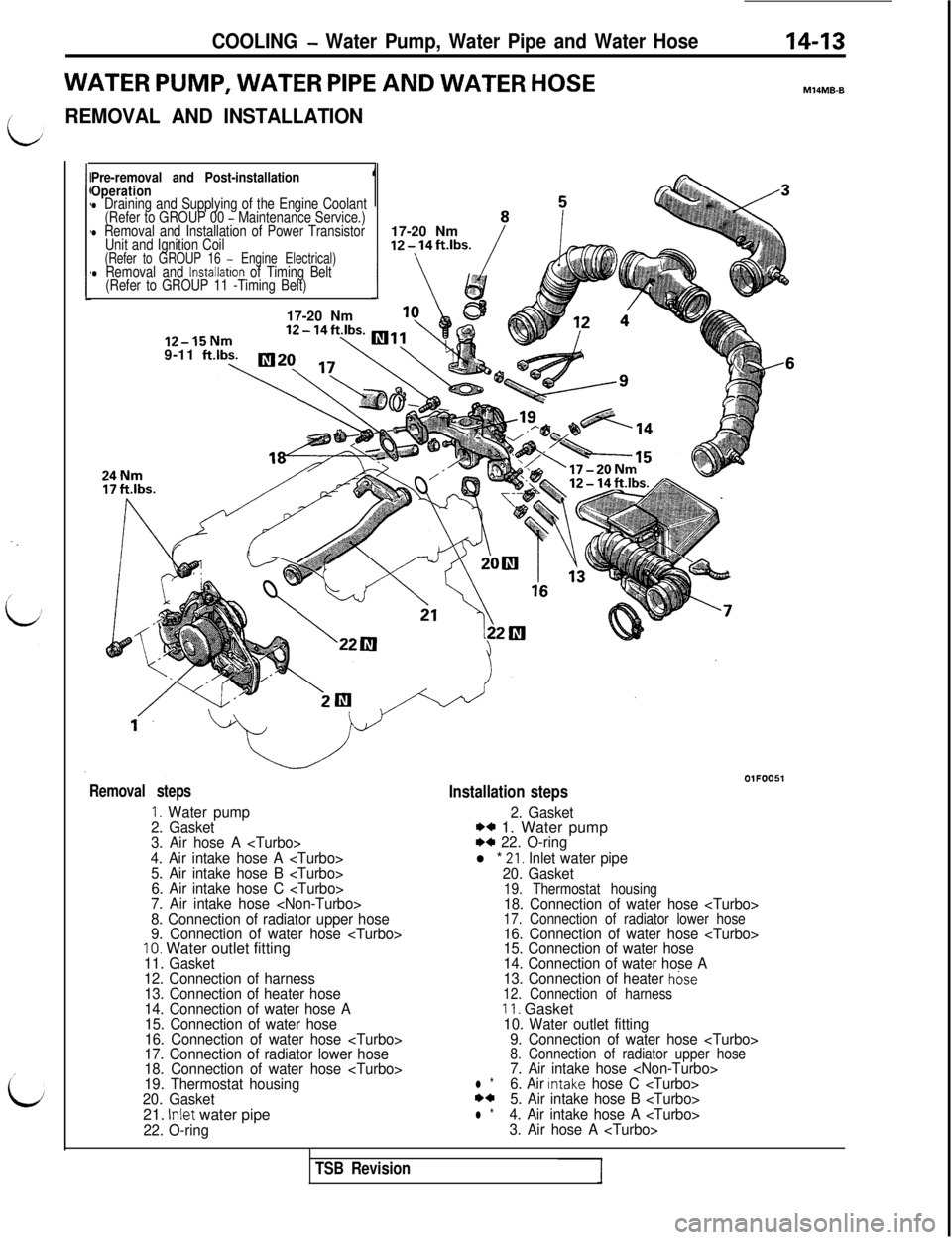
COOLING - Water Pump, Water Pipe and Water Hose
WATER PUMP, WATER PIPE AND WATER HOSE
14-13
M14MB-B
/REMOVAL AND INSTALLATION
Pre-removal and Post-installation
Operation
l Draining and Supplying of the Engine Coolant
(Refer to GROUP 00 - Maintenance Service.)l Removal and Installation of Power Transistor
Unit and Ignition Coil
(Refer to GROUP 16 - Engine Electrical)l Removal and lnstallatlon of Timing Belt
(Refer to GROUP 11 -Timing Belt)17-20 Nm17-20 Nm
12-14ft.lbs.
1
12-15Nm9-11 ft.1bs.q
Removal steps
1. Water pump
2. Gasket
3. Air hose A
4. Air intake hose A
5. Air intake hose B
6. Air intake hose C
7. Air intake hose
8. Connection of radiator upper hose
9. Connection of water hose
IO. Water outlet fitting11. Gasket
12. Connection of harness
13. Connection of heater hose
14. Connection of water hose A
15. Connection of water hose
16. Connection of water hose
17. Connection of radiator lower hose
18. Connection of water hose
19. Thermostat housing
20. Gasket21.
Her water pipe22. O-ringOlFOO51
Installation steps
2. Gasket** 1. Water pumpI)+ 22. O-ring
l * 21. Inlet water pipe
20. Gasket
19. Thermostat housing18. Connection of water hose
15. Connection of water hose
14. Connection of water hose A
13. Connection of heater h&e
12. Connection of harness11. Gasket10. Water outlet fitting
9. Connection of water hose
8. Connection of radiator upper hose7. Air intake hose
3. Air hose A
TSB Revision
Page 326 of 1146
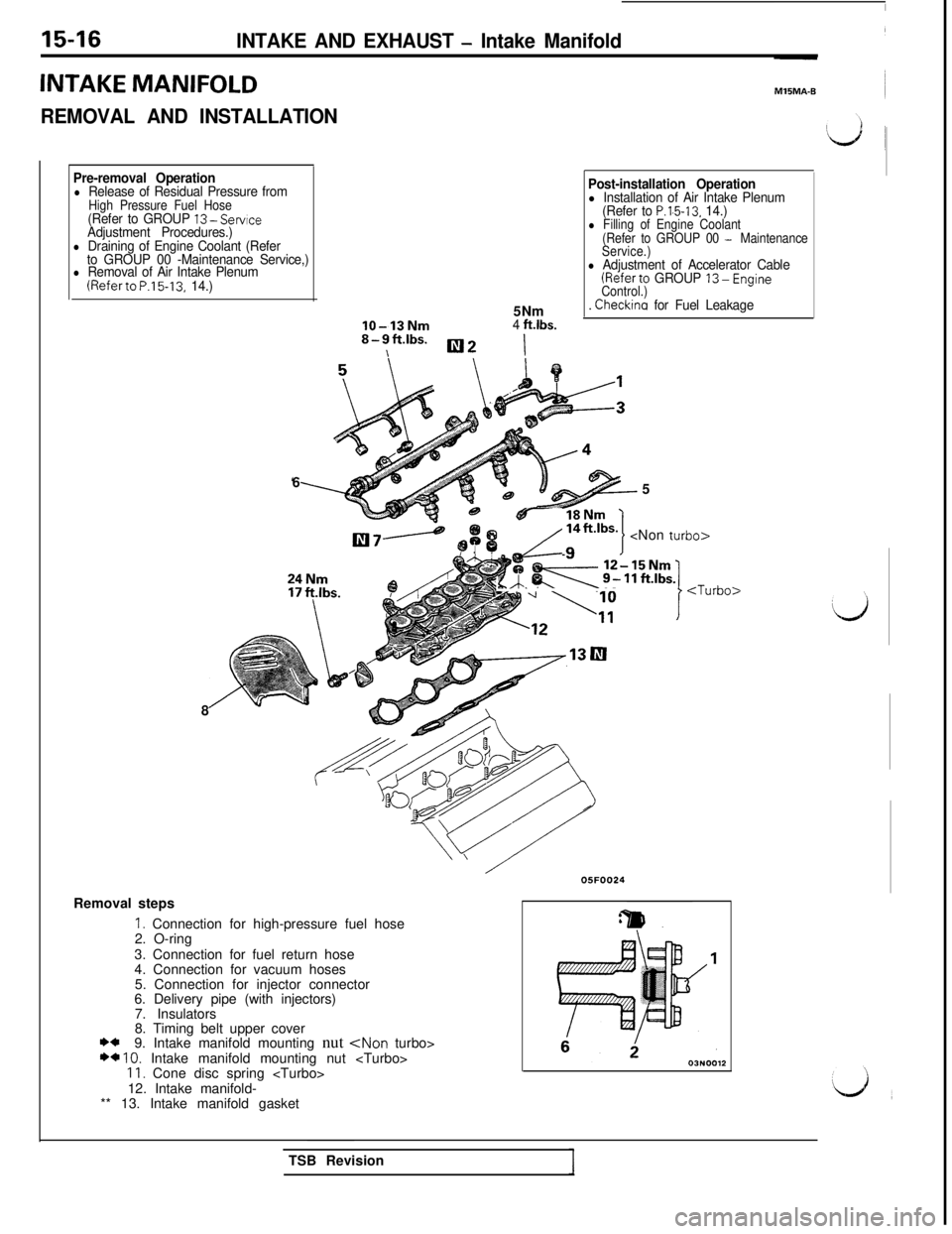
15-16INTAKE AND EXHAUST - Intake Manifold
INTAKE MANIFOLD
REMOVAL AND INSTALLATION
Pre-removal Operationl Release of Residual Pressure fromHigh Pressure Fuel Hose(Refer to GROUP 13-ServiceAdjustment Procedures.)l Draining of Engine Coolant (Refer
to GROUP 00 -Maintenance Service,)
l Removal of Air Intake Plenum(Referto P.15-13, 14.)5Nm
lo-13Nm4 ft.lbs.8-9ftJbs. w2\I
Post-installation Operationl Installation of Air Intake Plenum
(Refer to P.1.5-13. 14.)l Filling of Engine Coolant
(Refer to GROUP 00 - Maintenance
Service.)
l Adjustment of Accelerator Cable(Referto GROUP 13-EngineControl.). Checkina for Fuel Leakage6
5
2 :‘;bs.)
gp,.qgs ~-zt!EJ8OSFOO24
Removal steps
I. Connection for high-pressure fuel hose
2. O-ring
3. Connection for fuel return hose
4. Connection for vacuum hoses
5. Connection for injector connector
6. Delivery pipe (with injectors)
7. Insulators
8. Timing belt upper cover
I)*9. Intake manifold mounting nut
12. Intake manifold-
** 13. Intake manifold gasket
TSB Revision
Page 328 of 1146
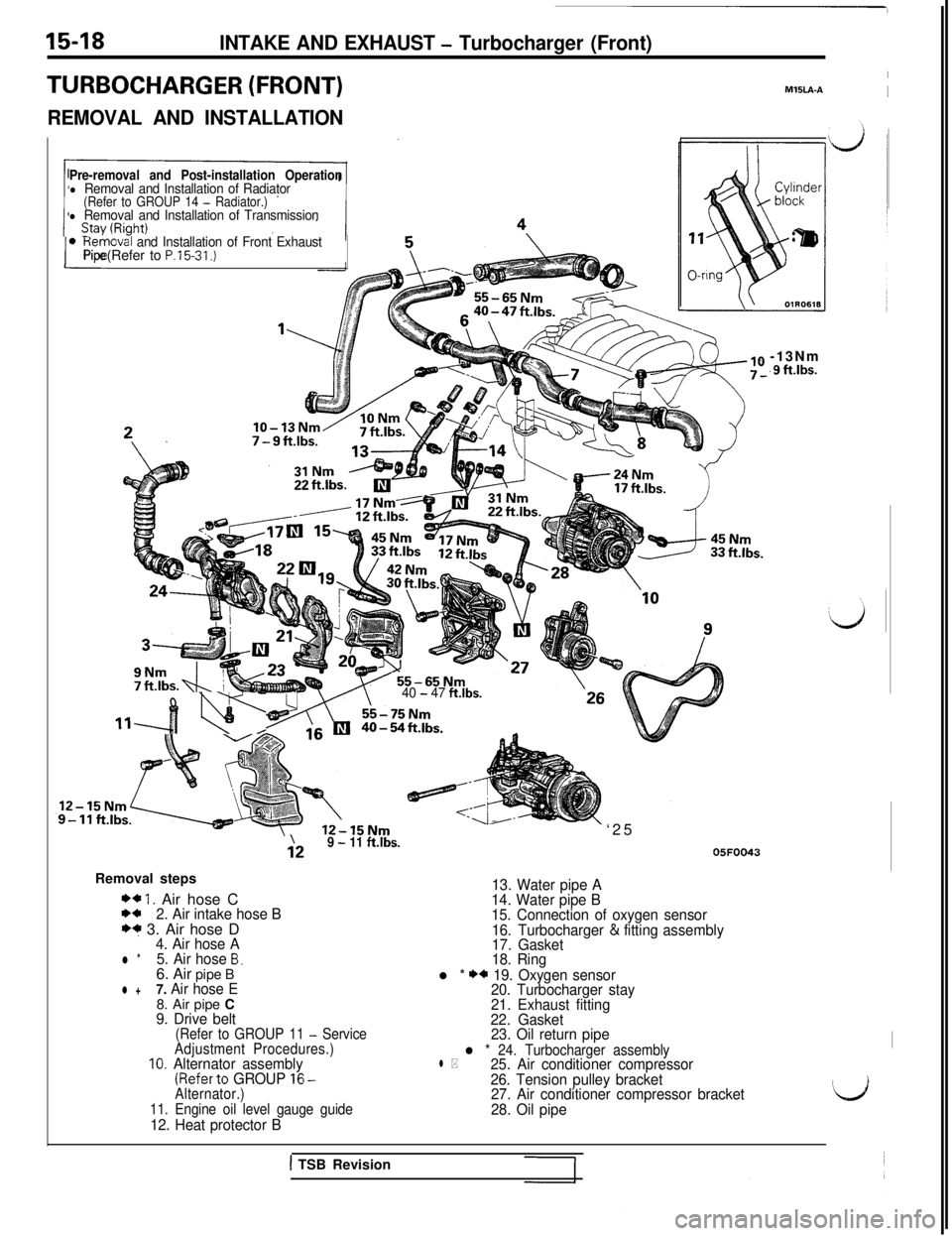
15-18INTAKE AND EXHAUST - Turbocharger (Front)
TURBOCHARGER (FRONT)
REMOVAL AND INSTALLATION
Pre-removal and Post-installation Operationl Removal and Installation of Radiator(Refer to GROUP 14 - Radiator.)l Removal and Installation of Transmission
l Rerr
IPipeioval and Installation of Front Exhaust(Refer to P.15-31.)
lJl QG!?
IMlSLA-AI
40 - 47 ft.lbs.
1\29 - 11 ft.lbs.Removal steps
** 1. Air hose C*+2. Air intake hose B*+ 3. Air hose D4. Air hose Al *5. Air hose B.6. Air pipe B
l +7. Air hose E8. Air pipe C
9. Drive belt(Refer to GROUP 11 - Service
Adjustment Procedures.)
10. Alternator assembly(Referto GROUP 16-Alternator.)
11. Engine oil level gauge guide
12. Heat protector B-13Nm
‘9 ft.lbs.
-‘25
05FOO43
13. Water pipe A
14. Water pipe B
15. Connection of oxygen sensor
16. Turbocharger
& fitting assembly
17. Gasket
18. Ring
l * ** 19. Oxygen sensor
20. Turbocharger stay
21. Exhaust fitting
22. Gasket
23. Oil return pipe
l * 24. Turbocharger assemblyl *25. Air conditioner compressor
26. Tension pulley bracket
27. Air conditioner compressor bracket
28. Oil pipe
I
LJ
1 TSB Revision
Page 337 of 1146
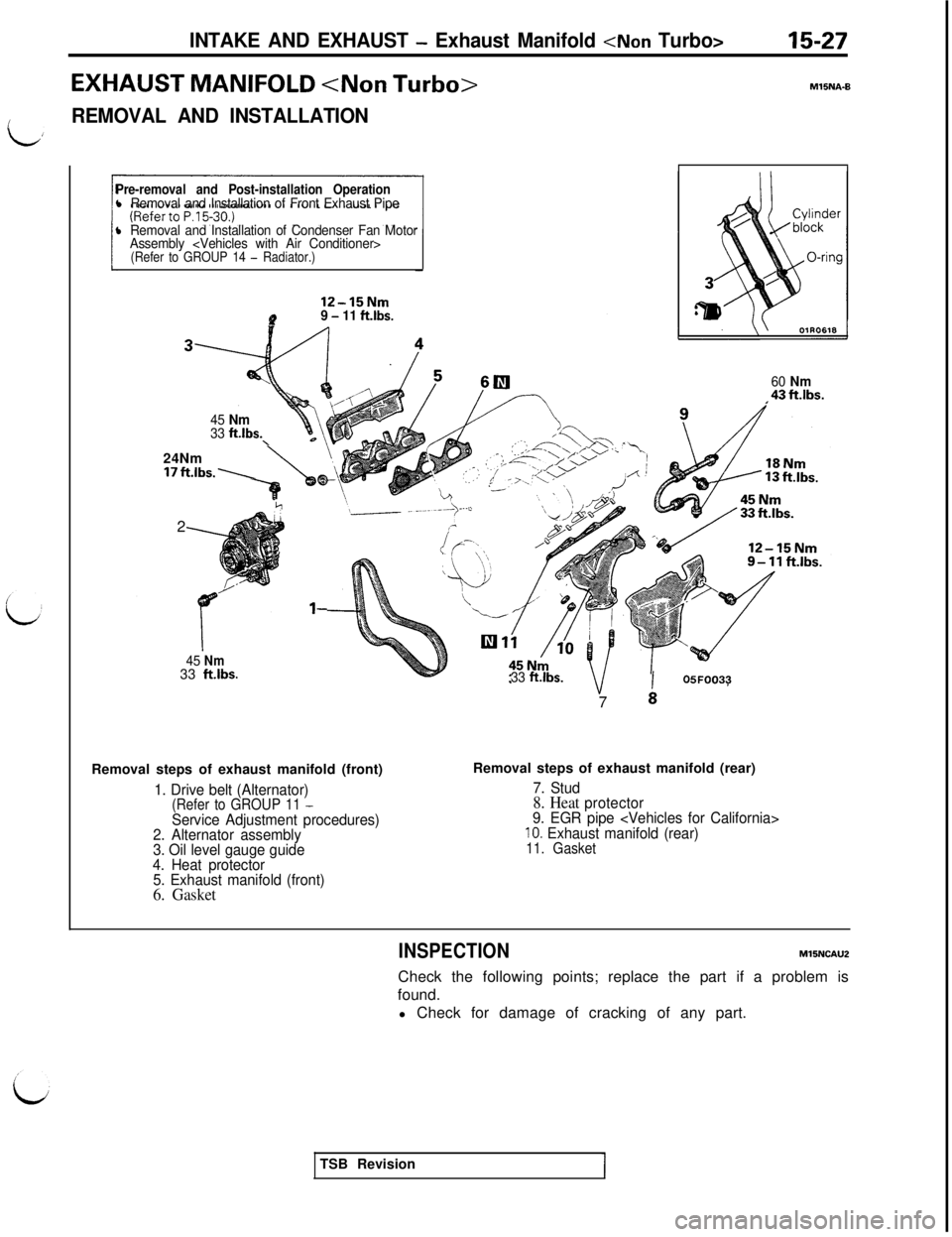
INTAKE AND EXHAUST - Exhaust Manifold
EXHAUST MANIFOLD
iREMOVAL AND INSTALLATION
Pre-removal and Post-installation Operationl Removal and Installation of Front Exhaust Pipe
l Removal and Installation of Condenser Fan Motor
Assembly
(Refer to GROUP 14 - Radiator.)
12-15Nm
P9 - 11 ft.lbs.
45 Nm33 ft.lbs.\24Nm
17ft.lbs.1
Li2
l-
45 Nm33 ft.lbs.
MSNA-8Removal steps of exhaust manifold (front)
1. Drive belt (Alternator)(Refer to GROUP 11 -Service Adjustment procedures)
2. Alternator assembly
3. Oil level gauge guide
4. Heat protector
5. Exhaust manifold (front)
6. Gasket
60 Nm,43 ft.lbs.
33 ftlbs.1 05F00337
8Removal steps of exhaust manifold (rear)
7. Stud
8. Heat protector
9. EGR pipe
IO. Exhaust manifold (rear)11. Gasket
INSPECTIONhllSNCAU2
Check the following points; replace the part if a problem is
found.
l Check for damage of cracking of any part.
TSB Revision
I
Page 829 of 1146
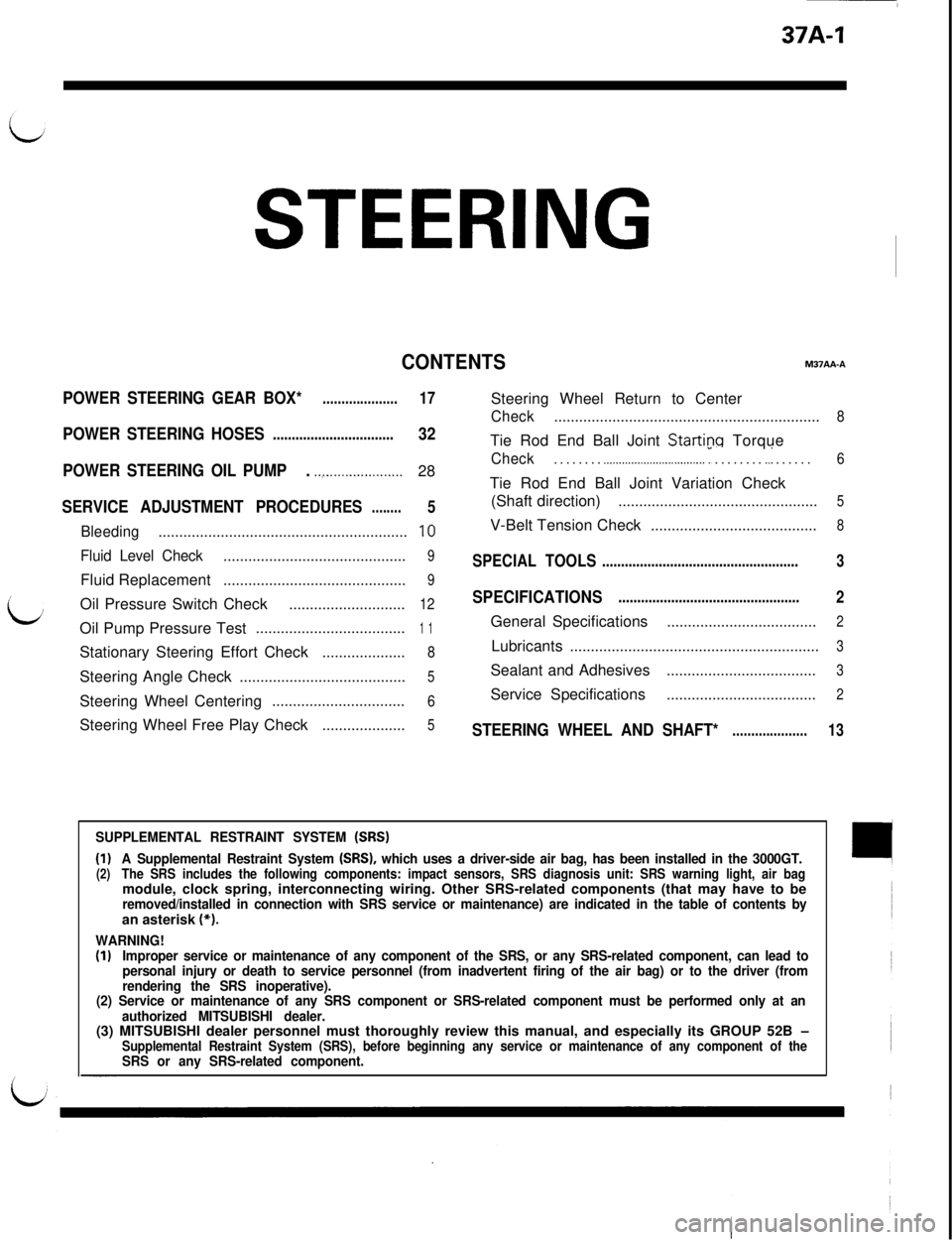
37A-1
STEERING
CONTENTSM37AA-A
POWER STEERING GEAR BOX*....................17Steering Wheel Return to Center
Check................................................................8
POWER STEERING HOSES................................32Tie Rod End Ball Joint Startinq Torque
POWER STEERING OIL PUMP. .._....................28Check. . . . . . . . .._.............................. r . . . . . . . . ..I . . . . . .6Tie Rod End Ball Joint Variation Check
SERVICE ADJUSTMENT PROCEDURES5(Shaft direction)................................................5........
Bleeding............................................................10V-Belt Tension Check........................................8
Fluid Level Check............................................9SPECIAL TOOLS....................................................3Fluid Replacement
............................................9
/
bOil Pressure Switch Check
SPECIFICATIONS2............................12................................................Oil Pump Pressure Test
....................................1 1General Specifications....................................2Stationary Steering Effort Check
....................8Lubricants............................................................3Steering Angle Check
5Sealant and Adhesives....................................3........................................Steering Wheel Centering
6Service Specifications....................................2................................Steering Wheel Free Play Check
....................5STEERING WHEEL AND SHAFT*....................13
SUPPLEMENTAL RESTRAINT SYSTEM (SRS)
(1)A Supplemental Restraint System (SRS), which uses a driver-side air bag, has been installed in the 3000GT.(2)The SRS includes the following components: impact sensors, SRS diagnosis unit: SRS warning light, air bagmodule, clock spring, interconnecting wiring. Other SRS-related components (that may have to be
removed/installed in connection with SRS service or maintenance) are indicated in the table of contents byan asterisk (*).
WARNING!(I)Improper service or maintenance of any component of the SRS, or any SRS-related component, can lead to
personal injury or death to service personnel (from inadvertent firing of the air bag) or to the driver (from
rendering the SRS inoperative).
(2) Service or maintenance of any SRS component or SRS-related component must be performed only at an
authorized MITSUBISHI dealer.(3) MITSUBISHI dealer personnel must thoroughly review this manual, and especially its GROUP 52B
-Supplemental Restraint System (SRS), before beginning any service or maintenance of any component of theSRS or any SRS-related component.