belt MITSUBISHI 3000GT 1991 Owner's Guide
[x] Cancel search | Manufacturer: MITSUBISHI, Model Year: 1991, Model line: 3000GT, Model: MITSUBISHI 3000GT 1991Pages: 1146, PDF Size: 76.68 MB
Page 830 of 1146
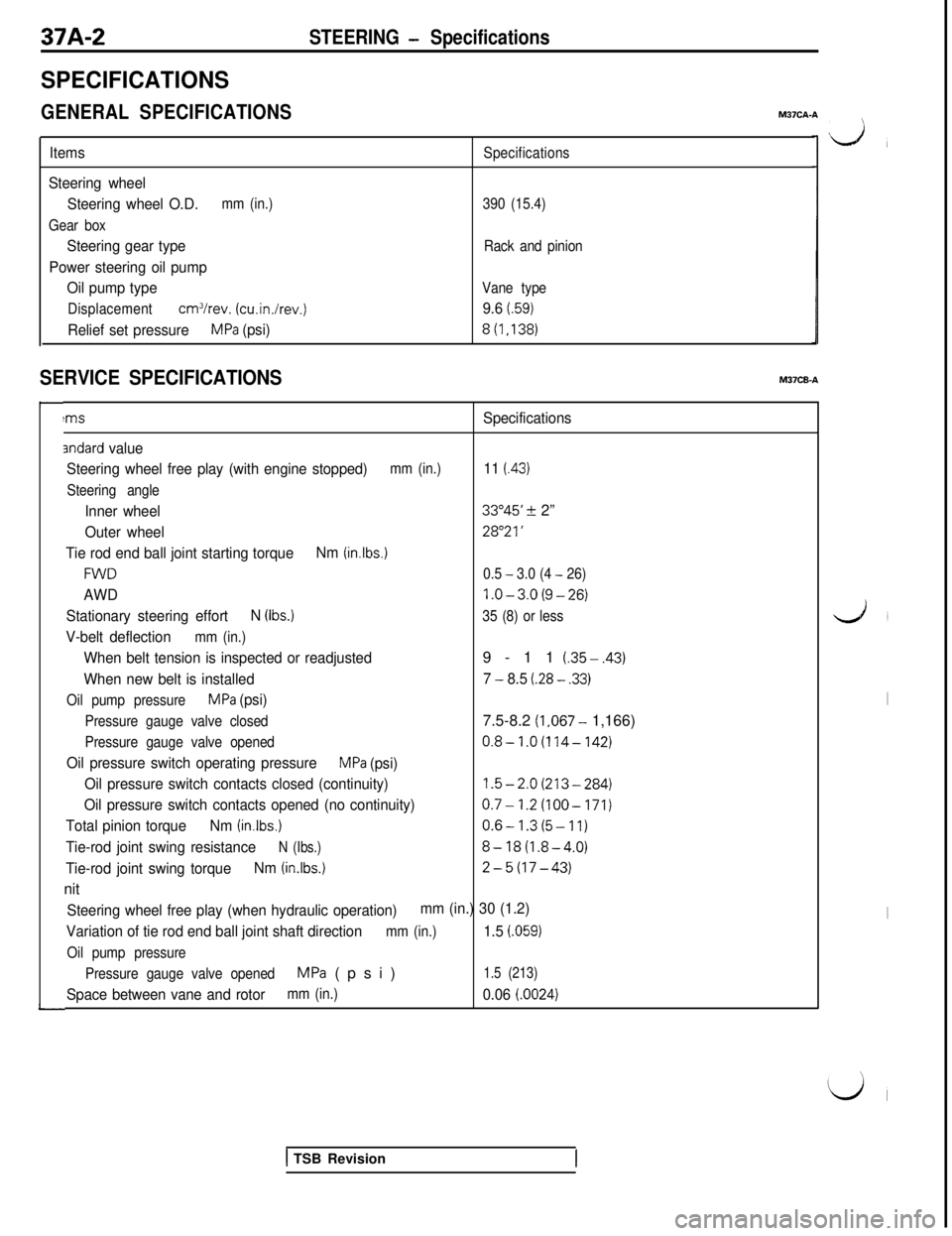
37A-2SPECIFICATIONS
STEERING - Specifications
GENERAL SPECIFICATIONS
M37CA-A
LA,Items
Steering wheel
Steering wheel O.D.
mm (in.)
Gear box
Steering gear type
Power steering oil pump
Oil pump type
Displacementcm3/rev. (cu.in./rev.)
Relief set pressureMPa (psi)
Specifications
390 (15.4)
Rack and pinion
Vane type
9.6 t.59)
8(1,138)
SERVICE SPECIFICATIONSM37CB-A
!msSpecifications
andard value
Steering wheel free play (with engine stopped)
mm (in.)11 (43)
Steering angle
Inner wheel33”45’ 2 2”
Outer wheel28”21’
Tie rod end ball joint starting torqueNm (in.lbs.)
FWD0.5 - 3.0 (4 - 26)
AWDl.O-3.0(9-26)
Stationary steering effortN (Ibs.)35 (8) or less
V-belt deflectionmm (in.)
When belt tension is inspected or readjusted9-11 (.35-.43)
When new belt is installed7 - 8.5 (.28 - .33)
Oil pump pressureMPa (psi)
Pressure gauge valve closed7.5-8.2 (1,067- 1,166)
Pressure gauge valve opened0.8-1.0(114-142)
Oil pressure switch operating pressureMPa (psi)
Oil pressure switch contacts closed (continuity)
1.5-2.0(213-284)
Oil pressure switch contacts opened (no continuity)0.7-1.2(100-171)
Total pinion torqueNm (in.lbs.)0.6-1.3(5-11)
Tie-rod joint swing resistanceN (Ibs.)8-18(1.8-4.0)
Tie-rod joint swing torqueNm (in.lbs.)2-5(17-43)nit
Steering wheel free play (when hydraulic operation)mm (in.) 30 (1.2)
Variation of tie rod end ball joint shaft direction
mm (in.)1.5 i.059)
Oil pump pressure
Pressure gauge valve opened
MPa (psi)1.5 (213)
Space between vane and rotormm (in.)0.06 (0024)
LJ’
I
I
L’l
1 TSB Revision
Page 836 of 1146
37A-8STEERING - Service Adjustment Procedures13FOOO3
13FOOOl
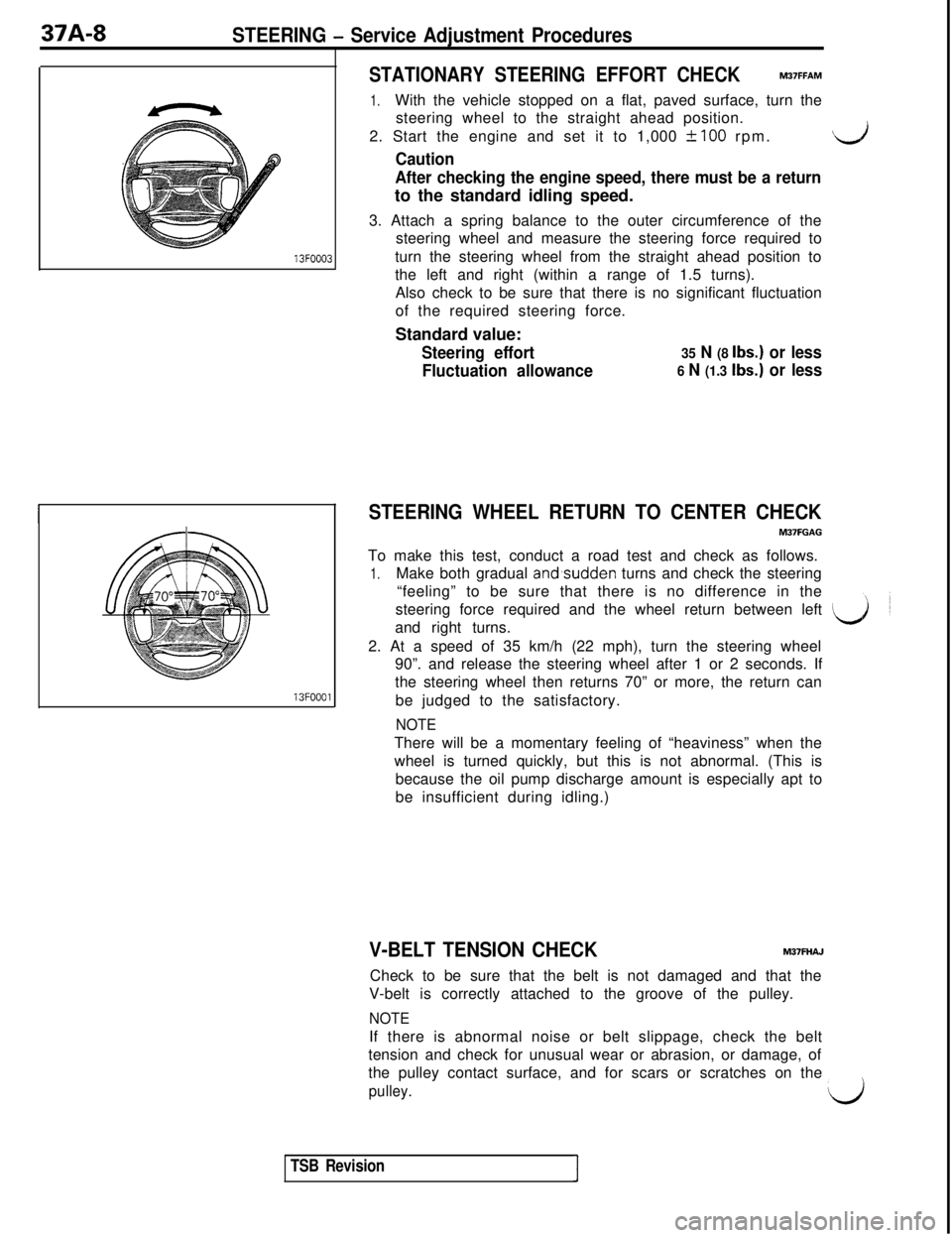
STATIONARY STEERING EFFORT CHECKM37FFAM
1.With the vehicle stopped on a flat, paved surface, turn the
steering wheel to the straight ahead position.
2. Start the engine and set it to 1,000
+ 100 rpm.d
Caution
After checking the engine speed, there must be a returnto the standard idling speed.
3. Attach a spring balance to the outer circumference of the
steering wheel and measure the steering force required to
turn the steering wheel from the straight ahead position to
the left and right (within a range of 1.5 turns).
Also check to be sure that there is no significant fluctuation
of the required steering force.
Standard value:
Steering effort35 N (8 Ibs.) or less
Fluctuation allowance
6 N (1.3 Ibs.) or less
STEERING WHEEL RETURN TO CENTER CHECK
M37FGACiTo make this test, conduct a road test and check as follows.
1.Make both gradual and,sudden turns and check the steering
“feeling” to be sure that there is no difference in the
steering force required and the wheel return between left
and right turns.
2. At a speed of 35 km/h (22 mph), turn the steering wheel
90”. and release the steering wheel after 1 or 2 seconds. If
the steering wheel then returns 70” or more, the return can
be judged to the satisfactory.
NOTEThere will be a momentary feeling of “heaviness” when the
wheel is turned quickly, but this is not abnormal. (This is
because the oil pump discharge amount is especially apt to
be insufficient during idling.)
V-BELT TENSION CHECKM37FHAJCheck to be sure that the belt is not damaged and that the
V-belt is correctly attached to the groove of the pulley.
NOTEIf there is abnormal noise or belt slippage, check the belt
tension and check for unusual wear or abrasion, or damage, of
the pulley contact surface, and for scars or scratches on the
pulley.d
TSB RevisionI
Page 837 of 1146
STEERING - Service Adjustment Procedures37A-9
LL:13N002E
FluId f[uctuatlon
While
engineWhile engme
runningstopped13uo13:
Return ho
Vinyl hose13AO142
j
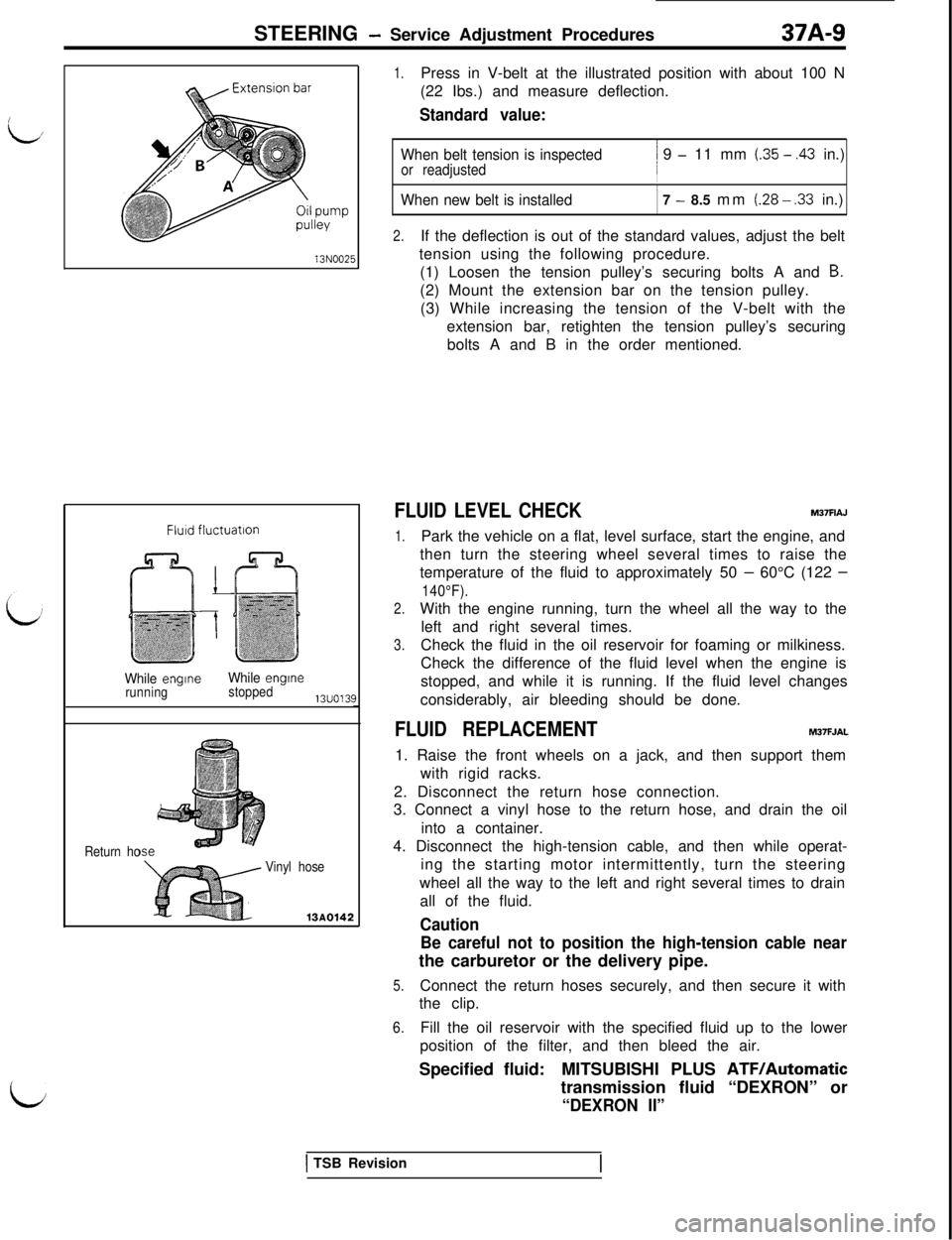
1.Press in V-belt at the illustrated position with about 100 N
(22 Ibs.) and measure deflection.
Standard value:
When belt tension is inspectedor readjusted
When new belt is installed
/ 9 - 11 mm (.35 - .43 in.)
I
’ 7 - 8.5 mm (.28 - .33 in.)
2.If the deflection is out of the standard values, adjust the belt
tension using the following procedure.
(1) Loosen the tension pulley’s securing bolts A and
B.(2) Mount the extension bar on the tension pulley.
(3) While increasing the tension of the V-belt with the
extension bar, retighten the tension pulley’s securing
bolts A and B in the order mentioned.
FLUID LEVEL CHECKM37FlAJ
1.Park the vehicle on a flat, level surface, start the engine, and
then turn the steering wheel several times to raise the
temperature of the fluid to approximately 50
- 60°C (122 -
140°F).
2.With the engine running, turn the wheel all the way to the
left and right several times.
3.Check the fluid in the oil reservoir for foaming or milkiness.
Check the difference of the fluid level when the engine is
stopped, and while it is running. If the fluid level changes
considerably, air bleeding should be done.
FLUID REPLACEMENTM37FJAL1. Raise the front wheels on a jack, and then support them
with rigid racks.
2. Disconnect the return hose connection.
3. Connect a vinyl hose to the return hose, and drain the oil
into a container.
4. Disconnect the high-tension cable, and then while operat-
ing the starting motor intermittently, turn the steering
wheel all the way to the left and right several times to drain
all of the fluid.
Caution
Be careful not to position the high-tension cable nearthe carburetor or the delivery pipe.
5.Connect the return hoses securely, and then secure it with
the clip.
6.Fill the oil reservoir with the specified fluid up to the lower
position of the filter, and then bleed the air.
Specified fluid:MITSUBISHI PLUS ATF/Automatic
transmission fluid “DEXRON” or
“DEXRON II”
1 TSB Revision
Page 856 of 1146
37A-28
STEERING - Power Steering Oil Pump
POWER STEERING OIL PUMP
REMOVAL AND INSTALLATION
I
M37RA-.
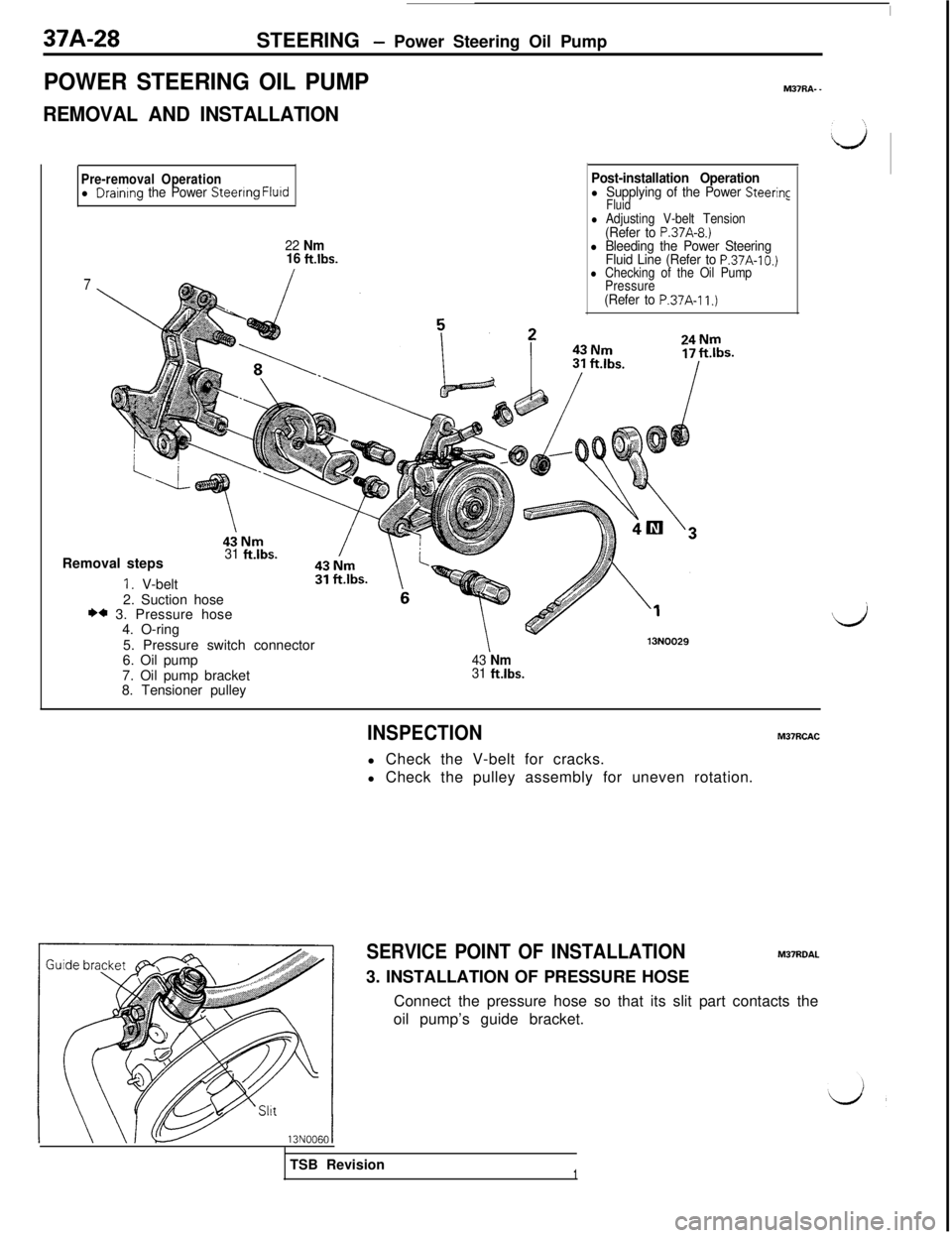
Pre-removal Operationl Draintng the Power Steenng Flurd
22 Nm
16 ft.lbs.
7
Post-installation Operationl Supplying of the Power Steering
Fluid
l Adjusting V-belt Tension(Refer to P.37A-8.)l Bleeding the Power Steering
Fluid Line (Refer to P.37A-10.)l Checking of the Oil Pump
Pressure
(Refer to P.37A-11.)Removal steps
31 ft.lbs.
1. V-belt
2. Suction hose
** 3. Pressure hose
4. O-ring
5. Pressure switch connector
6. Oil pump
7. Oil pump bracket
8. Tensioner pulley
43 Nm31 fklbs.
13N0029
Ij
INSPECTIONM37RCACl Check the V-belt for cracks.
l Check the pulley assembly for uneven rotation.
SERVICE POINT OF INSTALLATIONM37ROAL3. INSTALLATION OF PRESSURE HOSE
Connect the pressure hose so that its slit part contacts the
oil pump’s guide bracket.
TSB Revision
1
Page 863 of 1146
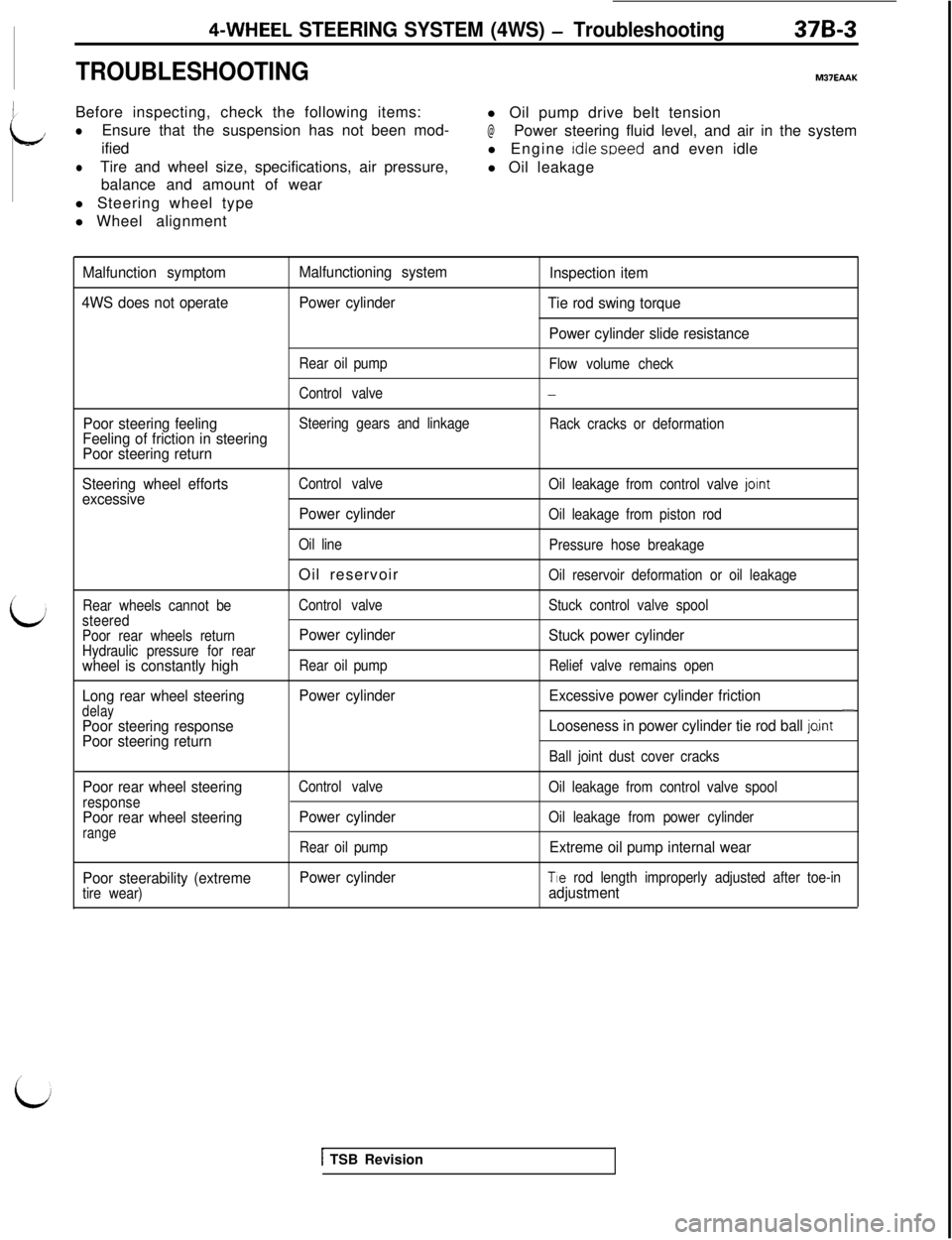
4-WHEEL STEERING SYSTEM (4WS) - Troubleshooting
TROUBLESHOOTING
37B-3
M37EMKBefore inspecting, check the following items:
l Oil pump drive belt tension
lEnsure that the suspension has not been mod-@Power steering fluid level, and air in the system
ified
l Engine
Idle soeed and even idle
lTire and wheel size, specifications, air pressure,
l Oil leakage
balance and amount of wear
l Steering wheel type
l Wheel alignment
Malfunction symptom
4WS does not operateMalfunctioning system
Power cylinderInspection item
Tie rod swing torque
Power cylinder slide resistance
Rear oil pump
Flow volume check
Control valve
-
Poor steering feelingSteering gears and linkage
Rack cracks or deformationFeeling of friction in steering
Poor steering return
Steering wheel efforts
excessive
Control valve
Oil leakage from control valve jornt
Rear wheels cannot be
steered
Poor rear wheels return
Hydraulic pressure for rear
wheel is constantly high
Long rear wheel steering
delayPoor steering response
Poor steering returnPower cylinder
Oil lineOil reservoir
Control valve
Power cylinder
Rear oil pump
Power cylinder
Oil leakage from piston rod
Pressure hose breakage
Oil reservoir deformation or oil leakage
Stuck control valve spool
Stuck power cylinder
Relief valve remains open
Excessive power cylinder friction-
Looseness in power cylinder tie rod ball jo.int
Ball joint dust cover cracks
Poor rear wheel steeringresponsePoor rear wheel steeringrange
Poor steerability (extremetire wear)Control valve
Power cylinder
Rear oil pump
Power cylinder
Oil leakage from control valve spool
Oil leakage from power cylinder
Extreme oil pump internal wear
Tie rod length improperly adjusted after toe-inadjustment
[ TSB Revision
Page 886 of 1146
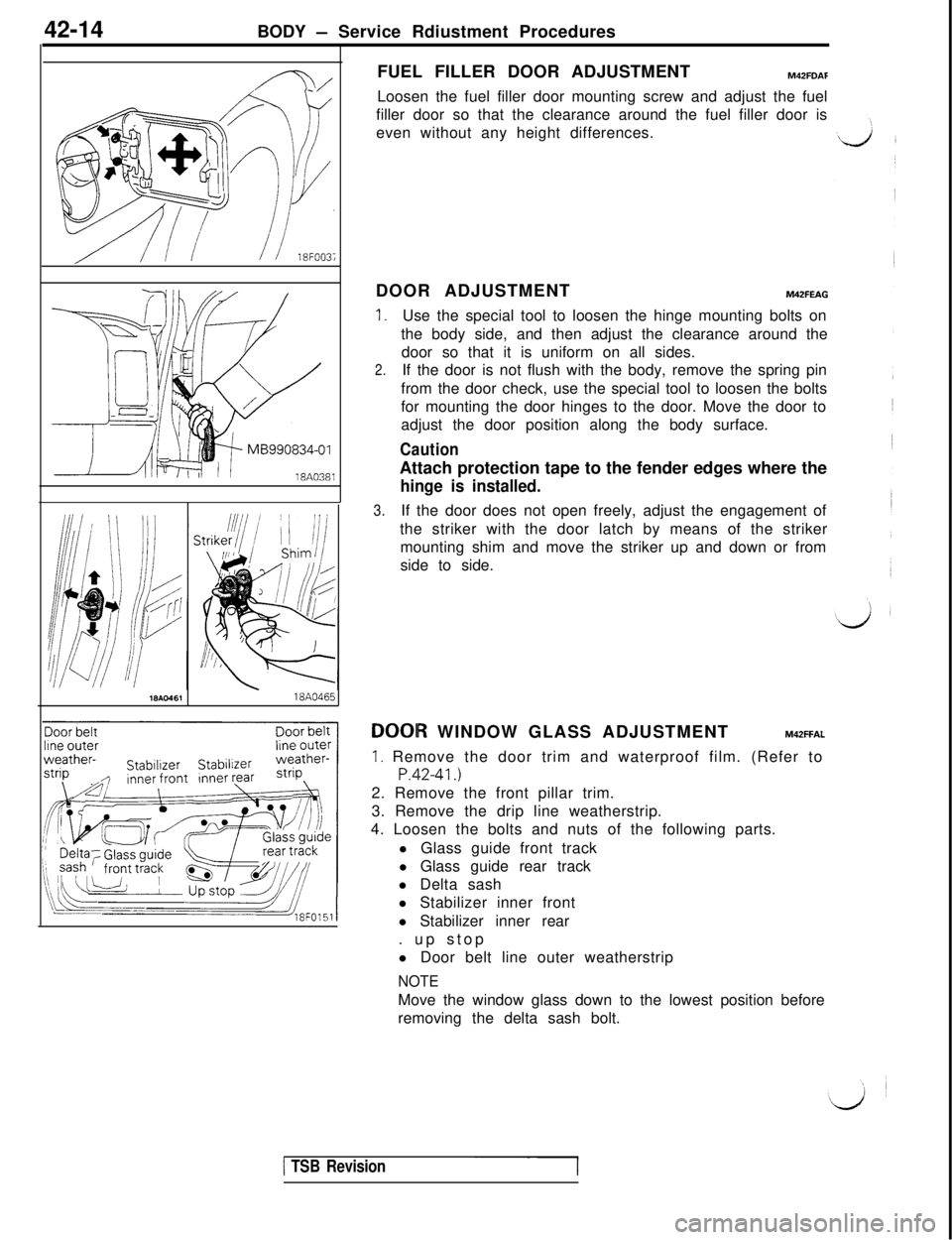
42-14BODY - Service Rdiustment ProceduresMB990834-0118A0381
18Ac-46118A0465FUEL FILLER DOOR ADJUSTMENT
M42FDAFLoosen the fuel filler door mounting screw and adjust the fuel
filler door so that the clearance around the fuel filler door is
even without any height differences.
DOOR ADJUSTMENT
M42FEAG
1.Use the special tool to loosen the hinge mounting bolts on
the body side, and then adjust the clearance around the
door so that it is uniform on all sides.
2.If the door is not flush with the body, remove the spring pin
from the door check, use the special tool to loosen the bolts
for mounting the door hinges to the door. Move the door to
adjust the door position along the body surface.
CautionAttach protection tape to the fender edges where the
hinge is installed.
3.If the door does not open freely, adjust the engagement of
the striker with the door latch by means of the striker
mounting shim and move the striker up and down or from
side to side.DOOIR WINDOW GLASS ADJUSTMENT
M42FFAL
1. Remove the door trim and waterproof film. (Refer to
P.42-41.)2. Remove the front pillar trim.
3. Remove the drip line weatherstrip.
4. Loosen the bolts and nuts of the following parts.
l Glass guide front track
l Glass guide rear track
l Delta sash
l Stabilizer inner front
l Stabilizer inner rear
. up stop
l Door belt line outer weatherstrip
NOTEMove the window glass down to the lowest position before
removing the delta sash bolt.
1 TSB Revision-1
Page 887 of 1146
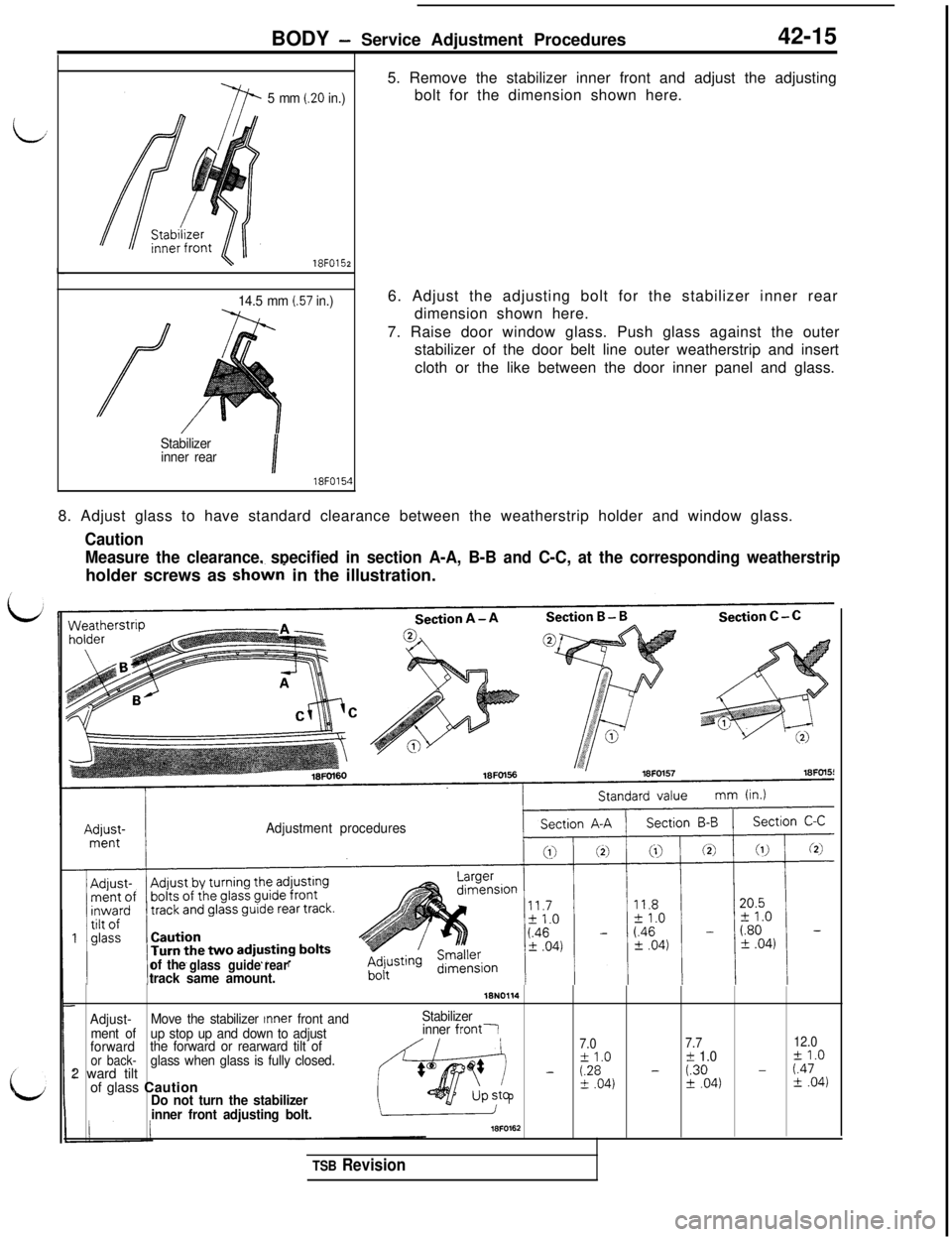
BODY - Service Adjustment Procedures42-15lSFO15
2
5 mm (20 in.)
14.5 mm
(.57 in.)
Stabilizer
inner rear
I18FO15‘5. Remove the stabilizer inner front and adjust the adjusting
bolt for the dimension shown here.
6. Adjust the adjusting bolt for the stabilizer inner rear
dimension shown here.
7. Raise door window glass. Push glass against the outer
stabilizer of the door belt line outer weatherstrip and insert
cloth or the like between the door inner panel and glass.
8. Adjust glass to have standard clearance between the weatherstrip holder and window glass.
Caution
Measure the clearance, specified in section A-A, B-B and C-C, at the corresponding weatherstripholder screws as
shown in the illustration.
Adjustment procedures
of theglass guidereartrack same amount.
18N0114
Adjust-Move the stabilizer Inner front and
ment ofup stop up and down to adjust
forwardthe forward or rearward tilt of
or back-glass when glass is fully closed.2 ward tilt
of glass Caution
Do not turn the stabilizer
inner front adjusting bolt.
Stabilizer
inner front17.07.712.0iI 1.0+ 1.0iz 1.0-(.28 -i.30-t.47t ,041z!z .04)IL .04)
P
18FOl62
TSB Revision
Page 914 of 1146
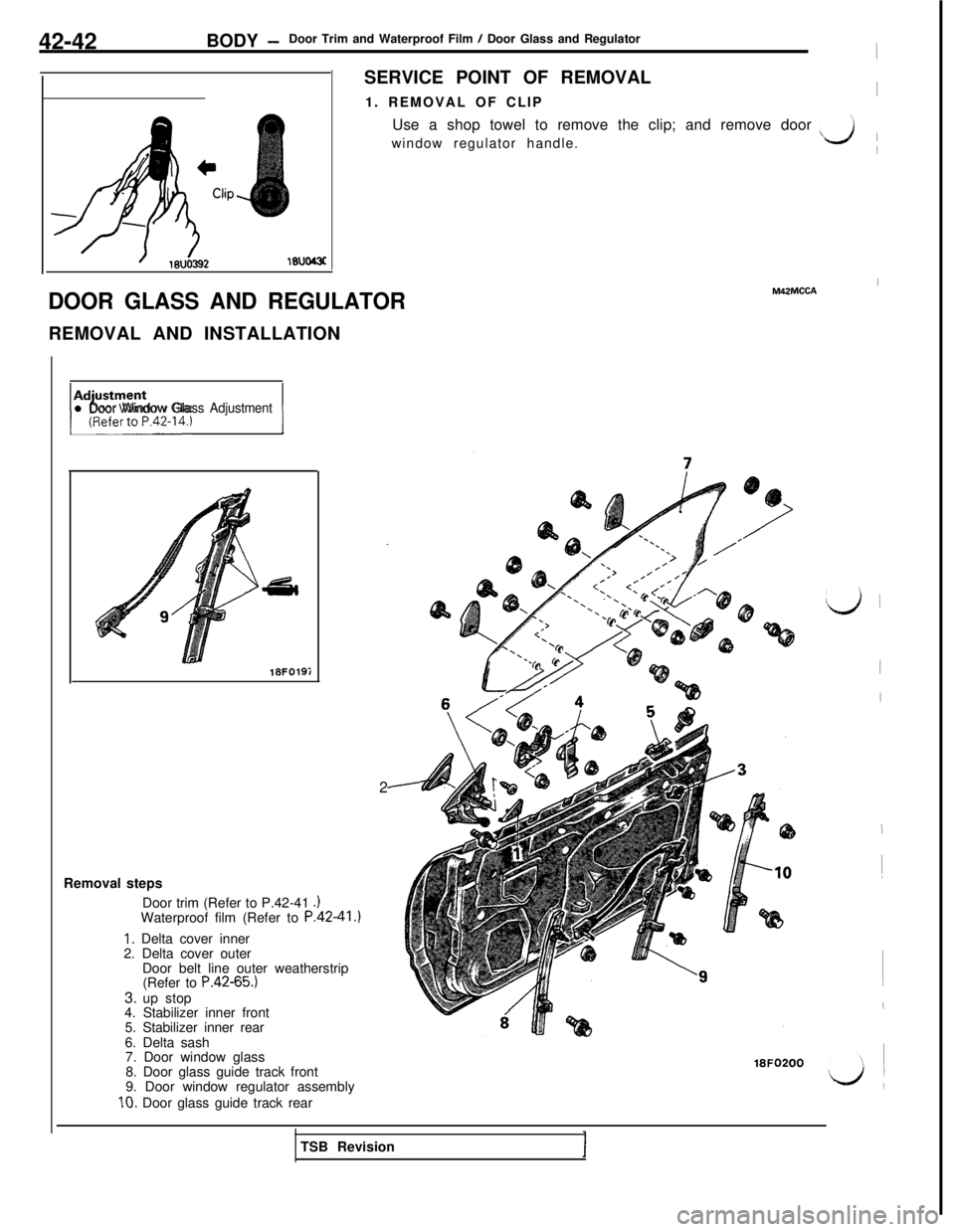
42-42BODY -Door Trim and Waterproof Film / Door Glass and Regulator
ISERVICE POINT OF REMOVAL
1. REMOVAL OF CLIP
IUse a shop towel to remove the clip; and remove door
window regulator handle.
\L.J II
DOOR GLASS AND REGULATORREMOVAL AND INSTALLATION
~;:;zL4., 1l Door Window Glass Adjustment
18FOlQi2
Removal steps
Door trim (Refer to P.42-41
.IWaterproof film (Refer to P.42-41 .I
1. Delta cover inner
2. Delta cover outer
Door belt line outer weatherstrip
(Refer to
P.42-65.)3. up stop
4. Stabilizer inner front
5. Stabilizer inner rear
6. Delta sash
7. Door window glass
8. Door glass guide track front
9. Door window regulator assemblyIO. Door glass guide track rear
IM42MCCA
18FO200
d
I
I
I
!
(
I
L&lTSB Revision
Page 923 of 1146
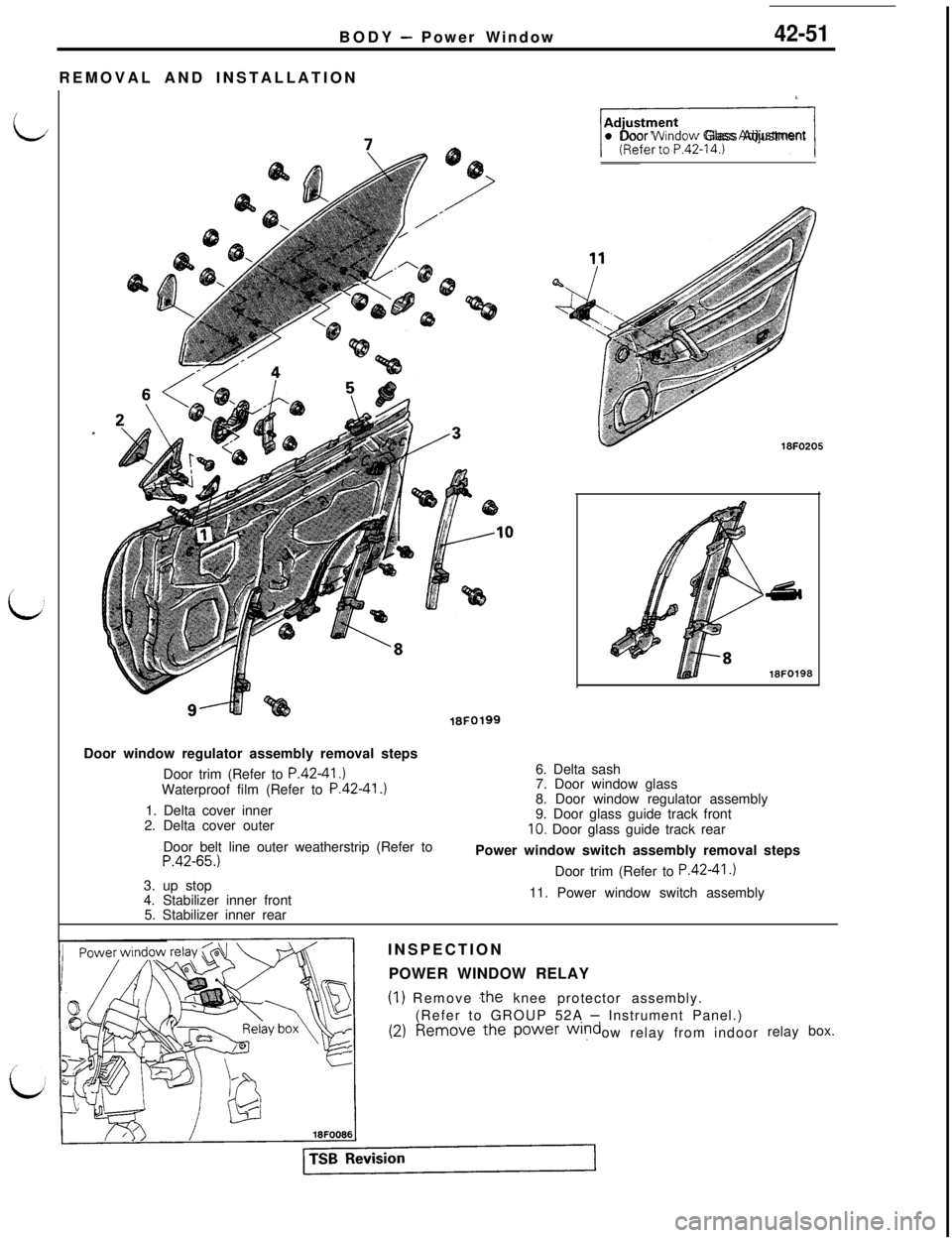
L
/
idBODY
- Power Window
REMOVAL AND INSTALLATION42-51
Cll Door Wlndow Glass Adjustment
18FO205
18FO198Door window regulator assembly removal steps
Door trim (Refer to
P.4241.)Waterproof film (Refer to P.42-41.)1. Delta cover inner
2. Delta cover outer
18FO1996. Delta sash
7. Door window glass
8. Door window regulator assembly
9. Door glass guide track front
10. Door glass guide track rear
Door belt line outer weatherstrip (Refer to
P.42-65.)3. up stop
4. Stabilizer inner frontPower window switch assembly removal steps
Door trim (Refer to P.42-41.)11. Power window switch assembly
5. Stabilizer inner rear
INSPECTION
POWER WINDOW RELAY
(1) Remove .the knee protector assembly.
(Refer to GROUP 52A
- Instrument Panel.)
ow relay from indoorrelaybox.
Page 937 of 1146
BODY - Drir, Line Weatherstrir,42-65
DRIP LINE WEATHERSTRIPM42MFALREMOVAL AND INSTALLATION
/
L
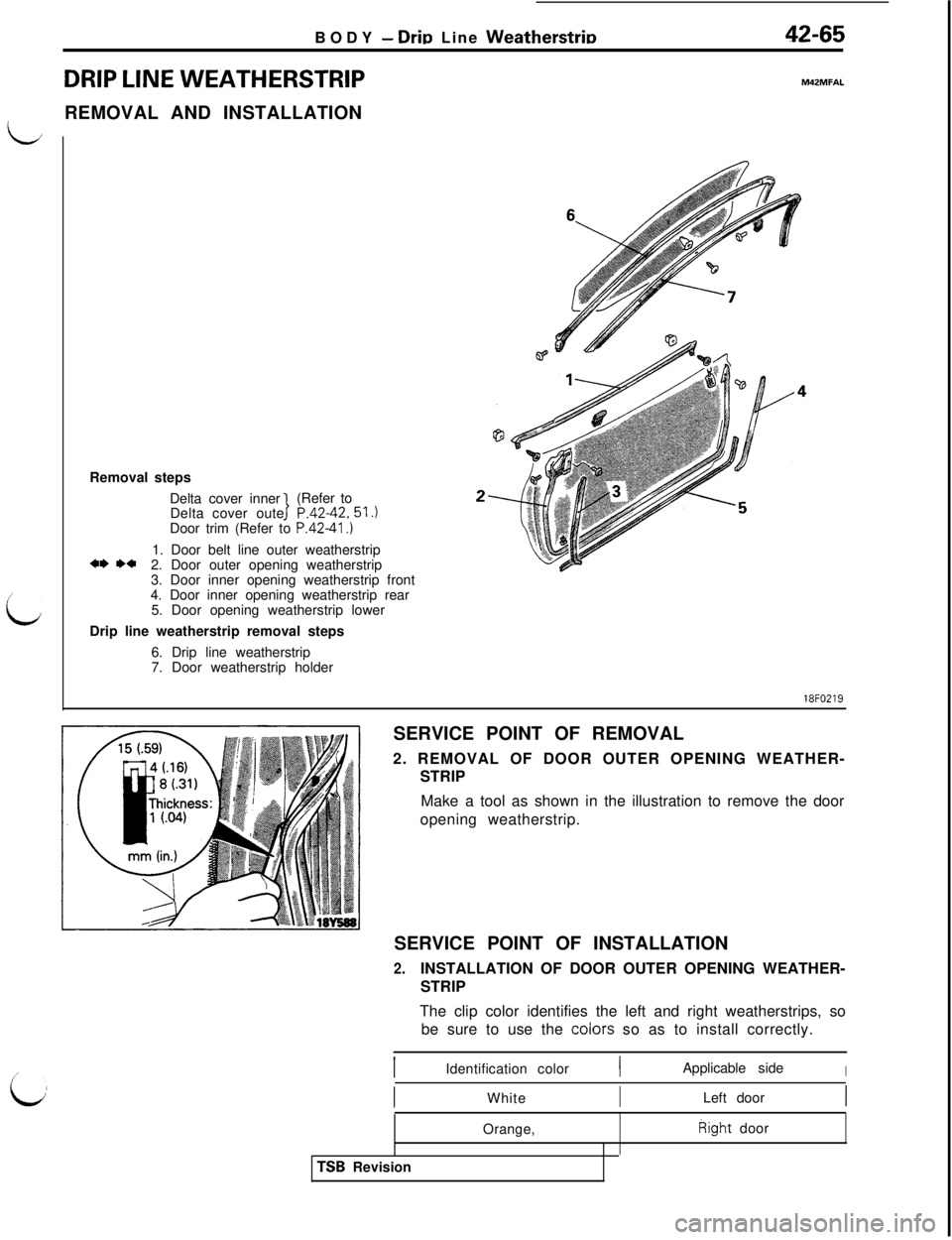
iRemoval steps
Delta cover inner
Delta cover outer P.42-42.51.)
1(Refer to
Door trim (Refer to P.4241.)
1. Door belt line outer weatherstrip
*I) I)+2. Door outer opening weatherstrip
3. Door inner opening weatherstrip front
4. Door inner opening weatherstrip rear
5. Door opening weatherstrip lower
Drip line weatherstrip removal steps
6. Drip line weatherstrip
7. Door weatherstrip holder
2-18FO219
SERVICE POINT OF REMOVAL
2. REMOVAL OF DOOR OUTER OPENING WEATHER-
STRIP
Make a tool as shown in the illustration to remove the door
opening weatherstrip.
SERVICE POINT OF INSTALLATION
2.INSTALLATION OF DOOR OUTER OPENING WEATHER-
STRIP
The clip color identifies the left and right weatherstrips, so
be sure to use the coiors so as to install correctly.
IIdentification colorIApplicable sideIWhiteLeft door
TSB RevisionOrange,Right door