transmission MITSUBISHI 3000GT 1991 Owner's Manual
[x] Cancel search | Manufacturer: MITSUBISHI, Model Year: 1991, Model line: 3000GT, Model: MITSUBISHI 3000GT 1991Pages: 1146, PDF Size: 76.68 MB
Page 443 of 1146
23-1
AUTOMATIC
TRANSAXLE
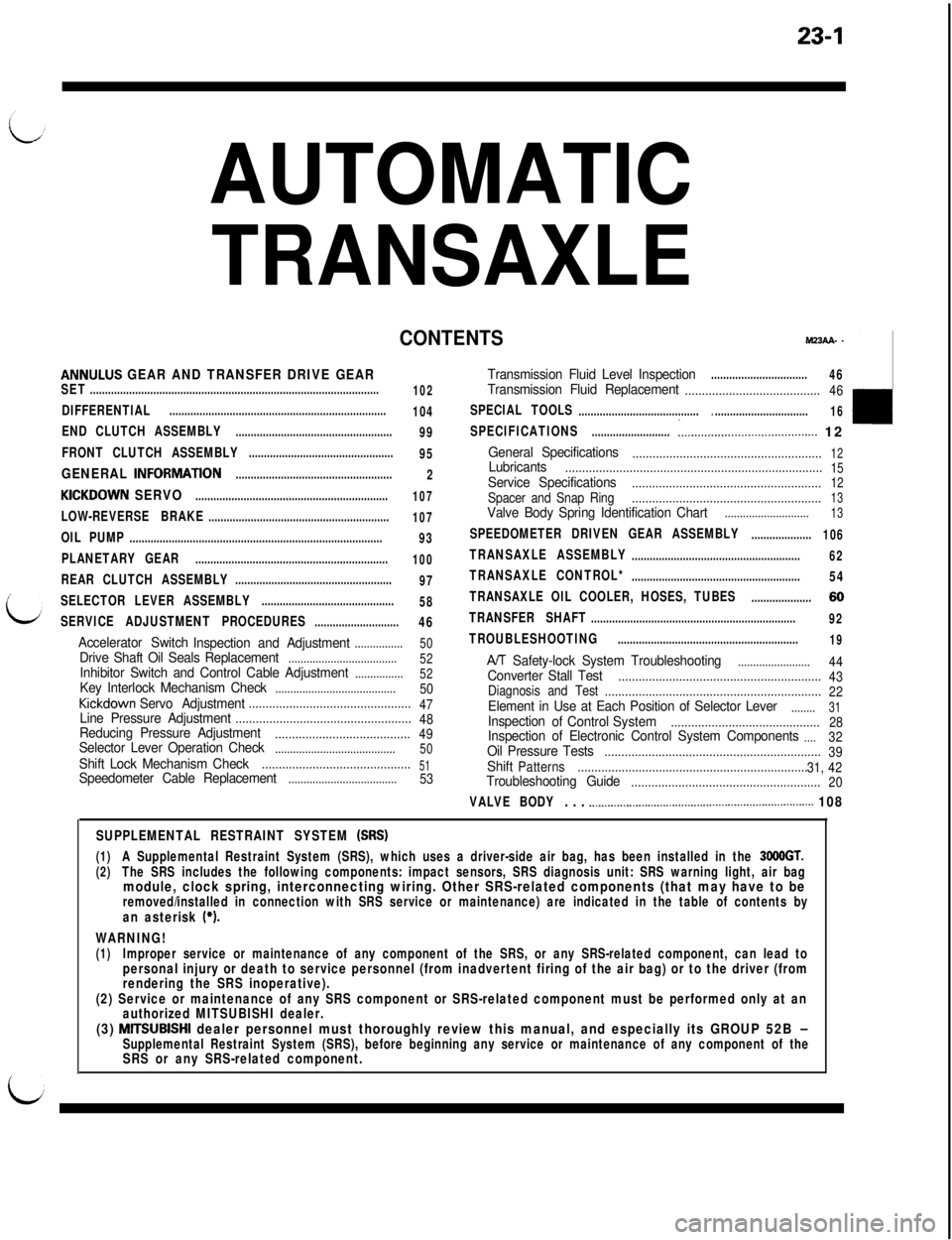
CONTENTSMZJAA- _
ANNULUS GEAR AND TRANSFER DRIVE GEARTransmission Fluid Level Inspection................................46SET................................................................................................
102Transmission Fluid Replacement........................................
46
DIFFERENTIAL........................................................................104SPECIAL TOOLS........................................................................
16
:......................................... 12IEND CLUTCH ASSEMBLY....................................................99SPECIFICATIONS..........................
FRONT CLUTCH ASSEMBLY................................................95
GENERAL INFORMATlON....................................................2
KICKDOWN SERVO................................................................
107
LOW-REVERSE BRAKE............................................................
107
OIL PUMP....................................................................................93
PLANETARY GEAR................................................................
100
REAR CLUTCH ASSEMBLY....................................................97
SELECTOR LEVER ASSEMBLY............................................58
SERVICE ADJUSTMENT PROCEDURES............................46
Accelerator Switch
Inspection and Adjustment................
50Drive Shaft Oil Seals Replacement....................................
52Inhibitor Switch and Control Cable Adjustment................
52Key Interlock Mechanism Check........................................50KickdownServo Adjustment................................................
47Line Pressure Adjustment....................................................
48Reducing Pressure Adjustment........................................
49Selector Lever Operation Check........................................
50Shift Lock Mechanism Check............................................51Speedometer Cable Replacement....................................53
General Specifications........................................................12Lubricants............................................................................15Service Specifications........................................................12Spacer and Snap Ring........................................................13Valve Body Spring Identification Chart............................13
SPEEDOMETER DRIVEN GEAR ASSEMBLY....................106
TRANSAXLE ASSEMBLY........................................................62
TRANSAXLE CONTROL*........................................................54
TRANSAXLE OIL COOLER, HOSES, TUBES
....................66
TRANSFER SHAFT....................................................................92
TROUBLESHOOTING............................................................
19
A/T Safety-lock System Troubleshooting........................44Converter Stall Test............................................................
43
Diagnosis and Test
................................................................
22
Element in Use at Each Position of Selector Lever........31Inspection
of ControlSystem............................................
28Inspection of Electronic Control System Components....32Oil Pressure Tests................................................................
39ShiftPatterns....................................................................
31,42Troubleshooting Guide........................................................
20
VALVE BODY. . . .._._.................................................................... 108
SUPPLEMENTAL RESTRAINT SYSTEM (SRS)
(1)A Supplemental Restraint System (SRS), which uses a driver-side air bag, has been installed in the 3668GT.(2)The SRS includes the following components: impact sensors, SRS diagnosis unit: SRS warning light, air bagmodule, clock spring, interconnecting wiring. Other SRS-related components (that may have to beremoved/installed in connection with SRS service or maintenance) are indicated in the table of contents byan asterisk (*).
WARNING!(1)Improper service or maintenance of any component of the SRS, or any SRS-related component, can lead topersonal injury or death to service personnel (from inadvertent firing of the air bag) or to the driver (from
rendering the SRS inoperative).
(2) Service or maintenance of any SRS component or SRS-related component must be performed only at an
authorized MITSUBISHI dealer.
(3) MlTSUBISHI dealer personnel must thoroughly review this manual, and especially its GROUP 52B -Supplemental Restraint System (SRS), before beginning any service or maintenance of any component of the
ISRS or any SRS-related component.
Page 481 of 1146
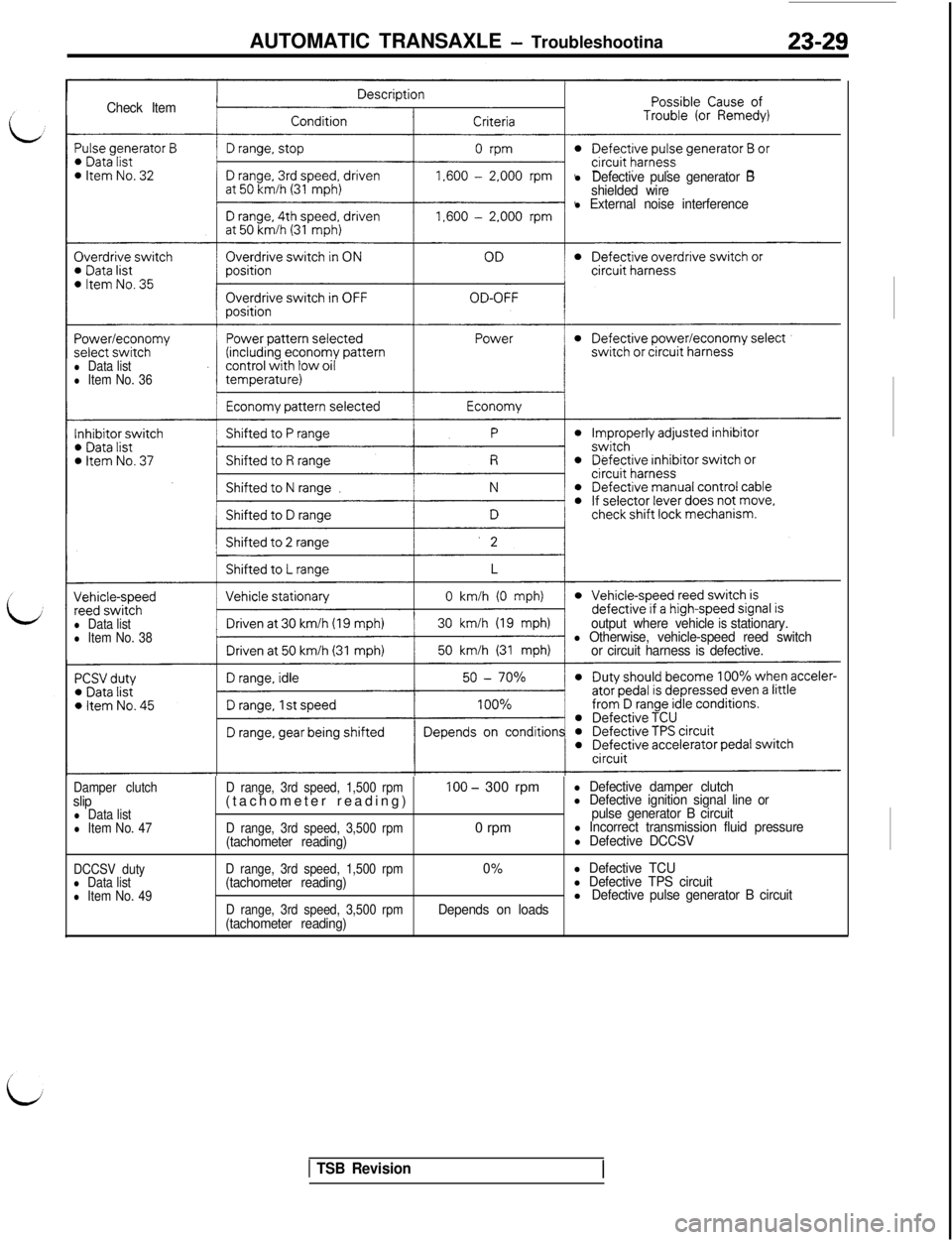
AUTOMATIC TRANSAXLE - Troubleshootina23-29
Check Iteml
Defective pulse generator B
shielded wire
l External noise interference
l Data listl Item No. 36
l Data listl Item No. 38output where vehicleisstationary.l Otherwise, vehicle-speed reed switch
or circuit harness is defective.
Damper clutchslipl Data listl Item No. 47
DCCSV duty
l Data listl Item No. 49D range, 3rd speed, 1,500 rpm(tachometer reading)
D range, 3rd speed, 3,500 rpm(tachometer reading)
D range, 3rd speed, 1,500 rpm(tachometer reading)
D range, 3rd speed, 3,500 rpm(tachometer reading)
100 - 300 rpm
0 rpm
0%
Depends on loads
l Defective damper clutchl Defective ignition signal line or
pulse generator B circuit
l Incorrect transmission fluid pressurel Defective DCCSV
l Defective TCUl Defective TPS circuitlDefective pulse generator B circuit
1 TSB Revision
Page 482 of 1146
23-30AUTOMATIC TRANSAXLE - Troubleshooting
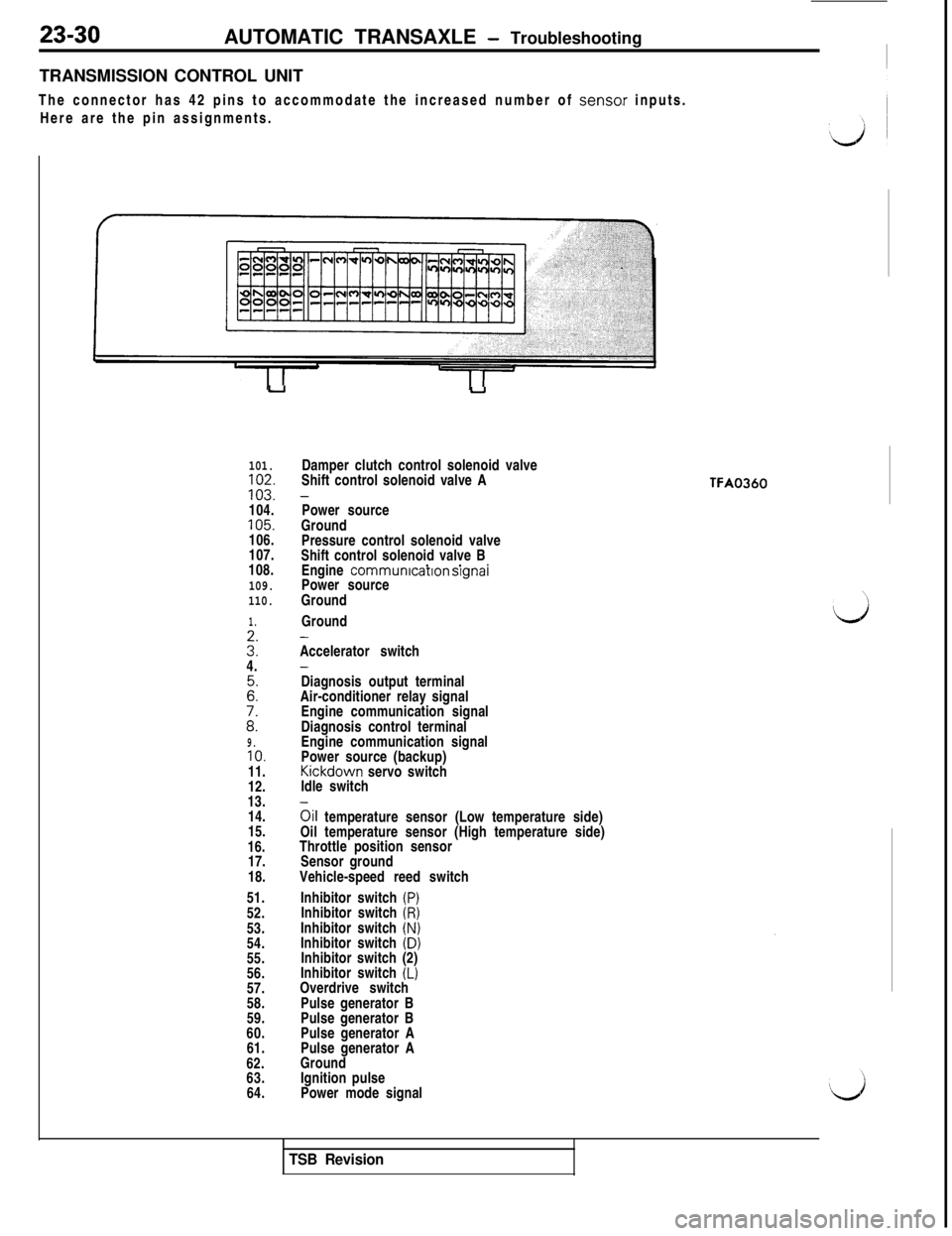
TRANSMISSION CONTROL UNIT
The connector has 42 pins to accommodate the increased number of senso.r inputs.
Here are the pin assignments.
uu
101.102.103.
104.105.
106.
107.
108.
109.
110.
1.
3':4.
Z:
i:9.10.11.
12.
13.
14.
15.
16.
17.
18.
51.
52.
53.
54.
55.
56.
57.
58.
59.
60.
61.
62.
63.
64.Damper clutch control solenoid valve
Shift control solenoid valve A
-Power source
Ground
Pressure control solenoid valve
Shift control solenoid valve B
. .
*Engine communrcatron srgnaiPower source
Ground
Ground
-Accelerator switch
-Diagnosis output terminal
Air-conditioner relay signal
Engine communication signal
Diagnosis control terminal
Engine communication signal
Power source (backup)Kickdown servo switch
Idle switch
oil temperature sensor (Low temperature side)
Oil temperature sensor (High temperature side)
Throttle position sensor
Sensor ground
Vehicle-speed reed switch
Inhibitor switch
(P)Inhibitor switch (R)Inhibitor switch (N)Inhibitor switch (D)
Inhibitor switch (2)
Inhibitor switch
(L)Overdrive switch
Pulse generator B
Pulse generator B
Pulse generator A
Pulse generator A
Ground
Ignition pulse
Power mode signal
TFA0360
TSB Revision
Page 488 of 1146
23-36AUTOMATIC TRANSAXLE - Troubleshootina
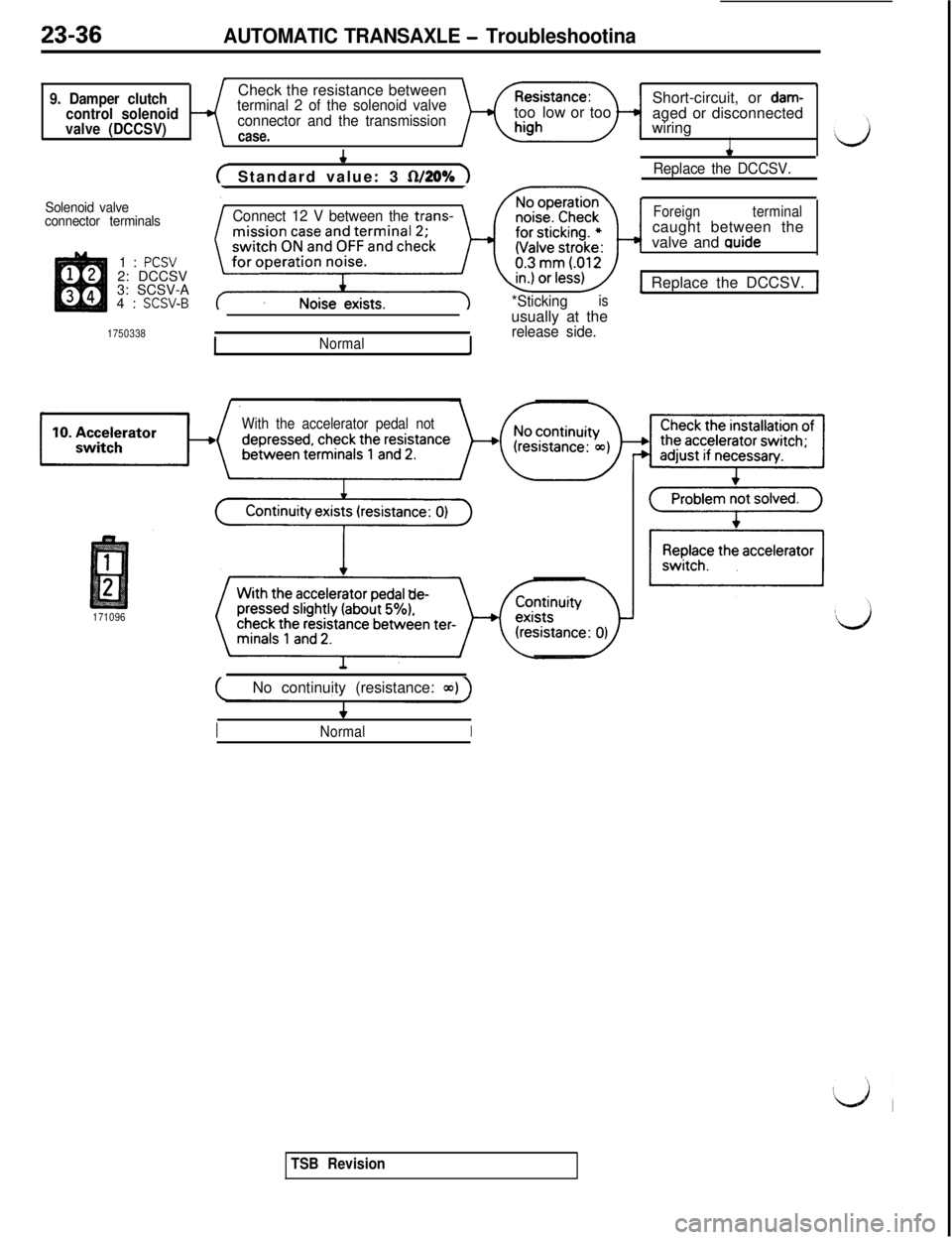
9. Damper clutch
control solenoid
valve (DCCSV)Check the resistance betweenterminal 2 of the solenoid valve
connector and the transmission
case.
?Short-circuit, or
dam-toolow or too
aged or disconnected
wiring
I
Solenoid valve
connector terminals1:
PCSV2: DCCSV
3: SCSV-A
4:
SCSV-B
1750338
( Standard value: 3 fWO% 1
Connect 12 V between the trans-
*Sticking
isusually at the
release side.
*
Replace the DCCSV.
Foreignterminalcaught between the
valve and
guide
1 Replace the DCCSV. J
INormal1
With the accelerator pedal not
171096
(No continuity (resistance: a~) )
INormalI
TSB Revision
Page 492 of 1146
23-40AUTOMATIC TRANSAXLE - Troubleshooting
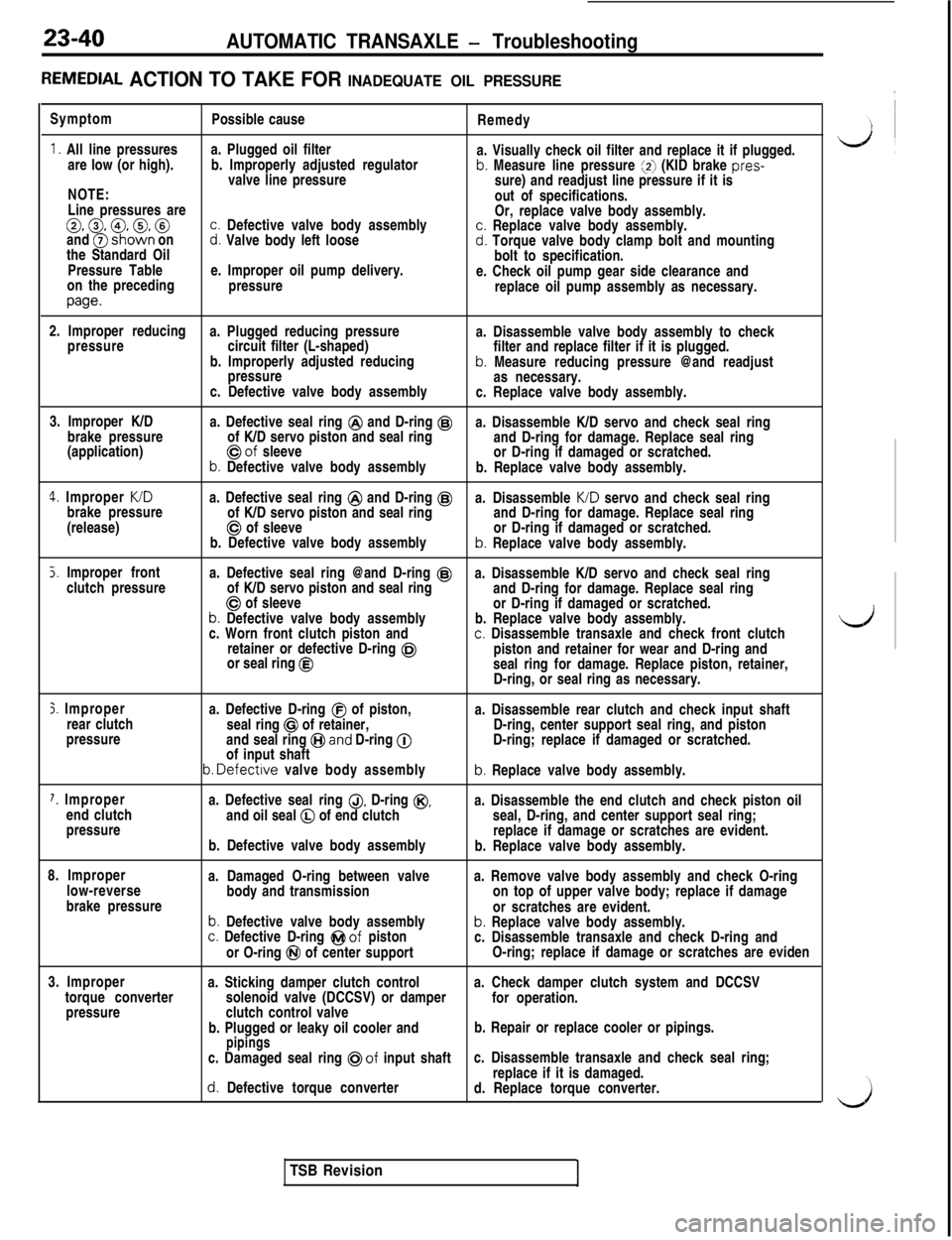
REMEDIAL ACTION TO TAKE FOR INADEQUATE OIL PRESSURESymptom
Possible cause
Remedy
1. All line pressuresa. Plugged oil filter
are low (or high).b. Improperly adjusted regulatora. Visually check oil filter and replace it if plugged.
valve line pressure
b. Measure line pressure (2) (KID brake pres-
NOTE:sure) and readjust line pressure if it is
Line pressures areout of specifications.
@.@.@).@.@and @shown onc. Defective valve body assemblyOr, replace valve body assembly.
the Standard Oil
Pressure Table
on the preceding
paw.
d. Valve body left loose
e. Improper oil pump delivery.
pressurec. Replace valve body assembly.d. Torque valve body clamp bolt and mounting
bolt to specification.
e. Check oil pump gear side clearance and
replace oil pump assembly as necessary.
2. Improper reducing
a. Plugged reducing pressure
a. Disassemble valve body assembly to check
pressurecircuit filter (L-shaped)
b. Improperly adjusted reducingfilter and replace filter if it is plugged.
b. Measure reducing pressure @and readjust
pressure
c. Defective valve body assemblyas necessary.
c. Replace valve body assembly.
3. Improper K/D
brake pressure
(application)a. Defective seal ring
@ and D-ring @of K/D servo piston and seal ringa. Disassemble K/D servo and check seal ring
@of sleeveand D-ring for damage. Replace seal ringb. Defective valve body assemblyor D-ring if damaged or scratched.
b. Replace valve body assembly.
4. Improper KIDbrake pressure
(release)
J. Improper front
clutch pressurea. Defective seal ring
@ and D-ring @of K/D servo piston and seal ringa. Disassemble KID servo and check seal ring
@ of sleeveand D-ring for damage. Replace seal ring
b. Defective valve body assemblyor D-ring if damaged or scratched.b. Replace valve body assembly.
a. Defective seal ring @and D-ring
@of K/D servo piston and seal ringa. Disassemble K/D servo and check seal ring
@ of sleeveand D-ring for damage. Replace seal ringb. Defective valve body assemblyor D-ring if damaged or scratched.
c. Worn front clutch piston andb. Replace valve body assembly.c. Disassemble transaxle and check front clutch
retainer or defective D-ring @or seal ring @piston and retainer for wear and D-ring and
seal ring for damage. Replace piston, retainer,
D-ring, or seal ring as necessary.
3. Improper
rear clutch
pressure
7. Improper
end clutch
pressurea. Defective D-ring
@ of piston,
seal ring @ of retainer,
and seal ring @and D-ring @of input shaft
b. Defectrve valve body assembly
a. Defective seal ring
0. D-ring 0,and oil seal (iJ of end clutch
b. Defective valve body assemblya. Disassemble rear clutch and check input shaft
D-ring, center support seal ring, and piston
D-ring; replace if damaged or scratched.
b. Replace valve body assembly.
a. Disassemble the end clutch and check piston oil
seal, D-ring, and center support seal ring;
replace if damage or scratches are evident.
b. Replace valve body assembly.
8. Improper
low-reverse
brake pressurea. Damaged O-ring between valve
body and transmission
b. Defective valve body assemblyc. Defective D-ring @of piston
or O-ring
@I of center supporta. Remove valve body assembly and check O-ring
on top of upper valve body; replace if damage
or scratches are evident.
b. Replace valve body assembly.
c. Disassemble transaxle and check D-ring and
O-ring; replace if damage or scratches are eviden
3. Improper
torque converter
pressurea. Sticking damper clutch controla. Check damper clutch system and DCCSV
solenoid valve (DCCSV) or damper
for operation.
clutch control valve
b. Plugged or leaky oil cooler and
pipingsb. Repair or replace cooler or pipings.
c. Damaged seal ring @of input shaftc. Disassemble transaxle and check seal ring;
d. Defective torque converterreplace if it is damaged.
d. Replace torque converter.
TSB Revision
d
‘\
d
Page 498 of 1146
23-46AUTOMATIC TRANSAXLE - Service Adjustment Procedures
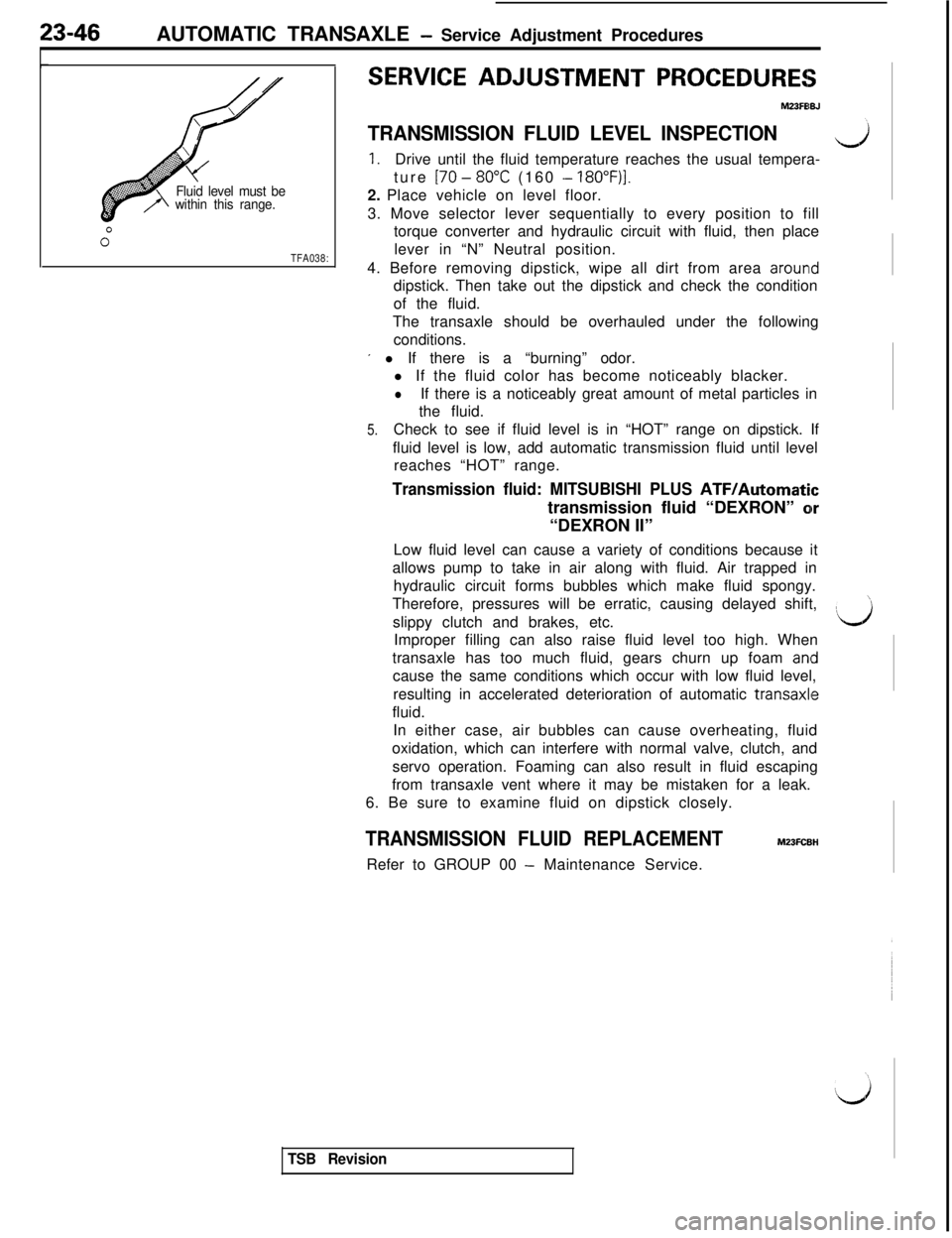
Fluid level must be
within this range.
TFA038:
SERVICE ADJUSTMENT PROCEDURE!5
MZ3FElBJ
TRANSMISSION FLUID LEVEL INSPECTION
1.Drive until the fluid temperature reaches the usual tempera-
ture
170 - 80°C (160 - 18O”F)].2. Place vehicle on level floor.
3. Move selector lever sequentially to every position to fill
torque converter and hydraulic circuit with fluid, then place
lever in “N” Neutral position.
4. Before removing dipstick, wipe all dirt from area
arouniddipstick. Then take out the dipstick and check the condition
of the fluid.
The transaxle should be overhauled under the following
conditions.
’ l If there is a “burning” odor.
l If the fluid color has become noticeably blacker.
lIf there is a noticeably great amount of metal particles in
the fluid.
5.Check to see if fluid level is in “HOT” range on dipstick. If
fluid level is low, add automatic transmission fluid until level
reaches “HOT” range.
Transmission fluid: MITSUBISHI PLUS ATF/Automatictransmission fluid “DEXRON”
abr“DEXRON II”
Low fluid level can cause a variety of conditions because it
allows pump to take in air along with fluid. Air trapped in
hydraulic circuit forms bubbles which make fluid spongy.
Therefore, pressures will be erratic, causing delayed shift,
slippy clutch and brakes, etc.
Improper filling can also raise fluid level too high. When
transaxle has too much fluid, gears churn up foam
anldcause the same conditions which occur with low fluid level,
resulting in accelerated deterioration of automatic
transaxllefluid.
In either case, air bubbles can cause overheating, fluid
oxidation, which can interfere with normal valve, clutch, and
servo operation. Foaming can also result in fluid escaping
from transaxle vent where it may be mistaken for a leak.
6. Be sure to examine fluid on dipstick closely.
TRANSMISSION FLUID REPLACEMENTM23FCBHRefer to GROUP 00
- Maintenance Service.
TSB Revision
Page 519 of 1146
AUTOMATIC TRANSAXLE - Transaxle Assembly
23-67
DISASSEMBLY
Caution1. The automatic transaxle consists of high-precision
parts and utmost care must be exercised during
disassembly and reassembly to prevent damage to the
parts.
2.Place a rubber mat on the workbench and keep it cleanat all times.
3.Do not use cotton work gloves or waste cloth for the
disassembly job. Use nylon cloth or paper towel if
necessary.4. Clean all disassembled parts. Commercially available
detergent may be used to clean the
metalllic parts;
however, be sure to dry them completely with air.
5. Clean the clutch disc, plastic thrust plates, and rubberparts with ATF (automatic transmission fluid) to pre-
vent adhesion of dust and dirt.
6.If the transaxle is damaged, the cooler system should
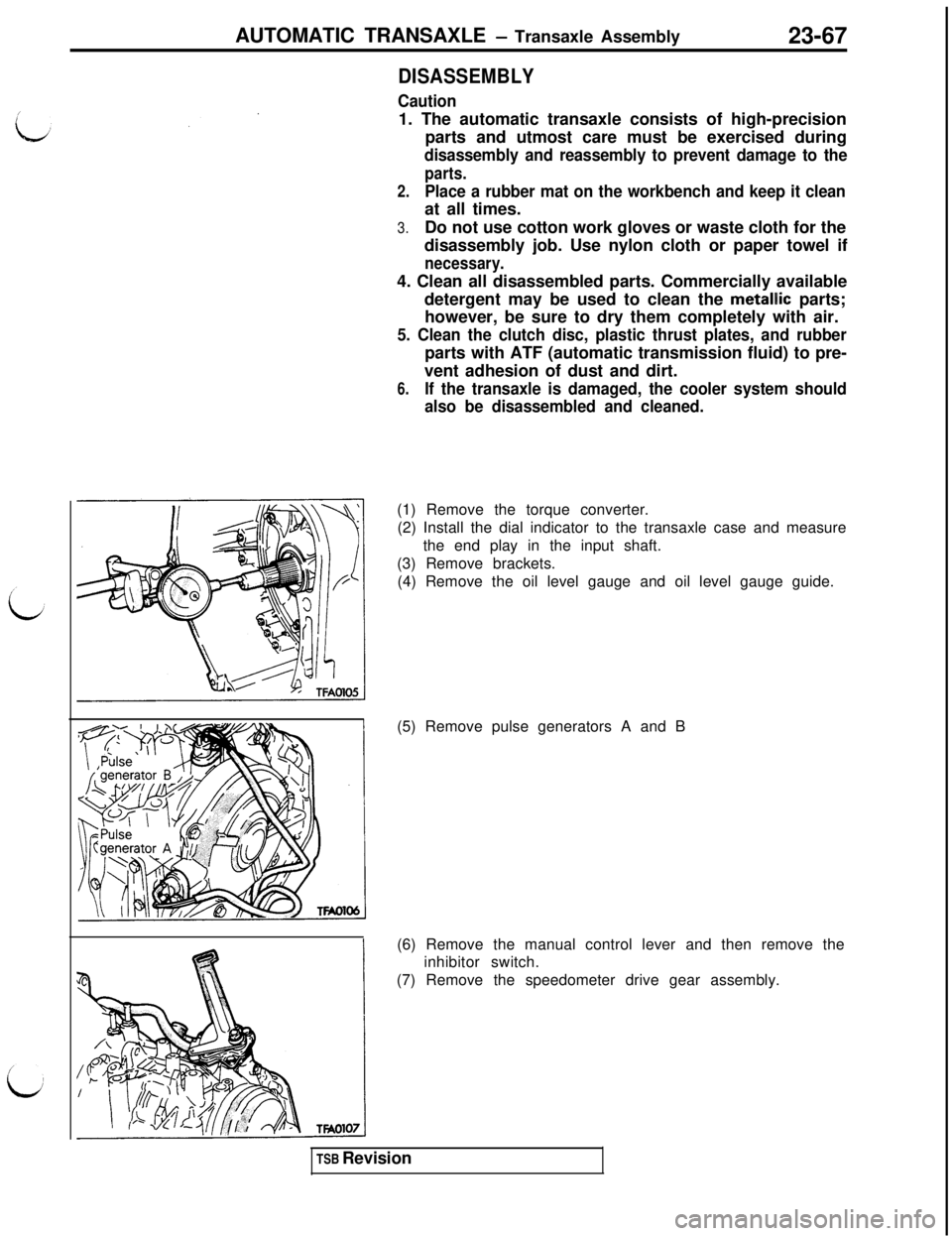
also be disassembled and cleaned.(1) Remove the torque converter.
(2) Install the dial indicator to the transaxle case and measure
the end play in the input shaft.
(3) Remove brackets.
(4) Remove the oil level gauge and oil level gauge guide.
(5) Remove pulse generators A and B
(6) Remove the manual control lever and then remove the
inhibitor switch.
(7) Remove the speedometer drive gear assembly.
TSB Revision
Page 548 of 1146
23-96AUTOMATIC TRANSAXLE - Front Clutch Assembly
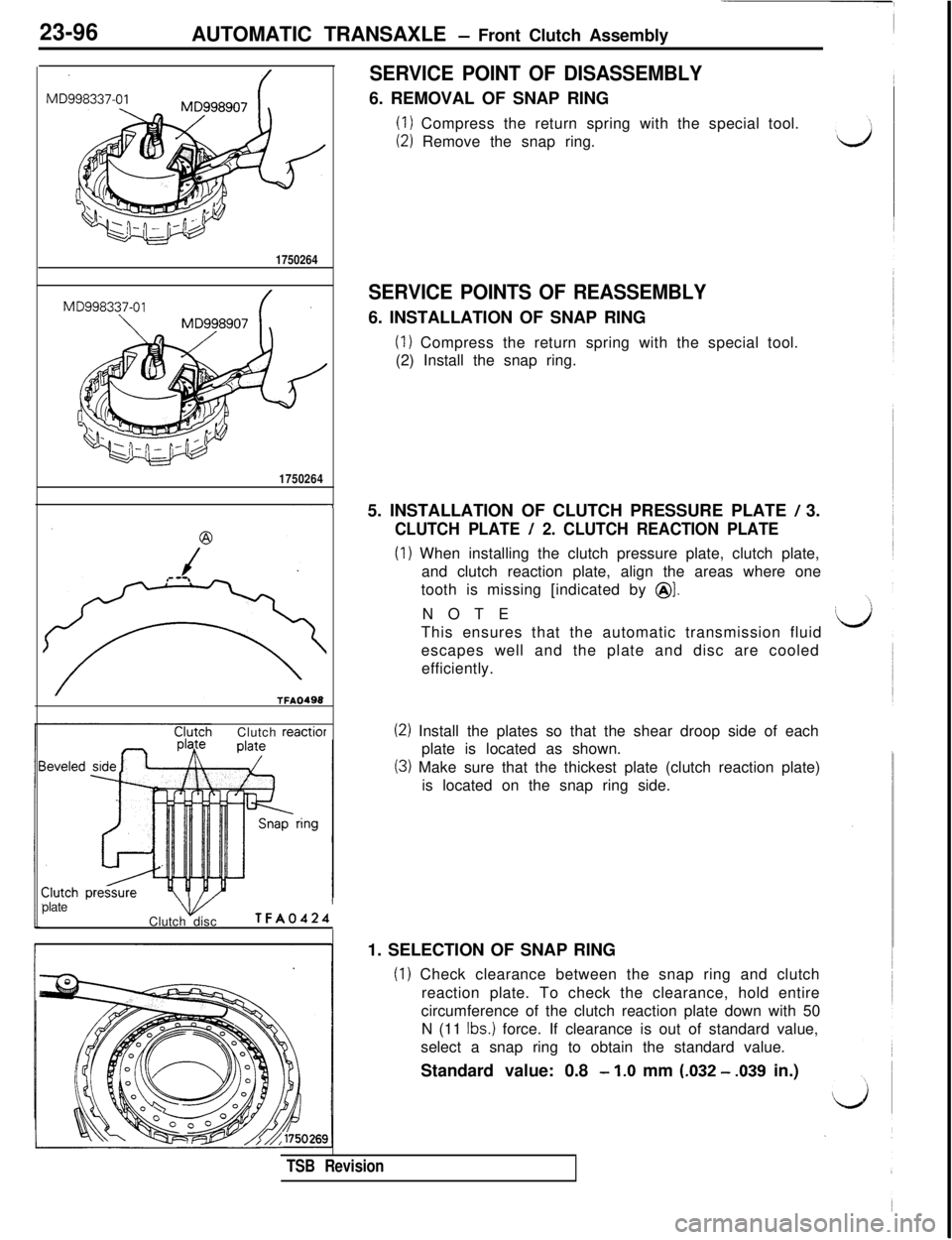
SERVICE POINT OF DISASSEMBLY6. REMOVAL OF SNAP RING
(I) Compress the return spring with the special tool.
(2) Remove the snap ring.
1750264
1750264
7Clutch
reactiorplate
’vClutch discTFAQ424
SERVICE POINTS OF REASSEMBLY6. INSTALLATION OF SNAP RING
(I) Compress the return spring with the special tool.
(2) Install the snap ring.
5. INSTALLATION OF CLUTCH PRESSURE PLATE
/ 3.
CLUTCH PLATE / 2. CLUTCH REACTION PLATE
(1) When installing the clutch pressure plate, clutch plate,
and clutch reaction plate, align the areas where one
tooth is missing [indicated by @I.
NOTE
This ensures that the automatic transmission fluid
escapes well and the plate and disc are cooled
efficiently.
(2) Install the plates so that the shear droop side of each
plate is located as shown.
(3) Make sure that the thickest plate (clutch reaction plate)
is located on the snap ring side.
1. SELECTION OF SNAP RING
(1) Check clearance between the snap ring and clutch
reaction plate. To check the clearance, hold entire
circumference of the clutch reaction plate down with 50
N (11
Ibs.) force. If clearance is out of standard value,
select a snap ring to obtain the standard value.
Standard value: 0.8
- 1.0 mm (.032 - .039 in.)
TSB Revision
Page 550 of 1146
23-98~
AUTOMATIC TRANSAXLE - Rear Clutch Assembly
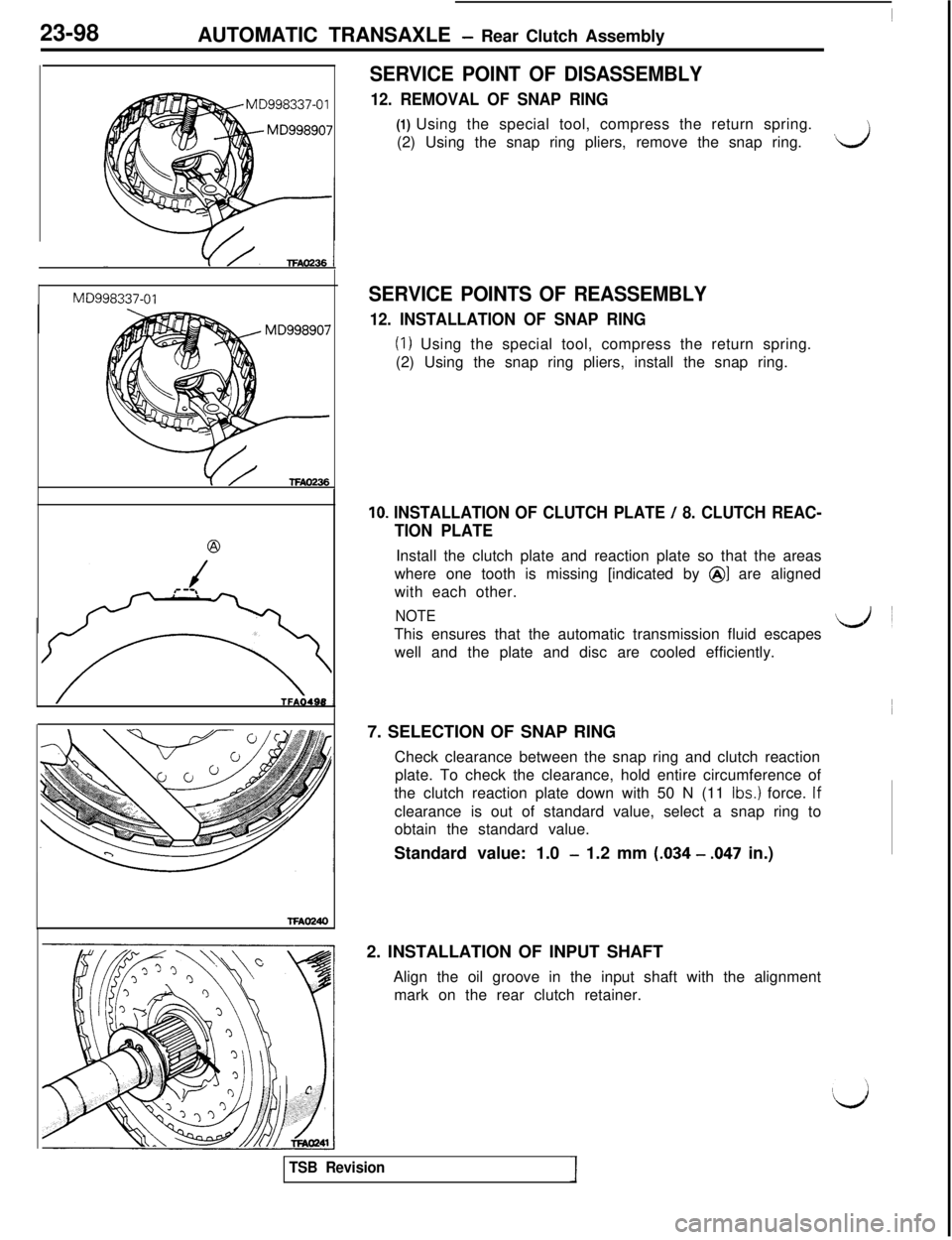
SERVICE POINT OF DISASSEMBLYMD998337-01
12. REMOVAL OF SNAP RING(1) Using the special tool, compress the return spring.
(2) Using the snap ring pliers, remove the snap ring.
‘LJMD998337-01
,
SERVICE POINTS OF REASSEMBLY
12. INSTALLATION OF SNAP RING
(I) Using the special tool, compress the return spring.
(2) Using the snap ring pliers, install the snap ring.
10. INSTALLATION OF CLUTCH PLATE / 8. CLUTCH REAC-
TION PLATEInstall the clutch plate and reaction plate so that the areas
where one tooth is missing [indicated by
@] are aligned
with each other.
NOTEThis ensures that the automatic transmission fluid escapes4~well and the plate and disc are cooled efficiently.
7. SELECTION OF SNAP RING
Check clearance between the snap ring and clutch reaction
plate. To check the clearance, hold entire circumference of
the clutch reaction plate down with 50 N (11
Ibs.) force. Ifclearance is out of standard value, select a snap ring to
obtain the standard value.
Standard value: 1.0
- 1.2 mm (.034 - .047 in.)
2. INSTALLATION OF INPUT SHAFT
Align the oil groove in the input shaft with the alignment
mark on the rear clutch retainer.
TSB Revision
Page 693 of 1146
REAR SUSPENSION
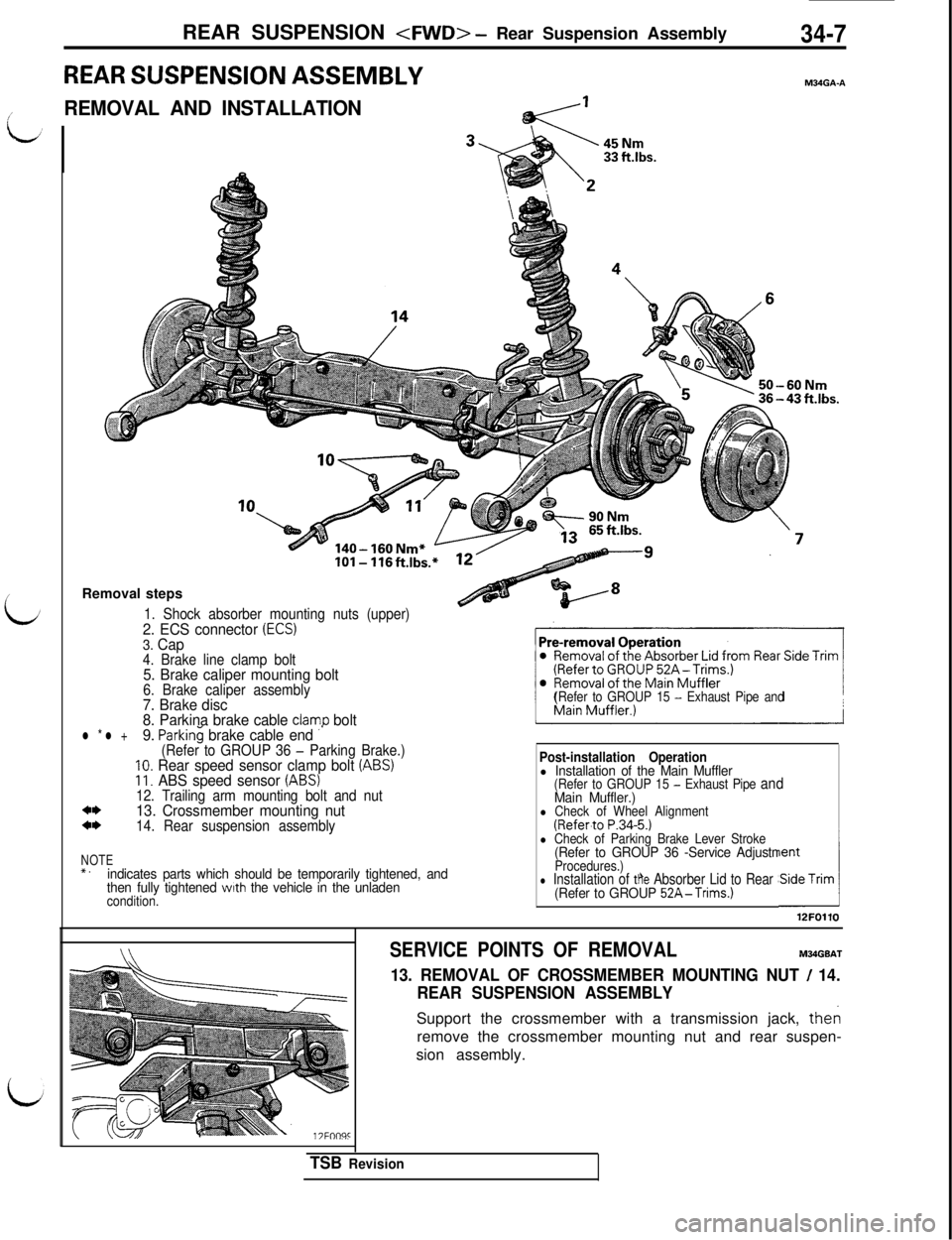
REAR SUSPENSION ASSEMBLYM34GA-A
L/
REMOVAL AND INSTALLATION
140- 160 Nm*IOI- 116ftlbs.
Removal steps
1. Shock absorber mounting nuts (upper)2. ECS connector (ECS)3. Cap4. Brake line clamp bolt5. Brake caliper mounting bolt6. Brake caliper assembly7. Brake disc
8. Parkina brake cable clamo bolt
(Refer to GROUP 15 - Exhaust Pipe and
l * l +9. ParkinG brake cable end ”(Refer to GROUP 36 - Parking Brake.)10. Rear speed sensor clamp bolt (ABS)11. ABS speed sensor (ABS)12. Trailing arm mounting bolt and nut*I)13. Crossmember mounting nut*I)14. Rear suspension assembly
NOTE*.indicates parts which should be temporarily tightened, and
then fully tightened with the vehicle in the unladencondition.
Post-installation Operationl Installation of the Main Muffler(Refer to GROUP 15 - Exhaust Pipe andMain Muffler.)l Check of Wheel Alignment(Refer.to P.34-5.)l Check of Parking Brake Lever Stroke(Refer to GROUP 36 -Service AdjustmentProcedures.)l Installation of the Absorber Lid to Rear Side Trim(Refer to GROUP 52A-Trims.)A12FOllO
SERVICE POINTS OF REMOVALM34GBAT
13. REMOVAL OF CROSSMEMBER MOUNTING NUT / 14.
REAR SUSPENSION ASSEMBLYSupport the crossmember with a transmission jack, then
remove the crossmember mounting nut and rear suspen-
sion assembly.
TSB Revision