engine MITSUBISHI 3000GT 1991 Service Manual
[x] Cancel search | Manufacturer: MITSUBISHI, Model Year: 1991, Model line: 3000GT, Model: MITSUBISHI 3000GT 1991Pages: 1146, PDF Size: 76.68 MB
Page 1092 of 1146
55-10 HEATERS AND MANUAL AIR CONDITIONER -Service Adjustment Procedures
OFF-----__-__1210235 2,1002,700
(30) (33)(299) (384)
Pressure Fil
2OPOOlL
SERVICE ADJUSTMENT PROCEDURES
M55FEAU
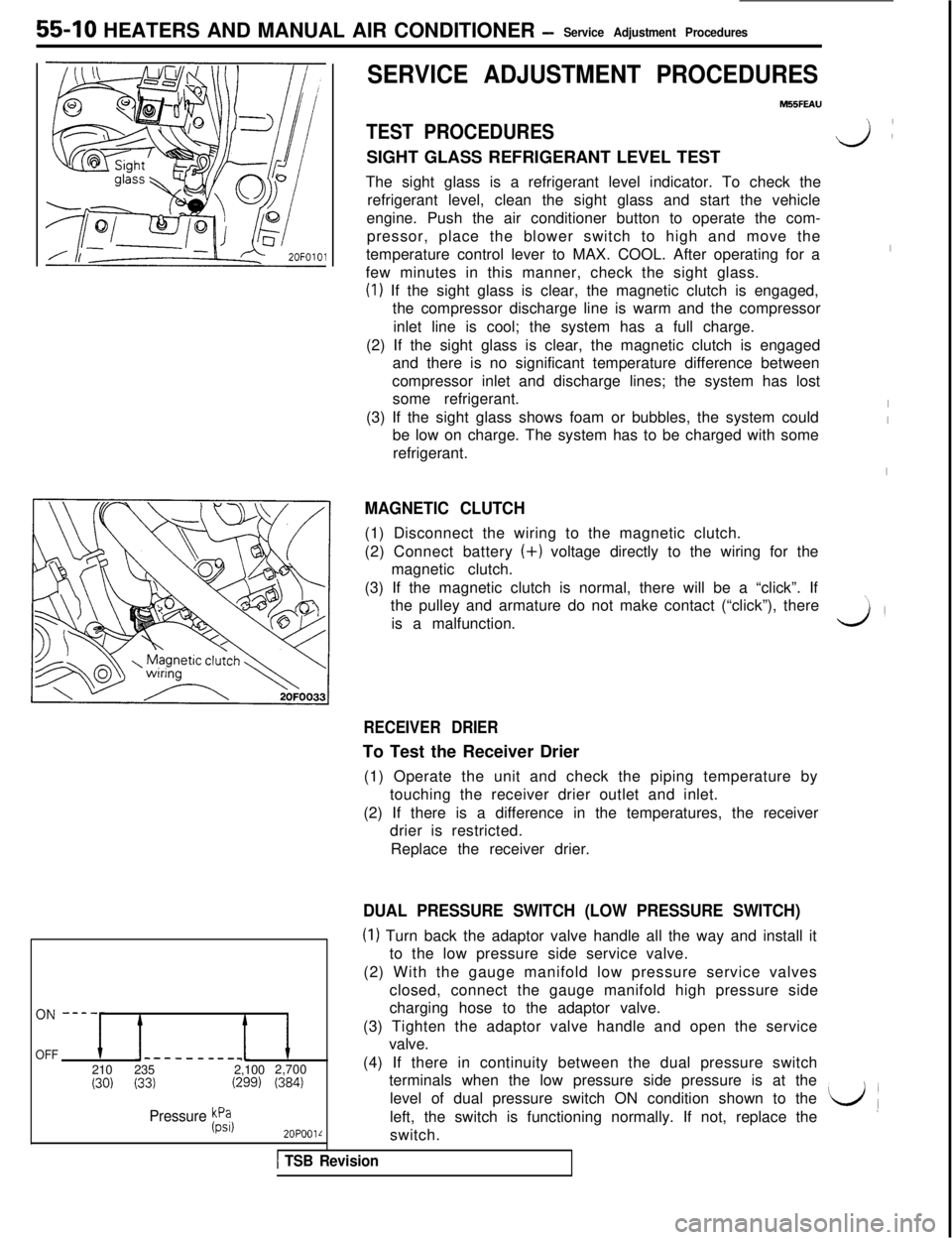
TEST PROCEDURESSIGHT GLASS REFRIGERANT LEVEL TEST
The sight glass is a refrigerant level indicator. To check the
refrigerant level, clean the sight glass and start the vehicle
engine. Push the air conditioner button to operate the com-
pressor, place the blower switch to high and move the
temperature control lever to MAX. COOL. After operating for a
few minutes in this manner, check the sight glass.
(I) If the sight glass is clear, the magnetic clutch is engaged,
the compressor discharge line is warm and the compressor
inlet line is cool; the system has a full charge.
(2) If the sight glass is clear, the magnetic clutch is engaged
and there is no significant temperature difference between
compressor inlet and discharge lines; the system has lost
some refrigerant.
(3) If the sight glass shows foam or bubbles, the system could
be low on charge. The system has to be charged with some
refrigerant.
MAGNETIC CLUTCH(1) Disconnect the wiring to the magnetic clutch.
(2) Connect battery (+) voltage directly to the wiring for the
magnetic clutch.
(3) If the magnetic clutch is normal, there will be a “click”. If
the pulley and armature do not make contact (“click”), there
is a malfunction.
v):
I
I
I
I
\,
3’
RECEIVER DRIERTo Test the Receiver Drier
(1) Operate the unit and check the piping temperature by
touching the receiver drier outlet and inlet.
(2) If there is a difference in the temperatures, the receiver
drier is restricted.
Replace the receiver drier.
DUAL PRESSURE SWITCH (LOW PRESSURE SWITCH)
(I) Turn back the adaptor valve handle all the way and install it
to the low pressure side service valve.
(2) With the gauge manifold low pressure service valves
closed, connect the gauge manifold high pressure side
charging hose to the adaptor valve.
(3) Tighten the adaptor valve handle and open the service
valve.
(4) If there in continuity between the dual pressure switch
terminals when the low pressure side pressure is at the
level of dual pressure switch ON condition shown to the
left, the switch is functioning normally. If not, replace the
L/(switch.
1 TSB Revision
Page 1093 of 1146
HEATERS AND MANUAL AIR CONDITIONER -Service Adjustment Procedures 55 1 1
lr In et sensor
UC03xD:c.-;am$2lYXSC0x.x
xa0:: :,:::25 cc,ii 77h>Temperature20A043F
argqse
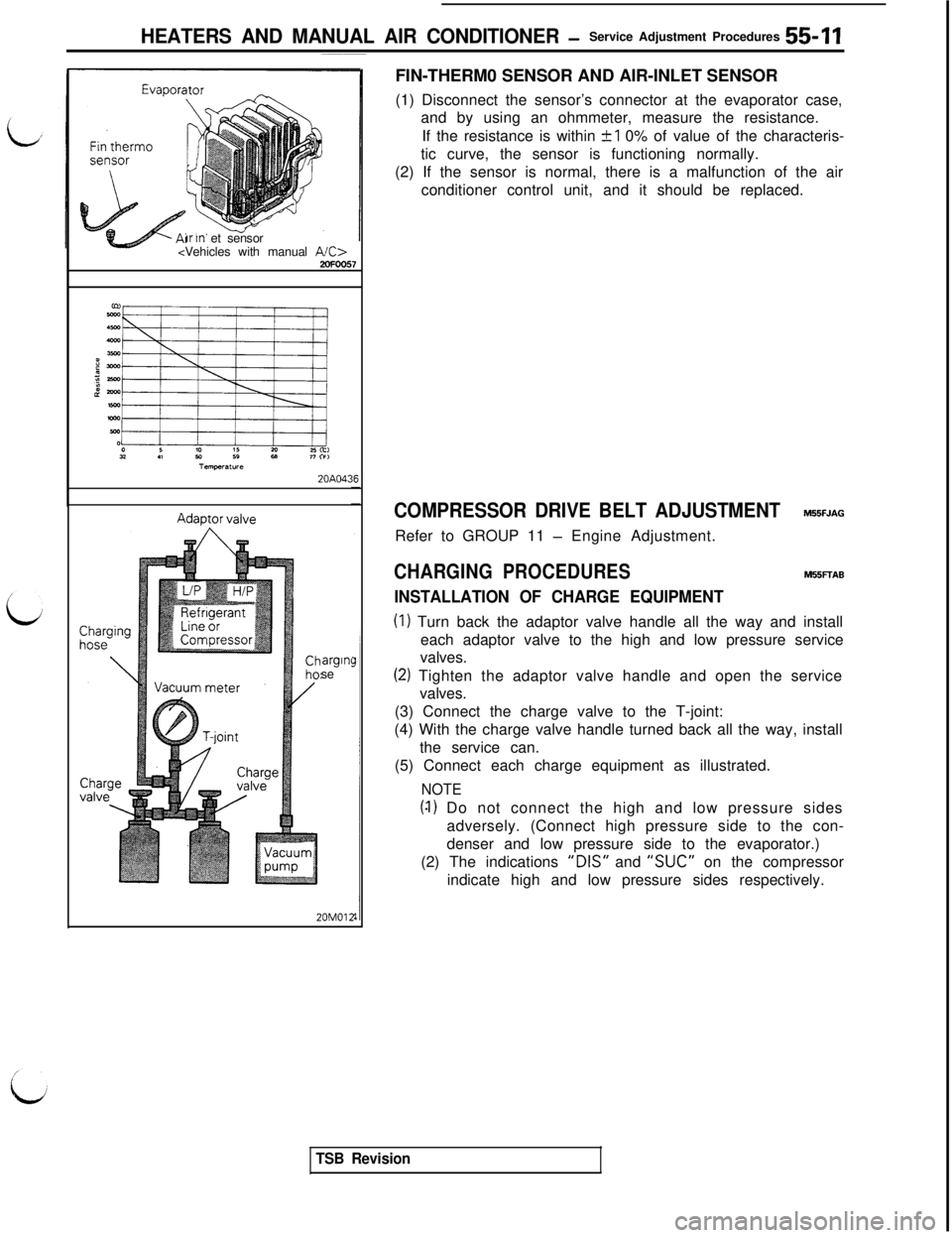
20M012FIN-THERM0 SENSOR AND AIR-INLET SENSOR
(1) Disconnect the sensor’s connector at the evaporator case,
and by using an ohmmeter, measure the resistance.
If the resistance is within
+I 0% of value of the characteris-
tic curve, the sensor is functioning normally.
(2) If the sensor is normal, there is a malfunction of the air
conditioner control unit, and it should be replaced.
COMPRESSOR DRIVE BELT ADJUSTMENTM55FJAGRefer to GROUP 11
- Engine Adjustment.
CHARGING PROCEDURESM55FTAB
INSTALLATION OF CHARGE EQUIPMENT
(I) Turn back the adaptor valve handle all the way and install
each adaptor valve to the high and low pressure service
valves.
(2) Tighten the adaptor valve handle and open the service
valves.
(3) Connect the charge valve to the T-joint:
(4) With the charge valve handle turned back all the way, install
the service can.
(5) Connect each charge equipment as illustrated.
NOTE
(4) Do not connect the high and low pressure sides
adversely. (Connect high pressure side to the con-
denser and low pressure side to the evaporator.)
(2) The indications
“DIS” and “SUC” on the compressor
indicate high and low pressure sides respectively.
TSB Revision
Page 1095 of 1146
HEATERS AND MANUAL AIR CONDITIONER - Service AdWment proceres 55-13. .
Charginglose
\Adaptor valve
Vacuum meter
T-joint
20M0121
(1O)Start the engine.(1l)Operate the air conditioner and set at the lowest tempera-
ture (MAX. COOL).
(12)Fix the engine speed at 1,500 rpm.
(13)Tighten the low pressure side adaptor valve and open the
service valve to charge specified amount of refrigerant.
Caution
If the service can is inverted, liquid refrigerant may bedrawn into the compressor damaging it by liquid
compression. Keep the service can upright to ensurethat refrigerant is charged in gas state.
(14)Upon completion of charging, turn back the low pressure
side adaptor valve handle all the way and close the service
valve.
CHARGING WITH REFRIGERANT RECOVERY AND RE-
CYCLING UNITWhen using refrigerant recovery and recycling unit, follow
carefully the instruction manual for the unit.
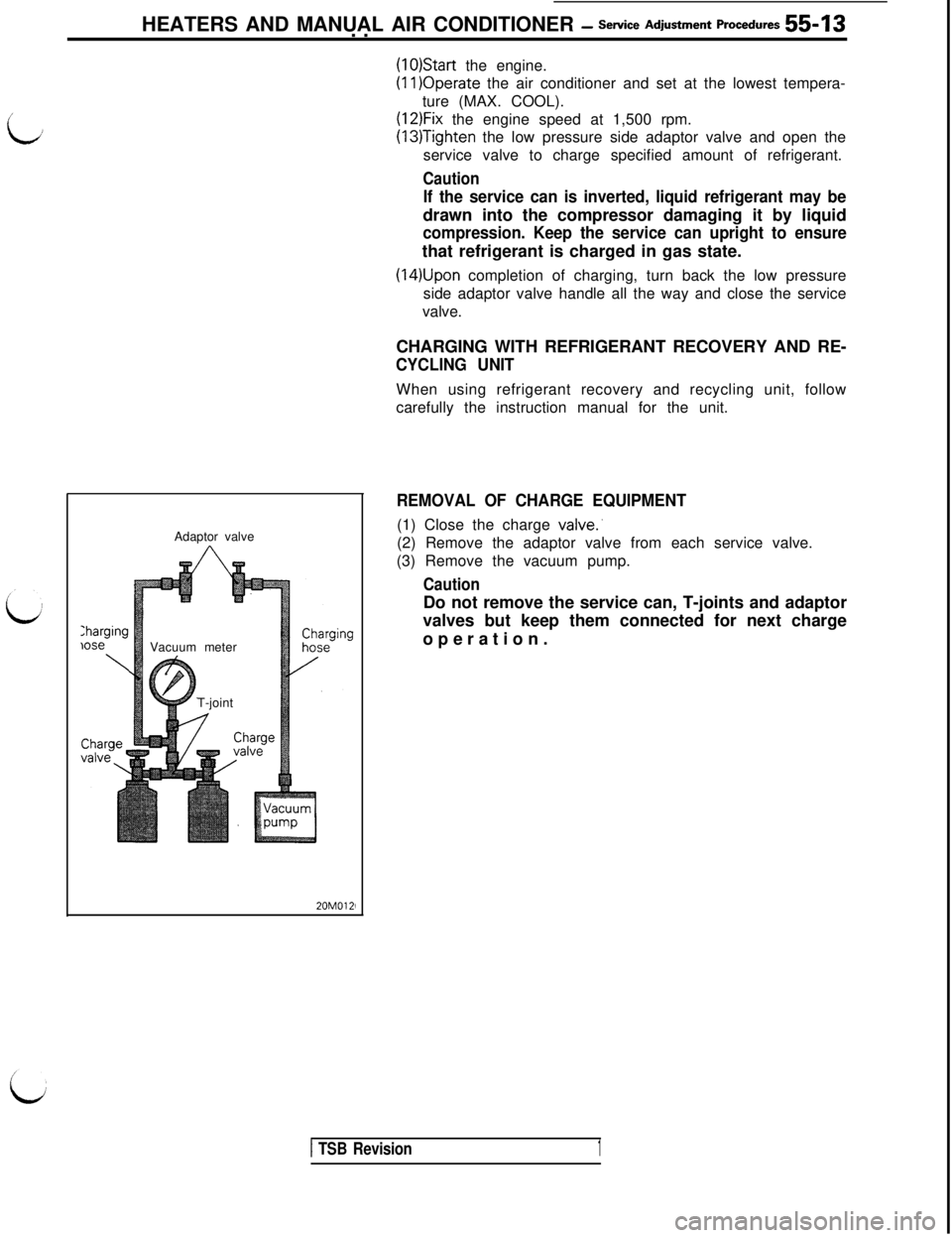
REMOVAL OF CHARGE EQUIPMENT(1) Close the charge
valve:(2) Remove the adaptor valve from each service valve.
(3) Remove the vacuum pump.
CautionDo not remove the service can, T-joints and adaptor
valves but keep them connected for next charge
operation.
1 TSB Revision1
Page 1096 of 1146
CautionRefrigerantR-l 2iAdaptorNever use the high pressure side as this may cause
/valve
refrigerant to flow back, using rupture of the servicecan.(7) Start the engine. Charge valvergmg hose
55-14 HEATERS AND MANUAL AIR CONDITIONER - Service Adjustment procedures
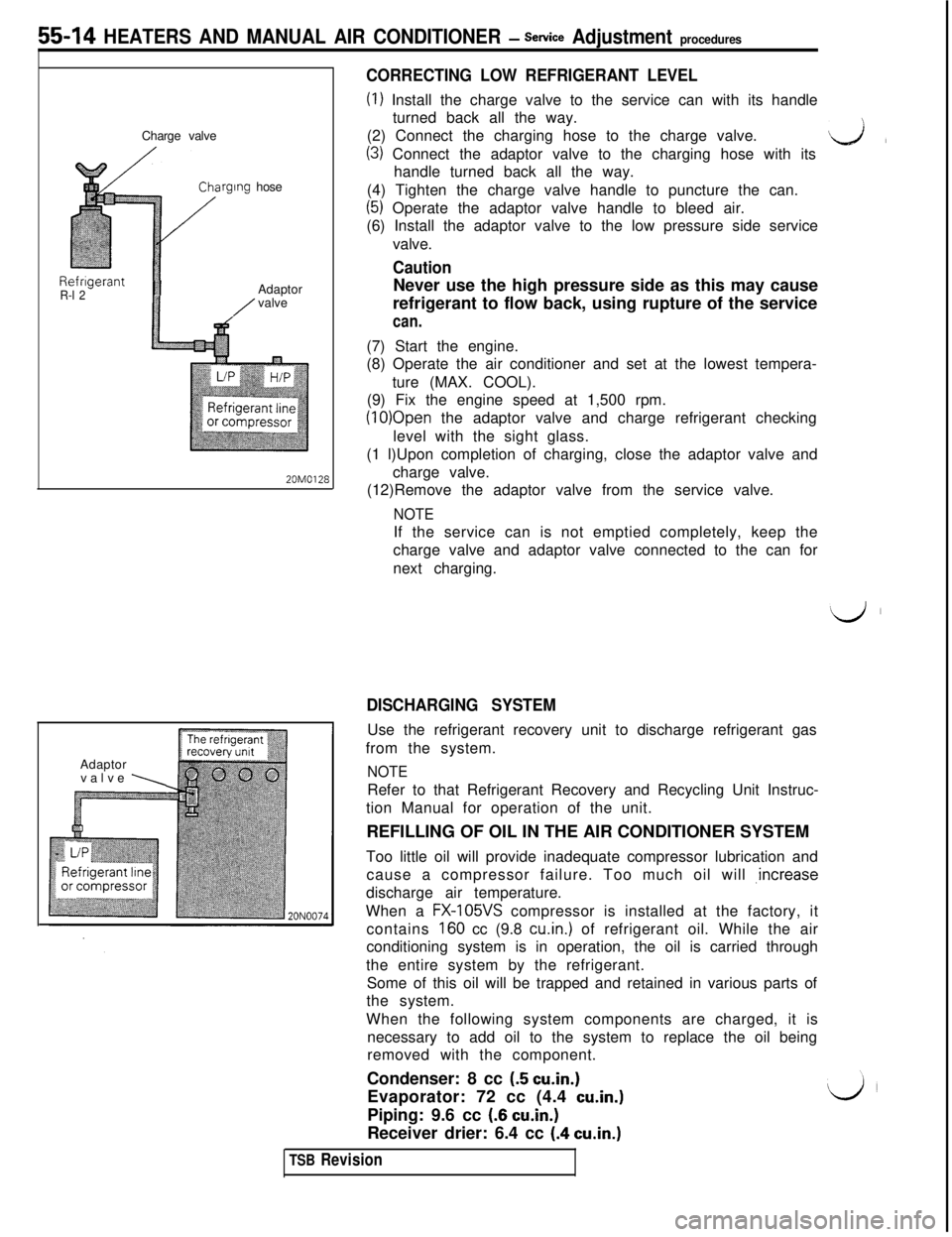
CORRECTING LOW REFRIGERANT LEVEL
(I) Install the charge valve to the service can with its handle
turned back all the way.
(2) Connect the charging hose to the charge valve.
(3) Connect the adaptor valve to the charging hose with itsL&lhandle turned back all the way.
(4) Tighten the charge valve handle to puncture the can.
(5) Operate the adaptor valve handle to bleed air.
(6) Install the adaptor valve to the low pressure side service
valve.
(8) Operate the air conditioner and set at the lowest tempera-
ture (MAX. COOL).
(9) Fix the engine speed at 1,500 rpm.
(10)Open the adaptor valve and charge refrigerant checking
level with the sight glass.
(1 l)Upon completion of charging, close the adaptor valve and
20M0128charge valve.
(12)Remove the adaptor valve from the service valve.
NOTEIf the service can is not emptied completely, keep the
charge valve and adaptor valve connected to the can for
next charging.
Adaptor
valve
\
DISCHARGING SYSTEMUse the refrigerant recovery unit to discharge refrigerant gas
from the system.
NOTERefer to that Refrigerant Recovery and Recycling Unit Instruc-
tion Manual for operation of the unit.
REFILLING OF OIL IN THE AIR CONDITIONER SYSTEM
Too little oil will provide inadequate compressor lubrication and
cause a compressor failure. Too much oil will ,increase
discharge air temperature.
When a
FX-105VS compressor is installed at the factory, it
contains
160 cc (9.8 cu.in.) of refrigerant oil. While the air
conditioning system is in operation, the oil is carried through
the entire system by the refrigerant.
Some of this oil will be trapped and retained in various parts of
the system.
When the following system components are charged, it is
necessary to add oil to the system to replace the oil being
removed with the component.
Condenser: 8 cc
(5 cu.in.)Evaporator: 72 cc (4.4
cu.in.)Piping: 9.6 cc
(6 cu.in.)Receiver drier: 6.4 cc
(.4 cu.in.)
TSB Revision
Page 1097 of 1146
L/
i
HEATERS AND MANUAL AIR CONDITIONER -Service Adjustment Procedures 55 15
PERFORMANCE TESTM55FWAH
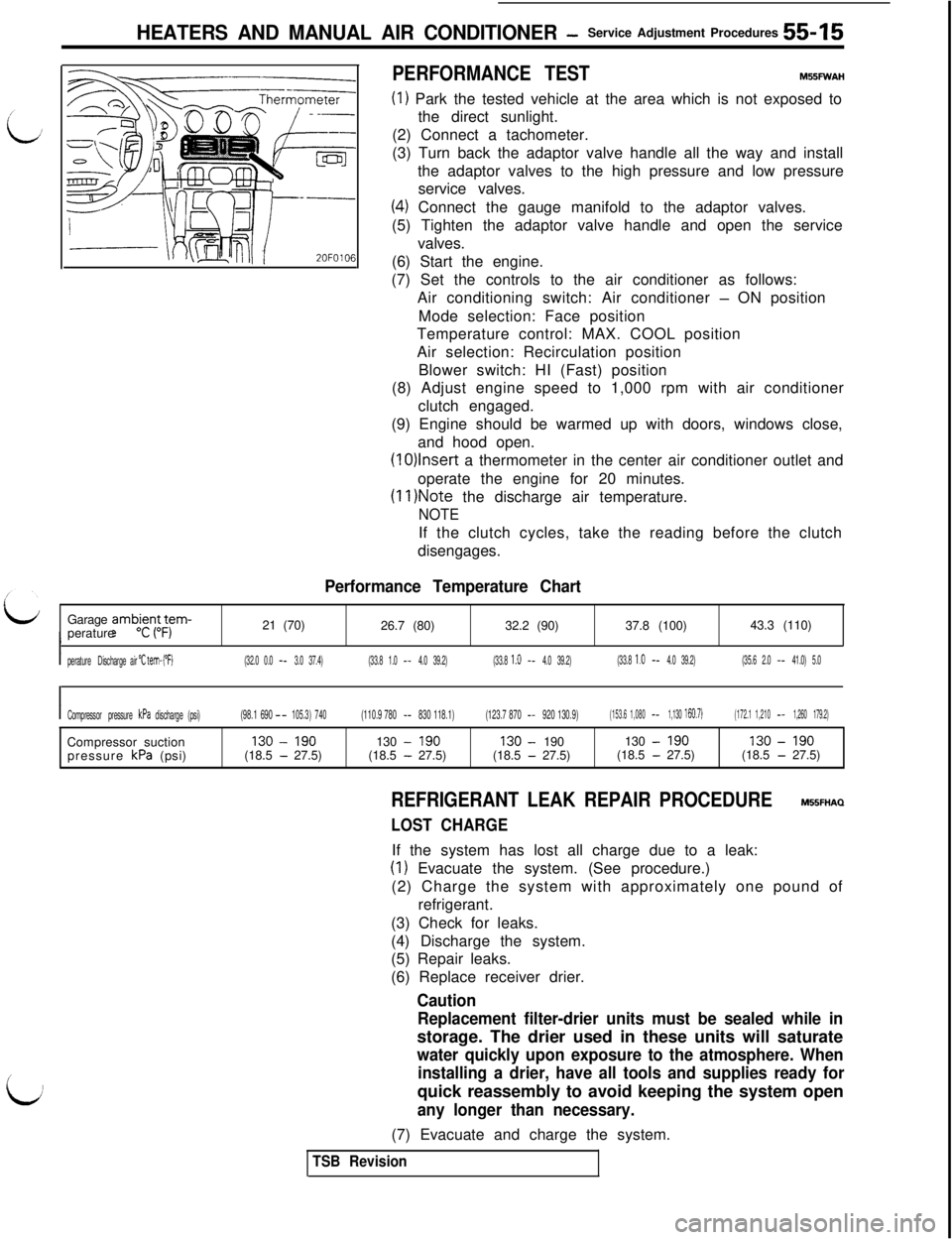
(I) Park the tested vehicle at the area which is not exposed to
the direct sunlight.
(2) Connect a tachometer.
(3) Turn back the adaptor valve handle all the way and install
the adaptor valves to the high pressure and low pressure
service valves.
(4) Connect the gauge manifold to the adaptor valves.
(5) Tighten the adaptor valve handle and open the service
valves.
(6) Start the engine.
(7) Set the controls to the air conditioner as follows:
Air conditioning switch: Air conditioner
- ON position
Mode selection: Face position
Temperature control: MAX. COOL position
Air selection: Recirculation position
Blower switch: HI (Fast) position
(8) Adjust engine speed to 1,000 rpm with air conditioner
clutch engaged.
(9) Engine should be warmed up with doors, windows close,
and hood open.
(1O)lnsert a thermometer in the center air conditioner outlet and
operate the engine for 20 minutes.
(II )Note the discharge air temperature.
NOTEIf the clutch cycles, take the reading before the clutch
disengages.
Performance Temperature ChartGarage
amb;in,L;am-perature21 (70)
26.7 (80)32.2 (90)37.8 (100)43.3 (110)
Iperature Dischargeair "C tem- ("F)(32.0 0.0- -3.0 37.4)(33.8 1.0- -4.0 39.2)(33.8 1.0- -4.0 39.2)(33.8 1.0- -4.0 39.2)(35.6 2.0- -41.0) 5.0
ICompressor pressure kPa discharge (psi)(98.1 690- -105.3) 740(110.9 780- -830 118.1)(123.7 870- -920 130.9)(153.6 1,080- -1,130 160.7)(172.1 1,210- -1,260 179.2)Compressor suction130
-190130-190130-190130-190130-190
pressure kPa (psi)(18.5-27.5)(18.5-27.5)(18.5-27.5)(18.5-27.5)(18.5-27.5)
REFRIGERANT LEAK REPAIR PROCEDUREM55FHAQ
LOST CHARGEIf the system has lost all charge due to a leak:
(1) Evacuate the system. (See procedure.)
(2) Charge the system with approximately one pound of
refrigerant.
(3) Check for leaks.
(4) Discharge the system.
(5) Repair leaks.
(6) Replace receiver drier.
Caution
Replacement filter-drier units must be sealed while instorage. The drier used in these units will saturate
water quickly upon exposure to the atmosphere. When
installing a drier, have all tools and supplies ready forquick reassembly to avoid keeping the system open
any longer than necessary.(7) Evacuate and charge the system.
TSB Revision
Page 1098 of 1146
55-16 HEATERS AND MANUAL AIR CONDITIONER -Service Adjustment Procedures
LOW CHARGE~
If the system has not lost all of its refrigerant charge; locate and
repair all leaks. If it is necessary to increase the system
pressure to find the leak (because of an especially low charge)
‘iaadd of refrigerant. If it is oossible to reoair the leak without
discharging-the refrigerant system, use the procedure for
correcting low refrigerant level.
HANDLING TUBING AND FITTINGSM55FlAFKinks in the refrigerant tubing or sharp bends in the refrigerant
hose lines will greatly reduce the capacity of the entire system.
High pressures are produced in the system when it is
operating. Extreme care must be exercised to make sure that
all connections are pressure tight. Dirt and moisture can enter
the system when it is opened for repair or replacement of lines
or components. The following precautions must be observed.
The system must be completely discharged before opening
any fitting of connection in the refrigeration system. Open
fittings with caution even after the system has been dis-
charged. If any pressure is noticed as a fitting is loosened, allow
trapped pressure to bleed off very slowly.
Never attempt to rebend formed lines to fit. Use the correct
line for the installation you are servicing.
A good rule for the flexible hose lines is keep the radius of all
bends at least 10 times the diameter of the hose.
Sharper bends will reduce the flow of refrigerant. The flexible
hose lines should be routed so that they are at least 80 mm (3
in.) from the exhaust manifold. It is good practice to inspect all
flexible hose lines at least once a year to make sure they are in
good condition and properly routed.
\ Aj iUnified plumbing connections with O-rings. These O-rings are
-not reusable.
I
COMPRESSOR NOISEM55FlAD
When investigating an air conditioning related noise, you must
first know the conditions when the noise occurs. These
conditions are: weather, vehicle speed, in gear on neutral,
engine temperature or any other special conditions.
Noises that develop during air conditioning operation can often
be misleading. For example: what sounds like a failed front
bearing or connecting rod. may be caused by loose bolts, nuts,
mounting brackets, or a loose clutch assembly. Verify acces-
sory drive belt tension (power steering or alternator).
Improper accessory drive belt tension can cause a misleading
noise when the compressor is engaged and little or no noise
when the compressor is disengaged.
Drive belts are speed sensitive. That is, at different engine
speeds, and depending upon belt tension, belts can develop
unusual noises that are often mistaken for mechanical prob-
lems within the compressor.
TSB Revision
Page 1099 of 1146
HEATERS AND MANUAL AIR CbNDlTlONER -Service Adjustment Procedures 55 17
ADJUSTMENT PROCEDURES(1) Select a quiet area for testing. Duplicate conditions as much
as possible. Switch compressor on and off several times to
clearly identify compressor noise.
To duplicate high ambient conditions (high head pressure),
restrict air flow through condenser. Install manifold gauge
set to make sure discharge pressure doesn’t exceed 2,070
kPa (300 psi).
(2) Tighten all compressor mounting bolts, clutch mounting
bolt, and compressor drive belt. Check to assure clutch coil
is tight (no rotation or wobble).
(3) Check refrigerant hoses for rubbing or interference that can
cause unusual noises.
(4) Check refrigerant charge. (See “Charging System”.)
(5) Recheck compressor noise as in Step 1.
(6) If noise still exists, loosen compressor mounting bolts and
retorque. Repeat Step 1.
(7) If noise continues, replace compressor and repeat Step 1.
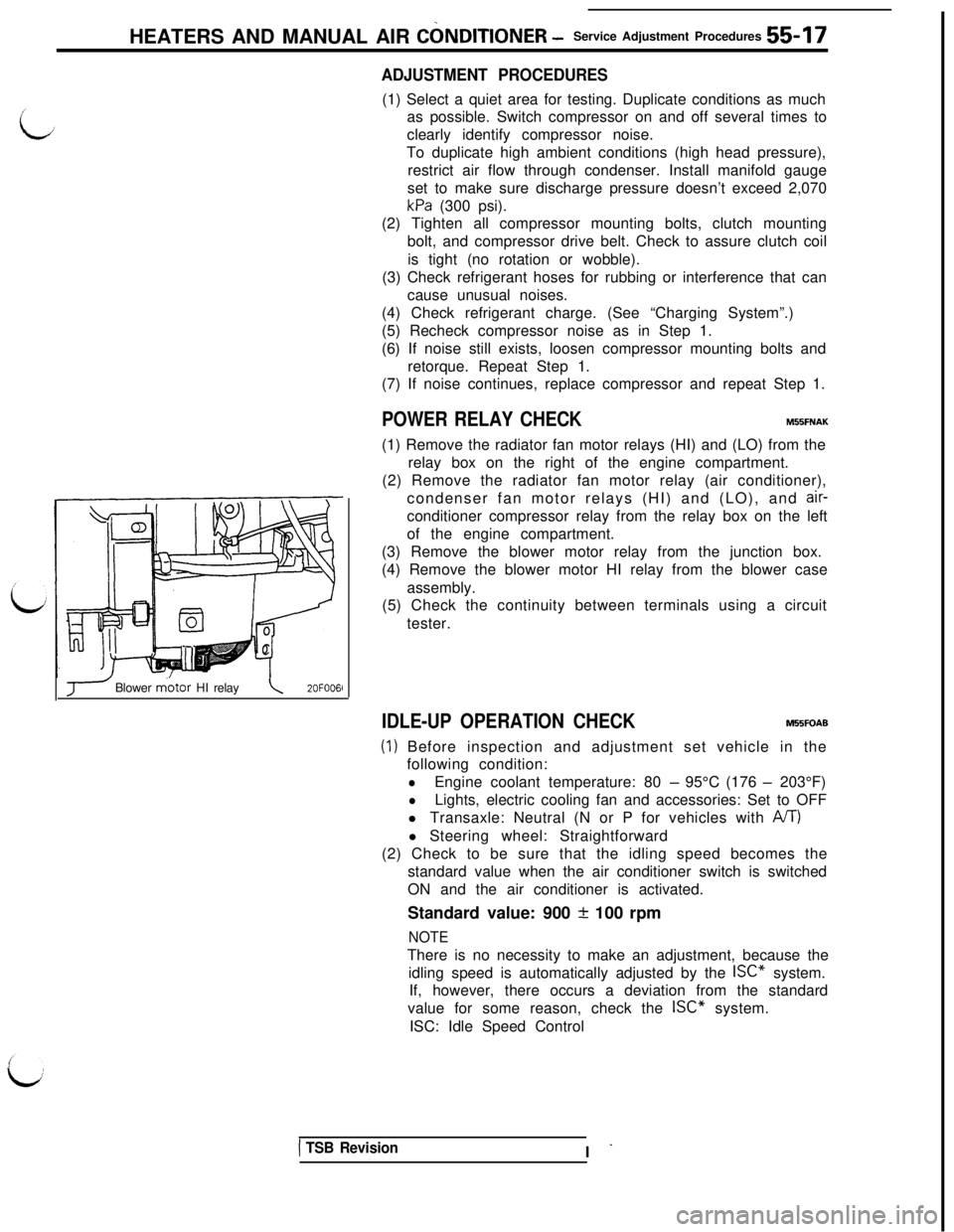
POWER RELAY CHECKMBBFNAK(1) Remove the radiator fan motor relays (HI) and (LO) from the
relay box on the right of the engine compartment.
(2) Remove the radiator fan motor relay (air conditioner),
condenser fan motor relays (HI) and (LO), and
air-conditioner compressor relay from the relay box on the left
of the engine compartment.
(3) Remove the blower motor relay from the junction box.
(4) Remove the blower motor HI relay from the blower case
assembly.
(5) Check the continuity between terminals using a circuit
tester.
J Blower m.otor HI relay\2OFOO6l
IDLE-UP OPERATION CHECKM55FOAB
(1) Before inspection and adjustment set vehicle in the
following condition:
lEngine coolant temperature: 80 - 95°C (176 - 203°F)
lLights, electric cooling fan and accessories: Set to OFF
l Transaxle: Neutral (N or P for vehicles with
A/T)l Steering wheel: Straightforward
(2) Check to be sure that the idling speed becomes the
standard value when the air conditioner switch is switched
ON and the air conditioner is activated.
Standard value: 900
+ 100 rpm
NOTEThere is no necessity to make an adjustment, because the
idling speed is automatically adjusted by the ISC” system.
If, however, there occurs a deviation from the standard
value for some reason, check the ISC” system.
ISC: Idle Speed Control
1 TSB RevisionI -
Page 1112 of 1146
HEATERS AND MANUAL AIR CONDITIONER - Compressor
Spring
Valve
ompressor
2OPO286~
SERVICE POINT OF DISASSEMBLYMSlSFAE3. REMOVAL OF NUT
Use the special tool to loosen the nut,
INSPECTIONM55SGABl Check the surface of the armature for scoring or bluing.
l Check the surface of the rotor for scoring or bluing.
l Check the sealing surfaces for cracks, scratches and
deformation.
0Check the front housing for cracks or scoring on the sealing
surfaces.l Check the compressor shaft for scoring.
J
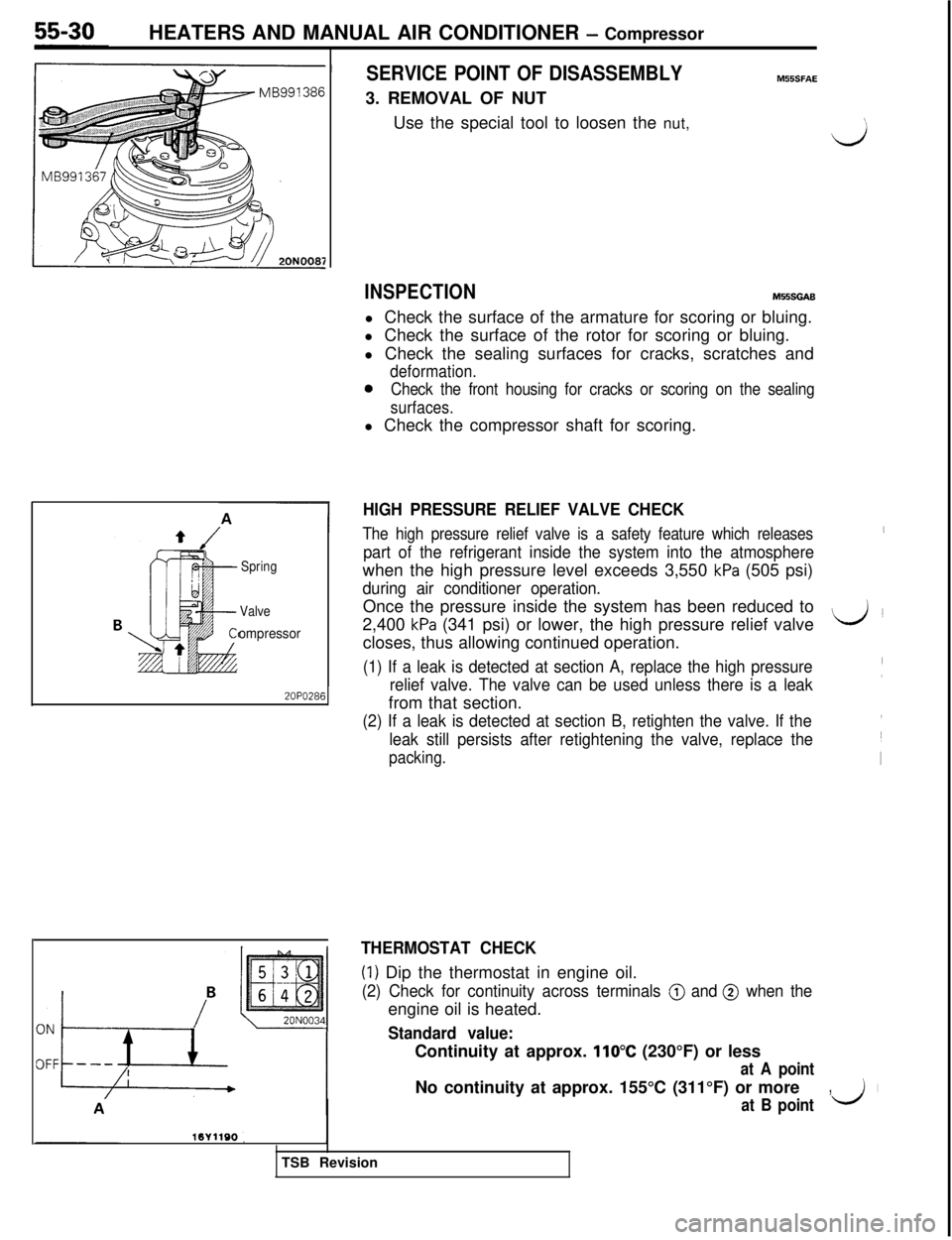
HIGH PRESSURE RELIEF VALVE CHECK
The high pressure relief valve is a safety feature which releasesI
part of the refrigerant inside the system into the atmospherewhen the high pressure level exceeds 3,550
kPa (505 psi)
during air conditioner operation.Once the pressure inside the system has been reduced to
2,400
kPa (341 psi) or lower, the high pressure relief valveL&Jcloses, thus allowing continued operation.
(1) If a leak is detected at section A, replace the high pressure
relief valve. The valve can be used unless there is a leak(from that section.
(2) If a leak is detected at section B, retighten the valve. If the
leak still persists after retightening the valve, replace the
packing.
THERMOSTAT CHECK
(1) Dip the thermostat in engine oil.
(2) Check for continuity across terminals @ and @ when theengine oil is heated.
Standard value:Continuity at approx.
110°C (230°F) or less
at A pointNo continuity at approx. 155°C (311°F) or more
,I
at B pointII;TSB Revision
Page 1113 of 1146
zz
h34\
*
Engine speed rpm2OPO2S
\CrankshaftTapered part
20A0157
REVOLUTION PICK UP SENSOR CHECKMeasure the resi")
HEATERS AND MANUAL AIR CONDITIONER - Compressor55-3120N003d
2OFOO96
I
Ec-3
3180?+I! (25)zz
h34\
*
Engine speed rpm2OPO2S
\CrankshaftTapered part
20A0157
REVOLUTION PICK UP SENSOR CHECKMeasure the resistance between terminals
@ and @ of the
connector.
Normal resistance: 405 + 35 R when ambient temperatureis
20°C (68°F)
If the measurement deviates greatly from the above resis-
tance, replace the revolution pick up sensor assembly.
CONTROL VALVE CHECKThe control valve detects a low pressure level during the
operation of the air conditioner, and adjusts the amount of
refrigerant to be bypassed.
(1) Operate the air conditioner under a high temperature loadcondition (when vehicle interior temperature is high).
(2) Connect a low pressure gauge to the air compressor.
(3) Operate the air conditioner with the engine running at idle.
(4) Gradually increase the engine speed while observing the
low pressure gauge.
If the valve is normal, the low pressure drops slowly as the
engine speed increases until a pressure of 180
kPa (25 psi)
is reached, at which point the pressure temporarily ceasesto drop. Then, the pressure again starts dropping as the
engine speed further increases.If the valve is abnormal, the low pressure drops in direct
proportion to the increase in engine speed without a
temporary leveling off at the 180 kPa (25 psi) pressure level.
If the low pressure drops like this, replace the control valve.
SERVICE POINTS OF REASSEMBLYM556HAF
8. INSTALLATION OF CLUTCH COIL
Align the pin of the clutch coil with the pin hole in the fronthousing, and then fit it into the hole.
7. INSTALLATION OF SNAP RING
Install the snap ring so that the tapered surface is at the
outer side.
1 TSB Revision
Page 1116 of 1146
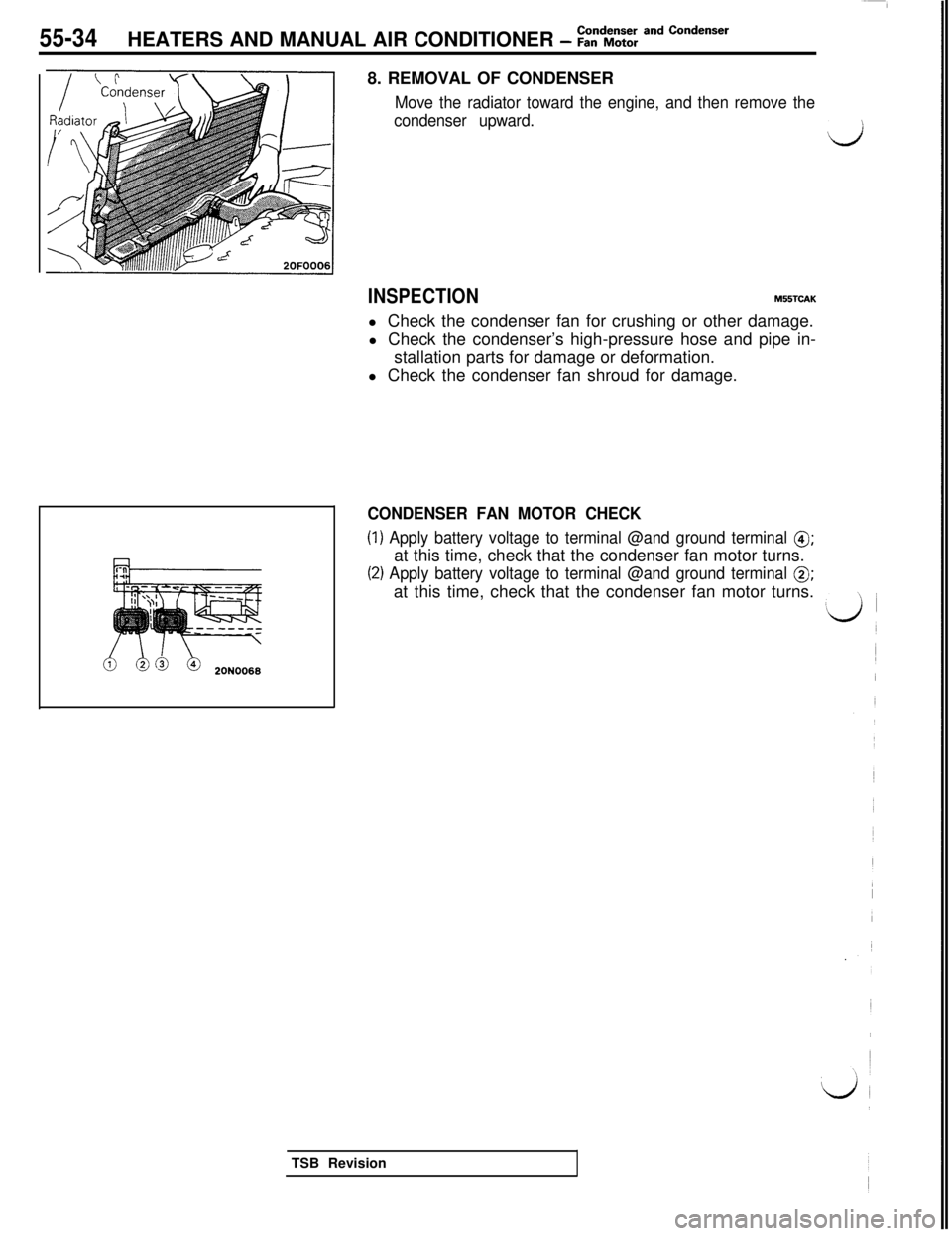
55-34HEATERS AND MANUAL AIR CONDITIONER - :t%%: and Condenser8. REMOVAL OF CONDENSER
Move the radiator toward the engine, and then remove the
condenser upward.
d
INSPECTIONM55TCAKl Check the condenser fan for crushing or other damage.
l Check the condenser’s high-pressure hose and pipe in-
stallation parts for damage or deformation.
l Check the condenser fan shroud for damage.
CONDENSER FAN MOTOR CHECK
(1) Apply battery voltage to terminal @and ground terminal 8;at this time, check that the condenser fan motor turns.
(2) Apply battery voltage to terminal @and ground terminal 0;at this time, check that the condenser fan motor turns.
TSB Revision