cruise control MITSUBISHI 3000GT 1991 Owner's Guide
[x] Cancel search | Manufacturer: MITSUBISHI, Model Year: 1991, Model line: 3000GT, Model: MITSUBISHI 3000GT 1991Pages: 1146, PDF Size: 76.68 MB
Page 288 of 1146
13-182CRUISE CONTROL SYSTEM - Service Adjustment ProceduresI
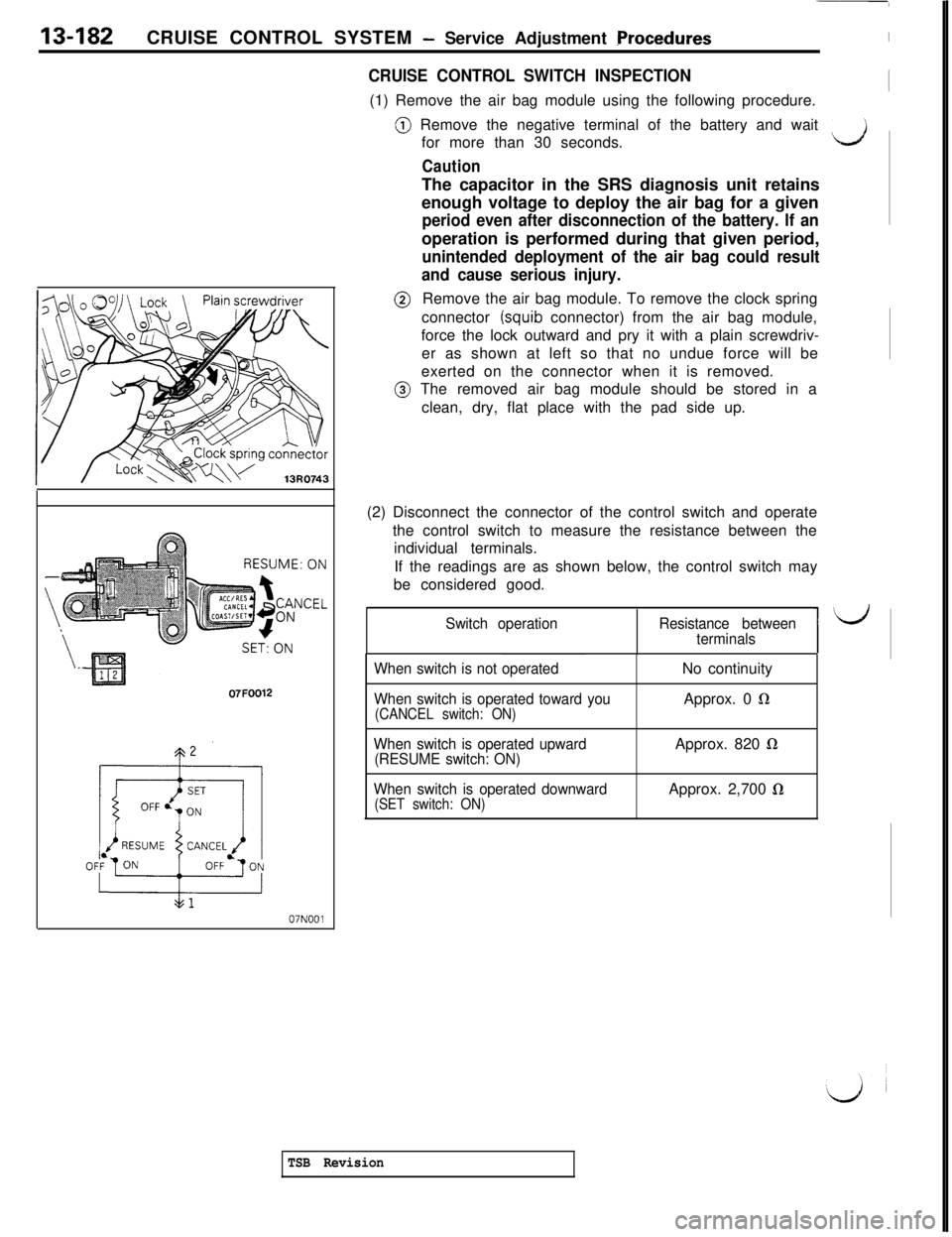
CRUISE CONTROL SWITCH INSPECTION(1) Remove the air bag module using the following procedure.I07FOO12
07NOOl@ Remove the negative terminal of the battery and wait
for more than 30 seconds.
d
CautionThe capacitor in the SRS diagnosis unit retains
enough voltage to deploy the air bag for a given
period even after disconnection of the battery. If anoperation is performed during that given period,
unintended deployment of the air bag could result
and cause serious injury.@Remove the air bag module. To remove the clock spring
connector
(squib connector) from the air bag module,
force the lock outward and pry it with a plain screwdriv-
er as shown at left so that no undue force will be
exerted on the connector when it is removed.@ The removed air bag module should be stored in a
clean, dry, flat place with the pad side up.
(2) Disconnect the connector of the control switch and operate
the control switch to measure the resistance between the
individual terminals.
If the readings are as shown below, the control switch may
be considered good.
Switch operationResistance between-iJ
terminals
When switch is not operated
When switch is operated toward you
(CANCEL switch: ON)
When switch is operated upward
(RESUME switch: ON)
When switch is operated downward
(SET switch: ON)No continuity
Approx. 0
1RApprox. 820
1RApprox. 2,700
fi
TSB Revision
Page 289 of 1146
CRUISE CONTROL SYSTEM - Service Adjustment Procedures13-183
onoo5J16LO285
141014;
TFA0359
16FO13LResistance
3--1Okl2
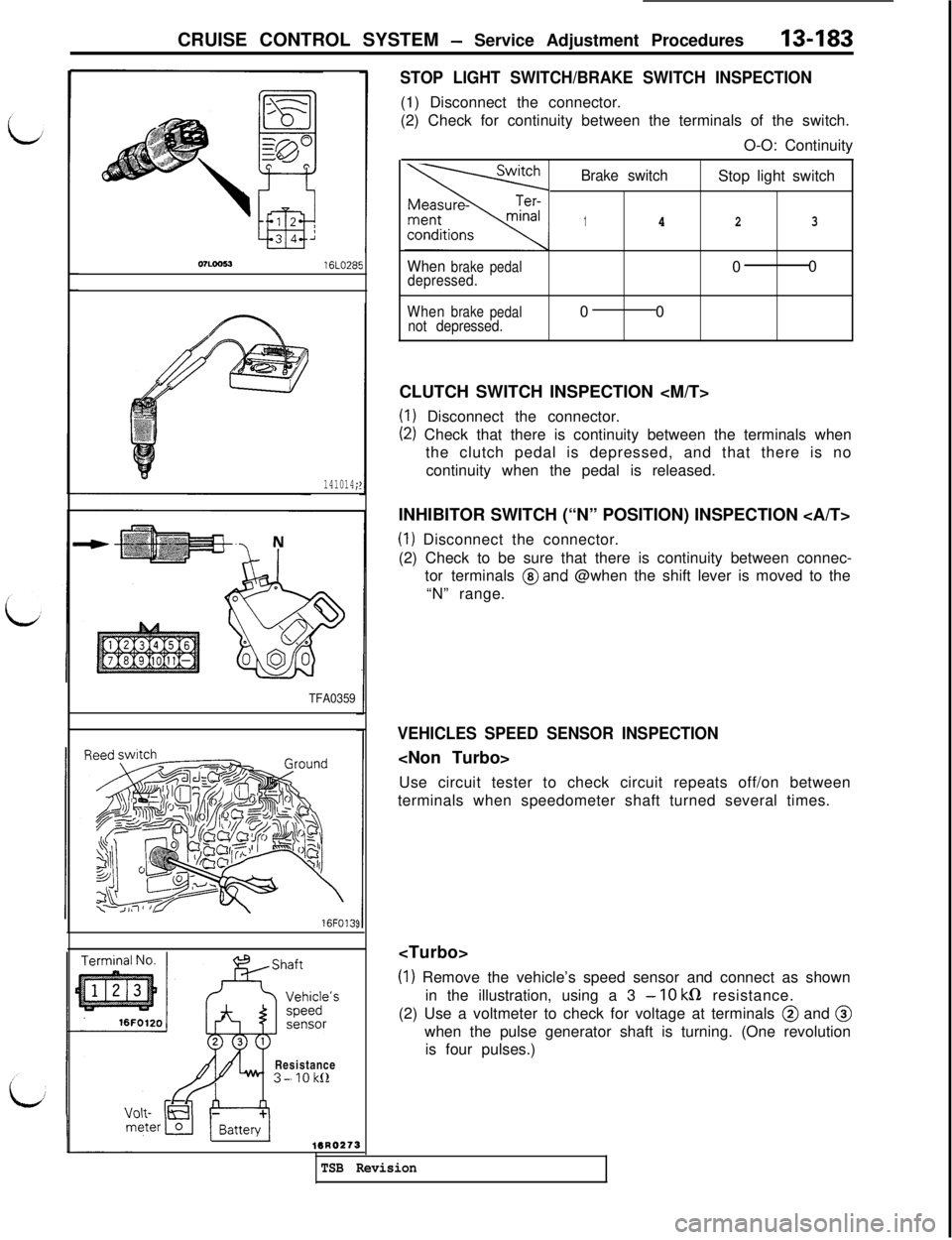
STOP LIGHT SWITCH/BRAKE SWITCH INSPECTION(1) Disconnect the connector.
(2) Check for continuity between the terminals of the switch.
O-O: Continuity
Brake switchStop light switch
1423
Whenbrakepedal00depressed.
When
brake
pedal00not depressed.CLUTCH SWITCH INSPECTION
(I) Disconnect the connector.
(2) Check that there is continuity between the terminals when
the clutch pedal is depressed, and that there is no
continuity when the pedal is released.
INHIBITOR SWITCH (“N” POSITION) INSPECTION
(1) Disconnect the connector.
(2) Check to be sure that there is continuity between connec-
tor terminals
@and @when the shift lever is moved to the
“N” range.
VEHICLES SPEED SENSOR INSPECTION
Use circuit tester to check circuit repeats off/on between
terminals when speedometer shaft turned several times.
(1) Remove the vehicle’s speed sensor and connect as shown
in the illustration, using a 3
- 10 kQ resistance.
(2) Use a voltmeter to check for voltage at terminals @ and @
when the pulse generator shaft is turning. (One revolution
is four pulses.)
16R0273
TSB Revision
Page 290 of 1146
13-184CRUISE CONTROL SYSTEM - Service Adjustment Procedures
07AOO51
07A005t07A005i
THROlTLE POSITION SENSOR INSPECTIONFor inspection, refer to
P.13-65.
IDLE POSITION SWITCH INSPECTIONFor inspection, refer to
P.13-68.VACUUM PUMP INSPECTION
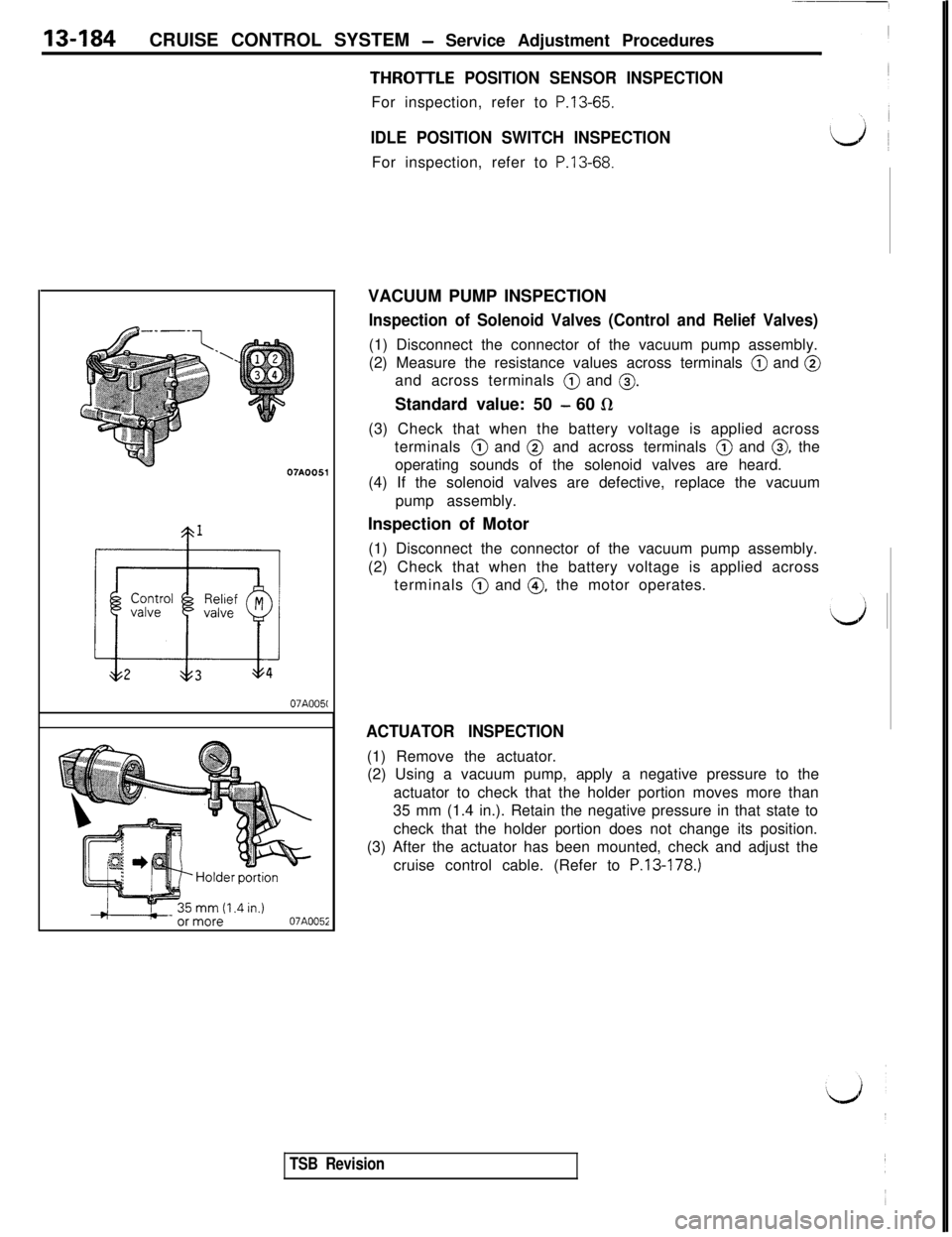
Inspection of Solenoid Valves (Control and Relief Valves)(1) Disconnect the connector of the vacuum pump assembly.
(2) Measure the resistance values across terminals @ and @
and across terminals @ and
0.Standard value: 50
- 60 R
(3) Check that when the battery voltage is applied across
terminals @ and @ and across terminals @ and
0, the
operating sounds of the solenoid valves are heard.
(4) If the solenoid valves are defective, replace the vacuum
pump assembly.
Inspection of Motor
(1) Disconnect the connector of the vacuum pump assembly.
(2) Check that when the battery voltage is applied across
terminals @ and
@, the motor operates.
ACTUATOR INSPECTION(1) Remove the actuator.
(2) Using a vacuum pump, apply a negative pressure to the
actuator to check that the holder portion moves more than
35 mm (1.4 in.). Retain the negative pressure in that state to
check that the holder portion does not change its position.
(3) After the actuator has been mounted, check and adjust the
cruise control cable. (Refer to
P.13-178.)
TSB Revision
Page 291 of 1146
CRUISE CONTROL SYSTEM - Cruise Control System13-185
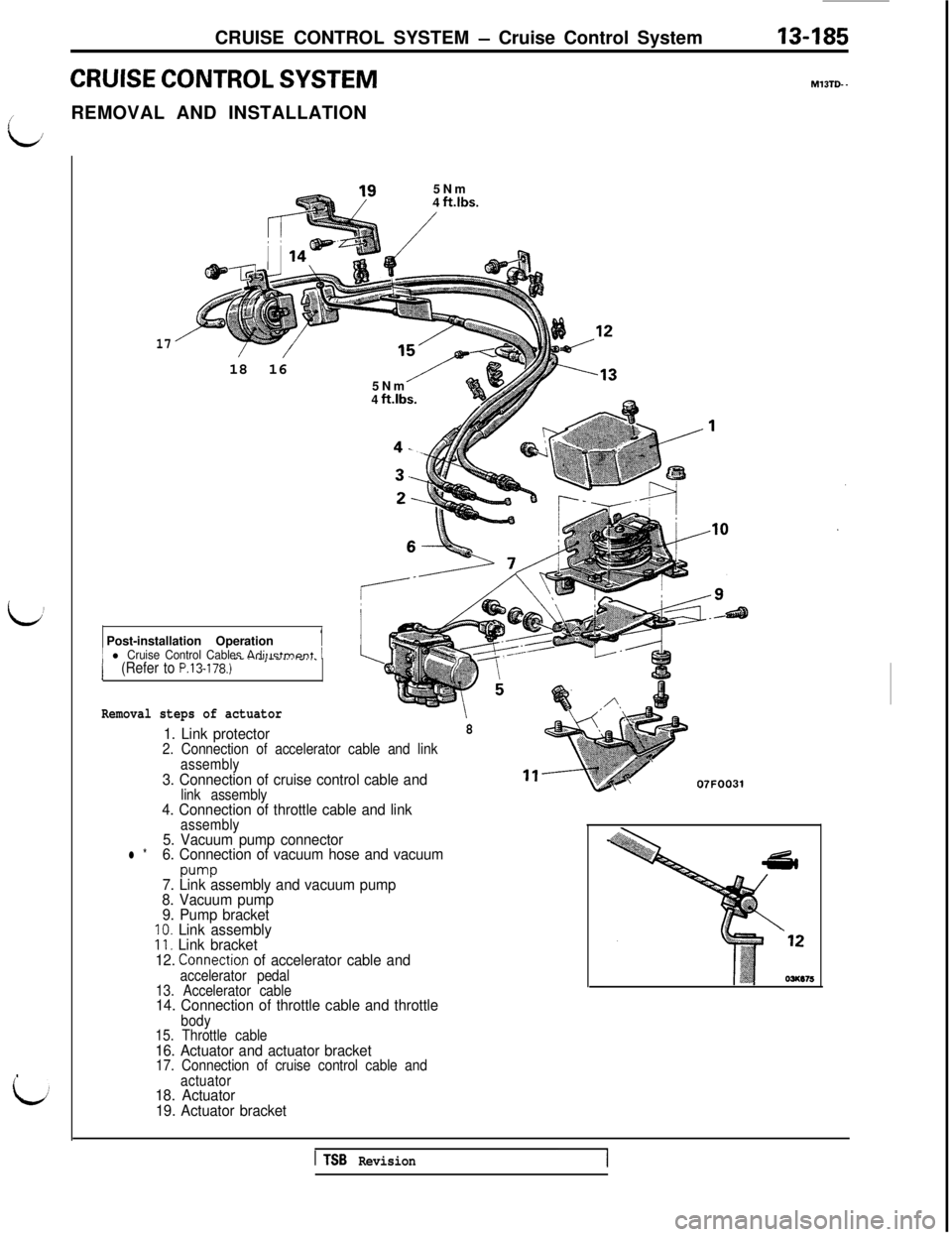
CRUISE CONTROL SYSTEMM13TD. -
L;REMOVAL AND INSTALLATION
5Nm
4
ft.lbs.
h :
17P18 16
5Nm
4
ft.lbs.7Post-installation Operation
11 l Cruise Control Cables Adillstmcwt 1j(Refer to P.13-178.)--’ -->---“‘-.,-
Removal steps of actuator
81. Link protector2. Connection of accelerator cable and link
assembly
3. Connection of cruise control cable andlink assembly4. Connection of throttle cable and linkassembly5. Vacuum pump connectorl *6. Connection of vacuum hose and vacuum
pump7. Link assembly and vacuum pump
8. Vacuum pump
9. Pump bracket
IO. Link assembly11. Link bracket
12. Connecti0.n of accelerator cable andaccelerator pedal
13. Accelerator cable
14. Connection of throttle cable and throttlebody
15. Throttle cable
16. Actuator and actuator bracket17. Connection of cruise control cable and,
Ld
actuator18. Actuator
19. Actuator bracket
07FOO31
1 TSB Revision
Page 292 of 1146
13486CRUISE CONTROL SYSTEM - Cruise Control System
1.6
- 2.2 ft.lbs.
07FOO27
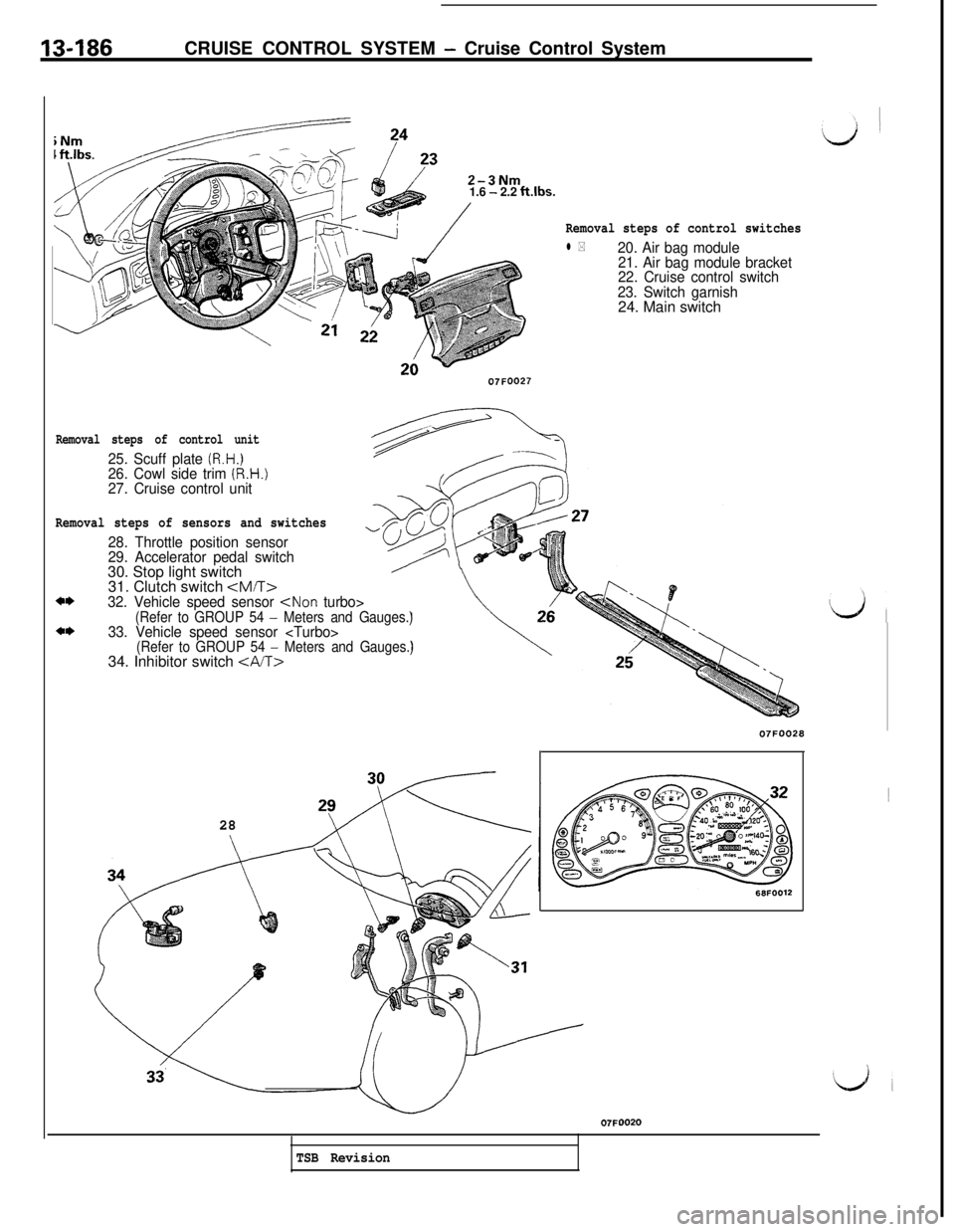
Removal steps of control switches
l *20. Air bag module
21. Air bag module bracket
22. Cruise control switch
23. Switch garnish24. Main switch
Removal steps of sensors and switches
28. Throttle position sensor
29. Accelerator pedal switch30. Stop light switch
31. Clutch switch
4*
4*
Removal steps of control unit
25. Scuff plate (R.H.)26. Cowl side trim (R.H.)27. Cruise control unit34. Inhibitor switch
2807FOO28
68FOO12
07FOO20
TSB Revision
Page 293 of 1146
CRUISE CONTROL SYSTEM - Cruise Control Svstem13-187Vacuum hoseSERVICE POINT OF REMOVAL
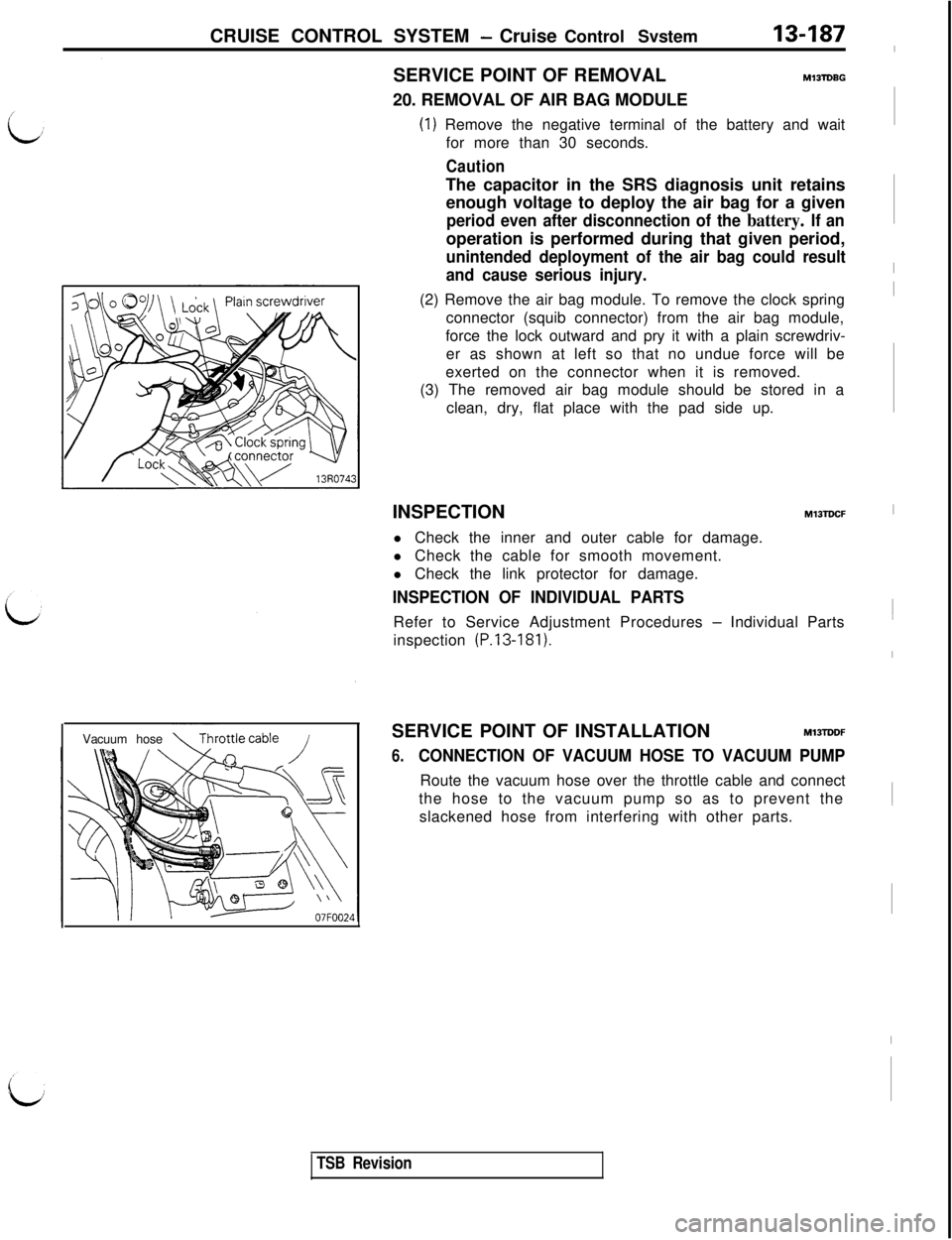
Ml3lDBG20. REMOVAL OF AIR BAG MODULE
(1) Remove the negative terminal of the battery and wait
for more than 30 seconds.
CautionThe capacitor in the SRS diagnosis unit retains
enough voltage to deploy the air bag for a given
period even after disconnection of the battery. If anoperation is performed during that given period,
unintended deployment of the air bag could result
and cause serious injury.(2) Remove the air bag module. To remove the clock spring
connector (squib connector) from the air bag module,
force the lock outward and pry it with a plain screwdriv-
er as shown at left so that no undue force will be
exerted on the connector when it is removed.
(3) The removed air bag module should be stored in a
clean, dry, flat place with the pad side up.
INSPECTION
MlJTDCFl Check the inner and outer cable for damage.
l Check the cable for smooth movement.
l Check the link protector for damage.
INSPECTION OF INDIVIDUAL PARTSRefer to Service Adjustment Procedures
- Individual Parts
inspection (P.l3-181).
SERVICE POINT OF INSTALLATION
M13TDDF
6.CONNECTION OF VACUUM HOSE TO VACUUM PUMPRoute the vacuum hose over the throttle cable and connect
the hose to the vacuum pump so as to prevent the
slackened hose from interfering with other parts.
TSB Revision
I
I
I
I~
I~~
I
Page 363 of 1146
CLUTCH - Service Adjustment Procedures21-5
Clutch pedal height
08YO41
auto-cruise control
\ \ 0Cl;tchswitch
\ \08F0010
Clutch pedal stroke
Lock nut
08F005414110052
SERVICE ADJUSTMENT PROCEDURES
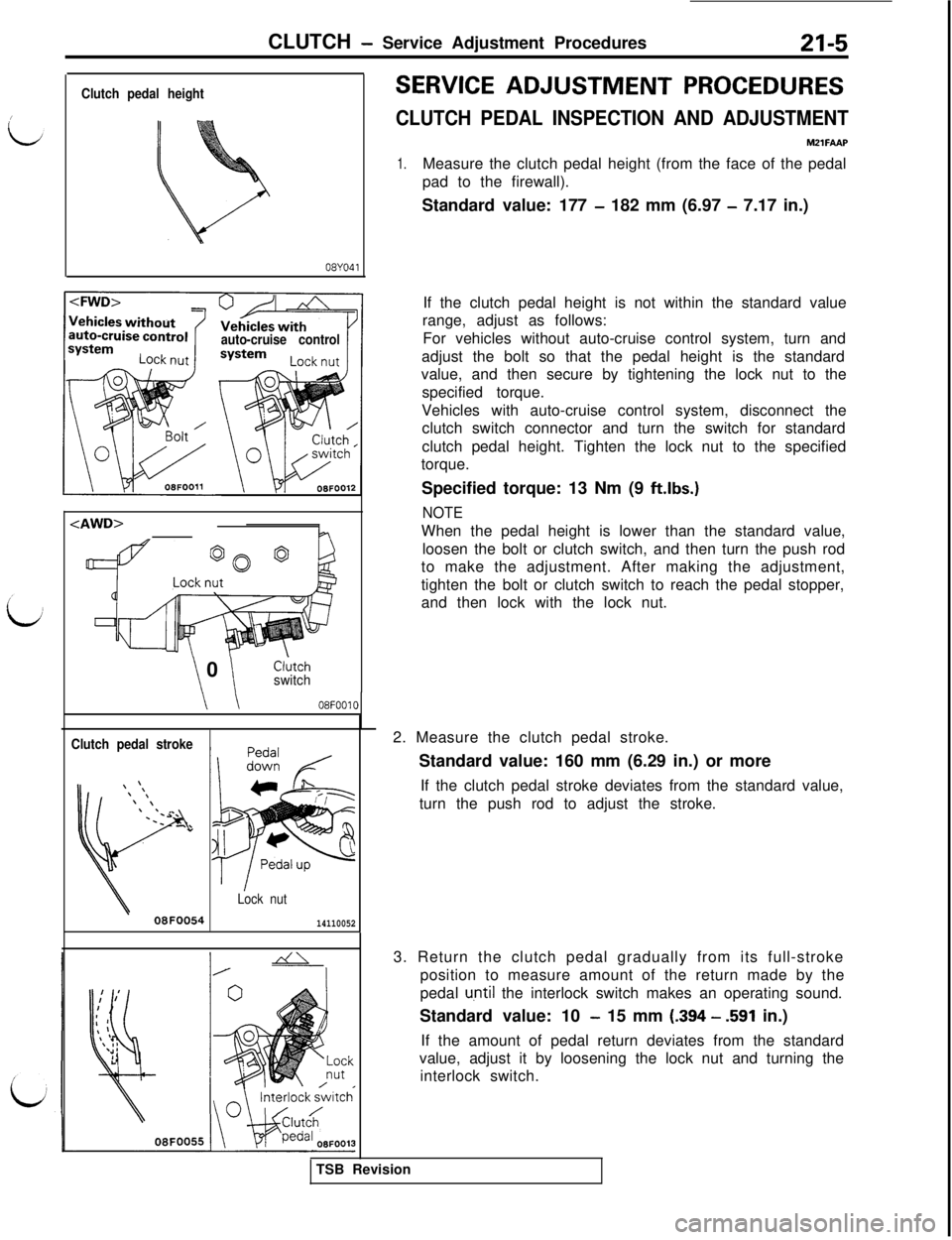
CLUTCH PEDAL INSPECTION AND ADJUSTMENTMZlFAAP
1.Measure the clutch pedal height (from the face of the pedal
pad to the firewall).
Standard value: 177
- 182 mm (6.97 - 7.17 in.)
If the clutch pedal height is not within the standard value
range, adjust as follows:
For vehicles without auto-cruise control system, turn and
adjust the bolt so that the pedal height is the standard
value, and then secure by tightening the lock nut to the
specified torque.
Vehicles with auto-cruise control system, disconnect the
clutch switch connector and turn the switch for standard
clutch pedal height. Tighten the lock nut to the specified
torque.
Specified torque: 13 Nm (9
ft.lbs.)
NOTEWhen the pedal height is lower than the standard value,
loosen the bolt or clutch switch, and then turn the push rod
to make the adjustment. After making the adjustment,
tighten the bolt or clutch switch to reach the pedal stopper,
and then lock with the lock nut.
2. Measure the clutch pedal stroke.
Standard value: 160 mm (6.29 in.) or more
If the clutch pedal stroke deviates from the standard value,
turn the push rod to adjust the stroke.
3. Return the clutch pedal gradually from its full-stroke
position to measure amount of the return made by the
pedal
u,ntil the interlock switch makes an operating sound.
Standard value: 10
- 15 mm (.394 - .591 in.)
If the amount of pedal return deviates from the standard
value, adjust it by loosening the lock nut and turning the
interlock switch.
TSB Revision
Page 366 of 1146
21-8CLUTCH - Clutch Pedal
CLUTCH PEDAL
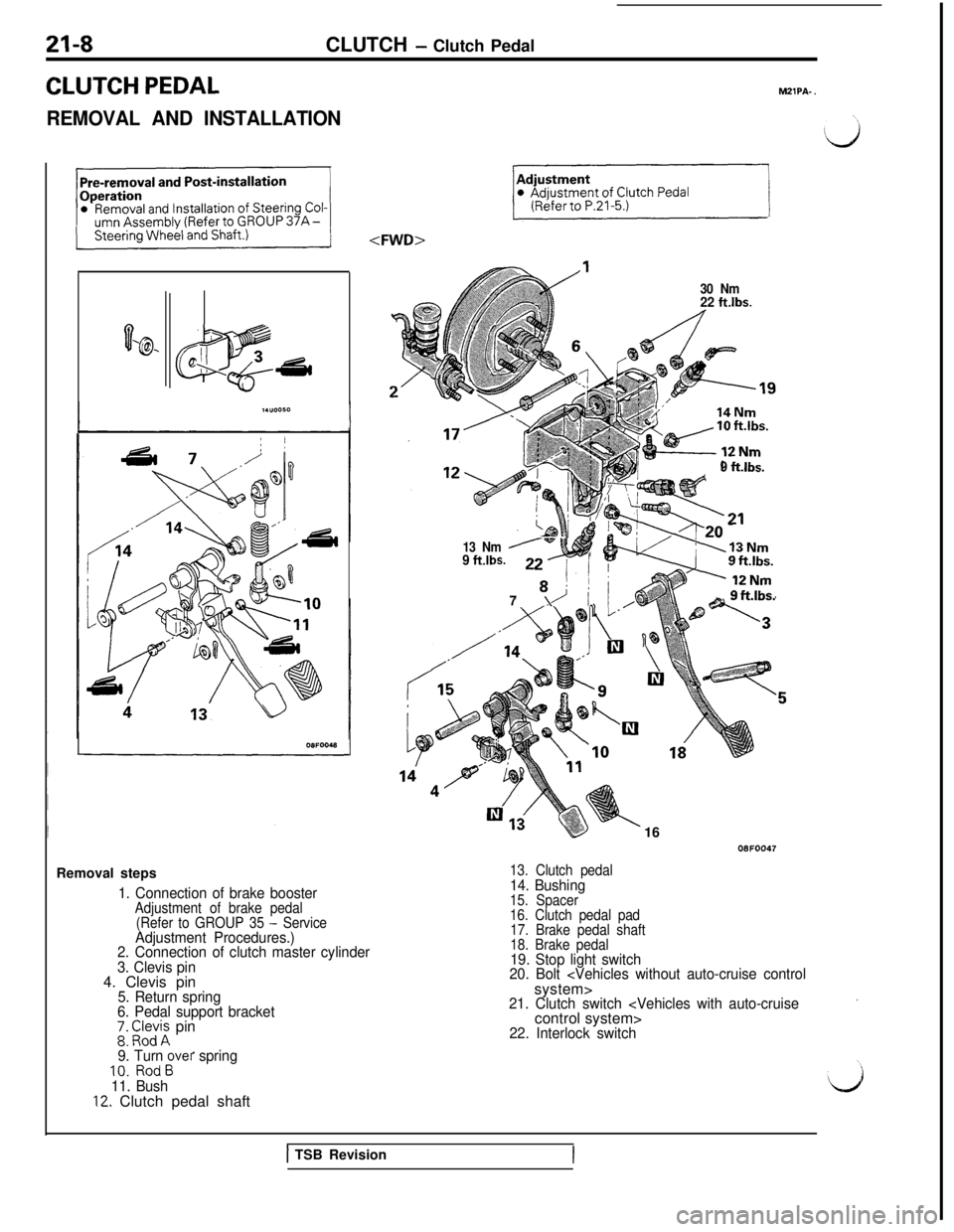
REMOVAL AND INSTALLATIONMZlPA-
.
0‘@- D.,
a
;
IGsdRemoval steps
1. Connection of brake boosterAdjustment of brake pedal
(Refer to GROUP 35 - ServiceAdjustment Procedures.)
2. Connection of clutch master cylinder
3. Clevis pin4. Clevis pin
5. Return spring
6. Pedal support bracket
;: EIe;i; pin
9. Turn over spring10. RodB
11. Bush
12. Clutch pedal shaft
30 Nm22 ftlbs.
9 ft.lbs.
13 Nm
9 ft.lbs.Gw+,
8 !!
79 I_a 9ft.lbs.
k1608FOO47
13. Clutch pedal14. Bushing15. Spacer
16. Clutch pedal pad
17. Brake pedal shaft
18. Brake pedal
19. Stop light switch
20. Bolt
21. Clutch switch
22. Interlock switch
1 TSB Revision
Page 645 of 1146
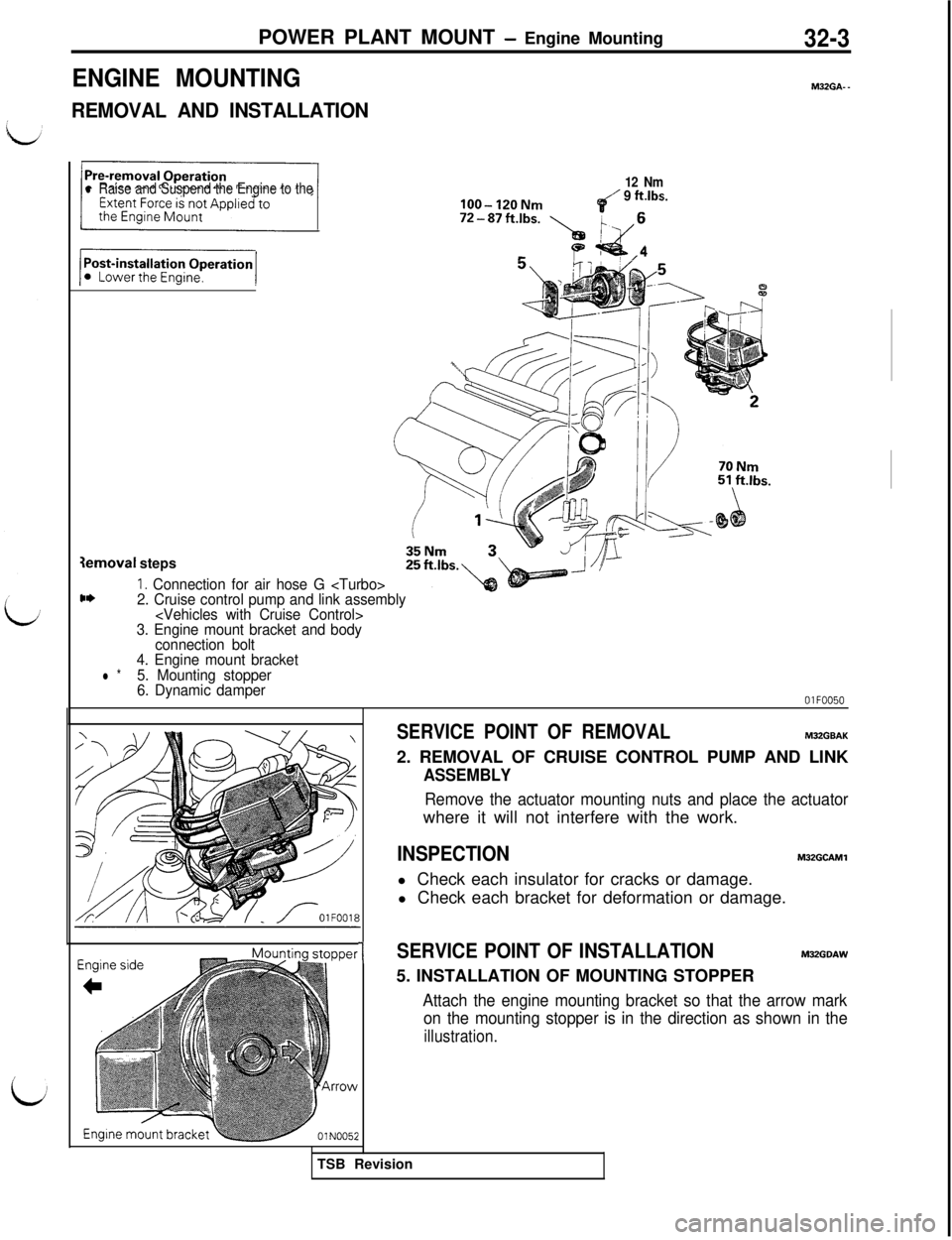
POWER PLANT MOUNT - Engine Mounting
ENGINE MOUNTING
REMOVAL AND INSTALLATION
32-3
l Raise and Suspend the Engine to the12 Nm
lOO-120Nm(9 ftlbs.
72-87ftlbs. > &6
rI’ I/4
c*1. Connection for air hose G
2. Cruise control pump and link assembly
3. Engine mount bracket and body
connection bolt
4. Engine mount bracket
l *5. Mounting stopper
6. Dynamic damperOlFOO50
3emoval steps
SERVICE POINT OF REMOVALM32GBAK2. REMOVAL OF CRUISE CONTROL PUMP AND LINK
ASSEMBLY
Remove the actuator mounting nuts and place the actuatorwhere it will not interfere with the work.
INSPECTIONM32GCAMl
l Check each insulator for cracks or damage.
l Check each bracket for deformation or damage.
1SERVICE POINT OF INSTALLATIONM32GDAW
5. INSTALLATION OF MOUNTING STOPPER
Attach the engine mounting bracket so that the arrow mark
on the mounting stopper is in the direction as shown in the
illustration.TSB Revision
Page 788 of 1146
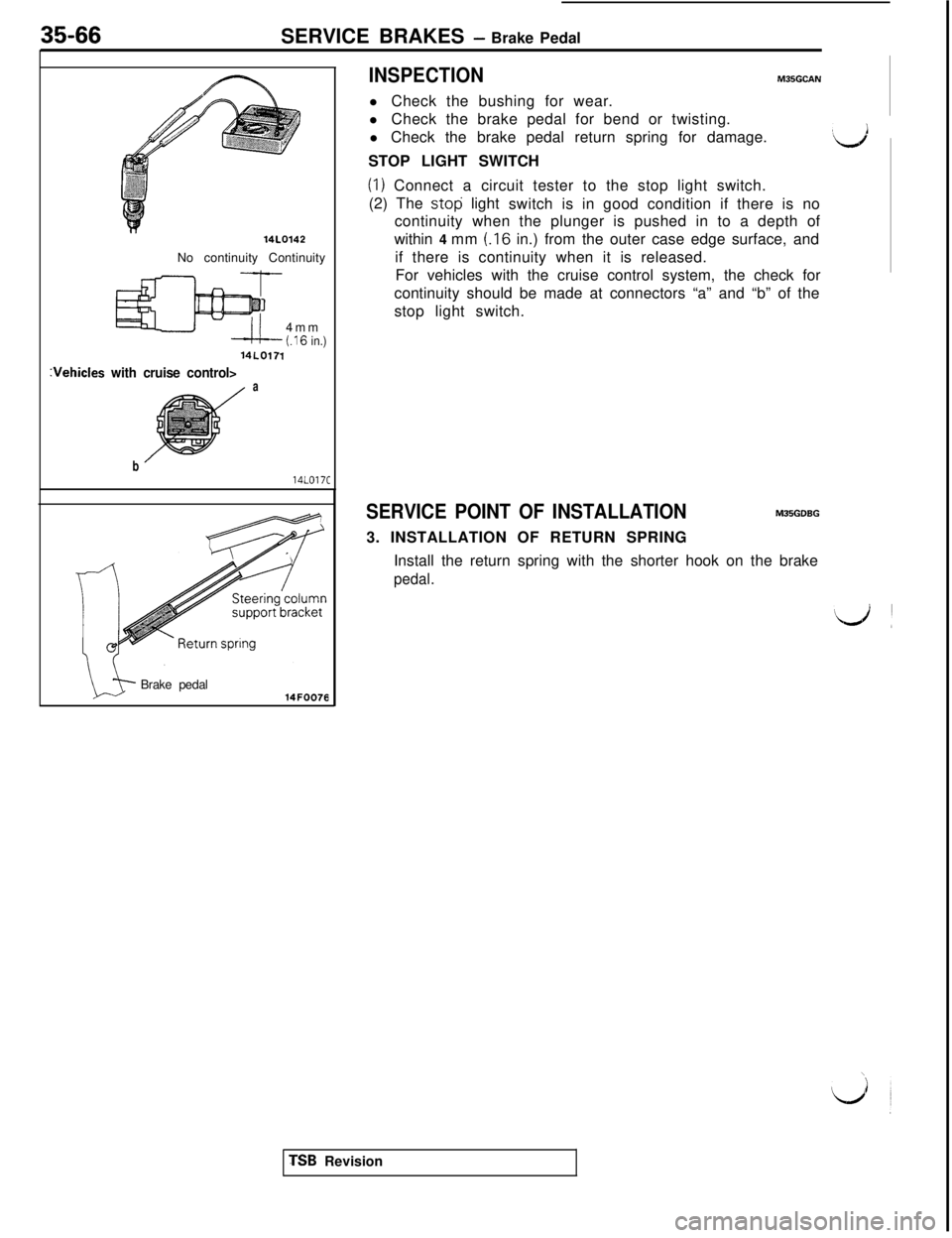
35-66SERVICE BRAKES - Brake Pedal
14LO142No continuity Continuity
4mm
(.I6 in.)14LO171
:Vehicles with cruise control>a
b14LO17C
Brake pedal
14FOO76
INSPECTIONM35GCANl Check the bushing for wear.
l Check the brake pedal for bend or twisting.
l Check the brake pedal return spring for damage.
‘LJ)STOP LIGHT SWITCH
(I) Connect a circuit tester to the stop light switch.
(2) The
stolj light
switch is in good condition if there is no
continuity when the plunger is pushed in to a depth of
within 4 mm
(.16 in.) from the outer case edge surface, and
if there is continuity when it is released.
For vehicles with the cruise control system, the check for
continuity should be made at connectors “a” and “b” of the
stop light switch.
SERVICE POINT OF INSTALLATIONM35GDBG3. INSTALLATION OF RETURN SPRING
Install the return spring with the shorter hook on the brake
pedal.
TSB Revision