cruise control MITSUBISHI 3000GT 1991 Owner's Manual
[x] Cancel search | Manufacturer: MITSUBISHI, Model Year: 1991, Model line: 3000GT, Model: MITSUBISHI 3000GT 1991Pages: 1146, PDF Size: 76.68 MB
Page 278 of 1146
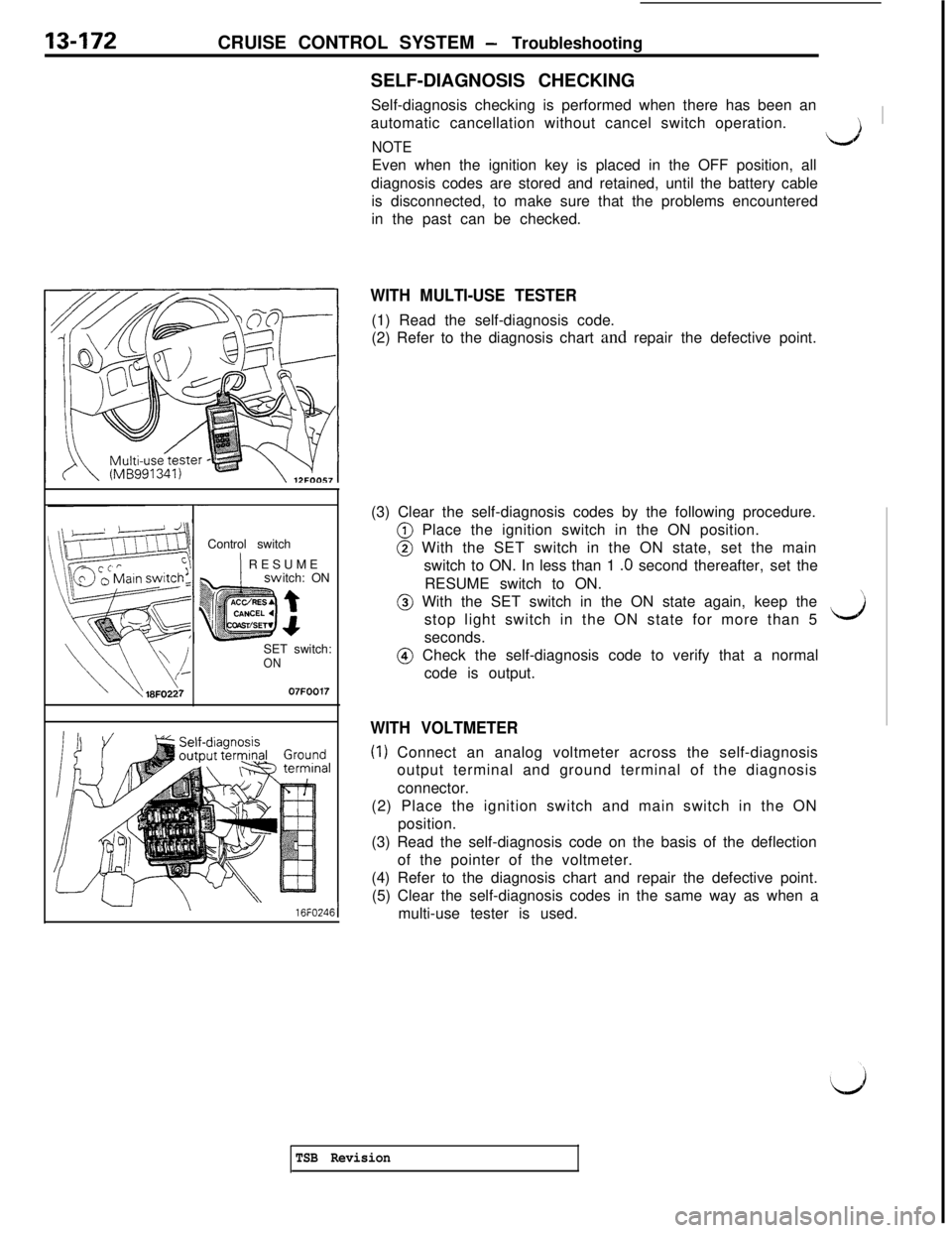
13-172CRUISE CONTROL SYSTEM - Troubleshooting
SELF-DIAGNOSIS CHECKING
Self-diagnosis checking is performed when there has been an
automatic cancellation without cancel switch operation.
‘1 ’
NOTE‘LAEven when the ignition key is placed in the OFF position, all
diagnosis codes are stored and retained, until the battery cable
is disconnected, to make sure that the problems encountered
in the past can be checked.
Control switch
1 RESUME
itch: ON
t
4SET switch:
ON
07FOO17
-\16FO2461
WITH MULTI-USE TESTER(1) Read the self-diagnosis code.
(2) Refer to the diagnosis chart and repair the defective point.
(3) Clear the self-diagnosis codes by the following procedure.@ Place the ignition switch in the ON position.@ With the SET switch in the ON state, set the main
switch to ON. In less than 1
.O second thereafter, set the
RESUME switch to ON.@ With the SET switch in the ON state again, keep the
’stop light switch in the ON state for more than 5dseconds.@ Check the self-diagnosis code to verify that a normal
code is output.
WITH VOLTMETER
(1) Connect an analog voltmeter across the self-diagnosis
output terminal and ground terminal of the diagnosis
connector.
(2) Place the ignition switch and main switch in the ON
position.
(3) Read the self-diagnosis code on the basis of the deflection
of the pointer of the voltmeter.
(4) Refer to the diagnosis chart and repair the defective point.
(5) Clear the self-diagnosis codes in the same way as when a
multi-use tester is used.
TSB Revision
Page 279 of 1146
CRUISE CONTROL SYSTEM - Troubleshooting
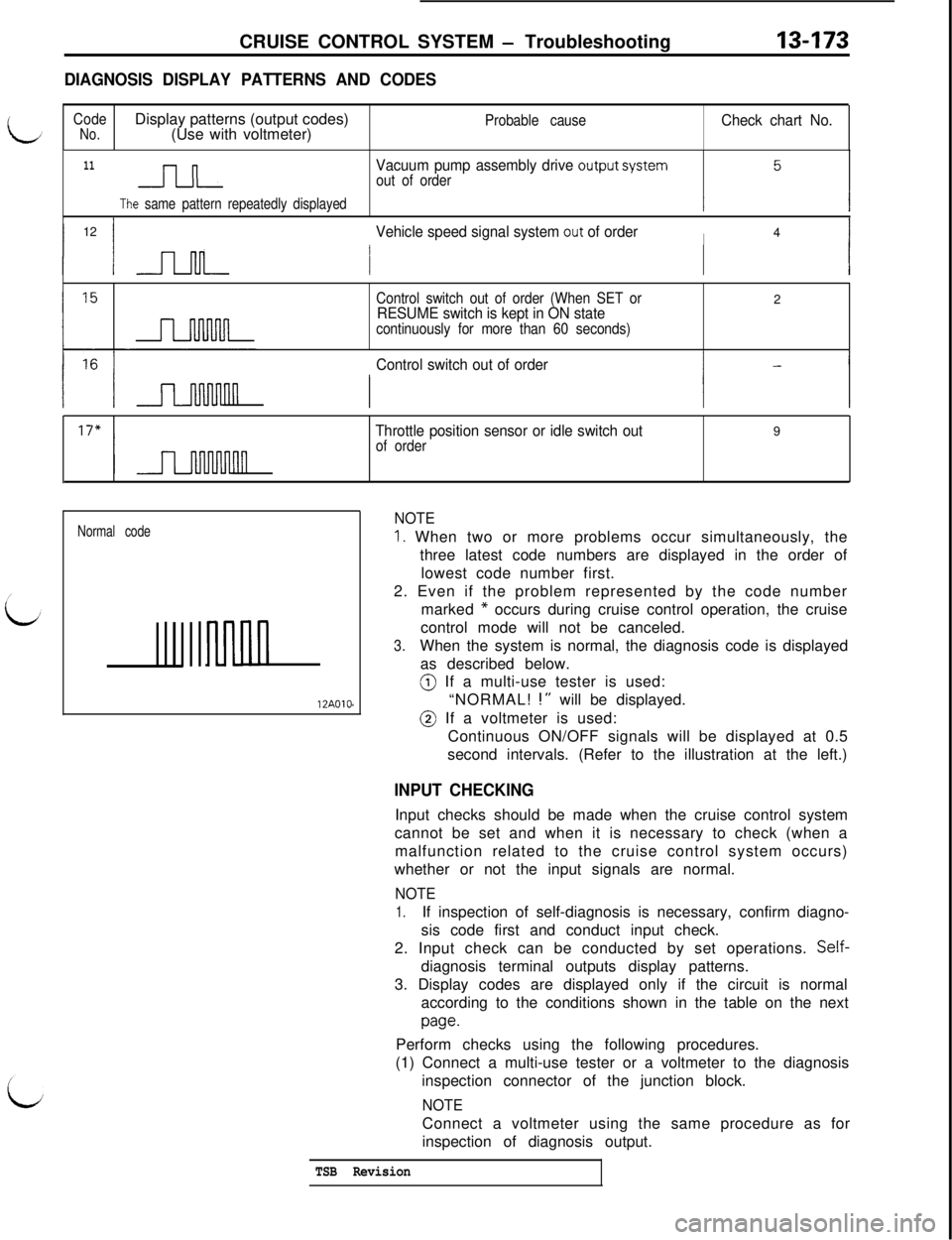
DIAGNOSIS DISPLAY PATTERNS AND CODES
13473
CodeDisplay patterns (output codes)Probable causeCheck chart No.No.(Use with voltmeter)
11l-l n-JILL
The same pattern repeatedly displayed
Vacuum pump assembly drive output systemout of order5
I I12Vehicle speed signal system out of orderI4I
I In
Control switch out of order (When SET or2RESUME switch is kept in ON statecontinuously for more than 60 seconds)
Control switch out of order
Throttle position sensor or idle switch out9
of order
Normal code
12AOlOa
NOTE
1. When two or more problems occur simultaneously, the
three latest code numbers are displayed in the order of
lowest code number first.
2. Even if the problem represented by the code number
marked * occurs during cruise control operation, the cruise
control mode will not be canceled.
3.When the system is normal, the diagnosis code is displayed
as described below.@ If a multi-use tester is used:
“NORMAL!
! I’ will be displayed.@ If a voltmeter is used:
Continuous ON/OFF signals will be displayed at 0.5
second intervals. (Refer to the illustration at the left.)
INPUT CHECKINGInput checks should be made when the cruise control system
cannot be set and when it is necessary to check (when a
malfunction related to the cruise control system occurs)
whether or not the input signals are normal.
NOTE
1.If inspection of self-diagnosis is necessary, confirm diagno-
sis code first and conduct input check.
2. Input check can be conducted by set operations.
Self-diagnosis terminal outputs display patterns.
3. Display codes are displayed only if the circuit is normal
according to the conditions shown in the table on the next
paw.Perform checks using the following procedures.
(1) Connect a multi-use tester or a voltmeter to the diagnosis
inspection connector of the junction block.
NOTEConnect a voltmeter using the same procedure as for
inspection of diagnosis output.
TSB Revision
Page 280 of 1146
13-174CRUISE CONTROL SYSTEM - Troubleshooting
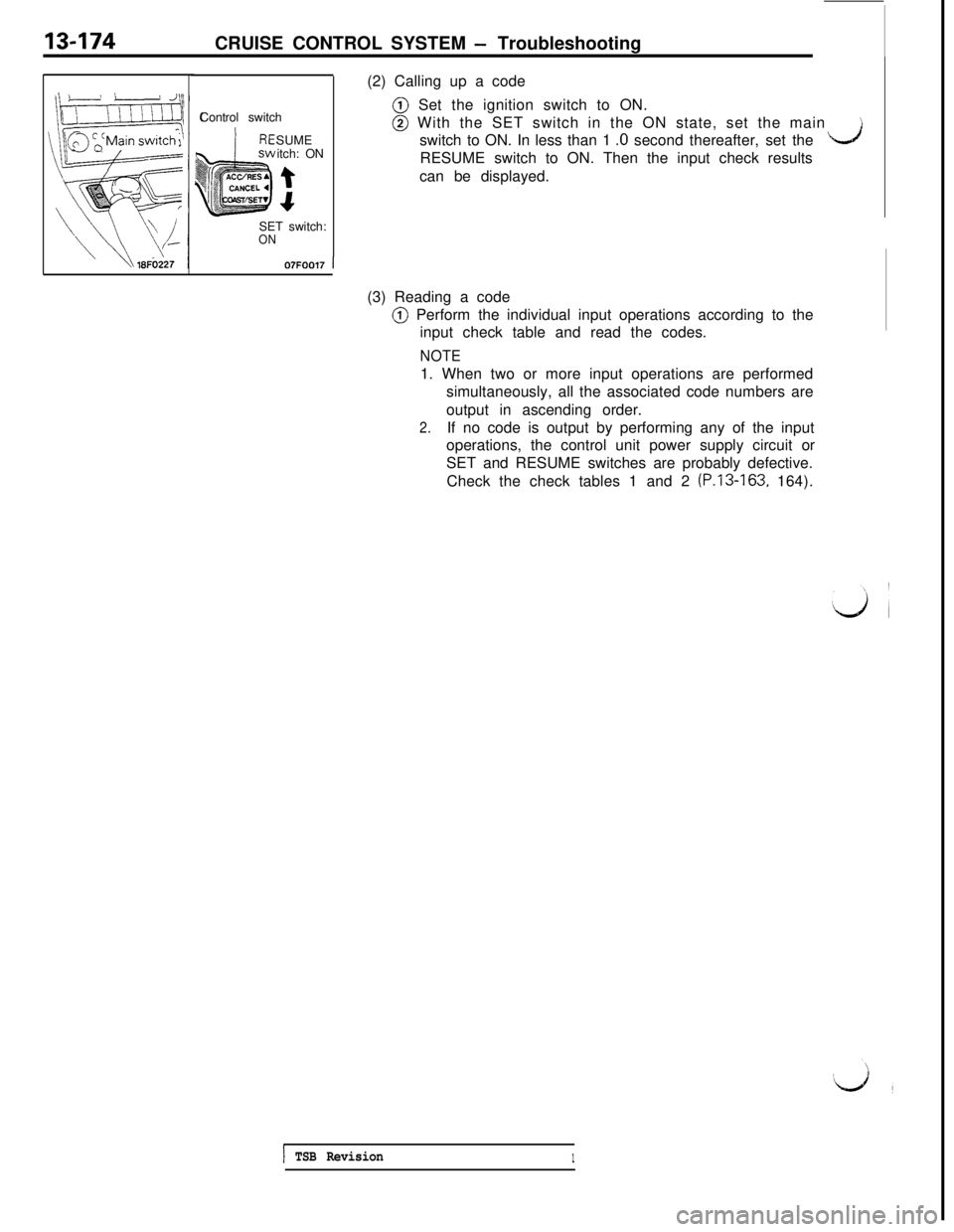
(2) Calling up a code
Control switch
SUME
itch: ON
t
4SET switch:
ON@ Set the ignition switch to ON.@ With the SET switch in the ON state, set the main
switch to ON. In less than 1
.O second thereafter, set theI,/RESUME switch to ON. Then the input check results
can be displayed.
07FOO17 I(3) Reading a code@ Perform the individual input operations according to the
input check table and read the codes.
NOTE1. When two or more input operations are performed
simultaneously, all the associated code numbers are
output in ascending order.
2.If no code is output by performing any of the input
operations, the control unit power supply circuit or
SET and RESUME switches are probably defective.
Check the check tables 1 and 2
(P.13-163, 164).
1 TSB Revision1
Page 281 of 1146
CRUISE CONTROL SYSTEM - Troubleshooting
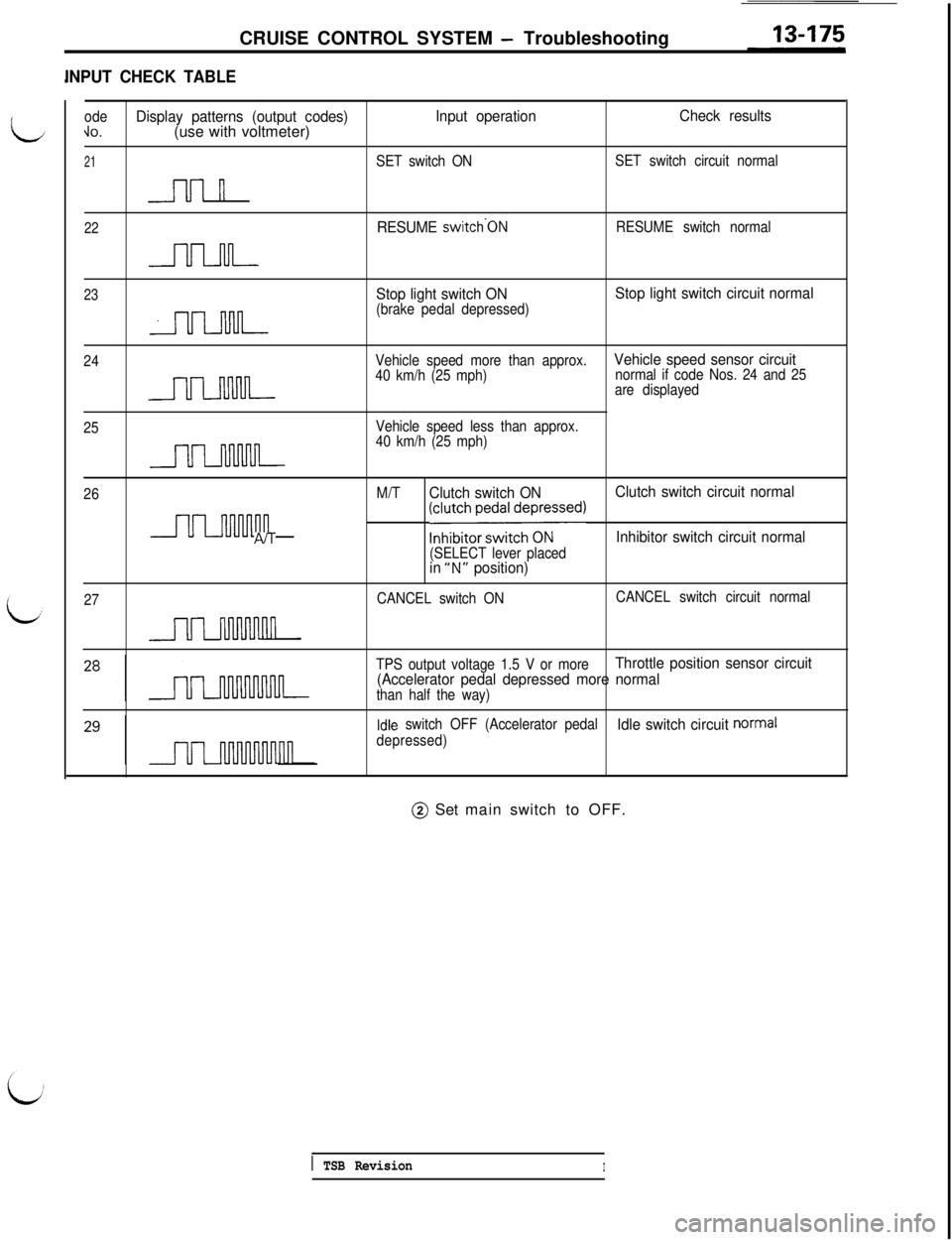
INPUT CHECK TABLE
odeDisplay patterns (output codes)Input operationCheck results40.(use with voltmeter)
21SET switch ONSET switch circuit normal
n
22RESUME switch.ONRESUME switch normal
23
nn
Stop light switch ON(brake pedal depressed)
Stop light switch circuit normal
24Vehicle speed more than approx.
40 km/h (25 mph)Vehicle speed sensor circuitnormal if code Nos. 24 and 25
are displayed
25Vehicle speed less than approx.
40 km/h (25 mph)
26M/T
Clutch switch ON
-1~ ~~;~~o~~i~~~~;sed’
(SELECT lever placedin “N” position)Clutch switch circuit normal
Inhibitor switch circuit normal
27CANCEL switch ONCANCEL switch circuit normal
TPS output voltage 1.5 V or more
Throttle position sensor circuit
(Accelerator pedal depressed more normal
than half the way)
Idle switch OFF (Accelerator pedalIdle switch circuit normal
depressed)@ Set main switch to OFF.
1 TSB RevisionI
Page 282 of 1146
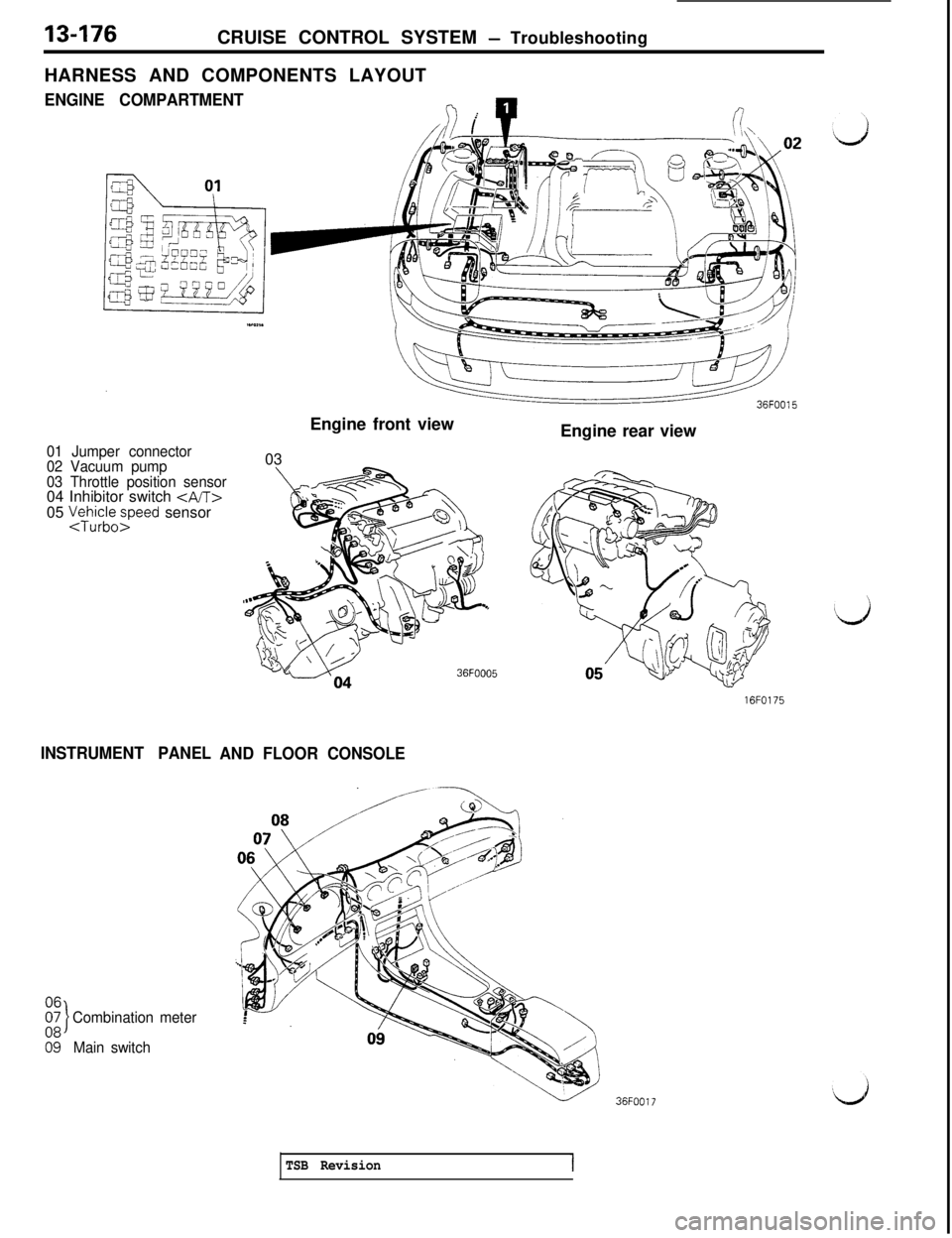
13-176CRUISE CONTROL SYSTEM - Troubleshooting
HARNESS AND COMPONENTS LAYOUT
ENGINE COMPARTMENT
01 Jumper connector
02 Vacuum pump
03 Throttle position sensor04 Inhibitor switch
05
VeTkFo;peed sensor
INSTRUMENT PANEL
AND FLOOR CONSOLE
Combination meter
Main switchEngine front view
03
36FOOO5Engine rear view
16FO175
36FOO17
TSB Revision
Page 283 of 1146
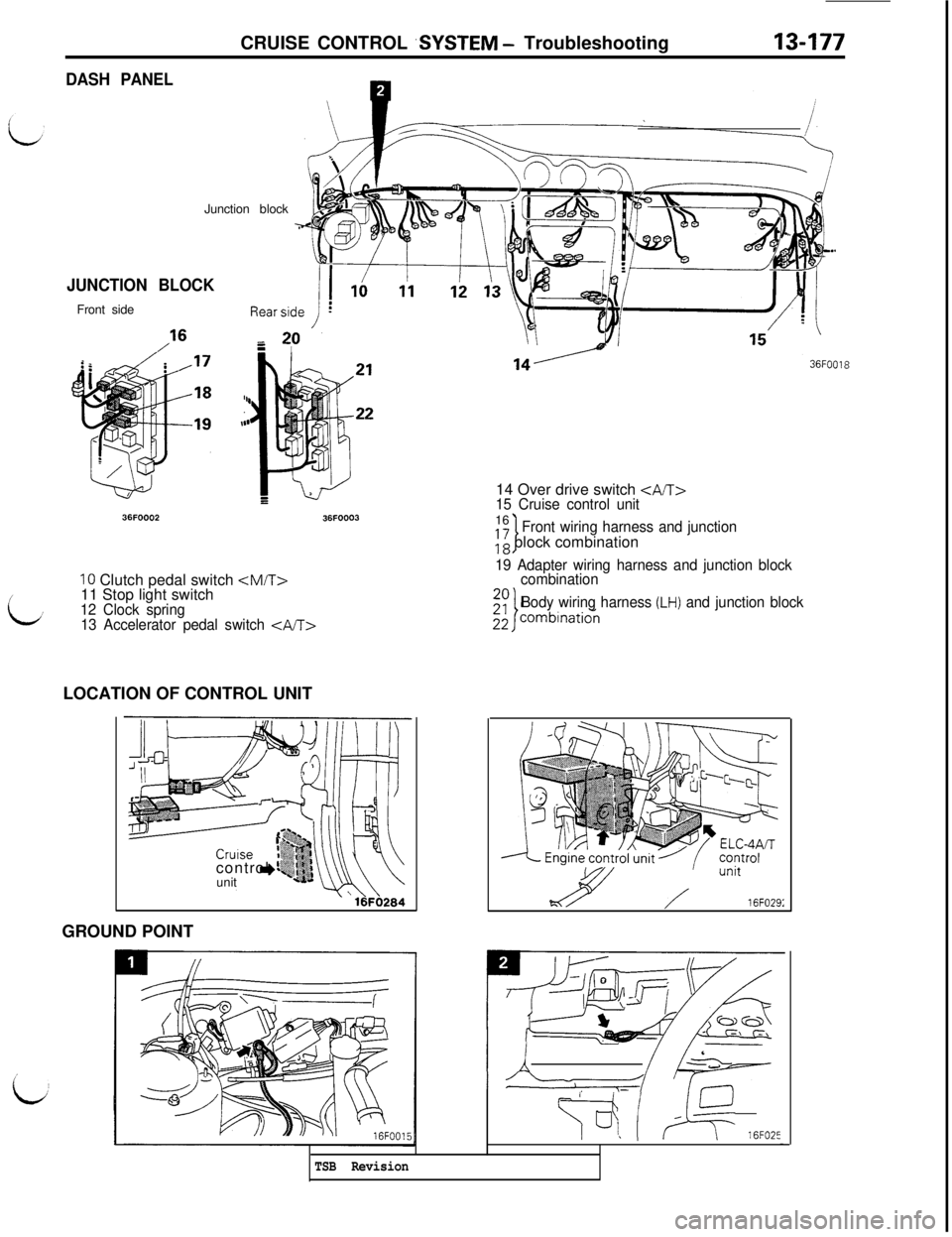
CRUISE CONTROL .SYSTEM - Troubleshooting13-177
DASH PANELJunction block
JUNCTION BLOCKFront side
36FOOO236FOOO3
i
10 Clutch pedal switch
12 Clock spring
13 Accelerator pedal switch
LOCATION OF CONTROL UNIT
E%sQ/I.LIlll-I BCrutse
!tcontrol
unit
GROUND POINT14 Over drive switch
15 Cruise control unit16
l 7
1
Front wiring harness and junctionl 8 block combination
19 Adapter wiring harness and junction block
combination
Body wiring harness
(LH) and junction block
I-\ --*
I d
4tT
-G
1
q\ ($$ 16F02E
36FOO18
TSB Revision
Page 284 of 1146
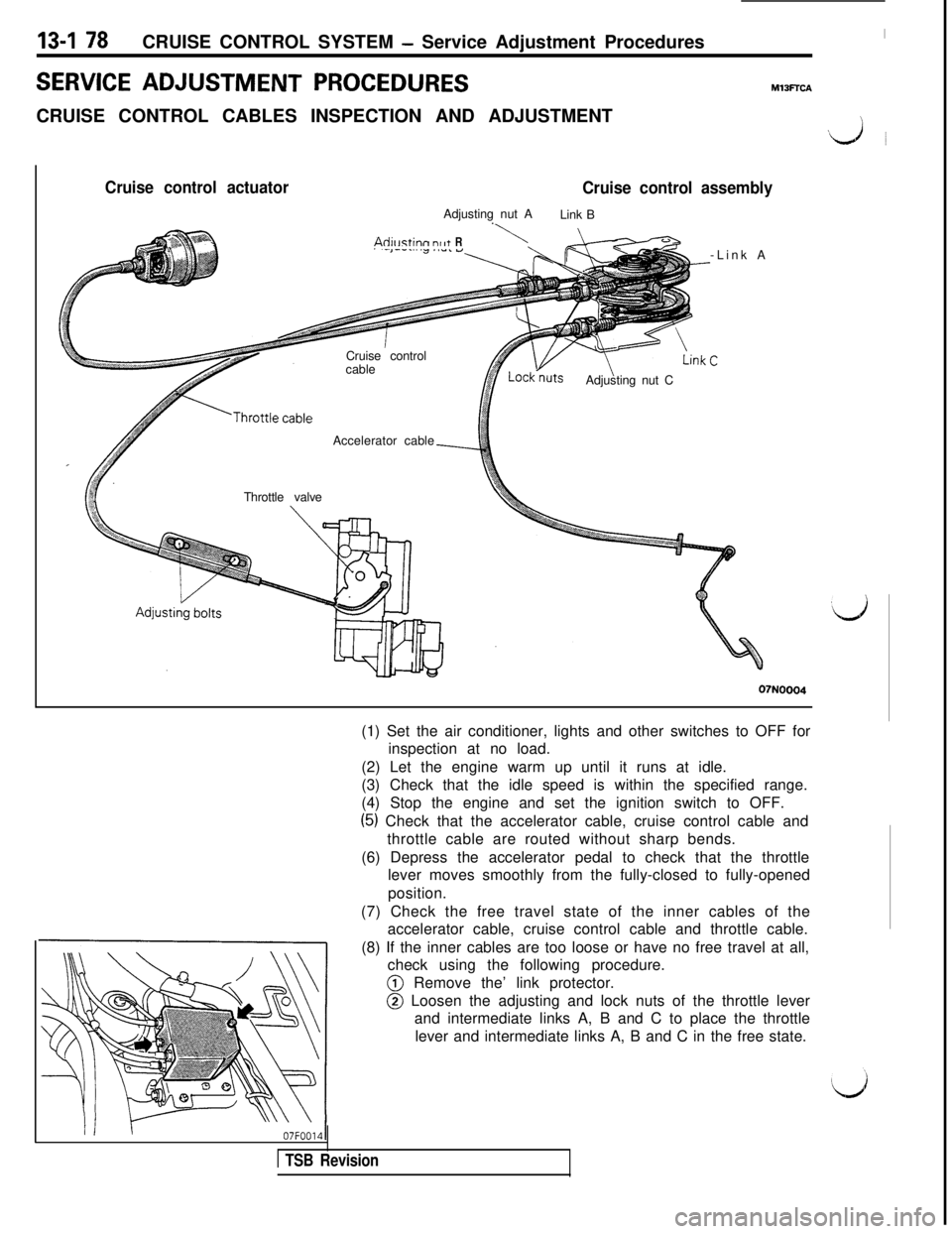
13-I 78CRUISE CONTROL SYSTEM - Service Adjustment ProceduresSERVICE
ADJUSTMENT PROCEDURESCRUISE CONTROL CABLES INSPECTION AND ADJUSTMENT
I
MlSFTCA
‘\J ~
Cruise control actuator
Cruise control assemblyAdjusting nut A
Link B
.
Adillstinn nr~+ R\Cruise control
cable
Adjusting nut C
Accelerator cable
Throttle valve-Link A
07N0004(1) Set the air conditioner, lights and other switches to OFF for
inspection at no load.
(2) Let the engine warm up until it runs at idle.
(3) Check that the idle speed is within the specified range.
(4) Stop the engine and set the ignition switch to OFF.
(5) Check that the accelerator cable, cruise control cable and
throttle cable are routed without sharp bends.
(6) Depress the accelerator pedal to check that the throttle
lever moves smoothly from the fully-closed to fully-opened
position.
(7) Check the free travel state of the inner cables of the
accelerator cable, cruise control cable and throttle cable.
(8) If the inner cables are too loose or have no free travel at all,
check using the following procedure.@ Remove the’ link protector.
@ Loosen the adjusting and lock nuts of the throttle lever
and intermediate links A, B and C to place the throttle
lever and intermediate links A, B and C in the free state.
1 TSB Revision
Page 285 of 1146
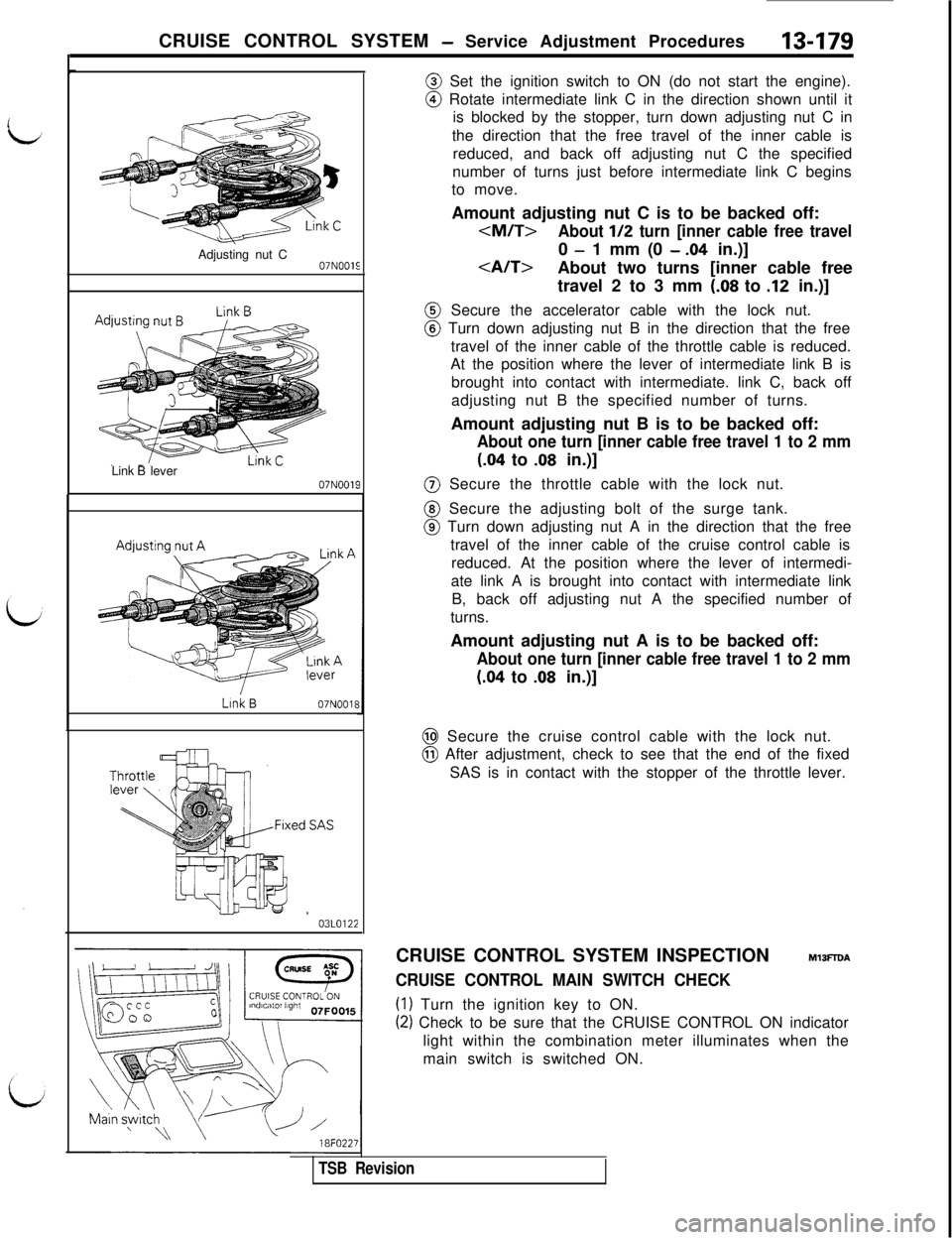
CRUISE CONTROL SYSTEM - Service Adjustment Procedures13-179Adjusting nut C
07NOOlELink Blever
07N0019Link
B07NOOlE
y,jj--ww ,03LO122
\\ \18FO2.2'@ Set the ignition switch to ON (do not start the engine).@ Rotate intermediate link C in the direction shown until it
is blocked by the stopper, turn down adjusting nut C in
the direction that the free travel of the inner cable is
reduced, and back off adjusting nut C the specified
number of turns just before intermediate link C begins
to move.
Amount adjusting nut C is to be backed off:
- 1 mm (0 - .04 in.)]
About two turns [inner cable free
travel 2 to 3 mm
(.08 to .12 in.)]@ Secure the accelerator cable with the lock nut.@ Turn down adjusting nut B in the direction that the free
travel of the inner cable of the throttle cable is reduced.
At the position where the lever of intermediate link B is
brought into contact with intermediate. link C, back off
adjusting nut B the specified number of turns.
Amount adjusting nut B is to be backed off:
About one turn [inner cable free travel 1 to 2 mm
(.04 to .08 in.)]@ Secure the throttle cable with the lock nut.@ Secure the adjusting bolt of the surge tank.@ Turn down adjusting nut A in the direction that the free
travel of the inner cable of the cruise control cable is
reduced. At the position where the lever of intermedi-
ate link A is brought into contact with intermediate link
B, back off adjusting nut A the specified number of
turns.
Amount adjusting nut A is to be backed off:
About one turn [inner cable free travel 1 to 2 mm
(.04 to .08 in.)]@ Secure the cruise control cable with the lock nut.@ After adjustment, check to see that the end of the fixed
SAS is in contact with the stopper of the throttle lever.
CRUISE CONTROL SYSTEM INSPECTION
MlBFlDA
CRUISE CONTROL MAIN SWITCH CHECK
(1) Turn the ignition key to ON.
(2) Check to be sure that the CRUISE CONTROL ON indicator
light within the combination meter illuminates when the
main switch is switched ON.
TSB Revision
Page 286 of 1146
 Switc")
13-180CRUISE CONTROL SYSTEM - Service Adjustment Procedures.
4
ET: ON
07FOOl;Control switch
\E: ON
t
07FOOliControl switch
\
SET: ON
07FOOlControl switch
\
07FOOl
CRUISE CONTROL SETTING CHECK(1) Switch ON the main switch.
(2) Drive at the desired speed within the range of approximate-
ly 40
- 145 km/h (25 - 90 mph).
(3) Operate the control switch downward. (SET switch: ON)
(4) Check to be sure that the speed is the desired constant
speed when the switch is released, and also check to be
sure that the CRUISE indicator light (within the combination
meter) illuminates.
NOTEIf the vehicle speed decreases to approximately 15 km/h (9
mph) below the set speed, because of climbing a hill for
example, the cruise control will be cancelled.
SPEED-INCREASE SETTING CHECK(1) Set to the desired speed.
(2) Operate the control switch upward. (RESUME switch: ON)
(3) Check to be sure that acceleration continues while the
switch is hold, and that when it is released the constant.
speed at the time when it was released becomes the
driving speed.
NOTEEven if, during acceleration, the vehicle speed reaches or
exceeds the high limit [approximately 145 km/h (90 mph)],
acceleration will continue, however, when the switch is
released, the set speed (“memorized speed”) will become
the high limit of the vehicle speed.
SPEED REDUCTION SETTING CHECK(1) Set to the desired speed.
(2) Operate the control switch downward. (SET switch: ON)
(3) Check to be sure that deceleration continues while the
switch is held, and that when it is released the constant
speed at the time when it was released becomes the
driving speed.
NOTEWhen the vehicle speed reaches the low limit [approx-
imately 40 km/h (25 mph)] during deceleration, the cruise
control will be cancelled.
CRUISE CONTROL CANCELLATION AND SET SPEED RE-
SUME CHECK(1) Set cruise control.
(2) In the cruising condition of the cruise control mode, check
that when any of the following operations are performed,
the normal drive mode is restored and
,the vehicle coasts
smoothly.@ Move the control switch toward you. (CANCEL switch:@ Depress the brake pedal.@ Depress the clutch pedal.
TSB Revision
Page 287 of 1146
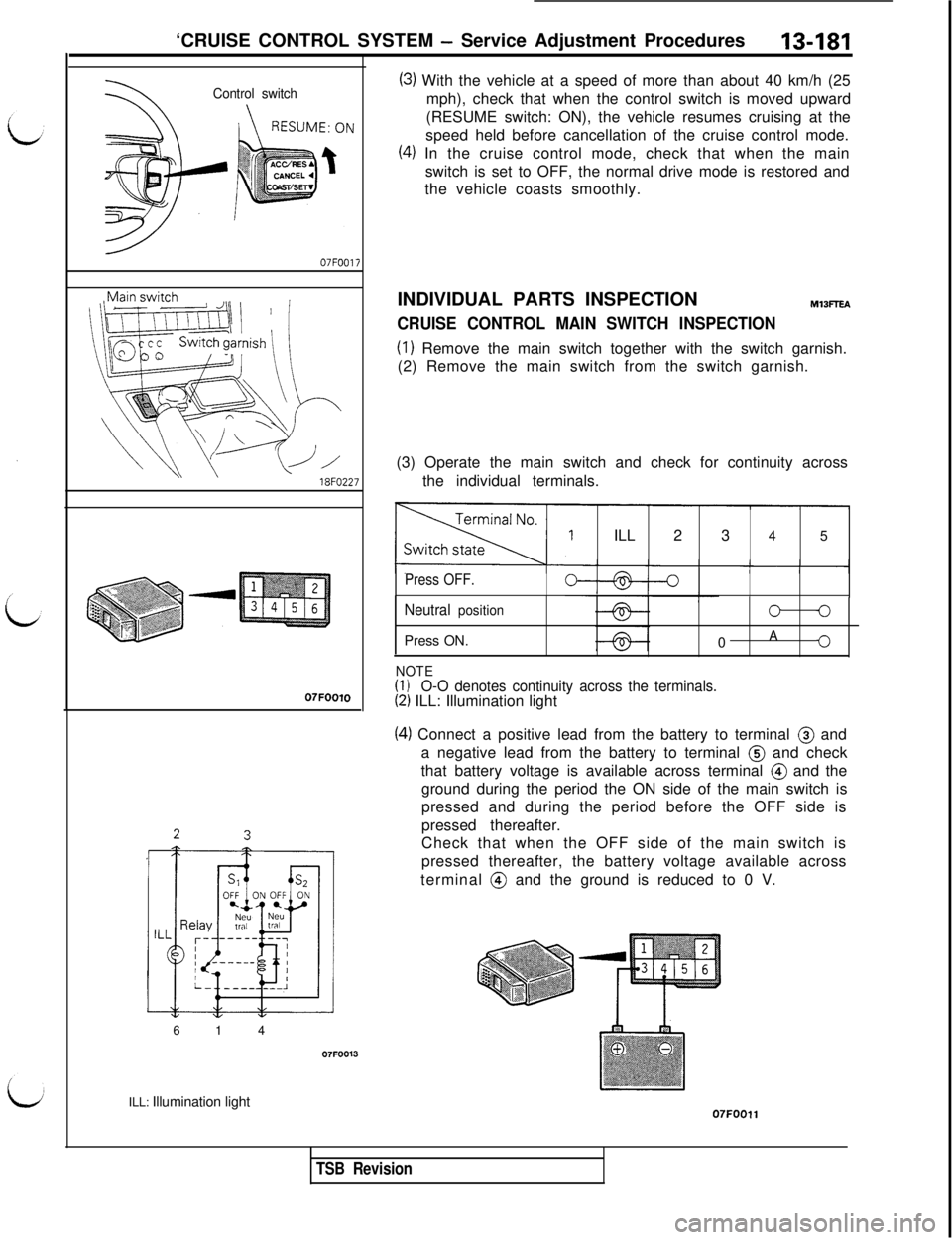
‘CRUISE CONTROL SYSTEM - Service Adjustment Procedures13-181
Control switch
07FOO17
\\ \18FO22;
07FOOlO6 1 4
ILL: Illumination light
I
07FOO13
(3) With the vehicle at a speed of more than about 40 km/h (25
mph), check that when the control switch is moved upward
(RESUME switch: ON), the vehicle resumes cruising at the
speed held before cancellation of the cruise control mode.
(4) In the cruise control mode, check that when the main
switch is set to OFF, the normal drive mode is restored and
the vehicle coasts smoothly.
INDIVIDUAL PARTS INSPECTION
M13FEA
CRUISE CONTROL MAIN SWITCH INSPECTION
(I) Remove the main switch together with the switch garnish.
(2) Remove the main switch from the switch garnish.
(3) Operate the main switch and check for continuity across
the individual terminals.
ILL 2 3 4 5
Press OFF.
Neutral positionPress ON.000A
0
NOTE(I 1O-O denotes continuity across the terminals.(2) ILL: Illumination light
(4) Connect a positive lead from the battery to terminal @ and
a negative lead from the battery to terminal @ and check
that battery voltage is available across terminal @ and the
ground during the period the ON side of the main switch is
pressed and during the period before the OFF side is
pressed thereafter.
Check that when the OFF side of the main switch is
pressed thereafter, the battery voltage available across
terminal @ and the ground is reduced to 0 V.
07FOOll
TSB Revision